A Novel Meta-Heuristic Approach to Solving the Assembly Line Worker Assignment and Balancing Problem with Equity of Work Distribution


Abstract
1. Introduction
- The first contribution is to demonstrate that the proposed mathematical model yields a superior distribution of workload balances compared to the classical model. In this way, the equity and efficiency of worker assignments are addressed more effectively.
- The second contribution is that a simulated annealing-based meta-heuristic algorithm is applied to solve large-scale problems.
- A comprehensive comparative study is conducted to validate the effectiveness of the meta-heuristic method. However, the result quality and computational efficiency were compared with the mathematical model.
- An Alternative Modeling Perspective: We propose an alternative perspective in ALWABP modeling by moving from traditional “bottleneck-oriented” objectives (minimizing ) to “population-oriented” objectives (minimizing ). This introduces “workload equity” as a quantifiable primary objective rather than a secondary soft constraint.
- Strategic Linearization: We provide a theoretical alternative to variance-based optimization. By formulating workload equity using linearized absolute deviations instead of quadratic penalty functions, we bypass the computational complexity of mixed-integer quadratic programming (MIQP). This strategy preserves the linearity of the solution space, facilitating more efficient exact solution procedures [5].
- Structural Handling of Interdependencies: We address the complex interdependencies between heterogeneous worker speeds and task assignments through a decoupled encoding strategy. Unlike traditional constructive heuristics that may generate infeasible assignments, our decoupled representation structurally guarantees feasibility by dynamically evaluating worker-dependent task times during the decoding process [27].
2. Problem Description and Formulation
2.1. Clarification of Terminology
- Workload Smoothing: Refers to the mathematical operation or technique used to minimize variance or deviation between station workloads.
- Workload Equity: Refers to the objective quantitative state of the system, where tasks are distributed evenly among workers. It is the direct output of the smoothing process.
- Fairness: In the context of this study, fairness is treated as a theoretical modeling interpretation rather than an empirically validated psychological state. While “equity” is the measurable system metric (mathematical variance) optimized by our algorithm, “fairness” is the human-centric conceptual goal that this mathematical formulation aims to support. We acknowledge that translating mathematical equity into true psychological fairness requires empirical behavioral validation, which falls outside the scope of this optimization study.
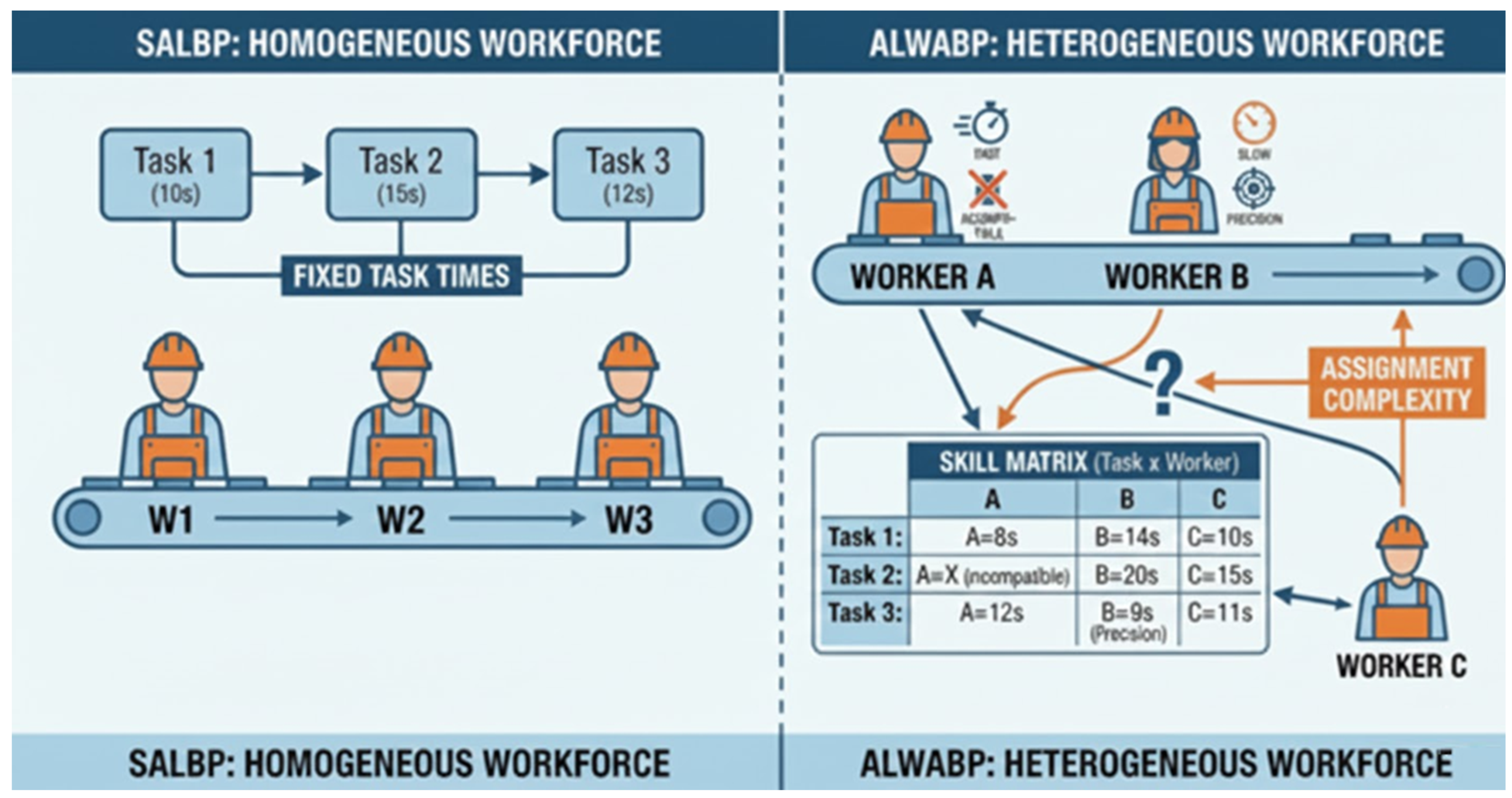
- A single model product is produced. Tasks with precedence relationships are assigned to fixed stations.
- A set of workers is available with varying processing times.
- Each worker is assigned to a single workstation, and a workstation can only have one worker.
- Tasks are indivisible and must be performed at a single station.
- The precedence relationships are known in advance and must be satisfied.
- The problem considers two conflicting objectives simultaneously. The first is minimization of cycle time, and the second is minimization of workload variation.
2.2. Mathematical Model
- : Set of tasks, indexed by .
- : Set of workstations, indexed by and .
- : Set of available workers, indexed by .
- : Set of precedence pairs , where task must precede task .
- : Processing time of task when performed by worker .
- : Weighting factors for the cycle time and smoothing objectives, respectively.
- : Binary variable, equal to 1 if task is assigned to station ; 0 otherwise.
- : Binary variable, equal to 1 if worker is assigned to station ; 0 otherwise.
- : Continuous variable representing the cycle time of the line.
- : Continuous variable representing the total workload of station .
- : Continuous variable representing the linearized absolute difference between the workloads of stations and .
2.2.1. Objective Function and Constraints
2.2.2. Workload Calculation and Linearization
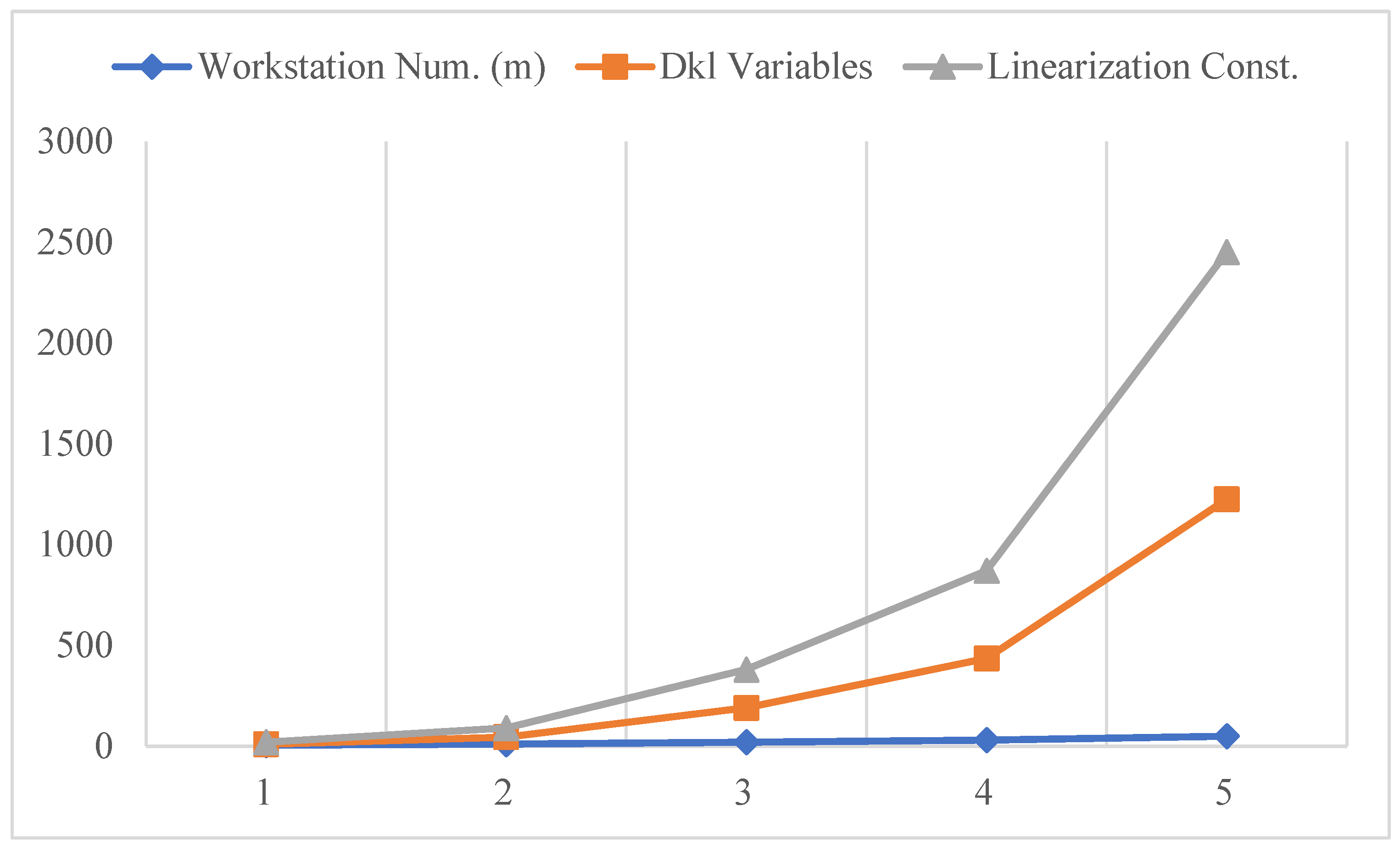
2.3. Model Complexity and Formulation Justification
- Binary Variables: .
- Continuous Variables: (where the last term represents the auxiliary variables ).
- Constraints: (where the last term represents the linearization constraints).
3. Solution Methodology
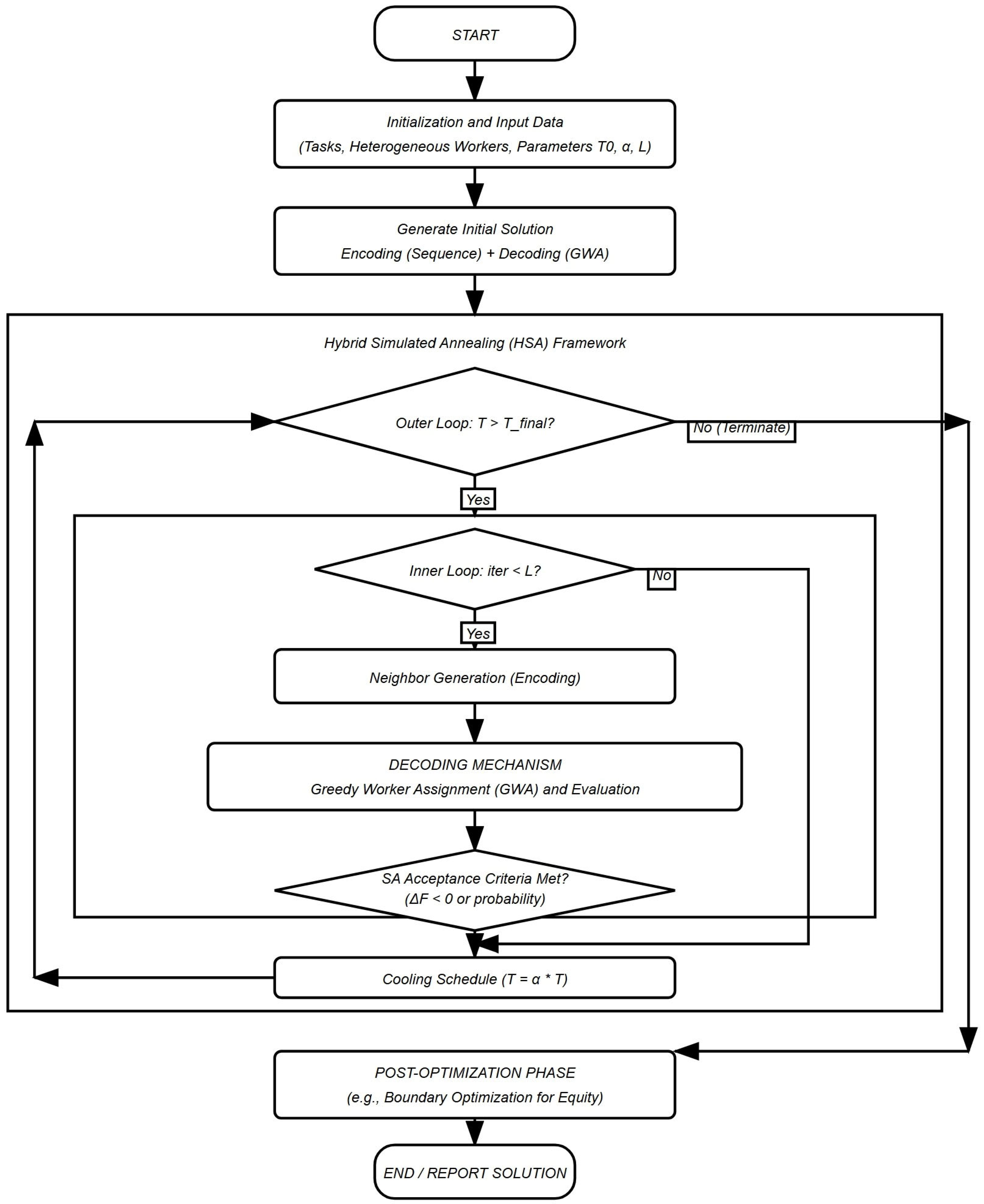
3.1. Encoding and Decoding Scheme
- Task Sequence Vector : A permutation of tasks satisfying the precedence constraints.
- Partition Vector : An integer array of size (number of stations), where indicates the number of tasks assigned to station .
- Difficulty Assessment: For each station , a “difficulty score” is calculated based on the minimum processing time required by the most capable available worker.
- Prioritization: Stations are sorted in descending order of difficulty.
- Assignment: The algorithm iterates through the sorted stations and assigns the most efficient available worker (the one who minimizes the processing time for that specific bundle) to the current station. This decoding strategy ensures that, for any given configuration of tasks, the worker assignment is locally optimal, minimizing potential bottlenecks dynamically.
3.2. Initial Solution Construction
3.3. Neighborhood Structures
- Feasible Swap Operator (): Two tasks in the task sequence vector are selected. They are swapped only if the move does not violate precedence constraints. This operator explores the sequencing search space.
- Boundary Shift Operator (): This operator modifies the partition vector to balance workloads. A station boundary is shifted by moving the last task of station to station , or vice versa. This effectively resizes the stations without changing the relative order of tasks.
3.4. The Hybrid Simulated Annealing Algorithm
| Algorithm 1. Hybrid simulated annealing (HSA) for the ALWABP |
| Inputs: Set of tasks N, Set of workers W, Processing times t_iw, Precedence graph P, Initial Temp. T0, Final Temp. T_final, Cooling rate α, Markov chain length L Outputs: Best-found assignment S_best and its bi-objective value F(S_best) / Phase 1: Initialization / T ← T0 Generate an initial topologically sorted task sequence π_init respecting P S_current ← GreedyWorkerAssignment(π_init, t_iw) // Decoupled decoding for feasibility S_best ← S_current π_current ← π_init / Phase 2: Simulated Annealing Main Loop / While T > T_final Do For iter = 1 to L Do π_new ← FeasibleSwap(π_current, P) // Generate neighbor task sequence S_new ← GreedyWorkerAssignment(π_new, t_iw) // Decode new sequence ΔF ← F(S_new) − F(S_current) // Evaluate objective difference If ΔF ≤ 0 or Random(0,1) < exp(−ΔF/T) Then S_current ← S_new // Accept new solution π_current ← π_new If F(S_current) < F(S_best) Then S_best ← S_current // Update global best End If End If End For T ← α × T // Apply geometric cooling schedule End While / Phase 3: Memetic Intensification / S_best ← BoundaryOptimization(S_best) // Local search to improve workload equity Return S_best |
3.5. Parameter Tuning and Sensitivity Analysis
4. Computational Study
5. Discussion
5.1. Comparative Analysis: MILP vs. Traditional MIQP
5.2. Performance Analysis
5.3. Implications for Industry 5.0
5.4. Pareto Trade-Off Analysis and Parameter Calibration
- During peak seasonal demand where throughput is critical, managers should calibrate the system towards Scenario 2 ().
- In sheltered work centers or during periods of high worker turnover/fatigue, prioritizing worker retention requires calibrating towards Scenario 4 ().
- Scenario 3 provides a robust default state for standard operations, proving that high equity can be achieved without catastrophic losses in production rates.
5.5. Managerial Implications
- Visualize Trade-offs: Identify scenarios where a negligible loss in production rate (e.g., 0.5%) results in a drastic reduction in workload inequality, thereby choosing a more sustainable operating point.
- Enhance Retention: By implementing the “workload equity” objective, managers can mitigate the feelings of unfairness that drive high turnover and absenteeism [15]. This is particularly critical in Industry 5.0 environments, where retaining skilled, heterogeneous human labor is a competitive advantage [17].
- Operationalize Social Responsibility: For managers in sheltered work centers, this model transforms the abstract concept of “social integration” into a concrete scheduling plan, ensuring that tasks are distributed in a way that respects the diverse capabilities of disabled workers without compromising the overall line flow.
- Prioritize Equity over Efficiency in High-Risk Contexts: Plant managers should actively shift the operational focus towards workload equity under specific real-world scenarios. Efficiency should be treated as a secondary goal when integrating highly vulnerable populations (such as in SWCs), where excessive physical or cognitive stress can lead to severe health consequences. Furthermore, equity must be prioritized during periods of widespread workforce fatigue, high staff turnover, or in high-precision manufacturing environments where overworked employees at bottleneck stations are significantly more prone to making costly quality errors. In these contexts, the long-term sustainability and quality of the workforce heavily outweigh the short-term gains of a maximized production rate.
5.6. Algorithmic Ablation Study
- Variant 1 (Base SA): A standard simulated annealing algorithm relying on the decoupled task sequence, but using a naive/random worker assignment mechanism and lacking any post-optimization.
- Variant 2 (SA + GWA): The simulated annealing algorithm integrated with the greedy worker assignment (GWA) mechanism during the decoding phase.
- Variant 3 (Full HSA): The complete proposed algorithm, integrating SA, GWA, and the memetic intensification phase (boundary optimization) applied at the end of the search.
- The Role of GWA: Comparing Variant 1 and Variant 2 reveals that the greedy worker assignment is the primary driver for production efficiency. By dynamically matching task bundles to the most capable heterogeneous workers during decoding, the GWA drastically reduces the average cycle time (an 11.4% improvement) and prevents the generation of bottleneck-heavy infeasible solutions.
- The Role of Boundary Optimization: Comparing variant 2 and the full HSA demonstrates the absolute necessity of the memetic intensification phase for social equity. While boundary optimization provides only a marginal secondary improvement to cycle time, it systematically redistributes boundary tasks, resulting in a dramatic 38.4% reduction in total workload difference.
6. Limitations
7. Conclusions
Author Contributions
Funding
Data Availability Statement
Conflicts of Interest
References
- Briken, K.; Moore, J.; Scholarios, D.; Rose, E.; Sherlock, A. Industry 5 and the Human in Human-Centric Manufacturing. Sensors 2023, 23, 6416. [Google Scholar] [CrossRef] [Scilit] [PubMed]
- Qian, X. A Heuristic-Mixed Genetic Algorithm for Type II Assembly Line Balancing with Multiple Workers in Workstations. Math. Probl. Eng. 2022, 2022, 9954518. [Google Scholar] [CrossRef] [Scilit]
- Chaves, A.A.; Lorena, L.A.N.; Miralles, C. Clustering search approach for the assembly line worker assignment and balancing problem. In Proceedings of the 37th International Conference on Computers & Industrial Engineering, Alexandria, Egypt, 20–23 October 2007; pp. 1469–1478. [Google Scholar]
- Miralles, C.; García-Sabater, J.P.; Andrés, C.; Cardós, M. Branch and bound procedures for solving the assembly line worker assignment and balancing problem: Application to sheltered work centres for disabled. Discret. Appl. Math. 2008, 156, 352–367. [Google Scholar] [CrossRef] [Scilit]
- Borba, L.; Ritt, M. A heuristic and a branch-and-bound algorithm for the assembly line worker assignment and balancing problem. Comput. Oper. Res. 2014, 45, 87–96. [Google Scholar] [CrossRef] [Scilit]
- Vila, M.; Pereira, J. A branch-and-bound algorithm for assembly line worker assignment and balancing problems. Comput. Oper. Res. 2014, 44, 105–114. [Google Scholar] [CrossRef] [Scilit]
- Oksuz, M.K.; Buyukozkan, K.; Satoglu, S.I. U-shaped assembly line worker assignment and balancing problem: A mathematical model and two meta-heuristics. Comput. Ind. Eng. 2017, 112, 246–263. [Google Scholar] [CrossRef] [Scilit]
- Yılmaz, Ö.F. Robust optimization for U-shaped assembly line worker assignment and balancing problem with uncertain task times. Croat. Oper. Res. Rev. 2020, 11, 229–239. [Google Scholar] [CrossRef] [Scilit]
- Janardhanan, M.N.; Li, Z.; Nielsen, P. Model and migrating birds optimization algorithm for two-sided assembly line worker assignment and balancing problem. Soft Comput. 2019, 23, 11263–11276. [Google Scholar] [CrossRef] [Scilit]
- Mejri, M.; Bouajaja, S.; Dridi, N. Multi-manned two-sided assembly line worker assignment and balancing problem. In Proceedings of the 2022 International Conference on Control, Automation and Diagnosis (ICCAD), Lisbon, Portugal, 13–15 July 2022; IEEE: New York, NY, USA, 2022; pp. 1–6. [Google Scholar]
- Araújo, F.F.B.; Costa, A.M.; Miralles, C. Two extensions for the ALWABP: Parallel stations and collaborative approach. Int. J. Prod. Econ. 2012, 140, 483–495. [Google Scholar] [CrossRef] [Scilit]
- Araújo, F.F.B.; Costa, A.M.; Miralles, C. Balancing parallel assembly lines with disabled workers. Eur. J. Ind. Eng. 2015, 9, 344–365. [Google Scholar] [CrossRef] [Scilit]
- Özcan, U.; Kızılkaya Aydoğan, E.; Himmetoğlu, S.; Delice, Y. Parallel assembly lines worker assignment and balancing problem: A mathematical model and an artificial bee colony algorithm. Appl. Soft Comput. 2022, 130, 109727. [Google Scholar] [CrossRef] [Scilit]
- Ritt, M.; Costa, A.M.; Miralles, C. The assembly line worker assignment and balancing problem with stochastic worker availability. Int. J. Prod. Res. 2016, 54, 907–922. [Google Scholar]
- Liu, M.; Liu, Z.; Chu, F.; Liu, R.; Zheng, F.; Chu, C. Risk-averse assembly line worker assignment and balancing problem with limited temporary workers and moving workers. Int. J. Prod. Res. 2022, 60, 7074–7092. [Google Scholar] [CrossRef] [Scilit]
- Pereira, J. The robust (minmax regret) assembly line worker assignment and balancing problem. Comput. Oper. Res. 2018, 93, 27–40. [Google Scholar] [CrossRef] [Scilit]
- Mao, Z.; Sun, Y.; Fang, K.; Huang, D.; Zhang, J. Model and metaheuristic for human-robot collaboration assembly line worker assignment and balancing problem. Comput. Oper. Res. 2024, 165, 106605. [Google Scholar]
- Tian, B.; Kaul, H.; Janardhanan, M. Balancing heterogeneous assembly line with multi-skilled human-robot collaboration via Adaptive cooperative co-evolutionary algorithm. Swarm Evol. Comput. 2024, 91, 101762. [Google Scholar] [CrossRef] [Scilit]
- Akyol, S.D.; Baykasoğlu, A. ErgoALWABP: A multiple-rule based constructive randomized search algorithm for solving assembly line worker assignment and balancing problem under ergonomic risk factors. J. Intell. Manuf. 2019, 30, 291–302. [Google Scholar] [CrossRef] [Scilit]
- Ghorbani, E.; Keivanpour, S.; Sekkay, F.; Imbeau, D. Fuzzy expert system for ergonomic assembly line worker assignment and balancing problem under uncertainty. J. Ind. Prod. Eng. 2025, 42, 274–296. [Google Scholar] [CrossRef] [Scilit]
- Costa, A.M.; Miralles, C. Job rotation in assembly lines employing disabled workers. Int. J. Prod. Econ. 2009, 120, 625–632. [Google Scholar] [CrossRef] [Scilit]
- Blum, C.; Miralles, C. On solving the assembly line worker assignment and balancing problem via beam search. Comput. Oper. Res. 2011, 38, 328–339. [Google Scholar] [CrossRef] [Scilit]
- Moreira, M.C.O.; Ritt, M.; Costa, A.M.; Chaves, A.A. Simple heuristics for the assembly line worker assignment and balancing problem. J. Heuristics 2012, 18, 505–524. [Google Scholar] [CrossRef] [Scilit]
- Mutlu, Ö.; Polat, O.; Supciller, A.A. An iterative genetic algorithm for the assembly line worker assignment and balancing problem of type-II. Comput. Oper. Res. 2013, 40, 418–426. [Google Scholar] [CrossRef] [Scilit]
- Janardhanan, M.N.; Li, Z.; Nielsen, P.; Tang, Q. Artificial bee colony algorithms for two-sided assembly line worker assignment and balancing problem. In Distributed Computing and Artificial Intelligence, Proceedings of the 14th International Conference, Toledo, Spain, 20–22 June 2018; Springer: Cham, Switzerland, 2018; pp. 341–348. [Google Scholar]
- Polat, O.; Kalayci, C.B.; Mutlu, Ö.; Gupta, S.M. A two-phase variable neighbourhood search algorithm for assembly line worker assignment and balancing problem type-II: An industrial case study. Int. J. Prod. Res. 2016, 54, 722–741. [Google Scholar] [CrossRef] [Scilit]
- Michels, A.S.; Costa, A.M. A note to: A multiple-rule based constructive randomized search algorithm for solving assembly line worker assignment and balancing problem. J. Intell. Manuf. 2021, 32, 2121–2124. [Google Scholar] [CrossRef] [Scilit]
- Akyol, S.D.; Baykasoğlu, A. A multiple-rule based constructive randomized search algorithm for solving assembly line worker assignment and balancing problem. J. Intell. Manuf. 2019, 30, 557–573. [Google Scholar]
- Yılmaz, H. Modeling and solving assembly line worker assignment and balancing problem with sequence-dependent setup times. Soft Comput. 2021, 25, 12899–12914. [Google Scholar] [CrossRef] [Scilit]
- Yang, H.; Lee, J.-H.; Lee, S.H.; Lee, S.G.; Kim, H.R.; Kim, H.-J. A Multi-Manned Assembly Line Worker Assignment and Balancing Problem with Positional Constraints. IEEE Robot. Autom. Lett. 2022, 7, 7786–7793. [Google Scholar] [CrossRef] [Scilit]
- Zacharia, P.T.; Nearchou, A.C. Balancing assembly lines operating with heterogeneous workers under uncertainty in task processing times. Eng. Comput. 2021, 38, 3853–3881. [Google Scholar] [CrossRef] [Scilit]
- Zacharia, P.T.; Nearchou, A.C. The fuzzy assembly line worker assignment and balancing problem. Cybern. Syst. 2021, 52, 221–243. [Google Scholar] [CrossRef] [Scilit]
- Liu, M.; Liang, B.; Chu, F. A risk-averse assembly line worker assignment and balancing problem with uncertain processing time. In Proceedings of the 2019 International Conference on Industrial Engineering and Systems Management (IESM), Shanghai, China, 25–27 September 2019; IEEE: New York, NY, USA, 2019; pp. 266–271. [Google Scholar]
- Liu, M.; Liu, R.; Chu, F. An improved model for assembly line worker assignment and balancing problem considering stochastic worker availability. In Proceedings of the 2019 International Conference on Industrial Engineering and Systems Management (IESM), Shanghai, China, 25–27 September 2019; IEEE: New York, NY, USA, 2019; pp. 731–736. [Google Scholar]
- Li, P.; Ji, C. Application of enhanced benders decomposition algorithm in circular assembly line balancing problem with task splitting. PLoS ONE 2025, 20, e0333263. [Google Scholar] [CrossRef] [Scilit]
- Gao, Z.; Yang, R.; Zhao, K.; Yu, W.; Liu, Z.; Liu, L. Hybrid convolutional neural network approaches for recognizing collaborative actions in human-robot assembly tasks. Sustainability 2024, 16, 139. [Google Scholar]
- Zacharia, P.T.; Nearchou, A.C. A population-based algorithm for the bi-objective assembly line worker assignment and balancing problem. Eng. Appl. Artif. Intell. 2016, 49, 1–9. [Google Scholar]
- Yılmaz, H.; Demir, Y. A new mathematical model for assembly line worker assignment and balancing. J. Inst. Sci. Technol. 2019, 9, 2002–2008. [Google Scholar] [CrossRef] [Scilit]
- Rashid, M.F.F.A.; Ramli, A.N. A new multiobjective tiki-taka algorithm for optimization of assembly line balancing. Eng. Comput. 2023, 40, 564–593. [Google Scholar] [CrossRef] [Scilit]
- Sivasankaran, P. Review on PCB assembly line balancing-glance. Acta Tecnol. 2023, 9, 59–71. [Google Scholar]



| Parameter | Level 1 (Low) | Level 2 (Medium) | Level 3 (High) | Selected Value |
|---|---|---|---|---|
| 50 | 100 | 200 | 100 | |
| 0.90 | 0.95 | 0.99 | 0.98 | |
| 20 | 50 | 100 | 50 |
| Dataset Family | Order Strength | |||
|---|---|---|---|---|
| Roszieg (Low) | 25 | 4 (Groups 1–4) | 4 (Groups 1–4) | 71.67 (High) |
| 6 (Groups 5–8) | 6 (Groups 5–8) | |||
| Heskia (Low) | 28 | 4 (Groups 1–4) | 4 (Groups 1–4) | 22.49 (Low) |
| 7 (Groups 5–8) | 7 (Groups 5–8) | |||
| Tonge (High) | 70 | 10 (Groups 1–4) | 10 (Groups 1–4) | 59.42 (High) |
| 17 (Groups 5–8) | 17 (Groups 5–8) | |||
| Wee-Mag (High) | 75 | 11 (Groups 1–4) | 11 (Groups 1–4) | 22.67 (Low) |
| 19 (Groups 5–8) | 19 (Groups 5–8) |
| Family (Roszieg) | Existing Model | Proposed Model | Imp (%) | |||
|---|---|---|---|---|---|---|
| Group | Test Problem | Best C | Total Workload Diff. | Best C | Total Workload Diff. | |
| Group 1 | 1 | 20 | 15 | 20 | 9 | 40.00 |
| 2 | 22 | 3 | 22 | 3 | 0.00 | |
| 3 | 18 | 6 | 18 | 6 | 0.00 | |
| 4 | 18 | 8 | 18 | 6 | 25.00 | |
| 5 | 17 | 9 | 17 | 0 | 100.00 | |
| 6 | 24 | 10 | 24 | 9 | 10.00 | |
| 7 | 21 | 7 | 21 | 3 | 57.14 | |
| 8 | 20 | 15 | 20 | 10 | 33.33 | |
| 9 | 22 | 16 | 22 | 9 | 43.75 | |
| 10 | 19 | 10 | 19 | 3 | 70.00 | |
| Group 2 | 11 | 30 | 89 | 30 | 89 | 0.00 |
| 12 | 27 | 41 | 27 | 41 | 0.00 | |
| 13 | 76 | 253 | 76 | 210 | 17.00 | |
| 14 | 25 | 34 | 25 | 34 | 0.00 | |
| 15 | 26 | 50 | 26 | 47 | 6.00 | |
| 16 | 22 | 10 | 22 | 10 | 0.00 | |
| 17 | 22 | 14 | 22 | 14 | 0.00 | |
| 18 | 20 | 6 | 20 | 0 | 100.00 | |
| 19 | 27 | 35 | 27 | 31 | 11.43 | |
| 20 | 40 | 110 | 40 | 110 | 0.00 | |
| Group 3 | 21 | 28 | 10 | 28 | 10 | 0.00 |
| 22 | 30 | 30 | 30 | 18 | 40.00 | |
| 23 | 26 | 22 | 26 | 3 | 86.36 | |
| 24 | 33 | 10 | 33 | 9 | 10.00 | |
| 25 | 28 | 3 | 28 | 3 | 0.00 | |
| 26 | 27 | 7 | 27 | 3 | 57.14 | |
| 27 | 21 | 18 | 21 | 18 | 0.00 | |
| 28 | 28 | 26 | 28 | 23 | 11.54 | |
| 29 | 27 | 27 | 27 | 27 | 0.00 | |
| 30 | 33 | 16 | 33 | 0 | 100.00 | |
| Group 4 | 31 | 31 | 33 | 31 | 9 | 72.73 |
| 32 | 29 | 18 | 29 | 0 | 100.00 | |
| 33 | 32 | 11 | 32 | 10 | 9.09 | |
| 34 | 27 | 3 | 27 | 0 | 100.00 | |
| 35 | 27 | 13 | 27 | 13 | 0.00 | |
| 36 | 29 | 13 | 29 | 13 | 0.00 | |
| 37 | 27 | 19 | 27 | 0 | 100.00 | |
| 38 | 28 | 4 | 28 | 4 | 0.00 | |
| 39 | 21 | 6 | 21 | 3 | 50.00 | |
| 40 | 29 | 7 | 29 | 4 | 42.86 | |
| Group 5 | 41 | 10 | 28 | 10 | 0 | 100.00 |
| 42 | 10 | 24 | 10 | 13 | 45.83 | |
| 43 | 10 | 29 | 10 | 15 | 48.28 | |
| 44 | 9 | 25 | 9 | 15 | 40.00 | |
| 45 | 12 | 28 | 12 | 5 | 82.14 | |
| 46 | 9 | 14 | 9 | 8 | 42.86 | |
| 47 | 10 | 17 | 10 | 10 | 41.18 | |
| 48 | 8 | 14 | 8 | 0 | 100.00 | |
| 49 | 10 | 17 | 10 | 8 | 52.94 | |
| 50 | 9 | 10 | 9 | 10 | 0.00 | |
| Group 6 | 51 | 11 | 53 | 11 | 23 | 56.60 |
| 52 | 10 | 10 | 10 | 8 | 20.00 | |
| 53 | 10 | 18 | 10 | 18 | 0.00 | |
| 54 | 10 | 18 | 10 | 15 | 16.67 | |
| 55 | 11 | 46 | 11 | 20 | 56.52 | |
| 56 | 13 | 13 | 13 | 13 | 0.00 | |
| 57 | 13 | 33 | 13 | 5 | 84.85 | |
| 58 | 11 | 27 | 11 | 20 | 25.93 | |
| 59 | 12 | 28 | 12 | 13 | 53.57 | |
| 60 | 9 | 8 | 9 | 8 | 0.00 | |
| Group 7 | 61 | 16 | 30 | 16 | 20 | 33.33 |
| 62 | 13 | 23 | 13 | 0 | 100.00 | |
| 63 | 19 | 18 | 19 | 9 | 50.00 | |
| 64 | 16 | 61 | 16 | 28 | 54.10 | |
| 65 | 14 | 33 | 14 | 8 | 75.76 | |
| 66 | 17 | 8 | 17 | 5 | 37.50 | |
| 67 | 17 | 54 | 17 | 8 | 85.19 | |
| 68 | 16 | 49 | 16 | 43 | 12.24 | |
| 69 | 15 | 55 | 15 | 40 | 27.27 | |
| 70 | 17 | 29 | 17 | 13 | 55.17 | |
| Group 8 | 71 | 15 | 43 | 15 | 27 | 37.21 |
| 72 | 16 | 26 | 16 | 0 | 100.00 | |
| 73 | 16 | 22 | 16 | 16 | 27.27 | |
| 74 | 16 | 64 | 16 | 18 | 71.88 | |
| 75 | 16 | 18 | 16 | 8 | 55.56 | |
| 76 | 17 | 39 | 17 | 5 | 87.18 | |
| 77 | 13 | 18 | 13 | 13 | 27.78 | |
| 78 | 14 | 48 | 14 | 37 | 22.92 | |
| 79 | 14 | 24 | 14 | 5 | 79.17 | |
| 80 | 14 | 19 | 14 | 9 | 52.63 | |
| Improvement Mean | 40.66 | |||||
| Family (Heskia) | Existing Model | Proposed Model | Imp (%) | |||
|---|---|---|---|---|---|---|
| Group | Test Problem | Best C | Total Workload Diff. | Best C | Total Workload Diff. | |
| Group 1 | 1 | 94 | 7 | 94 | 7 | 0 |
| 2 | 95 | 3 | 95 | 0 | 100 | |
| 3 | 102 | 3 | 102 | 3 | 0 | |
| 4 | 103 | 47 | 103 | 0 | 100 | |
| 5 | 92 | 6 | 92 | 3 | 50 | |
| 6 | 98 | 22 | 98 | 6 | 72.7273 | |
| 7 | 116 | 7 | 116 | 3 | 57.1429 | |
| 8 | 86 | 10 | 86 | 3 | 70 | |
| 9 | 95 | 3 | 95 | 0 | 100 | |
| 10 | 142 | 36 | 142 | 31 | 13.8889 | |
| Group 2 | 11 | 169 | 3 | 169 | 3 | 0 |
| 12 | 107 | 31 | 107 | 29 | 6.45161 | |
| 13 | 108 | 51 | 108 | 6 | 88.2353 | |
| 14 | 96 | 0 | 96 | 0 | 0 | |
| 15 | 130 | 7 | 130 | 0 | 100 | |
| 16 | 117 | 11 | 117 | 0 | 100 | |
| 17 | 146 | 32 | 146 | 27 | 15.625 | |
| 18 | 132 | 27 | 132 | 3 | 88.8889 | |
| 19 | 101 | 0 | 101 | 0 | 0 | |
| 20 | 120 | 24 | 120 | 0 | 100 | |
| Group 3 | 21 | 200 | 3 | 200 | 3 | 0 |
| 22 | 147 | 69 | 147 | 3 | 95.6522 | |
| 23 | 186 | 75 | 186 | 13 | 82.6667 | |
| 24 | 181 | 29 | 181 | 15 | 48.2759 | |
| 25 | 142 | 19 | 142 | 4 | 78.9474 | |
| 26 | 194 | 74 | 194 | 0 | 100 | |
| 27 | 149 | 36 | 149 | 12 | 66.6667 | |
| 28 | 191 | 29 | 191 | 15 | 48.2759 | |
| 29 | 170 | 119 | 170 | 6 | 94.958 | |
| 30 | 165 | 112 | 165 | 3 | 97.3214 | |
| Group 4 | 31 | 204 | 3 | 204 | 3 | 0 |
| 32 | 147 | 20 | 147 | 20 | 0 | |
| 33 | 211 | 21 | 211 | 7 | 66.6667 | |
| 34 | 127 | 6 | 127 | 3 | 50 | |
| 35 | 181 | 21 | 181 | 12 | 42.8571 | |
| 36 | 179 | 30 | 179 | 8 | 73.3333 | |
| 37 | 191 | 8 | 191 | 3 | 62.5 | |
| 38 | 152 | 19 | 152 | 3 | 84.2105 | |
| 39 | 167 | 35 | 167 | 12 | 65.7143 | |
| 40 | 153 | 3 | 153 | 3 | 0 | |
| Group 5 | 41 | 35 | 22 | 35 | 6 | 72.7273 |
| 42 | 40 | 82 | 40 | 0 | 100 | |
| 43 | 35 | 68 | 35 | 10 | 85.2941 | |
| 44 | 30 | 18 | 30 | 6 | 66.6667 | |
| 45 | 40 | 134 | 40 | 12 | 91.0448 | |
| 46 | 29 | 36 | 29 | 6 | 83.3333 | |
| 47 | 25 | 28 | 25 | 16 | 42.8571 | |
| 48 | 43 | 112 | 43 | 22 | 80.3571 | |
| 49 | 38 | 66 | 38 | 0 | 100 | |
| 50 | 34 | 58 | 34 | 12 | 79.3103 | |
| Group 6 | 51 | 51 | 278 | 51 | 6 | 97.8417 |
| 52 | 50 | 138 | 50 | 18 | 86.9565 | |
| 53 | 52 | 312 | 52 | 0 | 100 | |
| 54 | 33 | 78 | 33 | 48 | 38.4615 | |
| 55 | 38 | 22 | 38 | 18 | 18.1818 | |
| 56 | 34 | 72 | 34 | 6 | 91.6667 | |
| 57 | 42 | 58 | 42 | 10 | 82.7586 | |
| 58 | 39 | 72 | 39 | 40 | 44.4444 | |
| 59 | 59 | 186 | 59 | 6 | 96.7742 | |
| 60 | 28 | 90 | 28 | 0 | 100 | |
| Group 7 | 61 | 66 | 160 | 66 | 60 | 62.5 |
| 62 | 56 | 72 | 56 | 10 | 86.1111 | |
| 63 | 69 | 324 | 69 | 48 | 85.1852 | |
| 64 | 126 | 792 | 126 | 10 | 98.7374 | |
| 65 | 107 | 982 | 107 | 0 | 100 | |
| 66 | 39 | 96 | 39 | 40 | 58.3333 | |
| 67 | 87 | 456 | 87 | 0 | 100 | |
| 68 | 62 | 100 | 62 | 42 | 58 | |
| 69 | 61 | 48 | 61 | 6 | 87.5 | |
| 70 | 79 | 174 | 79 | 6 | 96.5517 | |
| Group 8 | 71 | 91 | 366 | 91 | 6 | 98.3607 |
| 72 | 65 | 86 | 65 | 48 | 44.186 | |
| 73 | 73 | 76 | 73 | 10 | 86.8421 | |
| 74 | 57 | 34 | 57 | 0 | 100 | |
| 75 | 65 | 72 | 65 | 22 | 69.4444 | |
| 76 | 70 | 74 | 70 | 6 | 91.8919 | |
| 77 | 71 | 54 | 71 | 24 | 55.5556 | |
| 78 | 58 | 58 | 58 | 28 | 51.7241 | |
| 79 | 46 | 42 | 46 | 10 | 76.1905 | |
| 80 | 76 | 132 | 76 | 30 | 77.2727 | |
| Improvement Mean | 67.0509 | |||||
| Family (Tonge) | Proposed Model | HSA Solutions | |||
|---|---|---|---|---|---|
| Group | Test Problem | Best C | Total Workload Diff. | Best C | Total Workload Diff. |
| Group 1 | 1 | 92 | 46 | 87 | 82 |
| 2 | 87 | 56 | 87 | 30 | |
| 3 | 102 | 73 | 100 | 88 | |
| 4 | 117 | 127 | 108 | 197 | |
| 5 | 92 | 97 | 89 | 106 | |
| 6 | 90 | 77 | 88 | 69 | |
| 7 | 95 | 81 | 94 | 96 | |
| 8 | 104 | 86 | 104 | 55 | |
| 9 | 71 | 127 | 69 | 57 | |
| 10 | 85 | 76 | 83 | 37 | |
| Group 2 | 11 | 118 | 187 | 110 | 221 |
| 12 | 110 | 339 | 108 | 375 | |
| 13 | 107 | 154 | 103 | 466 | |
| 14 | 94 | 85 | 93 | 278 | |
| 15 | 97 | 75 | 89 | 88 | |
| 16 | 102 | 97 | 100 | 152 | |
| 17 | 124 | 151 | 120 | 265 | |
| 18 | 115 | 70 | 112 | 239 | |
| 19 | 132 | 55 | 119 | 111 | |
| 20 | 114 | 107 | 113 | 140 | |
| Group 3 | 21 | 158 | 466 | 158 | 281 |
| 22 | 169 | 189 | 160 | 299 | |
| 23 | 148 | 70 | 144 | 429 | |
| 24 | 149 | 288 | 147 | 229 | |
| 25 | 169 | 255 | 169 | 189 | |
| 26 | 174 | 214 | 161 | 318 | |
| 27 | 146 | 62 | 146 | 349 | |
| 28 | 182 | 552 | 179 | 590 | |
| 29 | 190 | 478 | 182 | 251 | |
| 30 | 154 | 165 | 153 | 374 | |
| Group 4 | 31 | 179 | 412 | 167 | 226 |
| 32 | 192 | 172 | 177 | 428 | |
| 33 | 179 | 182 | 157 | 440 | |
| 34 | 178 | 214 | 172 | 176 | |
| 35 | 149 | 121 | 146 | 228 | |
| 36 | 174 | 135 | 163 | 304 | |
| 37 | 167 | 222 | 166 | 163 | |
| 38 | 169 | 265 | 152 | 262 | |
| 39 | 211 | 325 | 180 | 304 | |
| 40 | 159 | 315 | 159 | 450 | |
| Group 5 | 41 | 32 | 810 | 28 | 754 |
| 42 | 39 | 176 | 33 | 390 | |
| 43 | 42 | 302 | 32 | 228 | |
| 44 | 44 | 432 | 34 | 292 | |
| 45 | 40 | 654 | 32 | 540 | |
| 46 | 41 | 278 | 35 | 418 | |
| 47 | 36 | 366 | 30 | 296 | |
| 48 | 39 | 296 | 35 | 600 | |
| 49 | 36 | 316 | 33 | 324 | |
| 50 | 38 | 576 | 33 | 534 | |
| Group 6 | 51 | 40 | 292 | 37 | 372 |
| 52 | 45 | 416 | 43 | 640 | |
| 53 | 43 | 474 | 32 | 270 | |
| 54 | 42 | 372 | 36 | 276 | |
| 55 | 57 | 948 | 40 | 712 | |
| 56 | 43 | 702 | 40 | 714 | |
| 57 | 40 | 408 | 39 | 536 | |
| 58 | 46 | 384 | 40 | 726 | |
| 59 | 40 | 194 | 35 | 480 | |
| 60 | 40 | 194 | 38 | 508 | |
| Group 7 | 61 | 74 | 982 | 63 | 766 |
| 62 | 75 | 420 | 68 | 900 | |
| 63 | 69 | 908 | 64 | 544 | |
| 64 | 99 | 1798 | 97 | 1216 | |
| 65 | 72 | 914 | 60 | 910 | |
| 66 | 84 | 1684 | 67 | 606 | |
| 67 | 127 | 2968 | 52 | 840 | |
| 68 | 77 | 568 | 61 | 880 | |
| 69 | 85 | 1480 | 57 | 920 | |
| 70 | 75 | 706 | 60 | 776 | |
| Group 8 | 71 | 57 | 854 | 56 | 468 |
| 72 | 76 | 560 | 57 | 808 | |
| 73 | 79 | 600 | 72 | 742 | |
| 74 | 79 | 236 | 69 | 942 | |
| 75 | 81 | 1256 | 64 | 788 | |
| 76 | 74 | 586 | 59 | 1516 | |
| 77 | 73 | 856 | 60 | 612 | |
| 78 | 75 | 1234 | 68 | 728 | |
| 79 | 73 | 498 | 61 | 512 | |
| 80 | 72 | 1404 | 62 | 688 | |
| Family (Wee-Mag) | Proposed Model | HSA Solutions | |||
|---|---|---|---|---|---|
| Group | Test Problem | Best C | Total Workload Diff. | Best C | Total Workload Diff. |
| Group 1 | 1 | 29 | 10 | 26 | 82 |
| 2 | 31 | 36 | 26 | 10 | |
| 3 | 31 | 18 | 26 | 68 | |
| 4 | 35 | 58 | 30 | 86 | |
| 5 | 34 | 48 | 30 | 88 | |
| 6 | 26 | 30 | 26 | 76 | |
| 7 | 29 | 10 | 24 | 28 | |
| 8 | 32 | 60 | 28 | 58 | |
| 9 | 29 | 28 | 26 | 58 | |
| 10 | 30 | 36 | 27 | 62 | |
| Group 2 | 11 | 35 | 10 | 30 | 54 |
| 12 | 35 | 28 | 33 | 58 | |
| 13 | 36 | 106 | 31 | 90 | |
| 14 | 37 | 24 | 34 | 38 | |
| 15 | 36 | 18 | 33 | 58 | |
| 16 | 34 | 18 | 30 | 96 | |
| 17 | 36 | 10 | 32 | 62 | |
| 18 | 40 | 18 | 35 | 82 | |
| 19 | 35 | 24 | 33 | 18 | |
| 20 | 38 | 20 | 36 | 104 | |
| Group 3 | 21 | 57 | 46 | 49 | 68 |
| 22 | 58 | 58 | 46 | 58 | |
| 23 | 52 | 72 | 47 | 146 | |
| 24 | 53 | 52 | 48 | 96 | |
| 25 | 51 | 64 | 46 | 84 | |
| 26 | 62 | 46 | 46 | 142 | |
| 27 | 57 | 62 | 51 | 88 | |
| 28 | 52 | 70 | 47 | 104 | |
| 29 | 44 | 34 | 44 | 76 | |
| 30 | 57 | 28 | 50 | 98 | |
| Group 4 | 31 | 56 | 78 | 49 | 298 |
| 32 | 52 | 78 | 47 | 102 | |
| 33 | 61 | 34 | 48 | 52 | |
| 34 | 60 | 48 | 51 | 126 | |
| 35 | 50 | 90 | 42 | 38 | |
| 36 | 54 | 72 | 47 | 66 | |
| 37 | 51 | 46 | 40 | 106 | |
| 38 | 52 | 98 | 47 | 140 | |
| 39 | 47 | 46 | 47 | 104 | |
| 40 | 47 | 58 | 39 | 70 | |
| Group 5 | 41 | 14 | 226 | 10 | 198 |
| 42 | 13 | 0 | 12 | 176 | |
| 43 | 15 | 88 | 11 | 184 | |
| 44 | 14 | 148 | 12 | 214 | |
| 45 | 15 | 172 | 12 | 272 | |
| 46 | 12 | 230 | 11 | 360 | |
| 47 | 16 | 120 | 13 | 88 | |
| 48 | 14 | 130 | 11 | 140 | |
| 49 | 11 | 238 | 10 | 78 | |
| 50 | 13 | 158 | 12 | 234 | |
| Group 6 | 51 | 17 | 138 | 14 | 136 |
| 52 | 13 | 316 | 11 | 148 | |
| 53 | 15 | 166 | 12 | 174 | |
| 54 | 17 | 104 | 13 | 160 | |
| 55 | 13 | 144 | 12 | 128 | |
| 56 | 22 | 468 | 13 | 214 | |
| 57 | 14 | 232 | 13 | 210 | |
| 58 | 15 | 104 | 13 | 290 | |
| 59 | 20 | 208 | 16 | 300 | |
| 60 | 14 | 160 | 13 | 138 | |
| Group 7 | 61 | 19 | 412 | 18 | 300 |
| 62 | 23 | 546 | 19 | 248 | |
| 63 | 26 | 574 | 22 | 366 | |
| 64 | 28 | 136 | 19 | 362 | |
| 65 | 29 | 308 | 18 | 288 | |
| 66 | 35 | 896 | 20 | 206 | |
| 67 | 31 | 264 | 21 | 214 | |
| 68 | 24 | 422 | 18 | 310 | |
| 69 | 27 | 286 | 21 | 322 | |
| 70 | 25 | 538 | 24 | 540 | |
| Group 8 | 71 | 27 | 148 | 21 | 276 |
| 72 | 26 | 178 | 19 | 272 | |
| 73 | 31 | 680 | 18 | 122 | |
| 74 | 31 | 214 | 23 | 246 | |
| 75 | 24 | 510 | 19 | 230 | |
| 76 | 25 | 816 | 16 | 192 | |
| 77 | 24 | 280 | 19 | 366 | |
| 78 | 28 | 390 | 19 | 192 | |
| 79 | 26 | 220 | 21 | 272 | |
| 80 | 22 | 264 | 20 | 150 | |
| Dataset | Metric | Traditional MIQP (L2-Norm) | Proposed MILP (L1-Norm) | Improvement (%) |
|---|---|---|---|---|
| Roszieg | Avg. CPU Time (s) | 455.51 | 326.68 | 28.28% |
| Avg. Gap | 0.0% | 0.0% | - | |
| Heskia | Avg. CPU Time (s) | 386.07 | 282.64 | 26.79% |
| Avg. Gap | 0.0% | 0.0% | - |
| Scenario | Strategic Focus | Cycle Time (CT) | Total Workload Diff. | |
|---|---|---|---|---|
| 1 | (1.00, 0.00) | Pure Efficiency (Traditional) | 92 | 82 |
| 2 | (0.75, 0.25) | Efficiency-Biased | 94 | 34 |
| 3 | (0.50, 0.50) | Balanced Approach | 95 | 12 |
| 4 | (0.25, 0.75) | Equity-Biased | 102 | 3 |
| 5 | (0.00, 1.00) | Pure Equity | 116 | 0 |
| Algorithmic Variant | Included Components | Avg. Cycle Time | Avg. Workload Diff. | Contribution Highlight |
|---|---|---|---|---|
| Variant 1 (Base SA) | Sequencing only | 182.4 | 510.6 | Baseline Performance |
| Variant 2 (SA + GWA) | Sequencing + GWA | 161.5 | 345.2 | Significant Cycle Time reduction (−11.4%) |
| Variant 3 (Full HSA) | Sequencing + GWA + Boundary Opt. | 158.8 | 212.4 | Massive Workload Smoothing (−38.4%) |
Disclaimer/Publisher’s Note: The statements, opinions and data contained in all publications are solely those of the individual author(s) and contributor(s) and not of MDPI and/or the editor(s). MDPI and/or the editor(s) disclaim responsibility for any injury to people or property resulting from any ideas, methods, instructions or products referred to in the content. |
© 2026 by the authors. Licensee MDPI, Basel, Switzerland. This article is an open access article distributed under the terms and conditions of the Creative Commons Attribution (CC BY) license.
Share and Cite
Türkkan, Y.A.; Yılmaz, H. A Novel Meta-Heuristic Approach to Solving the Assembly Line Worker Assignment and Balancing Problem with Equity of Work Distribution. Mathematics 2026, 14, 927. https://doi.org/10.3390/math14060927
Türkkan YA, Yılmaz H. A Novel Meta-Heuristic Approach to Solving the Assembly Line Worker Assignment and Balancing Problem with Equity of Work Distribution. Mathematics. 2026; 14(6):927. https://doi.org/10.3390/math14060927
Chicago/Turabian StyleTürkkan, Yusuf Alptekin, and Hamid Yılmaz. 2026. "A Novel Meta-Heuristic Approach to Solving the Assembly Line Worker Assignment and Balancing Problem with Equity of Work Distribution" Mathematics 14, no. 6: 927. https://doi.org/10.3390/math14060927
APA StyleTürkkan, Y. A., & Yılmaz, H. (2026). A Novel Meta-Heuristic Approach to Solving the Assembly Line Worker Assignment and Balancing Problem with Equity of Work Distribution. Mathematics, 14(6), 927. https://doi.org/10.3390/math14060927