1. Introduction
Branching processes have their origins at the end of the 19th century, when Galton and Watson addressed the problem of the extinction of family surnames in Victorian England. In 1875 [
1], they formulated the first mathematical model of a branching process, in which each individual in a population independently produces a random number of offspring according to a fixed probability distribution.
The problem was revisited by other authors, but the definitive rigorous treatment can be found in ref. [
2], who established the correct extinction criterion in terms of the mean offspring number. The theory was further developed by Kolmogorov and Dmitriev [
3], who studied multi-type branching processes. In 1963, Harris’ monograph [
4], systematised and greatly extended the theory, treating in particular continuous-time branching processes and age-dependent models. Note that in the former models, breeding and death events appear at the arrival times of two independent Poisson processes, assigned to each individual. In age-dependent models, also known as Bellman–Harris models, the probability of death event depends on age (usually under the assumption that death becomes more likely as individuals age).
A parallel line of development concerns the work of Yule [
5], who introduced in 1925 a pure birth process that is now recognised as one of the earliest instances of a
preferential attachment process, in the context of modelling the distribution of species among genera in biology. This work anticipated the modern theory of growing random networks and is closely related to the model in ref. [
6], who independently rediscovered the preferential attachment mechanism in the context of the World Wide Web and scale-free networks.
Branching processes have been proposed since the earliest studies (see for example, [
7,
8]), as models for populations where individuals randomly breed and die. These processes also have a long tradition (see [
9,
10]) in epidemic modelling. The stochastic process represents, in these two situations, the total number of individuals of the population and the total number of infected individuals, respectively.
Already in the 1970s, the terminology
branching random walks appeared in the literature (see [
11,
12,
13,
14]), denoting branching processes where individuals are endowed with a position, and their position is chosen at random, given the position of their parent, according to the law of a random walk. Early contributions in this direction include the work of Hammersley [
15] and Kingman [
16] on the minimal displacement of branching random walks, and the subsequent development by Biggins [
17], who established the now-classical Biggins martingale convergence theorem. An extension of this result, which is worth mentioning, is due to Lyons [
18].
Branching random walks are a generalisation of branching processes, and the addition of an infinite space set motivates further questions. For example, while branching processes have only two phases (indefinite growth or extinction), in branching random walks, the process may survive globally, i.e., the population survives as a whole, while going extinct in any finite set (for details, see Definitions 1 and 3). This means that there are three possible phases: global and local extinction, global survival with local extinction, global and local survival. In the decades 1990–2010, several papers have been devoted to the study of branching random walks in environments where those three phases are distinct (mainly, but not only, on trees), see [
19,
20,
21,
22,
23,
24,
25,
26,
27,
28].
One of the most popular types of branching random walk is the continuous-time process, where individuals have an exponentially distributed lifespan and, during their lifetime, produce offspring, and place them in one of their neighbours, at the arrival times of a homogeneous Poisson process with rate proportional to (see Definition 2). We refer to this process as the classical continuous-time branching random walk. In the case of population modelling, represents the reproductive capacity, while in epidemic modelling, it represents transmissibility. Clearly, the larger is, the more likely it is for the population to survive, and it is possible to define at least two critical parameters (see Definition 3). The identification of these two parameters has an applicative relevance, since if , then the population goes globally extinct and if , then the population goes locally extinct.
In real situations, an individual’s reproductive capacity, as well as the infectiousness of an individual affected by a transmissible disease, is not constant over time. Instead, it decreases with age (in population modelling) or with time since infection (in an epidemiological context). It is therefore natural to introduce ageing branching random walks, in which reproduction occurs at the arrival times of an inhomogeneous Poisson process with a decreasing rate function (see Definition 5). We note that age-dependent branching processes have been investigated, for example, in ref. [
29] (Chapter IV) and [
4] (Chapter VI), but, in those studies, age dependence means that the lifespan is not exponentially distributed; therefore, the probability of dying during a given time interval depends on age. In our framework, by contrast, the lifetime is exponentially distributed, as in the classical case, while the ability to reproduce decreases over time. This definition is inspired by the concept of
dissipation, which has been studied in interacting particle systems, such as spin models [
30,
31] and contact processes [
32]. In those papers, dissipation affects the time between updates in the system: the update rate decreases over time and has been shown to produce rhythmic oscillations in macroscopic quantities.
We characterise local and global critical parameters (Theorems 1–3) of ageing branching random walks. We prove that in many cases (for example, in transitive processes), survival or extinction of ageing branching random walks depends only on the expected number of offspring. Since ageing branching random walks are a generalisation of classical continuous-time branching random walks, these results extend the characterisations of the critical parameters which can be found in ref. [
33,
34]. On the other hand, the theorems in ref. [
34] are an essential tool in the proofs in
Section 3, where we exploit the fact that an ageing branching random walk and its discrete-time counterpart share the same asymptotic behaviour.
In
Section 4 and
Section 5, we focus on ageing branching random walks with a breeding rate of the form
, where
t represents the age of the parent. In
Section 4, we study how local modifications of the rates affect the critical parameters. We prove that even modifications affecting the reproduction or ageing rates in a single site can lower or increase the critical parameters. This is of practical interest, since we may consider
as a fixed characteristic of the population, and lowering a critical parameter can turn a population, destined for extinction, into a surviving population. On the other hand, if we are able to increase a critical parameter, a surviving population can be driven to extinction. These results build on similar questions which were addressed in ref. [
35,
36] and extend those works to the case of ageing branching random walks.
Section 5 is devoted to the study of the behaviour, over time, of the expected number of individuals in a branching process with ageing (Theorems 6 and 7). This behaviour differs from that of a process without ageing. In particular, the population may grow in size before declining towards extinction. This indicates that, to determine whether the process will survive or go extinct, it must be observed over a sufficiently long period of time.
In
Section 6, we discuss our results and their implications for applications in species conservation, pest control, and epidemic control.
2. Branching Random Walks: With or Without Ageing
Given an at most countable set of locations (or types)
X, a branching random walk (briefly
BRW) is a process
, where
. In the particular case where
X is a singleton, the process is named
branching process. For any given
,
, the value
represents the number of individuals in
(or of type
x) alive at time
t. Time can be discrete or continuous, i.e.,
or
, respectively. The laws of the process, in continuous-time, discrete-time and with ageing, are described in
Section 2.1,
Section 2.2 and
Section 2.4, respectively.
We consider initial configurations with only one individual placed at a fixed site x, and we denote by the law of the corresponding process. The evolution of the process with more complex initial conditions can be obtained by superimposition, since reproductions and death of different individuals are independent.
Definition 1. Given a process , with , let and .
- 1.
The process survives in A, with positive probability, starting from x, if If , we say that the process survives locally, with positive probability, starting from x.
- 2.
The process goes extinct almost surely in A, starting from x, if .
- 3.
The process survives globally, with positive probability, starting from x, if .
- 4.
The process goes globally extinct, almost surely, starting from x, if .
- 5.
There is strong survival in A, starting from x, if and non-strong survival in A, if .
- 6.
The process is in a pure global survival phase, starting from x, if (we write instead of for all ).
Survival and extinction can be defined for single realisations of the process as well. For example, if, given , , is strictly positive at arbitrarily large times, we say that for this , there is local survival in x; if it is equal to zero for all sufficiently large t, we say that there is extinction in x. We stress that in discussions about survival, the qualifier “with positive probability” is often implicitly understood. Similarly, in the case of extinction, the phrase “almost surely” is often omitted.
Local survival at means that the process keeps coming back to the location x, while global survival means that there are individuals alive, somewhere in X, at all times. Clearly, local survival implies global survival. The converse does not hold: in the case of a process in a pure global survival phase, the process eventually vacates all fixed finite subsets of X, even if it does not die out. This behaviour is possible only when . Strong survival in A means that survival in A happens with positive probability, and for almost all realisations, the process either survives in A (hence globally) or goes extinct. More precisely, there is strong survival in y, starting from x, if and only if the probability of survival in y, starting from x, is positive and, conditioned on global survival, is equal to 1.
On the other hand, negation of strong survival in A means that either (almost sure global extinction) or (positive probability of global survival, without survival in A).
The probabilities of extinction clearly depend on the law of the BRW. Also the first-moment matrix , where each entry represents the expected number of children that an individual living at x sends to y during its lifetime, depends on the law of the process. Its computation varies according to the type of process: classical continuous-time BRWs, discrete-time BRWs and BRWs with ageing, but in all these processes, M provides important information on the asymptotic behaviour (see Theorems 1–3 for the latter case). In the classical case, the process is Markovian, since transitions depend only on the number and location of the individuals. We remark that this is not the case when reproductive capacity is affected by age. We first recall the definition of the classical BRW, in continuous or discrete time.
2.1. Continuous-Time Branching Random Walks
Classical continuous-time BRWs are assigned by the choice of the space X and of a nonnegative matrix . Each individual has an exponentially distributed lifetime with parameter 1 (death occurs at rate 1). Fix : for each individual living in x, and each , such that , we associate a Poisson process with parameter , which represents the breeding clock. At each arrival time of this Poisson process, provided that the parent at x is still alive, a newborn is placed at y. The death and reproduction clocks associated with different individuals are independent. We note that the reproduction rate, , is the product of the basic rate and . We can view as a knob that regulates the overall speed of reproduction (due to abundance or lack of resources, the presence of a good climate, etc.), and as the local proclivity for reproduction. We summarise the definition of continuous-time BRW in the following.
Definition 2. Given an at most countable set X and a nonnegative matrix , we denote by the family of continuous-time BRWs, indexed by , where each individual dies at rate 1 and individuals living in , produce offspring and send them to , at rate . All breeding and death events, for different individuals, are independent.
The law of the process is fully described by the set X, the matrix K and the parameter . Different values of correspond to different processes in the same family: represents the speed of the single process. With a slight abuse of notation, we often say that the family is a continuous-time BRW, rather than a family of BRWs. We stress that, even if other processes that model independent births and deaths may be constructed in continuous time, when we refer to continuous-time BRWs, we assume that the process is a BRW , constructed via time-homogeneous Poisson processes.
The set X is endowed with a graph structure , induced by the matrix K ( being the set of edges). Given , if and only if . In other words, there is an edge from x to y whenever an individual at x has a positive probability of placing some offspring in y. We say that there is a path from x to y, and we write , if it is possible to find a finite sequence , for some , such that , and for all (observe that by definition we assume that there is always a path of length 0 from x to itself). Whenever and , we write . The equivalence relation ⇌ induces a partition of X: the class of x is called an irreducible class of x. If there is only one irreducible class, the process is said to be irreducible. From the matrix of reproduction rates K, we derive the first-moment matrix , where each entry is given by . In particular, if and only if .
We note that, in the definition of continuous-time BRWs
, the reproduction rates along the edge
are given by
, while it is implicitly assumed that the death rate is equal to 1 at each site. It is not difficult to see that the introduction of a nonconstant death rate
(in place of rate 1 at each site), does not represent a significant generalisation. Indeed, one can study the BRW with death rate 1 and reproduction rates
; the two processes have the same behaviours in terms of survival and extinction ([
35] (Remark 2.1)). Hence, it suffices to study the behaviour of continuous-time BRWs with a death rate equal to 1 at each site.
The process is monotone in
: larger parameters imply faster breeding. To be precise, given
, we can couple the two corresponding processes, in a way such that the one with
has in all sites, and at all times, almost surely, a number of individuals that does not exceed the corresponding number for the process with speed
. We note that the extinction probabilities
depend on the choice of
. This leads to the definition of critical values of
(for a generalisation and further properties, see [
37]).
Definition 3. Let be a continuous-time BRW. For any , there are two critical parameters: the global survival critical parameter and the local survival critical parameter (or, briefly, global and local critical parameters), defined asIf the interval is not empty, we say that there exists a pure global survival phase
starting from x. These values depend only on the irreducible class of
x; in particular, they do not depend on
x if the BRW is irreducible. In the irreducible case, we simply write
and
. Moreover, we say that the process is
globally supercritical,
critical or
subcritical if
,
or
, respectively. An analogous definition of
locally supercritical,
critical or
subcritical is given using
instead of
. No reasonable definition of a
strong local survival critical parameter is possible (see [
35]).
The local survival critical parameter
can be computed, thanks to a result that links it to the first-return generating function
. We recall here the definition of the coefficients and of
. Let
One can see the similarity between the coefficients
and the first-arrival probabilities (or first-return, in case
) see [
38] (Section 1.C). In particular,
is the expected number of individuals alive at
y at time
n, when the initial state is just one individual at
x and the process behaves like the original BRW, except that every individual reaching
y at any time
is immediately killed (before breeding). The following characterisation holds (see [
33]):
Unfortunately, the characterisation of the global survival critical parameter is far less explicit, and we are not going to use it here. We refer the interested reader to [
33].
2.2. Discrete-Time Branching Random Walks
In discrete-time BRWS, individuals live one unit of time; at their death, they are replaced by their offspring. The number of children and their locations depend only on the location of the parent.
Definition 4. Let X be an at most countable set and let . Consider a family of probability measures on the (countable) measurable space . Denote by the discrete-time process in which each individual lives one unit of time and at their death, they are replaced by individuals at y, for all . The function f is chosen according to , where x is the location of the parent. All breeding and death events, for different individuals, are independent.
In the discrete-time case, the first-moment matrix, , has entries . For simplicity, we require . The graph structure is analogous to the continuous-time case: if and only if . In order to avoid trivial situations where individuals have one offspring almost surely, we also assume that in every equivalence class (with respect to ⇌) there is at least one vertex where an individual can have, with positive probability, a number of children different from 1.
We observe that, in contrast with the continuous-time case, here, the number of children and their locations are not necessarily independent variables. For example, for any
X with at least three distinct sites
, let
if
,
if
. Choose
such that
and
, with
and
. If the number of children and their locations are independent variables, then we say that the BRW is a BRW
with independent diffusion. A BRW with independent diffusion is fully described by the laws
, which regulate the total number of children of an individual that lives in
, and the transition matrix
P, defined as follows:
Note that the expected value of
,
, coincides with
. For a BRW with independent diffusion, we have:
2.3. The Discrete-Time Counterpart of a Continuous-Time BRW
For any continuous-time BRW, we associate a discrete-time BRW, which we call its
discrete-time counterpart. Time in the discrete-time counterpart represents generation: at time
, the only individuals alive are those who are offspring of individuals of the
n-th generation. If we define
then it is easy to show that
satisfies Equation (
3).
Note that the two processes do not share the same time clock and some individuals of the n-th generation may be born after individuals of the m-th generation, even if . However, the total number of individuals ever born at each site is the same for both processes. This means that the continuous-time BRW survives (in A, strongly in A or globally) with the same probability as its discrete-time counterpart.
2.4. BRW with Ageing
In the classical continuous-time BRW, each individual maintains its reproductive capacity throughout their entire life (the Poisson clock that regulates breeding is time-homogeneous, i.e., it has a constant parameter ). In real life, such a capacity typically decays with age. It is therefore natural to extend the definition of BRW to the case where breeding occurs at the arrival times of an inhomogeneous Poisson process.
Definition 5. Given an at most countable set X and a family , where each , we denote by the family of BRWs, indexed by , defined as follows. Each individual dies at rate 1, and an individual living in , produces offspring and sends them to , at the arrival times of a Poisson point process of intensity , where is the time of birth of the parent. All breeding and death events, for different individuals, are independent. These processes are called BRWs with ageing or ageing BRWs.
In an ageing BRW, the average number of children placed in
y by an individual at
x during its lifetime is
As in the discrete-time case, we require
. The graph structure
is again defined in terms of the first-moment matrix:
if and only if
.
We note that continuous-time BRWs are a particular case of ageing BRWs, where , for all . As for classical continuous-time BRWs, the family is monotone in . Therefore, we are able to define the critical parameters and of , as in Definition 3. We call the family ageing BRW or BRW with ageing. Clearly, breeding is subject to ageing, in common sense, when functions are eventually non-increasing. Nevertheless, we use this terminology for all choices of the family .
For any given , the process , where is the number of individuals alive in x at time t, is not a Markov process, unless the intensities are constant functions, i.e., the process coincides with a continuous-time classical BRW. The process becomes Markovian once we keep track of the age of each individual, that is, we consider the process , where represents the age, at time t, of the n-th individual born in the site x.
We observe that a choice of more general lifetimes does not provide a meaningful generalisation, as long as we are only interested in the first-moment matrix. Indeed, if each individual at
x has a random lifetime with cumulative distribution function
, then by writing
, we get
For any ageing BRW, we associate its discrete-time counterpart, where time represents generation. We may compute the measure
, which rules the number and locations of children of a parent living at
xWe note that the asymptotic behaviour of a BRW with ageing and of its discrete-time counterpart coincide: the two processes share the same extinction probabilities, and they also share the same first-moment matrix. Moreover, even if the ageing BRW is not Markovian, its discrete-time counterpart is, since it takes into account the children that an individual produces, during their whole life.
4. Critical Parameters Under Local Modifications
From now on, unless otherwise stated, all processes in the paper will be irreducible. In BRWs, an interesting topic is how the behaviour of the process changes after local modifications of the reproduction laws. In continuous-time BRWs, local changes may affect the value of critical parameters. This phenomenon has been investigated in detail in ref. [
36], and extended to more general families of BRWs in ref. [
37]. To be precise, we formally define local modifications of ageing BRWs. Note that the definition also covers the case of continuous-time BRWs, since these processes are particular cases of ageing BRWs, where the reproduction rates are constant.
Definition 6. Let and be two ageing BRWs, defined on the same space X. If the following set is finitethen we say that is a local modification of (and vice versa). Let
be an irreducible continuous-time BRW, with critical parameters
and
, and consider a local modification
. Let
and
be the critical parameters of
. It has been proven (see [
36] (Corollary 2, Corollary 3, Figure 1)) that if
has a pure global survival phase (i.e.
), then it is not possible to increase
through local modifications of the parameters, that is,
. Moreover, if
, this means that
. Equivalently, if
, then
.
In some cases, these results can also be exploited to retrieve the value of the global critical parameter. Indeed, suppose that is an -BRW (recall that examples are quasi-transitive BRWs) and . A local modification is highly likely to lack the property of being an -BRW. In this case, we do not have an explicit expression for , but we have the lower bound in Theorem 2, and we know that . On the other hand, the value of is known, by Theorem 1. If we are able to prove that , or that , then we know that .
The goal of this section is twofold. On the one hand, we study what happens to the critical parameters of an ageing BRW after local modifications, using Theorem 4. On the other hand, we compare an ageing BRW with the classical continuous-time BRW that shares the same first-moment matrix. In particular, we investigate the presence or absence of the pure global survival phase.
We note that the results in ref. [
36], which deal with the critical parameters of continuous-time BRWs under local changes, cannot be applied directly to ageing BRWs, since, in general, an ageing BRW and a continuous-time BRW, even if they have the same first-moment matrix, may have different behaviours. Instead, we make use of the following result that applies to the family of ageing BRWs. We omit the proof, since it is a direct application of the theorems in ref. [
37].
Theorem 4. Let and be two ageing BRWs. Denote by , , , , the critical parameters of the two processes. Suppose that and that is a local modification of . Then we have the following.
- 1.
.
- 2.
If , then .
- 3.
If , then . If , then .
In the following examples, we consider irreducible processes; therefore,
and
do not depend on the vertices. In these examples
, the homogeneous tree of degree
, and we write
x∼
y for vertices
that are adjacent. It is well known that rapidly growing trees, such as homogeneous trees, are the ideal setting where populations may survive on the graph, although they eventually vacate any finite portion of the graph itself (for early papers on BRWs on trees, see [
20,
21,
24,
25,
27]). We formally state this fact by recalling the example of the continuous-time BRW, which is adapted to the graph structure, i.e., the breeding may occur only along the edges of the graph, and homogeneous in the sense that it spreads equally along any edge (Example 1). The critical parameters of this BRW are well-known. They are evaluated, for example, in (ref. [
35] (Example 4.2)). We provide a proof for the sake of completeness. This proof, for the computation of
, is different from the one in ref. [
35], and exploits the first-return generating function
and its connection with
(see Equations (
1) and (
2)).
Example 1. Fix and consider the continuous-time BRW on the homogeneous tree of degree , where K is defined as k times the adjacency matrix of . The critical parameters satisfyHence, there exists a pure global survival phase.
Proof. The total number of individuals alive at time t coincides with the same quantity for a continuous-time branching process with rate (equivalently, this is the BRW on the singleton , with , ). Since a branching process survives if and only if the expectation of the offspring distribution is larger than 1, .
In order to compute
, we make use of the characterisation in Equation (
2). Fix a vertex
o and call it the root, and name
one of the neighbours of
o. From rotational invariance and absence of cycles, we get
By solving the quadratic equation, we obtain
whence, from Equation (
2),
. □
In the following examples, we study how local modifications of this process may or may not affect the critical parameters. The next example is a local modification of Example 1 and generalises ([
36] (Example 1)), where the case
was studied. We observe that the addition of a fast local reproduction can destroy the pure global survival phase: when
is small, the critical parameters coincide with those in Example 1; for intermediate values the global critical parameter is unchanged, while the local one decreases in
; for large values of
they coincide.
Example 2. Fix a vertex and call it the root of the tree. Consider the continuous-time BRW , with given bywhere k and are two nonnegative parameters. Let and be the two critical parameters of the process. Then we have the following explicit expressions. - 1.
If , then .
- 2.
If , then .
- 3.
If , then .
In particular, if , then ; if , then .
Proof. Let
be the first-return generating function of the BRW and let
be the corresponding one of the BRW on
, described in Example 1. It is easy to see that
From the above expression of
and Equation (
2), we derive the values of
, for different values of
. Since this BRW is a modification of the one in Example 1, if we use the notation
and
for the critical parameters in that example, from ([
36] (Corollary 2)), we know that if
, then
. Moreover, if
, then
. □
Now we add ageing to the process in Example 2. In the following examples, ageing is modelled by an exponential decay in the time of the birth rate. In Example 3, each location is affected by age and ageing affects the root and the other vertices of the tree differently.
Example 3. Let o be a fixed vertex in the homogeneous tree , and fix positive real numbers . Let be the ageing BRW, with the following reproduction rate functionsLet and be its global and local survival critical parameters, respectively. Let and be the global and local survival critical parameters of the process with and . There exist and , depending on , such that , is increasing in and the following hold. - 1.
If , then and for , .
- 2.
If and , then .
- 3.
If , then .
Proof. Let us denote by
, the ageing BRW, with reproduction rate functions
Note that
is a particular case of
, where
and
. First, we determine its critical parameters,
and
. The discrete-time counterpart of
shares the first-moment matrix with the discrete-time counterpart of the continuous-time BRW
,
,
if
x∼
y,
otherwise. Since the discrete-time counterparts of
and
are transitive BRWs (although the first is an ageing BRW and the second is a continuous-time BRW), their critical parameters depend only on the first-moment matrix and thus they also share the global and local critical parameters. Hence, as shown in Example 1,
,
. Clearly, for all
, the process has a pure global survival phase.
Now we note that , when and , is a local modification of . If we fix , , k and , then the families of processes and , indexed by , are ordered families of BRWs. Therefore, we are able to apply Theorem 4, and claim that , and that if and only if .
In order to compute
, we note that we can use the discrete-time counterpart of
, which coincides with the one of the continuous-time BRW that shares the same expected number of offspring at each site. Since, by Theorem 1, the value of the local survival critical parameter depends only on the first-moment matrix, we are left with the task of studying the continuous-time BRW
, with
,
The values of
are computed by evaluating the expected number of children:
where we put
, when
, and
, when
,
x∼
y.
We proceed to evaluate the first-return generating function
in comparison with the generating function
calculated in Example 1. Note that the first-return paths can be partitioned according to the first step. If the first step is along the loop
, then the expected number of children along this path is
; if the first step is from
o to
x (
x∼
o), then the path is entirely contained in
and the expected number of first-return children is the same and in
, multiplied by
(since the contribution of the expected number of children of the first step is
instead of
). Therefore, we have
Since the square root decreases in
, and is real if and only if
, then
The last quantity is not larger than 1 if
. This implies that, if
, then
and
. Note that
if and only if
, otherwise it is not possible that
.
On the other hand, since
equals 1 if
, then
if
. □
We remark that, in order to study the behaviour and the critical parameters of the general process in Example 3, we cannot assume that the critical parameters coincide with the ones of the continuous-time BRW with the same first-moment matrix. This is only true for the local critical parameter, but in general it is not true for the global parameter, which depends not only on the first moments but also on the offspring distribution.
Nevertheless, if the BRW is quasi-transitive, then the global critical parameter depends only on the first-moment matrix (the same is true for
-BRW). Since the process in Example 3 is not a quasi-transitive BRW (nor an
-BRW), the trick is to find a transitive ageing BRW
, of which
is a local modification. Then, on the one hand, we can apply Theorem 4, and compare
to
; on the other hand, we use the fact that the critical parameters of
coincide with those of the continuous-time BRW with the same first-moment matrix. We also stress that from the expression of
in Equations (
2) and (
7), one could derive (through easy, but tedious computation) the explicit expression of
(as in ([
36] (Example 1)), see [
39]).
The behaviour of the process in Example 3 can be seen from two different perspectives, according to the fact that we might use the process as a model for the spread of an endangered species or for disease/pest control. In such models, we can view as a fixed parameter which is a characteristic of the population.
In the case of endangered species, we see that encouraging local reproduction can lower the survival critical parameters, but ageing also plays a role. Indeed, the strength of the local reproduction rate, necessary to obtain or , depends on the ageing parameters. Controlling the fertility decay with age, together with the reproduction rates, becomes a reasonable strategy to prevent extinction. On the other hand, in the case of pest/disease control, identifying sites where local reproduction drives the survival of the population, could be of great importance: tampering with the local reproduction rates and the fertility decay in these sites may increase the global and local survival critical parameters above the given parameter , driving this population to extinction.
In Example 3, we have seen that the addition of local reproduction, which takes into account the ageing parameter, in a single site, can destroy the pure global survival phase. In Example 4, we see that in some cases, modifying just the ageing parameter may eliminate the pure global survival phase.
Example 4. Let o be a fixed vertex in the homogeneous tree , and fix positive real numbers . Let be the ageing BRW, with the following reproduction rate functionsLet and be its global and local survival critical parameters, respectively. Then, for any given k and , there are choices of α and such that and other choices such that . In particular, for any given k and , there are values of α such that, for some values of we have and for some other values of we have . Proof. Let us denote by
, the ageing BRW, with
. We proceed as in Example 3. The discrete-time counterpart of
shares the first-moment matrix with the discrete-time counterpart of the continuous-time BRW
,
,
if
x∼
y,
. Since
and
are transitive BRWs, their critical parameters depend only on the first-moment matrix and share the global and local critical parameters. The critical parameter for global survival coincides with that of a branching process with an expected number of children equal to
, thus
. To compute
, we write the first-return generating function
of
, as
Using the characterisation in Equation (
6), we obtain
, which is strictly larger than
, for any choice of the parameters.
Now, we observe that, if
, then
is a local modification of
. We may compute
, using the first-return generating function
of
. Indeed
has the following expression:
If
, then by Theorem 4,
. We note that
is equal to
We know that for all
, we get the process
, which has a pure global survival phase. If
, then for every sufficiently large
, the quantity
is larger than 1, and there is no pure global survival phase. On the other hand, once we have chosen such a large
, there exist sufficiently small values
such that the above quantity is still larger than 1, and thus
. This concludes the proof. □
In Examples 3 and 4, we see that we can take transitive BRWs that have a pure global survival phase and perform a local modification (of the reproduction and/or of the ageing parameters) that lowers the critical parameters and removes the pure global survival phase. It is natural to wonder if it is possible to take a transitive BRW, which does not have the pure global survival phase, and perform local modifications on the reproduction and ageing parameters to destroy this phase. The answer is negative, as Theorem 5 and Corollary 1 show.
Theorem 5. An irreducible ageing BRW with a pure global survival phase cannot be a local modification of an irreducible ageing BRW with no pure global survival phase and such that there is strong survival, for all values of λ, for which there is local survival with positive probability.
Proof. Let be a BRW with a pure global phase (i.e. ) and let be one of its local modifications, with critical parameters . Let be the finite set such that Consider now and suppose that . By Theorem 4, we have . Denote by and by the extinction probabilities of and , respectively, and recall that these quantities depend on the choice of . Fix . By the definition of critical parameters, for that choice of , holds for every . Since is irreducible, we have , for all , and for all non-empty, finite . In particular, we can take and note that , for all .
According to a generalisation of ([
36] (Theorem 3)) (see [
37]), from
, we deduce that
for all
. Since
,
survives locally, with positive probability. In other words,
, for all
. This implies that for our choice of
,
there is local survival, with positive probability, but no strong survival (that is, local and global survival have both positive probability, but these probabilities are different). This completes the proof. □
It is easy to prove that Theorem 5 implies the following corollary.
Corollary 1. An irreducible, ageing BRW with a pure global survival phase cannot be a local modification of an irreducible, quasi-transitive, ageing BRW, with no pure global survival phase.
Proof. By ([
35] (Corollary 3.2)), we know that for an irreducible quasi-transitive BRW, either
for all
, or
for all
. This means that for all values of
such that there is local survival with positive probability, there is strong survival, and by Theorem 5, we know that this BRW cannot be a local modification of a BRW with pure global survival phase. □
We summarise the main results of this section in
Table 1: in the first and second columns, we write the characteristics of the original process and of its modification, respectively. The third column explains which modifications we must perform. Note that the key is to work on the
hubs, that is, on sites where reproduction from the site to itself is possible. The modifications may involve both reproduction and ageing rates (first two cases) or only the ageing rates (third and fourth cases). The fourth column tells us where to find the example or result where we discussed the corresponding situation.
5. The Expected Number of Individuals in an Ageing BRW
In the previous section, we studied the critical parameters of ageing BRWs, subjected to local modifications. We exploited the fact that the long-term behaviour of BRWs coincides with their discrete-time counterparts and, in many cases, this behaviour depends only on the first moments of the offspring distributions. In particular, in those cases, the ageing BRW survives with positive probability (or goes extinct) if and only if the continuous-time BRW, with the same expectation of the offspring distribution, does.
Nevertheless, we know that the laws of an ageing BRW and of a continuous-time (classical) BRW are different. In this section, we investigate the expected number of individuals alive in an ageing BRW and in a continuous-time BRW, as a function of time. We recall that, by the law of large numbers, when the process
starts from a sufficiently large number
N of initial individuals, the normalised process
is close to the expected number of individuals alive at time
t. For classical branching processes, this statement is made precise by Kurtz’s limit theorems [
40,
41]: the supremum, over
t in a fixed time interval, of the difference between
and its expectation converges to zero almost surely. Consequently, the expected number of individuals at time
t captures, with high probability, the qualitative behaviour of the system, indicating when the total population tends to increase or decrease. To keep things simple, we consider branching processes, rather than BRWs.
Let
denote the expected number of individuals that are alive at time
, for a classical continuous-time branching process, with rate
. It is well-known that
satisfies the differential equation
, where by
we mean the derivative of
, with respect to
t (see, for example, ([
29] (Chapter III))). Its solution is
, where
is the initial number of individuals in the population.
Consider now the ageing branching process with , for all , . This means that the ability of each individual to reproduce decreases exponentially with time. The following result gives the expression of the expected number of individuals in this ageing branching process.
Theorem 6. Fix . Let be the ageing branching process, where and , for all . Let be the expected number of individuals that are alive at time . Then, for all fixed , is as follows.
- 1.
If , .
- 2.
If , then .
Proof. Recalling that each individual has an exponentially distributed lifetime of parameter 1, the expected number of offspring produced up to time
t by an individual born at time 0 is given by
Let denote the expected number of individuals alive at time , and let be the total number of individuals born up to time t. Clearly , since at time 0 the only individuals present are the initial ones. Moreover, is the expected number of births in the infinitesimal time interval .
The number
can be decomposed into the number of initial individuals that are still alive, plus the number of individuals that were born at time
and are still alive. Each of the initial individuals
has an exponential lifetime with parameter 1, hence survives until time
t with probability
. This yields a contribution
. On the other hand, consider an individual born at time
. They survive at least until time
t with probability
. The expected number of individuals born in
, still alive at time
t, is equal to
. Adding these two contributions, we obtain
We compute
, separating the contribution of individuals alive at time 0, from the one of individuals born at time
:
We note that in the first summand, we take into account that the initial population
reproduces with rate
, provided it has survived up to time
t (which occurs with probability
). The second summand represents the contribution of all individuals born at times
: each individual reproduces, at time
t, with a rate
, provided that it has survived up to an age
, an event that occurs with probability
.
Now, we differentiate the two members of Equation (
8), with respect to
t.
From Equations (
8) and (
10), we get
and
Therefore, Equation (
9) can be rewritten as
If we differentiate Equation (
11), we get
while differentiating Equation (
12) gives
From Equation (
13), we have
. Together with Equation (
14), this yields the following differential equations (where
is the number of initial individuals):
It is easy to check that the two cases in the statement of Theorem 6 are the solutions of (
15). □
We want to compare the function of the ageing branching process in Theorem 6 with the function of a continuous-time branching process that has the same first moment. To this aim, in the following definition, we define a branching process equivalent to . The term is justified by the fact that the two processes share the same destiny (they both survive with positive probability, or they both go almost surely extinct) and that they have the same expected number of offspring.
Definition 7. Fix and let be the ageing branching process defined in Theorem 6. The equivalent branching process is the continuous-time branching process, where individuals breed at the arrival times of a Poisson process of rate and die at rate 1.
We are now ready to state the following result, which compares the expectations of the number of individuals in these two processes.
Theorem 7. Fix and let be the ageing branching process, where , for all (). Let be its equivalent branching process. Denote by and the expected number of individuals who are alive at time , in and in , respectively. Suppose that . As , the possible cases are the following.
- 1.
If , then both and tend to infinity and is eventually larger than .
- 2.
If , then , for all , and .
- 3.
If , then both and tend to 0, and is eventually larger than .
- 4.
If , then both and tend to 0, and is eventually larger than .
- 5.
If , then both and tend to 0, and is eventually larger than .
Proof. We need to compare the asymptotic behaviour of and as computed in Theorem 6: if , while if . We analyse the asymptotic behaviour of in comparison with in the five possible regimes:
- 1.
. Here
and
, so
and
Since
,
grows faster than
. Therefore, both populations grow exponentially, with
eventually larger than
.
- 2.
. Then,
and
, hence
for all
, and
- 3.
. In this regime
and
. As
,
and
Since
,
decays faster than
, and
is eventually larger than
.
- 4.
. Then, as
,
while
. Since
decays faster than
,
decays faster than
and
is eventually larger than
.
- 5.
. Here, as
,
Since
, both functions converge to 0,
decays faster than
and
is eventually larger than
.
□
We note that, while the qualitative asymptotic behaviour of
and
are the same (diverging, converging to a finite positive limit or to 0), the quantitative behaviour differs. If
and
, only cases 3-4-5 of Theorem 7 are possible and
and
decay exponentially, although with different speed. The most striking difference between
and
appears with
. Whenever
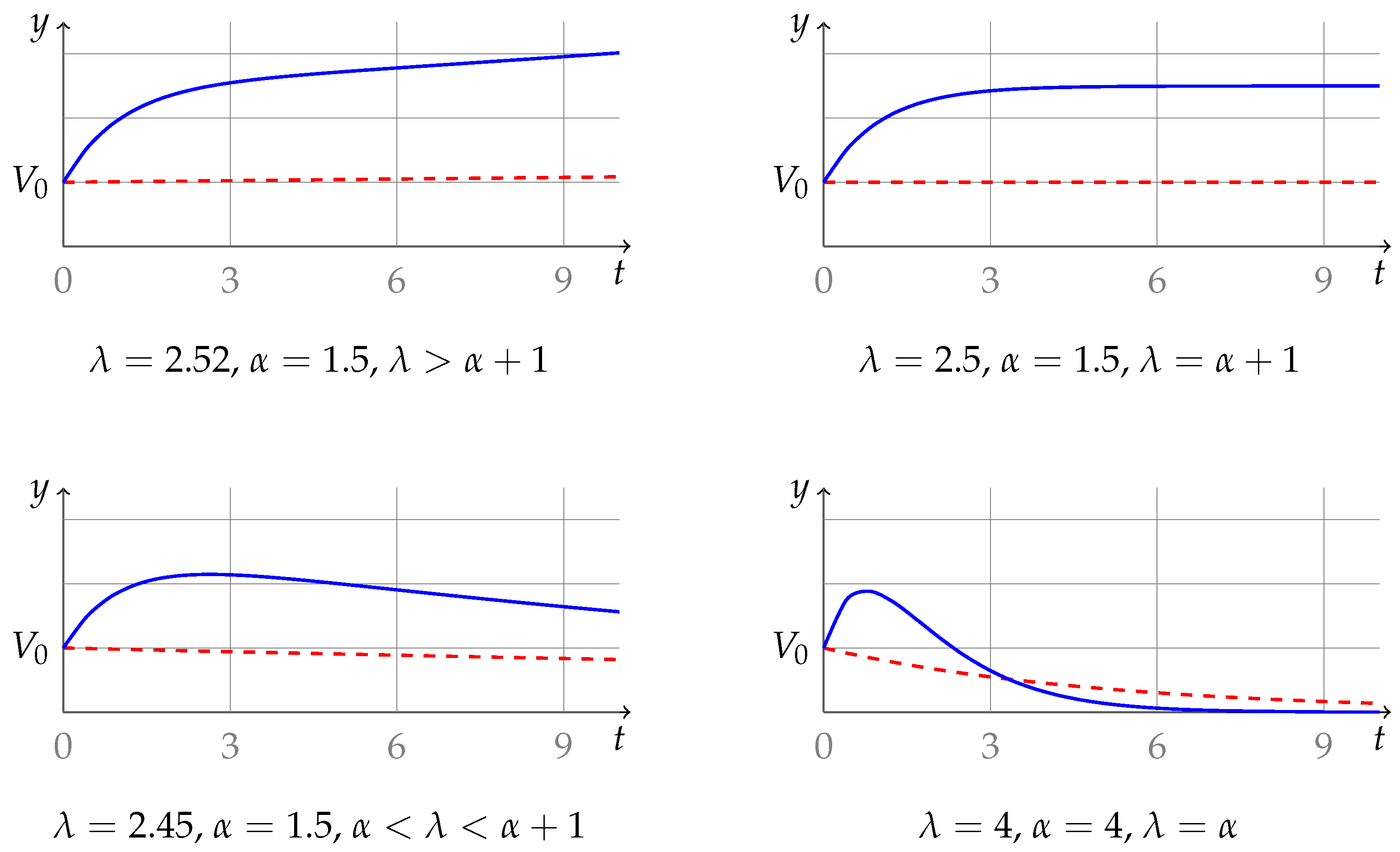
, for small values of
t,
is increasing (this is due to the initial condition in Equation (
15)). In particular, if
,
decreases for all
while
increases for small values of
t (cases 3-4-5 in Theorem 7, with
). As an exemplification of the possible cases when
, see
Figure 1. We note that cases 4 and 5 are quite similar; therefore, the last one is not displayed in this figure. Even if we observe these differences in the behaviour of ageing branching processes and classical branching processes (hence where the space
X is a singleton), we mention that similar phenomena can be observed by comparing ageing BRWs with classical BRWs, where
(see [
39]).
6. Conclusions
Branching random walks are stochastic processes that mainly model two quantities: the number of individuals in a population that breeds and dies, and the number of infected individuals during an epidemic outbreak. Branching events correspond to reproduction/infection events. The random walk part mimics the dispersion of children in the proximity of the parent or the contagion of social contacts. In both scenarios, individuals are endowed with a random lifespan, which represents the actual time during which the individual is fertile or contagious.
In the classical case, events occur at the arrival times of homogeneous Poisson processes, that is, lifespans and time intervals between breeding events are exponentially distributed. This assumption ensures Markovianity, but fails to capture more realistic features such as the dependence of the remaining lifetime and/or of the fertility on age. Several related models have been proposed to overcome this problem. Age-dependent branching processes, where an individual’s remaining lifetime depends on age (see [
4,
29]) are perhaps the first attempt towards more realistic models. In these processes, reproduction rates do not depend on age. Recently, processes that take into account a change, over time, in the speed of updates, have appeared in the literature. In particular, we refer the reader to refs. [
42,
43,
44,
45], where the process is affected by a so-called stochastic resetting: at random times, the parameters are changed, and this produces a phenomenon of ultraslow diffusion. Another line of research can be found in ref. [
30,
31,
32], where the updating rate decays exponentially in time.
Following the ideas of ref. [
30,
31,
32], we defined a new family of stochastic processes: ageing branching random walks. These are branching processes where lifespans are age-independent, while reproduction/infection events occur at the arrival times of an inhomogeneous Poisson process, which slows down as age increases. These processes are completely described by the spatial structure of interactions (reproduction/infection rates between sites), an intensity parameter
, which tunes the reproduction/infection speed and can be seen as an intrinsic characteristic of the population and the ageing function. We study the model where ageing implies that the reproduction rates are multiplied by
, with
.
Our results focus on three main aspects: the characterisation of the asymptotic behaviour of the process, distinguishing among global extinction, global survival with local extinction, and local survival (
Section 3); the influence of local modifications of the interaction and ageing parameters on the destiny of the population (
Section 4); the evolution, on the average, of the population when affected by reproductive ageing, as compared to non-ageing situations (
Section 5). The results in
Section 3 are based on, and extend, the theorems in ref. [
34], where critical parameters of non-ageing branching random walks were characterised. The influence of local modifications on the fate of the process has been previously tackled in ref. [
35,
36]. In both sections, an essential key is to draw a parallel between ageing, non-Markovian, branching random walks and their discrete-time counterpart, which is a classical branching random walk. We believe that this approach, bridging the continuous-time non-Markovian setting with the well-understood discrete-time theory, opens the door to further investigations of more general ageing phenomena in the context of branching processes.
To understand the practical applications of the critical parameters, we observe that in real situations, one aims either at survival (protecting endangered species, for example) or at extinction (epidemic or pest control). Increasing or decreasing the intensity
would seem to be the most natural option, but it might be impractical, since that would require a global change of the characteristics of the population. It is therefore important to understand if and how local changes affect survival. Moreover, when the model space is infinite, it is possible to observe local extinction (the population disappears from any finite set), while there is global survival (the population persists as a whole). Thus, the observation of the process on a finite set provides exhaustive information on the asymptotic behaviour only if there is no pure global survival phase, that is, when
. Indeed, when
, one might think that the population is destined to extinction, which is true from a local point of view, but local changes may lower
below
and thus imply that the population, after those changes, survives locally. Our results show that, in a population where reproduction/infection rates are affected by age, local changes of the ageing rates can change its ultimate fate (see
Table 1).
For endangered species, given a such that there is local or global extinction, increasing the local reproduction rate and/or reducing the fertility decay rate, even at one single location, can put the population in the range of local survival. On the other hand, if the population is sustained by a local environment where reproduction is fast and ageing slow, disrupting this ecosystem might lead to extinction. In disease (or pest) control, an infectious disease, destined to disappear, could turn into an epidemic outbreak if a community increases the frequency of contacts (higher reproduction rates) and/or lowers the speed of decay of transmissibility. On the contrary, a disease which persists thanks to some hubs, that is, sites with faster reproduction rates and/or slower ageing, can disappear once we isolate and treat those hubs.
The importance of hubs, or hot spots, has been pointed out by earlier works on mathematical epidemic modelling, both from a theoretical point of view [
46,
47] and through numerical simulations [
48,
49]. Our study confirms this importance: the treatment or creation of hubs can change the ultimate fate of a population or of an epidemic. In addition, we now know that even tampering only with the ageing rates can produce sizeable changes in the behaviour of the process.
While
Section 4 shows that the behaviour of the process cannot be predicted by observation only on finite sets,
Section 5 tells that, even when we consider the space as a singleton, it is important to observe populations for a sufficiently large amount of time. In fact, in classical branching processes, the expected number of individuals alive at time
t, can show only three behaviours: it increases for all
(supercritical case), it remains constant (critical case), or it decreases for all
(subcritical case). The introduction of an ageing parameter enriches the landscape of possibilities. In particular, in the subcritical case, there are cases where the expected number of individuals increases at the initial stages of the process, and only subsequently declines.
In conclusion, our results underline the role of ageing in population and epidemiological modelling. We should consider ageing as a factor, along with the reproductive speed and the interaction landscape, that determines the destiny of the population. Moreover, the introduction of this factor in branching models enlarges the realm of possible behaviours, providing a more realistic setting. Future work should focus on the short-term behaviour of ageing processes with multiple sites, and on both short and long-term behaviour of ageing BRW with constraints on the number of individuals in some/all sites. This could be investigated both through simulations and via the theoretical study of models with a small number of sites.