1. Introduction
Stochastic hybrid systems are widely employed to model systems subject to frequent and unpredictable structural changes, such as flexible manufacturing systems, air traffic management, power grids, mathematical finance, and risk management. A typical stochastic hybrid system is characterized by a hybrid state space: one component takes continuous values in a Euclidean space, while the other takes discrete values. Due to this structure, such systems have found diverse applications across numerous disciplines. For further details, we refer to [
1,
2,
3,
4].
An important class of stochastic hybrid systems is the following jump-diffusion model with Markovian switching:
where
is a continuous-time Markov chain representing the environmental state or system mode. Such processes are increasingly used to model stochastic systems subject to random impulses and frequent regime switches, typically captured by a Markov chain. A typical application of (
1) arises in risk theory within insurance and finance, where
represents a surplus process in a Markov-modulated market. Applications have also been documented in a broad spectrum of fields, including option pricing [
5] and flexible manufacturing systems [
6].
Given that many problems involving diffusions with Markovian switching and Lévy jumps cannot be solved explicitly, obtaining approximate solutions—either in explicit form or in a form amenable to numerical computation—is of significant theoretical and practical importance. Although numerical methods for stochastic differential equations (SDEs) have been extensively studied (see, e.g., [
7,
8,
9,
10]), considerably less attention has been devoted to numerical schemes for diffusion or jump-diffusion processes with Markovian switching. In this context, Yuan and Mao [
11] were the first to investigate numerical solutions for SDEs with Markovian switching. Subsequently, Ye and Li [
12] studied numerical methods for a class of jump diffusions with Markovian switching, establishing the convergence of the Euler–Maruyama (EM) numerical solutions to the exact solutions and providing an error estimate. More recently, Yin, Song, and Zhang [
13] proposed a numerical algorithm for such systems and proved its convergence via a martingale problem formulation.
In this paper, we propose a jump-adapted numerical scheme for system (
1) based on the truncated Euler method. Unlike the methods in [
13] and [
12], which employ a constant step size, our algorithm incorporates a sequence of jump times generated by a Poisson random measure. Another key distinction concerns the mode of convergence: whereas [
13] established weak convergence, we prove strong convergence of the scheme. Moreover, inspired by the techniques in [
12], we also investigate the order of strong convergence.
The remainder of the paper is structured as follows:
Section 2 briefly reviews the existence and uniqueness of solutions to Equation (
1) and describes the modified Euler-type algorithm for numerical solutions.
Section 3 establishes the
convergence of the numerical solution under this algorithm and derives the corresponding error order.
Section 4 provides a numerical example to evaluate the performance of the algorithm introduced in
Section 3.
2. The Truncated EM Method
Let
be a probability space. Let
be an increasing family of sub-
-algebras of
and
an
-adapted
-valued Brownian motion and also a martingale with respect to
. Let
be a strong Markov process on
with left-hand limits and right-continuous, where
. The first component
satisfies the following stochastic differential–integral equation:
where
is
-matrix valued,
and
are
-valued for
and
. Let
(corresponding to a random point function
) be a stationary
-Poisson point process independent of
, and let
be the compensated Poisson random measure on
, where
is a deterministic characteristic measure on the measurable space
, and
The second component
, which is
-adapted and independent of
and
, is a right-continuous irreducible Markov chain with finite state space
and
Q-matrix
such that
provided that
(cf. [
14]). For
and
, define
For the existence and uniqueness of the strong Markov process
satisfying (
2) and (
3), we make the following assumptions.
Assumption 1. Assume that the coefficients b and σ satisfy the local Lipschitz condition: for any there exists a constant such thatFor all with Assumption 2. (Khasminskii-type condition) There exist constant such that We state a known result (see, e.g., [
15]) as a lemma for later use.
Lemma 1. Under Assumptions 1 and 2, SDEs (2) and (3) have a unique global solution . Moreover, for any In the remainder of this section, we will show that the strong Markov process
can be associated with an appropriate generator. In what follows, let
and ∇ denote the inner product and the gradient operator in
, respectively. If
A is a vector or matrix,
denotes its transpose. For
, set
. Let
denote the family of all functions
on
that are twice continuously differentiable in
x and have compact support. For
, define an operator
as follows:
Here the operators
L,
and
Q are further defined by:
The essence of the truncated method lies in addressing super-linear coefficients. From the standpoint of finite-time convergence, linear coefficients do not pose difficulties for the EM scheme and therefore do not need to be truncated [
16]. In our TEM method, we focus exclusively on truncating the super-linear terms, specifically the coefficients
b and
.
To construct the TEM scheme, we first choose a strictly increasing function
satisfying
, as
, and
We denote by
the inverse function of
f. We observe that
is a strictly increasing continuous function mapping from
to
. We also choose a strictly decreasing function
and a number
such that
For a given step size
, we define a mapping
from
to the closed ball
by
For a given step size
, we define the truncated functions
for
, where we set
when
. It is easy to see that
That is, the truncated functions
and
remain bounded, even when the original coefficients
b and
are unbounded. Furthermore, for all
, where
is given in (
6), these truncated terms continue to satisfy a Khasminskii-type condition, as stated in the following lemma (see [
16]).
Lemma 2. Let Assumption 2 hold. Then, for all , there exist constant , such that Since
and
are independent, for given partition
,
is a discrete Markov chain with transition probability matrix
, where
is the
-th entry of the matrix
. Thus we can simulate the discrete Markov chain
using the following recursion: Suppose that
, and generate a random number
uniformly distributed in
. Define the next state as:
By repeating this procedure, a trajectory of can be simulated.
We can now form the discrete-time TEM numerical approximations
for
by setting
and computing
for
, where
. Here
are the jump times. Denote by
a homogeneous Poisson process with intensity
. Clearly,
,
are also stopping times. Let us now form two versions of the continuous-time TEM solutions. The first one is defined by
This is a simple step process, so its sample paths are not continuous. We refer to it as the
continuous-time step-process TEM approximation. The other is defined by
for
. We refer to this as the
continuous-time continuous-sample TEM approximation. Observe that
for all
.
4. Numerical Example
In this section, we discuss a numerical example integrated with music elements to illustrate the theory established in the previous sections. By incorporating music-related parameters and scenario settings, we demonstrate the feasibility and efficiency of computer simulations based on the TEM method for jump-diffusion processes with Markovian switching while highlighting the method’s adaptability in interdisciplinary scenarios.
Example 1. Take the dimension , and consider the following jump-diffusion model with Markovian switching integrated with music elements:
where
is a constant diffusion intensity coefficient;
is a one-dimensional Brownian motion, describing the continuous random fluctuations of the system;
is a stationary Poisson point process independent of
, and its compensated Poisson random measure is
; and
is a deterministic characteristic measure defined on the measurable space
, where
is a compact set excluding the origin and
is the Borel
-algebra on
. Since the jump coefficient takes the linear form
, Assumption 4 reduces to
If we set
and
is a Gamma process measure satisfying
, then
can be explicitly constructed via convex inequalities.
is a two-state Markov chain independent of
and
with state space
, corresponding to two core states of music: State 1 represents the “melody-dominated mode”, and State 2 represents the “rhythm-dominated mode”. Its Q-matrix is defined as
where
(switching rate from melody-dominated to rhythm-dominated mode) and
(switching rate from rhythm-dominated to melody-dominated mode), which is consistent with the natural transition characteristics of the two modes in music. The drift coefficient is bound to the state:
(in the melody-dominated state, the system mean shows an increasing trend, simulating the driving force of melody progression) and
(in the rhythm-dominated state, the system mean shows a mild decreasing trend, simulating the restrictive effect of rhythmic stability).
is the music dynamic intensity factor, whose value depends on the musical segment characteristics corresponding to time
t. Let
, where
(simulating the basic beat frequency of music) and
(initial phase). The value range of
is
, which is used to adjust the intensity of the diffusion term and reflect the periodic fluctuation in music intensity over time.
and
are the basic jump amplitude coefficients in the two states, respectively. The jump amplitude coefficient in State 1 (melody-dominated) is larger, simulating the sudden pitch changes in the melody, and the jump amplitude coefficient in State 2 (rhythm-dominated) is smaller, simulating the regular pulses of rhythm.
is the correlation function between jumps and music elements. Let
correspond to three typical jump events in music (such as strong beats, weak beats, and grace notes). Define
(strong beat jumps with the largest impact),
(weak beat jumps with medium impact) and
(grace note jumps, with the smallest impact amplitude); the characteristic measure satisfies
which is consistent with the occurrence probability distribution of strong beats, weak beats, and grace notes in music.
Select the truncation-related function
. At this time, all conditions in Equation (
6) hold for any
. Therefore, the truncation threshold is defined as
, and the truncation functions are:
The initial value is set to
. For different time step sizes
and total duration
(simulating the duration of a complete piece of music), the numerical solution
is calculated by the following recursive formula:
where
and
.
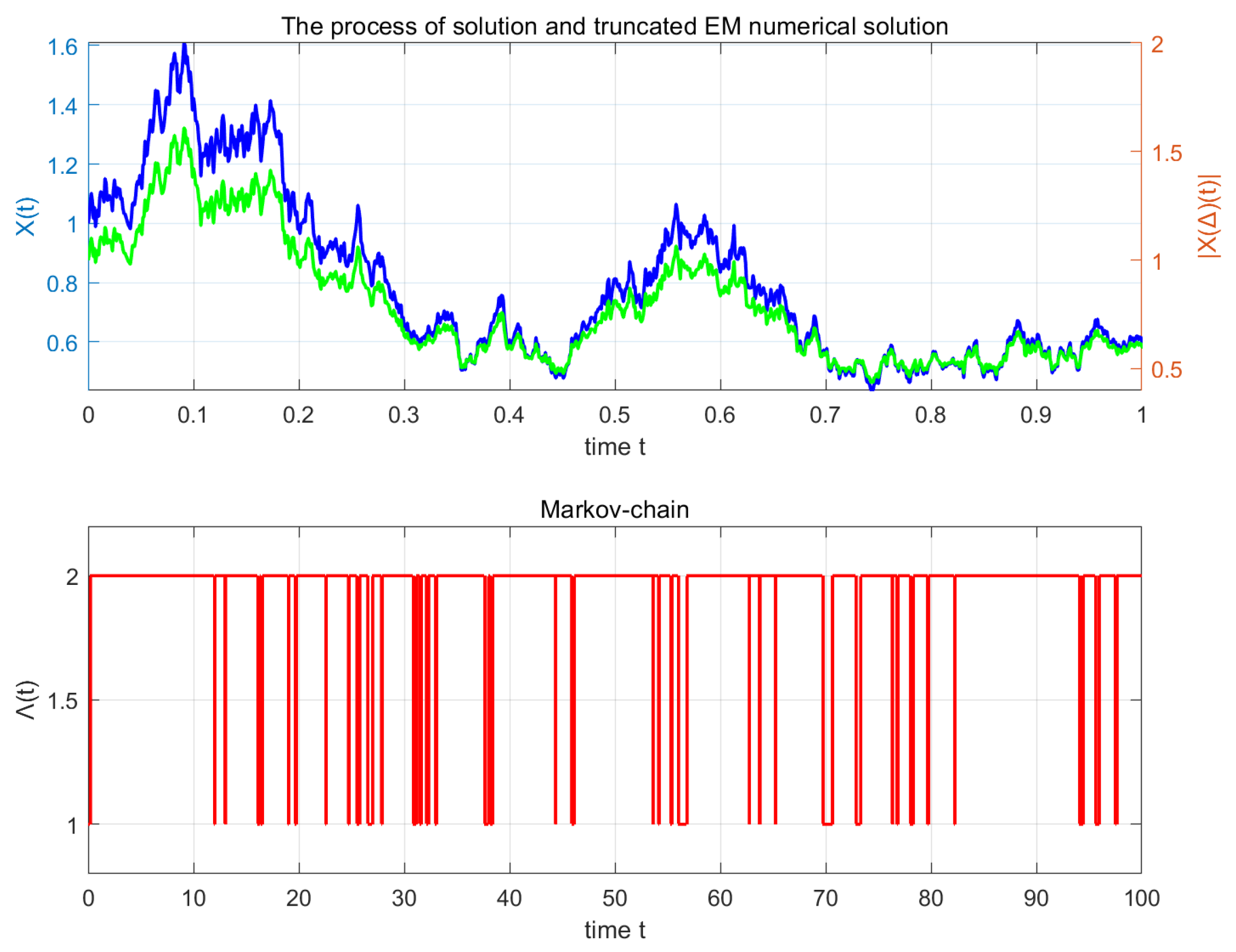
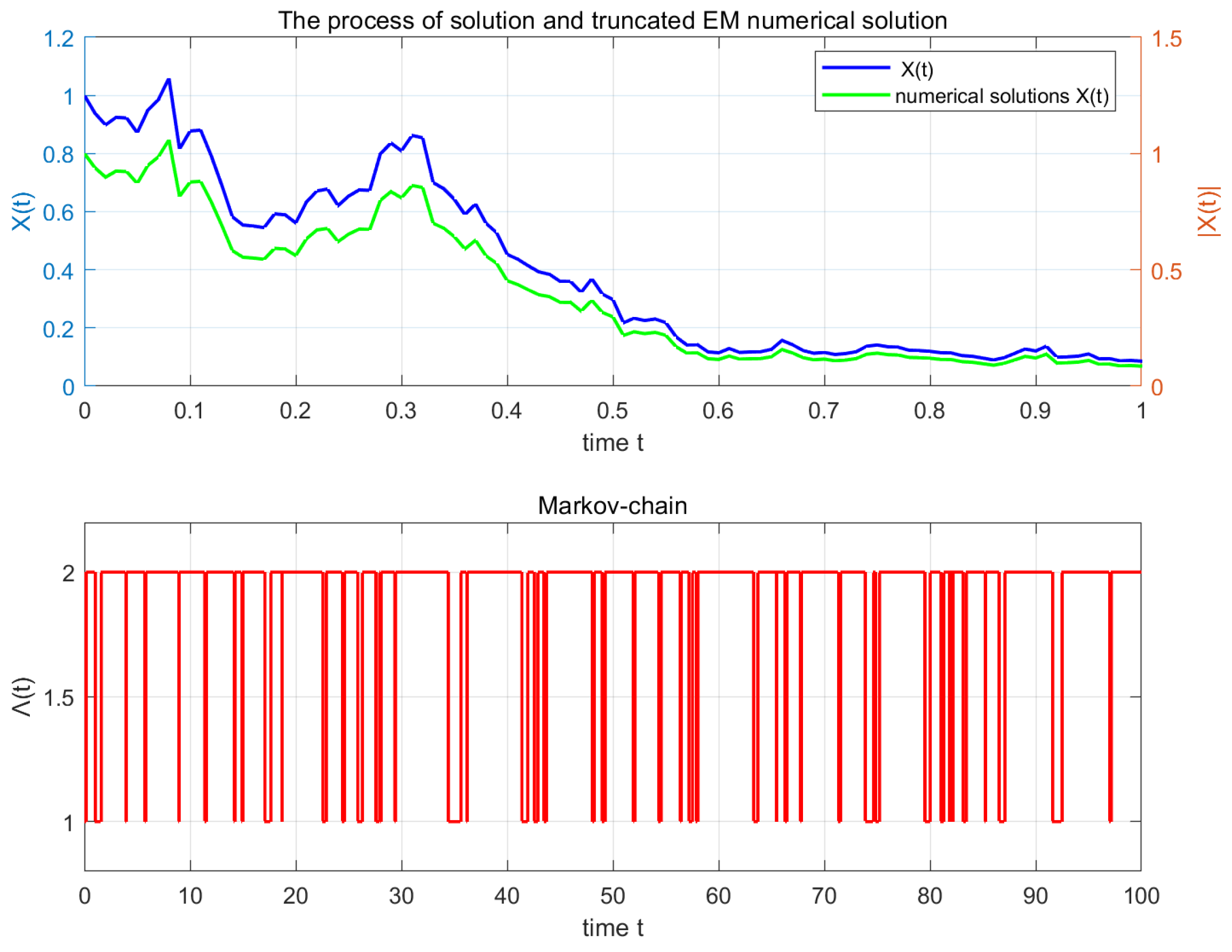
Based on the above settings, numerical simulations are performed using the TEM method, and the following results are obtained.
1.
Figure 1 (
) shows the trajectory of the numerical solution when the step size is extremely small. Since the step size is small enough, although the truncation threshold
is large, the truncation operation is rarely triggered, and the numerical solution is almost equivalent to the result of the standard EM method. In the trajectory, the combination of the periodic fluctuation brought by
and the Markov state switching (melody/rhythm dominance) makes the trajectory show the characteristics of increasing fluctuation in the melody segment and stable fluctuation in the rhythm segment. It can accurately capture the time nodes and impact amplitudes of jump events (strong beats/weak beats/grace notes), which is highly consistent with the system dynamics driven by real music, and the trajectory is smooth and consistent with the continuous characteristics of the theoretical solution.
2.
Figure 2 (
) shows the trajectory of the numerical solution when the step size is relatively large. Due to the increased step size, the capture accuracy of Markov state switching decreases, the periodic characteristics of
are not fully reflected, and the time positioning of jump events is deviated, resulting in more intense fluctuations and obvious deviations from the theoretical solution.
5. Conclusions and Discussion
The core idea of the TEM method is to control the explosive growth of numerical solutions through reasonable truncation, which is still applicable in models integrated with music elements.
When the step size is small enough, the truncation operation is rarely triggered. The method can accurately restore the impact of music elements (beat fluctuation, state switching, and jump events) on the system, and the numerical solution converges to the true solution of the stochastic differential equation. When the step size increases, the fluctuation and deviation of the numerical solution intensify, which verifies the importance of step size selection for the numerical simulation of jump-diffusion processes containing dynamic music elements.
This example shows that the TEM method is not only applicable to traditional jump-diffusion processes with Markovian switching but can also effectively adapt to extended models integrated with interdisciplinary elements such as music, providing a reliable numerical tool for fields such as music signal processing and music-driven dynamic system analysis.