Article

On Devising Carbon Offset Investments by Multiple-Objective Portfolio Selection and Exploring Multiple-Objective Capital Asset Pricing Models


1
Department of Financial Management, Business School, Nankai University, 94 Weijin Road, Tianjin 300071, China
2
College of Economics and Management, Shandong Agricultural University, 960 Wenquan Road, Taian 271018, China
*
Author to whom correspondence should be addressed.
Mathematics 2026, 14(6), 1080; https://doi.org/10.3390/math14061080
Submission received: 11 January 2026 / Revised: 1 March 2026 / Accepted: 10 March 2026 / Published: 23 March 2026
(This article belongs to the Special Issue Application of Multiple Criteria Decision Analysis)

Abstract

Humans face environmental deterioration. Scholars have identified carbon dioxide as one of the culprits, and they emphasize carbon offset. Researchers are investigating carbon offset investments. Some researchers have encouragingly deployed multivariate variational mode decomposition methods, but they have not fully optimized them. Some researchers have opportunely assessed capital asset pricing models, but they have not fully justified them. We devise multiple-objective portfolio selection models, fully optimize them, and dominate carbon offset indexes. We extend the classical methodology of advancing from portfolio selection to capital asset pricing models into the methodology of advancing from multiple-objective portfolio selection to multiple-objective capital asset pricing models. Specifically, we explore multiple-objective capital asset pricing models by numerically verifying many tangent lines (instead of the traditionally singular tangent line) and suggesting a tangent plane (instead of tangent lines). For multiple-objective zero-covariance capital asset pricing models, we numerically compute a set of zero-covariance portfolios (instead of the traditionally singular zero-covariance portfolio) and suggest picking an advantageous zero-covariance portfolio. We consider the second-level indicators of carbon offset and generalize three-objective portfolio selection to k-objective portfolio selection. As for contributions, first, this paper’s methodology is to logically advance from multiple-objective portfolio selection to multiple-objective capital asset pricing models, whereas the literature typically covers multiple-objective portfolio selection alone and barely covers multiple-objective capital asset pricing models. Second, this paper numerically demonstrates some difficulties and proposes hypothetical solutions in the process of obtaining multiple-objective capital asset pricing models.

Graphical Abstract

1. Introduction

1.1. Graphical Abstract

At the very beginning, we present a graphical abstract in figure form to show this paper’s contributions. It carries eight panels indicating research advancements. For instance, Panel A illustrates the typical research and this paper’s overall contribution for carbon offset investments.
For the graphical abstract’s structure, Panels B, C, and D jointly delineate the methodology of advancing from portfolio selection to capital asset pricing models and zero-covariance capital asset pricing models. Further, Panels E, F, and G jointly delineate the methodology of advancing from multiple-objective portfolio selection to multiple-objective capital asset pricing models and multiple-objective zero-covariance capital asset pricing models. Individually, Panel E extends Panel B, Panel F extends Panel C, Panel G extends Panel D, and Panel H further extends Panel E.
We will explain the graphical abstract below and clearly refer to its content by stating that, for example, “We catalog the three references above in Panel A of the graphical abstract”.

1.2. Typical Research for Carbon Offset Investments

Humans are encountering crucial threats of environmental deterioration. Scientists and entrepreneurs have detected carbon dioxide emissions as one of the reasons and launched the concept of carbon offset.
Carbon offset is a system of mechanisms to reduce or remove greenhouse gas (especially carbon dioxide) emissions and compensate for emissions produced elsewhere. Carbon offset investments are the allocation of money into financial instruments related to carbon offset. We will introduce carbon offset markets and carbon offset investments in Section 2.
Investors are eagerly seeking carbon offset investments. Researchers are actively investigating the investments (we will review more research on carbon offset investments in Section 2). Xue et al. [1] encouragingly deploy multivariate variational mode decomposition methods and vine-copula models, consider carbon offset, construct 10-objective portfolio optimization, and analyze data from 2009 to 2022.
It is a pity that Xue et al. [1] insufficiently optimize the models, as they ([1], pp. 5–7) do not fully disclose how they compute all the optimal solutions of their complicated models. It is another pity that Xue et al. ([1], p. 1) report indirect dominance (i.e., the dominance of their portfolios with specific investment horizons over their portfolios with other investment horizons), because the dominance of their portfolios over stock market indexes could be more desirable through efficient market hypotheses and active versus passive portfolio management (as described by Bodie et al. ([2], pp. 341–350)).
Chen et al. [3] promisingly harness utility functions, constrain carbon offset, and identify conditions for an increase in green investment. It is a pity that Chen et al. ([3], p. 1) restrict their asset scope to only three assets. Moreover, Markowitz ([4], p. 100) argues that maximizing expected utility functions is much more complex than portfolio selection.
Alessi et al. [5] opportunely assess capital asset pricing models for carbon offset and report the premium for greenness. It is a pity that Alessi et al. ([5], pp. 3–4) empirically construct the models and lack sufficient theoretical foundation.
We catalog the three references above in Panel A of the graphical abstract.

1.3. Overall Contributions of This Paper

This paper contributes to the research on carbon offset investments as follows:
  • We devise multiple-objective portfolio selection, fully optimize the models, and dominate carbon offset indexes in stock markets. Moreover, we do not restrict the asset universe, so it contains any numbers of stocks.
  • We extend the classical methodology of advancing from portfolio selection to capital asset pricing models and explore multiple-objective capital asset pricing models.
However, our result is exploratory but not definite. We catalog the contributions in Panel A of the graphical abstract.

1.4. Portfolio Selection as the Origin of Modern Finance

Portfolio selection is unanimously acclaimed as the origin of modern finance (as appraised by Rubinstein ([6], p. 1041), Fabozzi et al. ([7], p. 2), and Guerard ([8], p. 1)). Nobel laureate Markowitz ([9], p. 6) considers risk and return. Markowitz ([10], p. 83) proposes portfolio selection as the following two-objective optimization (We will introduce multiple-objective optimization in Section 4):
min z 1 = x T Σ x , variance of portfolio return max z 2 = x T μ 2 , expectation of portfolio return subject to x S , feasible region
where, for n stocks, Σ denotes the covariance matrix of stock returns, and μ 2 denotes a vector of the expectations of stock returns. A portfolio is fixed by its weight vector x . z 1 measures the portfolio return’s variance. z 2 measures the portfolio return’s expectation. S R n denotes a feasible region. Z denotes the feasible region in ( z 1 , z 2 ) space.
Equation (1) is a continuous formulation because x is a continuous vector. Although μ 2 is disparate, z 2 = x T μ 2 is a continuous function. For example, for n = 2 stocks,
x = x 1 x 2 , μ 2 = 1 2 , z 2 = x T μ 2 = x 1 + 2 x 2 is continuous
Equation (1) maps S to Z. In the central part of Panel B of the graphical abstract, we present the mapping by and present S and Z as shaded regions (Our depiction for S is conceptual because we consider n-dimensional space, which resists direct visualization).
A minimum-variance frontier acts as the boundary of Z and is a superset of the nondominated set. Nondominated sets are optimal sets for multiple-objective optimization. We will formulate minimum-variance frontiers and define nondominated sets in Section 4. Specifically, for the portfolio selection in the central part of Panel B of the graphical abstract, we present its nondominated set and minimum-variance frontier in Panel B.
In finance, standard deviation z 1 0.5 may be preferred to variance z 1 because standard deviation z 1 0.5 carries more direct financial implications. In mathematics and optimization, variance z 1 may be preferred to standard deviation z 1 0.5 because variance z 1 is simpler. Therefore, we accordingly utilize variance z 1 or standard deviation z 1 0.5 .
Sharpe ([11], pp. 59–62), Merton [12], and Campbell ([13], p. 34) discuss the following model:
min z 1 = x T Σ x max z 2 = x T μ 2 subject to 1 T x = 1
where 1 denotes a vector of ones. Merton [12] analytically derives the efficient set and minimum-variance frontier and proves the frontier as a parabola. Here, efficient sets are optimal sets for multiple-objective optimization. We will define efficient sets in Section 4. In the left part of Panel B of the graphical abstract, we present (2).

1.5. Capital Asset Pricing Models

On the basis of portfolio selection (especially (2)), Nobel laureate Sharpe [14] proposes capital asset pricing models. Overall, Sharpe [14] determines a line which is tangent to the nondominated set of (2) and passes through the risk-free asset r f . Sharpe [14] theoretically concludes that the tangent portfolio becomes the market portfolio (as defined by Bodie et al. ([2], pp. 115 and 285)) and renders a pricing relationship as follows:
E ( r ) = r f + β ( E ( r m ) r f )
where E ( r ) denotes the expectation of a stock return; E ( r m ) denotes the expectation of the market portfolio’s return; and β denotes the stock’s risk and is calculated as the covariance between r and r m over the variance of r m .
In Panel C of the graphical abstract, we present (3) and the tangency. We present the methodology of advancing from portfolio selection (2) to capital asset pricing models (3) as a short thick ↓ in the graphical abstract.

1.6. Zero-Covariance Capital Asset Pricing Models

As an alternative to (2), Nobel laureate Fama ([15], pp. 266–268) and Black [16] argue the inconvenience of empirically finding the market portfolio. They prove that, for typically any portfolio r p on the minimum-variance frontier, there exists a unique zero-covariance portfolio r z c p also on the minimum-variance frontier as follows:
c o v ( r p , r z c p ) = 0 .
Using (4), Fama ([15], pp. 266–268) and Roll [17] prove the following zero-covariance capital asset pricing models:
E ( r ) = E ( r z c p ) + β ( E ( r p ) E ( r z c p ) )
where β denotes the stock’s risk and is measured as the covariance between r and r p over the variance of r p .
In Panel D of the graphical abstract, we present (5), the minimum-variance frontier, r p , and r z c p . We present the methodology of advancing from portfolio selection (2) to zero-covariance capital asset pricing models (5) as a long, thick ↓ in the graphical abstract.

1.7. Ascent of Multiple-Objective Portfolio Selection as Extensions of Portfolio Selection

Markowitz ([18], pp. 471 and 476) perceives extra objectives after proposing portfolio selection. So does Sharpe [19]. For instance, Markowitz [20] stresses long-run portfolio variance and short-run portfolio variance. Fama ([21], pp. 445–447) and Cochrane ([22], pp. 1081–1082) target multiple factors for asset pricing models. Harvey and Siddique [23] consider skewness. Lo et al. [24] investigate liquidity. Pedersen et al. [25] treat ESG. Chow [26] probes tracking errors.
Dorfleitner et al. [27], Ehrgott et al. [28], Steuer et al. [29], Hirschberger et al. [30], Utz et al. [31], Qi et al. [32], and Utz and Steuer [33] extend portfolio selection and propose multiple-objective portfolio selection as follows:
min z 1 = x T Σ x , variance of portfolio return max z 2 = x T μ 2 , expectation of portfolio return max z 3 = x T μ 3 , expectation of general portfolio objective 3 max z k = x T μ k , expectation of general portfolio objective k subject to x S , feasible region
where μ 3 μ k denote vectors of the expectations of general stock objectives (e.g., carbon offset). z 3 z k measure the expectations of general portfolio objectives. Z denote the feasible region in ( z 1 , , z k ) space.
Equation (6) maps S to Z. In the central part of Panel E of the graphical abstract, we present the mapping by and present S and Z as shaded regions. In order to visualize, we present ( z 1 , z 2 , z 3 ) space (instead of ( z 1 , , z k ) space).
The minimum-variance surface of (6) generalizes the minimum-variance frontier. The minimum-variance surface is the boundary of Z of (6) and is a superset of the nondominated set. We will formulate minimum-variance surfaces in Section 4. Specifically, for the multiple-objective portfolio selection in the central part of Panel E of the graphical abstract, we present its nondominated set and the minimum-variance surface of Panel E.
Qi et al. [32] extend (2) and analyze the following model:
min z 1 = x T Σ x , variance of portfolio return max z 2 = x T μ 2 , expectation of portfolio return max z 3 = x T μ 3 , expectation of portfolio carbon offset subject to 1 T x = 1
where μ 3 denotes a vector of the expectations of stock carbon offsets, and z 3 denotes the expectation of portfolio carbon offset. In the left part of Panel E of the graphical abstract, we present (7).
Equation (7) is a continuous formulation because x is a continuous vector. Although μ 3 is disparate, z 3 = x T μ 3 is a continuous function. For example, for n = 2 stocks,
x = x 1 x 2 , μ 3 = 3 4 , z 3 = x T μ 3 = 3 x 1 + 4 x 2 is continuous
After analytically deriving the efficient set and minimum-variance surface, Qi et al. [32] prove that the surface is an elliptic paraboloid. In the right part of Panel E of the graphical abstract, we numerically present the surface as follows:
z 1 = 0.0724 z 2 2 0.0028 z 2 z 3 + 0.6196 z 3 2 0.0342 z 2 0.5605 z 3 + 0.1550 .
We will describe the derivation of (8) in Section 4.

1.8. Research Challenges of Multiple-Objective Portfolio Selection: Not Extending Multiple-Objective Capital Asset Pricing Models

Researchers are developing multiple-objective portfolio selection (as appraised by Zopounidis et al. ([34], p. 343)). Steuer and Na [35], Spronk and Hallerbach [36], Bana e Costa and Soares [37], Zopounidis et al. [38], La Torre et al. [39], Kandakoglu et al. [40], Aouni et al. [41], Ehrgott et al. [42], and Xidonas et al. [43] offer surveys.
Despite the development, there barely any research exists on advancing from multiple-objective portfolio selection to multiple-objective capital asset pricing models (as traditionally pioneered by Markowitz [10] and Sharpe [14]). Within the survey above, the researchers rarely document the advancement.

1.9. Exploring Multiple-Objective Capital Asset Pricing Models for Carbon Offset as This Paper’s Contributions

As capital asset pricing models are crucial in finance, multiple-objective capital asset pricing models can be equally crucial as they provide a pricing model between a stock’s risk and its expected return and carbon offset.

1.9.1. Exploring Multiple-Objective Capital Asset Pricing Models

We follow Sharpe [14] and delineate a line which is tangent to the nondominated set of (7) and passes through the risk-free asset r f . However, Sharpe [14] locates only one tangent line with only one tangent portfolio for (2), while we locate many tangent lines with many tangent portfolios for (7). In Panel F of the graphical abstract, we present two tangent lines with two tangent portfolios r m 1 and r m 2 (We will numerically verify the many tangent lines in Section 5).
In order to try to locate only one tangent portfolio for (7), we suggest researching the existence of a tangent plane which is tangent to the nondominated set of (7) and passes through the risk-free asset r f . Although our suggestion is speculative, it is new and worth researching.
We present the methodology of advancing from multiple-objective portfolio selection to multiple-objective capital asset pricing models as a short, thick ↓ in the graphical abstract.
For multiple-objective capital asset pricing models, this paper’s specific contribution is to numerically verify many tangent lines and suggest a tangent plane (instead of tangent lines). However, our result is exploratory and not definite.

1.9.2. Exploring Multiple-Objective Zero-Covariance Capital Asset Pricing Models

In order to bypass the dilemma of the many tangents above, we follow Fama ([15], pp. 266–268) and Roll [17] and calculate the zero-covariance portfolio. However, Black [16] and Fama ([15], pp. 266–268) locate only one zero-covariance portfolio r z c p for (2), while there is a set of zero-covariance portfolios for (7). We compute the set in the ( z 1 , z 2 , z 3 ) space of (7) as follows:
{ 0.6407 z 3 2 0.5616 z 3 + 0.1510 0.5211 z 3 + 0.2411 z 3 z 3 R }
We will describe the computation of (9) in Section 6. In Panel G of the graphical abstract, we present the minimum-variance surface, r p , and the set as a thick curve.
Hopefully, we suggest styles of pinpointing an advantageous zero-covariance portfolio to extend (5) for (7). We present the methodology of advancing from multiple-objective portfolio selection to multiple-objective zero-covariance capital asset pricing models as a long, thick ↓ in the graphical abstract.
For multiple-objective, zero-covariance capital asset pricing models, one specific contribution of this paper is to numerically compute a set of zero-covariance portfolios and suggest an advantageous zero-covariance portfolio. However, our result is exploratory but not definite.

1.10. Generalization

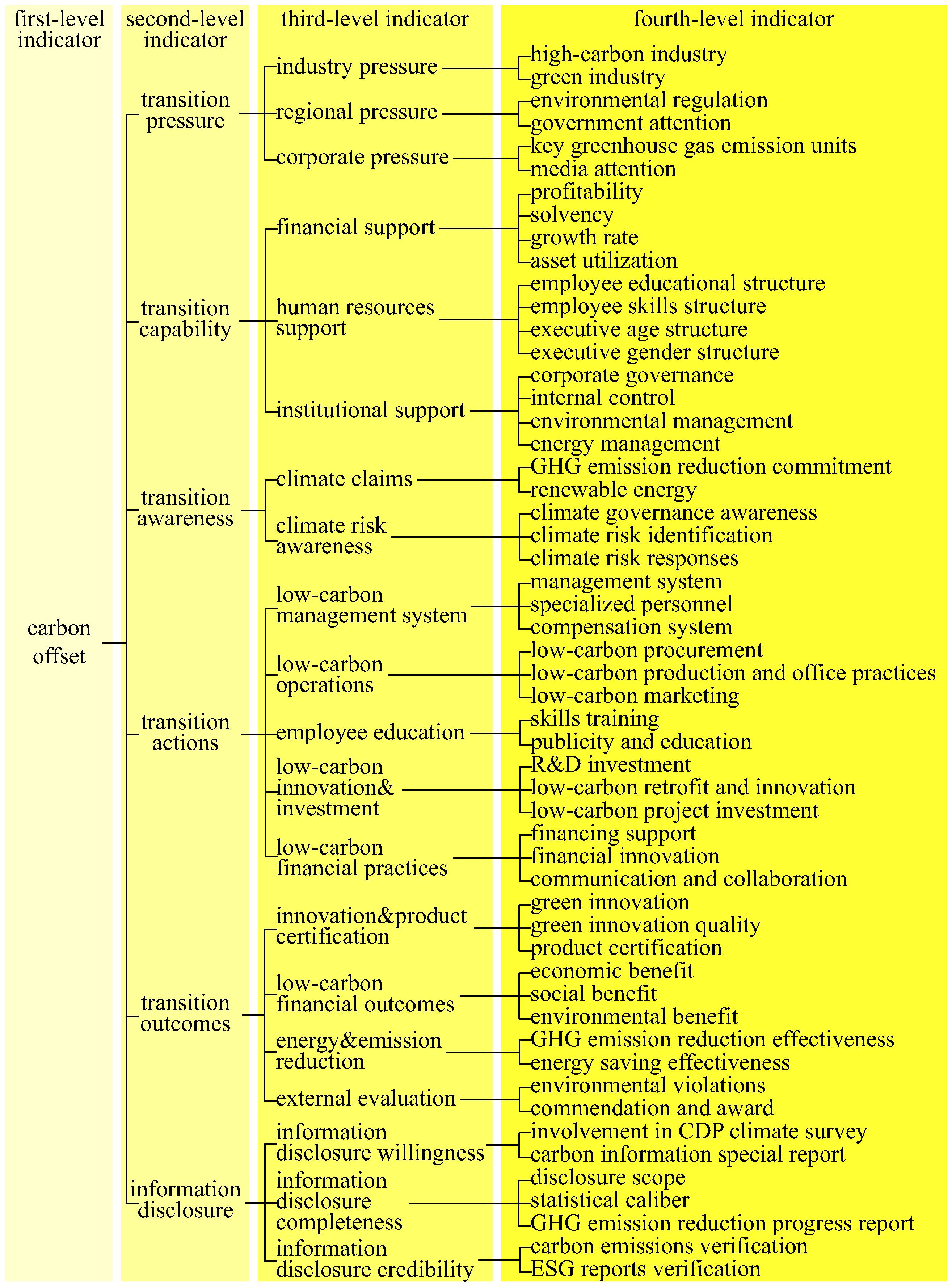
Researchers propose schemes of rating carbon offset. The schemes typically consist of different levels of indicators (e.g., first-level indicator, second-level indicators, third-level indicators, and fourth-level indicators). Carbon offset is typically designated as the first-level indicator. In addition to carbon offset as the first-level indicator, second-level indicators are also important for carbon offset investments and considered by researchers and investors. Researchers and investors need methods to formulate second-level indicators.
We suggest a scheme of rating carbon offset in Appendix A. Through the scheme, we extend (7) and formulate the six second-level indicators as follows:
min z 1 = x T Σ x , variance of portfolio return max z 2 = x T μ 2 , expectation of portfolio return max z 3 = x T μ 3 , expectation of portfolio transition pressure max z 4 = x T μ 4 , expectation of portfolio transition capability max z 5 = x T μ 5 , expectation of portfolio transition awareness max z 6 = x T μ 6 , expectation of portfolio transition action max z 7 = x T μ 7 , expectation of portfolio transition outcome max z 8 = x T μ 8 , expectation of portfolio information disclosure subject to A T x = b
where
  • μ 3 denotes a vector of the expectations of stock transition pressures.
  • μ 8 denotes a vector of the expectations of stock information disclosures.
  • z 3 measures the expectation of portfolio transition pressure.
  • z 8 measures the expectation of portfolio information disclosure.
  • A denotes an n × m constraint matrix.
  • b denotes an m-vector for the right-hand parameters.
In this paper, we use z 1 , z 2 , and z 3 to denote objective functions which will be introduced in Section 4. In different models, z 3 may denote different objective functions. For instance, z 3 denotes “ z 3 = x T μ 3 , expectation of portfolio carbon offset” in (7), while z 3 denotes “ z 3 = x T μ 3 , expectation of portfolio transition pressure” in (10). Similarly in mathematics, y = x + 1 and y = x + 3 denote different functions, although y and x appear in both functions.
Through (10), investors minimize risk z 1 , maximize expected return z 2 , and maximize all expectations of the second-level indicators z 3 z 8 . We present (10) in Panel H of the graphical abstract.
The design of (10) works for general schemes of rating carbon offset because
  • we could simply replace six second-level indicators with k second-level indicators, and
  • we could simply replace z 8 and μ 8 in (10) with z k + 2 and μ k + 2 .
We further generalize (10) by formulating the variances of the second-level indicators as follows:
min z 1 = x T Σ 2 x , variance of portfolio return min z 2 = x T Σ 3 x , variance of portfolio transition pressure min z 3 = x T Σ 4 x , variance of portfolio transition capability min z 4 = x T Σ 5 x , variance of portfolio transition awareness min z 5 = x T Σ 6 x , variance of portfolio transition action min z 6 = x T Σ 7 x , variance of portfolio transition outcome min z 7 = x T Σ 8 x , variance of portfolio information disclosure max z 8 = x T μ 2 , expectation of portfolio return max z 9 = x T μ 3 , expectation of portfolio transition pressure max z 10 = x T μ 4 , expectation of portfolio transition capability max z 11 = x T μ 5 , expectation of portfolio transition awareness max z 12 = x T μ 6 , expectation of portfolio transition action max z 13 = x T μ 7 , expectation of portfolio transition outcome max z 14 = x T μ 8 , expectation of portfolio information disclosure subject to A T x = b
where
  • Σ 2 = Σ .
  • Σ 3 denotes a covariance matrix of stock transition pressures.
  • Σ 8 denotes a covariance matrix of stock information disclosures.
  • z 2 measures the variance of portfolio transition pressure.
  • z 7 measures the variance of portfolio information disclosure.
In this paper, we use z 1 , z 2 , z 3 , etc., to denote objective functions which will be introduced in Section 4. In different models, z 3 may denote different objective functions. For instance, z 3 denotes “ z 3 = x T μ 3 , expectation of portfolio carbon offset” in (7), while z 3 denotes “ z 3 = x T Σ 4 x , variance of portfolio transition capability” in (11).
We dramatically control multiple risks (variances) by cogitating 1 + 6 pairs of variances and expectations. Similarly to the general design of (10), the design of (11) works for general schemes of rating carbon offset. We present (11) in Panel H of the graphical abstract.

1.11. Paper Structure

We organize the rest of this paper as follows: In Section 2, we introduce carbon offset markets and carbon offset investments. In Section 3, we justify the methodology of this paper. In Section 4, we devise carbon offset investments through multiple-objective portfolio selection, dominate carbon offset indexes, and demonstrate using the constituents of the Shanghai Stock Exchange 50 Index. In Section 5, we explore multiple-objective capital asset pricing models. In Section 6, we explore multiple-objective zero-covariance capital asset pricing models. In Section 7, we generalize for second-level indicators of carbon offset. We conclude in Section 8. We demonstrate a scheme of rating carbon offset in Appendix A.

2. A State-of-the-Art Review of Carbon Offset Markets and Investments

In this section, we review the origin and development of carbon offset markets and the research on carbon offset investments.

2.1. Origin of Carbon Offset Markets

Academically, scientists (e.g., Arrhenius [44], Callendar [45], Santer et al. [46], and Feldman et al. [47]) verify that greenhouse gas (especially carbon dioxide) emissions drive global warming and that humans cause these emissions. Practically, environmentalists and entrepreneurs address global warming and advocate carbon offset.
Overall, the principal purpose of carbon offset markets is for people to
  • price carbon emissions,
  • trade emissions,
  • and reduce emissions.
Specifically, carbon offset markets function as follows:
  • The markets reduce carbon emissions through emission reduction projects such as reforestation and afforestation, renewable energy, methane capture from landfills, electricity-efficient cook stove programs, etc.
  • The markets price carbon emissions and other carbon products in order to label financial incentives to cut emissions, mark climate costs for business decisions, encourage low-carbon innovations, etc.
  • The markets facilitate climate-control goals and carbon net-zero targets by declaring voluntary climate commitments expecting carbon net-zero targets, compensating for emissions, etc.
  • The markets channel capital to climate projects, such as renewable energy, forest conservation, carbon removal mechanisms, sustainable agriculture, etc.
  • The markets increase cost-control efficiency by allowing flexibility in carbon usage, lowering carbon costs, enabling gradual transition ultimately to carbon net-zero targets, etc.
  • The markets reinforce measurement and transparency with emission monitoring, cost reporting, reduction verification, etc.

2.2. Development of Carbon Offset Markets

Carbon offset markets are typically thought to have evolved through the following stages or milestones:
i
academic and practical foundations (1980s–1990s), with the ratification of “the Intergovernmental Panel on Climate Change” and “the United Nations Framework Convention on Climate Change”;
ii
the birth of carbon offset markets catalyzed by Kyoto Protocol, with the establishments of emission transaction and clean development mechanism;
iii
the institution of the European Union Emissions Trading System (2005), as one of the world’s leading carbon offset markets for trading emission allowances; and
iv
modern era since the adoption of Paris Agreement (2015–present), with the emphases of global carbon offset markets, transparency, and nationally determined contributions.

2.3. Financial Products Traded in Carbon Offset Markets

The following financial products are typically traded in carbon offset markets:
  • carbon credits,
  • emission allowances,
  • futures and forwards,
  • options,
  • carbon funds (e.g., carbon credit investment funds),
  • structured products (e.g., exchange-traded funds linked to carbon prices), and
  • swaps.

2.4. Research for Carbon Offset Investments

Overall, scholars are actively researching carbon offset investments primarily in the following areas:
For general climate change and carbon offset, Wagner and Weitzman [48] discuss climate change through the lens of environmental science and economics and emphasize risk management for carbon offset projects.Cullenward and Victor [49] emphasize smart regulation and industrial policy for climate change.
For performance of carbon offset markets, Dechezleprêtre et al. [50] report the effect of “the European Union Emissions Trading System on carbon emissions”. Schneider and Theuer [51] analyze environmental integrity and its effect on carbon offset under the Paris Agreement. Haya et al. [52] document that “the California’s Standardized Approach” can reduce the risk of carbon offset over-crediting.
For portfolio selection and multiple-objective portfolio selection, Luo and Wu [53] probe time-varying correlations in European carbon dioxide allowance and stock markets and construct portfolio selection models. Mueller et al. [54] investigate the effects of integrating carbon offset into portfolio selection and report positive effects. Chen et al. [3] construct portfolio selection models with carbon risk constraint and find that the constraints can boost green investments. Jano–Ito and Crawford–Brown [55] combine multi-attribute utility theory and portfolio selection and target multi-attribute portfolios using multiple-objective optimization for carbon offset.
For asset pricing, Bolton and Kacperczyk [56] contend that stocks with higher carbon emissions require higher returns and agree that investors require compensation for carbon emission risk. Chen et al. [57] study carbon emission growth, evaluate consumption risk within a report that the growth is a priced risk factor in consumption-based capital asset pricing models. Giroux et al. [58] commence empirical capital asset pricing models with score-driven conditional betas and value a time-varying premium for carbon risk.
For derivatives, Kumar et al. [59] predict carbon offset future prices and find significant correlations between economic indicators and the prices. Qi and Wang [60] consider jump diffusions and fractal Brownian motions and price Asian carbon offset options. Fang et al. [61] value carbon offset options under an emission trading scheme.

3. Justifying the Integrity of This Paper’s Methodology

In this section, we review the literature of asset pricing and justify the integrity of the methodology of advancing from portfolio selection to capital asset pricing models. As extensions, we justify the integrity of this paper’s methodology of advancing from multiple-objective portfolio selection to multiple-objective capital asset pricing models. We also discuss this paper’s exploratory contributions.

3.1. Briefly Reviewing the Literature of Asset Pricing

Asset pricing is the study of how financial assets are valued in financial markets. The valuation is crucial in finance, so asset pricing is a central research area. We briefly describe the development of asset pricing. Fama and French [62], Cochrane [63], and Campbell [13] review asset pricing.
The research proceeds principally through the following seven stages:
i
experience-based analysis (1930s–1950s), notably by Graham and Dodd [64];
ii
birth of modern finance by portfolio selection (1950s–1960s), notably by Markowitz [10];
iii
capital asset pricing models (1960s–1970s), notably by Sharpe [14];
iv
arbitrage theory and continuous-time models (1970s–1980s), notably by Ross [65] and Black and Scholes [66];
v
factor models and anomaly analysis (1980s–present), notably by Fama and French [67] and Carhart [68];
vi
behavioral analysis and alternative models (1990s–present), notably by Thaler [69]; and
vii
machine learning analysis and ESG study (2000s–present), notably by Gu et al. [70] and Pedersen et al. [25].
In theory, each stage emerges logically and functions effectively.

3.2. Justifying the Integrity of the Methodology of Advancing from Portfolio Selection to Capital Asset Pricing Models and to Zero-Covariance Capital Asset Pricing Models

For the seven stages above, there exist 7 2 = 21 pairs of comparisons. As to the relevance of this paper, we particularly compare capital asset pricing models with factor models as follows:
  • For assumptions, capital asset pricing models require strong and even ideal assumptions, while factor models require practical assumptions.
  • For the number of factors, capital asset pricing models require exactly one factor, while factor models can require several factors.
  • For which specific factors, capital asset pricing models require exactly the market portfolio, while factor models generally require several factors.
  • For justifying the specific factors, capital asset pricing models justify the market portfolio by strong assumptions of homogeneity and market equilibrium. Meanwhile, factor models justify the factors empirically instead of academically.
  • For the research integrity, the methodology of advancing from portfolio selection to capital asset pricing models is logical, and the research on portfolio selection and the research for capital asset pricing models benefit each other. Meanwhile, the connection between portfolio selection and factor models is tenuous.
The comparison between zero-covariance capital asset pricing models and factor models produces similar outcomes.

3.3. Justifying the Integrity of This Paper’s Methodology of Advancing from Multiple-Objective Portfolio Selection to Multiple-Objective Capital Asset Pricing Models and to Multiple-Objective Zero-Covariance Capital Asset Pricing Models

In order to investigate carbon offset investments, we extend
  • portfolio selection into multiple-objective portfolio selection,
  • capital asset pricing models into multiple-objective capital asset pricing models, and
  • zero-covariance capital asset pricing models into multiple-objective zero-covariance capital asset pricing models.
We compare our methodology with factor models as follows:
  • For assumptions, multiple-objective capital asset pricing models require strong and even ideal assumptions, while factor models require practical assumptions.
  • For the number of factors, multiple-objective capital asset pricing models can require exactly one factor, while factor models can require several factors.
  • For which specific factors, multiple-objective capital asset pricing models can require exactly the market portfolio, while factor models vaguely require several factors.
  • For justifying the specific factors, multiple-objective capital asset pricing models justify the market portfolio by strong assumptions of homogeneity and market equilibrium. Meanwhile, factor models justify the factors empirically instead of academically.
  • For the research integrity, the methodology of advancing from multiple-objective portfolio selection to multiple-objective capital asset pricing models is logical, and the research for multiple-objective portfolio selection and the research for multiple-objective capital asset pricing models benefit each other. Meanwhile, the connection between portfolio selection and factor models is tenuous.
The comparison between multiple-objective zero-covariance capital asset pricing models and factor models produces similar outcomes. We will further justify multiple-objective zero-covariance capital asset pricing models in Section 6.1.

3.4. Highlighting the Limited Literature on Multiple-Objective Capital Asset Pricing Models and Discussing This Paper’s Exploratory Contributions

To the best of our knowledge, the literature for multiple-objective capital asset pricing models is relatively scant. Ingersoll [71] considers skewness, imagines the nondominated set and a tangent line between one risk-free asset and the nondominated set, and suggests capital asset pricing models. Qi [72] categorizes minimum-variance surfaces. Qi et al. [73] report zero-covariance-portfolio curves. Qi et al. [74] criticize the research of multiple-objective portfolio selection and indicate the future direction of multiple-objective capital asset pricing models, but the indication is conceptual (instead of concrete or numerical) (some researchers (e.g., Jurczenko and Maillet [75] and Harvey and Siddique [23]) study capital asset pricing models with skewness and kurtosis by utility functions. Here, we deploy multiple-objective portfolio selection because we pursue the integral methodology of advancing from multiple-objective portfolio selection to multiple-objective capital asset pricing models).
Ultimately, devising multiple-objective capital asset pricing models is an arduous process, as many obstacles lurk (such as geometrically discerning the tangency in three-dimensional space instead of two-dimensional space and algebraically discerning the pricing equation).
Specifically, this paper’s exploratory contributions are to numerically verify many tangent lines in three-dimensional space (instead of only one tangent line in two-dimensional space). Hence, this paper numerically acts as a foothold for the process of ultimately deriving multiple-objective capital asset pricing models.

4. Devising Carbon Offset Investments Using Multiple-Objective Portfolio Selection and Dominating Carbon Offset Indexes

We review multiple-objective optimization and devise carbon offset investments using multiple-objective portfolio selection.We fully optimize the model and dominate carbon offset indexes. We provide a pilot empirical analysis.

4.1. Theoretical Background: Multiple-Objective Optimization

Researchers (e.g., Steuer [76]) introduce multiple-objective optimization as follows:
max z 1 = f 1 ( x ) max z k = f k ( x ) subject to x S
where x R n denotes a decision vector in decision space. k denotes the number of objectives. f 1 ( x ) f k ( x ) are objective functions. z = z 1 z k T denotes a criterion vector in criterion space. S R n denotes a feasible region in decision space. Z = { z x S } denotes the feasible region in criterion space.
Researchers introduce the following definitions:
Definition 1.
For z ¯ Z and z Z , that z ¯  dominates  z is defined as z ¯ 1 z 1 , , z ¯ k z k with at least one strict inequality.
Definition 2.
That z ¯ Z is nondominated is defined as that there does not exist a z Z such that z dominates z ¯ . Then, if x ¯ S is an inverse image of z ¯ (i.e., z ¯ = f 1 ( x ¯ ) f k ( x ¯ ) T ), x ¯ is efficient.
“Nondominated” and “efficient” extend the optimality of ordinary one-objective optimization. We introduce “properly nondominated” as a more refined version of “nondominated”. Namely, “nondominated” can be further classified as “properly nondominated” and “improperly nondominated”. Intuitively, “properly nondominated” implies that the trade-offs of objective functions at the criterion vector are mild or, more precisely, limited. Otherwise, “improperly nondominated” implies that the trade-offs of objective functions at the criterion vector are wild or, more precisely, unlimited.
Definition 3.
That x ¯ S is properly efficient is defined as that x ¯ is efficient and there exists a scalar M > 0 such that for each i { 1 , , k } , f i ( x ) f i ( x ¯ ) f j ( x ¯ ) f j ( x ) M for some j { 1 , , k } such that f j ( x ) < f j ( x ¯ ) whenever x S and f i ( x ) > f i ( x ¯ ) . Then, if z ¯ is the criterion vector of x ¯ , z ¯ is properly nondominated.
One object of multiple-objective optimization is to calculate the
  • efficient set as the set of efficient decision vectors;
  • nondominated set as the set of nondominated criterion vectors;
  • properly efficient set as the set of properly efficient decision vectors; and
  • properly nondominated set as the set of properly nondominated criterion vectors.
For terminologies, Markowitz [10] summons the optimal result of (1) in ( z 1 , z 2 ) space as an efficient frontier. Conversely, we respect Definition 2, differentiate “nondominated” for criterion space and “efficient” for decision space, and label the result as the nondominated set.
To solve (12), scientists (e.g., Steuer ([76], pp. 202–205)) commonly harness e-constraint methods as follows:
max z 1 = f 1 ( x ) subject to f 2 ( x ) = e 2 f k ( x ) = e k x S
where e 2 e k denote the parameters. (13) is a traditional one-objective optimization.
Scientists also solve (12) by weighted-sum methods. Using them, scientists maximize the following model with a weighting vector λ 1 λ k T 0 :
max λ 1 f 1 ( x ) + + λ k f k ( x ) subject to x S
where 0 denotes a vector of zeros.

4.2. Devising Carbon Offset Investments by Multiple-Objective Portfolio Selection

We devise carbon offset investments through multiple-objective portfolio selection (7) with the following advantages:
i
Equation (7) extends portfolio selection (1) and hence enjoys portfolio completeness because Markowitz ([9], p. 3) emphasizes portfolio completeness rather than stock selection (i.e., just a list of good stocks).
ii
Equation (7) explicitly operates carbon offset as an additional objective and can be readily formulated into extended utility functions.
iii
Equation (7) prescribes investors with a (whole) nondominated set (We have presented the set as a section in Panel E of the graphical abstract). With the sheer number of portfolios in the set, different investors can choose distinctive portfolios. In contrast, a carbon offset index (as recommended by traditional finance textbooks such as that of Bodie et al. ([2], pp. 104–106)) invariably prescribes only one portfolio for vastly different investors.

4.3. Fully Optimizing (7)

“Fully optimizing” means computing the (full) efficient set and (full) nondominated set (as defined in Section 4.1).

4.3.1. Optimizing (7) Using Analytical Methods

By e-constraint methods (13), the minimum-variance surface of (7) is modeled in the following model:
min z 1 = x T Σ x subject to x T μ 2 = e 2 x T μ 3 = e 3 1 T x = 1
where e 2 R and e 3 R denote the parameters. As e 2 varies and e 3 varies, the optimal solutions of (15) compose the minimum-variance surface in ( z 1 , z 2 , z 3 ) space. (Similarly, the minimum-variance frontier of (1) is modeled in the following model:
min z 1 = x T Σ x subject to x T μ 2 = e 2 x S
where e 2 R denotes a parameter. As e 2 varies, the optimal solutions of the model above compose the minimum-variance frontier in ( z 1 , z 2 ) space).
Qi et al. ([32], p. 169) analytically derive the minimum-variance surface of (7) as follows (“Analytical” means closed-form formulae):
z 1 = d 2 T Σ d 2 z 2 2 + 2 d 2 T Σ d 3 z 2 z 3 + d 3 T Σ d 3 z 3 2 + 2 d 2 T Σ x 0 z 2 + 2 d 3 T Σ x 0 z 3 + x 0 T Σ x 0
where
C a b c b d e c e f μ 2 T Σ 1 μ 2 μ 2 T Σ 1 μ 3 1 T Σ 1 μ 2 μ 2 T Σ 1 μ 3 μ 3 T Σ 1 μ 3 1 T Σ 1 μ 3 1 T Σ 1 μ 2 1 T Σ 1 μ 3 1 T Σ 1 1
d 2 T Σ d 2 = 1 | C | 2 ( a d 2 f 2 2 a d e 2 f + a e 4 b 2 d f 2 + b 2 e 2 f + 2 b c d e f 2 b c e 3 c 2 d 2 f + c 2 d e 2 )
d 2 T Σ d 3 = 1 | C | 2 ( a b d f 2 + a b e 2 f + a c d e f a c e 3 + b 3 f 2 + b c 2 d f 3 b 2 c e f + 2 b c 2 e 2 c 3 d e )
d 3 T Σ d 3 = 1 | C | 2 ( a 2 d f 2 a 2 e 2 f a b 2 f 2 + 2 a b c e f 2 a c 2 d f + a c 2 e 2 + b 2 c 2 f 2 b c 3 e + c 4 d )
d 2 T Σ x 0 = 1 | C | 2 ( a b d e f a b e 3 a c d 2 f + a c d e 2 b 3 e f + b 2 c d f + 2 b 2 c e 2 3 b c 2 d e + c 3 d 2 )
d 3 T Σ x 0 = 1 | C | 2 ( a 2 d e f + a 2 e 3 + a b 2 e f + a b c d f 3 a b c e 2 + a c 2 d e b 3 c f + 2 b 2 c 2 e b c 3 d )
x 0 T Σ x 0 = 1 | C | 2 ( a 2 d 2 f a 2 d e 2 2 a b 2 d f + a b 2 e 2 + 2 a b c d e a c 2 d 2 2 b 3 c e + b 4 f + b 2 c 2 d )
Geometrically, Qi et al. [32] prove that the minimum-variance surface is an elliptic paraboloid. Qi et al. [32] analytically derive the efficient set of (7) as follows:
{ x R n x = x m v + λ 2 η 2 + λ 3 η 3 , λ 2 0 , λ 3 0 }
where
x m v = 1 1 T Σ 1 1 Σ 1 1
η 2 = 1 2 ( Σ 1 μ 2 1 T Σ 1 μ 2 1 T Σ 1 1 Σ 1 1 )
η 3 = 1 2 ( Σ 1 μ 3 1 T Σ 1 μ 3 1 T Σ 1 1 Σ 1 1 )
x m v is the minimum-variance portfolio. Geometrically, Equation (24) is a two-dimensional translated cone in R n . That is, the cone is generated by η 2 and η 3 at the origin of R n and translated to x m v .
Qi et al. [32] analytically derive the nondominated set by incorporating (24) in (7). The set is a paraboloidal segment because it is a subset of the minimum-variance surface as an elliptical paraboloid.
So far, for (7), the efficient set (24), nondominated set, and minimum-variance surface (16) have been fully calculated.

4.3.2. Portfolio Optimization by Other Methods

To the best of our knowledge, only analytical methods and parametric quadratic programming can achieve “fully optimizing”.
For parametric quadratic programming, Bank et al. [77] propose the resolution methods of (6).Goh and Yang [78], Best [79], Hirschberger et al. [30], and Jayasekara et al. [80] suggest their parametric quadratic programming algorithms. Hirschberger et al. [30] compute the nondominated set of (6) with k = 3 and suggest that the set is piecewise composed of connected paraboloidal segments. Hirschberger et al. [30] propose that the efficient set is piecewise composed by connected linear segments. However, parametric quadratic programming is complex and computationally solves multiple-objective portfolio selection with only three objectives (as achieved by Hirschberger et al. [30]).
We respect other optimization methods (e.g., repetitive quadratic programming or evolutionary algorithms). However, repetitive quadratic programming achieves discrete optimization (instead of “fully optimizing”). Evolutionary algorithms and other heuristic methods achieve sub-optimization instead of optimization.

4.4. Dominating Carbon Offset Indexes

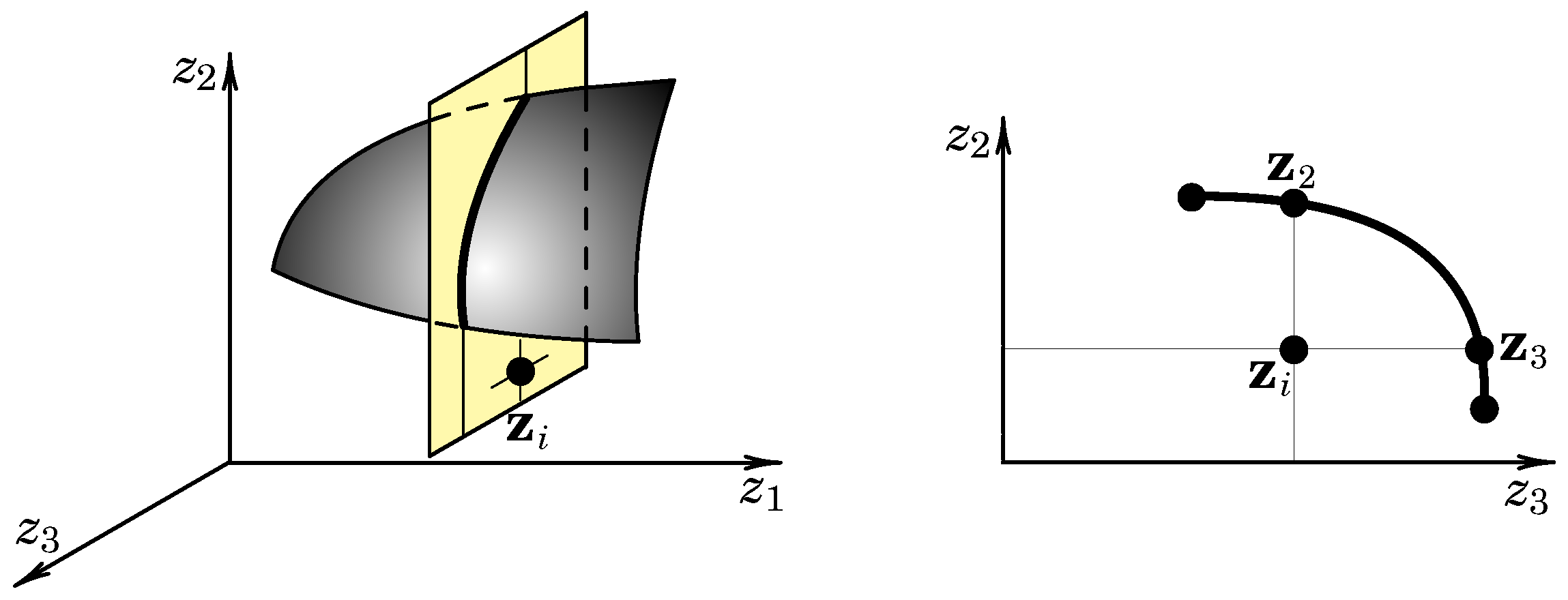
Graphically, we present the mechanism of dominating a carbon offset index in Figure 1. We exploit the nondominated set and pinpoint portfolios which dominate a carbon offset index.
We can compute a carbon offset index by following the stock-market index style of ([2], pp. 104–106). We mark the index as z i in Figure 1. We compute the index’s variance z 1 , such as z 1 = 0.04 . We construct a plane z 1 = 0.04 in the ( z 1 , z 2 , z 3 ) space of (7). We present the plane in yellow in the left part of Figure 1. The plane passes through the index z i . Moreover, the plane intersects the nondominated set of (7) at a thick curve. We present the set as the region in the left part of Figure 1.
Now, we analyze the intersection as a thick curve in ( z 2 , z 3 ) space (in the right part of Figure 1), because all points on the plane share z 1 = 0.04 . We discern that the curve between z 2 and z 3 dominates the index z i in ( z 1 , z 2 , z 3 ) space.
Algebraically, Qi ([81], pp. 504–505) proves the following theorem to dominate carbon offset indexes:
Theorem 1.
For (7), investors can locate portfolios z 2 and z 3 on an intersection of the nondominated set. The curve between z 2 and z 3 dominates the carbon offset index.

4.5. A Pilot Empirical Analysis of the Constituents of Shanghai Stock Exchange 50 Index

Again, this paper’s theme is devising carbon offset investments through multiple-objective portfolio selection and exploring multiple-objective capital asset pricing models. We provide a pilot empirical analysis of the constituents of the Shanghai Stock Exchange 50 Index. This analysis aims to test the applicability of this paper’s theme. We will propose larger-scale empirical analyses to further test the applicability in Section 8.

4.5.1. Populating the Parameter in (7)

We propose a scheme of rating carbon offset in Appendix A. We sample the 47 constituents of the Shanghai Stock Exchange 50 Index from 1 January 2020 to 31 December 2022 and rate the constituents’ carbon offsets (we have deposited the rating with evidence at Mendeley Data https://data.mendeley.com/datasets/75xt7jnmtv/1, accessed on 3 January 2026).
We assume the constituents’ carbon offset in 2020 as μ 3 in (7).
We sample the constituents’ monthly returns from 1 January 2020 to 31 December 2020. By the suggestion of Elton et al. ([82], p. 87), we compute the sample means of the constituents’ returns and hence assume the means as μ 2 in (7). We compute the sample covariance matrix of the constituents’ returns and hence assume the matrix as Σ in (7).

4.5.2. Computing the Minimum-Variance Surface (8) and Dominating Carbon Offset Indexes

After populating the parameters in (7), we follow (16)–(23) and compute the minimum-variance surface (8). We have presented (8) in the graphical abstract and introduction. We analytically derive the efficient set, nondominated set, etc (as outlined in Section 4.3).
Moreover, we apply Theorem 1 and pinpoint four portfolios dominating the carbon offset index.
We choose the period from 1 January 2021 to 31 December 2022 as our sample and try to check the domination.The four portfolios dominate the carbon offset index in carbon offset at the 10% significance level but cannot dominate the carbon offset index in return.

4.6. Analyzing the Four Dominating Portfolios for Their Composition, Association with the Multiple Tangency, and Financial Explanation for Decision-Making

In this subsection, we analyze the four dominating portfolios (as calculated in the previous subsection) for their composition, association with the multiple tangency, and financial explanation for decision-making. The portfolios are theoretically important, because they connect multiple-objective portfolio selection and multiple-objective capital asset pricing models. The portfolios are practically important because investors deploy them for carbon offset investments.
First, for the compositions, we deploy (7) with 47 stocks (or constituents), so each portfolio is composed of 47 stocks. We typically target the stocks with the largest portfolio weights. Uniformly, the four portfolios all have Stock 601,012 as the largest portfolio weight and Stock 601,088 as the second largest portfolio weight (In the USA, stocks are symboled by some letters (e.g., MSFT for Microsoft). In China, stocks are symboled by six digits). Moreover, the four portfolios all have a relatively similar selection of five stocks as their five largest portfolio weights. This uniform result can be considered a positive outcome for multiple-objective portfolio selection and may demonstrate some kinds of stability for the optimal solutions.
Second, we study the sector information for Stock 601,012 and Stock 601,088. Stock 601,012 belongs to the green-energy sector and has been actively involved in carbon offset. Stock 601,088 belongs to the coal-mining sector, is the leading company of the sector, and has been actively launching carbon offset projects in its operations. It is promising that the four portfolios uniformly have Stock 601,012 and Stock 601,088 as their two largest portfolio weights because the result is consistent with the very nature of carbon offset investments.
Third, we will numerically verify multiple tangent lines with multiple tangent portfolios for multiple-objective capital asset pricing models in Section 5. The four dominating portfolios can become the tangent portfolios due to their dominating properties. Moreover, by Assumption 2, the tangent portfolios can become the market portfolio. Therefore, we compare the dominating portfolios’ composition with the market portfolio’s composition. Overall, the two compositions tend to be relatively similar. The relative similarity is promising for advancing from multiple-objective portfolio selection to multiple-objective capital asset pricing models. In contrast, Hirschberger et al. [30] and Qi [83] utilize relatively practical multiple-objective portfolio selection models and report that their optimal portfolios uniformly contain relatively few stocks (i.e., numerous zero elements in the portfolio weight vectors). Consequently, their optimal portfolios are quite distinctive from the market portfolio that contains all the stocks.
Last, we summarize the result for investors’ financial decision. Provisionally, multiple-objective portfolio selection models can provide stable results. The results are consistent with the nature of carbon offset investments. The results are encouraging for studying multiple-objective capital asset pricing models, so investors can capitalize on multiple-objective portfolio selection and multiple-objective capital asset pricing models.

5. On Exploring Multiple-Objective Capital Asset Pricing Models: Numerically Verifying Many Tangent Lines

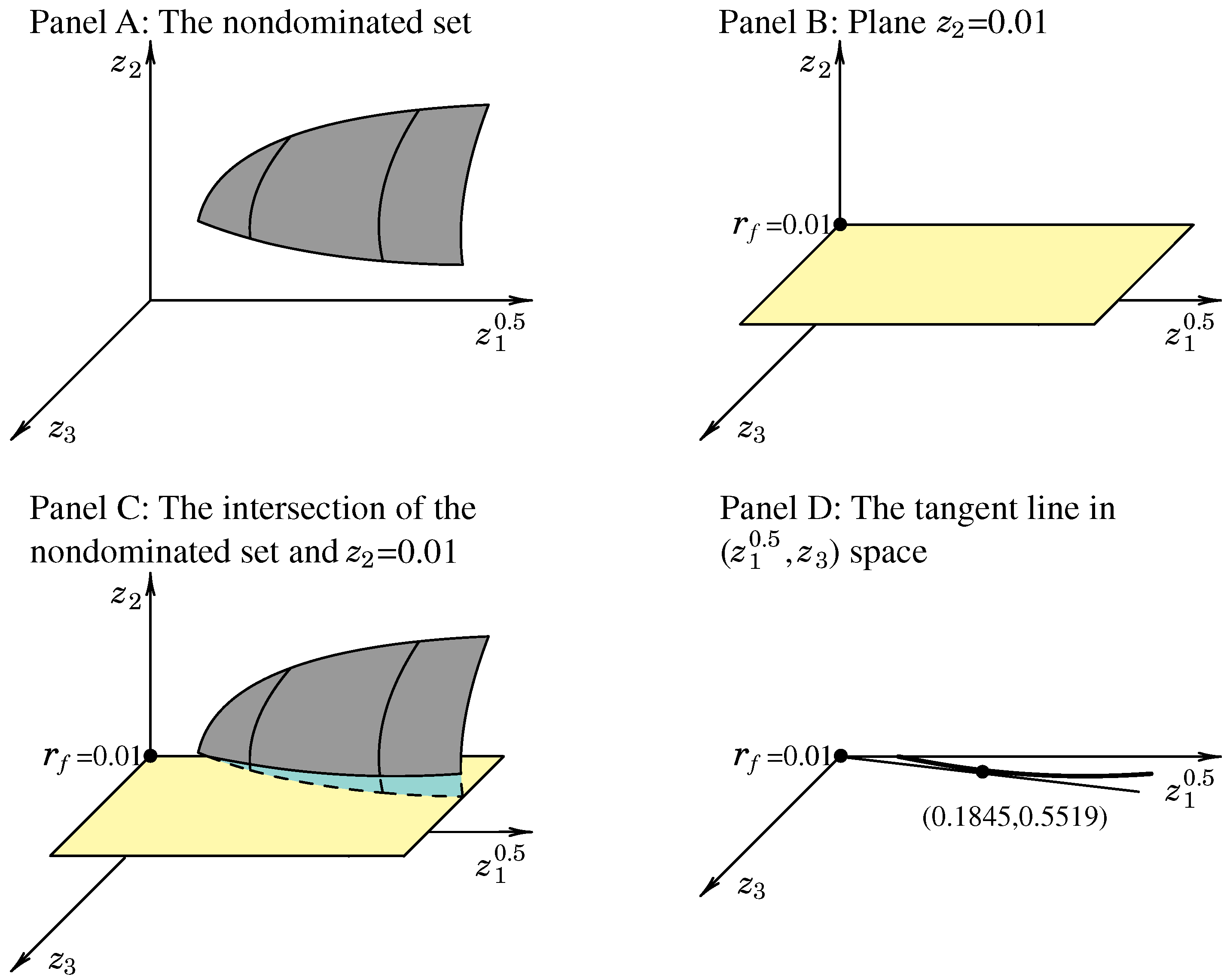
In this section, we explore multiple-objective capital asset pricing models. We increase the difficulty by numerically verifying many tangent lines which are tangent to the nondominated set of (7) and pass through the risk-free asset r f = 0.01 in ( z 1 0.5 , z 2 , z 3 ) space. In contrast, traditionally, there exists only one tangent line which is tangent to the nondominated set of (2) and passes through the risk-free asset r f in ( z 1 0.5 , z 2 ) space. We then suggest a tangent plane (instead of tangent lines) to hopefully locate the unique tangency.
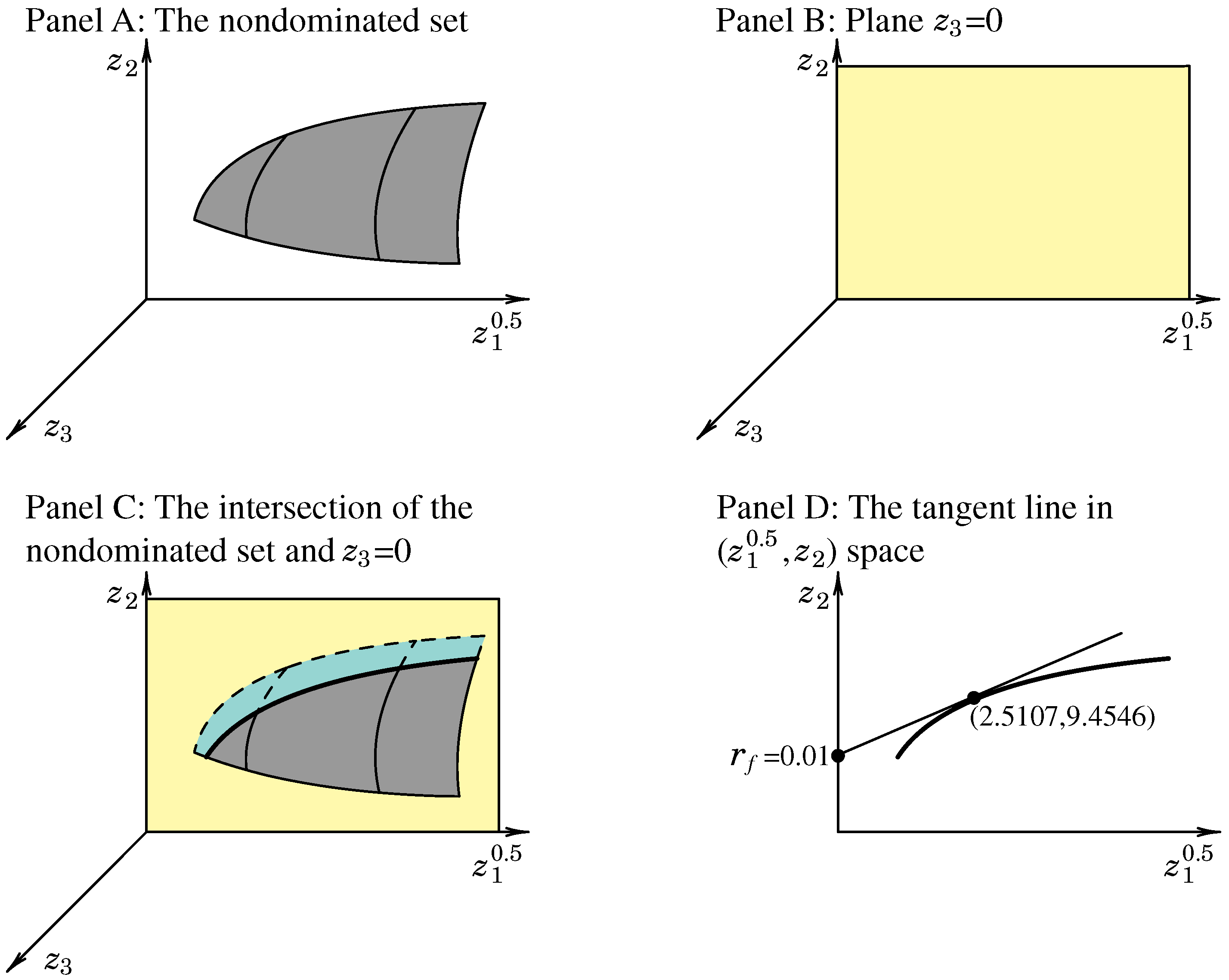
Directly computing tangent lines in ( z 1 0.5 , z 2 , z 3 ) space can be obscure. Therefore, for the risk-free asset r f = 0.01 (i.e., ( 0 , 0.01 , 0 ) in ( z 1 0.5 , z 2 , z 3 ) space), we exploit the third element z 3 = 0 . In particular, we select the plane z 3 = 0 , study the intersection between z 3 = 0 and the nondominated set of (7), and directly observe the tangency in two-dimensional space.
Likewise, we exploit the second element z 2 = 0.01 for the risk-free asset r f = 0.01 . Specifically, we select the plane z 2 = 0.01 , study the intersection between z 2 = 0.01 and the nondominated set of (7), and directly observe the tangency in two-dimensional space.

5.1. Calculating the First Tangent Line by the Plane z 3 = 0

We present the calculation method in Figure 2. In Panel A, we plot the nondominated set of (7) in ( z 1 0.5 , z 2 , z 3 ) space. In Panel B, we select a plane z 3 = 0 . In Panel C, we draw the intersection of the nondominated set and z 3 = 0 and mark the intersection by a thick curve. In Panel D, we visualize in ( z 1 0.5 , z 2 ) space with z 3 = 0 and calculate the tangent line which passes through r f and is tangent to the intersection. Eventually, we restore the tangency back to ( z 1 0.5 , z 2 , z 3 ) space.

5.1.1. Determining the Intersection of Figure 2A–C

In Section 5, we have followed (16)–(23) and computed the minimum-variance surface (8). In the graphical abstract and introduction, we have presented (8). In Section 4, we have established the nondominated set as a segment of the minimum-variance surface. We restate (8) in ( z 1 0.5 , z 2 , z 3 ) space as follows:
z 1 0.5 = ( 0.0724 z 2 2 0.0028 z 2 z 3 + 0.6196 z 3 2 0.0342 z 2 0.5605 z 3 + 0.1550 ) 0.5
Given that this paper’s contributions are to numerically verify many tangent lines (as some difficulties in the process of obtaining multiple-objective capital asset pricing models), we choose a convenient z 3 for simpler computations. We choose z 3 = 0 and substitute z 3 = 0 to (28) and determine the intersection (as a hyperbola) as follows:
z 1 0.5 = ( 0.0724 z 2 2 0.0342 z 2 + 0.1550 ) 0.5

5.1.2. Calculating the Tangency of Figure 2D

We suppose the tangent point on (29) in ( z 1 0.5 , z 2 ) space as follows:
z 1 0.5 z 2
We fix a line by connecting z 1 0.5 z 2 (30) and 0 r f with r f = 0.01 . We estimate the line slope as follows:
z 1 0.5 0 z 2 0.01
Larson and Edwards ([84], p. 102) exhibit calculating tangent lines. We follow Larson and Edwards ([84], pp. 102 and 111) and compute the derivative at (30) as follows:
d ( z 1 0.5 ) d z 2 = 0.1448 z 2 0.0342 2 z 1 0.5
For the tangent line, its slope equals the derivative. We equate (31) and (32) and rearrange as follows:
0.1448 z 2 0.0342 2 z 1 0.5 = z 1 0.5 z 2 0.01 ( 0.1448 z 2 0.0342 ) ( z 2 0.01 ) = 2 z 1
We substitute z 1 of (29) into (33) as follows:
( 0.1448 z 2 0.0342 ) ( z 2 0.01 ) = 2 ( 0.0724 z 2 2 0.0342 z 2 + 0.1550 )
We solve (34) and compute the root z 2 as follows:
z 2 9.4546
We substitute (35) into (29) and compute z 1 0.5 as follows:
z 1 0.5 2.5107
So far, we have calculated the tangent point (30) by (35) and (36) as follows:
2.5107 9.4546
Finally, we calculate the tangent line by connecting z 1 0.5 z 2 (30) and 0 r f with r f = 0.01 as follows:
z 2 = 3.7617 z 1 0.5 + 0.01

5.1.3. Restoring the Tangency Back in ( z 1 0.5 , z 2 , z 3 ) Space

By our computations (30)–(37) in ( z 1 0.5 , z 2 ) space, we readily add z 3 = 0 and restore the tangent point in ( z 1 0.5 , z 2 , z 3 ) space as follows:
2.5107 9.4546 0
Meanwhile, we fully acknowledge that the restoration is a trivial bookkeeping and not a formal methodological achievement.
Similarly, we restore the tangent line in ( z 1 0.5 , z 2 , z 3 ) space as follows:
z 2 = 3.7617 z 1 0.5 + 0.01 z 3 = 0

5.2. Calculating the Second Tangent Line by the Plane z 2 = 0.01

5.2.1. Determining the Intersection

Given that this paper’s contribution is to numerically verify many tangent lines (as some difficulties in the process of obtaining multiple-objective capital asset pricing models), we choose a convenient z 2 for simpler computations.
We choose z 2 = 0.01 and substitute z 2 = 0.01 to (28) and determine the intersection (as a hyperbola) as follows:
z 1 0.5 = ( 0.6196 z 3 2 0.560528 z 3 + 0.154665 ) 0.5

5.2.2. Calculating the Tangency

We suppose the tangent point on (38) in ( z 1 0.5 , z 3 ) space as follows:
z 1 0.5 z 3
We fix a line by connecting z 1 0.5 z 3 (39) and 0 0 . We estimate the line slope as follows (see also Figure 3):
z 1 0.5 z 3
Larson and Edwards ([84], p. 102) describe calculating tangent lines.We follow Larson and Edwards ([84], pp. 102 and 111) and compute the derivative at (39) as follows:
d ( z 1 0.5 ) d z 3 = 1.2392 z 3 0.560528 2 z 1 0.5
For the tangent line, its slope equals the derivative. We equate (40) and (41) and rearrange as follows:
1.2392 z 3 0.560528 2 z 1 0.5 = z 1 0.5 z 3 ( 1.2392 z 3 0.560528 ) z 3 = 2 z 1
We substitute z 1 of (38) into (42) and compute the root z 3 as follows:
z 3 0.5519
We substitute (43) into (38) and compute z 1 0.5 as follows:
z 1 0.5 0.1845
So far, we have calculated the tangent point (39) by (43)–(44) as follows:
0.1845 0.5519
Finally, we calculate the tangent line by connecting z 1 0.5 z 3 (39) and 0 0 as follows:
z 3 = 2.9913 z 1 0.5

5.2.3. Restoring the Tangency Back in ( z 1 0.5 , z 2 , z 3 ) Space

Through our computations (39)–(45) in ( z 1 0.5 , z 3 ) space, we readily add z 2 = 0.01 and restore the tangent point in ( z 1 0.5 , z 2 , z 3 ) space as follows:
0.1845 0.01 0.5519
Similarly, we restore the tangent line in ( z 1 0.5 , z 2 , z 3 ) space as follows:
z 3 = 2.9913 z 1 0.5 z 2 = 0.01

5.3. Generalizing from the First and Second Tangent Lines to Multiple Tangent Lines

In the previous two subsections, with r f = 0.01 (i.e., ( 0 , 0.01 , 0 ) in ( z 1 0.5 , z 2 , z 3 ) space), we calculate the first tangent line by selecting a plane z 3 = 0 and calculate the second tangent line by selecting a plane z 2 = 0.01 . Likewise, we can calculate more tangent lines by selecting more planes passing through r f = 0.01 .
Therefore, we can generalize from the first and second tangent lines to multiple tangent lines. Namely, we can numerically verify that there are many tangent lines which pass through the risk-free asset r f and are tangent to the nondominated set of (7).

5.4. Suggesting a Tangent Plane to Hopefully Achieve the Unique Tangency

Therefore, there exist many tangent lines with many tangent portfolios for multiple-objective capital asset pricing models by (7) (instead of only one tangent line with only one tangent portfolio for capital asset pricing models (3)).
With the aim to try to locate only one tangent portfolio for (7), we suggest researching the existence of a tangent plane which passes through the risk-free asset r f and is tangent to the nondominated set of (7). Our suggestion is new and worth researching because current scholars (as emphasized in Section 1.8) do not report such a suggestion in their surveys. Meanwhile, we fully acknowledge that the suggestion for a tangent plane is a speculation and that we will keep researching.

5.5. The Assumptions and Equilibrium Conditions for Multiple-Objective Capital Asset Pricing Models

In order to advance from portfolio selection (2) to capital asset pricing models, (3), Sharpe [14] and then Bodie et al. ([2], p. 284) suggest that all investors act homogenously and stock markets behave well as follows:
Assumption 1.
All investors utilize portfolio selection (2). All investors target a common time period and pick a common set of data for the parameters of (2). Stock markets behave without friction. Namely, investors can short without limits and pay neither taxes nor trading costs.
Sharpe [14] and Bodie et al. ([2], pp. 288–291) deduce the market portfolio as all investors’ common choice, compute a stock’s contribution to the risk of the market portfolio, and obtain capital asset pricing models (3).
In order to advance from multiple-objective portfolio selection (7) to multiple-objective capital asset pricing models, we attempt to extend Assumption 1 and suggest that all investors act homogenously and stock markets behave well as follows:
Assumption 2.
All investors utilize multiple-objective portfolio selection (7). All investors target a common time period and pick a common set of data for the parameters of (7). Stock markets and carbon offset markets behave without friction. Namely, investors can short without limits and pay neither taxes nor trading costs. All investors extend the tangent line method for capital asset pricing models (3) and obtain a unique tangent portfolio (preferably as the market portfolio) by the extension.
Hopefully, we can deduce the market portfolio from all investors’ common choice, compute stock returns’ and carbon offsets’ contribution to the risk of the market portfolio, and extend (3).

6. On Exploring Multiple-Objective Zero-Covariance Capital Asset Pricing Models: Suggesting an Advantageous Zero-Covariance Portfolio

In this section, we further justify multiple-objective zero-covariance capital asset pricing models and compute a set of zero-covariance portfolios (instead of traditionally only one zero-covariance portfolio). We suggest selecting an advantageous zero-covariance portfolio from the set.

6.1. Further Justifying Multiple-Objective Zero-Covariance Capital Asset Pricing Models

To the best of our knowledge, there scant research exists on multiple-objective zero-covariance capital asset pricing models. We have justified multiple-objective zero-covariance capital asset pricing models in Section 3.3. We further justify them below.

6.1.1. Additional Advantages of Zero-Covariance Capital Asset Pricing Models

In Section 3.3, we have demonstrated the integrity of the methodology of advancing from portfolio selection to zero-covariance capital asset pricing models. We now demonstrate that zero-covariance capital asset pricing models possess the following additional advantages and disadvantages:
  • Capital asset pricing models require the market portfolio. The market portfolio is theoretically well-founded but practically unobservable. This unobservability brings nontrivial difficulties to testing capital asset pricing models, although proxies of the market portfolio are utilized. In contrast, zero-covariance capital asset pricing models require a nondominated portfolio r p on the minimum-variance frontier (as presented in Panel D of the graphical abstract). Advantageously, the nondominated portfolio is theoretically well-founded and practically observable.
  • Disadvantageously, the choice among nondominated portfolios is not uniform. Namely, different investors could pick different nondominated portfolios.
  • Capital asset pricing models require the market portfolio. The market portfolio can be initially dominated, and a process of dynamic market adjustments finally leads to the nondominated status of the market portfolio. However, the dynamic market adjustments can be inconsistent with the static property of portfolio selection. In contrast, a nondominated portfolio r p on the minimum-variance frontier is initially nondominated. Advantageously, this initially nondominated status is consistent with the static property of portfolio selection.

6.1.2. Additional Advantages of Multiple-Objective Zero-Covariance Capital Asset Pricing Models

We have demonstrated the additional advantages of zero-covariance capital asset pricing models in the previous subsubsection. The advantages also hold for multiple-objective zero-covariance capital asset pricing models, except that investors select a nondominated portfolio r p on the minimum-variance surface (as presented in Panel G of the graphical abstract).
Moreover, practically, a nondominated portfolio r p on the minimum-variance surface can serve as a new financial product for carbon offset investments, as no such product exists (as reviewed in Section 2.3).

6.2. Computing a Set of Zero-Covariance Portfolios for (7)

For (2), refs. [16] and ([15], pp. 266–268) prove that there exists one unique zero-covariance portfolio in the following theorem:
Theorem 2.
On the minimum-variance frontier of (2), except the minimum-variance portfolio, for any portfolio (frontier portfolio) r p , there exists a unique frontier portfolio r z c p , so the covariance between r p and r z c p is zero (i.e., c o v ( r p , r z c p ) = 0 ).
For (7) as extensions for (2), Qi et al. [73] prove that there exists a set of zero-covariance portfolios in the following theorem:
Theorem 3.
On the minimum-variance surface of (7), except the minimum-variance portfolio, for any surface portfolio r p , there exists the following set of surface portfolios r z c p , so the covariance between r p and r z c p is zero (i.e., c o v ( r p , r z c p ) = 0 ):
{ z 1 b a 2 z 3 a 1 z 3 z 3 R , z 1 = 1 | C | b a 2 z 3 a 1 z 3 1 T d f e 2 c e b f b e c d c e b f a f c 2 b c a e b e c d b c a e a d b 2 b a 2 z 3 a 1 z 3 1 }
For the minimum-variance surface (8), we choose r p as follows:
r p = 0.1660 1.6241 0.5399
We apply Theorem 3 with (46) and compute the set (9) of zero-covariance portfolios. In Panel G of the graphical abstract, we have presented (9).

6.3. Suggesting an Advantageous Zero-Covariance Portfolio

In the previous subsection, we have demonstrated the set (9) of zero-covariance portfolios for multiple-objective zero-covariance capital asset pricing models (instead of only one zero-covariance portfolio for zero-covariance capital asset pricing models (5)).
Then, how do investors choose a unique or special zero-covariance portfolio from this set? As one provisional solution, we suggest picking an advantageous zero-covariance portfolio in the set (9). For instance, we substitute z 3 = 0 into (9) and pick an advantageous zero-covariance portfolio as follows:
0.1510 0.2411 0
As we argue in Section 3,
  • there quite limited research exists on multiple-objective capital asset pricing models;
  • this paper’s methodology is to logically advance from multiple-objective portfolio selection to multiple-objective capital asset pricing models, whereas the literature typically covers multiple-objective portfolio selection alone and barely covers multiple-objective capital asset pricing models; and
  • this paper numerically demonstrates some difficulties in the process of obtaining multiple-objective zero-covariance capital asset pricing models.
Meanwhile, we fully acknowledge that our suggestion is speculative and that we will keep researching.

6.4. The Assumptions and Equilibrium Conditions for Multiple-Objective Zero-Covariance Capital Asset Pricing Models

In order to advance from portfolio selection (2) to zero-covariance capital asset pricing models (5), Fama ([15], pp. 266–268), Black [16], and Roll [17] suggest that all investors act homogeneously and stock markets behave well as follows:
Assumption 3.
All investors utilize portfolio selection (2). All investors target a common time period and pick a common set of data for the parameters of (2). On the minimum-variance frontier, all investors choose the common r p and its zero-covariance portfolio r z c p . Stock markets behave without friction. Namely, investors can short without limits and pay neither taxes nor trading costs.
In order to advance from multiple-objective portfolio selection (7) to multiple-objective zero-covariance capital asset pricing models, we attempt to extend Assumption 3 and suggest that all investors act homogeneously and stock markets behave well as follows:
Assumption 4.
All investors utilize multiple-objective portfolio selection (7). All investors target a common time period and pick a common set of data for the parameters of (7). Stock markets and carbon offset markets behave without friction. Namely, investors can short without limits and pay neither taxes nor trading costs. On the minimum-variance surface, investors all determine the common r p , and investors all follow an advantageous approach and determine the common zero-covariance portfolio r z c p .
By Assumption 4, we can reach an equilibrium, price by r p and r z c p , and extend (5).

6.5. Empirical Limitations of Assumption 4 and Realistic Comparison with Alternative Models

Although Assumption 4 is based on Assumption 3 and thus theoretically logical, Assumption 4 can have the following empirical limitations:
  • Investors do not necessarily all deploy multiple-objective portfolio selection for carbon offset investments. Some investors may deploy utility functions. Additionally, the constraint 1 T x = 1 in (7) allows unrealistically unlimited short sales. Therefore, investors may impose more constraints even if they deploy multiple-objective portfolio selection.
  • As a set, the minimum-variance surface contains uncountably many portfolios, so investors may locate distinctive portfolios as r p .
  • Investors may focus on distinctive time horizons and collect distinctive sets of information for the input parameters for (7).
  • Stock markets and carbon offset markets behave with friction. Namely, investors short with limits and pay trading costs and taxes.
We further realistically compare multiple-objective zero-covariance capital asset pricing models with the asset pricing models of Alessi et al. [5] as follows:
  • Overall, the methodology of advancing from multiple-objective portfolio selection to multiple-objective zero-covariance capital asset pricing models is theoretically integral, but the methodology can have empirical limitations. In contrast, the models of Alessi et al. [5] realistically demonstrate the asset pricing relationship for the time period from January 2006 to August 2020, but the models’ foundation is empirical and may not work for other time periods.
  • As to assumptions, multiple-objective zero-covariance capital asset pricing models require strong and even ideal assumptions. In contrast, while the models of Alessi et al. [5] require practical assumptions.
  • As to the factors of asset pricing, multiple-objective zero-covariance capital asset pricing models always require exactly two factors (i.e., portfolio r p and its zero-covariance portfolio r z c p ). In contrast, the models of Alessi et al. [5] can require several factors and, moreover, do not ascertain which specific factors before studying the specific time period from January 2006 to August 2020.
  • For the research integrity, the methodology of advancing from multiple-objective portfolio selection to multiple-objective zero-covariance capital asset pricing models is logical, and the research for multiple-objective portfolio selection and the research for multiple-objective zero-covariance capital asset pricing models benefit each other. Meanwhile, the connection between portfolio selection and the models of Alessi et al. [5] is tenuous. Investors can acknowledge the specific result for the time period from January 2006 to August 2020 but can have difficulties in making decision now.

7. Generalization for Second-Level Indicators of Carbon Offset

In previous sections, we reflect carbon offset as the first-level indicator in rating carbon offset, and we formulate carbon offset in (7). In this section, we acknowledge the multi-faceted nature of the second-level indicators in rating carbon offset. We formulate the second-level indicators in (10) and (11). Moreover, we initially discuss the leap from the formulation to multiple-objective capital asset pricing models.

7.1. Fully Optimizing (10)

Barely any research exists on methodically optimizing general eight-objective portfolio selection. Providentially, analytical methods to resolve (10) exist. Qi and Steuer [85] analytically derive the minimum-variance surface of (10) as follows:
z 1 = z 2 z 8 b T ( μ 2 T μ 8 T A T Σ 1 μ 2 μ 8 A ) 1 z 2 z 8 b
Qi and Steuer [85] analytically derive the efficient set of (10) as follows:
{ x R n x = x m v + λ 2 η 2 + + λ 8 η 8 , λ 2 0 , , λ 8 0 }
where
x m v = Σ 1 A ( A T Σ 1 A ) 1 b
η 2 = 1 2 Σ 1 ( I n A ( A T Σ 1 A ) 1 A T Σ 1 ) μ 2
η 8 = 1 2 Σ 1 ( I n A ( A T Σ 1 A ) 1 A T Σ 1 ) μ 8
In (50) and (51), I n is an n × n identity matrix.
Geometrically, (48) is a translated cone. Namely, the cone is generated by η 2 η 8 at the origin of R n and is translated to x m v . From (48)–(51), Qi and Steuer [85] gain the parametric expression of the nondominated set of (10) and prove the set to be a paraboloidal segment.
So far, for (10), the efficient set, nondominated set, and minimum-variance surface have been fully calculated.

7.2. Optimizing (11) for Properly Efficient Sets (Instead of Efficient Sets)

Barely any research on methodically optimizing general 14-objective portfolio selection (especially with multiple quadratic objectives) exists. Providentially, analytical methods to resolve (11) for properly efficient sets (instead of efficient sets) exist. With λ 2 > 0 , , λ 14 > 0 , Qi and Steuer [86] utilize weighted-sum methods (11) to (14) as follows:
min ( x T Σ 2 x + λ 2 x T Σ 3 x + + λ 7 x T Σ 8 x ) ( λ 8 x T μ 2 + + λ 14 x T μ 8 ) subject to A T x = b
Qi and Steuer [86] analytically derive the properly efficient set of (11) as follows:
{ x R n x = x m v + λ 8 η 8 + + λ 14 η 14 , λ 2 > 0 , , λ 14 > 0 }
where
Φ = Σ 2 + λ 2 Σ 3 + + λ 7 Σ 8
x m v = Φ 1 A ( A T Φ 1 A ) 1 b
η 8 = 1 2 Φ 1 ( I n A ( A T Φ 1 A ) 1 A T Φ 1 ) μ 2
η 14 = 1 2 Φ 1 ( I n A ( A T Φ 1 A ) 1 A T Φ 1 ) μ 8
Qi and Steuer [86] prove the properly efficient set of (11) to be sequences of translated cones. Through (53)–(57), Qi and Steuer [86] gain the parametric expression of the properly nondominated set of (11) but do not determine the set’s structure.
So far, for (11), the properly efficient set and properly nondominated set have been fully calculated.

7.3. Advancing from (10) or (11) to Multiple-Objective Capital Asset Pricing Models

Advancing from (10) or (11) to multiple-objective capital asset pricing models is complex.
First, the computations required for eight objectives are much more complex than those for three objectives. In particular, for the minimum-variance surface (47) of (10), we miss the analytical expression of the following ( 8 1 + m ) × ( 8 1 + m ) matrix:
( ( μ 2 T μ 8 T A T Σ 1 μ 2 μ 8 A ) 1 ) ( 8 1 + m ) × ( 8 1 + m )
Conversely, for the minimum-variance surface (16) of (7), Qi et al. ([32], p. 169) obtain the analytical expression (16)–(23) of the 3 × 3 matrix by the favorable characters of 3 × 3 matrix C in (17).
Second, due to the complexity of (11), Qi and Steuer [86] do not demonstrate the properties of the properly nondominated set. Therefore, determining a tangent line to the properly nondominated set with unknown properties is difficult. Conversely, Qi et al. [32] prove the paraboloidal property of the nondominated set of (7) (as reviewed in Section 4.3).

8. Conclusions

In this section, we discuss future directions and the applicability of this paper. We summarize the contributions and limitations of this paper and conclude.

8.1. Future Directions

This paper attempts to serve as a didactic bridge between the classical methodology of advancing from portfolio selection to capital asset pricing models and the extended methodology of advancing from multiple-objective portfolio selection to multiple-objective capital asset pricing models. Therefore, the style is theoretical and pedagogical. Meanwhile, we do realize this paper’s limitations in terms of practicability and list them for future directions.

8.1.1. Considering Arbitrage Components

Equation (7) is based on ideal markets instead of real markets. In reality, arbitrage opportunities in carbon offset investments arise because carbon offset markets are fragmented across standards, instruments, time horizons, etc. These frictions constitute pricing inefficiencies. Therefore, we shall consider arbitrage components.
Carbon offset markets can be classified into
The two types of markets function differently. For instance, compliance carbon offset markets enact mandatory legal obligations, while voluntary carbon offset markets enact optional legal obligations. The participants in compliance carbon offset markets are mostly regulated companies, while the participants in voluntary carbon offset markets could be any company or even individuals. At a given moment, the prices of a financial product in compliance carbon offset markets tend to be conclusive, while the prices of a financial product in voluntary carbon offset markets tend to be tentative.
Due to the fact that a company may offer financial products on both compliance carbon offset markets and voluntary carbon offset markets, the difference between the two types of markets can impose different pricing mechanisms. The different pricing mechanisms can create arbitrage opportunities.
In the future, we will evaluate the arbitrage components’ impact on multiple-objective portfolio selection and attempt to reliably apply multiple-objective portfolio selection and estimate the parameter under the impacts.

8.1.2. Considering Country Premiums

In carbon offset investments, a country premium refers to the additional risk-based return which investors require, because the project or financial product is located in a particular country. Simply, a country premium is the extra compensation which investors demand for country-specific risks. Overall for country premiums, Erb et al. [87] analyze different measures of country risk and link the the measures to expected returns.
International investors pay special attentions to carbon offset projects or carbon offset financial products located in emerging markets because the countries may carry higher risks, such as contract enforcement problems, weak rule of law, regulatory uncertainty, etc.
In the future, we may restrict the usage of multiple-objective portfolio selection to a specific country and the domestic investors.

8.1.3. Comparing Multiple-Objective Portfolio Selection with the Utility Approach

Von Neumann and Morgenstern [88] systematically describe utility functions and propose maximizing expected utility functions as a fundamental principle for persons’ choices under uncertainty. Campbell [13] describes the application in the portfolio selection. Qi and Steuer [86] extend utility functions and describe the application in multiple-objective portfolio selection.
Generally, maximizing expected utility functions or maximizing expected extended utility functions is more compatible with economic theory than portfolio selection or multiple-objective portfolio selection are (as described by von Neumann and Morgenstern [88] and argued by Campbell [13]).
However, computationally and thus practically, maximizing expected utility functions or maximizing expected extended utility functions is more complex than portfolio selection or multiple-objective portfolio selection is, for the following reasons: First, investors should determine a specific utility function or extended utility function. Second, investors should estimate stock returns’ joint distribution and determine a portfolio return’s distribution. Last, investors should maximize expected utility function or expected extended utility function.
However, the comparison also depends on the number of objectives for multiple-objective portfolio selection. For instance, the computational complexity for (11) with 14 objectives can be exponentially higher than the computational complexity for (7) with 3 objectives.
Therefore, we will compare multiple-objective portfolio selection with the utility approach in the future with respect to the estimation process, optimization process, and number of objectives.

8.1.4. Algebraically Proving Many Tangent Lines for Multiple-Objective Capital Asset Pricing Models

This paper’s contributions are to numerically verify many tangent lines (as some difficulties in the process of obtaining multiple-objective capital asset pricing models) in Section 5. We compute and verify by specific numbers (e.g., (8) in the introduction and z 3 = 0 in Section 5).
In the future, we will attempt to algebraically prove many tangent lines. However, the proof will be highly demanding because we will use all symbols (e.g., (16) in Section 4 and z 3 in Section 5). Moreover, we may use advanced math (e.g., abstract algebra by Judson [89] and functional analysis by Stein and Shakarchi [90]), because we are using just calculus for numerical computations in Section 4, Section 5 and Section 6.

8.1.5. Pursuing Larger-Scale Empirical Analyses to Further Test the Applicability of This Paper

In Section 4, we provide a pilot empirical analysis of the constituents of the Shanghai Stock Exchange 50 Index. This analysis aims to test the applicability of this paper’s theme: devising carbon offset investments through multiple-objective portfolio selection and exploring multiple-objective capital asset pricing models.
We will pursue larger-scale empirical analyses to further test the applicability. For instance, we could augment the number of stocks by considering the 500 constituents of the S&P 500 Index. We could enhance the rating of carbon offset by considering quarterly evaluations (instead of annual evaluations).

8.2. Applicability of This Paper

As to the application of portfolio selection, although portfolio selection is unanimously acclaimed as the origin of modern finance, some scholars criticize portfolio selection especially for its application. For instance, Michaud [91] considers the estimation errors and contends that the optimal portfolios can become extreme and unstable. Jagannathan and Ma [92] address the intricacy in constructing the constraints. DeMiguel et al. [93] report that equal-weight portfolios outperform the optimal portfolios out of sample. Conversely, some scholars enrich portfolio selection for practice. For instance, in a series of such enrichments, Jacobs et al. [94] augment portfolio selection with factors, scenarios, and short positions. Jacobs [95] reiterates the application for portfolio theory, portfolio insurance, market simulation, and risks of portfolio leverage. Prado et al. [96] enhance portfolio selection with machine learning and discuss the application.
As to the application of multiple-objective portfolio selection, especially in the age of artificial intelligence, behavioral scientists have observed that people can have multiple attributes in reality. For instance, in a series of publications on the basis of actual experiments or interviews, Shefrin and Statman [97] and Statman ([98], pp. x–xii) reveal that investors consider multiple objectives (e.g., social responsibility and patriotism). In artificial intelligence, Zou et al. [99] deploy reinforcement learning for multiple-objective optimization. Choudhary et al. [100] perform reinforcement learning for portfolio optimization on the basis of a multiple-reward approach.
As to the applicability of this paper, in terms the application of portfolio selection and the application of multiple-objective portfolio selection (as presented above), this paper is at least theoretically applicable.Meanwhile, we fully understand the difficulty in the actual application and will consider future directions.

8.3. Contributions and Limitations of This Paper

8.3.1. Contributions

We briefly reiterate this paper’s contributions below. Overall, this paper contributes to the research on carbon offset investments as follows:
  • We devise multiple-objective portfolio selection, fully optimize the models, and dominate carbon offset indexes.
  • We extend the classical methodology of advancing from portfolio selection to capital asset pricing models and explore multiple-objective capital asset pricing models.
The specific contributions are as follows:
  • For multiple-objective capital asset pricing models, we numerically verify many tangencies and suggest a tangent plane.
  • For multiple-objective zero-covariance capital asset pricing models, we numerically compute a set of zero-covariance portfolios and suggest picking an advantageous zero-covariance portfolio.
However, our results are exploratory but not definite.

8.3.2. Limitations

Meanwhile, we fully understand the following limitations of this paper:
  • We construct only one constraint 1 T x = 1 in (7). Although we follow Merton [12] and analytically optimize (7) (instead of utilizing mathematical programming), the constraint 1 T x = 1 allows unrealistically unlimited short sales.
  • The suggestion of a tangent plane in Section 5 is a speculation.
  • The suggestion for picking an advantageous zero-covariance portfolio in Section 6 is speculative.

8.4. Concluding Remarks

Markowitz ([10], p. 83) pioneered portfolio selection. Sharpe [14] pioneered capital asset pricing models. Fama ([15], pp. 266–268) and Roll [17] enriched the area with zero-covariance capital asset pricing models.
Researchers have extended portfolio selection (1) into multiple-objective portfolio selection (6) and continue to explore multiple-objective capital asset pricing models. Researchers are proceeding steadily.

Author Contributions

Conceptualization, Y.Q.; methodology, Y.Q.; software, J.H.; validation, Y.L.; formal analysis, Z.Q.; investigation, Y.L.; resources, Z.Q.; data curation, J.H.; writing—original draft preparation, Y.Q.; writing—review and editing, Y.Q.; visualization, Y.L.; supervision, J.H.; project administration, Z.Q. All authors have read and agreed to the published version of the manuscript.

Funding

This research received no external funding.

Data Availability Statement

The original data presented in the study are openly available in Mendeley Data at https://data.mendeley.com/datasets/75xt7jnmtv/1 (accessed on 3 January 2026).

Acknowledgments

We would very much like to thank the two anonymous reviewers for their highly constructive comments.

Conflicts of Interest

The authors declare no conflicts of interest.

Appendix A. Rating Carbon Offset

In rating carbon offset, Engler et al. [101] emphasize the importance of corporate characters. Qing et al. [102] analyze corporate ecological and economic performance, highlight the importance of carbon offset investments, and explain the benefit to society.
From the research above, we propose a scheme of rating carbon offset in Figure A1. We classify carbon offset into four levels of indicators and designate carbon offset as the first-level indicator. We set 6 second-level indicators (e.g., transition pressure), 20 third-level indicators (e.g., industry pressure), and 54 fourth-level indicators (e.g., high-carbon industry).
We set all fourth-level indicators as annual binary variables. We evaluate the indicators by searching corporate performance through the corporate websites, industry associations, government agencies, and others. We assign a fourth-level indicator as 1 with supportive evidence or as 0 without supportive evidence. We sum all fourth-level indicators under a third-level indicator and assign the sum to the third-level indicator. For instance, we sum high-carbon industry and green industry and assign the sum to industry pressure.
Likewise, we sum all third-level indicators under a second-level indicator and assign the sum to the second-level indicator. For instance, we sum industry pressure, regional pressure, and corporate pressure and assign the sum to transition pressure.
Likewise, we sum all second-level indicators and assign the sum to the first-level indicator. For instance, we sum transition pressure to information disclosure and assign the sum to carbon offset.
We annually rate the 47 constituents of the Shanghai Stock Exchange 50 Index from 1 January 2020 to 31 December 2022.
Figure A1. Rating carbon offset.
Mathematics 14 01080 g0a1

References

  1. Xue, J.; Dai, X.; Xiao, L.; Wang, Q.; Li, M.C. Multi-objective carbon-energy portfolio optimization under investment horizon heterogeneity. Res. Int. Bus. Financ. 2025, 79, 103036. [Google Scholar]
  2. Bodie, Z.; Kane, A.; Marcus, A.J. Investments, 13th ed.; McGraw Hill LLC: New York, NY, USA, 2024. [Google Scholar]
  3. Chen, A.; Gerick, L.; Jin, Z. Optimizing portfolios under carbon risk constraints: Setting effective constraints to favor green investments. Energy Econ. 2025, 148, 108634. [Google Scholar] [CrossRef]
  4. Markowitz, H.M. Normative portfolio analysis: Past, present, and future. J. Econ. Bus. 1990, 42, 99–103. [Google Scholar] [CrossRef]
  5. Alessi, L.; Ossola, E.; Panzica, R. When do investors go green? Evidence from a time-varying asset-pricing model. Int. Rev. Financ. Anal. 2023, 90, 102898. [Google Scholar]
  6. Rubinstein, M. Markowitz’s “portfolio selection”: A fifty-year retrospective. J. Financ. 2002, 57, 1041–1045. [Google Scholar]
  7. Fabozzi, F.J.; Jacobs, B.I.; Levy, K.N. Editors’ introduction: The birth of portfolio theory. J. Portf. Manag. 2024, 50, 2–5. [Google Scholar] [CrossRef]
  8. Guerard, J.B. Investments: The (almost) century of Markowitz Harry Markowitz: Portfolio selection scholar, simulation creator, and applied investment researcher and consultant extraordinaire. Ann. Oper. Res. 2025, 346, 1–8. [Google Scholar] [CrossRef]
  9. Markowitz, H.M. Portfolio Selection: Efficient Diversification in Investments, 1st ed.; John Wiley & Sons: New York, NY, USA, 1959. [Google Scholar]
  10. Markowitz, H.M. Portfolio Selection. J. Financ. 1952, 7, 77–91. [Google Scholar]
  11. Sharpe, W.F. Portfolio Theory and Capital Markets, 1st ed.; McGraw-Hill: New York, NY, USA, 1970. [Google Scholar]
  12. Merton, R.C. An analytical derivation of the efficient portfolio frontier. J. Financ. Quant. Anal. 1972, 7, 1851–1872. [Google Scholar] [CrossRef]
  13. Campbell, J.Y. Financial Decisions and Markets: A Course in Asset Pricing, 1st ed.; Princeton University Press: Princeton, NJ, USA, 2018. [Google Scholar]
  14. Sharpe, W.F. Capital asset prices: A theory of market equilibrium. J. Financ. 1964, 19, 425–442. [Google Scholar]
  15. Fama, E.F. Foundations of Finance: Portfolio Decisions and Securities Prices, 1st ed.; Basic Books, Inc.: New York, NY, USA, 1976. [Google Scholar]
  16. Black, F. Capital market equilibrium with restricted borrowing. J. Bus. 1972, 45, 444–455. [Google Scholar] [CrossRef]
  17. Roll, R. A critique of the asset pricing theory’s tests Part I: On past and potential testability of the theory. J. Financ. Econ. 1977, 4, 129–176. [Google Scholar] [CrossRef]
  18. Markowitz, H.M. Foundations of portfolio selection. J. Financ. 1991, 46, 469–477. [Google Scholar] [CrossRef]
  19. Sharpe, W.F. Optimal Portfolios Without Bounds on Holdings; Online Lecture; Graduate School of Business, Stanford University: Stanford, CA, USA, 2001; Available online: https://web.stanford.edu/~wfsharpe/mia/opt/mia_opt2.htm (accessed on 2 January 2026).
  20. Markowitz, H.M. How to represent mark-to-market possibilities with the general portfolio selection model. J. Portf. Manag. 2013, 39, 1–3. [Google Scholar] [CrossRef]
  21. Fama, E.F. Multifactor portfolio efficiency and multifactor asset pricing. J. Financ. Quant. Anal. 1996, 31, 441–465. [Google Scholar] [CrossRef]
  22. Cochrane, J.H. Presidential address: Discount rates. J. Financ. 2011, 66, 1047–1108. [Google Scholar] [CrossRef]
  23. Harvey, C.R.; Siddique, A. Conditional skewness in asset pricing tests. J. Financ. 2000, 55, 1263–1296. [Google Scholar] [CrossRef]
  24. Lo, A.W.; Petrov, C.; Wierzbicki, M. It’s 11pm—Do you know where your liquidity is? The mean-variance-liquidity frontier. J. Invest. Manag. 2003, 1, 55–93. [Google Scholar]
  25. Pedersen, L.H.; Fitzgibbons, S.; Pomorski, L. Responsible investing: The ESG-efficient frontier. J. Financ. Econ. 2021, 142, 572–597. [Google Scholar] [CrossRef]
  26. Chow, G. Portfolio selection based on return, risk, and relative performance. Financ. Anal. J. 1995, 51, 54–60. [Google Scholar] [CrossRef]
  27. Dorfleitner, G.; Leidl, M.; Reeder, J. Theory of social returns in portfolio choice with application to microfinance. J. Asset Manag. 2012, 13, 384–400. [Google Scholar] [CrossRef]
  28. Ehrgott, M.; Klamroth, K.; Schwehm, C. An MCDM Approach to Portfolio Optimization. Eur. J. Oper. Res. 2004, 155, 752–770. [Google Scholar] [CrossRef]
  29. Steuer, R.E.; Qi, Y.; Hirschberger, M. Suitable-portfolio investors, nondominated frontier sensitivity, and the effect of multiple objectives on standard portfolio selection. Ann. Oper. Res. 2007, 152, 297–317. [Google Scholar] [CrossRef]
  30. Hirschberger, M.; Steuer, R.E.; Utz, S.; Wimmer, M.; Qi, Y. Computing the nondominated surface in tri-criterion portfolio selection. Oper. Res. 2013, 61, 169–183. [Google Scholar] [CrossRef]
  31. Utz, S.; Wimmer, M.; Steuer, R.E. Tri-criterion modeling for constructing more-sustainable mutual funds. Eur. J. Oper. Res. 2015, 246, 331–338. [Google Scholar] [CrossRef]
  32. Qi, Y.; Steuer, R.E.; Wimmer, M. An analytical derivation of the efficient surface in portfolio selection with three criteria. Ann. Oper. Res. 2017, 251, 161–177. [Google Scholar] [CrossRef]
  33. Utz, S.; Steuer, R.E. Empirical analysis of the trade-offs among risk, return, and climate risk in multi-criteria portfolio optimization. Ann. Oper. Res. 2025, 353, 53–76. [Google Scholar] [CrossRef]
  34. Zopounidis, C.; Doumpos, M.; Fabozzi, F.J. Preface to the Special Issue: 60 years following Harry Markowitz’s contributions in portfolio theory and operations research. Eur. J. Oper. Res. 2014, 234, 343–345. [Google Scholar] [CrossRef]
  35. Steuer, R.E.; Na, P. Multiple criteria decision making combined with finance: A categorized bibliography. Eur. J. Oper. Res. 2003, 150, 496–515. [Google Scholar] [CrossRef]
  36. Spronk, J.; Hallerbach, W.G. Financial modelling: Where to go? With an illustration for portfolio management. Eur. J. Oper. Res. 1997, 99, 113–127. [Google Scholar] [CrossRef]
  37. Bana e Costa, C.A.; Soares, J.O. Multicriteria approaches for portfolio selection: An overview. Rev. Financ. Mark. 2001, 4, 19–26. [Google Scholar]
  38. Zopounidis, C.; Galariotis, E.; Doumpos, M.; Sarri, S.; Andriosopoulos, K. Multiple criteria decision aiding for finance: An updated bibliographic survey. Eur. J. Oper. Res. 2015, 247, 339–348. [Google Scholar] [CrossRef]
  39. La Torre, D.; Boubaker, S.; Pérez-Gladish, B.; Zopounidis, C. Preface to the special issue on multidimensional finance, insurance, and investment. Int. Trans. Oper. Res. 2023, 30, 2137–2138. [Google Scholar] [CrossRef]
  40. Kandakoglu, M.; Walther, G.; Amor, S.B. The use of multi-criteria decision-making methods in project portfolio selection: A literature review and future research directions. Ann. Oper. Res. 2024, 332, 807–830. [Google Scholar] [CrossRef]
  41. Aouni, B.; Doumpos, M.; Pérez-Gladish, B.; Steuer, R.E. On the increasing importance of multiple criteria decision aid methods for portfolio selection. J. Oper. Res. Soc. 2018, 69, 1525–1542. [Google Scholar] [CrossRef]
  42. Ehrgott, M.; Köksalan, M.; Kadziński, M.; Deb, K. Fifty years of multi-objective optimization and decision-making: From mathematical programming to evolutionary computation. Eur. J. Oper. Res. 2025, 330, 1–25. [Google Scholar] [CrossRef]
  43. Xidonas, P.; Thomakos, D.; Samitas, A. On the integration of multiple criteria decision aiding and forecasting: Does it create value in portfolio selection? Eur. J. Oper. Res. 2025, 321, 516–528. [Google Scholar]
  44. Arrhenius, S. On the Influence of Carbonic Acid in the Air upon the Temperature of the Ground. Philos. Mag. J. Sci. 1896, 41, 237–276. [Google Scholar] [CrossRef]
  45. Callendar, G.S. The Artificial Production of Carbon Dioxide and Its Influence on Temperature. Q. J. R. Meteorol. Soc. 1938, 64, 223–240. [Google Scholar] [CrossRef]
  46. Santer, B.D.; Taylor, K.E.; Wigley, T.M.L.; Johns, T.C.; Jones, P.D.; Karoly, D.J.; Mitchell, J.F.B.; Oort, A.H.; Penner, J.E.; Ramaswamy, V.; et al. A Search for Human Influences on the Thermal Structure of the Atmosphere. Nature 1996, 382, 39–46. [Google Scholar] [CrossRef]
  47. Feldman, D.R.; Collins, W.D.; Gero, P.J.; Torn, M.S.; Mlawer, E.J.; Shippert, T.R. Observational Determination of Surface Radiative Forcing by CO2 from 2000 to 2010. Nature 2015, 519, 339–343. [Google Scholar] [CrossRef]
  48. Wagner, G.; Weitzman, M.L. Climate Shock: The Economic Consequences of a Hotter Planet; Princeton University Press: Princeton, NJ, USA, 2015. [Google Scholar]
  49. Cullenward, D.; Victor, D.G. Making Climate Policy Work; Polity: London, UK, 2020. [Google Scholar]
  50. Dechezleprêtre, A.; Nachtigall, D.; Venmans, F. The joint impact of the European Union emissions trading system on carbon emissions and economic performance. J. Environ. Econ. Manag. 2023, 118, 102758. [Google Scholar] [CrossRef]
  51. Schneider, L.; Theuer, S.L.H. Environmental integrity of international carbon market mechanisms under the Paris Agreement. Clim. Policy 2019, 19, 386–400. [Google Scholar] [CrossRef]
  52. Haya, B.; Cullenward, D.; Strong, A.L.; Grubert, E.; Heilmayr, R.; Sivas, D.A.; Wara, M. Managing uncertainty in carbon offsets: Insights from California’s standardized approach. Clim. Policy 2020, 20, 1112–1126. [Google Scholar] [CrossRef]
  53. Luo, C.; Wu, D. Environment and economic risk: An analysis of carbon emission market and portfolio management. Environ. Res. 2016, 149, 297–301. [Google Scholar] [CrossRef]
  54. Mueller, C.; Orgen, P.; Behr, P. Portfolio allocation and optimization with carbon offsets: Is it worth the while? J. Clim. Financ. 2023, 5, 100019. [Google Scholar] [CrossRef]
  55. Jano-Ito, M.A.; Crawford-Brown, D. Investment decisions considering economic, environmental and social factors: An actors’ perspective for the electricity sector of Mexico. Energy 2017, 121, 92–106. [Google Scholar] [CrossRef]
  56. Bolton, P.; Kacperczyk, M. Do investors care about carbon risk? J. Financ. Econ. 2021, 142, 517–549. [Google Scholar] [CrossRef]
  57. Chen, Z.; Liu, J.; Lu, A.; Tao, L. Carbon dioxide and asset pricing: Evidence from international stock markets. J. Empir. Financ. 2024, 75, 101461. [Google Scholar]
  58. Giroux, T.; Royer, J.; Zerbib, O.D. Empirical asset pricing with score-driven conditional betas. J. Financ. Econom. 2024, 22, 1310–1344. [Google Scholar] [CrossRef]
  59. Kumar, N.; Kayal, P.; Maiti, M. A study on the carbon emission futures price prediction. J. Clean. Prod. 2024, 483, 144309. [Google Scholar] [CrossRef]
  60. Qi, Y.; Wang, Y. Innovating and Pricing Carbon-Offset Options of Asian Styles on the Basis of Jump Diffusions and Fractal Brownian Motions. Mathematics 2023, 11, 3614. [Google Scholar] [CrossRef]
  61. Fang, M.; Tan, K.S.; Wirjanto, T.S. Valuation of carbon emission allowance options under an open trading phase. Energy Econ. 2024, 131, 107351. [Google Scholar] [CrossRef]
  62. Fama, E.F.; French, K.R. The Capital Asset Pricing Model: Theory and Evidence. J. Econ. Perspect. 2004, 18, 25–46. [Google Scholar] [CrossRef]
  63. Cochrane, J.H. Asset Pricing; Princeton University Press: Princeton, NJ, USA, 2005. [Google Scholar]
  64. Graham, B.; Dodd, D.L. Security Analysis: Principles and Technique, 1st ed.; McGraw-Hill Book Company: New York, NY, USA, 1934. [Google Scholar]
  65. Ross, S.A. The arbitrage theory of capital asset pricing. J. Econ. Theory 1976, 13, 343–362. [Google Scholar] [CrossRef]
  66. Black, F.; Scholes, M. The pricing of options and corporate liabilities. J. Political Econ. 1973, 81, 637–654. [Google Scholar]
  67. Fama, E.F.; French, K.R. Common risk factors in the returns on stocks and bonds. J. Financ. Econ. 1993, 33, 3–56. [Google Scholar]
  68. Carhart, M.M. On persistence in mutual fund performance. J. Financ. 1997, 52, 57–82. [Google Scholar] [CrossRef]
  69. Thaler, R.H. Advances in Behavioral Finance; Princeton University Press: Princeton, NJ, USA, 2005. [Google Scholar]
  70. Gu, S.; Kelly, B.; Xiu, D. Empirical Asset Pricing via Machine Learning. Rev. Financ. Stud. 2020, 33, 2223–2273. [Google Scholar]
  71. Ingersoll, J. Multidimensional security pricing. J. Financ. Quant. Anal. 1975, 10, 785–798. [Google Scholar]
  72. Qi, Y. Classifying the minimum-variance surface of multiple-objective portfolio selection for capital asset pricing models. Ann. Oper. Res. 2022, 311, 1203–1227. [Google Scholar] [CrossRef]
  73. Qi, Y.; Qi, Z.; Zhang, S.; Wang, Y. Discovering zero-covariance-portfolio curves for capital asset pricing models of multiple-objective portfolio selection. J. Ind. Manag. Optim. 2024, 21, 1910–1930. [Google Scholar] [CrossRef]
  74. Qi, Y.; Huang, J.; Zhu, Y. On intensively criticizing and envisioning the research on multiple-objective portfolio selection from the perspective of capital asset pricing models. Mathematics 2026, 14, 216. [Google Scholar] [CrossRef]
  75. Jurczenko, E.; Maillet, B. (Eds.) Multi-Moment Asset Allocation and Pricing Models; John Wiley & Sons Ltd.: Chichester, UK, 2006. [Google Scholar]
  76. Steuer, R.E. Multiple Criteria Optimization: Theory, Computation, and Application; John Wiley & Sons: New York, NY, USA, 1986. [Google Scholar]
  77. Bank, B.; Guddat, J.; Klatte, D.; Kummer, B.; Tammer, K. Non-Linear Parametric Optimization; Birkhäuser Verlag: Basel, Switzerland, 1983. [Google Scholar]
  78. Goh, C.; Yang, X. Analytic efficient solution set for multi-criteria quadratic programs. Eur. J. Oper. Res. 1996, 92, 166–181. [Google Scholar] [CrossRef]
  79. Best, M.J. An algorithm for the solution of the parametric quadratic programming problem. In Proceedings of the Applied Mathematics and Parallel Computing: Festschrift for Klaus Ritter; Fischer, H., Riedmüller, B., Schäffler, S., Eds.; Physica-Verlag: Heidelberg, Germany, 1996; pp. 57–76. [Google Scholar]
  80. Jayasekara, P.L.; Pangia, A.C.; Wiecek, M.M. On solving parametric multiobjective quadratic programs with parameters in general locations. Ann. Oper. Res. 2023, 320, 123–172. [Google Scholar] [CrossRef]
  81. Qi, Y. On outperforming social-screening-indexing by multiple-objective portfolio selection. Ann. Oper. Res. 2018, 267, 493–513. [Google Scholar] [CrossRef]
  82. Elton, E.J.; Gruber, M.J.; Brown, S.J.; Goetzmann, W.N. Modern Portfolio Theory and Investment Analysis, 9th ed.; John Wiley & Sons: New York, NY, USA, 2014. [Google Scholar]
  83. Qi, Y. Parametrically computing efficient frontiers of portfolio selection and reporting and utilizing the piecewise-segment structure. J. Oper. Res. Soc. 2020, 71, 1675–1690. [Google Scholar] [CrossRef]
  84. Larson, R.; Edwards, B. Calculus, 12th ed.; Cengage Learning, Inc.: Boston, MA, USA, 2023. [Google Scholar]
  85. Qi, Y.; Steuer, R.E. On the analytical derivation of efficient sets in quad-and-higher criterion portfolio selection. Ann. Oper. Res. 2020, 293, 521–538. [Google Scholar] [CrossRef]
  86. Qi, Y.; Steuer, R.E. An analytical derivation of properly efficient sets in multi-objective portfolio selection. Ann. Oper. Res. 2025, 346, 1573–1595. [Google Scholar] [CrossRef]
  87. Erb, C.B.; Harvey, C.R.; Viskanta, T.E. Political Risk, Economic Risk, and Financial Risk. Financ. Anal. J. 1996, 52, 29–46. [Google Scholar] [CrossRef]
  88. von Neumann, J.; Morgenstern, O. Theory of Games and Economic Behavior, 3rd ed.; Princeton University Press: Princeton, NJ, USA, 1953. [Google Scholar]
  89. Judson, T.W. Abstract Algebra: Theory and Applications; Orthogonal Publishing L3C: Charleston, SC, USA, 2023. [Google Scholar]
  90. Stein, E.M.; Shakarchi, R. Functional Analysis: Introduction to Further Topics in Analysis; Princeton University Press: Princeton, NJ, USA, 2011. [Google Scholar]
  91. Michaud, R.O. The Markowitz optimization enigma: Is ‘optimized’ optimal? Financ. Anal. J. 1989, 45, 31–42. [Google Scholar] [CrossRef]
  92. Jagannathan, R.; Ma, T. Risk reduction in large portfolios: Why imposing the wrong constraints helps. J. Financ. 2003, 58, 1651–1683. [Google Scholar] [CrossRef]
  93. DeMiguel, V.; Garlappi, L.; Nogales, F.J.; Uppal, R. A generalized approach to portfolio optimization: Improving performance by constraining portfolio norms. Manag. Sci. 2009, 55, 798–812. [Google Scholar] [CrossRef]
  94. Jacobs, B.I.; Levy, K.N.; Markowitz, H.M. Portfolio optimization with factors, scenarios, and realistic short positions. Oper. Res. 2005, 53, 586–599. [Google Scholar] [CrossRef]
  95. Jacobs, B.I. Collaborating with Harry Markowitz: A remembrance. J. Invest. Manag. 2025, 23, 61–70. [Google Scholar]
  96. Prado, M.L.; Simonian, J.; Fabozzi, F.A.; Fabozzi, F.J. Enhancing Markowitz’s portfolio selection paradigm with machine learning. Ann. Oper. Res. 2025, 346, 319–340. [Google Scholar] [CrossRef]
  97. Shefrin, H.; Statman, M. Behavioral Portfolio Theory. J. Financ. Quant. Anal. 2000, 35, 127–151. [Google Scholar] [CrossRef]
  98. Statman, M. What Investors Really Want: Know What Drives Investor Behavior and Make Smarter Financial Decisions; McGraw-Hill Education: New York, NY, USA, 2011. [Google Scholar]
  99. Zou, F.; Yen, G.G.; Tang, L.; Wang, C. A reinforcement learning approach for dynamic multi-objective optimization. Inf. Sci. 2021, 546, 815–834. [Google Scholar] [CrossRef]
  100. Choudhary, H.; Orra, A.; Sahoo, K.; Thakur, M. Risk-adjusted deep reinforcement learning for portfolio optimization: A multi-reward approach. Int. J. Comput. Intell. Syst. 2025, 18, 126. [Google Scholar] [CrossRef]
  101. Engler, D.; Gutsche, G.; Simixhiu, A.; Ziegler, A. On the relationship between corporate CO2 offsetting and pro-environmental activities in small- and medium-sized firms in Germany. Energy Econ. 2023, 118, 106487. [Google Scholar] [CrossRef]
  102. Qing, L.; Abbas, J.; Najam, H.; Ma, X.; Dagestani, A.A. Investment in renewable energy and green financing and their role in achieving carbon-neutrality and economic sustainability: Insights from Asian region. Renew. Energy 2024, 221, 119830. [Google Scholar] [CrossRef]
Figure 1. Dominating carbon offset indexes.
Mathematics 14 01080 g001
Figure 2. Determining the first tangent line.
Mathematics 14 01080 g002
Figure 3. Determining the second tangent line.
Mathematics 14 01080 g003
Disclaimer/Publisher’s Note: The statements, opinions and data contained in all publications are solely those of the individual author(s) and contributor(s) and not of MDPI and/or the editor(s). MDPI and/or the editor(s) disclaim responsibility for any injury to people or property resulting from any ideas, methods, instructions or products referred to in the content.