Stability and Direction of Hopf Bifurcation with Optimal Control Analysis of HIV Transmission Dynamics


Abstract
1. Introduction
2. Model Formulation with Drugs
- A1:
- We consider a dynamical system describing the interaction between uninfected CD4+ T cells, infected CD4+ T cells, and cytotoxic T lymphocytes (CTLs). Let us define the model populations:
- (i)
- The density of uninfected CD4+ T cells, T(t);
- (ii)
- The density of infected CD4+ T cells, y(t);
- (iii)
- The density of CTL cells, C(t), at any time t.
The interactions among the populations are discussed below. The model is built upon several biological and pharmacological assumptions that govern the dynamics of CD4+ T cells and cytotoxic T lymphocytes (CTLs) under HIV infection and drug treatment. - A2:
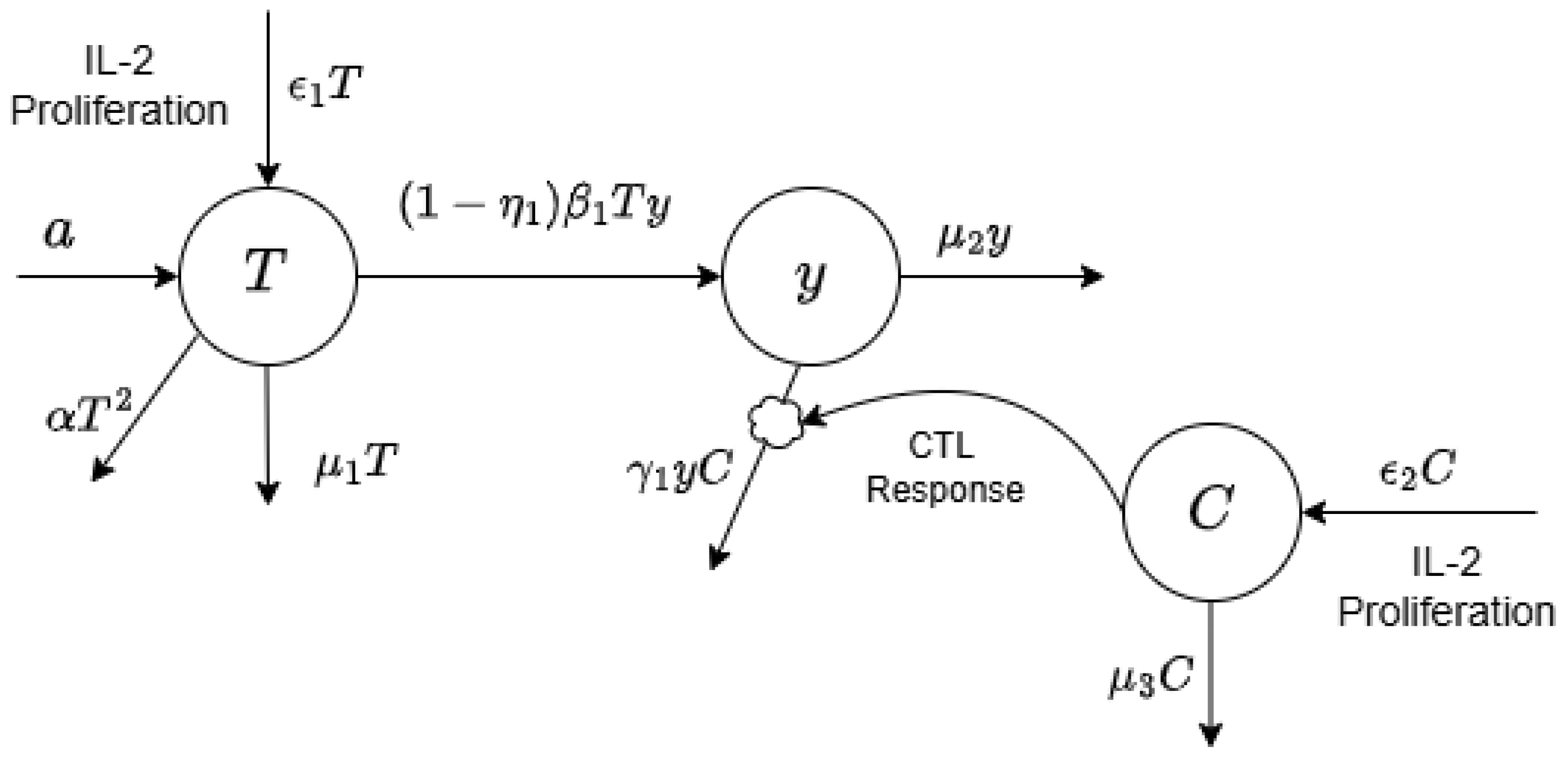
- We assumed that uninfected CD4+ T cells undergo natural apoptosis at a constant rate denoted by , while CTLs similarly die at a rate [35]. Due to spatial and resource limitations within the host environment, uninfected CD4+ T cells also experience intra-population competition, which is captured by a quadratic term [36,37].
- A3:
- The infection process is modeled as being proportional to the frequency of encounters between uninfected and infected CD4+ T cells, with an infection rate [8]. The presence of reverse transcriptase inhibitors (RTIs) reduces this infection rate by a factor of , where represents the efficacy of RTI treatment [38]. However, as emphasized in the introduction, this formulation explicitly captures the RTI aspect of HAART. Interleukin-2 (IL-2) therapy is also incorporated into the model to account for its role in enhancing the proliferation of CD4+ T cells, represented by the term [9,39,40] (as indicated by Figure 1).
- A4:
- On the immune response side, CTLs are responsible for eliminating infected CD4+ T cells, and this cytotoxic activity is modeled as being proportional to the contact rate between CTLs and infected cells, with a removal rate [15]. Furthermore, CTLs proliferate in response to the presence of infected cells at a rate [15], and this proliferation is further boosted by IL-2 treatment, captured by the term [41].
3. Basic Properties
3.1. Existence and Uniqueness of Solutions
3.2. Positive Invariance
3.3. Boundedness of the System
3.4. Equilibrium Analysis
- (i)
- The disease-free equilibrium where
- (ii)
- The CTL-free endemic equilibrium , whereis feasible if .
- (iii)
- The endemic equilibrium wherewith . is biologically feasible if
3.5. The Basic Reproduction Number,
4. Stability of Equilibria
- (i)
- The Jacobian at disease-free equilibrium, , isAt , the eigenvalues areFor the stability of the equilibrium, we require the conditions
- (ii)
- At , the Jacobian matrix is obtained asAt , one eigenvalue is Other two eigenvalues satisfywhereThus, the equilibrium is stable if
- (iii)
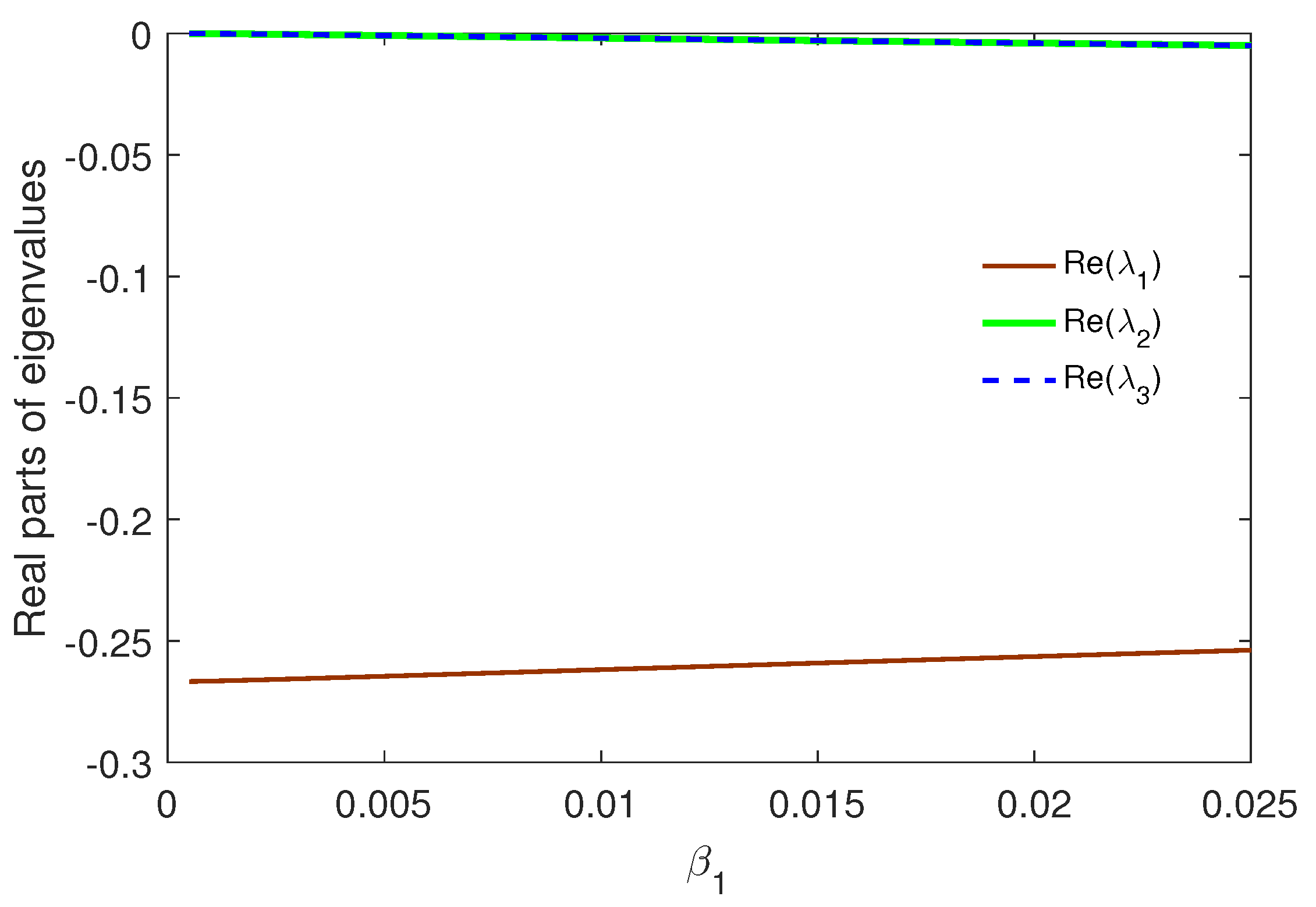
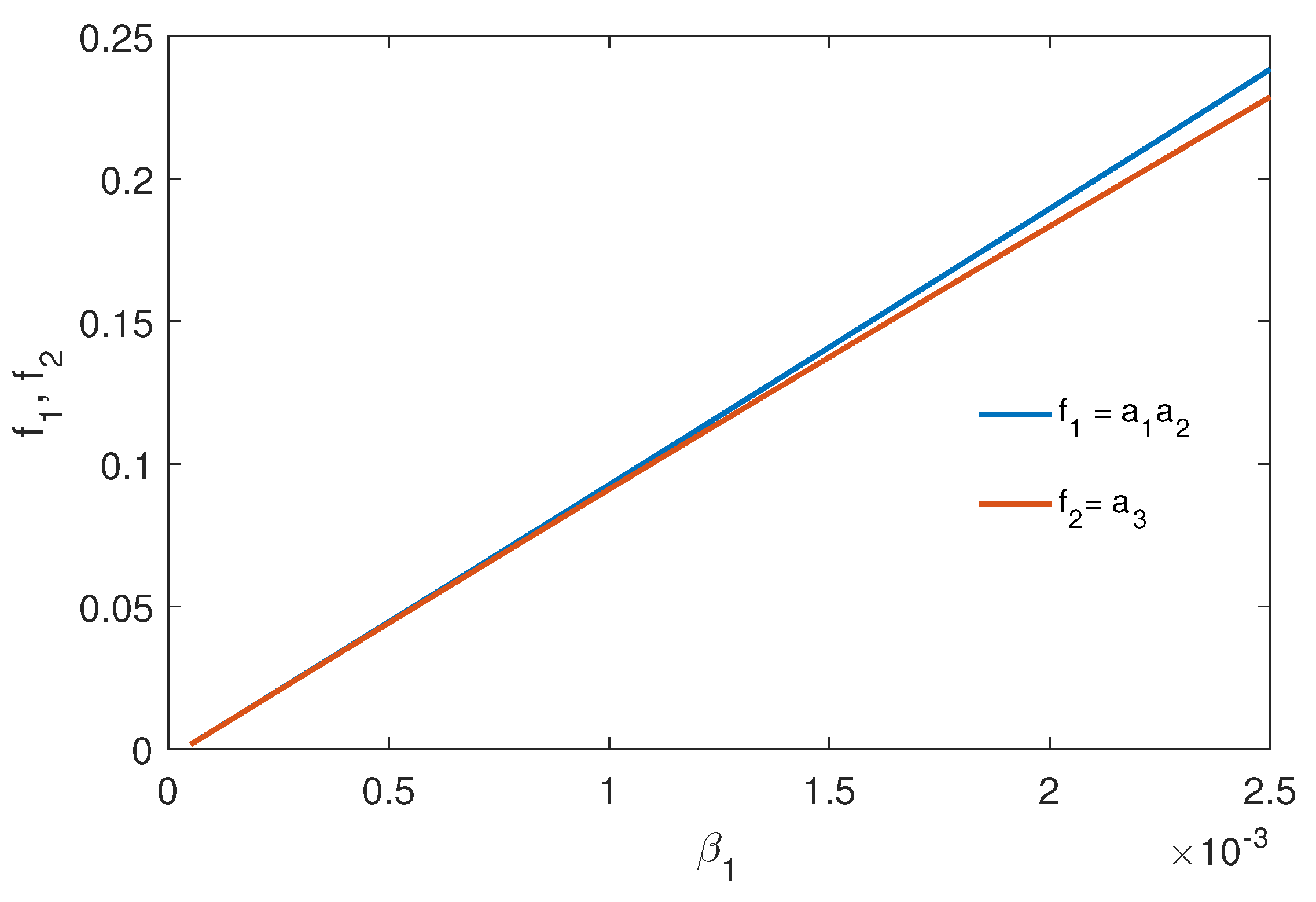
- Stability of endemic equilibrium : The Jacobian matrix at is determined aswithThe characteristic equation of J at iswhereThe Routh–Hurwitz conditions for all roots of to have negative real parts areTherefore, the local asymptotic stability conditions at the steady point areNow, we study the local Hopf bifurcation of . Any of the parameters of the model may be a bifurcation parameter. Thus, we assume as the generic bifurcating parameter of the system.
Stability and Direction of Hopf Bifurcation
- (i)
- If , the Hopf bifurcation is supercritical: a stable limit cycle is born for parameter values on the side where the equilibrium becomes unstable.
- (ii)
- If , the Hopf bifurcation is subcritical: an unstable limit cycle exists on the side where the equilibrium is still stable.
- (i)
- If , the bifurcating periodic orbits exist for ; if , they exist for .
- (ii)
- The periodic orbits are orbitally stable if and unstable if .
- (iii)
- The period varies according to : it increases if and decreases if .
5. System with Optimal Drug Dosing
- (i)
- : dosage of reverse transcriptase inhibitor (RTI);
- (ii)
- : dosage of interleukin-2 (IL-2) therapy.
5.1. Cost Functional and Admissible Controls
- (i)
- and represent the control functions corresponding to drug administration;
- (ii)
- denotes the population of susceptible CD4+ T cells at time t;
- (iii)
- denotes the population of CTL cells at time t;
- (iv)
- are weight constants penalizing drug usage;
- (v)
- are penalty multipliers rewarding the proliferation of CD4+ T cells and CTLs;
- (vi)
- is the treatment interval under consideration.
5.2. Existence of the Optimal Control Pair
- (i)
- The control set U is nonempty, closed, convex, and bounded;
- (ii)
- The right-hand side of (22) is jointly continuous in and locally Lipschitz in for each pair ;
- (iii)
5.3. The Hamiltonian
5.4. Adjoint System
5.5. Characterization of the Optimal Control Pair
5.6. Uniqueness of the Optimal Control Pair
5.6.1. Transformation of State and Adjoint Variables
5.6.2. Finding the Optimal Control
5.6.3. Inequalities for Control Differences
6. Numerical Results
6.1. Dynamics of the System Without Control


| Figures | Parameter Set |
|---|---|
| Figure 2 | , |
| Figure 3 | Parameter set is the same as in Figure 2 |
| Figure 4 | |
| Figure 5 | Parameter set is the same as in Figure 4 |
| Figure 6 | |
| Figure 7 | |
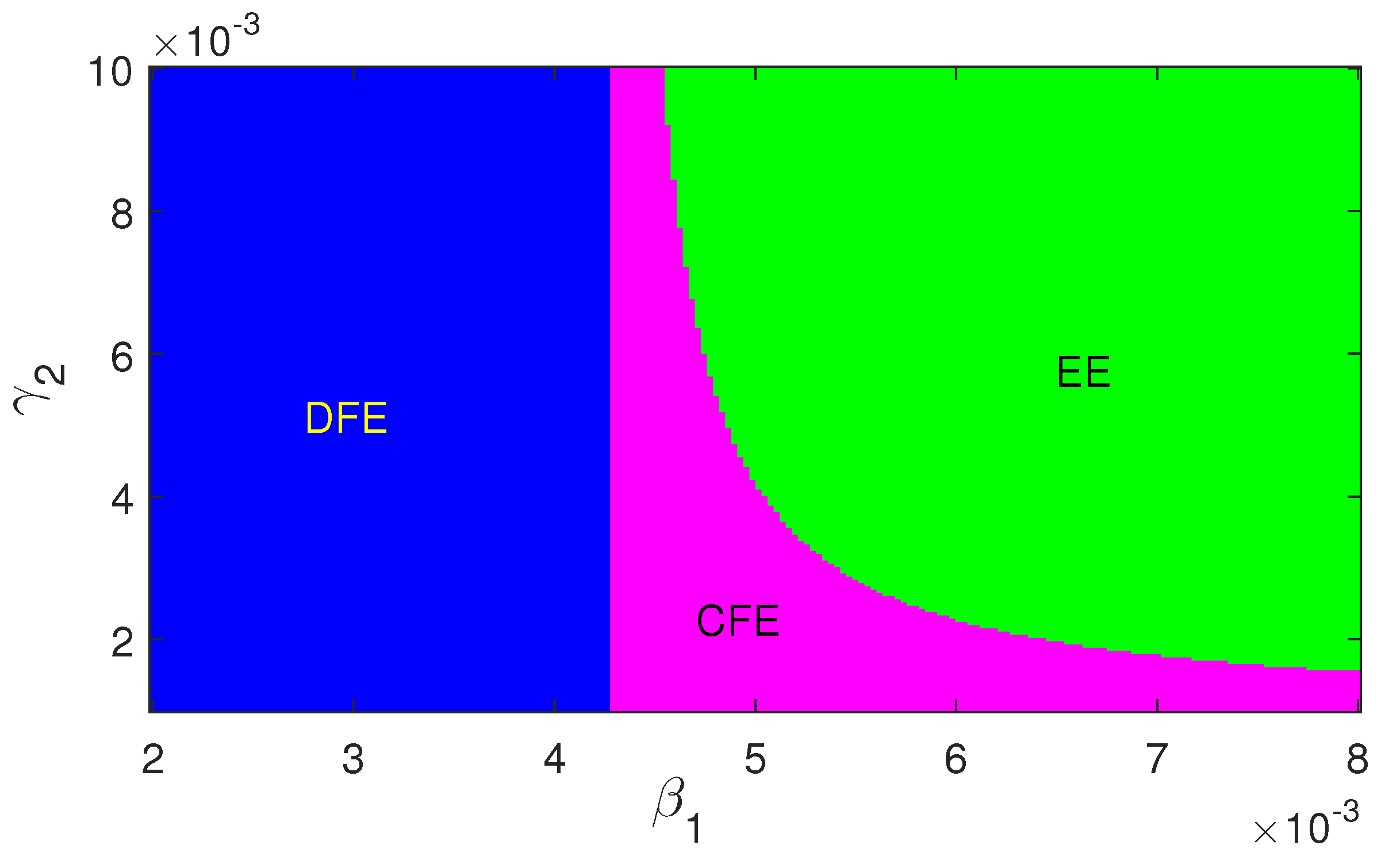
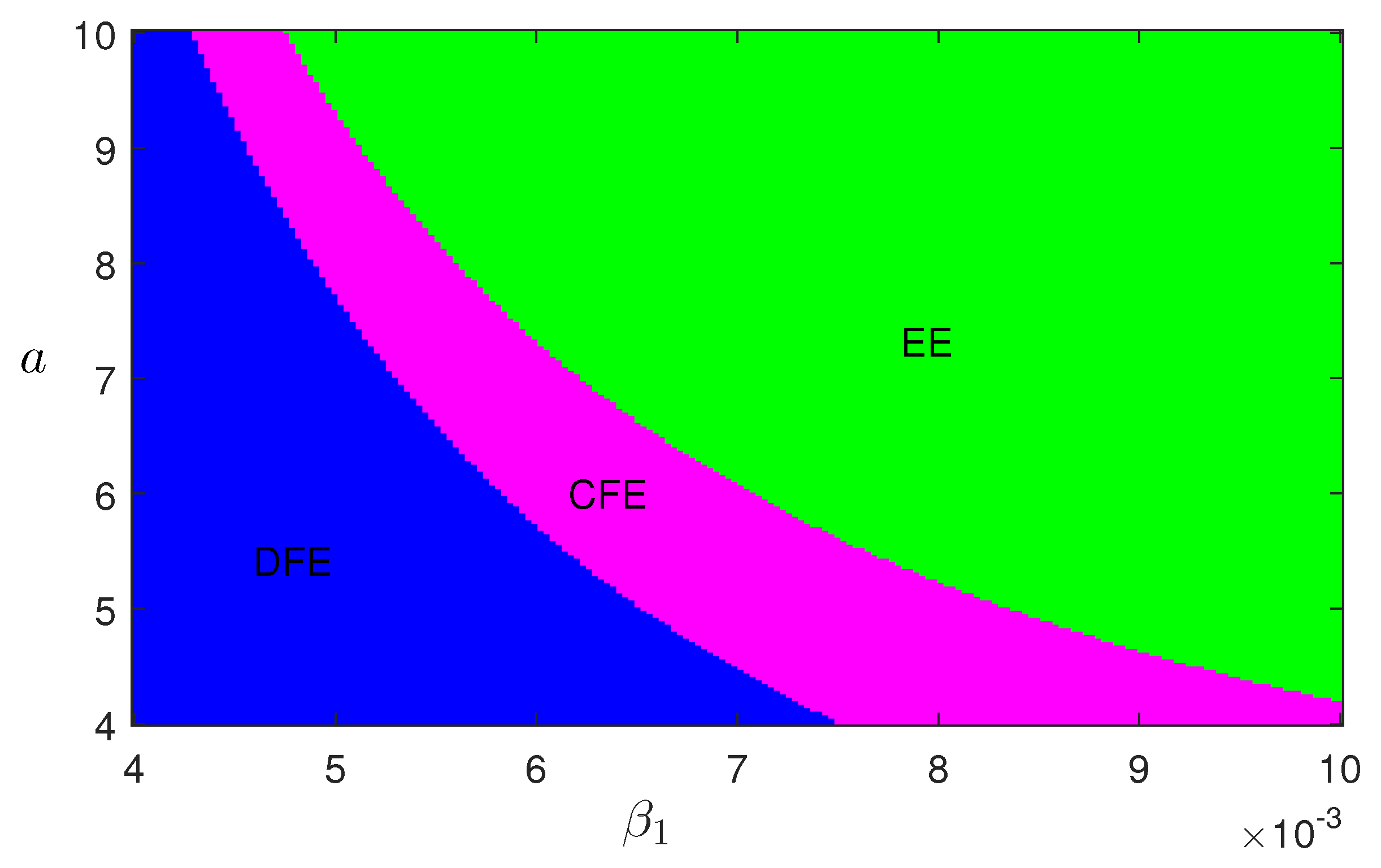
| Figure 8 | |
| Figure 9 | |
| Figure 10 | Parameter set is the same as in Figure 10 |
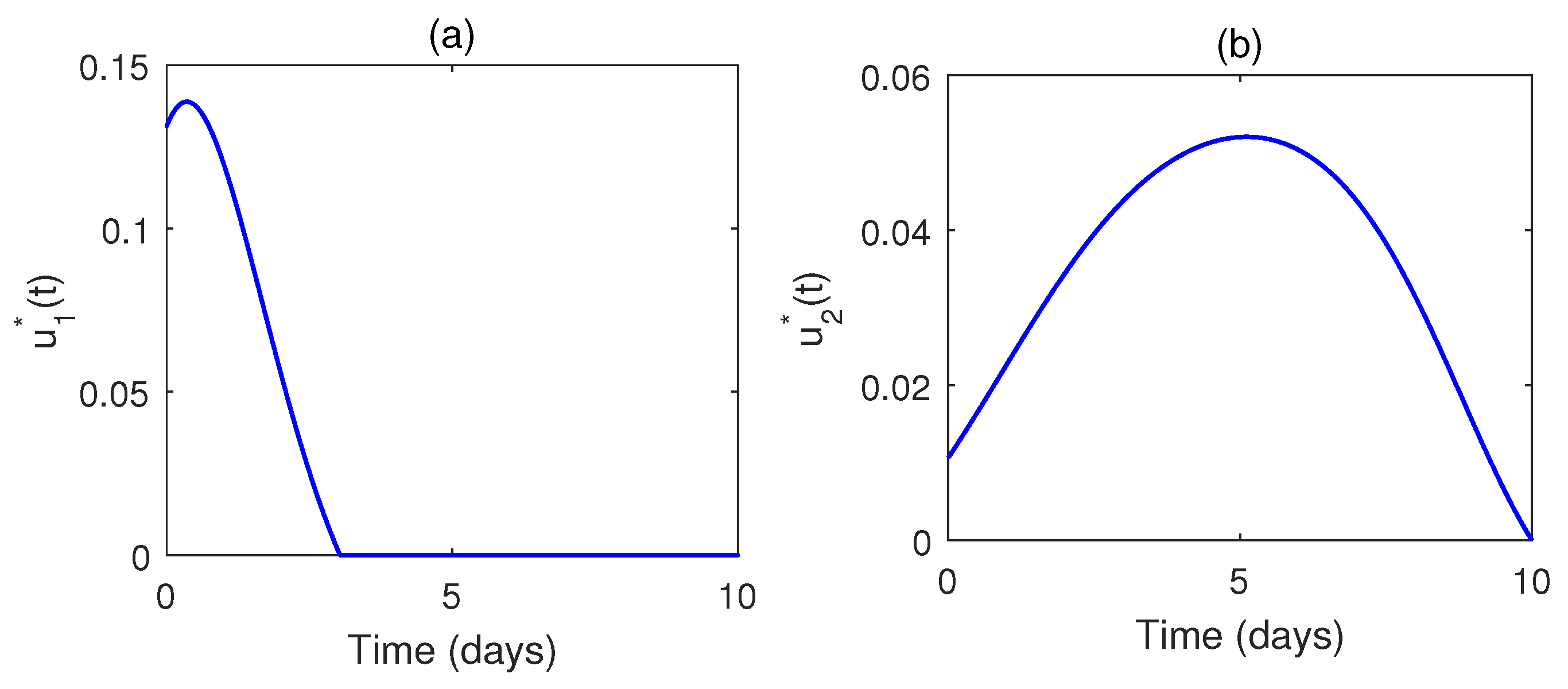
6.2. Dynamics of the System with Optimal Control
6.3. PRCC Analysis for the Optimal System
7. Discussion and Conclusions
Author Contributions
Funding
Data Availability Statement
Conflicts of Interest
References
- Gillespie, S.L.; Chinen, J.; Paul, M.E.; Shearer, W.T. Human immunodeficiency virus infection and acquired immunodeficiency syndrome. In Clinical Immunology; Elsevier: Amsterdam, The Netherlands, 2019; pp. 545–560. [Google Scholar]
- Lazarus, J.V.; Wohl, D.A.; Cascio, M.; Guaraldi, G.; Rockstroh, J.; Hodson, M.; Richman, B.; Brown, G.; Anderson, J.; Fuster-RuizdeApodaca, M.J. Long-term success for people living with HIV: A framework to guide practice. HIV Med. 2023, 24, 8–19. [Google Scholar] [CrossRef] [Scilit]
- Landovitz, R.J.; Scott, H.; Deeks, S.G. Prevention, treatment and cure of HIV infection. Nat. Rev. Microbiol. 2023, 21, 657–670. [Google Scholar] [CrossRef] [Scilit]
- Eron, J.J.; Little, S.J.; Crofoot, G.; Cook, P.; Ruane, P.J.; Jayaweera, D.; VanderVeen, L.A.; DeJesus, E.; Zheng, Y.; Mills, A.; et al. Safety of teropavimab and zinlirvimab with lenacapavir once every 6 months for HIV treatment: A phase 1b, randomised, proof-of-concept study. Lancet HIV 2024, 11, e146–e155. [Google Scholar] [CrossRef] [Scilit]
- Laher, F.; Mahlangu, N.; Sibiya, M. Beliefs about HIV cure: A qualitative study of people living with HIV in Soweto, South Africa. S. Afr. J. HIV Med. 2025, 26, 1644. [Google Scholar]
- Okesanya, O.J.; Ayeni, R.A.; Amadin, P.; Ngwoke, I.; Amisu, B.O.; Ukoaka, B.M.; Ahmed, M.M.; Oso, T.A.; Musa, S.S.; Lucero-Prisno, D.E. Advances in HIV Treatment and Vaccine Development: Emerging Therapies and Breakthrough Strategies for Long-Term Control. AIDS Res. Treat. 2025, 2025, 6829446. [Google Scholar]
- Perelson, A.S.; Nelson, P.W. Mathematical analysis of HIV-1 dynamics in vivo. SIAM Rev. 1996, 39, 3–44. [Google Scholar] [CrossRef] [Scilit]
- Nowak, M.A.; May, R.M. Virus Dynamics: Mathematical Principles of Immunology and Virology; Oxford University Press: Oxford, UK, 2000. [Google Scholar]
- The INSIGHT–ESPRIT Study Group; SILCAAT Scientific Committee. Interleukin-2 therapy in patients with HIV infection. N. Engl. J. Med. 2009, 361, 1548–1559. [Google Scholar] [CrossRef] [Scilit] [PubMed]
- Li, C.; Sun, J.P.; Wang, N.; Yan, P.; Wang, R.; Su, B.; Zhang, T.; Wu, H.; Chen, H.; Li, Z.; et al. Plasma cytokine expression and immune reconstitution in early and delayed anti-hiv 96-weeks treatment: A retrospective study. AIDS Res. Hum. Retroviruses 2024, 40, 101–109. [Google Scholar] [CrossRef] [Scilit] [PubMed]
- Rasi, G.; Emili, E.; Conway, J.M.; Cotugno, N.; Palma, P. Mathematical modeling and mechanisms of HIV latency for personalized anti latency therapies. Npj Syst. Biol. Appl. 2025, 11, 64. [Google Scholar] [PubMed]
- D’Orso, I.; Forst, C.V. Mathematical models of HIV-1 dynamics, transcription, and latency. Viruses 2023, 15, 2119. [Google Scholar] [CrossRef] [Scilit]
- Tarasova, O.; Petrou, A.; Ivanov, S.M.; Geronikaki, A.; Poroikov, V. Viral factors in modulation of host immune response: A route to novel antiviral agents and new therapeutic approaches. Int. J. Mol. Sci. 2024, 25, 9408. [Google Scholar] [CrossRef] [Scilit]
- AlShamrani, N.H. A diffusion-based HIV model with inflammatory cytokines and adaptive immune impairment. Front. Appl. Math. Stat. 2025, 11, 1659816. [Google Scholar] [CrossRef] [Scilit]
- Li, Y.; Zhang, L.; Zhang, J.; Liu, S.; Peng, Z. Dynamical modeling and data analysis of HIV infection with infection-age, CTLs immune response and delayed antibody immune response. J. Math. Biol. 2025, 91, 57. [Google Scholar] [CrossRef] [Scilit]
- de Carvalho, J.P.S.M. Qualitative analysis of HAART effects on HIV and SARS-CoV-2 coinfection model. Appl. Math. 2025, 70, 495–516. [Google Scholar] [CrossRef] [Scilit]
- Alsulami, I.M. On the stability, chaos and bifurcation analysis of a discrete-time chemostat model using the piecewise constant argument method. AIMS Math. 2024, 9, 33861–33878. [Google Scholar] [CrossRef] [Scilit]
- Rathnayaka, N.S.; Wijerathna, J.K.; Pradeep, B.G.S.A. Stability Properties and Hopf Bifurcation of a Delayed HIV Dynamics Model with Saturation Functional Response, Absorption Effect and Cure Rate. Int. J. Anal. Appl. 2025, 23, 92. [Google Scholar] [CrossRef] [Scilit]
- Hmarrass, H.; Qesmi, R. Global Stability and Hopf Bifurcation of a Delayed HIV Model with Macrophages, CD4+ T Cells with Latent Reservoirs and Immune Response. Eur. Phys. J. Plus 2025, 140, 335. [Google Scholar] [CrossRef] [Scilit]
- Lan, R.Y.; Selmi, C.; Gershwin, M.E. The regulatory, inflammatory, and T cell programming roles of interleukin-2 (IL-2). J. Autoimmun. 2008, 31, 7–12. [Google Scholar] [CrossRef] [Scilit]
- Eggleton, J.S.; Nagalli, S. Highly active antiretroviral therapy (HAART). In StatPearls [Internet]; StatPearls Publishing: Orlando, FL, USA, 2023. [Google Scholar]
- Amendola, A.; Poccia, F.; Martini, F.; Gioia, C.; Galati, V.; Pierdominici, M.; Marziali, M.; Pandolfi, F.; Colizzi, V.; Piacentini, M.; et al. Decreased CD95 expression on naive T cells from HIV-infected persons undergoing highly active anti-retroviral therapy (HAART) and the influence of IL-2 low dose administration. Clin. Exp. Immunol. 2000, 120, 324–332. [Google Scholar]
- Abiodun, O.; Olukayode, A.; Ndako, J. Mathematical Modeling and Optimal Control Strategies of HIV/AIDS with HAART. In Proceedings of the 2023 International Conference on Science, Engineering and Business for Sustainable Development Goals (SEB-SDG), Omu-Aran, Nigeria, 5–7 April 2023. [Google Scholar]
- Gumel, A.B.; Zhang, X.W.; Shivakumar, P.N.; Garba, M.L.; Sahai, B.M. A New Mathematical Model for Assessing Therapeutic Strategies for HIV. J. Theor. Med. 2002, 4, 147–155. [Google Scholar]
- Pontryagin, L.S.; Boltyanskii, V.G.; Gamkrelidze, R.V.; Mishchenko, E.F. The Mathematical Theory of Optimal Processes; Classic Reference Introducing the Pontryagin Maximum Principle; Routledge: London, UK, 1962. [Google Scholar]
- Campos, C.; Silva, C.J.; Torres, D.F.M. Numerical Optimal Control of HIV Transmission in Octave/MATLAB. Mathematics 2019, 25, 1. [Google Scholar] [CrossRef] [Scilit]
- Boukary, O.; Malicki, Z.; Elisée, G. Mathematical Modeling and Optimal Control of an HIV/AIDS Transmission Model. Int. J. Anal. Appl. 2024, 22, 234. [Google Scholar] [CrossRef] [Scilit]
- Al Basir, F.; Nisar, K.S.; Alsulami, I.M.; Chatterjee, A.N. Dynamics and optimal control of an extended SIQR model with protected human class and public awareness. Eur. Phys. J. Plus 2025, 140, 152. [Google Scholar] [CrossRef] [Scilit]
- Musa, S.; John, S.; Salvation, H. Mathematical Modeling of HIV Transmission Dynamics: Incorporating Treatment and Removal as Control Strategies. Int. J. Sci. Res. 2025, 9, 16–31. [Google Scholar]
- Chazuka, Z.; Madubueze, C.E.; Mathebula, D. Modelling and analysis of an HIV model with control strategies and cost-effectiveness. Results Control Optim. 2024, 14, 100355. [Google Scholar]
- Rana, P.S.; Sharma, N.; Priyadarshi, A. Mathematical Modeling and Optimal Control of a Deterministic SHATR Model of HIV/AIDS with Possibility of Rehabilitation: A Dynamic Analysis. Tamkang J. Math. 2024, 55, 267–285. [Google Scholar] [CrossRef] [Scilit]
- Kumar, N.; Kashif, M.; Chauhan, T.S.; Chauhan, I.S. Modeling and Control of HIV/AIDS Epidemics: A Stochastic and Optimal Control Perspective. J. Nonlinear Math. Phys. 2025, 32, 80. [Google Scholar] [CrossRef] [Scilit]
- Alblowy, A.H.; Maan, N.; Ibrahim, A.A. Optimal control strategies for SGLT2 inhibitors as a novel anti-tumor agent and their effect on human breast cancer cells with the effect of time delay and hyperglycemia. Comput. Biol. Med. 2023, 166, 107552. [Google Scholar] [CrossRef] [Scilit]
- Teklu, S.W.; Terefe, B.B.; Mamo, D.K.; Abebaw, Y.F. Optimal control strategies on HIV/AIDS and pneumonia co-infection with mathematical modelling approach. J. Biol. Dyn. 2024, 18, 2288873. [Google Scholar] [CrossRef] [Scilit]
- Février, M.; Dorgham, K.; Rebollo, A. CD4+ T cell depletion in human immunodeficiency virus (HIV) infection: Role of apoptosis. Viruses 2011, 3, 586. [Google Scholar] [CrossRef] [Scilit]
- Yates, A.; Stark, J.; Klein, N.; Antia, R.; Callard, R. Understanding the slow depletion of memory CD4+ T cells in HIV infection. PLoS Med. 2007, 4, e177. [Google Scholar]
- Boshier, F.A.T.; Reeves, D.B.; Duke, E.R.; Swan, D.A.; Prlic, M.; Cardozo-Ojeda, E.F.; Schiffer, J.T. Substantial uneven proliferation of CD4+ T cells during recovery from acute HIV infection is sufficient to explain the observed expanded clones in the HIV reservoir. J. Virus Erad. 2022, 8, 100091. [Google Scholar]
- Nath, B.J.; Sadri, K.; Sarmah, H.K.; Hosseini, K. An optimal combination of antiretroviral treatment and immunotherapy for controlling HIV infection. Math. Comput. Simul. 2024, 217, 226–243. [Google Scholar]
- Roy, P.K.; Chowdhury, S.; Chatterjee, A.; Majee, S.B. Mathematical Modeling of IL-2 Based Immune Therapy on T cell homeostasis in HIV; InTech: Toyama, Japan, 2012. [Google Scholar]
- Barish, S.; Ochs, M.F.; Sontag, E.D.; Gevertz, J.L. Evaluating optimal therapy robustness by virtual expansion of a sample population, with a case study in cancer immunotherapy. Proc. Natl. Acad. Sci. USA 2017, 114, E6277–E6286. [Google Scholar]
- Nath, B.J.; Sarmah, H.K.; Maurer, H. An optimal control strategy for antiretroviral treatment of HIV infection in presence of immunotherapy. Qual. Theory Dyn. Syst. 2022, 21, 30. [Google Scholar] [CrossRef] [Scilit]
- Culshaw, R.; Ruan, S. A delay-differential equation model of HIV-1 infection of CD4+ T-cells. Math. Biosci. 2000, 165, 425–444. [Google Scholar] [CrossRef] [Scilit] [PubMed]
- Wodarz, D.; Nowak, M. Specific therapy regimes could lead to long term immunological control to HIV. Proc. Natl. Acad. Sci. USA 1999, 96, 14464–14469. [Google Scholar]
- Teschl, G. Ordinary Differential Equations and Dynamical Systems; Graduate Studies in Mathematics; American Mathematical Society: Providence, RI, USA, 2012; Volume 140. [Google Scholar]
- Seifert, C.; Waurick, M. Evolutionary Equations: Picard’s Theorem for Partial Differential Equations, and Applications; Operator Theory: Advances and Applications; Birkhäuser: Basel, Switzerland, 2022; Volume 287. [Google Scholar]
- Brikhoff, G.; Rota, G. Ordinary Differential Equations; Ginn: Boston, MA, USA, 1982. [Google Scholar]
- Diekmann, O.; Heesterbeek, J.A.P.; Roberts, M.G. The construction of next-generation matrices for compartmental epidemic models. J. R. Soc. Interface 2010, 7, 873–885. [Google Scholar] [PubMed]
- Van den Driessche, P.; Watmough, J. Further notes on the basic reproduction number. In Mathematical Epidemiology; Springer: Berlin/Heidelberg, Germany, 2008; pp. 159–178. [Google Scholar]
- Diekmann, O.; Heesterbeek, J.A.P.; Metz, J.A. On the definition and the computation of the basic reproduction ratio R0 in models for infectious diseases in heterogeneous populations. J. Math. Biol. 1990, 28, 365–382. [Google Scholar] [CrossRef] [Scilit] [PubMed]
- Van den Driessche, P.; Watmough, J. Reproduction numbers and sub-threshold endemic equilibria for compartmental models of disease transmission. Math. Biosci. 2002, 180, 29–48. [Google Scholar] [CrossRef] [Scilit]
- Hassard, B.D.; Kazarinoff, N.D.; Wan, Y.H. Theory and Applications of Hopf Bifurcation; Cambridge University Press: Cambridge, UK, 1981. [Google Scholar]
- Fleming, W.H.; Rishel, R.W. Deterministic and Stochastic Optimal Control; Applications of Mathematics; Springer: New York, NY, USA, 1975; Volume 1. [Google Scholar] [CrossRef] [Scilit]
- Roy, P.K.; Nandi, S.; Ghosh, M.K. Modeling of a control induced system for product formation in enzyme kinetics. J. Math. Chem. 2013, 51, 2704–2717. [Google Scholar] [CrossRef] [Scilit]
- Zhang, H.Q.; Cao, B.Z.; Cao, Q.T.; Hun, M.; Cao, L.; Zhao, M.Y. An analysis of reported cases of hemophagocytic lymphohistiocytosis (HLH) after COVID-19 vaccination. Hum. Vaccines Immunother. 2023, 19, 2263229. [Google Scholar] [CrossRef] [Scilit] [PubMed]
- Jia, Y.; Fu, B.; Dong, L.; Zhao, M. Sweet syndrome induced by SARS-CoV-2 vaccines: A systematic review of patient-report studies. Hum. Vaccines Immunother. 2023, 19, 2217076. [Google Scholar] [CrossRef] [Scilit]
- Xu, K.; Gao, B.; Li, J.; Xiang, Y.; Cao, L.; Zhao, M. Clinical features, diagnosis, and management of COVID-19 vaccine-associated Vogt-Koyanagi-Harada disease. Hum. Vaccines Immunother. 2023, 19, 2220630. [Google Scholar] [CrossRef] [Scilit]
- Cheng, N.; Wang, W.; Zeng, H.; Liu, X.; Zhang, X. Novel exponential-weighted integral inequality for exponential stability analysis of time-varying delay systems. Appl. Math. Lett. 2026, 172, 109730. [Google Scholar] [CrossRef] [Scilit]




| Parameter | Definition | Value (Unit) |
|---|---|---|
| a | constant rate of production of Cells | 15 cells day−1 |
| death rate of Uninfected cells | 0.1 cells day−1 | |
| rate of infection | 0.00025–0.5 cells day−1 | |
| death rate of infected cells | 0.2 cells/day | |
| clearance rate of infected cells by CTL | 0.002 day−1 | |
| rate of proliferation of CTL | 0.02–0.6 day−1 | |
| decay rate of CTL | 0.1 day−1 | |
| intra-population competition | 0.00065 day−1 | |
| activation rate of uninfected CD4+T cell by IL-2 | 0.005 day−1 | |
| activation rate of CTL by IL-2 | 0.02 day−1 |
Disclaimer/Publisher’s Note: The statements, opinions and data contained in all publications are solely those of the individual author(s) and contributor(s) and not of MDPI and/or the editor(s). MDPI and/or the editor(s) disclaim responsibility for any injury to people or property resulting from any ideas, methods, instructions or products referred to in the content. |
© 2026 by the authors. Licensee MDPI, Basel, Switzerland. This article is an open access article distributed under the terms and conditions of the Creative Commons Attribution (CC BY) license.
Share and Cite
Alsulami, I.M.; Basir, F.A. Stability and Direction of Hopf Bifurcation with Optimal Control Analysis of HIV Transmission Dynamics. Mathematics 2026, 14, 1079. https://doi.org/10.3390/math14061079
Alsulami IM, Basir FA. Stability and Direction of Hopf Bifurcation with Optimal Control Analysis of HIV Transmission Dynamics. Mathematics. 2026; 14(6):1079. https://doi.org/10.3390/math14061079
Chicago/Turabian StyleAlsulami, Ibraheem M., and Fahad Al Basir. 2026. "Stability and Direction of Hopf Bifurcation with Optimal Control Analysis of HIV Transmission Dynamics" Mathematics 14, no. 6: 1079. https://doi.org/10.3390/math14061079
APA StyleAlsulami, I. M., & Basir, F. A. (2026). Stability and Direction of Hopf Bifurcation with Optimal Control Analysis of HIV Transmission Dynamics. Mathematics, 14(6), 1079. https://doi.org/10.3390/math14061079