Article

Surfaces of Revolution with Constant Mean Curvature in Galilean 3-Space

1
Department of Mathematics, Faculty of Science, Zonguldak Bülent Ecevit University, Zonguldak 67100, Türkiye
2
Department of Mathematics, Faculty of Science, Ankara University, Ankara 06100, Türkiye
3
Graduate School of Natural and Applied Sciences, Zonguldak Bülent Ecevit University, Zonguldak 67100, Türkiye
*
Author to whom correspondence should be addressed.
Mathematics 2026, 14(6), 1066; https://doi.org/10.3390/math14061066
Submission received: 20 February 2026 / Revised: 17 March 2026 / Accepted: 19 March 2026 / Published: 21 March 2026
(This article belongs to the Special Issue New Trends in Differential Geometry and Geometric Analysis)

Abstract

Revolution surfaces with zero mean curvature in the Galilean 3-space have been extensively studied in the literature. However, revolution surfaces with non-zero constant mean curvature in this geometric setting have not yet been investigated in a systematic way. In this paper, we address this gap by studying surfaces of revolution in the Galilean 3-space with constant mean curvature. We derive the necessary and sufficient differential conditions for such surfaces and obtain explicit parametrizations of the corresponding families. The results extend the theory beyond the minimal case and reveal geometric features that arise from the degenerate nature of the Galilean metric. Several examples are presented to illustrate the obtained surfaces and to emphasize the qualitative differences between minimal and non-minimal constant mean curvature configurations.

1. Introduction

The Galilean 3-space G 3 constitutes a notable example within the family of Cayley–Klein geometries, primarily due to the degenerate nature of its metric tensor, which leads to geometric phenomena fundamentally distinct from those observed in the Euclidean framework. Therefore, geometric analysis in G 3 not only enriches the theoretical framework of differential geometry but also finds motivation in applications related to kinematics, Newtonian mechanics, and computer-aided geometric design. Over the past several decades, various classes of surfaces in Galilean and pseudo-Galilean geometries have been systematically investigated. Notably, Divjak and Šipuš [1,2,3,4] conducted comprehensive studies on special, ruled, and constant-curvature surfaces in these spaces. In the pseudo-Galilean setting, Yoon [5] examined surfaces of revolution, whereas Kamenarović [6] established existence results for ruled surfaces. Ruled surfaces constitute an important class of surfaces in differential geometry due to their rich geometric structure and wide range of applications. The infinitesimal bending of curves lying on ruled surfaces in three-dimensional Euclidean space was studied in [7], where bending fields were obtained for curves on the cylinder, hyperbolic paraboloid, and helicoid. In [8], ruled surfaces associated with Legendre curves were considered, and the conditions under which the mean curvature vanishes along a curve were investigated. The geometric properties of minimal surfaces and their applications in civil engineering and architecture were discussed in [9]. Moreover, Yaylı and Gölgeleyen [10] examined developable ruled surfaces whose mean curvature remains constant along a given curve.
In the study of surfaces of revolution in the space G 3 , Dede et al. [11] provided a complete classification of surfaces whose Gaussian curvature or mean curvature vanishes, establishing the fundamental structure of minimal and flat surfaces of revolution in this singular metric setting. Their results constitute a fundamental reference for the study of curvature properties of surfaces of revolution in G 3 . However, these investigations are restricted to the case where the mean curvature is identically zero. In contrast, surfaces of revolution with non-zero constant mean curvature in G 3 have not yet been systematically classified. In this paper, we investigate surfaces of revolution in G 3 whose mean curvature is a non-zero constant. To this end, we derive explicit formulas for the mean curvature of the three standard families of surfaces of revolution and determine the differential conditions under which the mean curvature attains a fixed non-zero value. The study of constant mean curvature (CMC) surfaces in Galilean geometry is motivated by both theoretical interest and potential applications. In Euclidean space, CMC surfaces characterize equilibrium shapes under surface tension, as illustrated by López [12] for soap films and liquid droplets. Graphical representations of certain CMC surfaces of revolution were presented by Ćirić [13]. On the other hand, the degenerate structure of the Galilean metric leads to distinct geometric behavior, making the extension of CMC theory to G 3 both nontrivial and meaningful.
The structure of this paper is as follows. We begin by reviewing the fundamental concepts and geometric structure of G 3 . Subsequently, we introduce the three standard families of surfaces of revolution in G 3 and analyze their curvature behavior. In particular, we derive the mean curvature expressions for each type and establish the characterization conditions under which a surface of revolution in Galilean geometry possesses a non-zero constant mean curvature. Based on these criteria, we present a comprehensive classification of such surfaces and give the results through explicit parametric representations. Several examples and illustrations are provided to support the theoretical results.

2. Preliminaries

In this section, we recall the basic notions and fundamental definitions related to G 3 , which will be used throughout the paper. For further details on these related topics, we refer to [3,14,15].
A point P G 3 can be represented in Cartesian coordinates as P x , y , z . For two points P 1 x 1 , y 1 , z 1 and P 2 x 2 , y 2 , z 2 , the Galilean distance is defined as
d ( P 1 , P 2 ) = x 2 x 1 , if x 1 x 2 y 2 y 1 2 + z 2 z 1 2 , if x 1 = x 2 .
A vector a = x , y , z is called isotropic if x = 0 , and non-isotropic otherwise. The scalar product in G 3 is given by
a , b = x x 1 if x 0 or x 1 0 , y y 1 + z z 1 if x = x 1 = 0 ,
for the vectors a = x , y , z and b = x 1 , y 1 , z 1 . A vector a is called a unit vector whenever a = 1 . The Galilean cross product of two vectors a = x , y , z and b = x 1 , y 1 , z 1 is defined by the determinant:
a b = 0 e 2 e 3 x y z x 1 y 1 z 1 .
Consider a unit-speed curve α s = s , y s , z s in G 3 . The Frenet frame T s , N s , B s satisfies the Frenet equations
d d s T s N s B s = 0 κ s 0 0 0 τ s 0 τ s 0 T s N s B s ,
where κ s = α s denotes the curvature and τ s = 1 κ 2 s det α , α , α is the torsion of the curve. Let X ( u , v ) = x ( u , v ) , y ( u , v ) , z ( u , v ) denote a parametric surface in G 3 . The first fundamental form is written as
I = ( g 1 d u + g 2 d v ) 2 + ε ( h u u d u 2 + 2 h u v d u d v + h v v d v 2 ) ,
where g 1 = x u , g 2 = x v , h u v = y u y v + z u z v , h u u = y u 2 + z u 2 , h v v = y v 2 + z v 2 , and
ε = 0 , if the direction d u : d v is non-isotropic , 1 , if the direction d u : d v is isotropic .
The normal vector field of the surface X ( u , v ) is defined as
U = 1 W 0 , x u z v + x v z u , x u y v x v y u ,
where W = x u z v x v z u 2 + x v y u x u y v 2 . The second fundamental form is given by
I I = L 11 ( d u ) 2 + 2 L 12 d u d v + L 22 d v 2 ,
where
L i j = 1 g 1 g 1 ( 0 , y , i j , z , i j ) + g i , j ( 0 , y u , z u ) , N for g 1 0
or
L i j = 1 g 2 g 2 ( 0 , y , i j , z , i j ) + g i , j ( 0 , y v , z v ) , N for g 2 0 .
Here we set y , i j = y u i u j for i , j = 1 , 2 and u 1 = u , u 2 = v . Thus, the mean curvature H of the surface is
H = g 2 2 L 11 2 g 1 g 2 L 12 + g 1 2 L 22 2 W 2 .

3. Constant Curvature Surfaces of Revolution in G 3

In [11], the authors constructed surfaces of revolution in G 3 analogously to the Euclidean case and obtained three distinct types of such surfaces. To construct a surface of revolution in G 3 , two kinds of rotations are employed, which are defined as follows:
A Euclidean rotation about the non-isotropic x-axis is described by
x y z = 1 0 0 0 cos θ 1 sin θ 1 0 sin θ 1 cos θ 1 x y z ,
where θ 1 is the Euclidean angle and an isotropic rotation is given by
x y z = 1 0 0 θ 2 1 0 0 0 1 x y z + c θ 2 c 2 ( θ 2 ) 2 0 ,
where θ 2 is the isotropic angle and c R .
Given that a Euclidean plane is composed exclusively of isotropic vectors, whereas an isotropic plane encompasses both isotropic and non-isotropic vectors, it follows that three different classes of surfaces of revolution can be characterized in G 3 .
To this aim, we consider the isotropic rotations. By rotating the isotropic curve α t = ( 0 , f ( t ) , g ( t ) ) about the y z -plane by isotropic rotation, we obtain the parametrization of the surface of revolution of Type I as
φ ( s , t ) = c s , f ( t ) + c s 2 2 , g ( t ) ,
where f and g are smooth functions and c 0 R .
Next, we assume again, without loss of generality, that the profile curve α t = ( f ( t ) , g ( t ) , 0 ) lies in the isotropic x y -plane and is parameterized by
φ ( s , t ) = f ( t ) + c s , g ( t ) , s f ( t ) + c s 2 2 ,
where f and g are smooth functions and c 0 R . The surface (3) is called the surface of revolution of Type II.
Finally, for profile curve α t = ( f ( t ) , g ( t ) , 0 ) in the isotropic x y -plane, a Type III surface of revolution in G 3 is parameterized by
φ ( s , t ) = f ( t ) , g ( t ) cos s , g ( t ) sin s .

3.1. Constant Curvature Type I Surfaces of Revolution in G 3

For a Type I surface of revolution in G3, parametrized by (2) with c 0 , the expression for the mean curvature
H = s g n ( c ) f g f g 2 ( f 2 + g 2 ) 3 / 2
is formulated in [11]. Here, by s g n we mean the sign function. Since the surface is admissible, then f and g cannot be both identically zero. Hence the following classification theorem is given.
Theorem 1.
The mean curvature of a Type I surface of revolution in G 3 is constant if and only if it is parametrized by
φ ( s , t ) = c s , f ( t ) + c 2 s 2 , 1 2 A 1 ( 2 A f + K ) 2 + C ,
where A , c 0 and K , C R .
Proof. 
Assume that the mean curvature of a Type I surface of revolution is a prescribed constant A . Thus, the constant mean curvature condition yields
H = f g f g 2 ( f 2 + g 2 ) 3 / 2 = A ,
where A is a constant. Let us introduce the notation
v ( t ) = f ( t ) 2 + g ( t ) 2 .
Then we may write
f ( t ) = v ( t ) cos θ ( t ) , g ( t ) = v ( t ) sin θ ( t ) ,
for some smooth function θ ( t ) . With this representation, a direct computation shows that
f g f g = v 2 θ .
cccSubstituting this expression into Equation (5), we obtain
v 2 θ 2 v 3 = A ,
which simplifies to
θ = 2 A f cos θ .
Rewriting this equation in differential form gives
cos θ d θ = 2 A f ( t ) d t .
Integrating both sides, we arrive at
sin θ = 2 A f ( t ) + K ,
where K is a constant of integration. Next, using the relation
g ( t ) = v sin θ = f cos θ sin θ ,
and substituting the above expression for sin θ , we obtain
g ( t ) = f ( t ) ( 2 A f ( t ) + K ) 1 ( 2 A f ( t ) + K ) 2 .
Integrating with respect to t , we find
g ( t ) = 1 2 A 1 ( 2 A f ( t ) + K ) 2 + C ,
where C is another integration constant. Finally, substituting the expressions for f ( t ) and g ( t ) into the parametrization (2), we obtain
φ ( s , t ) = c s , f ( t ) + c 2 s 2 , 1 2 A 1 ( 2 A f ( t ) + K ) 2 + C ,
which completes the proof. □
Remark 1.
As a special case, in order to obtain the minimality condition for a Type I surface of revolution, it is sufficient that f g f g = 0 . Therefore, the following classification can be established for a Type I surface of revolution:
  • ( 1 ) A Type I surface of revolution reduces to a parabolic cylinder given by the parametrization
    φ ( s , t ) = c s , a + c 2 s 2 , g ( t ) .
  • ( 2 ) Another possibility is a portion of an isotropic plane, formed by a family of parabolic curves, and described by
    φ ( s , t ) = c s , f ( t ) + c 2 s 2 , a .
  • ( 3 ) Finally, one obtains a parabolic cylinder of a different type, whose parametrization is
    φ ( s , t ) = c s , f ( t ) + c 2 s 2 , a f ( t ) + b .
    Here a , b , c R with c 0 and a 0 ; see [11].
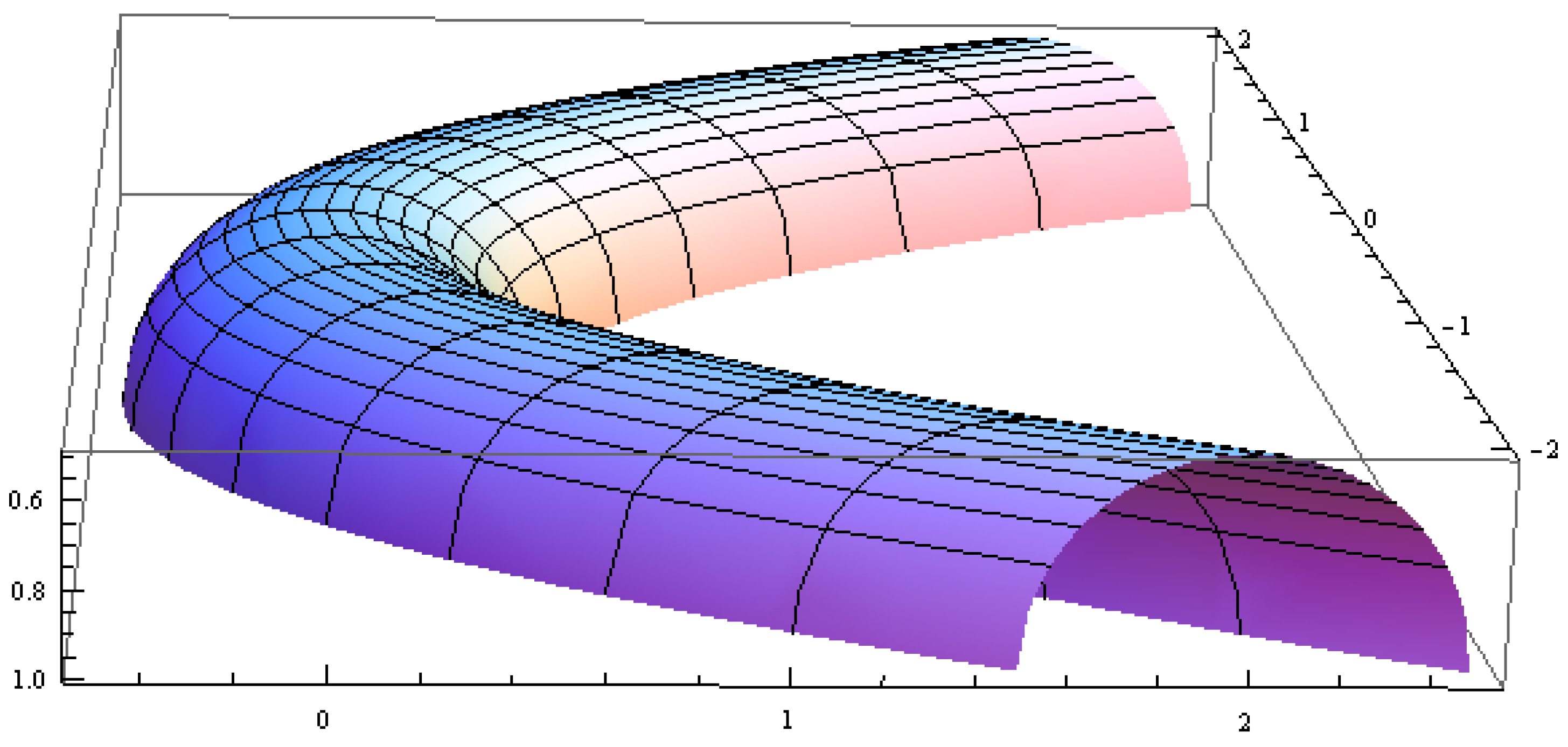
For the constant mean curvature case, the surface of revolution described in (6) is illustrated in Figure 1 for the parameter choices f ( t ) = t , A = 1 , K = 0 , c = C = 1 , s 2 , 2 and t 0.5 , 0.5 . Under these specifications, the corresponding surface reduces to a ruled surface
φ ( s , t ) = s , t + 1 2 s 2 , 1 2 1 ( 2 t ) 2 + 1 .
Theorem 2.
The mean curvature of a Type I surface of revolution in G 3 is constant if and only if its profile curve is a circle.
Proof. 
Let α ( t ) = 0 , f ( t ) , g ( t ) be a planar generating curve in G 3 . Its curvature is given by
κ α = f g f g ( f 2 + g 2 ) 3 / 2 .
In classical differential geometry, a fundamental result states that a planar curve has constant curvature if and only if it is a circle [16]. This characterization also holds for curves lying in isotropic planes of G 3 , since in this case the curvature reduces to the Euclidean curvature by definition [17]. If the curve α ( t ) generates a surface of revolution in G 3 , then the mean curvature of the resulting surface satisfies
H = s g n ( c ) κ α ,
where c 0 is a constant depending on the rotational parametrization. Consequently, the surface has constant mean curvature if and only if the generating curve has constant curvature, that is, the curve is a circle. □
Proposition 1.
A Type I surface of revolution in G 3 is minimal, if its profile curve is an isotropic straight line.
Proof. 
Let the profile curve α ( t ) be an isotropic straight line. Since straight lines in the Galilean geometry possess zero curvature, we have κ α = 0 . Considering the relation between the mean curvature H of the corresponding surface of revolution and the curvature of its profile curve, namely H = s g n ( c ) κ α , it follows that H = 0 . Thus, the surface is minimal. Conversely, if the surface is minimal, then H = 0 , which implies that κ α = 0 , and therefore the generating curve must be an isotropic straight line. Hence, the equivalence is established. □

3.2. Constant Curvature Type II Surfaces of Revolution in G3

Consider a Type II surface of revolution in G 3 , given by the parametrization (3). Using (1), the mean curvature of this surface is obtained as
H = c 2 2 w 3 f ( f g f g ) f 2 g ,
where w 2 = f 2 f 2 + c 2 g 2 . Moreover, since the surface is admissible, the functions f and g cannot vanish simultaneously along the parametrization. For a Type II surface of revolution, the condition for having constant mean curvature can be formulated in the following theorem, under the restriction f ( t ) = t , which allows the condition to be solved explicitly.
Theorem 3.
For f ( t ) = t , the mean curvature of a Type II surface of revolution in G 3 is constant if and only if it is parametrized by
φ ( s , t ) = t + c s , 1 2 A c 1 A c t 2 + K 2 + C , s t + c 2 s 2 , A c t 2 + K < 1 ,
where A , C , K R and A 0 .
Proof. 
Let the mean curvature be prescribed as a constant A. Then the following relation holds:
H = c 2 2 w 3 f ( f g f g ) f 2 g = A ,
where
w = ( f 2 f 2 + c 2 g 2 ) 1 / 2 .
Here, A and c are assumed to be real constants. Multiplying both sides by 2 w 3 , we obtain
c 2 f ( f g f g ) f 2 g = 2 A ( f 2 f 2 + c 2 g 2 ) 3 / 2 .
The general constant mean curvature condition leads to a highly nonlinear coupled differential equation in the functions f and g , which does not admit an explicit solution in closed form. Therefore, in this paper, we restrict ourselves to the case f = 0 , and in particular to the representative choice f ( t ) = t , for which the equation reduces to a solvable ordinary differential equation
c 2 t g f g ) g = 2 A ( t 2 + c 2 g 2 ) 3 / 2 .
Since f = 0 in this case, the expression becomes
c 2 t g g = 2 A ( t 2 + c 2 g 2 ) 3 / 2 .
Let us introduce the substitution p = g t . Then g = p , and thus the above differential equation can be rewritten as
c 2 t p p = 2 A ( t 2 + c 2 p 2 ) 3 / 2 .
Solving for t p , we obtain
t p = p + 2 A c 2 ( t 2 + c 2 p 2 ) 3 / 2 .
Next, let us set p = t c tan θ . Then its derivative takes the form
p = 1 c tan θ + t c θ sec 2 θ .
Substituting p and p back into the differential equation yields
c t 2 θ sec 2 θ = 2 A t 3 sec 3 θ ,
which gives
θ = 2 A t c sec θ .
This separable differential equation becomes
d θ d t = 2 A t c cos θ ,
and integration leads to the relation
sin θ = A t 2 c + K ,
where K is an integration constant. Since p = t c tan θ , we now have
g ( t ) = t c sin θ cos θ = t c A c t 2 + K 1 A c t 2 + K 2 .
Thus,
g ( t ) = t c A c t 2 + K 1 A c t 2 + K 2 d t .
Let u = A c t 2 + K . Then the integral becomes
g ( t ) = 1 2 A c u 1 u 2 d u = 1 2 A c 1 u 2 + c ,
and thus
g ( t ) = 1 2 A c 1 A c t 2 + K 2 + C , A c t 2 + K < 1 .
Finally, the surface of revolution takes the parametric form
φ ( s , t ) = t + c s , 1 2 A c 1 A c t 2 + K 2 + C , s t + c 2 s 2 ,
where A , C , K R and A 0 . Thus the proof is completed for the non-zero case of A .
On the other hand, in order to obtain the minimality condition for a Type II surface of revolution, we take A = 0 in the differential Equation (9). Hence we obtain the following differential equation
t p p = 0 ,
which implies
p p = 1 t .
Integrating both sides yields
p = K t ,
where K is an integration constant. Since p = g ( t ) , we obtain
g ( t ) = K 2 t 2 + D
with another constant of integration D. Hence, we obtain a parabolic spherical surface for f 0 and g 0 , described by
φ ( s , t ) = t + c s , K 2 t 2 + D , s t + c 2 s 2 .
If we take f = 0 in the expression (7), we obtain a parabolic cylinder, represented by
φ ( s , t ) = a + c s , g ( t ) , a s + c 2 s 2 .
Finally, if we write g = 0 in (7), we get a sector of an isotropic plane, consisting of a family of parabolic curves, given by
φ ( s , t ) = f t + c s , a , s f t + c 2 s 2 .
After distinguishing the cases A = 0 and A 0 , we now present representative parametrizations for each situation in order to illustrate the theoretical results.
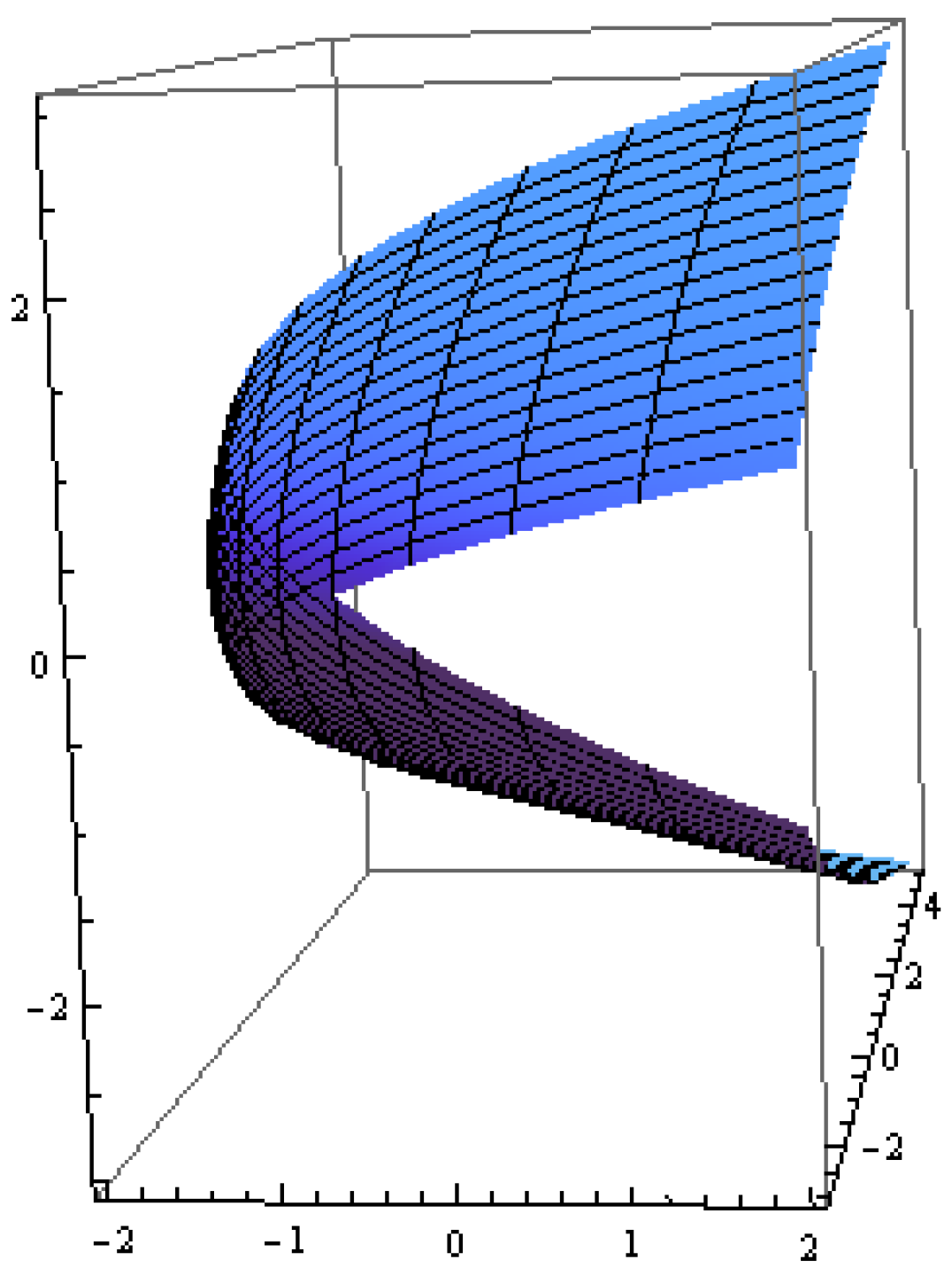
For the minimal surface case in (10), setting K = 2 , D = 2 and c = 0.5 yields a surface parametrized by
φ ( s , t ) = t + 0.5 s , t 2 2 , s t + 0.25 s 2 , s , t 2 , 2 .
The resulting surface is illustrated in Figure 2.
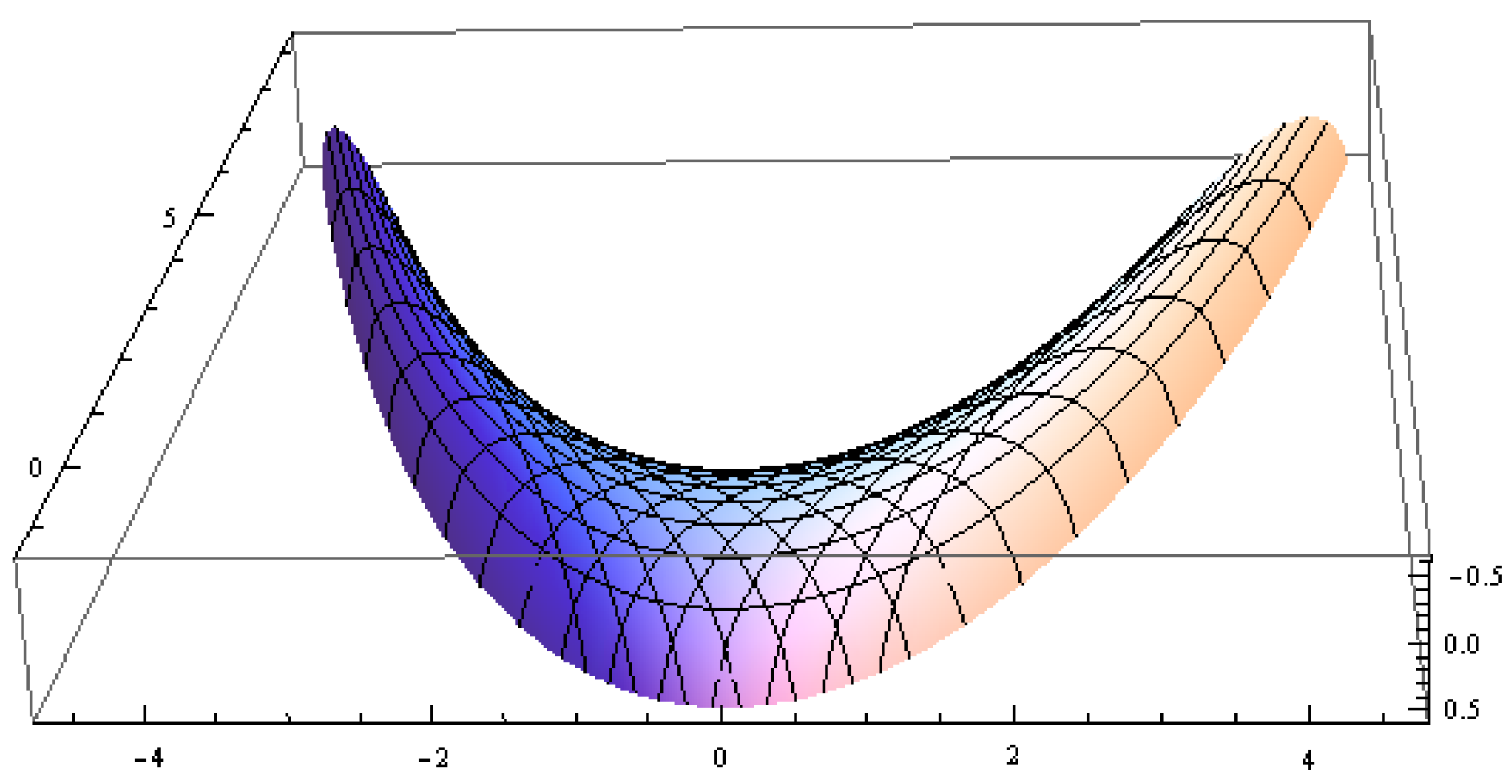
For the constant mean curvature case in (8), we set A = 0.3 . In this setting, choosing K = 0.2 , c = 1 and C = 1 , and taking the parameter ranges s 3 , 3 , t 1.6 , 1.6 , we obtain the following parametrization:
φ ( s , t ) = t + s , 1 5 3 1 3 10 t 2 + 1 5 2 , s t + 1 2 s 2 .
The corresponding surface is illustrated in Figure 3.

3.3. Constant Curvature Type III Surfaces of Revolution in G3

Consider a Type III surface of revolution in G 3 , given by the parametrization (4) using (1); the mean curvature of this surface is obtained as
H = s g n ( f g ) 2 g .
In order for the surface to be considered admissible, it is necessary that f 0 . Moreover, the function g must also be non-vanishing.
Theorem 4.
The mean curvature of a Type III surface of revolution in G 3 is constant if and only if the function g must be a non-zero constant. In this case, the surface is flat and coincides with a cylindrical surface generated over a Euclidean circle, and it admits the parametrization
φ ( s , t ) = f ( t ) , a cos s , a sin s ,
where a R 0 .
Proof. 
If H is constant, then from the expression (11) immediately implies that g must be a non-zero constant. Consequently, the surface is flat. Conversely, if g is a non-zero constant, then H is constant by the definition, and the corresponding surface is flat. In this case, the surface reduces to a cylindrical surface generated over a Euclidean circle. □

4. Conclusions

In this study, the constant mean curvature properties of surfaces of revolution in G 3 are investigated by classifying them into three types, namely Type I, Type II, and Type III, according to the geometric character of the rotation axis. The minimal surface of revolution results previously studied by Dede et al. [11] are extended in this work to the case of constant and non-zero mean curvature. The obtained results show that Type I surfaces of revolution admit the richest family of solutions under the constant mean curvature condition, whereas this condition is more restrictive for Type II surfaces, and in the case of Type III surfaces of revolution, it forces the surface to reduce to a flat cylindrical geometry. Furthermore, these results indicate that investigating the parallel surfaces corresponding to all three types of surfaces of revolution in G 3 under the assumption that the mean curvature of the parallel surface is constant constitutes a natural direction for future research.

Author Contributions

Conceptualization, İ.G. and Y.Y.; methodology, İ.G. and Y.Y.; software, İ.G. and E.Y.B.; validation, İ.G., Y.Y. and E.Y.B.; formal analysis, İ.G., Y.Y. and E.Y.B.; writing—original draft preparation, İ.G., Y.Y. and E.Y.B.; writing—review and editing, İ.G., Y.Y. and E.Y.B.; visualization, İ.G. and E.Y.B.; supervision, İ.G.; project administration, İ.G. All authors have read and agreed to the published version of the manuscript.

Funding

This research received no external funding.

Institutional Review Board Statement

Not applicable.

Data Availability Statement

No new data were created or analyzed in this study. Data sharing is not applicable to this article.

Conflicts of Interest

The authors declare no conflicts of interest.

References

  1. Divjak, B.; Milin-Šipuš, Ž. Special Curves on Ruled Surfaces in Galilean and Pseudo-Galilean Spaces. Acta Math. Hung. 2003, 98, 203–215. [Google Scholar] [CrossRef] [Scilit]
  2. Divjak, B.; Milin-Šipuš, Ž. Some Special Surfaces in the Pseudo-Galilean Space. Acta Math. Hung. 2008, 118, 209–226. [Google Scholar] [CrossRef] [Scilit]
  3. Milin-Šipuš, Ž.; Divjak, B. Surfaces of Constant Curvature in the Pseudo-Galilean Space. Int. J. Math. Math. Sci. 2012, 375264. [Google Scholar] [CrossRef] [Scilit]
  4. Milin-Šipuš, Ž.; Divjak, B. Translation Surfaces in the Galilean Space. Glas. Mat. 2011, 46, 455–469. [Google Scholar] [CrossRef] [Scilit]
  5. Yoon, D.W. Surfaces of Revolution in the Three-Dimensional Pseudo-Galilean Space. Glas. Mat. 2013, 48, 415–428. [Google Scholar] [CrossRef] [Scilit]
  6. Kamenarović, I. Existence Theorems for Ruled Surfaces in the Galilean Space G3. Rad Hrvat. Akad. Znan. Umjet. Mat. Znan. 1991, 456, 183–196. [Google Scholar]
  7. Najdanović, M.; Maksimović, M.; Velimirović, L. Curves on Ruled Surfaces under Infinitesimal Bending. Bull. Nat. Sci. Res. 2021, 11, 38–43. [Google Scholar] [CrossRef] [Scilit]
  8. Yaylı, Y.; Gölgeleyen, İ. Minimal Curves on Ruled Surfaces Generated by Legendre Curves. J. New Theory 2024, 49, 43–52. [Google Scholar] [CrossRef] [Scilit]
  9. Velimirović, L.S.; Radivojević, G.; Stanković, M.S.; Kostić, D. Minimal Surfaces for Architectural Constructions. Facta Univ.-Ser. Archit. Civ. Eng. 2008, 6, 89–96. [Google Scholar] [CrossRef] [Scilit]
  10. Gölgeleyen, İ.; Yaylı, Y.; Bulgan, E.Y. Developable Ruled Surfaces with Constant Mean Curvature Along a Curve. Mathematics 2026, 14, 234. [Google Scholar] [CrossRef] [Scilit]
  11. Dede, M.; Ekici, C.; Goemans, W. Surfaces of Revolution with Vanishing Curvature in the Galilean 3-Space. J. Math. Phys. Anal. Geom. 2018, 14, 141–152. [Google Scholar] [CrossRef] [Scilit]
  12. López, R. Liquid Drops, Soap Bubbles and Surfaces with Constant Mean Curvature. In Proceedings of the Twenty-First International Conference on Geometry, Integrability and Quantization, Varna, Bulgaria, 3–8 June 2019; Volume 21, pp. 13–54. [Google Scholar] [CrossRef] [Scilit]
  13. Ćirić, M. Notes on Constant Mean Curvature Surfaces and Their Graphical Presentation. Filomat 2009, 23, 97–107. [Google Scholar] [CrossRef] [Scilit]
  14. Ali, A.T. Position Vectors of Curves in the Galilean Space G3. Mat. Vesn. 2012, 64, 200–210. [Google Scholar]
  15. Aydın, M.E.; Kulahçı, M.A.; Öğrenmiş, A.O. Constant Curvature Translation Surfaces in Galilean 3-Space. Int. Electron. J. Geom. 2019, 12, 9–19. [Google Scholar] [CrossRef] [Scilit]
  16. Struik, D.J. Lectures on Classical Differential Geometry, 2nd ed.; Addison-Wesley: Reading, MA, USA, 1961. [Google Scholar]
  17. Divjak, B. Curves in Pseudo-Galilean Geometry. Ann. Univ. Sci. Budap. 1998, 41, 117–128. [Google Scholar]
Figure 1. Type I surface of revolution with constant mean curvature for A = 1 .
Mathematics 14 01066 g001
Figure 2. Minimal Type II surface of revolution for A = 0 .
Mathematics 14 01066 g002
Figure 3. Type II surface of revolution with constant mean curvature for A = 0.3 .
Mathematics 14 01066 g003
Disclaimer/Publisher’s Note: The statements, opinions and data contained in all publications are solely those of the individual author(s) and contributor(s) and not of MDPI and/or the editor(s). MDPI and/or the editor(s) disclaim responsibility for any injury to people or property resulting from any ideas, methods, instructions or products referred to in the content.