Article

An Investigation of Variable Segmental Inertial Parameters in Manual Load Lifting: A Genetic Algorithm-Based Inverse Dynamics Approach


1
Department of Mechanical Engineering, Kafkas University, 36100 Kars, Türkiye
2
Department of Computer Engineering, Atatürk University, 25240 Erzurum, Türkiye
3
Department of Mechanical Engineering, Atatürk University, 25240 Erzurum, Türkiye
*
Author to whom correspondence should be addressed.
Mathematics 2026, 14(6), 1065; https://doi.org/10.3390/math14061065
Submission received: 17 February 2026 / Revised: 16 March 2026 / Accepted: 19 March 2026 / Published: 21 March 2026
(This article belongs to the Special Issue Mathematical Modelling of Nonlinear Dynamical Systems)

Abstract

This study investigates the common assumption that segmental inertial parameters remain constant during manual lifting using a model-based experimental approach. The primary objective was to evaluate the variability in these parameters and the subsequent effects on biomechanical calculations. The research was conducted with 20 participants (10 females and 10 males) who performed lifting tasks in the two-dimensional sagittal plane under three distinct load conditions: 2.5 kg, 5.0 kg, and 7.5 kg. Angular variations of the hand, arm, and leg joints were recorded using video-based image processing techniques. These kinematic data, integrated with anthropometric measurements, were incorporated into Newton–Euler-based equations of motion to determine joint reaction forces and net joint moments. During the initial forward dynamics stage, the solvability of the problem was tested using constant mass ratios from the established literature. In the following inverse dynamics stage, genetic algorithms were utilized to overcome solution diversity and identify the variable inertial parameters responsible for the observed motion. The results indicate that changes in segment moments of inertia reached 18–37%, leading to variations of 0–19% in net joint moments. These findings highlight the critical necessity of incorporating dynamic inertial parameters into accurate biomechanical moment calculations for manual materials handling.

1. Introduction

The current industrial scenario is dominated by automated systems. However, human resources are still engaged in a number of tasks that require a lot of physical exertion. In the present day, a major part of the physical workload is composed of manual material handling tasks, which are mainly characterized by basic tasks like pushing, pulling, carrying, and lifting [1]. Under adverse load conditions and uncontrolled movement, these tasks may cause musculoskeletal disorders. These disorders are therefore considered among the leading occupational diseases and hence a major threat to the workforce.
The intricacy of manual load lifting, which involves all joints and all muscle groups of the human body, has attracted the attention of various disciplines like medicine, engineering, and biomechanics [2,3,4,5,6]. In response to these requirements, studies that have gained momentum since the 1970s have mainly focused on determining the human load-lifting capacity, setting safety limits, and preventing potential losses to the workforce [7]. Since the dynamics of manual load lifting and the forces acting on the human body cannot be measured using non-invasive techniques, the kinematic model is employed for analysis [8,9,10]. The Inverse Dynamics Method, which is a basic tool for the modeling stage, calculates the joint reaction forces for a human skeletal system model using the kinematic data and external forces as inputs [11].
In a review of the related literature, it has been observed that most of the analyses were performed in the sagittal plane. The scenarios were mostly related to lifting loads from the ground. The studies have examined the effect of gender and anatomical differences on joint loads. The change in the moment during flexion and rotational movements has been discussed in detail. Moreover, in recent years, the accuracy of kinematics has been increased using artificial intelligence models [12]. Nevertheless, it has been seen that both the current and classical approaches consider the human body as a rigid body that does not change shape. However, this does not reflect the biomechanical reality since it does not include muscle movements and interactions of soft tissues. Therefore, this represents a gap in the current approaches.
The assumption that segment inertia is constant contradicts the real dynamics of the human body. The position of the center of mass changes instantaneously during muscle contraction cycles. As a result, the moment of inertia changes rapidly. The problem has been approached from a model-based experimental point of view in this study, considering the biomechanical reality. It has been assumed that the inertia properties of the torso and limbs vary, and the parameters of these properties need to be determined. Kinematic data, collected via image processing, were used as input for a genetic algorithm-assisted inverse dynamic model, which was used to optimize the joint loads. The experiments were conducted with 20 participants (10 females, 10 males), and the load levels used were 2.5, 5 and 7.5 kg. The results show changes in the center of mass ranging from 4% to 23% and in the moment of inertia up to 37%. This study, which presents the effect of the ratios on the results, offers a new perspective in the literature.

2. Materials and Methods

2.1. Experimental Design and Setup

2.1.1. Subjects

This study included healthy volunteers. The subjects did not have any health problems that would prevent them from performing weight-lifting exercises. Volunteers with cardiovascular and musculoskeletal system disorders were excluded. All volunteers were informed beforehand about the experimental procedure. The experimental procedure was carried out in accordance with the approval of the Ethics Committee of Atatürk University. To maximize the ecological validity of the study, participants with professional lifting experience were excluded. This ensured that the acquired kinematic data accurately reflected the natural movement strategies of the general workforce. Furthermore, treating inertial parameters as variables allows the algorithm to dynamically adapt to individual fat and muscle distributions. This renders explicit static anthropometric measurements unnecessary. The total number of subjects in the study was 20, including 10 women and 10 men. The sample size of 20 subjects was determined based on established precedents in biomechanical studies of manual materials handling [9,13,14,15]. For investigating inverse dynamics for joint angle and moment calculations, this sample size is recognized as providing adequate statistical power to reliably evaluate kinematic and kinetic variations across different lifting conditions. The average physical characteristics of the subjects are presented in Table 1.
The subjects represent a wide age range of the active working population (male: 31.0 ± 13.86 years; female: 26.4 ± 5.85 years). This broad spectrum was intentionally designed to encompass various physiological profiles within the adult workforce, rather than being limited to a narrow age bracket. Furthermore, all participants exceed the legal minimum age limit of 18 years for manual materials handling, as stipulated by national labor legislation (Turkish Labour Law No. 4857) [16].

2.1.2. Experimental Setup

Joint angles during manual load lifting performed by the subjects using a squat technique were obtained using a web camera and the MediaPipe image processing library. Joint coordinates were identified through the software, and joint angles were calculated based on the acquired data. The anthropometric measurements of the participants (height and body mass) were recorded using a standard measurement device. For the load-lifting tasks, a handled box with dimensions of 47 cm (width) × 32 cm (depth) × 25 cm (height) was used. The load magnitudes applied in the experiments were set to 2.5 kg, 5.0 kg, and 7.5 kg, and the weights were placed inside the box in a manner ensuring homogeneous distribution.

2.1.3. Experimental Procedure

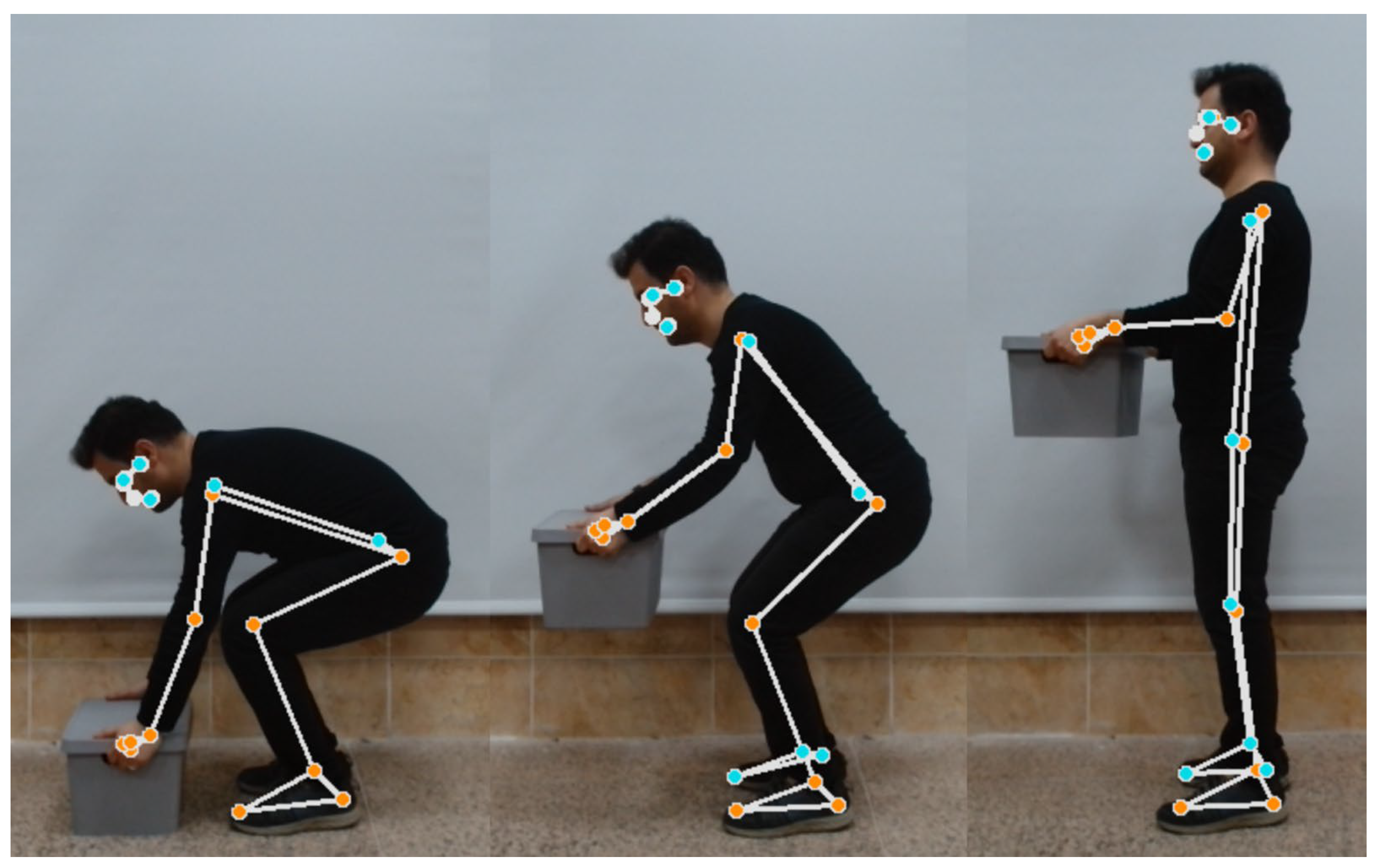
The experimental process was initiated by explaining the objective of the experiment and the equipment to be used to the participants. The camera setup and the analysis software for data acquisition were activated during the preparation phase. A total of 20 participants (10 females and 10 males) without musculoskeletal disorders were included in the experiment. The lifting task was standardized specifically using the squat lifting technique. Participants assumed an initial symmetrical squat posture with their feet positioned shoulder-width apart. From this position, they lifted the load from the ground to a fully upright standing posture with their forearms parallel to the floor and then immediately lowered the load back to the ground in a continuous, controlled manner. To ensure a constant movement speed, a metronome set to 60 beats per minute (bpm) was used, pacing one complete lift and lower cycle to exactly 8 s while joint angle data were recorded simultaneously. To ensure the reliability of the experiment, the lifting movement for each load level (2.5 kg, 5.0 kg, and 7.5 kg) was performed twice by the participants. Crucially, a 1 min rest period was provided between each trial to prevent muscle fatigue. During the execution of the movement, particular attention was paid to maintaining spinal integrity, and the load was kept close to the participants’ bodies. The experimental setup and movement patterns of the participants are shown in Figure 1.

2.2. Data Collection and Processing

Determination of Joint Angles Using Image Processing Application

For the determination of the joint motion angles, the image processing-based approach was followed. In this regard, the Python 3.10 programming language was used to develop a customized algorithm based on the MediaPipe Holistic library. Using the developed software, the landmarks and lengths of the joints were automatically detected, and the data were processed to obtain the necessary instantaneous angles of the joints [17].
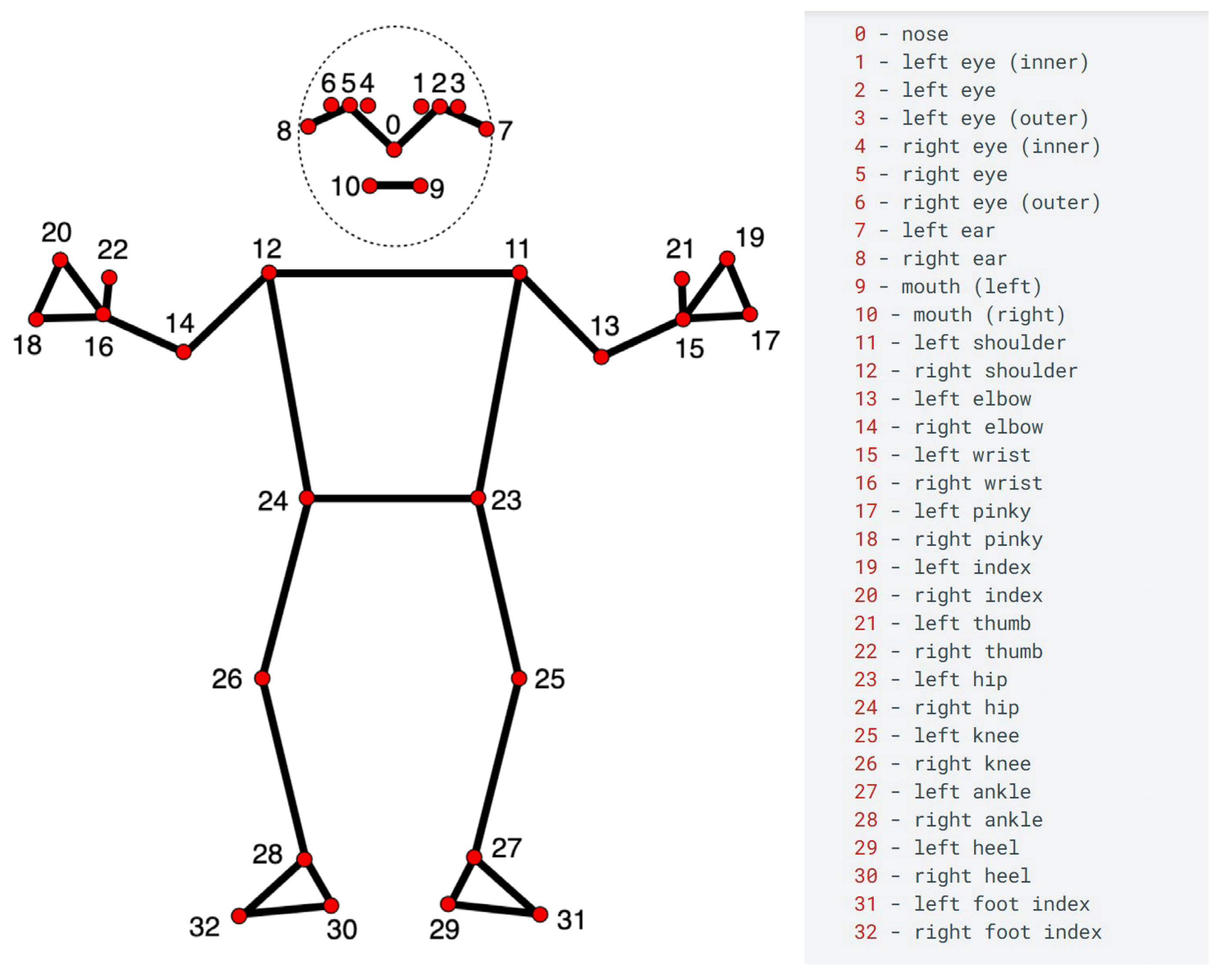
MediaPipe Holistic is an open-source pose estimation library that is comprehensive and capable of simultaneously detecting body, hand, and face key points. It was developed by Google and is used to carry out pose estimation. It is based on deep learning models and provides high-precision 2D and 3D human pose estimation. It has been widely used in the literature [15,17,18,19]. By providing analysis of a total of 33 anatomical key points, MediaPipe Holistic is a suitable library for the analysis of human motion. Figure 2 shows the anatomical placement and nomenclature of the 33 key points used for body pose estimation.
The raw data were smoothed using a second-order low-pass Butterworth filter with a cutoff frequency of 0.75 Hz, where the sampling rate was 30 Hz. The threshold was chosen to match the slow execution of the movement, thus allowing for the calculation of velocities and accelerations with minimal noise.

2.3. Model and Equation of Motion

In the kinematic analysis process, the Newton–Euler formulation was used as the basis for the construction of the equations of motion. Within the scope of the analysis, the joint angles obtained through the use of image processing techniques, along with their derivatives (i.e., the joint angular velocities and accelerations), were used as primary inputs to the formulated equations of motion. The mass ratios and the locations of the center of masses were defined based on the standard anthropometric data available in the literature, and the corresponding inertia properties were calculated. In the final stage, the assembled kinematic parameters, along with the mass inertia parameters, were used to formulate the equations of motion and obtain the reaction forces on the joints and the joint moments.

2.3.1. Two-Dimensional Skeletal Model and Anthropometric Data

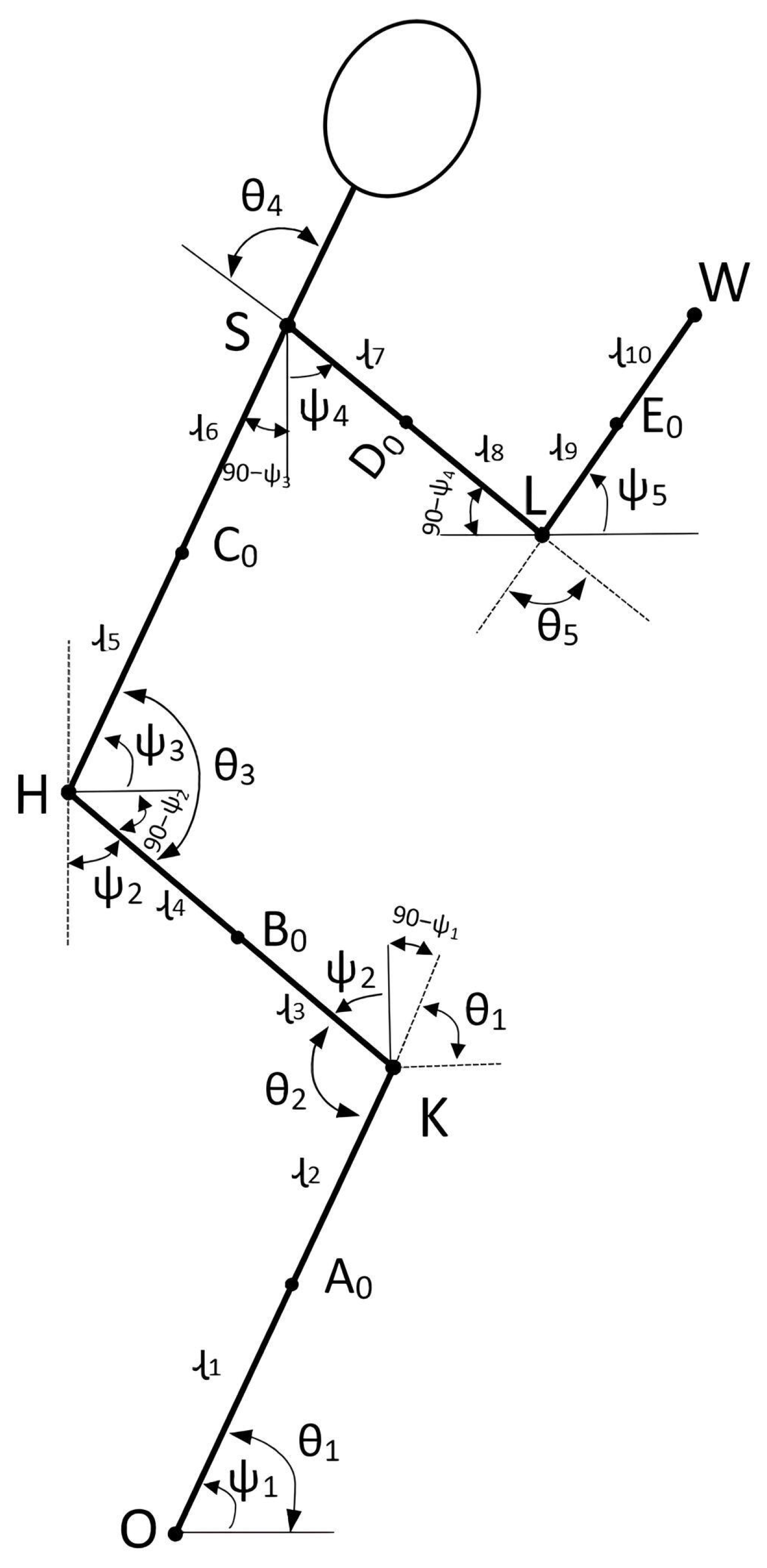
The 2D human skeletal model developed for the analyses consists of five main segments connected by joints. The segment lengths and components comprising the skeletal structure are illustrated in Figure 3. The joint angles obtained from MediaPipe are denoted as θ1, θ2, θ3, θ4, and θ5, whereas the angle values used in the calculations are represented as ψ 1, ψ 2,  ψ 3,  ψ 4,  and   ψ 5. The segments are labeled sequentially as A (lower leg), B (upper leg), C (trunk), D (upper arm), and E (forearm). The center of mass of each segment is defined by coordinate parameters (ɻ1, ɻ2, …, ɻ10) that geometrically proportion the corresponding segment.
The segment masses and lengths used in the model were calculated as presented in Table 2 based on data obtained from the literature. In the computation of the moments of inertia, the segments were assumed to have a uniform mass distribution. The subject’s height is denoted as H (m) and the subject’s mass as Sm (kg), as summarized in the table below.
Based on the acquired data, the kinematic chain of the five-segment system was solved, and the initial values of the joint forces and moments were obtained [11,20].

2.3.2. Newton–Euler Equations of Motion

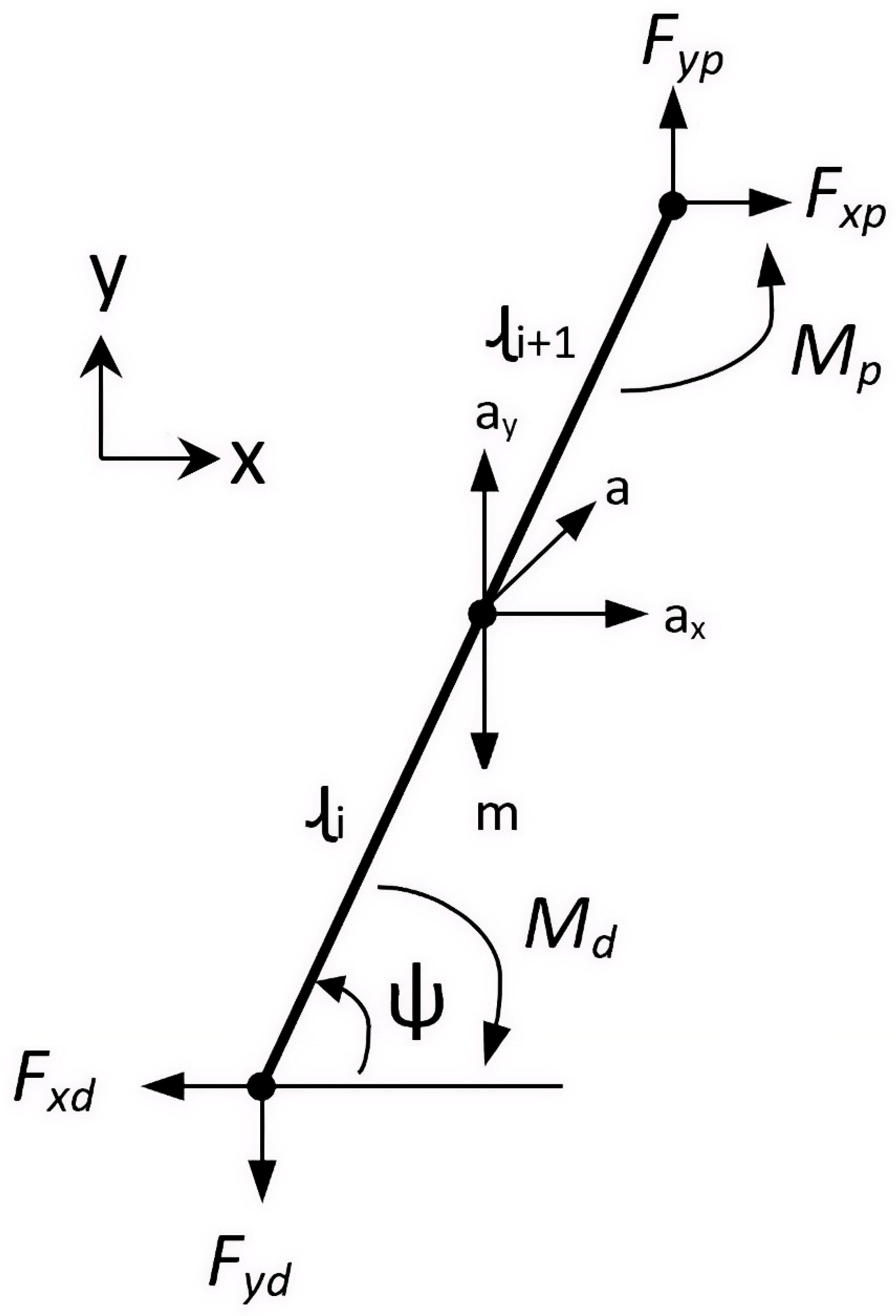
To compute the net joint reaction forces and muscle moments, a standard inverse dynamics approach was utilized [11,21]. The human body is modeled as a linked-segment system, and the dynamic equilibrium is established for a generic ith segment based on its free body diagram (Figure 4). The calculations proceed iteratively from the distal to the proximal end.
First, Newton’s Second Law of Motion is applied to the segment’s center of mass to determine the unknown proximal joint reaction forces ( F x p , F y p ) :
F x = m i a x F x p F x d = m i a x
F y = m i a y F y p F y d = m i a y
Subsequently, Euler’s equation of motion is applied to calculate the unknown net muscle moment at the proximal joint ( M p )
M = I i α M p M d F x p     ɻ i + 1 + F x d     ɻ i s i n ψ + F y p     ɻ i + 1 + F y d     ɻ i c o s ψ = I i α
where:
  • mi is the mass of the ilh segment.
  • Ii is the moment of inertia of the ilh segment about its center of mass.
  • ψ is the angle of segment in the plane of movement.
  • α is the angular acceleration of the segment.
  • a x, a y are the acceleration of the segment’s center of mass.
  • ɻi, ɻi+1 are the segment lengths.
  • Fxd, Fyd are the reaction forces at the distal joint, representing the known forces transferred from the preceding segment’s analysis.
  • Md is the net joint moment at the distal joint, which represents the known joint moment transferred from the previous analysis.
  • Fxp, Fyp are the unknown reaction forces acting on the proximal joint.
  • Mp is the unknown net muscle moment acting on the proximal joint.

2.4. Inverse Dynamics Method and Optimization via Genetic Algorithm

The genetic algorithm (GA) is a population-based optimization technique inspired by the principles of biological evolution and natural selection. Unlike traditional algorithms that perform optimization from a single starting point, the GA employs a distributed search process. It begins by randomly generating an initial population of candidate solutions within a given range. These solutions are quantitatively evaluated using an objective function to assign a fitness value. Guided by Darwin’s theory of ‘survival of the fittest’, the population systematically evolves through the basic genetic operators: selection, crossover, and mutation. This evolutionary cycle continues until an optimal solution is obtained or a predefined termination criterion is met [22].
The reason for choosing the GA for this study was mainly based on the complexities that are inherently present in musculoskeletal systems. Such systems are known for their high levels of severity in non-linearity, high dimensions, and complex coupling. Gradient-based optimization algorithms were not considered suitable for this study because these algorithms are heavily dependent on the mathematical derivatives that govern a given function. Moreover, these algorithms are known for being extremely sensitive to initial guesses. Such a property renders these algorithms extremely prone to being trapped by local optima. On the other hand, the GA offers a powerful optimization tool that does not require any mathematical derivatives. This feature greatly improves the chances of finding the true global optimum even if the initial guesses for the parameters are randomly distributed. The algorithm’s population-based approach and mutation operator prevent premature convergence to local minima, enabling a thorough exploration of the search space. Robust convergence is guaranteed when the fitness value stabilizes over multiple generations, ensuring mathematically and physically valid optimized parameters [23,24].
The robust optimization framework of the genetic algorithm stands out strategically for solving the deterministic constraints of standard inverse dynamics. Standard inverse dynamics is a deterministic process when inertial parameters are fixed based on literature data. However, treating these parameters (center of mass and moment of inertia) as time-dependent variables to reflect soft tissue dynamics transforms the system analysis into an optimization problem. In the current research, genetic algorithms (GAs), as a tool of evolutionary computation, were used to overcome the indeterminacy and find the variable inertia parameters (center of mass and moment of inertia). The objective function, aiming to minimize joint moments, was employed, which is critical for the health of the joint [25].
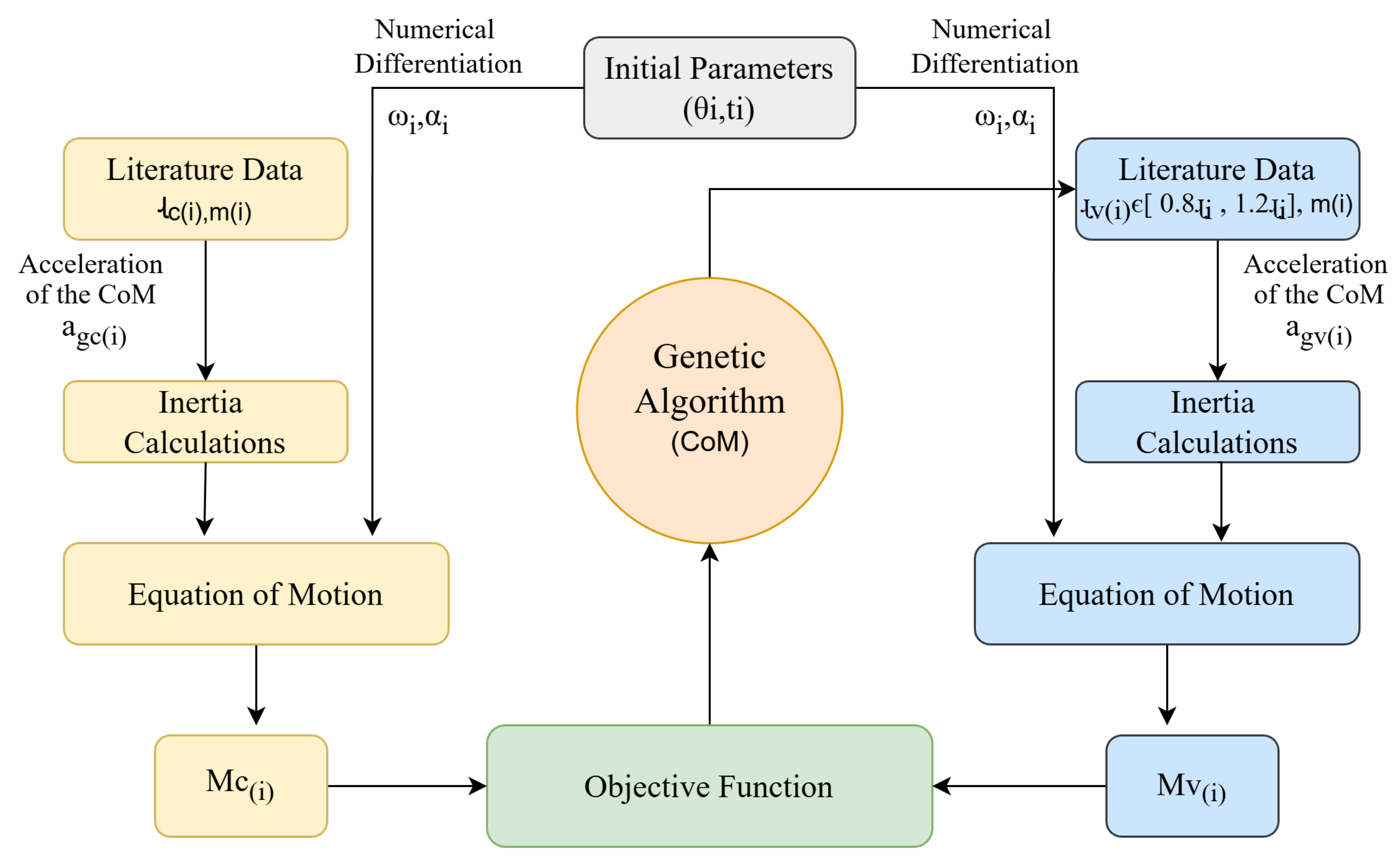
The analysis process was conducted in three consecutive stages, as summarized in Figure 5.
Data Input and Initial Parameters: In the first stage of the process, the kinematic inputs obtained from image processing (θi, ti) were subjected to numerical differentiation to obtain angular velocities (ωi) and angular accelerations (αi). In addition, segment moments of inertia (I0(c)) were calculated using constant anthropometric data adopted from the literature, including the positions of segment centers of mass (ɻc(i)) and segment masses. By solving the equations of motion with these constant inertial parameters, the joint moments (Mc(i)) for constant inertia were obtained.
Optimization Loop and Variable Dynamics: In the second stage, the genetic algorithm (GA) suggested new configurations by changing the constant CoM positions within a certain range, defined as a percentage of ±%20 of the literature values. The results obtained by the algorithm were represented as variable center of mass positions (ɻv(i)). Since the position of the center of mass physically changes the distribution of the masses relative to the axis of rotation, the moment of inertia (I0(v)) values were adjusted accordingly. The GA calculated a new inertial configuration, as well as the corresponding joint moments, i.e., (Mv(i)), related to the variable inertial parameters.
Objective Function: In the final stage, an objective function (Equation (4)) was formulated to evaluate the algorithm’s performance and mathematically express the minimization goal. This function aims to minimize the relationship between joint moments obtained from the optimized model using variable inertial parameters (Mv(i)) and joint moments computed with constant inertial parameters (Mc(i)) through a normalized error metric. In the function, the moment generated with variable inertia (Mv(i)) is divided by the moment generated with constant inertia (Mc(i)) to obtain a dimensionless quantity. This normalization balances the contributions of joint moments with different magnitudes and prevents larger moments from dominating the overall error.
m i n J = i = 1 T j = 1 N ( M v j i | M c j ( i ) | + ε ) 2
Here, i denotes the time index i = 1 , , T , j represents the joint index j = 1 , , N , M v j i and M c j i correspond to the joint moments obtained using variable and constant inertia parameters, respectively, and ε is a small positive constant introduced to avoid division by zero.

3. Results

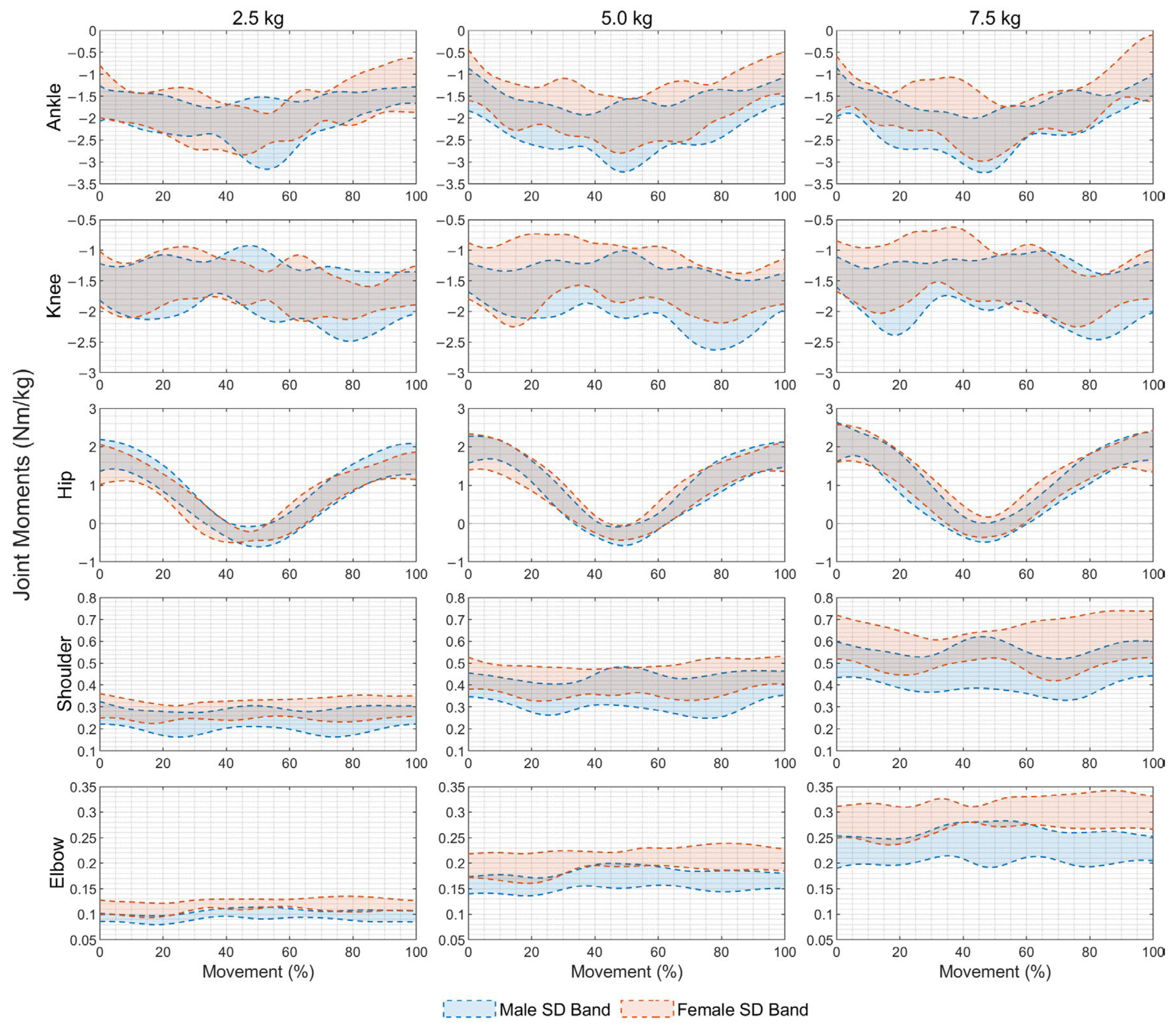
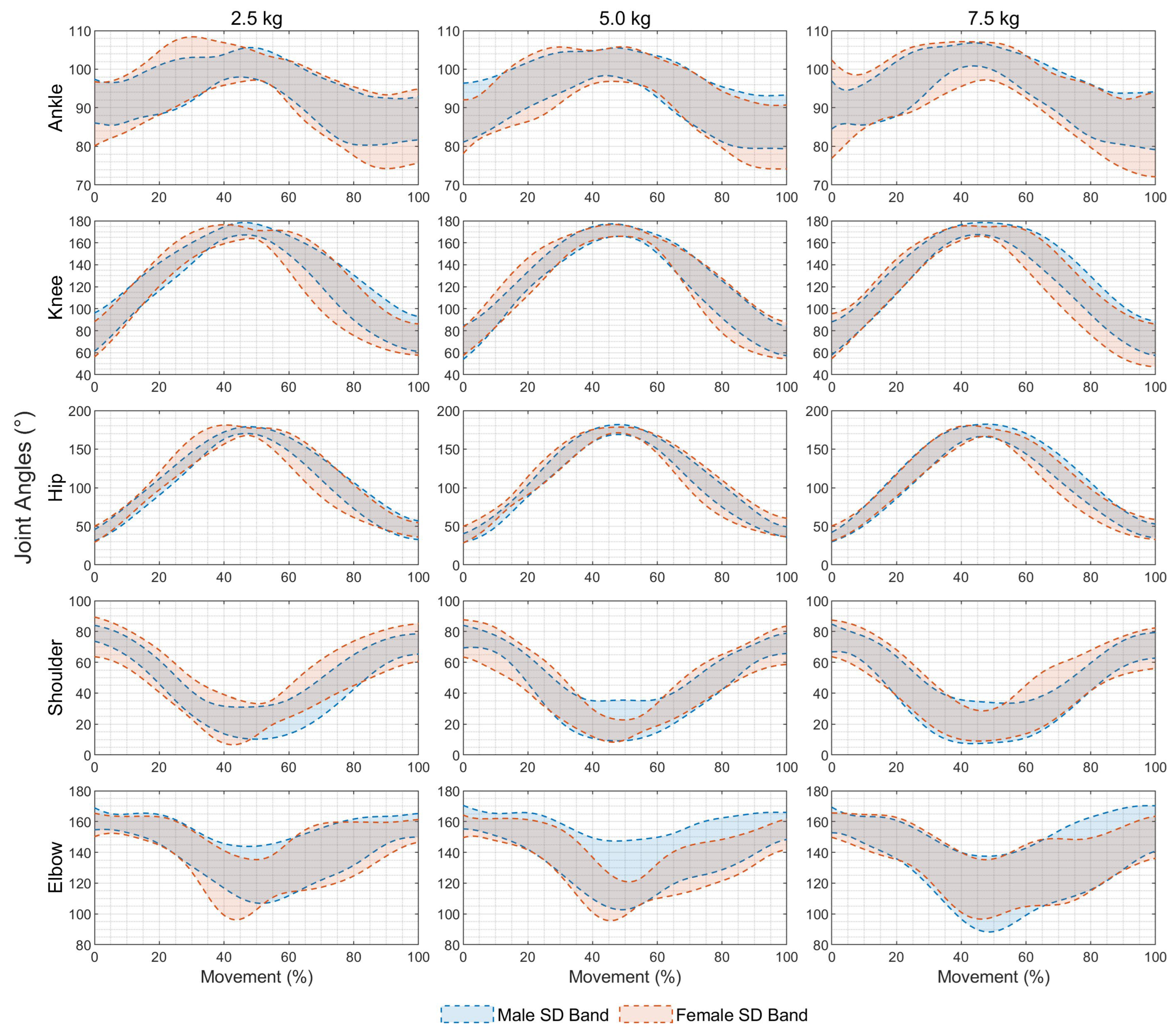
Figure 6 shows the angular changes occurring in the ankle, knee, hip, shoulder, and elbow joints during the lifting of 2.5 kg, 5.0 kg, and 7.5 kg loads. In the graphs, blue lines represent the standard deviation band for male participants, while red lines represent that for female participants. All angular data have been filtered according to motion characteristics and camera sampling frequencies to minimize signal noise.
An examination of the motion trajectories reveals that, during the lifting phase, the knee, hip, and ankle joint angles increase, whereas the shoulder and elbow joint angles decrease in order to control the load. Lower extremity joints, particularly the knee and hip, exhibited higher peak flexion angles compared to the ankle, reflecting their dominant role in load handling. Maximum and minimum joint angle values suggest that load-related adaptations primarily influence joint excursion amplitudes rather than the general shape of the movement.
The standard deviation bands provide additional insight into movement variability across participants. Female participants exhibited slightly wider standard deviation ranges compared to male participants, particularly under higher load conditions; this suggests increased variability in joint kinematics. This variability was most evident near peak and minimum angle regions, suggesting that inter-individual differences become more pronounced at mechanically demanding phases of the movement. In contrast, narrower standard deviation bands observed in male participants imply more consistent joint angle patterns, particularly in lower extremity joints, across increasing load levels.
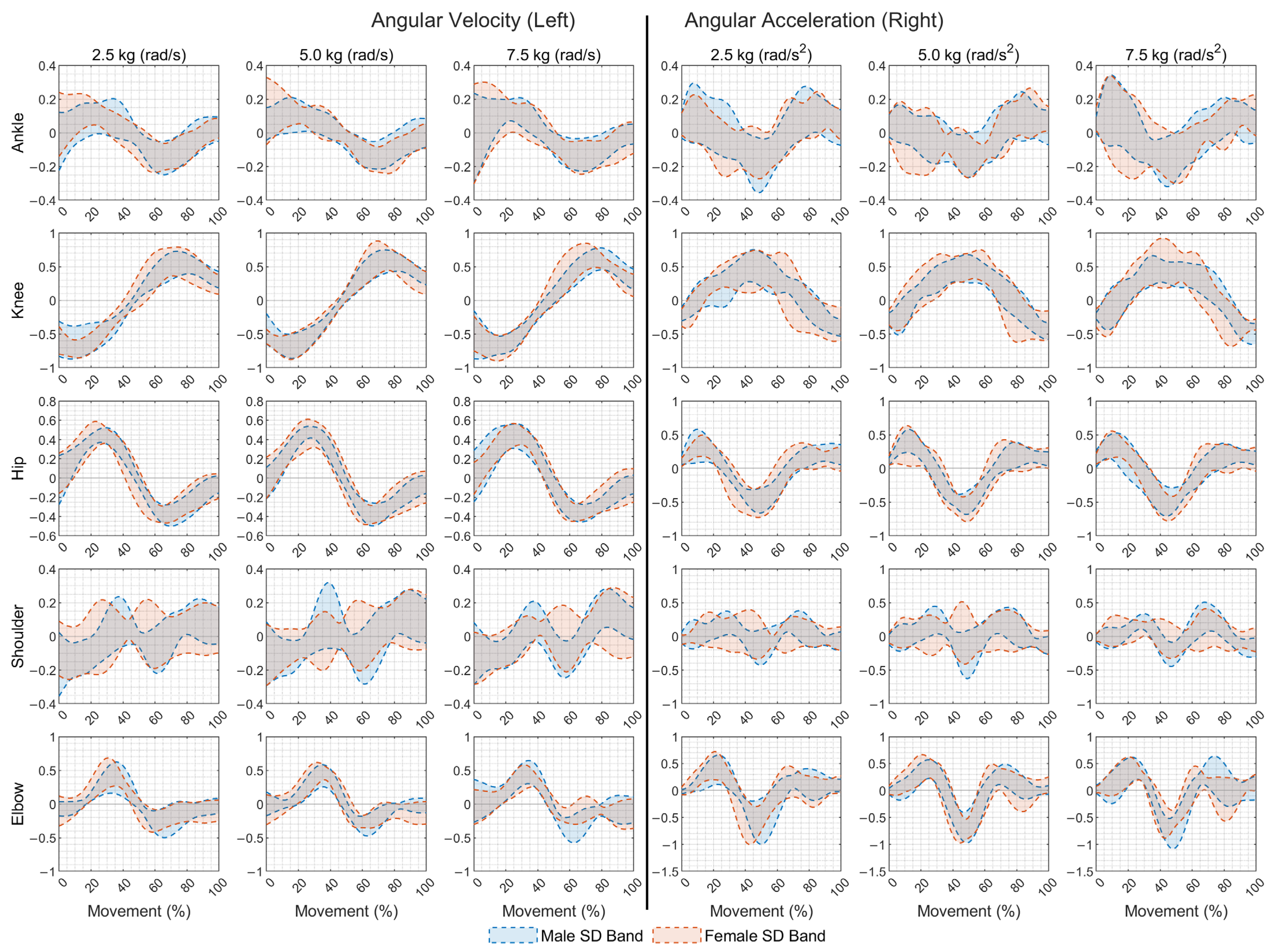
The angular velocity (rad/s) and angular acceleration (rad/s2) profiles, derived from time-dependent joint angle variations, are presented in Figure 7.
An examination of the graphs clearly reveals the physical relationship between the derivatives of the kinematic data: at the instants when the direction of motion changes (transition from lifting to lowering), the velocity approaches zero, while the acceleration reverses direction and reaches maximum (peak) values. Similarly, at points where the velocity attains its maximum, the acceleration is observed to approach zero. Increasing the load magnitude from 2.5 kg to 7.5 kg resulted in higher-frequency acceleration fluctuations, particularly at distal joints such as the shoulder and elbow. This finding indicates that, with increasing load, fine motor control at the distal segments becomes more challenging and the demand for stabilization increases.
Following the determination of joint angles, a kinetic analysis of the system was conducted to calculate joint moments, the results of which are presented in Figure 8. To eliminate inter-subject physical discrepancies, moment values were normalized by dividing by the participants’ body mass and expressed in units of Nm/kg [20].
The resulting joint moment profiles are believed to be in accordance with the prin-ciple of minimum effort of the musculoskeletal system. As the external load was increased from 2.5 kg to 7.5 kg, a significant increase in the amount of torque needed to carry out the movement was evident. This increase was more pronounced for the hip, knee, and ankle joints, which are responsible for the load-carrying movement. During the lifting move-ment, the maximum moments occurred at the hip and ankle joints, while the shoulder and elbow joints were seen to be stabilizing the movement with lower magnitudes of moments.
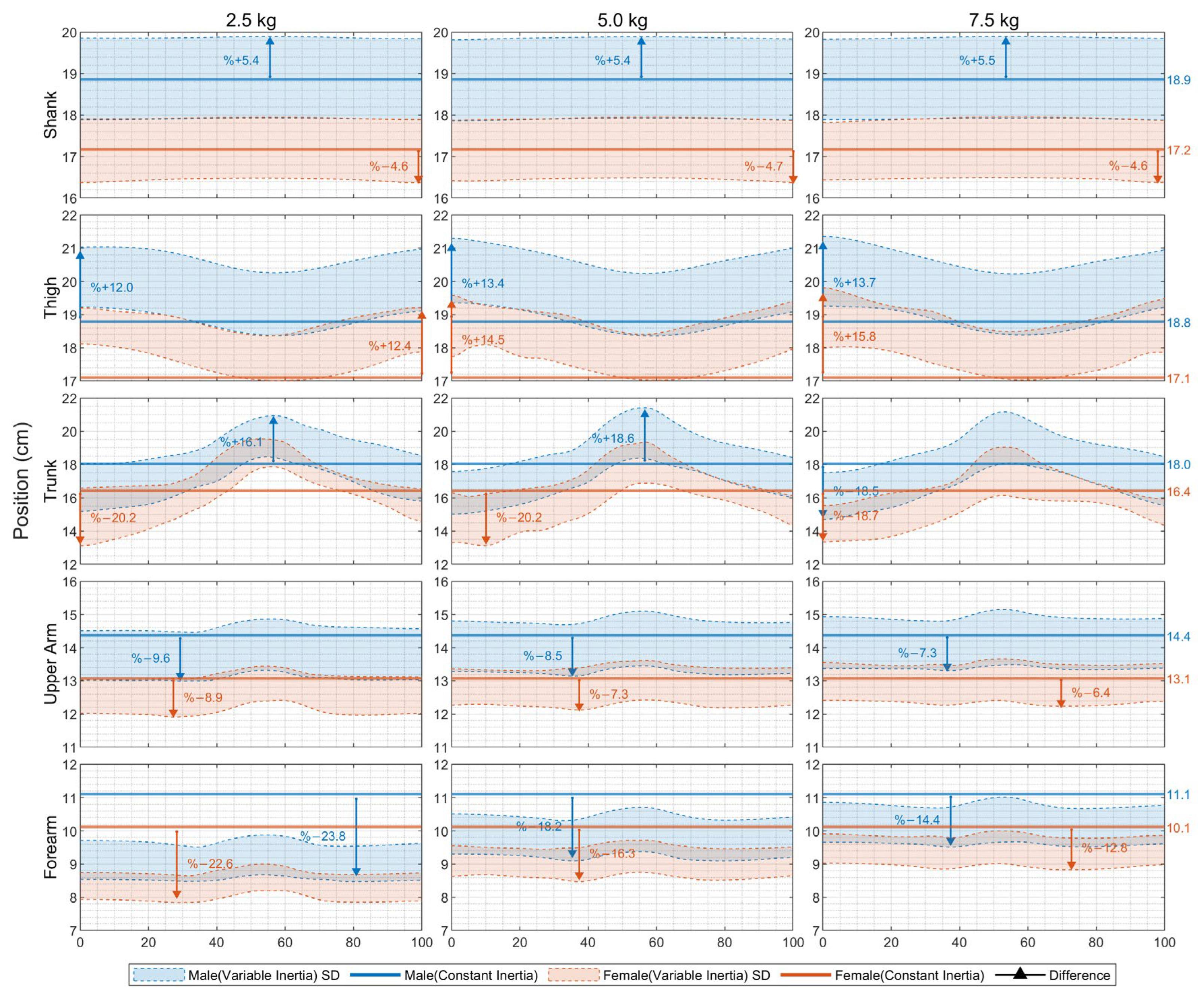
Following the kinematic analyses, a genetic algorithm (GA)-assisted inverse dynamics approach was employed to determine the dynamic parameters of the system. In this process, the instantaneous values of segment inertial properties and center-of-mass locations (ɻ2, ɻ4, ɻ6, ɻ7, ɻ9) were optimized. Figure 9 shows the changes in the center of mass (CoM) of each segment throughout the motion cycle.
When the data obtained from the graphs were examined, it was observed that the segment centers of mass (CoM) do not remain in a fixed position during movement but exhibit dynamic changes. The most pronounced variations were observed in the trunk and thigh segments, which contain large muscle groups; specifically, variable CoM positions in the trunk deviated positively from fixed literature values by up to 18.6%. In contrast, distal segments such as the forearm and upper arm showed negative deviations, dropping as low as −23.8% below standard values. Examining the effect of increased load (from 2.5 kg to 7.5 kg) revealed a dual mechanism: In the arm segments, tissue mobility was restricted due to muscle stiffness; consequently, forearm deviation significantly decreased from −23.8% to −14.4%. Conversely, in the supporting thigh region, the deviation magnitude increased from 12.0% to 13.7% with the heavier load, indicating that soft tissue deformation persists or intensifies in weight-bearing segments Figure 10 shows the changes in mass moments of inertia, which represent the resistance of the segments to rotational movement throughout the movement cycle.
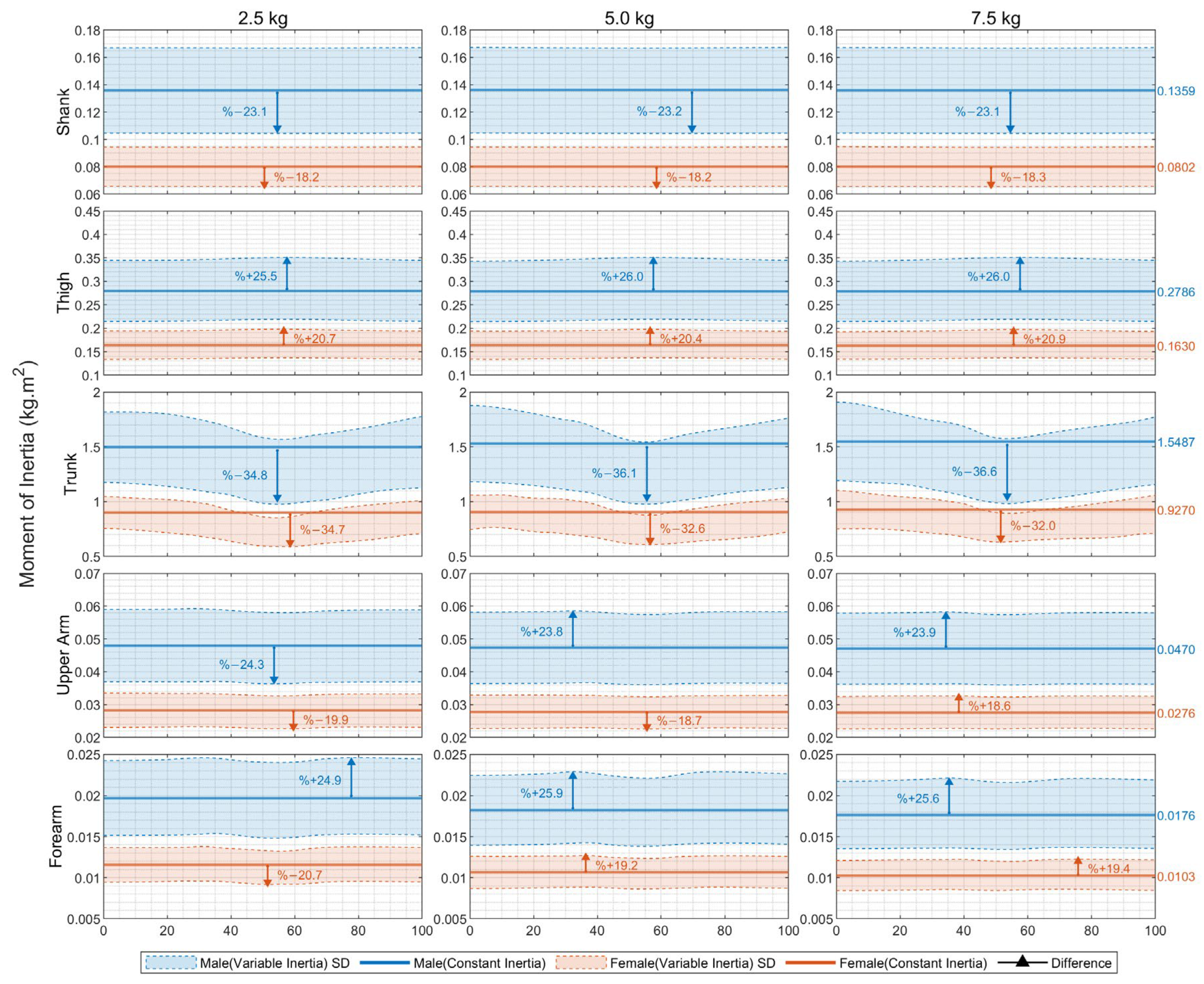
In observing the mass moment of inertia (MoI) profile, it can be seen that there is a specific differentiation between the segments. The highest variation and bandwidth were observed in the torso segment, attributed to the significant volume of soft tissue and internal viscera. In this segment, it was observed that the variable model deviated from the fixed model by 36.6% when subjected to a 7.5 kg load, which confirms the fluid nature of the trunk mass rather than a rigid structure. On the other hand, it was observed that the calf segment followed a stable pattern during the entire movement, with a narrower range of variation.
When analyzing gender, it has been noted that the variation pattern progresses in a similar phase; however, the amplitude of the variation is different. In male participants (blue band), it was observed that there was a greater standard deviation range and deviation rate in all segments when compared to female participants (red band). For instance, in the thigh segment, it was observed that the maximum positive deviation rate was +26.0% in males, whereas this rate was observed to be +20.9% in females. This is due to the fact that in male participants, the average standard deviation value is quite high, as well as for the anatomical muscle mass and diameter of the segments.
One of the most critical observations from the analysis of the graphs is that, despite the fact that the external load is increased threefold (2.5 kg, 7.5 kg), the change in the segment’s moment of inertia is relatively negligible (e.g., from −34.8% to −36.6% for the torso segment). The key reason for this observation, which shows that an increase in the load does not significantly influence the change in the moment of inertia, is that, according to the formula for calculating the moment of inertia (I = mk2), an increase in the load does not change the biological mass of the human body (m), while only one factor, the radius of gyration (k), which is defined as the result of the contraction of muscles and deformation of tissues, changes.
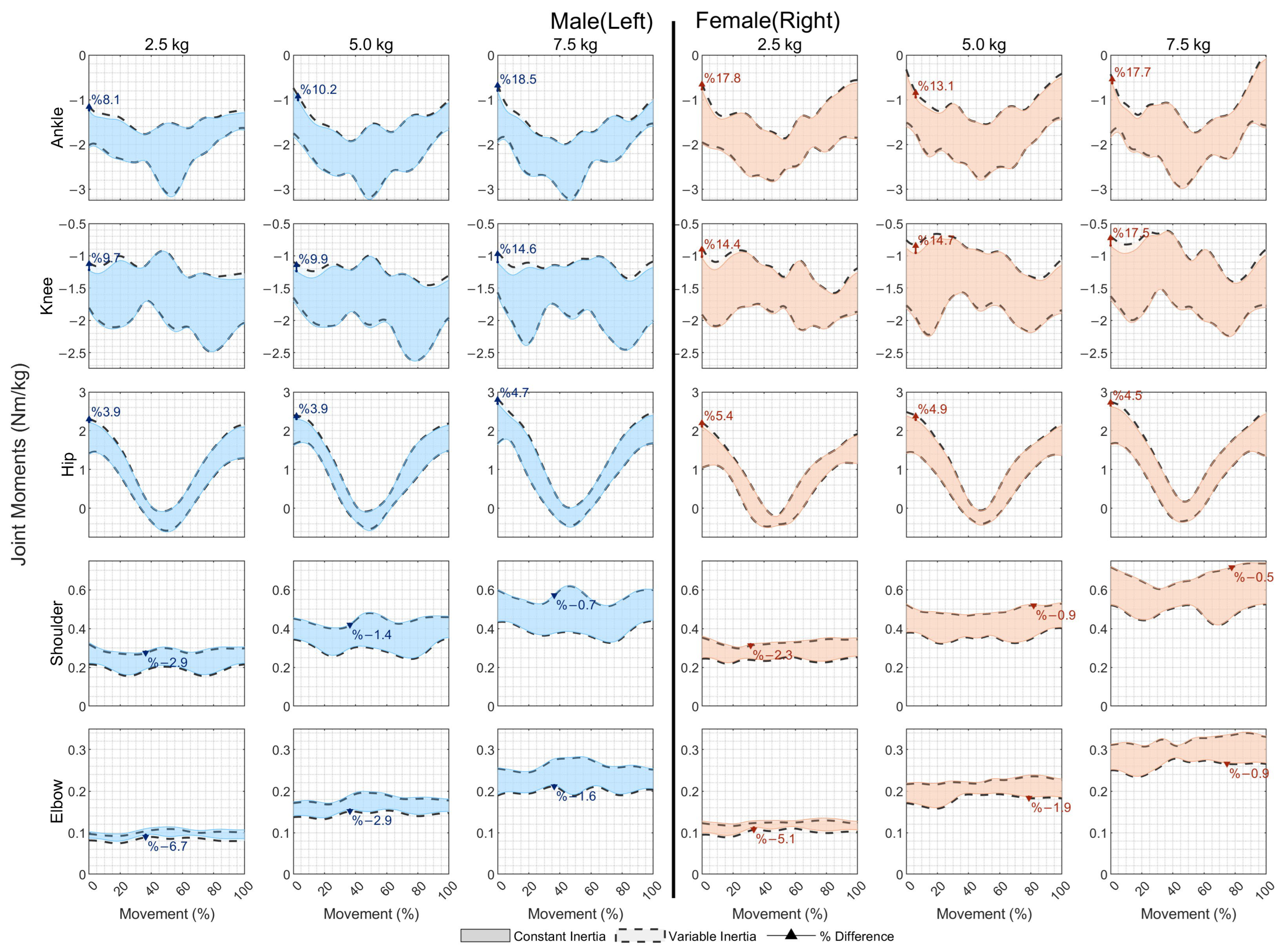
The differences between the variable inertia model obtained using the optimization algorithm and the fixed inertia model based on standard literature coefficients are presented in Figure 11.
From the analysis of the data, there are notable differences between the lower and upper body parts. The ankle and knee joint deviations were the most sensitive to the inertia models. Deviations in the ankle and knee joints reached a maximum of −18.5% in males and −17.8% in females. Conversely, the hip joint showed positive deviations that reached a maximum of +5.4%. The upper body parts remained relatively stable. Deviations in the shoulder and elbow joints remained minimal and below 3%.
The gender differences in the responses also showed notable differences. At lower loads of 2.5 kg, females showed higher deviation rates compared to males. However, at higher loads of 7.5 kg, male deviations increased considerably and surpassed those of females. More importantly, despite the percentage deviations in the joint moments at certain points, the moment trajectory for the variable inertia model tracked a similar path to that of the constant model. This shows that although the dynamic inertia model provides precise results, it does not change the topology of joint moment.

4. Discussion

The current study aimed to investigate the manual lifting of loads, which is a common phenomenon in daily activities. The study was carried out within a model-based framework that involved different external loads (2.5 kg, 5.0 kg, and 7.5 kg) and gender effects (10 females and 10 males). The focus of this study was not on absolute values of joint loads, but rather on the relative changes in inertia parameters. Hence, a two-dimensional sagittal plane model was preferred. The results of this study indicate that the musculoskeletal system of humans not only involves a kinematic adaptation process; additionally, the physical properties of body segments also change dynamically according to the nature of the movement.
The genetic algorithm (GA) was used in this study for optimization. The results reveal that the human body adapts itself not only by changing the joint angles, but by also dynamically changing the physical properties of the limbs, such as the center of mass and moment of inertia, depending on the nature of the applied load. When the load was increased, the participants adopted a safety strategy. In this strategy, the hip, shoulder, and elbow joints were used more. To keep the balance and reduce the load on the waist, the load was kept closer to the center of the body. Analysis of the results revealed that both female and male participants adopted a similar pattern of adaptation. However, it was found that there were variations in the range of motion and moment magnitude due to anatomical differences.
The main contribution of this study lies in the quantitative measurement of the changes in the parameters of the segments. Especially for the trunk and thigh segments, where the density of the muscles and the level of movement are high, the shift of the centers of mass has been observed to be between 4 and 23%. Contrary to the general literature values, the centers of mass of the arm segments were observed to be closer to the joint axes. The changes observed were 18–37% for the moment of inertia, which measures the resistance of rotation. In their study, Pain and Challis [26] concentrated on the shank segment. The shift of the centers of mass observed was between 1.1 cm and 1.7 cm. The physical shift of the centers of mass resulted in an 8% change in the moment of inertia for this particular segment.
Joint moments are a critical parameter in the validation phase of the model. Joint moments are an indication of motor control strategies in the kinetic analysis of movement. In accordance with these expectations, it was observed in this study that, as opposed to traditional static assumptions, joint moments vary during movement. Inertia model sensitivity was observed in the lower extremities. Negative deviations, ranging from −18.5%, were recorded in the ankle and knee, whereas a positive shift of +5.4% was recorded in the hip. On the other hand, in the upper body, changes were below 3%. Despite these transient peak deviations, it was observed that there was significant agreement between the two models. The resulting agreement verifies that the proposed method, which takes into account variable inertia, increases the accuracy of amplitude without affecting the kinetic topology produced by the traditional model. The successful prediction verifies the reliability of the proposed method in predicting complex human movement.
One of the key aspects of the nonlinear inverse dynamic approach is its model sensitivity, particularly in terms of inertial parameter input variations and their effect on the calculated joint moments. The proposed model exhibits partial sensitivity to inertial parameter variations. While the genetic algorithm identified substantial changes in the position of the center of mass and, in turn, changes in moments of inertia, these substantial changes in the input parameters to the model produced bounded and limited changes in the calculated joint moments. Therefore, it may be said that our model is appropriately sensitive to physiological mass changes, as it does not exhibit volatile and disproportionate changes in the calculated values of the joint moments.
As a technical consideration, processing the complete dataset (60 trials) required approximately 60 min (averaging 1 min/trial). While this timeframe precludes real-time monitoring, it is highly efficient for standard offline ergonomic analyses.
A review of the literature reveals that there is a wide range of research on the biomechanics of manual load lifting. Current research on the topic ranges from classical inverse dynamic models [27] to modern artificial intelligence models such as MonoMSK [12]. However, all these studies have a common and important limitation: the human body is represented by a series of undeformable ‘rigid segments’. In fact, this limitation was emphasized by the authors of a review on methods for augmenting biomechanical data published by [28]. The authors emphasized the limitation of current models due to the inability to account for the effects of soft tissues and the presence of a ‘synthetic gap’ between simulation and reality. Furthermore, Robert et al. [29] showed that rigid-body simplifications can cause joint moment errors of up to 30% during complex movements. Faber et al. [14] showed that rigid geometric assumptions underestimate L5/S1 moments by up to 17%. Dranetz et al. [30] reported that inaccuracies for segment mass and inertial properties cause a 0.115 ± 0.032 Nm/kg difference in hip flexion moments during the swing phase, while mischaracterization of joint center locations results in an increase of 0.217 ± 0.055 Nm/kg in hip abductive moments during stance. Langenderfer et al. [31] demonstrated that minor uncertainties in segment parameters and landmarks can lead to substantial variabilities in inverse dynamics predictions, reaching up to 56% for joint forces and 156% for moments. The limitation of this study, however, lies in the fact that the joint was basically treated as a simple revolute joint, and complex joint mechanical behavior was not considered, as the primary aim of this study was to validate the variable inertia estimation method developed. This study contributes to research on variable inertia with its originality and scientific value by presenting its findings.

5. Conclusions

In conclusion, this study has shown that the fixed inertia values used in the literature are not entirely sufficient to account for the dynamic conditions of motion. This study has shown the significance of the variations resulting from muscle contractions and the movement of soft tissues. It is not a choice, but rather a necessity to use variable parameters to account for inertia variability. This is especially important when conducting analyses at the individual level, as the reliability of the model is significantly increased.
There are many possibilities for the expansion of the proposed framework. For example, different age groups, such as the elderly and children, could be used in the study. The range of body mass indexes could be more diverse, and higher loads could be used. Another important factor is that the variable inertia information has a lot of potential to be used practically. It is possible to monitor workers in the fields of ergonomics and occupational health. This will allow for early detection of injury risks. From a technological point of view, the system can be made more accurate with the use of high-speed cameras and deep learning algorithms. From the results, it is evident that human movement dynamics are unique to each individual, depending on their anatomy.

Author Contributions

Conceptualization, M.Ç. and Ö.G.; methodology, M.Ç., B.U. and Ö.G.; software, M.Ç.; validation, M.Ç., B.U. and Ö.G.; formal analysis, M.Ç.; investigation, M.Ç.; resources, M.Ç.; data curation, M.Ç.; writing—original draft preparation, M.Ç.; writing—review and editing, B.U. and Ö.G.; visualization, M.Ç.; supervision, B.U. and Ö.G.; project administration, Ö.G. All authors have read and agreed to the published version of the manuscript.

Funding

This work was supported by the Atatürk University Scientific Research Projects Coordination Unit (BAP) within the scope of project FDK-2022-11177.

Institutional Review Board Statement

Ethics committee approval for the acquisition of the data used in this study was obtained from the Faculty of Science and Engineering Ethics Committee Presidency with the decision dated 29 September 2022 and numbered 22 of the 9th meeting.

Informed Consent Statement

Informed consent was obtained from all subjects involved in this study.

Data Availability Statement

The raw data supporting the conclusions of this article will be made available by the authors on request.

Acknowledgments

We thank the Atatürk University Scientific Research Projects Coordination Unit (BAP) for the support provided during this study.

Conflicts of Interest

The authors declare no conflicts of interest.

References

  1. Taylor, G.A.; Easter, K.; Hegney, R. Enhancing Occupational Safety and Health; Elsevier: Amsterdam, The Netherlands, 2004. [Google Scholar]
  2. Zajac, F.E.; Neptune, R.R.; Kautz, S.A. Biomechanics and muscle coordination of human walking: Part I: Introduction to concepts, power transfer, dynamics and simulations. Gait Posture 2002, 16, 215–232. [Google Scholar] [CrossRef] [PubMed]
  3. van der Krogt, M.M.; Delp, S.L.; Schwartz, M.H. How robust is human gait to muscle weakness? Gait Posture 2012, 36, 113–119. [Google Scholar] [CrossRef] [PubMed]
  4. Selbie, W.S.; Caldwell, G.E. A simulation study of vertical jumping from different starting postures. J. Biomech. 1996, 29, 1137–1146. [Google Scholar] [CrossRef] [PubMed]
  5. Anderson, F.C.; Pandy, M.G. Dynamic optimization of human walking. J. Biomech. Eng. 2001, 123, 381–390. [Google Scholar] [CrossRef] [PubMed]
  6. Arnold, E.M.; Delp, S.L. Fibre operating lengths of human lower limb muscles during walking. Philos. Trans. R. Soc. B Biol. Sci. 2011, 366, 1530–1539. [Google Scholar] [CrossRef] [PubMed]
  7. Ayoub, M. Problems and solutions in manual materials handling: The state of the art. Ergonomics 1992, 35, 713–728. [Google Scholar] [CrossRef]
  8. Huang, C.; Sheth, P.N.; Granata, K.P. Multibody dynamics integrated with muscle models and space-time constraints for optimization of lifting movements. In Proceedings of the International Design Engineering Technical Conferences and Computers and Information in Engineering Conference, Long Beach, CA, USA, 24–28 September 2005; pp. 391–398. [Google Scholar]
  9. Song, J.; Qu, X.; Chen, C.-H. Simulation of lifting motions using a novel multi-objective optimization approach. Int. J. Ind. Ergon. 2016, 53, 37–47. [Google Scholar] [CrossRef]
  10. Xiang, Y.; Arora, J.S.; Rahmatalla, S.; Marler, T.; Bhatt, R.; Abdel-Malek, K. Human lifting simulation using a multi-objective optimization approach. Multibody Syst. Dyn. 2010, 23, 431–451. [Google Scholar] [CrossRef]
  11. Winter, D.A. Biomechanics and Motor Control of Human Movement; John Wiley & Sons: Hoboken, NJ, USA, 2009. [Google Scholar]
  12. Koleini, F.; Xue, H.; Helmy, A.; Wang, P. MonoMSK: Monocular 3D Musculoskeletal Dynamics Estimation. arXiv 2025, arXiv:2511.19326. [Google Scholar] [CrossRef]
  13. Yanikören, M.; Yilmaz, S.; Gündoğdu, Ö. 3D biomechanical model that can perform dynamic analysis of the upper extremity and L5/S1 joints without the use of force sensor. Sādhanā 2024, 49, 241. [Google Scholar] [CrossRef]
  14. Faber, G.S.; Kingma, I.; Chang, C.C.; Dennerlein, J.T.; van Dieen, J.H. Validation of a wearable system for 3D ambulatory L5/S1 moment assessment during manual lifting using instrumented shoes and an inertial sensor suit. J. Biomech. 2020, 102, 109671. [Google Scholar] [CrossRef] [PubMed]
  15. Kusunose, M.; Inui, A.; Mifune, Y.; Yamaura, K.; Shinohara, I.; Tanaka, S.; Ehara, Y.; Takigami, S.; Osawa, S.; Nakabayashi, D. Estimation of Forearm Pronation–Supination Angles Using MediaPipe and IMU Sensors: Performance Comparison and Interpretability Analysis of Machine Learning Models. Appl. Sci. 2025, 15, 10527. [Google Scholar] [CrossRef]
  16. Republic of Turkey Ministry of Labour and Social Security. Labor Law No. 4857 (İş Kanunu). Available online: https://www.mevzuat.gov.tr/mevzuat?MevzuatNo=4857&MevzuatTur=1&MevzuatTertip=5 (accessed on 11 March 2026).
  17. Google AI. MediaPipe Solutions Guide. Available online: https://ai.google.dev/edge/mediapipe/solutions/guide (accessed on 25 December 2025).
  18. Simoes, W.; Reis, L.; Araujo, C.; Maia, J., Jr. Accuracy assessment of 2D pose estimation with MediaPipe for physiotherapy exercises. Procedia Comput. Sci. 2024, 251, 446–453. [Google Scholar] [CrossRef]
  19. Al-Barhamtoshy, H.M.; AlHarbi, K.; Rashad, A. An AI Analytical Model for Human’s Posture Analysis: Posture Correction with MediaPipe. In Proceedings of the 2025 2nd International Conference on Advanced Innovations in Smart Cities (ICAISC), Jeddah, Saudi Arabia, 9–11 February 2025; pp. 1–6. [Google Scholar]
  20. Gundogdu, O. Quantification and Assessment of Objective Function Performance in Manual Materials Handling; Rensselaer Polytechnic Institute: Troy, NY, USA, 2000. [Google Scholar]
  21. Robertson, D.G.E.; Caldwell, G.E.; Hamill, J.; Kamen, G.; Whittlesey, S. Research Methods in Biomechanics; Human Kinetics: Champaign, IL, USA, 2013. [Google Scholar]
  22. Michalewicz, Z. Genetic Algorithms + Data Structures = Evolution Programs; Springer Science & Business Media: Berlin/Heidelberg, Germany, 1996. [Google Scholar]
  23. Goldberg, D.E. Genetic Algorithms for Selection, Optimization, and Machine Learning; Addison-Wesley: Reading, MA, USA, 1989. [Google Scholar]
  24. Rao, S.S. Engineering Optimization: Theory and Practice; John Wiley & Sons: Hoboken, NJ, USA, 2019. [Google Scholar]
  25. Latash, M. Control of Human Movement; Human Kinetics: Chicago, IL, USA, 1993. [Google Scholar]
  26. Pain, M.T.; Challis, J.H. High resolution determination of body segment inertial parameters and their variation due to soft tissue motion. J. Appl. Biomech. 2001, 17, 326–334. [Google Scholar] [CrossRef]
  27. Hwang, S.; Kim, Y.; Kim, Y. Lower extremity joint kinetics and lumbar curvature during squat and stoop lifting. BMC Musculoskelet. Disord. 2009, 10, 15. [Google Scholar] [CrossRef] [PubMed]
  28. Halmich, C.; Höschler, L.; Schranz, C.; Borgelt, C. Data augmentation of time-series data in human movement biomechanics: A scoping review. PLoS ONE 2025, 20, e0327038. [Google Scholar] [CrossRef] [PubMed]
  29. Robert, T.; Chèze, L.; Dumas, R.; Verriest, J.-P. Validation of net joint loads calculated by inverse dynamics in case of complex movements: Application to balance recovery movements. J. Biomech. 2007, 40, 2450–2456. [Google Scholar] [CrossRef] [PubMed]
  30. Dranetz, J.; Chen, S.; Choi, H. Impact of model geometry and joint center locations on inverse kinematic/dynamic predictions: A comparative study of sexually dimorphic models. J. Biomech. 2024, 169, 112147. [Google Scholar] [CrossRef] [PubMed]
  31. Langenderfer, J.E.; Laz, P.J.; Petrella, A.J.; Rullkoetter, P.J. An efficient probabilistic methodology for incorporating uncertainty in body segment parameters and anatomical landmarks in joint loadings estimated from inverse dynamics. J. Biomech. Eng. 2008, 130, 014502. [Google Scholar] [CrossRef] [PubMed]
Figure 1. Experimental execution demonstrating the squatting, lifting, and standing phases of manual load lifting, where the colored circles and lines indicate the human joints and body posture detected by the MediaPipe Holistic library.
Mathematics 14 01065 g001
Figure 2. The 33 landmarks used in MediaPipe body pose estimation [17].
Mathematics 14 01065 g002
Figure 3. Labeled segments and angular positions.
Mathematics 14 01065 g003
Figure 4. Free body diagram showing net forces, moments, and accelerations of single segment.
Mathematics 14 01065 g004
Figure 5. Flowchart of experiment.
Mathematics 14 01065 g005
Figure 6. Joint angle trajectories of the ankle, knee, hip, shoulder, and elbow during lifting tasks under three different load conditions (2.5, 5.0, and 7.5 kg). The male (blue) and female (red) joint angle profiles, including ±1 standard deviation bands (boundaries indicated by dashed lines), are presented.
Mathematics 14 01065 g006
Figure 7. The angular velocity (rad/s) and angular acceleration (rad/s2) changes of the lower and upper extremity joint movements during different load conditions (2.5, 5.0, 7.5 kg) for males (Blue) and females (Red). The left and right panels show the velocity and acceleration changes, respectively. The shaded area represents the standard deviation(boundaries indicated by dashed lines).
Mathematics 14 01065 g007
Figure 8. The mass-normalized joint moments obtained by using constant inertial parameters for all the joints in a manual load-lifting task with different load conditions (2.5 kg, 5.0 kg, and 7.5 kg) and for different sexes (male: blue; female: red). Dashed lines indicate the SD boundaries.
Mathematics 14 01065 g008
Figure 9. Center of mass position profiles (cm) of all segments during manual load-lifting tasks under different load conditions (2.5, 5.0 and 7.5 kg) for male (blue) and female (red) participants. Constant and variable inertia models are compared. Shaded regions show standard deviation ranges(boundaries indicated by dashed lines), while arrows indicate percentage differences between inertia conditions.
Mathematics 14 01065 g009
Figure 10. Moment of inertia (kg.m2) profiles of all segments during lifting tasks under varying loads (2.5, 5.0, and 7.5 kg) for male (blue) and female (red) participants. Constant and variable inertia models are compared. Shaded regions indicate standard deviation (±1 SD) (boundaries indicated by dashed lines), and arrows show maximum percentage differences between models.
Mathematics 14 01065 g010
Figure 11. Normalized joint moment profiles (Nm/kg) calculated using constant and variable inertia models under different load conditions (2.5, 5.0, 7.5 kg). The plots compare male (blue) and female (red) participants for five different joints. The shaded area shows the standard deviation (±1 SD), while the arrow shows the maximum relative percentage difference between the two models.
Mathematics 14 01065 g011
Table 1. Descriptive characteristics of participants: age, height, and body mass (Mean ± SD).
Average AgeAverage Height (m)Average Mass (kg)
Male31.0 ± 13.861.77 ± 0.0986.80 ± 13.53
Female26.4 ± 5.851.61 ± 0.0761.90 ± 6.84
Overall28.7 ± 10.621.69 ± 0.1174.35 ± 16.50
Table 2. Calculation coefficients for segmental properties (mass, length, and CoM) based on total body mass and height [11].
SegmentMass (kg)Segment Length (m)CoM Position (Distal) (m)CoM Position (Proximal) (m)
A (Shank)0.093Sm0.246H (OK) 0.13948 H   ( ɻ 1 ) 0.10652 H   ( ɻ 2 )
B (Thigh)0.200Sm0.245H (KH) 0.13892 H   ( ɻ 3 ) 0.10609 H   ( ɻ 4 )
C (Trunk)0.578Sm0.288H (HS) 0.10188 H   ( ɻ 6 ) 0.18612 H   ( ɻ 5 )
D (Upper Arm)0.056Sm0.186H (SL) 0.10490 H   ( ɻ 8 )   0.08110 H   ( ɻ 7 )
E (Forearm)0.032Sm0.146H (LW) 0.08322 H   ( ɻ 10 ) 0.06278 H   ( ɻ 9 )
Disclaimer/Publisher’s Note: The statements, opinions and data contained in all publications are solely those of the individual author(s) and contributor(s) and not of MDPI and/or the editor(s). MDPI and/or the editor(s) disclaim responsibility for any injury to people or property resulting from any ideas, methods, instructions or products referred to in the content.