Article

Three-Dimensional Second-Order Rational Difference Equations: Explicit Formulas and Simulations

by
Ahmed Ghezal
1,*,
Hassan J. Al Salman
2,* and
Ahmed A. Al Ghafli
2
1
Department of Mathematics, Abdelhafid Boussouf University of Mila, Mila 43000, Algeria
2
Department of Mathematics and Statistics, College of Science, King Faisal University, Hofuf 31982, Alahsa, Saudi Arabia
*
Authors to whom correspondence should be addressed.
Mathematics 2026, 14(5), 876; https://doi.org/10.3390/math14050876
Submission received: 25 January 2026 / Revised: 21 February 2026 / Accepted: 24 February 2026 / Published: 5 March 2026
(This article belongs to the Special Issue Nonlinear Dynamics, Chaos, and Mathematical Physics)

Abstract

This paper studies a three-dimensional second-order rational difference system, which generalizes earlier scalar and bidimensional models. We derive explicit closed-form solutions for general initial conditions and identify special cases that simplify the system’s structure. These explicit solutions are particularly significant, as they not only enable rigorous stability analysis but also provide a precise analytical characterization of the system’s long-term behavior, offer deeper insight into its underlying periodic structure, and establish a solid theoretical foundation for potential future applications in the control, prediction, and optimization of multivariable dynamical systems. The analysis carefully addresses conditions ensuring well-defined solutions, avoiding singularities. Numerical simulations illustrate various dynamic behaviors, including oscillations, convergence, and sensitivity to parameters, confirming the richness and robustness of the system’s temporal evolution.

1. Introduction

Difference equations constitute one of the cornerstones of modern discrete mathematics, owing to their fundamental role in modeling dynamical processes evolving in discrete time. They naturally arise as discrete analogues of differential and delay differential equations, and they appear extensively in applications ranging from population dynamics, epidemiology, and ecology to economics, finance, genetics, neural systems, and engineering sciences (see, e.g., [1,2,3,4,5,6,7,8,9,10]). In particular, discrete-time models are indispensable for describing systems with non-overlapping generations or seasonal reproduction, where continuous-time formulations fail to capture the intrinsic temporal structure of the underlying phenomena.
Over the past decades, nonlinear rational difference equations and their systems have attracted increasing attention due to the richness of their dynamical behavior, including boundedness, periodicity, quasi-periodicity, multistability, and chaotic regimes [11,12,13]. Early foundational works by Elsayed et al. [14,15,16,17], as well as Kulenović and Ladas [18], highlighted that rational difference equations of order greater than one possess highly nontrivial global dynamics, making them both theoretically challenging and practically relevant. Subsequent studies further demonstrated that such equations serve as discrete prototypes for understanding nonlinear interactions in higher-order dynamical systems [19,20,21,22,23]. In parallel, considerable attention has been devoted to deriving closed-form solutions of nonlinear difference systems, often through connections with special sequences such as generalized Fibonacci numbers, which provide powerful analytical tools for solvability and structural analysis; see Al Salman [24] and Al Ghafli [25]. A classical example in this direction is the second-order rational difference equation introduced and analyzed by Elabbasy et al. [26], given by
ϕ m + 1 = ϕ m ϕ m 1 ϕ m 1 + 1 , m 0 ,
where nonzero initial conditions ϕ 1 ,   ϕ 0 are assumed. Equation (1) represents one of the simplest yet nontrivial rational recursions capable of generating rich qualitative behavior. Its analytical tractability and dynamic complexity motivated several generalizations toward coupled and higher-dimensional settings. Building upon this scalar framework, Haddad et al. [27] proposed a bidimensional second-order rational system
ϕ m + 1 1 = λ 1 ϕ m 1 ϕ m 1 2 ϕ m 2 δ 1 + δ 2 , ϕ m + 1 2 = λ 2 ϕ m 2 ϕ m 1 1 ϕ m 1 δ 2 + δ 1 , m 0 ,
where λ k , k = 1 , 2 , and the initial conditions ϕ 1 k ,   ϕ 0 k ,   k = 1 , 2 , are assumed to be nonzero real numbers, while δ k , k = 1 , 2 , are arbitrary real numbers, which can be viewed as a natural vector generalization of (1) incorporating cross-coupling between two interacting components. This formulation significantly broadens the modeling capability of rational difference equations, allowing the description of asymmetric interactions and mutual feedback mechanisms frequently encountered in economics and biological systems. Related asymmetric and multivariate discrete models have also been investigated in stochastic and threshold-based frameworks. To further reflect environments with time-dependent or seasonal effects, Yazlık et al. [28] extended system (1) by introducing periodic coefficients, leading to
ϕ m + 1 1 = λ m 1 ϕ m 1 ϕ m 1 2 ϕ m 2 δ m 1 + δ m + 1 2 , ϕ m + 1 2 = λ m 2 ϕ m 2 ϕ m 1 1 ϕ m 1 δ m 2 + δ m + 1 1 , m 0 ,
where the initial conditions ϕ 1 k ,   ϕ 0 k ,   k = 1 , 2 , are assumed to be nonzero real numbers, and λ m k m ,   δ m k m ,   k = 1 , 2 , are two periodic sequence of real numbers, thereby generalizing (2) in a non-autonomous setting. Such periodic structures are particularly relevant in applications involving seasonal forcing, regime switching, or periodically varying environments, as emphasized in recent studies on periodic difference systems [29,30,31,32,33]. More recently, Touafek and Al-Juaid [34] proposed a more comprehensive second-order rational system:
ϕ m + 1 1 = λ 1 ϕ m 1 ϕ m 1 2 ϕ m 2 ξ 1 ϕ m 1 2 δ 1 + ξ 2 ϕ m 1 + δ 2 , ϕ m + 1 2 = λ 2 ϕ m 2 ϕ m 1 1 ϕ m 1 ξ 2 ϕ m 1 1 δ 2 + ξ 1 ϕ m 2 + δ 1 ,
for m 0 , where λ k and the initial conditions ϕ 1 k ,   ϕ 0 k ,   k = 1 , 2 , are assumed to be nonzero real numbers, while δ k , ξ k , k = 1 , 2 , are arbitrary real numbers, which subsumes (2) as a special case and introduces additional linear feedback terms involving delayed states. This formulation captures more intricate interaction mechanisms and aligns with recent advances in higher-order difference systems [35,36,37,38]. Motivated by the above developments and by the growing interest in three-dimensional nonlinear difference systems [2,29,30,39], we introduce in this paper a new three-dimensional second-order rational system:
ϕ m + 1 k = λ k ϕ m k ϕ m 1 k + 2 mod 3 ϕ m k + 2 mod 3 ξ k + 2 mod 3 ϕ m 1 k + 2 mod 3 δ k + 2 mod 3 + ξ k ϕ m k + δ k ,
for k = 1 , 2 , 3 , m 0 , where λ k and the initial conditions ϕ 1 k ,   ϕ 0 k ,   k = 1 , 2 , 3 , are assumed to be nonzero real numbers, while δ k , ξ k , k = 1 , 2 , 3 , are arbitrary real numbers. System (4) represents a systematic and symmetric generalization of (3) to three interacting components, governed by cyclic coupling and second-order rational feedback. Conceptually, the three-dimensional system (4) is viewed not merely as a straightforward mathematical generalization but as a natural dynamical structure that emerges when three interdependent units interact within a closed loop. The periodic coupling pattern k k + 2 k + 1 k reflects an indirect exchange mechanism common in many real-world systems, where each component influences the others not through direct bilateral connections but via a third, intermediary element. This pattern is clearly evident in three-phase biological rhythm models, in loop-structured feedback neural networks, and in economic systems where three indicators (such as production, investment, and expectations) form time-delayed, interdependent loops. Theoretically, this model bridges a gap between two-dimensional systems—which capture only pairwise interactions—and high-dimensional models, which often lack explicit analytical tractability. The symmetrical loop structure of system (4) enables the emergence of new properties, most notably intrinsic periodicity. Thus, the system provides an intermediate framework that combines dynamical richness with analytical solvability, giving it independent significance beyond being a simple mathematical extension. From an applied perspective, this structural richness enhances the modeling of complex multivariate dynamics such as biological rhythms, neural interactions, and coupled economic indicators, as highlighted in recent three-dimensional studies [2,3,29,39]. The main objective of this paper is to investigate the solvability of system (4). In particular, we aim to derive analytical insights into the structure of solutions, explore periodic regimes, and illustrate the theoretical findings through numerical simulations. Our results contribute to the growing literature on higher-dimensional nonlinear difference systems and provide a unified framework that encompasses several well-known models as special cases.
The remainder of this paper is organized as follows. In Section 2, we present the main theoretical results of the proposed three-dimensional second-order rational difference system. Section 3 is devoted to numerical simulations and illustrative examples, which are provided to confirm the theoretical findings and to highlight the dynamical behaviors of the system under various parameter settings. Finally, Section 4 concludes the paper with a summary of the main contributions and a brief discussion of possible directions for future research. For completeness, additional technical proofs and auxiliary results are collected in Appendix A.

2. The Explicit Solution Formulas

In this section, we derive complete and explicit closed-form solutions for the proposed system. We begin by stating a fundamental theorem that provides direct analytic expressions for computing all terms of the solution sequences. Subsequently, we investigate several special cases that lead to substantial simplifications of these formulas, including situations where the system coefficients are equal or vanish. These cases offer valuable insight into the system’s behavior under different parameter configurations and help clarify the structural properties of the obtained solutions. Before presenting the main result concerning solvability, it is necessary to state explicitly the assumptions under which system (4) is mathematically well-defined.
Remark 1. 
For system (4) to be rigorously and unambiguously solvable, it is necessary to ensure that all coefficients and quantities appearing in the nonlinear fractional expressions do not lead to indeterminate situations, such as division by zero. This requires satisfying a fundamental condition, namely, that the denominators remain nonzero throughout the entire evolution of the sequences. In particular,
ϕ m k ξ k ϕ m 1 k δ k 0 , k = 1 , 2 , 3 , m 0 .
Furthermore, due to the multiplicative and fractional structure of the system, which involves products and ratios of the state variables, it is also necessary to assume that k = 1 3 ϕ m k 0 ,   m 0 . Under these conditions, the system admits a well-defined and consistent formulation, and all transformations and explicit solution formulas derived in this work are mathematically justified and globally applicable.
The following theorem provides explicit and comprehensive closed-form expressions for all components of the solution in direct analytic form. These formulas are derived from the periodic structure of the system, and the theorem clearly specifies the initial values required to generate all subsequent iterations.
Theorem 1. 
Consider system (4). Then, the system is explicitly solvable in the analytical sense, and its solutions admit closed-form expressions. More precisely, for all m 0 ,   l = 0 , 1 , 2 , and for each k = 1 , 2 , 3 , the solution sequences ϕ m k are given by
ϕ 6 m + 2 l k = A 2 l , k 6 m ϕ 2 l k + i = 0 m 1 u = 0 5 A 2 l , k 6 i A 2 l , k u δ k , ϕ 6 m + 2 l + 1 k = A 2 l + 1 , k 6 m ϕ 2 l + 1 k + i = 0 m 1 u = 0 5 A 2 l + 1 , k 6 i A 2 l + 1 , k u δ k .
where the coefficients A l , k u are defined by A l , k u = v = 0 u 1 ψ l v + 6 k + ξ k with A l , k 0 = 1 . The auxiliary sequences ψ . k ,   k = 1 , 2 , 3 , are six-periodic and given by
ψ 0 k = ϕ 0 k ξ k ϕ 1 k δ k ϕ 1 k 1 , ψ 1 k = λ k ψ 0 k + 2 mod 3 1 , ψ 2 k = λ k λ k + 2 mod 3 ψ 0 k + 1 mod 3 , ψ 3 k = λ k + 1 mod 3 λ k + 2 mod 3 λ k ψ 0 k 1 , ψ 4 k = λ k + 1 mod 3 λ k + 2 mod 3 ψ 0 k + 2 mod 3 , ψ 5 k = λ k + 1 mod 3 ψ 0 k + 1 mod 3 1 .
Furthermore, the initial iterates ϕ . k , k = 1 , 2 , 3 , are explicitly determined by the linear relations ϕ s k = ϕ s 1 k ψ s k + ξ k + δ k ,   s = 1 , , 5 .
Remark 2. 
From a numerical standpoint, the selection of initial values plays a crucial role. Since system (4) involves rational expressions and the auxiliary quantities ψ m ( k ) require divisions by ϕ 1 ( k ) and ϕ 0 ( k ) , the initial data must avoid values that are excessively close to zero, as such choices may amplify rounding errors and lead to numerical instability. Under the non-vanishing assumptions stated previously, particular care must also be taken in numerical implementations to avoid values that are close to singular configurations, thereby preventing unstable behavior in the system’s evolution. In practical computations, moderately scaled initial values are preferable. Excessively large magnitudes may trigger rapid growth whenever the effective six-step multipliers A l , k ( 6 ) exceed unity in absolute value, whereas extremely small values may compromise numerical precision. It is important to emphasize that, owing to the explicit closed-form representation established in Theorem 1, the computation of solutions does not depend on long recursive iterations, significantly limiting the accumulation of numerical errors.
Remark 3. 
We note that the explicitly derived formulas for system (4), although they involve large products and sums, remain relatively computationally efficient for large m when handled systematically. In fact, the system’s periodic structure—specifically, its six-step cycle—can be exploited, together with sequential analysis techniques, to significantly reduce the computational burden. Recurring sums and products are thus represented by reusable periodic coefficients rather than being recalculated for each new index m. This approach not only improves computational efficiency but also renders the explicit results suitable for practical applications, including the numerical simulation of the system’s dynamics over a large number of time steps without requiring a full re-iteration of each sequence element. From a practical standpoint, the choice of m should reflect the objectives of the specific application. Small values of m are sufficient to study short-term or transient dynamics, while larger values are necessary to capture long-term trends, periodic patterns, or the approach to equilibrium. Owing to the explicit closed-form solutions provided in Theorem 1, computations for any selected m do not require extended recursive iterations. This flexibility allows users to set m based solely on the relevant time horizon, ensuring that the essential dynamical features are captured efficiently without introducing numerical instability or inefficiency. From a computational perspective, the evaluation of the system can be significantly accelerated by leveraging its inherent periodicity. The six-step cycle enables precomputation of recurring multipliers and sums as reusable coefficients, eliminating repeated calculations at each iteration. Furthermore, fast exponentiation of boundary multipliers and closed-form evaluation of geometric sums allow large values of m to be handled efficiently without long recursive loops. These strategies ensure that the explicit formulas provide both precise analytical solutions and rapid, stable numerical implementation, making additional acceleration techniques unnecessary. Readers interested in applications can implement these formulas in mathematical software, taking advantage of the system’s periodicity and geometric structure to precompute recurring multipliers and sums. Fast exponentiation of boundary terms and closed-form evaluation of inner sums allow large m values to be handled efficiently, ensuring accurate solutions with minimal computational cost. Thus, the explicit formulas are not only theoretically precise but also practically implementable for large-scale computations.
Remark 4. 
The periodic behavior of the auxiliary sequences ψ . k does not stem from a prior assumption but rather emerges naturally from the inherent loop structure of the system. Each component ψ . k explicitly depends on another component with a shifted index of the form k + 2 mod 3 , leading to the formation of a closed feedback loop among the three dimensions of the system. When tracing the system’s evolution through a complete reaction cycle, these interdependencies collapse into a higher-order recursive relationship involving only one component, as illustrated by (A2). This relationship shows that each auxiliary sequence evolves independently with a two-step time delay. Reapplying this procedure yields the linear relationship shown in (A3), which clearly demonstrates that each sequence ψ . k returns to its initial values after six steps. Therefore, we can directly conclude that the sequences ψ . k for k = 1 , 2 , 3 are periodic with period six. This explicit periodicity is a fundamental structural property of the system, as it allows reducing the original nonlinear system to linear difference equations with periodic coefficients. This explains the possibility of deriving explicit analytical solutions without resorting to iterative calculations.
  • Having established the general explicit form of the system’s solutions in Theorem 1, it is natural to examine special cases that lead to further simplifications of these formulas. Among such cases, the situation in which all coefficients λ k ,   k = 1 , 2 , 3 , are equal is of particular interest, as it reflects a higher degree of symmetry in the interaction among the three sequences. In this setting, many of the relative ratio terms cancel out, yielding a unit value. As a consequence, compact and simplified expressions are obtained for the auxiliary sequences ψ . k ,   k = 1 , 2 , 3 , and for the initial iteration values ϕ u k , k = 1 , 2 , 3 ,   u = 1 , 2 , 3 , 4 , 5 . These simplified formulas are presented in the following corollary, which highlights how the equality of the coefficients λ k ,   k = 1 , 2 , 3 , induces an algebraic simplification without altering the underlying periodic structure of the solution.
Corollary 1. 
Let λ 1 = λ 2 = λ 3 in system (4). Then the explicit solution retains the structure given in Theorem 1, with the auxiliary sequences ψ . k ,   k = 1 , 2 , 3 , and the first five iterates ϕ u k , k = 1 , 2 , 3 ,   u = 1 , 2 , 3 , 4 , 5 , simplifying to the forms listed below:
ψ 0 k = ϕ 0 k ξ k ϕ 1 k δ k ϕ 1 k 1 , ψ 1 k = λ k ψ 0 k + 2 mod 3 1 , ψ 2 k = ψ 0 k + 1 mod 3 , ψ 3 k = λ k ψ 0 k 1 , ψ 4 k = ψ 0 k + 2 mod 3 , ψ 5 k = λ k + 1 mod 3 ψ 0 k + 1 mod 3 1 , ϕ s k = ϕ s 1 k ψ s k + ξ k + δ k , s = 1 , , 5 .
In the study of general solutions to a system, it is essential to examine boundary cases in which the equations reduce to simpler forms, as this facilitates a deeper understanding of the system’s behavior and the underlying structure of the solutions. One such case arises when the coefficients λ k , k = 1 , 2 , 3 , are set to zero, whereby the nonlinear coupling associated with the interacting variables is eliminated, and the system reduces to a collection of discrete linear recurrence relations. In this scenario, the following corollary provides the explicit closed-form solution for this particular case, expressed in terms of the initial values and the coefficients ξ k and δ k , k = 1 , 2 , 3 .
Corollary 2. 
Let λ 1 = λ 2 = λ 3 = 0 in system (4). Then, the general closed-form solution (5) reduces to the elementary explicit expressions:
ϕ m k = ξ k m ϕ 0 k + ξ k m 1 ξ k 1 δ k , ξ k 1 , k = 1 , 2 , 3 ,
and, for the singular value ξ k = 1 , k = 1 , 2 , 3 ,
ϕ m k = ϕ 0 k + m δ k , k = 1 , 2 , 3 .
Remark 5. 
To ensure that the system of difference equations is well defined and that its solutions exist for m, special attention must be paid to the interaction coefficients λ k , k = 1 , 2 , 3 . If one of these coefficients is set equal to zero (for example, λ k 0 = 0) while the remaining coefficients remain nonzero, the equation corresponding to the k 0 becomes linear, whereas the other equations remain nonlinear and involve variable denominators. This structure significantly increases the possibility that some denominators may vanish after a finite number of iterations, depending on the initial conditions and the values of the remaining coefficients, thereby rendering the corresponding component undefined and breaking down the global evolution of the system. Therefore, to avoid this mathematical inconsistency, only one of two coherent scenarios should be adopted. Either all interaction coefficients λ k , k = 1 , 2 , 3 , are simultaneously zero, in which case the system reduces to a safe linear discrete system, or all coefficients λ k , k = 1 , 2 , 3 are nonzero, with the initial conditions chosen so as to ensure that no denominator vanishes throughout the entire iteration process. Only under these assumptions is the system fully well posed, and the explicit solution formulas derived in this work remain valid and applicable for all time steps.
Remark 6. 
In light of recent advances in the theory of fuzzy difference equations, including studies on nonlinear systems with exponential-type bounds [35], global stability analyses of higher-order fuzzy difference equations [38], and existence and uniqueness results for two-dimensional fuzzy systems with logarithmic interactions [40], a natural and promising direction for future research emerges. This direction consists in extending the system proposed in this paper to a fuzzy-number framework. Such a generalization would allow for more realistic modeling of dynamical processes subject to uncertainty or imprecise data, which frequently arise in practical applications.

Limitations and Scope of Applicability

Although this paper provides explicit and comprehensive analytical formulations for the solutions of the proposed three-component system, it is important to acknowledge several inherent limitations that delineate the scope of applicability of the present approach. This is essential to present a balanced and transparent scientific picture to the reader.
Due to the nonlinear and rational nature of system (4), the behavior of the solutions may exhibit a marked sensitivity to initial conditions, particularly when these conditions are close to the boundary at which the denominator vanishes. This phenomenon is not unique to the present system but is a general characteristic of higher-order rational difference systems, where even small changes in initial conditions can significantly affect subsequent dynamical paths. Nevertheless, the availability of explicit closed-form solutions—as derived in this paper—allows for an analytical investigation of this sensitivity and a clearer understanding of its structural mechanisms, rather than relying solely on numerical observation.
To systematically assess sensitivity, we analyzed the propagation of small perturbations in the initial values through the explicit formulas derived in Theorem 1. This approach allows a direct evaluation of how variations in the starting data influence all subsequent iterations without relying on long recursive computations, substantially limiting numerical errors. The analysis confirms the robustness of the formulas and aids in selecting appropriate initial data.
Having assessed sensitivity systematically, it remains crucial to ensure that the system is well-posed under the stated assumptions. Ensuring well-posedness rests primarily on the assumptions that the denominators never vanish and that the state variables remain nonzero throughout the time evolution, as discussed previously. These constraints, while seemingly restrictive, are mathematically necessary to guarantee the existence and persistence of solutions. Moreover, the ranges of initial values identified through sensitivity analysis complement these conditions, providing a quantitative measure of stability and guiding practical implementation. Explicitly stating these assumptions from the outset enhances analytical rigor and delineates the precise validity range of the results obtained.
This paper is concerned with deriving explicit analytical solutions within a well-defined framework of constant coefficients and regular periodic interactions. Consequently, extending the model to include stochastic coefficients, external perturbations, or non-periodic coupling structures may require different analytical tools that lie beyond the scope of the present paper. Nevertheless, the analytical framework developed herein can serve as a solid foundation for such future extensions.
In light of the above, the aforementioned limitations do not diminish the significance of the results presented; rather, they situate them within their proper mathematical context and make clear that the central objective of this paper is to achieve a deeper structural and dynamical understanding of the proposed system while preserving analytical and numerical tractability within a well-defined and transparent framework.

3. Numerical Examples

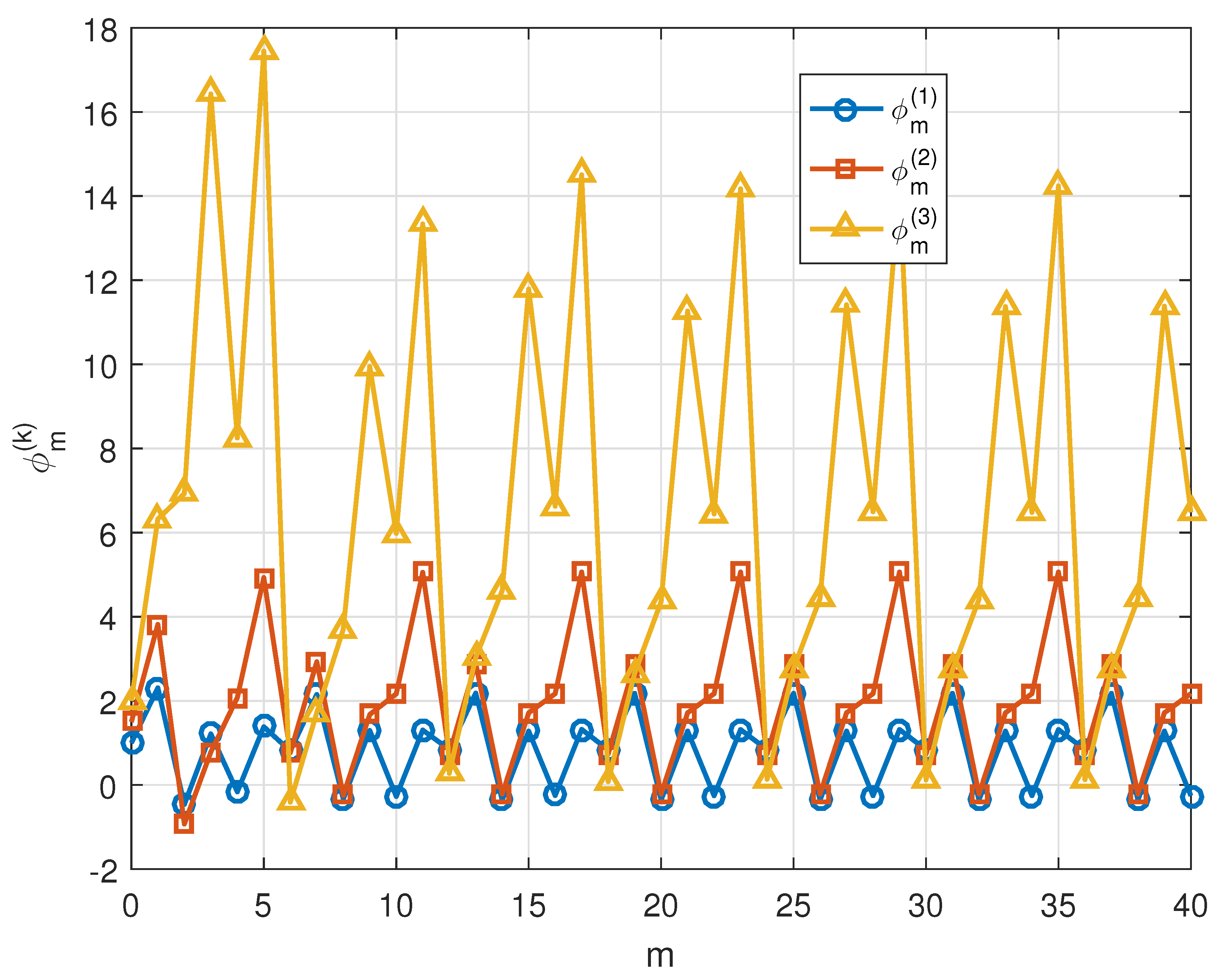
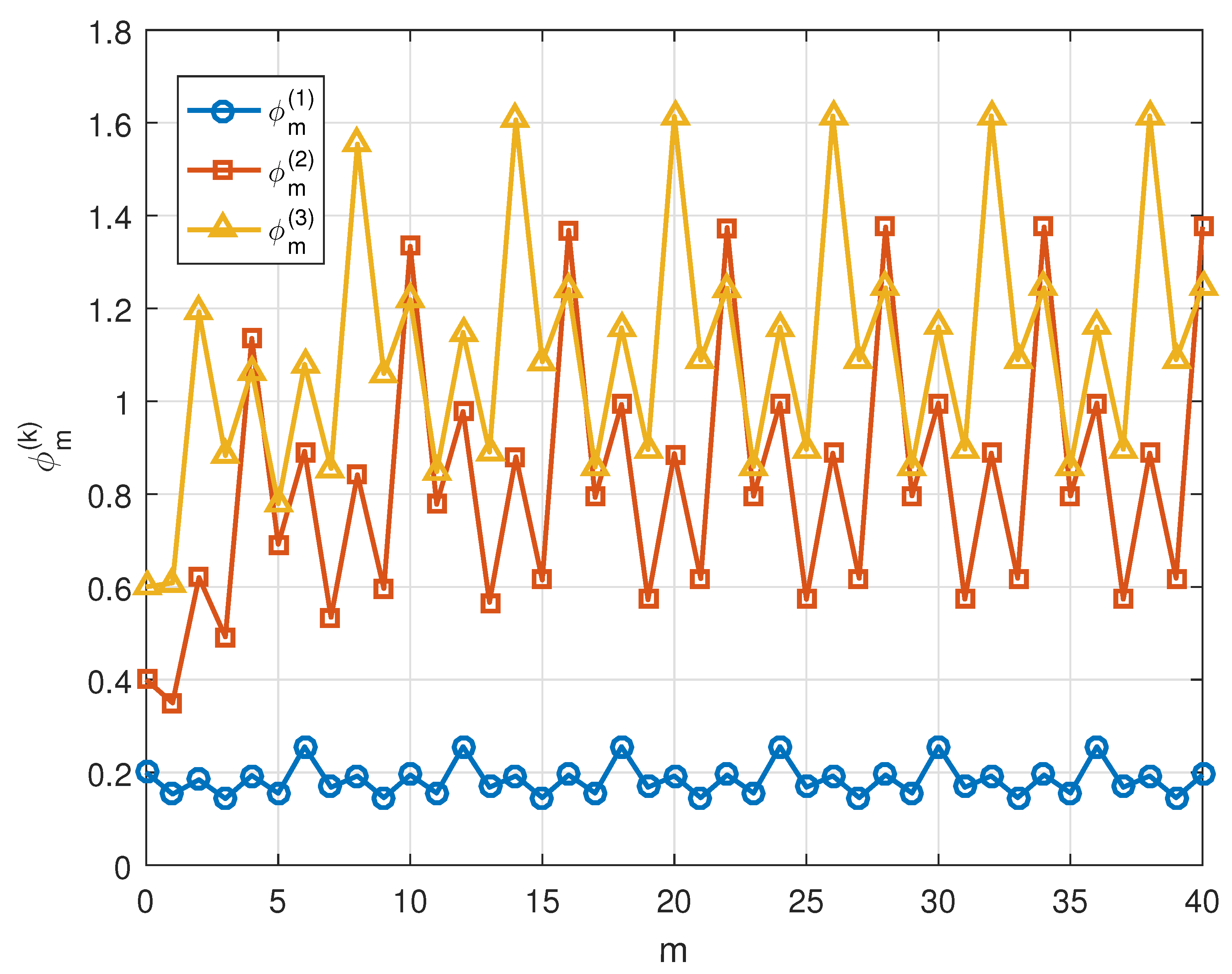
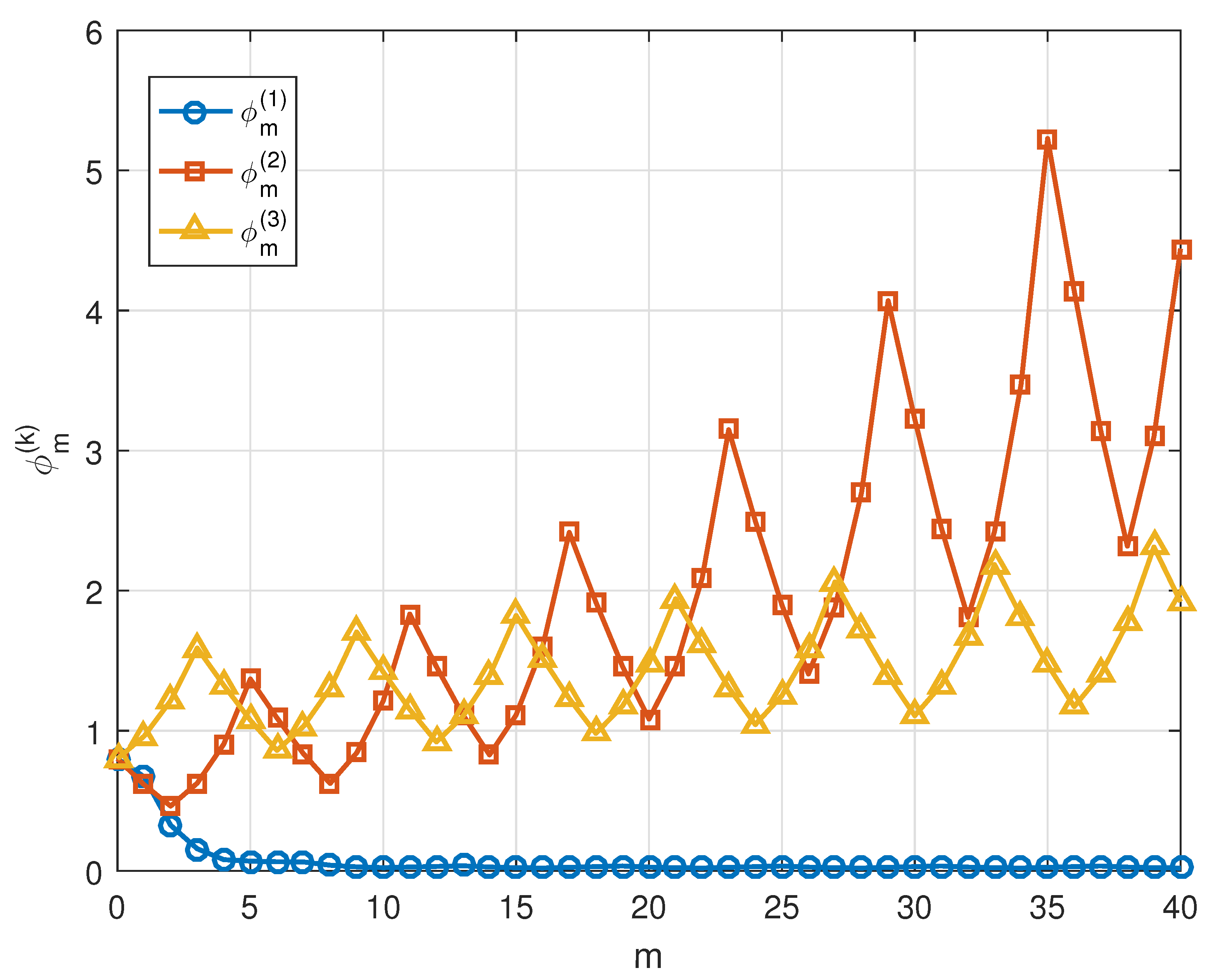
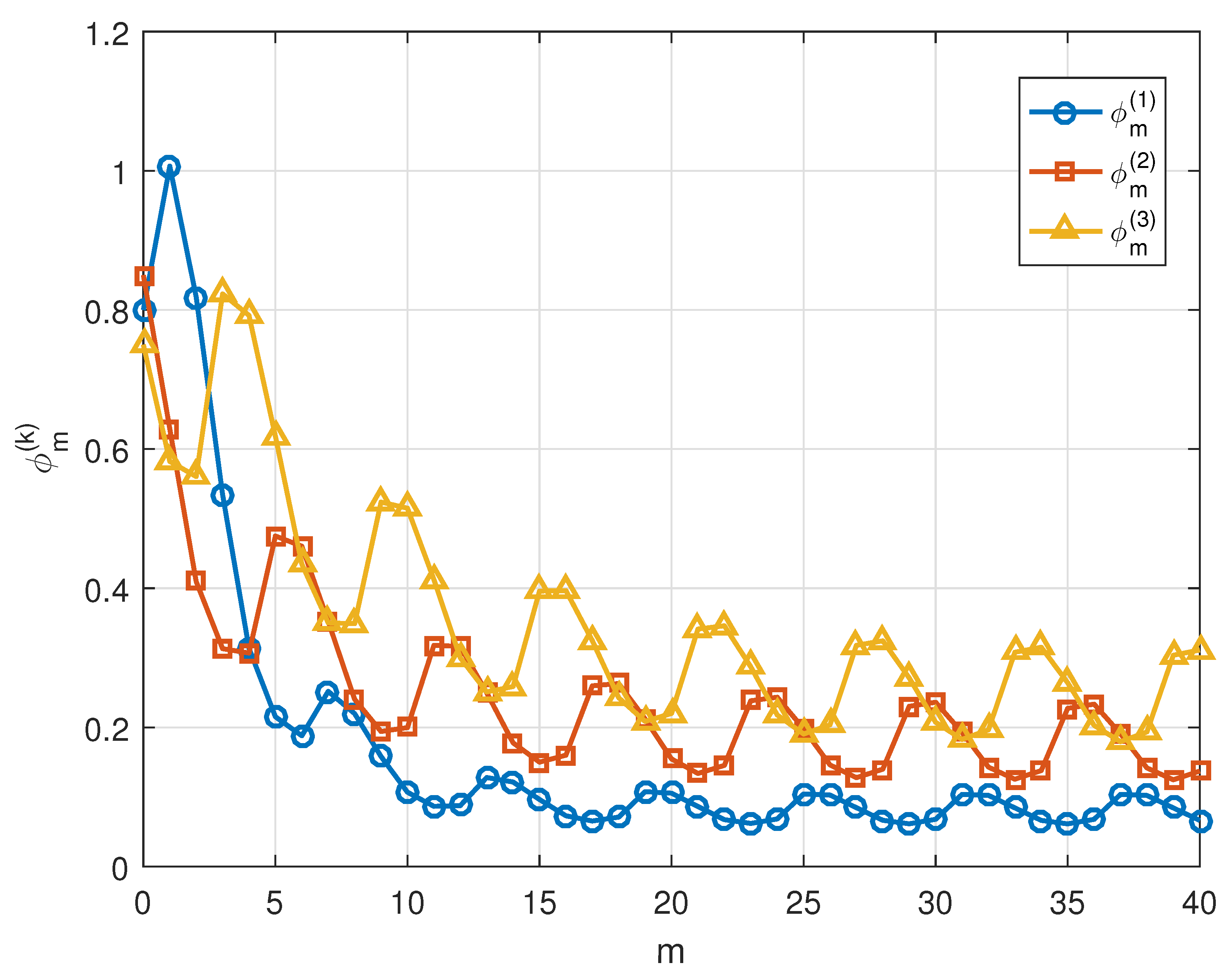
These numerical examples are intended to illustrate the theoretical results established in the previous section and to highlight the dynamic behavior of the system under different choices of parameters and initial conditions. Through numerical simulations, we demonstrate how the sequences generated by the system evolve over time, emphasizing the influence of the parametric structure on stability, oscillatory behavior, and convergence. Moreover, the simulations provide a clear visual insight into the system’s sensitivity to parameter variations. The results are displayed in six graphical representations, each corresponding to a distinct dynamical scenario. Together, these figures reflect the richness of the system’s temporal dynamics and confirm its robustness and stability over a wide range of parameter configurations. In this context, in practical applications, the index m represents the discrete time horizon of interest and is chosen according to the time scale of the phenomenon under study. In the present paper, sufficiently large values of m were selected to illustrate the long-term convergent behavior of the system, rather than to fit a specific dataset.
Remark 7. 
Regarding the computational setting, although the explicit solutions to system (4) depend on the initial conditions, the choice of these conditions in numerical simulations is dictated primarily by the analytical requirements for ensuring that the system is well-defined—namely, avoiding zero denominators and maintaining nonzero state variables. Initial conditions are not employed here as a means of tuning numerical stability or accelerating computations. In practice, the closed-form solutions derived in this paper are evaluated directly from a finite set of initial values, leveraging the system’s six-step periodic structure. This enables efficient simulation even for large indices m, without the need to iterate over each time step or resort to sensitive numerical algorithms. Consequently, the numerical results presented reflect the intrinsic behavior of the system, rather than a particular artifact of the initial condition selection.
Example 1. 
Let the parameters of system (4) be
λ 1 = λ 2 = λ 3 = 1 , δ k = 1 2 k + 2 , ξ k = 3 5 k + 1 , k = 1 , 2 , 3 ,
and the initial conditions be: ϕ 1 k = k ,   ϕ 0 k = k + 1 ,   k = 1 , 2 , 3 . The resulting evolution of the three sequences ( ϕ m k ) , k = 1 , 2 , 3 , is displayed graphically in Figure 1.
Example 2. 
Let the parameters of system (4) be
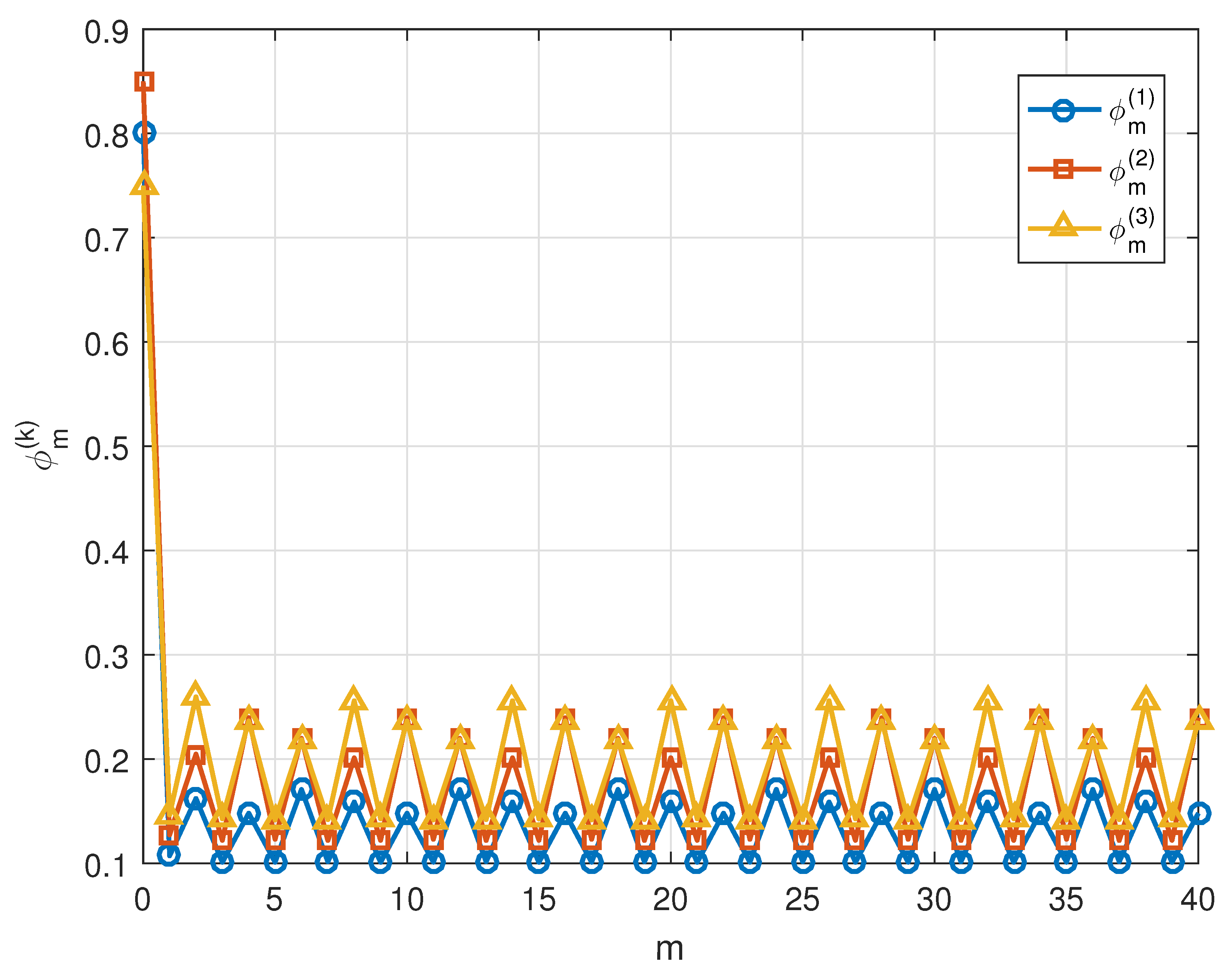
λ k = k + 1 50 , δ k = k 10 , ξ k = k + 1 10 , k = 1 , 2 , 3 ,
and the initial conditions be: ϕ 1 k = k + 1 10 ,   ϕ 0 k = k + 1 5 ,   k = 1 , 2 , 3 . The resulting evolution of the three sequences ( ϕ m k ) , k = 1 , 2 , 3 , is displayed graphically in Figure 2.
Example 3. 
Let the parameters of system (4) be
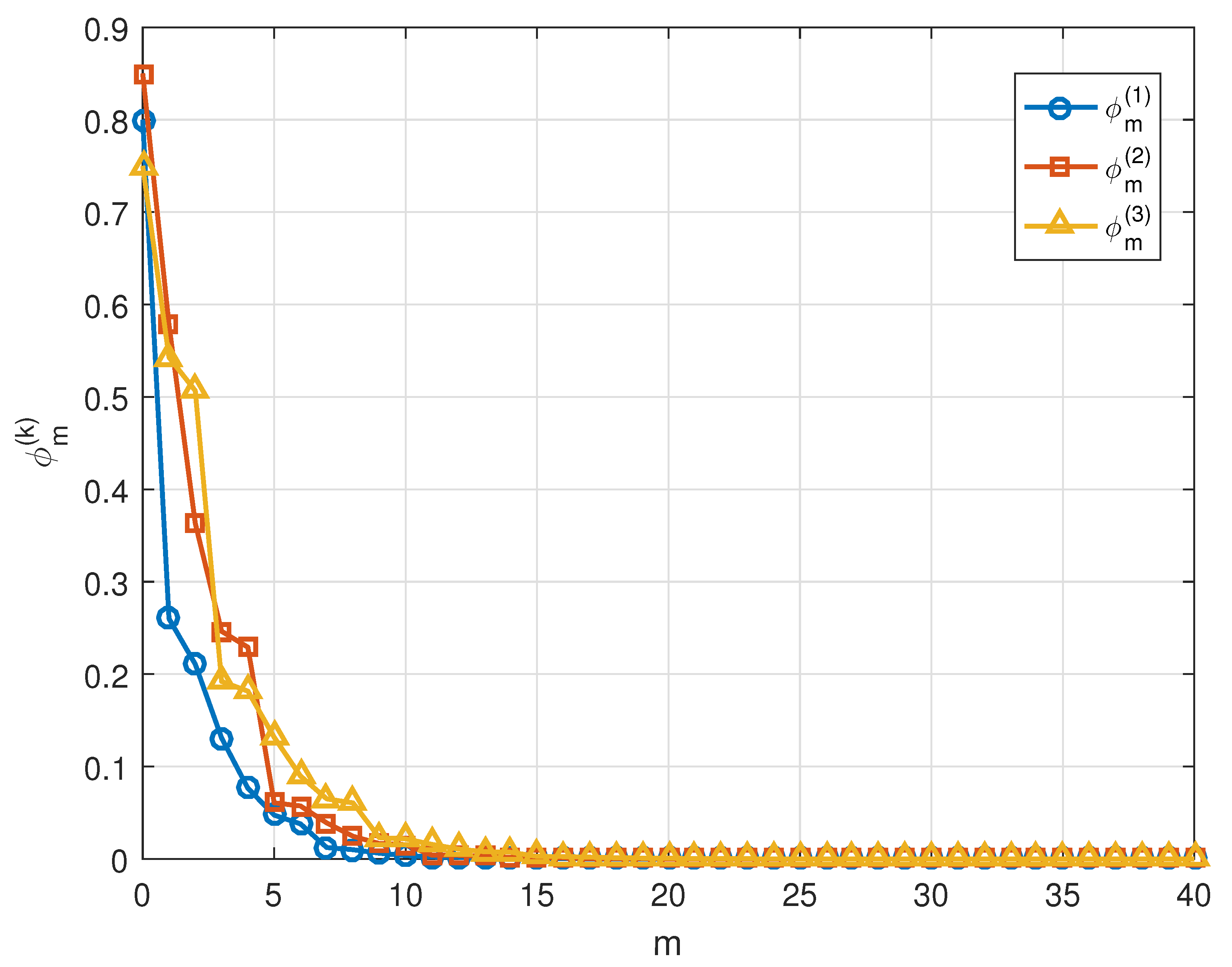
λ k = k + 1 20 , δ k = 3 20 k + 1 , ξ k = 1 100 , k = 1 , 2 , 3 ,
and the initial conditions be: ϕ 1 k = 1 ,   ϕ 0 k = 4 5 ,   k = 1 , 2 , 3 . The resulting evolution of the three sequences ( ϕ m k ) , k = 1 , 2 , 3 , is displayed graphically in Figure 3.
Example 4. 
Let the parameters of system (4) be
λ k = k + 7 200 , δ k = k + 9 20 , ξ k = k + 3 200 , k = 1 , 2 , 3 ,
and the initial conditions be:
ϕ 1 k = 1 + 1 k + 1 10 k 2 , ϕ 0 k = 16 + 1 k k 2 20 , k = 1 , 2 , 3 ,
where . denotes the integer-part. The resulting evolution of the three sequences ( ϕ m k ) , k = 1 , 2 , 3 , is displayed graphically in Figure 4.
Example 5. 
Let the parameters of system (4) be
λ k = k + 4 1000 , δ k = k + 4 50 , ξ k = 0 , k = 1 , 2 , 3 ,
and the initial conditions be as in (6). The resulting evolution of the three sequences ( ϕ m k ) , k = 1 , 2 , 3 , is displayed graphically in Figure 5.
Example 6. 
Let the parameters of system (4) be
λ k = k + 4 1000 , δ k = 0 , ξ k = k + 11 20 , k = 1 , 2 , 3 ,
and the initial conditions be as in (6). The resulting evolution of the three sequences ( ϕ m k ) , k = 1 , 2 , 3 , is displayed graphically in Figure 6.
The six figures provide a comprehensive numerical illustration of the temporal evolution of the system’s sequences under various parametric configurations, thereby offering deeper insight into the system’s dynamic behavior and its sensitivity to parameter variations. In Figure 1, the three sequences evolve in an almost parallel manner, exhibiting mild oscillations and a controlled upward trend. This behavior indicates that the chosen parameter values promote a stable dynamic regime, in which each component preserves its individual characteristics while remaining coherently coupled. Figure 2 displays a more tranquil dynamic, where the sequences are confined within a narrow range and gradually converge without pronounced oscillations. This reflects the damping effect of small parameter values, which effectively limit the amplitude of the system’s motion. In Figure 3, a clear transition from an initial oscillatory phase to a near steady state is observed. This behavior suggests the presence of an intrinsic regulatory mechanism within the system, enabling it to self-adjust over time despite relatively strong interactions among the components. By contrast, Figure 4 and Figure 5 exhibit a more conservative dynamic response. The sequences rapidly stabilize within very narrow intervals, accompanied by the near disappearance of temporal fluctuations. This confirms that weak interaction parameters can significantly suppress dynamic activity while maintaining overall stability. Figure 6 represents a distinct boundary case, in which setting one of the parameters to zero alters the temporal trajectories of the three components, yet the system remains stable and well ordered. This outcome highlights the robustness of the system’s mathematical structure. Overall, these numerical simulations confirm that the qualitative behavior of the system is largely governed by its parametric configuration, and that stability is preserved across a wide range of parameter values. These observations are in strong agreement with the theoretical analysis and the explicit results derived in this study. To further elucidate the connection between the numerical observations and the analytical results, we provide the following interpretation. The numerical results presented in Figure 1, Figure 2, Figure 3, Figure 4, Figure 5 and Figure 6 demonstrate a clear agreement with the analytical structure of the closed-form solutions derived in Theorem 1. According to the explicit formulas in (5), the long-term behavior of the solutions is primarily governed by the combined growth factors A l , k ( 6 ) , which determine whether the term A l , k ( 6 ) m leads to amplification or damping of the trajectories. When these factors are close to or less than unity, the numerical solutions exhibit bounded oscillations or gradual convergence, reflecting the intrinsic six-periodic structure of the auxiliary sequences ( ψ . ( k ) ) . In examples where the interaction coefficients λ ( k ) are small, the cumulative term in (5) dominates, resulting in rapid stabilization and attenuation of oscillations. Moreover, the limiting case in which one of the linear coefficients vanishes illustrates that the analytical periodicity of the system is not destroyed but reorganized into a different dynamical pattern, thereby highlighting the robustness of the theoretically derived periodic structure. Consequently, the observed numerical behaviors are not merely empirical artifacts but rather a direct manifestation of the intrinsic analytical and periodic properties encoded in the explicit solution formulas.

4. Conclusions

In this paper, we investigated a novel three-dimensional system of second-order nonlinear difference equations with a periodic structure and cyclic interactions among its components. We derived explicit closed-form solutions for all sequences, uncovering an inherent six-step periodicity. Theoretical analysis demonstrates that the proposed system encompasses many previously known special cases, including linear systems, confirming both its generality and the robustness of its mathematical framework. Numerical simulations complement the theoretical results by illustrating the system’s dynamic behavior under various coefficient configurations. The sequences evolve synchronously with mild fluctuations under moderate coefficients, while quickly reaching a steady state under weaker coefficients. The simulations further confirm that stability is maintained even in limiting cases where some interaction coefficients vanish or are arbitrarily small.
The main contributions of this paper are threefold: (i) the introduction of a flexible, nonlinear, three-dimensional model for multivariable discrete dynamics, (ii) the provision of complete explicit solutions via a systematic transformation revealing the system’s underlying periodic structure, and (iii) the demonstration that the model subsumes known systems as special cases, reinforcing its scientific value. Regarding limitations, modifications to the system’s structure or the inclusion of higher-order interactions may significantly increase complexity, complicating the derivation of explicit solutions and the detection of periodic patterns.
Future research may extend the proposed model to time-dependent or stochastic settings, incorporate fuzzy uncertainty, and explore applications in biological, neurological, and economic systems. In parallel, further developments could arise from linking the analytical framework of this paper with recent advances in multidimensional difference equations, particularly the works of Lyapin et al. [32,41,42] and Leinartas and Yakovleva [43], which emphasize Cauchy problems, generating functions, and recurrence-based characterizations of solutions. Integrating such multidimensional analytical tools with the rational and periodic nonlinear structures studied here may lead to more general and computationally efficient frameworks for high-dimensional discrete dynamical systems.

Author Contributions

Methodology, A.G., A.A.A.G. and H.J.A.S.; Software, H.J.A.S.; Validation, A.A.A.G.; Formal analysis, A.A.A.G. and H.J.A.S.; Writing—original draft, A.G., A.A.A.G. and H.J.A.S.; Writing—review & editing, A.G., A.A.A.G. and H.J.A.S. All authors have read and agreed to the published version of the manuscript.

Funding

This work was supported by the Deanship of Scientific Research, Vice Presidency for Graduate Studies and Scientific Research, King Faisal University, Saudi Arabia [KFU260975].

Data Availability Statement

No new data were created or analyzed in this study. Data sharing is not applicable to this article.

Conflicts of Interest

The authors declare no conflicts of interest.

Appendix A

This appendix provides the mathematical foundations underlying the analytical framework developed in this work. We begin by introducing the key tool employed in the proofs, namely the general formula for solving first-order linear iterative equations, which serves as the cornerstone for deriving explicit solutions. Next, we provide a detailed proof of the central theorem, illustrating the systematic transformation of the original system into well-defined periodic relations that lead to the final closed-form expressions. Finally, we discuss the natural consequences of this framework, highlighting how special cases emerge seamlessly from the general solution. Now, we proceed by recalling the general solution for first-order non-homogeneous linear difference equations.
Lemma A1. 
Let ϕ m satisfy the first-order linear difference equation:
ϕ m + 1 = ξ m ϕ m + δ m , m 0 ,
with a given real initial value ϕ 0 and arbitrary real sequences ξ m , δ m . Then every term of the sequence can be expressed explicitly as:
ϕ m = k = 0 m 1 ξ k ϕ 0 + l = 0 m 1 k = l + 1 m 1 ξ k δ l , m 0 ,
where we use the standard conventions: j = i m ξ j = 1 and j = i m δ j = 0 whenever m < i . In the important special case where the coefficients are constant, i.e., ξ m = ξ ,   δ m = δ for all m 0 , the formula simplifies to the well-known closed form:
m 0 , ϕ m = ξ m ϕ 0 + δ ξ m 1 ξ 1 if ξ 1 ϕ 0 + m δ if ξ = 1 .
Proof of Theorem 1. 
First, we rearrange the original equations of system (4) to isolate the nonlinear terms on each side. Using the algebraic structure of the system, we construct suitable auxiliary iterative expressions that can be factorized. This procedure leads to the following set of relations:
ϕ m + 1 k ξ k ϕ m k δ k ϕ m k = λ k ϕ m 1 k + 2 mod 3 ϕ m k + 2 mod 3 ξ k + 2 mod 3 ϕ m 1 k + 2 mod 3 δ k + 2 mod 3 ,
for k = 1 , 2 , 3 , and m 0 . The original equations are transformed into a more tractable form under the assumption that the solutions are well defined, that is, k = 1 3 ϕ m k 0 for all m 0 . This reformulation explicitly reveals the cyclic dependence of each component on the preceding one. Exploiting the periodic structure of the system and the mutual interdependence among the three components ϕ m k , k = 1 , 2 , 3 , we observe that the left-hand side of the preceding relation involves only the variable indexed by k at the step m + 1 . This observation naturally motivates the introduction of an auxiliary sequence that simplifies the analysis of the system. Accordingly, for all m 0 , we define:
ψ m + 1 k = ϕ m + 1 k ξ k ϕ m k δ k ϕ m k , k = 1 , 2 , 3 .
This definition transforms the original equations into the relations:
ψ m + 1 k = λ k ψ m k + 2 mod 3 , k = 1 , 2 , 3 , m 0 .
After completing one full cycle of substitutions, the system decouples into independent equations for each auxiliary sequence. As a result, each component evolves separately according to the same structural rule. Consequently, for m 2 , we obtain:
ψ m + 1 k = λ k λ k + 1 mod 3 λ k + 2 mod 3 ψ m 2 k , k = 1 , 2 , 3 .
Moreover, by applying these relations successively twice, a fundamental periodic property of the system emerges. In particular, the auxiliary sequences satisfy a higher-order periodic recurrence relation, specifically, for m 5 :
ψ m + 1 k = ψ m 5 k , k = 1 , 2 , 3 .
Integrating the linear (A3) and nonlinear (A2) iterative systems reveals a clear mathematical structure that enables the formulation of closed-form equations describing all values of ( ψ m k ) , k = 1 , 2 , 3 , without the need for recursive computation, for all m 0 and l = 0 , 1 , 2 :
ψ 6 m + 2 l k = ψ 0 k , l = 0 λ k λ k + 2 mod 3 ψ 0 k + 1 mod 3 , l = 1 λ k + 1 mod 3 λ k + 2 mod 3 ψ 0 k + 2 mod 3 , l = 2 , ψ 6 m + 2 l + 1 k = λ k ψ 0 k + 2 mod 3 1 , l = 0 λ k λ k + 1 mod 3 λ k + 2 mod 3 ψ 0 k 1 , l = 1 λ k + 1 mod 3 ψ 0 k + 1 mod 3 1 , l = 2 ,
k = 1 , 2 , 3 , with ψ 0 k = ϕ 0 k ξ k ϕ 1 k δ k ϕ 1 k 1 , k = 1 , 2 , 3 . Using the definitions established in (A1), we obtain the following system of independent difference equations:
ϕ m k = ψ m k + ξ k ϕ m 1 k + δ k , k = 1 , 2 , 3 .
Since the sequences ( ψ m k ) , k = 1 , 2 , 3 , exhibit a periodic structure of length six (as shown previously), these relations can be rewritten in a systematic periodic form. In particular, for each l = 0 , 1 , 2 , we obtain the following pair of iterative equations:
ϕ 6 m + 2 l k = ψ 6 m + 2 l k + ξ k ϕ 6 m + 2 l 1 k + δ k , ϕ 6 m + 2 l + 1 k = ψ 6 m + 2 l + 1 k + ξ k ϕ 6 m + 2 l k + δ k ,
for k = 1 , 2 , 3 . Applying Lemma A1 to the linear difference equations derived above, we obtain explicit solution formulas for the sequences ϕ m k ,   k = 1 , 2 , 3 , expressed in terms of the initial values and the system coefficients. In particular, for all l = 0 , 1 , 2 , and all m 1 , we obtain:
ϕ 6 m + 2 l k = v = 0 5 ψ 6 m + 2 l v k + ξ k ϕ 6 m 1 + 2 l k + u = 0 5 v = 0 u 1 ψ 6 m + 2 l v k + ξ k δ k , ϕ 6 m + 2 l + 1 k = v = 0 5 ψ 6 m + 2 l + 1 v k + ξ k ϕ 6 m 1 + 2 l + 1 k + u = 0 5 v = 0 u 1 ψ 6 m + 2 l + 1 v k + ξ k δ k ,
for k = 1 , 2 , 3 . By repeatedly applying the auxiliary Lemma A1 to the iterative relations derived above, we obtain complete explicit expressions for the solution sequences, written directly in terms of the initial values ϕ 2 l k , ϕ 2 l + 1 k , k = 1 , 2 , 3 , where l = 0 , 1 , 2 . The resulting explicit formulas are given as follows:
ϕ 6 m + 2 l k = v = 0 5 ψ 6 + 2 l v k + ξ k m ϕ 2 l k + i = 0 m 1 u = 0 5 v = 0 5 ψ 6 + 2 l v k + ξ k i   × v = 0 u 1 ψ 6 m + 2 l v k + ξ k δ k , ϕ 6 m + 2 l + 1 k = v = 0 5 ψ 6 + 2 l + 1 v k + ξ k m ϕ 2 l + 1 k + i = 0 m 1 u = 0 5 v = 0 5 ψ 6 + 2 l v k + ξ k i   × v = 0 u 1 ψ 6 m + 2 l + 1 v k + ξ k δ k .
Proof of Corollary 1. 
Assuming that all interaction coefficients are equal, i.e., λ ( 1 ) = λ ( 2 ) = λ ( 3 ) , all ratios of the form λ k + 1 mod 3 λ k + 2 mod 3 cancel out, yielding a value of one. This algebraic simplification is the only modification required, since the fundamental structure of the solution remains unchanged, as described in Theorem 1. Consequently, the simplified forms of the auxiliary sequences ψ m k , k = 1 , 2 , 3 , are directly obtained from the general formulas in the theorem by removing these ratios. This demonstrates that the system preserves its periodic pattern of length six, and the explicit solution formulas remain valid with the substitution of the simplified coefficients.
Proof of Corollary 2. 
Assuming that all interaction coefficients are zero, i.e., λ ( 1 ) = λ ( 2 ) = λ ( 3 ) = 0 , the nonlinear terms of the original system (4) vanish entirely. Under this condition, the three coupled equations reduce to three independent first-order linear discrete equations, each of the form:
ϕ m + 1 k = ξ k ϕ m k + δ k , k = 1 , 2 , 3 , m 0 .
This formula represents a direct special case of the auxiliary Lemma A1 for constant coefficients α =   ξ k and β = δ k , k = 1 , 2 , 3 . By applying the general formula for the solution of a linear equation with constant coefficients, we obtain the following two characteristic expressions:
  • If ξ k 1 for all k = 1 , 2 , 3 , the solution takes the standard form:
    ϕ m k = ξ k m ϕ 0 k + ξ k m 1 ξ k 1 δ k , k = 1 , 2 , 3 ,
  • If ξ k = 1 for all k = 1 , 2 , 3 , the solution takes the standard form:
    ϕ m k = ϕ 0 k + m δ k , k = 1 , 2 , 3 .

References

  1. Elaydi, S. An Introduction to Difference Equations; Springer: New York, NY, USA, 2005. [Google Scholar] [CrossRef]
  2. Althagafi, H. Stability analysis of biological rhythms using three-dimensional systems of difference equations with squared terms. J. Appl. Math. Comput. 2025, 71, 3211–3232. [Google Scholar] [CrossRef]
  3. Althagafi, H. Dynamics of difference systems: A mathematical study with applications to neural systems. AIMS Math. 2025, 10, 2869–2890. [Google Scholar] [CrossRef]
  4. Althagafi, H.; Ghezal, A. Solving a system of nonlinear difference equations with bilinear dynamics. AIMS Math. 2024, 9, 34067–34089. [Google Scholar] [CrossRef]
  5. Alraddadi, R. The Markov-switching threshold BLGARCH model. AIMS Math. 2025, 10, 18838–18860. [Google Scholar] [CrossRef]
  6. Alraddadi, R. The logTG-SV model: A threshold-based volatility framework with logarithmic shocks for exchange rate dynamics. AIMS Math. 2025, 10, 19495–19511. [Google Scholar] [CrossRef]
  7. Cavicchioli, M.; Ghezal, A.; Zemmouri, I. (Bi)spectral analysis of Markov switching bilinear time series. Stat. Methods Appl. 2025. [Google Scholar] [CrossRef]
  8. Alzeley, O.; Ghezal, A. On an asymmetric multivariate stochastic difference volatility: Structure and estimation. AIMS Math. 2024, 9, 18528–18552. [Google Scholar] [CrossRef]
  9. Alzeley, O.; Ghezal, A. Probabilistic properties and estimation methods for periodic threshold autoregressive stochastic volatility. AIMS Math. 2024, 9, 11805–11832. [Google Scholar] [CrossRef]
  10. Ghezal, A.; Balegh, M.; Zemmouri, I. Markov-switching threshold stochastic volatility models with regime changes. AIMS Math. 2024, 9, 3895–3910. [Google Scholar] [CrossRef]
  11. Abo-Zeid, R.; Cinar, C. Global behavior of the difference equation xn+1 = Axn−1/BCxnxn−2. Bol. Sociedade Parana. Matemática 2013, 31, 43–49. [Google Scholar] [CrossRef][Green Version]
  12. Attia, N.; Ghezal, A. Global stability and co-balancing numbers in a system of rational difference equations. Electron. Res. Arch. 2024, 32, 2137–2159. [Google Scholar] [CrossRef]
  13. Kara, M. Investigation of the global dynamics of two exponential-form difference equations systems. Electron. Res. Arch. 2023, 31, 6697–6724. [Google Scholar] [CrossRef]
  14. Elsayed, E.M. Expression and behavior of the solutions of some rational recursive sequences. Math. Methods Appl. Sci. 2016, 39, 5682–5694. [Google Scholar] [CrossRef]
  15. El-Metwally, H.; Elsayed, E.M. Qualitative behavior of some rational difference equations. J. Comput. Anal. Appl. 2016, 20, 226–236. [Google Scholar]
  16. Elsayed, E.M.; El-Metwally, H. Global behavior and periodicity of some difference equations. J. Comput. Anal. Appl. 2015, 19, 298–309. [Google Scholar]
  17. Elsayed, E.M. On the solutions and periodicity of some rational systems of difference equations. Bull. Math. Soc. Sci. Math. Roum. 2017, 108, 159–171. [Google Scholar] [CrossRef]
  18. Kulenović, M.R.S.; Ladas, G. Dynamics of Second Order Rational Difference Equations: With Open Problems and Conjectures; Chapman & Hall/CRC: Boca Raton, FL, USA, 2002. [Google Scholar] [CrossRef]
  19. Elsayed, E.M.; El-Metwally, H. Stability and solutions for rational recursive sequence of order three. J. Comput. Anal. 2014, 17, 305. [Google Scholar]
  20. Gümxuxş, M. Global asymptotic behavior of a discrete system of difference equations with delays. Filomat 2023, 37, 251–264. [Google Scholar] [CrossRef]
  21. Gümxuxş, M.; Abo-Zeid, R. Global behavior of a rational second order difference equation. J. Appl. Math. Comput. 2020, 62, 119–133. [Google Scholar] [CrossRef]
  22. Zhang, Y.; Yang, X.; Megson, G.M.; Evans, D.J. On the system of rational difference equations. Appl. Math. Comp. 2006, 176, 403–408. [Google Scholar] [CrossRef]
  23. Zhang, Q.; Yang, L.; Liu, J. Dynamics of a system of rational third order difference equation. Adv. Differ. Equ. 2012, 2012, 136. [Google Scholar] [CrossRef]
  24. Salman, H.J.A. Closed-form solutions of systems of nonlinear difference equations and their connections to generalized Fibonacci numbers and related sequences. AIMS Math. 2025, 10, 25307–25328. [Google Scholar] [CrossRef]
  25. Ghafli, A.A.A. Closed-form solutions of a nonlinear bidimensional difference system via generalized Fibonacci sequences. AIMS Math. 2025, 10, 26545–26567. [Google Scholar] [CrossRef]
  26. Elabbasy, E.; Elmatwally, H.; Elsayed, E. Qualitative behavior of higher order difference equation. Soochow J. Math. 2007, 33, 861–873. [Google Scholar]
  27. Haddad, N.; Touafek, N.; Rabago, J. Well-defined solutions of a system of difference equations. J. Appl. Math. Comput. 2018, 56, 439–458. [Google Scholar] [CrossRef]
  28. Yazlik, Y.; Kara, M. On a solvable system of difference equations of higherorder with periodic coefficients. Commun. Fac. Sci. Univ. 2019, 68, 1675–1693. [Google Scholar] [CrossRef]
  29. Ghezal, A.; Attia, N. On explicit periodic solutions in three-dimensional difference systems. AIMS Math. 2025, 10, 25469–25488. [Google Scholar] [CrossRef]
  30. Semmar, B.; Batiha, I.M. A study on a solvable two-dimensional system of fourth-order difference equations. Int. J. Robot. Control Syst. 2025, 5, 2104–2117. [Google Scholar] [CrossRef]
  31. Ghezal, A.; Zemmouri, I. Solution forms for generalized hyperbolic cotangent type systems of p-difference equations. Bol. Soc. Parana. Matematica 2024, 42, 1–14. [Google Scholar] [CrossRef]
  32. Grigoriev, A.A.; Leinartas, E.K.; Lyapin, A.P. Summation of functions and polynomial solutions to a multidimensional difference Equation. J. Sib. Fed. Univ. Math. Phys. 2023, 16, 153–161. [Google Scholar]
  33. Alofi, B.S. Qualitative dynamics of a higher-order rational difference equation system. J. Math. Comput. SCI-JM 2026, 41, 519–534. [Google Scholar] [CrossRef]
  34. Touafek, N.; AL-Juaid, J.G. On a second-order system of difference equations: Expressions and behavior of the solutions. AIMS Math. 2025, 10, 28077–28099. [Google Scholar] [CrossRef]
  35. Balegh, M.; Ghezal, A. Dynamical analysis of a system of fuzzy difference equations with power terms. Int. J. Dynam. Control 2025, 13, 364. [Google Scholar] [CrossRef]
  36. Althagafi, H.; Ghezal, A. Analytical study of nonlinear systems of higher-order difference equations: Solutions, stability, and numerical simulations. Mathematics 2024, 12, 1159. [Google Scholar] [CrossRef]
  37. Oğul, B.; Simşek, D. Dynamical behavior of one rational fifth-order difference equation. Carpathian Math. Publ. 2023, 15, 43–51. [Google Scholar] [CrossRef]
  38. Althagafi, H.; Ghezal, A. Global stability of a system of fuzzy difference equations of higher-order. J. Appl. Math. Comput. 2025, 71, 1887–1909. [Google Scholar] [CrossRef]
  39. Almoteri, Y.; Ghezal, A. Solvability of three-dimensional nonlinear difference systems via transformations and generalized Fibonacci recursions. Mathematics 2025, 13, 3904. [Google Scholar] [CrossRef]
  40. Almoteri, Y.; Ghezal, A. On the existence and uniqueness of two-dimensional nonlinear fuzzy difference equations with logarithmic interactions. Mathematics 2025, 13, 3532. [Google Scholar] [CrossRef]
  41. Lyapin, A.P.; Akhtamova, S.S. Recurrence relations for the sections of the generating series of the solution to the multidimensional difference equation. Vestn. Udmurt. Univ. Mat. Mekhanika Komp’Yuternye Nauk. 2021, 31, 414–423. [Google Scholar] [CrossRef]
  42. Lyapin, A.P.; Chandragiri, S. The Cauchy problem for multidimensional difference equations in lattice cones. J. Sib. Fed. Univ. Math. Phys. 2020, 13, 187–196. [Google Scholar] [CrossRef]
  43. Leinartas, E.K.; Yakovleva, T.I. The Cauchy problem for multidimensional difference equations and the preservation of the hierarchy of generating functions of its solutions. J. Sib. Fed. Univ. Math. Phys. 2018, 11, 712–722. [Google Scholar] [CrossRef]
Figure 1. Temporal behavior of the three sequences ( ϕ m k ), k = 1 , 2 , 3 , of system (4).
Mathematics 14 00876 g001
Figure 2. Temporal behavior of the three sequences ( ϕ m k ) , k = 1 , 2 , 3 , of system (4).
Mathematics 14 00876 g002
Figure 3. Temporal behavior of the three sequences ( ϕ m k ) , k = 1 , 2 , 3 , of system (4).
Mathematics 14 00876 g003
Figure 4. Temporal behavior of the three sequences ( ϕ m k ) , k = 1 , 2 , 3 , of system (4).
Mathematics 14 00876 g004
Figure 5. Temporal behavior of the three sequences ( ϕ m k ) , k = 1 , 2 , 3 , of system (4).
Mathematics 14 00876 g005
Figure 6. Temporal behavior of the three sequences ( ϕ m k ) , k = 1 , 2 , 3 , of system (4).
Mathematics 14 00876 g006
Disclaimer/Publisher’s Note: The statements, opinions and data contained in all publications are solely those of the individual author(s) and contributor(s) and not of MDPI and/or the editor(s). MDPI and/or the editor(s) disclaim responsibility for any injury to people or property resulting from any ideas, methods, instructions or products referred to in the content.