Article

An Adaptive Consensus Model to Manage Non-Cooperative Behaviors in Large Group Decision-Making with Probabilistic Linguistic Information


1
Intelligent Policing Key Laboratory of Sichuan Province, Sichuan Police College, Luzhou 646000, China
2
Department of Transportation Management, Sichuan Police College, Luzhou 646000, China
3
School of Management, Guizhou University, Guiyang 550025, China
4
Digital Transformation and Governance Collaborative Innovation Laboratory, Guizhou University, Guiyang 550025, China
5
Department of Engineering and Industrial Professions, University of North Alabama, Florence, AL 35632, USA
*
Author to whom correspondence should be addressed.
Mathematics 2026, 14(6), 1049; https://doi.org/10.3390/math14061049
Submission received: 25 February 2026 / Revised: 12 March 2026 / Accepted: 18 March 2026 / Published: 20 March 2026
(This article belongs to the Section D2: Operations Research and Fuzzy Decision Making)

Abstract

To address challenges in complex group decision-making (GDM)—specifically preference fuzziness, intricate subgroup segmentation, and non-cooperative behavior—this study proposes an adaptive consensus model based on probabilistic linguistic term sets (PLTSs). By integrating fuzzy C-means (FCM) clustering with a Gaussian mixture model (GMM), a fuzzy Gaussian mixture model (FGMM) is constructed to achieve soft segmentation of expert preference distributions. On this basis, an adaptive consensus feedback mechanism is developed, which dynamically integrates interactive and automated adjustment strategies via multi-level consensus thresholds, thereby balancing decision efficiency and quality. To identify and control non-cooperative behaviors, a cooperation index and a three-tier management strategy, which incorporates intra-group negotiation, weight penalties and an exit-delegation mechanism, were introduced. In the case of strategic decision-making of new energy vehicles (NEV), after four rounds of feedback iterations, the group consensus level increased from the initial 0.316 to 0.804, reaching the preset threshold and verifying the effectiveness of the consensus mechanism. Compared with the existing literature methods, the framework in this paper achieves more comprehensive integration and innovation in four aspects: preference expression, clustering mechanism, consensus feedback and behavior management.

1. Introduction

In modern management science, social computing, and emergency management, complex decision-making environments often require the aggregation of expertise and experience from multiple experts. However, due to inherent differences among decision-makers in professional expertise, vested interests, cognitive patterns, and risk preferences, groups frequently exhibit divergent opinions, making it difficult to reach a unified conclusion spontaneously. This challenge has spurred the development of systematic research on consensus-reaching processes (CRP). CRP aim to progressively align decision-makers’ preferences through multiple rounds of discussion, negotiation, and communication. A key take lies in designing effective feedback mechanisms to facilitate consensus [1]. Within the existing literature, most CRPs employ “soft consensus” as the level of agreement within decision-making processes, rather than the unattainable “hard consensus”.
Due to the complexity and ambiguity of GDM problems, experts may struggle provide precise numerical information due to limited knowledge or hesitation. Therefore, scholars have proposed the concept of “fuzzy sets” to express the uncertainty inherent in expert opinions [2]. Subsequently, numerous studies have introduced various extensions of fuzzy sets for decision-making problems, including interval-valued intuitionistic fuzzy sets [3,4], hesitant fuzzy sets [5], and others [6]. Typically, decision-makers express their preferences for a set of alternatives to prioritize them, by using intuitive linguistic terms like “slightly better” or “good” to describe uncertain information. Such evaluation terms constitute a linguistic term set (LTS). However, the LTS framework lacks the capacity to explicitly indicate the weight of different linguistic terms. To address this limitation, Pang et al. [7] proposed the concept of Probabilistic Linguistic Term Sets (PLTSs). As a novel linguistic variable, PLTS serves as an extended expression of hesitant fuzzy linguistic terms, enabling decision-makers to convey multiple linguistic terms alongside with their corresponding probability information [8]. Consequently, conducting in-depth research on PLTSs holds significant theoretical and practical importance.
In recent years, numerous scholars have conducted multifaceted explorations of PLTSs [9,10]. For instance, Tan et al. [1] integrated probabilistic linguistic information with social network analysis to propose a novel dynamic trust mechanism. Similarly, Jin et al. [11] primarily addressed the consistency of probabilistic linguistic preference relations (PLPRs) and solved the trust-driven issue of expert weighting. Building upon the integration of PLTSs and PLPRs, Han et al. [12] introduced innovations concerning trust risk neglect and excessive reliance on group opinions in consensus problems. Considering scenarios where decision-makers may fail to provide complete probabilistic information, scholars have conducted in-depth research on incomplete PLPRs [13,14,15,16]. Furthermore, PLTSs have played a significant role in mitigating non-cooperative behavior issues within group decision-making [14,17,18]. Given the methodological advantages of PLTSs in handling uncertain preference information, this study adopts PLTSs as its methodological foundation.
Early studies often treated groups as homogeneous entities. In recent years, however, scholars have recognized the existence of subgroup structures within larger collectives. Consequently, social network analysis and clustering methods have been introduced to identify these subgroups. Traditional clustering methods, such as K-means clustering [19] and hierarchical clustering, are based on distance metrics to definitively assign each decision-maker to a specific cluster. However, applying these traditional “hard” clustering methods directly to GDM scenarios presents significant limitations. Meanwhile, as decision-making environments grow increasingly complex, scholars have begun exploring more flexible and interpretable clustering techniques. Examples include overlapping community clustering [20,21], spectral clustering [22], fuzzy C-means (FCM) clustering [23], and deep learning-based clustering, among others. Although these methods demonstrate significant advantages over traditional clustering approaches, they often retain inherent limitations. For instance, the FCM still exhibits shortcomings in terms of cluster shape adaptability and noise resistance. To overcome the limitations of individual methods, recent studies have attempted to achieve complementary advantages through method integration. For instance, Wang et al. [24] developed a convex clustering method combining the strengths of K-means and hierarchical clustering to enable adaptive subgroup formation and automatic determination of the optimal number of clusters. Within this research context, this study combines FCM with the Gaussian mixture model (GMM). This approach aims to leverage the theoretical strengths of GMM in modeling probability distributions alongside the flexibility of FCM in characterizing membership degrees. This integration enables more effective handling of fuzzy boundaries within expert preference information and facilitates the identification of complex patterns in group preference structure.
Furthermore, in the design of consensus models, decision-making efficiency and quality are two critical metrics. Existing consensus strategies are typically categorized into automated strategies [25] and interactive approaches [26]. In interactive strategies, the moderator provides decision-makers with recommended preference values; whereas in automated strategies, the moderator uses specific algorithms or rules to automatically adjust decision-makers’ preference values to enhance the level of consensus [27]. However, interactive strategies often lack decision-making efficiency, while automated strategies may compromise decision-making quality. To address this trade-off, this study proposes an adaptive consensus model that synthesizes both interactive and automated strategies. By implementing different strategies based on the specific level of consensus achieved in each round, the model balances both decision-making efficiency and quality.
Additionally, non-cooperative behavior within decision-making processes cannot be overlooked. Existing research in this domain can be broadly categorized into two main approaches: one focuses on managing such behavior through trust relationships and social networks, while the other emphasizes behavioral management using consensus models and optimization methods. The former emphasizes leveraging trust relationships [28,29,30], social network structures [31,32] or coordination mechanisms [33] to mitigate non-cooperative behavior. The latter concentrates on developing sophisticated consensus models and optimization or frameworks, such as hierarchical consensus [27,34], convergent behavior [35], self-organizing mechanisms [36] and robust consensus [37,38].
Consequently, this study employs a Fuzzy Gaussian mixture model (FGMM) based on PLTS to construct an adaptive consensus feedback framework that incorporates non-cooperative behavior management. The primary contributions of this study are summarized as follows: (1) A novel FGMM is proposed by integrating FCM and GMM to overcome the limitations of the standalone approaches, thereby enhancing the clustering performance and robustness. (2) An enhanced adaptive consensus feedback framework is developed that synergistically integrates interactive and automated strategies, achieving a sound balance between decision-making efficiency and quality is ach. (3) By introducing a cooperation index to quantify experts’ cooperation level and implementing a three-tier management strategy, non-cooperative behavior among experts is effectively addressed.
In summary, this study constructs a more practical adaptable group decision-making consensus model through method integration and mechanism innovation. Case studies and multi-angle comparative analysis of new energy vehicle development strategies show that the proposed model is better than traditional methods in terms of consensus stability, behavior management and robustness of decision-making results.
The remainder of this study is organized as follows. Section 2 reviews fundamental concepts of PLTSs and clustering methods. Section 3 formulates the propose an adaptive consensus-reaching framework. Section 4 discusses the identification and management of non-cooperative behavior. Section 5 presents a case study and numerical comparisons. Finally, Section 6 concludes the paper and discusses potential future research directions.

2. Preliminaries

2.1. Probabilistic Linguistic Term Sets

PLTSs mitigate the loss of original linguistic information by integrating probabilistic parameters into the hesitation fuzzy linguistic itemset framework. It overcomes the limitations of traditional linguistic evaluation methods by allowing decision-makers to express judgments and preferences over alternative options using multiple linguistic terms alongside their corresponding probability values. This structure not only avoids the unreasonableness of assigning equal weights to all possible terms but also comprehensively and precisely reflects the actual information states and cognitive disparities among decision-makers.
Definition 1. 
Let  S   =   { s 0 ,   s 1 ,   ,   s 2 τ }  denote a set of linguistic terms, where τ is a positive integer. Then, PLTS can be defined as
L p = L k p k L k S , p k 0 , k = 1 , 2 , , # L p , k = 1 # L p p k 1
where  s 0 ,   s 1 ,   ,   s 2 τ  denotes the set of linguistic terms expressed by the decision-maker. Lk(pk) represents the k-th linguistic term Lk and its probability pk, while #L(p) indicates the number of linguistic terms in L(p).
Definition 2. 
Given a PLTS L(p) satisfying  k = 1 # L p p k 1 , the normalized probabilistic language term set (NPLTS) LN can be defined as
L N ( p ) = L N ( k ) ( p N ( k ) ) k = 1 , 2 , , # L ( p )
p N ( k ) = p k k = 1 # L ( p ) p k , k = 1 , 2 , , # L ( p )
Standardized operations can effectively redistribute the weights of incomplete probabilistic information relative to the original PLTS. From the PLTS and the NPLTS, the scoring function and deviation degree of the PLTS can be derived.
Definition 3. 
Let  L ( p )   =   { L k ( p k ) | k   =   1 ,   2 ,   . . . ,   # L ( p ) }  is a PLTS, the scoring function S(L(p)) for the PLTS is defined as follows:
S ( L ( p ) ) = s α
α = k = 1 # L ( p ) r k p k k = 1 # L ( p ) p k
where rk is the subscript of linguistic term Lk, and  p k  is the probability of the corresponding term. α is the weighted average of all term subscripts, weighted by their normalized probabilities. For example, in the LTS S = {s−2, s−1, s0, s1, s2}, if S(L(p)) = s1.2, the overall evaluation tends toward “better”.
Definition 4. 
From the scoring function, the formula for the deviation ϕ of PLTS is defined as in Equation (6). Deviation degree refers to the weighted standard deviation, measuring the degree of deviation of each language term’s subscript from the mean value α:
ϕ ( L ( p ) ) = ( K = 1 # L ( P ) ( p k ( r k α ) ) 2 ) 1 2 k = 1 # L ( p ) p k
According to Definitions 3 and 4, the comparison rules between any two linguistic terms L1(p) and L2(p) are as follows:
(1) 
If  S ( L 1 ( p ) ) > S ( L 2 ( p ) ) , then L1(p) > L2(p)
(2) 
If  S ( L 1 ( p ) ) < S ( L 2 ( p ) ) , then L1(p) < L2(p)
(3) 
If  S ( L 1 ( p ) ) = S ( L 2 ( p ) ) , then
(a) 
If  ϕ ( L 1 ( p ) ) > ϕ ( L 2 ( p ) ) , then L1(p) < L2(p)
(b) 
If  ϕ ( L 1 ( p ) ) < ϕ ( L 2 ( p ) ) ,then L1(p) > L2(p)
(c) 
If  ϕ ( L 1 ( p ) ) = ϕ ( L 2 ( p ) ) ,then L1(p) ~ L2(p)
Definition 5. 
Let  L 1 ( p )   =   { L 1 k 1 ( p k 1 ) | k 1   =   1 ,   2 ,   ,   # L 1 ( p ) }  and  L 2 ( p ) = { L 2 k 2 ( p k 2 ) | k 2 = 1 ,   2 ,   ,   # L 2 ( p ) }  be any two PLTS,  L 1 N ( p )  and  L 2 N ( p )  be their corresponding NPLTS. The distance between two PLTS can be calculated as follows:
d L 1 p , L 2 p = d L 1 N p , L 1 N p = K = 1 # L p r 1 N ( k 1 ) , r 2 N ( k 2 ) d r 1 N ( k 1 ) , r 2 N ( k 2 )
d r 1 N ( k 1 ) , r 2 N ( k 2 ) = r 1 N ( k 1 ) r 2 N ( k 2 ) T
p r 1 N ( k 1 ) , r 2 N ( k 2 ) = p r 1 N ( k 1 ) p r 2 N ( k 2 ) = p 1 N ( k 1 ) p 2 N ( k 2 )
where T represents the total count of the LTS S,  # L   =   # L 1 ( p )   ×   # L 2 ( p ) .
Definition 6. 
Let  X   =   { x 1 ,   x 2 ,   ,   x n }  denote a discrete set of alternative options, and  E = { e 1 ,   e 2 ,   ,   e n }  denote the set of decision-makers. Each decision-maker provides a probability language preference relation (PLTR) matrix  M = { L ij ( p ) } n × n  for the option set. Each element  L ij ( p )  represents a PLTS, indicating the decision-maker’s preference for alternative xi over xj. Let  L ( p ) l i     M l  and  L ( p ) l j     M l  be two row vectors of PLTR M, the similarity degree between  L ( p ) l i  and  L ( p ) l j  can be defined as
s i m L p l i , L p l j = 1 d L p l i , L p l j
Definition 7. 
Aggregate the comparison information between each alternative and all other alternatives to obtain a value representing the overall preference for that alternative, known as the comprehensive preference value (CPV). This is typically accomplished using the probabilistic language-hybrid weighted geometry (PLHWG) operator. This operator aggregates the preference relations  L ij ( p )  between alternative i and all other alternatives (j = 1, 2, …, m), outputting a new, single PLTS, namely CPVi, which represents the overall superiority of alternative i:
C P V i = P L H W G λ , η L i 1 p , L i 2 p , , L i n p
where λ represents the weight vector, and η is the weight vector related to integration.

2.2. Clustering Methods

2.2.1. Fuzzy C-Means

FCM is a prominent soft clustering method originally introduced by Dunn [39] in 1974. Unlike hard clustering, FCM uses membership degrees to represent the relationships between data points, thereby determining the cluster to which each data point belongs.
Definition 8. 
FCM uses fuzzy partitioning to allow data points to belong to multiple clusters in the form of membership degrees, thereby minimizing the objective function, which is expressed as in Equation (12):
J = i = 1 n j = 1 k u i j v x i c j 2
j = 1 k u i j = 1 , u i j 0 , 1
where uij represents the membership degree of point xi to cluster j, v denotes the fuzzy factor, and cj is the cluster center. To minimize the objective function J while satisfying the constraints, the Lagrange multiplier method is applied to the objective function, thereby obtaining the membership degree matrix U and the cluster centers cj.
The key step of the FCM algorithm involves continuous iterative update of cluster centers to minimize intra-cluster distances. The primary advantage lies in generating membership degree information, making it suitable for scenarios with fuzzy boundaries. However, it requires pre-setting the number of clusters, and determining the optimal cluster count is challenging. Furthermore, the initial center points are selected randomly, which introduces significant uncertainty and can adversely affect clustering results.

2.2.2. Gaussian Mixture Model

GMM is a clustering algorithm based on probability density functions. It assumes that the dataset is generated by a mixture of K Gaussian distributions, with each Gaussian distribution corresponding to a latent “cluster”. The objective is to infer cluster memberships by estimating distribution parameters through maximum likelihood (MLE) or maximum a posteriori (MAP) estimation.
Definition 9. 
Suppose the observed data  X   =   { x 1 ,   x 2 ,   ,   x n }  is generated by a mixture of K Gaussian distributions. Then, the probability of generating a data point p(xn) is
p x n = k = 1 K π k ψ ( x n μ k , Γ k )
ψ ( x n μ k , Γ k ) = 1 ( 2 π ) D / 2 Γ k 1 / 2 ×   exp 1 2 x n μ k T Γ k 1 ( x n μ k )
where μk denotes the mean vector,  Γ k  represents the covariance matrix, πk represents the covariance matrix, and  ψ ( x n | μ k , Γ k )  is the probability density function of the multivariate Gaussian distribution. Parameter estimation for GMM typically employs the Expectation-Maximization (EM) algorithm, where the E-step calculates the likelihood values and the M-step updates the parameters. The responsibility value  γ ( z nk )  reflects the “degree of belonging” or “responsibility” of data point xn to the k-th Gaussian distribution. The objective of the EM algorithm is to maximize the log-likelihood function. The responsibility value γ is calculated as in Equation (16):
γ z n k = p z n = k x n = π k ψ x n μ k , Γ k j = 1 K π j ψ x n μ k , Γ k
Update parameters μk, Γk, and πk based on the responsibility value.
N k = n = 1 N γ z n k
μ k n e w = 1 N k n = 1 N γ z n k x n
Γ k n e w = 1 N k n = 1 N γ z n k x n μ k n e w x n μ k n e w T
π k n e w = N k N
where Nk denotes the number of valid samples. After completing the parameter estimation update, each data point xn is assigned to the cluster with the maximum responsibility value.
Essentially, GMM is a probabilistic generative clustering method that enables samples to be associated with multiple clusters with varying probabilities. Through the covariance matrix, it can model clusters with diverse shapes (e.g., elliptical, linear, or rotated ones) and provide posterior probabilities (responsibility value γ) for sample membership in each cluster instead of hard assignments. This soft-assignment approach facilitates a robust assessment of uncertainty. However, this method exhibits high computational complexity. The EM algorithm necessitates extensive iterations, and computing the inverse of the covariance matrix becomes computationally intensive for high-dimensional data. Moreover, the EM algorithm is sensitive to initial values and may converge to local optima. Consequently, a meticulous evaluation of these trade-offs is essential when implementing this approach.

3. Consensus Reached Process

3.1. Fuzzy Gaussian Mixture Model

On the basis of the limitations of the two clustering methods mentioned in Section 2.2, this study introduces a hybrid clustering approach that integrates FCM and GMM. By leveraging FCM’s fuzzy membership principle to enhance GMM’s flexible partitioning capability, this approach aims to overcome the intrinsic limitations of standalone method, thereby improving clustering performance and robustness. Simultaneously, the probabilistic distribution assumption of GMM is incorporated into the objective function of FCM. Specifically, the weighted squared Euclidean distance in FCM is replaced with the Mahalanobis distance, effectively introducing Gaussian distribution while retaining FCM’s membership weighting scheme. The integrated objective function is shown in Equation (21):
J H y b r i d = i = 1 n j = 1 k u i j v D 2 x n , μ k
D 2 x n , v k = x n μ k T Γ k 1 x n μ k
In E-step of the GMM, the membership degree uij is used as a weight to adjust the calculation of the posterior probability γ. The posterior probability of GMM contains the complete normalization coefficient of the Gaussian distribution, which has a strict probability interpretation. The membership of FGMM adopts a simplified form, focusing more on the fuzzy division of distance measures, while retaining the concept of subgroup prior weights through πk. In M-step, parameter updates are performed based on the current membership degrees. The updated FGMM membership degrees and parameters are given by Equations (23)–(26):
u i k = π k × exp D 2 x n , μ k j = 1 c π j × exp D 2 x n , μ j
μ k = i = 1 n u i k v x n i = 1 n u i k v
Γ k = i = 1 n u i k v x n μ k x n μ k T i = 1 n u i k v
π k = 1 n i = 1 n u i k
All the above update rules can be derived from the optimization of the target function (21). Equation (23) can be considered as a closed-form solution introduced with entropy regularization on the FCM objective function; Equations (24)–(26) are parameter estimation formulas obtained by directly differentiating the objective function.

3.2. Subgroup Weight Determination

In group decision-making, we tend to trust those who share similar views, values, or judgment criteria more readily. Similarity breeds trust, and trust influences weighting. Therefore, this study utilizes an inferred decision-maker similarity matrix to calculate the trust density of each subgroup, assigning subgroup weights based on this trust density. For a subcluster Ci, its trust density TD(Ci) is the average similarity among all its members:
T D C i = 1 C i C i 1 e p C i e q C i s i m p q , p q
where C i represents the number of experts in subgroup Ci, while the denominator denotes the total number of possible expert pairs within the subgroup, used to calculate the average. sim pq represents the sum of similarity degrees among all experts within a subgroup.
Higher trust density indicates greater cohesion within the subgroup, warranting greater influence in the final consensus and thus a higher weight assigned to that subgroup. Normalize the trust density of each subgroup to obtain its final weight:
ω C i = T D C i j = 1 K T D C j

3.3. Consensus Measure

It is difficult to achieve complete consensus in current group decision-making problems. Therefore, a consensus threshold is predefined, such that the optimal solution is deemed acceptable once the consensus level meets this threshold. Typically, we can measure consensus levels on two dimensions: (1) Intra-subgroup consensus level: Assessing the consistency of expert opinions within each subgroup. (2) Overall consensus level: Evaluating the consistency of all expert opinions. The later can be achieved by either weighting the average of each subgroup’s consensus level (using subgroup weights) or directly calculating the consensus level across all experts. This study develops a hierarchical consensus measurement framework based on PLTSs, which progresses from the most granular pairwise alternatives to the overall decision-making level and thus comprehensively gauges the level of group consensus. This framework comprises four consensus levels: consensus on alternative pairs, consensus on alternatives, subgroup level consensus, and overall decision-making consensus.
Consensus on alternative pairs refers to the degree of agreement among all experts when comparing each pair of solutions. The consensus on alternative pairs Cij can be calculated as
C i j = 2 n n 1 p = 1 n 1 q = p + 1 n s i m L p i j , L q i j
where n denotes the total number of experts, sim() represents the similarity function, and L p ( ij ) indicates expert p’s evaluation of the alternative pair (i, j).
Consensus on alternative measures the overall degree of agreement among experts when comparing each individual alternative against all others. There is a total of m alternatives, and the consensus on alternatives CAi can be calculated as
C A i = 1 m 1 j = 1 , j i m C i j
Subgroup level consensus considers the measurement of consensus levels both within and between subgroups. This includes intra-subgroup consensus CCk and inter-subgroup consensus CBkl:
C C k = 1 C k C k 1 / 2 p C k q C k s i m e p , e q
C B k l = 1 C k C l p C k q C l s i m e p , e q
Overall decision-making consensus measures the comprehensive level of agreement on the entire decision-making issue, serving as the ultimate gauge of group opinion alignment. It can be categorized into simple overall consensus CR and weighted overall consensus CW. Simple overall consensus CR is a single aggregation of CAi. Weighted overall consensus CW is calculated by comprehensively considering CCk and CBkl. CCk is weighted according to its assigned weight, while CBkl employs a conservative weighting strategy: it takes half of the smaller weight among the relevant subgroups. This prevents excessive amplification of high consensus among a few high-weight subgroups. Finally, normalization ensures values fall within the range [0, 1].
C R = 1 m i = 1 m C A i
C W = k = 1 K ω k × C C k + k = 1 K min ω k , ω l 2 × C B k l k = 1 K ω k + k = 1 K min ω k , ω l 2
All consensus measures above fall within the interval [0, 1]. In CRP, a predefined threshold δ must be set beforehand. If CWδ, the entire group achieves consensus, and the alternative selection process proceeds. Otherwise, the iterative process should be initiated. The value of δ depends on the specific problem being addressed. Setting a relatively high δ value (e.g., 0.9 or 0.85) yields superior consensus quality. In time-critical decision-making scenarios, δ can be appropriately lowered to improve consensus efficiency, thus allowing the group to rapidly reach a feasible consensus.

3.4. Adaptive Consensus Feedback Mechanism

The CRP is a dynamic iterative process designed to enhance consensus levels. When the group’s consensus level fails to reach a predefined threshold during consensus iteration, a feedback adjustment mechanism is activated to elevate consensus. This study proposes an adaptive feedback mechanism that integrates interactive and automated strategies to enhance group consensus levels. Specifically, when the consensus level is low, an interaction strategy is initiated, requiring the moderator and experts to negotiate and determine preference adjustments. Conversely, as consensus approaches a predefined threshold, it automatically adjusts expert preference values. This mechanism reduces time consumption while ensuring adequate expert participation.
To distinguish between high and low consensus levels, two consensus thresholds, δ1 and δ2, need to be established. Based on these thresholds, the group’s consensus level is categorized into three types: (1) CW < δ1 indicates a low level of consensus. (2) δ1CW < δ2 indicates a medium level of consensus. (3) δ2CW < δ indicates a high level of consensus.
When CWδ, the optimal solution is directly computed. When CW < δ, three distinct feedback adjustment mechanisms are proposed to enhance the level of consensus.
(1) 
Feedback adjustment mechanism for low consensus levels
At the outset of the CRP, decision-makers exhibited significant divergence in preferences, resulting in low consensus. When the overall consensus level falls within the preset range CW < δ1, extensive adjustments are required to accelerate the convergence process. To maintain the enthusiasm and genuine willingness of decision-makers to participate, an interactive feedback strategy is adopted in this context. Under this interactive strategy framework, the first step involves identifying the alternative with the minimum consensus level in each subgroup; subsequently, decision-makers within the corresponding subgroup are required to adjust their preference values for the identified alternatives. To pinpoint the alternatives and their corresponding subgroups for intervention, an alternative-specific consensus threshold ξ1 is established, defined as the average of the alternative consensus levels as ξ1:
ξ 1 = 1 m m 1 i = 1 m j = 1 m C i j
Identify alternatives with consensus levels below the threshold ξ1, and generate directional guidance rules to offer specific recommendations. If L ij C i ( p ) < L ij c ( p ) , all experts in subgroup Ci should increase their evaluations of the alternative pair (xi, xj). Conversely, they should decrease their evaluations of this pair. If L ij C i ( p ) = L ij c ( p ) , all experts in subgroup Ci are not required to alter their evaluations of the corresponding alternative pair.
(2) 
Feedback adjustment mechanism for medium consensus level
At this stage, the overall consensus level reaches the preset range δ1CW < δ2. The primary goal is to reduce both the number of experts required to revise their evaluations and the number of preference values needing adjustment. Where appropriate, an automatic adjustment strategy is activated to minimize discussion duration and coordination costs. Calculate the average consensus level ξ2 across all current alternative pairs, using the same method as in Equation (35). Identify the pairs whose consensus levels fall below this threshold ξ2. Subsequently, compute the proportion of pairs that require adjustment. If this proportion is less than 20%, implement an automatic adjustment strategy for the relevant experts, with the adjusted preference values derived from Equation (36). If the proportion exceeds 20%, an interactive adjustment approach shall be adopted, with directional recommendations provided in accordance with the procedure of the preceding stage.
P a = P i + λ P c P i
λ = min σ i d P i , P c , 1
where λ is the adjustment coefficient, Pi and Pc represent the individual probabilistic linguistic preference relationship and the collective probabilistic linguistic preference relationship of the experts, respectively. σi denotes the predefined acceptable automatic adjustment range for the i-th expert, σi ∈ (0,1), signifies the “maximum authority” or “trust level” granted by the experts to the system for automatic adjustments. d (Pi, Pc) is the actual distance between individual preferences and collective preferences.
(3) 
Feedback adjustment mechanism for high consensus level
When the overall consensus level falls within the preset range δ2CW < δ, the primary goal of this stage is to achieve the final consensus threshold δ with maximum efficiency while preserving existing consensus outcomes. During this stage, the system operates entirely under an automated adjustment strategy. The adjustment process utilizes the maximum acceptable adjustment range σ i , which represents the highest level of authority that experts grant to the system for automatic adjustments.

4. Identification and Management of Non-Cooperative Behavior

4.1. Identification of Non-Cooperative Behavior

In the decision-making process, experts who exhibit reluctance to adjust their preference values or who make changes in the opposite direction, are categorized as non-cooperative members. This section proposes a method to measure the degree of cooperation for each expert in every iterative round. By introducing a cooperation index (CI), we derive a metric to identify specific typologies of non-cooperative behavior.
Let TA denote the total adjustment amount of the recommended decision-maker in the t-th round of CRP. Let TP denote the deviation between the adjusted recommended preference value and the decision-maker’s actual preference value in the t-th round of CRP. Define the cooperation index CI as
C I i t = 1 , if T A i t = 0 1 T P i t T A t t , otherwise
When CI i t < 0, it indicates that the decision-maker exhibits non-cooperative behavior in the t-th round of the CRP.

4.2. Management of Non-Cooperative Behavior

In this study, a tiered management strategy was adopted for non-cooperative actors.
First level strategy: Intra-group consultation. The non-cooperative expert’s behavior and its subsequent impact on group consensus are disclosed to other members of the respective subgroup. This is followed by the initiation of a subgroup vote to decide whether automatic preference adjustment should be implemented for the expert in question. If more than two-thirds of the members approve, the automatic adjustment is executed with a magnitude of σi.
Second level strategy: Weight penalty. If a subgroup fails to reach a consensus (with the agreement rate falling below two-thirds), a weight penalty mechanism will be triggered. The decision weight for that subgroup is reduced using the weight update function in reference [34].
ω C i t + 1 = 0.9 × ω C i t , C I r C i , t 0.25 , 0 0.7 × ω C i t , C I r C i , t 0.5 , 0.25 0.5 × ω C i t , C I r C i , t 0.75 , 0.5 0.3 × ω C i t , C I r C i , t 1 , 0.75
where ω C i t represents the weight of subgroup Ci in round t of discussion, and ω C i t + 1 represents the adjusted weight of subgroup Ci in round t + 1. After weight penalty application, all expert weights must be renormalized, calculated as in Equation (40), where ω ^ C i t + 1     0 , 1 , i = 1 k ω ^ C i t + 1   =   1 .
ω ^ C i t + 1 = ω C i t + 1 i = 1 k ω C i t + 1
Third level strategy: Exit-delegation. If an expert’s cooperation index remains below 0 for three consecutive rounds and their subgroup consequently fails to reach a consensus, the exit-delegation protocol is activated. The expert will then exclude from remaining consensus-reaching iterations. Their decision-making weight will be redistributed proportionally among other subgroups based on respective consensus levels. Specifically, the subgroup demonstrating the highest consensus level will be allocated two-thirds of the delegated weight, while the subgroup with the second-highest consensus level will receive the remaining one-third.

4.3. Decision-Making Process

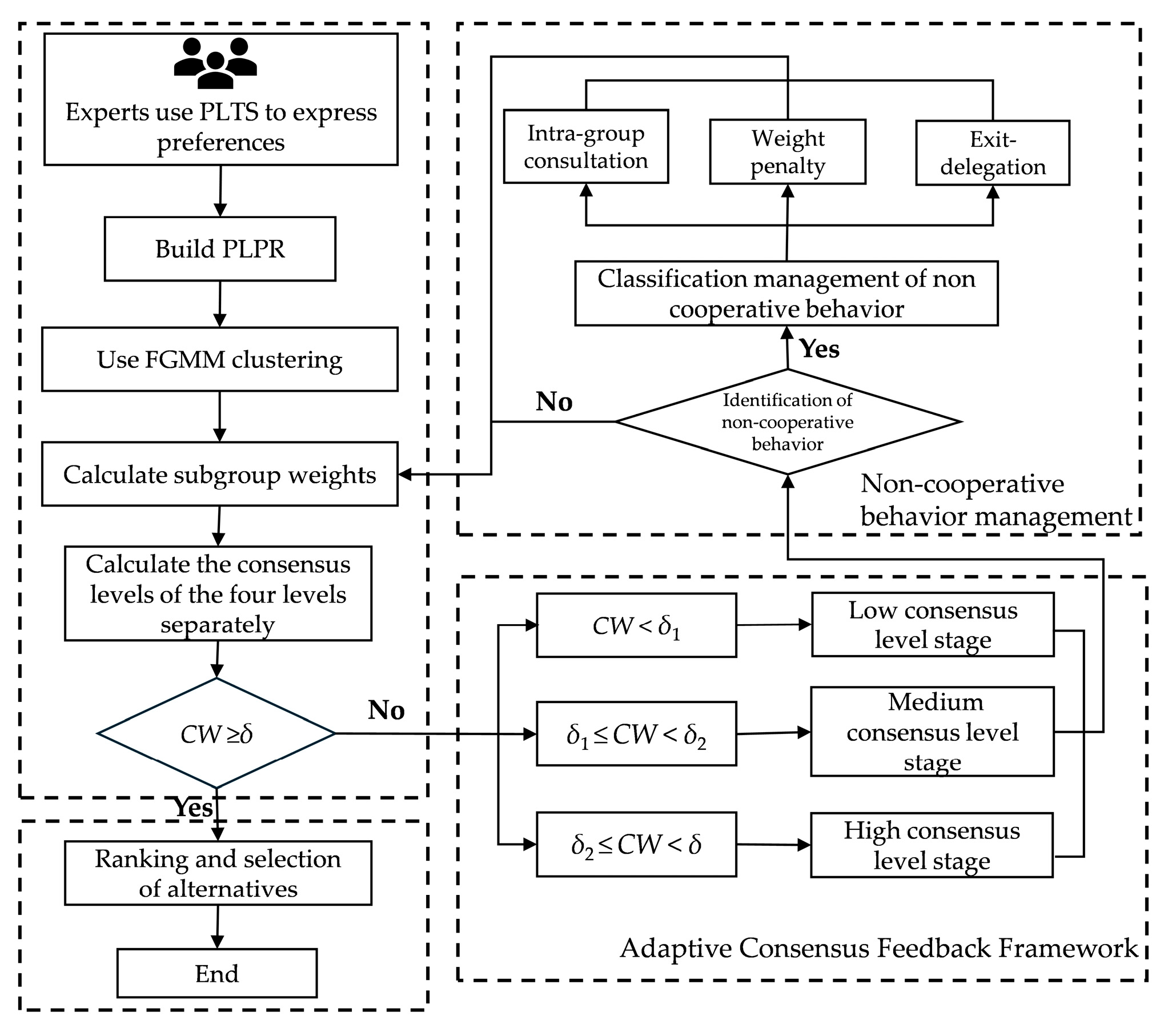
The steps of the proposed method are outlined below, and the overall decision-making flowchart is presented in Figure 1.
Step 1: Experts expressed their preferences using PLTS to construct the PLPR.
Step 2: Using the FGMM method, all experts are divided into K subgroups by Equations (21)–(26).
Step 3: The trust density of each subgroup is calculated by Equation (27), and then normalized by Equation (28) to obtain the final weight of each subgroup.
Step 4: Calculate the consensus on alternative pairs, consensus on alternatives, subgroup level consensus, and overall decision-making consensus using Equations (29)–(34).
Step 5: Based on the consensus level, select different strategies: If CW < δ1, adopt the low consensus level feedback adjustment strategy; If δ1CW < δ2, adopt the medium consensus level feedback adjustment strategy; If δ2CW < δ, adopt the high consensus level feedback adjustment strategy; If CWδ, proceed to Step 7.
Step 6: Calculate the cooperation index using Equation (38) to identify non-cooperative behavior, and select the corresponding level of behavioral management methods based on the degree of non-cooperation, where the weight penalty and weight renormalization calculations are as shown in Equations (39) and (40). After updating the weights, return to Step 3.
Step 7: Rank the alternative options. Calculate the CPV for each option using Equation (11), then compute its score and deviation using Equations (4)–(6) for each alternative’s CPV. Finally, rank the alternatives using the comparison rules.
Step 8: End.

5. Case Study

5.1. Case Background

China has made a solemn commitment to the international community to “achieve carbon peak before 2030 and carbon neutrality before 2060”. As a core sector in emission reduction efforts, the green and low-carbon transition of the transportation industry is of particular urgency and critical importance. Among the multitude of pathways toward deep decarbonization in the transportation sector, the large-scale adoption and advancement of new energy vehicles (NEV) is widely recognized as a core strategy for fulfilling the dual carbon goals. Simultaneously, curbing over-reliance on imported oil, strengthening national energy security capabilities, and advancing the shift in energy consumption structures toward diversification and localization (including electricity and hydrogen energy) has emerged as an inevitable choice for China’s energy strategy. Against this backdrop, identifying a forward-looking, feasible, and illustrative development pathway for NEV has emerged as a pivotal challenge. Anchored in global technological trajectories and the prevailing realities of China’s automotive industry, four representative and actionable alternative pathways are proposed:
Alternative x1: Battery Electric Vehicle (BEV) Dominant Strategy. This strategy concentrates resources on prioritizing the development of battery electric vehicles, which offer inherent merits of full-lifecycle zero emissions and high energy efficiency. Nevertheless, it faces notable challenges, such as potential impacts on power grids and bottlenecks in battery recycling systems.
Alternative x2: Plug-in Hybrid Electric Vehicle (PHEV) Transition Strategy. This approach utilizes PHEV as a bridge from traditional fuel-powered vehicles to full electrification. It boasts core advantages of mitigating driving range anxiety and capitalizing on existing infrastructure. However, a residual drawback persists, as this pathway inevitably generates a degree of tailpipe emissions during operation.
Alternative x3: Fuel Cell Electric Vehicles (FCEV) Breakthrough Strategy. This strategy centers on hydrogen fuel cell vehicles, aiming to establish a hydrogen energy industrial chain covering the entire spectrum of production, storage, transportation, and refueling. It offers distinctive advantages of full-cycle zero emissions and rapid refueling performance. Nonetheless, it is confronted with prominent challenges, such as massive infrastructure investment requirements and elevated costs associated with green hydrogen production.
Alternative x4: Multi-technology Integration Strategy. Adopting a technology-neutral stance, this approach simultaneously supports multiple technical pathways including BEV, PHEV, and FCEV, deferring the ultimate selection to market dynamics. It delivers a core advantage of mitigating technology lock-in risks. However, a significant drawback remains, as the dispersion of policy resources may impede the realization of economies of scale.
This study employed a questionnaire survey, inviting 20 experts {e1, e2, …, e20} to evaluate the above four alternative pathways {x1, x2, x3, x4} using the PLTS method. The questionnaire content is presented in Appendix A.

5.2. Method Process and Numerical Results

Step 1: Using a questionnaire survey format, experts expressed their preferences for PLTS to construct the PLPR. Given the large volume of data, only the PLPR of expert 1 are presented in this paper, as shown in Table 1.
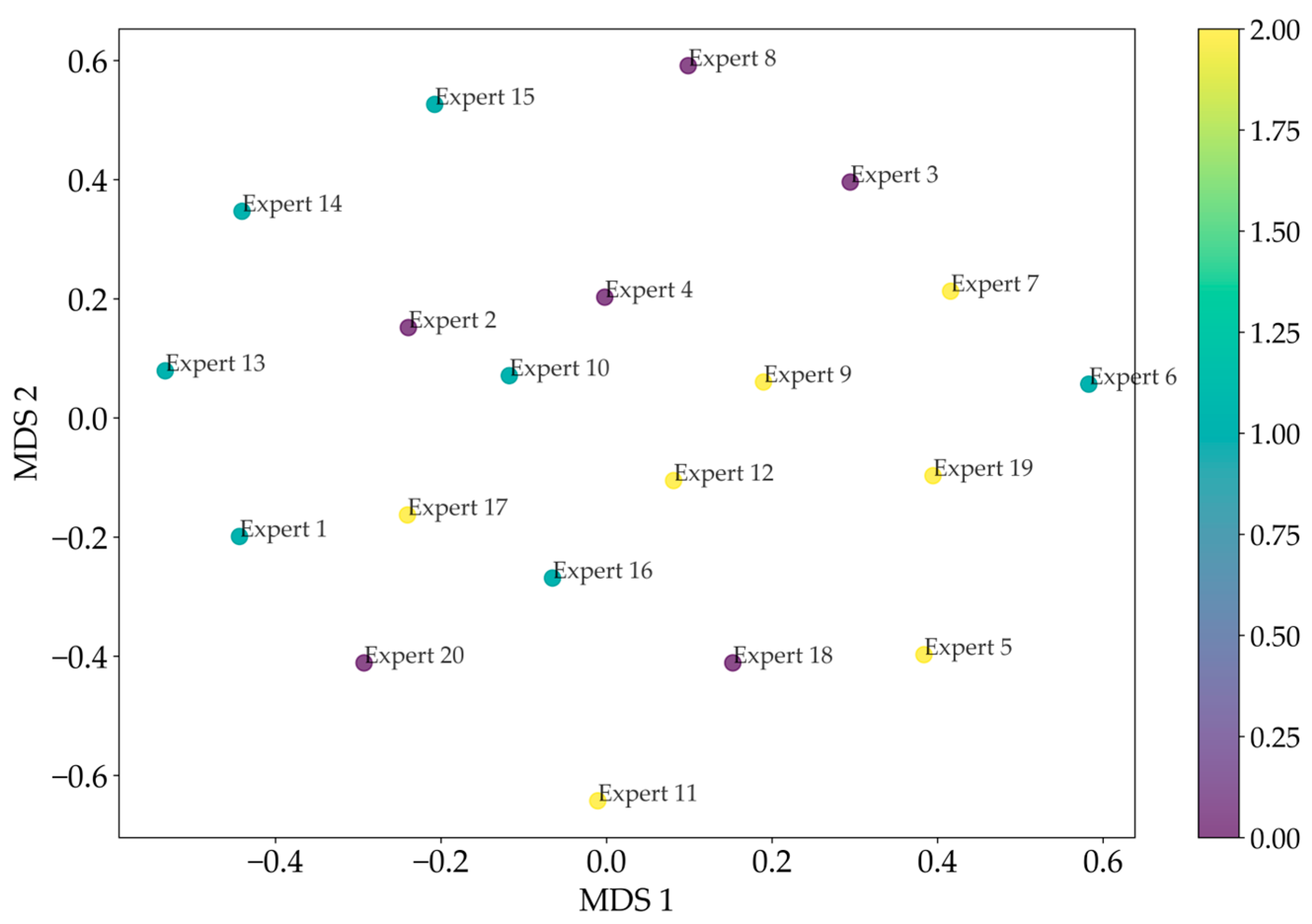
Steps 2: Using the FGMM, the 20 experts were divided into three subgroups via Equations (21)–(26). The clustering results is shown in Figure 2. The “MDS 1” and “MDS 2” representations in the figure are the coordinate axes after dimensionality reduction, which are used to approximate the similarity relationship between experts on a two-dimensional plane.
Steps 3: The trust density of each subgroup was calculated and normalized from Equations (27) and (28), yielding the trust density and initial weights for each subgroup, as shown in Table 2.
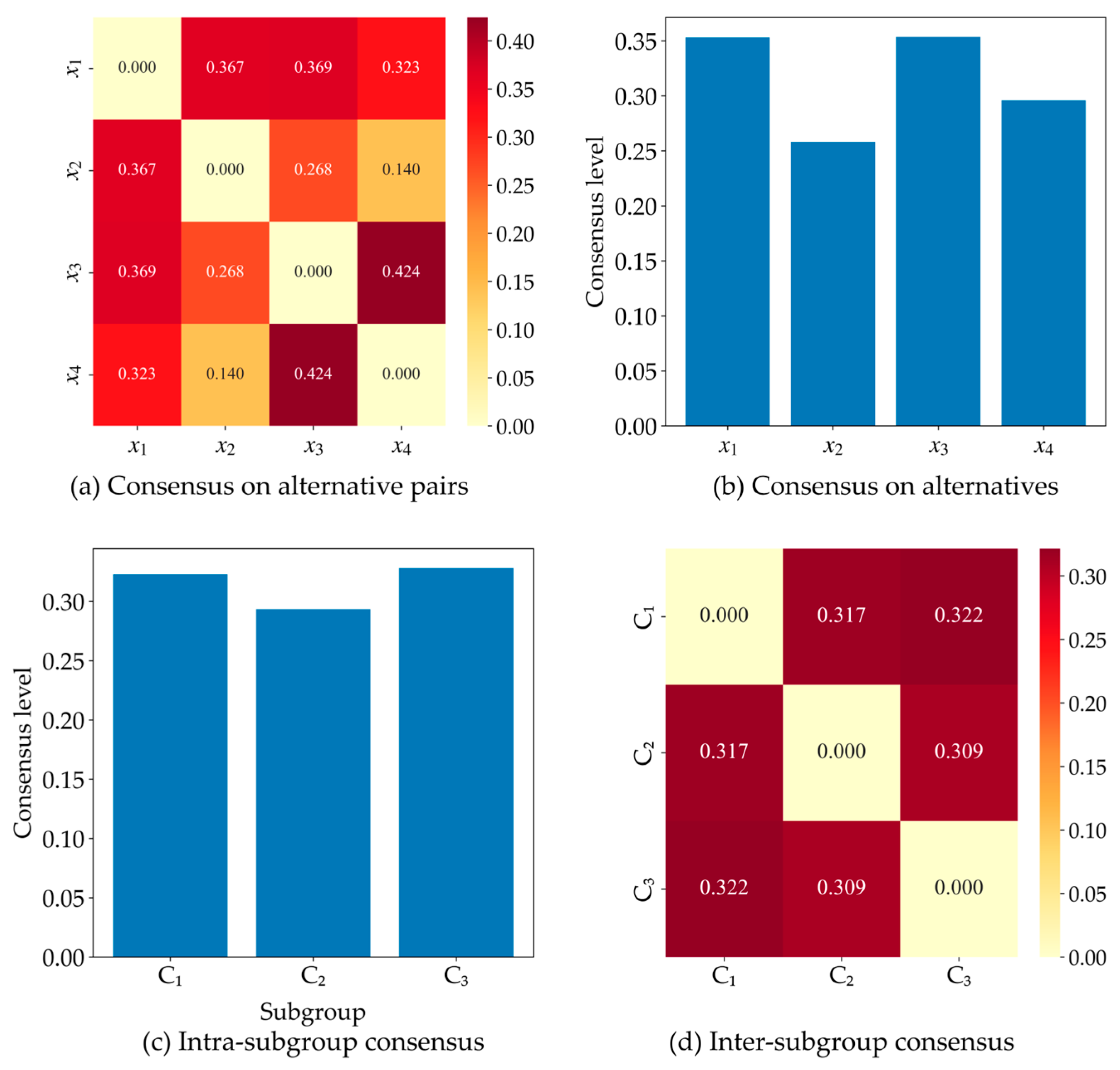
Step 4: Using Equations (29)–(34), sequentially calculate the alternative pairs, subgroups, and overall consensus level. The alternative-level and subgroup-level results are shown in Figure 3. Figure 3a shows the degree of consensus in expert preferences between each pair of alternatives, with warmer colors indicating a higher degree of consensus. Figure 3b shows the consensus level of each alternative. Figure 3c represents the level of consensus of each expert within the subgroup, and the internal consensus can explain the rationality of the subgroup division. Figure 3d shows the level of consensus between different subgroups to identify disagreements between subgroups. The final overall consensus CW = 0.316.
Steps 5 and 6: The preset parameters δ1, δ2 and δ are 0.6, 0.7 and 0.8, respectively. Enter the adaptive feedback consensus process with a maximum consensus round count tm = 5.
First round: Since CW < δ1, the system enters the feedback adjustment phase at a low consensus level. According to Equations (39) and (40), the alternative solutions requiring adjustment are as follows: C1: (x1, x4), (x2, x3), (x2, x4); C2; (x2, x3), (x2, x4); C3: (x1, x2), (x1, x3), (x1, x4), (x2, x4). Adjust the identified alternatives according to the adjustment rules. Continuing with non-cooperative behavior detection, the result showed that no non-cooperative behavior was detected in this round. After adjustment, the new group consensus CW(1) = 0.616 did not reach the predetermined consensus and needs to enter the second round of feedback adjustment.
Second Round: δ1 < CW(1) < δ2, entering the feedback adjustment phase with medium consensus. The alternative options requiring adjustment include: C1: (x1, x2), (x1, x3), (x3, x4); C2: (x1, x2), (x1, x3), (x1, x4), (x3, x4); C3: (x2, x3), (x3, x4). Since the proportion of pairs requiring adjustment exceeds 20%, an interactive adjustment strategy is employed to modify the identified pairs according to the adjustment rules. Subsequently, non-cooperative behavior detection is performed, with no instances detected in this round. The adjusted new group consensus CW(2) = 0.743, failing to meet the predetermined consensus threshold, triggering a third round of feedback adjustment.
Third Round: δ2 < CW(2) < δ, entering the feedback adjustment phase with high consensus, adopting an automatic adjustment strategy. This round detected non-cooperative behavior from experts e1 and e11, CI e 1 3 = −0.01, CI e 11 3 = −0.05. Subsequently, intra-group consultations were conducted. Subgroups C1 and C3, which included the two non-cooperative experts, both voted through consultation. As more than two-thirds of members in each subgroup agreed to automatically adjust their preferences for these experts, an automatic adjustment management strategy was implemented for experts e1 and e11. After the adjustment, the group consensus CW(3) = 0.782. Since the predetermined consensus was not achieved, the system entered the fourth round of feedback adjustment.
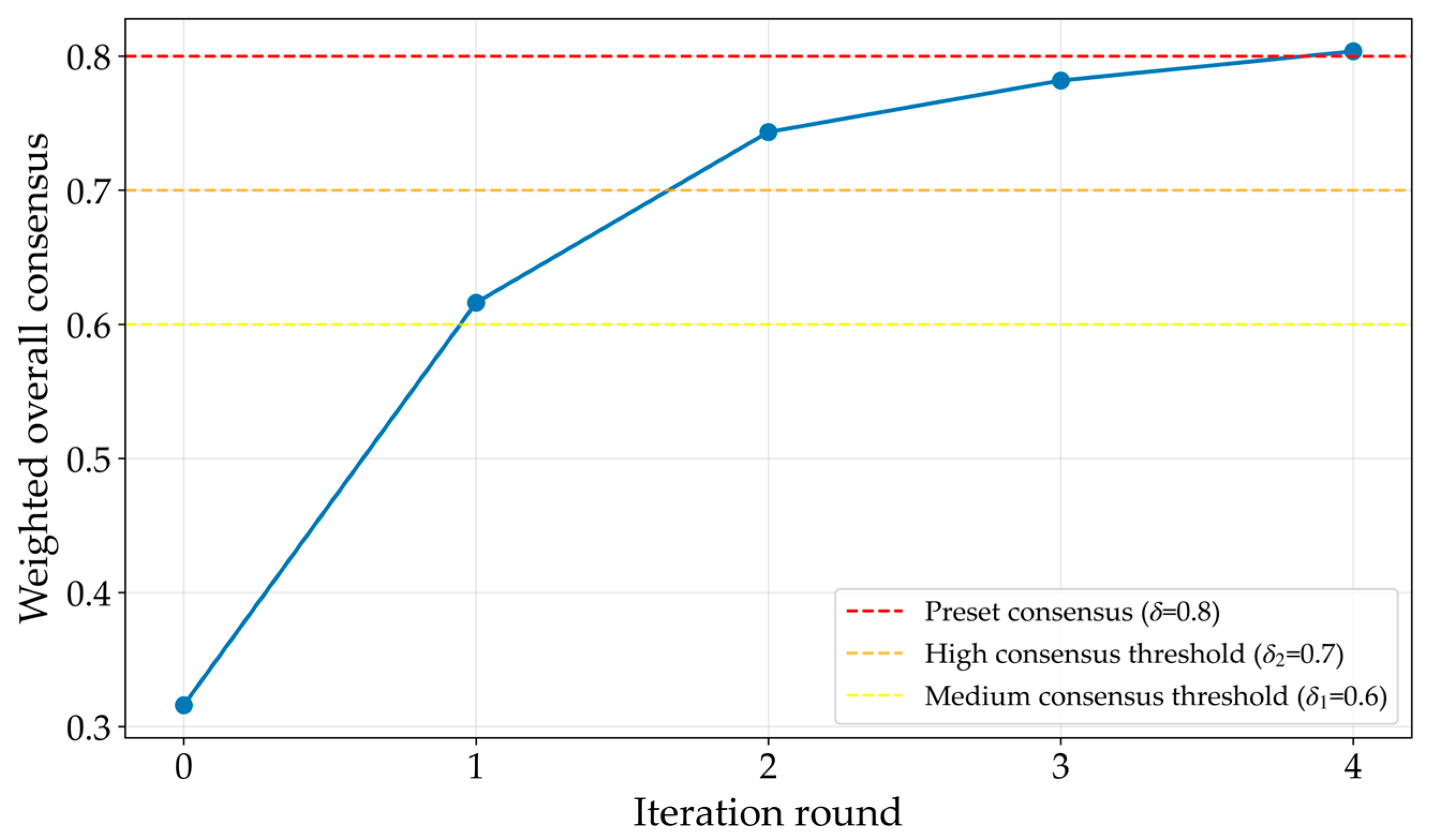
Fourth Round: δ2 < CW(3) < δ, entering the feedback adjustment phase with high consensus, adopting an automatic adjustment strategy. Non-cooperative behavior was detected in three experts: e1, e11 and e15. Following internal deliberation within Subgroup C1, only one-fifth of members agreed to automatically adjust preferences for expert e1. This failed to meet the required two-thirds threshold. Consequently, Subgroup C1 was subjected to a weight penalty strategy, resulting in a reduced weight of ω(C1)4 = 0.27. Following intra-group consultation within subgroup C3, only one-sixth of members agreed to automatically adjust preferences for expert e11., which is fewer than two-thirds. Consequently, subgroup C3 was subjected to a weight penalty strategy, resulting in a reduced weight of ω(C3)4 = 0.35; Following deliberation within subgroup C2, only one-third of members agreed to automatically adjust preferences for expert e15. This also failed to reach the required two-thirds, thus triggering a weight penalty strategy for subgroup C2. The adjusted weight is ω(C2)4 = 0.28. After weight penalties, all expert weights are renormalized using Equation (40), and the group consensus is recalculated, yielding CW(4) = 0.804. Final consensus is achieved, completing the adaptive consensus feedback process. The consensus convergence process is illustrated in Figure 4. It shows the consensus level after each iteration.
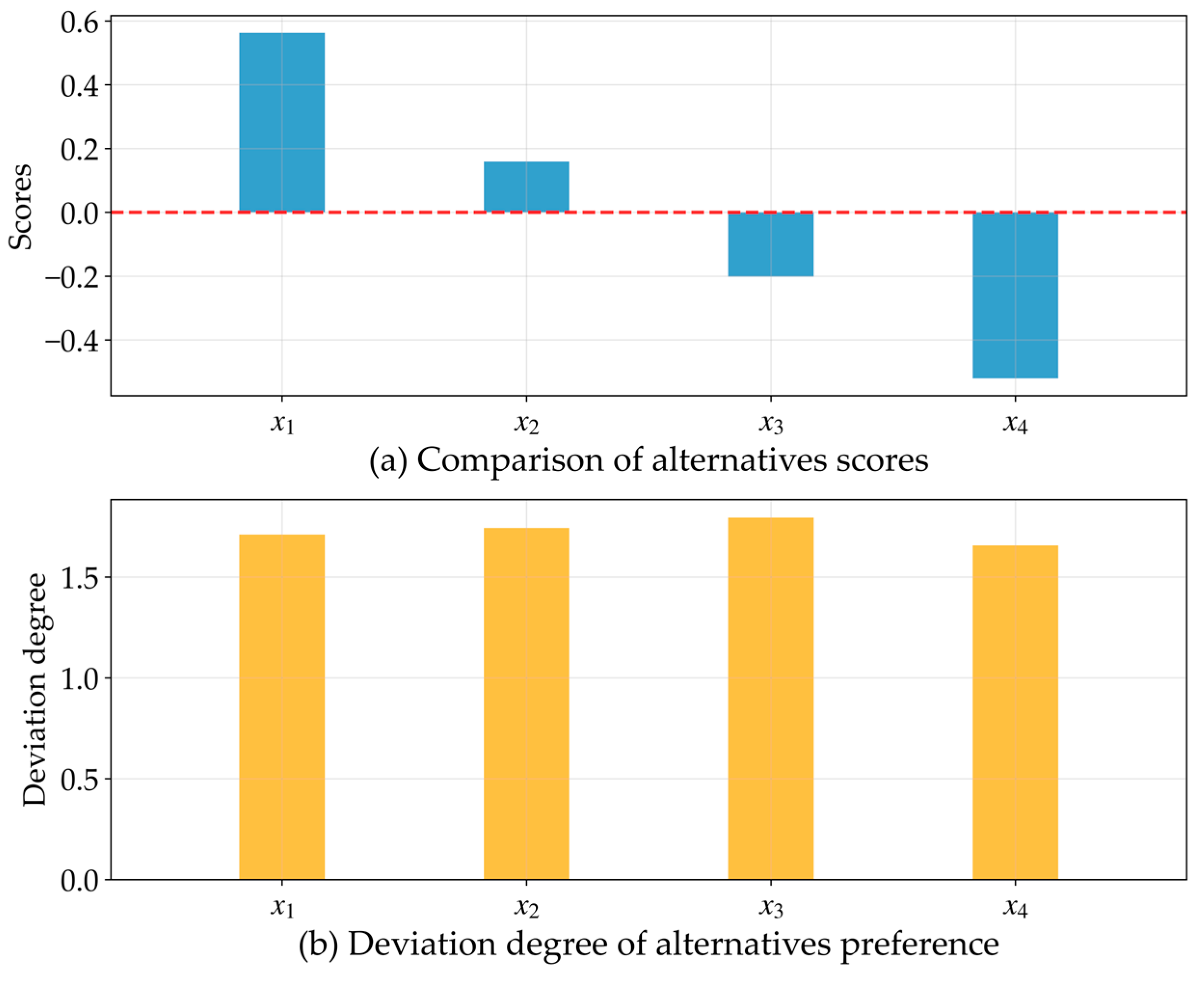
Step 7: Ranking of alternatives. The CPV, scores, and deviation results for each alternative, calculated using Equations (4)–(6) and (11), are shown in Figure 5. Figure 5a shows the scores of each alternative, and Figure 5b represents the deviation degree of each alternative. According to the comparison rules mentioned after Definitions 3 and 4, when scores differ, they are directly compared; when scores are equal, deviations are compared. The final ranking of alternatives is x1 > x2 > x3 > x4. The optimal alternative is alternative x1.

5.3. Sensitivity Analysis

5.3.1. Number of Clusters

The number of clustering subgroups may exert an impact on both the decision-making process and its outcomes, accordingly. A sensitivity analysis was conducted to examine this relationship. As shown in Table 3, from the initial consensus to the final consensus, it can be seen that the final consensus level under all cluster quantity settings can reach the preset consensus threshold δ, Furthermore, the final consensus levels exhibit relative concentration (0.80–0.85), demonstrating the consensus feedback mechanism’s strong adaptability to the initial grouping structure. Additionally, a distinct nonlinear relationship exists between the number of clusters and the number of iteration rounds. When the number of clusters is two or five, consensus thresholds are achieved after only two rounds of iteration, demonstrating high convergence efficiency. When the number of clusters is three, four, and six, the corresponding number of iterations required is four, six, and six. This phenomenon indicates that specific cluster structures can significantly enhance consensus-building efficiency. The exceptionally high efficiency observed with five clusters may stem from this grouping structure coincidentally forming a balanced preference distribution, thereby reducing coordination costs between subgroups. In this study, the number of clusters K = 3 was selected as the number of clusters to balance convergence efficiency and decision quality. Finally, analyzing the ranking stability, the order of alternatives remained fully consistent (x1 > x2 > x3 > x4) when the number of clusters was two, three, four, or six, demonstrating strong robustness in the decision results. However, when the number of clusters is set to five, a change in ranking occurs (x3 > x1 > x2 > x4). This is because the grouping structure alters the dynamic equilibrium of preference aggregation. Comprehensive analysis indicates that the method proposed in this study exhibits strong parameter robustness, generating consistent and logically coherent decision outcomes across the majority of clustering configurations.

5.3.2. Consensus Threshold

To classify group consensus levels, three consensus thresholds (δ1, δ2, and δ) are preset, with consensus categorized into low, medium, and high tiers, accordingly. By varying the magnitude of these thresholds, the influence of such parameter adjustments on convergence performance and consensus quality is analyzed. The analysis results are shown in Table 4. When the threshold settings were upgraded from the more lenient combination (0.5, 0.6, 0.7) to the stricter combination (0.7, 0.8, 0.9), the number of iteration rounds correspondingly increased from three rounds to five rounds. This phenomenon indicates that stringent consensus standards necessitate a more thorough preference adjustment process. From the perspective of the final consensus level, as the threshold strictness increases, the consensus quality shows a continuous improvement trend, rising from 0.747 to 0.911. This validates the decisive impact of threshold settings on consensus quality. Performance variations across different threshold combinations enable specific advantages for diverse application scenarios: In decision-making scenarios with high time sensitivity, relaxed thresholds (0.5, 0.6, 0.7) can achieve an acceptable level of consensus within three rounds; For critical decisions prioritizing quality, strict thresholds (0.7, 0.8, 0.9) ensure high-quality consensus outcomes but may incur additional computational costs. The intermediate thresholds (0.6, 0.7, 0.8) provide balanced solutions, achieving high-quality consensus at a moderate iteration cost. Therefore, this study adopts the intermediate thresholds (0.6, 0.7, 0.8) as the data input for the case analysis.

5.4. Comparative Analysis

5.4.1. Comparison of Clustering Methods

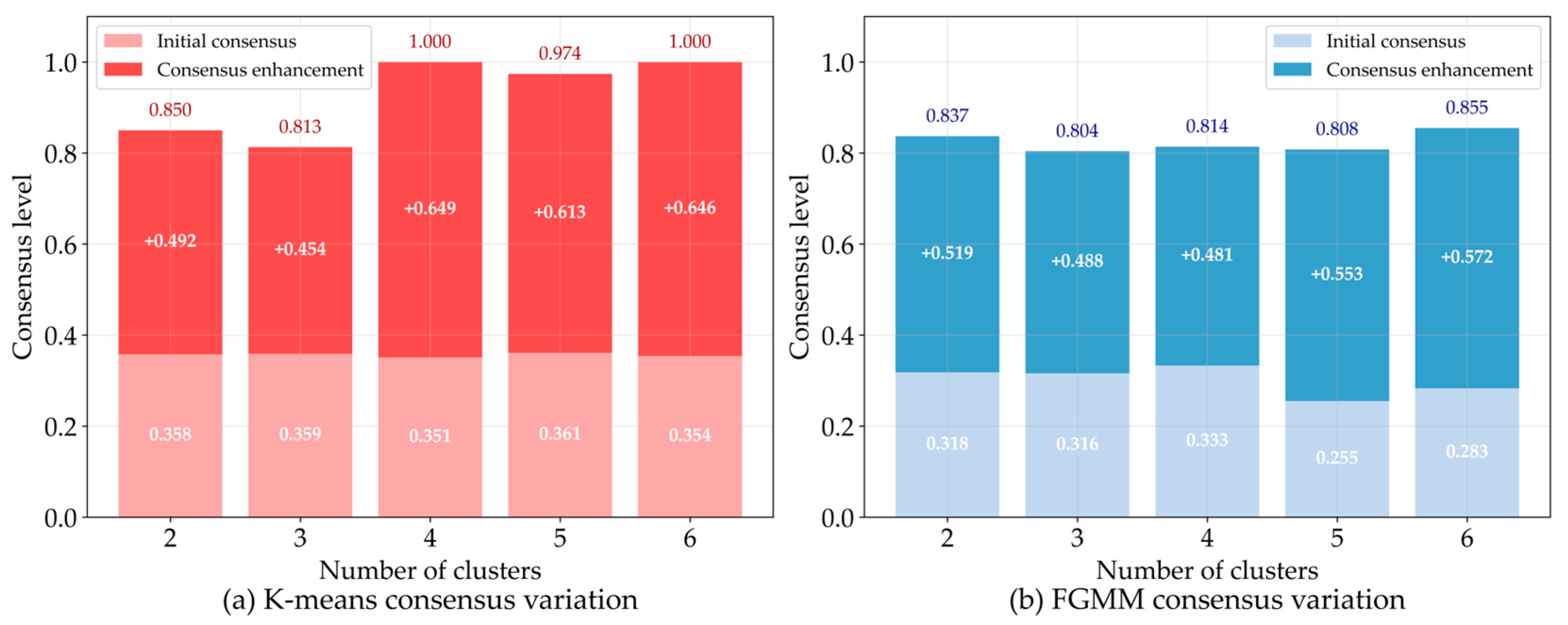
To overcome the limitations of single clustering methods, this study employs a hybrid clustering approach that integrates FCM with a GMM. To demonstrate the advantages of this method, the consensus levels obtained using the traditional K-means method are compared with those from the proposed FGMM. As shown in Figure 6, this further demonstrates the stability advantage of the FGMM method. The traditional K-means method exhibits significant fluctuations in consensus levels across different numbers of clusters, particularly when the number of clusters is set to 4 and 6. In these cases, the final consensus level reaches “1”, indicating a hard consensus level, which is not suitable for practical application scenarios. The final consensus level achieved using the FGMM method consistently remained around 0.8, demonstrating strong stability. This suggests that the traditional K-means method may suffer from instability and over-idealization, though it retains computational efficiency advantages under simple clustering structures. Overall, K-means pursues rapid yet potentially superficial consensus, while FGMM focuses on building deep and stable consensus. By integrating probabilistic membership degrees and Mahalanobis distances, FGMM precisely captures subtle differences in expert preferences. Although it requires more iteration rounds, this approach ensures controllable consensus quality.

5.4.2. Comparison of Existing Literature

Through systematic review and comparative analysis of the representative literature in the field of GDM, the GDM method based on FGMM and adaptive consensus feedback proposed in this paper demonstrates its unique advantages and innovation in multiple key dimensions. As shown in Table 5, compared to the hesitant fuzzy sets in reference [5], the incomplete fuzzy preferences in reference [19], and the intuitionistic fuzzy numbers in reference [27], probabilistic linguistic sets demonstrate a superior capacity to accurately characterize the cognitive uncertainty of decision-makers operating within complex decision-making environments. Regarding clustering methods, for the improved K-means in reference [19], two-stage clustering in references [5,40], Louvain dynamic clustering in reference [27], and natural clustering in reference [17], the FGMM not only effectively addresses the boundary rigidity issue of traditional hard clustering methods in group partitioning but also enhances the stability of the overall decision-making system. In addition, the proposed improved adaptive consensus feedback mechanism, when contrasted with the two-stage feedback adopted in references [17,19,41] and the dynamic feedback in reference [40], achieves the matching of feedback strength and consensus state through the organic combination of multi-level consensus measurement and dynamic adjustment strategy. Finally, among the listed references, only references [27,41] address the management of non-cooperative behavior. The three-tiered behavioral management strategy proposed in this paper avoids the limitations of a one-size-fits-all approach while enabling targeted management of expert behavior to enhance decision-making quality.
In summary, the proposed framework highly synthesized four components: a probabilistic linguistic terminology set (PLTSs), the FGMM, adaptive consensus feedback, and non-cooperative behavior management. This integration not only addresses the adaptability limitations of existing methods in complex scenarios but also enables precise modeling of expert preference distributions through the fusion of clustering methods. Furthermore, it establishes intelligent regulation within the consensus feedback process, effectively enhancing the decision-making efficiency and quality of group decisions in complex environments.

6. Conclusions

In this study, an integrated framework is constructed by combining PLTSs, FGMM, adaptive consensus feedback mechanism, and non-cooperative behavior management. Specifically, the proposed fusion method introduces a FGMM to improve the flexibility and robustness of clustering boundaries via a dual mechanism involving membership degrees and probability distributions. Furthermore, an adaptive feedback mechanism integrating interactive and automated strategies is developed, together with a three-tier behavior management strategy. This approach not only ensures in-depth expert participation during the low-consensus phase but also enhances adjustment efficiency in the high-consensus phase, thereby effectively alleviating the negative impact of non-cooperative behaviors on the consensus-reaching process. Finally, a case study on the strategic pathways of new energy vehicle development validates the excellent convergence and stability of the proposed method. Notably, after four rounds of iteration, the overall consensus level rose from the initial value of 0.316 to 0.804, satisfying the preset threshold.
Sensitivity analysis and comparative results indicate (1) The number of clusters affects consensus convergence speed, yet consistent decision outcomes are achievable under most clustering configurations, underscoring the structural stability of the model. While certain specific grouping structures may alter the dynamic balance of preference aggregation, it is recommended in practice to compare multiple group cluster numbers and select the most robust consensus convergence result as the basis for final decision-making. (2) Threshold settings exhibit scenario adaptability. For decision-making scenarios with high timeliness requirements, a relaxed threshold can achieve an acceptable level of consensus in fewer rounds; whereas for critical decisions prioritizing quality, a strict threshold can ensure high-quality consensus results, but may require additional computational costs. This demonstrates the model’s flexibility in practical applications. (3) Compared to traditional K-means methods, the proposed FGMM method demonstrates superior performance in consensus stability and quality control. Compared to existing research, the proposed framework exhibits greater innovation and systematicity.
Based on the findings and limitations of this study, future research may be expanded in the following directions: First, while this paper mentions trust relationships, it has not yet deeply coupled dynamic trust evolution mechanisms with the consensus process. Subsequent work could explore incorporating dynamic trust networks into both the clustering and feedback phases. Second, the current model relies on a unified probabilistic language terminology set. Future research may consider introducing multi-granularity or non-uniform language terminology to accommodate more diverse types of decision-makers. Finally, there are a certain number of preset parameters in the model. In the future, it could be considered to study methods based on historical data or combined with machine learning to adaptively calibrate or optimize key parameters in the model, reducing subjectivity.

Author Contributions

X.H.: Supervision, Validation, Methodology, Writing—Original Draft, Writing—Review and Editing. X.G.: Writing—Original Draft, Investigation, Software, Resources. G.C.: Conceptualization, Writing—Review and Editing; J.F.: Formal Analysis, Writing—Review and Editing. X.L.: Writing—Review and Editing. All authors have read and agreed to the published version of the manuscript.

Funding

This work was supported by the Intelligent Policing Key Laboratory of Sichuan Province Project of China (ZNJW2025KFQN011), the Guizhou Provincial Basic Research Program (Natural Science) of China (MS[2026]190, MS[2025]629), the Guizhou Provincial Philosophy and Social Sciences Planning Project of China (24GZYB134), and the Guizhou University Humanities and Social Sciences Young Scholars Program of China (GDQN2023007).

Data Availability Statement

The original contributions presented in this study are included in the article. Further inquiries can be directed to the corresponding author.

Conflicts of Interest

The authors declare that they have no known competing financial interests or personal relationships that could have appeared to influence the work reported in this paper.

Appendix A

Questionnaire on Preference Evaluation for New Energy Vehicle Development Strategies
 
Dear Expert,
Hello! We are conducting a group decision-making study on New Energy Vehicle Development Strategies. We kindly request that you evaluate the following four alternative options in pairwise comparisons based on your professional expertise and experience. Your assessment will be crucial to our research. Thank you for your support!
Before beginning the evaluation, please familiarize yourself with the following criteria:
Language Terminology Set: We will use a simple rating scale to describe your preference for one alternative over another:
S−3: Very Poor
S−2: Poor
S−1: Slightly Poor
S0: Equivalent
S1: Slightly Better
S2: Good
S3: Very Good
Probability Language Evaluation: You may assign multiple evaluation levels and their corresponding probabilities (likelihoods) to each comparison pair, but the sum of all probabilities must equal to 1.
Example: When comparing Alternative Option x1 and x2, if you feel x1 is “slightly better” 70% of the time but also feel it is “good” 30% of the time, you can fill it out as follows:
enter 0.7 after S1 (slightly better),
enter 0.3 after S2 (good),
enter 0 or leave blank for other ratings.
Alternative Options Overview:
x1: [Battery Electric Vehicle (BEV) Dominant Strategy]. Concentrate resources on prioritizing the development of battery electric vehicles, which offer inherent merits of full-lifecycle zero emissions and high energy efficiency. Nevertheless, it faces notable challenges, such as potential impacts on power grids and bottlenecks in battery recycling systems.
x2: [Plug-in Hybrid Electric Vehicle (PHEV) Transition Strategy]. Utilizing plug-in hybrid electric vehicles as a bridge from traditional fuel-powered vehicles to full electrification. It boasts core advantages of mitigating driving range anxiety and capitalizing on existing infrastructure, yet it retains a key drawback in that it still generates a certain level of tailpipe emissions.
x3: [Fuel Cell Electric Vehicles (FCEV) Breakthrough Strategy]. Focusing on hydrogen fuel cell vehicles, establish a hydrogen energy industrial chain covering the entire spectrum of production, storage, transportation, and refueling. It offers distinctive advantages of full-cycle zero emissions and rapid refueling performance, yet it is confronted with prominent challenges such as massive infrastructure investment requirements and elevated costs associated with green hydrogen production.
x4: [Multi-technology Integration Strategy]. Adopting a technology-neutral stance, it simultaneously supports multiple technical pathways including BEV, PHEV, and FCEV, deferring the ultimate selection to market dynamics. It delivers a core advantage of mitigating technology lock-in risks, yet it carries a notable drawback in that policy resources risk fragmentation, a challenge that hinders the realization of economies of scale.
Please evaluate your preference for each pair of alternatives in the rows of Table A1. Assign a probability to each comparison, ensuring that the sum of all probabilities in each row is equal to 1 [Enter numbers between 0 and 1].
Table A1. Alternative preference evaluation.
S−3S−2S−1S0S1S2S3Probability and Verification
x1x2 =1
x1—x3 =1
x1x4 =1
x2x3 =1
x2x4 =1
x3x4 =1
Note: Since the comparisons are complementary (e.g., the evaluation of x1 relative to x2 is known, and the evaluation of x2 relative to x1 can be calculated), to avoid duplication and contradictions, we only require you to fill in the upper triangular portion.

References

  1. Tan, X.; Zhu, J.; Cabrerizo, F.J.; Herrera-Viedma, E. A Cyclic Dynamic Trust-Based Consensus Model for Large-Scale Group Decision Making with Probabilistic Linguistic Information. Appl. Soft Comput. 2021, 100, 106937. [Google Scholar] [CrossRef]
  2. Zadeh, L.A. Fuzzy sets. Information and control. J. Symb. Log. 1965, 8, 338–353. [Google Scholar] [CrossRef]
  3. Du, K.; Fan, R.; Wang, Y.; Wang, D.; Qian, R.; Zhu, B. A Data-Driven Group Emergency Decision-Making Method Based on Interval-Valued Intuitionistic Hesitant Fuzzy Sets and Its Application in COVID-19 Pandemic. Appl. Soft Comput. 2023, 139, 110213. [Google Scholar] [CrossRef]
  4. Liu, S.; Yu, W.; Chan, F.T.S.; Niu, B. A Variable Weight-based Hybrid Approach for Multi-attribute Group Decision Making under Interval-valued Intuitionistic Fuzzy Sets. Int. J. Intell. Syst. 2021, 36, 1015–1052. [Google Scholar] [CrossRef]
  5. Yang, H.; Xu, G.; Wang, F.; Zhang, Y. A Clustering-Based Method for Large-Scale Group Decision Making in the Hesitant Fuzzy Set Environment. Comput. Ind. Eng. 2023, 183, 109526. [Google Scholar] [CrossRef]
  6. Liang, X.; Xu, X.; Cabrerizo, F.J. A Novel Group Decision-Making Method with Adjustment Willingness in a Distributed Hesitant Fuzzy Linguistic Environment. Mathematics 2025, 13, 1186. [Google Scholar] [CrossRef]
  7. Pang, Q.; Wang, H.; Xu, Z. Probabilistic Linguistic Term Sets in Multi-Attribute Group Decision Making. Inf. Sci. 2016, 369, 128–143. [Google Scholar] [CrossRef]
  8. Zhao, H.; Li, B.; Li, Y. Probabilistic Linguistic Group Decision-Making Method Based on Attribute Decision and Multiplicative Preference Relations. Int. J. Fuzzy Syst. 2021, 23, 2200–2217. [Google Scholar] [CrossRef]
  9. Zhang, Y.; Hao, Z.; Gong, Z.; Zhang, R. Context-Dependent Probabilistic Linguistic Multi-Attribute Decision-Making Methods. Appl. Intell. 2025, 55, 681. [Google Scholar] [CrossRef]
  10. Jin, F.; Guo, S.; Liu, J. A Novel Probabilistic Linguistic Group Decision-Making Method Driven by DEA Cross-Efficiency and Trust Relationship. Appl. Intell. 2025, 55, 1035. [Google Scholar] [CrossRef]
  11. Jin, F.; Cao, M.; Liu, J.; Martínez, L.; Chen, H. Consistency and Trust Relationship-Driven Social Network Group Decision-Making Method with Probabilistic Linguistic Information. Appl. Soft Comput. 2021, 103, 107170. [Google Scholar] [CrossRef]
  12. Han, X.; Zhan, J.; Xu, Z.; Martínez, L. Trust Risk Test-Based Group Consensus With Probabilistic Linguistic Preference Relations Under Social Networks. IEEE Trans. Fuzzy Syst. 2024, 32, 3508–3520. [Google Scholar] [CrossRef]
  13. Tian, X.; Ma, W.; Wu, L.; Xie, M.; Kou, G. Large-Scale Consensus with Dynamic Trust and Optimal Reference in Social Network under Incomplete Probabilistic Linguistic Circumstance. Inf. Sci. 2024, 661, 120123. [Google Scholar] [CrossRef]
  14. Yang, W.; Liang, C. A Large-Scale Consensus Decision-Making Model for Non-Cooperative Behavior Based on Incomplete Probabilistic Hesitant Fuzzy Information in Social Trust Networks. Inf. Sci. 2025, 714, 122196. [Google Scholar] [CrossRef]
  15. Liu, P.; Dang, R.; Wang, P.; Wu, X. Unit Consensus Cost-Based Approach for Group Decision-Making with Incomplete Probabilistic Linguistic Preference Relations. Inf. Sci. 2023, 624, 849–880. [Google Scholar] [CrossRef]
  16. Dang, R.; Liu, P.; Wang, P.; Martínez, L. Consistency- and Ordinal Consensus-Based Multiple Scenario Model for Group Decision-Making with Incomplete Probabilistic Linguistic Preference Relations. Appl. Soft Comput. 2025, 184, 113722. [Google Scholar] [CrossRef]
  17. Zhou, J.-L.; Chen, J.-A. A Consensus Model to Manage Minority Opinions and Noncooperative Behaviors in Large Group Decision Making With Probabilistic Linguistic Term Sets. IEEE Trans. Fuzzy Syst. 2021, 29, 1667–1681. [Google Scholar] [CrossRef]
  18. Ma, W.; Lv, J.; Tian, X.; Krejcar, O.; Herrera-Viedma, E. Large-Scale Consensus in Incomplete Social Network with Non-Cooperative Behaviors and Dimension Reduction. Inf. Sci. 2025, 690, 121563. [Google Scholar] [CrossRef]
  19. Zhan, J.; Cai, M. A Cost-Minimized Two-Stage Three-Way Dynamic Consensus Mechanism for Social Network-Large Scale Group Decision-Making: Utilizing K -Nearest Neighbors for Incomplete Fuzzy Preference Relations. Expert Syst. Appl. 2025, 263, 125705. [Google Scholar] [CrossRef]
  20. Hua, Z.; Gou, X.; Martínez, L. Dynamic Clustering-Based Consensus Model for Large-Scale Group Decision-Making Considering Overlapping Communities. Inf. Fusion 2025, 115, 102743. [Google Scholar] [CrossRef]
  21. Ding, R.-X.; Yang, B.; Huang, Y.; Zhang, Y.; Chiclana, F. Social Network-Based Overlapping Community Clustering and Feedback Mechanism for Large-Scale Group Decision Making. Eur. J. Oper. Res. 2025, 329, 518–535. [Google Scholar] [CrossRef]
  22. Li, L.; Jiao, S.; Shen, Y.; Liu, B.; Pedrycz, W.; Chen, Y.; Tang, X. A Two-Stage Consensus Model for Large-Scale Group Decision-Making Considering Dynamic Social Networks. Inf. Fusion 2023, 100, 101972. [Google Scholar] [CrossRef]
  23. Li, X.; Liao, H. A Consensus Model for Large-Scale Group Decision Making Based on Empathetic Network Analysis and Its Application in Strategical Selection of COVID-19 Vaccines. J. Oper. Res. Soc. 2023, 74, 604–621. [Google Scholar] [CrossRef]
  24. Wang, P.; Zhang, J.; Lin, Y.; Huang, S.; Xu, X. An Opinion Evolution-Based Consensus-Reaching Model for Large-Scale Group Decision-Making: Incorporating Implicit Trust and Individual Influence. Comput. Ind. Eng. 2025, 203, 110974. [Google Scholar] [CrossRef]
  25. Lu, Y.; Xu, Y.; Herrera-Viedma, E.; Han, Y. Consensus of Large-Scale Group Decision Making in Social Network: The Minimum Cost Model Based on Robust Optimization. Inf. Sci. 2021, 547, 910–930. [Google Scholar] [CrossRef] [PubMed]
  26. Shang, C.; Zhang, R.; Zhu, X.; Liu, Y. An Adaptive Consensus Method Based on Feedback Mechanism and Social Interaction in Social Network Group Decision Making. Inf. Sci. 2023, 625, 430–456. [Google Scholar] [CrossRef]
  27. Shang, C.; Zhang, R.; Zhu, X. An Adaptive Consensus Model in Large-Scale Group Decision Making with Noncooperative and Compromising Behaviors. Appl. Soft Comput. 2023, 149, 110944. [Google Scholar] [CrossRef]
  28. Yang, G.-R.; Wang, X.; Ding, R.-X.; Lin, S.-P.; Lou, Q.-H.; Herrera-Viedma, E. Managing Non-Cooperative Behaviors in Large-Scale Group Decision Making Based on Trust Relationships and Confidence Levels of Decision Makers. Inf. Fusion 2023, 97, 101820. [Google Scholar] [CrossRef]
  29. Xu, X.; Zhang, Q.; Chen, X. Consensus-Based Non-Cooperative Behaviors Management in Large-Group Emergency Decision-Making Considering Experts’ Trust Relations and Preference Risks. Knowl. Based Syst. 2020, 190, 105108. [Google Scholar] [CrossRef]
  30. Xu, X.; Du, Z.; Chen, X.; Cai, C. Confidence Consensus-Based Model for Large-Scale Group Decision Making: A Novel Approach to Managing Non-Cooperative Behaviors. Inf. Sci. 2019, 477, 410–427. [Google Scholar] [CrossRef]
  31. Yuan, Y.; Wang, C.; Cheng, D.; Zhang, F.; Zhou, Z.; Cheng, F. Minimum Conflict Consensus Models for Group Decision-Making Based on Social Network Analysis Considering Non-Cooperative Behaviors. Inf. Fusion 2023, 99, 101855. [Google Scholar] [CrossRef]
  32. Gai, T.; Chiclana, F.; Jin, W.; Zhou, M.; Wu, J. A Transformation Method of Noncooperative to Cooperative Behavior by Trust Propagation in Social Network Group Decision Making. IEEE Trans. Fuzzy Syst. 2025, 33, 2238–2250. [Google Scholar] [CrossRef]
  33. Shen, J.; Wang, S.; Ji, F.; Gai, T.; Wu, J. The Reconciliation Mechanism by Cooperative Intention Index for Managing Non-Cooperative Behaviors in Social Network Group Decision Making. Eng. Appl. Artif. Intell. 2023, 126, 107066. [Google Scholar] [CrossRef]
  34. Tang, M.; Liao, H.; Mi, X.; Lev, B.; Pedrycz, W. A Hierarchical Consensus Reaching Process for Group Decision Making with Noncooperative Behaviors. Eur. J. Oper. Res. 2021, 293, 632–642. [Google Scholar] [CrossRef]
  35. Xiao, Y.; Ma, X.; Zhan, J. Group Decision-Making in Heterogeneous Multi-Scale Information Fusion: Integrating Overconfident and Non-Cooperative Behaviors. Inf. Fusion 2026, 125, 103401. [Google Scholar] [CrossRef]
  36. Zhao, S.; Wu, S.; Dong, Y. Managing Non-Cooperative Behaviors and Ordinal Consensus through a Self-Organized Mechanism in Multi-Attribute Group Decision Making Managing Non-Cooperative Behaviors and Ordinal Consensus through a Self-Organized Mechanism in Multi-Attribute Group Decision Making. Expert Syst. Appl. 2024, 240, 122571. [Google Scholar] [CrossRef]
  37. Fu, J.; Guan, X.; Han, X.; Chen, G. Robust Minimum-Cost Consensus Model with Non-Cooperative Behavior: A Data-Driven Approach. Mathematics 2025, 13, 3098. [Google Scholar] [CrossRef]
  38. Zhang, X.; Liang, H.; Qu, S. Robust Consensus Modeling: Concerning Consensus Fairness and Efficiency with Uncertain Costs. Mathematics 2024, 12, 1266. [Google Scholar] [CrossRef]
  39. Dunn, J.C. A Fuzzy Relative of the ISODATA Process and Its Use in Detecting Compact Well-Separated Clusters. J. Cybern. 1973, 3, 32–57. [Google Scholar] [CrossRef]
  40. Lu, Y.; Li, M.; Xu, Y.; Qiu, H. A Two-Stage Clustering Method and Consensus Based on Trust Excitation and Conflict Hindrance for Large-Scale Group Decision-Making with Complex Social Relationships. Inf. Fusion 2026, 127, 103719. [Google Scholar] [CrossRef]
  41. Liu, A.; Qiu, H.; Lu, H.; Guo, X. A Consensus Model of Probabilistic Linguistic Preference Relations in Group Decision Making Based on Feedback Mechanism. IEEE Access 2019, 7, 148231–148244. [Google Scholar] [CrossRef]
Figure 1. Flowchart of the proposed adaptive consensus model.
Mathematics 14 01049 g001
Figure 2. The results of clustering 20 experts using the FGMM based on probabilistic language preference.
Mathematics 14 01049 g002
Figure 3. The consensus level of the alternative-level and the subgroup-level.
Mathematics 14 01049 g003
Figure 4. Adaptive consensus convergence process.
Mathematics 14 01049 g004
Figure 5. Final alternatives ranking base score and deviation degree.
Mathematics 14 01049 g005
Figure 6. Consensus level comparison of K-means and FGMM under different numbers of clusters.
Mathematics 14 01049 g006
Table 1. The PLPR of expert 1.
x1x2x3x4
x1{s0 (1.0)}{s−1 (0.4),
s0 (0.0), s1 (0.1),
s2 (0.0), s3 (0.5)}
{s−2 (0.2),
s0 (0.0), s2 (0.8)}
{s1 (0.2),
s0 (0.1), s1 (0.2),
s2 (0.4), s3 (0.1)}
x2{s3 (0.5),
s2 (0.0), s1 (0.1),
s0 (0.0), s1 (0.4)}
{s0 (1.0)}{s2 (0.2),
s0 (0.1), s1 (0.2),
s2 (0.1), s3 (0.4)}
{s1 (0.1),
s1 (0.3), s2 (0.6)}
x3{s2 (0.8), s2 (0.2)}{s−3 (0.4),
s2 (0.1), s1 (0.2),
s0 (0.1), s2 (0.2)}
{s0 (1.0)}{s−2 (0.5), s−1 (0.5)}
x4{s−3 (0.1),
s2 (0.4), s1 (0.2),
s0 (0.1), s1 (0.2)}
{s−2 (0.6),
s1 (0.3), s1 (0.1)}
{s1 (0.5), s2 (0.5)}{s0 (1.0)}
Table 2. Subgroup weights based on trust density.
SubgroupNumber of ExpertsExpertsTrust DensityWeight
C16e2, e3, e4, e8, e18, e200.120.30
C27e1, e6, e10, e13, e14, e15, e160.130.30
C37e5, e7, e9, e11, e12, e17, e190.160.40
Table 3. Decision results under different cluster numbers.
KInitial ConsensusFinal ConsensusIteration RoundRanking of Alternatives
20.3180.8372x1 > x2 > x3 > x4
30.3160.8044x1 > x2 > x3 > x4
40.3330.8146x1 > x2 > x3 > x4
50.2550.8082x3 > x1 > x2 > x4
60.2830.8556x1 > x2 > x3 > x4
Table 4. Iterative rounds and final consensus under different threshold combinations.
δ1, δ2, δIteration RoundFinal Consensus
0.5, 0.6, 0.730.747
0.6, 0.7, 0.840.804
0.7, 0.8, 0.950.911
Table 5. Comparison with existing representative literature.
ReferencesLanguage Preference ExpressionClustering MethodConsensus Feedback ProcessNon-Cooperative Behavior
[5]Hesitant fuzzy setsTwo-stage clustering××
[19]Incomplete fuzzy preferencesImproved K-meansTwo-stage feedback×
[27]Intuitionistic fuzzy numbersLouvain dynamic clusteringAdaptive feedback
[41]PLTS×Two-stage feedback×
[17]PLTSNatural clusteringTwo-stage feedback
[40]×Two-stage clusteringDynamic feedback×
This paperPLTSFGMMAdaptive feedback
Note: “×” and “√” indicate “no” or “yes” for the inclusion of this method in the reference.
Disclaimer/Publisher’s Note: The statements, opinions and data contained in all publications are solely those of the individual author(s) and contributor(s) and not of MDPI and/or the editor(s). MDPI and/or the editor(s) disclaim responsibility for any injury to people or property resulting from any ideas, methods, instructions or products referred to in the content.