Article

Refined Conditions for the Inclusion Properties of Special Functions in Lemniscate and Nephroid Domains

by
Saiful R. Mondal
1 and
Lateef Ahmad Wani
2,*
1
Department of Mathematics and Statistics, College of Science, King Faisal University, Al-Ahsa 31982, Saudi Arabia
2
Department of Mathematics, Thapar Institute of Engineering and Technology, Patiala 147001, Punjab, India
*
Author to whom correspondence should be addressed.
Mathematics 2026, 14(5), 882; https://doi.org/10.3390/math14050882
Submission received: 3 February 2026 / Revised: 1 March 2026 / Accepted: 2 March 2026 / Published: 5 March 2026
(This article belongs to the Special Issue Special Functions with Applications)

Abstract

For D : = { z C : | z | < 1 } , this paper derives refined conditions for the inclusion of special functions in lemniscate and nephroid domains focusing on solutions to the differential equations of the form z n F ( z ) + a ( z ) z n 1 F ( z ) + b ( z ) F ( z ) + d ( z ) = 0 , n { 1 , 2 } , z D , with normalization F ( 0 ) = 1 , where a ( z ) , b ( z ) and d ( z ) are analytic in D . Using advanced techniques from geometric function theory, we generalize and improve existing results, particularly for classes of functions defined by differential equations. Specific applications include generalized Bessel functions, regular Coulomb wave functions, and associated Laguerre polynomials, where we derive improved bounds for their inclusion in lemniscate domains. Additionally, we present open problems, supported by numerical experiments, to guide future research in this direction.

1. Introduction

Let D denote the open unit disk z C : | z | < 1 . An analytic function f defined on D is said to be univalent if it never takes the same value in C more than once (see [1,2,3]). For two analytic functions f and g defined on D , the function f is said to be subordinate to g, denoted by f g , if there exists an analytic function w : D D satisfying w ( 0 ) = 0 and f ( z ) = g ( w ( z ) ) . Moreover, if the function g is univalent, then f g if and only if f ( 0 ) = g ( 0 ) and f ( D ) g ( D ) (see [1]).
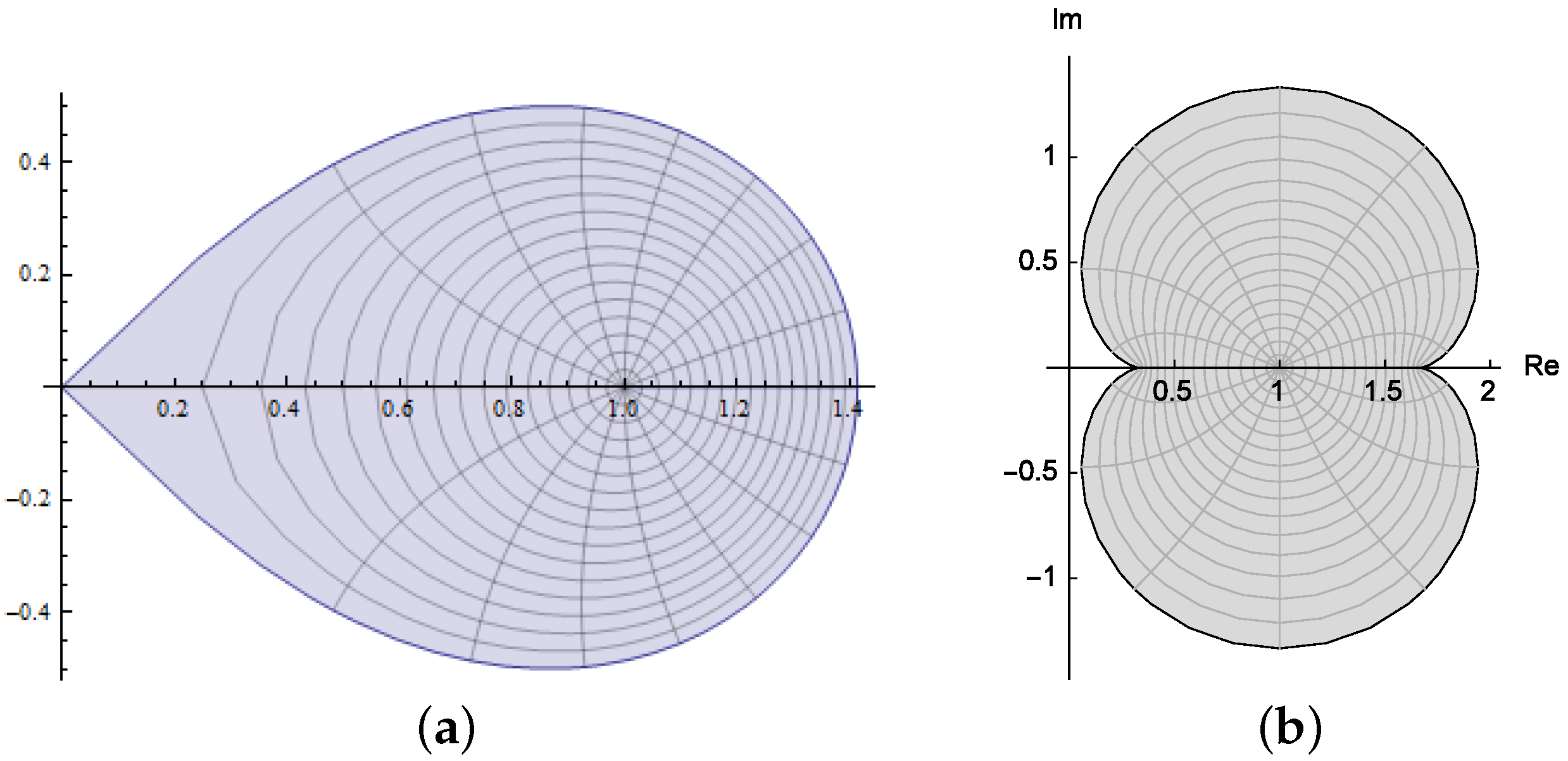
Consider the function Φ L ( z ) : = 1 + z , which maps D univalently onto the region illustrated in Figure 1a. This domain is commonly referred to as the lemniscate domain (see [4,5,6,7,8]). Additionally, define Φ N ( z ) : = 1 + z z 3 / 3 , which maps D univalently onto the region illustrated in Figure 1b. This domain is known as the nephroid domain (see [9,10]).
For this study, we begin by considering three functions, denoted as a ( z ) , b ( z ) , and d ( z ) , which are defined on the unit disk D . These functions play a central role in defining differential equations that characterize various classes of analytic functions. Specifically, we use a ( z ) , b ( z ) , and d ( z ) to define four distinct classes of functions, each satisfying a second-order linear differential equation of the form L [ F ] ( z ) = 0 , where L is a differential operator involving a ( z ) , b ( z ) , and d ( z ) . The classes are defined as follows:
F D E 1 = F : D C z 2 F ( z ) + a ( z ) z F ( z ) + b ( z ) F ( z ) + d ( z ) = 0 & F ( 0 ) = 1 ,
F D E 2 = F : D C z F ( z ) + a ( z ) F ( z ) + b ( z ) F ( z ) + d ( z ) = 0 & F ( 0 ) = 1 ,
F D E 3 = F : D C z 2 F ( z ) + a ( z ) z F ( z ) + b ( z ) F ( z ) = 0 & F ( 0 ) = 1 ,
F D E 4 = F : D C z F ( z ) + a ( z ) F ( z ) + b ( z ) F ( z ) = 0 & F ( 0 ) = 1 .
Here, F : D C denotes an analytic function defined on the unit disk D , and the normalization condition F ( 0 ) = 1 ensures that all functions in these classes are standardized at the origin. The differential equations defining these classes differ in the form of the differential operator L , particularly in the coefficients of F ( z ) and F ( z ) , as well as the presence or absence of the inhomogeneous term d ( z ) .

1.1. Relationships Between the Classes

The four classes F D E 1 , F D E 2 , F D E 3 , and F D E 4 are closely related, as they all arise from variations of a second-order linear differential equation. However, for the purposes of this study, we present them separately to facilitate reader comprehension and to highlight the distinct properties of each class.
  • Class F DE 1 : This class is defined by a differential equation where the coefficient of F ( z ) is z 2 , and the equation includes an inhomogeneous term d ( z ) . This class is particularly useful for modeling functions that arise in physical and engineering applications, where external forcing terms (represented by d ( z ) ) are often present.
  • Class F DE 2 : Here, the coefficient of F ( z ) is z, and the equation also includes the inhomogeneous term d ( z ) . This class is closely related to F D E 1 , but the reduced power of z in the coefficient of F ( z ) leads to different analytical properties.
  • Class F DE 3 : This class is defined by a homogeneous differential equation (i.e., d ( z ) = 0 ) with the coefficient of F ( z ) being z 2 . The absence of the inhomogeneous term simplifies the analysis, making this class particularly amenable to theoretical investigations.
  • Class F DE 4 : Similar to F D E 3 , this class is defined by a homogeneous differential equation, but the coefficient of F ( z ) is z. This class is closely related to F D E 2 , but the absence of d ( z ) allows for a more straightforward analysis of the solutions.

1.2. Special Functions Encompassed by These Classes

By judiciously choosing the functions a ( z ) , b ( z ) , and d ( z ) , the classes F D E 1 through F D E 4 encompass a broad range of special functions that are of significant interest in both pure and applied mathematics. We present the following examples:
(i)
Bessel Functions: These functions arise as solutions to differential equations of the form
z 2 F ( z ) + z F ( z ) + ( z 2 ν 2 ) F ( z ) = 0 ,
which can be represented within F D E 3 by setting a ( z ) = 1 , b ( z ) = z 2 ν 2 , and d ( z ) = 0 .
(ii)
Hypergeometric Functions: These functions satisfy differential equations of the form
z ( 1 z ) F ( z ) + [ c ( a + b + 1 ) z ] F ( z ) a b F ( z ) = 0 ,
which can be represented within F D E 2 by appropriate choices of a ( z ) , b ( z ) , and d ( z ) .
(iii)
Coulomb Wave Functions: These functions arise in quantum mechanics and can be represented within F D E 1 or F D E 2 by incorporating appropriate inhomogeneous terms.
The proposed framework provides a unified treatment of various special functions, allowing for a systematic analysis of their properties. By varying the functions a ( z ) , b ( z ) , and d ( z ) , the framework can be adapted to study a wide range of differential equations and their solutions. The classification of functions into these classes facilitates the derivation of general results that apply to entire families of special functions, rather than individual cases.
In subsequent sections, we will explore specific examples of special functions that fall within these classes, demonstrating the versatility and applicability of the proposed framework. By studying these classes, we aim to unify the analysis of a wide range of special functions under a common theoretical framework, thereby providing new insights into their properties and interrelationships.
The study of analytic functions and their geometric properties has been a central theme in geometric function theory. In recent years, the inclusion of functions in lemniscate and nephroid domains has garnered significant attention due to their applications in various areas of mathematics and physics. The following lemmas available in the literature are needed in sequel.
Lemma 1 
([11,12]). Let Ω C . Suppose that Ψ : C 3 × D C satisfies the condition
Ψ ( i ρ , σ , μ + i ν ; z ) Ω
when z D , ρ is real, σ ( 1 + ρ 2 ) / 2 and σ + μ 0 . If p is analytic in D , with p ( 0 ) = 1 and Ψ ( p ( z ) , z p ( z ) , z 2 p ( z ) ; z ) Ω for z D , then Re p ( z ) > 0 for z D .
If Ψ : C 2 × D C , then the condition in Lemma 1 reduces to
Ψ ( i ρ , σ ; z ) Ω ,
when ρ is real and σ ( 1 + ρ 2 ) / 2 .
Lemma 2 
([13]). Let p ( z ) be a non-constant analytic function with p ( 0 ) = 1 . Let Ω C , and Ψ : C 3 × D C satisfy
Ψ ( r , s , t ; z ) Ω
whenever z D , and for m 1 , π / 4 θ π / 4 ,
r = 2 cos ( 2 θ ) e i θ , s = m e 3 i θ 2 2 cos ( 2 θ ) a n d Re ( t + s ) e 3 i θ 3 m 2 8 2 cos ( 2 θ ) .
If Ψ ( p ( z ) , z p ( z ) , z 2 p ( z ) ; z ) Ω for z D , then p ( z ) 1 + z in D .
Lemma 3 
([14]). Let Ω C , and Ψ : C 3 × D C satisfy Ψ ( r , s , t ; z ) Ω whenever z D , and for m 1 , θ ( 0 , 2 π ) ,
r = e e i θ , s = m e i θ e e i θ a n d Re 1 + t s m ( 1 + cos ( θ ) .
If Ψ ( p ( z ) , z p ( z ) , z 2 p ( z ) ; z ) Ω for z D , then p ( z ) e z in D .
Lemma 4 
([9]). Let p : D C be analytic such that p ( 0 ) = 1 and for δ > 0 ,
p ( z ) + β z p ( z ) 1 + z .
Then, for β 0.158379 , p ( z ) Φ N ( z ) .
Lemma 5 
([9]). Let p : D C be analytic such that p ( 0 ) = 1 . Then each of the following subordinations imply p ( z ) Φ N ( z ) :
(i) 
1 + β z p ( z ) 1 + z  for  β 3 ( 1 log ( 2 ) ) 0.920558 ;
(ii) 
1 + β z p ( z ) p ( z ) 1 + z  for  β 2 2 + log ( 2 ) 1 log ( 1 + 2 log ( 5 / 3 ) 0.884792 ;
(iii) 
1 + β z p ( z ) p ( z ) 2 1 + z  for  β 5 2 + log ( 2 ) 1 log ( 1 + 2 ) 1.12994 .

2. Main Results

We now present and prove our first main result, which establishes conditions under which functions in the classes F D E 1 and F D E 2 map the unit disk D into the lemniscate domain and nephroid domains. The result is based on Lemma 4, which provides a subordination criterion for functions satisfying certain differential inequalities.
Theorem 1. 
Suppose that F F D E i for i = 1 or 2. Assume that the functions a ( z ) , b ( z ) , and d ( z ) satisfy one of the following inequalities:
H 1 : Re a ( z ) 1 > 2 2 | b ( z ) | + 2 2 | d ( z ) + b ( z ) | 3 4 ,
H 2 : Re a ( z ) 1 > 4 | b ( z ) | + 2 2 | d ( z ) | 3 4 .
If, for some β > 0 , there exists a function g 1 such that g 1 ( 0 ) = 1 and the following integral relationship holds:
0 z F ( t ) β t 1 β 1 d t = z 1 β g 1 ( z )
for all | z | < 1 , then the function g 1 ( z ) satisfies the subordination g 1 ( z ) Φ N ( z ) = 1 + z z 3 / 3 whenever β β 1 = 0.158379 .
Proof. 
For F F D E i , where i = 1 or 2, assume that
z 1 / β g 1 ( z ) = 1 β 0 z F ( t ) t 1 β 1 d t .
Since β > 0 , the integral on the right-hand side of (10) vanishes at z = 0 , and hence the identity holds at z = 0 . For z 0 , differentiating both sides of (10) and applying the Fundamental Theorem of Calculus yields
1 β z 1 β 1 g 1 ( z ) + z 1 β g 1 ( z ) = 1 β F ( z ) z 1 β 1 .
This simplifies to
g 1 ( z ) + β z g 1 ( z ) = F ( z ) .
By Lemma 4, it suffices to show that F ( z ) 1 + z . To this end, let p ( z ) = F ( z ) .
  • Case 1: F F D E 1
In this case, we have
z 2 p ( z ) + a ( z ) z p ( z ) + b ( z ) p ( z ) + d ( z ) = 0 .
Let Ω : = { 0 } , and define the function Ψ : C 3 × D C by
Ψ ( r , s , t ; z ) = t + a ( z ) s + b ( z ) r + d ( z ) .
Then, Ψ ( p , z p , z p ; z ) Ω .
For the given r, s, and t as in (5), along with the conditions | r 1 | < 1 and Re ( a ( z ) 1 ) > 0 , we obtain
| Ψ ( r , s , t ; z ) | = | ( t + s ) + ( a ( z ) 1 ) s + b ( z ) r + d ( z ) | .
Using the inequalities provided in (5), we derive
| Ψ ( r , s , t ; z ) | ( t + s ) e 3 i θ + ( a ( z ) 1 ) m 2 2 cos ( 2 θ ) | b ( z ) | | r 1 | | d ( z ) + b ( z ) | .
Further simplification yields
| Ψ ( r , s , t ; z ) | Re ( t + s ) e 3 i θ + Re ( a ( z ) 1 ) m 2 2 cos ( 2 θ ) | b ( z ) | | d ( z ) + b ( z ) | .
This can be bounded as
| Ψ ( r , s , t ; z ) | 3 m 2 8 2 cos ( 2 θ ) + Re ( a ( z ) 1 ) m 2 2 cos ( 2 θ ) | b ( z ) | | d ( z ) + b ( z ) | .
Finally, we obtain
| Ψ ( r , s , t ; z ) | 4 Re ( a ( z ) 1 ) + 3 8 2 | b ( z ) | | d ( z ) + b ( z ) | > 0 ,
provided
Re ( a ( z ) 1 ) > 2 2 | b ( z ) | + 2 2 | d ( z ) + b ( z ) | 3 4 .
This condition is precisely H 1 .
  • Case 2: F F D E 2
In this case, we have
z p ( z ) + a ( z ) p ( z ) + b ( z ) p ( z ) + d ( z ) = 0 ,
which can be rewritten as
z 2 p ( z ) + a ( z ) z p ( z ) + z b ( z ) p ( z ) + z d ( z ) = 0 .
Proceeding similarly to the previous case, we obtain
| Ψ ( r , s , t ; z ) | = | ( t + s ) + ( a ( z ) 1 ) s + z b ( z ) r + z d ( z ) | .
Using the same inequalities, we derive
| Ψ ( r , s , t ; z ) | ( t + s ) e 3 i θ + ( a ( z ) 1 ) m 2 2 cos ( 2 θ ) | z b ( z ) | | r 1 | | z d ( z ) + z b ( z ) | .
This simplifies to
| Ψ ( r , s , t ; z ) | 4 Re ( a ( z ) 1 ) + 3 8 2 | b ( z ) | | d ( z ) + b ( z ) | > 0 ,
provided
Re ( a ( z ) 1 ) > 2 2 | b ( z ) | + 2 2 | d ( z ) + b ( z ) | 3 4 .
In either case, we have Ψ ( r , s , t ; z ) Ω . By Lemma 2, it follows that the hypothesis H 1 in (7) implies F ( z ) 1 + z . The rest of the conclusion follows from Lemma 4 for g 1 .
Using a similar technique, it is proved in ([15] Theorem 1) that under the hypothesis H 2 in (8), F ( z ) 1 + z . We omit the detailed proof for the second condition, as it follows analogously to the first case. □
Remark 1. 
The parameter β plays a crucial role in determining the range of validity for the subordination. The threshold β 1 = 0.158379 is derived from Lemma 4 and ensures that the integral transformation preserves the desired geometric properties.
Remark 2. 
With several specific choices of a ( z ) , b ( z ) , and d ( z ) , we can construct examples involving both basic and special functions. These examples will be established in Section 3. In many cases, the hypothesis H 2 yields the best outcomes, but in several instances, hypothesis H 1 is more effective. We present the following examples:
  • If d ( z ) = 0 , H 2 performs better than H 1 .
  • If d ( z ) = b ( z ) , H 1 performs better than H 2 .
  • If b ( z ) = 0 , both H 1 and H 2 yield the same results.
Several examples constructed in [15] use H 2 . We will revisit all of those examples to implement the second part of Theorem 1.
In the case d ( z ) = 0 , it is clear that F D E 1 = F D E 3 and F D E 2 = F D E 4 . This leads to the following special case of Theorem 1:
Corollary 1. 
Suppose that F F D E i for i = 3 or 4. Assume that the functions a ( z ) and b ( z ) satisfy the following inequality:
H 3 : Re a ( z ) 1 > 4 | b ( z ) | 3 4 .
If, for some β > 0 , there exists a function g 1 such that g 1 ( 0 ) = 1 and the following integral relationship holds:
0 z F ( t ) β t 1 β 1 d t = z 1 β g 1 ( z ) ,
for all | z | < 1 , then the function g 1 ( z ) satisfies the subordination g 1 ( z ) Φ N ( z ) whenever β β 1 = 0.158379 .
Theorem 2. 
Suppose that F F D E 4 with F ( 0 ) = 1 . Assume that the analytic functions a ( z ) and b ( z ) satisfy the following inequalities:
H 4 : Re a ( z ) 1 > max 0 , 3 4 4 Re z b ( z ) ,
H 5 : Im z b ( z ) 2 3 8 + 1 2 Re a ( z ) 1 3 8 + 1 2 Re a ( z ) 1 + 2 Re z b ( z ) < 0 .
If, for some β > 0 , there exists a function g 1 such that g 1 ( 0 ) = 1 and the following integral relationship holds:
0 z F ( t ) β t 1 β 1 d t = z 1 β g 1 ( z ) ,
for all | z | < 1 , then the function g 1 ( z ) satisfies the subordination g 1 ( z ) Φ N ( z ) whenever β β 1 = 0.158379 .
Proof. 
Consider the function
q ( z ) : = ( F ( z ) ) 2 2 ( F ( z ) ) 2 .
A simplification leads to
( F ( z ) ) 2 = 2 q ( z ) 1 + q ( z ) .
Taking the logarithmic derivative, we obtain
F ( z ) = q ( z ) 2 q ( z ) ( 1 + q ( z ) ) F ( z ) .
A logarithmic differentiation of both sides of (18) yields
F ( z ) = q ( z ) 2 q ( z ) ( 1 + q ( z ) ) ( 4 q ( z ) + 1 ) ( q ( z ) ) 2 4 ( q ( z ) ) 2 ( 1 + q ( z ) ) 2 F ( z ) .
Now, consider the differential equation,
z y ( z ) + a ( z ) y ( z ) + b ( z ) y ( z ) = 0 .
Multiplying through by z, we obtain
z 2 y ( z ) + a ( z ) z y ( z ) + z b ( z ) y ( z ) = 0 .
Substituting y ( z ) = F ( z ) and the expressions for F ( z ) and F ( z ) , we derive
z 2 q ( z ) 2 q ( z ) ( 1 + q ( z ) ) F ( z ) ( 4 q ( z ) + 1 ) ( z q ( z ) ) 2 4 ( q ( z ) ) 2 ( 1 + q ( z ) ) 2 F ( z ) + a ( z ) z q ( z ) 2 q ( z ) ( 1 + q ( z ) ) F ( z ) + z b ( z ) F ( z ) = 0 .
Simplifying, we arrive at
z 2 q ( z ) ( 4 q ( z ) + 1 ) 2 q ( z ) ( 1 + q ( z ) ) ( z q ( z ) ) 2 + a ( z ) z q ( z ) + 2 z b ( z ) q ( z ) ( 1 + q ( z ) ) = 0 .
Let Ω = { 0 } and define Ψ ( r , s , t ; z ) by
Ψ ( r , s , t ; z ) : = t ( 4 q ( z ) + 1 ) 2 q ( z ) ( 1 + q ( z ) ) s 2 + a ( z ) s + 2 z b ( z ) r ( 1 + r ) .
From (19), it follows that
Ψ ( q ( z ) , z q ( z ) , z 2 q ( z ) ; z ) Ω .
We now show that Re q ( z ) > 0 for z D . By Lemma 1, it suffices to show that
Re Ψ ( ρ i , σ , μ + i ν ; z ) < 0 ,
for z D , any real ρ , σ 1 + ρ 2 2 , and σ + μ 0 .
From (20), we have
Re Ψ ( ρ i , σ , μ + i ν ; z ) = μ Re 4 i ρ + 1 2 i ρ ( i ρ + 1 ) σ 2 + Re ( a ( z ) ) σ + 2 Re ( z b ( z ) i ρ ( 1 + i ρ ) ) .
Since σ 1 + ρ 2 2 and ρ R , we have
Re 4 q ( z ) + 1 2 q ( z ) ( 1 + q ( z ) ) σ 2 = 3 σ 2 2 ( ρ 2 + 1 ) > 3 8 ( ρ 2 + 1 ) .
Additionally,
Re ( z b ( z ) i ρ ( 1 + i ρ ) ) = Re ( z b ( z ) ) ρ 2 ρ Im ( z b ( z ) ) .
Thus,
Re Ψ ρ i , σ , μ + i ν ; z ( μ + σ ) 3 8 ( ρ 2 + 1 ) + Re ( a ( z ) 1 ) σ 2 Re ( z b ( z ) ) ρ 2 2 ρ Im ( z b ( z ) ) < 3 8 + Re ( a ( z ) 1 ) 2 + 2 Re ( z b ( z ) ) ρ 2 2 ρ Im ( z b ( z ) ) 3 8 + Re ( a ( z ) 1 ) 2 = H ( ρ ) ,
where
H ( ρ ) = 3 8 + Re ( a ( z ) 1 ) 2 + 2 Re ( z b ( z ) ) ρ 2 + 2 ρ Im ( z b ( z ) ) + 3 8 + Re ( a ( z ) 1 ) 2 .
To ensure Re Ψ ( ρ i , σ , μ + i ν ; z ) < 0 , it suffices to show that H ( ρ ) > 0 for all ρ R . Clearly, the expression 3 8 + Re ( a ( z ) 1 ) 2 + 2 Re ( z b ( z ) ) , which is the coefficient of ρ 2 in H ( ρ ) is positive under the hypothesis H 4 . The minimum of H ( ρ ) occurs at
ρ 0 = Im ( z b ( z ) ) 3 8 + Re ( a ( z ) 1 ) 2 + 2 Re ( z b ( z ) ) .
Evaluating H ( ρ 0 ) , we obtain
H ( ρ 0 ) = ( Im ( z b ( z ) ) ) 2 3 8 + Re ( a ( z ) 1 ) 2 + 2 Re ( z b ( z ) ) + 3 8 + Re ( a ( z ) 1 ) 2 > 0 ,
provided
( Im ( z b ( z ) ) ) 2 3 8 + Re ( a ( z ) 1 ) 2 + 2 Re ( z b ( z ) ) 3 8 + Re ( a ( z ) 1 ) 2 < 0 .
This condition is precisely H 5 . Thus, Re Ψ ( ρ i , σ , μ + i ν ; z ) < 0 , and by Lemma 1, it follows that Re ( q ( z ) ) > 0 for z D .
By the definition of subordination, there exists a function w : D D with w ( 0 ) = 0 and | w ( z ) | < 1 such that
( F ( z ) ) 2 2 ( F ( z ) ) 2 = 1 + w ( z ) 1 w ( z ) .
Solving for F ( z ) , we obtain
F ( z ) = 1 + w ( z ) .
By the definition of subordination, this implies F ( z ) 1 + z . The rest of the proof follows similarly to the proof of Theorem 1. □

3. Applications

In this section, we apply the main results obtained in Section 2 by judiciously choosing the functions a ( z ) , b ( z ) , and d ( z ) . For this purpose, we introduce another function, Lerch’s Transcendent function [16], denoted by φ ( z , s , a ) and defined by the series
φ ( z , s , a ) = n = 0 z n ( n + a ) s , | z | < 1 .

3.1. Involving Generalized Bessel Functions

One of the most significant functions in the literature of geometric function theory is the generalized and normalized Bessel function, defined as
U p , b , c ( z ) = n = 0 ( 1 ) n c n 4 n ( κ ) n z n n ! , 2 κ = 2 p + b + 1 0 , 2 , 4 , 6 , ,
which is the solution of the differential equation
4 z 2 U ( z ) + 4 κ z U ( z ) + c z U ( z ) = 0 .
For b = c = 1 , the function U p , b , c = J p represents the normalized classical Bessel function of order p, while for b = c = 1 , the function U p , b , c = I p represents the normalized classical modified Bessel function of order p. The spherical Bessel function can also be obtained by setting b = 2 and c = 1 .
The inclusion of U p , b , c in various subclasses of univalent functions theory has been extensively studied by many authors [17,18,19,20,21,22,23]. Recently, the lemniscate convexity and other properties of U p , b , c were studied in [17]. Clearly, U p , b , c F D E 1 with a ( z ) = κ , b ( z ) = c z 4 , d ( z ) = 0 , and U p , b , c ( 0 ) = 1 .
Theorem 3. 
For p , b , c C and β R + , the generalized hypergeometric function satisfies
F 2 1 1 β ; κ , 1 + 1 β ; c z 4 = 1 β U p , b , c ( z ) φ z , 1 , 1 + 1 β Φ N ( z ) ,
whenever Re ( κ 1 ) > max { 0 , | c | 3 4 } and β 0.158379 . In particular, for κ R and β : = 1 κ , the subordination U p + 1 , b , c ( z ) 1 + z z 3 3 holds when κ < 6.31397 .
Proof. 
Consider F ( z ) = U p , b , c ( z ) , which is the solution of the differential Equation (22). Clearly, U p , b , c F D E 1 with a ( z ) = κ , b ( z ) = c z 4 , and U p , b , c ( 0 ) = 1 . Then, for
Re ( κ 1 ) > max { 0 , | c | 3 4 } ,
we have U p , b , c 1 + z . This fact is already established in [15,17] and can be easily reestablished from both Theorems 1 and 2.
Theorem 1 gives
G 1 ( z ) = z 1 β 0 z F ( t ) β t 1 β 1 d t 1 + z z 3 3 .
Next, we evaluate the integral in (24). Since
F ( z ) = U p , b , c ( z ) = n = 0 ( 1 ) n c n 4 n ( κ ) n z n n ! ,
it follows that
z 1 β 0 z F ( t ) β t 1 β 1 d t = z 1 β β n = 0 ( 1 ) n c n 4 n ( κ ) n n ! 0 z t n + 1 β 1 d t = z 1 β β n = 0 ( 1 ) n c n 4 n ( κ ) n n ! z n + 1 β n + 1 β = 1 β U p , b , c ( z ) φ z , 1 , 1 β .
Thus, the first part of the result follows from (23) and (24).
For the second part, set β = 1 κ . It follows that
z 1 β 0 z F ( t ) β t 1 β 1 d t = κ n = 0 ( 1 ) n c n 4 n ( κ ) n n ! z n n + κ = n = 0 ( 1 ) n c n 4 n ( κ + 1 ) n n ! z n = U p + 1 , b , c ( z ) .
The result follows from (24) and the condition β = 1 / κ > 0.158379 , which implies κ < 6.31397 . □
Now, U p , b , c satisfies the recurrence relation 4 κ U p , b , c ( z ) = c U p + 1 ( z ) , which gives
4 κ c U p , b , c ( z ) = U p + 1 , b , c ( z ) 1 + z z 3 3
for | c | 1 4 < κ < 6.31397 .
In particular, if we consider b = 1 = c and b = 1 = c , then (25) respectively gives
2 p + 1 z p 2 1 2 Γ ( p + 2 ) J p + 1 z 1 + z z 3 3 ,
2 p + 1 z p 2 1 2 Γ ( p + 2 ) I p + 1 z 1 + z z 3 3 ,
for 0.25 < p < 5.31397 .
In the first part of Theorem 3, the conditions on κ and β are independent of each other. On the other hand, setting β = 1 κ in the second part restricts the range of κ . Based on graphical experiments of the mapping of D by F 2 1 1 β ; κ , 1 + 1 β ; z , we have the following open problem:
Problem 1 (Open Problem).
For a fixed β > 0 , there exists a κ 0 > 0 such that
F β ( D ) : = F 2 1 1 β ; κ , 1 + 1 β ; z 4 , z D Φ L ( D ) Φ N ( D )
for κ > κ 0 . Furthermore, for increasing β, the value of κ 0 decreases.
In this study, we are unable to theoretically determine the existence of κ 0 . However, we have experimented with several cases by fixing β , as listed below:
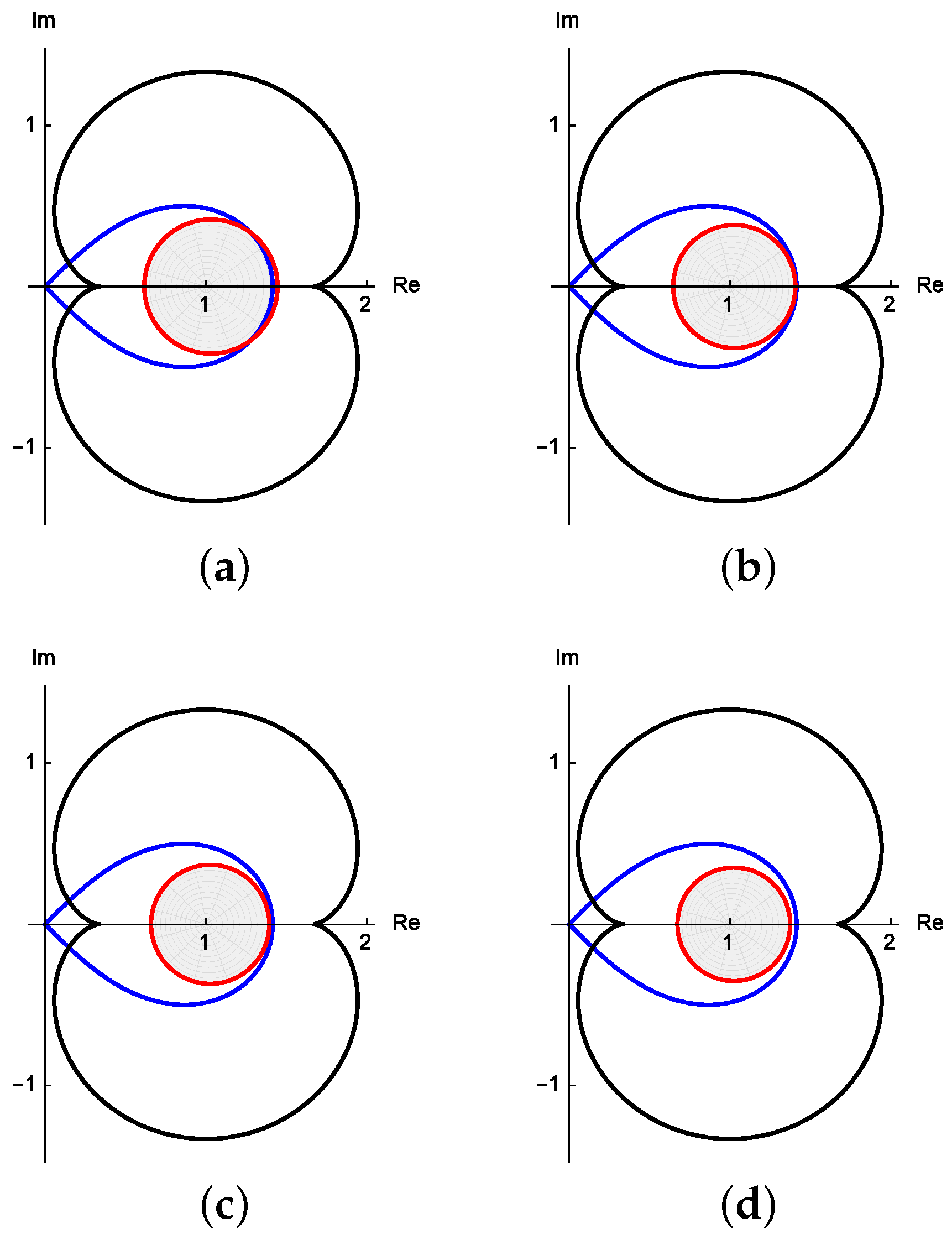
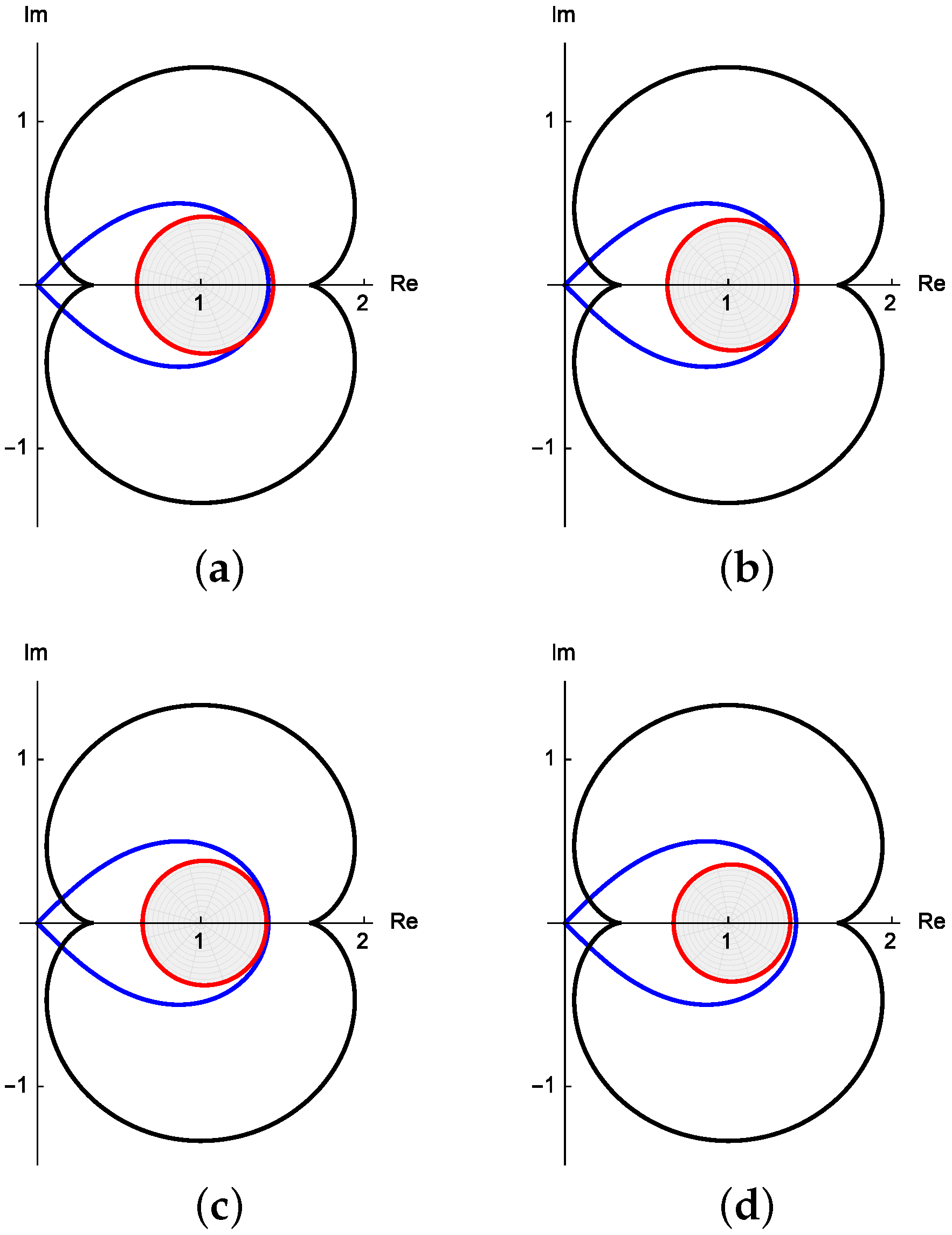
Case 1. For the first case, we consider β = 0.1 and κ = 0.55 , 0.59 , 0.61 , 0.65 . To determine κ 0 , we investigate the four images in Figure 2. It is evident from Figure 2a that the graph of F β ( D ) slightly extends beyond Φ L ( D ) Φ N ( D ) , while Figure 2d shows that F β ( D ) lies entirely within Φ L ( D ) Φ N ( D ) .
For κ = 0.59 , Figure 2b demonstrates that the image of F β = 0.1 ( D ) lies in close proximity to the boundary of Φ L ( D ) Φ N ( D ) , appearing nearly tangent to it. Likewise, Figure 2c shows that for κ = 0.61 , the image exhibits a comparable near-contact behavior with the same boundary configuration.
These graphical observations strongly suggest the existence of a critical parameter value κ 0 ( 0.59 , 0.61 ) for which the image of F β = 0.1 ( D ) attains extremal boundary contact with Φ L ( D ) Φ N ( D ) .
Case 2. This case has additional significance because if we fix β = 1 ,
F 2 1 1 β ; κ , 1 + 1 β ; z 4 = 4 ( κ 1 ) F 1 0 ( κ 1 , z 4 ) 1 z = 4 ( κ 1 ) U p 1 , b , 1 ( z ) 1 z .
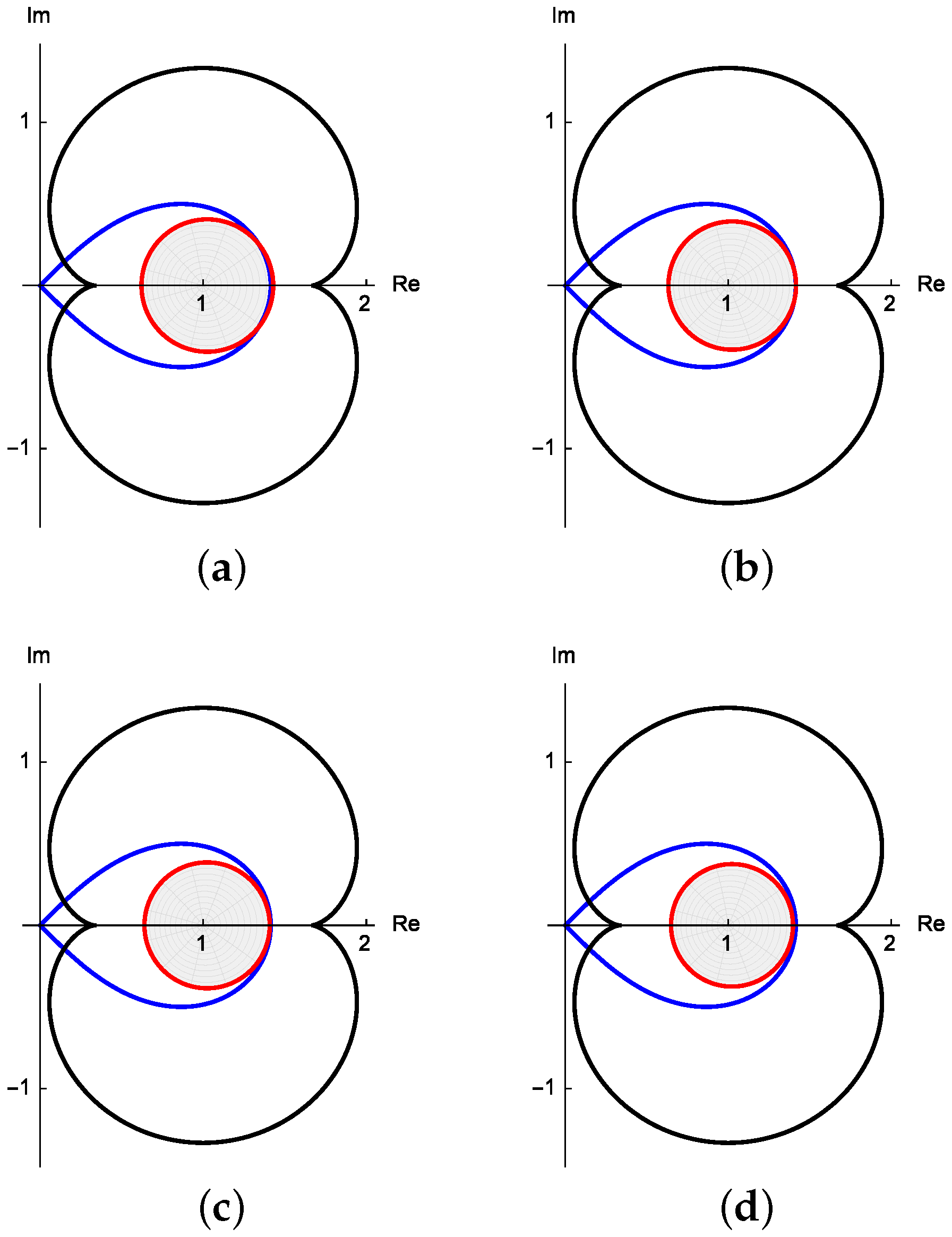
As indicated in Figure 3, for κ > κ 0 ( 0.32 , 0.326 ) ,
F β = 1 ( D ) Φ L ( D ) Φ N ( D ) .
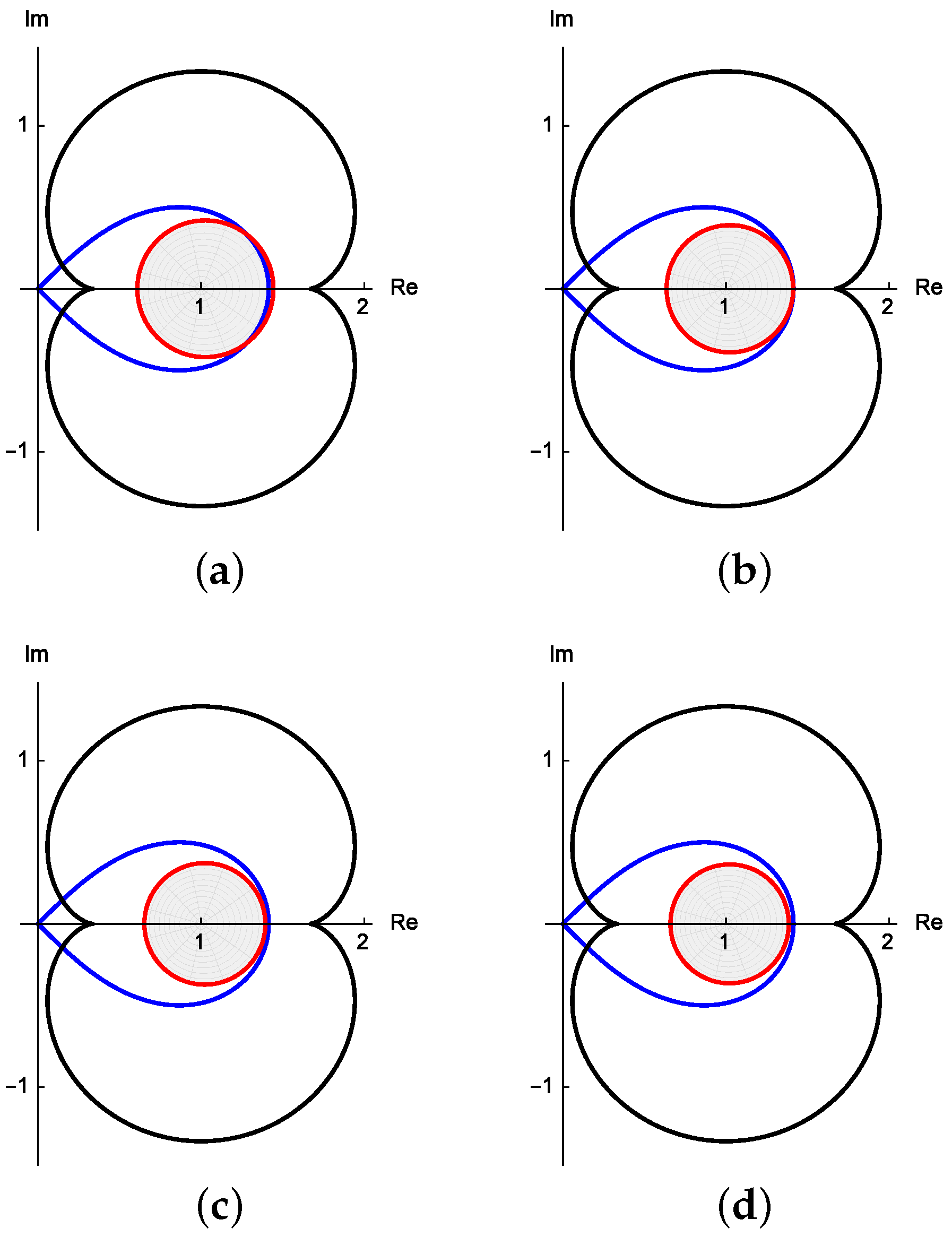
Case 3. In this case, by setting β = 2 , we find, as presented in Figure 4, that the approximate value for κ 0 is 0.215 . This means that for κ > κ 0 0.215 ,
F β = 2 ( D ) Φ L ( D ) Φ N ( D ) .
Case 4. The fourth case, as presented in Figure 5, shows that the approximate value of κ 0 is 0.11 .
Collecting the above cases, we have the following table (Table 1) of approximate values of κ 0 for each fixed β . The table clearly indicates that as β increases, the values of κ 0 decrease. These observations support the Open Problem 1. As mentioned earlier, the listed values of κ 0 are approximate and derived from the image of F ( D ) . These values have negligible errors, which do not affect the claim in Open Problem 1.
Figure 2. Graphs of F β ( D ) for fixed β = 0.1 and different values of κ . (a) κ = 0.55 . (b) κ = 0.59 . (c) κ = 0.61 . (d) κ = 0.65 .
Mathematics 14 00882 g002
Figure 3. Graphs of F β ( D ) for fixed β = 1 and different values of κ . (a) κ = 0.31 . (b) κ = 0.32 . (c) κ = 0.326 . (d) κ = 0.335 .
Mathematics 14 00882 g003
Figure 4. Graphs of F β ( D ) for fixed β = 2 and different values of κ . (a) κ = 0.20 . (b) κ = 0.215 . (c) κ = 0.225 . (d) κ = 0.23 .
Mathematics 14 00882 g004
Figure 5. Graphs of F β ( D ) for fixed β = 5 and different values of κ . (a) κ = 0.10 . (b) κ = 0.105 . (c) κ = 0.11 . (d) κ = 0.12 .
Mathematics 14 00882 g005

3.2. Examples Involving the Regular Coulomb Wave Function

The regular Coulomb wave function (RCWF), usually denoted by F L , η ( z ) , is defined on the entire complex plane and is analytic with respect to z, η , and L for all finite values in C (see [24,25,26,27]). It arises as a distinguished solution of the Coulomb differential equation
d 2 w d z 2 + 1 2 η z L ( L + 1 ) z 2 w = 0 ,
which is a second-order linear differential equation with regular singularities at z = 0 and z = . The parameter η C is called the Sommerfeld parameter, and it measures the strength of the Coulomb interaction (or Coulomb distortion) in the underlying physical model. The parameter L C represents the complex angular momentum (see [24,28]).
From the analytic viewpoint, the RCWF admits the following hypergeometric representation (see [24,25])
F L , η ( z ) : = z L + 1 e i z C L ( η ) F 1 1 ( L + 1 + i η , 2 L + 2 ; 2 i z ) = C L ( η ) n = 0 a L , n z n + L + 1 ,
with normalization
C L ( η ) = 2 L e π η 2 | Γ ( L + 1 + i η ) | Γ ( 2 L + 2 ) , a L , 0 = 1 , a L , 1 = η L + 1 , a L , n = 2 η a L , n 1 a L , n 2 n ( n + 2 L + 1 ) , n { 2 , 3 , } .
For our purposes, we consider the normalized form
f L , η ( z ) = C L 1 ( η ) z L 1 F L , η ( z ) = a L , 0 + a L , 1 z + a L , 2 z 2 + = 1 + η L + 1 z + .
Direct substitution into (28) shows that f L , η satisfies the transformed equation (see [25])
z 2 y ( z ) + 2 ( L + 1 ) z y ( z ) + ( z 2 2 η z ) y ( z ) = 0 .
Dividing throughout by z (for z 0 ) yields the equivalent form
z y ( z ) + 2 ( L + 1 ) y ( z ) + ( z 2 η ) y ( z ) = 0 .
Hence the differential Equation (32) belongs to the class F D E 4 with
a ( z ) = 2 ( L + 1 ) and b ( z ) = z 2 η .
The following result is obtained in ([29] Theorem 1):
Theorem 4. 
([15,29]). For η , L C , suppose that
Re ( 2 L + 1 ) > 8 | η | + 3.25 ,
then f L , η ( z ) 1 + z .
It is pointed out in [29] that for some fixed values of η , the lower bound of Re ( 2 L + 1 ) can be improved. Here, we establish this fact with specific values of η .
Corollary 2. 
For L C , the following assertions hold:
(i) 
f L , 1 2 ( z ) 1 + z   i f Re ( 2 L + 1 ) > 4.09808 .
(ii) 
f L , i 2 ( z ) 1 + z   i f Re ( 2 L + 1 ) > 7.25 .
(iii) 
f L , 1 ( z ) 1 + z   i f Re ( 2 L + 1 ) > 5.25 .
(iv) 
f L , i ( z ) 1 + z   i f Re ( 2 L + 1 ) > 11.25 .
Proof. 
Since the associated differential Equation (32) is a member of F D E 4 , Theorem 2 is applicable. In view of the hypotheses and the proof of Theorem 2, to arrive at the desired subordinations, it suffices to verify the condition H 5 , namely
Im ( z b ( z ) ) 2 3 8 + 1 2 Re ( a ( z ) 1 ) 3 8 + 1 2 Re ( a ( z ) 1 ) + 2 Re ( z b ( z ) ) < 0 , z D .
(i) First, consider the case when η = 1 / 2 . From (33), it follows that
z b ( z ) = z 2 z = ( x + i y ) 2 ( x + i y ) = x 2 y 2 x + i ( 2 x y y ) .
Thus,
Re ( z b ( z ) ) = x 2 y 2 x and Im ( z b ( z ) ) = 2 x y y .
For simplification, let
M 1 = 4 Re ( 2 L + 1 ) + 3 8 .
Then the left side of H 5 becomes
( Im ( z b ( z ) ) ) 2 3 8 + Re ( 2 L + 1 ) 2 + 2 Re ( z b ( z ) ) 3 8 + Re ( 2 L + 1 ) 2 = ( 2 x y y ) 2 M 1 M 1 + 2 ( x 2 y 2 x ) = ( ( 2 x 1 ) 2 + 2 M 1 ) y 2 M 1 M 1 + 2 ( x 2 x ) < ( ( 2 x 1 ) 2 + 2 M 1 ) ( 1 x 2 ) M 1 M 1 + 2 ( x 2 x ) = : G x ( M 1 ) ,
where we have used the constraint x 2 + y 2 < 1 and the bound y 2 1 x 2 to obtain an upper estimate independent of y. Rearranging G x ( M 1 ) , we have
G x ( M 1 ) = M 1 2 + ( 4 x 2 + 2 x + 2 ) M 1 ( 1 2 x ) 2 ( x 2 1 ) .
Differentiating G x with respect to M 1 gives
G x ( M 1 ) = 2 M 1 + ( 4 x 2 + 2 x + 2 )
Since the quadratic expression 4 x 2 + 2 x + 2 is concave, its maximum on the interval ( 1 , 1 ) occurs at the vertex x = b 2 a = 1 4 . Evaluating the quadratic at x = 1 4 gives
4 1 4 2 + 2 1 4 + 2 = 1 4 + 2 = 2.25 .
Thus for all x ( 1 , 1 ) ,
4 x 2 + 2 x + 2 2.25 ,
and consequently
G x ( M 1 ) = 2 M 1 + ( 4 x 2 + 2 x + 2 ) 2 M 1 + 2.25 .
Now, the RHS of the above inequality is < 0 whenever M 1 > 9 / 8 = 1.125 Therefore, for M 1 > 1.125 , the function G x ( M 1 ) is strictly decreasing with respect to M 1 . We now determine a threshold value of M 1 ensuring that
G x ( M 1 ) < 0 for all x ( 1 , 1 ) .
Since G x ( M 1 ) is decreasing in M 1 for M 1 > 1.125 , it suffices to determine the smallest value M 1 such that
max x ( 1 , 1 ) G x ( M 1 ) = 0 .
A numerical maximization of G x ( M 1 ) with respect to x shows that the critical value is M 1 2.42404 , at which the maximum is attained near x 0.0669875 and
max x ( 1 , 1 ) G x ( 2.42404 ) = 5.17539 × 10 6 < 0 .
It follows that
G x ( M 1 ) < 0 for all x ( 1 , 1 )
whenever M 1 > 2.42404 .
Since G x ( M 1 ) is an upper bound for the left-hand side of H 5 , it follows that the admissibility condition H 5 is satisfied for all z D whenever M 1 > 2.42404 . Since M 1 = 4 Re ( 2 L + 1 ) + 3 8 , the inequality M 1 > 2.42404 is equivalent to Re ( 2 L + 1 ) > 4.09808 . Consequently, by Theorem 2, we conclude that f L , 1 ( z ) 1 + z whenever Re ( 2 L + 1 ) > 4.09808 .
(ii) Next, consider the case when η = i / 2 . From (33), it follows that
z b ( z ) = z 2 i z = ( x + i y ) 2 i ( x + i y ) = x 2 y 2 + y + i ( 2 x y x ) .
Thus, Re ( z b ( z ) ) = x 2 y 2 + y and Im ( z b ( z ) ) = 2 x y x . Setting M 2 = 4 Re ( 2 L + 1 ) + 3 8 , we have
( Im ( z b ( z ) ) ) 2 3 8 + Re ( 2 L + 1 ) 2 + 2 Re ( z b ( z ) ) 3 8 + Re ( 2 L + 1 ) 2 = ( 2 x y x ) 2 M 2 M 2 + 2 ( x 2 y 2 + y ) = ( 2 y 1 ) 2 2 M 2 x 2 + 2 M 2 ( y 2 y ) M 2 2 < ( 2 y 1 ) 2 2 M 2 ( 1 y 2 ) + 2 M 2 ( y 2 y ) M 2 2 = M 2 2 + ( 4 y 2 2 y 2 ) M 2 + ( 2 y 1 ) 2 ( 1 y 2 ) = : G y ( M 2 ) .
Differentiating G y with respect to M 2 we have
G y ( M 2 ) = 2 M 2 + ( 4 y 2 2 y 2 )
Since 4 y 2 2 y 2 is a quadratic in y opening upward, its maximum on any closed interval occurs at one of the endpoints. For the open interval ( 1 , 1 ) , we examine the limits as y approaches the following endpoints:
lim y 1 + f ( y ) = 4 and lim y 1 f ( y ) = 0 .
Hence the supremum of f ( y ) on ( 1 , 1 ) is 4, though this value is not attained inside the open interval. Therefore,
4 y 2 2 y 2 < 4 for all y ( 1 , 1 ) ,
and consequently
G y ( M 2 ) 2 M 2 + 4 .
For M 2 > 2 , we have G y ( M 2 ) < 0 for every y ( 1 , 1 ) and hence G y is strictly decreasing in M 2 .
We now find the threshold value M 2 such that G y ( M 2 ) < 0 for all y. Since G y is a quadratic polynomial in M 2 with negative leading coefficient, it is positive between its two roots and negative outside the roots. Therefore, in order to ensure that
G y ( M 2 ) < 0 for all y ,
we need M 2 to be larger than the larger root for all y. Upon applying the quadratic formula, we have
M 2 = ( 2 y 2 y 1 ) ± ( 2 y 2 y 1 ) 2 + ( 2 y 1 ) 2 ( 1 y 2 ) .
The larger root is
M + ( y ) = ( 2 y 2 y 1 ) + ( 2 y 2 y 1 ) 2 + ( 2 y 1 ) 2 ( 1 y 2 ) = 2 y 2 y 1 + 2 ( 1 y ) .
It is easy to verify that M + ( y ) is strictly decreasing on ( 1 , 1 ) and the supremum is 4. However, this value is not attained within the interval, since it is approached only in the limiting case as y 1 + .
Because G y ( M 2 ) is strictly decreasing for M 2 > 2 , we have G y ( M 2 ) < 0 for all y precisely when M 2 exceeds the supremum of M + ( y ) , that is, when M 2 > 4 . Therefore,
G y ( M 2 ) < 0 for all y ( 1 , 1 ) whenever M 2 > 4 .
Recalling that M 2 = 4 Re ( 2 L + 1 ) + 3 8 , the condition M 2 > 4 is equivalent to Re ( 2 L + 1 ) > 7.25 . This verifies the required inequality and hence establishes condition H 5 for Re ( 2 L + 1 ) > 7.25 .
(iii) Now consider the case when η = 1 . From (33), it follows that
z b ( z ) = z 2 2 z = ( x + i y ) 2 2 ( x + i y ) = x 2 y 2 2 x + i ( 2 x y 2 y ) .
Thus,
Re ( z b ( z ) ) = x 2 y 2 2 x , Im ( z b ( z ) ) = 2 x y 2 y .
Let
M 3 = 4 Re ( 2 L + 1 ) + 3 8 .
Then the left-hand side of H 5 becomes
( Im ( z b ( z ) ) ) 2 3 8 + Re ( 2 L + 1 ) 2 + 2 Re ( z b ( z ) ) 3 8 + Re ( 2 L + 1 ) 2 = ( 2 x y 2 y ) 2 M 3 M 3 + 2 ( x 2 y 2 2 x ) = 4 ( x 1 ) 2 + 2 M 3 y 2 2 M 3 x 2 + 4 M 3 x M 3 2 < 4 ( x 1 ) 2 + 2 M 3 ( 1 x 2 ) 2 M 3 x 2 + 4 M 3 x M 3 2 = : G x ( M 3 ) .
Rearranging G x ( M 3 ) gives
G x ( M 3 ) = M 3 2 + ( 4 x 2 + 4 x + 2 ) M 3 4 ( x 1 ) 2 ( x 2 1 ) .
Differentiating with respect to M 3 and using the supremum of the quadratic in x ( 1 , 1 ) , we have
G x ( M 3 ) = 2 M 3 + ( 4 x 2 + 4 x + 2 ) 2 M 3 + 3 .
Therefore, for M 3 > 3 / 2 = 1.5 , the function G x ( M 3 ) is strictly decreasing with respect to M 3 .
We now determine a threshold value M 3 such that G x ( M 3 ) < 0 for all x ( 1 , 1 ) . As in part (1), it suffices to find the smallest value M 3 satisfying
max x ( 1 , 1 ) G x ( M 3 ) = 0 .
A numerical maximization with respect to x yields M 3 3.0 . Hence
G x ( M 3 ) < 0 for all x ( 1 , 1 ) whenever M 3 > 3 .
Since G x ( M 3 ) is an upper bound for the left-hand side of H 5 , the condition H 5 is satisfied for all z D whenever M 3 > 3 . Since M 3 = 4 Re ( 2 L + 1 ) + 3 8 , the inequality M 3 > 3 is equivalent to
Re ( 2 L + 1 ) > 21 4 = 5.25 .
Consequently, by Theorem 2, we conclude that f L , 1 ( z ) 1 + z whenever
Re ( 2 L + 1 ) > 5.25 .
(iv) Finally, we consider the case when η = i . From (33), it follows that
z b ( z ) = z 2 2 i z = ( x + i y ) 2 2 i ( x + i y ) = x 2 y 2 + 2 y + i ( 2 x y 2 x ) .
Thus, Re ( z b ( z ) ) = x 2 y 2 + 2 y and Im ( z b ( z ) ) = 2 x y 2 x . Setting
M 4 = 4 Re ( 2 L + 1 ) + 3 8 ,
we obtain
( Im ( z b ( z ) ) ) 2 3 8 + Re ( 2 L + 1 ) 2 + 2 Re ( z b ( z ) ) 3 8 + Re ( 2 L + 1 ) 2 = ( 2 x y 2 x ) 2 M 4 M 4 + 2 ( x 2 y 2 + 2 y ) = 4 ( y 1 ) 2 2 M 4 x 2 + 2 M 4 ( y 2 2 y ) M 4 2 < 4 ( y 1 ) 2 2 M 4 ( 1 y 2 ) + 2 M 4 ( y 2 2 y ) M 4 2 = M 4 2 + ( 4 y 2 4 y 2 ) M 4 + 4 ( y 1 ) 2 ( 1 y 2 ) = : G y ( M 4 ) .
Differentiating G y with respect to M 4 gives
G y ( M 4 ) = 2 M 4 + ( 4 y 2 4 y 2 ) .
The quadratic 4 y 2 4 y 2 opens upward and attains its supremum on the open interval ( 1 , 1 ) at y 1 + . Therefore
4 y 2 4 y 2 < 4 ( 1 ) 2 4 ( 1 ) 2 = 6 .
Thus for all y ( 1 , 1 ) , 4 y 2 4 y 2 < 6 , and hence
G y ( M 4 ) 2 M 4 + 6 .
Clearly, for M 4 > 3 , G y ( M 4 ) < 0 , and so G y is strictly decreasing in M 4 .
Since G y is a quadratic polynomial in M 4 with negative leading coefficient, it is positive between its two roots and negative outside them. Therefore, to ensure
G y ( M 4 ) < 0 for all y ,
we must choose M 4 larger than the larger root given by
M + ( y ) = 2 y 2 2 y 1 + ( 2 y 2 2 y 1 ) 2 + 4 ( y 1 ) 2 ( 1 y 2 ) = 2 y 2 2 y 1 + 5 4 y .
A direct evaluation shows that the function M + ( y ) is strictly decreasing on ( 1 , 1 ) and sup y ( 1 , 1 ) M + ( y ) = 6 . Therefore
G y ( M 4 ) < 0 for all y ( 1 , 1 ) whenever M 4 > 6 .
Recalling that M 4 = 4 Re ( 2 L + 1 ) + 3 8 , the condition M 4 > 6 is equivalent to
Re ( 2 L + 1 ) > 11.25 .
This verifies condition H 5 in the case η = i . □
Remark 3. 
For η = 1 2 and η = 1 , Theorem 4 yields the condition Re ( 2 L + 1 ) > 7.25 and Re ( 2 L + 1 ) > 11.25 , respectively, whereas Corollary 2 provides substantially improved bounds in these cases.
Although the final admissible range obtained for η = i 2 and η = i coincides with the classical estimate, the analytical technique employed here to derive these bounds is new and differs significantly from earlier approaches.
It would be natural to extend Corollary 2 to general η C . However, the algebraic complexity increases considerably in the complex setting, and a complete treatment remains an open problem for future investigation.

3.3. Example Involving Associated Laguerre Polynomial

The generalized [24] or associated Laguerre polynomial (ALP), denoted by L n α ( z ) , is the solution of the differential equation
z y ( z ) + ( α + 1 z ) y ( z ) + n y ( z ) = 0 , α R ,
and is represented by the series
L n α ( z ) = i = 0 n ( 1 ) i n + α n i z i i ! = ( 1 + α ) n n ! F 1 1 ( n ; 1 + α ; z ) ,
where F 1 1 is the confluent hypergeometric function, and ( a ) n is the Pochhammer symbol defined as
( a ) 0 = 1 , ( a ) n = a ( a + 1 ) ( a + n 1 ) , n N .
The following normalized form is considered in [30] as
L α , n ( z ) = n ! ( 1 + α ) n L n α ( z ) , z D ,
which satisfies the normalization condition L α , n ( 0 ) = 1 and is a solution of the differential equation
z 2 y ( z ) + ( α + 1 z ) z y ( z ) + n z y ( z ) = 0 .
Again, the equation belongs to the class F D E 4 with a ( z ) = α + 1 z and b ( z ) = n .
It is proved in [30] that
Theorem 5. 
For Re ( α ) > 4 n + 0.25 , L α , n ( z ) 1 + z .
In the next result, we improve Theorem 5.
Corollary 3. 
For Re ( α ) > 4 n 1.75 , L α , n ( z ) 1 + z .
Proof. 
We have Re ( z b ( z ) ) = n x and Im ( z b ( z ) ) = n y . Let M 2 = 3 + 4 Re ( α ) 8 . Under the hypothesis Re ( α ) > 4 n 1.75 , we have M 2 > 4 n 1 2 . Thus,
( Im ( z b ( z ) ) ) 2 3 8 + Re ( a ( z ) 1 ) 2 + 2 Re ( z b ( z ) ) 3 8 + Re ( a ( z ) 1 ) 2 = n 2 y 2 3 8 + Re ( α z ) 2 + 2 n x 3 8 + Re ( α z ) 2 = n 2 y 2 3 8 + Re ( α ) 2 x 2 + 2 n x 3 8 + Re ( α ) 2 x 2 < n 2 ( 1 x 2 ) M 2 x 2 + 2 n x M 2 x 2 = δ 1 ( x + 1 ) 2 δ 2 ( x + 1 ) δ 3 < 0 ,
because for n 1 and M 2 > 4 n 1 2 ,
δ 1 = n 2 n + 1 4 > 0 , δ 2 = ( 2 n 1 ) M 2 2 n 2 + 2 n 1 2 > 1 2 ( 2 n 1 ) ( 4 n 1 ) 2 n 2 + 2 n 1 2 = 2 n 2 n > 0 , δ 3 = M 2 2 ( 2 n 1 ) M 2 n + 1 4 > 0 .
To show δ 3 > 0 , first observe that δ 3 is an increasing function of M 2 when M 2 > 2 n 1 2 . Now, when M 2 = 4 n 1 2 > 2 n 1 2 , we have
δ 3 = 1 4 ( 4 n 1 ) 2 1 2 ( 4 n 1 ) ( 2 n 1 ) n + 1 4 = 0 .
Thus, δ 3 > 0 for M 2 > 4 n 1 2 . Hence, the conclusion follows. □
Remark 4. 
Clearly, Corollary 3 is an improvement of Theorem 5.

4. Conclusions

In this work, we have explored the properties of various special functions, including the regular Coulomb wave function (RCWF) and the associated Laguerre polynomial (ALP), and their relationships with differential equations and subordination theory. Through detailed analysis and rigorous proofs, we have established improved bounds and conditions under which these functions satisfy specific subordination properties. These results extend existing theoretical frameworks and open avenues for future research.

Author Contributions

Conceptualization, S.R.M. and L.A.W.; Formal analysis, S.R.M. and L.A.W.; Funding acquisition, S.R.M.; Methodology, S.R.M. and L.A.W.; Writing—original draft, S.R.M.; Writing—review and editing, S.R.M. and L.A.W. All authors have read and agreed to the published version of the manuscript.

Funding

This work was supported by the Deanship of Scientific Research, Vice Presidency for Graduate Studies and Scientific Research, King Faisal University, Saudi Arabia [Grant No. KFU261098].

Data Availability Statement

No new data were created or analyzed in this study. Data sharing is not applicable to this article.

Conflicts of Interest

The authors declare no conflicts of interest.

References

  1. Duren, P.L. Univalent Functions; Grundlehren der Mathematischen Wissenschaften [Fundamental Principles of Mathematical Sciences]; Springer: New York, NY, USA, 1983; Volume 259, pp. xiv+382. [Google Scholar]
  2. Pommerenke, C. Univalent Functions; Vandenhoeck & Ruprecht: Göttingen, Germany, 1975. [Google Scholar]
  3. Thomas, D.K.; Tuneski, N.; Vasudevarao, A. Univalent Functions: A Primer; De Gruyter: Berlin, Germany, 2018. [Google Scholar]
  4. Sokół, J.; Stankiewicz, J. Radius of convexity of some subclasses of strongly starlike functions. Zesz. Nauk. Politech. Rzesz. Mat. 1996, 19, 101–105. [Google Scholar]
  5. Sokol, J.; Thomas, D.K. Further results on a class of starlike functions related to the Bernoulli lemniscate. Houston J. Math 2018, 44, 83–95. [Google Scholar]
  6. Kumar, S.S.; Kumar, V.; Ravichandran, V.; Cho, N.E. Sufficient conditions for starlike functions associated with the lemniscate of Bernoulli. J. Inequalities Appl. 2013, 2013, 176. [Google Scholar] [CrossRef]
  7. Cang, Y.L.; Liu, J.L. Radius of convexity for certain analytic functions associated with the lemniscate of Bernoulli. Expo. Math. 2015, 33, 387–391. [Google Scholar] [CrossRef]
  8. Ali, R.M.; Cho, N.; Ravichandran, V.; Kumar, S.S. Differential Subordination for Functions Associated with the Lemniscate of Bernoulli. Taiwan. J. Math. 2012, 16, 1017–1026. [Google Scholar] [CrossRef]
  9. Swaminathan, A.; Wani, L.A. Sufficiency for nephroid starlikeness using hypergeometric functions. Math. Methods Appl. Sci. 2022, 45, 5388–5401. [Google Scholar] [CrossRef]
  10. Ullah, W.; Fayyaz, R.; Breaz, D.; Cotîrlă, L.I. On Certain Analytic Functions Associated with Nephroid Function. Axioms 2025, 14, 136. [Google Scholar] [CrossRef]
  11. Miller, S.S.; Mocanu, P.T. Differential subordinations and inequalities in the complex plane. J. Differ. Equ. 1987, 67, 199–211. [Google Scholar] [CrossRef]
  12. Miller, S.S.; Mocanu, P.T. Differential Subordinations. In Monographs and Textbooks in Pure and Applied Mathematics; Theory and Applications; Marcel Dekker, Inc.: New York, NY, USA, 2000; Volume 225, pp. xii+459. [Google Scholar]
  13. Madaan, V.; Kumar, A.; Ravichandran, V. Starlikeness associated with lemniscate of Bernoulli. Filomat 2019, 33, 1937–1955. [Google Scholar] [CrossRef]
  14. Naz, A.; Nagpal, S.; Ravichandran, V. Exponential starlikeness and convexity of confluent hypergeometric, Lommel, and Struve functions. Mediterr. J. Math. 2020, 17, 204. [Google Scholar] [CrossRef]
  15. Alzahrani, R.; Mondal, S.R. Geometric Nature of Special Functions on Domain Enclosed by Nephroid and Leminscate Curve. Symmetry 2023, 16, 19. [Google Scholar] [CrossRef]
  16. Erdelyi, A. Higher Transcendental Functions; McGraw-Hill: New York, NY, USA, 1953. [Google Scholar]
  17. Madaan, V.; Kumar, A.; Ravichandran, V. Lemniscate convexity of generalized Bessel functions. Studia Sci. Math. Hungar. 2019, 56, 404–419. [Google Scholar] [CrossRef]
  18. Naz, A.; Nagpal, S.; Ravichandran, V. Geometric Properties of Generalized Bessel Function Associated with the Exponential Function. Math. Slovaca 2023, 73, 1459–1478. [Google Scholar] [CrossRef]
  19. Baricz, A. Generalized Bessel Functions of the First Kind; Lecture Notes in Mathematics; Springer: Berlin/Heidelberg, Germany, 2010; Volume 1994, pp. xiv+206. [Google Scholar] [CrossRef]
  20. Baricz, A.; Ponnusamy, S. Starlikeness and convexity of generalized Bessel functions. Integral Transform. Spec. Funct. 2010, 21, 641–653. [Google Scholar] [CrossRef]
  21. Baricz, A.; Szász, R. The radius of convexity of normalized Bessel functions of the first kind. Anal. Appl. 2014, 12, 485–509. [Google Scholar] [CrossRef]
  22. Baricz, A. Geometric properties of generalized Bessel functions. Publ. Math. Debrecen 2008, 73, 155–178. [Google Scholar] [CrossRef]
  23. Baricz, A. Geometric properties of generalized Bessel functions of complex order. Mathematica 2006, 48, 13–18. [Google Scholar]
  24. Abramowitz, M.; Stegun, I.A. Handbook of Mathematical Functions with Formulas, Graphs, and Mathematical Tables; Dover Publications: New York, NY, USA, 1965. [Google Scholar]
  25. Olver, F.W.J.; Lozier, D.W.; Boisvert, R.F.; Clark, C.W. (Eds.) NIST Handbook of Mathematical Functions; Cambridge University Press: Cambridge, UK, 2010. [Google Scholar] [CrossRef]
  26. Aktaş, İ. Lemniscate and Exponential Starlikeness of Regular Coulomb Wave Functions. Stud. Sci. Math. Hung. 2020, 57, 372–384. [Google Scholar] [CrossRef]
  27. Noreen, S.; Raza, M.; Deniz, E.; Malik, S.N. On the Janowski Starlikeness of the Coulomb Wave Functions. J. Funct. Spaces 2022, 2022, 4085296. [Google Scholar] [CrossRef]
  28. Gaspard, D. Connection formulas between Coulomb wave functions. J. Math. Phys. 2018, 59, 112104. [Google Scholar] [CrossRef]
  29. Mondal, S.R. Subordination Involving Regular Coulomb Wave Functions. Symmetry 2022, 14, 1007. [Google Scholar] [CrossRef]
  30. Mondal, S.R. Mapping Properties of Associate Laguerre Polynomials in Leminiscate, Exponential and Nephroid Domain. Symmetry 2022, 14, 2303. [Google Scholar] [CrossRef]
Figure 1. Images of the domains Φ L ( D ) and Φ N ( D ) . (a) Image of Φ L ( D ) . (b) Image of Φ N ( D ) .
Mathematics 14 00882 g001
Table 1. Approximate values of κ 0 for various values of β .
β 0.1125
Approximate values of κ 0 0.590.3250.2150.11
Disclaimer/Publisher’s Note: The statements, opinions and data contained in all publications are solely those of the individual author(s) and contributor(s) and not of MDPI and/or the editor(s). MDPI and/or the editor(s) disclaim responsibility for any injury to people or property resulting from any ideas, methods, instructions or products referred to in the content.