Article

An Adaptive Damped Double-Inertial Parallel Algorithm for Common Fixed-Point Problems with Applications to Image Restoration


1
Department of Mathematics and Statistics, Faculty of Science and Technology, Chiang Mai Rajabhat University, Chiang Mai 50300, Thailand
2
Department of Mathematics, Faculty of Science, Chiang Mai University, Chiang Mai 50200, Thailand
*
Author to whom correspondence should be addressed.
Mathematics 2026, 14(5), 880; https://doi.org/10.3390/math14050880
Submission received: 15 January 2026 / Revised: 24 February 2026 / Accepted: 25 February 2026 / Published: 5 March 2026
(This article belongs to the Section C1: Difference and Differential Equations)

Abstract

Inertial methods are widely used to accelerate the convergence of iterative algorithms for solving fixed-point problems. However, standard inertial terms often introduce undesirable oscillations, particularly in high-dimensional settings. In this paper, we propose a novel parallel double inertial algorithm with adaptive damping control (D-DIMPMHA) for finding a common fixed point of a finite family of nonexpansive mappings in real Hilbert spaces. By integrating a double inertial step with a self-adaptive damping parameter, the proposed method effectively balances momentum and stability, thereby mitigating numerical oscillations without requiring vanishing inertial conditions. We establish the weak convergence theorem of the generated sequence under suitable control conditions. Furthermore, the practical efficiency of the algorithm is demonstrated through numerical experiments on large-scale convex feasibility problems and image restoration problems. Comparative results indicate that the proposed algorithm achieves superior convergence speed and higher restoration quality compared to existing single inertial methods and FISTA.

1. Introduction

The Common Fixed-Point Problem (CFPP) is a powerful model as it unifies numerous other problems, such as Convex Feasibility Problems (CFP) [1,2], variational inequalities, and convex minimization problems (e.g., LASSO), which can be reformulated as finding a common fixed point of their respective operators [3,4]. The common fixed-point problem (CFPP) is expressed as follows:
Find x * H such that x * = T i x * , i = 1 , 2 , N
where H is a real Hilbert space, and  T i : H H is a mapping for all i = 1 , 2 , N . The set of common fixed point sets is denoted by i = 1 N F ( T i ) , where F ( T i ) is the fixed point set of T i .
Several iterative methods have been proposed to approximate common fixed points of families of nonexpansive mappings. For instance, Das and Debata [5] extended the Mann and Ishikawa iteration processes to find a common fixed point of two commuting mappings. Later, Shimizu and Takahashi [6] proved strong convergence theorems for finding a common fixed point of a family of nonexpansive mappings using a Halpern-type iteration. Other major families of algorithms include hybrid projection methods, such as the well-known CQ algorithm by Nakajo and Takahashi [7], which were introduced to guarantee strong convergence. The CQ algorithm is given as follows:
x 0 = x C , y n i = ( 1 α n i ) x n + α n i T i x n , y ¯ n = arg max { y n i x n : i = 1 , 2 , , N } , C n = { z C y ¯ n z x n z } , Q n = { z C x n z , x 0 x n 0 } , x n + 1 = P C n Q n ( x 0 ) , n 1
where 0 < α n i < a for some a [ 0 , 1 ) . Nakajo and Takahashi proved the strong convergence of the sequence generated by their method. Recently, parallel and hybrid techniques have been further developed to handle more complex constraints and improve efficiency in large-scale settings [8,9,10].
While classical algorithms are guaranteed to converge, a primary drawback is their often slow rate of convergence. This practical limitation has motivated significant research into acceleration techniques. One of the most influential involves the incorporation of an inertial step, pioneered by Polyak [11]. This step calculates an intermediate variable y n by leveraging information from the previous iterates, x n 1 and x n , as follows:
y n = x n + θ n ( x n x n 1 )
where θ n 0 is the inertial parameter. This principle has been effectively integrated into algorithms such as FISTA [3] and various Inertial KM variants [12] to improve convergence rates. In recent years, this technique has been extensively studied and refined by many authors to address various optimization and fixed-point problems (see, e.g., [13,14,15,16,17]).
However, the inclusion of inertial terms introduces a delicate trade-off between speed and stability. While strict vanishing conditions are not always required for weak convergence, using a large inertial parameter without adequate control can lead to undesirable numerical oscillations. These oscillations can hinder practical efficiency, causing the algorithm to exhibit slow convergence tails. Consequently, many existing approaches either limit the inertial parameter to small values or enforce vanishing conditions to preserve stability, thereby restricting the potential acceleration effect, especially in large-scale problems. To mitigate these issues without relying on vanishing parameters, recent studies have explored adaptive step-size strategies [18], viscosity approximations [19], and applications in data classification and deep learning [20,21,22].
This paper proposes the Damped Double Inertial Modified Parallel Monotone Hybrid Algorithm (D-DIMPMHA) to address these challenges. The proposed method introduces a double inertial mechanism, controlled by adaptive damping coefficients that are iteratively adjusted to effectively balance momentum and stability. The concept of double inertial steps has also attracted attention for its potential to accelerate convergence further, as seen in [23]. This mechanism mitigates oscillations, allowing larger inertial steps without the need for a vanishing parameter. Additionally, D-DIMPMHA employs a maximal displacement strategy, which significantly reduces the computational burden per iteration compared to classical parallel KM approaches. We demonstrate the efficacy of the proposed scheme by establishing weak convergence theorems for the sequences in real Hilbert spaces. The numerical performance is validated on two important classes of problems: convex feasibility problems arising from systems of convex constraints, and image restoration problems, a field where inertial methods have shown significant promise [24]. Experimental results confirm that D-DIMPMHA achieves superior CPU time efficiency and faster convergence compared to existing inertial methods.
This paper is arranged as follows: Section 2 reviews some preliminary definitions and properties for use in the sequel. Section 3 presents the Damped Double-Inertial Modified Parallel Monotone Hybrid Algorithm and the corresponding convergence result. Section 4 discusses the performance of the proposed algorithm on a convex feasibility problem and image restoration problem in comparison with several existing algorithms through numerical experiments. Finally, Section 5 presents some conclusions and concluding remarks.

2. Preliminaries

In this section, we present some fundamental definitions and lemmas used in the subsequent sections. Let H be a real Hilbert space endowed with inner product · , · , and its corresponding norm · . For a sequence { x k } in H, we denote the strong convergence and the weak convergence of a sequence { x k } to a point p * H by x k p * and x k p * , respectively.
Definition 1. 
A mapping T : H H is said to be
(i) 
nonexpansive if T x T y x y , x , y H ;
(ii) 
quasi-nonexpansive if F ( T ) and T x y x y , x H and y F ( T ) ;
(iii) 
firmly nonexpansive if T x T y 2 T x T y , x y , x , y H .
Remark 1. 
From Definition 1, we have the following:
1. 
Every firmly nonexpansive mapping is nonexpansive, i.e., (iii) ⇒ (i).
2. 
If F ( T ) , then every nonexpansive mapping is quasi-nonexpansive, i.e., (i) ⇒ (ii). However, the converse is not true in general.
3. 
The metric projection P C onto a nonempty closed convex subset C of H is a firmly nonexpansive mapping.
Definition 2. 
Let T : C C be a mapping. The mapping T I is said to be demiclosed at zero if for any sequence { x k } in C if x k u and T x k x k 0 , then x F ( T ) .
Lemma 1 
([25]). Let H be a real Hilbert space, and T : H H be a nonexpansive mapping. If  { x n } is a sequence in H such that x n x and x n T x n 0 , then x = T x .
Definition 3. 
Let f : R n R be a smooth convex function and let g : R n R be a proper, lower semi-continuous, convex function. Following Moreau [26], define, for  λ > 0 , the proximity operator with respect to λ and g by
prox λ g ( x ) = argmin y H g ( y ) + 1 2 λ y x 2 ,
see [27]. Define the Forward–Backward operator T as T : = prox λ g ( I λ f ) with λ > 0 . If  λ ( 0 , 2 / L ) , where L is a Lipschitz constant of f , then T is nonexpansive.
Lemma 2 
([28]). Suppose that { a n } and { b n } be sequences of nonnegative real numbers such that a n + 1 a n + b n , for all n 1 . If   n = 1 b n < . Then lim n a n exists.
Lemma 3 
([29]). The following holds for all u , w H and any λ [ 0 , 1 ] :
1. 
λ u + ( 1 λ ) w 2 = λ u 2 + ( 1 λ ) w 2 λ ( 1 λ ) u w 2 ;
2. 
u ± w 2 = u 2 ± 2 u , w + w 2 ;
3. 
u + w 2 u 2 + 2 w , u + w .
Lemma 4 
([28]). Let { a n } , { b n } and { δ n } be sequences of nonnegative numbers such that
a n + 1 ( 1 + δ n ) a n + b n , n N .
If n = 1 δ n < and n = 1 b n < , then lim n a n exists.
Lemma 5 
(Opial  [30]). Let { x k } be a sequence in H such that there exists a nonempty set Ω H satisfying:
(i) 
For every p Ω ,   lim k x k p exists;
(ii) 
ω w ( x k ) Ω .
Then, { x k } converges weakly to a point in Ω .

3. Main Results

In this section, we propose a new parallel algorithm for finding common fixed points of nonexpansive mappings. We introduce a double inertial step combined with adaptive damping to improve convergence speed and ensure stability.
We first present a two-step inertial alternating projection algorithm (Algorithm 1) by assuming the following:
  • T i : H H is a nonexpansive mapping,    for all i = 1 , 2 , N .
  • Ω : = i = 1 N F ( T i ) .
Let { α n i } ( 0 , 1 ) and { μ n } , { ρ n } , { τ n } ( 0 , ) .
Algorithm 1 Damped Double-Inertial Modified Parallel Monotone Hybrid Algorithm (D-DIMPMHA)
1:
Initialize: Take x 0 , x 1 H . Set y ¯ 0 = x 0 and y ¯ 1 = x 1 . Select sequences { α n i } [ 0 , 1 ] and damping sequence { η n } > 0 .
2:
for  n = 2 , 3 ,  do
3:
    Set intermediate points:
y n i = ( 1 α n i ) x n + α n i T i x n , i = 1 , 2 , , N
4:
    Select maximal displacement:
y ¯ n = arg max { y n i x n : i = 1 , 2 , , N }
5:
    Compute inertial coefficients:
θ n = min μ n , τ n y ¯ n y ¯ n 1 y ¯ n y ¯ n 1 , μ n otherwise ,
δ n = max ρ n , τ n y ¯ n 1 y ¯ n 2 y ¯ n 1 y ¯ n 2 , ρ n otherwise .
6:
    Compute damped coefficients:
η n = min { | θ n | , | δ n | }
7:
    Compute damped double inertial step:
x n + 1 = y ¯ n + ( θ n η n ) ( y ¯ n y ¯ n 1 ) + ( δ n η n ) ( y ¯ n 1 y ¯ n 2 )
8:
end for
Remark 2. 
To improve the performance of finding common fixed points, we design Algorithm 1 with four key features:
  • Parallel Structure ( y n i ): Computing all mappings one by one is slow when N is large. Our algorithm computes all y n i at the same time (parallel). This saves a lot of computation time per iteration.
  • Maximal Displacement ( y ¯ n ): We choose the point that moves the farthest from x n (the largest y n i x n ). This helps the algorithm converge on the solution faster than simply averaging all points.
  • Double Inertial Steps ( θ n , δ n ): Standard methods use only one previous point ( x n 1 ) to speed up. We use two previous points ( x n 1 and x n 2 ) to gain more acceleration (momentum).
  • Adaptive Damping ( η n ): Using a large inertial step can cause the sequence to oscillate. We introduce a damping term η n that acts as an automatic brake. It reduces the step size when momentum is too strong, ensuring the algorithm remains stable without complex conditions.
We make the following assumptions about the control sequences in Algorithm 1:
(C1)
n = 1 τ n <
(C2)
0 < a 1 i α n i a 2 i < 1    for some constants a 1 i , a 2 i R .
The following lemmas establish key estimates needed for the proof of Theorem 1.
Lemma 6. 
Let { x n } be a sequence generated by Algorithm 1. Then, for any p Ω , we have
(i) 
x n + 1 p x n p + 2 τ n ,
(ii) 
lim n x n p exists.
Proof. 
Let p Ω and let { x n } be a sequence in H generated by Algorithm 1. For  i = 1 , 2 , , N , we obtain
y n i p = ( 1 α n i ) x n + α n i T i x n p ( 1 α n i ) x n p + α n i T i x n p ( 1 α n i ) x n p + α n i x n p = x n p
This implies that
y ¯ n p x n p .
Based on the selection of θ n and δ n , we get
θ n y n y n 1 τ n and | δ n | y n 1 y n 2 τ n .
Combining inequalities (1) and (3), we derive
x n + 1 p y n ¯ p + ( θ n η n ) y n ¯ y ¯ n 1 + | δ n η n | y ¯ n 1 y ¯ n 2 y n ¯ p + θ n y n ¯ y ¯ n 1 + | δ n | y ¯ n 1 y ¯ n 2 x n p + 2 τ n .
Therefore, by Lemma 4, it follows that lim n x n p exists.    □
Lemma 7. 
Let { x n } be a sequence generated by Algorithm 1. Then,
lim n T i x n x n = 0 f o r i = 1 , 2 , , N .
Proof. 
For any i { 1 , 2 , , N } , by the definition of y n i and Lemma 3, we obtain
y n i p 2 = ( 1 α n i ) ( x n p ) + α n i ( T i x n p ) 2 = ( 1 α n i ) x n p 2 + α n i T i x n p 2 α n i ( 1 α n i ) T i x n x n 2 x n p 2 α n i ( 1 α n i ) T i x n x n 2 .
By the definition of y ¯ n , there exists an index k n { 1 , 2 , , N } such that y ¯ n = y n k n and y ¯ n x n = max i y n i x n . Applying (5) with i = k n , we have
α n k n ( 1 α n k n ) T k n x n x n 2 x n p 2 y ¯ n p 2 .
By Lemma 6, we know that lim n x n p = d exists. Using the inequality (2) and similar arguments as in Lemma 6, we have
lim sup n y ¯ n p d .
Using the lower bound derived from the triangle inequality on x n + 1 :
x n + 1 p y ¯ n p + 2 τ n ,
taking lim inf yields d lim inf n y ¯ n p . Thus, lim n y ¯ n p = d . From (6) and condition (C2), taking the limit as n , we obtain
lim n T k n x n x n = 0 .
Consequently,
y ¯ n x n = α n k n T k n x n x n 0 .
Since y ¯ n x n = max i y n i x n , it follows that for all i = 1 , 2 , , N ,
y n i x n 0 .
Finally, since y n i x n = α n i T i x n x n and α n i a 1 i > 0 , we conclude that
lim n T i x n x n = 0 , i = 1 , 2 , , N .
   □
Next, we prove the weak convergence theorem of the sequence generated by Algorithm 1.
Theorem 1. 
Let { x n } be a sequence generated by Algorithm 1 and Ω . Then, the sequence { x n } converges weakly to an element p Ω ,
Proof. 
Let p Ω . By Lemma 6, we obtain lim n x n p exists. From Lemma 7, we obtain, for  i = 1 , 2 , , N , lim n T i x n x n = 0 . Since I T i is demiclosed at 0, we obtain ω w ( x n ) Ω : = i = 1 N F ( T i ) . By Lemma 5, we can conclude that { x n } converges weakly to a point in Ω : = i = 1 N F ( T i ) .    □
We now present Algorithm 2, which is a modification of Algorithm 1 by
T i : = prox c i g ( I c i h )
This modification enables us to address both convex minimizations, and we establish the weak convergence of the generated sequence to a minimizer of g + h .
Algorithm 2 Damped Double-Inertial Modified Parallel Proximal-Gradient Hybrid Algorithm (D-DIMPPGHA)
1:
Initialize: Take x 0 , x 1 H , select sequences { α n i } [ 0 , 1 ] , damping sequence { η n } > 0 , tolerance ε > 0 , and max iterations N max .
2:
for  n = 2 , 3 , , N max  do
3:
    Set intermediate points:
y n i = ( 1 α n i ) x n + α n i prox c n i h x n c n i f ( x n ) , i = 1 , 2 , , N
4:
    Select maximal displacement:
y ¯ n = arg max { y n i x n : i = 1 , 2 , , N }
5:
    Compute inertial coefficients:
θ n = min μ n , τ n y ¯ n y ¯ n 1 y ¯ n y ¯ n 1 , μ n otherwise ,
δ n = max ρ n , τ n y ¯ n 1 y ¯ n 2 y ¯ n 1 y ¯ n 2 , ρ n otherwise .
6:
    Compute damped coefficients:
η n = min { θ n , δ n }
7:
    Compute damped double inertial step:
x n + 1 = y ¯ n + ( θ n η n ) ( y ¯ n y ¯ n 1 ) + ( δ n η n ) ( y ¯ n 1 y ¯ n 2 )
8:
    if  x n + 1 x n < ε  then
9:
        Stop and Return  x n + 1
10:
    end if
11:
end for
Theorem 2. 
Let { x n } be a sequence generated by Algorithm 2 (D-DIMPPGHA) where { τ n } , { μ n } , { r n } , { α n } , and { β n } are the same as in Theorem 1. Then, { x n } converges weakly to a point in T .
Proof. 
Since each T i is a nonexpansive operator. For all i = 1 , 2 , , N , the fixed points of T i = prox c i g ( I c i h ) coincide exactly with the minimizers of h + g . Therefore, we have:
Ω : = i = 1 N F ( T i ) = Argmin ( h + g ) .
Theorem 1 then guarantees that the sequence { x n } generated by Algorithm 2 converges to a point in i = 1 N F ( T ) = Argmin ( h + g ) . Therefore, { x n } converges to a point in T . □

4. Numerical Experiments

In this section, we evaluate the performance of our proposed algorithm (D-DIMPMHA) through numerical experiments. All programs were implemented in Python 3.12.8 using the Spyder IDE 5.5.1 and executed on a MacBook Pro equipped with an Apple M1 chip and 16 GB of RAM.

4.1. Application to Convex Feasibility Problems

In this section, we test the performance of our proposed algorithm (D-DIMPMHA) on a convex feasibility problem (CFP) in a finite-dimensional Hilbert space. The goal is to find a common point x * in the intersection of N closed convex sets C i , i.e.,
Find x * F = i = 1 N C i .
We set our operators T i = P C i , the projection operator onto C i . It is well known that P C i is a firmly nonexpansive mapping and its fixed point set is Fix ( P C i ) = C i . Thus, the common fixed-point problem for { T i } i = 1 N is equivalent to the CFP.
In 2017, D. V. Thong and D. V. Hieu [12] proposed the Krasnosel’skii–Mann method with inertial terms for solving common fixed-point problems as follows: we set A : = 0 , then compute,
y n = x n + θ ( x n x n 1 ) x n + 1 = ( 1 α n ) y n + α n i = 1 N w i P C i ( y n )
where α n ( 0 , 1 ) (as P C i are firmly nonexpansive) and w i > 0 with i = 1 N w i = 1 and θ is a constant inertial parameter.
For our test problem, we construct the sets C i in R d as half-spaces:
C i = { x R d a i , x b i } ,
where a i R d and b i R . The projection onto C i has a closed-form solution [31] given by
P C i ( y ) = y max ( 0 , a i , y b i ) a i 2 a i .
To ensure the existence of a known ground truth x * , we first define x * = 1 R d (the vector of all ones). We then generate each a i by sampling from a standard normal distribution, a i N ( 0 , I d ) . Finally, we set b i = a i , x * , which guarantees that x * F .
In this experiment, we set the dimensions as d = 200 and the number of sets as N = 5000 . All algorithms are initialized from the same starting point x 0 , randomly generated from N ( 0 , I d ) , and we set x 1 = x 0 for inertial methods.
The parameters for each algorithm in this experiment are detailed in Table 1. The settings for the competitor methods were chosen based on standard configurations and common values from the literature, while the parameters for our proposed algorithm (D-DIMPMHA) were selected to ensure stable and efficient convergence.
The detailed parameter settings for all algorithms in this experiment are listed in Table 1. For the competitor method, the algorithm defined by (7), the parameters were chosen based on standard configurations found in the literature. In contrast, the parameters for our proposed method (D-DIMPMHA) were selected based on two primary criteria to ensure both theoretical consistency and practical efficiency. First, the control sequences were chosen to strictly satisfy the convergence conditions (C1)–(C2) derived in our theoretical analysis. For instance, the choice of τ n = 1000 / n 2 ensures that n = 1 τ n < , which is essential for the boundedness of the iterative sequence, while the damping sequence ρ n = 1 / ( n + 1 ) satisfies the required decaying condition for stability. Second, the specific constant values, such as α n = 0.99 , μ = 0.9 , and the scaling factor 1000, were determined through preliminary numerical experiments to provide an optimal balance between convergence speed and numerical stability.
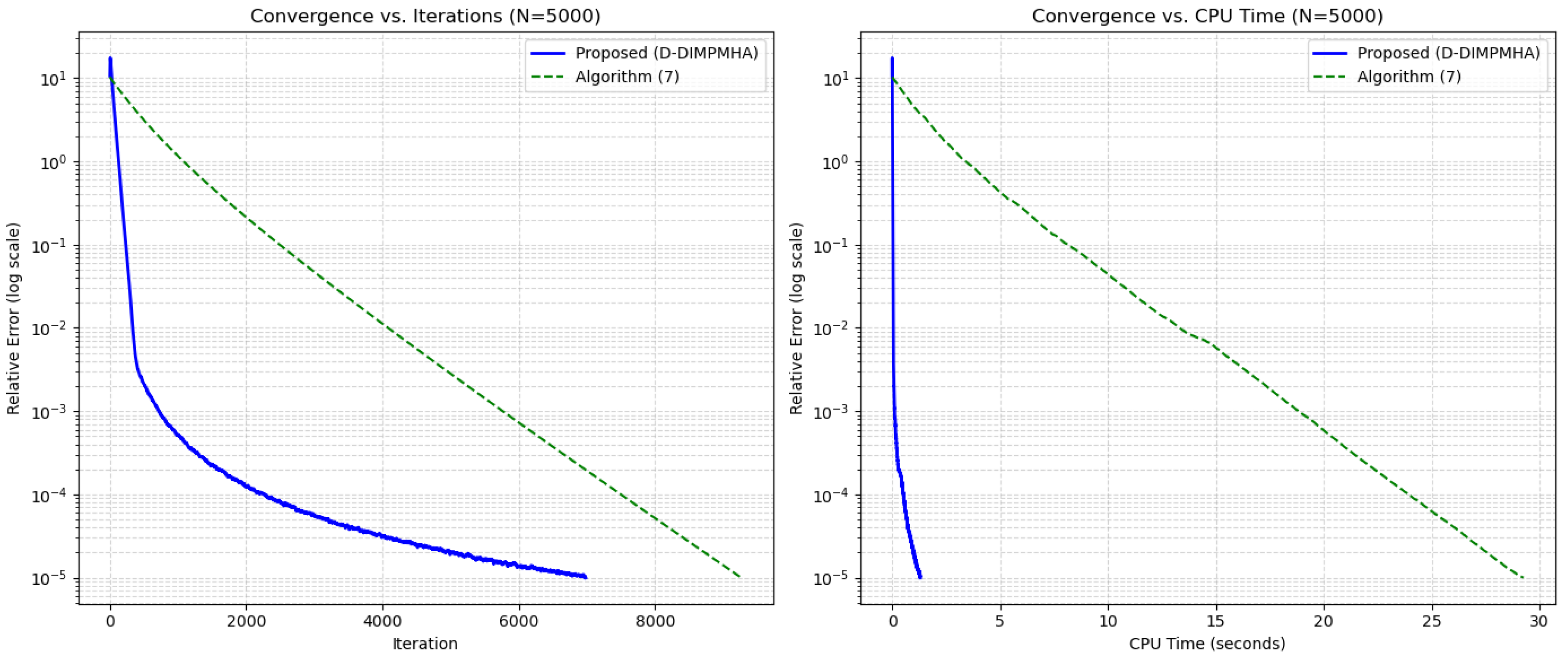
All algorithms are terminated when the relative error to the solution, x n x * x * , falls below the tolerance ε = 10 5 , or when the maximum number of iterations N max = 10 , 000 is reached. We plot the relative error against the number of iterations and the CPU time (in seconds).
Figure 1 illustrates the convergence performance for the large-scale CFP experiment. The results clearly demonstrate the superiority of the proposed method.
In terms of iterations (left plot), the proposed D-DIMPMHA (blue line) exhibits a sharp initial descent, reducing the relative error by several orders of magnitude within the first few hundred iterations. In contrast, Algorithm (7) (green dashed line) shows a slower, linear convergence rate on the logarithmic scale.
The computational advantage of the proposed method is most evident in the CPU time comparison (right plot). As shown in the experimental logs, the proposed D-DIMPMHA achieves the target tolerance in approximately 2.20 s, whereas Algorithm (7) requires 35.29 s to reach a comparable error level. This corresponds to a reduction in computational time of approximately 94%. The results confirm that for large-scale problems, the proposed D-DIMPMHA provides a much more efficient solution than the standard inertial parallel method (Algorithm (7)), both in terms of iteration count and computational time.

4.2. Application to Image Deconvolution

In this section, we examine the computational performance of the proposed D-DIMPPGHA by applying it to the image restoration problem, specifically deblurring. The degradation process is typically modeled as a linear inverse problem:
a = A y + v ,
where y R n × 1 denotes the original signal (clean image); a R m × 1 represents the observed (blurred and noisy) image; A R m × n is the blurring operator; and v signifies additive noise. To reconstruct the original image from the corrupted observation, we employ the LASSO (Least Absolute Shrinkage and Selection Operator) framework, which seeks to solve the following convex minimization problem:
min y 1 2 A y a 2 2 + λ y 1 ,
where the first term represents the data fidelity, the second term induces sparsity, and λ > 0 serves as the regularization parameter. This problem falls under the general composite optimization model min y { h ( y ) + g ( y ) } , where h ( y ) = 1 2 A y a 2 2 is a smooth convex function with a Lipschitz continuous gradient h = A T ( A y a ) , and g ( y ) = λ y 1 is a continuous, non-smooth convex function.
To validate the efficiency of our proposed method, we compare the D-DIMPPGHA against several well-established iterative algorithms used for solving (9):
  • FBS: The classical Forward–Backward Splitting algorithm [4].
  • IFBS: The Inertial Forward–Backward Splitting proposed by Moudafi and Oliny [30], incorporating a heavy-ball type momentum.
  • FISTA: The Fast Iterative Shrinkage-Thresholding Algorithm by Beck and Teboulle [3], known for its optimal convergence rate O ( 1 / n 2 ) .
  • FBMWA: The Forward–Backward Modified W-Algorithm introduced by Hanjing and Suantai [32].
Experimental Configuration: The numerical experiments were implemented in Python and executed on a MacBook Pro equipped with an Apple M1 chip and 16 GB of RAM. We utilized two standard 256 × 256 grayscale test images: “Cameraman” and “Coffee.” The images were degraded using a Gaussian blur kernel of size 9 × 9 with a standard deviation σ = 4 .
The restoration quality is quantified using the Peak Signal-to-Noise Ratio (PSNR), calculated as
P S N R ( x n ) = 10 log 10 255 2 MSE ,
where MSE = 1 M x n x ¯ 2 2 denotes the Mean Squared Error between the reconstructed image x n and the ground truth x ¯ (M is the total number of pixels). A higher PSNR indicates superior restoration quality. Convergence is monitored via the relative error criterion: x n x n 1 2 / x n 1 2 tol .
The Lipschitz constant L was determined by the maximum eigenvalue of A T A . All algorithms were initialized with the blurred image a and run for a maximum of N = 1000 iterations.
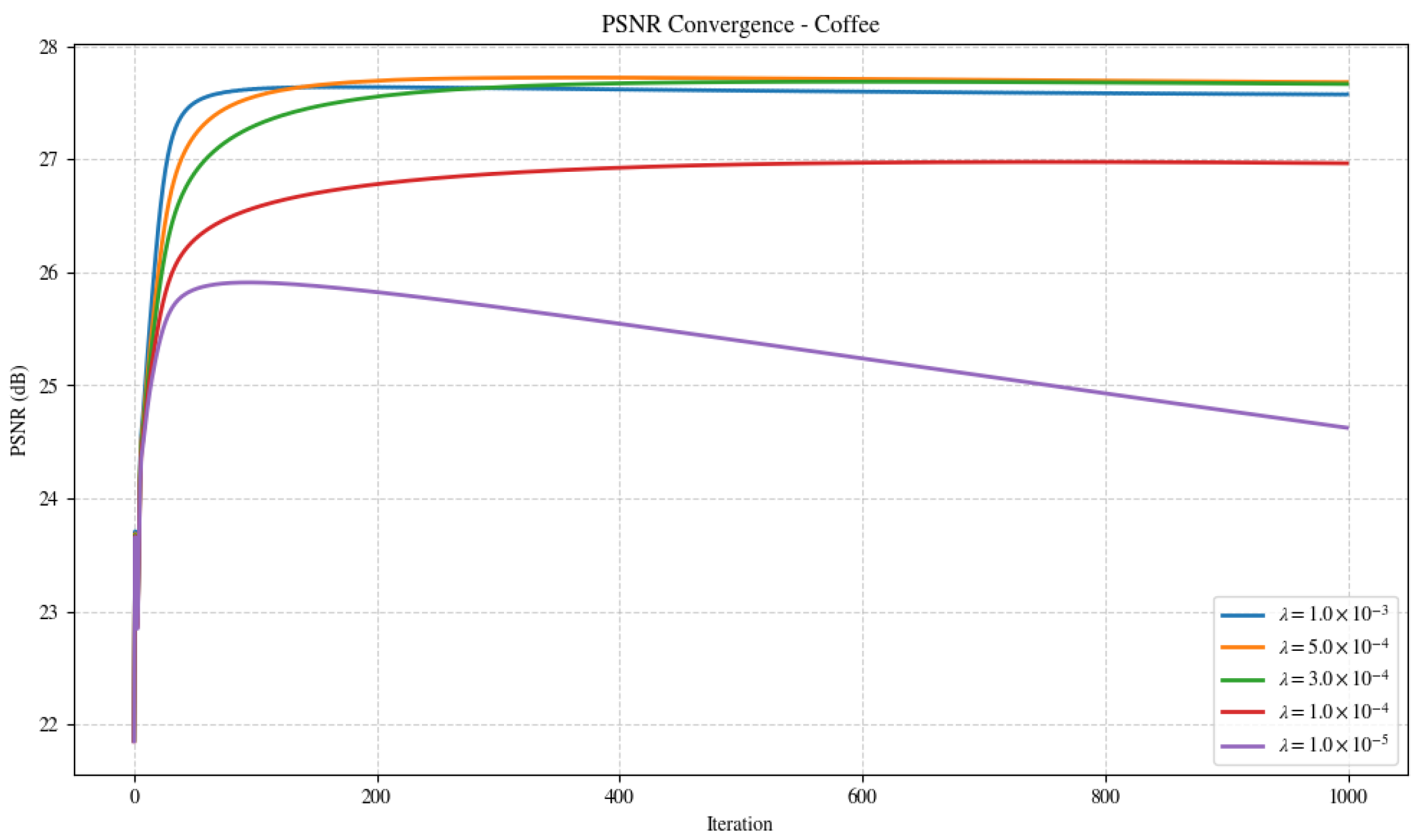
Sensitivity Analysis of Regularization Parameter ( λ ): The choice of λ significantly impacts the trade-off between noise suppression and detail preservation. To determine the optimal setting, we conducted a sensitivity analysis by varying λ across the set { 10 3 , 5 × 10 4 , , 10 6 } . As illustrated in Figure 2, the highest PSNR and most stable convergence were achieved at λ = 5 × 10 4 . Consequently, this value was fixed for all subsequent comparative experiments.
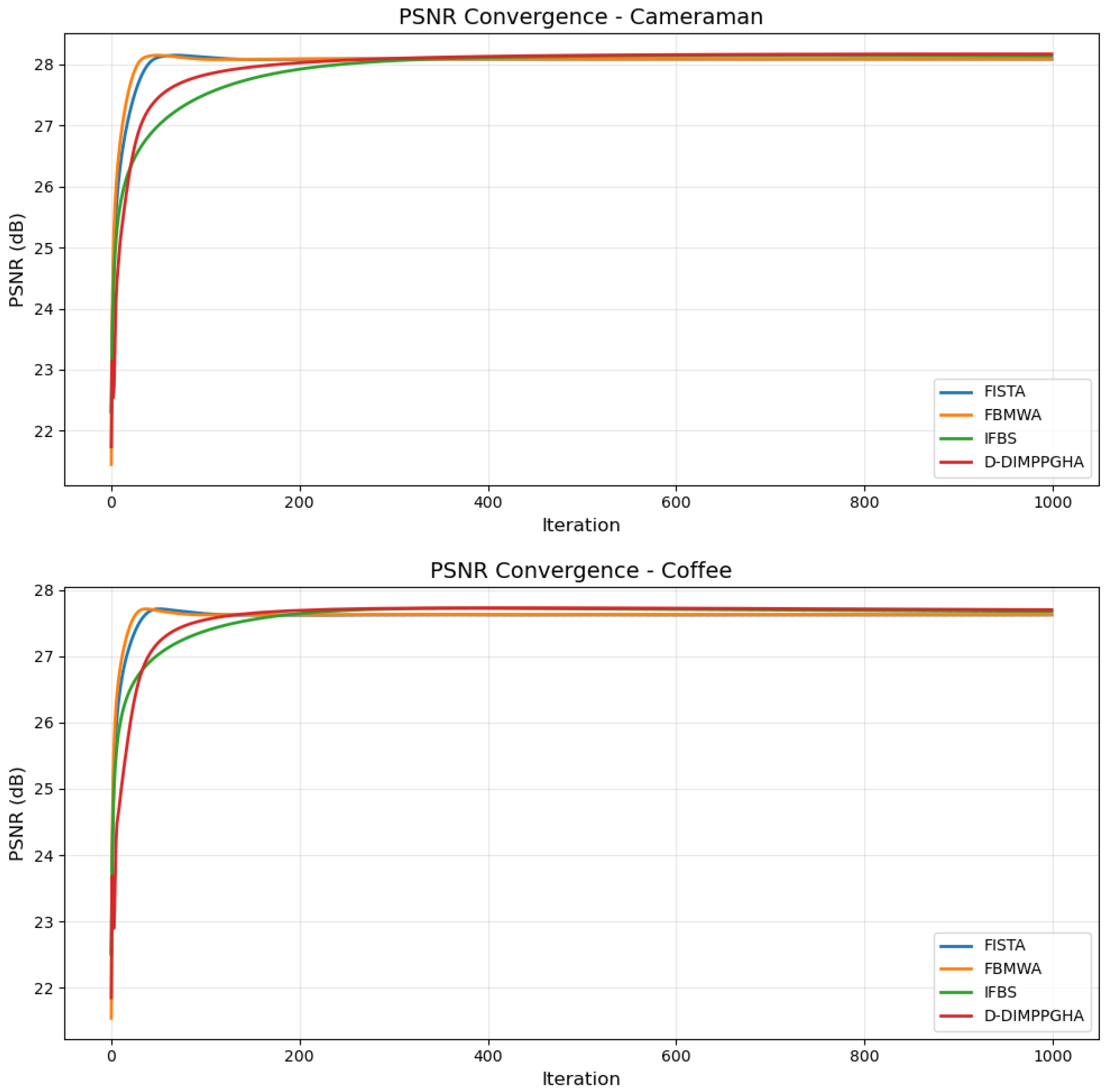
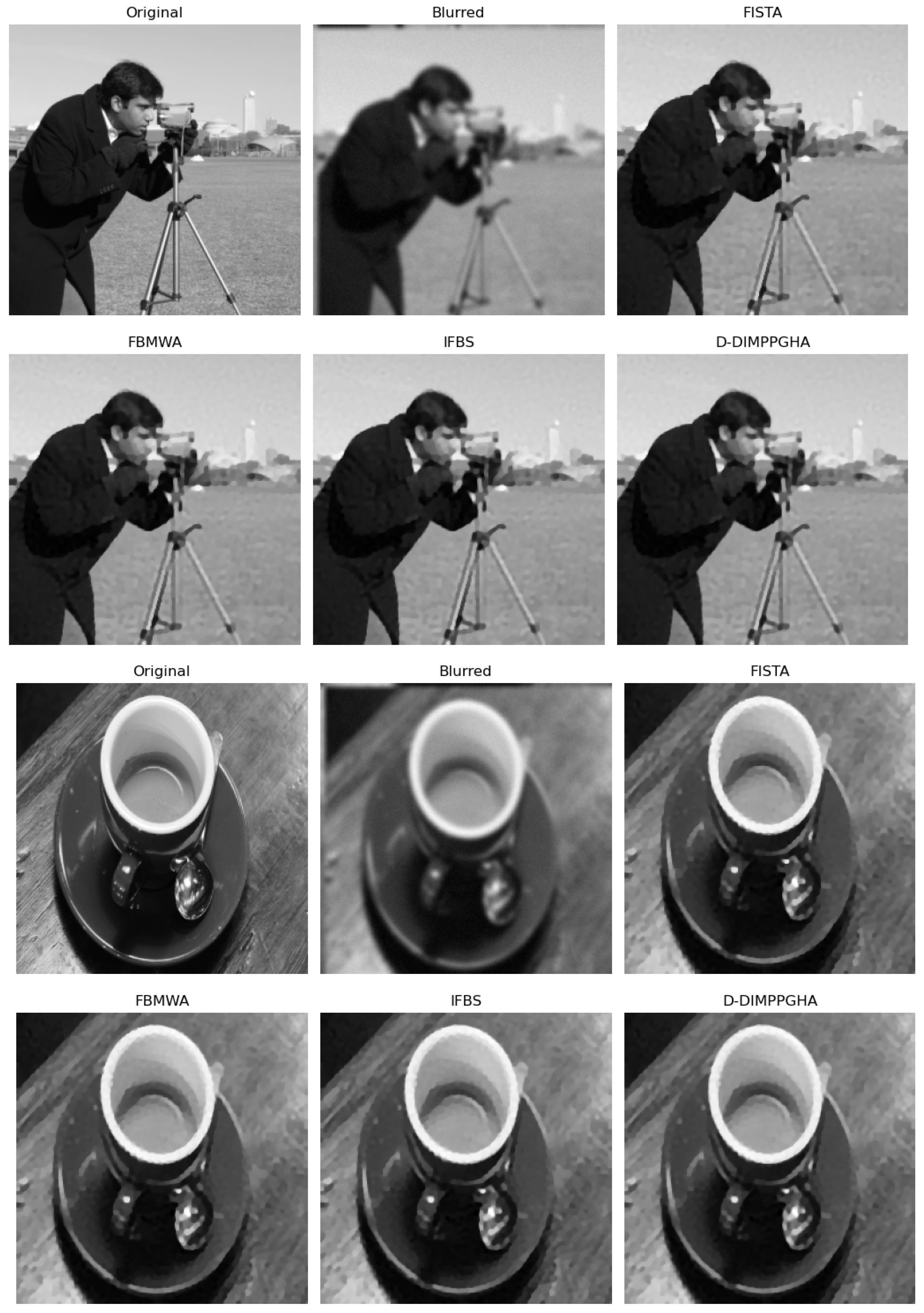
The specific parameter settings for all competing algorithms are detailed in Table 2. The numerical results at the 1000th iteration are summarized in Table 3, and visual comparisons of the restored images are presented in Figure 3 and Figure 4.

5. Conclusions

This paper introduces the Damped Double Inertial Modified Parallel Monotone Hybrid Algorithm (D-DIMPMHA) and its proximal-gradient variant to address the challenges of numerical instability and oscillation often encountered in standard inertial methods. The key innovation lies in the adaptive damping mechanism that dynamically adjusts the inertial coefficients based on iterative behavior, enabling the simultaneous achievement of acceleration and stability, a balance that has historically eluded classical fixed-parameter approaches. Furthermore, the incorporation of a maximal displacement strategy significantly reduces computational overhead per iteration. The theoretical analysis rigorously establishes the stability of the sequence and guarantees its weak convergence to a common fixed point in real Hilbert spaces. We demonstrate the versatility of the algorithm by successfully applying it to two important problem classes: convex feasibility problems arising from systems of constraints and image restoration problems formulated as composite optimization models. Numerical experiments confirm that the D-DIMPMHA achieves superior CPU efficiency and faster convergence than existing inertial methods.

Author Contributions

S.T. and J.T. contributed to the design of the algorithm and performed the numerical experiments. S.S. supervised the project and provided theoretical guidance. All authors have read and agreed to the published version of the manuscript.

Funding

This work was supported by Chiang Mai University and the Fundamental Fund 2026, Chiang Mai University, Chiang Mai, Thailand. Additionally, the first and the third authors were supported by Chiang Mai Rajabhat University.

Data Availability Statement

The original contributions presented in this study are included in the article. Further inquiries can be directed to the corresponding author.

Acknowledgments

The authors would like to thank the reviewers for their valuable suggestions and comments for improving the paper. The second author would like to thank Chiang Mai University for financial support. The first and the third authors would like to thank Chiang Mai Rajabhat University for financial support.

Conflicts of Interest

The authors declare no conflict of interest.

References

  1. Bregman, L.M. The relaxation method of finding the common point of convex sets and its application to the solution of problems in convex programming. USSR Comput. Math. Math. Phys. 1967, 7, 200–217. [Google Scholar] [CrossRef]
  2. Gubin, L.G.; Polyak, B.T.; Raik, E.V. The method of projections for finding the common point of convex sets. USSR Comput. Math. Math. Phys. 1967, 7, 1–24. [Google Scholar] [CrossRef]
  3. Beck, A.; Teboulle, M. A fast iterative shrinkage-thresholding algorithm for linear inverse problems. SIAM J. Imaging Sci. 2009, 2, 183–202. [Google Scholar] [CrossRef]
  4. Lions, P.L.; Mercier, B. Splitting algorithms for the sum of two nonlinear operators. SIAM J. Numer. Anal. 1979, 16, 964–979. [Google Scholar] [CrossRef]
  5. Das, G.; Debata, J.P. Fixed points of quasinonexpansive mappings. Indian J. Pure Appl. Math. 1975, 6, 1453–1458. [Google Scholar]
  6. Shimizu, T.; Takahashi, W. Strong convergence to common fixed points of families of nonexpansive mappings. J. Math. Anal. Appl. 1997, 211, 71–83. [Google Scholar] [CrossRef]
  7. Nakajo, K.; Takahashi, W. Strong convergence theorems for nonexpansive mappings and nonexpansive semigroups. J. Math. Anal. Appl. 2003, 279, 372–379. [Google Scholar] [CrossRef]
  8. Abass, H.A.; Adamu, A. A new parallel inertial splitting algorithm for inclusion and fixed-point problems in Banach spaces. Bangmod Int. J. Math. Comput. Sci. 2025, 11, 421–449. [Google Scholar] [CrossRef]
  9. Van Hieu, D. Parallel hybrid methods for generalized equilibrium problems and asymptotically strictly pseudocontractive mappings. J. Appl. Math. Comput. 2017, 53, 531–554. [Google Scholar] [CrossRef]
  10. Tan, B.; Xu, S.; Li, S. Strong convergence of inertial viscosity splitting algorithms for inclusion problems with applications. J. Nonlinear Convex Anal. 2023, 24, 345–366. [Google Scholar]
  11. Polyak, B.T. Some methods of speeding up the convergence of iteration methods. USSR Comput. Math. Math. Phys. 1964, 4, 1–17. [Google Scholar] [CrossRef]
  12. Thong, D.V.; Hieu, D.V. An inertial method for solving split common fixed-point problems. J. Fixed Point Theory Appl. 2017, 19, 3029–3051. [Google Scholar]
  13. Kesornprom, S.; Inkrong, P.; Paimsang, P.; Pholasa, N.; Cholamjiak, P. On solving split variational inclusion problems with multi-inertial extrapolation and applications. J. Math. Comput. Sci. 2026, 41, 347–364. [Google Scholar] [CrossRef]
  14. Jameel, F.; Al-Mazrooei, A.E.; Alshammari, F.S.; Malik, M. Parallel Inertial Algorithm for Common Variational Inclusion Problems in Hilbert Spaces. Mathematics 2023, 11, 281. [Google Scholar]
  15. Naravejsakul, K.; Sukson, P.; Waratamrongpatai, W.; Udomluck, P.; Khwanmuang, M.; Cholamjiak, W.; Yajai, W. A Double Inertial Mann-Type Method for Two Nonexpansive Mappings with Application to Urinary Tract Infection Diagnosis. Mathematics 2025, 13, 2352. [Google Scholar] [CrossRef]
  16. Srinew, P.; Kumam, P. A new inertial iterative scheme for solving the split common fixed-point problem with application to image restoration. J. Appl. Math. Comput. 2020, 63, 779–806. [Google Scholar]
  17. Tan, B.; Chen, J.W.; Li, S.; Ou, X.Q. Extragradient algorithms with double inertial for solving variational inequalities and applications to signal processing. Commun. Nonlinear Sci. Numer. Simul. 2026, 152, 109213. [Google Scholar]
  18. Gibali, A.; Thong, D.V. New adaptive step-size algorithms for solving split feasibility problems with applications to image restoration. Optimization 2024, 73, 855–878. [Google Scholar]
  19. Kumam, P.; Seangwattana, P. Accelerated viscosity approximation methods for fixed-point problems with applications to machine learning. Adv. Differ. Equ. 2025, 2025, 1–18. [Google Scholar]
  20. Cholamjiak, W.; Shehu, Y.; Yao, J.C. Prediction of breast cancer through fast optimization techniques applied to machine learning. Optimization 2025, 74, 3629–3657. [Google Scholar] [CrossRef]
  21. Janngam, K.; Suantai, S.; Wattanataweekul, R. A novel fixed-point based two-step inertial algorithm for convex minimization in deep learning data classification. AIMS Math. 2025, 10, 6209–6232. [Google Scholar] [CrossRef]
  22. Sae-jia, P.; Suantai, S. A new two-step inertial algorithm for solving convex bilevel optimization problems with application in data classification problems. AIMS Math. 2024, 9, 8476–8496. [Google Scholar] [CrossRef]
  23. Reich, S.; Thong, D.V. Double inertial methods for solving variational inequalities with application to signal recovery. J. Fixed Point Theory Appl. 2024, 26, 12. [Google Scholar]
  24. Bot, R.I.; Nguyen, D.K. Inertial proximal block coordinate method for regularized optimization with application to image deblurring. J. Glob. Optim. 2023, 85, 321–349. [Google Scholar]
  25. Browder, F.E. Fixed point theorems for noncompact mappings in Hilbert spaces. Proc. Nat. Acad. Sci. USA 1965, 53, 1272–1276. [Google Scholar] [CrossRef] [PubMed]
  26. Moreau, J.J. Fonctions convexes duales et points proximaux dans un espace hilbertien. C. R. Acad. Sci. Paris 1962, 255, 2897–2899. [Google Scholar]
  27. Combettes, P.L.; Wajs, V.R. Signal recovery by proximal Forward-Backward splitting. Multiscale Model. Simul. 2005, 4, 1168–1200. [Google Scholar] [CrossRef]
  28. Tan, K.K.; Xu, H.K. Approximating fixed points of nonexpansive mappings by the Ishikawa iteration process. J. Math. Anal. Appl. 1993, 178, 301–308. [Google Scholar] [CrossRef]
  29. Takahashi, W. Introduction to Nonlinear and Convex Analysis; Yokohama Publishers: Yokohama, Japan, 2009. [Google Scholar]
  30. Moudafi, A.; Oliny, M. Convergence of a splitting inertial proximal method for monotone operators. J. Comput. Appl. Math. 2003, 155, 447–454. [Google Scholar] [CrossRef]
  31. Bauschke, H.H.; Combettes, P.L. Correction to: Convex analysis and monotone operator theory in Hilbert spaces. In Convex Analysis and Monotone Operator Theory in Hilbert Spaces; Springer: Berlin/Heidelberg, Germany, 2020; pp. C1–C4. [Google Scholar]
  32. Hanjing, A.; Suantai, S. A fast image restoration algorithm based on a fixed point and optimization method. Mathematics 2020, 8, 378. [Google Scholar] [CrossRef]
Figure 1. Convergence behavior for the large-scale CFP experiment ( N = 5000 ). The proposed D-DIMPMHA (blue, solid) demonstrates significantly faster convergence compared to Algorithm (7) (green, dashed). The proposed method reaches the error tolerance rapidly, highlighting the computational efficiency of the most violated constraint selection strategy combined with double inertial steps.
Mathematics 14 00880 g001
Figure 2. Sensitivity analysis of the regularization parameter λ for the Coffee image. The peak performance is observed at λ = 5 × 10 4 .
Mathematics 14 00880 g002
Figure 3. Convergence behavior: PSNR vs. iterations for Cameraman and Coffee.
Mathematics 14 00880 g003
Figure 4. Visual comparison of deblurring results for Cameraman (top) and Coffee (bottom).
Mathematics 14 00880 g004
Table 1. The setting of parameters for the comparison experiment ( N = 5000 ).
ParametersProposed (D-DIMPMHA)Algorithm (7)
α n 0.99 0.99
μ 0.9 -
ρ n 1 n + 1 -
θ n - 1 ( n + 3 ) 2
τ n 1000 n 2 -
r 10 6 -
w i - 1 N
Table 2. Algorithm parameters and control settings.
AlgorithmParameters
IFBS c n = 1 L , θ n = min 1 n 2 x n x n 1 , if x n x n 1 , 0 , otherwise .
FISTA t 1 = 1 , t n + 1 = 1 + 1 + 4 t n 2 2 , θ n = t n 1 t n + 1
FBMWA α n = β n = γ n = 0.5 , c n = n n + 1 , c = 1 / L ,
t 1 = 1 , t n + 1 = 1 + 1 + 4 t n 2 2 , θ n = t n 1 t n + 1 , if 1 n N , 1 2 n , otherwise .
D-DIMPPGHA α n 1 = 0.2 , α n 2 = 0.4 , α n 3 = 0.6 , c n = 1 / L ,
μ n = 1 0.01 n + 1 , τ n = 2 14 n 2 , ρ n = 1 5 n + 1
Table 3. Comparison of image restoration performance (PSNR and CPU Time) at 1000 iterations.
CameramanCoffee
AlgorithmPSNR (dB)Time (s)PSNR (dB)Time (s)
IFBS28.13634.400427.67454.1905
FISTA28.08674.104027.62094.0200
FBMWA28.086913.005727.625312.5399
D-DIMPPGHA28.16936.856927.69757.8785
Disclaimer/Publisher’s Note: The statements, opinions and data contained in all publications are solely those of the individual author(s) and contributor(s) and not of MDPI and/or the editor(s). MDPI and/or the editor(s) disclaim responsibility for any injury to people or property resulting from any ideas, methods, instructions or products referred to in the content.