Parameter Optimization of ADRC for Rolling-Mill Hydraulic Screw-Down Synchronization Based on a WMA–PSO Hybrid Algorithm



Abstract
1. Introduction
- A novel adaptive hybrid optimization algorithm, named WMA-PSO, is proposed by integrating the Whale Migration Algorithm (WMA) and Particle Swarm Optimization (PSO). By designing a dynamic population division mechanism based on fitness ranking and introducing an adaptive fusion weight, the algorithm effectively balances the powerful global exploration of WMA with the efficient local exploitation of PSO. This synergistic integration is designed to improve performance in solving complex optimization problems.
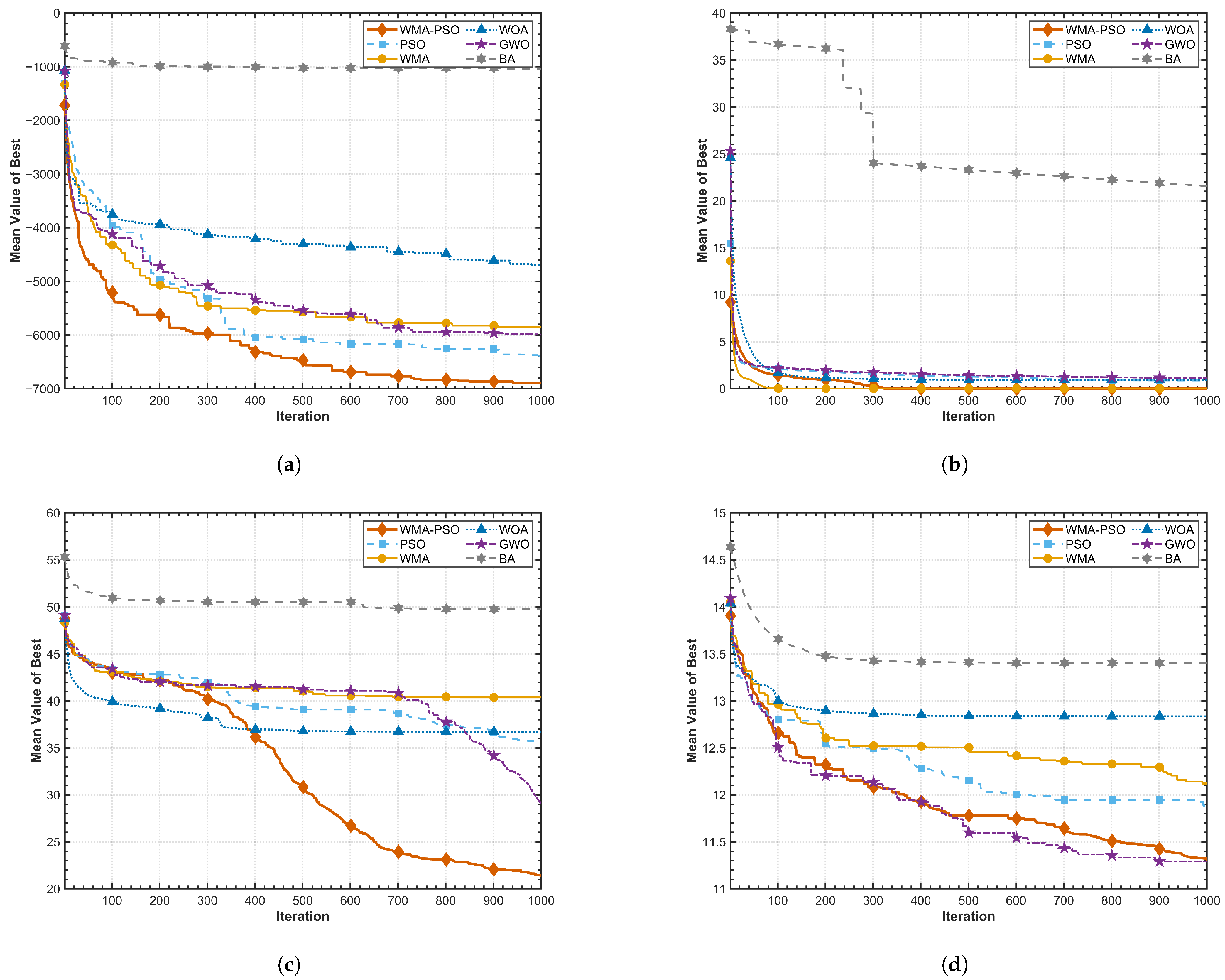
- The proposed WMA-PSO algorithm was evaluated against several state-of-the-art baseline optimization methods using the widely recognized CEC-2005 benchmark suite. The results demonstrate that WMA-PSO achieves superior performance in convergence speed, solution accuracy, and stability.
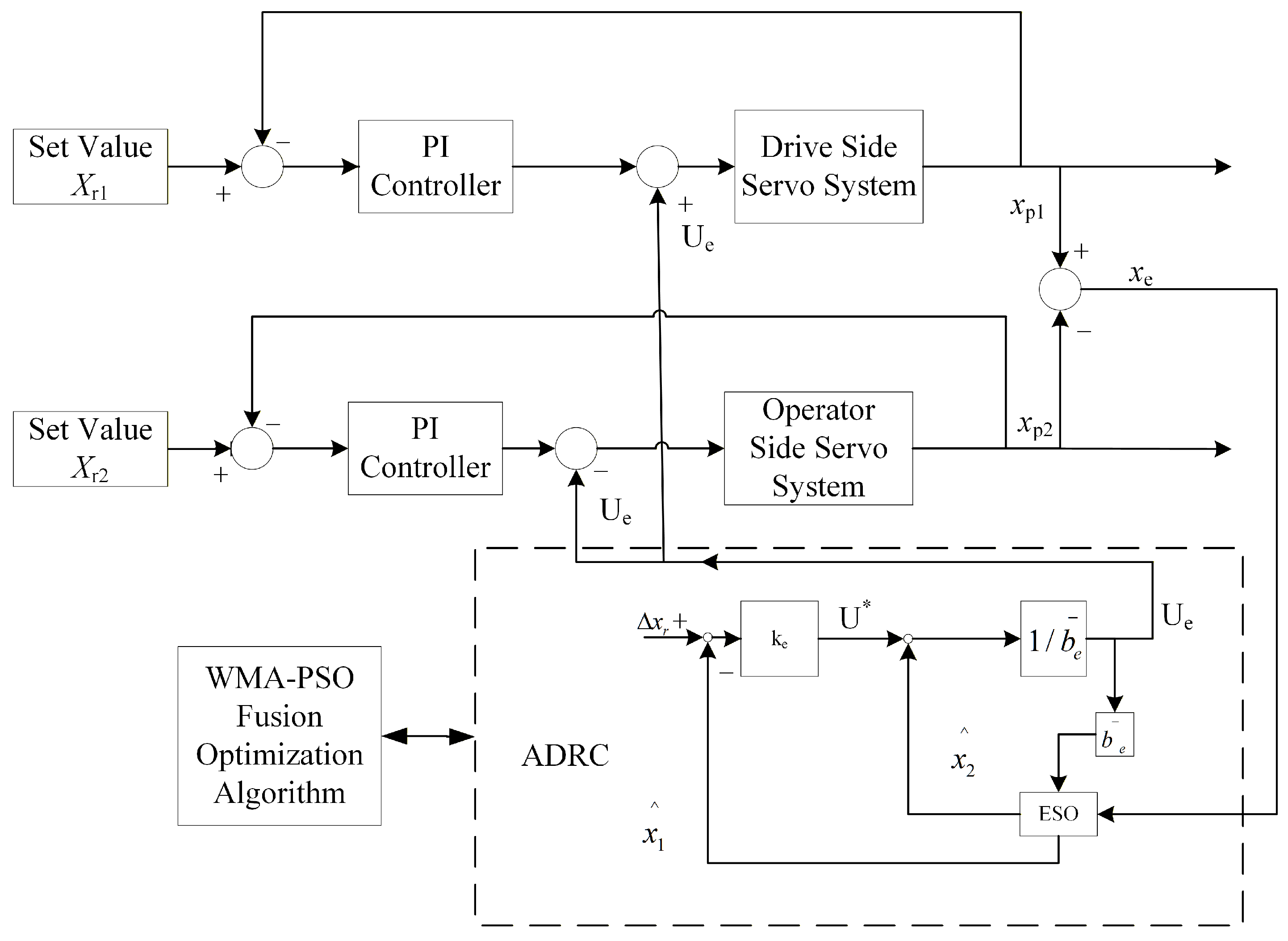
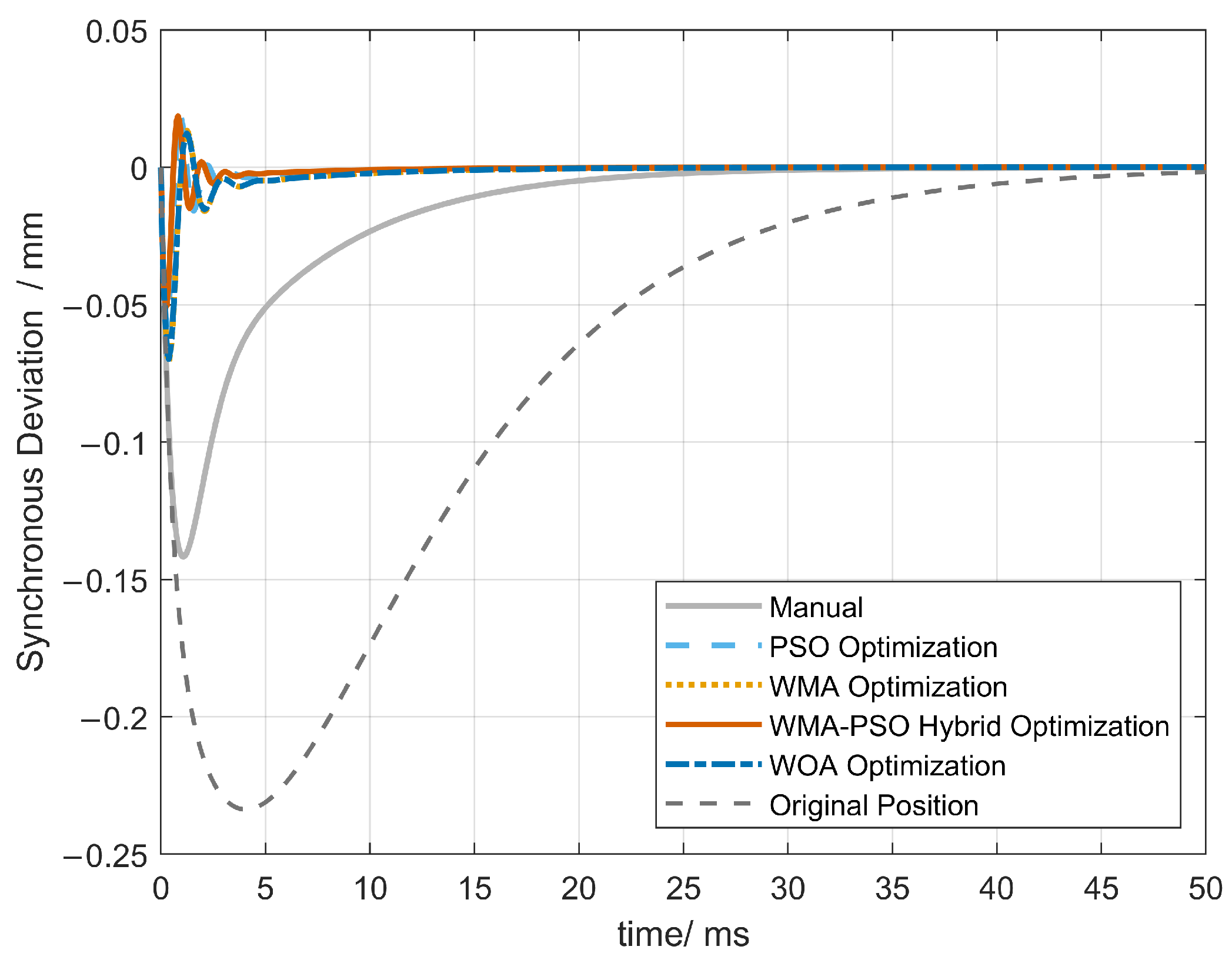
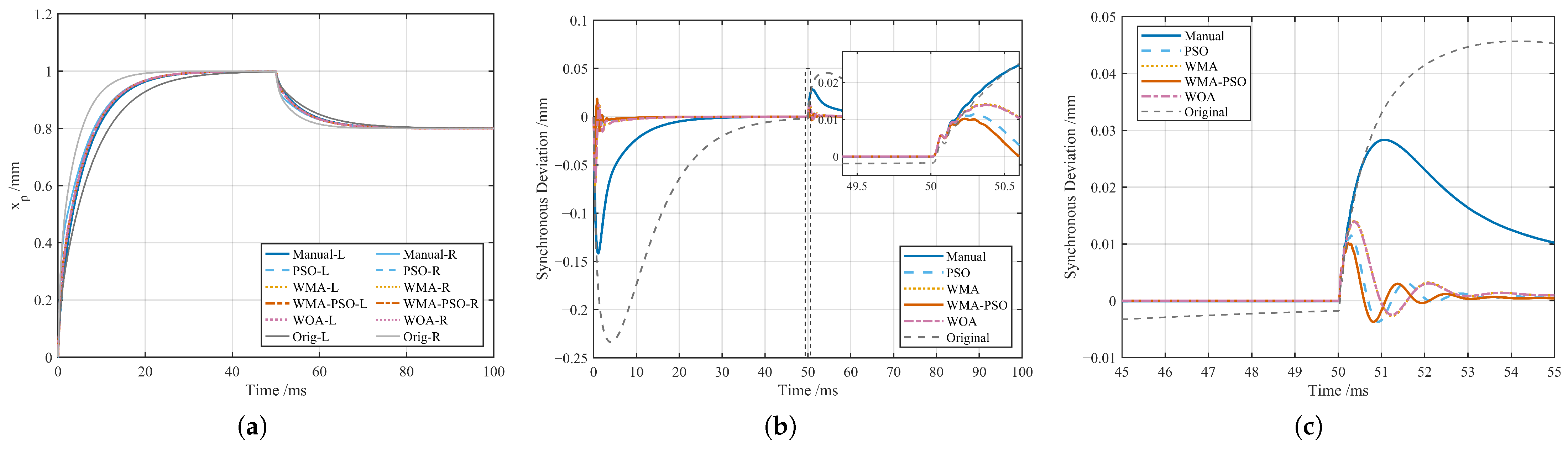
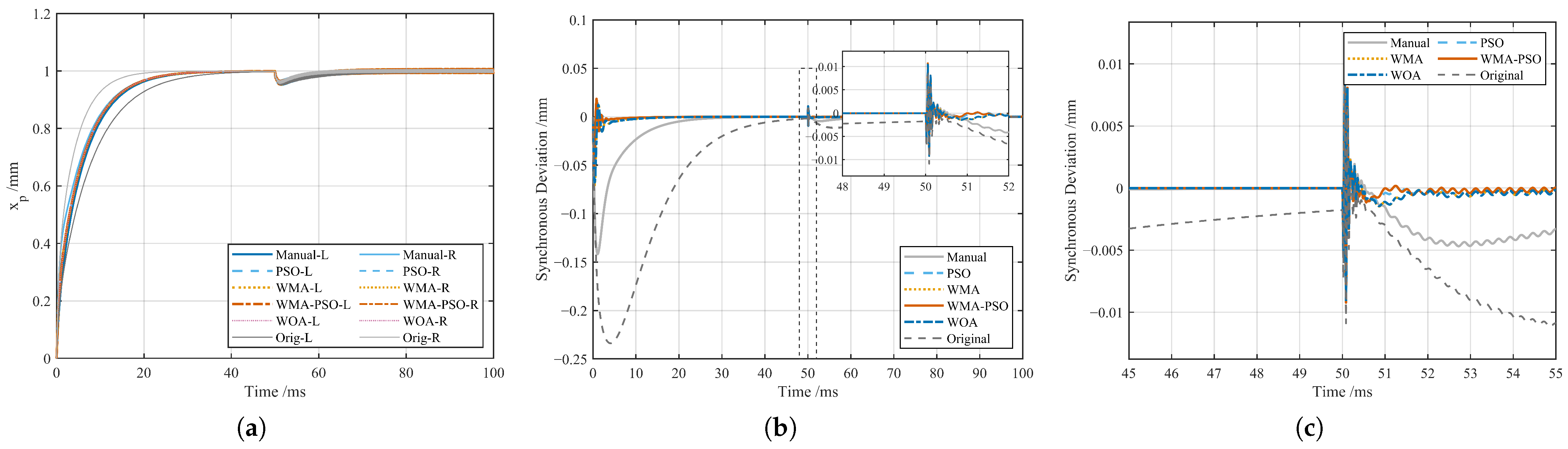
- The practical efficacy of WMA-PSO was demonstrated through its application to ADRC parameter tuning in a rolling-mill hydraulic synchronous control system. In comparative simulations under multiple working conditions, including step response, dynamic tracking, and load disturbance rejection, the parameters identified by WMA-PSO enabled the control system to achieve optimal comprehensive dynamic performance, minimizing synchronization error, settling time, and demonstrating the strongest robustness. This application not only validates the algorithm’s effectiveness for high-dimensional, strongly coupled engineering problems but also establishes a valuable reference for the automated parameter tuning of other complex control systems.
2. System Modeling and Problem Formulation
2.1. Model of the Hydraulic Servo Synchronization System in a Rolling Mill
2.2. Problem Formulation and Engineering Context
3. The Hybrid WMA–PSO Optimization Algorithm
3.1. Review of the Base Algorithms
3.1.1. Particle Swarm Optimization (PSO)
3.1.2. Whale Migration Algorithm (WMA)
3.2. Leading Group the WMA-PSO Hybrid
- Leading group:
- Adopts the standard PSO update to exploit the promising regions around the current best solutions.
- Following group:
- Performs a hybrid move: first executes a WMA-style migration toward the leading centroid, and then applies a PSO-style inertial increment to explore along the leadings’ direction while maintaining its own momentum. These two moves are convexly fused.
3.3. Implementation of the WMA-PSO Hybrid
3.3.1. Algorithmic Procedure
- Initialization Phase
- (a)
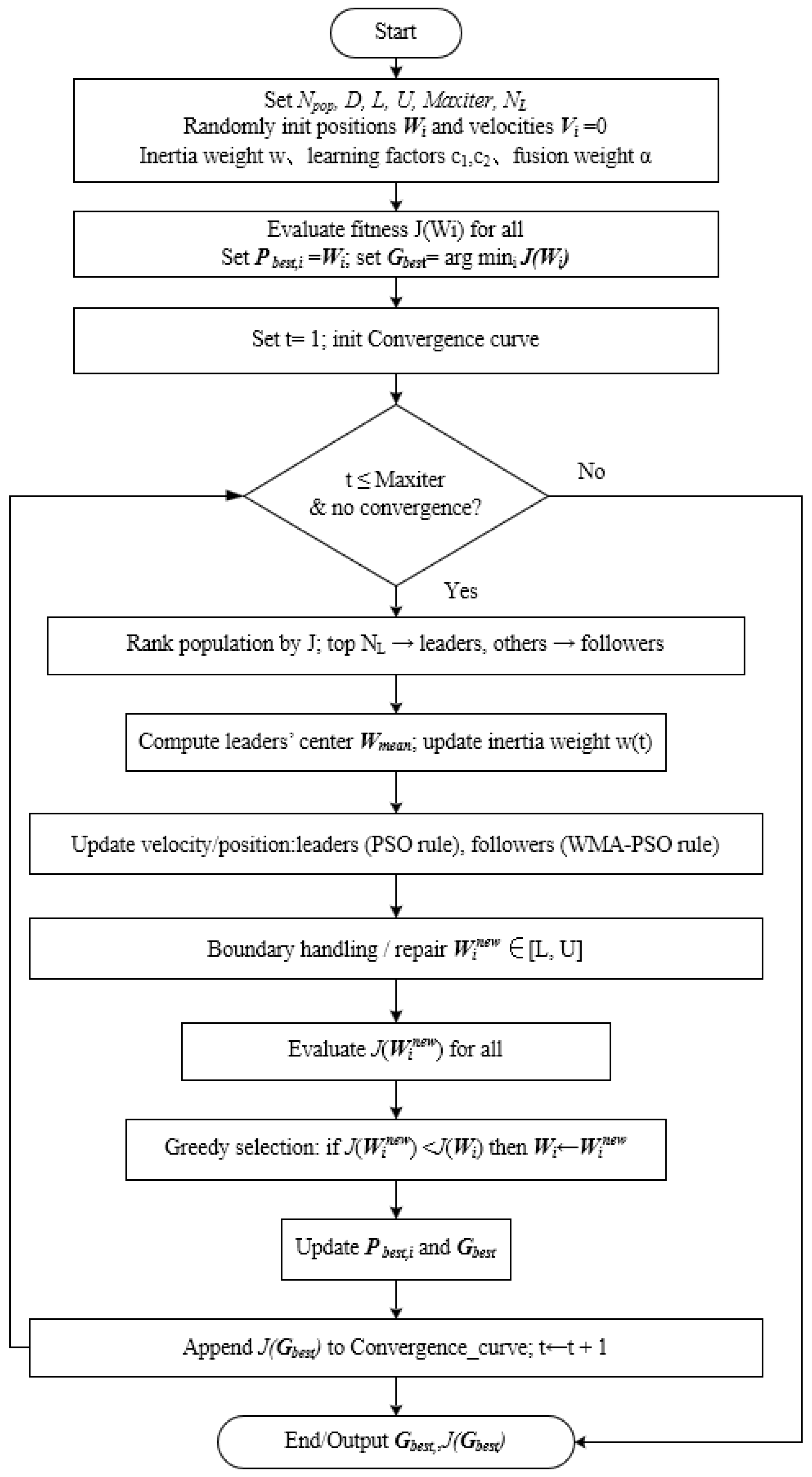
- Parameter and population initialization: Define the population size , the problem dimension , the lower bound and the upper bound for the parameters to be optimized; the maximum number of iterations , and the leader ratio . Within the given parameter boundaries, randomly initialize the position of each individual in the population and set its initial velocity to zero.
- (b)
- Initial Fitness Evaluation; For the initialized population, calculate the fitness value for each individual.
- (c)
- Best Value Initialization: Set the current position of each individual as its personal best position, i.e., . From the entire initial population, find the individual with the minimum fitness value and assign its position to the global best position, .
- Main Evolutionary Loop
- (a)
- Fitness Evaluation: For each individual in the population (each set of ADRC parameters), run the simulation of the rolling mill synchronous control system. Using the Integral of Squared Error (ISE), J, as the fitness function, calculate the corresponding fitness value for each individual.
- (b)
- Population Sorting and Grouping: Sort all individuals in the current population in ascending order based on their fitness values. Define the top individuals as the leading whales and the rest as the following whales.
- (c)
- Center Calculation and Weight Update: Calculate the central position of the leading whale group, and update the adaptive inertia weight w based on the current iteration number.
- (d)
- Position Update: Update the velocity and position of each individual using different update rules described below, depending on its group (leader or follower).
- (e)
- Boundary Handling: Check if the updated positions exceed the predefined boundaries. If so, set them to the boundary values.
- (f)
- Fitness Evaluation and Selection Update: For each individual i in the population, calculate the fitness value of the new position . Only if the fitness of the new position is better than that of the old position, i.e., , is the update accepted, setting .
- (g)
- Personal and Global Best Update: For each individual i in the population, update the personal best and the global best as follows: If , update . If , update .
- (h)
- Termination Condition: The loop terminates when the maximum number of iterations is reached, or when the fitness value no longer shows significant improvement.
- Termination Phase
- (a)
- Output Result: Output the final optimal parameters for the ADRC controller and their corresponding best fitness value, .
3.3.2. Core Update Rules
- Adaptive Weight: To balance the algorithm’s exploration and exploitation capabilities at different stages, a linearly decreasing adaptive inertia weight is designed:where denotes the inertia weight at iteration . In early iterations, a larger w encourages global exploration (particularly for the leading group), whereas in later iterations a smaller w facilitates fine-grained local search near the optimum.
- Update Rule for the Leading Group: As the leading group, the task of the leading group is to perform deep exploitation within the promising regions that have already been discovered. Therefore, it adopts the standard PSO update formulas, fully utilizing personal best information and global best information to guide its movement. Velocity Update:Position Update:
- updated position vector of individual i;
- current position vector of individual i;
- updated velocity vector of individual i;
- current velocity vector of individual i;
- personal best position vector of individual i;
- global best position vector;
- random vectors (e.g., elementwise in );
- cognitive and social acceleration coefficients, ;
- w
- scalar inertia weight with a linearly decreasing schedule from to as the iteration index increases.
- Update Rule for the Following Group: The task of the following whale group is to learn from the leading group while simultaneously exploring new possibilities. Its update rule fuses the concepts of WMA and PSO.
- centroid of the leading group;
- ⊙
- Hadamard (element-wise) product;
- positions of the -th and i-th individuals in the fitness-sorted list (for , may belong to the leading set);
- fused PSO-style velocity increment for the following individual i;
- intermediate PSO step, WMA step, and the final fused position of individual i;
- fusion weight, (set to in our experiments);
- vector-valued global best, personal best, and per-dimension i.i.d. random vectors; as defined in the leading-group update (Section 3.3.2).
4. Simulation Experiments and Results Analysis
4.1. Performance on the CEC-2005 Benchmark Suite
4.2. Engineering Application: ADRC Parameter Tuning for Synchronous Position Control of a Rolling Mill Hydraulic System
Experimental Setup
- Fitness Function: All algorithms utilized the comprehensive performance evaluation function, J, constructed in Section 2 as the optimization objective. This function incorporates the integral of the synchronization error, where a lower value indicates better control performance.
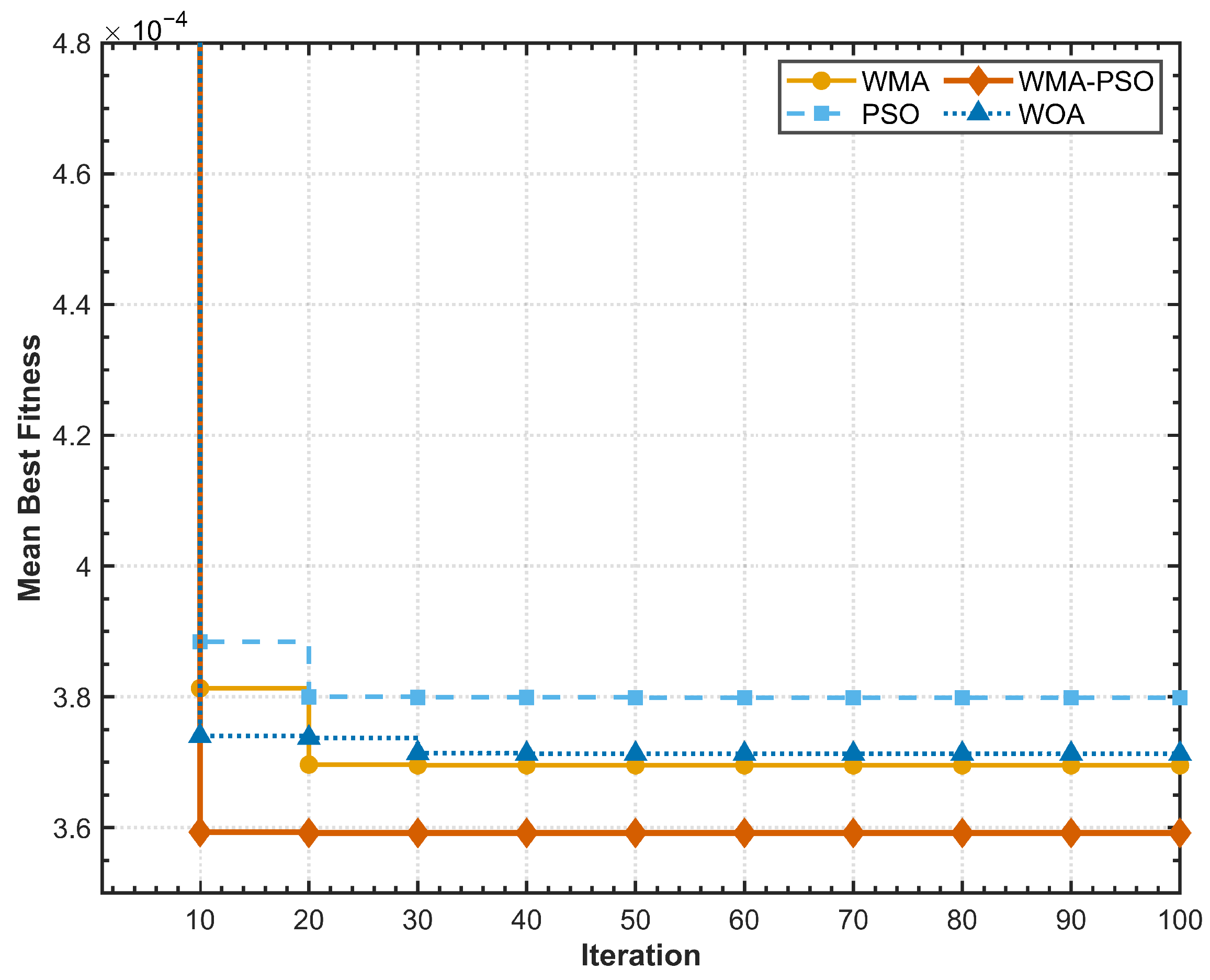
- Algorithm Configuration: The primary parameters for each algorithm were consistent with those used in the CEC-2005 benchmark tests. However, to reflect the demands of practical engineering applications, the maximum number of iterations was set to 100. To mitigate the effects of stochasticity, each algorithm was independently executed 30 times, and the average performance was analyzed.
4.3. Comparative Analysis of ADRC Synchronous Control Performance
4.3.1. Step Response Performance Analysis
4.3.2. Dynamic Tracking Performance Analysis
4.3.3. Disturbance Rejection Performance Analysis
4.4. Summary of Experimental Results
- Superior Optimization Performance: WMA-PSO significantly outperforms the baseline algorithms in key optimization metrics, including convergence speed, accuracy, and stability, as demonstrated on the CEC-2005 test suite.
- Comprehensive Control Performance: In the engineering application of ADRC parameter tuning, the parameters identified by WMA-PSO not only achieved the smallest overshoot and shortest settling time in the initial step response; in the newly added dynamic tracking (setpoint step-change) and disturbance rejection (asymmetric load disturbance) experiments, the WMA-PSO-optimized controller also exhibited the strongest robustness. It consistently demonstrated the minimum transient deviation and the fastest convergence speed, showcasing the optimal overall control quality.
5. Conclusions and Future Work
5.1. Conclusions
5.2. Future Work
- Performance Enhancement of the Algorithm: Although WMA-PSO demonstrates excellent overall performance, its efficacy on a few specific functions, such as those with landscapes similar to the Rosenbrock function, could be improved. Future work could investigate the incorporation of gradient information or a dedicated Local Search Operator, with the aim of further strengthening its deep exploitation capability on such complex topographies.
- Extension to Multi-objective Optimization: Practical industrial control often necessitates a trade-off among multiple conflicting performance indicators, such as rapidity, stability, and energy consumption. Therefore, extending WMA-PSO to a multi-objective version (MOWMA-PSO) to generate a set of Pareto optimal solutions for decision-makers would be a research direction of significant practical value.
Author Contributions
Funding
Data Availability Statement
Acknowledgments
Conflicts of Interest
References
- Sun, Y.; Li, J.; Sun, Y.; Song, L.; Yang, Q.; Wang, X. Modeling and simulation of shape control based on digital twin technology in hot strip rolling. Sensors 2024, 24, 614. [Google Scholar] [CrossRef] [PubMed]
- Prinz, K.; Steinboeck, A.; Kugi, A. Optimization-based feedforward control of the strip thickness profile in hot strip rolling. J. Process Control 2018, 64, 100–111. [Google Scholar] [CrossRef]
- Li, R.; Yuan, W.; Ding, X.; Xu, J.; Sun, Q.; Zhang, Y. Review of research and development of hydraulic synchronous control system. Processes 2023, 11, 981. [Google Scholar] [CrossRef]
- Radionov, A.; Gasiyarov, V.; Karandaev, A.; Loginov, B.; Khramshin, V. Advancement of roll-gap control to curb the camber in heavy-plate rolling mills. Appl. Sci. 2021, 11, 8865. [Google Scholar] [CrossRef]
- Wang, Z.; Wang, J.; Zhang, Y.; Li, J.; Zhang, F.; Zhao, L. Active disturbance rejection synchronous control for both sides of hydraulic servo position system of rolling mill. Control Theory Appl. 2013, 30, 1603–1608. (In Chinese) [Google Scholar] [CrossRef]
- Han, J. From PID to active disturbance rejection control. IEEE Trans. Ind. Electron. 2009, 56, 900–906. [Google Scholar] [CrossRef]
- Lyu, C.; Zhao, S.D.; Liu, S. An improved active disturbance rejection control method for a deep-sea aquaculture vessel. Isr. J. Aquac. Bamidgeh. 2025, 77, 14–28. [Google Scholar] [CrossRef]
- Zeng, R.; Zhao, J.; Xiong, Y.; Luo, X. Active disturbance rejection control of five-phase motor based on parameter setting of genetic algorithm. Processes 2023, 11, 1712. [Google Scholar] [CrossRef]
- Kang, C.; Wang, S.; Ren, W.; Lu, Y.; Wang, B. Optimization design and application of active disturbance rejection controller based on intelligent algorithm. IEEE Access. 2019, 7, 59862–59870. [Google Scholar] [CrossRef]
- Gao, L.; Guo, X.; Mei, D.; Qu, Z. Parameter tuning of active disturbance rejection control based on improved differential evolution algorithm. In Proceedings of the 2022 IEEE International Conference on Signal Processing (ICSP), Beijing, China, 20–22 April 2022; IEEE: New York, NY, USA, 2022; pp. 342–346. [Google Scholar] [CrossRef]
- Deng, Y.; Zhou, T.; Zhao, G.; Zhu, K.; Xu, Z.; Liu, H. The improved particle swarm optimization method: An efficient parameter tuning method with the tuning parameters of a dual-motor active disturbance rejection controller. Sensors 2023, 23, 8605. [Google Scholar] [CrossRef] [PubMed]
- Zhou, Z.; Wang, L.; Wang, Y.; Zhou, X.; Tong, Y. Research on active disturbance rejection control with parameter tuning for PMSM based on improved PSO algorithm. Electronics 2024, 13, 3436. [Google Scholar] [CrossRef]
- Ren, J.; Chen, Z.; Yang, Y.; Sun, M.; Sun, Q.; Wang, Z. Grey wolf optimization based active disturbance rejection control parameter tuning for ship course. Int. J. Control Autom. Syst. 2022, 20, 842–856. [Google Scholar] [CrossRef]
- Yu, Y.; Wang, H.; Li, N.; Su, Z.; Wu, J. Automatic carrier landing system based on active disturbance rejection control with a novel parameters optimizer. Aerosp. Sci. Technol. 2017, 69, 149–160. [Google Scholar] [CrossRef]
- Liu, Q.; Zhang, Y.; Hou, Z.; Qiao, Y.; Cao, J.; Lei, Y. Optimal Hilbert transform parameter identification of bistable structures. Nonlinear Dyn. 2023, 111, 5449–5468. [Google Scholar] [CrossRef]
- Liu, Q.; Cao, J. Identification of Asymmetric Bouc–Wen Hysteresis Under Intense Noise by Only Measuring Acceleration. J. Comput. Nonlinear Dyn. 2023, 18, 081009. [Google Scholar] [CrossRef]
- Xu, C.; Li, K.; Xu, B.; Yang, Z. Biogeography-based learning particle swarm optimization for combined heat and power economic dispatch problem. Knowl. Based Syst. 2020, 208, 106463. [Google Scholar] [CrossRef]
- Ghasemi, M.; Deriche, M.; Trojovský, P.; Mansor, Z.; Zare, M.; Trojovská, E.; Abualigah, L.; Ezugwu, A.E.; Mohammadi, S.K. An efficient bio-inspired algorithm based on humpback whale migration for constrained engineering optimization. Results Eng. 2025, 25, 104215. [Google Scholar] [CrossRef]
- Dai, F.; Ma, T.; Gao, S. Optimal design of a fractional order PIDD2 controller for an AVR system using hybrid black-winged kite algorithm. Electronics 2025, 14, 2315. [Google Scholar] [CrossRef]
- Fu, X.; Sun, Y.; Wang, H.; Li, H. Task scheduling of cloud computing based on hybrid particle swarm algorithm and genetic algorithm. Clust. Comput. 2023, 26, 2479–2488. [Google Scholar] [CrossRef]
- Sheng, L.; Wu, S.; Lv, Z. Modified grey wolf optimizer and application in parameter optimization of PI controller. Appl. Sci. 2025, 15, 4530. [Google Scholar] [CrossRef]



| Parameter | Value |
|---|---|
| Population size, | 60 |
| Maximum iterations, | 1000/100 |
| Observer bandwidth, | [1, 10,000] |
| Dynamic compensation factor, | [1, 50,000] |
| Error feedback gain, | [0.1, 20,000] |
| PSO learning factors, | 2, 2 |
| WMA leader ratio, | 0.2 |
| Fusion weight, | 0.3 |
| Inertia weight, | 0.9/0.4 |
| ID | Function | Dim. | Property |
|---|---|---|---|
| F1 | Shifted Sphere | 30 | Unimodal, separable |
| F2 | Shifted Schwefel 2.26 | 30 | Multimodal, separable |
| F3 | Shifted Rotated High-Cond. Elliptic | 30 | Unimodal, non-sep. |
| F4 | Shifted Schwefel 2.26 (with noise) | 30 | Multimodal, separable |
| F5 | Schwefel 2.6 (linear max) | 30 | Unimodal, non-sep. |
| F6 | Shifted Rosenbrock | 30 | Valley, non-separable |
| F7 | Shifted Rotated Griewank | 30 | Multimodal, non-sep. |
| F8 | Shifted Rotated Ackley | 30 | Multimodal, non-sep. |
| F9 | Shifted Rastrigin | 30 | Multimodal, separable |
| F10 | Shifted Rotated Rastrigin | 30 | Multimodal, non-sep. |
| F11 | Shifted Rotated Weierstrass | 30 | Multimodal, non-sep. |
| F12 | Schwefel 2.13 | 30 | Multimodal, non-sep. |
| F13 | Expanded Griewank + Rosenbrock | 30 | Multimodal, non-sep. |
| F14 | Shifted Rotated Expanded Scaffer’s F6 | 30 | Multimodal, non-sep. |
| Func. | WMA-PSO | PSO | WMA | WOA | GWO | BA |
|---|---|---|---|---|---|---|
| 1.13 × 10⁻²⁶ | 9.13 × 10² | 4.41 × 10⁻²⁶ | 1.18 × 10² | 6.42 × 10² | 9.80 × 10⁴ | |
| 1.48 × 10⁻²⁶ | 6.99 × 10² | 2.38 × 10⁻²⁶ | 1.12 × 10² | 5.31 × 10² | 1.75 × 10⁴ | |
| 1 | 5 | 2 | 3 | 4 | 6 | |
| −2.02 × 10³ | −1.80 × 10³ | −1.86 × 10⁻³ | −1.59 × 10³ | −2.12 × 10³ | −4.83 × 10² | |
| 7.52 × 101 | 1.46 × 10² | 1.15 × 10² | 1.83 × 10² | 1.23 × 10² | 2.85 × 10² | |
| 2 | 4 | 3 | 5 | 1 | 6 | |
| 2.06 × 10⁷ | 1.25 × 10⁷ | 1.08 × 10⁶ | 5.01 × 10⁷ | 1.47 × 10⁷ | 6.12 × 10⁹ | |
| 3.52 × 10⁷ | 7.67 × 10⁶ | 6.48 × 10⁵ | 2.39 × 10⁷ | 8.85 × 10⁶ | 2.79 × 10⁹ | |
| 4 | 2 | 1 | 5 | 3 | 6 | |
| −7.84 × 10³ | −6.56 × 10³ | −6.37 × 10³ | −4.51 × 10³ | −6.60 × 10³ | −1.08 × 10³ | |
| 8.68 × 10² | 9.26 × 10² | 1.02 × 10³ | 8.81 × 10² | 8.72 × 10² | 6.61 × 10² | |
| 1 | 2 | 4 | 5 | 3 | 6 | |
| 5.07 × 10³ | 2.08 × 10³ | 2.29 × 10³ | 9.38 × 10² | 4.11 × 101 | 2.67 × 10⁴ | |
| 1.44 × 10³ | 8.65 × 10² | 8.14 × 10² | 2.04 × 10³ | 7.54 × 100 | 8.19 × 10³ | |
| 5 | 3 | 4 | 2 | 1 | 6 | |
| 5.63 × 10⁸ | 2.54 × 10⁸ | 8.26 × 100 | 5.92 × 10⁶ | 4.67 × 10⁷ | 7.98 × 10¹⁰ | |
| 8.39 × 10⁸ | 2.82 × 10⁸ | 1.32 × 101 | 4.51 × 10⁶ | 6.60 × 10⁷ | 6.66 × 10¹⁰ | |
| 5 | 4 | 1 | 2 | 3 | 6 | |
| 9.86 × 10⁻⁴ | 1.36 × 100 | 1.55 × 10⁻² | 9.52 × 10⁻¹ | 1.27 × 100 | 2.83 × 101 | |
| 3.12 × 10⁻³ | 1.69 × 10⁻¹ | 1.13 × 10⁻² | 6.14 × 10⁻² | 4.71 × 10⁻¹ | 8.31 × 100 | |
| 1 | 5 | 2 | 3 | 4 | 6 | |
| 2.09 × 101 | 2.10 × 101 | 2.10 × 101 | 2.07 × 101 | 2.10 × 101 | 2.00 × 101 | |
| 6.40 × 10⁻² | 3.87 × 10⁻² | 4.62 × 10⁻² | 1.93 × 10⁻¹ | 4.98 × 10⁻² | 1.09 × 10⁻¹ | |
| 3 | 5 | 4 | 2 | 6 | 1 | |
| 5.31 × 10⁴ | 5.36 × 10⁴ | 5.33 × 10⁴ | 5.32 × 10⁴ | 5.34 × 10⁴ | 5.55 × 10⁴ | |
| 1.28 × 101 | 6.22 × 10² | 1.85 × 10² | 4.09 × 10² | 2.09 × 10² | 1.83 × 10³ | |
| 1 | 5 | 3 | 2 | 4 | 6 | |
| 5.83 × 10⁴ | 5.86 × 10⁴ | 5.85 × 10⁴ | 5.82 × 10⁴ | 5.87 × 10⁴ | 5.94 × 10⁴ | |
| 1.85 × 10² | 2.17 × 10² | 2.16 × 10² | 1.55 × 10² | 3.49 × 10² | 1.44 × 10³ | |
| 2 | 4 | 3 | 1 | 5 | 6 | |
| 2.04 × 101 | 3.11 × 101 | 4.05 × 101 | 3.76 × 101 | 2.33 × 101 | 5.09 × 101 | |
| 5.09 × 100 | 3.98 × 100 | 1.45 × 100 | 2.83 × 100 | 1.20 × 101 | 3.04 × 100 | |
| 1 | 3 | 5 | 4 | 2 | 6 | |
| 5.49 × 100 | 2.35 × 10⁻¹ | 2.33 × 10⁻³ | 7.96 × 10⁻²² | 1.28 × 10⁻¹¹ | 1.92 × 10⁻³ | |
| 7.72 × 100 | 3.23 × 10⁻¹ | 2.31 × 10⁻³ | 4.36 × 10⁻²¹ | 6.64 × 10⁻¹¹ | 1.48 × 10⁻³ | |
| 6 | 5 | 4 | 1 | 2 | 3 | |
| 8.64 × 10¹⁵ | 8.73 × 10¹⁵ | 8.64 × 10¹⁵ | 8.64 × 10¹⁵ | 8.76 × 10¹⁵ | 8.93 × 10¹⁵ | |
| 8.55 × 10¹³ | 9.75 × 10¹³ | 1.74 × 10⁹ | 2.87 × 10⁸ | 6.92 × 10¹³ | 2.58 × 10¹⁴ | |
| 3 | 4 | 2 | 1 | 5 | 6 | |
| 1.13 × 101 | 1.19 × 101 | 1.22 × 101 | 1.27 × 101 | 1.10 × 101 | 1.39 × 101 | |
| 5.59 × 10⁻¹ | 2.71 × 10⁻¹ | 3.45 × 10⁻¹ | 5.16 × 10⁻¹ | 8.71 × 10⁻¹ | 3.52 × 10⁻¹ | |
| 2 | 3 | 4 | 5 | 1 | 6 | |
| Nb/Nw/MFr | 5/1/2.64 | 0/0/3.85 | 2/0/3.00 | 4/0/2.93 | 3/1/3.14 | 1/12/5.42 |
| Final rank | 1 | 5 | 4 | 2 | 3 | 6 |
| Algorithm | Statistical Results of Optimal Fitness Value | Optimal Parameter Set | ||||
|---|---|---|---|---|---|---|
| Best | Average | Std. Dev. | ||||
| WMA | 3.60 × 10⁻⁴ | 3.70 × 10⁻⁴ | 1.79 × 10⁻⁵ | 995 | 12.4 | 167 |
| PSO | 3.61 × 10⁻⁴ | 3.79 × 10⁻⁴ | 1.79 × 10⁻⁵ | 723 | 5 | 167 |
| WOA | 3.71 × 10⁻⁴ | 3.71 × 10⁻⁴ | 2.10 × 10⁻⁵ | 703 | 5 | 93 |
| WMA-PSO | 3.59 × 10⁻⁴ | 3.59 × 10⁻⁴ | 1.64 × 10⁻⁵ | 871 | 5 | 106 |
Disclaimer/Publisher’s Note: The statements, opinions and data contained in all publications are solely those of the individual author(s) and contributor(s) and not of MDPI and/or the editor(s). MDPI and/or the editor(s) disclaim responsibility for any injury to people or property resulting from any ideas, methods, instructions or products referred to in the content. |
© 2026 by the authors. Licensee MDPI, Basel, Switzerland. This article is an open access article distributed under the terms and conditions of the Creative Commons Attribution (CC BY) license.
Share and Cite
Yang, Y.; Zhang, F.; Hong, Z.; Huang, X.; Du, Y.; Li, Y. Parameter Optimization of ADRC for Rolling-Mill Hydraulic Screw-Down Synchronization Based on a WMA–PSO Hybrid Algorithm. Mathematics 2026, 14, 799. https://doi.org/10.3390/math14050799
Yang Y, Zhang F, Hong Z, Huang X, Du Y, Li Y. Parameter Optimization of ADRC for Rolling-Mill Hydraulic Screw-Down Synchronization Based on a WMA–PSO Hybrid Algorithm. Mathematics. 2026; 14(5):799. https://doi.org/10.3390/math14050799
Chicago/Turabian StyleYang, Yixuan, Fei Zhang, Zhao Hong, Xuezhong Huang, Ye Du, and Yanjiao Li. 2026. "Parameter Optimization of ADRC for Rolling-Mill Hydraulic Screw-Down Synchronization Based on a WMA–PSO Hybrid Algorithm" Mathematics 14, no. 5: 799. https://doi.org/10.3390/math14050799
APA StyleYang, Y., Zhang, F., Hong, Z., Huang, X., Du, Y., & Li, Y. (2026). Parameter Optimization of ADRC for Rolling-Mill Hydraulic Screw-Down Synchronization Based on a WMA–PSO Hybrid Algorithm. Mathematics, 14(5), 799. https://doi.org/10.3390/math14050799