1. Introduction
Consider the first-order difference equations with several advanced arguments
where
denotes the set of positive integers and
is the backward difference operator. Throughout the paper, the coefficient sequences
,
, are assumed to be nonnegative real-valued for all sufficiently large
n. Moreover, the integer-valued sequences
represent advanced arguments and satisfy
A sequence
, for some
, is said to be a solution of Equation (
1) if it satisfies the equation for all
.
A solution
of Equation (
1) is called oscillatory if its terms
are neither eventually positive nor eventually negative. Otherwise, the solution is said to be nonoscillatory [
1]. Equation (
1) is called oscillatory if every solution
is oscillatory. Otherwise, it is said to be nonoscillatory.
The oscillation theory of differential and difference equations provides fundamental insights into the qualitative behavior of dynamical systems across diverse domains, including population dynamics, control systems, biological feedback or feedforward mechanisms, and economics; see [
2,
3,
4,
5]. The analysis of oscillatory behavior enables researchers to determine whether solutions fluctuate around equilibrium states or converge monotonically, thereby revealing underlying stability properties, periodic tendencies, or chaotic dynamics in physical and biological processes. In discrete systems, oscillation analysis assumes particular significance, as many real-world models evolve through discrete time steps and incorporate delay or advance arguments to capture memory effects or anticipation mechanisms; see [
2,
3].
The study of oscillation of difference equations plays an essential role in discrete mathematics, and its development has been addressed in a wide range of contributions; see [
2,
3,
6,
7,
8,
9,
10,
11,
12,
13,
14,
15,
16,
17,
18,
19,
20,
21,
22,
23,
24,
25,
26,
27,
28,
29,
30,
31,
32,
33]. While classical results typically assume a single monotone argument, realistic systems often involve several advanced arguments that may vary non-monotonically over time. Such complex structures arise naturally in predictive control systems, biological population models with anticipation mechanisms, and signal propagation through feedback networks [
2,
3].
Ladas [
19] investigated the oscillatory behavior of the first-order differential equation with non-decreasing delay
and established the well-known lim sup-type oscillation criterion
Motivated by the continuous case, Chatzarakis and Stavroulakis [
12] extended Ladas’ condition to the discrete setting. In particular, they obtained the following discrete analogue of Equation (
2):
for the advanced difference equation
where
is a sequence of nonnegative real numbers and
is an integer-valued non-decreasing sequence satisfying
Subsequently, Chatzarakis, Pinelas, and Stavroulakis [
10] extended condition (
3) to Equation (
1) and obtained
where
and each
represents a non-decreasing sequence.
Braverman and Karpuz [
8] demonstrated that condition (
2) is not valid for both the continuous and the corresponding discrete cases when the assumption of monotonicity is relaxed to allow for general, not necessarily monotone, delay arguments. This finding highlights the limitations of directly extending results from monotone to non-monotone delays and shows that more specific methods are required for equations with non-monotone arguments [
16,
17].
Despite notable progress in the oscillation theory of delay difference equations, the case involving several advanced arguments remains insufficiently explored. Existing studies [
8,
34] present only sufficient conditions for the oscillation of all solutions; however, they do not reveal the qualitative differences between equations with one or with several advanced arguments. Following the approach in [
8], we construct a counterexample showing that some extensions of condition (
3) cannot hold for Equation (
1), even when the advanced arguments are non-decreasing and satisfy
. In this work, we show that there is no constant
such that any of the following conditions guarantees the oscillation of all solutions of Equation (
1):
or
This paper has several additional goals. First, we develop a new framework for studying oscillatory behavior and derive new sufficient conditions that extend and unify earlier results (see
Table 1). Second, we show that, for a certain class of equations of the form (
1), some of our criteria ensure oscillation, whereas all previously known conditions, whether iterative or non-iterative, fail for this class. Finally, we introduce a new concept for difference equations with advanced arguments, namely, the distance between generalized successive zeros of solutions, and illustrate its relevance through numerical simulations.
In summary, we establish new oscillation criteria and demonstrate their effectiveness relative to all existing results for a certain class of Equation (
1). Furthermore, we show that several advanced arguments have a significant impact on the behavior of solutions, and that many conditions valid in the single advanced argument case cannot be extended to the several advanced argument case, even under the assumption that the advanced arguments are non-decreasing.
2. Main Results
The following result shows that several classical oscillation tests for difference equations with a single advanced argument fail when extended to equations with several advanced arguments. This highlights a fundamental limitation of such extensions and emphasizes that the interaction among several advanced arguments requires genuinely new criteria.
Theorem 1. None of the following conditions, for any constant , guarantees the oscillation of Equation (
1)
when is non-decreasing for all and : Proof. Consider the first–order difference equation with several advanced arguments
It is evident that this equation is a particular case of (
1), with
The above equation possesses a non-oscillatory solution
Furthermore, we obtain
and similarly,
As the integer
M may be taken arbitrarily large, the proof of the theorem is complete. □
In what follows, and throughout the remainder of this work, we assume that the sequences , for , are integer-valued, with no monotonicity assumption. The analysis of this general setting is more complex and presents several challenges. To overcome these difficulties, we introduce the following associated non-decreasing sequences.
Specifically, we define the non-decreasing sequences
Furthermore, for integers
, we define
The following lemma establishes an iterative sequence
of lower bounds for the ratio
,
, which increases progressively with
k. Although this lemma is stated without proof in ([
9], Theorem 2.4), we give a proof here by following the approach of ([
9], Lemma 2.1).
Lemma 1. Assume that is a positive solution of Equation (
1)
. Then for all , , we have Proof. Dividing Equation (
1) by
and rearranging, we obtain
Taking the product from
to
p, we have
Since the sequence
is positive, it follows from Equation (
1) that
is eventually non-decreasing. Consequently,
Hence, from (
8) we have
That is,
Moreover, since
, it follows that
Substituting this estimate into (
8) and rearranging yields
Proceeding inductively in this manner, we finally arrive at inequality (
7). □
We are now in a position to state the main oscillation criterion for Equation (
1). This result provides sufficient conditions ensuring that all solutions oscillate, even without assuming monotonicity of the advanced arguments. Moreover, the theorem introduces a novel approach to the oscillation problem, distinct from existing treatments in the literature.
Theorem 2 (Main oscillation criterion for several non-monotone advanced arguments).
Let . Suppose that there exists an unbounded sequence of positive integers such thatThen Equation (1) is oscillatory. Proof. Assume, for the sake of contradiction, that Equation (
1) possesses a non-oscillatory solution
. Due to the linearity of the equation, we may, without loss of generality, assume that
for all sufficiently large
n. It follows from Equation (
1) that
is eventually nondecreasing for all sufficiently large
n.
Summing Equation (
1) from
n to
,
, yields
By virtue of inequality (
7) and the fact that
for all
, it follows that
Substituting this estimate into the previous equality gives
Summing this inequality for
, we obtain
Now, according to condition (
9), there exists a sufficiently large
i such that
In view of this fact and the positivity of
, inequality (
12) implies
which is a contradiction and thus completes the proof. □
Under a common lower bound on the coefficient sequences, the oscillatory behavior of Equation (
1) can be characterized by a simpler lim sup condition. The following theorem establishes an effective sufficient criterion for oscillation that is independent of the detailed structure of the coefficients.
Theorem 3. Assume that for , , . Ifthen, Equation (1) is oscillatory. Proof. Following the argument used in the proof of Theorem 2, together with the nondecreasing property of
, we obtain
where
and
is a positive solution of Equation (
1). Using
for all
, and summing over
, we get
that is,
Consequently,
Therefore,
contradicts (
13). □
In some cases, certain terms of the difference equation restrict the applicability of existing oscillation criteria. To overcome this difficulty, we reorder the advanced arguments together with their associated coefficient sequences, thereby identifying the source of the obstruction and eliminating it. We then proceed to study the resulting reduced equation, as illustrated by the following result.
More precisely, the sequences
and
, for
, associated with Equation (
1), can be rearranged so that the following inequality is eventually satisfied:
Theorem 4. Let and . Suppose that condition (
14)
holds and that there exists an unbounded sequence of positive integers such thatThen Equation (1) is oscillatory. Proof. As before, let
denote a positive solution of Equation (
1). Following the same arguments as in the proof of Theorem 2, we have (inequaity (
11))
The positivity of
implies that
Taking the sum over
, we obtain
Combining this with the positivity of
and condition (
15), we obtain
which yields a contradiction and completes the proof of the theorem. □
Remark 1. It is worth noting that one of the significant consequences of Theorem 1 is that none of the conditionsorwhere each denotes a non-decreasing sequence of positive integers, is a necessary condition for the non-oscillation of Equation (
1).
3. Numerical Results and Simulations
In this section, we provide a comparative analysis between our results and those reported in previous studies, as summarized in
Table 1. It is clear that all existing works establish only sufficient conditions for the oscillation of Equation (
1). In contrast, our results not only yield new and sharper oscillation criteria but also reveal that certain formulas are not sufficient to ensure the oscillatory behavior of all solutions of Equation (
1).
We also present two numerical examples to illustrate the validity and sharpness of the obtained results, as well as the new concept of solutions termed generalized zeros. The first example applies one of the main results (Theorem 4) to demonstrate that a class of difference equations of the form (
1) is oscillatory, whereas previously known criteria fail to detect this behavior. Solution simulations and graphical representations further illustrate the oscillatory nature and highlight regions where the earlier conditions are ineffective. The second example addresses a qualitative property that, to the best of the authors’ knowledge, has not been previously studied for difference equations with advanced arguments, namely the distance between generalized zeros, and the simulations indicate that this distance decreases as the sequence of coefficients increases, highlighting the relevance of this property for a deeper understanding of the solution dynamics.
Table 1.
Comparison of existing results with the present study.
Table 1.
Comparison of existing results with the present study.
| Reference | Type of Equation | Argument Structure | Main Contribution |
|---|
| Braverman & Karpuz (2011) [8] | Delay differential and difference equations | Single non-monotone delay argument | New oscillation criterion; Monotone-delay results do not extend to non-monotone delay. |
| Chatzarakis and Pašić [11] | Difference equations with delay and advanced arguments | Several non-monotone arguments | Improved sufficient conditions using summation inequalities. |
| Present study | Difference equations with advanced arguments | Several non-monotone advanced arguments | Sharp and generalized oscillation conditions; Monotone-single advanced arguments results can not be extend to several monotone advanced arguments. |
Example 1. Consider the first-order linear difference equation with several advanced argumentswhereandwhere , and denotes the greatest integer less than or equal to . Furthermore, , andwhere , , and the sequence is an unbounded sequence of positive integers that satisfies We will show below that all the hypotheses of Theorem 4 are satisfied for Equation (
17)
, and hence it is oscillatory. It follows directly that condition (
14)
holds, andConsequently, for , we obtainTherefore, condition (
15)
is satisfied with , and hence Equation (
17)
is oscillatory. However, as we will demonstrate below, all known iterative and non-iterative oscillation criteria fail to prove the oscillation of Equation (
17)
. For example,where . Therefore,Consequently, ([10], Theorem 3.2) cannot be applied to Equation (
17)
. Furthermore, we observe thatandMoreover, defineTherefore,andSimilarly,Consequently,for sufficiently small δ and ϵ. Hence, ([1], Theorem 2.7) is not satisfied. Likewise, it can be shown that the remaining oscillation conditions are not satisfied for Equation (
17).
This example demonstrates that condition (
15) yields sharper results than existing ones. The numerical results confirm the oscillatory behavior of Equation (
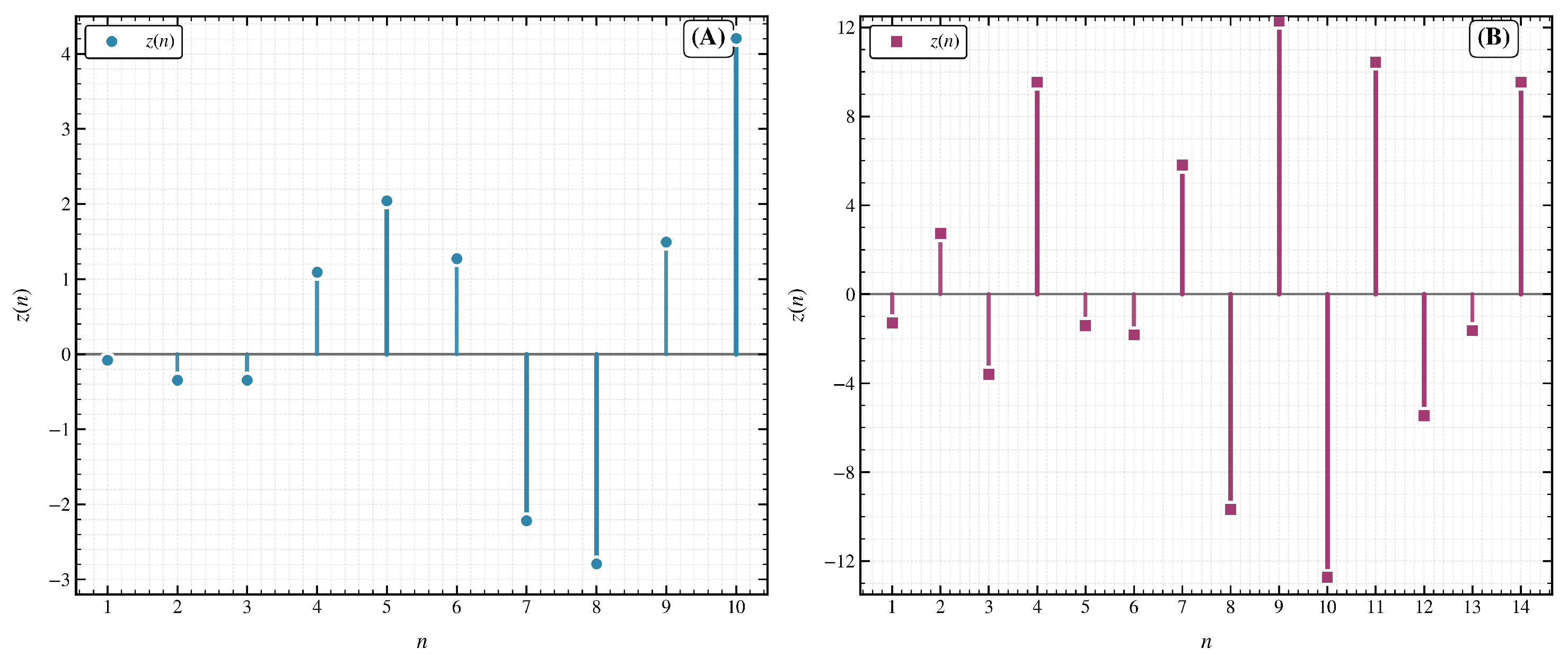
17). As seen in
Figure 1, the solution
oscillates for
and
with
, while smaller
leads to more sign changes, motivating further study of the distance between generalized zeros (see Example 2).
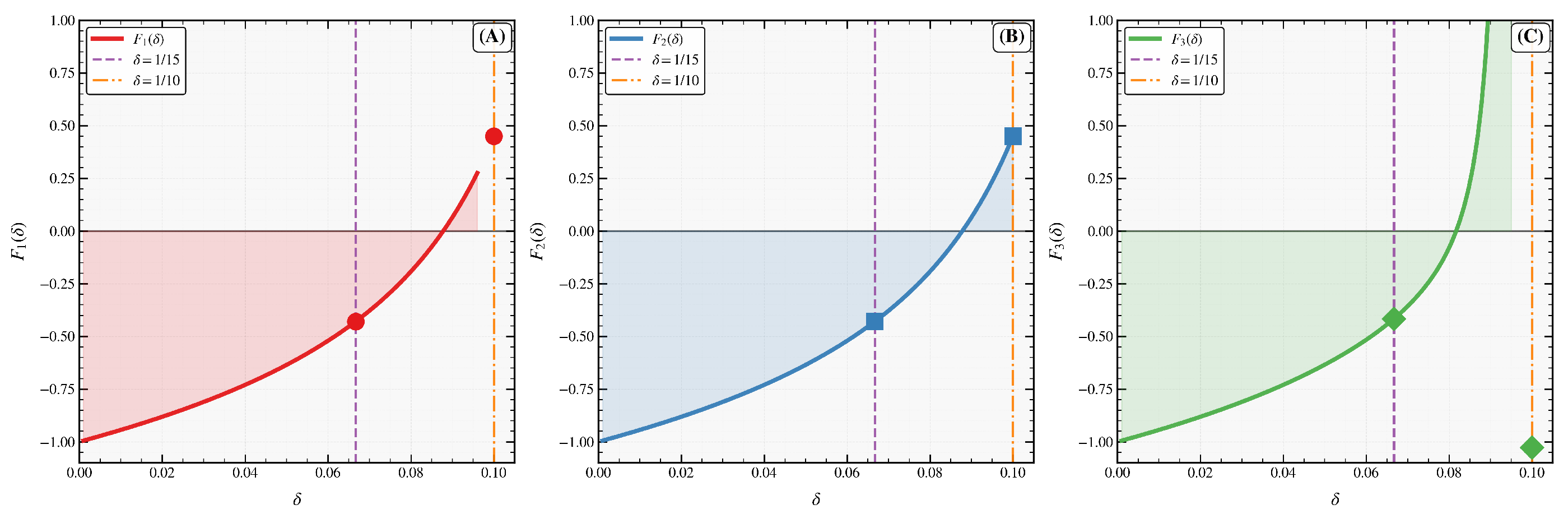
In addition, we illustrate, through several graphical representations, a comparison between condition (
15) and ([
1], Theorem 2.7). Specifically, we define the function
where
. We plot the relationship between
and the parameter
. As illustrated in
Figure 2 and
Table 2, the oscillation condition of ([
1], Theorem 2.7), for
and 3, is not satisfied on the intervals
respectively. However, as shown above, Equation (
17) is oscillatory for all
and
.
Example 2. Consider the difference equation with advanced argumentThis equation represents a particular case of Equation (
4)
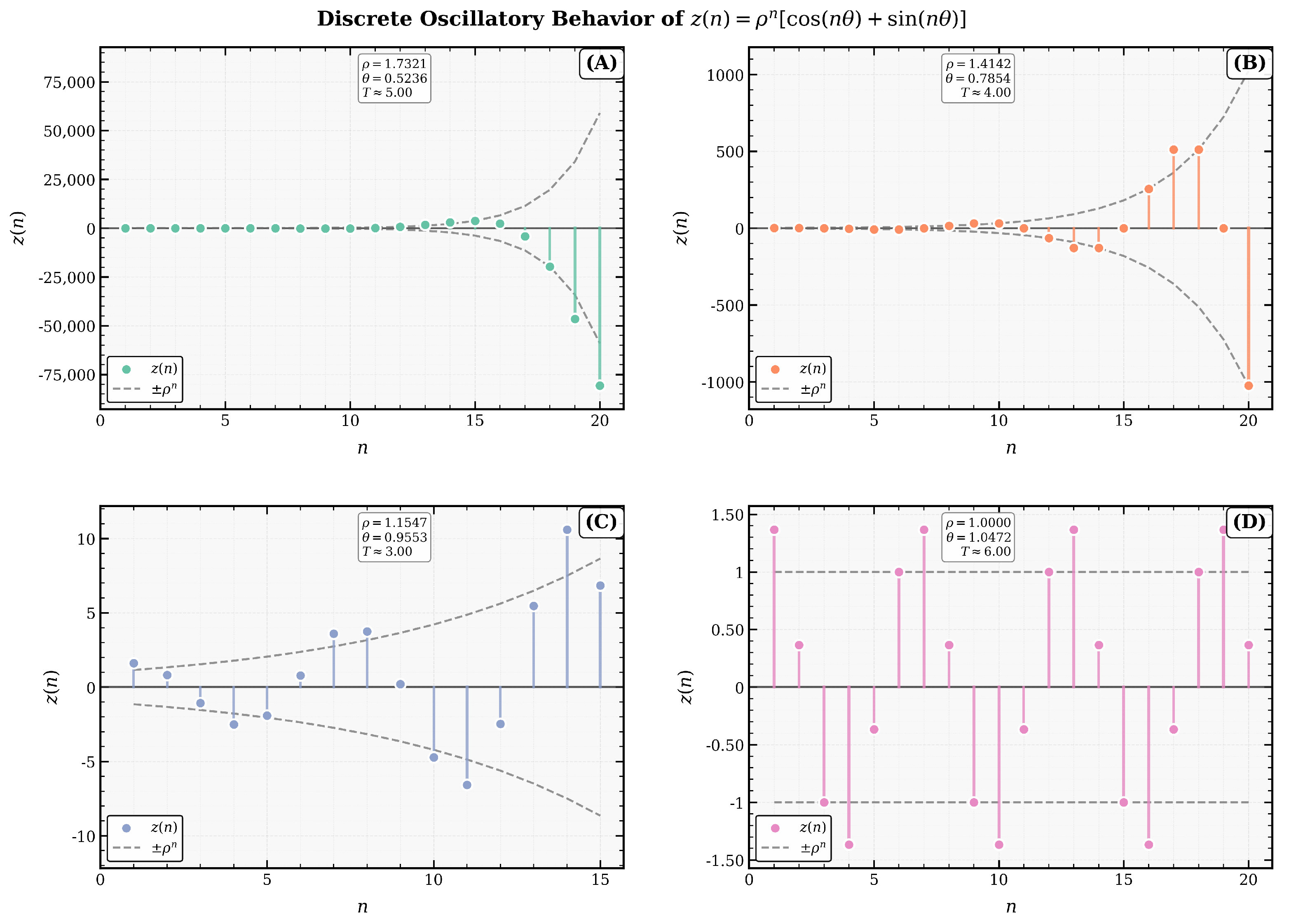
with and . In this example, we illustrate the concept of generalized zeros for solutions of advanced difference equations and their relation to both the sequences of coefficients and advanced arguments. Here, a generalized zero is a positive integer at which the solution is zero or has a different sign than at the preceding integer. Numerical simulations of Equation (
18)
reveal a clear dependence between the parameter μ and the distance between consecutive generalized zeros of the solutions. The numerical results show that the maximum interval length T, over which the solution remains positive (or negative), decreases as μ increases. Specifically, for , the corresponding lengths are and 3, respectively (see Figure 3). These findings highlight the importance of examining the spacing between successive generalized zeros in advanced-type difference equations, as such an analysis provides deeper insight into the qualitative oscillatory dynamics of these equations. It is worth noting that a systematic and independent study of the distance between generalized zeros for advanced difference equations is still needed to establish sharp and verifiable criteria for measuring this property. The distance between zeros has been widely studied in the context of delay differential equations; therefore, several analytical ideas developed in the continuous setting may be adapted and extended to the discrete framework. However, studying this property for advanced difference equations presents significant difficulties, due to the fundamentally different nature of their behavior in comparison with delay differential equations. In particular, the analysis of a lower bound for the distance between generalized zeros of solutions is not a straightforward extension of the corresponding results for differential equations, since it depends on the properties of the initial function, which, to the best of the authors’ knowledge, have not yet been defined for advanced difference equations.