1. Introduction
Accurate object detection in agricultural environments has become a critical research topic in modern precision agriculture due to the increasing demand for intelligent harvesting, automated monitoring, yield estimation, and agricultural robotics. Agricultural object detection systems are widely applied to tasks such as fruit recognition, disease identification, crop counting, maturity estimation, and autonomous harvesting, where reliable perception capability directly affects operational efficiency and agricultural productivity. Among these applications, fruit detection under natural field conditions remains particularly challenging because agricultural images are commonly affected by illumination variation, background clutter, overlapping fruits, scale variation, weather interference, motion blur, and partial occlusion caused by leaves and branches. These environmental disturbances significantly degrade the robustness and generalization capability of conventional object detection frameworks, thereby limiting their deployment in real-world agricultural scenarios.
Recent advances in deep learning and computer vision have substantially improved object detection performance across various domains. In particular, convolutional neural network (CNN)-based detectors and transformer-based architectures have demonstrated remarkable success in feature extraction and semantic representation learning. Single-stage detection frameworks such as the YOLO (You Only Look Once) series have attracted significant attention because of their high detection speed and competitive accuracy, making them suitable for real-time agricultural applications. The YOLO framework formulates object detection as a unified regression problem, enabling simultaneous localization and classification within a single forward inference process. Owing to its computational efficiency and end-to-end optimization capability, YOLO has been widely adopted in agricultural target detection tasks [
1,
2,
3,
4].
Despite the impressive progress of deep neural networks, object detection models still exhibit limited robustness under complex agricultural environments. Existing methods mainly improve performance through deterministic data augmentation strategies, including geometric transformation, brightness adjustment, flipping, noise injection, and image enhancement operations. Although these approaches increase training diversity to some extent, they usually fail to provide a mathematically consistent modeling mechanism for real-world environmental perturbations. Consequently, detectors trained using conventional augmentation strategies often suffer from performance degradation when encountering unseen environmental disturbances. Furthermore, standard augmentation operations generally lack probabilistic interpretability and cannot explicitly characterize the stochastic degradation process that naturally occurs in agricultural imaging systems.
To overcome these limitations, diffusion models have recently emerged as a powerful generative learning framework capable of modeling complex probability distributions through progressive stochastic perturbation and representation processes. Diffusion-based learning introduces a forward diffusion mechanism that gradually corrupts data distributions with Gaussian noise and a representation process that reconstructs meaningful representations from degraded observations. Due to their strong generative capability and stable optimization characteristics, diffusion models have achieved remarkable performance in image generation, restoration, denoising, super-resolution, and semantic representation tasks. Recent studies have demonstrated that diffusion mechanisms can effectively improve representation robustness and visual consistency under complex environments [
5,
6,
7,
8].
In agricultural computer vision, generative learning and diffusion-based methods have recently attracted increasing attention for addressing environmental uncertainty and limited data diversity. Min et al. [
9] comprehensively reviewed the integration of computer vision and generative models in agriculture and highlighted the potential of stochastic generative frameworks for robust agricultural perception. Similarly, several studies have investigated image enhancement and image restoration techniques to improve object detection performance under visually degraded conditions [
10,
11,
12,
13,
14,
15,
16]. However, most existing methods focus primarily on image generation or enhancement tasks rather than directly integrating diffusion mechanisms into object detection optimization frameworks.
Moreover, current diffusion-related object detection studies frequently introduce additional trainable diffusion modules, feature representation subnetworks, or latent-space generative architectures, which significantly increase model complexity and computational cost. Such designs may limit practical deployment in real-time agricultural systems where computational efficiency and inference speed are critical. In addition, many existing methods formulate diffusion processes within feature spaces or latent representations rather than directly in the image domain, thereby reducing the physical interpretability of image degradation and restoration processes.
To address these challenges, this study proposes a DROD framework for robust agricultural target detection under complex outdoor environments. Unlike conventional augmentation strategies or feature-level refinement methods, the proposed framework introduces a mathematically grounded forward–representation mechanism directly into the image domain. Specifically, stochastic perturbations are progressively generated through a forward diffusion process, while semantically meaningful image structures are reconstructed through a diffusion-guided representation process. The resulting noisy and reconstructed samples are jointly incorporated into the YOLO-based detection optimization framework, enabling diffusion-based regularization while preserving the original detection architecture and computational efficiency.
The core idea of the proposed framework is fundamentally different from ordinary noise augmentation. Traditional augmentation methods simply inject random perturbations into training images, whereas the proposed DROD framework establishes a probabilistic forward–representation interaction that simultaneously models stochastic degradation and semantic representation. Through this mechanism, the detector learns not only robustness against environmental perturbations but also structural consistency and semantic preservation under degraded visual conditions. Such a design is particularly suitable for agricultural environments where illumination variation, background interference, and partial occlusion are frequently encountered.
From a theoretical perspective, the proposed DROD framework establishes a unified mathematical formulation integrating agricultural image representation, stochastic diffusion modeling, reverse representation, and YOLO-based detection optimization. Specifically, the agricultural image is formulated as a vector-valued function over a two-dimensional spatial domain, while the forward diffusion process is modeled as a Markov chain progressively injecting Gaussian perturbations into the image space. The diffusion-guided representation process estimates and removes the injected noise to reconstruct semantically meaningful image representations. Finally, noisy and reconstructed images are jointly optimized through a unified detection objective.
Unlike existing empirical augmentation methods, the proposed framework additionally provides rigorous theoretical analysis regarding perturbation stability, representation consistency, detection robustness, and optimization convergence. Specifically, this study derives bounded perturbation analysis for the forward diffusion process, establishes Lipschitz stability conditions for the detection model, formulates explicit relationships between representation error and detection error, and proves convergence properties under stochastic optimization assumptions. These analyses provide a mathematically interpretable explanation for the robustness improvement achieved by the proposed framework.
In recent years, several studies have attempted to combine generative models, image enhancement techniques, and object detection frameworks for challenging visual environments. For example, Islam et al. [
17] proposed a fast-underwater image enhancement framework to improve visual perception under underwater degradation conditions. Li et al. [
18] established an underwater image enhancement benchmark dataset and investigated restoration-based visual enhancement approaches. Liu et al. [
19] explored robust underwater object detection under visually degraded marine environments. Similarly, Wang et al. [
20] investigated enhanced YOLO-based small-target detection in sonar imagery using data enhancement techniques. These studies demonstrate that environmental degradation significantly affects object detection performance and that image restoration or enhancement can improve robustness.
Particularly relevant to this study is the recent work [
21], which introduced a physics-informed generative adversarial framework for underwater image synthesis and object detection enhancement. This work demonstrated that physically meaningful image generation can effectively improve object detection performance in visually degraded underwater environments. By incorporating environmental modeling and image generation mechanisms into the learning process, the framework improved detection robustness under complex underwater conditions. The study highlights the importance of integrating physically interpretable degradation modeling into visual perception systems, which strongly motivates the present work. However, unlike GAN-based image synthesis frameworks that rely on adversarial optimization and additional generative modules, the proposed DROD framework introduces a mathematically grounded diffusion-based regularization mechanism directly in the image domain without increasing structural complexity. Furthermore, the proposed approach explicitly formulates stochastic perturbation, representation consistency, and detection robustness within a unified theoretical framework, thereby providing stronger analytical interpretability and optimization consistency for agricultural object detection tasks.
In addition to underwater vision studies, recent research has also explored generative learning for industrial inspection, anomaly detection, and medical image analysis. Xiao et al. [
22] proposed an adaptive industrial video anomaly detection framework empowered by edge intelligence. Slimi et al. [
23] combined YOLO, GAN synthesis, and hybrid learning strategies for gait classification tasks. Chen et al. [
24] introduced a lightweight detection framework using dynamic attention mechanisms for defect detection. These studies collectively demonstrate that generative learning and stochastic modeling techniques can effectively improve representation robustness under visually challenging conditions. Nevertheless, most existing approaches either focus on image generation tasks or require additional generative networks that increase computational burden.
Compared with these existing studies, the proposed DROD framework exhibits several unique characteristics. First, the diffusion mechanism is directly formulated in the image domain rather than in latent feature spaces, thereby preserving the physical interpretability of image degradation and restoration processes. Second, the proposed framework establishes explicit theoretical relationships between diffusion perturbation, representation accuracy, and detection robustness, providing rigorous mathematical support for the proposed regularization mechanism. Finally, the framework demonstrates strong architecture independence and can be integrated into different YOLO variants without structural modification.
To validate the effectiveness of the proposed method, extensive experiments were conducted using a self-constructed pineapple detection dataset containing 1600 real-world agricultural images captured under outdoor plantation conditions [
25]. Although the present study focuses on pineapple detection, the proposed DROD framework operates at the image level and is independent of crop-specific characteristics. Therefore, it can be readily integrated with existing object detectors for other agricultural object detection tasks, such as fruit, wheat, or orchard datasets. Comparative experiments involving YOLOv8-s, YOLOv8-L, conventional augmentation methods, and diffusion ablation configurations demonstrate that the proposed DROD framework consistently improves Precision, Recall, mAP@0.5, and mAP@0.5:0.95 across different model scales [
26,
27,
28,
29,
30,
31,
32]. In addition, ablation studies confirm that the observed performance improvement originates from the complete forward–representation interaction rather than simple noise injection alone. Visualization analysis further provides intuitive evidence illustrating how diffusion perturbation and semantic representation contribute to robust localization performance under complex agricultural environments.
Recent studies have further improved the robustness of visual recognition by enhancing feature representation and feature fusion mechanisms. For example, SCAFNet [
33] proposed a semantic compensated adaptive fusion network for remote sensing image change detection, where semantic compensation and adaptive CNN–Transformer feature fusion are employed to alleviate feature misalignment and suppress pseudo changes. By integrating local spatial details with global contextual information through cross-attention mechanisms, SCAFNet significantly improves detection robustness under complex scene variations. Although originally developed for remote sensing change detection, this work demonstrates the effectiveness of semantic-aware feature fusion for improving visual perception in challenging environments.
The major contributions of this paper are summarized as follows:
- (1)
A novel DROD framework is proposed for robust agricultural target detection under complex field environments.
- (2)
A mathematically grounded forward–representation mechanism is introduced directly in the image domain to achieve diffusion-based regularization.
- (3)
A unified optimization framework integrating stochastic diffusion perturbation, reverse representation, and YOLO-based detection is established.
- (4)
Rigorous theoretical analysis is developed to characterize perturbation bounds, detection stability, representation consistency, and stochastic optimization convergence.
- (5)
Extensive experiments and diffusion ablation studies demonstrate that the proposed DROD framework consistently outperforms conventional augmentation strategies and baseline detectors.
- (6)
Visualization analysis provides intuitive evidence explaining how diffusion perturbation and semantic representation improve localization robustness and detection completeness in complex agricultural environments.
The remainder of this paper is organized as follows.
Section 2 introduces the proposed DROD framework, including the agricultural image representation model, the forward diffusion process, the diffusion-guided representation formulation, the YOLO-based detection framework, the unified optimization strategy, the theoretical analysis, and the overall DROD procedure.
Section 3 presents the experimental setup, comparative evaluations with baseline models, traditional augmentation, and JTA:GAN, followed by diffusion ablation studies, sensitivity analysis of diffusion parameters, visualization analysis, and experimental validation of the theoretical robustness analysis. Finally,
Section 4 concludes the paper and outlines future research directions.
2. Methodology
In this section, we present the DROD framework for accurate recognition of pineapple targets in agricultural imagery. Unlike conventional approaches that rely on feature-level refinement, the proposed framework operates directly in the image domain, thereby preserving the physical interpretability of pixel-level information while maintaining full compatibility with standard object detection architectures.
The core idea of DROD is to incorporate a diffusion-based perturbation mechanism as a data augmentation strategy to enhance the robustness of the detection model against environmental noise, illumination variations, and background complexity. Specifically, noisy image samples are generated through a forward diffusion process and subsequently utilized to train a YOLO-based detection network.
We begin by establishing a rigorous mathematical representation of agricultural images and their associated annotations. Based on this formulation, a diffusion process is introduced in the image space to generate stochastic perturbations of the input data. The augmented dataset is then used to train a parameterized detection model.
Each subsection presents the necessary mathematical definitions, followed by formal derivations and algorithmic interpretations, ensuring that the entire framework is theoretically consistent, self-contained, and aligned with practical implementation.
2.1. Mathematical Representation of Agricultural Images
Before developing the proposed framework, it is essential to establish a rigorous mathematical formulation of agricultural image data. In real-world agricultural environments, images are often affected by complex backgrounds, varying illumination conditions, and partial occlusions, all of which increase the difficulty of reliable object detection. Therefore, a precise mathematical representation is required to support both theoretical analysis and algorithmic development.
In this study, an agricultural image is modeled as a vector-valued function defined over a two-dimensional spatial domain. Formally, let the image intensity function be defined as
where
denotes the spatial domain of the image,
represents the two-dimensional Euclidean coordinate space, and
corresponds to the RGB color space.
Let a spatial coordinate in the image domain be denoted by
where
and
represent the horizontal and vertical coordinates, respectively.
Accordingly, the image intensity at spatial location
can be expressed as
where
,
, and
denote the red, green, and blue channel intensities at spatial coordinate
.
For computational purposes, the continuous image function is discretized and represented as a tensor:
where
H and
W denote the height and width of the image, respectively.
Next, the agricultural image dataset used for training is formally defined as
where
denotes the total number of samples,
represents the
i-th image,
denotes the corresponding bounding box annotation, and
is the class label.
The bounding box associated with the
i-th image is defined as
where
denote the center coordinates of the bounding box, and
,
represent its width and height, respectively.
Through the above formulation, the agricultural dataset is rigorously represented as a collection of image functions defined over a spatial domain together with their corresponding annotation structures. This representation provides a mathematically consistent foundation for subsequent stochastic modeling and learning procedures.
Importantly, all subsequent operations in this work are conducted directly in the image space. This design choice ensures consistency with the physical interpretation of image degradation processes and maintains alignment between theoretical modeling and practical implementation.
Accordingly, the next subsection introduces a diffusion-based perturbation mechanism defined in the image domain, which serves as the core component of the proposed DROD framework.
2.2. Diffusion Forward Process
To enhance robustness against environmental noise and imaging degradations, this study introduces a stochastic diffusion process directly in the image space. Unlike conventional approaches that operate on feature representations, the proposed formulation perturbs the raw pixel intensities of the input image, thereby preserving the physical interpretability of the degradation process.
The fundamental idea of the forward diffusion process is to progressively corrupt an input image by injecting Gaussian noise over a sequence of timesteps. This formulation enables the learning system to become invariant to noise, illumination variations, and background disturbances, which are commonly encountered in agricultural imaging scenarios.
Let
denote the original clean image, and let
denote the noisy image at diffusion timestep
t. The forward diffusion process is defined as a Markov chain:
where the sequence
progressively transitions from the original image to a noise-dominated distribution.
The conditional transition probability is defined as:
where
denotes a multivariate Gaussian distribution,
is a predefined variance schedule controlling the noise intensity, and
denotes the identity covariance matrix.
For notational convenience, we define:
and the cumulative product
which represents the accumulated signal preservation factor up to timestep
t.
By recursively applying the Markov transition, the noisy image at timestep
t can be expressed in closed form as:
where
denotes the original clean image and
is standard Gaussian noise.
This formulation shows that the forward diffusion process gradually transforms the original image into a Gaussian distribution as the timestep increases. In particular, for sufficiently large t, the distribution of approaches an isotropic Gaussian distribution, effectively removing the structural information contained in .
Through this process, a diverse set of noisy image samples can be generated, which serve as augmented data for improving model robustness. Importantly, since the perturbation is applied directly in the image domain, the generated samples remain consistent with real-world degradation patterns, such as sensor noise and illumination variations.
In contrast to feature-level diffusion models, the proposed image-level formulation avoids introducing additional representation dependencies and ensures consistency between theoretical modeling and the underlying data domain.
The generated noisy samples will be utilized in the subsequent detection framework, where both clean images and perturbed images contribute to improving the generalization capability of the object detection model.
2.3. Diffusion-Guided Representation
In the forward diffusion process, the original image is progressively corrupted by Gaussian noise as the diffusion timestep increases. Consequently, the noisy observation gradually loses its structural and semantic information, eventually approaching an isotropic Gaussian distribution. To characterize the restoration of diffusion-perturbed images, a diffusion-guided representation formulation is introduced to model the estimation and removal of injected noise from noisy observations.
By accurately estimating this noise, the model can reconstruct an approximation of the original clean image from its corrupted counterpart. For theoretical completeness, a noise-estimation function is introduced to characterize the diffusion-guided representation formulation.
Let the noise estimation function be denoted by
where
denotes a parameterized noise-estimation function used to characterize the representation process in the diffusion-guided representation formulation. The objective of this formulation is to characterize the Gaussian noise component introduced during the forward diffusion process.
Given a noisy image
at timestep
t, the noise-estimation function produces an estimate of the corresponding noise component as
which approximates the true noise sample
.
To characterize the consistency between noisy observations and reconstructed image representations, the following representation objective is introduced:
where
denotes the Euclidean norm,
is the original image,
t is a randomly sampled timestep, and
is the Gaussian noise used in the forward process.
This objective quantifies the discrepancy between the estimated and injected noise components and serves as a theoretical measure of representation consistency. Once the noise component has been estimated, an approximation of the original image representation can be obtained as
is the cumulative noise coefficient defined in the forward diffusion process.
is introduced as a theoretical representation formulation for diffusion-guided analysis and is not implemented as a separate trainable denoising network in the YOLOv8-based DROD framework.
This formulation characterizes the removal of the estimated noise component from the noisy observation, thereby providing an approximation of the underlying image representation.
It is important to emphasize that the diffusion-guided representation formulation is introduced primarily as a theoretical framework for analyzing the restoration of diffusion-perturbed image representations in the image domain. By characterizing the removal of injected Gaussian perturbations, the reverse formulation provides a mathematical interpretation of how structural image information can be restored from corrupted observations.
This formulation complements the forward diffusion process and establishes a unified probabilistic interpretation of image degradation and restoration. In particular, it characterizes how structural and semantic information can be progressively reconstructed from noisy observations.
Furthermore, the diffusion-guided representation process offers insight into the stability and robustness of images under noise corruption. By modeling the restoration trajectory, it becomes possible to understand how noise affects image structure and how such effects can be systematically mitigated.
Consequently, the diffusion formulation establishes a coherent analytical framework for studying both image corruption and restoration in a unified manner. This perspective is particularly relevant in complex environments where noise, illumination variations, and background clutter are prevalent.
In the subsequent subsection, the diffusion-perturbed images are incorporated into the object detection pipeline, enabling robust localization and recognition of pineapple targets in challenging agricultural environments.
2.4. YOLO Detection Model
Following the diffusion-based augmentation process defined in the previous subsection, the next step is to construct an object detection model capable of accurately identifying pineapple targets in agricultural images. In this study, the detection module is built upon the YOLO architecture, which formulates object detection as a single-stage regression problem.
Unlike traditional multi-stage detection frameworks, the YOLO architecture directly predicts object locations and class probabilities from an input image in a single forward pass. This design enables efficient end-to-end training and real-time inference, making it particularly suitable for agricultural applications.
To ensure consistency with the image-level diffusion formulation, the detection process is defined as a parameterized mapping operating directly on the image domain rather than on intermediate representations.
Let
denote an input image, which may correspond to the original clean image
, a diffusion-perturbed sample
, or a reconstructed image
obtained from the diffusion-guided representation formulation. The YOLO detection model is defined as a mapping:
where
represents the predicted detection tensor and .
denotes the YOLO detection function parameterized by .
represents the set of trainable network parameters.
The output of the detection network is given by
where
For each grid cell, the prediction vector can be decomposed as
where
denotes the objectness score, representing the probability that an object exists within the region.
denotes the class probability vector over C categories.
represents the bounding box parameters.
The bounding box is defined as
where
, denote the center coordinates of the bounding box.
, denote the width and height of the bounding box, respectively.
In the proposed DROD framework, the input to the detection model is drawn from the set , thereby incorporating clean, perturbed, and reconstructed images within a unified formulation. This training strategy enables the network to learn noise-invariant representations implicitly through exposure to diverse image conditions.
It is important to emphasize that no additional feature extraction module is introduced in this work. Instead, the representation learning process is inherently handled within the YOLO architecture, ensuring that the overall framework remains computationally efficient and structurally consistent.
By exposing the detection model to a diverse set of noisy and reconstructed observations during training, the proposed approach improves robustness against real-world disturbances such as illumination variations, sensor noise, and background clutter. Consequently, the detection performance is expected to be more stable and reliable in complex agricultural environments.
Finally, it is worth noting that the diffusion formulation is consistently defined within the image domain, and the training objective depends solely on the detection loss, as will be described in the following subsection.
2.5. Training Objective and Optimization Framework
To establish a mathematically rigorous and unified learning framework, this subsection integrates the diffusion forward process, diffusion-guided representation process, and the YOLO-based detection model into a single optimization formulation. This integration enables a direct analytical connection between noisy observations, reconstructed images, and detection outputs.
2.5.1. Training Dataset Formulation
Let the original dataset be defined as
where
denotes the
i-th clean input image,
denotes the corresponding bounding box annotation, defined as
, where
and
represent the center coordinates of the bounding box, and
,
denote its width and height, respectively, and
denotes the class label associated with the target object.
Based on the forward diffusion process in (7), noisy samples are generated as
Since the diffusion process preserves spatial structure, the corresponding annotations remain unchanged:
2.5.2. Diffusion-Guided Representation
Following the diffusion-guided representation formulation in (15), the reconstructed image is defined as
where
denotes the representation of the original clean image from the noisy observation
.
2.5.3. Detection Mapping Integration
Based on the detection model defined in (16), the YOLO network produces predictions from both noisy and reconstructed images:
where
denotes the YOLO detection function parameterized by .
denote the detection outputs.
This formulation establishes dual input pathways for the detection model, enabling learning from both perturbed and reconstructed image distributions.
2.5.4. Training Objective
The overall optimization objective is defined as
where
2.5.5. Detection Loss Formulation
Detection Loss Formulation
where
denotes the bounding box regression loss (e.g., IoU-based loss).
denotes the objectness loss.
denotes the classification loss.
2.5.6. Optimization Scheme
Let
denote the parameters of the YOLO detection network. The training problem is formulated as
The training process is performed using stochastic gradient descent (SGD) or its variants. At iteration
k, the parameter update is given by:
where
The learning rate sequence
is assumed to satisfy standard convergence conditions:
which guarantees convergence to a stationary point under standard stochastic optimization assumptions.
2.5.7. Discussion
The incorporation of the reconstructed image establishes an explicit linkage between the diffusion-guided representation process and the object detection task. By jointly utilizing noisy observations and reconstructed images , the proposed framework enables the propagation of representation characteristics into the detection objective.
From a theoretical perspective, this formulation induces a closed-loop structure:
which provides a principled basis for analyzing how diffusion-induced perturbations and representation errors influence detection performance. This structure is particularly crucial for the subsequent theoretical analysis, where explicit bounds on representation error can be systematically related to detection accuracy.
2.6. Theoretical Properties and Stability Analysis
To rigorously analyze the robustness and convergence properties of the proposed DROD framework, we establish a series of theoretical results that characterize the relationships among diffusion-induced perturbations, representation accuracy, and object detection performance in the image domain.
Specifically, the analysis addresses the following aspects:
- (1)
Bounded perturbation induced by the forward diffusion process.
- (2)
Stability of the detection model under input perturbations.
- (3)
Propagation of diffusion and representation errors to detection outputs.
- (4)
Convergence of the training process under stochastic optimization.
These results provide a mathematically grounded explanation for the robustness enhancement achieved by the proposed framework.
Lemma 1 (Bound on Diffusion-Induced Image Perturbation). Let denote the original image and
be the noisy image generated by the forward diffusion process Equation (11):
Then, the perturbation between and satisfies
Proof. From Equation (11), we compute the difference:
Taking the Euclidean norm on both sides gives
By applying the triangle inequality, we obtain
Factoring out the scalar coefficients yields
Since , we have .
Therefore,
which completes the proof. □
Theorem 1 (Lipschitz Stability of Detection Model)
. Assume that the detection function is Lipschitz continuous, i.e., there exists a constant such that for all , .
Then, the detection deviation induced by diffusion satisfies Proof. By the Lipschitz continuity of
, for any inputs
and
, we have
Setting
and
, we directly obtain
which completes the proof. □
2.6.1. Practical Remark
The Lipschitz continuity assumption adopted in Theorem 1 is a standard theoretical condition widely used in the stability analysis of deep neural networks. It provides a mathematically tractable framework for characterizing the sensitivity of detection outputs to input perturbations. However, for modern deep architectures such as YOLOv8, which incorporate multiple nonlinear operations and SiLU activation functions, obtaining an explicit Lipschitz constant is generally difficult in practice. Therefore, the constant () should be interpreted as a theoretical stability parameter rather than a directly computable quantity. The purpose of this assumption is to establish a rigorous analytical connection between diffusion-induced perturbations and detection robustness, rather than to provide an exact numerical bound for a specific network implementation.
Theorem 2 (Detection Error Bound with Representation)
: Let denote the reconstructed image defined in (23). Assume that is Lipschitz continuous with constant . Then, the detection error satisfiesFurthermore, combining with Lemma 1 yields Substituting (39) into (45) Proof. Using the triangle inequality,
By substituting (39) into (48), we obtain (49); subsequently, inserting (49) into (44) yields (50).
This completes the proof. □
Corollary 1 (Detection Robustness under Diffusion and Representation). The detection error Equation (50) is bounded by both the diffusion noise magnitude and the representation accuracy. This result shows that improving representation accuracy (i.e., reducing ) and controlling diffusion noise jointly enhance detection robustness.
Theorem 3 (Convergence of the Training Process). Let the objective function ) defined in (26) be continuously differentiable.
Assume that its gradient is Lipschitz continuous, i.e., there exists a constant
Consider the stochastic gradient descent update:
Assume that:
- (1)
is continuously differentiable.
- (2)
is Lipschitz continuous.
- (3)
The learning rate sequence satisfies Equations (30) and (31).
Proof. By the Lipschitz continuity of the gradient, the loss function satisfies the smoothness condition:
Substituting the update rule
Summing both sides over
k = 1 to
T, we obtain
Under the condition
, it follows that
which implies convergence to a stationary point. □
2.6.2. Summary
The above theoretical results establish a rigorous connection between diffusion modeling and object detection performance:
- (1)
The diffusion forward process introduces bounded perturbations in the image domain.
- (2)
The detection model remains stable under such perturbations due to Lipschitz continuity.
- (3)
Detection error is explicitly controlled by both diffusion noise and representation accuracy.
These results provide a solid theoretical foundation for the robustness and effectiveness of the proposed DROD framework in complex agricultural environments.
2.7. DROD Procedure
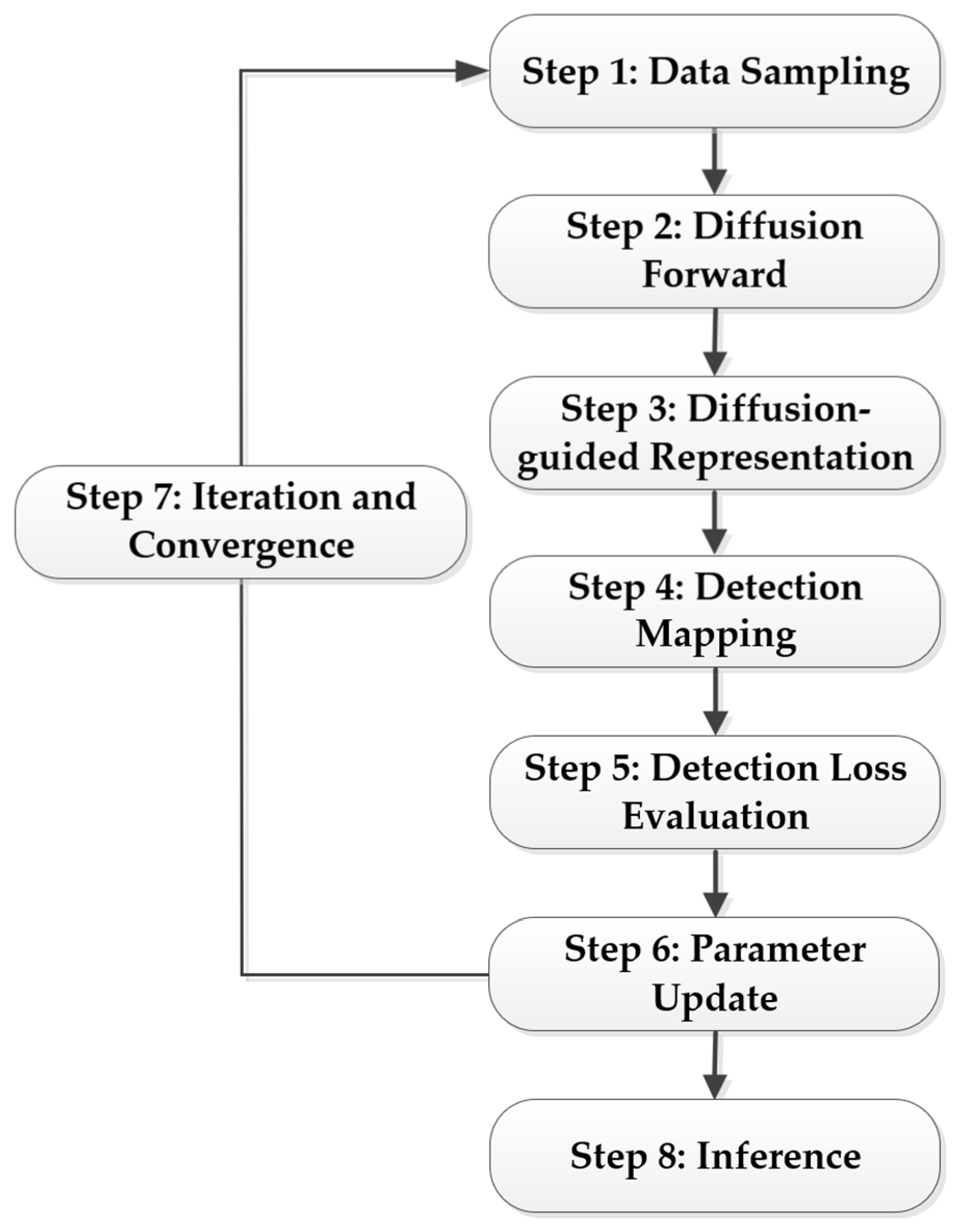
To facilitate reproducibility and provide a clear understanding of the proposed framework,
Figure 1 illustrates the overall workflow of the proposed DROD framework. The workflow summarizes the complete algorithmic procedure, including data sampling, forward diffusion, diffusion-guided representation, detection mapping, detection loss evaluation, parameter update, iteration and convergence, and inference. Based on this workflow, the proposed DROD framework is implemented according to the mathematical formulations presented in
Section 2.2,
Section 2.3,
Section 2.4 and
Section 2.5. The corresponding algorithmic procedure is summarized as follows.
Based on the workflow illustrated in
Figure 1, this subsection presents the complete algorithmic procedure of the proposed DROD framework to ensure reproducibility and provide a mathematically consistent implementation framework. The procedure strictly follows the image-level diffusion model, diffusion-guided representation, and detection mapping established in the preceding sections.
2.7.1. Algorithm
- Step 1:
Data Sampling
For each iteration, sample a mini-batch
where
- Step 2:
Diffusion Forward
Generate noisy images using (11):
- Step 3:
Diffusion-guided Representation
Formulate the clean image using (23):
This step establishes the representation pathway:
- Step 4:
Detection Mapping
Compute detection outputs using (24) and (25):
where
denotes the YOLO detection function parameterized by .
denote the detection outputs.
- Step 5:
Detection Loss Evaluation
Compute detection losses:
denotes the bounding box regression loss (e.g., IoU-based loss).
denotes the objectness loss.
denotes the classification loss.
- Step 6:
Parameter Update
Update parameters using stochastic gradient descent:
with learning rate conditions:
- Step 7:
Iteration and Convergence
Repeat Steps 1–6 until convergence:
- Step 8:
Inference
Given a new input image :
2.7.2. Discussion
The proposed DROD algorithm establishes a unified computational pipeline that integrates diffusion perturbation, reverse representation, and object detection within a mathematically consistent framework.
The key structural flow can be summarized as:
This formulation ensures that both noisy observations and reconstructed images contribute to the learning process, enabling the model to capture noise-invariant representations while preserving structural information.
From a theoretical perspective, the inclusion of the representation pathway
directly connects the diffusion-guided representation process to the detection objective, thereby enabling the analytical results in
Section 3.6, where representation error and detection error are explicitly linked.
2.7.3. Summary of the Methodology
The proposed DROD framework consists of the following components:
- (1)
A rigorous mathematical representation of agricultural images and annotations.
- (2)
A stochastic forward diffusion process defined in the image domain.
- (3)
A diffusion-guided representation process for recovering semantically meaningful image representations from diffusion-perturbed inputs.
- (4)
A YOLO-based detection model formulated as a parameterized mapping
- (5)
A unified optimization framework integrating noisy and reconstructed inputs.
- (6)
A theoretically grounded algorithm ensuring convergence and robustness.
Collectively, these components establish a mathematically rigorous and fully reproducible framework for object detection in agricultural imagery, bridging stochastic image modeling with modern detection architectures under a unified theoretical foundation.
3. Experiments and Results
This section presents a comprehensive experimental evaluation of the proposed DROD framework for pineapple target detection in complex agricultural environments. The primary objective of the experiments is to validate whether the proposed diffusion-based regularization strategy can effectively improve detection accuracy, robustness, and generalization performance compared with conventional object detection pipelines.
Unlike traditional augmentation methods that rely on deterministic geometric or photometric transformations, DROD introduces a stochastic forward–representation mechanism in the image domain, enabling the detector to learn more robust feature representations under environmental disturbances such as illumination variation, background clutter, and partial occlusion. Therefore, the experimental design is not limited to performance comparison alone, but further aims to investigate the specific contribution of each diffusion component within the proposed framework.
To ensure a fair and rigorous evaluation, all comparative models are trained under identical conditions using the same dataset partition, optimization settings, and evaluation metrics. Both lightweight and large-scale YOLOv8 architectures are adopted to verify the general applicability of DROD across different model capacities. In addition, an ablation study is conducted to analyze the effectiveness of the forward diffusion process, the diffusion-guided representation mechanism, and the complete DROD framework. Finally, qualitative visualization results are provided to offer intuitive evidence of how diffusion-based regularization improves detection performance in practical agricultural scenarios.
The remainder of this section is organized as follows.
Section 3.1 describes the experimental setup, including the dataset, implementation details, training configuration, and evaluation metrics.
Section 3.2 presents a comprehensive comparison among the baseline YOLOv8 models, conventional data augmentation, the recent JTA:GAN method, and the proposed DROD framework.
Section 3.3 investigates the effectiveness of the proposed diffusion mechanism through ablation studies.
Section 3.4 analyzes the sensitivity of the proposed framework under different diffusion parameter configurations.
Section 3.5 provides qualitative visualization results to illustrate the diffusion-guided representation process and the detection performance of different methods. Finally,
Section 3.6 presents experimental validation of the theoretical robustness analysis under different perturbation levels, providing quantitative evidence to support the theoretical findings presented in
Section 2.
3.1. Experimental Setup
To comprehensively evaluate the effectiveness of the proposed DROD framework, a self-constructed pineapple detection dataset was established using real-world agricultural images collected under outdoor field conditions. A total of 1600 pineapple images were manually captured using a high-resolution digital camera in natural plantation environments. The dataset contains various challenging scenarios commonly encountered in practical agricultural applications, including illumination variation, background clutter, partial occlusion caused by leaves, overlapping fruits, and scale variation resulting from different shooting distances. These factors significantly increase the difficulty of accurate object detection and therefore provide a realistic benchmark for evaluating model robustness.
Each image was manually annotated using bounding-box labels corresponding to pineapple targets to ensure annotation accuracy and consistency. The entire dataset was divided into training, validation, and testing subsets with a ratio of 70%, 20%, and 10%, respectively. Specifically, 1120 images were used for training, 320 images were allocated for validation, and 160 images were reserved for final testing. This partition strategy ensures sufficient training diversity while maintaining an independent test set for generalization assessment. The dataset was carefully partitioned into training, validation, and test subsets to minimize potential data leakage during model evaluation.
All input images were resized to a unified resolution of 640 × 640 pixels before training to ensure compatibility with the standard input requirements of the YOLOv8 object detection framework. This resolution provides a practical balance between computational efficiency and detection accuracy for agricultural targets of varying scales.
To investigate the effectiveness of diffusion-based regularization, all comparative methods were constructed from the same set of manually captured images. The baseline YOLOv8 models were trained directly using the original training images. For the conventional augmentation setting, augmented samples were generated from the same training images using geometric transformations and noise perturbations. For the proposed DROD framework, diffusion-perturbed images and their corresponding reconstructed representations were generated from the original training images through the forward diffusion and representation processes described in
Section 2. No additional manually annotated images were introduced during training. Consequently, all methods were developed from the same underlying dataset, ensuring that performance differences originate from the learning strategy rather than from additional data acquisition.
All experiments were conducted on a workstation manufactured by MSI (Micro-Star International), located in Zhonghe District, New Taipei City, Taiwan, equipped with an Intel(R) Core(TM) i7-10875H CPU @ 2.30 GHz, 32 GB RAM, and an NVIDIA GeForce RTX 2080 Super with Max-Q Design GPU containing 8 GB memory. The experimental environment was implemented using Python 3.11.9, the PyTorch 2.2.2 deep learning framework, and the Ultralytics YOLOv8 library. The proposed DROD framework was integrated into the standard YOLOv8 training pipeline without modifying the original network architecture.
To ensure fair comparison, all models were trained using identical optimization settings. The Adam optimizer was adopted with an initial learning rate of 0.001, a batch size of 16, and a maximum of 300 training epochs. Early stopping based on validation performance was employed to prevent overfitting and improve training stability.
For the conventional augmentation baseline, several widely used image transformation strategies were employed, including a 50% probability of horizontal flipping, a 50% probability of vertical flipping, random rotation within the range of −15° to +15°, random brightness adjustment from 0% to 25%, Gaussian noise injection, and salt-and-pepper noise applied to 5% of image pixels. These augmentation techniques simulate common visual disturbances encountered in agricultural environments and therefore serve as a strong baseline for comparison.
To quantitatively evaluate detection performance, four widely adopted object detection metrics were employed, namely Precision, Recall, mean Average Precision at an Intersection-over-Union threshold of 0.5 (mAP@0.5), and mean Average Precision averaged over IoU thresholds ranging from 0.5 to 0.95 (mAP@0.5:0.95). Precision measures the reliability of positive predictions, whereas Recall evaluates the ability of the detector to identify target objects. The mAP@0.5 metric reflects overall detection accuracy under standard localization requirements, while mAP@0.5:0.95 provides a more comprehensive evaluation under increasingly strict localization criteria.
In addition to detection accuracy, computational efficiency was evaluated using three commonly adopted deployment-oriented metrics: the number of trainable parameters (Parameters), floating-point operations (FLOPs), inference time and frames per second (FPS). Parameters and FLOPs reflect model complexity and computational cost, whereas inference time and FPS directly characterizes real-time processing capability. These metrics provide a comprehensive evaluation of the trade-off between detection accuracy and deployment efficiency, which is particularly important for practical agricultural applications requiring lightweight implementation and low-latency operation.
All experiments were conducted under identical training conditions, optimization settings, and evaluation protocols. This unified experimental design ensures that any observed performance improvements can be attributed to the proposed diffusion-based regularization mechanism rather than to differences in training configuration, model architecture, or dataset composition.
3.2. Baseline, Augmentation, JTA:GAN, and DROD Comparison
This section aims to investigate whether the proposed DROD framework can achieve superior detection performance and computational efficiency compared with the original YOLOv8 detector, conventional data augmentation strategies, and the recent JTA:GAN method [
21]. The primary objective is to verify whether the observed performance improvement originates from the proposed diffusion-based regularization mechanism rather than from conventional augmentation operations or additional generative modules.
To ensure a comprehensive and fair comparison, two representative YOLOv8 architectures with different model capacities were selected, namely YOLOv8-s and YOLOv8-L, corresponding to lightweight and large-scale detection models, respectively. For each architecture, four training strategies were considered: the original baseline model without additional augmentation, the model trained with conventional augmentation techniques, the model enhanced by the JTA:GAN method, and the model trained using the proposed DROD framework. Consequently, a total of eight comparative models were evaluated:
The conventional augmentation setting includes a 50% probability of horizontal flipping, a 50% probability of vertical flipping, random rotation within the range of −15° to +15°, random brightness adjustment from 0% to 25%, Gaussian noise injection, and salt-and-pepper noise applied to 5% of image pixels. These augmentation operations represent commonly adopted strategies for improving model generalization in agricultural image analysis and therefore serve as a strong baseline for comparison.
Table 1 presents the quantitative results of all comparative models in terms of Precision, Recall, mAP@0.5, mAP@0.5:0.95, parameter count (Parameters), FLOPs, inference time and FPS. The inclusion of computational efficiency metrics enables a comprehensive evaluation of both detection accuracy and deployment capability, which are critical considerations for real-time agricultural applications requiring lightweight implementation and low-latency operation.
The results clearly demonstrate that conventional augmentation improves detection performance compared with the original baseline models for both YOLOv8-s and YOLOv8-L. This observation indicates that geometric transformations and noise injection can partially enhance model robustness by increasing data diversity during training. Nevertheless, the performance gains achieved by traditional augmentation remain relatively limited, particularly under the stricter localization criterion represented by mAP@0.5:0.95.
Compared with traditional augmentation, the recently proposed JTA:GAN method achieves further performance improvements across all evaluation metrics, indicating the effectiveness of generative augmentation strategies for agricultural object detection. However, these gains are accompanied by increased computational complexity, as reflected by the higher parameter count, FLOPs, inference time and FPS resulting from the additional generative module.
In contrast, the proposed DROD framework consistently achieves the highest performance across all evaluation metrics and model scales. For the lightweight YOLOv8-s model, DROD improves mAP@0.5 from 87.9% to 91.7% and increases mAP@0.5:0.95 from 71.5% to 75.8%, corresponding to gains of 3.8% and 4.3%, respectively. Similarly, for the larger YOLOv8-L model, DROD increases mAP@0.5 from 90.9% to 93.6% and improves mAP@0.5:0.95 from 75.4% to 79.0%, yielding improvements of 2.7% and 3.6%, respectively. Moreover, DROD consistently outperforms JTA:GAN while maintaining computational complexity and inference speed comparable to those of the original YOLOv8 architecture.
More importantly, the improvement achieved by DROD is consistently greater than that obtained through both conventional augmentation and JTA. This observation suggests that the proposed framework does not merely function as an additional augmentation strategy, but rather introduces a more effective diffusion-based regularization mechanism. By exposing the detector to diffusion-perturbed image distributions, DROD encourages the learning of more robust and discriminative representations under complex agricultural conditions.
Another important observation is that the proposed DROD framework remains effective across different model capacities. Both the lightweight YOLOv8-s and the large-scale YOLOv8-L benefit substantially from diffusion-based regularization, indicating that the proposed approach is largely architecture-independent and can be generalized to detectors of different scales without requiring modifications to the original network structure.
From the perspective of practical deployment, DROD achieves a favorable balance between detection accuracy and computational efficiency. Unlike JTA:GAN, which introduces additional computational overhead, DROD preserves nearly the same parameter count, FLOPs, inference speed and FPS as the original YOLOv8 models while delivering the highest detection accuracy. This characteristic is particularly advantageous for real-time agricultural applications requiring lightweight implementation and low-latency operation.
Overall, these results verify that DROD consistently improves detection performance across different model scales while maintaining excellent computational efficiency. The findings provide strong empirical evidence supporting the effectiveness of diffusion-based regularization for agricultural object detection and further validate the theoretical framework established in
Section 2.
3.3. Diffusion Ablation Study
This section presents the most critical experiment of this study, namely the diffusion ablation analysis of the proposed DROD framework. The primary objective of this experiment is to determine whether the observed performance improvement truly originates from the diffusion mechanism itself, rather than from simple noise perturbation or partial representation effects.
To address this issue, three representative model variants were designed for comparison while maintaining the same YOLOv8 detection backbone and identical training settings. These models are defined as follows:
YOLOv8 + Forward Diffusion Only
In this setting, only the forward diffusion process is applied to the input images, where stochastic Gaussian perturbations are gradually introduced into the image space. The noisy samples generated by the forward process are directly used for detector training without applying representation.
YOLOv8 + Representation Only
In this setting, the detector is trained using reconstructed images obtained from diffusion-perturbed observations without explicitly performing progressive stochastic perturbation during training. This configuration evaluates whether representation alone can provide sufficient regularization benefits.
YOLOv8 + Full DROD
This represents the complete proposed framework, where both the forward diffusion process and the representation mechanism are jointly incorporated into the training pipeline. The detector learns from both noisy and reconstructed image distributions, thereby achieving diffusion-based regularization in the image domain.
The purpose of this ablation study is to verify whether the performance gain is achieved by the complete diffusion-based regularization mechanism rather than by simple noise perturbation alone.
Table 2 summarizes the quantitative results of the three diffusion configurations in terms of Precision, Recall, mAP@0.5, and mAP@0.5:0.95.
The results reveal that the Forward Diffusion Only configuration provides only limited improvement compared with the corresponding baseline models. For YOLOv8-s, mAP@0.5 increases from 87.9% to 88.5%, while mAP@0.5:0.95 improves from 71.5% to 72.3%. Similarly, for YOLOv8-L, mAP@0.5 increases from 90.9% to 91.4% and mAP@0.5:0.95 increases from 75.4% to 76.1%. These results indicate that stochastic perturbation can improve training diversity and enhance robustness to a certain extent. However, forward diffusion alone behaves similarly to conventional noise augmentation and cannot fully exploit the potential benefits of diffusion-based regularization.
The Representation Only configuration consistently outperforms the Forward Diffusion Only model across all evaluation metrics. For YOLOv8-s, mAP@0.5 increases from 88.5% to 89.7%, while mAP@0.5:0.95 improves from 72.3% to 73.6%. Likewise, for YOLOv8-L, mAP@0.5 increases from 91.4% to 92.3%, and mAP@0.5:0.95 improves from 76.1% to 77.1%. These improvements suggest that representation contributes positively to preserving structural consistency and enhancing feature learning. By recovering meaningful image representations from diffusion-perturbed observations, the detector can learn more stable and discriminative object features. Nevertheless, the performance remains lower than that achieved by the complete DROD framework, indicating that representation alone cannot fully capture the robustness benefits introduced by stochastic perturbation.
In contrast, the Full DROD configuration achieves the best performance across all evaluation metrics and model scales. For YOLOv8-s, mAP@0.5 reaches 91.7% and mAP@0.5:0.95 reaches 75.8%, corresponding to improvements of 3.2% and 3.5%, respectively, compared with the Forward Diffusion Only configuration. Relative to the Representation Only model, additional gains of 2.0% and 2.2% are obtained.
Similarly, for YOLOv8-L, the Full DROD framework achieves an mAP@0.5 of 93.6% and an mAP@0.5:0.95 of 79.0%. Compared with the Forward Diffusion Only configuration, the complete framework improves mAP@0.5 by 2.2% and mAP@0.5:0.95 by 2.9%. Compared with the Representation Only configuration, additional improvements of 1.3% and 1.9% are achieved, respectively.
These results clearly demonstrate that the performance improvement cannot be attributed solely to noise perturbation or representation individually. Instead, the combination of forward diffusion and representation provides complementary benefits. The forward process introduces stochastic perturbations that enhance robustness against environmental uncertainty, whereas the representation process preserves structurally meaningful information and improves feature consistency. The interaction between these two mechanisms enables the detector to learn both robustness and discriminative capability simultaneously, which is particularly beneficial for agricultural object detection in complex outdoor environments.
From a theoretical perspective, this ablation study provides strong empirical support for the mathematical framework established in
Section 2. The experimental results verify that the proposed DROD framework functions as an effective diffusion-based regularization strategy rather than as a conventional augmentation method. Therefore, the superior performance of DROD can be attributed to the synergistic interaction between diffusion perturbation and representation, which constitutes the core contribution of this work.
3.4. Sensitivity Analysis of Diffusion Parameters
To further investigate the influence of diffusion-related hyperparameters on the proposed DROD framework, a sensitivity analysis was conducted by varying the diffusion steps together with the corresponding noise levels. Since the diffusion process determines the magnitude of stochastic perturbations introduced during training, selecting an appropriate diffusion configuration is important for balancing robustness enhancement and the preservation of discriminative image information.
Table 3 and
Table 4 summarize the experimental results obtained under different diffusion configurations for the YOLOv8-s and YOLOv8-L models, respectively. It can be observed that relatively weak diffusion configurations (e.g., (T = 50), (σ = 0.02)) provide limited regularization effects, resulting in comparatively lower detection performance. As the diffusion configuration is gradually strengthened, the detection accuracy consistently improves for both models and reaches the best performance at (T = 200) and (σ = 0.06). Under this setting, the proposed DROD framework achieves the highest detection accuracy, reaching 91.7% mAP@0.5 and 75.8% mAP@0.5:0.95 for YOLOv8-s, and 93.6% mAP@0.5 and 79.0% mAP@0.5:0.95 for YOLOv8-L.
When the diffusion configuration is further increased (e.g., (T = 300) and (400) with higher noise levels), a slight decrease in detection performance is observed for both models. This phenomenon suggests that excessively strong perturbations may gradually weaken discriminative image information, thereby reducing the effectiveness of detector training. Nevertheless, the overall performance variation remains relatively small, indicating that the proposed DROD framework is not overly sensitive to moderate variations in the diffusion parameters.
Overall, the results demonstrate that the proposed diffusion-based regularization exhibits stable performance over a reasonable range of diffusion configurations for both lightweight and large-scale detection models. The selected configuration (T = 200, σ = 0.06) provides the best balance between perturbation diversity and semantic information preservation, thereby achieving the highest detection accuracy. These findings further confirm the robustness, stability, and practical applicability of the proposed DROD framework.
3.5. Visualization Analysis
In addition to quantitative evaluation, qualitative visualization analysis is conducted to provide intuitive evidence for the effectiveness of the proposed DROD framework. Since the core contribution of this study lies in the forward–representation mechanism operating directly in the image domain, visual interpretation is essential for understanding how diffusion-based regularization improves object detection performance in complex agricultural environments. This section aims to offer visual demonstrations to explain why DROD works and how each component contributes to the final detection improvement.
The visualization analysis consists of three parts: (1) forward diffusion samples, (2) diffusion-guided representation, and (3) detection performance comparison among the baseline model, traditional augmentation method, GTA:GAN method and the proposed DROD framework.
- (1)
Forward Diffusion Samples
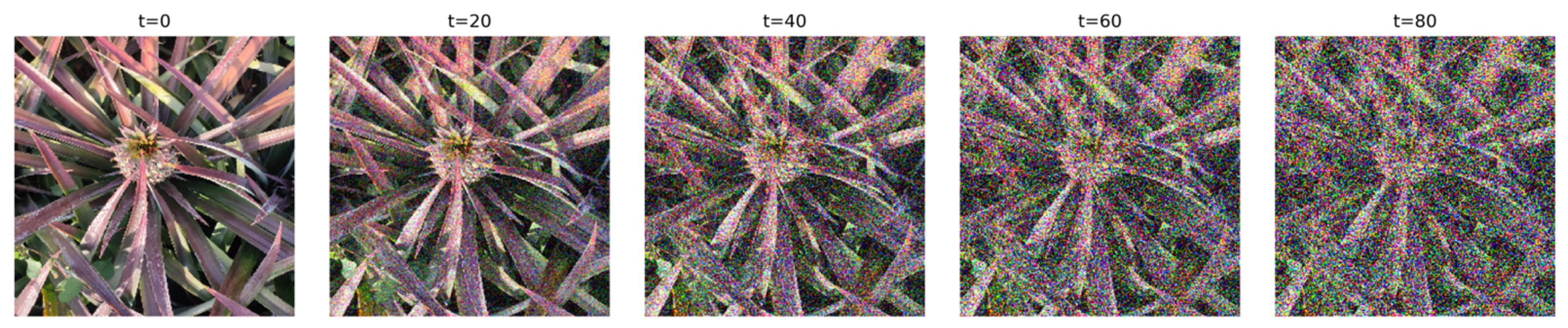
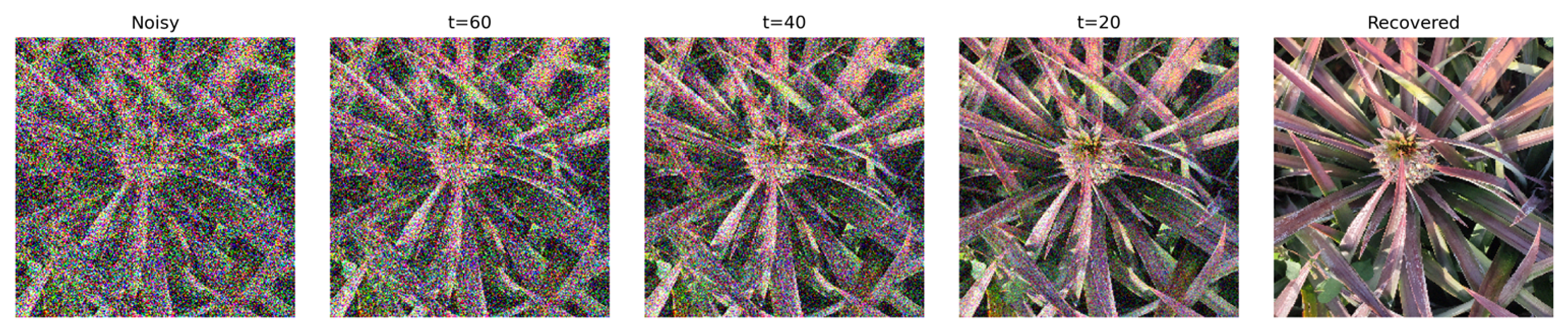
The first visualization illustrates the forward diffusion process, where stochastic Gaussian perturbations are progressively injected into the original agricultural images.
Figure 2 presents representative examples of the transformation from clean images to noisy images under different diffusion steps.
As the diffusion step increases, the visual appearance of pineapple targets gradually becomes less distinguishable due to the accumulation of stochastic noise. Fine-grained texture details, object boundaries, and local semantic structures are progressively weakened, while background interference becomes more dominant. This process simulates real-world agricultural disturbances such as illumination fluctuation, sensor noise, dust interference, and environmental occlusion.
Unlike conventional random noise augmentation, the forward diffusion process introduces perturbations in a mathematically controlled stochastic manner, allowing the detector to learn robust representations under progressively degraded visual conditions. This improves the model’s tolerance to environmental uncertainty and enhances generalization ability in practical field scenarios.
Therefore, the forward diffusion samples visually demonstrate that DROD does not simply add random noise, but rather constructs a structured perturbation distribution for robust feature learning.
- (2)
Diffusion-guided Representation Analysis
The second visualization illustrates the diffusion-guided image representation associated with the proposed theoretical formulation.
Figure 3 presents representative noisy images together with their corresponding diffusion-guided reconstructed representations, providing an intuitive interpretation of the image evolution described in
Section 2.
It can be observed that, although the diffusion perturbation introduces substantial visual degradation, the reconstructed representations preserve the principal semantic structures of the pineapple targets. The object boundaries remain distinguishable, while major structural characteristics are retained despite the presence of stochastic perturbations. These observations provide qualitative evidence that the proposed formulation captures meaningful object semantics throughout the diffusion process.
From the perspective of object detection, the diffusion-guided representations illustrate how diffusion-based regularization encourages the detector to learn features that are less sensitive to image perturbations while preserving essential structural information. Such robustness is particularly beneficial in agricultural environments, where target appearance is frequently influenced by occlusion, illumination variation, and complex background interference.
Overall, the visualization results provide an intuitive illustration of the theoretical diffusion-guided formulation presented in
Section 2 and qualitatively support the effectiveness of the proposed diffusion-based regularization framework.
- (3)
Detection Comparison among Baseline, Augmentation, JTA:GAN and DROD
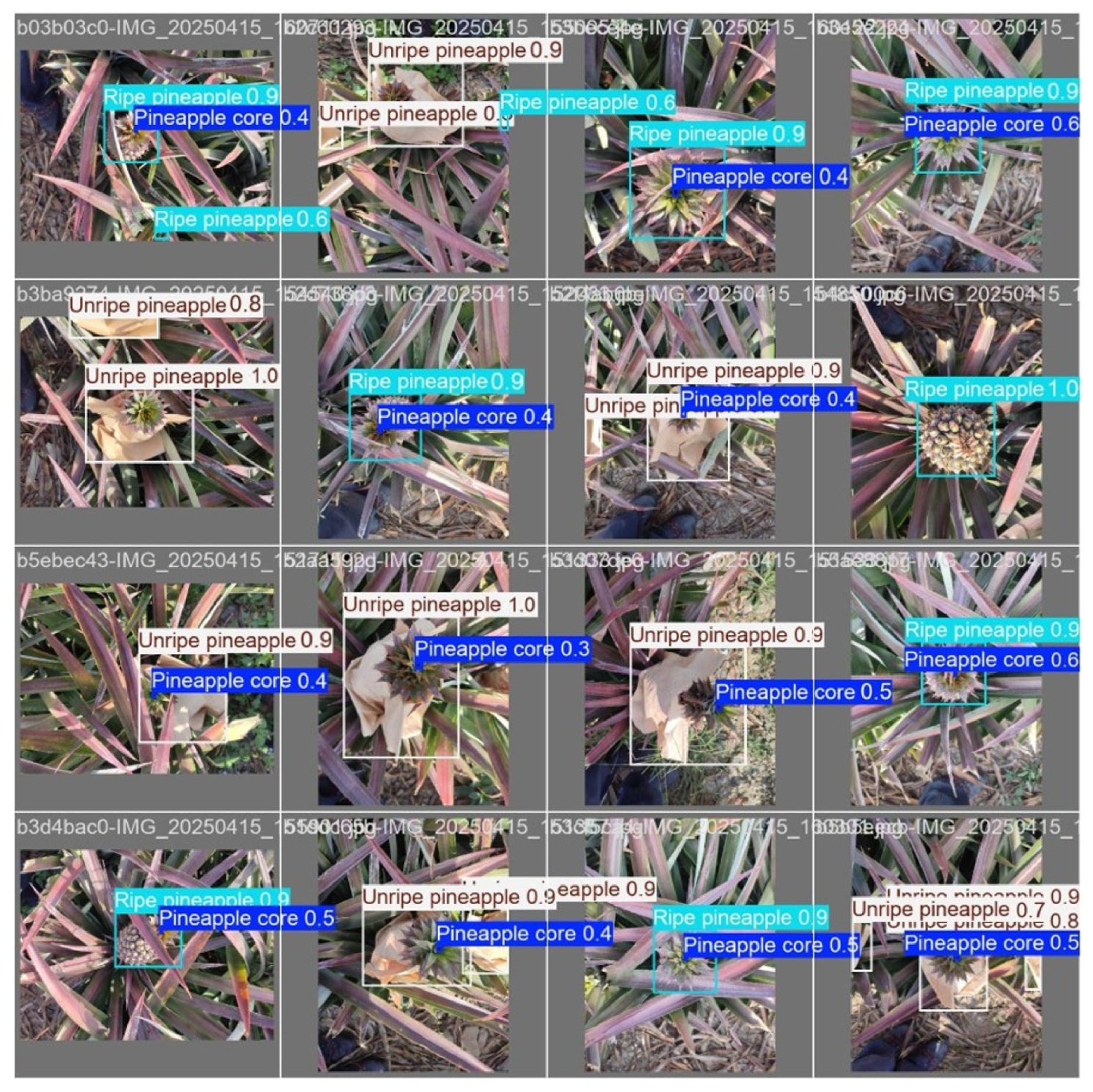
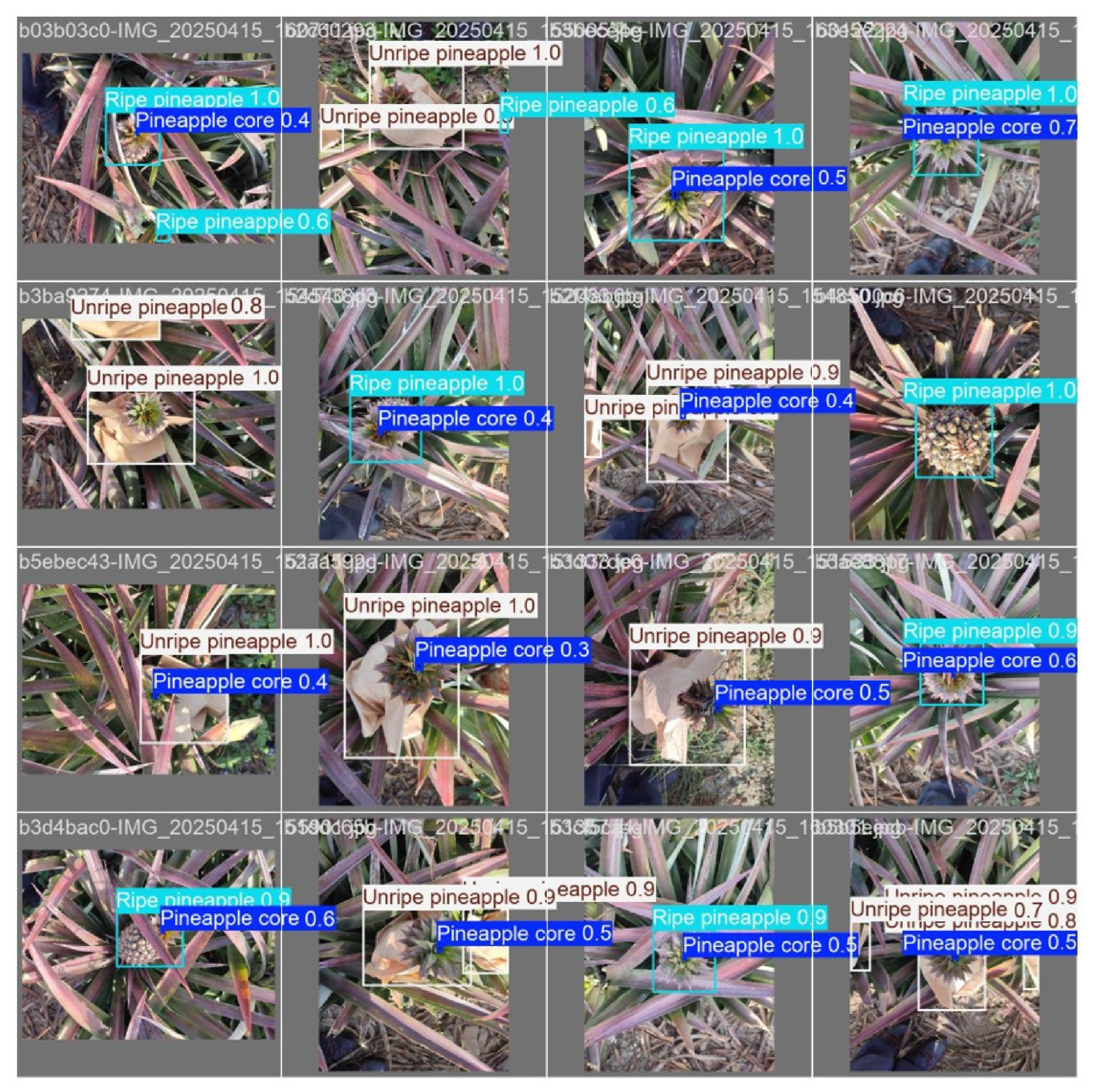
The final visualization analysis compares the detection results produced by the baseline YOLOv8 model, the traditional augmentation-based model, the JTA model, and the proposed DROD framework.
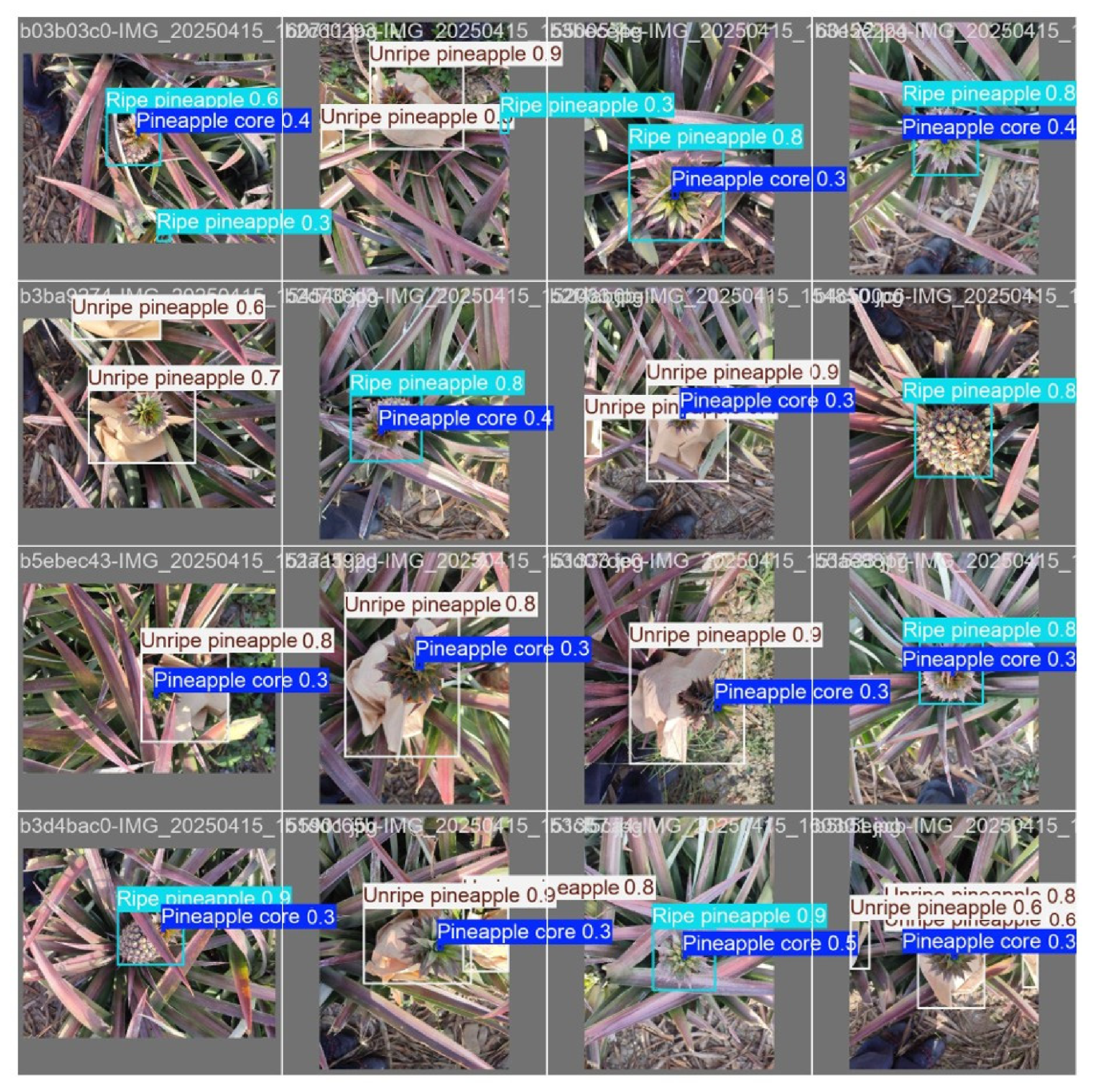
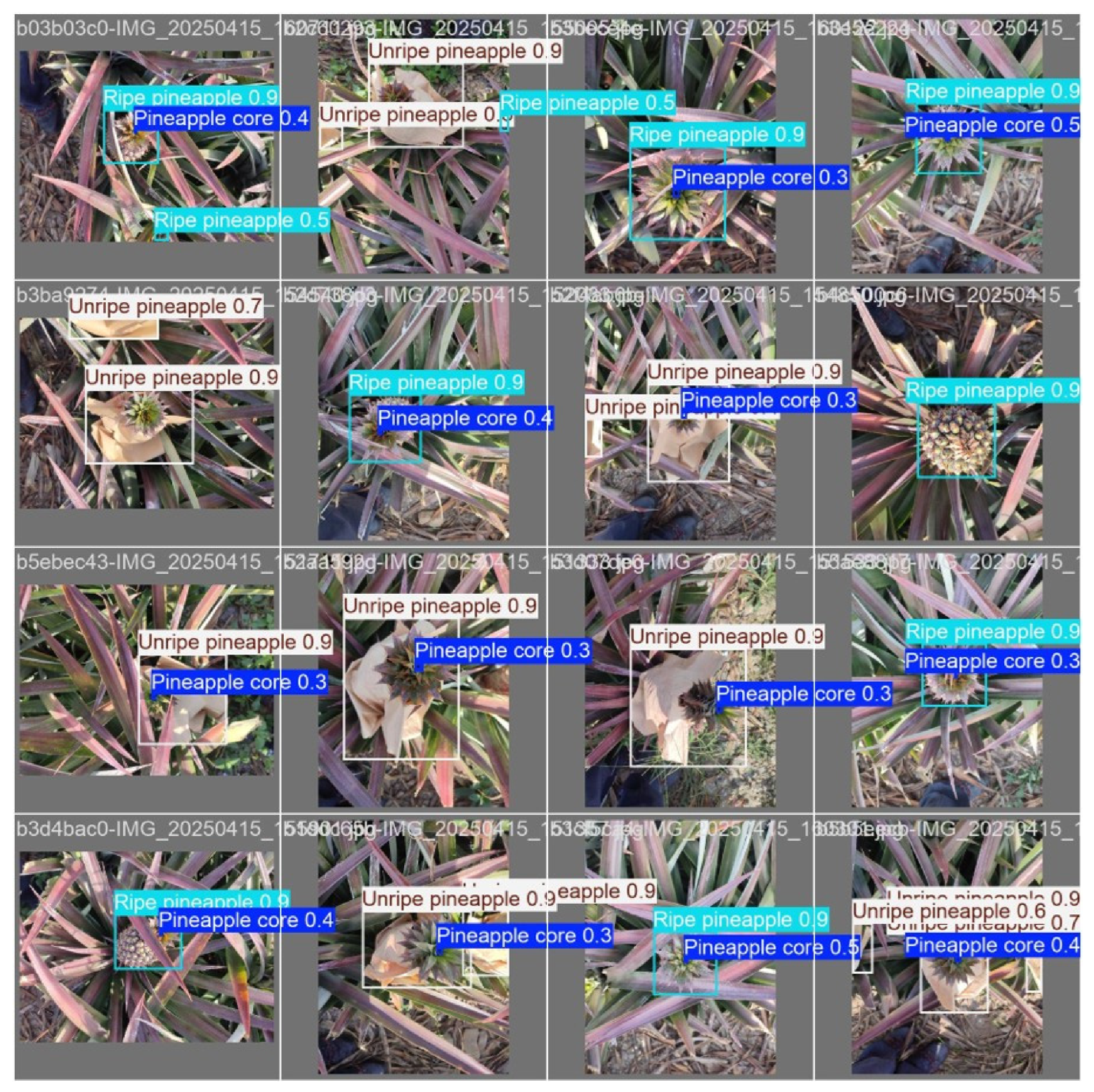
Figure 4,
Figure 5,
Figure 6 and
Figure 7 present representative detection results obtained from the same set of 16 challenging test images, including cases with partial occlusion, overlapping fruits, illumination variation, and complex background interference, thereby enabling a direct visual comparison among all methods.
The baseline detector exhibits the weakest detection performance, generally producing lower confidence scores and occasional localization inaccuracies, particularly when pineapple targets are partially occluded by leaves or visually resemble the surrounding background. Traditional augmentation improves the overall robustness of the detector; however, relatively lower confidence scores and occasional missed detections are still observed under challenging field conditions. The JTA:GAN method further enhances detection accuracy and confidence compared with conventional augmentation, demonstrating the benefit of generative augmentation for improving feature diversity.
Among all compared methods, the proposed DROD framework consistently achieves the most accurate and stable detection results. It produces higher confidence scores under complex agricultural scenarios. The qualitative results are consistent with the quantitative comparisons presented in
Table 1, further confirming the superior detection capability of the proposed framework.
These observations demonstrate that the proposed diffusion-based regularization mechanism effectively enhances feature discrimination and robustness without modifying the original YOLO detection architecture. Consequently, DROD provides more reliable object detection under challenging agricultural environments while maintaining excellent practicality for real-world deployment.
Overall, the visualization analysis provides strong qualitative support for the quantitative results presented in
Section 3.2 and
Section 3.3. The forward diffusion samples demonstrate structured perturbation modeling, while the representation results reveal the capability of preserving meaningful semantic information under diffusion-induced degradation. Together, these visual results clearly explain why the proposed DROD framework consistently outperforms conventional detection pipelines and validate the effectiveness of diffusion-based regularization for agricultural object detection.
3.6. Experimental Validation of Theoretical Robustness
To further validate the theoretical analysis presented in
Section 2, an additional robustness experiment was conducted under different levels of Gaussian perturbation. According to Theorems 1 and 2, the proposed diffusion-based regularization is expected to improve the stability of object detection against input perturbations. Therefore, all comparative methods were evaluated under progressively increasing noise levels.
Table 5 summarizes the detection performance of the eight comparative models under different perturbation intensities. As the perturbation level increases, all methods exhibit a gradual decrease in detection accuracy. However, the proposed DROD framework consistently achieves the highest mAP@0.5 for both YOLOv8-s and YOLOv8-L across all perturbation levels. Moreover, the performance degradation of DROD is noticeably smaller than that of the baseline model, the traditional augmentation method, and JTA:GAN, indicating superior robustness against input perturbations.
These experimental results quantitatively corroborate the theoretical analyses presented in
Section 2 by demonstrating that the proposed diffusion-based regularization effectively bounds the degradation of detection performance under increasing perturbation levels, thereby providing empirical support for the derived perturbation stability and robustness analysis. Specifically, the bounded degradation in detection performance under increasing perturbations provides empirical evidence supporting the proposed stability analysis and demonstrates that diffusion-based regularization effectively improves robustness while preserving detection accuracy under challenging agricultural conditions.
4. Conclusions
This paper presented a DROD framework for robust pineapple target detection in complex agricultural environments. Unlike conventional object detection methods that primarily rely on deterministic data augmentation or feature-level refinement, the proposed framework introduces a mathematically grounded forward diffusion and diffusion-guided representation mechanism directly in the image domain, enabling diffusion-based regularization without increasing the structural complexity of the original detection network. By integrating stochastic perturbation modeling with semantic representation during training, the proposed framework effectively improves the robustness of YOLO-based detectors under challenging agricultural field conditions.
A rigorous mathematical framework was established to formulate agricultural image representation, stochastic forward diffusion, diffusion-guided representation, perturbation stability, and the unified optimization process for object detection. Based on this formulation, theoretical analyses of perturbation propagation, Lipschitz stability, and training convergence were derived to provide mathematical support for the proposed framework.
Extensive experiments were conducted on a self-constructed pineapple dataset containing 1600 real-world images collected under practical agricultural conditions. Comparative experiments involving YOLOv8-s, YOLOv8-L, traditional data augmentation, and the recent JTA:GAN method demonstrated that the proposed DROD framework consistently achieved the best detection performance in terms of Precision, Recall, mAP@0.5, and mAP@0.5:0.95. Furthermore, the computational efficiency analysis showed that DROD maintained nearly identical model complexity, FLOPs, inference speed and FPS to the original YOLOv8 architecture while significantly outperforming competing methods in detection accuracy.
Additional ablation studies, diffusion parameter sensitivity analysis, visualization analysis, and experimental validation under different perturbation levels further confirmed the effectiveness of the proposed diffusion mechanism. The results consistently demonstrated that the complete DROD framework provides superior robustness to stochastic perturbations while maintaining stable detection performance over a wide range of diffusion parameter settings. These experimental findings quantitatively corroborate the theoretical analyses presented in
Section 2 and verify the effectiveness of diffusion-based regularization for robust agricultural object detection.
Overall, the proposed DROD framework provides an effective balance between detection accuracy, robustness, and computational efficiency without modifying the original detector architecture. Owing to its architecture-independent design and lightweight implementation, the proposed framework can be readily integrated into existing object detection pipelines, making it a promising solution for practical precision agriculture applications. Future work will investigate the applicability of the proposed framework to additional public agricultural datasets and other object detection architectures to further evaluate its generalization capability.