1. Introduction
The organization and semantic enrichment of tourism Points of Interest (POIs) is a central challenge in smart tourism research and practice. Tourism applications—ranging from destination discovery and itinerary planning to personalized recommendation and cross-country analytics—depend on reliable, interpretable, and comparable representations of tourism-relevant places [
1]. Yet constructing such representations at scale remains difficult, primarily because the data sources available for POI enrichment are heterogeneous, incomplete, and not designed with tourism semantics in mind.
Wikidata has emerged as one of the most promising open sources for tourism-oriented POI data [
2]. It provides extensive multilingual coverage, structured properties, links to Wikipedia, heritage designation indicators, and geographic coordinates for a large and growing number of entities worldwide. These characteristics make it attractive as a backbone for tourism knowledge infrastructures [
3,
4,
5]. At the same time, Wikidata presents significant challenges for direct tourism use. Its native type system is highly fine-grained and heterogeneous, with thousands of distinct
instance of classes that do not map cleanly onto the compact, interpretable categories that tourism applications require. Metadata completeness is uneven across countries, languages, and entity types [
6,
7]. And the absence of a shared tourism taxonomy means that raw Wikidata categories cannot be used directly for cross-country comparison or faceted exploration.
These limitations motivate the need for a pipeline that transforms raw Wikidata POIs into a compact, tourism-oriented representation that is interpretable, comparable across countries, and capable of supporting multi-category assignments. Multi-label categorization is particularly important in tourism, because many real-world POIs combine multiple thematic dimensions simultaneously: a castle may also function as a museum and carry a heritage designation, a monastery may be located within a protected natural landscape, and an archaeological cave may be both a natural feature and a site of cultural significance. Collapsing such entities into a single dominant label discards semantically meaningful information that is directly relevant for faceted search, multi-criteria filtering, and personalized recommendation [
8,
9].
This paper presents an end-to-end pipeline that addresses these challenges through a combination of AI-based semantic estimation and fuzzy inference. The pipeline proceeds through five stages. First, tourism-relevant POIs are extracted from Wikidata for six countries—Greece, Italy, Spain, Norway, Sweden, and Denmark—using a seed-based SPARQL query strategy that yields a structured, reproducible dataset. Second, a compact eight-category tourism taxonomy is defined to serve as the shared label space for all subsequent processing. Third, a training-free AI baseline estimates, for each POI, a probability distribution over the eight categories by computing cosine similarity between sentence embeddings of POI texts and category anchor descriptions [
10,
11]. Fourth, a fuzzy inference layer refines these estimates by combining AI-derived probabilities with structured Wikidata evidence—type labels and heritage designations—through a permissive OR-style fusion strategy that preserves meaningful secondary category signals and produces interpretable membership scores. Fifth, the pipeline generates ranked POI catalogs per country and category, country-level tourism profiles, and diagnostic comparison views.
The main contributions of this paper are summarized as follows:
A reproducible pipeline for extracting and semantically enriching Wikidata POIs at country scale, with fixed extraction settings, taxonomy definitions, and output formats.
A compact eight-category tourism taxonomy designed to support cross-country comparability and multi-label representation of tourism POIs.
A training-free AI baseline that estimates category probabilities using sentence embeddings and category anchor descriptions, without requiring labeled training data.
A fuzzy inference layer that combines semantic AI probabilities with structured Wikidata evidence from type labels and heritage designations, producing interpretable membership scores and multi-category assignments.
An empirical analysis across six countries, including ranked POI catalogs, country-level tourism profiles, diagnostic case studies, and quantitative comparison between AI-only, Type-only, and AI + Fuzzy variants.
The remainder of the paper is organized as follows.
Section 2 reviews related work on tourism POI categorization, knowledge graphs, semantic classification, and fuzzy reasoning in tourism.
Section 3 describes the proposed pipeline in detail.
Section 4 presents the empirical results, including country-level profiles, multi-label analysis, representative catalogs, and quantitative evaluation.
Section 5 discusses the main findings, limitations, and directions for future work.
2. Related Work
Research on tourism information systems has long emphasized the central role of Points of Interest (POIs) in recommendation, planning, and destination exploration. Surveys of tourism recommender systems show that the field has traditionally focused on personalizing attractions, routes, and activities under user-specific preferences and contextual constraints, often treating POIs as the main units of interaction and decision support [
8,
12,
13]. This line of work highlights the importance of reliable POI representations for downstream tourism applications, but it has generally concentrated on recommendation and itinerary generation rather than on building compact, interpretable, and cross-country semantic representations of POIs extracted from open knowledge graphs. AI-supported cultural heritage applications have also been explored in related intelligent learning and cultural-content contexts [
14].
Recent AI-based smart tourism studies can be grouped into several complementary directions. One direction focuses on AI-enabled smart tourist destinations and tourism marketing, emphasizing how AI can support destination management, service quality, personalization, and future smart-destination strategies [
15]. A second direction examines tourist adoption of AI-driven smart tourism technologies, with particular attention to trust, personalization, ethical AI practices, perceived value, efficiency, and privacy concerns [
16,
17]. A third direction concerns AI-supported recommendation, personalization, and itinerary planning, including survey work on AI-driven personalization in tourism and recent systems for visualizing smart tourism recommendations and travel plans [
18,
19]. These studies confirm the increasing importance of AI in smart tourism services and user-facing applications. However, they mainly address marketing, adoption, personalization, recommendation, or itinerary-support scenarios, whereas the present study focuses on the upstream semantic organization of Wikidata-derived POIs into compact, explainable, and multi-category tourism representations.
A second line of research has explored semantic-web and knowledge-graph infrastructures for tourism data. Several studies have demonstrated the value of structured tourism knowledge graphs for data integration, service interoperability, and downstream applications such as analytics, conversational assistants, and recommendation. Early efforts in this direction include the 3cixty knowledge base for city exploration [
20] and the Tourpedia linked dataset [
21], both of which demonstrated the feasibility of aggregating heterogeneous tourism data into a queryable semantic layer. More recent examples include the Tyrolean Tourism Knowledge Graph [
3], the German Tourism Knowledge Graph integrating data from all 16 federal states [
4], and ontology-driven tourism knowledge-graph efforts aimed at knowledge organization and intelligent tourism information management [
22]. Related work has also combined tourism retrieval with knowledge-graph and retrieval-augmented generation paradigms, as illustrated by TravelRAG [
23], and open-data infrastructures for sustainable tourism have stressed the importance of reusable, shareable repositories of cultural and touristic information [
24]. Taken together, these studies confirm the value of structured and interoperable tourism knowledge resources, but they do not directly address the problem of converting Wikidata POIs into a compact, explainable, multi-category tourism taxonomy at country scale.
Wikidata is a natural candidate backbone for such a pipeline because it provides a large, collaboratively curated, multilingual knowledge base with structured statements, human-readable labels, descriptions, and growing linkage to the Linked Data Web [
2,
25]. At the same time, prior work has shown that multilingual coverage in Wikidata is uneven, reflecting broader imbalances in language communities and curation activity [
6], and that completeness and consistency are core quality dimensions affecting downstream usability [
7]. These observations are especially relevant in tourism settings, where labels, descriptions, and type assignments are not only metadata fields but also practical signals for retrieval, interpretation, and end-user explanation. However, most existing work treats Wikidata either as a general-purpose multilingual knowledge base or as linked-data infrastructure, rather than as a source to be reorganized into tourism-oriented, category-level POI representations.
A related stream of literature concerns semantic classification and representation learning for tourism entities. Sentence embedding models, such as those built on the transformer architecture introduced by Vaswani et al. [
10] and further developed through pre-trained language models [
11], have become attractive because they provide training-light or training-free mechanisms for mapping textual descriptions into shared semantic spaces. These approaches are particularly relevant for POI data, where labels, short descriptions, and type cues often provide the only scalable signals for category estimation across large heterogeneous collections. Recent tourism-oriented studies have also explored embedding-based approaches for tourism information management and attraction retrieval [
22,
23,
26]. Nevertheless, embedding-based methods alone tend to produce soft semantic preferences rather than fully interpretable final assignments, especially when categories overlap or when metadata is sparse. In multi-label settings, this limitation is particularly pronounced, since a single dominant score does not capture the overlapping thematic dimensions that characterize many real-world POIs [
27].
Finally, explainability and fuzzy reasoning have an established role in tourism decision support, particularly in personalization, recommendation, and multi-criteria evaluation under uncertainty [
28,
29,
30]. Fuzzy-logic methods are attractive because they can combine heterogeneous and partially uncertain signals in a transparent way, which is important in smart-tourism systems where users and curators may wish to understand why a destination or attraction has been selected [
9,
31]. Similar fuzzy-logic approaches have also been used in intelligent assessment contexts, where gradual degrees rather than hard labels are required [
32]. However, most fuzzy-tourism studies focus on preference modeling, destination ranking, or service recommendation rather than on semantic multi-category POI classification grounded in open knowledge-graph metadata.
Against this background, the present study occupies a different position. It does not rely on raw Wikidata classes as final categories, nor does it reduce POIs to single-label outputs. Instead, it combines a compact tourism taxonomy, an embedding-based semantic baseline, and a fuzzy fusion layer that integrates AI-derived probabilities with structured Wikidata evidence from type labels and heritage designations. In this way, the paper contributes a reproducible framework for transforming heterogeneous Wikidata POIs into interpretable, multi-category tourism representations that support country-level comparison, catalog generation, and explainable downstream use in smart tourism applications [
33,
34]. More specifically, the gap addressed by this study is the lack of a reproducible method that transforms heterogeneous Wikidata POIs into compact, explainable, and multi-category tourism representations by combining semantic AI evidence with structured knowledge-graph signals. Unlike previous approaches that primarily focus on recommendation, knowledge-graph construction, or single-source semantic classification, the proposed framework explicitly combines semantic similarity, structured type evidence, and heritage cues within a unified fuzzy multi-label classification layer. The practical value of this hybrid design is evaluated empirically by comparing AI-only, Type-only, and AI + Fuzzy variants in terms of multi-label coverage, top-
k performance, and category-level behavior.
3. Materials and Methods
This section describes the methodological pipeline used to transform raw Wikidata entities into interpretable multi-category tourism representations. It first presents the overall framework, then describes the Wikidata extraction process, the design of the tourism taxonomy, the AI-based category estimation stage, and the fuzzy membership layer.
3.1. Overall Framework
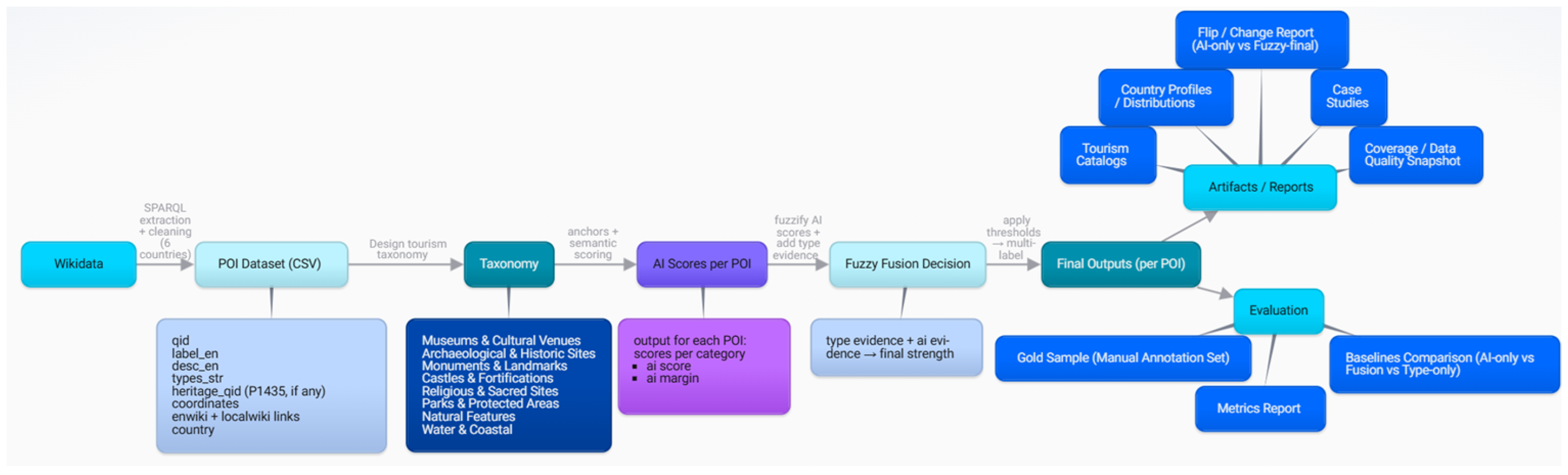
The proposed framework transforms raw Wikidata entities into interpretable, multi-category tourism representations through a sequence of five stages, illustrated in
Figure 1.
In the first stage, tourism-relevant POIs are extracted from Wikidata for six countries using a seed-based SPARQL query strategy, yielding a structured dataset with textual, typological, geographic, and heritage metadata per entity. In the second stage, a compact eight-category tourism taxonomy is defined to serve as the shared label space for all subsequent processing. The third stage applies a training-free AI baseline that embeds each POI’s textual representation and computes its semantic similarity to category anchor descriptions, producing a probability vector over the eight categories. The fourth stage introduces a fuzzy inference layer that combines these AI-based probabilities with structured Wikidata evidence—type labels and heritage designations—to produce final membership scores and principled multi-label assignments. The fifth stage generates the practical outputs of the pipeline: ranked tourism catalogs per country and category, country-level tourism profiles, and diagnostic comparison views.
The five stages form a strictly feed-forward pipeline, in which the output of each stage is used as the input of the next. Stage 1 produces a merged POI dataset containing textual, typological, geographic, heritage, and sitelink metadata. Stage 2 defines the eight-category tourism taxonomy that serves as the common label space for the remaining stages. Stage 3 consumes both the POI dataset and the taxonomy anchors and emits, for each POI, a probability vector over the eight categories. Stage 4 takes these probability vectors together with the type labels and heritage flags retained in Stage 1 and produces the final fuzzy membership scores. Stage 5 aggregates these scores into ranked catalogs, country-level profiles, and diagnostic views.
The framework deliberately combines data-driven and rule-based components. The data-driven components are the Wikidata retrieval results, which determine the entity population; the sentence-embedding similarity that yields the AI probabilities; and the per-category percentile anchors used in fuzzification, all of which are derived from the data itself. The rule-based components are the predefined extraction seed classes, the eight-category taxonomy and its keyword sets, the conversion of keyword matches into type evidence, the heritage-boost values, and the permissive OR-style fusion together with its threshold () and top-3 retention rule. Making this separation explicit clarifies where the pipeline is driven by the extracted data and where it applies fixed, interpretable rules, which is central to both its reproducibility and its explainability.
3.2. Dataset Extraction from Wikidata
To build the empirical basis of the study, we compiled a structured dataset of tourism-related Points of Interest (POIs) from Wikidata [
2]. Given the scale and heterogeneity of Wikidata, the objective was not to retrieve all entities associated with a country, but to construct a controlled and reproducible dataset of tourism-relevant places that would remain analytically manageable while preserving cross-country diversity.
The dataset covers six countries: Greece, Italy, Spain, Norway, Sweden, and Denmark. These countries were selected in order to support comparison across distinct tourism contexts. Greece, Italy, and Spain represent a Mediterranean setting strongly associated with archaeology, religion, monuments, and coastal tourism, whereas Norway, Sweden, and Denmark introduce a contrasting Northern European setting with stronger representation of natural features, protected landscapes, and water-related POIs. This selection enables us to examine whether the proposed framework behaves consistently across countries with clearly different tourism-related entity profiles.
The extraction process followed a seed-based SPARQL query strategy. In this context, “seed-based” means that the retrieval was initialized from a predefined set of Wikidata P31 classes that functioned as entry points for identifying tourism-relevant entities. More specifically, we defined a set of 14 tourism-relevant seed types, expressed as exact instance of categories in Wikidata. These seeds were: museum (Q33506), monument (Q4989906), archaeological site (Q839954), castle (Q23413), place of worship (Q1370598), church (Q16970), national park (Q46169), protected area (Q473972), beach (Q40080), island (Q44782), mountain (Q8502), lake (Q23397), waterfall (Q35509), and cave (Q355304). The role of this seed list was to constrain the retrieval space and reduce noise, so that the resulting dataset would focus on entities that can plausibly function as tourism POIs in later stages of the framework.
For each country and each seed type, Wikidata was queried for entities satisfying three main conditions. First, the entity had to be associated with the country through the country property (P17). Second, it had to be linked to one of the selected seed types through an exact instance of relation (P31). Third, it had to include geographic coordinates (P625), so that it could be treated as a spatially grounded place rather than as a loosely related or abstract entity. This coordinate requirement was important because it ensured that the extracted entities were meaningful as mappable tourism POIs.
For each matching entity, we extracted a compact but informative set of attributes. These included the Wikidata identifier (qid), English labels and English descriptions where available, type identifiers and English type labels, geographic coordinates, heritage designation information when available (P1435), and Wikipedia sitelinks from both the local-language Wikipedia and English Wikipedia. This metadata was intentionally kept lightweight: it is sufficient to support semantic categorization, type-based evidence construction, and manual inspection, while avoiding an unnecessarily heavy extraction layer.
A practical consideration in this stage was the tractability of querying the public Wikidata Query Service (WDQS). Since the endpoint imposes limits on query size and execution time, retrieval was performed with capped extraction per country–seed combination, up to 1000 returned rows for each query. This choice made the collection procedure executable on a public endpoint, easier to repeat under the same settings, and less vulnerable to timeout failures. In a few cases, queries required automatic retries due to temporary WDQS timeout responses, further confirming the need for a controlled extraction strategy.
The seed-wise counts revealed meaningful cross-country differences already at the retrieval stage. Mediterranean countries exhibited high counts and frequent saturation of the 1000-row cap for seeds such as archaeological sites, churches, castles, beaches, and mountains. By contrast, the Scandinavian countries showed stronger relative representation in churches, mountains, and lakes, while Denmark displayed almost no mountain or waterfall entities under the selected criteria, which is consistent with its physical geography. These patterns indicate that the extraction design preserved interpretable differences in tourism-related POI composition across countries rather than artificially homogenizing the national subsets. The seed-based strategy also introduces a controlled form of selection bias. Since only entities matching the predefined P31 seed classes were retrieved, the dataset should not be interpreted as an exhaustive inventory of all tourism-related Wikidata items. Instead, it represents the subset of POIs captured by the selected cultural, religious, natural, and coastal seed categories. This design improves tractability and cross-country comparability, but it may under-represent POIs whose tourism relevance is expressed through more specific subclasses, alternative Wikidata properties, or weaker textual cues. The extracted data therefore represent a reproducible and tourism-relevant subset of Wikidata POIs rather than the full diversity of all possible tourism-related entities.
After retrieval, the raw outputs were cleaned and aggregated. Because the same entity could appear multiple times across raw query results, all records were grouped by qid, so that each POI would correspond to a single row in the final dataset. During aggregation, type-related and heritage-related values were merged into unique lists, while the remaining metadata fields were normalized into a compact tabular format. The final outcome of this stage was a separate POI file for each country and a unified merged dataset, pois_ALL.csv, which was used as the input to the subsequent AI-based categorization and fuzzy membership modeling stages.
Table 1 presents a representative sample of POIs included in the final dataset. Each row corresponds to one Wikidata entity and provides the main fields retained after extraction and aggregation. More specifically, the column
qid gives the unique Wikidata identifier of the entity, while
label_en and
desc_en provide its English name and short textual description. The
typeLabel_en field shows the tourism-relevant type information associated with the POI,
coordinates indicates its geographic location, and
country identifies the case-study country to which the entity was assigned. Finally, the
enwiki and
localwiki fields indicate whether the POI is linked to English Wikipedia and to the corresponding local-language Wikipedia, respectively. Taken together, these records provide a concrete view of the structured information extracted from Wikidata and show the type of metadata that later supports semantic category estimation and fuzzy membership modeling.
While
Table 1 shows the structure of individual POI records,
Table 2 summarizes the extracted dataset at the country level. The first column lists the six countries included in the study, while the
POIs column reports the number of unique tourism-related entities retained after grouping by
qid. The remaining columns describe the coverage of the main metadata fields used in the subsequent stages of the framework. In particular,
Label EN (%) indicates the proportion of POIs with an available English label,
Desc EN (%) the proportion with an English description, and
Coord (%) the proportion with geographic coordinates. Similarly,
EN Wiki (%) and
Local Wiki (%) show the proportion of entities linked to English Wikipedia and to the corresponding local-language Wikipedia. These statistics provide a compact overview of both dataset size and metadata completeness, allowing the reader to understand how well each national subset is documented and how suitable it is for downstream semantic categorization and explainable analysis.
Because Wikidata is collaboratively maintained, the extracted dataset inevitably reflects uneven metadata completeness and documentation practices across countries and entity types. Missing English labels or descriptions were not used as exclusion criteria; instead, each POI was retained when the required extraction constraints were satisfied, and the available labels, descriptions, and type labels were later combined through the fallback strategy used in the AI-based category estimation stage. Geographic coordinates were required during extraction in order to retain only spatially grounded POIs. Type and heritage fields were aggregated as unique lists in order to reduce duplication and preserve multiple Wikidata statements per entity.
These data-quality characteristics may influence the downstream results. Incomplete descriptions can weaken the semantic signal available to the embedding-based AI baseline, while inconsistent type granularity can affect the strength of type-based fuzzy evidence. Similarly, uneven Wikipedia sitelink coverage and country-specific documentation practices may influence the interpretation of country-level profiles. For this reason, the reported results should be interpreted as profiles and classifications of Wikidata-derived tourism POI collections rather than as exhaustive or fully unbiased representations of each country’s tourism supply.
3.3. Tourism Taxonomy Design
A central challenge in using Wikidata for tourism-oriented analysis is that its native type system is too fine-grained and heterogeneous to serve directly as an operational tourism taxonomy. The extracted POIs are associated with a wide variety of instance of labels, ranging from broad types such as museum, church building, or lake to much more specific descriptions such as archaeological museum, fortified tower, or mountain range. While this richness is valuable from a knowledge-graph perspective, it is less suitable for tourism applications, which typically require a compact, interpretable, and comparable set of categories that can be used consistently across countries and POI collections.
To address this issue, we defined a compact tourism taxonomy consisting of eight categories: Museums & Cultural Venues, Archaeological & Historic Sites, Monuments & Landmarks, Castles & Fortifications, Religious & Sacred Sites, Parks & Protected Areas, Natural Features, and Water & Coastal. These categories were designed to function as a semantic layer above the heterogeneous Wikidata type system, allowing diverse and highly specific Wikidata entities to be mapped into a smaller, tourism-oriented conceptual space.
The taxonomy was designed according to four main criteria. First, the categories needed to be interpretable, that is, understandable by both researchers and potential downstream users of tourism catalogs. Second, they needed to be tourism-relevant, reflecting broad themes that commonly structure tourism discovery and destination profiling, such as heritage, religion, nature, and coastal attractions. Third, they needed to be observable from the available metadata, so that category evidence could be inferred from the fields actually extracted from Wikidata, including labels, descriptions, type labels, and heritage-related properties. Fourth, the taxonomy needed to support multi-label membership, since many tourism POIs naturally combine multiple dimensions, such as a castle that also functions as a museum, a monastery located in a protected landscape, or an archaeological cave with both natural and cultural significance. The distinction between some categories is deliberate. For example, Archaeological & Historic Sites captures site-scale heritage locations such as ruins, excavation areas, or ancient settlements, whereas Monuments & Landmarks refers more strongly to symbolic or built markers such as monuments, memorials, statues, and landmark structures. Similarly, Parks & Protected Areas is separated from Natural Features in order to distinguish institutionally protected landscapes from individual natural formations such as caves, waterfalls, cliffs, or mountains. Water & Coastal is also treated as a distinct category because beaches, islands, bays, lakes, and other water-related attractions form a particularly important and recognizable tourism dimension, especially in cross-country comparison.
Importantly, the taxonomy is not identical to the seed types used during data extraction. The seed list was designed to retrieve candidate POIs from Wikidata, whereas the taxonomy defines the target semantic categories used in the subsequent classification stages. As a result, the taxonomy is both broader and more conceptually organized than the extraction seeds. It provides the shared label space for the AI-based similarity stage and, later, for the fuzzy membership layer that combines semantic and structured evidence into interpretable multi-category outputs.
3.4. AI-Based Category Estimation
After defining the compact tourism taxonomy, we constructed an AI-based semantic baseline that estimates, for each POI, its degree of association with the eight target tourism categories. The purpose of this stage is not to assign a single definitive label, but to produce a probability distribution over the predefined category space. In this sense, the AI component serves both as a semantic baseline and as the probabilistic input to the subsequent fuzzy layer. The input to this stage was the unified POI dataset compiled in the previous step. For each POI, we constructed a textual representation by combining three types of information extracted from Wikidata: the English label (label_en), the English description (desc_en), and the available English type labels (typeLabel_en). To keep the representation compact while preserving useful structured cues, up to the first ten available type labels were concatenated into a single textual field. The resulting POI text therefore followed the general form: label. description. Types: type1, type2, …. A fallback strategy was applied to ensure robustness to missing metadata. If the English description was missing, the representation was built from the label and type labels only. If the label was also missing, the type labels alone were retained. In the rare case where all these fields were unavailable, a placeholder string (Unknown place of interest) was inserted so that the embedding pipeline could still operate without failure.
Category estimation was performed using a reproducible, training-free semantic similarity approach based on sentence embeddings. For each of the eight tourism categories, we defined a short anchor text consisting of representative terms and phrases describing its semantic content. For example, the anchor for Religious & Sacred Sites included terms such as church, monastery, cathedral, and place of worship, whereas the anchor for Water & Coastal included terms such as beach, island, lake, and coast. These anchor texts act as compact semantic prototypes of the target categories.
Both the POI texts and the category anchor texts were embedded in the same semantic vector space using the
all-MiniLM-L6-v2 model from the SentenceTransformers library (
https://www.sbert.net/). This model transforms each text into a dense numerical representation that captures its semantic content. After embedding, cosine similarity was computed between each POI vector and each category anchor vector, resulting in eight similarity scores per POI, one for each category. These similarity values express the semantic proximity between the textual description of a POI and the conceptual profile of each tourism category.
To convert these similarity scores into a normalized category distribution, we applied the softmax function. If
denotes the similarity score between a POI and category
, then the estimated category probability is given by
This transformation yields a probability vector over the eight categories for each entity, with all probabilities summing to one. These probabilities should be interpreted as relative semantic preferences within the fixed category space rather than as calibrated confidence estimates. In practice, the highest scores are often numerically close to one another, especially for POIs with mixed or overlapping semantics, which makes this stage more suitable as a soft semantic baseline than as a hard single-label classifier.
The outputs of the AI stage were stored in the file and, for each POI, the file includes eight probability columns (p_*), corresponding to the estimated probability of membership in each tourism category. In addition, the category with the highest probability was recorded as ai_top1, together with its score (ai_top1_score), while the second-ranked category and its score were recorded as ai_top2 and ai_top2_score. These outputs provide a transparent semantic baseline for later comparison and constitute the main probabilistic input to the fuzzy membership layer, where they are combined with structured Wikidata evidence in order to produce final interpretable multi-category assignments.
3.5. Fuzzy Membership Layer
The AI stage provides, for each POI, a probability distribution over the eight tourism categories. However, these probabilities alone are not sufficient for final categorization, since many POIs combine multiple semantic dimensions and the AI scores are often relatively close to one another. For this reason, we introduced a fuzzy logic-based layer that refines the AI-based estimates by incorporating structured Wikidata evidence and producing interpretable multi-category memberships.
The fuzzy layer takes as input the file that contains the AI probability columns for the eight tourism categories. In addition to these semantic probabilities, the fuzzy layer also uses two forms of structured Wikidata evidence: type-based evidence derived from the English type labels of each POI, and heritage evidence derived from the presence of a heritage designation. Thus, the fuzzy representation combines semantic similarity with knowledge-graph structure rather than relying on text alone.
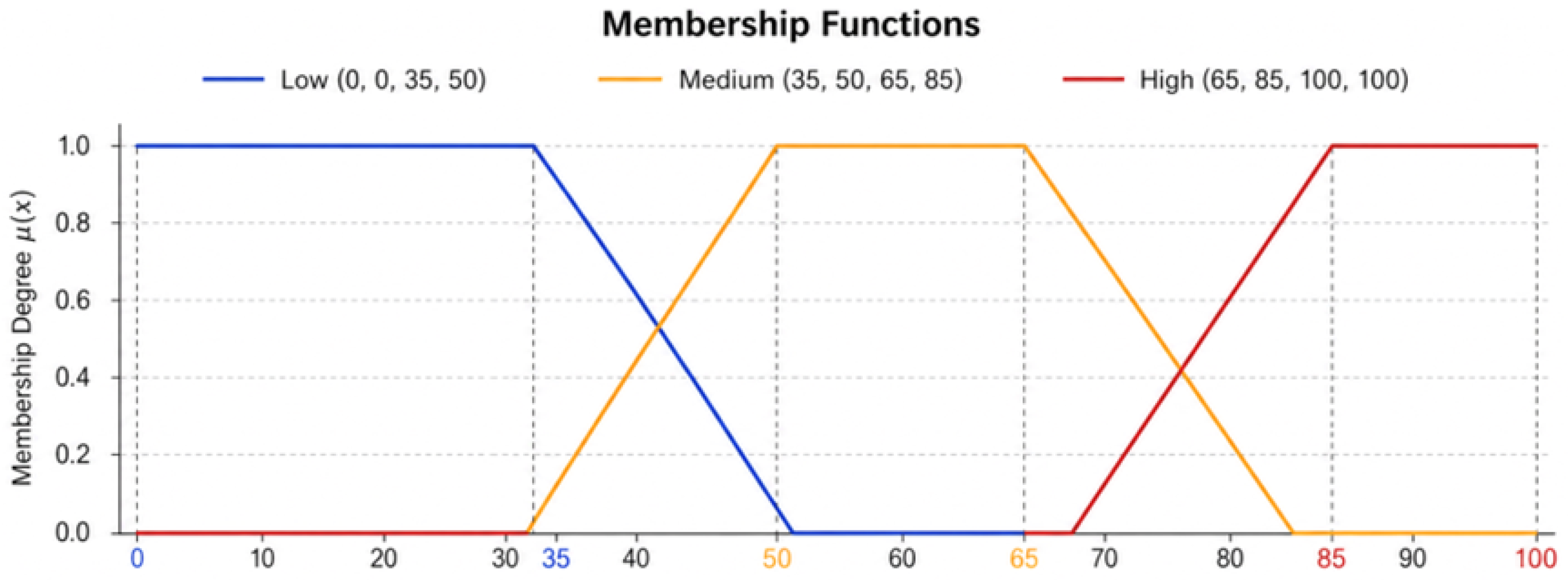
The first step is the fuzzification of the AI probabilities. The raw AI scores are not used directly, because they are generally small and are not easily interpretable as final category-association values. Instead, for each category separately, the empirical distribution of the corresponding probability column is summarized through three reference points: the 35th, 65th, and 85th percentiles. These act as adaptive low, medium, and high anchors, allowing each AI probability to be mapped to a fuzzy membership value. In more detail, based on percentiles, the fuzzy sets of
Table 3 are defined. The partitions of these fuzzy sets were empirically defined by 5 experts with at least 10 years of experience in the tourism sector. The fuzzy sets’ membership functions, illustrated in
Figure 2, take as input the percentile of an AI probability score and give as output a fuzzy value in the interval
. Due to overlaps of the fuzzy sets, there is a possibility that an AI probability may assign values across two adjacent fuzzy sets, whose sum is greater than 1. For the purposes of our research, and in order to simplify the calculations, we always keep the value of the rightmost (i.e., better) set. For example, if an AI probability corresponds to 45th percentile, then
and
. For our calculations, the system takes into consideration
as the membership value.
This category-specific quantile-based strategy is preferable to fixed global thresholds, since the probability ranges differ across categories and the AI baseline is intended to provide soft semantic evidence rather than calibrated confidence scores.
A second source of evidence is obtained from the type labels associated with each POI. The available English type labels are concatenated into a compact textual field and checked against category-specific keyword sets. For example, terms such as
church,
monastery, and
cathedral support
Religious & Sacred Sites; terms such as
castle,
fortress, and
tower support
Castles & Fortifications; terms such as
mountain,
cave, and
waterfall support
Natural Features; and terms such as
beach,
island,
lake, and
port support
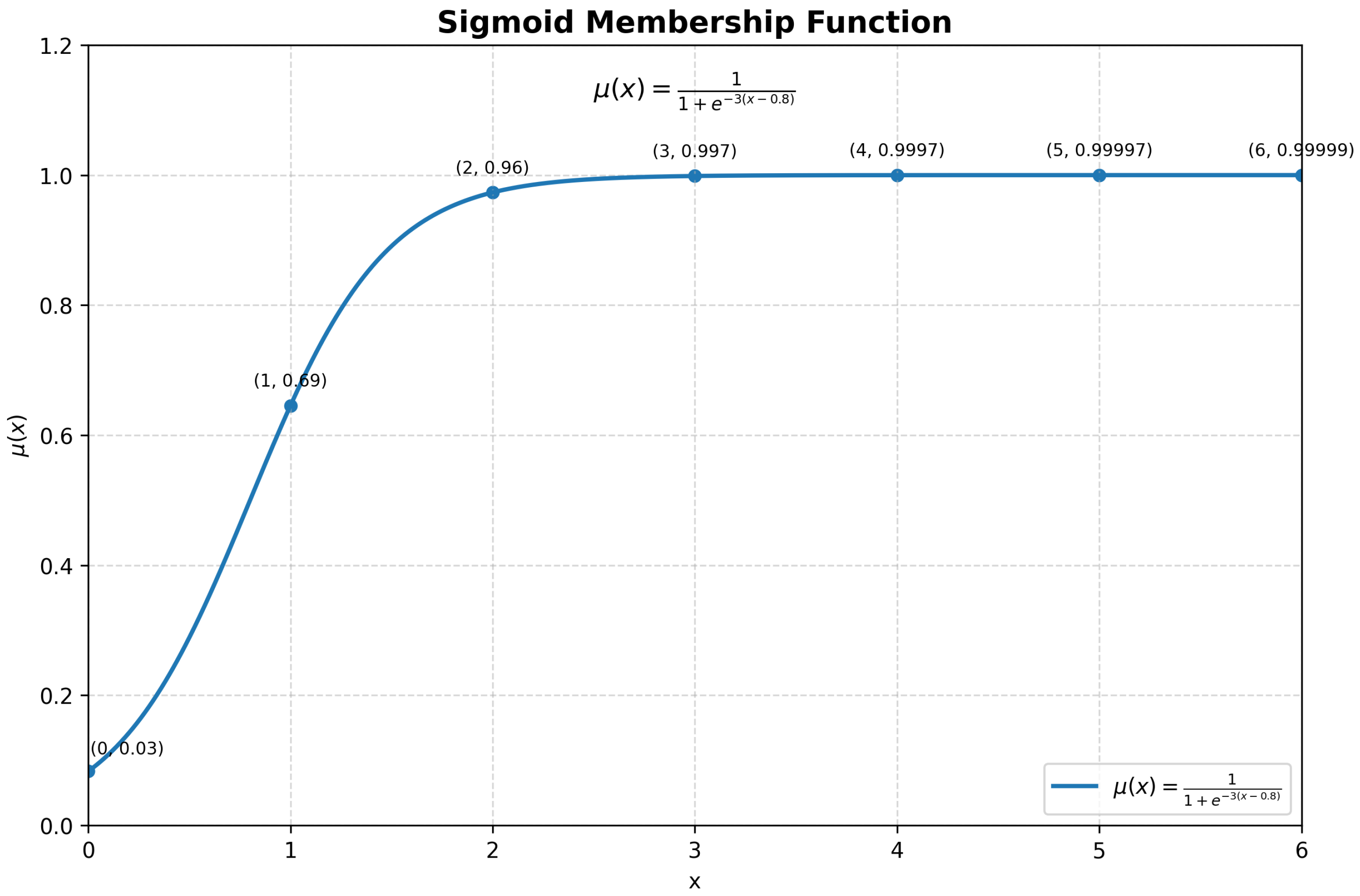
Water & Coastal. The number of keyword matches is then converted into a type-based fuzzy score, so that stronger structured evidence produces stronger support for the corresponding category. This conversion is realized by using the sigmoid membership function, which is depicted in
Figure 3. Accordingly, the type-based fuzzy score is approximately 0 for zero matches, approximately 0.9 for two matches, and approaches 1 for three or more matches. This membership function was defined empirically too. This approach is a reasonable approximation chosen to behave sensibly in the system.
A third signal is derived from heritage designations. When a POI includes at least one heritage-related value, an additional boost is assigned to categories that are more strongly associated with cultural and historical significance, namely
Monuments & Landmarks,
Archaeological & Historic Sites,
Castles & Fortifications, and, to a lesser degree,
Museums & Cultural Venues. In this way, heritage information acts as an explicit and interpretable cue that reinforces categories where such designations are especially meaningful. The specific boost values applied per category are listed in
Table 4. These values were derived empirically by 5 experts in the field of tourism. The experts were based on semantic relationships (with heritage being more strongly associated with monuments), balancing contributions from AI-based and type-based signals, and empirical tuning on the dataset to prevent score saturation.
The final category membership is obtained by combining these three sources of information through a permissive OR-style fusion strategy. For category
c, the final membership
is defined as
where
denotes the fuzzified AI membership for category
c,
denotes the type-based fuzzy evidence, and
denotes the heritage boost when applicable. The coefficient 0.8 is a heuristic scaling parameter introduced to prevent score saturation at the upper bound, to retain sufficient margin for the heritage boost to exert influence, and to preserve a balanced interplay between the various contributing signals within the model. The score is clipped to the interval
. This design was intentionally chosen to preserve secondary but meaningful category signals, since the objective of the framework is not only to assign a dominant label, but also to support exploratory and research-oriented multi-category analysis.
The outputs of the fuzzy layer are stored in a file and, for each POI, the method produces a final membership score for each of the eight categories, a main fuzzy category (fuzzy_top1), and its associated score (fuzzy_top1_score). In addition, all categories whose membership exceeds a predefined threshold () are retained as strong labels, while the top three categories are always recorded in order to preserve a stable multi-category view even in ambiguous cases. Together, these outputs provide an interpretable representation of POIs that is better aligned with their overlapping tourism semantics than a hard single-label assignment.
From a computational perspective, let N denote the number of POIs, C the number of tourism categories, d the embedding dimension, and K the number of category-specific type keywords. The embedding-based AI stage requires operations for the cosine similarity between POI embeddings and category anchors, followed by operations for softmax normalization. The fuzzy layer requires operations for AI-score fuzzification, approximately operations for type-keyword matching, and operations for the final fusion step. Since the taxonomy is fixed in this study () and the keyword sets are predefined, the post-extraction computational cost of the pipeline scales approximately linearly with the number of POIs. The most computationally demanding part is the embedding-based AI estimation, whereas the fuzzy inference stage is lightweight.
4. Results
This section presents the empirical outputs of the proposed pipeline. It first reports country-level tourism profiles, followed by the multi-label categorization results, representative ranked catalogs and case studies, and the quantitative evaluation of the proposed AI + Fuzzy approach against baseline variants.
4.1. Country-Level Tourism Profiles
The country-level profiles reported in this subsection are aggregate diagnostic outputs of the pipeline. They do not evaluate the correctness of individual POI assignments; rather, they summarize how AI-only and fuzzy top-1 assignments are distributed within each national subset. In this way, the profiles help interpret both model behavior and characteristics of the underlying Wikidata-derived data. Shifts between the AI and fuzzy profiles indicate where structured type and heritage evidence modifies the semantic baseline, while cross-country differences reflect both the composition of the extracted POI collections and country-specific Wikidata documentation patterns. Item-level classification behavior is examined separately in the representative case studies and evaluation subsections.
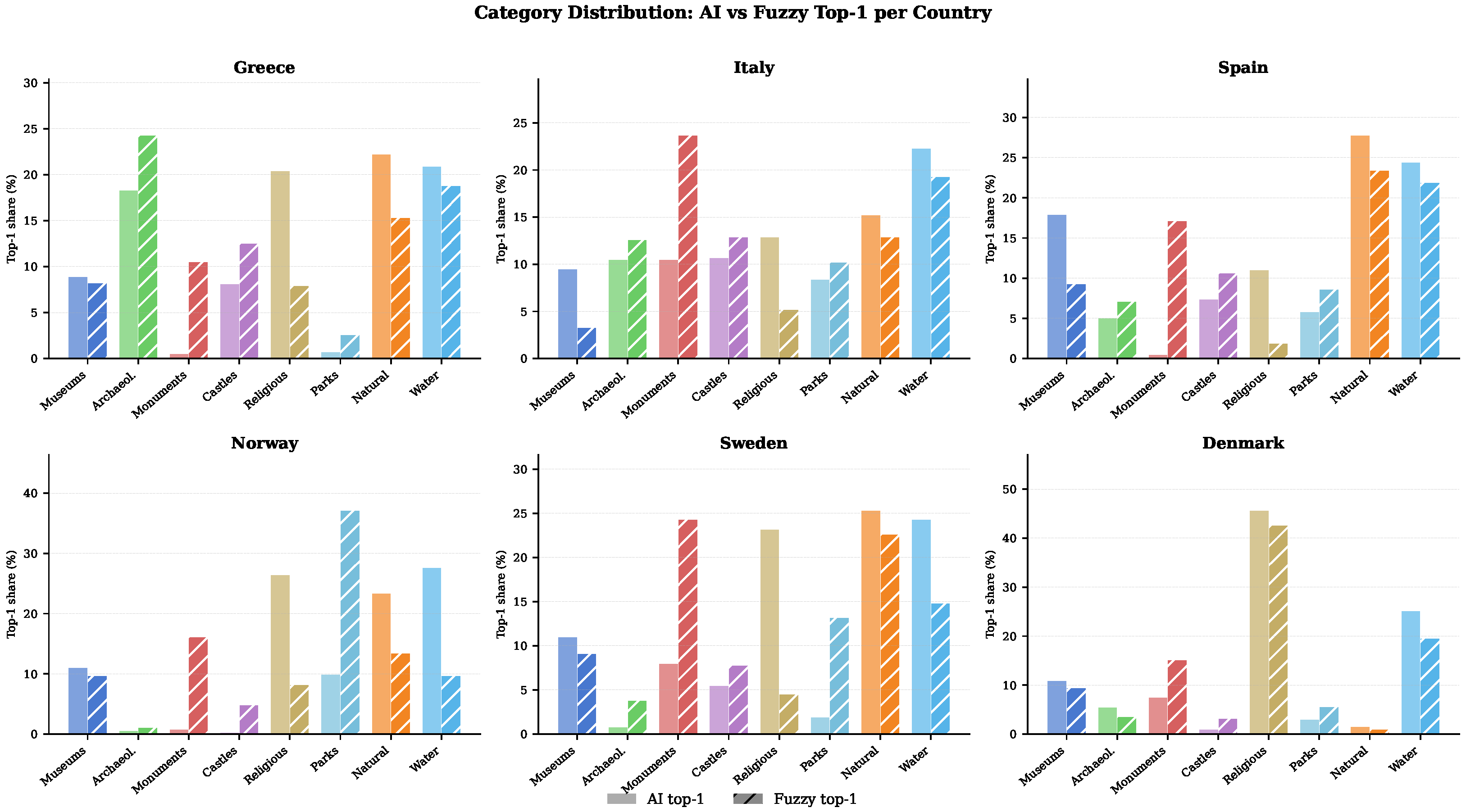
For each country, category profiles are computed separately for the AI stage and the fuzzy stage by recording, for every POI, the category with the highest score and aggregating these assignments into a percentage distribution over the eight taxonomy categories.
Figure 4 presents these profiles side by side for all six countries.
The comparison reveals consistent and interpretable shifts introduced by the fuzzy layer. In Greece, the share of Archaeological & Historic Sites increases from 18.3% to 24.3%, reflecting the reinforcement provided by type and heritage evidence for a country with strong archaeological representation in the dataset. In Italy, Monuments & Landmarks rises from 10.5% to 23.7%, capturing the monument-dense character of the Italian POI collection more accurately than the AI baseline alone. The most pronounced shift occurs in Norway, where Parks & Protected Areas increases from 9.9% to 37.1%, a change driven by strong type-based evidence for protected landscapes that the text-only AI baseline underweights.
By contrast, the share of Religious & Sacred Sites decreases substantially in several countries—most notably in Greece (20.4% to 7.9%), Norway (26.4% to 8.2%), and Spain (11.0% to 1.9%)—suggesting that the AI baseline tends to overestimate religious affiliation from textual cues, and that the fuzzy layer corrects this through more discriminative type-based evidence. Denmark remains the most stable profile across both stages, with Religious & Sacred Sites dominant at 45.6% and 42.6%, respectively, which is consistent with the dataset composition: 999 of the Danish POIs carry the type church building, and all of them receive Religious & Sacred Sites as their AI top-1 category. This pattern also illustrates a dataset-level characteristic rather than a limitation of the pipeline: the profiles reflect the actual composition of tourism-relevant entities in Wikidata for each country, and differences across countries are therefore both methodologically expected and analytically informative.
4.2. Multi-Label Categorization
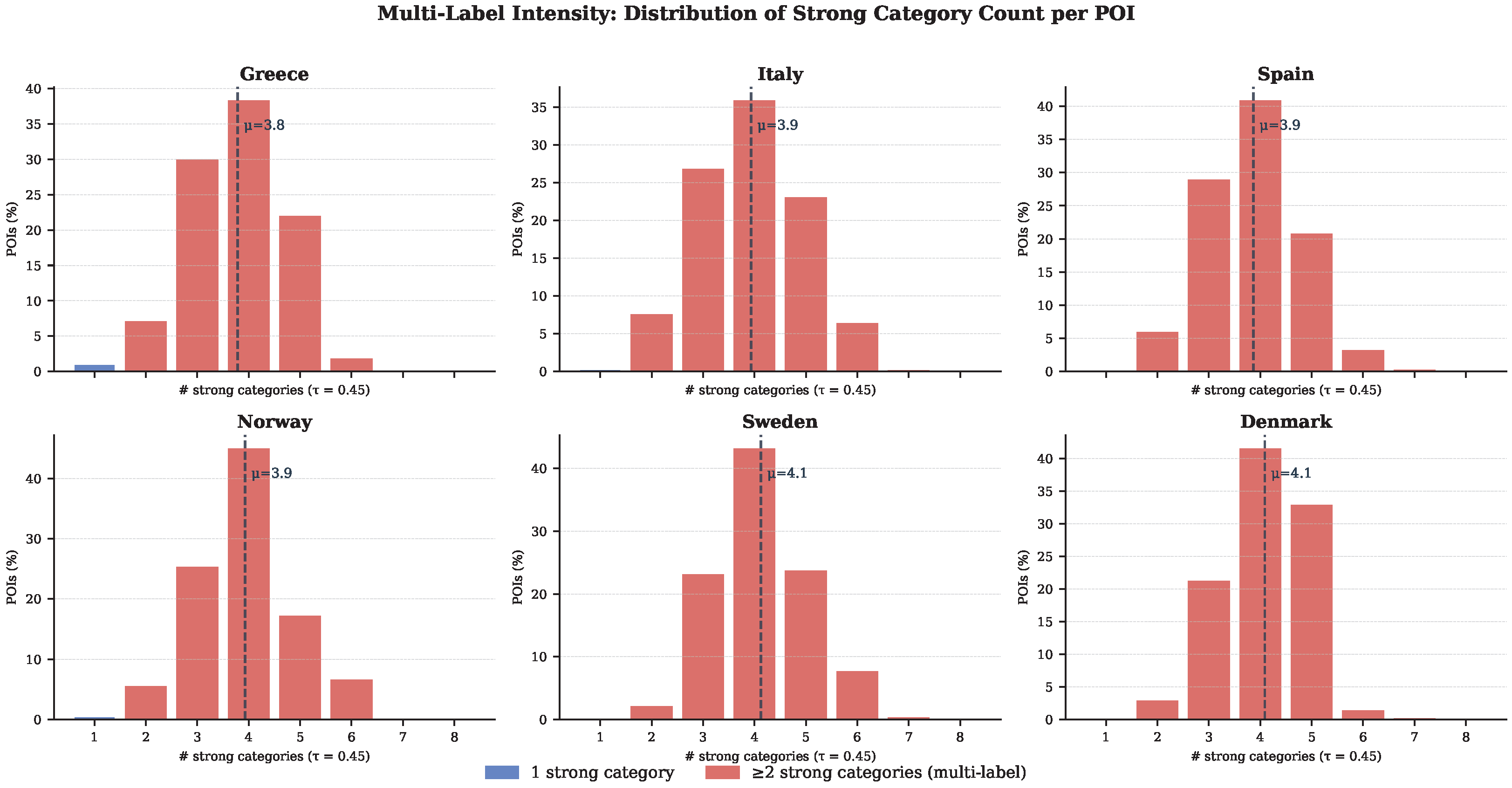
A key property of the proposed framework is its ability to assign multiple strong category labels to a single POI, reflecting the overlapping tourism semantics that characterize real-world places. For each POI, all categories whose membership score exceeds the threshold are retained as strong labels, and the count of strong labels per POI (fuzzy_n_strong) is recorded as a measure of multi-label intensity.
Figure 5 shows the distribution of this count across all six countries. In every country, the distribution is strongly concentrated at three to five strong labels per POI, with a negligible proportion of POIs receiving only a single strong assignment. The mean number of strong labels ranges from 3.8 in Greece to 4.1 in Sweden and Denmark, indicating that multi-label membership is the norm rather than the exception under the proposed framework.
This pattern has two important implications. First, it confirms that the permissive OR-style fusion design is effective at preserving meaningful secondary category signals rather than collapsing them into a single dominant label. Second, it demonstrates that a single-label representation would systematically discard a substantial portion of the tourism-relevant semantic information present in the data—information that is directly useful for faceted search, multi-criteria filtering, and personalized recommendation in smart tourism applications.
The slight variation across countries—with Scandinavian countries showing marginally higher mean strong-label counts than Mediterranean ones—is consistent with the broader type composition of the respective datasets. POIs from Norway, Sweden, and Denmark tend to carry more generic Wikidata types (e.g., church building, lake) that partially match multiple keyword sets, whereas Mediterranean POIs more frequently carry domain-specific types (e.g., archaeological site, castle) that concentrate evidence in fewer categories.
4.3. Representative Catalogs and Case Studies
Table 5 presents the top-10 ranked POIs for Greece in the
Archaeological & Historic Sites category, sorted by fuzzy membership score
. The entries span well-known sites such as the Ancient Agora of Athens and the Ancient Theatre of Epidaurus, alongside less prominent but equally well-typed entities. All ten POIs receive at least three strong category labels, confirming that even within a thematically focused catalog, multi-label membership is the norm. The narrow score range (0.919–0.923) reflects the homogeneous type composition of this subset: all entries carry the
archaeological site type, which produces consistently strong type-based evidence for the target category. Entries that additionally receive
Castles & Fortifications as a strong label—such as the Temple of Rome and Augustus and Proclus’s House—do so because their type labels include structural terms that partially match the fortification keyword set, illustrating how the fuzzy layer surfaces overlapping signals that a single-label classifier would suppress.
To further illustrate the interpretability of the fuzzy layer,
Table 6 presents four representative cases where the dominant category assignment changes between the AI stage and the fuzzy stage (
ai_top1 ≠
fuzzy_top1). Across the full dataset, such flips occur in 10,002 out of 32,445 POIs (30.8%), indicating that the fuzzy layer introduces substantial and systematic refinements beyond the AI baseline.
The four cases illustrate distinct mechanisms through which the fuzzy layer refines the AI baseline. In the case of the Temple of Apollo in Delphi, the AI assigns Archaeological & Historic Sites with a low probability score of 0.160, while the fuzzy layer elevates Monuments & Landmarks to a membership of 1.000, driven by the heritage boost applied to a POI carrying a heritage designation (P1435). This case illustrates how structured Wikidata properties can override a weakly differentiated AI signal when explicit cultural significance indicators are present.
In the case of Agios Nikolaos in Chania, the AI assigns Religious & Sacred Sites based on the textual similarity of the POI’s label and description to the religious anchor, reflecting a common pattern whereby the AI baseline overestimates religious affiliation for church-labelled entities. The fuzzy layer reassigns the dominant category to Archaeological & Historic Sites (0.721), supported by type-based evidence that the entity’s church building type is consistent with a historically significant structure rather than an exclusively religious one.
The Kranaion cave sanctuary presents a case of inherently overlapping semantics: the POI is both a natural cave and an ancient religious site, producing five strong labels spanning Archaeological, Monuments, Castles, Religious, and Natural Features. The AI baseline, constrained to a single dominant probability, assigns Religious & Sacred Sites, while the fuzzy layer correctly identifies Archaeological & Historic Sites as the primary dimension (0.824) while preserving the religious and natural signals as secondary memberships.
Finally, the Castle of Herakleia illustrates a case where the dominant category shifts from Castles & Fortifications to Archaeological & Historic Sites (0.902), with Water & Coastal appearing among the strong labels—reflecting the geographic context of a coastal fortification. This multi-dimensional assignment would not be captured by any single-label approach, yet it is precisely the kind of nuanced representation that supports faceted tourism search queries such as “historic coastal fortifications”.
4.4. Evaluation
4.4.1. Annotation Protocol
To assess the categorization quality of the proposed pipeline, we constructed a targeted evaluation set of 60 POIs drawn from the full dataset. Rather than random sampling, we adopted a targeted design composed of four groups of 15 POIs each, selected to cover complementary difficulty levels: cases where the dominant category changes between the AI and fuzzy stages (Group A), cases with five or more strong fuzzy labels (Group B), cases where the AI baseline assigns a low-confidence top-1 score (Group C), and cases where the fuzzy layer produces a high-confidence dominant assignment (Group D). This design was chosen to stress-test the pipeline in the conditions most relevant to its practical use, rather than to provide a random population estimate.
Each POI was independently annotated by two human annotators, each of whom assigned between one and three category labels from the eight-category taxonomy. Both annotators worked from the same information—the English label, the Wikidata type information, and the Wikipedia link of each entity—without access to the system outputs or to each other’s annotations. Written annotation guidelines were followed, including category definitions, the distinctions between adjacent categories, and worked examples for ambiguous cases. The first annotator’s labels constitute the gold set used in the quantitative evaluation, while the second, independent annotation is used to quantify inter-annotator agreement.
Inter-annotator agreement confirms that the two annotators interpreted the taxonomy consistently. The two annotations have near-identical label density (2.43 vs. 2.45 categories per POI), and, treating each of the eight categories as an independent binary present/absent decision, the mean per-category Cohen’s
[
35] is
, with a mean pairwise Jaccard overlap of
between the full label sets—both in the substantial range on the scale of Landis and Koch [
36]. Agreement is substantial to almost perfect on five of the eight categories, covering all of the well-delineated, type-driven classes (Castles & Fortifications
, Religious & Sacred Sites
, Natural Features
, Water & Coastal
, Museums & Cultural Venues
). Lower agreement is confined to the two categories with intentionally fuzzy conceptual boundaries: Archaeological & Historic Sites (
) and Parks & Protected Areas, where protected natural landscapes are split between that category and Natural Features. The primary-label agreement (
,
exact) is necessarily more conservative and is itself informative: that even careful annotators frequently disagree on which of several jointly valid categories is dominant directly supports the central argument of this work, namely that a single-label representation is inadequate for tourism POIs while a multi-label one is required. Because the 60-POI set was deliberately constructed to over-represent ambiguous and borderline cases (Groups A and C), these figures are conservative lower bounds relative to the agreement expected on a random sample. Notably, the two lowest-agreement categories are also those on which the fuzzy layer delivers its largest gains over the AI baseline indicating that structured Wikidata evidence contributes most precisely where human judgement is least consistent.
4.4.2. Quantitative Results
Table 7 reports the main evaluation metrics for three system variants: AI-only (top-1 prediction), Type-only (fuzzy top-1 based on structured type evidence alone, without AI probabilities), and AI + Fuzzy (full pipeline, evaluated at top-2 and top-3). All metrics are computed against the human-annotated multi-label gold set, whose mean label count is 2.43 categories per POI.
For each POI, let
G denote the human-annotated gold label set and let
denote the set of the top-
k categories predicted by a system. Jaccard similarity is computed as
Precision at
k is defined as
while recall at
k is defined as
The corresponding F1 score is computed as
with
when both precision and recall are zero. For AI-only and Type-only variants,
, whereas for the AI + Fuzzy system, results are reported at
and
in order to reflect its intended multi-label use.
The results reveal a clear trade-off between precision and coverage. The AI-only baseline achieves the highest top-1 precision (0.867) and F1@1 (0.531), indicating that when evaluated on its single dominant prediction, it reliably identifies a correct category. However, it provides no multi-label coverage beyond that single prediction. The Type-only system consistently underperforms the AI baseline across all metrics, confirming that structured type signals alone are insufficient for reliable categorization and that the semantic estimation provided by the AI stage is a necessary component of the pipeline.
The AI + Fuzzy pipeline, when evaluated at top-3, achieves the highest Jaccard (0.486) and F1@3 (0.616) across all variants, demonstrating that the full pipeline provides substantially better multi-label coverage than either component alone. The lower top-1 precision of AI + Fuzzy reflects the permissive fusion design: the fuzzy layer is not optimized for single-label accuracy but for capturing the overlapping tourism semantics of real-world POIs. The gap between top-2 and top-3 performance indicates that the meaningful secondary labels are typically found within the top three fuzzy assignments.
Table 8 shows the per-category Jaccard comparison between AI-only and AI + Fuzzy (top-3). The fuzzy pipeline outperforms the AI baseline in four of the seven represented categories. The largest gains are observed in
Archaeological & Historic Sites (+0.218) and
Parks & Protected Areas (+0.214)—precisely the categories where structured Wikidata evidence from type labels and heritage designations provides the strongest signal. By contrast, the fuzzy layer underperforms for
Natural Features (−0.438) and
Water & Coastal (−0.250), where keyword-based type evidence is less discriminative and the heritage boost does not apply.
The per-group analysis shows that the relative advantage of the fuzzy pipeline is most pronounced in Group D (clear cases, Jaccard = 0.667 at top-3), where high-confidence fuzzy assignments align well with human judgement. In Group A (flip cases, Jaccard = 0.493 at top-3), the fuzzy layer also outperforms the AI baseline (0.400), supporting the qualitative finding that category changes driven by type and heritage evidence tend to be interpretable and correct. Group C (ambiguous cases) shows the weakest performance across all systems (Jaccard ≤ 0.356), which is expected given that these POIs were selected precisely because the AI baseline was uncertain about them.
These results should be interpreted in light of two methodological considerations. First, although inter-annotator agreement has now been quantified on a second, independent annotation, the gold set remains of modest size. Second, the sample was constructed through targeted rather than random selection, meaning that the reported metrics reflect performance on challenging and ambiguous cases rather than on a representative cross-section of the full dataset. Both factors suggest that the quantitative results reported here should be treated as indicative rather than as population-level estimates, and that a more comprehensive evaluation on a larger random sample remains an important direction for future work.
5. Discussion and Conclusions
This paper presented an end-to-end pipeline for transforming heterogeneous Wikidata POIs into compact, interpretable, and multi-category tourism representations. Starting from a seed-based extraction strategy applied to six countries, the framework combines a training-free AI baseline based on sentence embeddings with a fuzzy inference layer that integrates structured Wikidata evidence—type labels and heritage designations—to produce final membership scores and principled multi-label assignments. The pipeline generates ranked tourism catalogs per country and category, country-level tourism profiles, and diagnostic comparison views that together provide a multi-granularity picture of each national POI collection.
The country-level profile analysis reveals that the fuzzy layer introduces consistent and interpretable shifts relative to the AI baseline. In Mediterranean countries, the fuzzy stage reinforces categories that are well supported by structured Wikidata evidence: Archaeological & Historic Sites increases substantially in Greece (18.3% to 24.3%), and Monuments & Landmarks rises sharply in Italy (10.5% to 23.7%), reflecting the monument-dense character of the Italian POI collection. The most pronounced shift occurs in Norway, where Parks & Protected Areas increases from 9.9% to 37.1%, driven by strong type-based evidence for protected landscapes that the text-only AI baseline underweights. Across several countries, the fuzzy layer also reduces the share of Religious & Sacred Sites, correcting a systematic tendency of the AI baseline to overestimate religious affiliation from textual cues. These patterns demonstrate that combining semantic and structured evidence produces country profiles that are more aligned with the actual composition and character of each national POI collection than AI-only outputs.
The multi-label analysis confirms that the permissive OR-style fusion design achieves its intended purpose. Across all six countries, the vast majority of POIs receive three to five strong category assignments, with mean values ranging from 3.8 to 4.1. This pattern demonstrates that multi-label membership is the norm rather than the exception for tourism POIs, and that a single-label representation would systematically discard a substantial portion of the semantically meaningful category information present in the data. The case studies further illustrate how the fuzzy layer captures nuanced multi-dimensional POI profiles—such as a coastal fortification that is simultaneously a Castle, a Monument, and a Water & Coastal attraction—that are directly relevant for faceted tourism search and personalized recommendation.
The quantitative evaluation on the 60-POI targeted gold set shows that AI + Fuzzy (top-3) achieves the highest Jaccard similarity (0.486) and F1@3 (0.616) across all system variants, outperforming both the AI-only and Type-only baselines in overall multi-label coverage. The per-category analysis identifies Archaeological & Historic Sites (+0.218) and Parks & Protected Areas (+0.214) as the categories where the fuzzy layer contributes most substantially, consistent with the availability of strong type and heritage signals for these categories in Wikidata. The weaker performance for Natural Features and Water & Coastal points to a specific limitation of the current keyword-based type evidence, and suggests that richer or more discriminative signals would be beneficial for these categories in future work.
The framework has several limitations that should be acknowledged. First, the dataset is a controlled extraction rather than an exhaustive census of Wikidata tourism entities. The seed list constrains the retrieval space; the use of exact P31 seed classes may exclude relevant entities represented through more specific subclasses or alternative properties; the 1000-row cap per country seed query limits coverage; and the public WDQS endpoint introduces variability due to timeout constraints. Second, Wikidata coverage is uneven across countries, languages, and entity types. Missing or incomplete English descriptions can weaken the semantic signal available to the embedding-based AI baseline, while inconsistent type granularity can affect the strength of type-based fuzzy evidence. As a result, the extracted country profiles reflect both tourism-related entity composition and documentation biases within Wikidata. Third, the fuzzy inference layer relies on heuristic keyword sets and manually assigned heritage-boost values, which were designed to be interpretable and reproducible but were not optimized through systematic parameter search. Finally, although inter-annotator agreement is now reported, the evaluation still rests on a targeted rather than random sample of modest size. Therefore, the reported quantitative metrics should be interpreted as indicative results on challenging cases rather than as population-level estimates of performance.
Despite these limitations, the proposed framework offers several practical contributions. The pipeline is fully reproducible: all extraction queries, model choices, taxonomy definitions, fuzzy parameters, and output formats are documented and fixed, so that the same results can be obtained by re-running the pipeline on the same or analogous input data. The eight-category taxonomy is compact enough to serve as a stable label space for cross-country comparison, yet expressive enough to capture the main thematic dimensions of tourism POI collections. The explainability traces produced by the fuzzy layer—showing which type labels, heritage signals, and AI probabilities contributed to each category assignment—provide a transparent audit trail that supports both curator oversight and downstream user explanation in smart tourism applications [
9,
33,
34].
Future work should address the identified limitations along several directions. A larger, randomly sampled evaluation set, annotated by additional independent annotators, would provide more reliable population-level estimates of system performance. Future work should also compare the proposed method with stronger supervised or weakly supervised multi-label baselines, where suitable annotated data is available. Richer type-based signals, for example drawing on broader Wikidata property sets such as architectural styles, protection status, or geographic proximity features could improve coverage for underperforming categories such as Natural Features and Water & Coastal. Extending the pipeline to additional countries and geographic regions would test the robustness of the taxonomy and the generalizability of the fuzzy parameters across different Wikidata coverage profiles. Finally, integrating the pipeline outputs into a downstream smart tourism interface—enabling faceted search, multi-criteria filtering, and personalized POI recommendation—would provide a practical validation of the explainable multi-label representations produced by the framework.