1. Introduction
From the perspective of control theory, dynamical complex networks—typically modeled as systems of coupled ordinary differential equations—provide a paradigmatic framework for analyzing large-scale interactive dynamics. Research in this area systematically addresses foundational challenges, including network modeling, characterization of intrinsic properties, investigation of dynamical evolution, and the design of synchronization protocols [
1,
2,
3]. Within this broad context, the synchronization of networked systems has emerged as a distinct and highly active sub-discipline, attracting substantial research interest [
4,
5,
6,
7,
8,
9]. Rooted in the theory of nonlinear dynamical systems [
10], the study of synchronization mechanisms offers a principled approach to enhancing cooperative behaviors and mitigating undesired disturbances. These theoretical developments have proven instrumental in optimizing performance across a range of application domains, including physical systems, biological processes, laser engineering, and networked communications.
In contemporary control literature, complex dynamical networks are commonly studied under two principal synchronization paradigms. The first enhances intrinsic synchronizability through the master stability function (MSF) framework [
11], which facilitates the systematic optimization of network parameters—such as topological configuration and coupling strength—to promote coherent dynamics. The second paradigm relies on external control interventions, which can be broadly categorized into discontinuous and continuous implementations. Discontinuous strategies, including event-triggered mechanisms [
6,
7], sampled-data control [
12], intermittent control [
13], and impulsive control [
14], offer practical advantages such as reduced communication load, bandwidth conservation, lower energy consumption, and decreased implementation costs. Conversely, continuous techniques—encompassing adaptive control, optimal control, fuzzy control, sliding mode control, and feedback control—have established a robust theoretical foundation for synchronization analysis, yielding fundamental criteria and deep insights into the dynamical mechanisms underlying complex network behavior.
As is known to all, it is well recognized that dynamical coupling between network nodes is realized through information exchange. During this process, the formation, integration, and transmission of information inevitably introduce time delays, which manifest as output or response lags. Moreover, due to the prevalence of environmental disturbances and internal fluctuations, stochastic noise is ubiquitous in both natural and engineered systems. Consequently, the analysis and control of complex dynamical networks must account for stochastic disturbances [
6,
15,
16,
17,
18,
19,
20,
21]. For instance, Song et al. [
15] investigated global synchronization of stochastic delayed complex networks, while Wang et al. [
16] employed adaptive feedback control to drive a stochastic dynamical network toward its mean state orbit. The pinning synchronization of stochastic complex networks based on adaptive fuzzy approximation has been extensively explored in [
17,
18,
19]. More recently, the synchronization problem for stochastic complex-valued dynamical networks via aperiodically intermittent adaptive control was systematically addressed in [
20].
The aforementioned synchronization strategies are primarily premised on the framework of asymptotic convergence, whether defined in mean square or probabilistic terms. In contrast, practical imperatives often require convergence within a finite horizon, thus driving the application of finite-time stability theory for its inherent rapidity and disturbance rejection properties [
21,
22,
23,
24,
25,
26,
27,
28,
29,
30]. Within this finite-time paradigm, Significant progress has been made in the study of synchronization for complex dynamical networks. Mei et al. [
13] explored the finite-time synchronization of two complex networks with non-identical topologies, establishing results based on finite-time stability theory. Extending this line of research, Yang and Cao [
21] investigated the stochastic synchronization problem for complex networks subjected to random noise perturbations, providing analytical criteria for ensuring synchronization in probabilistic settings. Sun et al. [
22] addressed the problem of finite-time stochastic outer synchronization between two non-identical dynamical networks subjected to stochastic disturbances, establishing sufficient conditions under which synchronization can be achieved within a finite time horizon despite the presence of random perturbations. In [
23], Zhao et al. addressed the synchronization control problem for uncertain complex networks featuring multi-links, focusing on stochastic mean-square stability in the framework of modified function projective synchronization. Xie et al. [
24] developed an adaptive controller along with coupling structure update laws to achieve finite-time synchronization of complex delayed networks subject to Markovian jumping parameters and stochastic perturbations. Subsequently, Xie et al. [
25] established novel finite-time robust stochastic synchronization criteria for uncertain Markovian complex dynamical networks with mixed time-varying delays and reaction-diffusion terms. These criteria were formulated in terms of linear matrix inequalities, providing computationally verifiable conditions for synchronization. Then, with the help of hybrid control strategy and Wirtinger’s inequality, Ren et al. [
26] addressed the finite-time synchronization problem for Markovian jumping stochastic complex dynamical systems with mixed delays using Lyapunov stability theory and stochastic analysis techniques. In a similar vein, the authors of [
27,
28] investigated the finite-time stochastic synchronization of (semi)Markovian switching neural networks with time delays, establishing synchronization criteria based on linear matrix inequalities. Departing from finite-time analysis, Liu [
29] proposed a unified framework for fixed-time synchronization of complex networks by incorporating an aperiodically intermittent control strategy, which offers greater flexibility in controller design while ensuring synchronization within a fixed time. The finite-time synchronization of dynamic networks with nonlinear coupling strength has been extensively investigated in [
30,
31,
32,
33,
34], where quantized intermittent control strategies are employed to achieve synchronization within a finite time horizon. These studies highlight the effectiveness of quantization techniques in reducing communication burden while maintaining synchronization performance. In parallel, recent years have witnessed growing interest in the finite-time synchronization of complex hyperchaotic systems [
35], which exhibit more complex dynamical behaviors and pose additional challenges for synchronization control due to their higher sensitivity to initial conditions and parameter variations. Fuzzy neural networks [
36,
37,
38] are also explored in depth. Concurrently, the interplay between network topology, external disturbances, and synchronization performance has emerged as a focal point of ongoing research.
Existing research on synchronization of complex networks above has achieved significant progress across several major directions, including asymptotic synchronization with known topologies, finite-time synchronization in the absence of stochastic disturbances, stochastic synchronization with unknown but time-invariant couplings, and mean-square periodic coupling estimation without finite-time convergence guarantees. Despite these advances, no unified framework has yet addressed the problem of finite-time stochastic synchronization for networks that simultaneously involve unknown time-varying periodic couplings, bounded delays, and stochastic perturbations.
Several important questions therefore remain open. In particular, it is unknown whether finite-time synchronization can be guaranteed in probability when the outer coupling matrix is both unknown and periodically time-varying. Furthermore, the design of adaptive laws capable of estimating such periodic couplings while ensuring synchronization within a finite horizon has not been explored, and no theoretical bound on the expected settling time under stochastic disturbances has been established.
Despite these advances, a critical limitation persists; the joint treatment of finite-time stochastic perturbations and unknown time-varying periodic couplings remains conspicuously absent from the current literature. Most existing studies, as reviewed above, successfully address one aspect of this challenge, yet fall short of providing a unified framework that can simultaneously accommodate both types of complex dynamic constraints. It is well recognized that both the coupling configuration and the nodal dynamics play fundamental roles in the behavior of complex dynamical networks. Modifications in link strength typically induce concomitant changes in network topology as well as in the coupling configuration [
15,
25]. In practice, however, due to inherent uncertainties and environmental variability, the topological structure of complex dynamical networks is often partially if not entirely unknown. Adaptive control schemes offer notable advantages in such settings, including improved control accuracy and reduced control cost [
23,
31], while also serving as an effective tool for the estimation and identification of unknown network parameters. In light of these considerations, the synchronization of complex dynamical networks with unknown time-varying coupling structures constitutes a challenging yet essential research endeavor, which motivates the present work.
In [
4], it was established that mean-square synchronization of time-delay coupled networks can be attained simultaneously with the estimation of unknown periodic coupling weights, using adaptive learning update laws in conjunction with an appropriately designed controller. Extending this line of inquiry, Hao and Li [
32] proposed a combined adaptive-learning control strategy for networks under stochastic disturbances, achieving mean-square convergence while estimating the unknown periodic coupling structure. Despite these important contributions, achieving finite-time stochastic synchronization in networks characterized by unknown periodic coupling structure remains an open and challenging problem.
Motivated by the limitations of existing studies, this paper investigates the finite-time synchronization problem for time-delay complex dynamical networks with unknown time-varying coupling structure by designing an adaptive feedback controller. The main contribution of our work is the successful integration of feedback control, adaptive control, and learning control strategies to accomplish finite-time synchronization, particularly under the challenging condition that the outer coupling configuration among nodes is unknown and periodic. We design a novel controller that combines period-based adaptive estimation, feedback gain adaptation, and a finite-time-oriented term, and we employ a carefully constructed Lyapunov–Krasovskii functional to rigorously prove that the error system converges to zero in finite time with probability one, together with an explicit upper bound on the expected settling time. Numerical examples further demonstrate that the unknown periodic couplings are accurately estimated online, validating the effectiveness of the proposed approach.
The remainder of this paper is organized as follows. In
Section 2, a novel dynamical complex network model with stochastic disturbance is formulated, and the problem statement, along with relevant preliminaries, is provided.
Section 3 develops the adaptive finite-time synchronization approach and the associated parameter update laws for complex dynamical networks, where sufficient stabilization criteria are derived and rigorously proved.
Section 4 presents a numerical example to validate the correctness and effectiveness of the proposed control method. Finally,
Section 5 concludes the paper with a summary of findings and future research directions.
2. Problem Statement and Preliminaries
Addressing the finite-time synchronization problem, this section focuses on a heterogeneous dynamical complex network with time delays. The model is characterized by an unknown periodic outer coupling structure and is described by the following differential equations:
where
denotes the state vector of the
i-th node; its dynamics evolve according to the smooth nonlinear function
, which characterizes the isolated dynamics of node
i, and satisfies Lipschitz condition Assumption 1. The term
denotes the unknown bounded time-varying delay, satisfying
for a positive constant
, and the initial value
. The matrix
is the inner coupling matrix, which quantifies the interaction between individual state components. The outer coupling matrix
encodes the topological structure of the network, where
(for
) indicates a directed connection from node
j to node
i; otherwise,
. Furthermore, the time-varying weights
are unknown periodic functions that satisfy the following condition:
In addition, is the noise intensity function matrix; is an n-dimensional Wiener process defined on the probability space , satisfying and . In this paper, we assume that the Wiener processes and are mutually independent for all .
The dynamics of network (1) are subject to the initial condition on , where the initial function belongs to the function space —the Banach space of all represents the set of all -valued continuous functions on the interval .
Without loss of generality, the solution
to the following Equation (
3) serves as the global synchronization goal orbit.
To analyze the synchronization behavior, we define the error state as
. Consequently, the error system is derived as
Next, the outer injections are properly introduced into the dynamical network (1) to realize globally finite-time synchronization between the complex dynamical networks (1) and (3).
Definition 1 ([
30,
31])
. The dynamical complex network (1) is said to achieve finite-time synchronization with (3) in probability provided that for every initial state , there exists a settling time such that the state of network (1) satisfies for . Here, is dependent on the initial state vector . Remark 1. Definition 1 implies that despite the presence of multiplicative white noise, the state of each network node converges exactly to the target trajectory at the random settling time with probability one. This is stronger than mean-square or asymptotic convergence; it guarantees that almost every sample path of the stochastic process enters and remains at the synchronization manifold within a finite time. The stochastic disturbance does not vanish asymptotically but is allowed to be non-zero during the transient phase. However, condition (8) ensures that once synchronization is achieved, the noise intensity at the synchronous solution becomes zero, which is natural when the noise depends on state differences, as in Assumption 3.
To facilitate the derivation of the main results, the following necessary assumptions and lemmas are introduced.
Assumption 1 ([
21])
. It is assumed that the vector-valued function satisfies the uniform Lipschitz condition with respect to time t. That is, for any , there exists positive constants , such that Assumption 2. For network (1), the unknown time-varying coupling weights are all periodical parameters, that is, for , where T is the known common period of . Furthermore, there exists a known positive constant such that for all t.
Assumption 3. There exist nonnegative scalars , such that for Remark 2. Under the condition that the network achieves synchronization, the stochastic disturbance term reduces to zero, i.e., For more discussions, the definition of differential operator is given below.
Definition 2. Consider the following continuous stochastic nonlinear system, described bylet , denoting all nonnegative functions that are in χ and in t. The operator is given bywhere ,
. Lemma 1 ([
31])
. Consider the system (9); provided that there exist constants such that then it follows that the solution of system (9) is stochastically finite-time stable in probability, and the corresponding stochastic settling time satisfies 3. Finite-Time Stochastic Synchronization for Dynamical Complex Networks
In this section, we address the finite-time stochastic synchronization of the delayed coupled network (1) by employing stochastic finite-time stability theory. To meet the synchronization condition (3), we design a controller
for each node
i, so that the controlled network takes the form
where
is designed as following,
where
means
, and similarly hereinafter.
are adjustable positive matrices,
are the parameters,
is the known upper bound of
, and
is the estimation of unknown coupling structure
. The first term addresses the adaptive coupling estimation error, the second term represents the adaptive feedback controller, and the remaining terms handle the finite-time feedback.
Let
be the estimation error; the update law uses the period
T to implement a ‘learning’ action, and the estimate at the previous period is corrected by an innovation term based on the current error.
Periodically time-varying coupling structures are commonly encountered in real-world networks. For instance, interaction strengths among agents in biological or environmental monitoring networks often follow circadian or seasonal rhythms in communication systems such as wireless sensor or satellite networks. Bandwidth allocation is typically governed by periodic scheduling, giving rise to coupling strengths that vary with a known period, and in power grids, the coupling between generators and loads fluctuates periodically in response to daily demand cycles.
The adaptive feedback
in controller (13) is designed as follows:
where
are positive constants to be designed, and
are bounded positive constants.
is a continuous and strictly increasing function for
that satisfies
and
.
According to the diffusively coupling condition (2), we can see that
, and hence,
. Substituting the controller (13) into the error system (4) gives the error dynamics for
,
When
, the following error dynamical system holds true for every
:
where we denote
.
Combining the finite-time stabilization theorem of stochastic differential system, the following theorem is presented.
Theorem 1. Under Assumptions 1–3, if one can find positive definite matrices and positive scalars () satisfying the following conditions: Then under the action of controllers (13) and (15), together with the adaptive periodical outer coupling laws (14), the controlled network (12) achieves finite-time synchronization of each state
to the reference trajectory
in a probability sense, with the settling time
satisfying
For time-delay systems, the Lyapunov–Krasovskii functional inevitably depends on the initial functions over the delay intervals, not just on the instantaneous initial state. This is a fundamental feature of the Lyapunov–Krasovskii framework, not a shortcoming specific to our method. The settling time estimate therefore reflects the worst-case contribution of the initial history to the convergence process. In practice, the initial functions on and are often known or can be bounded based on physical considerations. Under the mild assumption that the initial history is bounded in norm, we can derive a computable upper bound on and, hence, on .
Proof. Construct the Lyapunov–Krasovskii-like function candidate:
where
where matrix
is positive, and
are positive constants that are sufficiently large but remain to be determined. □
By
formula, the evolution of
along system (10) is governed by
When
, based on the error dynamical Equation (16), the operator
can be expressed as
We now proceed to calculate each term individually. Applying Assumption 1 to these terms yields
With the help of the matrix equality
and the estimate (14), similar to the derivation in Reference [
32], it follows that
In view of the adaptive law (12), we have
Simultaneously, the following result is obtained:
Then, by leveraging the boundedness of the time delay
, the final term can be handled as follows:
Define
. Consequently, substituting (22)–(26) into (21), together with Assumption 3, yields
As the unknown coupling connection estimation error is
, so
. Combining with the property
, we have
Utilizing the properties of matrix eigenvalues, the formula (26) can be expressed in the following form:
where
and
denote the maximum and minimum eigenvalues of matrix
. If condition (17) holds, it follows that
Hence, we obtain,
When
, computing the derivative of
yields
Since
is continuous and shows a monotonic increase in
, so
. Thus, with the help of the adaptive law of
, we obtain
The operator
can be computed as follows:
Exploiting the boundedness of
and
, and substituting results (22) and (24)–(26) into the above operator, we obtain
where
is large enough such that
. So when condition (17) is satisfied, we can obtain
Based on the above two situations, taking the mathematical expectation of both sides of the (20) with (31), we obtain
In light of Lemma 1, the stochastic finite-time stability theorem, , it follows that the error system (16) will be stabilized in settling time , which satisfies . Furthermore, it implies that the controlled system (12) will synchronize to the goal orbit in settling time .
With the time delay set to zero, i.e.,
, the controlled system (12) collapses to
and the desired synchronization trajectory
is governed by
.
The controller can be simplified to the following expression:
By employing a similar argument to that used in Theorem 1, the following corollary can be readily established.
Corollary 1. Assume that Assumptions 1–3 hold. Then, provided there exist positive constants (), we satisfyEach state in the controlled network (32), subject to the adaptive periodic outer coupling update laws (14), will be finite-time synchronized to the goal orbit under the adaptive finite-time controllers (33) and (15) in probability sense, where the settling time can be estimated by the following inequality: 4. Numerical Simulations
To validate the efficacy of the proposed control algorithm in achieving finite-time synchronization for network (1) subject to unknown time-varying coupling, a numerical example is provided. Specifically, a five-node network is considered where the dynamics of each node are characterized by the Sprott-O chaotic system, mathematically expressed as
The corresponding controlled complex dynamical network is
In the network model, the inner coupling matrix is defined as the identity matrix
, while the outer coupling matrices are configured as follows:
By calculation, the period of the outer coupling matrix equals
. For
, the noise intensity function matrix, which characterizes the stochastic disturbance acting on each node, is specified as
Denote
. By calculating, we can obtain
.
For the finite-time controller, the relevant parameters are selected as
, respectively. Without loss of generality, the matrix
is taken as
;
I is the identity matrix. The parameters of adaptive update laws (14) and feedback gain update laws (15) are
Simultaneously, the initial state vectors for each node are set as
,
. In the simulation, the parameters
and
should first be calculated according to Equation (
7). Then their maximum values
and
h are taken and substituted into the second inequality of condition (17) to determine the values of the matrix
. Subsequently, these are substituted into the second inequality of (17) to solve for the parameters
. Furthermore, the initial value for the desired trajectory is given by
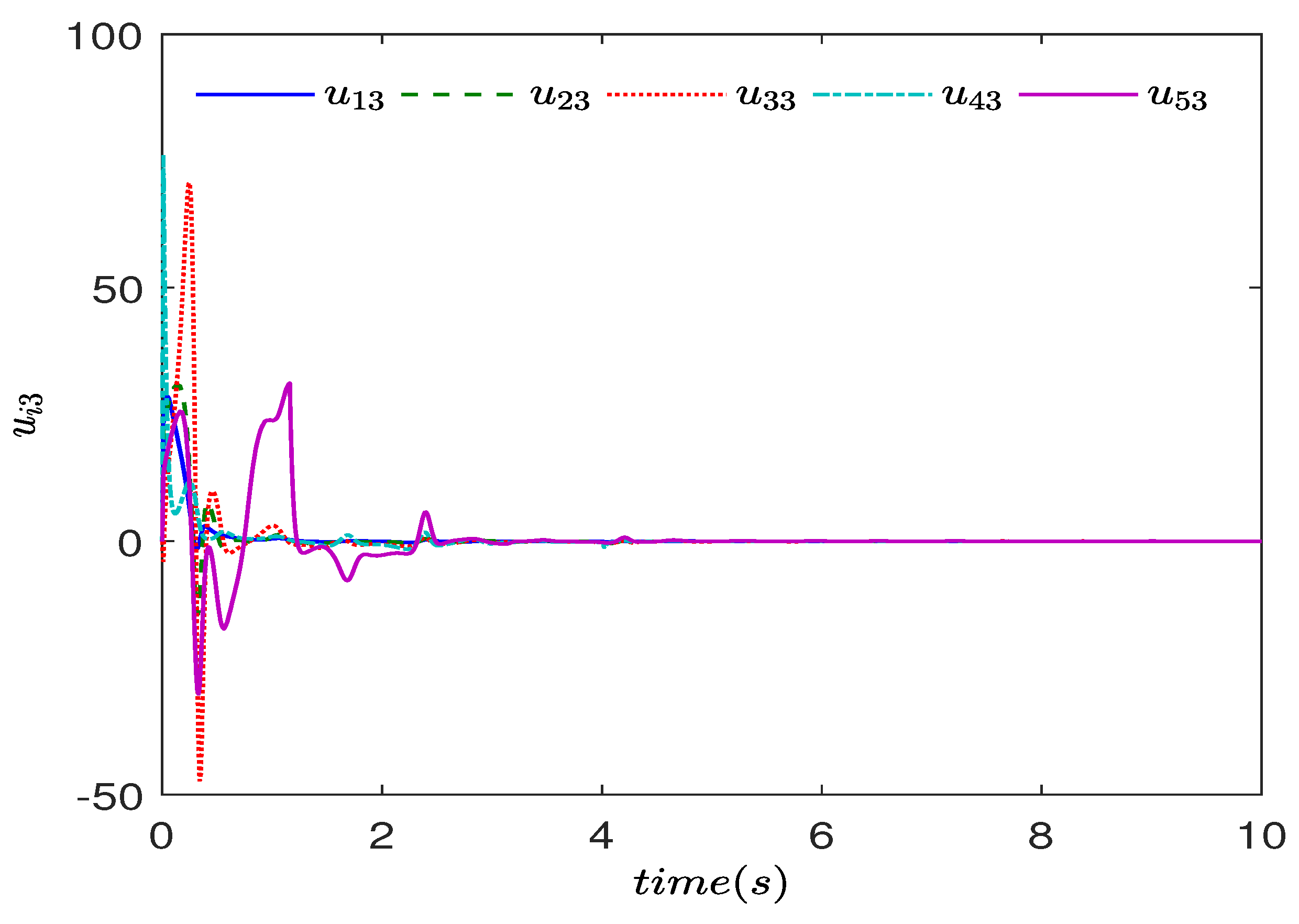
. By numerical experiments, the simulation results are presented in
Figure 1,
Figure 2,
Figure 3,
Figure 4,
Figure 5,
Figure 6,
Figure 7,
Figure 8 and
Figure 9.
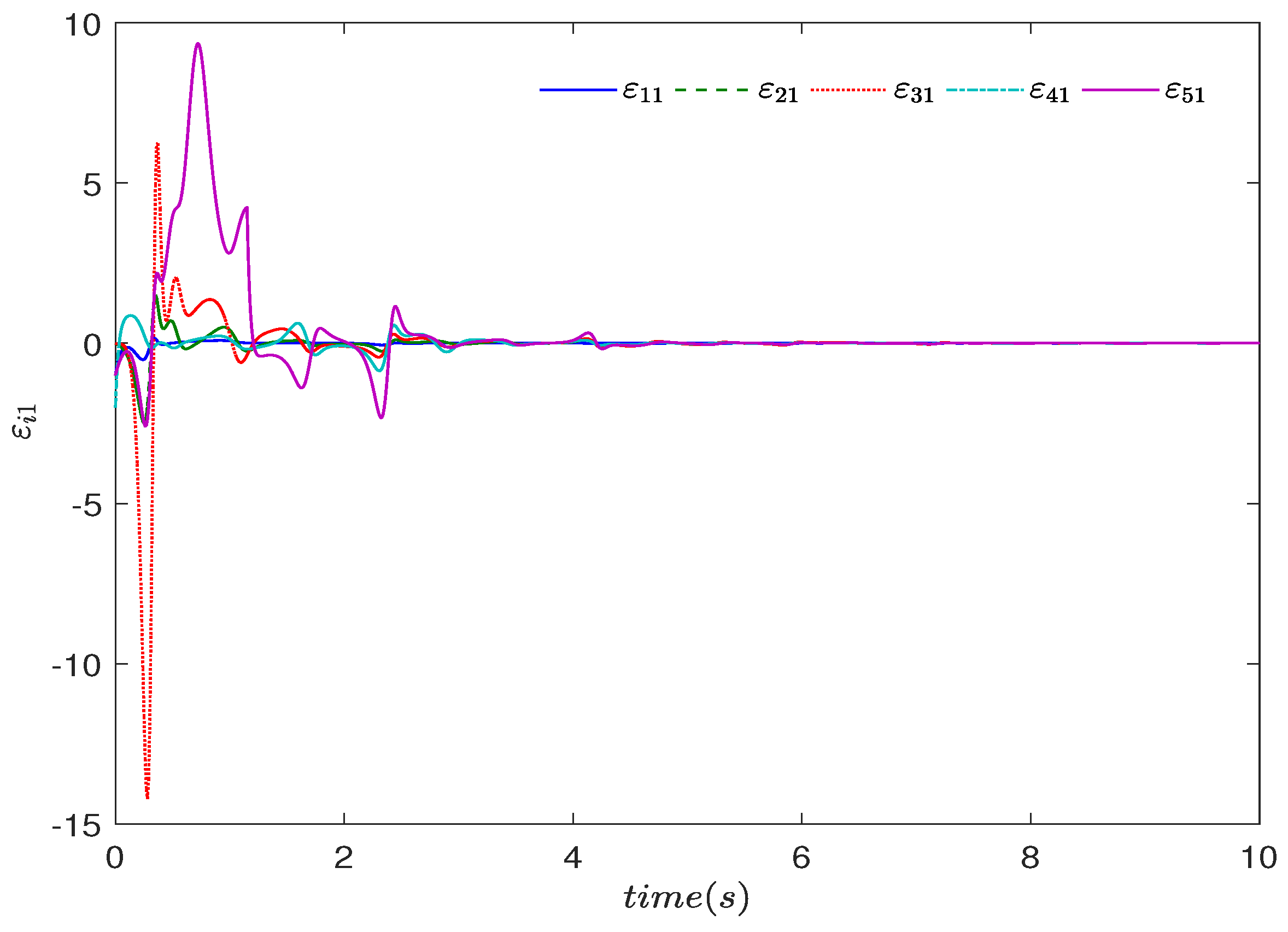
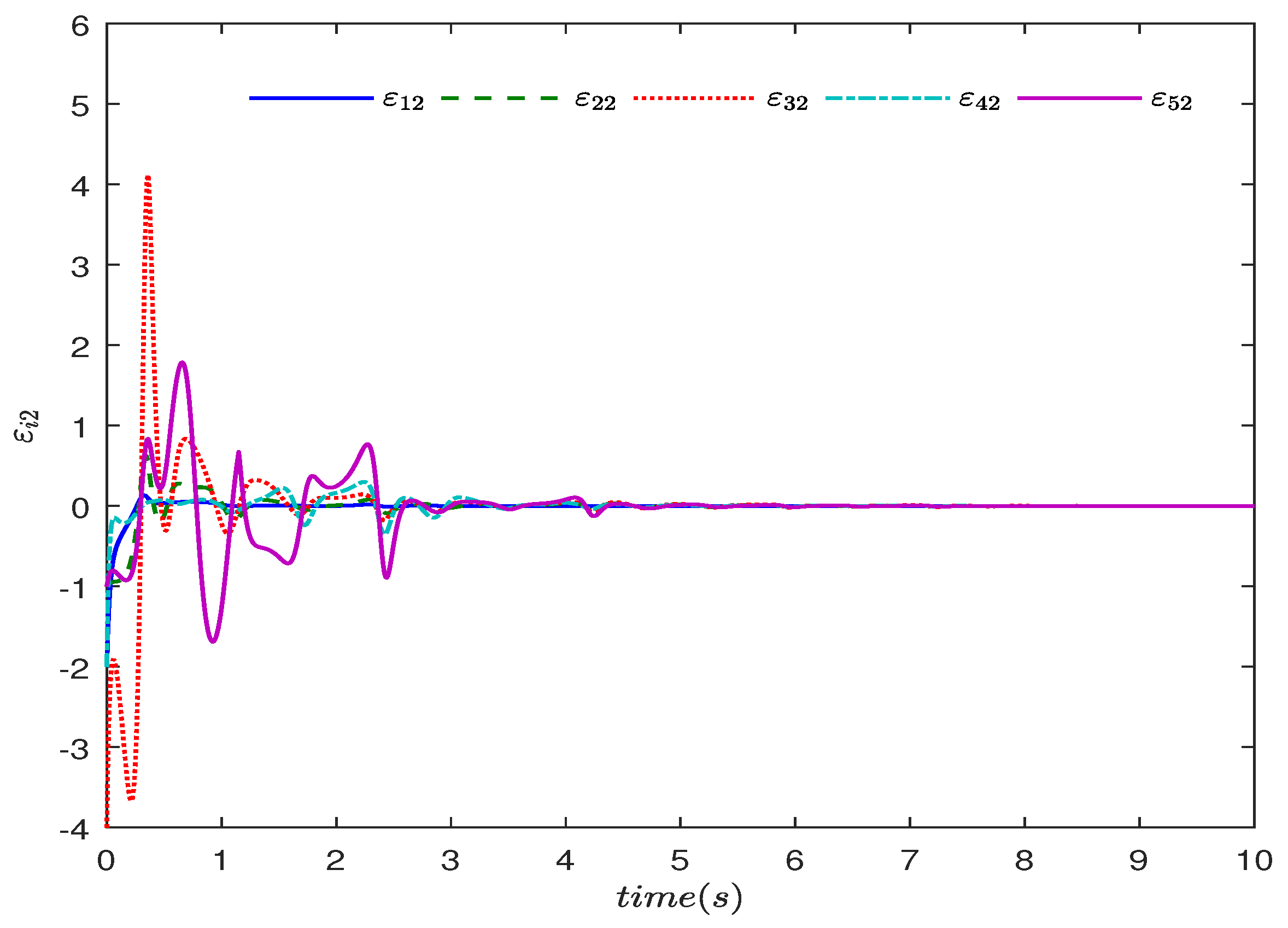
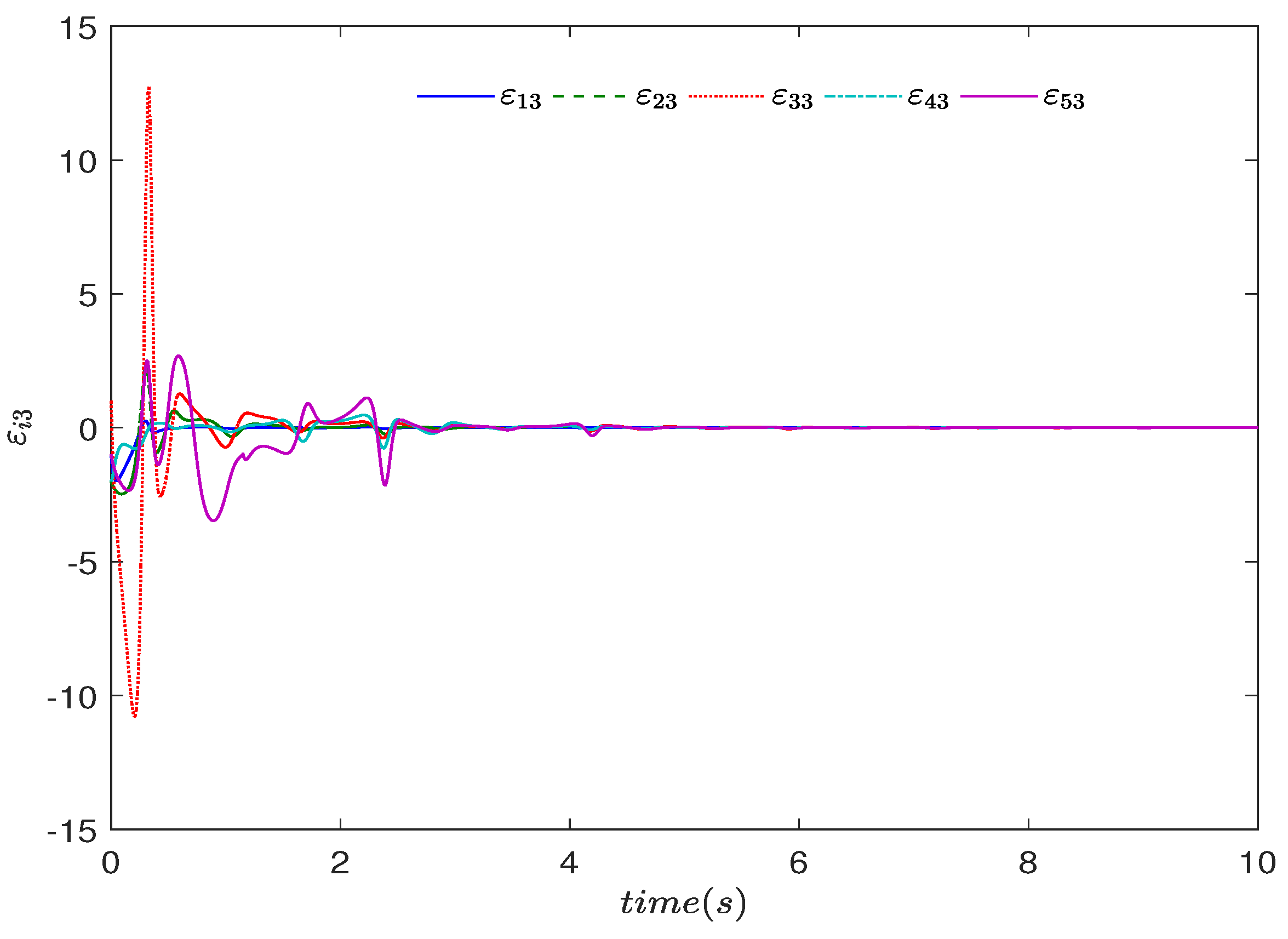
The following numerical simulations validate the proposed finite-time synchronization control strategy for stochastic complex networks (12) with time-varying delays, demonstrating its ability to achieve synchronized network states within a finite time.
Figure 1,
Figure 2 and
Figure 3 are the synchronization error evolution curve of five nodes in complex dynamic network. It can be observed from the figures that in the presence of stochastic disturbances, each node of the network converges to zero in
s. Moreover, by substituting the control parameters
and the initial value
to the expression (18) of
, it is found that the convergence time in simulation is less than that in theoretical calculation, which is consistent with the theoretical conclusions.
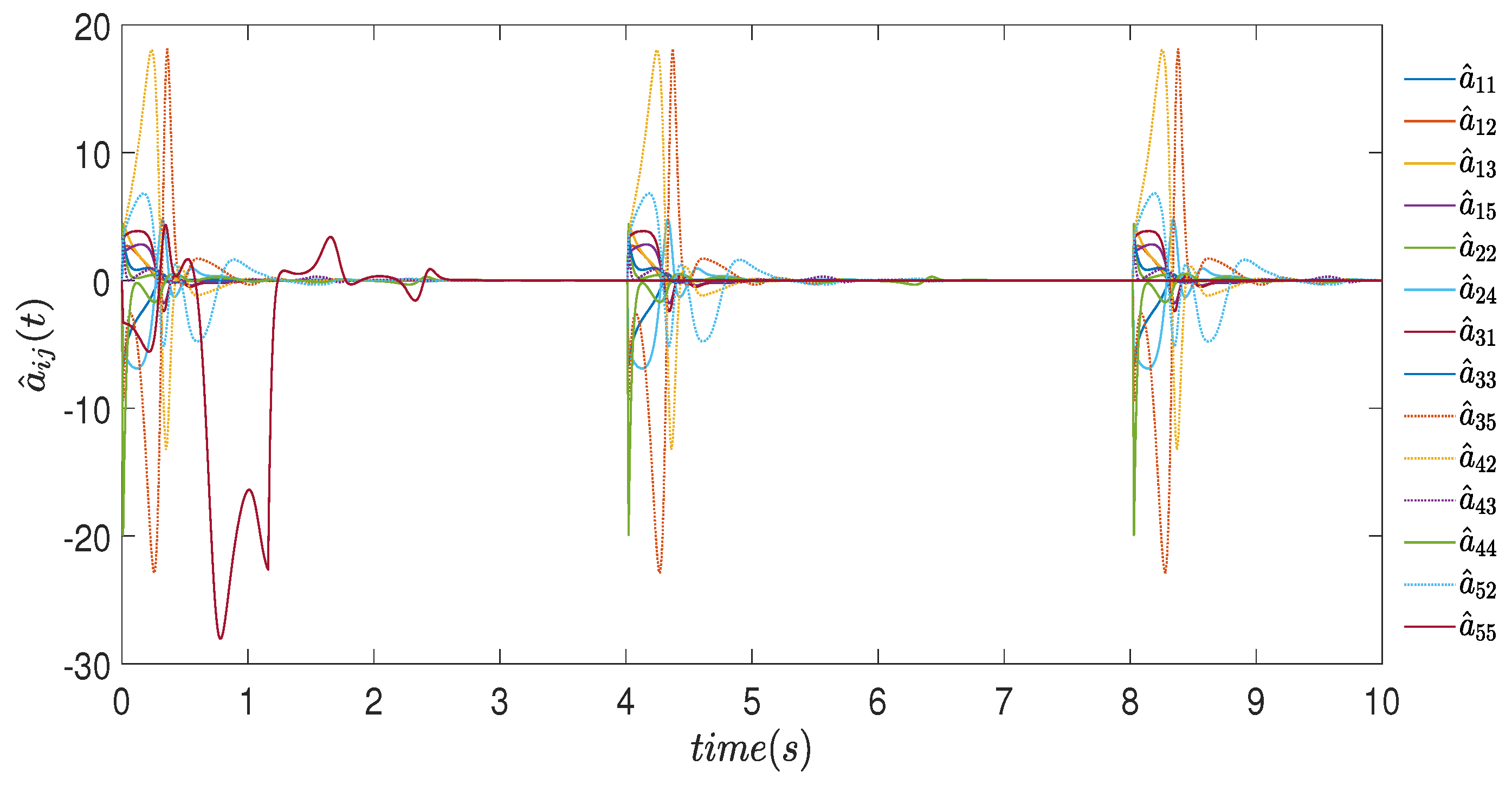
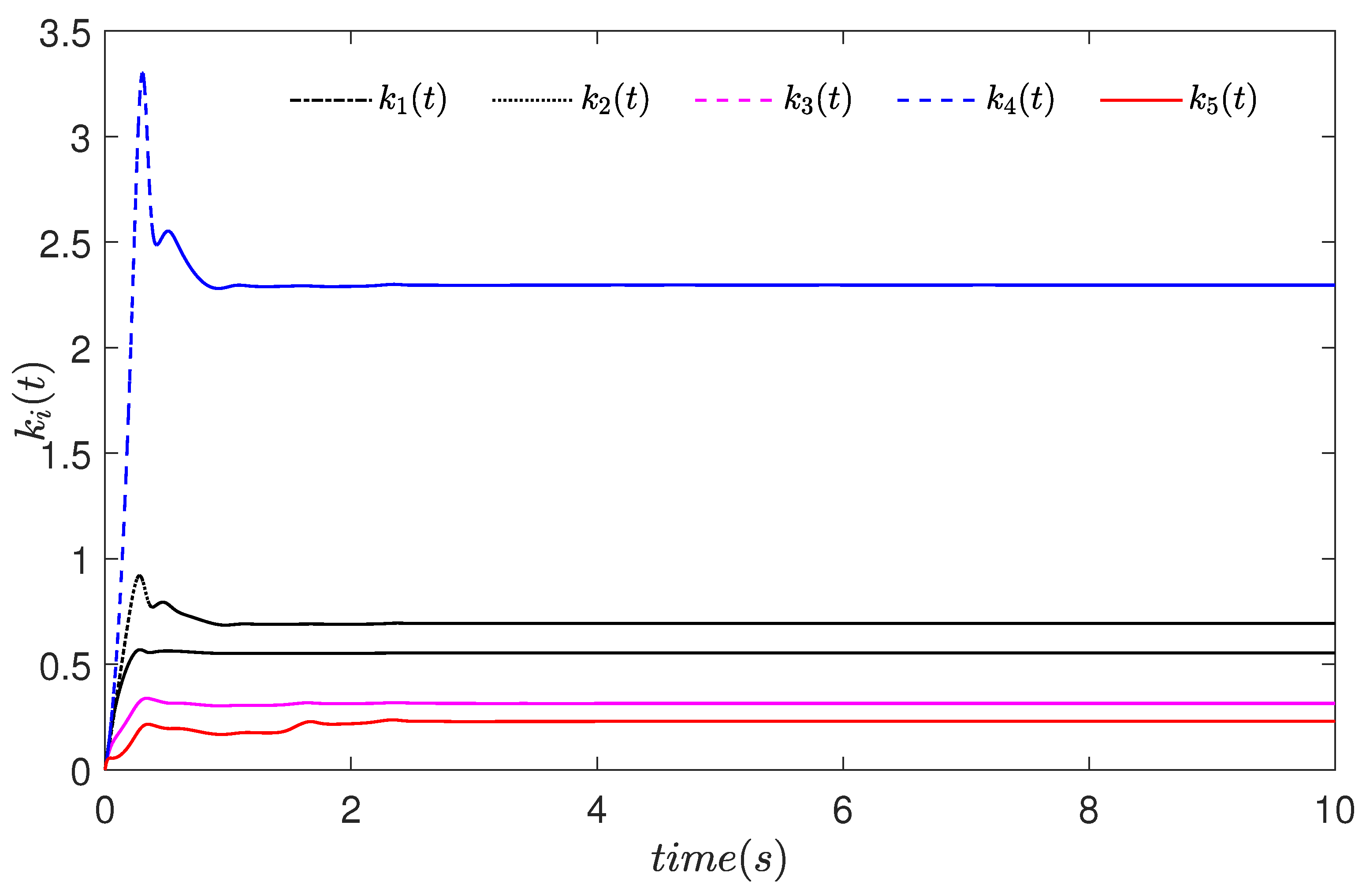
Figure 4 and
Figure 6 are the trajectories of the estimated coupling structure elements and the control parameters changing with time. It can be seen from the two figures that the coupling elements of each period are successfully estimated, and the feedback gain in the controller converges to a fixed value in a relatively short time.
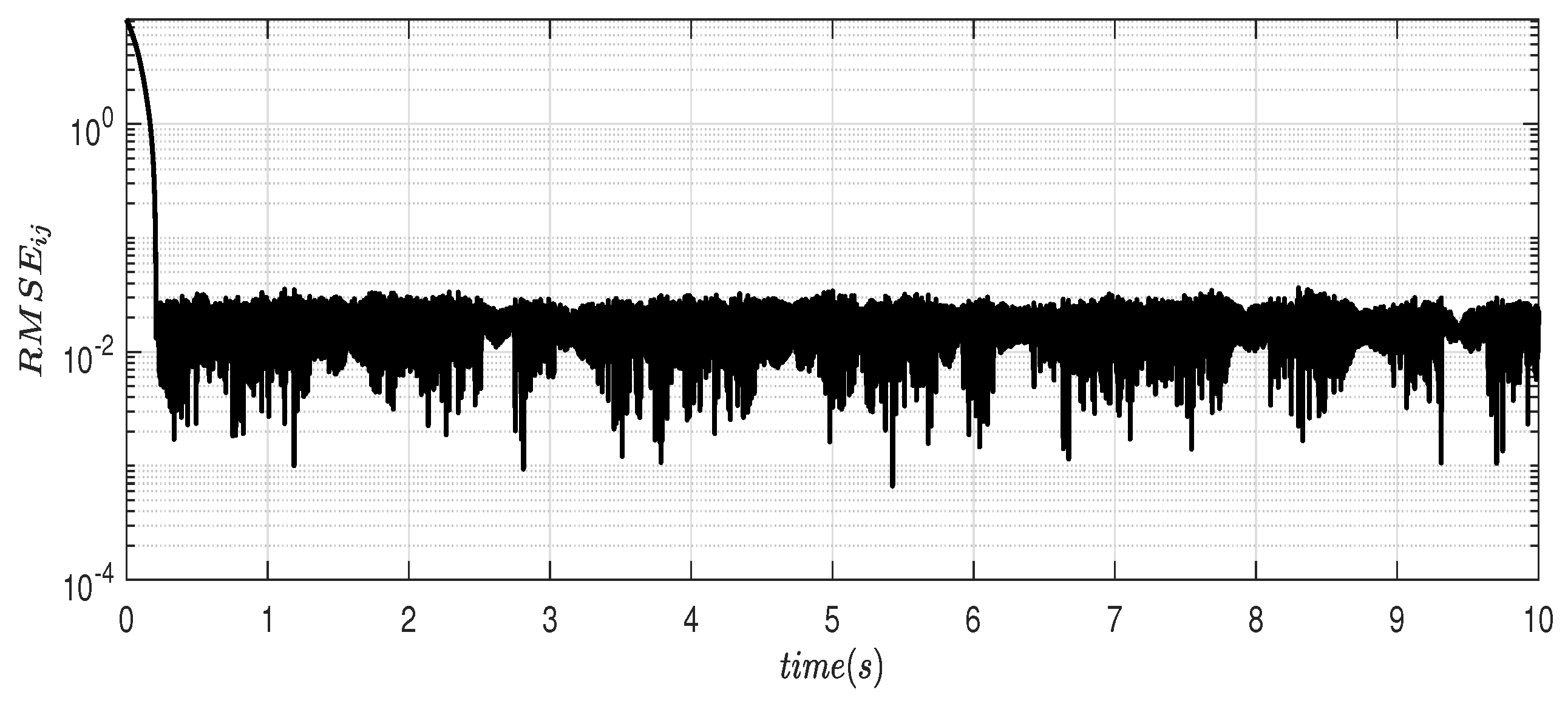
To assess the accuracy of the adaptive estimation law (14), we define the root mean square error (RMSE) for each estimated coupling weight as follows:
Furthermore,
Figure 5 shows the evolution curve of
; we can see that as time evolves, the root mean square error (RMSE) for each estimated coupling weight of the estimation error of the outer coupling matrix gradually approaches and remains around
.
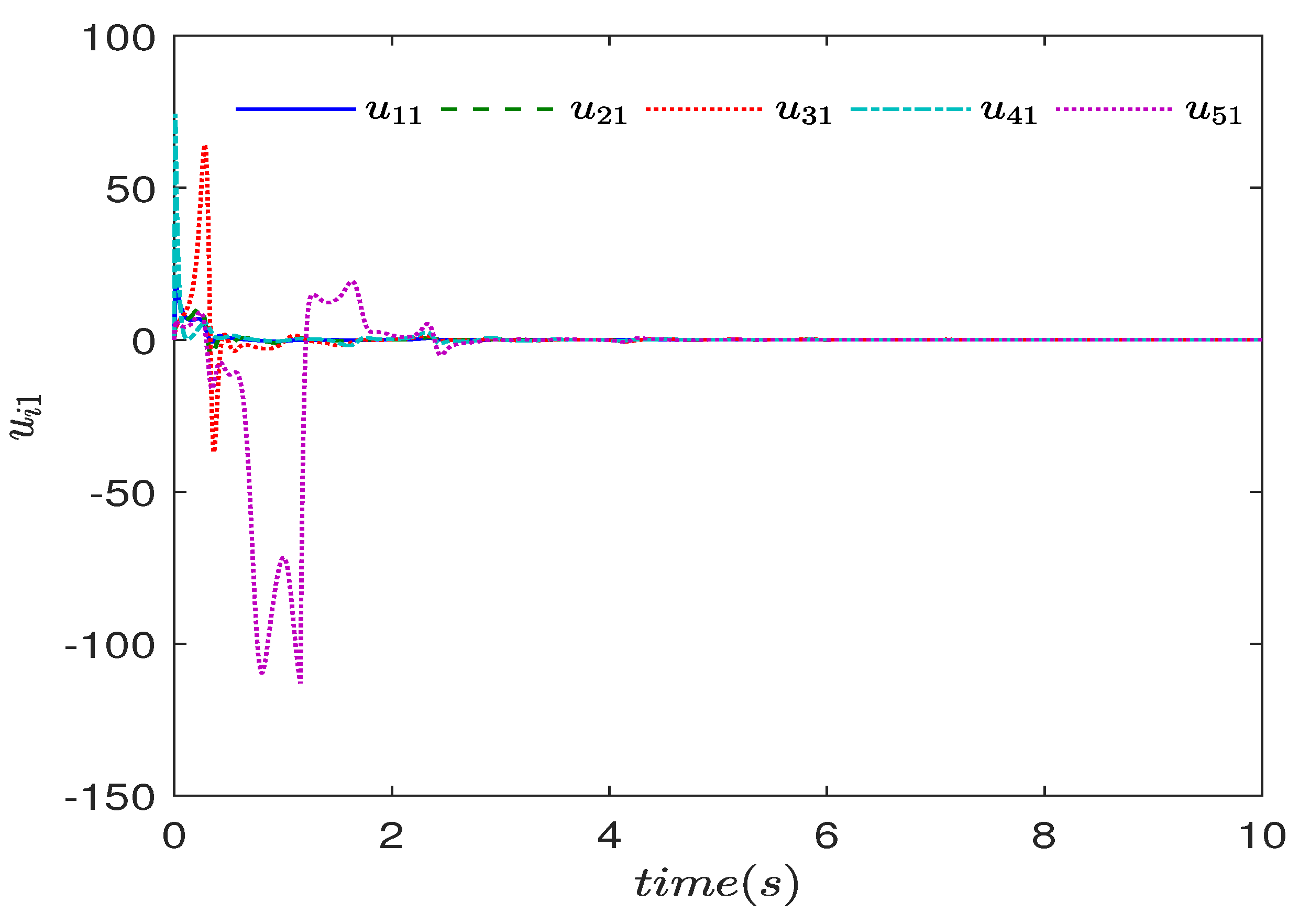
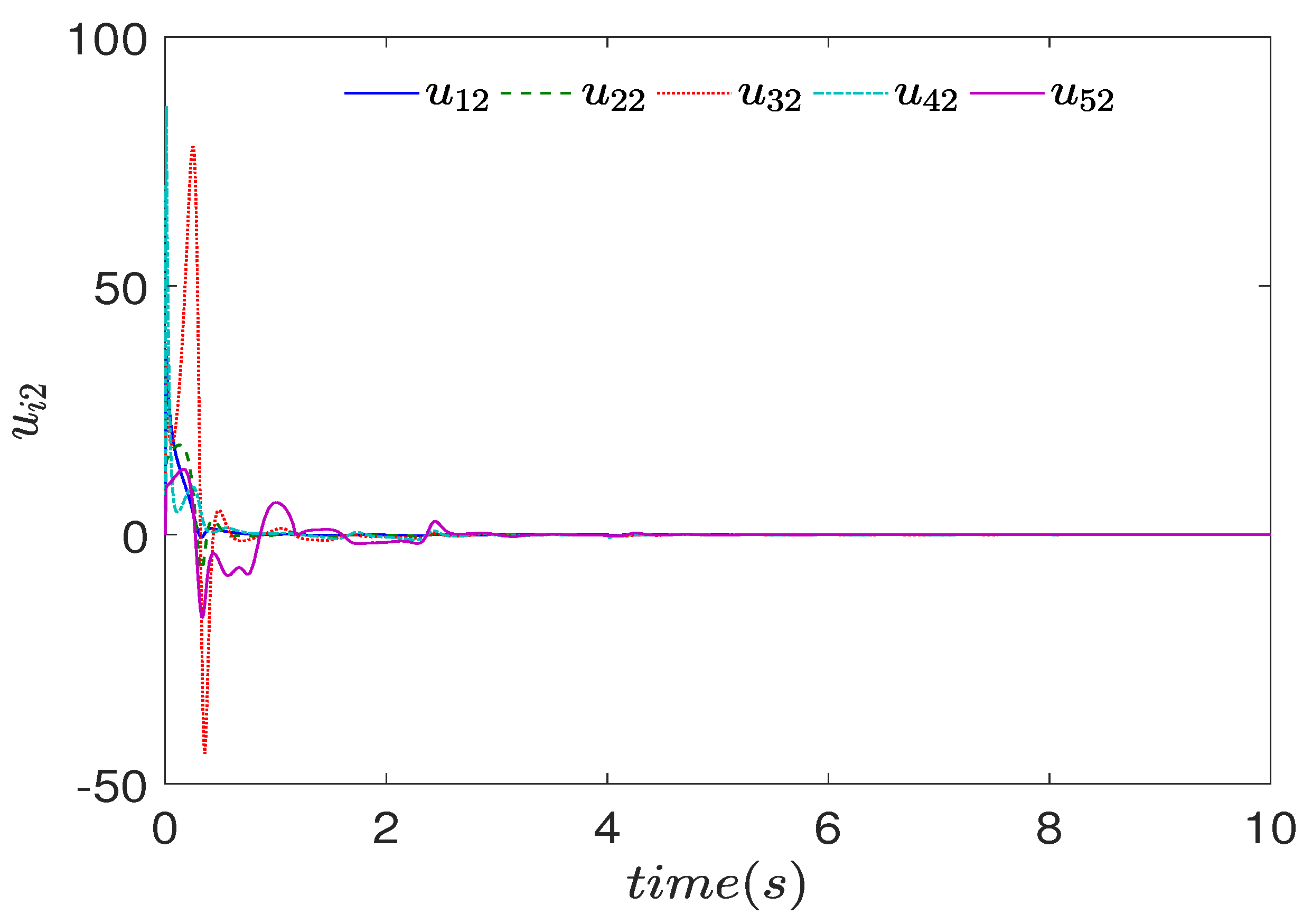
Figure 7,
Figure 8 and
Figure 9 are the control input component for each node separately. We can see that constrained by dissipative coupling condition, once the network is synchronized, the outer control signal is converted to zero rapidly.