Article

An ADRC Approach for a Class of Nonlinear Hybrid Stochastic Systems with Fractional Noise

School of Statistics and Data Science, Zhejiang Gongshang University, Hangzhou 310018, China
*
Author to whom correspondence should be addressed.
Mathematics 2026, 14(12), 2082; https://doi.org/10.3390/math14122082
Submission received: 26 May 2026 / Revised: 6 June 2026 / Accepted: 9 June 2026 / Published: 11 June 2026

Abstract

This paper extends the active disturbance rejection control (ADRC) approach to a class of nonlinear hybrid systems with uncertain fractional disturbances and unknown parameters, aiming to investigate the applicability of the ADRC approach in the presence of abrupt state changes and complex noise structures. By employing the fractional Wick–Itô–Skorohod (fWIS) integral, an extended state observer (ESO) together with an ESO-based control strategy is developed. It is shown that the resulting closed-loop hybrid stochastic system achieves mean-square stability under fractional noise. Furthermore, the proposed approach is generalized to enable the observation, tracking, and compensation of white noise disturbances with abrupt changes. Numerical simulations are presented to demonstrate the effectiveness of the proposed method.

1. Introduction

In recent years, fractional Brownian motion (fBm) has garnered increasing attention across various scientific disciplines. For instance, Brody et al. [1] modeled temperature dynamics using fBm, while Simonsen [2] applied it to model electricity prices in the deregulated Nordic electricity market. Additionally, fBm has been employed in financial market modeling [3], among other applications. The intrinsic properties of fBm make it a promising tool for numerous fields. However, several challenges hinder its broader adoption. First, the paths of fBm exhibit unbounded variation, rendering the conventional Lebesgue–Stieltjes integral inapplicable. Moreover, because fBm is not a semi-martingale, standard Itô stochastic calculus cannot be directly applied. Due to the complexity of its dependence structures and the absence of convenient stochastic integral representations, systematic research on fBm remains relatively limited compared to that on standard Brownian motion.
These mathematical challenges have important implications for real-world modeling. In many practical systems, external disturbances are often assumed to be white noise rather than fractional noise. However, for systems exhibiting “cluster” phenomena (i.e., systems with memory and persistence), as well as those characterized by intermittency and anti-persistence, fractional noise provides a more realistic description of external disturbances. To address this modeling gap, alternative stochastic calculus techniques have been developed.
One significant line of research has focused on defining appropriate stochastic integrals for fBm. Decreusefond and Üstünel [4] introduced a stochastic integral with respect to fBm using Malliavin calculus, while Duncan, Hu, and Pasik-Duncan [5] formulated an integral via the Wick product, leading to an Itô-type formula in the Wick sense. Building on these foundations, Yan [6] proposed a novel method for analyzing the stability of a class of hybrid stochastic differential equations driven by fractional Brownian motion. These contributions provide essential mathematical tools for studying the stability of fractional-order systems.
Beyond the theoretical developments, practical considerations further motivate the need for more advanced noise models. Due to the presence of time constants and various noise mechanisms, it is often more appropriate to represent external disturbances as specific forms of non-white noise. Additionally, many real-world systems experience abrupt changes, such as shifts in environmental conditions or variations in subsystem interconnections [7,8,9,10,11]. From this perspective, a hybrid system with fractional noise emerges as a promising candidate to capture these effects. However, controlling nonlinear hybrid systems with fractional disturbances remains a challenging and open research question.
One promising approach to handling uncertain disturbances in nonlinear systems is active disturbance rejection control (ADRC). Originally introduced in [12] and later analyzed in [13], ADRC has been widely recognized as an effective control strategy. Rooted in proportional-integral-derivative (PID) control, ADRC excels in managing unknown system dynamics and external disturbances. Although initially developed from an application-oriented perspective with a limited theoretical foundation, ADRC has been successfully implemented in diverse engineering domains, including model-scale helicopters [14], delta parallel robots [15], gasoline engines [16], flight vehicle control [17], thermal power plants [18], and optoelectronic stabilized platforms [19].
To complement its practical success, substantial efforts have been made to establish a rigorous theoretical foundation for ADRC. Its effectiveness was first demonstrated through numerical simulations in [12]. The underlying connection between ADRC and output regulation was systematically examined in [20]. Furthermore, the stabilization of stochastic linear systems driven by white noise with unknown covariance was explored in [21]. The work in [22] extended ADRC to systems with uncertain functions and unmeasured states. In addition, increasing attention has been paid to the control of output feedback for systems subject to stochastic disturbances [23].
We note that for noisy systems, various modified ESO designs have been proposed based on optimal filtering, Kalman filtering or other estimation approaches. For example, Kalman-filter-based ESO has been employed to handle measurement noise in [24], while cascade observer techniques were integrated with ADRC to improve disturbance rejection performance in [25]. However, these methods primarily focus on white noise or Gaussian disturbances, and their extension to fractional noise with memory effects remains unexplored. Moreover, the presence of Markovian switching introduces additional complexity that is not addressed by existing filtering-based approaches.
The discussion aforementioned motivates us to extend the active disturbance rejection control (ADRC) framework to uncertain nonlinear hybrid systems with fractional noise. In this setting, Markovian switching is employed to model unexpected random abrupt changes in the system’s external or internal structures [7,8,9], while fractional noise is used to capture memory effects such as cluster phenomena, intermittency, and anti-persistence [1,3,26].
Compared to white noise, fractional noise poses significant challenges due to its nature that is not semi-martingale, which renders traditional stochastic calculus inapplicable. In Addition, the presence of abrupt changes further complicates the analysis. To address these difficulties, we utilize the fractional Wick–Itô–Skorohod (fWIS) integral and an extended Itô-type formula, as developed in [6,27]. Furthermore, we propose an extended state observer (ESO)-based output-feedback control scheme, providing a novel approach for stabilizing a class of uncertain nonlinear systems affected by hybrid fractional noise.
A distinctive feature of the ADRC approach is its ability to handle external disturbances that are significantly more complex than those considered in most conventional control strategies. Therefore, we also extend ADRC to disturbances that are bounded in the mean-square sense. Moreover, we investigate control strategies for hybrid systems (systems with Markovian switching) influenced by fractional noise, further broadening the applicability of ADRC in uncertain nonlinear systems. As a special case, the proposed framework also applies to systems subject to white noise.
To facilitate the reader’s understanding of the problem context, we present the system model below. The technical details and assumptions will be specified in Section 3.
Consider the following target system:
d x 1 ( t ) = x 2 ( t ) d t d x 2 ( t ) = x 3 ( t ) d t d x n ( t ) = [ f ( t , x ( t ) ) + g ( t , x ( t ) ) ω ( t ) + u ( t ) ] d t y ( t ) = x 1 ( t ) ,
where x ( t ) = ( x 1 ( t ) , , x n ( t ) ) T R n denotes the state, u ( t ) R denotes the control (input), and y ( t ) R denotes the output of system (1). f , g : [ 0 , ) × R n R . The external disturbance, ω ( t ) R , is assumed to satisfy the following hybrid system:
d ω ( t , r t ) = ϕ ( t , ω ( t ) , r t ) d t + ψ ( t , ω ( t ) , r t ) d B t H , ω ( 0 ) = ω 0 .
where { r t } t 0 is a right-continuous Markov chain taking values in S = { 1 , 2 , , N } , ϕ , ψ : [ 0 , ) × R × S R , and B t H t 0 is a one-dimension fractional Brownian motion with Hurst parameter H > 1 / 2 . Throughout this paper, the generator Q-matrix ( Q = ( q i j ) N × N ) of { r t } t 0 is assumed to be irreducible and conservative, such that q i = q i i = i j q i j < . Denote the invariant probability measure associated with Q by π = ( π i ) i S . Moreover, ϕ , ψ , f and g are possibly unknown, and the stochastic integral is a fractional Wick–Itô–Skorohod (fWIS) integral defined in [28].
Hybrid system (2) can be regarded as the result of the following several equations:
d ω ( t , i ) = ϕ ( t , ω ( t ) , i ) d t + ψ ( t , ω ( t ) , i ) d B t H , ω ( 0 , i ) = ω 0 , i ,
switching from one to another according to the movement of { r t } t 0 .
The main contributions of this paper are threefold. First, we extend the ADRC framework to hybrid systems with fractional noise, which is not addressed by existing filtering-based approaches that primarily focus on white noise or Gaussian disturbances. Second, we develop an ESO-based output-feedback control strategy using the fractional Wick–Itô–Skorohod (fWIS) calculus, and establish mean-square stability for the resulting closed-loop system under fractional noise, thereby generalizing existing ADRC stability results from white noise to fractional noise settings. Third, we further broaden the applicability of the proposed approach by considering disturbances bounded in mean-square sense and systems with underlying unbounded models, which relaxes conventional disturbance constraints in the ADRC literature.
This paper is organized as follows: In Section 2, we briefly revisit some basic facts regarding Markovian switching, and fractional calculation. In Section 3, an effective nonlinear ESO is designed for the target system (1). Then, Section 4 is devoted to the practical mean-square stability. In Section 5, we address the ADRC approach for a much more complicated external disturbance. Finally, in Section 6, a numerical example is given to illustrate the effectiveness of our approach.

2. Preliminaries

In this section, we first recall some basic results of the fractional calculation briefly. For more details, we refer the reader to [29,30,31,32]. The (standard) fractional Brownian motion B t H t 0 with Hurst parameter H > 1 / 2 is a continuous centered Gaussian process with E ( B t H ) = 0 and covariance function:
R H ( s , t ) = E ( B s H B t H ) = 1 2 ( | s | 2 H + | t | 2 H | s t | 2 H ) , s , t 0 .
In this paper, stochastic integral 0 T F s d B s H is defined as
0 T F s d B s H = lim | π ˜ | 0 i = 0 n 1 F t i π ( B t i + 1 H B t i H ) ,
where | π ˜ | = max i { 0 , 1 , , n 1 } { t i + 1 t i } , F s L ϕ ( 0 , T ) (defined in Chapter 3.6 of [28]). In addition, the stochastic integral satisfies E 0 T F s d B s H = 0 , and
E 0 T F s d B s H 2 = E 0 T 0 T D s ϕ F t D t ϕ F s d s d t + | | F | | H 2 ,
where D s ϕ F denotes the Malliavin derivative of F at s and | | · | | H is given in Chapter 3.1 of [28].
To proceed, we need to introduce the following extended Itô’s formula.
Lemma 1.
Let V ( t , x ( t , i ) , i ) , ϕ ( t , x ( t ) , i ) and ψ ( t , x ( t ) , i ) satisfy the conditions of Theorem 3.7.4 in [28], for each i S . Then, for any 0 s < t ,
E V ( t , x ( t , r t ) , r t ) = E V ( s , x ( s , r s ) , r s ) + E s t A V ( u , x ( u , r u ) , r u ) d u + E s t V x ( u , x ( u , r u ) , r u ) ψ ( u , x ( u , r u ) , r u ) d B u H ,
where
A V ( t , x , i ) = L ( i ) V ( t , x , i ) + j = 1 N q i j V ( t , x , j ) ,
and
L ( i ) V ( t , x , i ) = V t + V x ϕ ( t , x , i ) + 2 V x 2 ψ ( t , x , i ) D t ϕ x ( t , i ) ,
in which D t ϕ x ( t , i ) denotes the Malliavin derivative of x ( t , i ) with respect to the fractional Brownian motion at time t, evaluated in state i.
Proof. 
The proof is similar to that for Theorem 2.6 in [6], so we omit it here. □
Lemma 2
([33]). Let
P ( x ) = x n + a 1 x n 1 + a 2 x n 2 + + a n 1 x + a n
be a polynomial with real coefficients, and let
Q ( x ) = a 1 x n 1 + a 3 x n 3 + a 5 x n 5 +
be the polynomial obtained by dropping the odd terms ( x n , a 2 x n 1 , ) of P ( x ) . Then, all the zeros of P ( x ) have negative real parts if
Q ( x ) P ( x ) = 1 c 1 x + 1 + 1 c 2 x + 1 c 2 x + 1 + 1 c n x ,
where c 1 , c 2 , , c n are positive constants.
Since the switching is used to model the practical unexpected random abrupt changes, the Markov chain, { r t } t 0 , with the generator matrix Q = ( q i j ) N × N , is assumed to be independent of B t H t 0 and almost every sample path of { r t } t 0 has a finite number of simple jumps in any finite time interval [ 0 , T ] . For a vector x = ( x 1 , , x n ) R n , let x denote the transpose. Let | x | denote the Euclidean norm. Let Law ( X t ) denote the distribution law of a stochastic process { X t } t 0 .

3. Nonlinear Extended State Observer

Next, we will design a nonlinear ESO (NLESO in short). To this end, the following assumptions are imposed.
Motivated by [34], we design an NLESO for system (1) as follows:
d x ^ 1 ( t ) = x ^ 2 ( t ) d t + ε n 1 φ 1 1 ε n ( y ( t ) x ^ 1 ( t ) ) d t , d x ^ 2 ( t ) = x ^ 3 ( t ) d t + ε n 2 φ 2 1 ε n ( y ( t ) x ^ 1 ( t ) ) d t , d x ^ n ( t ) = x ^ n + 1 ( t ) d t + φ n 1 ε n ( y ( t ) x ^ 1 ( t ) ) d t + u ( t ) d t , d x ^ n + 1 ( t ) = ε 1 φ n + 1 1 ε n ( y ( t ) x ^ 1 ( t ) ) d t ,
where φ i ( · ) , i = 1 n + 1 are some appropriately chosen continuous real valued functions. Notice that the solution of system (3) depends on the regulable gain parameter ε , but we shall miss ε by abuse of notation without confusion.
Assumption 1.
Suppose f ( · ) , g ( · ) are continuously differentiable and
| u ( t ) | + | f ( t , x ) | + f ( t , x ) t c 0 + i = 1 n c i | x i | ,
| g ( t , x ) | + g ( t , x ) t + i = 1 n f ( t , x ) x i + i = 1 n g ( t , x ) x i c n + 1 ,
for some positive constants c i , i = 0 , 1 , , n + 1 .
In addition, the functions ϕ and ψ satisfy the following linear growth condition: there exist positive constants L ϕ and L ψ such that
| ϕ ( t , ω , i ) | L ϕ ( 1 + | ω | ) , | ψ ( t , ω , i ) | L ψ ( 1 + | ω | ) ,
for all t 0 , ω R , and i S .
Assumption 2.
There exists a constant C so that for each i = 1 , , n and all t 0 :
( i ) sup t 0 E | x i ( t ) | 2 C , ( i i ) | ω ( t ) | C a . s . .
Assumption 3.
Let V ( x , r t ) , U ( x , r t ) : R n + 1 × S R be positive definite functions, and twice continuously differentiable with respect to x. There exist constants λ i , i = 1 , , 4 and constants α 1 , α 2 > 0 so that
λ 1 | x | 2 V ( x , j ) λ 2 | x | 2 , λ 3 | x | 2 U ( x , j ) λ 4 | x | 2 , L V ( x , j ) β j U ( x , j ) , j S π j β j < 0 , V ( x ) x n + 1 α 1 | x | , D t ϕ x n + 1 2 V ( x ) x n + 1 2 α 2 ,
for all x R n + 1 , j S . Here, the operator L : R R is defined by
L V ( x , j ) = i = 1 n V x i ( x i + 1 φ i ( x 1 ) ) V x n + 1 φ n + 1 ( x 1 ) .
Remark 1.
If the invariant probability measure of { r t } t 0 is unknown, then the conditions L V ( x , j ) β j U ( x , j ) , j S π j β j < 0 in Assumption 3 are supposed to be L V ( x , j ) β U ( x , j ) , with β > 0 .
Theorem 1.
Suppose that Assumptions 1–3 are satisfied. Then, the NLESO designed by (3) is convergent, i.e., for any initial values x 0 , x ^ 0 R n + 1 and initial time t 0 > 0 ,
lim ε 0 E i = 1 n + 1 [ x i ( t ) x ^ i ( t ) ] 2 = 0 , t [ t 0 , )
uniformly holds, where x n + 1 : = f ( t , x ) + g ( t , x ) ω ( t ) is the extended state variable.
Proof. 
Set
μ ( t ) = f t + i = 1 n f x i x i + 1 ( t ) + ω ( t ) g t + i = 1 n g x i x i + 1 ( t ) + ϕ ( t , ω ( t ) , r t ) g ( t , x ( t ) )
σ ( t ) = ψ ( t , ω ( t ) , r t ) g ( t , x ) .
Then, system (1) can be rewritten as
d x 1 ( t ) = x 2 ( t ) d t d x 2 ( t ) = x 3 ( t ) d t d x n ( t ) = x n + 1 d t + u ( t ) d t d x n + 1 ( t ) = μ ( t ) d t + σ ( t ) d B t H .
Noting that B t H is a self-similar process, one has Law ( B ( a t ) H ) = Law ( a H B t H ) .
Set
x ˜ i ( t ) = x i ( t ) x ^ i ( t ) , θ i ( t ) = ( ε t ) ε ( n + 1 i ) x ˜ i , B ^ t H = ( ε ) H B ε t ,
where i = 1 , 2 , , n + 1 . B ^ t H is also a fractional Brownian motion.
From systems (1) and (6) and the scaling (7), one has that the error θ satisfies the following system of equations:
d θ 1 ( t ) = [ θ 2 ( t ) φ 1 ( θ 1 ( t ) ) ] d t d θ 2 ( t ) = [ θ 3 ( t ) φ 2 ( θ 1 ( t ) ) ] d t d θ n ( t ) = [ θ n + 1 ( t ) φ n ( θ 1 ( t ) ) ] d t d θ n + 1 ( t ) = [ ε μ ( ε t ) ϕ n + 1 ( θ 1 ( t ) ) ] d t + ε H σ ( ε t ) d B ^ t H .
According to Lemma 1 and applying the extended Itô formula to V ( θ ( t ) , r t ) defined by (8), we get
E d V ( θ ( t ) , r t ) = E L V + j = 1 N q r t j V ( · , j ) d t + ε μ ( ε t ) V θ n + 1 d t + ε H σ ( ε t ) V θ n + 1 d B ^ t H + ε H σ ( ε t ) D t ϕ x n + 1 2 V x n + 1 2 d t .
Similar to [6,27], we can infer that there exists a constant δ > 0 so that
L V ( x , r t ) + j = 1 N q r t j V ( x , j ) δ U ( x , r t ) .
On the other hand, Assumptions 1 and 2 imply that there exists a positive constant C so that E | μ ( ε t ) | 2 C , E | σ ( ε t ) | C for all t 0 . Moreover, there exists ε 0 > 0 such that η : = ( δ λ 3 ) / λ 2 ( ε 0 / 2 ) > 0 . We take ε ( 0 , ε 0 ) . Then, one has
d d t E V ( θ ( t ) , r t ) δ E U ( θ ( t ) , r t ) + α 1 ε λ 1 E μ ( ε t ) V ( θ ( t ) , r t ) + α 2 ε H E | σ ( ε t ) | δ λ 3 λ 2 E V ( θ ( t ) , r t ) + ε 2 E V ( θ ( t ) , r t ) + α 1 2 ε 3 2 2 λ 1 E | μ ( ε t ) | 2 + α 2 ε H E | σ ( ε t ) | η E V ( θ ( t ) , r t ) + ε H C α 1 2 2 λ 1 ε 3 / 2 H + C α 2 .
So, for every t 0 > 0 , set t = t 0 / ε in the above inequality. Noting that E V ( θ ( 0 ) , r 0 ) λ 2 | θ ( 0 ) | 2 = O ( ε 2 n ) by the scaling (6), and that e η t 0 / ε ε 2 n 0 as ε 0 for any η , t 0 > 0 , we obtain
lim ε 0 E V θ t 0 ε , · = 0 , t 0 [ t 0 , ) .
By (6), it follows that
lim ε 0 E x ˜ i ( t ) 2 = 0 , t 0 [ t 0 , ) , i = 1 , , n + 1 .
Then, the required assertion follows. □

4. Output Feedback Based on ESO

Next, we are going to design a feedback control based on the designed ESO. At first, we need to choose some constants k 1 , k 2 , , k n , so that the coefficients of
P ( λ ) = i = 1 n 1 ( 1 ) n + i ( k i ) ( λ ) i 1 + ( k n λ ) ( λ ) n 1
satisfy Lemma 2. It is obvious that the eigenvalues of
A = 0 1 0 0 0 0 1 0 0 0 0 1 k 1 k 2 k n 1 k n n × n
have negative real parts. Noting that for all x i (including the states and the “total disturbance”), we have obtained their estimates. We shall design a feedback control as follows:
u ( t ) = i = 1 n k i x ^ i ( t ) x ^ n + 1 ( t ) ,
where x ^ n + 1 is the estimation for the “total disturbance”. Here, we consider the simplified case where the input gain is known and normalized to b = 1 .
In particular, combining (1) and (3), we obtain the following closed-loop system:
d x 1 ( t ) = x 2 ( t ) d t d x 2 ( t ) = x 3 ( t ) d t d x n ( t ) = x n + 1 d t + u ( t ) d t d x n + 1 ( t ) = μ ( t ) d t + σ ( t ) d B t H d θ 1 ( t ) = [ θ 2 ( t ) φ 1 ( θ 1 ( t ) ) ] d t d θ 2 ( t ) = [ θ 3 ( t ) φ 2 ( θ 1 ( t ) ) ] d t d θ n ( t ) = [ θ n + 1 ( t ) φ n ( θ 1 ( t ) ) ] d t d θ n + 1 ( t ) = [ ε μ ( ε t ) ϕ n + 1 ( θ 1 ( t ) ) ] d t + ε H σ ( ε t ) d B ^ t H
where x ˜ i ( t ) , θ i ( t ) , i = 1 , , n + 1 are defined in (7), μ ( t ) and σ ( t ) are defined by (4) and (5), respectively.
Theorem 2.
Suppose that Assumptions 1 and 3 and Assumption 2(ii) are satisfied. Then, for any initial values x 0 , x ^ 0 R n + 1 , (12) admits a solution and is mean-square asymptotically stable, i.e.,
lim ε 0 t E i = 1 n x ^ i 2 ( t ) + x i 2 ( t ) = 0 .
Proof. 
Set η i ( t ) = x i ( ε t ) , i = 1 , , n + 1 . Replace x i ( t ) by η i ( t ) to obtain
d η 1 ( t ) = ε η 2 ( t ) d t d η 2 ( t ) = ε η 3 ( t ) d t d η n ( t ) = i = 1 n ε n + 2 i k i θ i ( t ) ε k i η i ( t ) d t + ε θ n + 1 ( t ) d t d η n + 1 ( t ) = μ ( t ) d t + σ ( t ) d B t H d θ 1 ( t ) = [ θ 2 ( t ) φ 1 ( θ 1 ( t ) ) ] d t d θ 2 ( t ) = [ θ 3 ( t ) φ 2 ( θ 1 ( t ) ) ] d t d θ n ( t ) = [ θ n + 1 ( t ) φ n ( θ 1 ( t ) ) ] d t d θ n + 1 ( t ) = [ ε μ ( ε t ) ϕ n + 1 ( θ 1 ( t ) ) ] d t + ε H σ ( ε t ) d B ^ t H .
Obviously, system (13) is equivalent to system (12).
Noting that A is Hurwitz, then for an identity matrix I n × n , there exists a positive-definite matrix Q that satisfies the following Lyapunov equation: Q A + A T Q = I . Then, define a Lyapunov function K : R n R : K ( η ) = Q η , η , in which η = ( η 1 , , η n ) . Thus, for any η R n , there exist constants c > 0 , ξ 1 > 0 , ξ 2 > 0 such that
ξ 1 | η | 2 K ( η ) ξ 2 | η | 2 , K ( η ) η n c | η | .
Assumption 1 and part (ii) of Assumption 2 indicate that there exist constants M 1 > 0 , M 2 > 0 so that
E | μ ( ε t ) | 2 M 1 E | η ( t ) | 2 + M 2 .
Next, we take ε 1 > 0 such that
γ 0 = i = 1 n c 2 k i 2 2 λ 1 ε 1 2 i + c 2 ε 1 2 λ 1 + ε 1 2 δ λ 3 λ 2 > 0
and
α 0 = 1 1 2 n ε 1 + ε 1 + α 1 2 ε 1 λ 1 M 1 > 0 .
Assume that ε < min { ε 1 , γ 0 ξ 2 α 0 } . Making use of (9) and Lemma 1, applying Itô’s formula to K ( η ( t ) ) and V ( θ ( t ) ) along with the system (13), we obtain
d d t ( E K ( η ( t ) ) + E V ( θ ( t ) ) ) ε E | η ( t ) | 2 + E K ( η ) η n + ε 0 2 δ λ 3 λ 2 E V ( θ ( t ) ) + i = 1 n ε n + 2 i k i θ i ( t ) + ε θ n + 1 ( t ) + α 1 2 ε 3 2 2 λ 1 E | μ ( ε t ) | 2 + C α 2 ε H ε E | η ( t ) | 2 + i = 1 n c 2 k i 2 2 λ 1 ε 2 i + c 2 ε 2 λ 1 E V ( θ ( t ) ) + n ε + ε 2 ε E | η ( t ) | + ε 0 2 δ λ 3 λ 2 E V ( θ ( t ) ) + α 1 2 ε 3 2 2 λ 1 M 1 E | η ( t ) | 2 + α 1 2 ε 3 2 2 λ 1 M 2 + C α 2 ε H γ 0 E V ( θ ( t ) ) ε α 0 ξ 2 E K ( η ( t ) ) + α 1 2 ε 3 2 2 λ 1 M 2 + C α 2 ε H ε α 0 ξ 2 E K ( η ( t ) ) + E V ( θ ( t ) ) + α 1 2 ε 3 2 2 λ 1 M 2 + C α 2 ε H .
Now for any constant a > 1 , assuming τ ε = ε a and integrating (15), there exists a positive constant B so that sup t τ ε E | η ( t ) | 2 B . With Theorem 1, one has
lim ε 0 t E i = 1 n + 1 x ˜ i 2 ( t ) = 0 .
Next, we shall deal with the closed-loop system combined by (1) and (3). Setting x = ( x 1 , , x n ) R n and applying Itô’s formula to K ( x ( t ) ) again along with system (12), one has
d d t E K ( x ( t ) ) = i = 1 n 1 E K ( x ) x i x i + 1 + E K ( x ) x n x ˜ n + 1 ( t ) i = 1 n k i x ^ i ( t ) .
Using (14) and (17) indicates that
d d t E K ( x ( t ) ) ( 1 + n + 1 2 b ) E | x ( t ) | 2 + c 2 b 2 E | x ˜ n + 1 ( t ) | 2 + i = 1 n k i 2 E | x ˜ i ( t ) | 2 c 2 b 2 k 2 E i = 1 n + 1 | x ˜ i ( t ) | 2 + ( n + 1 ) / b 2 2 ξ 2 E K ( x ( t ) ) ,
where k 2 = max { k 1 2 , , k n 2 , 1 } , b ( n + 1 2 , ) . Integrating both sides of (18), one has
lim ε 0 t E i = 1 n x i 2 ( t ) = 0 .
It then follows from (7) and (16) that
lim ε 0 t E i = 1 n x ^ i 2 ( t ) 2 lim ε 0 t E i = 1 n x i 2 ( t ) + E i = 1 n x ˜ i 2 ( t ) = 0 .
Then, the required assertion follows. □

5. Some Useful Results

In this section, we extend the active disturbance rejection control (ADRC) approach to uncertain nonlinear systems with external disturbances that are bounded in the mean-square sense. Furthermore, we also consider disturbances arising from underlying unbounded models (i.e., in certain substates, the disturbance may tend to infinity as time increases). For the sake of clarity, we still consider system (1) disturbed by (2). In this section, ϕ and ψ are functions satisfying the conditions of Theorem 4.5 in [5] and for some j S , ω ( t , j ) may have underlying unbounded models. To proceed, we need the following assumptions.
Assumption 4.
There exists a constant C so that for each i = 1 , , n , k = 1 , 2 and all t 0 :
( i ) sup t 0 E | x i ( t ) | 2 C , ( i i ) E | ω ( t ) | k C .
Remark 2.
In Assumption 4, the disturbance is supposed to be E | ω ( t ) | k C , k = 1 , 2 instead of | ω ( t ) | C , a.s. Noting that neither of them is deducible from the other. Using part (ii) of Assumption 4 and Chebyshev’s inequality, for any M > 0 ,
P ( | ω ( t ) | > M ) E | ω ( t ) | k M k C M k .
Thus, ω ( t ) is bounded in probability, i.e., sup t P ( | ω ( t ) | > M ) 0 as M .
Assumption 5.
Let V ( t , x , i ) : R + × R × S R be a positive definite function, twice continuously differentiable with respect to x and continuously differentiable with respect to t. There exist positive constants b 1 , b 2 , p 1 and β i R such that for all x R , t t 0 , j S ,
b 1 | x | p | V ( t , x , i ) | b 2 | x | p ,
L ( j ) V ( t , x , i ) β j V ( t , x , i ) ,
and
i S π i β i < 0 .
Remark 3.
Using of Assumptions 1, 3 and 4, similar to Section 3, we can establish the nonlinear ESO (3) and prove that it is convergent similarly. Then, an ESO-based output-feedback control could be established similar way to maintain the system in a practically stable state.
Remark 4.
Similarly to [6], with the help of Poisson equation or M-matrix, Assumption 5 implies that lim t sup 1 t log ( E | X t | p ) < 0 . Thus, making use of Remark 3, we can establish an ESO-based feedback control to maintain systems practically stable without much difficulty.
Remark 5.
All of our results in Section 3, Section 4 and Section 5 are still effective when Hurst parameter H = 1 / 2 , i.e., Brownian motion.

6. Numerical Simulation

In this section, we present a numerical example motivated by [35] to illustrate the effectiveness of the proposed approach.
Let { r t } t 0 be a Markov chain taking values in S = { 1 , 2 } with generator Q:
Q = λ λ λ λ .
It is easy to obtain the stationary distribution π associated with Q:
π = ( π 1 , π 2 ) = ( 1 2 , 1 2 ) .
Consider the following system:
d x 1 ( t ) = x 2 ( t ) d t d x 2 ( t ) = x 1 ( t ) + x 2 ( t ) ω ( t ) u ( t ) d t y ( t ) = x 1 ( t ) ,
with an external disturbance
d ω ( t ) = f ( t , r t ) ω ( t ) + g ( t , r t ) d B t H ω ( 0 ) = 2 .
Here, we take H = 0.7 , g ( t , i ) = i ( t + 2 ) 2 , i = 1 , 2 and
f ( · , i ) = 1 , i f i = 1 , f ( · , i ) = 3 , i f i = 2 .
Note that all Assumptions are satisfied. Therefore, an NLESO (3) is designed for system (19) as follows:
d x ^ 1 ( t ) = x ^ 2 ( t ) + 3 ε ( y ( t ) x ^ 1 ( t ) ) ε φ y ( t ) x ^ 1 ( t ) ε 2 d t d x ^ 2 ( t ) = x ^ 3 ( t ) + 3 ε 2 ( y ( t ) x ^ 1 ( t ) ) + u ( t ) d t d x ^ 3 ( t ) = x ^ 3 ( t ) + 1 ε 3 ( y ( t ) x ^ 1 ( t ) ) d t .
Here, φ ( s ) : R R satisfies
φ ( s ) = 1 2 , s ( , π 2 ) 1 2 sin ( s ) , s π 2 , π 2 1 2 , s ( π 2 , ) .
Without loss of generality, we set
x 1 ( 0 ) = 1 , x 2 ( 0 ) = 2 , x ^ i ( 0 ) = 0 , i = 1 , 2 , 3
and the input u ( t ) :
u ( t ) = sin ( t + B t H ) .
Therefore, the total disturbance x 3 ( t ) has the following form:
x 3 ( t ) = [ x 1 ( t ) + x 2 ( t ) ω ( t ) ] .
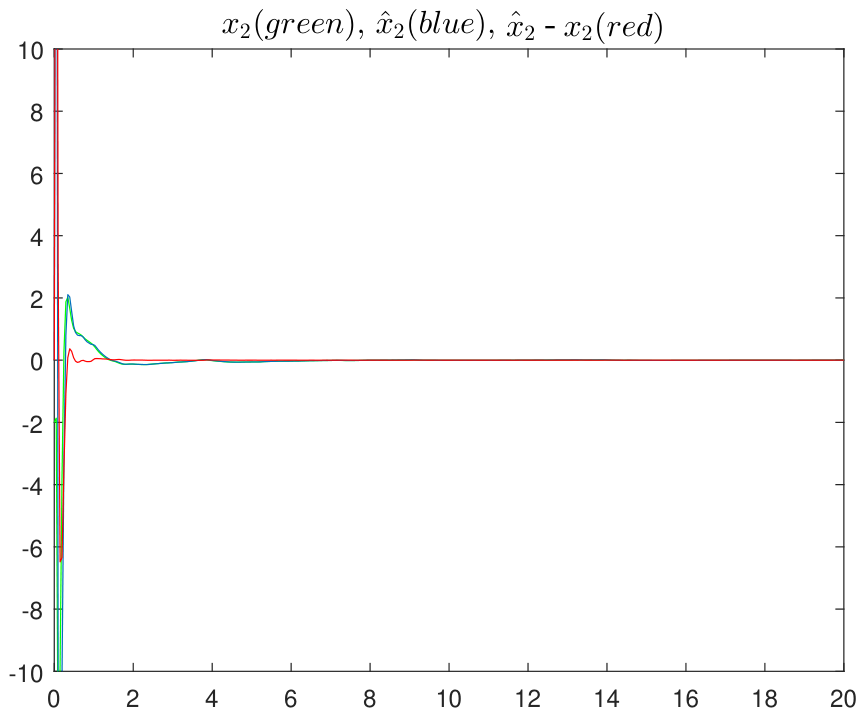
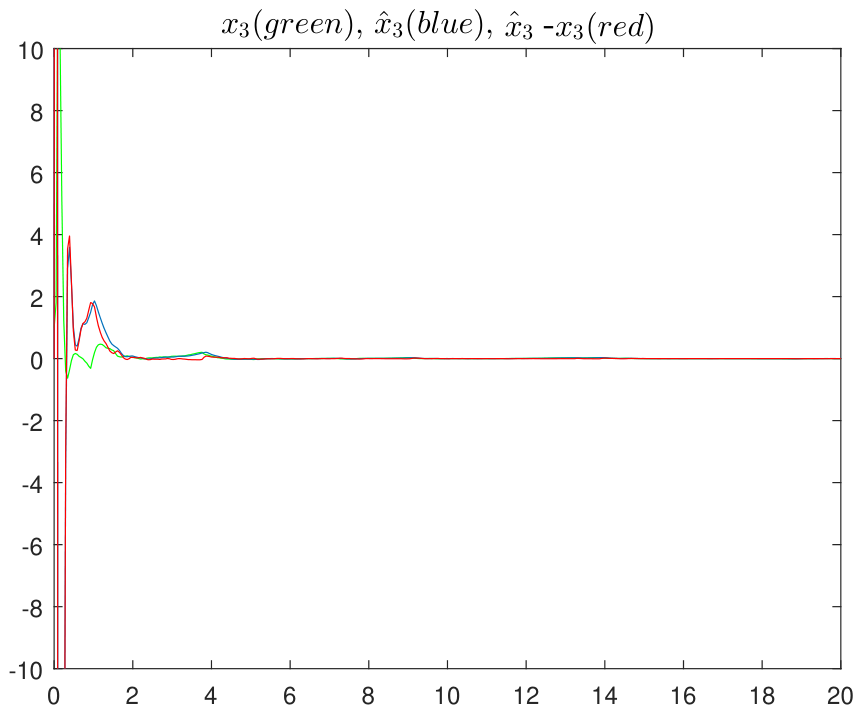
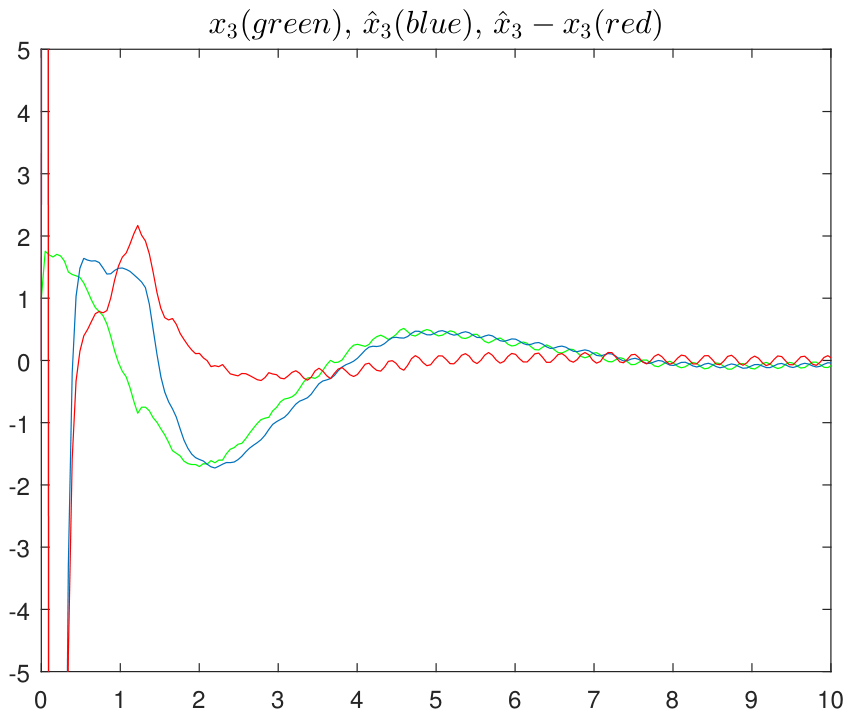
Figure 1, Figure 2 and Figure 3 demonstrate the tracking performance of the NLESO (20) under the open-loop input u ( t ) = sin ( t + B t H ) . In each figure, the green curve represents the true state x i ( t ) , the blue curve represents the estimate x ^ i ( t ) , and the red curve represents the estimation error x ˜ i ( t ) = x ^ i ( t ) x i ( t ) .
Figure 1, Figure 2 and Figure 3 show that with the control u ( t ) , the estimates converge rapidly to the true states, indicating that the NLESO (20) can efficiently track the system (19). However, the system states do not converge to zero under this open-loop input.
Then, to stabilize the closed-loop system, u ˜ ( t ) is designed as follows:
u ˜ ( t ) = [ 2 x ^ 1 ( t ) + 3 x ^ 2 ( t ) + x ^ 3 ( t ) ] .
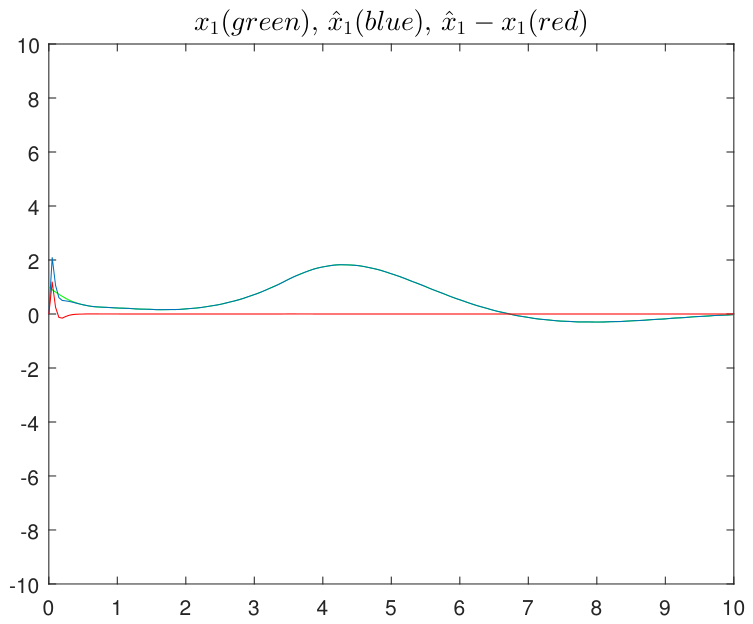
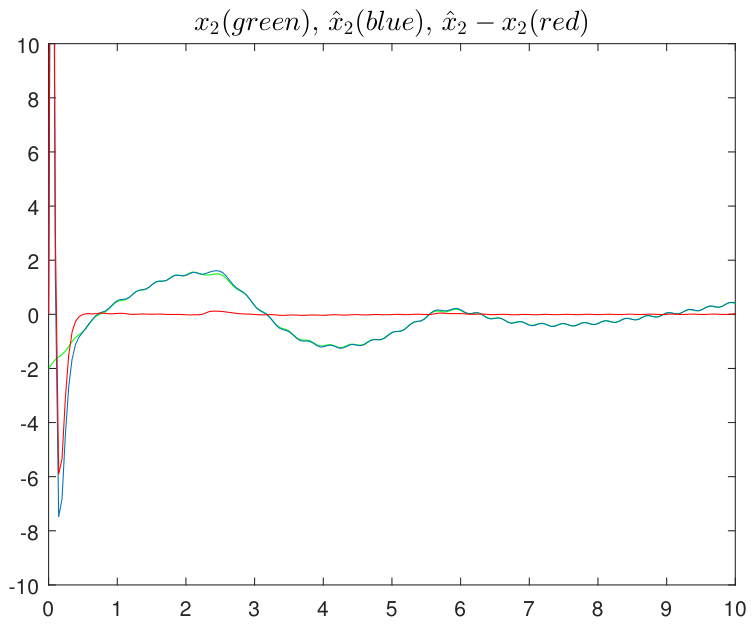
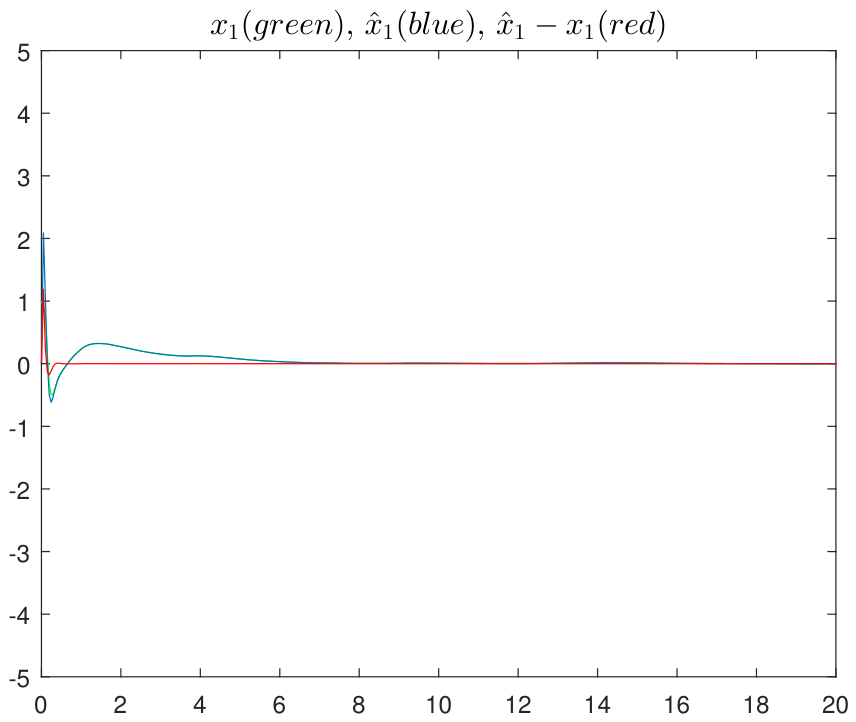
According to Figure 4, Figure 5 and Figure 6, we know that with the NLESO-based feedback control u ˜ ( t ) , the closed-loop system, including both estimation and stabilization, rapidly achieves practically stability, which illustrates the effectiveness of u ˜ ( t ) .

7. Conclusions

In this paper, we extend the active disturbance rejection control (ADRC) approach to feedback stabilization of nonlinear hybrid stochastic systems with fractional noise. Additionally, we consider various system states, including unexpected random abrupt changes and memory effects inherent in fractional noise.
To achieve reference tracking and disturbance rejection, we design an extended state observer (ESO) to estimate the reference signal in real time and propose an ESO-based control strategy to ensure system stability. We establish new sufficient conditions for the exponential stability of a class of hybrid stochastic differential equations (SDEs) with fractional noise, thereby enabling the application of the ADRC framework to nonlinear stochastic systems with fractional disturbances.
Furthermore, we generalize the ADRC approach to systems experiencing large abrupt changes, where the disturbances may be bounded in the mean-square sense or even arise from underlying unbounded models, thereby relaxing conventional disturbance constraints.
Notably, the proof of the standard ADRC approach is based on Brownian motion ( H = 0.5 ), and its theoretical foundation relies on the semi-martingale property of Brownian motion and the classical Itô calculus. These tools are not applicable to fractional Brownian motion with H > 1 / 2 or systems with Markovian switching. The proposed fWIS-based approach is specifically developed to address this mathematical challenge using fractional Wick–Itô–Skorohod calculus, and its advantage lies in handling memory effects and abrupt changes that standard ADRC cannot capture. Moreover, when H = 0.5 and there is only one state (i.e., no switching), our results reduce to the standard ADRC framework, which demonstrates the consistency and generality of our approach.

Author Contributions

Conceptualization, W.P. and F.L.; methodology, W.P.; software, F.L.; validation, W.P. and F.L.; formal analysis, W.P.; investigation, W.P.; resources, W.P.; data curation, F.L.; writing—original draft preparation, F.L.; writing—review and editing, W.P.; visualization, W.P.; supervision, W.P.; project administration, W.P.; funding acquisition, W.P. All authors have read and agreed to the published version of the manuscript.

Funding

The research of W. Pei was partially supported by the NSFC (Nos. 12401180 and 12371150) and the NSF of Zhejiang (No. LQN25A010006). This paper was also supported by the Summit Advancement Disciplines of Zhejiang Province (Zhejiang Gongshang University-Statistics) and the Collaborative Innovation Center of Statistical Data Engineering Technology & Application.

Institutional Review Board Statement

Not applicable.

Informed Consent Statement

Not applicable.

Data Availability Statement

The original contributions presented in this study are included in the article. Further inquiries can be directed to the corresponding author.

Acknowledgments

The authors are grateful and thank the anonymous reviewers for assessing the paper and for their helpful comments, which led to the improvement of this paper.

Conflicts of Interest

The authors declare no conflicts of interest.

References

  1. Brody, D.; Syroka, J.; Zervos, M. Dynamical pricing of weather derivatives. Quant. Financ. 2002, 2, 189–198. [Google Scholar] [CrossRef]
  2. Simonsen, I. Measuring anti-correlations in the Nordic electricity spot market by wavelets. Phys. A Stat. Mech. Appl. 2003, 322, 597–606. [Google Scholar] [CrossRef]
  3. Hu, Y.; Øksendal, B. Fractional white noise calculus and applications to finance. Infin. Dimens. Anal. Quantum Probab. Relat. Top. 2003, 6, 1–32. [Google Scholar] [CrossRef]
  4. Decreusefond, L.; Üstünel, A.S. Stochastic analysis of the fractional Brownian motion. Potential Anal. 1999, 10, 177–214. [Google Scholar] [CrossRef]
  5. Duncan, T.; Hu, Y.; Pasik-Duncan, B. Stochastic calculus for fractional Brownian motion. I. Theory. SIAM J. Control Optim. 2000, 38, 582–612. [Google Scholar] [CrossRef]
  6. Yan, L.; Pei, W.; Zhang, Z. Exponential stability of SDEs driven by fBm with Markovian switching. Discret. Contin. Dyn. Syst. Ser. A 2019, 39, 6467–6483. [Google Scholar] [CrossRef]
  7. Mao, X. Stability of stochastic differential equations with Markovian switching. Stoch. Proc. Appl. 1999, 79, 45–67. [Google Scholar] [CrossRef]
  8. Yuan, C.; Mao, X. Stability of stochastic delay hybrid systems with jumps. Eur. J. Control 2010, 16, 595–608. [Google Scholar] [CrossRef]
  9. Yin, G.; Zhu, C. Hybrid Switching Diffusions: Properties and Applications; Springer: New York, NY, USA, 2010. [Google Scholar]
  10. Lu, Y.; Ruan, D.; Zhu, Q. Symmetric Analysis of Stability Criteria for Nonlinear Systems with Multi-Delayed Periodic Impulses: Intensity Periodicity and Averaged Delay. Symmetry 2025, 17, 1481. [Google Scholar] [CrossRef]
  11. Liao, Q.; Luo, D. Exponential Stability Criteria for Fractional Order Switched System Based on Multiple Discontinuous Lyapunov Function Method. Complex Syst. Stab. Control 2026, 2, 3. [Google Scholar] [CrossRef]
  12. Han, J. Auto-disturbance rejection control and it’s applications. Control Decis. 1998, 13, 19–23. [Google Scholar]
  13. Han, J. From PID to active disturbance rejection control. IEEE Trans. Ind. Electron. 2009, 56, 900–906. [Google Scholar] [CrossRef]
  14. Leonard, F.; Martini, A.; Abba, G. Robust nonlinear controls of model scale helicopter sunder lateral and vertical windgusts. Trans. Control Syst. Technol. 2012, 20, 154–163. [Google Scholar] [CrossRef]
  15. Ramírez-Neria, M.; Sira-Ramírez, H.; Luviano-Juárez, A.; Rodríguez-Ángeles, A. Active disturbance rejection control applied to a delta parallel robot in trajectory tracking tasks. Asian J. Control 2015, 17, 636–647. [Google Scholar] [CrossRef]
  16. Xue, W.; Bai, W.; Yang, S.; Song, K.; Huang, Y.; Xie, H. ADRC with adaptive extended state observer and its application to air-fuel ratio control in gasoline engines. IEEE Trans. Ind. Electron. 2015, 62, 5847–5857. [Google Scholar] [CrossRef]
  17. Xia, Y.; Fu, M. Compound Control Methodology for Flight Vehicles; Springer: Berlin/Heidelberg, Germany, 2013. [Google Scholar]
  18. Wu, Z.; Gao, Z.; Li, D.; Chen, Y.; Liu, Y. On transitioning from PID to ADRC in thermal power plants. Control Theory Technol. 2021, 19, 3–18. [Google Scholar] [CrossRef]
  19. Sui, S.; Zhao, T. Active disturbance rejection control for optoelectronic stabilized platform based on adaptive fuzzy sliding mode control. ISA Trans. 2022, 125, 85–98. [Google Scholar] [CrossRef]
  20. Chen, Z.; Xu, D. Output regulation and active disturbance rejection control: Unified formulation and comparison. Asian J. Control 2016, 18, 1668–1678. [Google Scholar] [CrossRef]
  21. Deng, H.; Krstić, M. Output-feedback stabilization of stochastic nonlinear systems driven by noise of unknown covariance. Syst. Control Lett. 2000, 39, 173–182. [Google Scholar] [CrossRef]
  22. Li, J.; Chen, W.; Li, J.; Fang, Y. Adaptive NN output-feedback stabilization for a class of stochastic nonlinear strict-feedback systems. ISA Trans. 2009, 48, 468–475. [Google Scholar] [CrossRef] [PubMed]
  23. Wu, Z.; Guo, B. On convergence of active disturbance rejection control for a class of uncertain stochastic nonlinear systems. Int. J. Control 2019, 92, 1103–1116. [Google Scholar] [CrossRef]
  24. Michalski, J.; Mrotek, M.; Pazderski, D.; Kozierski, P.; Retinger, M. Improving performance of ADRC control systems affected by measurement noise using Kalman filter-tuned extended state observer. Electronics 2024, 24, 4916. [Google Scholar] [CrossRef]
  25. Benyahia, A.T.-E.; Stanković, M.; Madonski, R.; Babayomi, O.; Manojlović, S.M. Improving control performance by cascading observers: Case of ADRC with cascade ESO. IEEE/CAA J. Autom. Sin. 2025, 12, 1702–1712. [Google Scholar] [CrossRef]
  26. Hamilton, J. A new approach to the economic analysis of nonstationary time series and the business cycle. Econometrica 1989, 57, 357–384. [Google Scholar] [CrossRef]
  27. Pei, W.; Zhang, Z. Stability of Hybrid SDEs Driven by fBm. Front. Phys. 2021, 9, 783434. [Google Scholar] [CrossRef]
  28. Biagini, F.; Hu, Y.; Øksendal, B.; Zhang, T. Stochastic Calculus for Fractional BROWNIAN Motion and Applications; Springer: London, UK, 2008. [Google Scholar]
  29. Anderson, W. Continuous-Time Markov Chains: An Applications-Oriented Approach. In Springer Series in Statistics: Probability and Its Applications; Springer: New York, NY, USA, 2012. [Google Scholar]
  30. Mishura, Y. Stochastic Calculus for Fractional Brownian Motion and Related Process; Springer: Berlin/Heidelberg, Germany, 2008. [Google Scholar]
  31. Alos, E.; Mazet, O.; Nualart, D. Stochastic calculus with respect to Gaussian processes. Ann. Probab. 1999, 29, 766–801. [Google Scholar] [CrossRef]
  32. Nualart, D.; Răşcanu, A. Differential equations driven by fractional Brownian motion. Collect. Math. 2002, 53, 55–81. [Google Scholar]
  33. Wall, H. Polynomials whose zeros have negative real parts. Am. Math. Mon. 1945, 52, 308–322. [Google Scholar] [CrossRef]
  34. Guo, B.; Wu, Z.; Zhou, H. Active disturbance rejection control approach to output-feedback stabilization of a calss of uncertain nonlinear system subject to stochastic disturbance. IEEE Trans. Autom. Control 2015, 61, 1613–1618. [Google Scholar] [CrossRef]
  35. Guo, B.; Zhao, Z. Extended state observer for nonlinear system with uncertainty. IFAC Proc. Vol. 2011, 44, 1855–1860. [Google Scholar] [CrossRef]
Figure 1. Open-loop system: state x 1 ( t ) . x axis: time t, y axis: state value.
Mathematics 14 02082 g001
Figure 2. Open-loop system: state x 2 ( t ) . x axis: time t, y axis: state value.
Mathematics 14 02082 g002
Figure 3. Open-loop system: total disturbance x 3 ( t ) . x axis: time t, y axis: state value.
Mathematics 14 02082 g003
Figure 4. Closed-loop system: state x 1 ( t ) . x axis: time t, y axis: state value.
Mathematics 14 02082 g004
Figure 5. Closed-loop system: state x 2 ( t ) . x axis: time t, y axis: state value.
Mathematics 14 02082 g005
Figure 6. Closed-loop system: total disturbance x 3 ( t ) . x axis: time t, y axis: state value.
Mathematics 14 02082 g006
Disclaimer/Publisher’s Note: The statements, opinions and data contained in all publications are solely those of the individual author(s) and contributor(s) and not of MDPI and/or the editor(s). MDPI and/or the editor(s) disclaim responsibility for any injury to people or property resulting from any ideas, methods, instructions or products referred to in the content.