Article

Secure Dissipative Fuzzy Filtering for Nonlinear Networked Systems with Stochastic Cyber Attacks


1
School of Electronic and Control Engineering, North China Institute of Aerospace Engineering, Langfang 065000, China
2
School of Electronics and Information Engineering, Langfang Normal University, Langfang 065000, China
*
Author to whom correspondence should be addressed.
Mathematics 2026, 14(11), 1992; https://doi.org/10.3390/math14111992
Submission received: 8 May 2026 / Revised: 31 May 2026 / Accepted: 2 June 2026 / Published: 4 June 2026

Abstract

This paper investigates the problem of non-fragile dissipative filtering for discrete-time nonlinear networked systems with dynamic quantization, a dynamic event-triggered mechanism and stochastic cyber attacks. The nonlinear networked system under investigation is described by an uncertain Takagi–Sugeno (T-S) fuzzy model. In this work, a novel fuzzy-dependent dynamic event-triggered communication scheme and the dynamic quantization strategy, integrated with an online adjustment rule, are introduced to reduce the frequency and volume of data transmission, thus realizing more rational utilization of the limited communication resources. In addition, the stochastic cyber attacks are characterized by a random variable obeying the Bernoulli distribution. The core focus of this paper is to design a non-fragile filter such that the resulting filtering error system is stochastically stable and meets the prescribed dissipative filtering performance. Based on the matrix inequality decoupling technique, the design conditions of the desired filter are derived and presented in the form of linear matrix inequalities (LMIs). Finally, the effectiveness and superiority of the proposed filter design approach is verified via two simulation examples.

1. Introduction

With the widespread application of networked systems across various industries [1], relevant research has garnered increasing attention from scholars worldwide. Currently, networked systems are mainly confronted with two challenges: on the one hand, communication resources are not infinitely available; on the other hand, data transmission in networked systems faces various interferences and attacks. To achieve more rational and efficient utilization of communication resources, scholars have proposed quantization strategies and event-triggered strategies and conducted extensive research on these two approaches. For instance, the authors of [2,3] investigated the control-related problems of networked systems under quantization constraints, while the control issues of networked systems under the event-driven mechanism have been discussed in detail in [3,4,5]. To enhance the stability of networked systems in the presence of uncertainties, the authors of [5,6,7] studied the controller design problems for networked systems under the influence of cyber attacks, and the design methodology of non-fragile controllers has been presented in [6,7].
Owing to the numerous constraints of linear system theory in practical applications, research on nonlinear system theory has received growing attention and a wealth of research results have been obtained [8]. For instance, the design methodology of controllers for nonlinear systems under quantization constraints is presented in [9]; the authors of [10,11,12] investigated the control-related problems of nonlinear systems with event-triggered strategies, and the design approaches of non-fragile controllers and controllers under the influence of cyber attacks are introduced in [13,14], respectively. Among the numerous research approaches for nonlinear systems, Takagi–Sugeno (T-S) fuzzy system theory has attracted widespread attention from scholars worldwide. This is attributed to the fact that the T-S fuzzy system can realize the local linearization of nonlinear systems, which enables the application of mature linear system theories to solve the corresponding problems. A wealth of research results have been achieved by scholars on T-S fuzzy systems: for example, a design method of controllers for T-S fuzzy systems with quantization strategies was proposed in [15]; the authors of [16,17] investigated the controller design problems of T-S fuzzy systems under the event-driven mechanism; the controller design methodology for T-S fuzzy systems subject to cyber attacks is presented in [16,17]; and the relevant research on non-fragile controllers based on T-S fuzzy systems is introduced in [18,19].
As a critical research direction in the field of control engineering, the problem of filtering has garnered extensive attention from scholars and yielded a wealth of research achievements, especially in the current context where the internal state evolution of systems is increasingly difficult to characterize accurately. For example, the authors of [20] investigated the filtering problem for nonlinear systems under quantization constraints. The authors of [21] introduced the design method of nonlinear system filters under an event-driven mechanism. The research results of non-fragile filters and filters affected by cyber attacks were presented in [22,23], respectively. Furthermore, plentiful research outcomes have been obtained regarding the filtering problem of T-S fuzzy systems. For example, the authors in [24,25,26,27,28,29,30,31,32,33,34] have investigated the filtering problem of T-S fuzzy systems subject to quantization constraints. The authors in [28,29,30,31,32,33,34,35,36,37] have proposed filter design methods for T-S fuzzy systems under the event-driven mechanism. Relevant research results of filter design under the impact of cyber attacks are presented in [30,31,32,37], and corresponding design methods of non-fragile filters are demonstrated in [38,39,40]. Notably, the quantization strategies and event-triggered strategies adopted in the above-mentioned achievements are generally incapable of dynamic adjustment, and none of them simultaneously take cyber attacks and non-fragility into full consideration. Therefore, within the theoretical framework of T-S fuzzy systems, it is still of great theoretical and engineering significance to investigate the design methodology of non-fragile filters under cyber attacks based on dynamic event-triggered strategies and online adjustable dynamic quantization strategies.
Compared with the existing research results in the literature, the main contributions of this paper are summarized as follows:
(1)
This paper addresses the non-fragile dissipative filtering problem for a class of discrete-time nonlinear networked systems subject to stochastic cyber attacks.
(2)
To achieve efficient utilization of network communication resources and alleviate the communication burden of the system, a novel fuzzy dependent dynamic event-triggered communication scheme and the dynamic quantization scheme integrated with an online adjustment strategy are employed in this paper.
(3)
Based on the matrix inequality decoupling technique, the design conditions for both the full-order and reduced-order have been established in a unified framework in terms of linear matrix inequalities (LMIs).
The remainder of this paper is organized as follows: Section 2 gives a detailed description of the problem investigated in this work, Section 3 presents the main filter design results, Section 4 provides two simulation examples for verification, and Section 5 concludes the whole paper.

2. Problem Formulation

The framework of the networked filtering system studied in this paper is shown in Figure 1. In this figure, the T-S fuzzy model is used to describe the nonlinear system. Moreover, we will adopt an event-triggered strategy and a dynamic quantizer to reduce the transmission frequency of y ( k ) . Subsequently, the signal y f ( k q ) will be transmitted to the filter part through an unreliable communication network, where the effects of cyber attacks are also necessary to take into consideration. In what follows, the mathematical formulation of the investigated non-fragile dissipative filtering problem is presented.

2.1. Nonlinear Plant

In this paper, the following discrete-time T-S fuzzy system will be utilized to approximated the concerned nonlinear plant. The r t h fuzzy rule is formulated as
PlantRule r : If g 1 ( k ) is N 1 r and g 2 ( k ) is N 2 r … and g v ( k ) is N v r , then
x ( k + 1 ) = ( A r + Δ A r ) x ( k ) + ( B r + Δ B r ) v ( k ) y ( k ) = C r x ( k ) + D r v ( k ) z ( k ) = E r x ( k ) + F r v ( k )
where g ( k ) = [ g 1 ( k ) , g 2 ( k ) , , g v ( k ) ] is the premise variable, N s r stand for the fuzzy sets with r = 1 , , r , s = 1 , , v , and r is the number of fuzzy rules. x ( k ) R n x denotes the system state vector, y ( k ) R n y represents the measured output, z ( k ) R n z stands for the performance output and the v ( k ) R n v is the exogenous disturbance input which belongs to the l 2 0 , space. A r , B r , C r , D r , E r , and F r are known system matrices with compatible dimensions.
The matrices Δ A r and Δ B r represent the time-varying norm-bounded parameter uncertainties in the system model, which are given by
Δ A r Δ B r = E g r Δ R R 1 R 2
where the unknown matrix Δ R satisfies the norm-bounded condition Δ R T Δ R I , and E g r , r = 1 , , r . R 1 and R 2 are known real constant matrices with compatible dimensions.
For the T-S fuzzy model (1), we define the normalized fuzzy basis functions as follows:
ϑ r ( g ( k ) ) = s = 1 v N s r ( g s ( k ) ) r = 1 r s = 1 v N s r ( g s ( k ) ) , r = 1 , , r
where N s r ( g s ( k ) ) denotes the membership grade of the premise variable g s ( k ) corresponding to the fuzzy set N s r .
In accordance with the definition established above, one is able to conclude that:
ϑ r ( g ( k ) ) 0 , r = 1 r ϑ r ( g ( k ) ) = 1 , r = 1 , , r
Moreover, the T-S fuzzy model (1) can be expressed as
x ( k + 1 ) = ( A ( ϑ ) + Δ A ( ϑ ) ) x ( k ) + ( B ( ϑ ) + Δ B ( ϑ ) ) v ( k ) y ( k ) = C ( ϑ ) x ( k ) + D ( ϑ ) v ( k ) z ( k ) = E ( ϑ ) x ( k ) + F ( ϑ ) v ( k )
where
A ( ϑ ) = r = 1 r ϑ r ( g ( k ) ) A r , B ( ϑ ) = r = 1 r ϑ r ( g ( k ) ) B r , C ( ϑ ) = r = 1 r ϑ r ( g ( k ) ) C r , D ( ϑ ) = r = 1 r ϑ r ( g ( k ) ) D r , E ( ϑ ) = r = 1 r ϑ r ( g ( k ) ) E r , F ( ϑ ) = r = 1 r ϑ r ( g ( k ) ) F r , Δ A ( ϑ ) = r = 1 r ϑ r ( g ( k ) ) Δ A r , Δ B ( ϑ ) = r = 1 r ϑ r ( g ( k ) ) Δ B r .

2.2. Event-Triggered Communication Scheme

Motivated by the work in [4,29,33], to reduce the frequency of data transmission, we adopt an improved dynamic event-triggered scheme as the event-triggered strategy depicted in Figure 1. The corresponding event-triggered condition is given by the following inequality:
1 ω η ( k ) ε T ( k ) 1 ( ϑ ) ε ( k ) λ y T ( k q ) 2 ( ϑ ) y ( k q )
The measured output y ( k ) is released and transmitted to the dynamic quantizer if and only if the event-triggered condition (6) holds. In condition (6), ω > 0 and 0 λ 1 denote two prescribed constant parameters. 1 ( ϑ ) > 0 and 2 ( ϑ ) > 0 denote two to-be-determined weight matrices. ε ( k ) = y ( k ) y ( k q ) , y ( k q ) denotes the latest transmitted measured output. Finally, η ( k ) is the threshold function, with its mathematical expression given below
η ( k + 1 ) = σ η ( k ) ε T ( k ) 1 ( ϑ ) ε ( k ) + λ y T ( k q ) 2 ( ϑ ) y ( k q )
where η ( 0 ) = η 0 0 and 0 < σ < 1 represent the initial value of the threshold function for the event-triggered condition (6) and a pre-specified constant parameter in the design procedure, respectively. From [4], we can obtain that η ( k ) 0 for all k as long as ω σ 1 .
Remark 1.
It should be noted that the developed fuzzy-dependent dynamic event-triggered communication scheme in this paper is more general than the static ones in [28,30,31] and the dynamic ones in [29,33]. In contrast to the static event-triggered communication schemes in [29,33], the dynamic adjustment of the event-triggered condition in (6) is achieved by introducing the threshold function in (7) and parameters ω, λ and σ, which further reduces the data transmission frequency. More specifically, by setting ω = , 1 ( ϑ ) = 1 , 2 ( ϑ ) = 2 , the developed fuzzy-dependent dynamic event-triggered communication scheme herein reduces to the static one in [30]; and by setting ω = , 1 ( ϑ ) = 2 ( ϑ ) = 1 , it reduces to the static one in [28,31]. Moreover, the dyanmic one in [33] can be obtained from the fuzzy dependent dynamic event-triggered communication scheme herein by choosing 1 ( ϑ ) = 2 ( ϑ ) = 1 , and the dynamic one in [29] can be obtained by choosing 1 ( ϑ ) = 1 , 2 ( ϑ ) = 2 .

2.3. Dynamic Quantizer

For the quantization scheme depicted in Figure 1, its implementation in this paper is formulated as follows:
First, we define a static quantizer for the dynamic quantization framework, which is subject to the two constraint conditions listed below
f ( θ ) θ Δ , i f θ M
f ( θ ) θ > Δ , i f θ > M
where Δ > 0 and M > 0 represent the quantization error bound and the quantization range of the aforementioned static quantizer, respectively. On this basis, we express the dynamic quantizer for the proposed scheme in the following form
y f ( k q ) = ϕ f y ( k q ) ϕ
with ϕ > 0 indicating the dynamic parameter.
Remark 2.
Compared with the static quantizer used in [25], the dynamic scheme utilized in this paper is more general. This is mainly due to the fact that the dynamic scheme utilized in this paper is able to ensure the asymptotic stability of the related filtering error system by the designed quantized filtering strategy with a finite number of quantization levels.

2.4. Cyber Attacks

To improve the robustness of the filtering error system, we adopt the nonlinear function s ( x ( k ) ) proposed in [5,31] to model the deception attack signals. Furthermore, consistent with the assumption in [5,31], we assume that the nonlinear function s ( x ( k ) ) satisfies the following inequality
s T ( x ( k ) ) s ( x ( k ) ) x T ( k ) G T G x ( k )
where G denotes a given matrix parameter associated with the nonlinear function s ( x ( k ) ) .
Based on the above derivation, we can obtain the expression of the quantized measured output signal subject to potential network attacks.
y ¯ f ( k q ) = μ C ( ϑ ) s ( x ( k ) ) + ( 1 μ ) y f ( k q )
where μ is a Bernoulli random variable, from which we have
P r o b μ = 1 = E μ = μ ¯ P r o b μ = 0 = 1 μ ¯
where 0 μ ¯ 1 is a given scalar.

2.5. Filter

In this paper, to achieve the objective of estimating the system state and further improve the robustness of the filtering error system, a non-fragile filter is constructed as follows:
x f ( k + 1 ) = ( A f + Δ A f ) x f ( k ) + ( B f + Δ B f ) y ¯ f ( k q ) z f ( k ) = ( E f + Δ E f ) x f ( k ) + ( F f + Δ F f ) y ¯ f ( k q )
where x f ( k ) R n x f and z f ( k ) R x z denote the state and output of the proposed non-fragile filter, respectively. A f , B f , E f , and F f represents the to-be-designed parameter matrix of the aforementioned non-fragile filter proposed in this work. Δ A f , Δ B f , Δ E f , and Δ F f are the parametric gain variations for the non-fragile filter in (14) and they can be defined as
Δ A f = F g 1 Δ f M f 1 , Δ B f = F g 1 Δ f M f 2 Δ E f = F g 2 Δ f M f 3 , Δ F f = F g 2 Δ f M f 4
wherein F g 1 , F g 2 , M f 1 , M f 2 , M f 3 , and M f 4 stand for constant known matrices with compatible dimensions, while Δ f denotes an unknown matrix that satisfies the norm-bounded condition Δ f T Δ f I .
Remark 3.
The non-fragile filter employed in (14) is more general than the standard filter adopted in [29,30,31]. This is mainly because the non-fragile filter in (14) concerns parametric gain variations. This implies that the filter employed in this article is capable of maintaining satisfactory performance even in the presence of parameter variations. Moreover, by setting Δ A f = Δ B f = Δ E f = Δ F f = 0 , the non-fragile filter in (14) reduces to the standard one in [29,30,31].

2.6. Filtering Error System

By defining δ ( k ) = x T ( k ) x f T ( k ) T , α ( k ) = ϕ f y ( k q ) ϕ y ( k q ) ϕ , e ( k ) = z ( k ) z f ( k ) . The filtering error system (16) can be obtained based on (5), (12) and (14).
δ ( k + 1 ) = ( A 1 + μ ˜ A 2 ) δ ( k ) + ( B 1 + μ ˜ B 2 ) v ( k ) + ( C 1 + μ ˜ C 2 ) s ( x ( k ) ) + ( D 1 + μ ˜ D 2 ) α ( k ) ( D 1 + μ ˜ D 2 ) ε ( k ) e ( k ) = ( F 1 + μ ˜ F 2 ) δ ( k ) + ( G 1 + μ ˜ G 2 ) v ( k ) + ( H 1 + μ ˜ H 2 ) s ( x ( k ) ) + ( U 1 + μ ˜ U 2 ) α ( k ) ( U 1 + μ ˜ U 2 ) ε ( k )
where
A 1 = A Δ 0 ( 1 μ ¯ ) B f Δ C ( ϑ ) A f Δ , B 1 = B Δ ( 1 μ ¯ ) B f Δ D ( ϑ ) , A 2 = 0 0 B f Δ C ( ϑ ) 0 , B 2 = 0 B f Δ D ( ϑ ) , D 2 = 0 B f Δ , C 1 = 0 μ ¯ B f Δ C ( ϑ ) , C 2 = 0 B f Δ C ( ϑ ) , D 1 = 0 ( 1 μ ¯ ) B f Δ , F 1 = E ( ϑ ) ( 1 μ ¯ ) F f Δ C ( ϑ ) E f Δ , G 2 = F f Δ D ( ϑ ) , U 1 = ( 1 μ ¯ ) F f Δ , H 1 = μ ¯ F f Δ C ( ϑ ) , H 2 = F f Δ C ( ϑ ) , G 1 = F ( ϑ ) ( 1 μ ¯ ) F f Δ D ( ϑ ) , F 2 = F f Δ C ( ϑ ) 0 , U 2 = F f Δ , A Δ = A ( ϑ ) + Δ A ( ϑ ) , B Δ = B ( ϑ ) + Δ B ( ϑ ) , A f Δ = A f + Δ A f , B f Δ = B f + Δ B f , E f Δ = E f + Δ E f , F f Δ = F f + Δ F f , μ ˜ = μ μ ¯ .
Before proceeding to the main problem studied in this paper, we first give the definition of dissipativity, as well as two basic lemmas.
Definition 1.
Suppose that the matrices Y 1 = Y 1 T R n z × n z 0 , Y 2 R n z × n v , Y 3 = Y 3 T R n v × n v , and Y 1 = Y ¯ 1 T Y ¯ 1 with Y ¯ 1 R n z × n z 0 are known. Then, for m > 0 and under zero initial conditions, the filtering error system (16) is dissipative and satisfies the dissipative performance γ, if and only if the following inequality is satisfied:
k = 0 m ( e T ( k ) Y 1 e ( k ) + sym { e T ( k ) Y 2 v ( k ) } + v T ( k ) ( Y 3 γ I ) v ( k ) ) 0
Lemma 1
([26,27,35]). Let W 1 = W 1 T , W 2 , W 3 be real matrices of compatible dimensions. For any ς satisfying ς T ς I , the inequality W 1 + W 2 ς W 3 + W 3 T ς T W 2 T < 0 holds if and only if there exists a scalar ρ > 0 such that
W 1 + ρ 1 W 2 W 2 T + ρ W 3 T W 3 < 0
Lemma 2
([24,30]). Let J 1 , J 2 , J 3 , and J 4 be real matrices with appropriate dimensions. Then J 1 + J 2 J 3 + J 3 T J 2 T < 0 , if and only if there exists a matrix J 4 such that
J 1 J 2 T + J 4 J 3 J 4 J 4 T < 0
Remark 4.
In Definition 1, several special cases of the dissipative filtering performance can be obtained by selecting different parameters. Specifically, the H filtering performance in [26,27,31,35,37] is derived when Y 1 = I , Y 2 = 0 , Y 3 = ( γ + γ 2 ) I hold; the passive filtering performance can be obtained when Y 1 = 0 , Y 2 = I , Y 3 = 2 γ I are satisfied; and the mixed passive and H filtering performance is achieved when Y 1 = ϖ I , Y 2 = ( 1 ϖ ) I , Y 3 = ( 2 γ + ϖ ( γ 2 γ ) ) I and 0 ϖ 1 hold simultaneously.
The objective of this paper is to design the non-fragile filter in (14), such that the filtering error system in (16) is stochastically stable with dissipative filtering performance in the sense of Definition 1.

3. Main Results

3.1. Filtering Performance Analysis

In this section, we will investigate the analysis problem of the dissipative filtering performance for the filtering error system (16). Specifically, when the filter parameters in (14) are known, the stochastic stability and dissipative performance of the system can be guaranteed by the following theorem characterized by two inequalities.
Theorem 1.
For given scalars 0 λ 1 , ω > 0 , 0 < σ < 1 , M > 0 , Δ > 0 , μ ¯ , 0 < σ 1 σ 2 and 0 < β 1 β 2 , with 1 β 1 σ 1 , and matrices Y 1 = Y 1 T 0 , Y 2 , Y 3 = Y 3 T , the stochastic stability and the prescribed dissipative filtering performance of the filtering error system in (16) can be guaranteed with the following online adjusting strategy:
β 1 τ y ( k q ) ϕ β 2 τ y ( k q )
If there exist matrices P > 0 , 1 ( ϑ ) > 0 , 2 ( ϑ ) > 0 , S and scalars κ > 1 and τ > 0 satisfying the following inequalities
σ 1 M τ σ 2 M
Γ 11 Γ 21 Γ 22 Γ 31 0 Γ 22 Γ 41 0 0 I Γ 51 0 0 0 I Γ 61 0 0 0 0 I < 0
where Γ 22 = P S S T , ψ = σ κ + 1 + 1 κ ω ,
Γ 11 = ı 11 ı 21 ı 22 0 ı 32 I 0 ı 42 0 I ı 51 ı 52 0 0 ı 55 , Γ 31 = μ ^ S T A 2 μ ^ S T B 2 μ ^ S T C 2 μ ^ S T D 2 μ ^ S T D 2 , Γ 51 = μ ^ Y ¯ 1 F 2 μ ^ Y ¯ 1 G 2 μ ^ Y ¯ 1 H 2 μ ^ Y ¯ 1 U 2 μ ^ Y ¯ 1 U 2 , Γ 21 = S T A 1 S T B 1 S T C 1 S T D 1 S T D 1 , Γ 41 = Y ¯ 1 F 1 Y ¯ 1 G 1 Y ¯ 1 H 1 Y ¯ 1 U 1 Y ¯ 1 U 1 , Γ 61 = Ω C ˜ Ω D ( ϑ ) 0 0 Ω I , ı 51 = λ ψ 2 ( ϑ ) C ˜ , ı 11 = κ P + λ ψ C ˜ T 2 ( ϑ ) C ˜ + G ˜ T G ˜ , Ω = σ 2 β 2 Δ M , ı 21 = Y 2 T F 1 + λ ψ D ( ϑ ) T 2 ( ϑ ) C ˜ , ı 32 = H 1 T Y 2 , ı 52 = U 1 T Y 2 λ ψ 2 ( ϑ ) D ( ϑ ) , ı 55 = ψ 1 ( ϑ ) + λ ψ 2 ( ϑ ) , ı 22 = ( Y 3 γ I ) G 1 T Y 2 Y 2 T G 1 + λ ψ D ( ϑ ) T 2 ( ϑ ) D ( ϑ ) , ı 42 = U 1 T Y 2 , μ ^ = ( μ ¯ ( 1 μ ¯ ) ) 1 / 2 , C ˜ = C ( ϑ ) 0 , G ˜ = G 0 .
Proof. 
Considering the fact that P S S T S T P 1 S , a congruence transformation is performed on inequality (22) with the transformation matrix d i a g { I , S T , S T , I , I , I } , then we can obtain that
Γ 11 Γ 21 P 1 Γ 31 0 P 1 Γ 41 0 0 I Γ 51 0 0 0 I Γ 61 0 0 0 0 I
where Γ 21 = A 1 B 1 C 1 D 1 D 1 and Γ 31 = μ ^ A 2 μ ^ B 2 μ ^ C 2 μ ^ D 2 μ ^ D 2 .
For the filtering error system established in (16), we construct the following Lyapunov function:
V ( δ ( k ) ) = δ T ( k ) P δ ( k ) + 1 κ ω η ( k ) , P > 0 .
Then, we can obtain that
E { V ( δ ( k + 1 ) ) κ V ( δ ( k ) ) e T ( k ) Y 1 e ( k ) e T ( k ) × Y 2 v ( k ) v T ( k ) Y 2 T e ( k ) v T ( k ) ( Y 3 γ I ) v ( k ) } = E { [ ( A 1 + μ ˜ A 2 ) δ ( k ) + ( B 1 + μ ˜ B 2 ) v ( k ) + ( C 1 + μ ˜ C 2 ) s ( x ( k ) ) + ( D 1 + μ ˜ D 2 ) α ( k ) + ( D 1 μ ˜ D 2 ) ε ( k ) ] T P [ ( A 1 + μ ˜ A 2 ) δ ( k ) + ( B 1 + μ ˜ B 2 ) v ( k ) + ( C 1 + μ ˜ C 2 ) s ( x ( k ) ) + ( D 1 + μ ˜ D 2 ) α ( k ) + ( D 1 μ ˜ D 2 ) ε ( k ) ] κ δ T ( k ) P δ ( k ) + 1 κ ω η ( k + 1 ) 1 ω η ( k ) [ ( F 1 + μ ˜ F 2 ) δ ( k ) + ( G 1 + μ ˜ G 2 ) v ( k ) + ( H 1 + μ ˜ H 2 ) s ( x ( k ) ) + ( U 1 + μ ˜ U 2 ) α ( k ) + ( U 1 μ ˜ U 2 ) ε ( k ) ] T Y 1 [ ( F 1 + μ ˜ F 2 ) δ ( k ) + ( G 1 + μ ˜ G 2 ) v ( k ) + ( H 1 + μ ˜ H 2 ) s ( x ( k ) ) + ( U 1 + μ ˜ U 2 ) α ( k ) + ( U 1 μ ˜ U 2 ) ε ( k ) ] [ ( F 1 + μ ˜ F 2 ) δ ( k ) + ( G 1 + μ ˜ G 2 ) v ( k ) + ( H 1 + μ ˜ H 2 ) s ( x ( k ) ) + ( U 1 + μ ˜ U 2 ) α ( k ) + ( U 1 μ ˜ U 2 ) ε ( k ) ] T Y 2 v ( k ) v T ( k ) Y 2 T × [ ( F 1 + μ ˜ F 2 ) δ ( k ) + ( G 1 + μ ˜ G 2 ) v ( k ) + ( H 1 + μ ˜ H 2 ) s ( x ( k ) ) + ( U 1 + μ ˜ U 2 ) α ( k ) + ( U 1 μ ˜ U 2 ) ε ( k ) ] v ( k ) T ( Y 3 γ I ) v ( k ) } = δ ^ T ( k ) ( [ A 1 B 1 C 1 D 1 D 1 ] T P [ A 1 B 1 C 1 D 1 D 1 ] + μ ^ 2 [ A 2 B 2 C 2 D 2 D 2 ] T P [ A 2 B 2 C 2 D 2 D 2 ] [ F 1 G 1 H 1 U 1 U 1 ] T Y 1 [ F 1 G 1 H 1 U 1 U 1 ] μ ^ 2 [ F 2 G 2 H 2 U 2 U 2 ] T Y 1 [ F 2 G 2 H 2 U 2 U 2 ] [ F 1 G 1 H 1 U 1 U 1 ] T Y 2 [ 0 I 0 0 0 ] [ 0 I 0 0 0 ] T × Y 2 T [ F 1 G 1 H 1 U 1 U 1 ] d i a g { κ P , Y 3 γ I , 0 , 0 , 0 } ) δ ^ ( k ) + 1 κ ω η ( k + 1 ) 1 ω η ( k )
where δ ^ ( k ) = δ T ( k ) v T ( k ) s T ( x ( k ) ) α T ( k ) ε T ( k ) T .
Subsequently, we proceed to tackle 1 κ ω η ( k + 1 ) 1 ω η ( k ) to obtain its unified LMI formulation; with the event-triggered condition in (6) and the threshold function in (7) taken into account, one can obtain that
1 κ ω η ( k + 1 ) 1 ω η ( k ) = 1 κ ω ( σ η ( k ) ε T ( k ) 1 ( ϑ ) ε ( k ) + λ y T ( k q ) 2 ( ϑ ) y ( k q ) ) 1 ω η ( k ) = 1 ω ( σ κ 1 ) η ( k ) 1 κ ω ε T ( k ) 1 ( ϑ ) ε ( k ) + λ κ ω y T ( k q ) 2 ( ϑ ) y ( k q ) ( σ κ + 1 + 1 κ ω ) ε T ( k ) 1 ( ϑ ) ε ( k ) + λ ( σ κ + 1 + 1 κ ω ) y T ( k q ) 2 ( ϑ ) y ( k q ) = ψ ε T ( k ) 1 ( ϑ ) ε ( k ) + λ ψ y T ( k q ) 2 ( ϑ ) y ( k q ) = δ ^ T ( k ) ( λ ψ [ C ˜ D ( ϑ ) 0 0 I ] T 2 ( ϑ ) [ C ˜ D ( ϑ ) 0 0 I ] d i a g { 0 , 0 , 0 , 0 , ψ 1 ( ϑ ) } ) δ ^ ( k )
Then, we can obtain that
E { V ( δ ( k + 1 ) ) κ V ( δ ( k ) ) e T ( k ) Y 1 e ( k ) e T ( k ) × Y 2 v ( k ) v T ( k ) Y 2 T e ( k ) v T ( k ) ( Y 3 γ I ) v ( k ) } δ ^ T ( k ) ( [ A 1 B 1 C 1 D 1 D 1 ] T P [ A 1 B 1 C 1 D 1 D 1 ] + μ ^ 2 [ A 2 B 2 C 2 D 2 D 2 ] T P [ A 2 B 2 C 2 D 2 D 2 ] [ F 1 G 1 H 1 U 1 U 1 ] T Y 1 [ F 1 G 1 H 1 U 1 U 1 ] μ ^ 2 [ F 2 G 2 H 2 U 2 U 2 ] T Y 1 [ F 2 G 2 H 2 U 2 U 2 ] [ F 1 G 1 H 1 U 1 U 1 ] T Y 2 [ 0 I 0 0 0 ] [ 0 I 0 0 0 ] T Y 2 T [ F 1 G 1 H 1 U 1 U 1 ] + λ ψ [ C ˜ D ( ϑ ) 0 0 I ] T 2 ( ϑ ) [ C ˜ D ( ϑ ) 0 0 I ] d i a g { κ P , Y 3 γ I , 0 , 0 , ψ 1 ( ϑ ) } ) δ ^ ( k ) = δ ^ T ( k ) Π 0 δ ^ ( k )
where
Π 0 = [ A 1 B 1 C 1 D 1 D 1 ] T P [ A 1 B 1 C 1 D 1 D 1 ] + μ ^ 2 [ A 2 B 2 C 2 D 2 D 2 ] T P [ A 2 B 2 C 2 D 2 D 2 ] [ F 1 G 1 H 1 U 1 U 1 ] T Y 1 [ F 1 G 1 H 1 U 1 U 1 ] μ ^ 2 [ F 2 G 2 H 2 U 2 U 2 ] T Y 1 [ F 2 G 2 H 2 U 2 U 2 ] [ F 1 G 1 H 1 U 1 U 1 ] T Y 2 [ 0 I 0 0 0 ] [ 0 I 0 0 0 ] T Y 2 T [ F 1 G 1 H 1 U 1 U 1 ] + λ ψ [ C ˜ D ( ϑ ) 0 0 I ] T 2 ( ϑ ) [ C ˜ D ( ϑ ) 0 0 I ] d i a g { κ P , Y 3 γ I , 0 , 0 , ψ 1 ( ϑ ) }
By combining the online adjustment strategy in (20) and the inequality in (21), we can obtain:
y ( k q ) 1 β 1 τ ϕ M β 1 σ 1 ϕ M ϕ
From the quantizer constraint f ( ) presented in (8), we have that
ϕ f ( y ( k q ) ϕ ) y ( k q ) ϕ Δ
Further, we can conclude that
α ( k ) ϕ Δ β 2 τ y ( k q ) Δ β 2 σ 2 Δ M y ( k q )
which can be reformulated as
α T ( k ) α ( k ) Ω 2 y T ( k q ) y ( k q )
which can be denoted as
δ ^ T ( k ) Π 1 δ ^ ( k ) 0
where Π 1 = Ω C ˜ Ω D ( ϑ ) 0 0 Ω I T Ω C ˜ Ω D ( ϑ ) 0 0 Ω I d i a g { 0 , 0 , 0 , I , 0 } .
Finally, we present the unified LMI formulation for the cyber attacks constraints in (11)
δ ^ T ( k ) Π 2 δ ^ ( k ) 0
where Π 2 = G ˜ 0 0 0 0 T G ˜ 0 0 0 0 d i a g { 0 , 0 , I , 0 , 0 } .
By the Schur complement, we can obtain an equivalent form of the inequality in (23).
Π 0 + Π 1 + Π 2 < 0
According to the S-procedure in [24] with the inequalities in (32), (33) and (34) we can deduce that δ ^ T ( k ) Π 0 δ ^ ( k ) < 0 , i.e.,
E { V ( δ ( k + 1 ) ) κ V ( δ ( k ) ) e T ( k ) Y 1 e ( k ) e T ( k ) Y 2 × v ( k ) v T ( k ) Y 2 T e ( k ) v T ( k ) ( Y 3 γ I ) v ( k ) } < 0
Next, by summing up (35) from k = 0 to k = ν with ν 1 , we can conclude that
E { V ( δ ( ν + 1 ) ) } κ V ( δ ( 0 ) ) k = 0 ν ( E { e T ( k ) Y 1 e ( k ) + e T ( k ) Y 2 v ( k ) + v T ( k ) Y 2 T e ( k ) } + v T ( k ) ( Y 3 γ I ) v ( k ) ) < 0
It should be noted that E { V ( δ ( ν + 1 ) ) } 0 and V ( δ ( 0 ) ) = 0 . Thus, we can obtain that
k = 0 ν ( E { ( e T ( k ) Y 1 e ( k ) + e T ( k ) Y 2 v ( k ) + v T ( k ) Y 2 T × e ( k ) + v T ( k ) ( Y 3 γ I ) v ( k ) ) } ) 0
Therefore, for zero initial conditions, the prescribed dissipative filtering performance γ > 0 of the filtering error system in (16) can be guaranteed.
Next, for v ( k ) = 0 , we proceed to prove that the stochastic stability of the filtering error system in (16) can be guaranteed by the conditions given in (20), (21), and (22).
When v ( k ) = 0 , the inequality (35) can be rewritten as
E { V ( δ ( k + 1 ) ) κ V ( δ ( k ) ) } < e T ( k ) Y 1 e ( k )
Considering the condition that Y 1 0 , it can be obtained that
E { V ( δ ( k + 1 ) ) κ V ( δ ( k ) ) } < 0
Therefore, as in [30], under the condition that the disturbance signal v ( k ) = 0 , we can derive that the stochastic stability of the filtering error system in (16) can be guaranteed by the inequalities established in (21) and (22) with the online tuning rule proposed in (20).
The proof of Theorem 1 is completed. □
Remark 5.
It is highlighted that the proposed online adjustment strategy in (20) exhibits stronger universality and a wider range of applicability than existing schemes in the literature. Specifically, the proposed strategy degenerates into the one adopted in [24] when β 1 = β 2 , and reduces to the method used in [31] under the parameter setting σ 1 = β 1 = 1 and β 2 = 2 .

3.2. Filters Design

In this section, building on the theoretical analysis results established in the previous section, we proceed to address the design problem of the non-fragile dissipative filter for the considered networked system. We will propose the design conditions for the desired filter based on linear matrix inequalities.
Theorem 2.
For given scalars ϱ 1 , ϱ 2 , ϱ 3 , ϱ 4 , Δ , M, μ ¯ , λ, 0 < σ 1 σ 2 , 0 < β 1 β 2 , 0 < σ < 1 with 1 β 1 σ 1 , and matrices Y ¯ 1 0 , Y 2 , Y 3 = Y 3 T , the stochastic stability and the prescribed dissipative filtering performance of the filtering error system in (16) can be guaranteed with the online adjusting strategy in (20), if there exist matrices P > 0 , 1 r > 0 , 2 r > 0 , Υ, A F , B F , E F , F F , S 1 , S 2 , S 3 , and S 4 , and scalars τ > 0 , ρ 1 > 0 and ρ 2 > 0 satisfying
χ r < 0 , r = 1 , , r
where
χ r = Ξ 11 r Ξ 21 r Ξ 22 Ξ 31 Ξ 32 r Ξ 33 Ξ ¯ 41 Ξ ¯ 42 0 Ξ ¯ 44 Ξ ¯ 51 r 0 0 0 Ξ ¯ 55 Ξ ˜ 61 r 0 0 0 0 Ξ ¯ 55 Ξ ˜ 71 r Ξ ˜ 72 0 0 0 0 Ξ ˜ 77 , Ξ 11 r = 11 r 21 r 22 r 0 32 r I 0 42 0 I 51 r 52 r 0 0 55 r , Ξ 21 r = 61 r 71 r 81 r 91 r a 1 r Ξ 31 = 0 0 0 0 0 0 ρ 1 R 1 0 ρ 1 R 2 0 0 0 , Ξ ¯ 41 T = ¯ 11 T 0 0 0 0 0 0 0 , Ξ ¯ 51 r T = ¯ 91 r T 0 0 0 , Ξ 33 = d i a g ρ 1 I , ρ 1 I , Ξ ˜ 61 r T = ˜ 11 r T ˜ 21 r T ¯ 91 r T ˜ 41 r T , Ξ ˜ 71 r T = ˜ 51 r T ˜ 61 r T , Ξ 22 = d i a g 66 , 66 , I , I , I , Ξ 32 r = E g r T S 1 T E g r T S 3 T 0 0 0 0 0 0 0 0 0 0 0 0 , Ξ ¯ 42 T = 0 0 0 0 ¯ 52 T ¯ 62 T ¯ 72 T ¯ 82 T , Ξ ˜ 72 T = ˜ 52 T ˜ 62 T , Ξ ¯ 44 = d i a g Ξ ¯ 55 , Ξ ¯ 55 , Ξ ¯ 55 = d i a g ρ 2 I , ρ 2 I , ρ 2 I , ρ 2 I , Ξ ˜ 77 = d i a g Υ Υ T , Υ Υ T , 11 r = κ P 1 + λ ψ C r T 2 r C r + G T G κ P 2 κ P 3 , 66 = P 1 S 1 S 1 T P 2 S 3 S 2 T P 4 S 4 S 4 T , 21 r = ( Y 2 T E r + ( 1 μ ¯ ) Y 2 T F F C r + λ ψ D r T 2 r C r ) T ( Y 2 T E F ) T T , 51 r = λ ψ 2 r C r 0 , 22 r = ( Y 3 γ I ) sym Y 2 T F r ( 1 μ ¯ ) Y 2 T F F D r + λ ψ D r T 2 r D r , 55 r = ψ 1 r + λ ψ 2 r , 42 = ( 1 μ ¯ ) F F T Y 2 , 52 r = ( 1 μ ¯ ) F F T Y 2 λ ψ 2 r D r , 32 r = μ ¯ C r T F F T Y 2 , 61 r = ˘ 11 r ˘ 12 r ˘ 13 r ˘ 14 ˘ 14 , 71 r = ˘ 21 r ˘ 22 r ˘ 23 r ˘ 24 ˘ 24 ,
81 r = ˘ 31 r ˘ 32 r ˘ 33 r ˘ 34 ˘ 34 , 91 r = ˘ 41 r ˘ 42 r ˘ 43 r ˘ 44 ˘ 44 , a 1 r = Ω C r 0 Ω D r 0 0 Ω I , ˘ 11 r = S 1 A r + ( 1 μ ¯ ) ϱ 1 Q B F C r ϱ 1 Q A F S 3 A r + ( 1 μ ¯ ) ϱ 2 B F C r ϱ 2 A F , ˘ 12 r = S 1 B r + ( 1 μ ¯ ) ϱ 1 Q B F D r S 3 B r + ( 1 μ ¯ ) ϱ 2 B F D r , ˘ 14 = ( 1 μ ¯ ) ϱ 1 Q B F ( 1 μ ¯ ) ϱ 2 B F , ˘ 13 r = μ ¯ ϱ 1 Q B F C r μ ¯ ϱ 2 B F C r , ˘ 22 r = μ ^ ϱ 3 Q B F D r μ ^ ϱ 4 B F D r , ˘ 23 r = μ ^ ϱ 3 Q B F C r μ ^ ϱ 4 B F C r , ˘ 24 = μ ^ ϱ 3 Q B F μ ^ ϱ 4 B F , ˘ 21 r = μ ^ ϱ 3 Q B F C r 0 μ ^ ϱ 4 B F C r 0 , ˘ 31 r = Y ¯ 1 E r ( 1 μ ¯ ) Y ¯ 1 F F C r Y ¯ 1 E F , ˘ 32 r = Y ¯ 1 F r ( 1 μ ¯ ) Y ¯ 1 F F D r , ˘ 33 r = μ ¯ Y ¯ 1 F F C r , ˘ 34 = ( 1 μ ¯ ) Y ¯ 1 F F , ˘ 41 r = μ ^ Y ¯ 1 F F C r 0 , ˘ 42 r = μ ^ Y ¯ 1 F F D r , ˘ 43 r = μ ^ Y ¯ 1 F F C r , ˘ 44 = μ ^ Y ¯ 1 F F , ¯ 11 = 0 0 F g 2 T Y 2 0 0 0 , ¯ 91 r = ρ 2 φ ˘ 11 r ρ 2 φ ˘ 12 r ρ 2 φ ˘ 13 r ρ 2 φ ˘ 14 ρ 2 φ ˘ 14 , φ ˘ 11 r = ( 1 μ ¯ ) M f 4 C r M f 3 , φ ˘ 13 r = μ ¯ M f 4 C r , φ ˘ 12 r = ( 1 μ ¯ ) M f 4 D r , φ ˘ 14 = ( 1 μ ¯ ) M f 4 ˜ 11 r = ρ 2 φ 11 r ρ 2 φ 12 r ρ 2 φ 13 r ρ 2 φ 14 ρ 2 φ 14 , ˜ 21 r = ρ 2 φ 21 r ρ 2 φ 22 r ρ 2 φ 23 r ρ 2 φ 24 ρ 2 φ 24 , ˜ 41 r = ρ 2 φ 41 r ρ 2 φ 42 r ρ 2 φ 43 r ρ 2 φ 44 ρ 2 φ 44 , ˜ 51 r = φ 51 r φ 52 r φ 53 r φ 54 φ 54 , φ 44 = M f 4 , ˜ 61 r = φ 61 r φ 62 r φ 63 r φ 64 φ 64 , φ 24 = M f 2 , φ 11 r = ( 1 μ ¯ ) M f 2 C r M f 1 , φ 12 r = ( 1 μ ¯ ) M f 2 D r , φ 13 r = μ ¯ M f 2 C r , φ 14 = ( 1 μ ¯ ) M f 2 , φ 23 r = M f 2 C r , φ 21 r = M f 2 C r 0 , φ 51 r = ( 1 μ ¯ ) B F C r A F , φ 22 r = M f 2 D r , φ 41 r = M f 4 C r 0 , φ 42 r = M f 4 D r , φ 43 r = M f 4 C r , φ 52 r = ( 1 μ ¯ ) B F D r , φ 53 r = μ ¯ B F C r , φ 54 = ( 1 μ ¯ ) B F , φ 61 r = μ ^ B F C r 0 , φ 63 r = μ ^ B F C r , ¯ 72 = 0 0 0 0 F g 2 T Y ¯ 1 T 0 0 , φ 62 r = μ ^ B F D r , ¯ 82 = 0 0 0 0 0 μ ^ F g 2 T Y ¯ 1 T 0 , φ 64 = μ ^ B F , ¯ 52 = F g 1 T S 2 T F g 1 T S 4 T 0 0 0 0 0 , ¯ 62 = 0 0 μ ^ F g 1 T S 2 T μ ^ F g 1 T S 4 T 0 0 0 , ˜ 52 = ( S 2 ϱ 1 Q Υ ) T ( S 4 ϱ 2 Υ ) T 0 0 0 0 0 , ˜ 62 = 0 0 ( S 2 ϱ 3 Q Υ ) T ( S 4 ϱ 4 Υ ) T 0 0 0 .
In addition, the parameters of the filter given in (14), namely A f , B f , E f , and F f , can be obtained through
A f = Υ 1 A F , B f = Υ 1 B F , E f = E F , F f = F F
Proof. 
It can be observed that there still exist uncertain variables Δ A , Δ B , Δ A f , Δ B f , Δ E f , and Δ F f in Theorem 1. We eliminate these uncertain variables via a two-step procedure based on Lemma 1 to obtain the design results of the filter in (14).
First, with respect to the uncertain variables Δ A ( ϑ ) and Δ B ( ϑ ) , the inequality in (22) can be rewritten as
Γ 11 Γ ˜ 21 Γ 22 Γ 31 0 Γ 22 Γ ˜ 41 0 0 Γ ˜ 44 + sym { X ˜ Δ R Y ˜ } < 0
where X ˜ = 0 X T 0 0 T , Y ˜ = Y 0 0 0 ,
Γ ˜ 21 = S T A ˜ 1 S T B ˜ 1 S T C 1 S T D 1 S T D 1 , Γ ˜ 41 = Γ 41 T Γ 51 T Γ 61 T T , Γ ˜ 44 = d i a g { I , I , I } , A ˜ 1 = A ( ϑ ) 0 ( 1 μ ¯ ) B f Δ C ( ϑ ) A f Δ , B ˜ 1 = B ( ϑ ) ( 1 μ ¯ ) B f Δ D ( ϑ ) , X = ( E g T ( ϑ ) 0 S ) T , Y = R 1 0 R 2 0 0 0 .
By applying the Schur complement and Lemma 1 to (42), with ς = Δ R , W 2 = X ˜ , and W 3 = Y ˜ , it can be concluded that (42) holds if and only if there exists a scalar ρ 1 > 0 such that the following inequality holds.
Γ 11 Γ ^ 21 Γ ^ 22 Γ ^ 31 Γ ^ 32 Γ ^ 33 < 0
where
Γ ^ 21 = Γ ˜ 21 T Γ 31 T Γ 41 T Γ 51 T T , Γ ^ 31 = Γ 61 T 0 ρ 1 Y T T , Γ ^ 22 = d i a g { Γ 22 , Γ 22 , I , I } , Γ ^ 32 = 0 [ X T 0 0 0 ] 0 , Γ ^ 33 = d i a g { I , ρ 1 I , ρ 1 I } .
Next, with respect to the uncertain variables Δ A f , Δ B f , Δ E f , and Δ F f , the inequality in (43) can be rewritten in an analogous manner as
Γ ¯ 11 Γ ¯ 31 Γ ^ 33 + sym { W Δ f T } < 0
where W = [ 0 W 1 T ] 0 T , T = [ T 1 0 0 0 0 ] 0 ,
W 1 = d i a g { Y 2 T F g 2 , 0 , 0 , 0 , S T 0 F g 1 , μ ^ S T 0 F g 1 , Y ¯ 1 F g 2 , μ ^ Y ¯ 1 F g 2 } , Γ ¯ 31 = Γ ^ 31 Γ ^ 32 , T 1 = ρ 2 1 ¯ 91 T 0 0 0 ˜ 11 T ˜ 21 T ¯ 91 T ˜ 41 T T , Γ ¯ 11 = ȷ 11 ȷ 21 ȷ 22 , ȷ 22 = d i a g { Γ 22 , Γ 22 , I , I } , ȷ 11 = ȷ ˇ 11 ȷ ˇ 21 ȷ ˇ 22 0 ȷ ˇ 32 I 0 ȷ ˇ 42 0 I ȷ ˇ 51 ȷ ˇ 52 0 0 ȷ ˇ 55 , ȷ 21 = ȷ 6 ȷ 7 ȷ 8 ȷ 9 , ȷ ˇ 11 = κ P + λ ψ C ˜ T 2 ( ϑ ) C ˜ + G ˜ T G ˜ , ȷ ˇ 51 = λ ψ 2 ( ϑ ) C ˜ ȷ ˇ 21 = Y 2 T F 1 + λ ψ D ( ϑ ) T 2 ( ϑ ) C ˜ , ȷ ˇ 32 = H 1 T Y 2 , ȷ ˇ 22 = ( Y 3 γ I ) G 1 T Y 2 Y 2 T G 1 + λ ψ D ( ϑ ) T 2 ( ϑ ) D ( ϑ ) , ȷ ˇ 42 = U 1 T Y 2 , ȷ ˇ 52 = U 1 T Y 2 λ ψ 2 ( ϑ ) D ( ϑ ) , ȷ ˇ 55 = ψ 1 ( ϑ ) + λ ψ 2 ( ϑ ) ȷ 6 = S T A 1 S T B 1 S T C 1 S T D 1 S T D 1 , ȷ 7 = μ ^ S T A 2 μ ^ S T B 2 μ ^ S T C 2 μ ^ S T D 2 μ ^ S T D 2 , ȷ 8 = Y ¯ 1 F 1 Y ¯ 1 G 1 Y ¯ 1 H 1 Y ¯ 1 U 1 Y ¯ 1 U 1 , ȷ 9 = μ ^ Y ¯ 1 F 2 μ ^ Y ¯ 1 G 2 μ ^ Y ¯ 1 H 2 μ ^ Y ¯ 1 U 2 μ ^ Y ¯ 1 U 2 , A 1 = A ( ϑ ) 0 ( 1 μ ¯ ) B f C ( ϑ ) A f , A 2 = 0 0 B f C ( ϑ ) 0 , B 2 = 0 B f D ( ϑ ) B 1 = B ( ϑ ) ( 1 μ ¯ ) B f D ( ϑ ) , D 2 = 0 B f , C 2 = 0 B f C ( ϑ ) , D 1 = 0 ( 1 μ ¯ ) B f , C 1 = 0 μ ¯ B f C ( ϑ ) , F 1 = E ( ϑ ) ( 1 μ ¯ ) F f C ( ϑ ) E f , F 2 = F f C ( ϑ ) 0 , G 1 = [ F ( ϑ ) ( 1 μ ¯ ) F f D ( ϑ ) ] , G 2 = [ F f D ( ϑ ) ] , U 2 = F f H 1 = [ μ ¯ F f C ( ϑ ) ] , H 2 = [ F f C ( ϑ ) ] , U 1 = [ ( 1 μ ¯ ) F f ] .
By applying the Schur complement and Lemma 1 to (44), with ς = Δ f , W 2 = W , and W 3 = T , we obtain that (44) holds if and only if there exists a scalar ρ 2 > 0 such that the following inequality holds.
Γ ¯ 11 Γ ¯ 31 Γ ^ 33 W T 0 ρ 2 I ρ 2 T 0 0 ρ 2 I < 0
Finally, we define the matrices P and S in (45) as P = P 1 P 2 P 3 and S T = S 1 S 2 S 3 S 4 . Furthermore, by considering a dimension adjustment matrix Q, a nonsingular matrix variable Υ , and defining Υ A f = A F , Υ B f = B F , E f = E F , and F f = F F , the inequality formulated in (45) can be rewritten as
L 11 L 21 66 L 31 0 66 L 41 0 0 L 44 L ¯ 51 L ¯ 52 L ¯ 53 L ¯ 54 L ¯ 55 + sym 0 K 1 K 2 0 0 K 3 0 0 0 0 < 0
where
L 11 = L 11 L 21 L 22 0 L 32 I 0 L 42 0 I L 51 L 52 0 0 ȷ ˇ 55 , L 21 = L 61 T L 62 T L 63 T L 64 T L 64 T T , L 31 = L 71 T L 72 T L 73 T L 74 T L 74 T T , L 41 = L 81 T L 82 T L 83 T L 84 T L 84 T T , L ¯ 51 = Y 11 Y 21 Y 31 Y 41 ,
L ¯ 53 = 0 Y 23 T 0 0 T , L ¯ 54 = 0 Y 24 T 0 0 T , L ¯ 55 = d i a g { I ρ 1 I , ρ 1 I , ρ 2 I , ρ 2 I , ρ 2 I , ρ 2 I , ρ 2 I , ρ 2 I , ρ 2 I , ρ 2 I , ρ 2 I , ρ 2 I , ρ 2 I , ρ 2 I , ρ 2 I , ρ 2 I , ρ 2 I , ρ 2 I } , L 44 = d i a g { I I } , L ¯ 52 = 0 Y 22 T 0 0 T , L 11 = κ P 1 + λ ψ C ( ϑ ) T 2 ( ϑ ) C ( ϑ ) + G T G κ P 2 κ P 3 , L 21 = ( Y 2 T E ( ϑ ) + ( 1 μ ¯ ) Y 2 T F F C ( ϑ ) + L ¯ 22 ) T ( Y 2 T E F ) T T , L ¯ = λ ψ D ( ϑ ) T 2 ( ϑ ) C ( ϑ ) , L 22 = ( Y 3 γ I ) sym Y 2 T F ( ϑ ) ( 1 μ ¯ ) Y 2 T F F D ( ϑ ) + λ ψ D ( ϑ ) T 2 ( ϑ ) D ( ϑ ) , L 32 = μ ¯ C ( ϑ ) T F F T Y 2 , L 52 = ( 1 μ ¯ ) F F T Y 2 λ ψ 2 ( ϑ ) D ( ϑ ) , L 42 = ( 1 μ ¯ ) F F T Y 2 , L 51 = λ ψ 2 ( ϑ ) C ( ϑ ) 0 , L 61 = S 1 A ( ϑ ) + ( 1 μ ¯ ) ϱ 1 Q B F C ( ϑ ) ϱ 1 Q A F S 3 A ( ϑ ) + ( 1 μ ¯ ) ϱ 2 B F C ( ϑ ) ϱ 2 A F , L 62 = S 1 B ( ϑ ) + ( 1 μ ¯ ) ϱ 1 Q B F D ( ϑ ) S 3 B ( ϑ ) + ( 1 μ ¯ ) ϱ 2 B F D ( ϑ ) ,
L 63 = μ ¯ ϱ 1 Q B F C ( ϑ ) μ ¯ ϱ 2 B F C ( ϑ ) , L 64 = ( 1 μ ¯ ) ϱ 1 Q B F ( 1 μ ¯ ) ϱ 2 B F , L 71 = μ ^ ϱ 3 Q B F C ( ϑ ) 0 μ ^ ϱ 4 B F C ( ϑ ) 0 , L 74 = μ ^ ϱ 3 Q B F μ ^ ϱ 4 B F , L 72 = μ ^ ϱ 3 Q B F D ( ϑ ) μ ^ ϱ 4 B F D ( ϑ ) , L 73 = μ ^ ϱ 3 Q B F C ( ϑ ) μ ^ ϱ 4 B F C ( ϑ ) , L 82 = Y ¯ 1 F ( ϑ ) ( 1 μ ¯ ) Y ¯ 1 F F D ( ϑ ) μ ^ Y ¯ 1 F F D ( ϑ ) , L 83 = μ ¯ Y ¯ 1 F F C ( ϑ ) μ ^ Y ¯ 1 F F C ( ϑ ) , L 84 = ( 1 μ ¯ ) Y ¯ 1 F F μ ^ Y ¯ 1 F F , L 81 = Y ¯ 1 E ( ϑ ) ( 1 μ ¯ ) Y ¯ 1 F F C ( ϑ ) Y ¯ 1 E F μ ^ Y ¯ 1 F F C ( ϑ ) 0 , Y 11 = Ω C ( ϑ ) 0 Ω D ( ϑ ) 0 0 Ω I , Y 21 = 0 Y ¯ 22 T 0 0 0 0 0 0 0 T , Y ¯ 22 = [ ρ 1 R 1 0 ] ρ 1 R 2 0 0 0 0 F g 2 T Y 2 0 0 0 , Y 41 = Y ¯ 41 Y ¯ 42 Y ¯ 43 Y ¯ 44 Y ¯ 44 , Y ¯ 31 = Y ˜ 31 Y ˜ 32 Y ˜ 33 Y ˜ 34 Y ˜ 34 , Y ˜ 31 = ρ 2 ( 1 μ ¯ ) M f 4 C ( ϑ ) ρ 2 M f 3 , Y 31 = Y ¯ 31 T 0 0 0 T , Y ˜ 32 = ρ 2 ( 1 μ ¯ ) M f 4 D ( ϑ ) , Y ˜ 33 = ρ 2 μ ¯ M f 4 C ( ϑ ) , Y ˜ 34 = ρ 2 ( 1 μ ¯ ) M f 4 , Y ¯ 41 = ρ 2 ( 1 μ ¯ ) M f 2 C ( ϑ ) ρ 2 M f 1 ρ 2 M f 2 C ( ϑ ) 0 ρ 2 ( 1 μ ¯ ) M f 4 C ( ϑ ) ρ 2 M f 3 ρ 2 M f 4 C ( ϑ ) 0 , Y ¯ 42 = ρ 2 ( 1 μ ¯ ) M f 2 D ( ϑ ) ρ 2 M f 2 D ( ϑ ) ρ 2 ( 1 μ ¯ ) M f 4 D ( ϑ ) ρ 2 M f 4 D ( ϑ ) , Y ¯ 43 = ρ 2 μ ¯ M f 2 C ( ϑ ) ρ 2 M f 2 C ( ϑ ) ρ 2 μ ¯ M f 4 C ( ϑ ) ρ 2 M f 4 C ( ϑ ) ,
Y ¯ 44 = ρ 2 ( 1 μ ¯ ) M f 2 ρ 2 M f 2 ρ 2 ( 1 μ ¯ ) M f 4 ρ 2 M f 4 , Y 23 = 0 0 0 0 0 0 0 [ μ ^ F g 1 T S 2 T μ ^ F g 1 T S 4 T ] 0 0 ,
Y 22 = [ E g T ( ϑ ) S 1 T E g T ( ϑ ) S 3 T ] 0 0 0 0 0 [ F g 1 T S 2 T F g 1 T S 4 T ] 0 0 0 , Y 24 = 0 0 0 0 0 0 0 0 [ F g 2 T Y ¯ 1 T 0 ] [ 0 μ ^ F g 2 T Y ¯ 1 T ] , K 3 = O 1 O 2 O 3 O 4 O 4 , K 1 = S 2 ϱ 1 Q Υ 0 S 4 ϱ 2 Υ 0 , K 2 = 0 S 2 ϱ 3 Q Υ 0 S 4 ϱ 4 Υ , O 1 = ( 1 μ ¯ ) B f C ( ϑ ) A f μ ^ B f C ( ϑ ) 0 , O 2 = ( 1 μ ¯ ) B f D ( ϑ ) μ ^ B f D ( ϑ ) , O 3 = μ ¯ B f C ( ϑ ) μ ^ B f C ( ϑ ) , O 4 = ( 1 μ ¯ ) B f μ ^ B f .
By employing Lemma 2 to the inequality in (46) with J 4 = d i a g { Υ , Υ } , we can obtain that
r = 1 r ϑ r ( g ( k ) ) χ r < 0
Finally, by virtue of the properties of the fuzzy basis functions ϑ r ( g ( k ) ) established in (4), it can be concluded that (47) holds if the inequality in (40) is satisfied. The proof of the above theorem is completed. □
Remark 6.
In this paper, by using Lemma 2 with the dimension tuning matrix Q and the nonsingular matrix variable Υ, the design conditions for both the full order and reduced order have been established in Theorem 2 under a unified framework in terms of linear matrix inequalities. The design conditions developed in Theorem 2 can be utilized to deal with the full-order filtering problem by choosing Q = I R n x f × n x f with n x f = n x , and reduced-order filtering problem by choosing Q = I R n x f × n x f 0 R n x f × n x n x f T with 1 n x f < n x . Moreover, in contrast with the filter design strategy utilized in [26,29,31,36], the developed filter design approach in this paper allows the slack matrix S with a free structure, i.e., the constraint on the structure of the introduced slack matrix S in [26,29,31,36] has been removed. Therefore, it can deduced that the proposed filter design approach herein is more relaxed than the one in [26,29,31,36]. This point will be further demonstrated in Example 2.

4. Simulation Examples

In this section, we will adopt the Henon mapping system and the tunnel diode circuit system to demonstrate the feasibility and superiority of the dissipative filtering scheme developed in this paper, respectively.
Example 1: In this example, we will utilize the Henon mapping system in [28,30] to demonstrate the effectiveness of the proposed dissipative filtering scheme herein by assuming x 1 ( k ) [ ξ , ξ ] , ξ > 0 . Based on the results in [28,30], the Henon mapping system can be represented by a discrete-time T-S fuzzy model with two IF-THEN rules defined in (1). The relevant system matrices are given as follows:
A 1 = ξ 0.3 1 0 , A 2 = ξ 0.3 1 0 , B 1 = B 2 = 1 0 , C 1 = C 2 = 2.5 1 , D 1 = D 2 = 1.3 , E 1 = E 2 = 1 0.3 , F 1 = F 2 = 0.1 .
Moreover, the uncertain parameter matrices are assumed to be
E g 1 = 0.0027 0.0016 0.0011 0.0011 , E g 2 = 0.0017 0.0014 0.0009 0.0006 , R 1 = 0.04 0.0017 0.03 0.0027 , R 2 = 0.3 0.2 , F g 2 = 0.01 0 , F g 1 = 0.0011 0.045 0.003 0.005 , M f 1 = 0.04 0 0 0.011 , M f 3 = 0.11 0 0 0.05 , M f 2 = 0.08 0 , M f 4 = 0.07 0 .
Furthermore, the corresponding fuzzy membership functions of the aforementioned fuzzy system can be formulated as
ϑ 1 ( x 1 ( k ) ) = 1 2 1 x 1 ( k ) ξ , ϑ 2 ( x 1 ( k ) ) = 1 2 1 + x 1 ( k ) ξ .
By setting the relevant parameter in Theorem 2 as ξ = 0.2 , λ = 0.26 , σ = 0.6 , σ 1 = β 1 = 1 , σ 2 = β 2 = 2 , Δ = 0.1 , M = 50 , ω = 10 , μ ¯ = 0.1 , ϱ 1 = 1 , ϱ 2 = 2 , ϱ 3 = 2 , ϱ 4 = 1 , κ = 1.95 , Y 1 ¯ = 0.6 , Y 2 = 1.2 , Y 3 = 16 , γ = 1.5 , Q = I 2 × 2 and G = d i a g { 0.01 , 0.01 } , we can obtain the undetermined design parameters 11 , 12 , 21 and 22 in the event-triggered strategy, as well as the filter parameters A f , B f , E f and F f as follows:
11 = 6.4011 , 12 = 6.6372 , 21 = 1.0406 , 22 = 1.6685 , A f = 0.0027 0.0083 0.0031 0.0019 , B f = 0.0226 0.0140 , E f = 0.1942 0.2220 , F f = 0.2548 .
Next, we set the initial state of the system as x ( 0 ) = [ 0 0 ] T , the initial state of the filter as x f ( 0 ) = [ 0 0 ] T , the initial condition of the event-triggered threshold function as η 0 = 4.5 , the exogenous disturbance input v ( k ) as v ( k ) = 0.1 cos ( 0.3 k ) e 0.1 k , the cyber attacks signal as s ( x ( k ) ) = [ ( tanh ( 0.01 x 1 ( k ) ) ) T ( tanh ( 0.01 x 2 ( k ) ) ) T ] T , and the uncertain matrix functions in the system and the filter as Δ R = sin ( 0.1 k ) and Δ f = 0.8 sin ( 0.1 k ) , respectively.
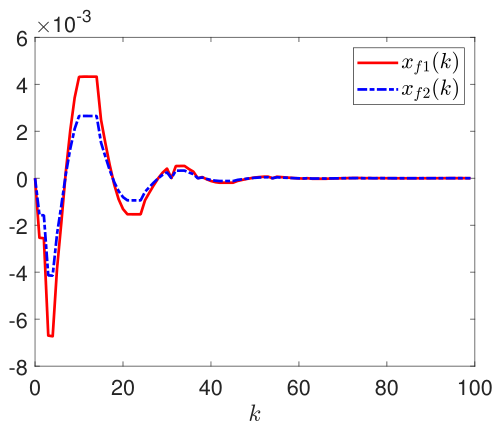
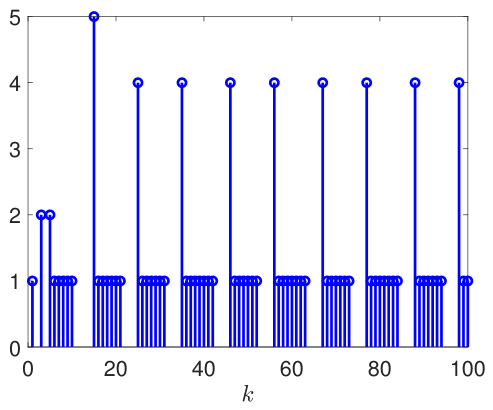
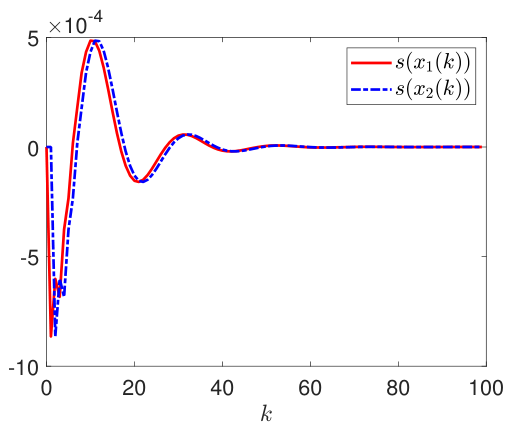
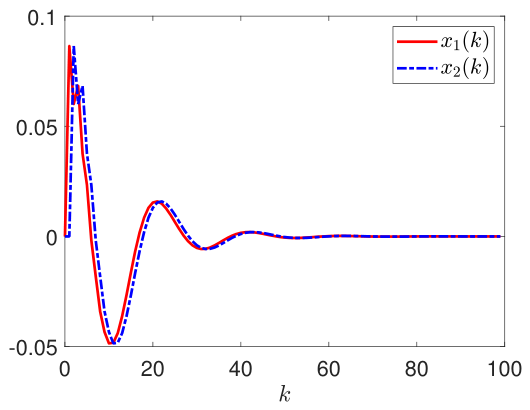
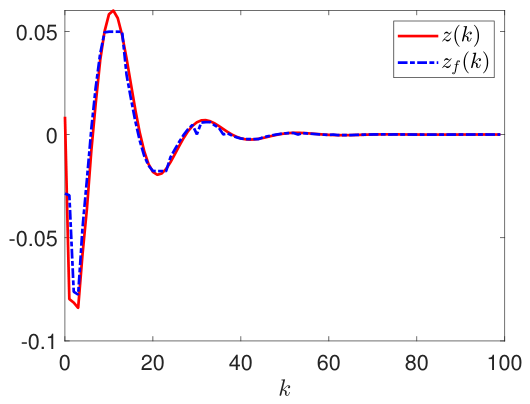
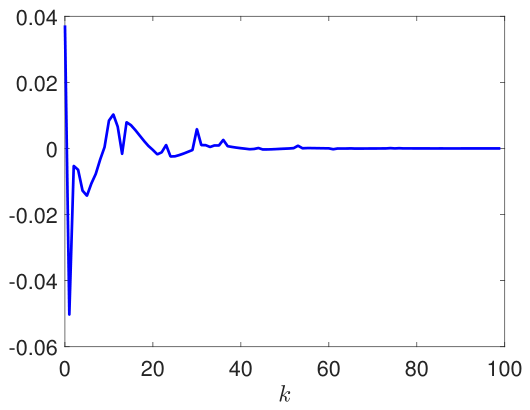
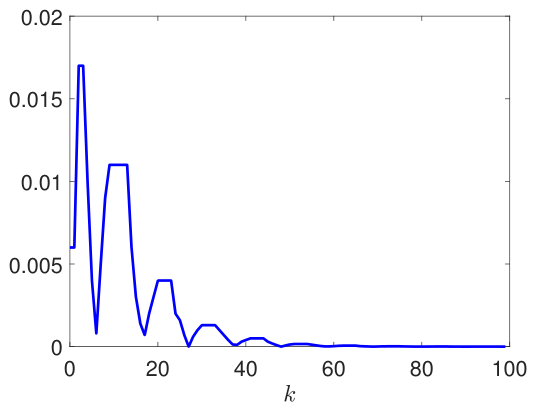
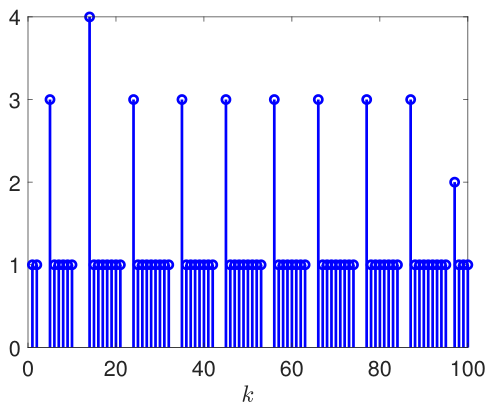
Based on the above information, the simulation results are given in Figure 2, Figure 3, Figure 4, Figure 5, Figure 6, Figure 7, Figure 8 and Figure 9 to demonstrate the effectiveness of the proposed dissipative filter design approach herein. Figure 2 and Figure 3 depict the responses of the system state x ( k ) and the filter state x f ( k ) , respectively. Figure 4 presents the responses of the performance output z ( k ) and the filter output z f ( k ) . Figure 5 depicts the response of the filtering error e ( k ) . Figure 6 plots the trajectory of the dynamic parameter ϕ . Figure 7 gives the intervals for the fuzzy-dependent dynamic event-triggered communication scheme. Figure 8 gives the release intervals for the fuzzy-independent dynamic event-triggered communication scheme in [29]. The cyber attacks signal s ( x ( k ) ) is depicted in Figure 9.
From the simulation results shown in Figure 2, Figure 3, Figure 4, Figure 5, Figure 6, Figure 7, Figure 8 and Figure 9, it can be concluded that the stochastic stability of the filtering error system in (16) can be ensured by the designed dissipative filter in the presence of dynamic event-triggered communication scheme, dynamic quantization, and stochastic cyber attacks for the Henon mapping system. Moreover, the designed dissipative filter produces a good estimation of the performance output z ( k ) . From Figure 7 and Figure 8, it can be concluded that the event is triggered only 70 times by using the fuzzy-dependent dynamic event-triggered communication scheme developed herein, which is much fewer than the 80 times triggered under the fuzzy independent dynamic event-triggered communication scheme developed in [29].
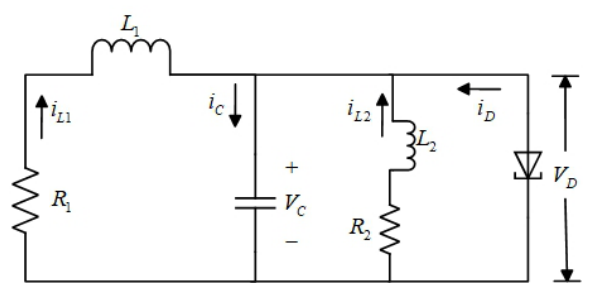
Example 2: In this example, we will employ the tunnel diode circuit system shown in Figure 10 to demonstrate the superiority of the filter design method proposed in this paper.
Based on the results in [24], by selecting x 1 ( k ) = v C ( k ) , x 2 ( k ) = i L 1 ( k ) and x 3 ( k ) = i L 2 ( k ) , the state-space equation of the tunnel diode circuit can be obtained as
C x ˙ 1 ( k ) = A x 1 ( k ) B x 1 3 ( k ) + x 2 ( k ) + x 3 ( k ) D 1 x ˙ 2 ( k ) = x 1 ( k ) U 1 x 2 ( k ) + G v ( k ) D 2 x ˙ 3 ( k ) = x 1 ( k ) U 2 x 3 ( k )
Next, we assume that C = 20 mF, A = 0.002 s, B = 0.01 s, D 1 = 1000 mH, U 1 = 10 Ω , G = 1 , D 2 = 100 mH, U 2 = 1 Ω and x 1 ( k ) 3 , i.e., 0 x 1 2 ( k ) 9 . Subsequently, the nonlinear tunnel diode circuit described in (48) can be approximated by a continuous-time T-S fuzzy model with two IF-THEN rules, which is expressed as
Plant Rule 1 : IF x 1 2 ( k ) is 0 , THEN x ˙ ( t ) = A 1 x ( t ) + B 1 u ( t ) Plant Rule 2 : IF x 1 2 ( k ) is 9 , THEN x ˙ ( t ) = A 2 x ( t ) + B 2 u ( t )
where
A 1 = 0.1 50 50 1 10 0 10 0 10 , B 1 = 0 1 0 , A 2 = 4.6 50 50 1 10 0 10 0 10 , B 2 = 0 1 0 .
Furthermore, the corresponding fuzzy membership functions of the aforementioned fuzzy system can be formulated as
ϑ 1 ( x 1 ( k ) ) = 1 x 1 2 ( k ) 9 , 3 x 1 ( k ) 3 0 , otherwise ϑ 2 ( x 1 ( k ) ) = 1 ϑ 1 ( x 1 ( k ) ) .
By setting the sampling period T = 0.02 s , we can obtain that
A 1 = 0.8970 0.8726 0.8726 0.0175 0.8101 0.0086 0.1745 0.0859 0.7328 , A 2 = 0.8170 0.8332 0.8332 0.0167 0.8104 0.0083 0.1666 0.0833 0.7354 , B 1 = 0.0092 0.0181 0.0006 , B 2 = 0.0089 0.0181 0.0006 .
and other relative matrices are supposed to be
C 1 = C 2 = 1 3 2 , D 1 = D 2 = 0.4 , E 1 = E 2 = 2 1 6 , F 1 = F 2 = 0.1 , F g 2 = 0.03 0.02 0.01 , E g 1 = 0.0117 0.0116 0.0121 0.0111 0.0111 0.0111 0.0123 0.0116 0.0116 , R 2 = 0.1 0.3 0.5 , E g 2 = 0.1117 0.1114 0.0146 0.0129 0.0116 0.0156 0.0111 0.0131 0.0141 , M f 2 = 0.018 0.011 0.017 , R 1 = 0.0114 0.0117 0.1114 0.0113 0.0017 0.0115 0.0111 0.0111 0.0138 , M f 4 = 0.17 0.17 0.12 , F g 1 = 0.0111 0.0151 0.0131 0.0113 0.015 0.0111 0.0115 0.0117 0.0211 , M f 1 = 0.0112 0.0111 0.1111 0.0111 0.0111 0.0117 0.0111 0.0121 0.0117 , M f 3 = 0.021 0.017 0.011 0.011 0.021 0.011 0.011 0.011 0.019 .
The quantization range and quantization bound are assumed to be M = 10 and Δ = 0.5 , respectively, and the predefined parameters for the investigated problem are selected as σ 1 = β 1 = 1 , σ 2 = β 2 = 2 , ω = 10 , λ = 0.26 , σ = 0.6 , G = d i a g { 0.01 , 0.01 , 0.01 } , ϱ 1 = 5 , ϱ 2 = ϱ 3 = ϱ 4 = 1 and μ ¯ = 0.1 .
Finally, to verify the superiority of the filter design method proposed in this paper over the one used in [26,29,31,36], we take the H filtering problem as an example. The optimized H performance index γ min under the different n x f obtained by Theorem 2 and the filter design strategy utilized in [26,29,31,36], are shown in Table 1.
As expected, it can be concluded from Table 1 that the filter design method proposed in this paper is more relaxed than the classical filter design method used in [26,29,31,36].
Comparative Explanations: Based on the developed filtering strategy, we can solve the non-fragile dissipative filtering problem for the Henon mapping system and the tunnel diode circuit system in (48) with a dynamic event-triggered mechanism, dynamic quantization, and stochastic cyber attacks via linear matrix inequalities. Compared with the existing results, the main advantages of the dissipative filtering strategy proposed in this paper are summarized as follows:
(1) In contrast to the existing results on filtering for networked systems, where only the dynamic event-triggered scheme [21,33,35,37] or dynamic quantization scheme [24,26,30,31,34] was considered, the problem addressed in this paper is more general. On the one hand, it can be seen from Figure 7 and Figure 8 that the event is triggered only 70 times, which is much fewer than the 80 times triggered under the fuzzy independent dynamic event-triggered communication scheme developed in [29]. Therefore, the fuzzy dependent dynamic event-triggered communication scheme proposed in this paper is more general than the one in [29]. On the other hand, the online tuning strategies in [24,26,31,34] can be directly obtained from the proposed method by selecting appropriate parameters, thus the dynamic quantization-based filtering strategy proposed in this paper has wider generality than the methods reported in [24,26,31,34]. In addition, as shown in Figure 6, the online adjusting strategy in this paper performs as well as expected.
(2) By applying the matrix inequality decoupling technique, the design conditions for both the full order and reduced order have been established in a unified framework in terms of linear matrix inequalities. Compared with the filter design approach utilized in [26,29,31,36], the developed filter design method can effectively remove the restrictive assumptions on the auxiliary matrix variable, i.e., it does not need the elements in the second column of the auxiliary matrix variable to be identical. The comparisons of the optimized H filtering performance listed in Table 1 demonstrate that the proposed filter design approach is more relaxed than the one utilized in [26,29,31,36].

5. Conclusions

In this paper, based on T-S fuzzy system theory, the problem of non-fragile dissipative filtering has been investigated for discrete-time nonlinear networked systems with stochastic cyber attacks. To reduce the transmission volume and frequency of data, the dynamic quantization scheme with an improved adjusting scheme and a fuzzy-dependent dynamic event-triggered communication scheme are introduced in this work. Furthermore, the effects of stochastic cyber attacks obeying the Bernoulli distribution have also been considered. By applying the matrix inequality decoupling method, the design conditions for the desired event-triggered quantized non-fragile filter have been established in terms of linear matrix inequalities, which guarantee asymptotic stability and the predefined dissipative filtering performance for the filtering error system. Finally, two simulation examples are provided at the end of the paper to verify the effectiveness and superiority of the proposed filter design approach.
In order to further show the engineering applicability, we will validate the non-fragile dissipative filtering strategy proposed in this paper on hardware-in-the-loop or real-time IoT testbeds. In addition, as two active research fronts, both data-driven filtering and learning-based attack detection have received a great deal of attention in recent years. Next, we will investigate the problem of data-driven non-fragile filtering for nonlinear networked systems, and the problem of learning-based attack detection for nonlinear networked systems.

Author Contributions

Conceptualization, K.C., Z.L. and Z.Z.; Formal analysis, Z.L. and Z.Z.; methodology, K.C., Z.L. and Z.Z.; funding acquisition, Z.L.; investigation, writing—original draft preparation and editing, and writing—review and editing, K.C., Z.L. and Z.Z.; software, K.C. and Z.Z. All authors have read and agreed to the published version of the manuscript.

Funding

This work was supported in part by the National Natural Science Foundation of China under Grant 62003006, in part by the Science and Technology Project of Hebei Education Department under Grant QN2024181, in part by the Langfang Youth Talent Support Program under Grant LFBJ202202.

Data Availability Statement

The original contributions presented in the study are included in the article. Further inquiries can be directed to the corresponding author.

Conflicts of Interest

The authors declare no conflicts of interest.

References

  1. Zhang, X.-M.; Han, Q.-L.; Ge, X.; Ding, D.; Ding, L.; Yue, D.; Peng, C. Networked control systems: A survey of trends and techniques. IEEE/CAA J. Autom. Sin. 2020, 7, 1–17. [Google Scholar] [CrossRef]
  2. Ren, W.; Xiong, J. H control of linear networked and quantized control systems with communication delays and random packet losses. IEEE Trans. Syst. Man Cybern. Syst. 2022, 52, 3926–3936. [Google Scholar] [CrossRef]
  3. Zhao, R.; Zuo, Z.; Wang, Y. Event-triggered control for networked switched systems with quantization. IEEE Trans. Syst. Man Cybern. Syst. 2022, 52, 6120–6128. [Google Scholar] [CrossRef]
  4. Zha, L.; Liao, R.; Liu, J.; Cao, J.; Xie, X. Dynamic event-triggered security control of cyber-physical systems against missing measurements and cyber-attacks. Neurocomputing 2022, 500, 405–412. [Google Scholar] [CrossRef]
  5. Liu, J.; Wu, Z.-G.; Yue, D.; Park, J.H. Stabilization of networked control systems with hybrid-driven mechanism and probabilistic cyber attacks. IEEE Trans. Syst. Man Cybern. Syst. 2021, 51, 943–953. [Google Scholar] [CrossRef]
  6. Divya, H.; Sakthivel, R.; Karthick, S.A.; Aouiti, C. Non-fragile control design for stochastic markov jump system with multiple delays and cyber attacks. Math. Comput. Simul. 2022, 192, 291–302. [Google Scholar] [CrossRef]
  7. Li, F.; Li, K.; Peng, C.; Gao, L. Dynamic event-triggered fuzzy non-fragile control of DC microgrids. ISA Trans. 2023, 142, 83–97. [Google Scholar] [CrossRef]
  8. Jia, F.; Zhu, Q. Nonovershooting tracking control for nonlinear output feedback systems with application to DC motor. IEEE Trans. Circuits Syst. I Regul. Pap. 2025, 72, 8383–8395. [Google Scholar] [CrossRef]
  9. Wu, J.; Sun, W.; Su, S.-F.; Wu, Y. Adaptive asymptotic tracking control for input-quantized nonlinear systems with multiple unknown control directions. IEEE Trans. Cybern. 2023, 53, 5216–5225. [Google Scholar] [CrossRef]
  10. Zhu, Z.; Zhu, Q. Adaptive event-triggered fuzzy control for stochastic highly nonlinear systems with time delay and nontriangular structure interconnections. IEEE Trans. Fuzzy Syst. 2024, 32, 27–37. [Google Scholar] [CrossRef]
  11. Zhu, Q. Stabilization of stochastic nonlinear delay systems with exogenous disturbances and the event-triggered feedback control. IEEE Trans. Autom. Control 2019, 64, 3764–3771. [Google Scholar] [CrossRef]
  12. Zhu, Q. Event-triggered sampling problem for exponential stability of stochastic nonlinear delay systems driven by Lévy processes. IEEE Trans. Autom. Control 2025, 70, 1176–1183. [Google Scholar] [CrossRef]
  13. Wei, C.; Li, J. Finite-time non-fragile boundary feedback control for a class of nonlinear parabolic systems. Nonlinear Dyn. 2021, 103, 2753–2768. [Google Scholar] [CrossRef]
  14. Du, Z.; Di, M.; Li, C. Improved event-triggered controller design for nonlinear networked cascade control system under cyber attacks. Nonlinear Dyn. 2025, 113, 31305–31321. [Google Scholar] [CrossRef]
  15. Chang, X.-H.; Liu, X.-M.; Hou, L.-W.; Qi, J.-H. Quantized fuzzy feedback control for electric vehicle lateral dynamics. IEEE Trans. Syst. Man Cybern. Syst. 2024, 54, 2331–2341. [Google Scholar] [CrossRef]
  16. Li, Q.-L.; Chang, X.-H. Observer-based improved event-triggered interval type-2 fuzzy networked control systems subject to deception attacks in dual communication channels. Commun. Nonlinear Sci. Numer. Simul. 2025, 142, 108579. [Google Scholar] [CrossRef]
  17. Gu, Z.; Shi, P.; Yue, D.; Yan, S.; Xie, X. Memory-based continuous event-triggered control for networked T-S fuzzy systems against cyberattacks. IEEE Trans. Fuzzy Syst. 2021, 29, 3118–3129. [Google Scholar] [CrossRef]
  18. Rouamel, M.; Guelton, K.; Bourahala, F.; Lopes, A.N.D.; Arcese, L. Non-fragile mixed event-triggered networked control for Takagi-Sugeno systems subject to actuator faults and external disturbances. Inf. Sci. 2024, 61, 120198. [Google Scholar] [CrossRef]
  19. Samidurai, R.; Yazhini, M.; Punitha, P.; Udhayakumar, R. LMI based non-fragile sample data control of fractional order T-S fuzzy complex valued neural networks with event triggered mechanism. Inf. Sci. 2026, 741, 123288. [Google Scholar] [CrossRef]
  20. Zhang, D.; Yang, H. Ultimately bounded filtering for nonlinear systems subject to integral-type event-triggered mechanism and dynamic quantization. IEEE Sens. J. 2023, 23, 27574–27580. [Google Scholar] [CrossRef]
  21. Chen, Y.; Cai, Y.; Liu, J.; Deng, Y.; Jiang, H. Adaptive event-triggered robust distributed filter for nonlinear systems with non-stationary heavy-tailed noise. Chaos Solitons Fractals 2025, 201, 117340. [Google Scholar] [CrossRef]
  22. Li, J.; Wang, Z.; Hu, J.; Han, Q.-L. Non-fragile cubature Kalman filtering under innovation-based weighted try-once-discard protocol with channel noise. Inf. Sci. 2025, 686, 121296. [Google Scholar] [CrossRef]
  23. Wu, J.; Peng, C.; Zhang, J.; Zhang, B.-L. Event-triggered finite-time H filtering for networked systems under deception attacks. J. Frankl. Inst. 2020, 357, 3792–3808. [Google Scholar] [CrossRef]
  24. Chang, X.-H.; Li, Z.-M.; Park, J.H. Fuzzy generalized H2 filtering for nonlinear discrete-time systems with measurement quantization. IEEE Trans. Syst. Man Cybern. Syst. 2018, 48, 2419–2430. [Google Scholar] [CrossRef]
  25. Zheng, Q.; Xu, S.; Zhang, Z. Nonfragile quantized H filtering for discrete-time switched T-S fuzzy systems with local nonlinear models. IEEE Trans. Fuzzy Syst. 2021, 29, 1507–1517. [Google Scholar] [CrossRef]
  26. Chang, X.-H.; Liu, Y. Robust H filtering for vehicle sideslip angle with quantization and data dropouts. IEEE Trans. Veh. Technol. 2020, 69, 10435–10445. [Google Scholar] [CrossRef]
  27. Zheng, Q.; Xu, S.; Du, B. H filtering of fuzzy impulsive switched systems with multipath quantizations and packet dropouts via multiple hybrid strategies. IEEE Trans. Fuzzy Syst. 2024, 32, 4178–4191. [Google Scholar] [CrossRef]
  28. Chen, Z.; Zhang, B.; Zhang, Y.; Zhang, Z. Dissipative fuzzy filtering for nonlinear networked systems with limited communication links. IEEE Trans. Syst. Man Cybern. Syst. 2020, 50, 962–971. [Google Scholar] [CrossRef]
  29. Lu, C.; Li, Z.-M.; Jing, S. Event-based quantized dissipative filtering for nonlinear networked systems. Mathematics 2025, 13, 1248. [Google Scholar] [CrossRef]
  30. Li, Z.-M.; Lu, C.; Chang, X.-H.; Xiong, J. Security dissipative fuzzy filtering for networked nonlinear systems with stochastic cyber-attacks. IEEE Trans. Signal Inf. Process. Over Netw. 2025, 11, 1344–1356. [Google Scholar] [CrossRef]
  31. Li, Z.-M.; Xiong, J. Event-triggered fuzzy filtering for nonlinear networked systems with dynamic quantization and stochastic cyber attacks. ISA Trans. 2022, 121, 53–62. [Google Scholar] [CrossRef]
  32. Liu, X.-M.; Chang, X.-H.; Hou, L.-W. Attack-dependent adaptive event-triggered security fuzzy control for nonlinear networked cascade control systems under deception attacks. Mathematics 2024, 12, 3385. [Google Scholar] [CrossRef]
  33. Zhang, X.; Han, H. Event-triggered finite-time filtering for nonlinear networked system with quantization and DOS attacks. IEEE Access 2024, 12, 1308–1320. [Google Scholar] [CrossRef]
  34. Yang, Q.; Chang, X.-H. Dissipativity-based robust filter design for singular fuzzy systems with dynamic quantization and event-triggered mechanism. Commun. Nonlinear Sci. Numer. Simul. 2024, 137, 108071. [Google Scholar] [CrossRef]
  35. Li, W.; Xie, Z.; Wong, P.K.; Hu, Y.; Guo, G.; Zhao, J. Event-triggered asynchronous fuzzy filtering for vehicle sideslip angle estimation with data quantization and dropouts. IEEE Trans. Fuzzy Syst. 2022, 30, 2822–2836. [Google Scholar] [CrossRef]
  36. Liu, Y.; Guo, B.-Z.; Park, J.H.; Lee, S. Event-based reliable dissipative filtering for T-S fuzzy systems with asynchronous constraints. IEEE Trans. Fuzzy Syst. 2018, 26, 2089–2098. [Google Scholar] [CrossRef]
  37. Zhao, N.; Zhao, X.; Zong, G.; Xu, N. Resilient event-triggered filtering for networked switched T-S fuzzy systems under denial-of-service attacks. IEEE Trans. Fuzzy Syst. 2024, 32, 2140–2152. [Google Scholar] [CrossRef]
  38. Liu, G.-J.; Wang, F.; Hu, D. Nonfragile fuzzy filtering for nonlinear systems with event-triggered and quantized mechanisms. Appl. Math. Comput. 2026, 522, 129984. [Google Scholar] [CrossRef]
  39. Wan, J.; Hu, Z.; Cai, J.; Luo, Y.; Mei, C.; Han, A. Non-fragile dissipative filtering of cyber–physical systems with random sensor delays. ISA Trans. 2020, 104, 115–121. [Google Scholar] [CrossRef]
  40. Liu, Y.; Guo, B.-Z.; Park, J.H. Non-fragile H filtering for delayed Takagi–Sugeno fuzzy systems with randomly occurring gain variations. Fuzzy Sets Syst. 2017, 316, 99–116. [Google Scholar] [CrossRef]
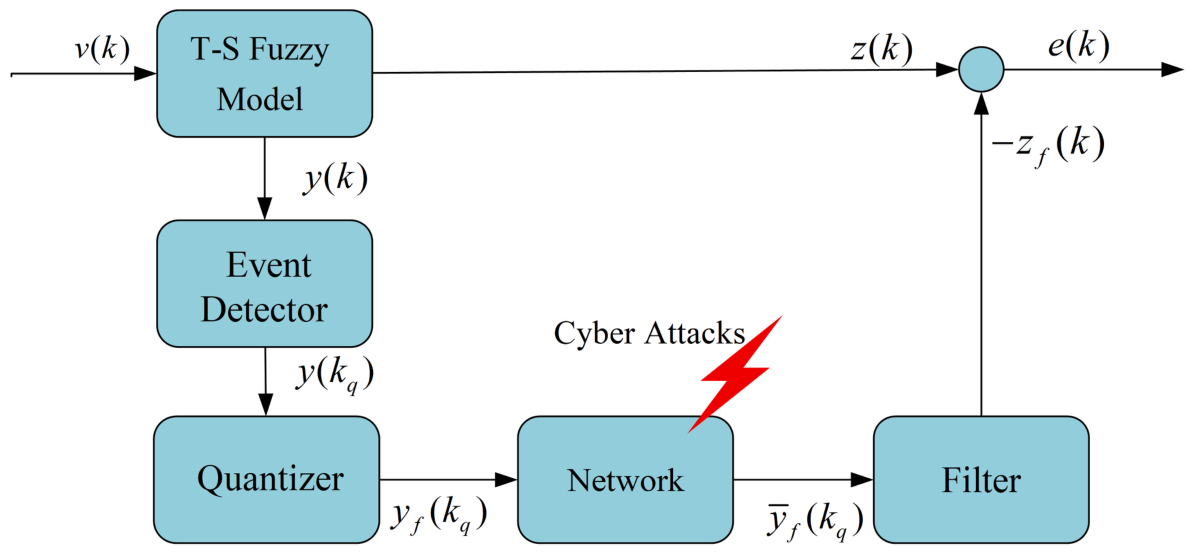
Figure 1. Schematic of filtering for nonlinear networked systems.
Mathematics 14 01992 g001
Figure 2. The response of the system’s state x ( k ) .
Mathematics 14 01992 g002
Figure 3. The response of the filter’s state x f ( k ) .
Mathematics 14 01992 g003
Figure 4. The responses of the performance output z ( k ) and the filter’s output z f ( k ) .
Mathematics 14 01992 g004
Figure 5. The response of the filtering error e ( k ) .
Mathematics 14 01992 g005
Figure 6. The trajectory of the dynamic parameter ϕ .
Mathematics 14 01992 g006
Figure 7. The intervals for the fuzzy-dependent dynamic event-triggered communication scheme.
Mathematics 14 01992 g007
Figure 8. The release intervals for the fuzzy-independent dynamic event-triggered communication scheme in [29].
Mathematics 14 01992 g008
Figure 9. The cyber attacks signal s ( x ( k ) ) .
Mathematics 14 01992 g009
Figure 10. Tunnel diode circuit structure diagram.
Mathematics 14 01992 g010
Table 1. Optimized H filtering performances under different n x f .
n x f 123
[26,29,31,36]0.38990.38870.3867
Theorem 20.38980.38830.3833
Disclaimer/Publisher’s Note: The statements, opinions and data contained in all publications are solely those of the individual author(s) and contributor(s) and not of MDPI and/or the editor(s). MDPI and/or the editor(s) disclaim responsibility for any injury to people or property resulting from any ideas, methods, instructions or products referred to in the content.