Deep Learning-Based Porosity Prediction of Concrete Under Freeze–Heaving Conditions Using Strain Fields


Abstract
1. Introduction
2. Models for Frost Heaving in Porous Concrete
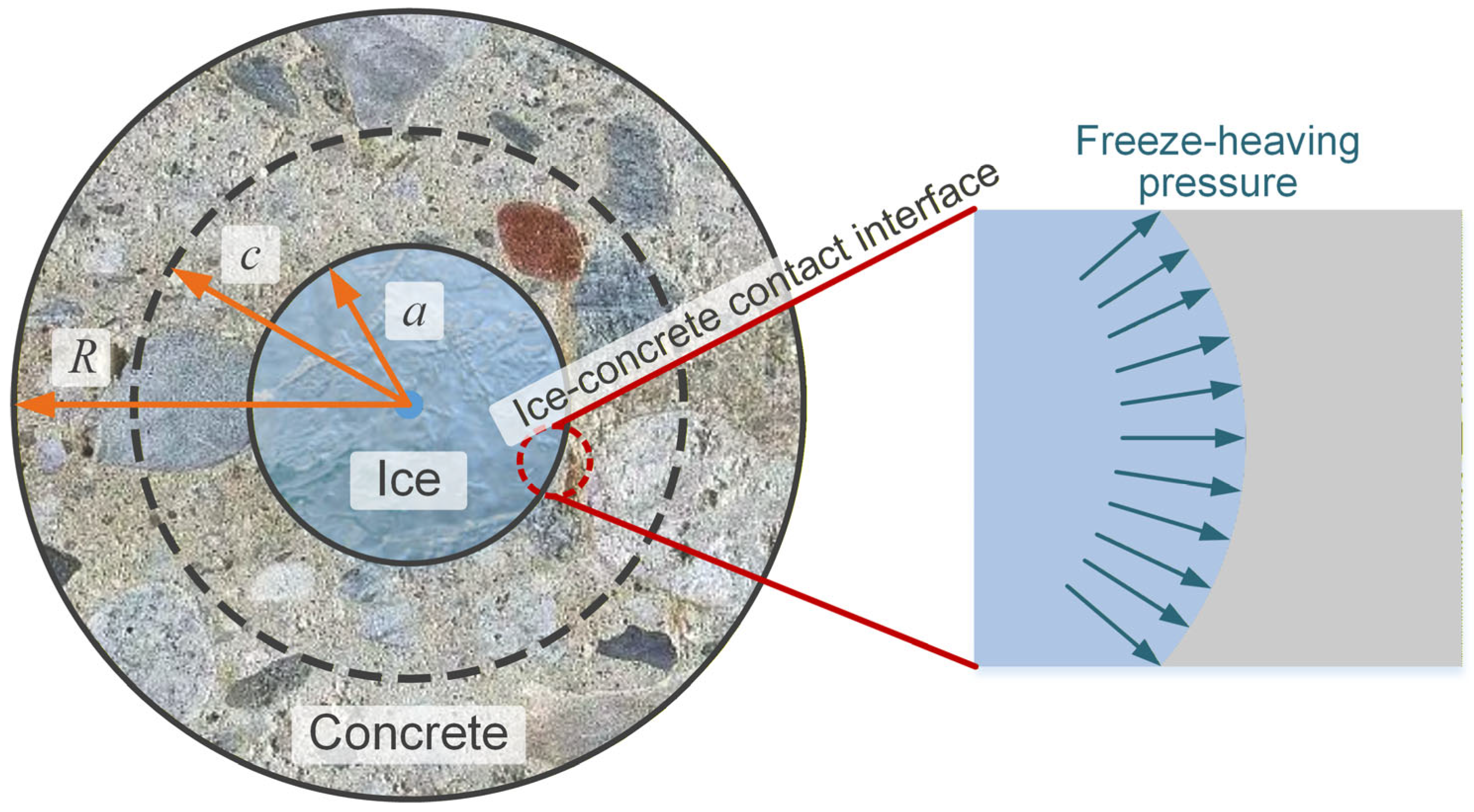
2.1. Theoretical Model
| Algorithm 1. Computational procedure for evaluating frost-heaving pressure |
|
2.2. Model Validation and Mechanism Analysis
2.2.1. Parameter Setting
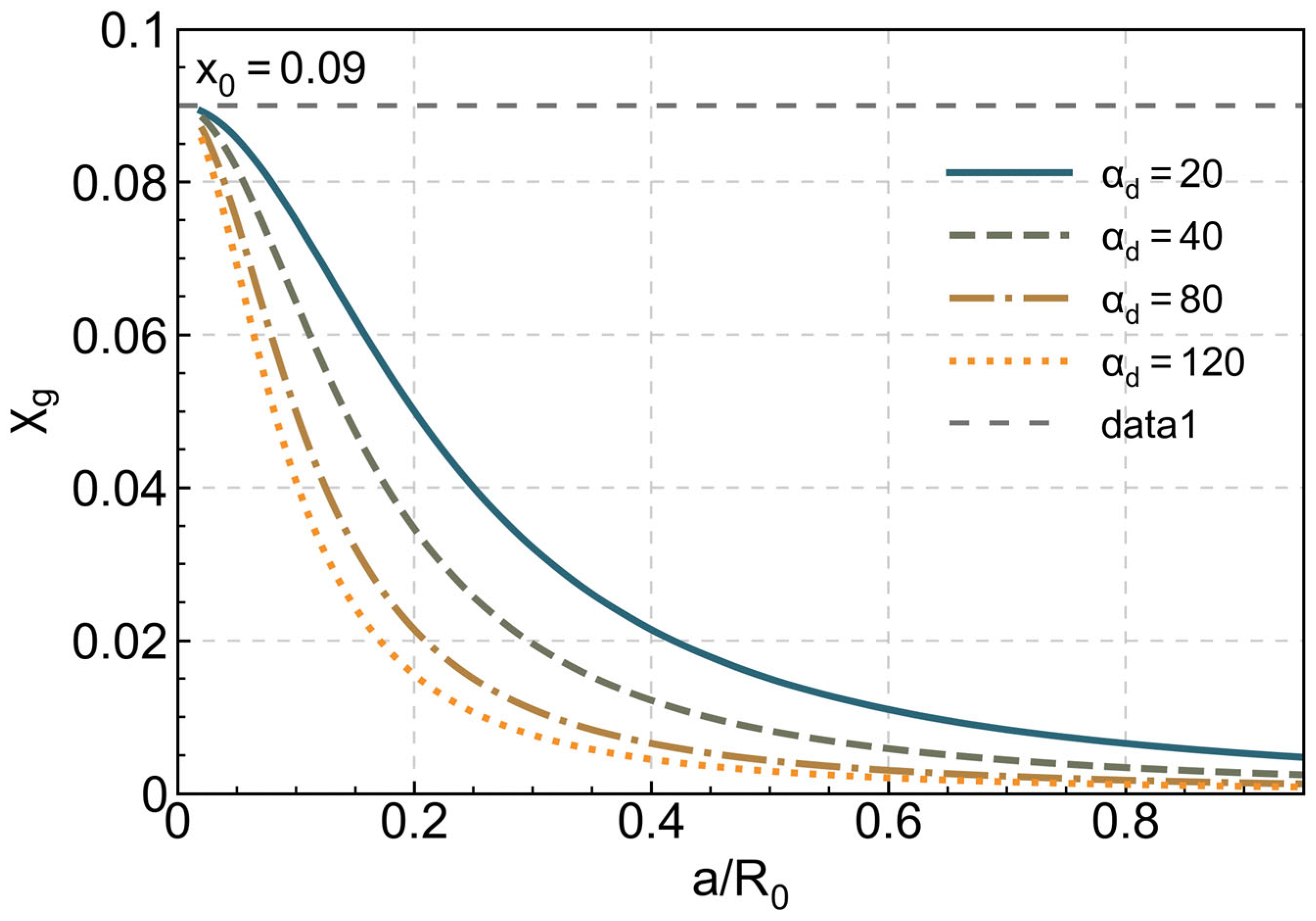
2.2.2. Effect of Drainage on Effective Expansion
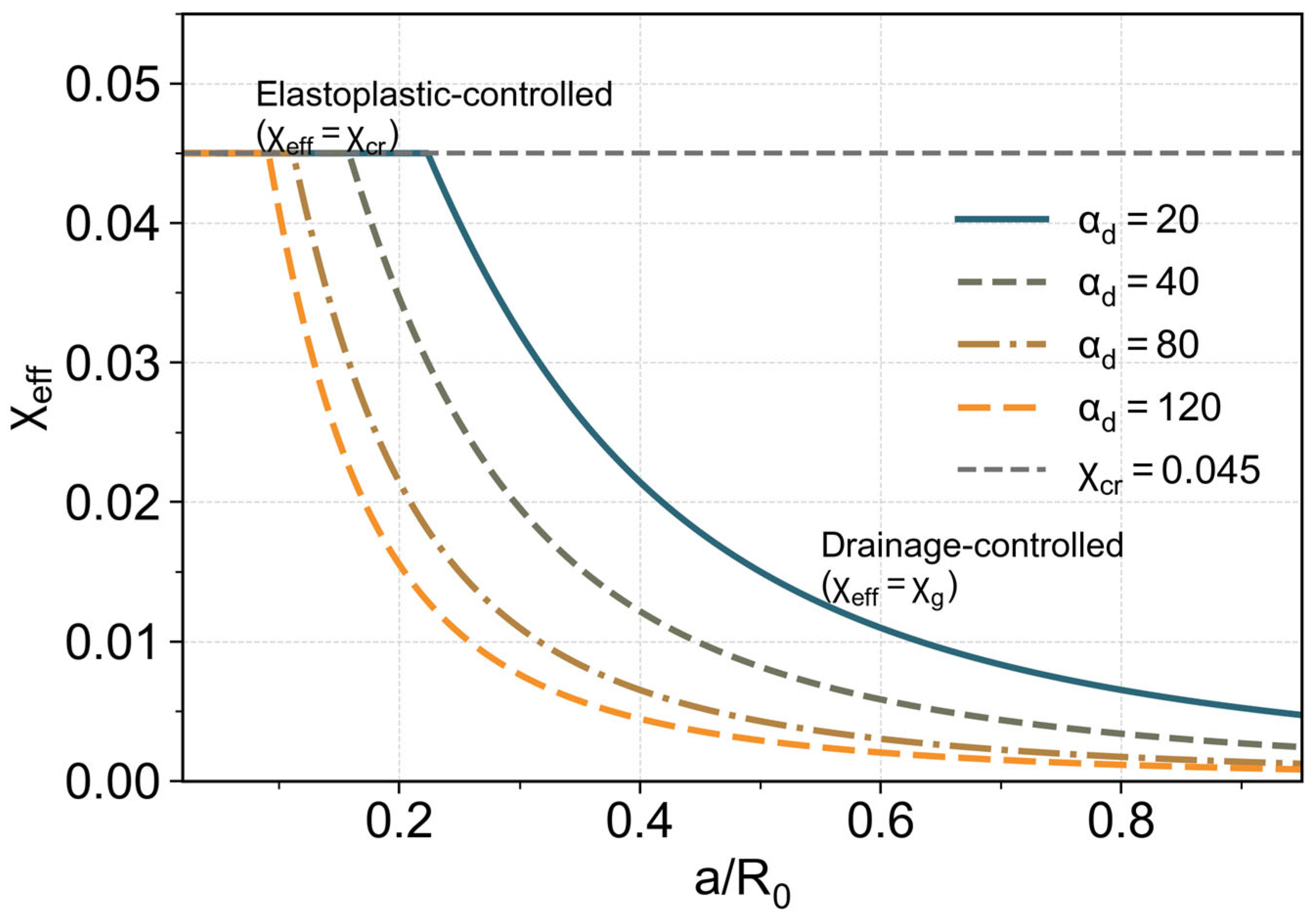
2.2.3. Competition Between Elastoplastic Admissibility and Drainage
- Elastoplastic-controlled regime (χg > χcr)The imposed expansion exceeds the admissible limit, and the response is governed by the mechanical strength of the matrix.
- Drainage-controlled regime (χg < χcr)The effective expansion is sufficiently reduced by drainage, and the elastoplastic constraint is not activated.
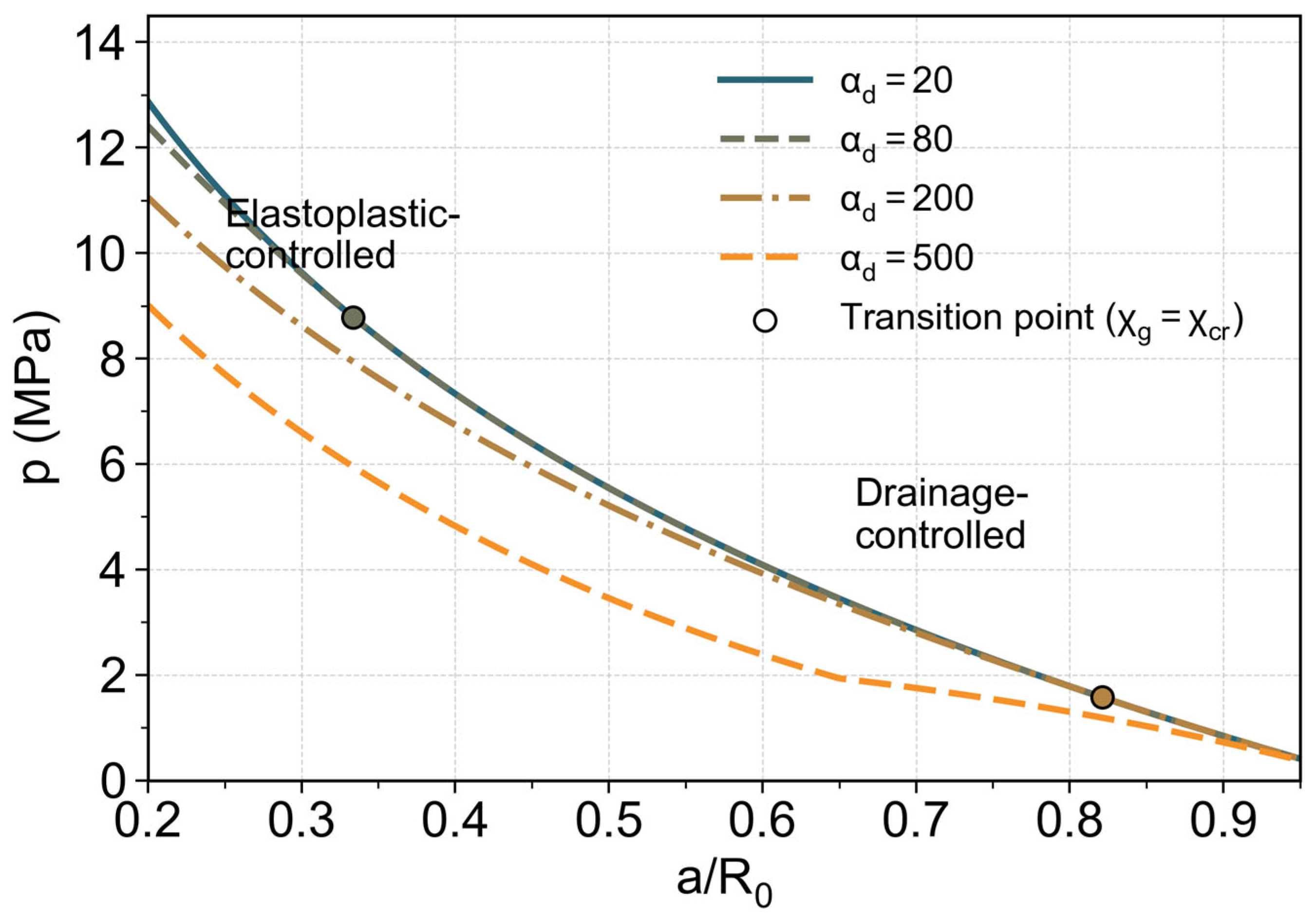
2.2.4. Resulting Frost-Heaving Pressure
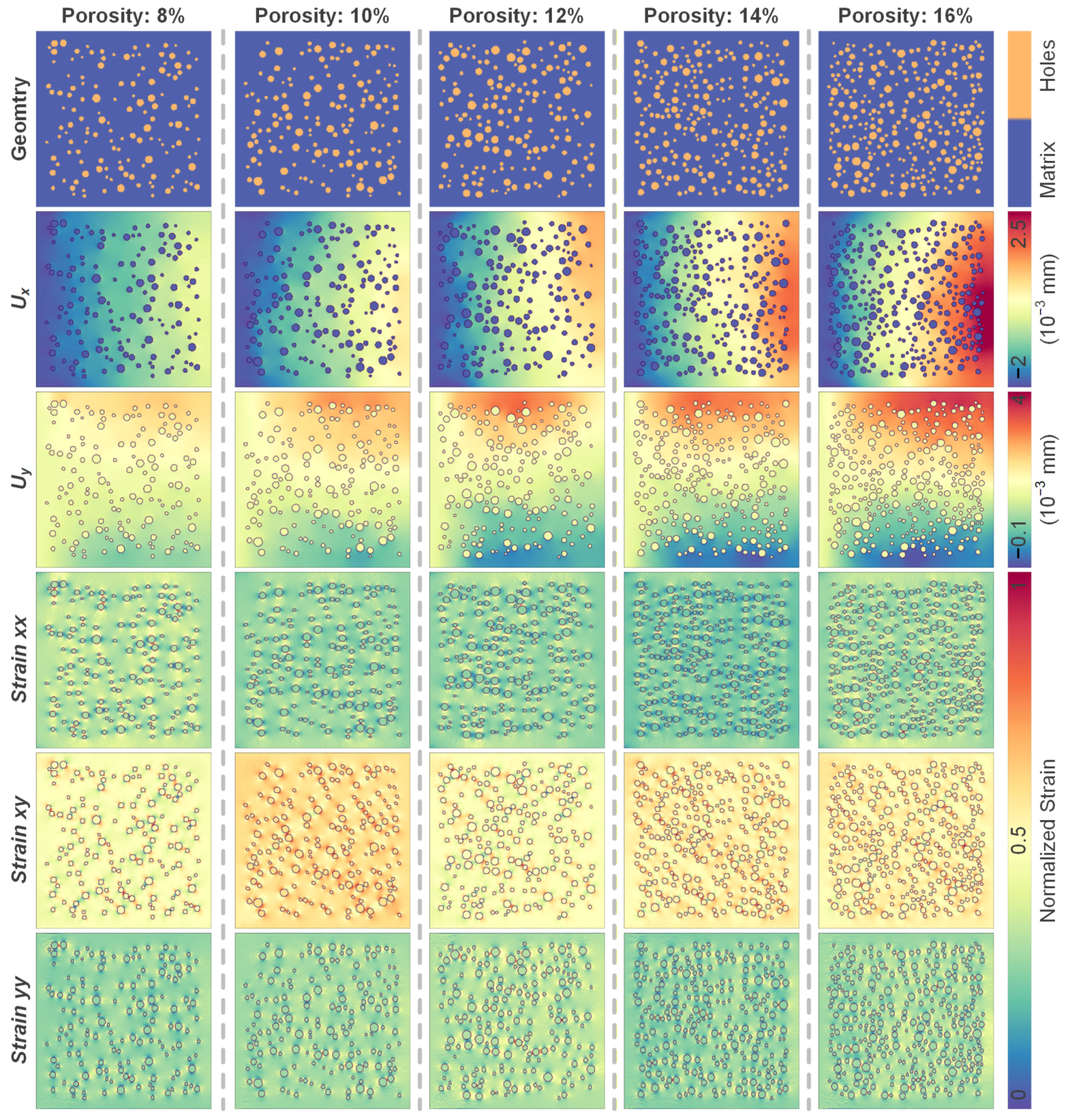
2.3. Finite Element Models of Concrete Plates
3. Methodology
3.1. Problem Formulation and Data Representation
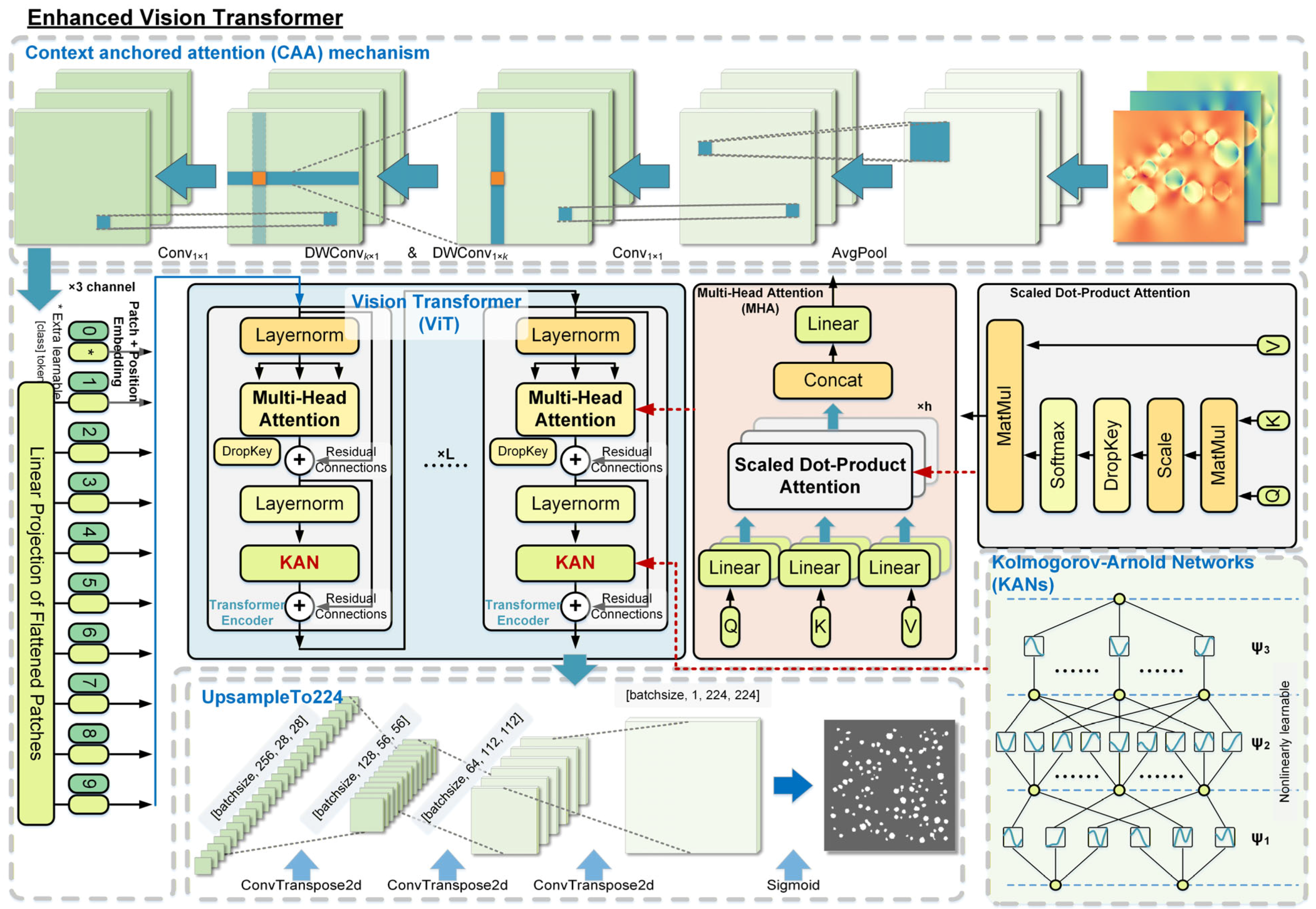
3.2. Backbone Architecture of the Proposed Model
3.2.1. Vision Transformer Backbone
3.2.2. KANs-Enhanced Nonlinear Mapping
3.2.3. Context Refinement and Pore Reconstruction
3.2.4. Training Strategy and Loss Function
4. Experimental Results and Discussion
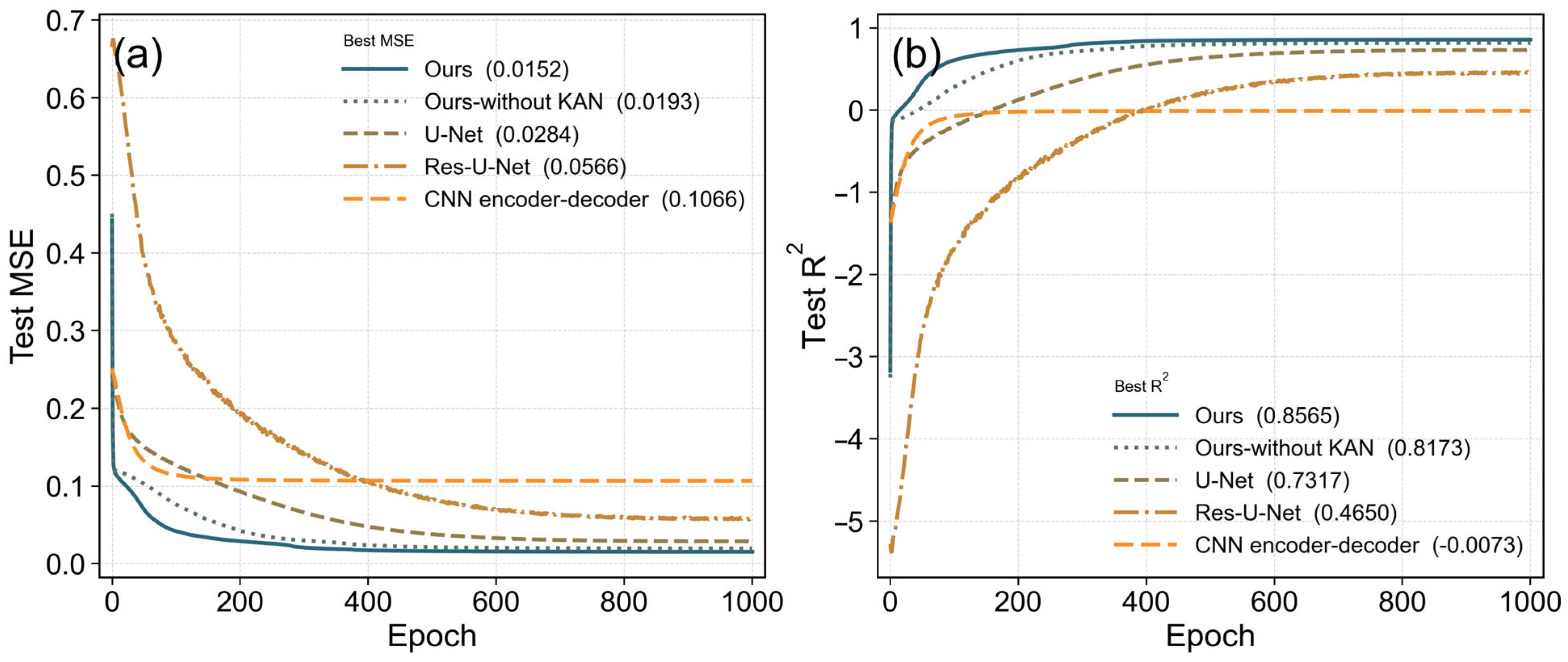
4.1. Training Convergence Analysis
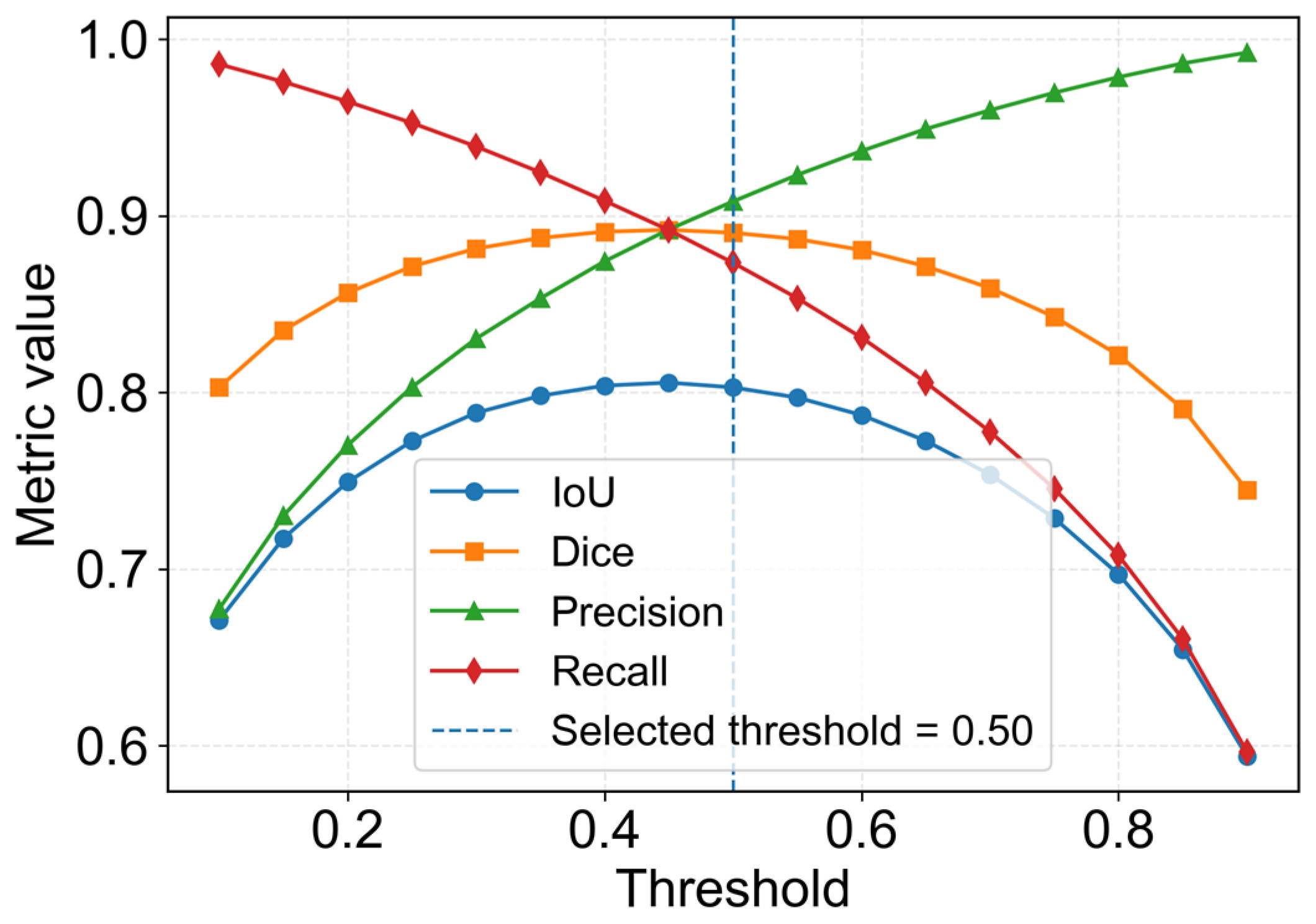
4.2. Threshold Sensitivity Analysis
4.3. Quantitative Evaluation of Pore Prediction Performance
4.4. Representative Visualization of Reconstructed Pore Distributions
4.5. Limitations and Future Work
5. Conclusions
- A mechanics-based frost-heaving model was established by considering pore-scale elastoplastic response, drainage-induced attenuation, and mechanical admissibility. The model explains why realistic frost-heaving pressure in porous concrete remains much lower than the fully confined freezing pressure and provides the physical basis for generating strain-field data with randomly distributed pores.
- A strain-field-to-pore inversion framework was constructed using an enhanced Vision Transformer with KAN-enhanced nonlinear mapping. The three strain components, εxx, εyy, and εxy, provide mechanically informative inputs for pore reconstruction, while the combination of self-attention and KAN improves the representation of the nonlinear relationship between strain redistribution and pore morphology.
- The proposed model achieved the best test MSE of 0.0152 and R2 of 0.8565, outperforming the model without KAN and the convolutional baselines. Compared with the model without KAN, the proposed model reduced the test MSE from 0.0193 to 0.0152 and improved R2 from 0.8173 to 0.8565, confirming the contribution of the KAN-enhanced nonlinear mapping.
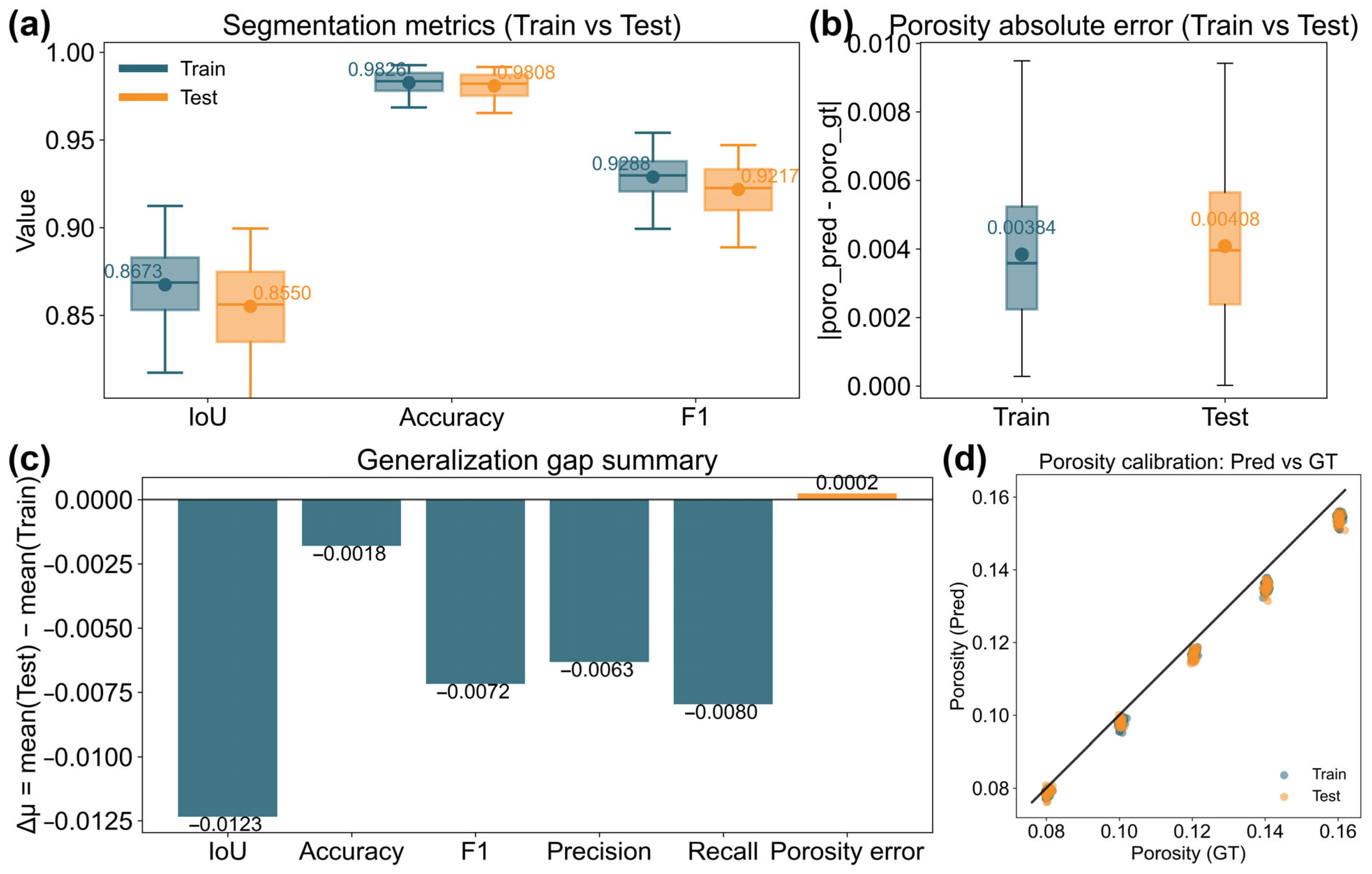
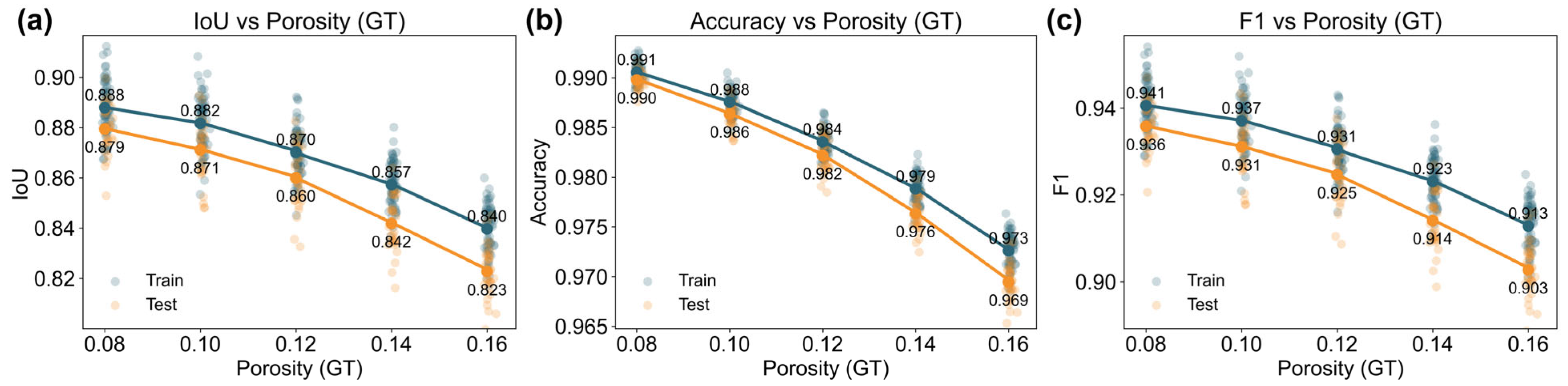
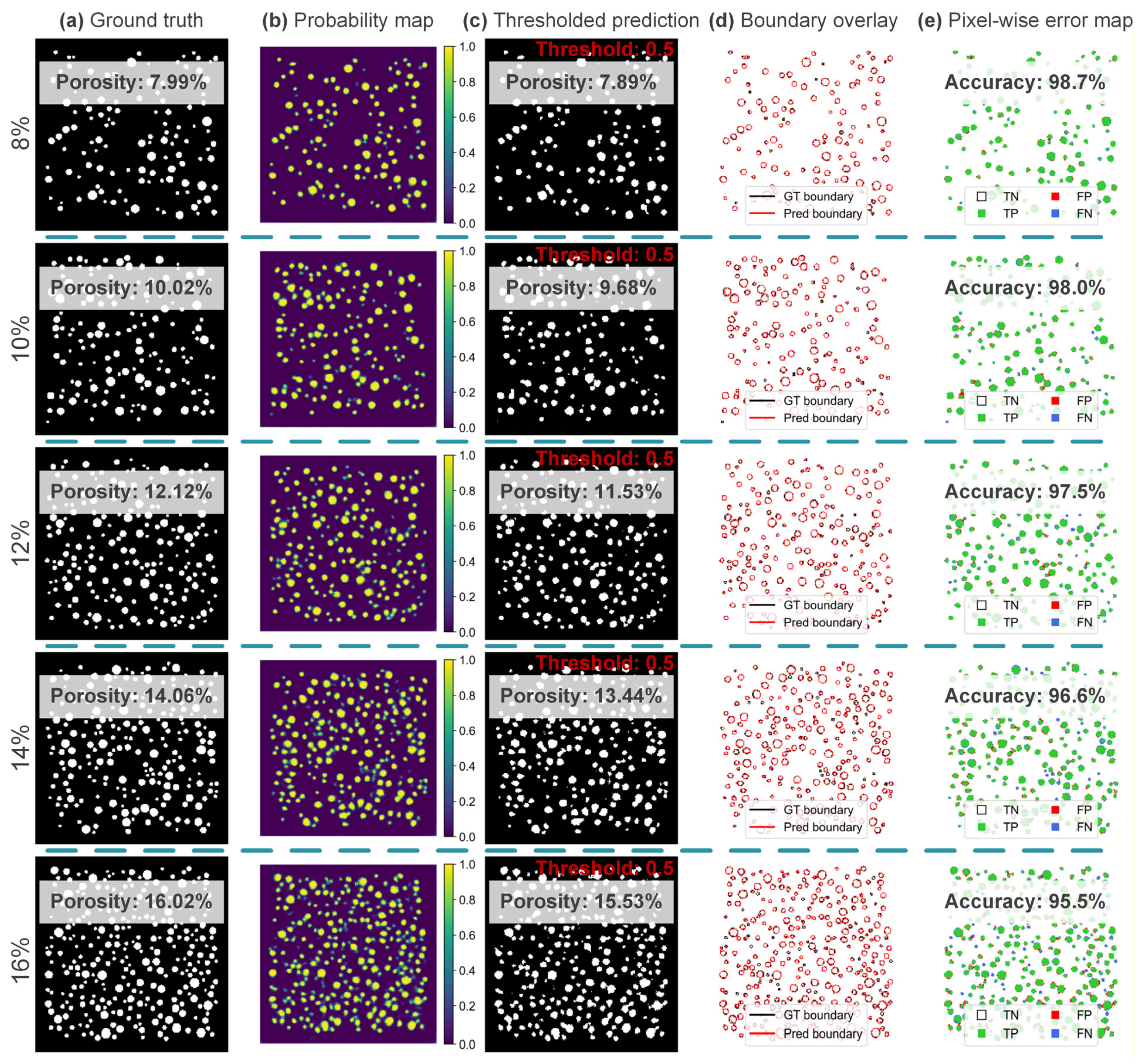
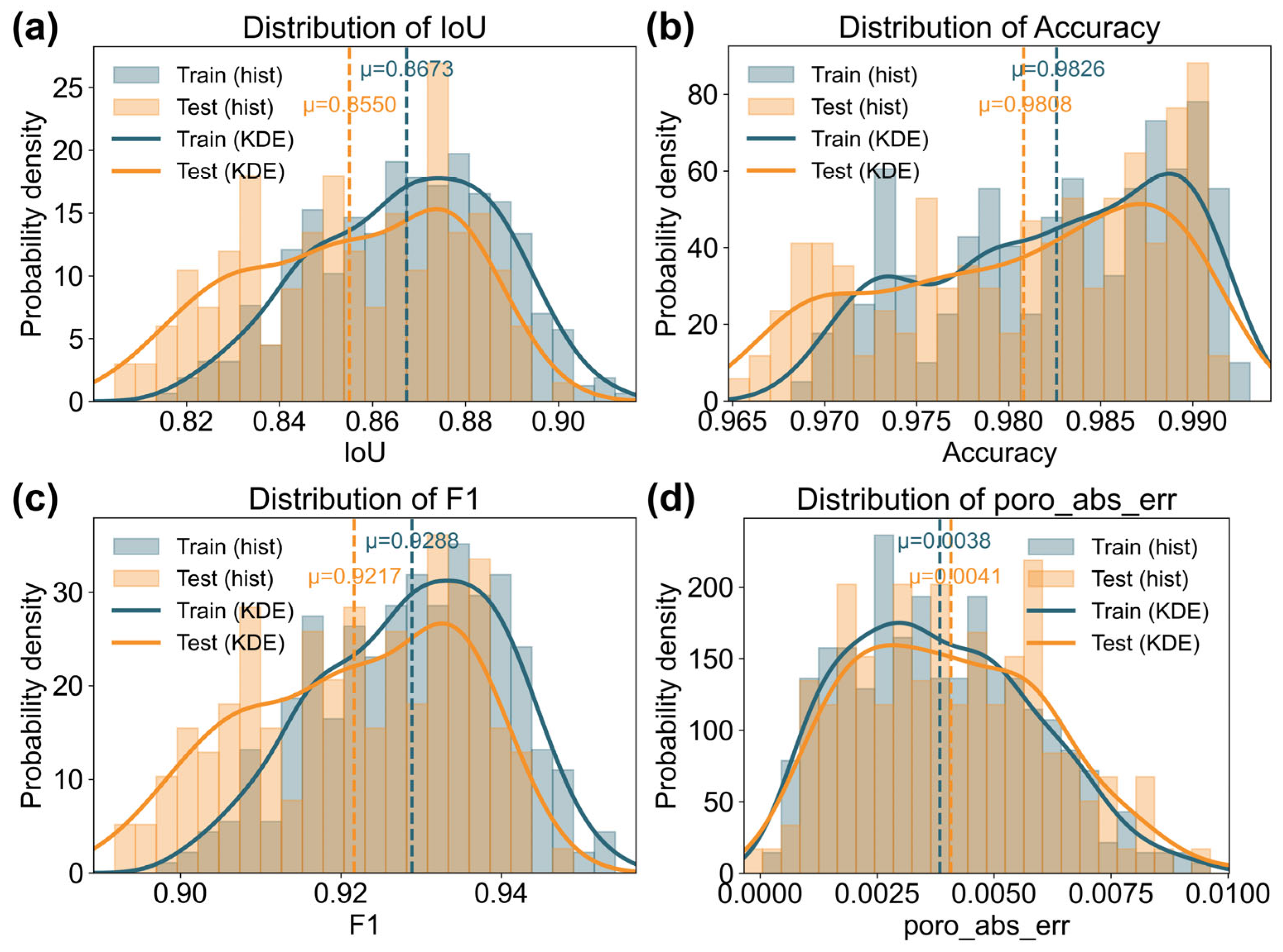
- Under the selected threshold of 0.50, the proposed model achieved a mean IoU of 0.8550, accuracy of 0.9808, F1 score of 0.9217, and porosity absolute error of 0.00408 on the test set. The train–test differences remained limited, indicating satisfactory generalization capability. Prediction errors were mainly concentrated near pore boundaries and locally dense pore regions, especially for high-porosity samples.
Author Contributions
Funding
Data Availability Statement
Conflicts of Interest
References
- Xu, Y.; Ye, H.; Yuan, Q.; Shi, C.; Gao, Y.; Fu, Q. The durability of concrete subject to mechanical load coupled with freeze–thaw cycles: A review. Arch. Civ. Mech. Eng. 2022, 22, 47. [Google Scholar] [CrossRef]
- Wang, R.; Hu, Z.; Li, Y.; Wang, K.; Zhang, H. Review on the deterioration and approaches to enhance the durability of concrete in the freeze–thaw environment. Constr. Build. Mater. 2022, 321, 126371. [Google Scholar] [CrossRef]
- Liu, D.; Tu, Y.; Shi, P.; Sas, G.; Elfgren, L. Mechanical and durability properties of concrete subjected to early-age freeze–thaw cycles. Mater. Struct. 2021, 54, 211. [Google Scholar] [CrossRef]
- Zheng, X.; Wang, Y.; Zhang, S.; Xu, F.; Zhu, X.; Jiang, X.; Zhou, L.; Shen, Y.; Chen, Q.; Yan, Z.; et al. Research progress of the thermophysical and mechanical properties of concrete subjected to freeze-thaw cycles. Constr. Build. Mater. 2022, 330, 127254. [Google Scholar] [CrossRef]
- Taheri, B.M.; Ramezanianpour, A.M.; Sabokpa, S.; Gapele, M. Experimental evaluation of freeze-thaw durability of pervious concrete. J. Build. Eng. 2021, 33, 101617. [Google Scholar] [CrossRef]
- Wang, Y.; Gu, H.; Gu, C.; Shao, C.; Jiang, Z.; Wang, Y.; Chen, X. Analysis of concrete damage evolution in cold regions under combined freeze-thaw cycle-crack effect. Constr. Build. Mater. 2024, 456, 139296. [Google Scholar] [CrossRef]
- Coussy, O.; Monteiro, P.J.M. Poroelastic model for concrete exposed to freezing temperatures. Cem. Concr. Res. 2008, 38, 40–48. [Google Scholar] [CrossRef]
- Penttala, V. Surface and internal deterioration of concrete due to saline and non-saline freeze–thaw loads. Cem. Concr. Res. 2006, 36, 921–928. [Google Scholar] [CrossRef]
- Zhao, L.; Yan, Z.; Xu, S.; Ren, S.; Wang, Y.; Chi, L. Mesoscopic damage mechanism of multiple freeze–thaw cycles of cement gravel based on particle flow theory. Comput. Part. Mech. 2025, 12, 527–539. [Google Scholar] [CrossRef]
- Yang, H.; Hou, Y.; Li, Z. Bond strength theory between rebar and recycled aggregate concrete after freeze-thaw cycles under stress state I: Uniaxial lateral compression. Constr. Build. Mater. 2024, 411, 134391. [Google Scholar] [CrossRef]
- Mayercsik, N.P.; Vandamme, M.; Kurtis, K.E. Assessing the efficiency of entrained air voids for freeze-thaw durability through modeling. Cem. Concr. Res. 2016, 88, 43–59. [Google Scholar] [CrossRef]
- Niu, F.; He, J.; Jiang, H.; Jiao, C. Damage constitutive model for concrete under the coupling action of freeze–thaw cycles and load based on homogenization theory. J. Build. Eng. 2023, 76, 107152. [Google Scholar] [CrossRef]
- Hang, M.; Cui, L.; Wu, J.; Sun, Z. Freezing-thawing damage characteristics and calculation models of aerated concrete. J. Build. Eng. 2020, 28, 101072. [Google Scholar] [CrossRef]
- Peng, R.; Qiu, W.; Teng, F. Three-dimensional meso-numerical simulation of heterogeneous concrete under freeze-thaw. Constr. Build. Mater. 2020, 250, 118573. [Google Scholar] [CrossRef]
- Dong, X.; Yu, T.; Zhang, Q.; Bui, T.Q. Multiscale freezing-thaw in concrete: A numerical study. Compos. Struct. 2023, 309, 116758. [Google Scholar] [CrossRef]
- Gan, L.; Liu, G.; Liu, J.; Zhang, H.; Feng, X.; Li, L. Three-dimensional microscale numerical simulation of fiber-reinforced concrete under sulfate freeze-thaw action. Case Stud. Constr. Mater. 2024, 20, e03308. [Google Scholar] [CrossRef]
- Shang, H.; Song, Y. Triaxial compressive strength of air-entrained concrete after freeze–thaw cycles. Cold Reg. Sci. Technol. 2013, 90–91, 33–37. [Google Scholar] [CrossRef]
- Shang, H. Triaxial T–C–C behavior of air-entrained concrete after freeze–thaw cycles. Cold Reg. Sci. Technol. 2013, 89, 1–6. [Google Scholar] [CrossRef]
- Guan, J.; Li, Y.; Guo, L. A novel exploration in anisotropic thermal fracture analysis: 3D thermal–mechanical coupled FEM–PD model. Int. Commun. Heat Mass Transf. 2025, 163, 108708. [Google Scholar] [CrossRef]
- Wu, P.; Liu, Y.; Peng, X.; Chen, Z. Peridynamic modeling of freeze-thaw damage in concrete structures. Mech. Adv. Mater. Struct. 2023, 30, 2826–2837. [Google Scholar] [CrossRef]
- Guan, J.; Li, Y.; Guo, Y.; Li, W.; Guo, L. Phase-driven fracture mechanics: Modeling spontaneous volume changes via hybrid PD-SPH in cryogenic damage. Int. Commun. Heat Mass Transf. 2025, 169, 109695. [Google Scholar] [CrossRef]
- Tian, Z.; Zhu, X.; Chen, X.; Ning, Y.; Zhang, W. Microstructure and damage evolution of hydraulic concrete exposed to freeze–thaw cycles. Constr. Build. Mater. 2022, 346, 128466. [Google Scholar] [CrossRef]
- Fan, Y.; Liu, J.; Tao, Y.; Sun, Y.; Li, Z.; Li, J.; Wang, K.; Ma, J.; Fan, D.; Xu, L. A transfer-learning framework to alleviate data scarcity in cross-slope wind pressure modeling. Results Eng. 2026, 29, 109376. [Google Scholar] [CrossRef]
- He, X.; Liu, J.; Li, J.; Yang, Z.; Kong, X.; Zhang, Y.; Lu, Y.; Yu, Y. Toward intelligent pavement maintenance: A transferable deep learning framework for cross-domain crack segmentation and UAV-based field inspection. Adv. Eng. Inform. 2026, 73, 104582. [Google Scholar] [CrossRef]
- Tariq, M.; Choi, K. Swin–YOLOv12: A Hybrid Transformer-Based Deep Learning Approach for Enhanced Real-Time Brain Tumor Detection in MRI Images. Mathematics 2026, 14, 1447. [Google Scholar] [CrossRef]
- Sun, Z.; Wang, X.; Han, T.; Liu, J.; Wang, L.; Wei, X.; Huang, H.; Huang, X.; Wu, Z. Advanced prediction of pipeline vertical deformation and axial strain via multi-source data fusion and multi-task deep learning. Struct. Health Monit. 2025, 1–27. [Google Scholar] [CrossRef]
- Li, F.; Luo, D.; Niu, D. Durability evaluation of concrete structure under freeze-thaw environment based on pore evolution derived from deep learning. Constr. Build. Mater. 2025, 467, 140422. [Google Scholar] [CrossRef]
- Liu, J.; Wang, S.; Chen, K.; Wang, K.; Fan, Y.; Wang, Q. Synthetic data augmentation and Integrated prediction framework for low-carbon recycled concrete: Leveraging CTGAN and multiple ML models stacking. J. Clean. Prod. 2026, 543, 147599. [Google Scholar] [CrossRef]
- Liu, J.; Kong, X.; Wang, S.; Peng, L.; Wang, Q.; Zhang, Y.; Bao, X. Multi-objective material-structure integrated optimization of recycled aggregate CFST stub columns for mechanical performance, reliability, and sustainability. Expert Syst. Appl. 2026, 324, 132597. [Google Scholar] [CrossRef]
- Sun, Z.; Li, Y.; Yang, Y.; Su, L.; Xie, S. Splitting tensile strength of basalt fiber reinforced coral aggregate concrete: Optimized XGBoost models and experimental validation. Constr. Build. Mater. 2024, 416, 135133. [Google Scholar] [CrossRef]
- Zhang, Y.; Wang, Z.; Liu, J.; Li, Y.; Huang, Z.; Yu, X. A metaheuristic-driven categorical boosting framework with interpretability for high-precision prediction of mechanical properties in corroded reinforced concrete beams. Eng. Appl. Artif. Intell. 2026, 163, 112804. [Google Scholar] [CrossRef]
- Lu, D.; Wang, X.; Sun, Z.; Ding, L.; Ding, J.; Liu, J.; Chen, Z.; Wu, Z. Seismic design of FRP grid and bar strengthened RC columns via multi-objective optimization and decision analysis. Constr. Build. Mater. 2026, 519, 145826. [Google Scholar] [CrossRef]
- Zhen, L.; Qu, C.; Tang, M.-L.; Yin, J. High-Performance Concrete Strength Regression Based on Machine Learning with Feature Contribution Visualization. Mathematics 2025, 13, 3965. [Google Scholar] [CrossRef]
- Nie, F.; Wang, Z.; Liu, L.; Wang, H.; Lin, J. 3D CNN-based crack propagation prediction in peridynamic concrete models under freeze-thaw cycles. Comput. Struct. 2025, 318, 107959. [Google Scholar] [CrossRef]
- Luan, H.; Wu, J.; Geng, F.; Zhao, X.; Li, Z. Freezing characteristics of deicing salt solution and influence on concrete salt frost deterioration. J. Adv. Concr. Technol. 2023, 21, 643–654. [Google Scholar] [CrossRef]
- Ma, H.; Yu, H.; Da, B.; Tan, Y. Study on failure mechanism of concrete subjected to freeze-thaw condition in airport deicers. Constr. Build. Mater. 2021, 313, 125202. [Google Scholar] [CrossRef]
- Coussy, O. Poromechanics of freezing materials. J. Mech. Phys. Solids 2005, 53, 1689–1718. [Google Scholar] [CrossRef]
- Van Genuchten, M.T. A Closed-form Equation for Predicting the Hydraulic Conductivity of Unsaturated Soils. Soil Sci. Soc. Am. J. 1980, 44, 892–898. [Google Scholar] [CrossRef]
- Wang, K.; Shen, T.; Liu, J.; Wang, S.; Bao, X.; Wei, J.; Hu, W.; Xu, L. Exploration of computational formulations for wind-induced interference effects on high-rise buildings via Kolmogorov–Arnold networks. Dev. Built Environ. 2025, 24, 100770. [Google Scholar] [CrossRef]
- Sun, Z.; Wang, X.; Han, T.; Wang, L.; Zhu, Z.; Huang, H.; Ding, J.; Wu, Z. Pipeline deformation prediction based on multi-source monitoring information and novel data-driven model. Eng. Struct. 2025, 337, 120461. [Google Scholar] [CrossRef]
- Dosovitskiy, A.; Beyer, L.; Kolesnikov, A.; Weissenborn, D.; Zhai, X.; Unterthiner, T.; Dehghani, M.; Minderer, M.; Heigold, G.; Gelly, S.; et al. An Image is Worth 16 × 16 Words: Transformers for Image Recognition at Scale. arXiv 2021, arXiv:2010.11929. [Google Scholar] [CrossRef]
- Vaswani, A.; Shazeer, N.; Parmar, N.; Uszkoreit, J.; Jones, L.; Gomez, A.N.; Kaiser, Ł.; Polosukhin, I. Attention is all you need. In Advances in Neural Information Processing Systems 30; NIPS Foundation: San Diego, CA, USA, 2017; Available online: https://proceedings.neurips.cc/paper/2017/hash/3f5ee243547dee91fbd053c1c4a845aa-Abstract.html (accessed on 11 November 2025).
- Cai, X.; Lai, Q.; Wang, Y.; Wang, W.; Sun, Z.; Yao, Y. Poly Kernel Inception Network for Remote Sensing Detection. In Proceedings of the IEEE/CVF Conference on Computer Vision and Pattern Recognition (CVPR); IEEE: Piscataway, NJ, USA, 2024; pp. 27706–27716. Available online: https://openaccess.thecvf.com/content/CVPR2024/html/Cai_Poly_Kernel_Inception_Network_for_Remote_Sensing_Detection_CVPR_2024_paper.html (accessed on 14 December 2024).
- Li, Y.; Guan, J.; Guo, L. Peridynamic-driven feature-enhanced Vision Transformer for predicting defects and heterogeneous materials locations: Applications of deep learning in inverse problems. Eng. Appl. Artif. Intell. 2025, 151, 110677. [Google Scholar] [CrossRef]
- Liu, Z.; Wang, Y.; Vaidya, S.; Ruehle, F.; Halverson, J.; Soljačić, M.; Hou, T.Y.; Tegmark, M. KAN: Kolmogorov-Arnold Networks. arXiv 2025, arXiv:2404.19756. [Google Scholar] [CrossRef]
- Li, Y.; Guan, J.; Guo, L. Peridynamics-driven two-stage conditional diffusion generative model for discontinuous fracture prediction in porous structure. Adv. Eng. Inform. 2026, 69, 104090. [Google Scholar] [CrossRef]
- Yu, X.; Li, J.; Liu, J.; Li, Y.; Chen, A.; Zhang, Y.; Chang, H. Cross-Scenario Impact Damage Prediction in Concrete Using Peridynamics-Trained Kolmogorov–Arnold Networks with Transfer Learning. Int. J. Impact Eng. 2026, 215, 105764. [Google Scholar] [CrossRef]
- Kong, X.; Fan, Y.; Liu, J.; Xi, M.; Zhang, Y.; Yu, Y. Lightweight Kolmogorov-Arnold Network with dual-objective optimization for axial capacity prediction of square coal gangue concrete-filled steel tube stub columns based on finite element simulation. Eng. Appl. Artif. Intell. 2026, 176, 114843. [Google Scholar] [CrossRef]
- Li, Y.; Sun, Z.; Li, Y.; Yang, H.; Liu, X.; He, W. A vision transformer-based method for predicting seismic damage states of RC piers: Database development and efficient assessment. Reliab. Eng. Syst. Saf. 2025, 263, 111287. [Google Scholar] [CrossRef]
- Huang, P.; Mei, X.; Sheng, H.; Li, K.; Di, S.; Cui, Z. Prediction of Manufactured-Sand Concrete Compressive Strength Using Hybrid ML Models and Dream Optimization Algorithm. Mathematics 2025, 13, 3792. [Google Scholar] [CrossRef]
- Sun, Z.; Li, Y.; Su, L.; Liu, S.; Chen, Z. Predicting corrosion behaviour of steel reinforcement in eco-friendly coral aggregate concrete based on hybrid machine learning methods. Nondestruct. Test. Eval. 2025, 40, 1334–1354. [Google Scholar] [CrossRef]
- Li, Y.; Sun, Z.; Mangalathu, S.; Li, Y.; Yang, H.; He, W. Seismic damage states prediction of in-service bridges using feature-enhanced swin transformer without reliance on damage indicators. Eng. Appl. Artif. Intell. 2025, 159, 111651. [Google Scholar] [CrossRef]
- He, K.; Zhang, X.; Ren, S.; Sun, J. Delving deep into rectifiers: Surpassing human-level performance on imagenet classification. In Proceedings of the IEEE International Conference on Computer Vision; IEEE: Piscataway, NJ, USA, 2015; pp. 1026–1034. Available online: http://openaccess.thecvf.com/content_iccv_2015/html/He_Delving_Deep_into_ICCV_2015_paper.html (accessed on 25 March 2026).
- Alkayem, N.F.; Mayya, A.; Shen, L.; Zhang, X.; Asteris, P.G.; Wang, Q.; Cao, M. Co-CrackSegment: A New Collaborative Deep Learning Framework for Pixel-Level Semantic Segmentation of Concrete Cracks. Mathematics 2024, 12, 3105. [Google Scholar] [CrossRef]
- Girshick, R. Fast r-cnn. In Proceedings of the IEEE International Conference on Computer Vision; IEEE: Piscataway, NJ, USA, 2015; pp. 1440–1448. Available online: http://openaccess.thecvf.com/content_iccv_2015/html/Girshick_Fast_R-CNN_ICCV_2015_paper.html (accessed on 25 March 2026).
- Ren, S.; He, K.; Girshick, R.; Sun, J. Faster r-cnn: Towards real-time object detection with region proposal networks. In Advances in Neural Information Processing Systems 28; NIPS Foundation: San Diego, CA, USA, 2015; Available online: https://proceedings.neurips.cc/paper/2015/hash/14bfa6bb14875e45bba028a21ed38046-Abstract.html (accessed on 25 March 2026).
- He, T.; Zhang, Z.; Zhang, H.; Zhang, Z.; Xie, J.; Li, M. Bag of tricks for image classification with convolutional neural networks. In Proceedings of the IEEE/CVF Conference on Computer Vision and Pattern Recognition; IEEE: Piscataway, NJ, USA, 2019; pp. 558–567. Available online: http://openaccess.thecvf.com/content_CVPR_2019/html/He_Bag_of_Tricks_for_Image_Classification_with_Convolutional_Neural_Networks_CVPR_2019_paper.html (accessed on 25 March 2026).
- Hoang, N.-D. Leveraging a Hybrid Machine Learning Approach for Compressive Strength Estimation of Roller-Compacted Concrete with Recycled Aggregates. Mathematics 2024, 12, 2542. [Google Scholar] [CrossRef]
- Sun, Z.; Li, Y.; Han, T.; Su, L.; Zhu, X.; He, J.; Xie, S.; Shi, Y. Performance evaluation of hybrid fiber-reinforced concrete based on electrical resistivity: Experimental and data-driven method. Constr. Build. Mater. 2024, 446, 137992. [Google Scholar] [CrossRef]
- Hoang, N.-D.; Tran, V.-D.; Tran, X.-L. Predicting Compressive Strength of High-Performance Concrete Using Hybridization of Nature-Inspired Metaheuristic and Gradient Boosting Machine. Mathematics 2024, 12, 1267. [Google Scholar] [CrossRef]
- Sun, Z.; Li, Y.; Bei, Y.; Han, T.; Liu, R.; Wang, L.; Su, L. Compressive strength resistance coefficient of sustainable concrete in sulfate environments: Hybrid machine learning model and experimental verification. Mater. Today Commun. 2024, 39, 108667. [Google Scholar] [CrossRef]
- Li, Y.; Sun, Z.; Mangalathu, S.; Li, Y.; He, W.; Xue, X. Machine learning-based full-life-cycle seismic response assessment for in-service bridge piers: Comprehensive analysis of interpretability and seismic fragility. Structures 2025, 80, 110050. [Google Scholar] [CrossRef]
- Sun, Z.; Han, T.; Wang, X.; Wang, L.; Fu, H.; Li, Y.; Zhong, Z.; Liu, J.; Huang, H.; Wu, Z. Bidirectional mapping modeling of pipeline vertical deformation and axial strain based on multi-source monitoring data and machine learning. J. Pipeline Sci. Eng. 2026; in press. [CrossRef]
- He, K.; Zhang, X.; Ren, S.; Sun, J. Deep Residual Learning for Image Recognition. In Proceedings of the IEEE Conference on Computer Vision and Pattern Recognition (CVPR); IEEE: Piscataway, NJ, USA, 2016; pp. 770–778. Available online: https://openaccess.thecvf.com/content_cvpr_2016/html/He_Deep_Residual_Learning_CVPR_2016_paper.html (accessed on 3 April 2025).
- Zheng, Z.; Wang, P.; Liu, W.; Li, J.; Ye, R.; Ren, D. Distance-IoU Loss: Faster and Better Learning for Bounding Box Regression. Proc. AAAI Conf. Artif. Intell. 2020, 34, 12993–13000. [Google Scholar] [CrossRef]
- Feng, J.; Wang, L.; Zhai, X.; Chen, K.; Wu, W.; Liu, L.; Fu, X.-M. Constructing boundary-identical microstructures via guided diffusion for fast multiscale topology optimization. Comput. Methods Appl. Mech. Eng. 2025, 436, 117735. [Google Scholar] [CrossRef]
- Tharwat, A. Classification assessment methods. Appl. Comput. Inform. 2021, 17, 168–192. [Google Scholar] [CrossRef]




Disclaimer/Publisher’s Note: The statements, opinions and data contained in all publications are solely those of the individual author(s) and contributor(s) and not of MDPI and/or the editor(s). MDPI and/or the editor(s) disclaim responsibility for any injury to people or property resulting from any ideas, methods, instructions or products referred to in the content. |
© 2026 by the authors. Licensee MDPI, Basel, Switzerland. This article is an open access article distributed under the terms and conditions of the Creative Commons Attribution (CC BY) license.
Share and Cite
Guo, Y.; Li, Y.; Song, L.; Guo, L. Deep Learning-Based Porosity Prediction of Concrete Under Freeze–Heaving Conditions Using Strain Fields. Mathematics 2026, 14, 2053. https://doi.org/10.3390/math14122053
Guo Y, Li Y, Song L, Guo L. Deep Learning-Based Porosity Prediction of Concrete Under Freeze–Heaving Conditions Using Strain Fields. Mathematics. 2026; 14(12):2053. https://doi.org/10.3390/math14122053
Chicago/Turabian StyleGuo, Yilong, Yalin Li, Linhui Song, and Li Guo. 2026. "Deep Learning-Based Porosity Prediction of Concrete Under Freeze–Heaving Conditions Using Strain Fields" Mathematics 14, no. 12: 2053. https://doi.org/10.3390/math14122053
APA StyleGuo, Y., Li, Y., Song, L., & Guo, L. (2026). Deep Learning-Based Porosity Prediction of Concrete Under Freeze–Heaving Conditions Using Strain Fields. Mathematics, 14(12), 2053. https://doi.org/10.3390/math14122053