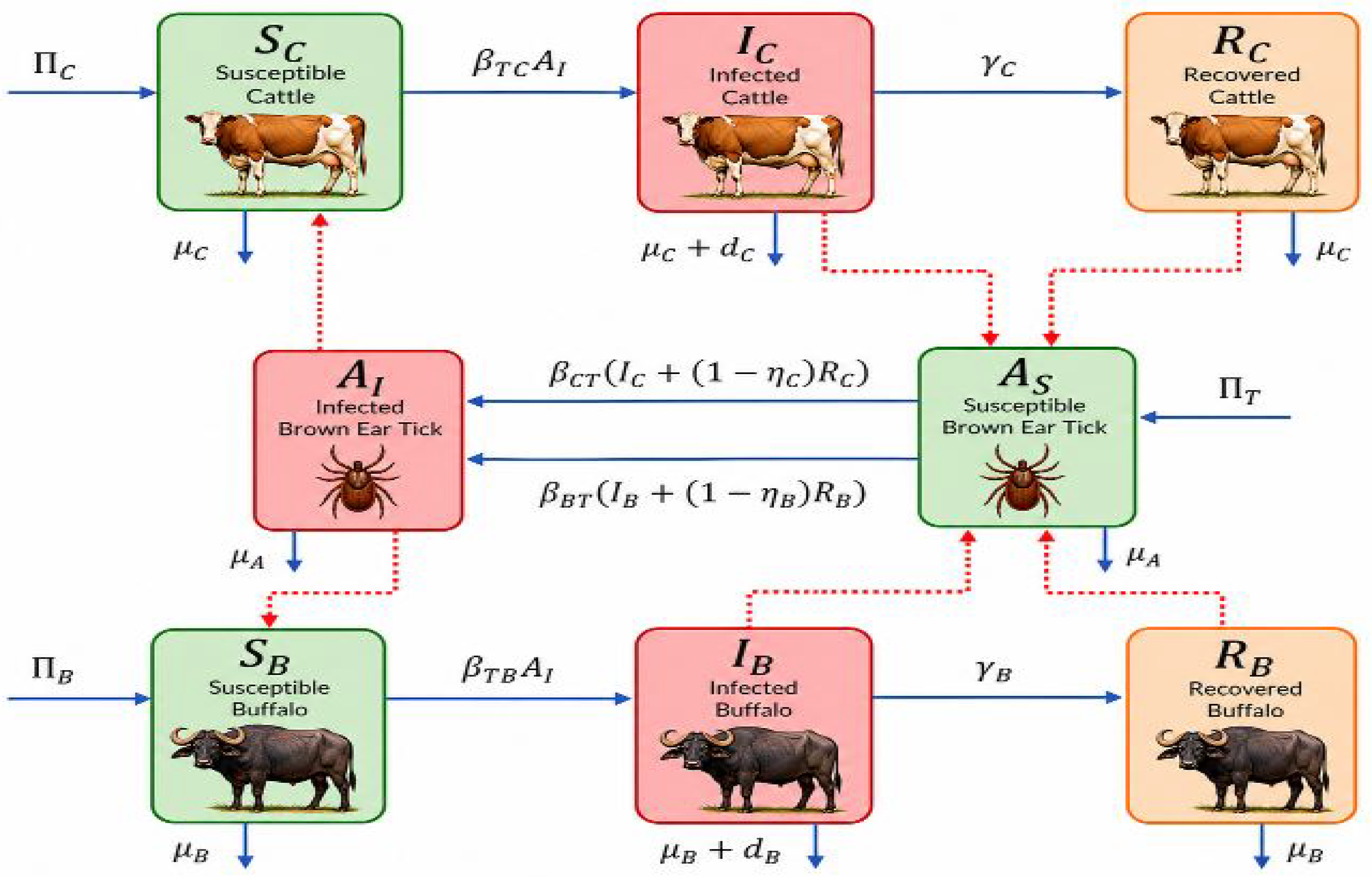
Figure 1.
Schematic diagram of an East Coast fever (ECF) transmission model with carrier infectivity and host heterogeneity. Susceptible cattle and susceptible buffaloes (green) become infected through contact with infectious ticks (red), moving to the infectious classes , (red), and subsequently recover into carrier classes , (orange). The tick population is divided into susceptible ticks (green) and infectious ticks (red), with infection acquired from both infectious and carrier hosts. Solid blue arrows indicate transitions between compartments, while dashed red arrows represent transmission pathways between hosts and ticks. Recruitment into each population is denoted by , and , natural mortality by , and , and disease-induced mortality by and . Colors distinguish epidemiological states: green (susceptible), red (infectious), and orange (carrier).
Figure 1.
Schematic diagram of an East Coast fever (ECF) transmission model with carrier infectivity and host heterogeneity. Susceptible cattle and susceptible buffaloes (green) become infected through contact with infectious ticks (red), moving to the infectious classes , (red), and subsequently recover into carrier classes , (orange). The tick population is divided into susceptible ticks (green) and infectious ticks (red), with infection acquired from both infectious and carrier hosts. Solid blue arrows indicate transitions between compartments, while dashed red arrows represent transmission pathways between hosts and ticks. Recruitment into each population is denoted by , and , natural mortality by , and , and disease-induced mortality by and . Colors distinguish epidemiological states: green (susceptible), red (infectious), and orange (carrier).
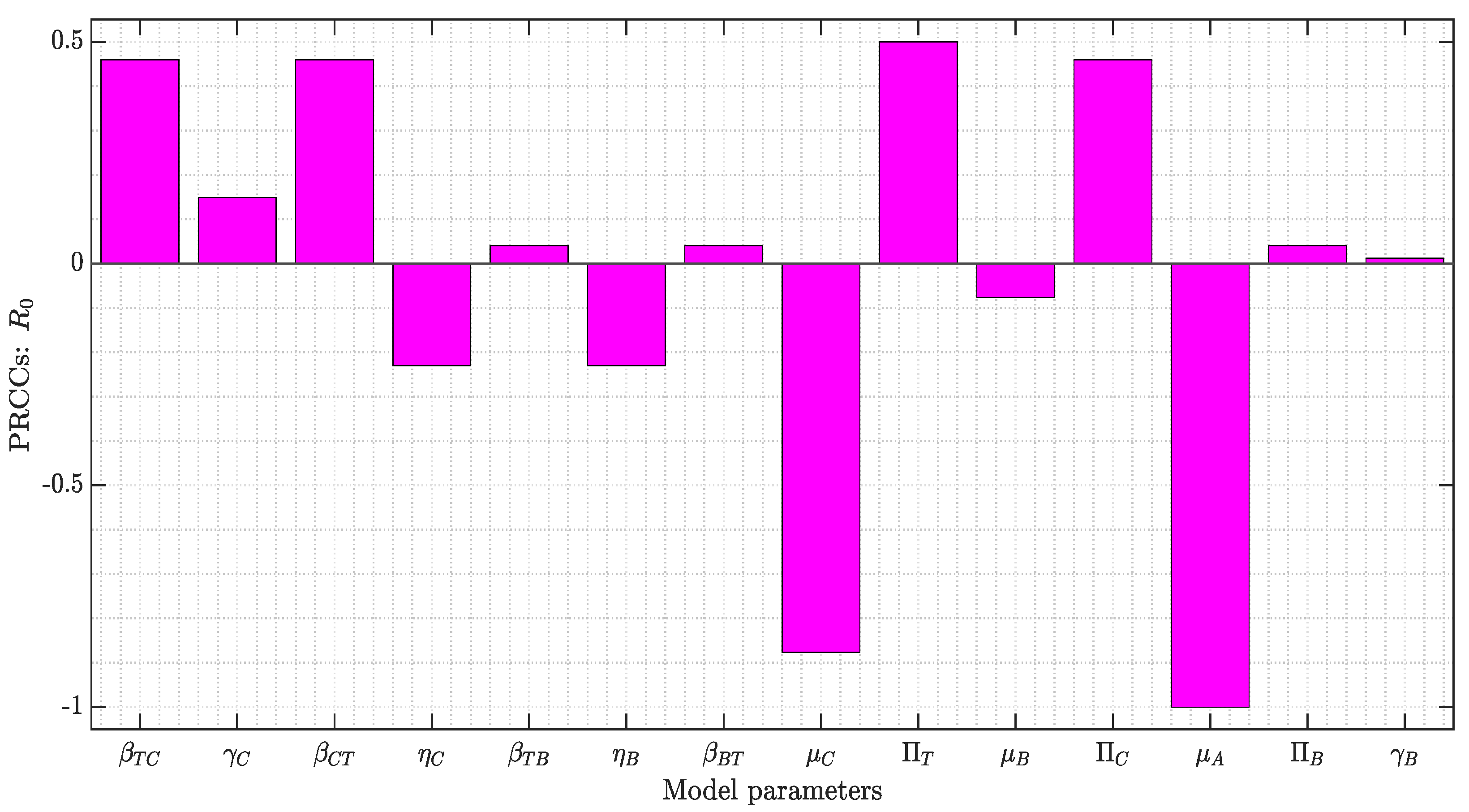
Figure 2.
Simulation results on sensitivity analysis of with respect to key model parameters.
Figure 2.
Simulation results on sensitivity analysis of with respect to key model parameters.
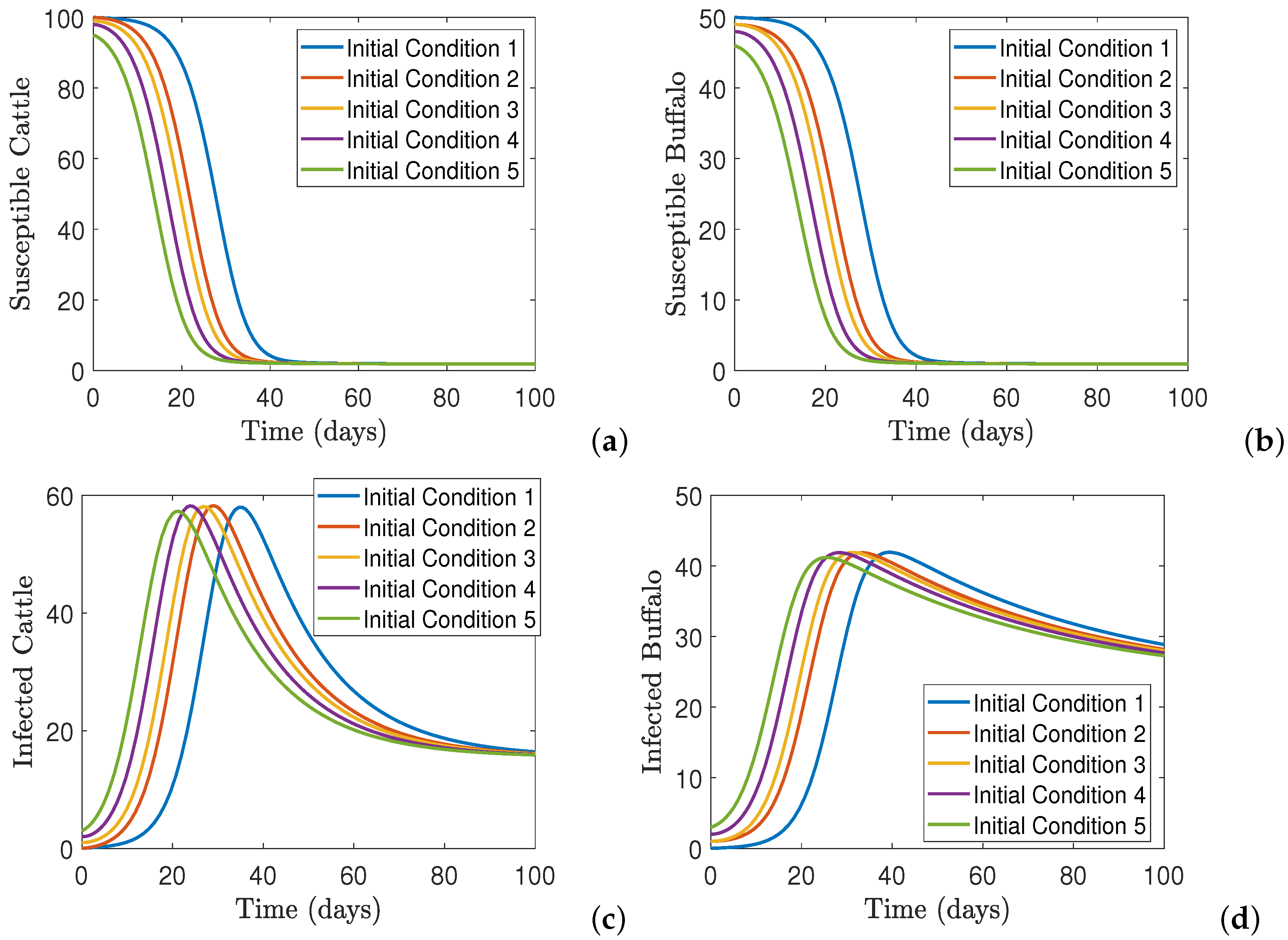
Figure 3.
Simulation results for susceptible and infected cattle and buffalo population, showing dynamics of the deterministic model under varying initial conditions. Initial conditions were as follows: , , , , and . Plot (a) depicts the dynamics of susceptible cattle. Plot (b) shows the dynamics of susceptible buffaloes. Plot (c) demonstrates the dynamics of infected cattle, and lastly, plot (d) shows the dynamics of infected buffaloes.
Figure 3.
Simulation results for susceptible and infected cattle and buffalo population, showing dynamics of the deterministic model under varying initial conditions. Initial conditions were as follows: , , , , and . Plot (a) depicts the dynamics of susceptible cattle. Plot (b) shows the dynamics of susceptible buffaloes. Plot (c) demonstrates the dynamics of infected cattle, and lastly, plot (d) shows the dynamics of infected buffaloes.
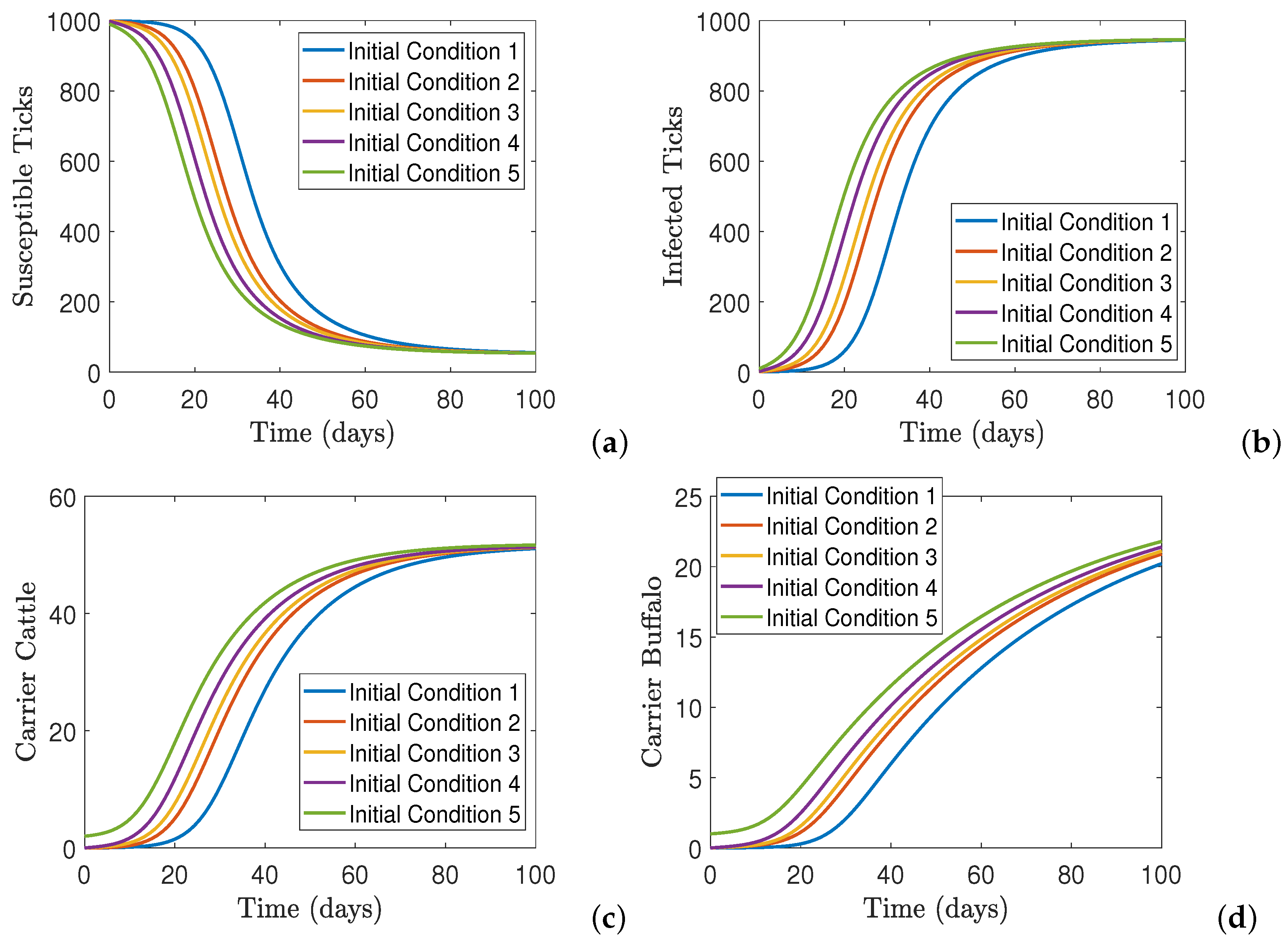
Figure 4.
Simulation results for susceptible ticks, infectious tick population, and carrier cattle and buffalo populations, showing dynamics for the deterministic model under varying initial conditions. Plot (a) depicts the dynamics of susceptible ticks. Plot (b) shows the dynamics of infected ticks. Plot (c) demonstrates the dynamics of carrier cattle, and lastly, plot (d) shows the dynamics of carrier buffaloes.
Figure 4.
Simulation results for susceptible ticks, infectious tick population, and carrier cattle and buffalo populations, showing dynamics for the deterministic model under varying initial conditions. Plot (a) depicts the dynamics of susceptible ticks. Plot (b) shows the dynamics of infected ticks. Plot (c) demonstrates the dynamics of carrier cattle, and lastly, plot (d) shows the dynamics of carrier buffaloes.
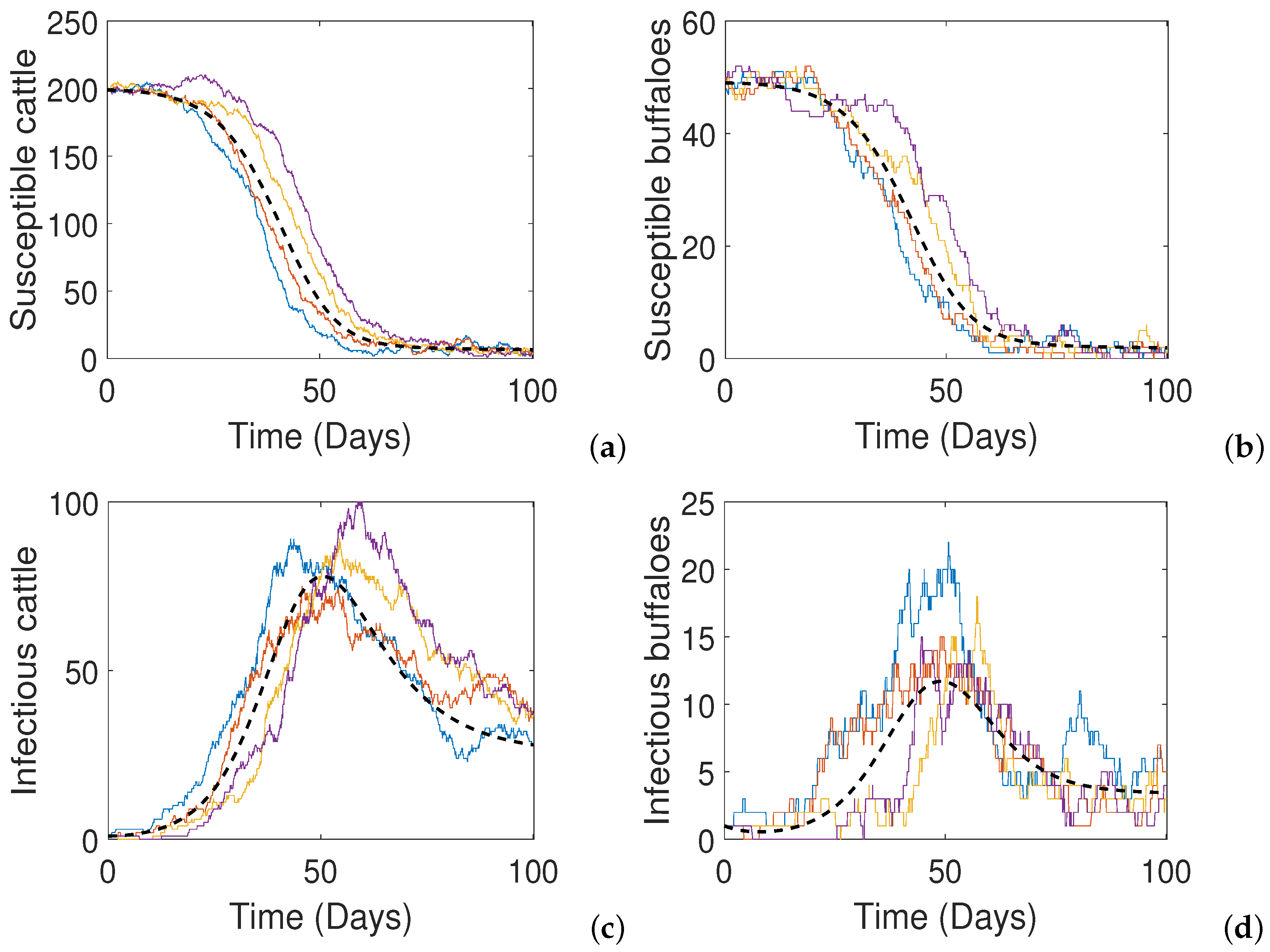
Figure 5.
Simulation results for susceptible and infected cattle and buffalo population showing both the deterministic model and the stochastic model. The dashed black curves represent the population levels for the deterministic model and the solid curves represent population levels for the CTMC stochastic model. Plot (a) depicts the dynamics of susceptible cattle. Plot (b) shows the dynamics of susceptible buffaloes. Plot (c) demonstrates the dynamics of infected cattle, and lastly, plot (d) shows the dynamics of infected buffaloes.
Figure 5.
Simulation results for susceptible and infected cattle and buffalo population showing both the deterministic model and the stochastic model. The dashed black curves represent the population levels for the deterministic model and the solid curves represent population levels for the CTMC stochastic model. Plot (a) depicts the dynamics of susceptible cattle. Plot (b) shows the dynamics of susceptible buffaloes. Plot (c) demonstrates the dynamics of infected cattle, and lastly, plot (d) shows the dynamics of infected buffaloes.
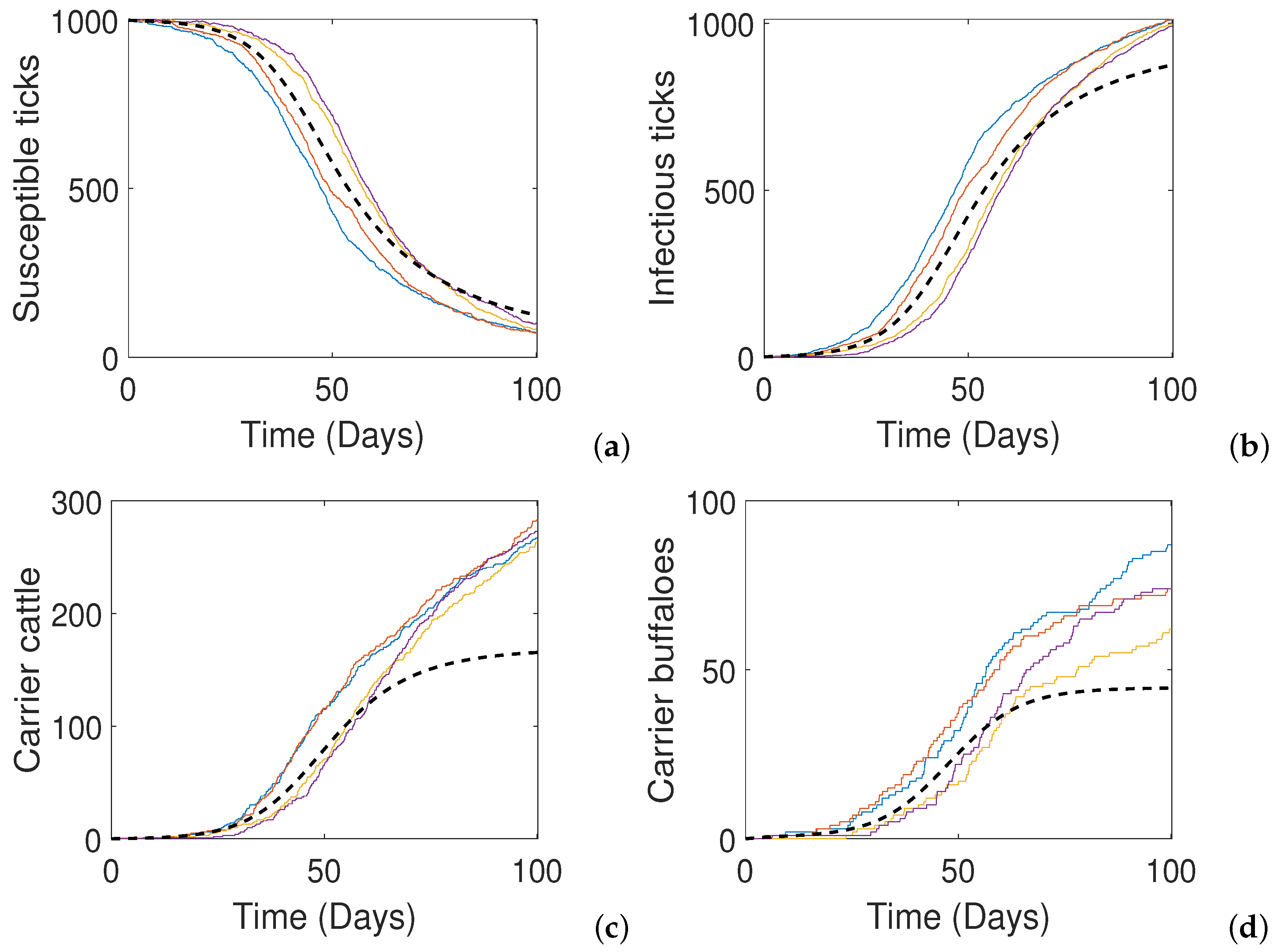
Figure 6.
Simulation results for carrier cattle and buffalo populations, susceptible ticks and infectious tick population showing both the deterministic model and the stochastic model. The black dashed curves represent the population levels for the deterministic model and the other curves represent population levels for the stochastic model. Plot (a) depicts the dynamics of susceptible ticks. Plot (b) shows the dynamics of infected ticks. Plot (c) demonstrates the dynamics of carrier cattle, and lastly, plot (d) shows the dynamics of carrier buffaloes.
Figure 6.
Simulation results for carrier cattle and buffalo populations, susceptible ticks and infectious tick population showing both the deterministic model and the stochastic model. The black dashed curves represent the population levels for the deterministic model and the other curves represent population levels for the stochastic model. Plot (a) depicts the dynamics of susceptible ticks. Plot (b) shows the dynamics of infected ticks. Plot (c) demonstrates the dynamics of carrier cattle, and lastly, plot (d) shows the dynamics of carrier buffaloes.
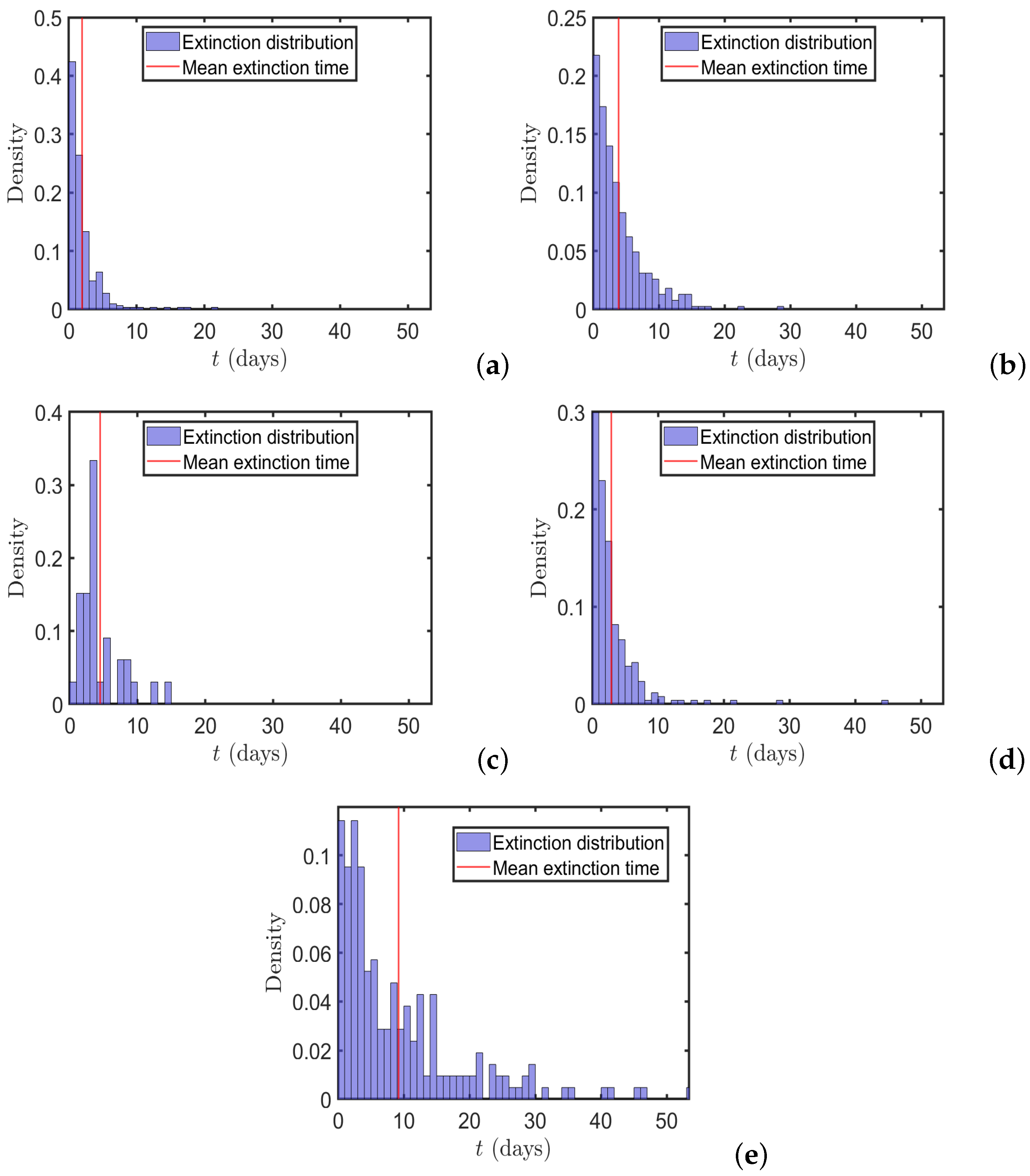
Figure 7.
Approximate probability distribution for the time of disease extinction
T for the CTMC model when the disease is introduced by infectious cattle, carrier cattle, infectious buffalo, carrier buffalo, and an infectious tick (see histogram (
a)), with initial condition
, (
b)
, (
c)
, (
d)
, and (
e)
. The probability of disease extinction
and
T for each graph are presented in
Table 6. This histogram is generated using 10,000 sample paths. All the other parameter values are as given in
Table 1.
Figure 7.
Approximate probability distribution for the time of disease extinction
T for the CTMC model when the disease is introduced by infectious cattle, carrier cattle, infectious buffalo, carrier buffalo, and an infectious tick (see histogram (
a)), with initial condition
, (
b)
, (
c)
, (
d)
, and (
e)
. The probability of disease extinction
and
T for each graph are presented in
Table 6. This histogram is generated using 10,000 sample paths. All the other parameter values are as given in
Table 1.
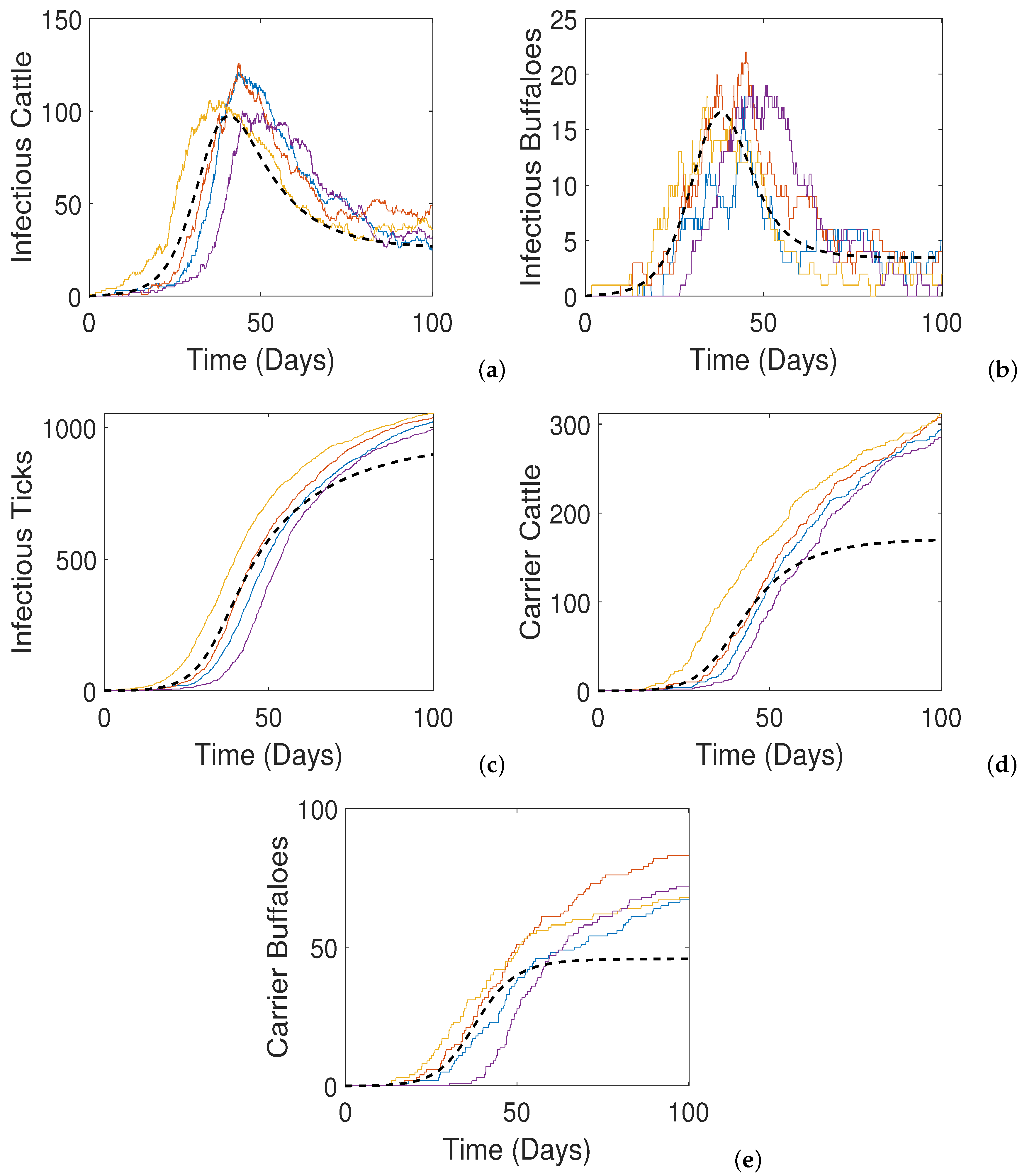
Figure 8.
Comparison of the deterministic model solutions (black dashed curve) and the four sample paths of the CTMC model illustrating an outbreak or extinction when the disease is initiated by a tick. The parameter values used are as given in
Table 1. The initial conditions are
and
. The total population for host populations
,
and
. Plot (
a) shows the dynamics of infected cattle
and an outbreak is predicted that lasts for the entire period under investigation. Plot (
b) shows dynamics of infected buffaloes
, plot (
c) shows the dynamics of infected ticks
, plot (
d) shows the dynamics of carrier cattle
, and lastly, plot (
e) shows the dynamics of carrier buffaloes
.
Figure 8.
Comparison of the deterministic model solutions (black dashed curve) and the four sample paths of the CTMC model illustrating an outbreak or extinction when the disease is initiated by a tick. The parameter values used are as given in
Table 1. The initial conditions are
and
. The total population for host populations
,
and
. Plot (
a) shows the dynamics of infected cattle
and an outbreak is predicted that lasts for the entire period under investigation. Plot (
b) shows dynamics of infected buffaloes
, plot (
c) shows the dynamics of infected ticks
, plot (
d) shows the dynamics of carrier cattle
, and lastly, plot (
e) shows the dynamics of carrier buffaloes
.
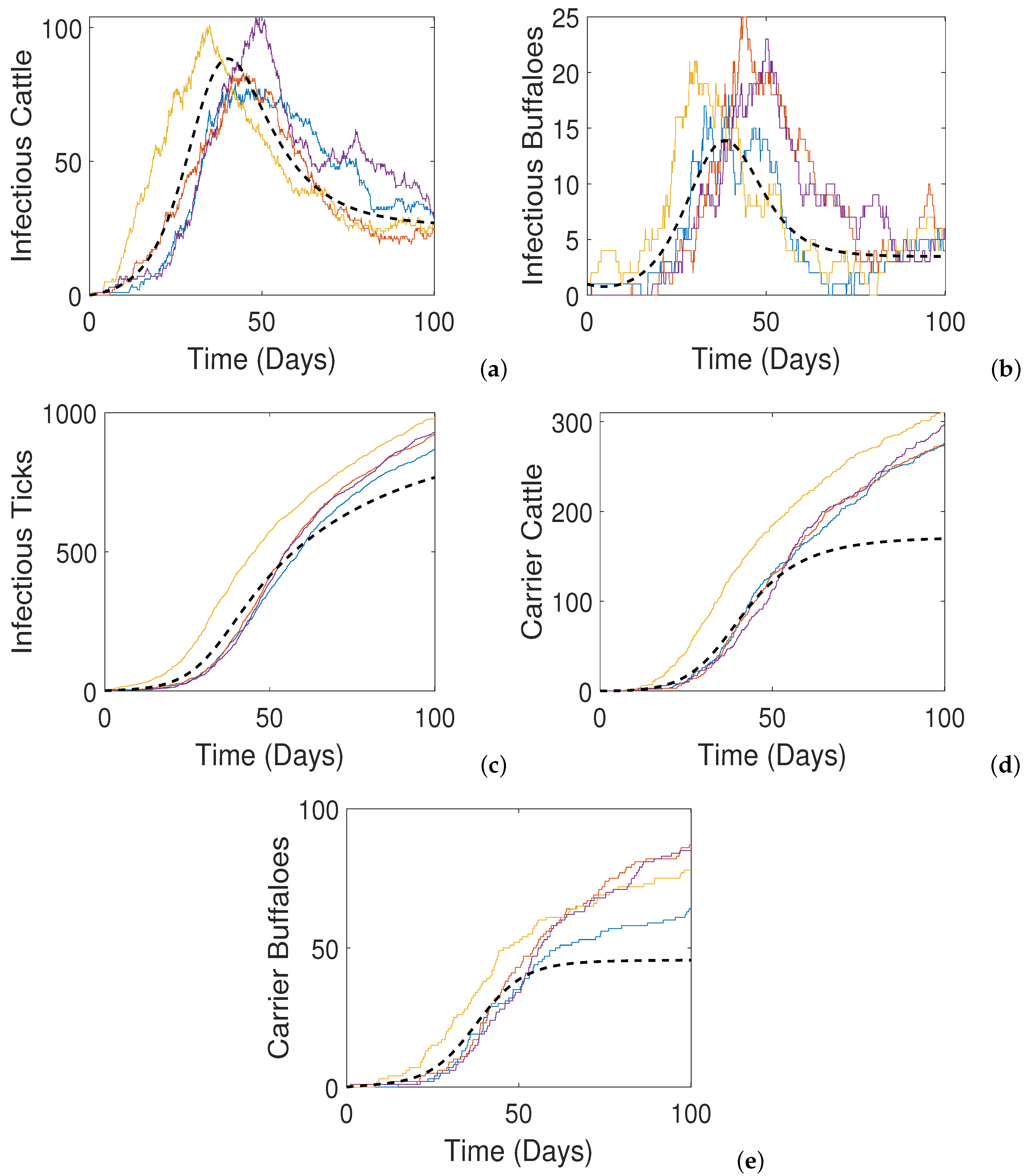
Figure 9.
Comparison of the deterministic model solutions (black dashed curve) and the four sample paths of the CTMC model illustrating an outbreak or extinction when the disease is initiated by one infectious buffalo and a tick. The parameter values used are as given in
Table 1. The initial conditions are
and
. The total population for host populations
,
and
. Plot (
a) shows the dynamics of infected cattle
. Plot (
b) shows dynamics of infected buffaloes
, plot (
c) shows the dynamics of infected ticks
, plot (
d) shows the dynamics of carrier cattle
, and lastly, plot (
e) shows the dynamics of carrier buffaloes
.
Figure 9.
Comparison of the deterministic model solutions (black dashed curve) and the four sample paths of the CTMC model illustrating an outbreak or extinction when the disease is initiated by one infectious buffalo and a tick. The parameter values used are as given in
Table 1. The initial conditions are
and
. The total population for host populations
,
and
. Plot (
a) shows the dynamics of infected cattle
. Plot (
b) shows dynamics of infected buffaloes
, plot (
c) shows the dynamics of infected ticks
, plot (
d) shows the dynamics of carrier cattle
, and lastly, plot (
e) shows the dynamics of carrier buffaloes
.
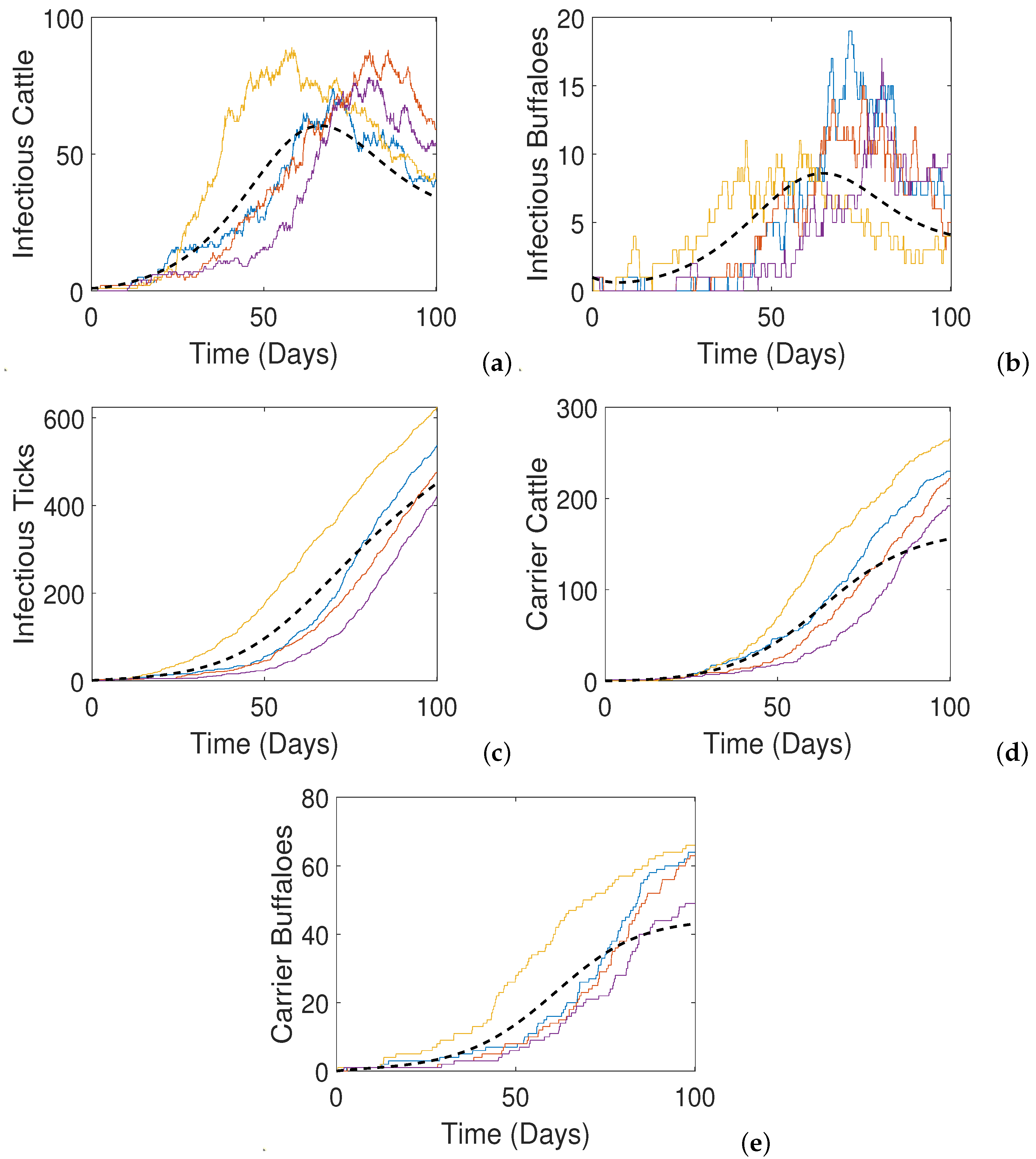
Figure 10.
Comparison of the deterministic model solutions (black dashed curve) and the four sample paths of the CTMC model illustrating an outbreak or extinction when the disease is initiated by one infectious cattle, an infectious buffalo and a tick. The parameter values used are as given in
Table 1. The initial conditions are
and
. The total population for host populations
,
and
. Plot (
a) shows the dynamics of infected cattle
. Plot (
b) shows dynamics of infected buffaloes
, plot (
c) shows the dynamics of infected ticks
, plot (
d) shows the dynamics of carrier cattle
, and lastly, plot (
e) shows the dynamics of carrier buffaloes
.
Figure 10.
Comparison of the deterministic model solutions (black dashed curve) and the four sample paths of the CTMC model illustrating an outbreak or extinction when the disease is initiated by one infectious cattle, an infectious buffalo and a tick. The parameter values used are as given in
Table 1. The initial conditions are
and
. The total population for host populations
,
and
. Plot (
a) shows the dynamics of infected cattle
. Plot (
b) shows dynamics of infected buffaloes
, plot (
c) shows the dynamics of infected ticks
, plot (
d) shows the dynamics of carrier cattle
, and lastly, plot (
e) shows the dynamics of carrier buffaloes
.
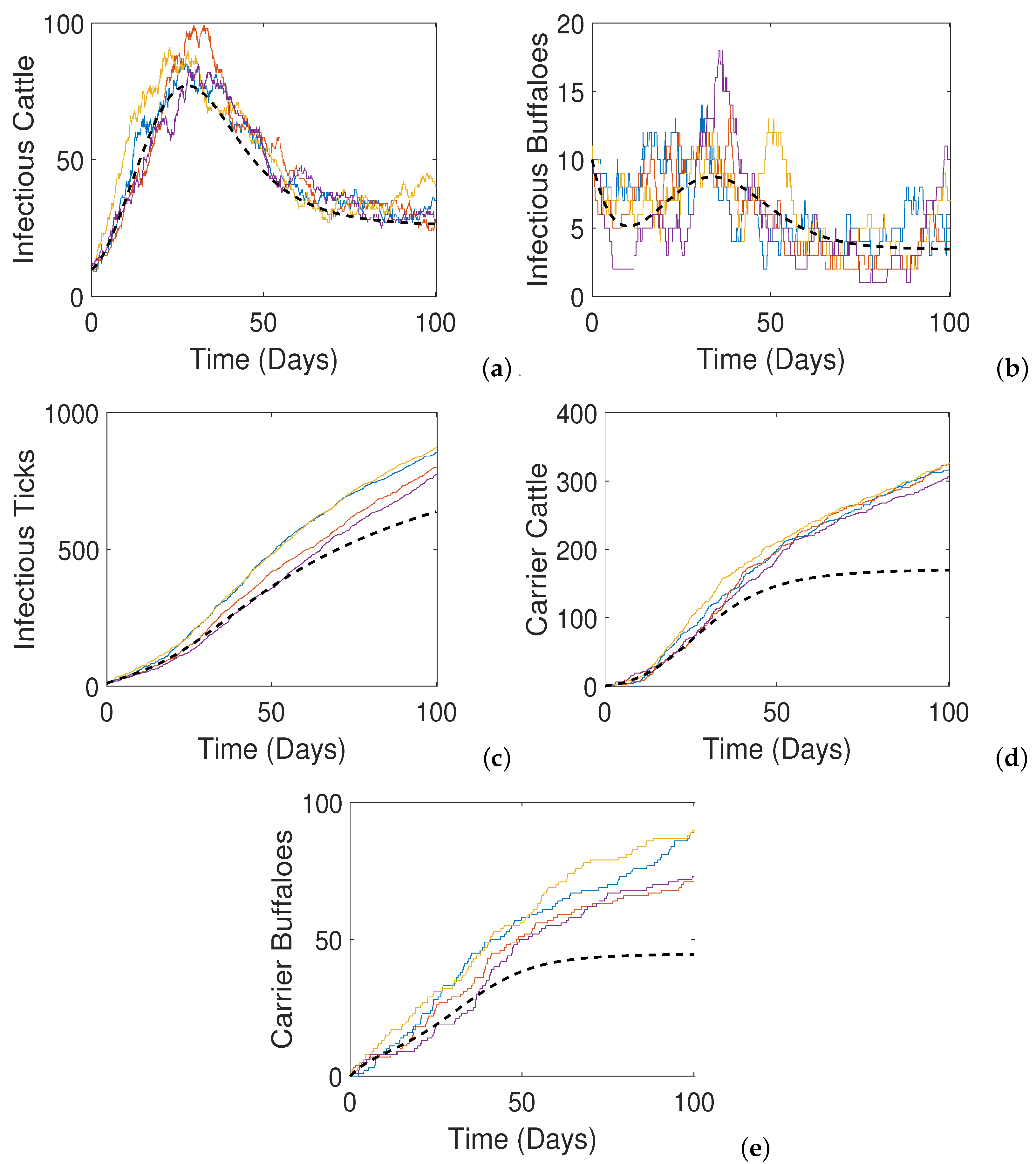
Figure 11.
Comparison of the deterministic model solutions (black dashed curve) and the four sample paths of the CTMC model illustrating an outbreak or extinction when the disease is initiated by ten infectious cattle, ten infectious buffaloes and ten infectious ticks. The parameter values used are as given in
Table 1. The initial conditions are
and
. The total population for host populations
,
and
. Plot (
a) shows the dynamics of infected cattle
. Plot (
b) shows dynamics of infected buffaloes
, plot (
c) shows the dynamics of infected ticks
, plot (
d) shows the dynamics of carrier cattle
, and lastly, plot (
e) shows the dynamics of carrier buffaloes
.
Figure 11.
Comparison of the deterministic model solutions (black dashed curve) and the four sample paths of the CTMC model illustrating an outbreak or extinction when the disease is initiated by ten infectious cattle, ten infectious buffaloes and ten infectious ticks. The parameter values used are as given in
Table 1. The initial conditions are
and
. The total population for host populations
,
and
. Plot (
a) shows the dynamics of infected cattle
. Plot (
b) shows dynamics of infected buffaloes
, plot (
c) shows the dynamics of infected ticks
, plot (
d) shows the dynamics of carrier cattle
, and lastly, plot (
e) shows the dynamics of carrier buffaloes
.
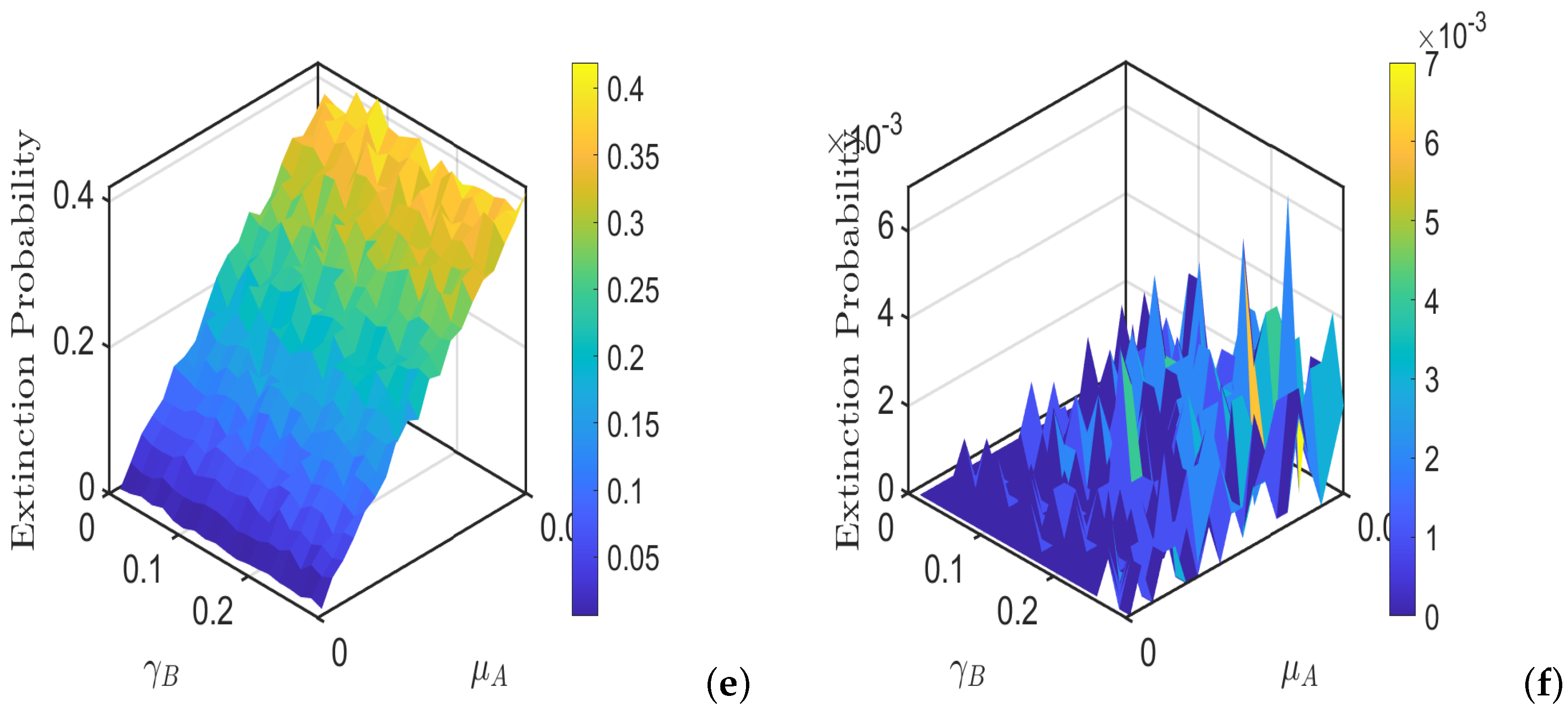
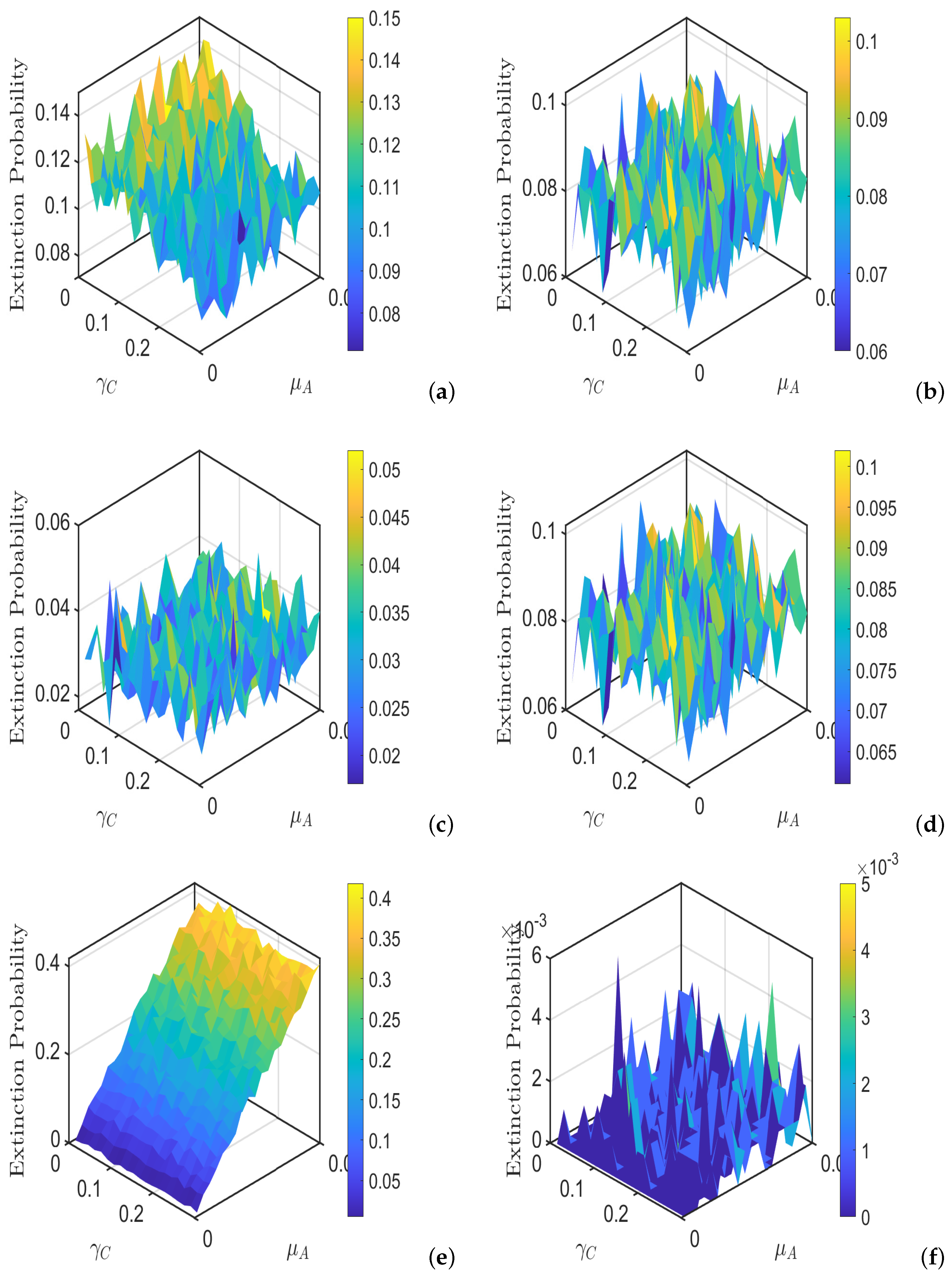
Figure 12.
The plots show the effect of varying recovery rate against tick mortality rate on the probability of disease extinction. Plot (a) shows the probability of extinction with initial conditions set as . Plot (b) shows the probability of extinction with initial conditions , plot (c) shows the probability of extinction with initial conditions given as , plot (d) shows the probability of extinction with initial conditions given as , plot (e) shows the probability of extinction with initial conditions given as , and plot (f) shows the probability of extinction with initial conditions given as .
Figure 12.
The plots show the effect of varying recovery rate against tick mortality rate on the probability of disease extinction. Plot (a) shows the probability of extinction with initial conditions set as . Plot (b) shows the probability of extinction with initial conditions , plot (c) shows the probability of extinction with initial conditions given as , plot (d) shows the probability of extinction with initial conditions given as , plot (e) shows the probability of extinction with initial conditions given as , and plot (f) shows the probability of extinction with initial conditions given as .
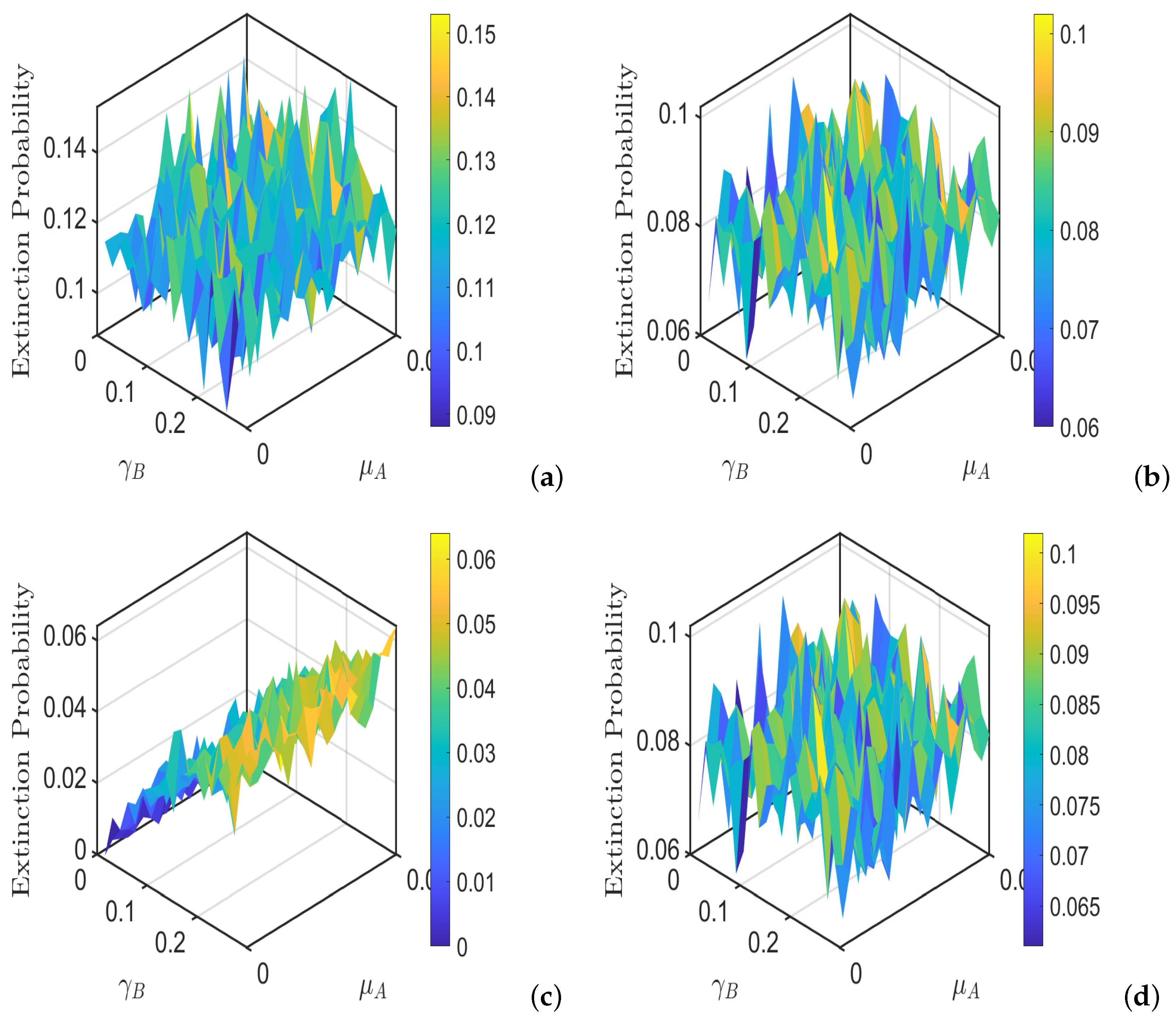
Figure 13.
The plots show the effect of varying the recovery rate of buffaloes () against tick mortality rate () on the probability of disease extinction. Plot (a) shows the probability of extinction under the initial conditions . Plot (b) shows the probability of extinction as and vary with initial conditions . Plot (c) shows the probability of extinction with initial conditions . Plot (d) shows the probability of extinction under the initial conditions . Plot (e) shows the probability of extinction with initial conditions . Plot (f) shows the probability of extinction with initial conditions .
Figure 13.
The plots show the effect of varying the recovery rate of buffaloes () against tick mortality rate () on the probability of disease extinction. Plot (a) shows the probability of extinction under the initial conditions . Plot (b) shows the probability of extinction as and vary with initial conditions . Plot (c) shows the probability of extinction with initial conditions . Plot (d) shows the probability of extinction under the initial conditions . Plot (e) shows the probability of extinction with initial conditions . Plot (f) shows the probability of extinction with initial conditions .
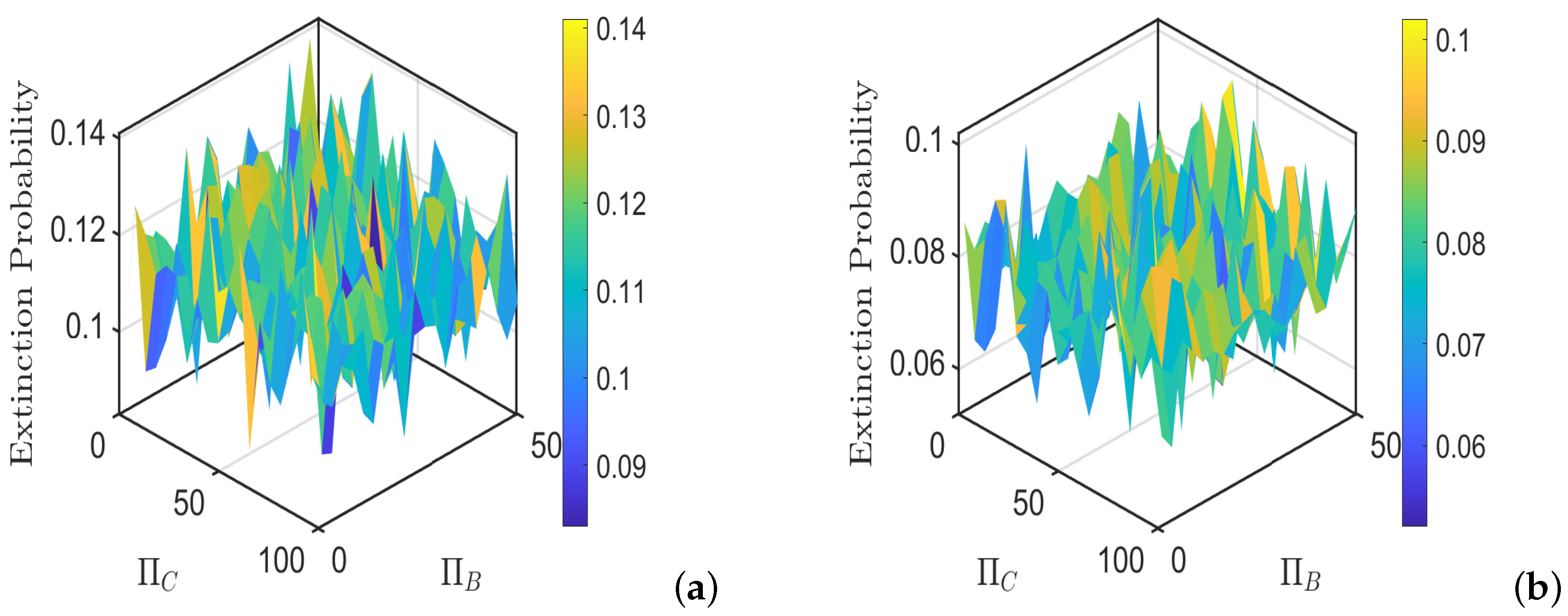
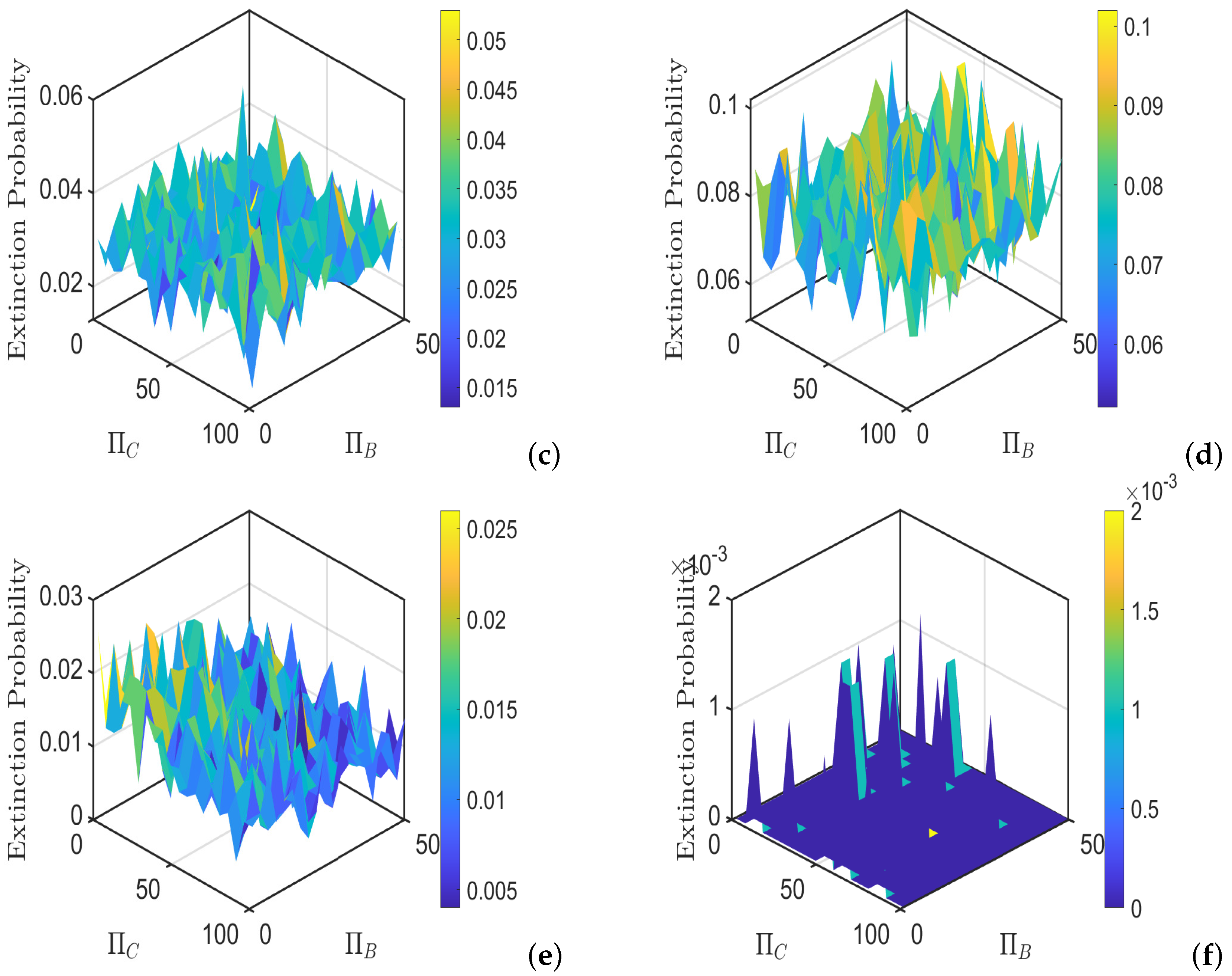
Figure 14.
The plots show the effect of varying the recruitment rate of buffaloes () against recruitment rate of cattle () on the probability of disease extinction. Plot (a) shows the probability of extinction under the initial conditions . Plot (b) shows the probability of extinction as and vary with initial conditions . Plot (c) shows the probability of extinction with initial conditions . Plot (d) shows the probability of extinction under the initial conditions . Plot (e) shows the probability of extinction with initial conditions . Plot (f) shows the probability of extinction with initial conditions .
Figure 14.
The plots show the effect of varying the recruitment rate of buffaloes () against recruitment rate of cattle () on the probability of disease extinction. Plot (a) shows the probability of extinction under the initial conditions . Plot (b) shows the probability of extinction as and vary with initial conditions . Plot (c) shows the probability of extinction with initial conditions . Plot (d) shows the probability of extinction under the initial conditions . Plot (e) shows the probability of extinction with initial conditions . Plot (f) shows the probability of extinction with initial conditions .
Table 1.
Model parameters and their biological descriptions.
Table 1.
Model parameters and their biological descriptions.
| Symbol | Definition | Units |
|---|
| Probability of transmission from an infectious tick to a cattle and buffaloes | Dimensionless |
| Probability of transmission from an infectious cattle to ticks | Dimensionless |
| Probability of transmission from an infectious ticks to a susceptible buffaloes | Dimensionless |
| Probability of transmission from an infectious buffaloes to a susceptible ticks | Dimensionless |
| Reduction of infectivity of carrier cattle compared to symptomatic cattle | Dimensionless |
| Reduction of infectivity of carrier buffaloes compared to symptomatic buffaloes | Dimensionless |
| mortality rate of cattle | Day−1 |
| mortality rate of buffaloes | Day−1 |
| mortality rate of ticks | Day−1 |
| Recovery rate of cattle | Day−1 |
| Recovery rate of cattle, buffaloes | Day−1 |
| disease death rate of cattle | Day−1 |
| disease death rate of buffaloes | Day−1 |
Table 2.
Model parameters and their baseline values.
Table 2.
Model parameters and their baseline values.
| Symbol | Baseline Values | Units | Source |
|---|
| 0.0006 (0–1) | Dimensionless | [31] |
| 0.0003 (0–1) | Dimensionless | [31] |
| 0.0006 (0–1) | Dimensionless | [31] |
| 0.0003 (0–1) | Dimensionless | [31] |
| 0.99 (0–1) | Dimensionless | [12] |
| 0.99 (0–1) | Dimensionless | [12] |
| | Day−1 | [27] |
| 0.00016116 (15–20) | Day−1 | [27] |
| 0.00238095238 (100–420) | Day−1 | [27] |
| 0.0333333 (21–30) | Day−1 | [27] |
| 0.011111 (60–180) | Day−1 | [27] |
Table 3.
Discrete events and transition rates for the CTMC model associated with the ODE model.
Table 3.
Discrete events and transition rates for the CTMC model associated with the ODE model.
| Event | Description | State Transition | Transition Rate |
|---|
| 1 | Birth of | | |
| 2 | Death of | | |
| 3 | Infection of | | |
| 4 | Death of | | |
| 5 | Recovery of | | |
| 6 | Death of | | |
| 7 | Birth of | | |
| 8 | Death of | | |
| 9 | Infection of | | |
| 10 | Death of | | |
| 11 | Recovery of | | |
| 12 | Death of | | |
| 13 | Birth of | | |
| 14 | Death of | | |
| 15 | Infection of by | | |
| 16 | Infection of by | | |
| 17 | Infection of by | | |
| 18 | Infection of by | | |
| 19 | Death of | | |
Table 4.
Sensitivity indices of with respect to the parameters.
Table 4.
Sensitivity indices of with respect to the parameters.
| Parameter | Sensitivity Index | Parameter | Sensitivity Index |
|---|
| | | |
| | | |
| | | |
| | | |
| | | |
| | | |
| | | |
Table 5.
Probability of disease extinction
for ECF evaluated from the fixed point of the branching process and numerical approximation
estimated from 10,000 sample paths of the CTMC model. The extinction probabilities were evaluated for different initial infectious configurations of cattle, buffaloes, carrier hosts, and infected ticks under the parameter values listed in
Table 1.
Table 5.
Probability of disease extinction
for ECF evaluated from the fixed point of the branching process and numerical approximation
estimated from 10,000 sample paths of the CTMC model. The extinction probabilities were evaluated for different initial infectious configurations of cattle, buffaloes, carrier hosts, and infected ticks under the parameter values listed in
Table 1.
| | | | | | |
|---|
| 1 | 0 | 0 | 0 | 0 | | |
| 0 | 1 | 0 | 0 | 0 | | |
| 0 | 0 | 1 | 0 | 0 | | |
| 0 | 0 | 0 | 1 | 0 | | |
| 0 | 0 | 0 | 0 | 1 | | |
| 1 | 0 | 0 | 0 | 1 | | |
| 0 | 0 | 1 | 0 | 1 | | |
| 1 | 0 | 1 | 0 | 1 | | |
Table 6.
Finite-time extinction
T for the CTMC model when the infection is introduced by infectious cattle, recovered/carrier cattle, an infectious buffalo, a carrier buffalo, and an infectious tick.
T is estimated based on 10,000 sample paths and the 95th percentile of end times. Parameter values are as in
Table 1 with initial total populations of hosts given as
,
,
. The reproduction number
.
Table 6.
Finite-time extinction
T for the CTMC model when the infection is introduced by infectious cattle, recovered/carrier cattle, an infectious buffalo, a carrier buffalo, and an infectious tick.
T is estimated based on 10,000 sample paths and the 95th percentile of end times. Parameter values are as in
Table 1 with initial total populations of hosts given as
,
,
. The reproduction number
.
| | | | | | | T(Days) |
|---|
| 1 | 0 | 0 | 0 | 0 | | | |
| 0 | 1 | 0 | 0 | 0 | | | |
| 0 | 0 | 1 | 0 | 0 | | | |
| 0 | 0 | 0 | 1 | 0 | | | |
| 0 | 0 | 0 | 0 | 1 | | | |
Table 7.
Probability of disease extinction (
) estimated from 10,000 sample paths of the CTMC model, using parameter values from
Table 1 with varying initial conditions.
Table 7.
Probability of disease extinction (
) estimated from 10,000 sample paths of the CTMC model, using parameter values from
Table 1 with varying initial conditions.
| | | | | | | |
|---|
| 1 | 0 | 0 | 0 | 0 | | | |
| 0 | 1 | 0 | 0 | 0 | | | |
| 0 | 0 | 1 | 0 | 0 | | | |
| 0 | 0 | 0 | 1 | 0 | | | |
| 0 | 0 | 0 | 0 | 1 | | | |
Table 8.
Probability of disease extinction
calculated from the numerical approximation based on 10,000 sample paths of the
model. Parameter values are as in
Table 1 with varying initial conditions.
Table 8.
Probability of disease extinction
calculated from the numerical approximation based on 10,000 sample paths of the
model. Parameter values are as in
Table 1 with varying initial conditions.
| | | | | | | |
|---|
| 1 | 0 | 0 | 0 | 0 | | | |
| 0 | 1 | 0 | 0 | 0 | | | |
| 0 | 0 | 1 | 0 | 0 | | | |
| 0 | 0 | 0 | 1 | 0 | | | |
| 0 | 0 | 0 | 0 | 1 | | | |