1. Introduction
A graph G is irregular if every two vertices of G have distinct degrees. It is well known that no graph of order 2 or more is irregular.
Theorem 1 ([
1])
. For every integer , there is no irregular graph of order n. The
degree set of a graph
G is
. By Theorem 1, there is no graph
G of order
for which
. For each integer
, there are two graphs
G of order
n, such that
. If
and
are the two graphs of order
with
, then
is the complement of
. Graphs with this property are sometimes referred to as
antiregular graphs; that is, a nontrivial graph
G is
antiregular if exactly two vertices of
G have the same degree (see [
2,
3,
4], for example).
Theorem 2 ([
2,
3])
. For every integer , there are exactly two antiregular graphs of order n, one of which is connected. The connected antiregular graph of order
n is denoted by
and its complement
is the disconnected antiregular graph of order
n. Then,
where
and
. Thus,
and
. If
is even, then the two vertices of the same degree
in
are adjacent; while if
is odd, then the two vertices of the same degree
in
are not adjacent.
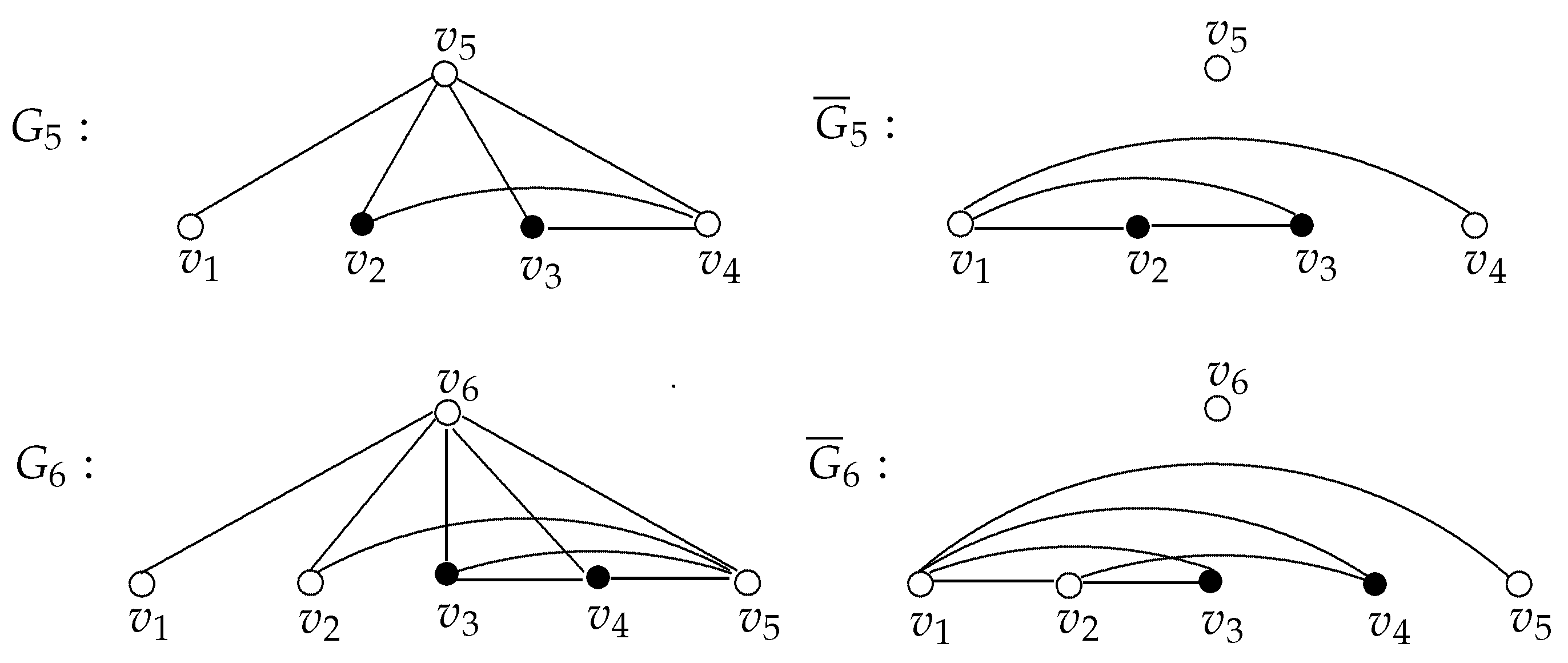
Figure 1 shows
and
for
. More information on antiregular graphs can be found in [
4,
5,
6,
7,
8,
9,
10]. Degree sets of other types of irregular graphs have also been studied (see [
11,
12], for example).
A graph
G is
locally irregular if every two adjacent vertices of
G have distinct degrees (see [
13], for example). An edge
in a graph with
is an
irregular edge, while
e is a
regular edge if
. Thus, a graph
G is locally irregular if and only if every edge of
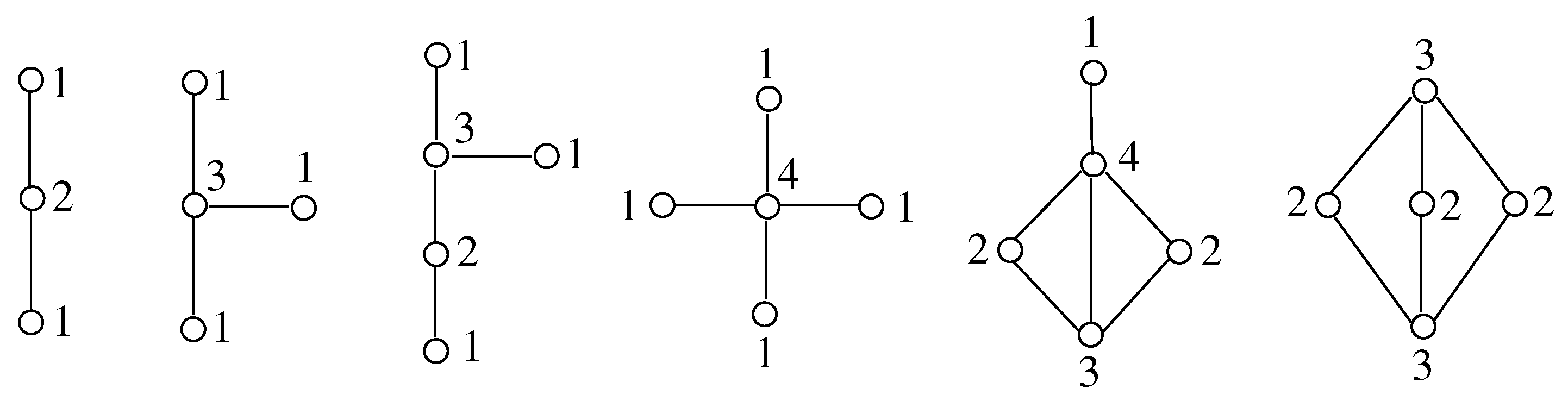
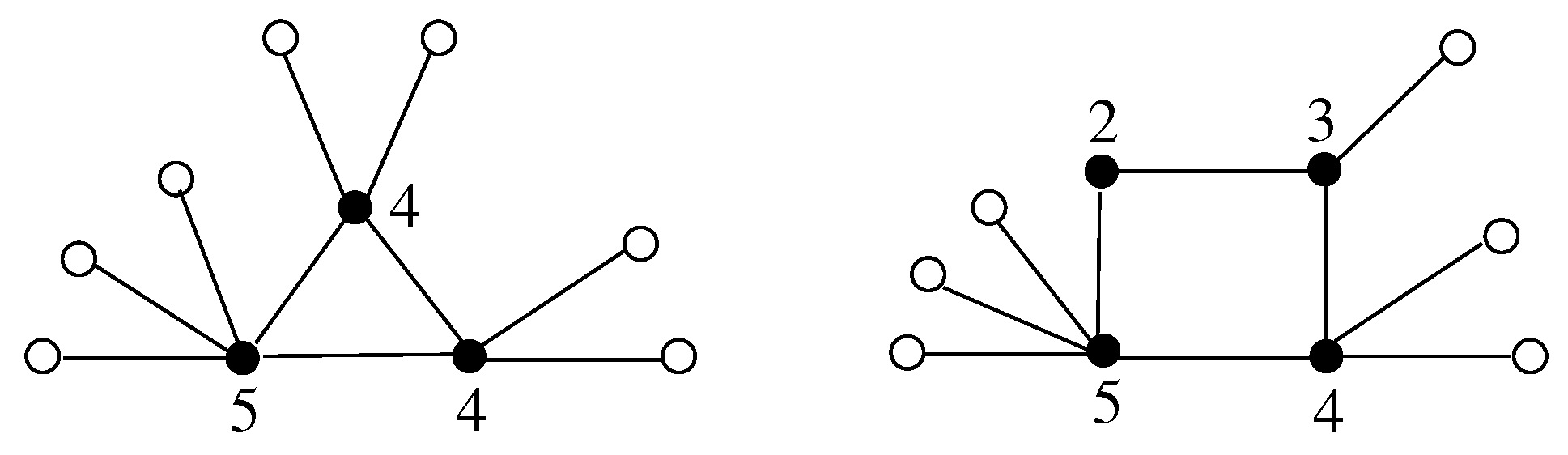
G is irregular. The connected locally irregular graphs of order
n with
are shown in
Figure 2 where each vertex is labeled with its degree.
Since the two vertices of the same degree in the connected antiregular graph of odd order are not adjacent, is locally irregular and is not locally irregular for odd integers . Since the two vertices of the same degree in the graph of even order are adjacent, is not locally irregular and is locally irregular for even integers .
A graph
G is
locally irregular-connected if there is a locally irregular
path for every two vertices
u and
v of
G. While irregular graphs of order 2 or more do not exist, there are a number of properties possessed by the related class of locally irregular-connected graphs which we present. If a locally irregular graph
G is connected, then every two vertices
u and
v of
G are connected by a locally irregular
path and so
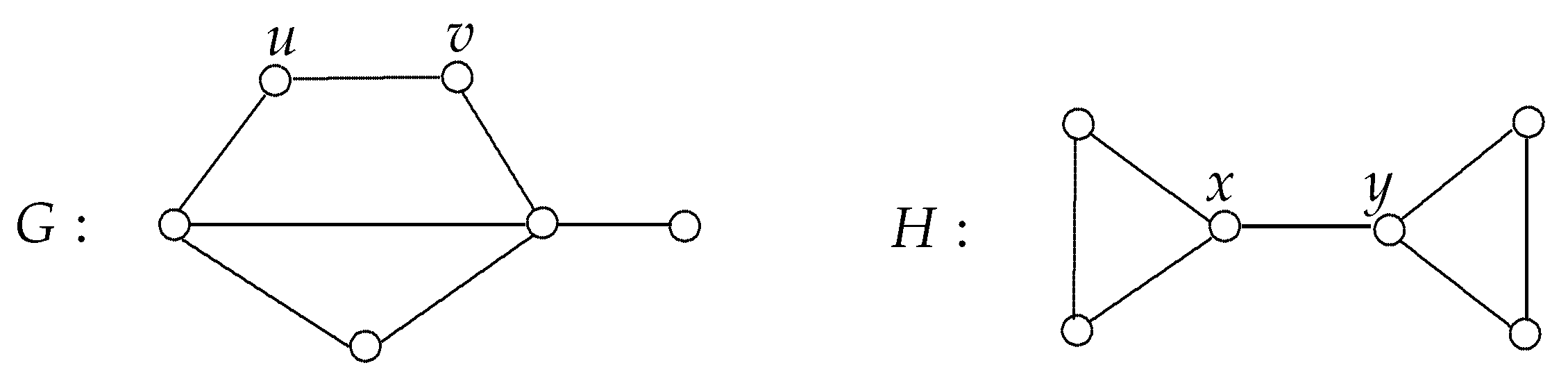
G is locally irregular-connected. The converse is not true, however. For example, the locally irregular-connected graph
G of
Figure 3 is not locally irregular since
is a regular edge. The edge
in the graph
H of
Figure 3 is regular. Since
is a bridge in
H, it follows that
is the only
path in
H and so there is no locally irregular
path in
H. Therefore,
H is not locally irregular-connected.
The following two observations for locally irregular-connected graphs are often useful.
Observation 1. If a graph G contains a regular edge that is a bridge, then G is not locally irregular-connected.
Observation 2. A graph G is locally irregular-connected if G contains a connected spanning subgraph H that is locally irregular, that is, every edge of H is irregular. In particular, every connected locally irregular graph is locally irregular-connected.
Every connected antiregular graph of order at least 3 is locally irregular-connected, as we show next.
Proposition 1. For each integer , the connected antiregular graph of order n is locally irregular-connected.
Proof. First, suppose that is odd. Since the two vertices of the same degree in are not adjacent, it follows that is locally irregular and so is locally irregular-connected by Observation 2. Next, suppose that is even. Let u and v be two vertices of . We show that there is a locally irregular path in . The vertex w of degree in is adjacent to every vertex of . If , then is a locally irregular path in ; while if , then is a locally irregular path in . □
2. Degree Sets of Locally Irregular-Connected Graphs
Since no regular graph is locally irregular-connected, every graph G with is not locally irregular-connected. On the other hand, for each integer , there is a locally irregular-connected graph G with . For example, if is a set of any k distinct positive integers, then the complete k-partite graph is a locally irregular-connected graph with . In fact, more can be said.
Theorem 3. For every pair of integers with , there exists a locally irregular-connected graph of order n with .
Proof. For , the connected antiregular graph of order n has and is locally irregular-connected by Proposition 1. For and , the star of order n has . For and , the double star of order n has central vertices of degrees 2 and and so . Since and are locally irregular, these graphs are locally irregular-connected.
For
, let
be the connected antiregular graph of order
. Then
and so
. The vertex
w of degree
k in
is adjacent to all other vertices of
. Let
be the graph obtained from
and
by joining each vertex of
to the vertex
w in
. Thus,
. This implies that
and so
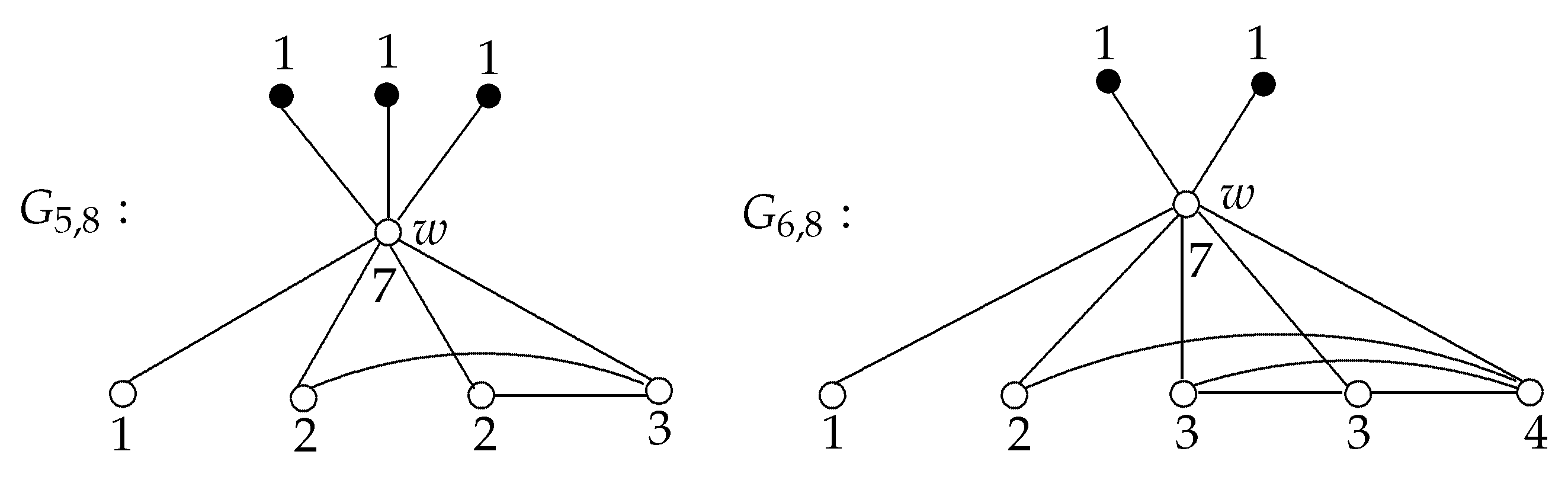
. The graphs
and
are shown in
Figure 4. We now show that
is locally irregular-connected. That is, there is a locally irregular
path in
for every two vertices
u and
v of
. First, suppose that
. Since
is locally irregular-connected by Proposition 1, there is a locally irregular
path in
and in
as well. Next, suppose that at least one of
u and
v is not in
, say
. If
, then
is a locally irregular
path in
. If
, then for a locally irregular
path
P in
, the
path
in
is locally irregular. Therefore,
is locally irregular-connected.
It was shown in [
14] that every finite set of positive integers is the degree set of some graph. □
Theorem 4 ([
14])
. For every set of positive integers with , there exists a graph G with . Furthermore, the minimum order of such a graph G is . A finite set S of distinct positive integers is realizable if there is a locally irregular-connected graph G such that . Theorem 4 suggests the following question.
Question 1: Which finite sets S of distinct positive integers are realizable?
If S is a realizable set of positive integers for a locally irregular-connected graph G of order n and is the largest integer in S, then . This observation suggests another question.
Question 2: For a realizable set S of positive integers, what is the minimum order of a locally irregular-connected graph G with ?
By applying the technique used in the proof of Theorem 4, an analogous result for locally irregular-connected graphs can be established which provides answers to Questions 1 and 2. For this purpose, a lemma is presented. For two vertex-disjoint graphs F and H, the graph is the join of F and H and is the union of F and H.
Lemma 1. Let be the join of two vertex-disjoint graphs F and H. If for every two vertices x and y where and , then G is locally irregular-connected.
Proof. Let u and v be two vertices of . If or , say the former, then is a locally irregular path in G for some vertex w of H. If one of u and v is in F and the other is in H, then is a locally irregular path in G. Hence, G is locally irregular-connected. □
Theorem 5. For every set of positive integers where , there is a locally irregular-connected graph G of order such that . Consequently, the minimum order of a locally irregular-connected graph G with is .
Proof. We proceed by induction on .
- ⋆
For , the order of the graph is . Since if and if , it follows that . By Lemma 1, G is locally irregular-connected.
- ⋆
For , the order of the graph is . Since if , if , and if , it follows that . By Lemma 1, G is locally irregular-connected.
Hence, the statement is true for . Let . Suppose that for every set of j positive integers where and , there is a locally irregular-connected graph H of order such that .
Next, let be a set of positive integers, where . We show that there is a locally irregular-connected graph G of order with . Let . Then and . By the induction hypothesis, there is a locally irregular-connected graph of order with . Let . Then the order of G is . Since if , if , and for some integer i with if , it follows that . By Lemma 1, G is locally irregular-connected. □
3. Trees and Unicyclic Graphs
In this section, we characterize locally irregular-connected trees and locally irregular-connected unicyclic graphs and determine all sets S of positive integers that are the degree sets of graphs in these two classes as well as determine the minimum order of each such graph with degree set S. We begin with trees.
Proposition 2. A tree T is locally irregular-connected if and only if T contains no regular edges.
Proof. First, suppose that a tree T contains a regular edge. Since every edge of a tree is a bridge, it follows by Observation 1 that T is not locally irregular-connected. Next, suppose that T contains no regular edges. It then follows by Observation 2 that T is locally irregular-connected. □
A caterpillar is a tree of order 3 or more, the removal of whose end-vertices produces a path called the spine of the caterpillar.
Theorem 6. Let be a set of positive integers. There is a locally irregular-connected tree T with if and only if . Furthermore, if , then the minimum order of a locally irregular-connected tree T with is .
Proof. First, suppose that T is a locally irregular-connected tree with . Since every nontrivial tree T contains at least two end-vertices, . Next, let , where . If , then let be the star of order with . If , let T be the caterpillar whose spine is the path where for . The order of T is and . Since every edge of T is irregular, T is locally irregular-connected.
Next, let
T be a locally irregular-connected tree of order
n with
. Then, the size of
T is
. Since
T contains at least one vertex of degree
for
and the remaining vertices have degree at least 1, it follows that
and so
We saw that there is a locally irregular-connected tree of order
having degree set
S. Therefore, the minimum order of a locally irregular-connected tree
T with
is
. □
We now turn to unicyclic graphs. A unicyclic graph is a connected graph with exactly one cycle. Thus, a unicyclic graph is obtained from a tree by adding an edge that joins two nonadjacent vertices of the tree. We now characterize of all locally irregular-connected unicyclic graphs and determine all realizable sets for locally irregular-connected unicyclic graphs as well as determine the minimum order of such graphs with a prescribed degree set.
Proposition 3. A unicyclic graph G is locally irregular-connected if and only if G has at most one regular edge and the regular edge (if it exists) must lie on the unique cycle in G.
Proof. If G has no regular edge, then G is locally irregular-connected by Observation 2. Thus, let G be a graph with exactly one regular edge e that lies on the cycle. Then is a spanning tree of G and has no regular edge. Again, it follows by Observation 2 that G is locally irregular-connected.
Next, we verify the converse. Suppose that G is a unicyclic graph that contains two or more regular edges. Let be the unique cycle of order in G and let e and f be two regular edges of G. It follows by Observation 1 that e and f are not bridges and so they lie on the cycle C. We may assume that and where . There are exactly two paths in G (both on C), namely and . Since contains e and contains f, neither nor is locally irregular. Thus, there is no locally irregular path in G and so G is not locally irregular-connected. □
We now determine all sets S of positive integers that are the degree sets of locally irregular-connected unicyclic graphs and determine the minimum order of such a unicyclic graph G with . First, we show that the degree set of a locally irregular-connected unicyclic graph contains at least three elements.
Proposition 4. There is no locally irregular-connected unicyclic graph G with .
Proof. Assume, to the contrary, that there is a locally irregular-connected unicyclic graph G with , where . Let be the unique cycle of G for some integer . Since C is not locally irregular-connected, . Hence, G contains at least one end-vertex and so . This implies that for and so every edge on C is regular, which contradicts Proposition 3. □
Theorem 7. Let be a set of positive integers. There is a locally irregular-connected unicyclic graph G with if and only if . Furthermore, if , then the minimum order of a locally irregular-connected unicyclic graph G with is if and is if .
Proof. First, suppose that G is a locally irregular-connected unicyclic graph with . Then G is not a cycle. Thus, G contains at least one end-vertex and so . Next, let , where .
- ⋆
For , let G be the unicyclic graph with the unique cycle such that and . Then, the order of G is and . Since G has exactly one regular edge that lies on the cycle, it follows by Proposition 3 that G is locally irregular-connected.
- ⋆
For , let G be the unicyclic graph with the unique cycle such that for . Then, the order of G is , where and . Since every edge of G is irregular, G is locally irregular-connected.
For
or
, some locally irregular-connected unicyclic graphs
G are shown in
Figure 5 with
.
Among all locally irregular-connected unicyclic graphs whose degree set is S = {, , }, where , let G be one of minimum order n. Then, the size of G is n as well.
- ⋆
First, suppose that
. Let
be the unique cycle of
G for some integer
. Since (1)
for
and (2)
C contains at most one regular edge by Proposition 3, it follows that
and
contains exactly one regular edge. Thus, exactly two vertices on
C have the same degree. Therefore,
and the remaining
vertices of
G are end-vertices. Thus,
and so
. Since there is a locally irregular-connected unicyclic graph of order
with degree set
S, it follows that
.
- ⋆
Next, suppose that
. Since
G contains at least one vertex of degree
for
and the remaining
vertices have degree at least 1, it follows that
and so
Since there is a locally irregular-connected unicyclic graph of order
with degree set
S, it follows that
.
□
4. Graphs of Cycle Rank 2
The number of edges that must be deleted from a connected graph G of order n and size m to obtain a spanning tree of G is its cycle rank . Thus, the cycle rank of a tree is 0 and the cycle rank of a unicyclic graph is 1. By Propositions 2 and 3, a graph G has cycle rank 0 if and only if G has no regular edge and a graph G has cycle rank 1 if and only if G has at most one regular edge and this regular edge is not a bridge. We now turn our attention to locally irregular-connected graphs of cycle rank 2 and determine all realizable sets for these graphs and determine the minimum order with a prescribed degree set. For this purpose, we first introduce some additional definitions and describe the structure of graphs of cycle rank 2.
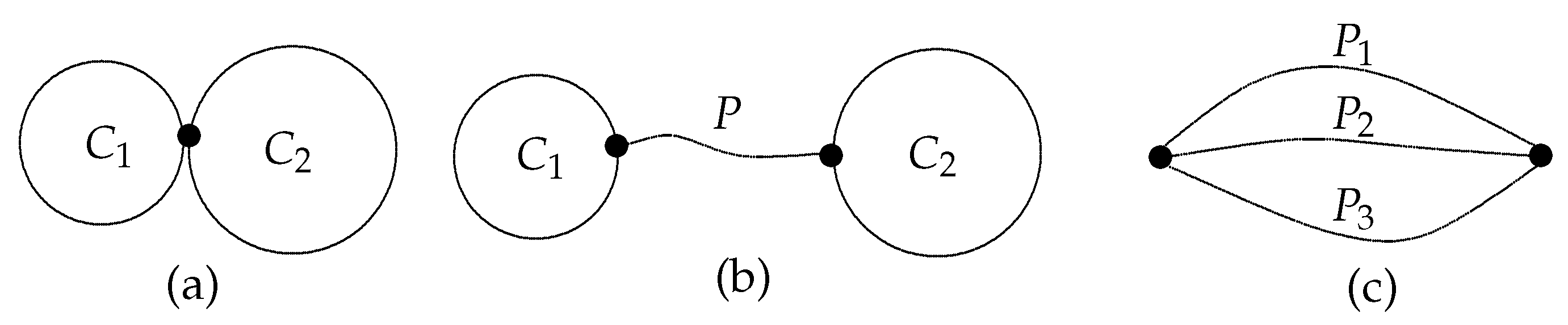
A graph H is a subdivision of a graph G if or H is obtained from G by inserting vertices of degree 2 into one or more edges of G. If G is a graph of order n and size m having cycle rank 2, then and G contains at least two cycles. Therefore, G has a subgraph that is isomorphic to one of the following three graphs:
- (1)
a graph obtained from two edge-disjoint cycles
and
by identifying a vertex in
and a vertex in
, as shown in
Figure 6a,
- (2)
a graph obtained from two vertex-disjoint cycles
and
and a nontrivial path
P by identifying an end-vertex of
P with a vertex of
and identifying the other end-vertex of
P with a vertex of
, as shown in
Figure 6b,
- (3)
a subdivision of
consisting of three internally disjoint paths
), as shown in
Figure 6c, where at least two paths
) have length 2 or more.
A graph G of cycle rank 2 is of type I if G contains exactly two edge-disjoint cycles and is of type II if G contains a subdivision of . The minimum degree of a graph G of cycle rank 2 is either 1 or 2.
Theorem 8. A graph G of cycle rank 2 is locally irregular-connected if and only if G has at most two regular edges and satisfies one of the following two conditions, depending on whether G is of type I or type II.
- (1)
If G is of type I, then each regular edge of G lies on a cycle and no cycle contains more than one regular edge.
- (2)
If G is of type , where is the set of the three paths forming the cycles in G, then each regular edge lies on some path in and no path in contains more than one regular edge.
Proof. We consider two cases, according to whether G is of type I or type II.
Case 1. G is of type I. We show that G is locally irregular-connected if and only if G has at most two regular edges such that each regular edge lies on a cycle and no cycle contains more than one regular edge.
First, suppose that G has at most two regular edges where each regular edge lies on a cycle and no cycle contains more than one regular edge. If G has no regular edge, then G is locally irregular-connected by Observation 2. If G contains exactly one regular edge e lying on a cycle, then is a spanning subgraph of G and has no regular edge. By Observation 2 again, G is locally irregular-connected. If G contains exactly two regular edges e and f lying on different cycles in G. Then is a spanning tree of G and has no regular edge. Once again, by Observation 2, G is locally irregular-connected.
For the converse, suppose that G contains three or more regular edges. We show that G is not locally irregular-connected. Let be three regular edges of G. It follows by Observation 1 that () is not a bridge and so lies on a cycle. This implies that at least one of the two cycles in G contains two or more regular edges. We may assume that is a cycle in G for some integer and and are regular edges for some integer i with . There are exactly two paths in G (both on C), namely and . Since contains and contains , neither nor is locally irregular. Thus, there is no locally irregular path in G and so G is not locally irregular-connected.
Case 2. G is of type II. Let be the set consisting of the three paths forming the cycles in G. We show that G is locally irregular-connected if and only if G has at most two regular edges such that each regular edge lies on some path in and no path in contains more than one regular edge.
First, suppose that G has at most two regular edges such that each regular edge lies on some path in and no path in contains more than one regular edge. If G has no regular edge, then G is locally irregular-connected by Observation 2. If G contains exactly one regular edge lying on a path in , then is a connected spanning subgraph of G and has no regular edge. By Observation 2 again, G is locally irregular-connected. If G contains exactly two regular edges e and f lying on different paths in , then is a spanning tree of G and has no regular edge. Once again, by Observation 2, G is locally irregular-connected.
For the converse, suppose that G contains three or more regular edges. We show that G is not locally irregular-connected. Let be three regular edges of G. It follows by Observation 1 that () is not a bridge and so lies on a path in .
- ⋆
First, suppose that there is path in containing two or more regular edges, say contains the regular edges and . Let for some integer and and where . There are exactly three paths in G, namely , , and . Since contains and both and contain , there is no locally irregular path in G and so G is not locally irregular-connected.
- ⋆
Next, suppose that each path () in contains exactly one regular edge, say for . Let for some integer and , where . There are exactly three paths in G, namely , , and . Since for , there is no locally irregular path in G and so G is not locally irregular-connected.
Next, we determine all sets S of positive integers that are the degree sets of locally irregular-connected graphs of cycle rank at most 2 as well as the minimum order of such a graph G with . We begin with 2-element sets S. □
Proposition 5. Let be a set of two positive integers where . There is a locally irregular-connected graph G of cycle rank 2 with if and only if or . In each case, the minimum order of a locally irregular-connected graph G of cycle rank 2 with is .
Proof. If
where
and
, there is a locally irregular-connected graph
G of cycle rank 2 with
(see
Figure 7, for example).
Next, suppose that
G is a locally irregular-connected graph of cycle rank 2 with
where
. Then,
is the minimum degree
of
G and
is the maximum degree
of
G. Since the minimum degree of every graph of cycle rank 2 is either 1 or 2, it follows that
. Let
C be one of the cycles of
G. By Theorem 8, there is at most one regular edge on
C and so at least two vertices on
C have different degrees. Hence,
. Thus,
. So
and
. Let
and
denote the number of vertices of degree
and
in
G, respectively. Since
G is a graph of cycle rank 2, its size is
and so
Since
, it follows that
. Because
and
are positive integer, either
and
or
and
. Therefore,
.
If G is a locally irregular-connected graph of cycle rank 2 with , then the order of G is at least and so the minimum order of a locally irregular-connected graph with degree set S is at least . Since the graph of order 4 is a locally irregular-connected graph G of cycle rank 2 with and the graph of order 5 is a locally irregular-connected graph G of cycle rank 2 with , the minimum order of a locally irregular-connected graph G of cycle rank 2 with is . □
Proposition 6. Let be a set of three positive integers with . There is a locally irregular-connected graph G of cycle rank 2 with if and only if . Furthermore, if , then the minimum order of a locally irregular-connected graph G of cycle rank 2 with is Proof. First, suppose that
G is a locally irregular-connected graph of cycle rank 2 with
. Since
, it follows that
G is not one of the graphs in
Figure 6. Hence,
G contains an end-vertex and so
. Next, let
where
.
- ⋆
If
and
, then let
G be one of the two graphs of maximum degree 3 in
Figure 8. By Theorem 8, these two graphs are locally irregular-connected. The graph of type I has order 8, while the graph of type II has order 6.
- ⋆
If
and
, then let
G be the graph of cycle rank 2 obtained from the graph
by adding
pendant edges at each of the two vertices of degree 3 in
. This is illustrated in
Figure 8 for
. Then, the order of
G is
and
. By Theorem 8,
G is locally irregular-connected.
- ⋆
If and , then let G be the graph of cycle rank 2 obtained from the graph by adding pendant edges at each of the two vertices of degree 2 in and adding pendant edges at each of the two vertices of degree 3 in . Then, the order of G is and . Since G has exactly one regular edge that lies on a cycle, it follows by Theorem 8 that G is locally irregular-connected.
Among all locally irregular-connected graphs of cycle rank 2 with degree set , where , let G be one of minimum order n. Then, the size of G is . We consider two cases, according to whether or .
Case 1. . There are two possibilities here depending on whether or .
Subcase . . First, suppose that G is of type I. Since , the two cycles and of order at least 3 are vertex-disjoint. Since G is locally irregular-connected, G contains no regular bridge. Thus, the path joining and has order at least 3. Since , there is at least one end-vertex in G. Therefore, . (In fact, is the minimum order of such a graph.)
Next, suppose that G is of type II. Since , it follows that and so . We show in fact that . Assume, to the contrary, that . Since , it follows that G is the graph obtained from by adding an end-vertex that is joined to a vertex of degree 2 in . This implies that all three vertices on one cycle of G have degree 3. Hence, G is not locally irregular-connected by Theorem 8 and so . Since there is a locally irregular-connected graph of cycle rank 2 that has order 6 and degree set , it follows that .
Subcase . . Let
x be a vertex of degree
. First, suppose that
G is of type I. Since there are at least 5 vertices lying on a cycle of
G, it follows that
G has at least 4 vertices (distinct from
x) having degree at least 2 and the remaining
vertices have degree at least 1. Thus,
and so
. Next, suppose that
G is of type II. Since there are at least 4 vertices lying on a cycle of
G, it follows that
G has at least 3 vertices (distinct from
x) such that one has degree at least 3 and the other two have degree at least 2. The remaining
vertices of
G have degree at least 1. Thus,
and so
. There are locally irregular-connected graphs of cycle rank 2 having order
and degree set
where
. One such graph is obtained from two triangles with exactly one common vertex
v by attaching
pendant edges at
v. Thus,
.
Case 2. . Let
x be a vertex of degree
. First, suppose that
G is of type I. Since there are at least 5 vertices lying on a cycle of
G, it follows that
G has at least 4 vertices (distinct from
x) having degree at least
and the remaining
vertices have degree at least 1. Thus,
and so
. Next, suppose that
G is of type II. Since there are at least 4 vertices lying on a cycle of
G, it follows that
G has at least 3 vertices (distinct from
x) having degree at least
. The remaining
vertices of
G have degree at least 1. Thus,
and so
. Since
, and it follows that
when
. There are locally irregular-connected graphs of cycle rank 2 having order
and degree set
, where
. One such graph is obtained from the graph
by (1) adding
pendant edges at each of the two vertices of degree 2 in
, (2) adding
pendant edges at one vertex of degree 3 in
, and (3) adding
pendant edges at the other vertex of degree 3 in
. Therefore,
. □
Proposition 7. Let be a set of positive integers with . There is a locally irregular-connected graph G of cycle rank 2 with if and only if . Furthermore, if , then the minimum order of a locally irregular-connected graph G of cycle rank 2 with is Proof. First, suppose that
G is a locally irregular-connected graph of cycle rank 2 with
. Since
, it follows that
G is not one of the graphs in
Figure 6. Hence,
G contains an end-vertex and so
. Next, let
where
.
- ⋆
If , then let G be the graph obtained from by (1) adding pendant edges at each of the two vertices of degree 2 in , (2) adding pendant edges at one vertex of degree 3 in , and (3) adding pendant edges at the other vertex of degree 3 in . Then, the order of G is and .
- ⋆
If
, then let
F be the graph of cycle rank 2 obtained from the
-cycle
by adding the edge
. The graph
G is obtained from
F by (1) adding
pendant edges at
for
and
and (2) adding
pendant edges at
for
and
. The order of
G is
and
.
Among all locally irregular-connected graphs of cycle rank 2 with degree set S{, , …, }, where , let G be one of minimum order n. Then, the size of G is . We consider two cases, according to whether or .
Case 1. . The graph
G contains at least one vertex of degree
for
. Since there are at least four vertices that are not end-vertices, there are at least two non-end vertices of the same degree
for some integer
i with
. The remaining
vertices have degree 1 or more. Hence,
so
Since there is a locally irregular-connected graph of cycle rank 2 that has order
and degree set
S, it follows that
.
Case 2. . The graph
G contains at least one vertex of degree
for
and the remaining
vertices have degree 1 or more. Hence,
and so
Since there is a locally irregular-connected graph of cycle rank 2 that has order
and degree set
S, it follows that
. □
Propositions 5–7 give rise to the following result.
Theorem 9. For an integer , let be a set of k positive integers with .
- (1)
If , then there is a locally irregular-connected graph G of cycle rank 2 with if and only if or . In either case, the minimum order of a locally irregular-connected graph G of cycle rank 2 with is .
- (2)
If , then there is a locally irregular-connected graph G of cycle rank 2 with if and only if . Furthermore, if , then the minimum order of a locally irregular-connected graph G of cycle rank 2 with is