Extended State Observer-Based Design of a Bilateral Dual-Kernel Fuzzy Control Algorithm


Abstract
1. Introduction
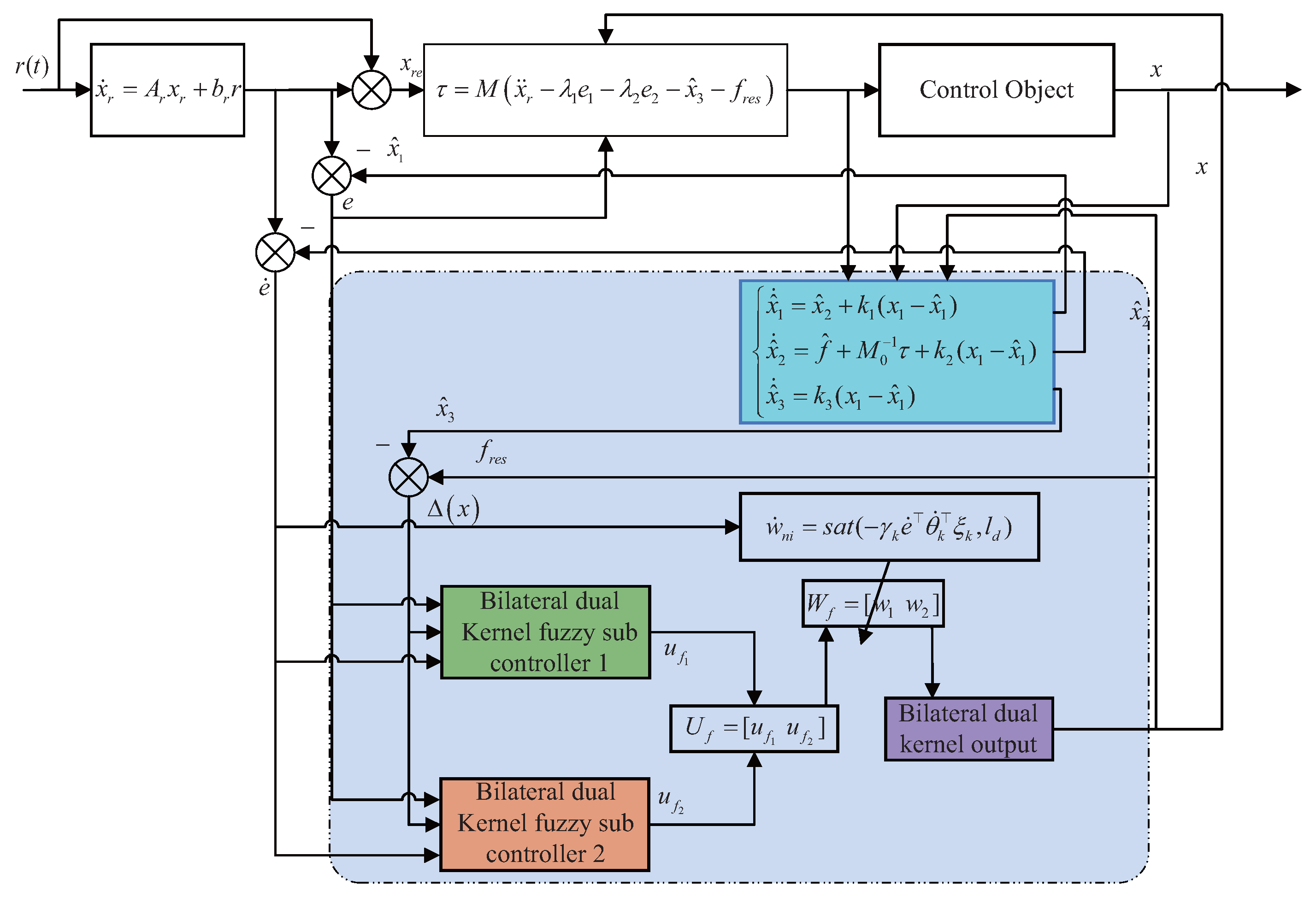
- Aiming at the problem that the joint angular velocity is unmeasurable during the actual operation of the robot, an extended state observer (ESO) is designed. By defining the unknown part and disturbance equation of the manipulator system, constructing augmented state variables and reasonably designing the observer gain parameters, this observer can realize the synchronous observation and estimation of joint position, velocity and the nonlinear part of the system.
- A dual-kernel fuzzy controller is designed. In the fuzzy controller, the dual-kernel function is used to replace the traditional single-kernel function to form the dual-kernel fuzzy controller. Compared with the traditional fuzzy controller, the dual-kernel fuzzy controller enhances the fast response ability to state signals, thereby improving the response speed of the controller and reducing the response time.
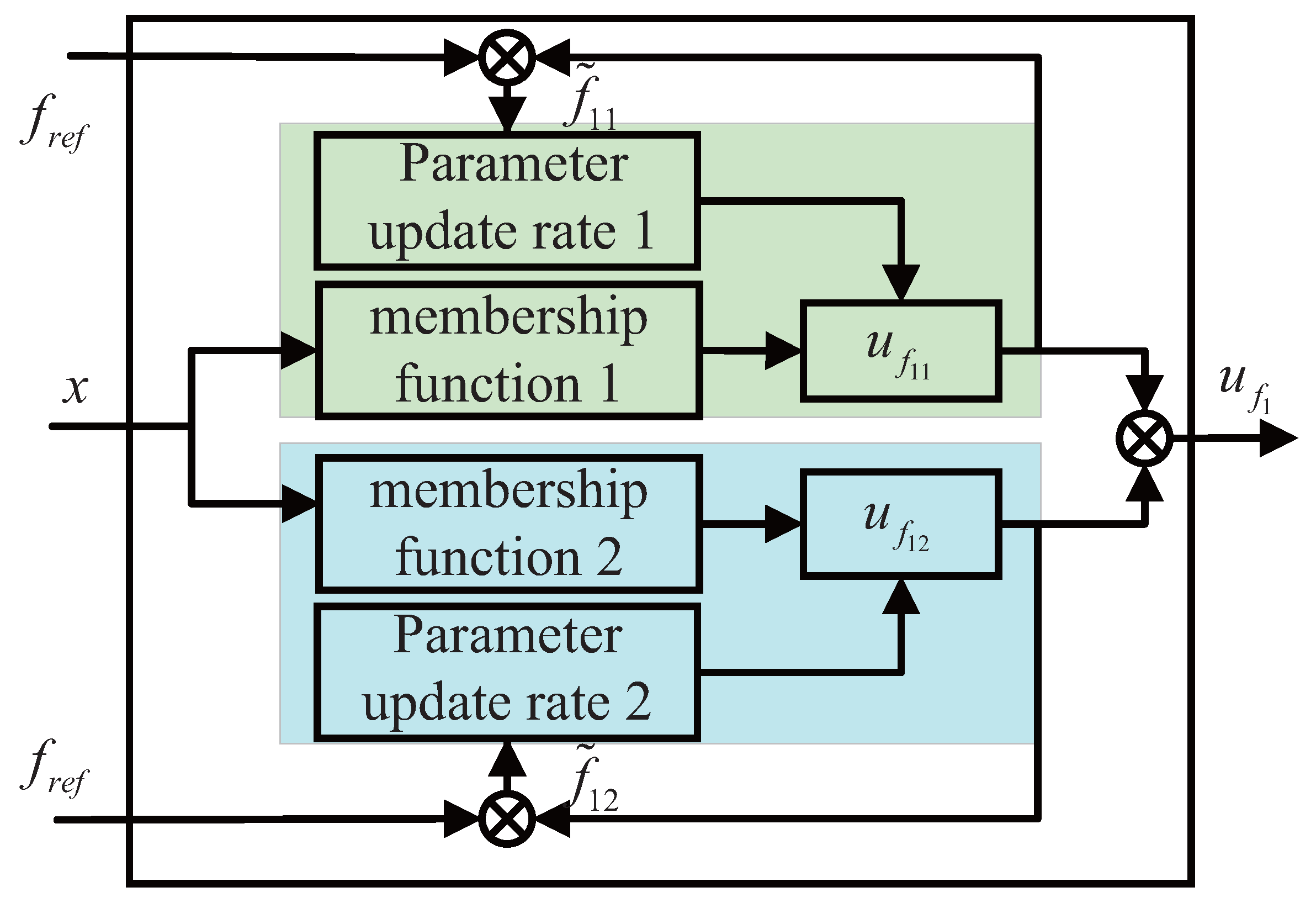
- A bilateral control strategy is proposed, wherein multiple unilateral dual-kernel fuzzy sub-controllers are integrated. The weighting parameters are continuously updated based on the approximation error, thereby improving the approximation accuracy of the control system in the presence of uncertainties.
2. Controller Design
3. Stability Analysis
4. Experimental Validation
4.1. Simulation Validation
4.1.1. Parameter Setting
4.1.2. Simulation Results and Analysis
4.2. Robot Platform Experimental Verification
4.2.1. Parameter Setting
4.2.2. Experimental Results and Analysis
5. Discussion
Author Contributions
Funding
Data Availability Statement
Conflicts of Interest
Abbreviations
| ESO | Extended State Observer |
| LESO | Linear Extended State Observer |
| NESO | Nonlinear Extended State Observer |
| ESO-BDKFC | Extended State Observer-based Bilateral Dual-Kernel Fuzzy Controller |
References
- Vrabel, R. Optimum settings for discrete PID control of nonlinear systems. Swarm Evol. Comput. 2025, 97, 102052. [Google Scholar] [CrossRef] [Scilit]
- Kutlu, F.; Atan, Ö.; Silahtar, O. Intuitionistic fuzzy adaptive sliding mode control of nonlinear systems: F. Kutlu et al. Soft Comput. 2020, 24, 53–64. [Google Scholar] [CrossRef] [Scilit]
- Lan, J.; Zhao, X.; Sun, C. Data-Driven Sliding Mode Control for Partially Unknown Nonlinear Systems. Int. J. Robust Nonlinear Control 2026, 36, 629–638. [Google Scholar] [CrossRef] [Scilit]
- Lan, Y.H.; Yuan, Y.K.; Wu, J.Y.; Ding, L. Integral Sliding Mode Preview Repetitive Control for Continuous-Time Nonlinear Systems. Int. J. Adapt. Control Signal Process. 2026, 40, 200–209. [Google Scholar] [CrossRef] [Scilit]
- Li, Y.; Li, K.; Tong, S. Reinforcement learning-based adaptive finite-time performance constraint control for nonlinear systems. IEEE Trans. Syst. Man Cybern. Syst. 2023, 54, 1335–1344. [Google Scholar] [CrossRef] [Scilit]
- Chen, T.; Kapronand, N.; Hsieh, C.Y.; Cy Chen, J. Evolved auxiliary controller with applications to aerospace. Aircr. Eng. Aerosp. Technol. 2021, 93, 529–543. [Google Scholar] [CrossRef] [Scilit]
- Cheng, L.; Wang, Z.; Jiang, F.; Li, J. Adaptive neural network control of nonlinear systems with unknown dynamics. Adv. Space Res. 2021, 67, 1114–1123. [Google Scholar] [CrossRef] [Scilit]
- Cabrer, L.M.; Mundici, D. A Stone–Weierstrass theorem for MV-algebras and unital l-groups. J. Log. Comput. 2014, 25, 683–699. [Google Scholar] [CrossRef] [Scilit]
- Shanthi, S.A.; Sathiyapriya, G. Universal approximation theorem for a radial basis function fuzzy neural network. Mater. Today Proc. 2022, 51, 2355–2358. [Google Scholar] [CrossRef] [Scilit]
- Chiang, M.H. The velocity control of an electro-hydraulic displacement-controlled system using adaptive fuzzy controller with self-tuning fuzzy sliding mode compensation. Asian J. Control 2011, 13, 492–504. [Google Scholar] [CrossRef] [Scilit]
- Mei, K.; Ding, S.; Zheng, W.X. Fuzzy adaptive SOSM based control of a type of nonlinear systems. IEEE Trans. Circuits Syst. II Express Briefs 2021, 69, 1342–1346. [Google Scholar] [CrossRef] [Scilit]
- Phan, V.D.; Nguyen, H.L.; Le, V.C.; Ahn, K.K. Position tracking control of electro-hydrostatic actuators via adaptive finite-time backstepping and state observation. Sci. Rep. 2026, 16, 14433. [Google Scholar] [CrossRef] [Scilit]
- Li, Q.; Wang, T.; Li, S.; Chen, W.; Liu, H.; Breaz, E.; Gao, F. Online extremum seeking-based optimized energy management strategy for hybrid electric tram considering fuel cell degradation. Appl. Energy 2021, 285, 116505. [Google Scholar] [CrossRef] [Scilit]
- Zhang, J.; Gao, W.; Guo, Q. Extended state observer-based sliding mode control design of two-dof lower limb exoskeleton. Actuators 2023, 12, 402. [Google Scholar] [CrossRef] [Scilit]
- Ding, B.; Pan, Y.; Lu, Q. Neural adaptive optimal control for nonlinear multiagent systems with full-state constraints and immeasurable states. Neurocomputing 2023, 544, 126259. [Google Scholar] [CrossRef] [Scilit]
- Wang, Z.; Shen, J.; Li, L.; Shen, M.; Meng, X. Iterative learning adaptive control with completely unknown states. Int. J. Robust Nonlinear Control 2026, 36, 1772–1780. [Google Scholar] [CrossRef] [Scilit]
- Li, J.; Xia, Y.; Qi, X.; Wan, H. On convergence of the discrete-time nonlinear extended state observer. J. Frankl. Inst. 2018, 355, 501–519. [Google Scholar] [CrossRef] [Scilit]
- Fan, A.; Chang, S. Extended state observer-based backstepping sliding mode control for an electromagnetic valve actuator. J. Mech. Sci. Technol. 2019, 33, 847–856. [Google Scholar] [CrossRef] [Scilit]
- Cao, L.; Yang, X.; Wang, G.; Liu, Y.; Hu, Y. Fault detection based on extended state observer and interval observer for UAVs. Aircr. Eng. Aerosp. Technol. 2022, 94, 1759–1771. [Google Scholar] [CrossRef] [Scilit]
- Naghdi, M.; Sadrnia, M.A. A novel fuzzy extended state observer. ISA Trans. 2020, 102, 1–11. [Google Scholar] [CrossRef] [Scilit]
- Diao, S.; Zhao, X.; Zhao, D.; Dong, Z. Hierarchical control of nonlinear uncertain active suspension system based on extended state observer. J. Vib. Eng. Technol. 2025, 13, 178. [Google Scholar] [CrossRef] [Scilit]
- Zhang, X.; Ye, Z.; Zhang, D.; Cheng, J.; Yan, H. Finite-time extended state observer-based sliding mode control of near-space vehicle systems. Asian J. Control 2025, 27, 2088–2094. [Google Scholar] [CrossRef] [Scilit]
- Wang, L.; Chen, J.; Huang, Y.; Zhu, Y.; Pei, H. Geometric attitude tracking control of quadrotor UAVs with adaptive extended state observers. ISA Trans. 2025, 160, 289–297. [Google Scholar] [CrossRef] [Scilit] [PubMed]
- Raheem, F.A.; Hasan, A.F.; Flaieh, E.H.; Humaidi, A.J. A Nonlinear Disturbance Observer-Based Super-Twisting Sliding Mode Controller for a Knee-Assisted Exoskeleton Robot. Automation 2026, 7, 23. [Google Scholar] [CrossRef] [Scilit]
- Ismael, O.Y.; Alnema, Y.H.S.; Hameed, A.H.; Humaidi, A.J. Robust control of a magnetic levitation system via LESO-based feedback linearization tuned by modified flood algorithm. Int. J. Dyn. Control 2026, 14, 14. [Google Scholar] [CrossRef] [Scilit]
- Alawad, N.A.; Humaidi, A.J.; Al-Obaidi, A.S.M.; Alaraji, A.S. Active disturbance rejection control of wearable lower-limb system based on reduced ESO. Indones. J. Sci. Technol. 2022, 7, 203–218. [Google Scholar] [CrossRef] [Scilit]
- Yunjun, C.; Chao, J.; Jiuzhi, D.; Zhanshan, Z. Output feedback sliding mode control based on adaptive sliding mode disturbance observer. Meas. Control 2022, 55, 646–656. [Google Scholar] [CrossRef] [Scilit]
- Behera, A.K.; Mondal, S.; Bandyopadhyay, B. A decoupled design of a robust sliding mode observer. Automatica 2023, 148, 110799. [Google Scholar] [CrossRef] [Scilit]
- Ma, C.; Zhou, S.; Wang, Z.; Zhang, H.; Xu, L.; Miao, J. In-motion fine alignment algorithm for AUV based on improved extended state observer and Kalman filter. Meas. Sci. Technol. 2024, 35, 126305. [Google Scholar] [CrossRef] [Scilit]
- Chebbi, A.; Franchek, M.A.; Grigoriadis, K. Simultaneous State and Parameter Estimation Methods Based on Kalman Filters and Luenberger Observers: A Tutorial & Review. Sensors 2025, 25, 7043. [Google Scholar] [CrossRef] [Scilit]
- Anderson, B.D.; Dehghani, A. Challenges of adaptive control–past, permanent and future. Annu. Rev. Control 2008, 32, 123–135. [Google Scholar] [CrossRef] [Scilit]
- Ma, M.; Wang, T.; Qiu, J.; Karimi, H.R. Adaptive fuzzy decentralized tracking control for large-scale interconnected nonlinear networked control systems. IEEE Trans. Fuzzy Syst. 2020, 29, 3186–3191. [Google Scholar] [CrossRef] [Scilit]
- Fei, J.; Chen, Y.; Liu, L.; Fang, Y. Fuzzy multiple hidden layer recurrent neural control of nonlinear system using terminal sliding-mode controller. IEEE Trans. Cybern. 2021, 52, 9519–9534. [Google Scholar] [CrossRef] [Scilit] [PubMed]
- Wang, J.; Ma, J.; Pan, H.; Sun, W. Event-triggered adaptive saturated fault-tolerant control for unknown nonlinear systems with full state constraints. IEEE Trans. Autom. Sci. Eng. 2023, 21, 1837–1849. [Google Scholar] [CrossRef] [Scilit]
- Sui, S.; Chen, C.P.; Tong, S. Neural-network-based adaptive DSC design for switched fractional-order nonlinear systems. IEEE Trans. Neural Netw. Learn. Syst. 2020, 32, 4703–4712. [Google Scholar] [CrossRef] [Scilit]
- Lee, H.; Utkin, V.I. Chattering suppression methods in sliding mode control systems. Annu. Rev. Control 2007, 31, 179–188. [Google Scholar] [CrossRef] [Scilit]
- Zhang, L.; Ding, H.; Shi, J.; Huang, Y.; Chen, H.; Guo, K.; Li, Q. An adaptive backstepping sliding mode controller to improve vehicle maneuverability and stability via torque vectoring control. IEEE Trans. Veh. Technol. 2020, 69, 2598–2612. [Google Scholar] [CrossRef] [Scilit]
- Wang, B.; Shen, Y.; Li, N.; Zhang, Y.; Gao, Z. An adaptive sliding mode fault-tolerant control of a quadrotor unmanned aerial vehicle with actuator faults and model uncertainties. Int. J. Robust Nonlinear Control 2023, 33, 10182–10198. [Google Scholar] [CrossRef] [Scilit]
- Vieira Hollweg, G.; Dias de Oliveira Evald, P.J.; Grundling, H.A.; Su, W. Lyapunov stability analysis of an RMRAC-based adaptive sigmoid super-twisting sliding mode under matched and unmatched uncertainties. Int. J. Robust Nonlinear Control 2024, 34, 11887–11923. [Google Scholar] [CrossRef] [Scilit]
- Amer, A.F.; Sallam, E.A.; Elawady, W.M. Quasi sliding mode-based single input fuzzy self-tuning decoupled fuzzy PI control for robot manipulators with uncertainty. Int. J. Robust Nonlinear Control 2012, 22, 2026–2054. [Google Scholar] [CrossRef] [Scilit]
- Nguyen, A.T.; Taniguchi, T.; Eciolaza, L.; Campos, V.; Palhares, R.; Sugeno, M. Fuzzy control systems: Past, present and future. IEEE Comput. Intell. Mag. 2019, 14, 56–68. [Google Scholar] [CrossRef] [Scilit]
- Bucolo, M.; Fortuna, L.; La Rosa, M. Complex dynamics through fuzzy chains. IEEE Trans. Fuzzy Syst. 2004, 12, 289–295. [Google Scholar] [CrossRef]
- Murari, A.; Vagliasindi, G.; Arena, P.; Fortuna, L.; Barana, O.; Johnson, M.; Contributors, J.E. Prototype of an adaptive disruption predictor for JET based on fuzzy logic and regression trees. Nucl. Fusion 2008, 48, 035010. [Google Scholar] [CrossRef] [Scilit]
- Wei, X.; Yan, Z.; Liang, X. A survey on fuzz testing technologies for industrial control protocols. J. Netw. Comput. Appl. 2024, 232, 104020. [Google Scholar] [CrossRef] [Scilit]






| Input: Desired trajectory |
| Output: Control input u |
| 1: Initialization: |
| Set initial states , . |
| Set ESO states . |
| Initialize fuzzy parameters , . |
| Set control gains and adaptation gains. |
| 2: Loop for each sampling time t: |
| 3: Measurement: obtain system output q. |
| 4: Error computation: |
| 5: ESO update (state and disturbance estimation): |
| Obtain estimates: |
| 6: State reconstruction: . |
| 7: Fuzzy system approximation (double-kernel structure): |
| 8: Bilateral fuzzy control law: |
| 9: Parameter adaptation law: |
| 10: Stability compensation update (ESO + fuzzy coupling): update gains if required based on Lyapunov design. |
| 11: Apply control input: send u to mechanical system. |
| 12: End loop |
| LESO | NESO | ESO-BDKFC | |
|---|---|---|---|
| 0.001363 | 0.0005333 | 0.0001367 | |
| 0.002156 | 0.002093 | 0.002032 | |
| 0.00208 | 0.001217 | 0.0010015 | |
| 0.008209 | 0.00769 | 0.007206 |
| PID | LESO | NESO | ESO-BDKFC | |
|---|---|---|---|---|
| 0.49113 | 0.27782 | 0.27154 | 0.19716 | |
| 0.76142 | 0.73529 | 0.55818 | 0.47008 |
Disclaimer/Publisher’s Note: The statements, opinions and data contained in all publications are solely those of the individual author(s) and contributor(s) and not of MDPI and/or the editor(s). MDPI and/or the editor(s) disclaim responsibility for any injury to people or property resulting from any ideas, methods, instructions or products referred to in the content. |
© 2026 by the authors. Licensee MDPI, Basel, Switzerland. This article is an open access article distributed under the terms and conditions of the Creative Commons Attribution (CC BY) license.
Share and Cite
Liu, C.; Chen, L.; Wang, Z.; Liu, Q. Extended State Observer-Based Design of a Bilateral Dual-Kernel Fuzzy Control Algorithm. Mathematics 2026, 14, 1765. https://doi.org/10.3390/math14101765
Liu C, Chen L, Wang Z, Liu Q. Extended State Observer-Based Design of a Bilateral Dual-Kernel Fuzzy Control Algorithm. Mathematics. 2026; 14(10):1765. https://doi.org/10.3390/math14101765
Chicago/Turabian StyleLiu, Chuqiang, Lujun Chen, Zhulin Wang, and Qunpo Liu. 2026. "Extended State Observer-Based Design of a Bilateral Dual-Kernel Fuzzy Control Algorithm" Mathematics 14, no. 10: 1765. https://doi.org/10.3390/math14101765
APA StyleLiu, C., Chen, L., Wang, Z., & Liu, Q. (2026). Extended State Observer-Based Design of a Bilateral Dual-Kernel Fuzzy Control Algorithm. Mathematics, 14(10), 1765. https://doi.org/10.3390/math14101765