All articles published by MDPI are made immediately available worldwide under an open access license. No special
permission is required to reuse all or part of the article published by MDPI, including figures and tables. For
articles published under an open access Creative Common CC BY license, any part of the article may be reused without
permission provided that the original article is clearly cited. For more information, please refer to
https://www.mdpi.com/openaccess.
Feature papers represent the most advanced research with significant potential for high impact in the field. A Feature
Paper should be a substantial original Article that involves several techniques or approaches, provides an outlook for
future research directions and describes possible research applications.
Feature papers are submitted upon individual invitation or recommendation by the scientific editors and must receive
positive feedback from the reviewers.
Editor’s Choice articles are based on recommendations by the scientific editors of MDPI journals from around the world.
Editors select a small number of articles recently published in the journal that they believe will be particularly
interesting to readers, or important in the respective research area. The aim is to provide a snapshot of some of the
most exciting work published in the various research areas of the journal.
This paper investigates the distributed formation control problem for nonlinear multiagent systems subject to full-state constraints and proposes a predefined-time neural adaptive control scheme based on a nonlinear mapping technique. To handle the time-varying asymmetric constraints on system states, a smooth and invertible nonlinear mapping function is introduced to transform the original constrained states into unconstrained variables, thereby eliminating the dependence on initial conditions typically required by traditional barrier Lyapunov functions. Within this transformed framework, a predefined-time distributed formation control law is developed, which guarantees that all followers converge to the desired formation configuration and track the leader’s trajectory within a user-specified time upper bound, independent of the initial states. Radial basis function neural networks are employed to approximate the unknown nonlinear dynamics of each agent, and adaptive laws are designed to update the network weights online. Theoretical analysis shows that all closed-loop signals remain bounded, the original system states strictly stay within their prescribed constraint boundaries at all times, and the formation tracking errors converge to a small neighborhood of the origin within the predefined time. Numerical simulations validate the effectiveness of the proposed method, demonstrating faster convergence, higher steady-state accuracy, and improved robustness to initial conditions compared to existing control approaches.
In recent decades, the distributed coordinated control of multiagent systems (MASs) has attracted widespread attention in both the academic and industrial communities due to its expansive applications in unmanned aerial vehicle formations, autonomous robotic swarms, sensor networks, and smart grids [1,2,3]. At the core of MAS cooperation lies the fundamental problem of consensus or formation tracking, which requires all distributed agents to reach an agreement on specific state trajectories or to seamlessly follow a dynamic leader via localized communication topologies [4,5,6]. However, operating in complex, dynamically changing environments inevitably introduces uncertain nonlinear dynamics into each individual agent. To address these inherent structural uncertainties and guarantee accurate tracking performance, adaptive neural network control has emerged as an exceptionally robust strategy [7,8,9]. By leveraging the universal approximation capability of radial basis function (RBF) neural networks, unknown smooth nonlinear functions can be effectively approximated without requiring a precise system model [10,11,12]. For high-order nonaffine or strict-feedback nonlinear MASs, backstepping is commonly combined with neural network approximation in control design [13,14,15].
Real-world physical systems are strictly governed by mechanical limitations, safety specifications, and operational boundaries. Consequently, the state variables of agents must be rigorously confined within predefined constraint regions. Ignoring full-state constraints can severely deteriorate transient performance or even cause hardware failures. To enforce state constraints, arrier Lyapunov functions (BLFs) are commonly integrated into adaptive backstepping [16,17,18]. The BLF grows to infinity as states approach the specified boundary, thereby preventing constraint violations [19,20]. However, BLF-based control requires stringent feasibility conditions on virtual control laws during the recursive backstepping procedure, which are difficult to verify and limit design flexibility [21,22,23]. To overcome these limitations, alternative methods such as nonlinear mapping functions have been proposed [24,25]. By converting the constrained system into an equivalent unconstrained representation, the nonlinear mapping approach bypasses the feasibility bottlenecks of BLFs and simplifies control design [26,27].
Beyond safety constraints, the convergence speed of the cooperative tracking error remains a pivotal performance metric for multiagent systems. Asymptotic consensus guarantees convergence only as time tends to infinity, which is insufficient for time-critical missions. Finite-time control ensures convergence within a bounded time [28,29], but the settling time depends on the initial states [30,31,32]. Fixed-time control removes this dependency, yet the upper bound is often a complex function of controller gains, making tuning difficult [33,34,35]. By contrast, predefined-time control [36,37,38] allows the user to explicitly prescribe a constant settling time in the controller design, achieving convergence within that bound regardless of initial conditions and without complex gain tuning [39,40,41,42].
Inspired by the discussion above, we develop a novel distributed predefined-time neural [43] adaptive control scheme for a class of leader-following multiagent systems, characterized by uncertain affine nonlinear second-order dynamics and full-state constraints. By synergizing a nonlinear mapping technique with an adaptive predefined-time backstepping framework, the proposed approach ensures that all closed-loop signals are cooperatively semi-globally uniformly ultimately bounded (CSUUB). To sum up, the main contributions of our work are listed as follows.
Compared with traditional finite-time and fixed-time control methods, the proposed controller guarantees the convergence of the tracking error within a constant predefined time prescribed by the user for any initial condition, which solves a vital problem in the distributed control field. Many practical cooperative multiagent systems are required to achieve a fast steady response from the transient response. This article provides a predefined-time cooperative control method wherein the settling time is an explicit parameter decoupled entirely from the initial states, thus meeting this stringent demand directly.
Although the considered system is subject to strict full-state physical constraints, the presented global predefined-time adaptive control scheme guarantees that the closed-loop system remains stable without suffering from the highly restrictive feasibility conditions of BLFs. This means that the control method in this article is superior to the existing approaches relying heavily on BLF architectures. The reason is that a novel state-dependent nonlinear mapping is explicitly applied to transform the fully constrained tracking error system into an equivalent unconstrained space. Consequently, this circumvents the complicated inequality checks inherent in BLF-based backstepping, while still guaranteeing constraint satisfaction. Moreover, the presented controller ensures that the tracking error converges to zero within the preset time even in the presence of strong system uncertainties.
RBF neural networks are seamlessly integrated into the backstepping procedure rather than relying on precise modeling. The distributed adaptive weight update laws are formulated using solely local information exchanged over a directed communication graph, successfully eliminating the need for global network topology knowledge. Furthermore, the derivatives of the virtual control laws are efficiently handled without inducing singularities, which successfully avoids the traditional problem of “explosion of complexity” during recursive design, thereby streamlining implementation for high-order interconnected systems.
2. System and Problem Presentation
A.
System formation
Consider a class of leader-following multiagent systems, characterized by uncertain affine nonlinear second-order dynamics and comprising a single leader agent 0, numbering followers. The follower agent of the affine nonlinear multiagent system is described by the following dynamics:
where are the states of the affine nonlinear multiagent system , is the output of the system, denotes the controller need to be designed, the functions and belong to a class of unknown smooth nonlinear functions for . The dynamics of the leader agent are described by:
where represents the output of the leader agent, and error states are defined as .
Let represent the directed communication graph among the agents. The node set denotes the collection of agents. The edge set describes the information flow. An edge signifies that agent can directly receive information from agent . In this case, agent is considered a neighbor of agent . The neighbor set of agent is therefore .
The adjacency matrix encodes the topology of . Its elements are defined such that if , otherwise, . For a weighted graph, the value represents the weight of the edge. Self-loops are excluded, meaning for all . Finally, the degree matrix is a diagonal matrix with its diagonal entries given by the in-degrees .
In the context of controlling nonlinear systems with full-state constraints, a nonlinear mapping is a transformation technique that converts a constrained system into an equivalent unconstrained one. Then the nonlinear mapping method is proposed as
therefore, to satisfy the full-state constraints, the multiagent system (1) is transformed into:
with
where , , , and are positive constants with .
The local tracking error for agent is given by:
where , the element of the adjacency matrix characterizes the information flow between follower agents, denotes the pinning gain that reflects the connection between a follower and the leader.
It is well known that RBF neural networks have the capability to approximate unknown nonlinear functions with arbitrary accuracy. Such an approximation can be described as:
where is the ideal constant weight matrix, and denotes the reconstruction error, which is defined as:
B.
Predefined-Time Stability
Consider the nonlinear system
where is the state vector, is the parameter vector, and is a smooth nonlinear function satisfying (i.e., the origin is an equilibrium).
Definition1
[44].(Predefined-Time Stability): Consider the nonlinear system (9), the origin is said to be predefined time stable, if the solutionhold when , and is a constant independent of the initial condition .
Lemma1.
For nonlinear system (9), the origin of system (9) is predefined-time stable if there exists a Lyapunov functionsuch that for any initial condition , the derivative of along the trajectories of (9) satisfies
where , is a constant and is the predefined settling time.
Proof.
Define , then and . Substituting the given differential inequality gives
find the solution of the differential equation
therefore
The bound becomes zero when the argument of the logarithm equals one, as
Hence , proving finite-time convergence and is the predefined settling time. □
Definition2
[44].Consider the multiagent system (1) operating under a directed graph. The tracking errors are said to be cooperatively semi-globally uniformly ultimately bounded (CSUUB) if there exist constants, and bounds , all independent of , such that for any and , there exists (independent of ) for which the following hold for all :
where , .
This paper addresses the design of an adaptive neural consensus tracking protocol for the multiagent system (1) via a backstepping technique. The primary goal is to guarantee that all closed-loop signals are CSUUB and that each follower’s output asymptotically tracks the leader’s output .
[44].For any positive constants , then the following inequality holds:
Lemma4
[44].For any positive constants , and, then the following inequality holds:
Lemma5
[45].For, let, then the following inequality holds:
where .
Notation: In this article, represents estimated weight, represents ideal weight, then define , and hold.
3. Main Results
This section presents a distributed adaptive neural network control scheme for a class of nonaffine nonlinear leader-following multiagent systems. By integrating predefined-time stability theory with a backstepping design, the proposed controller utilizes neural networks to approximate unknown nonlinearities, with adaptive predefined-time laws governing the weight updates. The closed-loop error system is proven to achieve predefined-time consensus, ensuring that all followers track the leader within a predefined settling time independent of the initial conditions.
Based on the local tracking error for agent in (6), the time-derivative can be derived from (4) as
RBF NNs are utilized to approximate the unknown nonlinear term over a compact set , yielding
where is the ideal constant weight vector with , is the regressor vector, and is the approximation error bounded by with .
Following the backstepping design procedure for system (20), the virtual control input is chosen as:
design the filter as
where , then the dynamics of can be derived as:
where , , , .
Select a Lyapunov function candidate as:
the time derivative of (25) is given by:
where , , , and the adaptive law for the neural networks is designed as:
With the error state and system (4) as the foundation, the following holds:
RBF NNs are utilized to approximate the unknown nonlinear term over a compact set , yielding
where is the ideal constant weight vector with , is the regressor vector, and is the approximation error bounded by with .
Following the backstepping design procedure for the system (28), the virtual control input is chosen as:
design the filter as
where , then the dynamics of can be derived as:
where , , , .
Select a Lyapunov function candidate as:
the time derivative of (25) is given by:
where , and the adaptive law for the neural networks is designed as:
With the error state and system (4) as the foundation, the following holds:
RBF NNs are utilized to approximate the unknown nonlinear term over a compact set , yielding
where is the ideal constant weight vector with , is the regressor vector, and is the approximation error bounded by with .
Following the backstepping design procedure for the system (36), the control input is chosen as:
then, the dynamics of can be derived as:
where , .
Select a Lyapunov function candidate as:
the time derivative of (40) is given by:
where , and the adaptive law for the neural networks is designed as:
Theorem1.
To achieve constraint control for the nonaffine nonlinear leader-following multiagent system (1), a nonlinear mapping is designed in conjunction with the local tracking error system (6), an adaptive predefined-time neural network control scheme is developed based on the backstepping technique. The virtual control laws are designed as (22) and (30), the distributed adaptive predefined-time update laws are given by (27), (35), (42) and the actual controller is constructed as (38). Under the proposed control scheme, the tracking error system achieves predefined-time consensus, and the convergence time is independent of the initial conditions.
Proof.
Choose Lyapunov candidate functional as
the time derivative of (43) is given by:
based on Lemma 5, and suppose , the parameters are selected to satisfy , then
where , therefore, are bounded.
Choose Lyapunov candidate functional as
then
the design parameter satisfies , then
According to Lemma 2,
choose parameters , , based on Lemma 3 and Lemma 4, then
Based on Lemma 3 and Lemma 4,
then we have
choose the parameters , , , then
based on Lemma 1, the tracking error system achieves predefined-time consensus at the predefined time . □
Remark1.
This subsection analyzes the computational complexity of the proposed controller. The main burden comes from: (i) backstepping recursion: per agent; (ii) RBF network approximation and weight update: each; (iii) multiagent interactions: per agent. The overall per-agent complexity per step is . For moderate and, real-time implementation is feasible (sampling time seconds in our simulations). For large-scale systems with dense topologies (), the complexity may become a bottleneck; possible remedies (event-triggered control, distributed computing, or network sparsification) are discussed as future work.
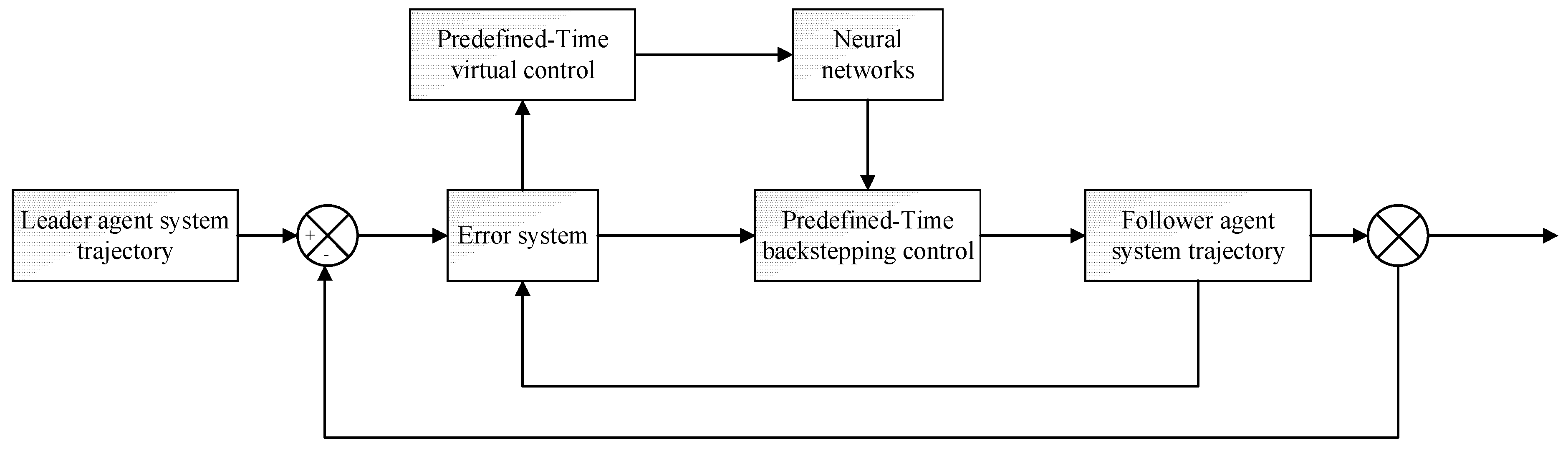
Figure 1 shows the control structure. The leader agent system trajectory provides the reference path. The error system compares it with the follower agents’ motion to generate tracking errors. These errors are fed into the predefined-time virtual control, then to the predefined-time backstepping control with the help of neural networks that handle system uncertainties. Finally, the follower agent system trajectory tracks the leader’s within a predefined time.
4. Simulation
This section presents simulation examples that demonstrate the validity of the proposed controller, highlighting its ability to achieve the desired control objectives under various scenarios.
Example1.
Consider a class of leader-following multiagent systems, where the i follower agent of this affine nonlinear multiagent system is described by the following dynamic equation:
where , andrepresent the position and velocity of the agent, respectively. The parameters , , and the initial condition for each follower agent are listed in Table 1. All other simulation settings are the same as in Example 1 and Example 2.
The adjacency matrix
In the controller design, to address the unknown nonlinear dynamics, an RBF neural network is adopted for online approximation. Gaussian functions are chosen as the basis functions due to their simplicity, smoothness, and universal approximation capability. The network input vector includes position and velocity information, and the hidden layer contains a preset number of nodes, with the center and width of each node determined based on the input signal range to ensure effective coverage of the system’s operating region.
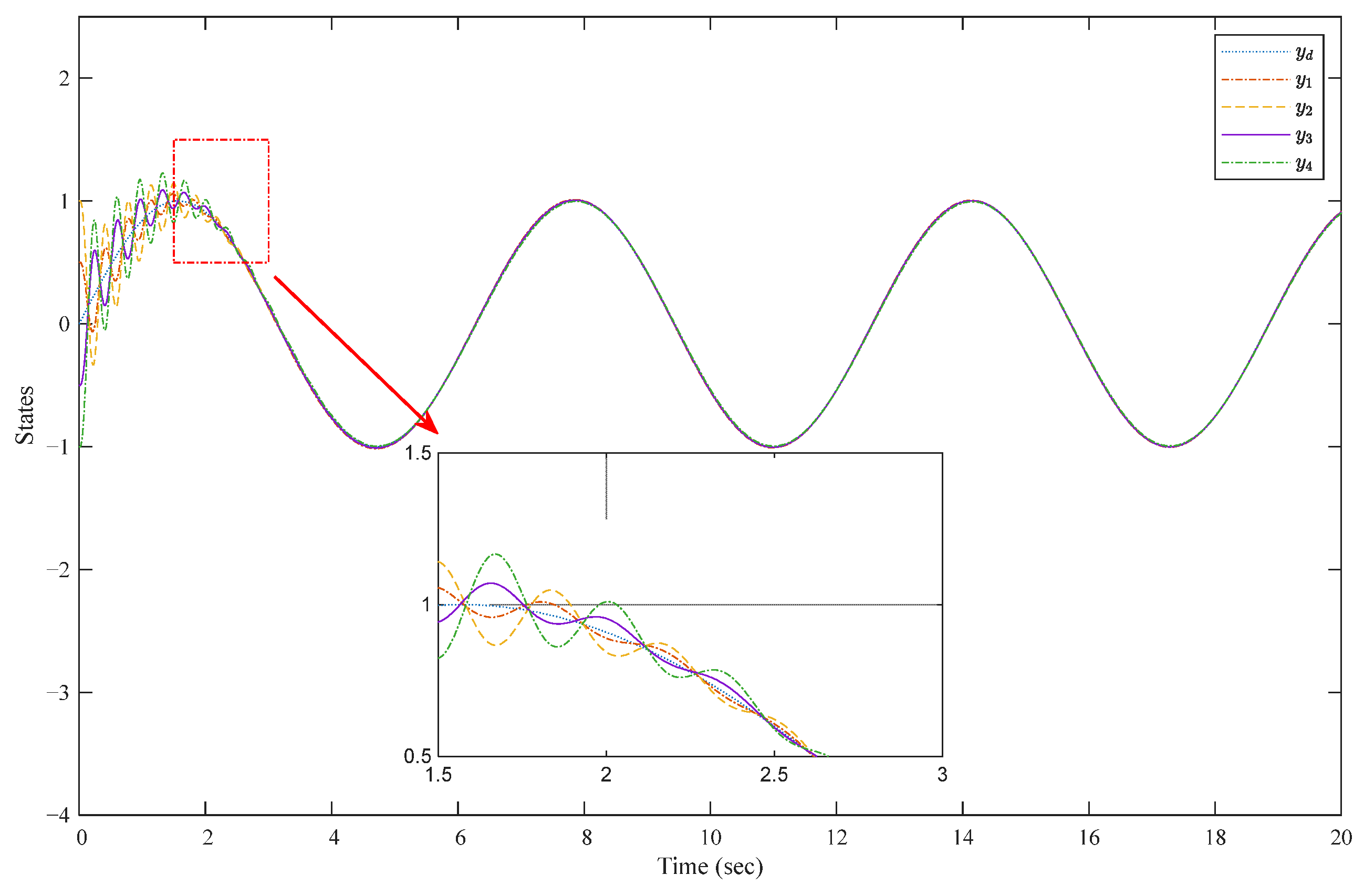
Figure 2 shows the position trajectories of the leader and the four followers. The leader follows a sinusoidal reference. Although the followers start from dispersed initial positions, they quickly catch up with the leader and thereafter track the sinusoidal trajectory with high accuracy, demonstrating the fast and precise tracking capability of the proposed scheme.
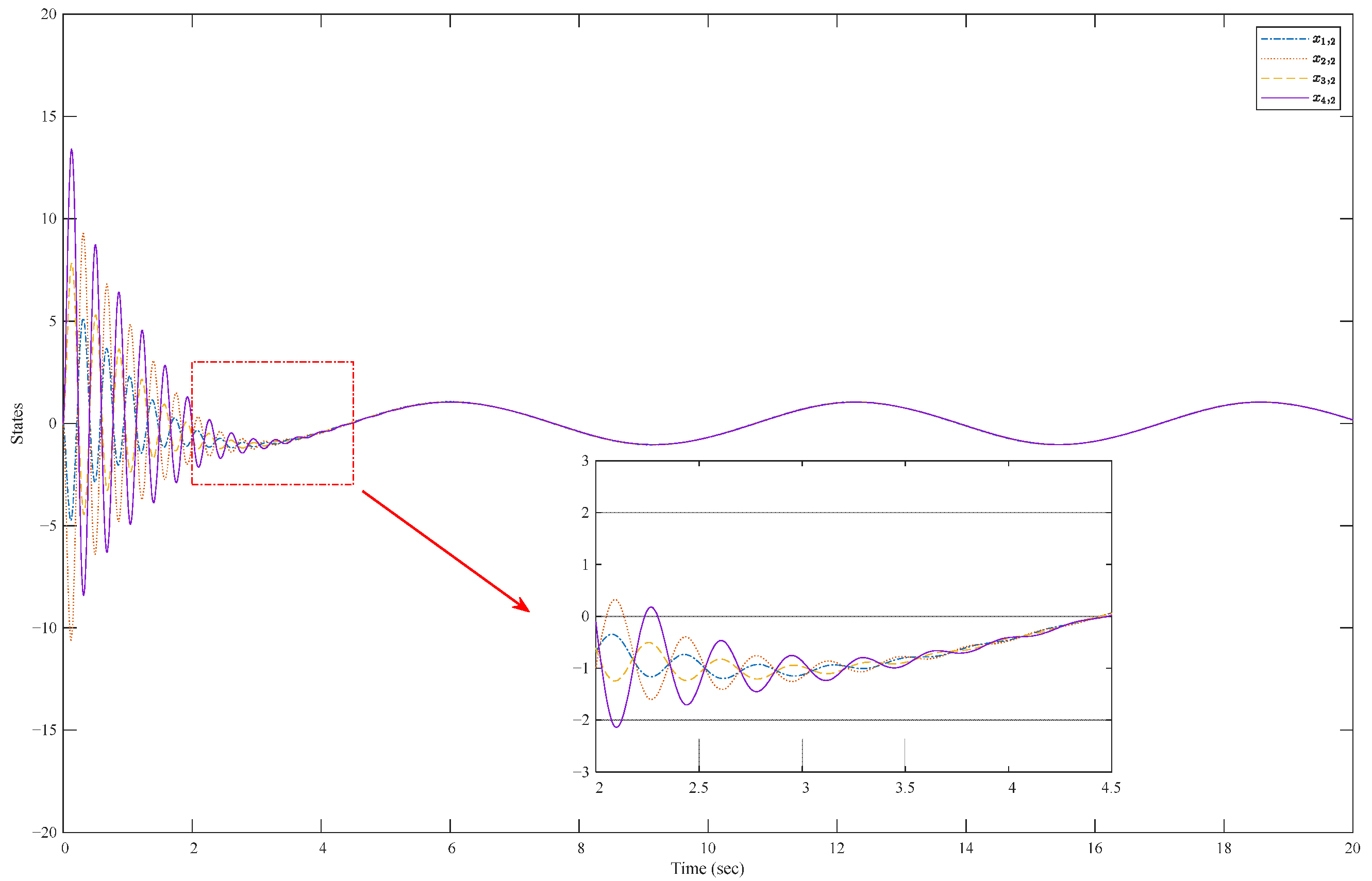
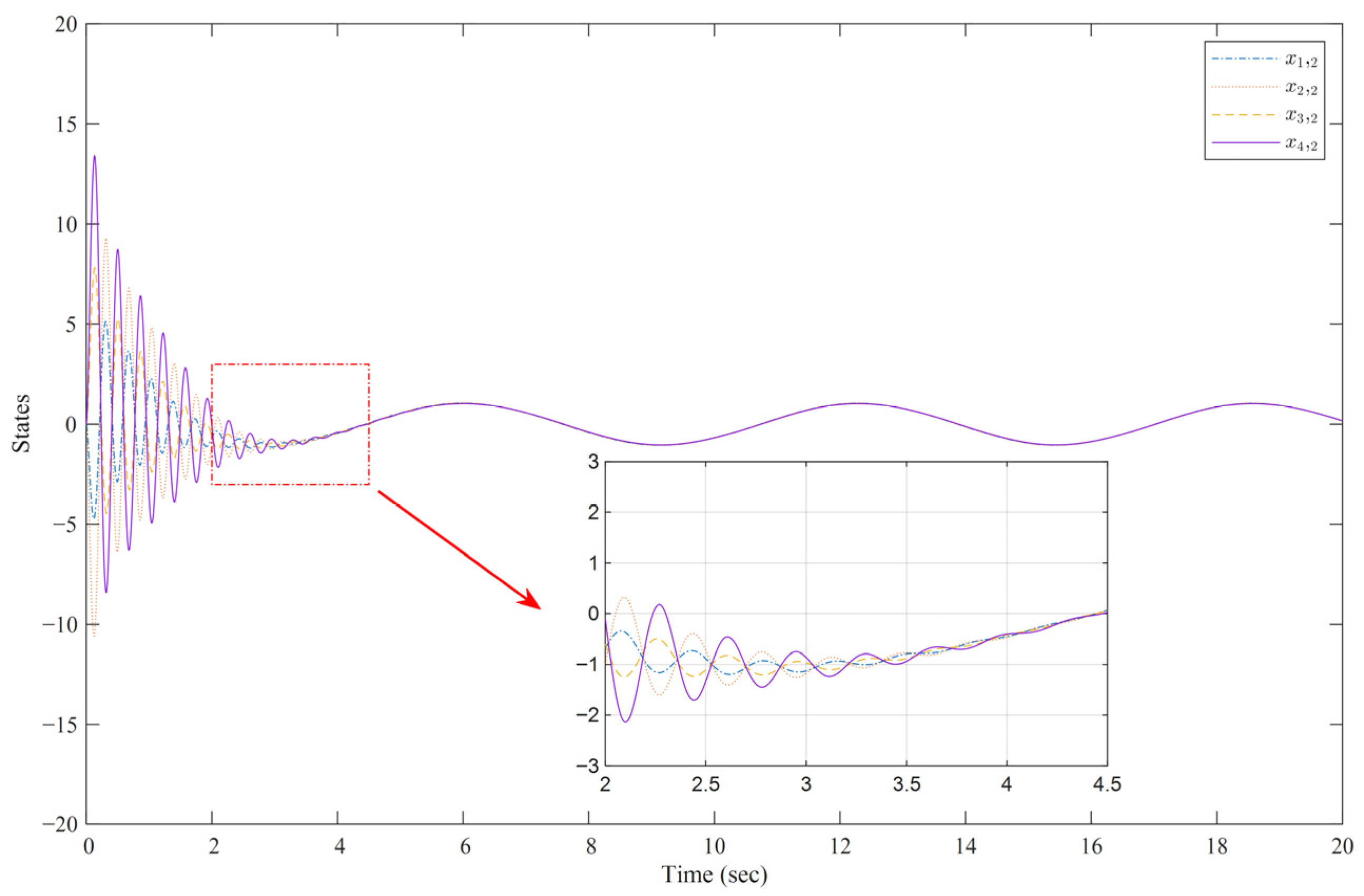
Figure 3 presents the velocity responses of the four followers. All velocity curves remain bounded throughout the simulation, which confirms that the system states are kept within the safe and stable range prescribed under the designed controller.
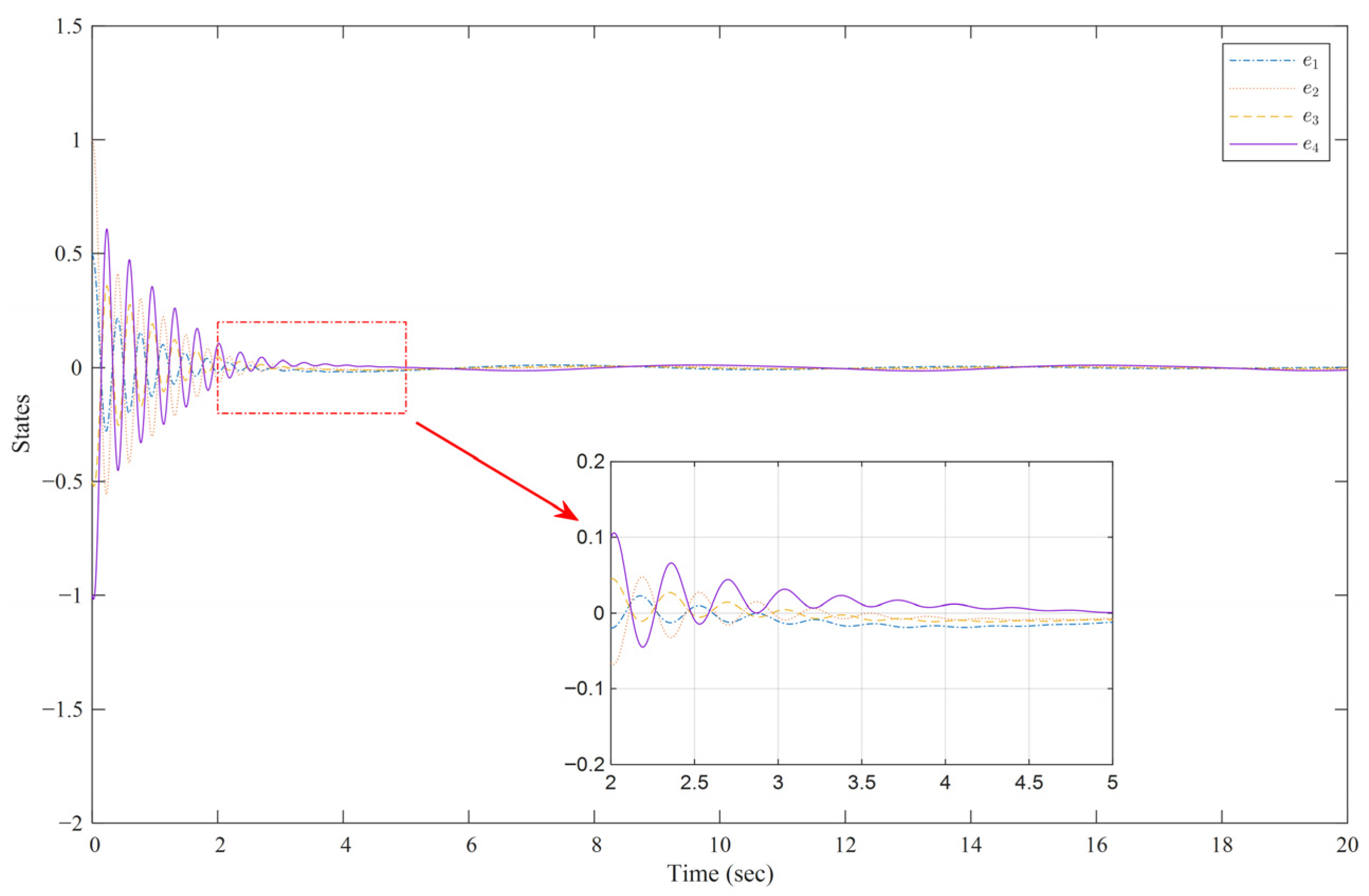
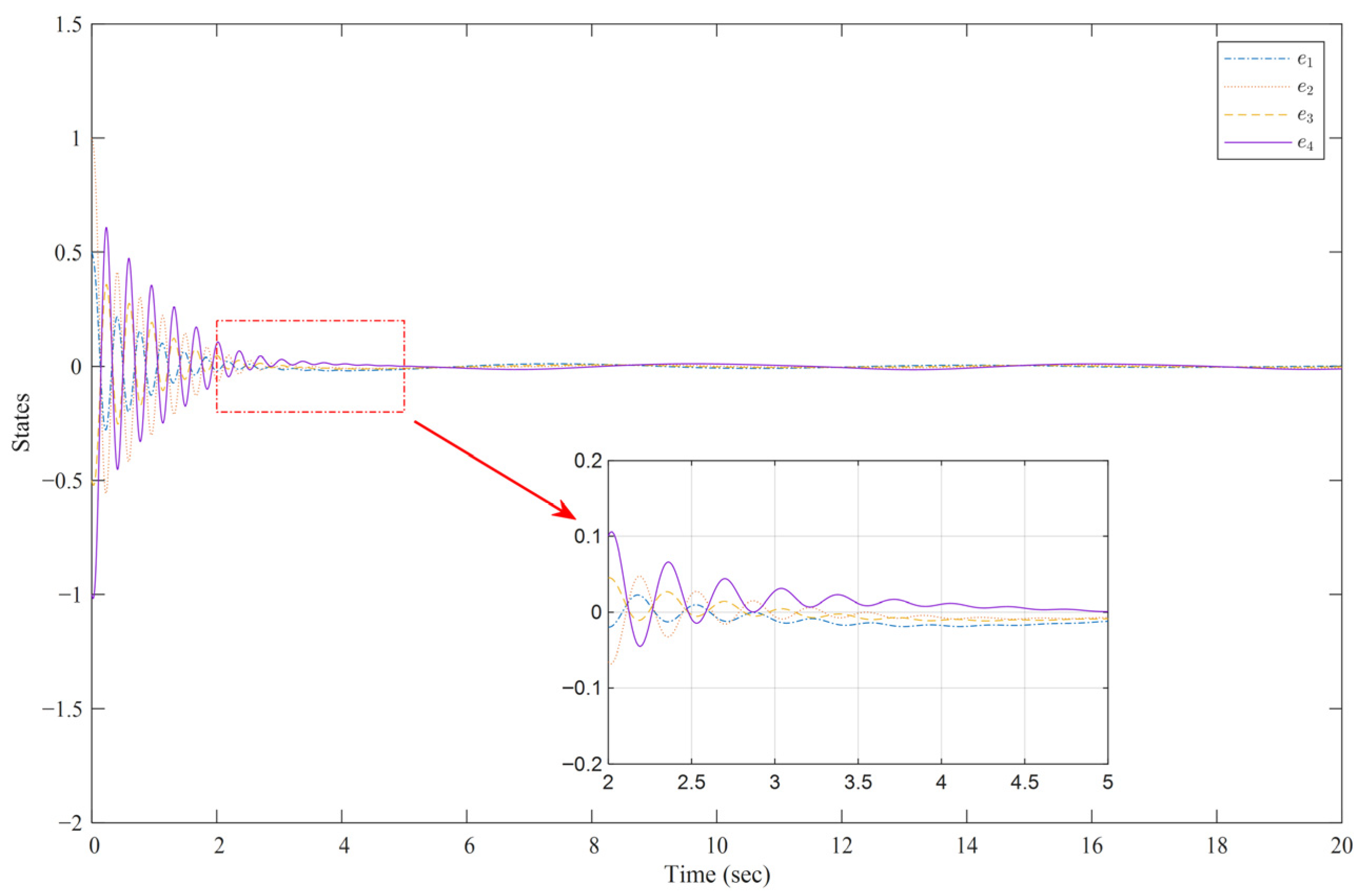
Figure 4 depicts the tracking errors of the followers. The errors converge rapidly to a small neighborhood of zero and stay there, illustrating the excellent steady-state performance and the fast transient response achieved by the predefined-time control.
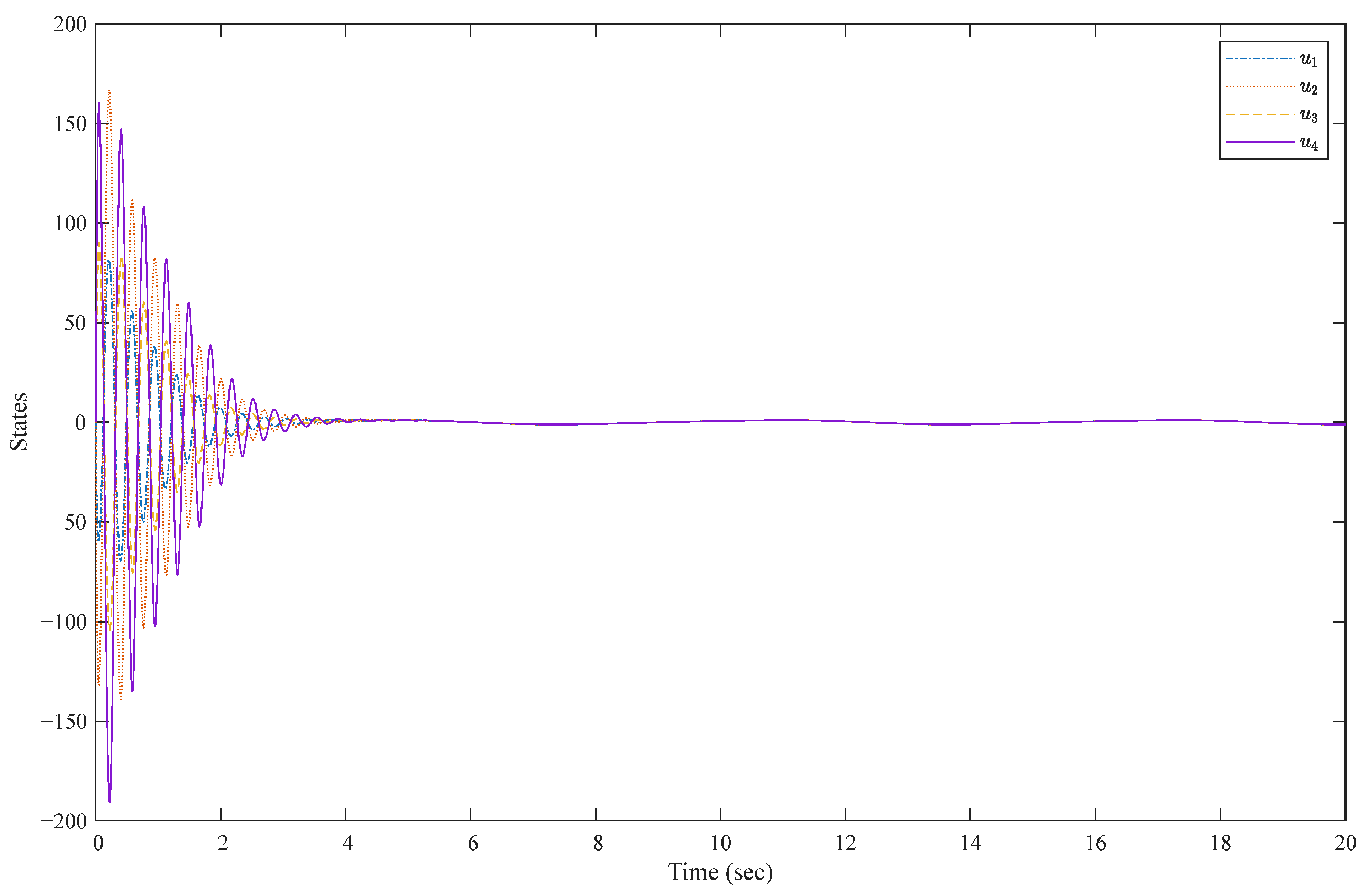
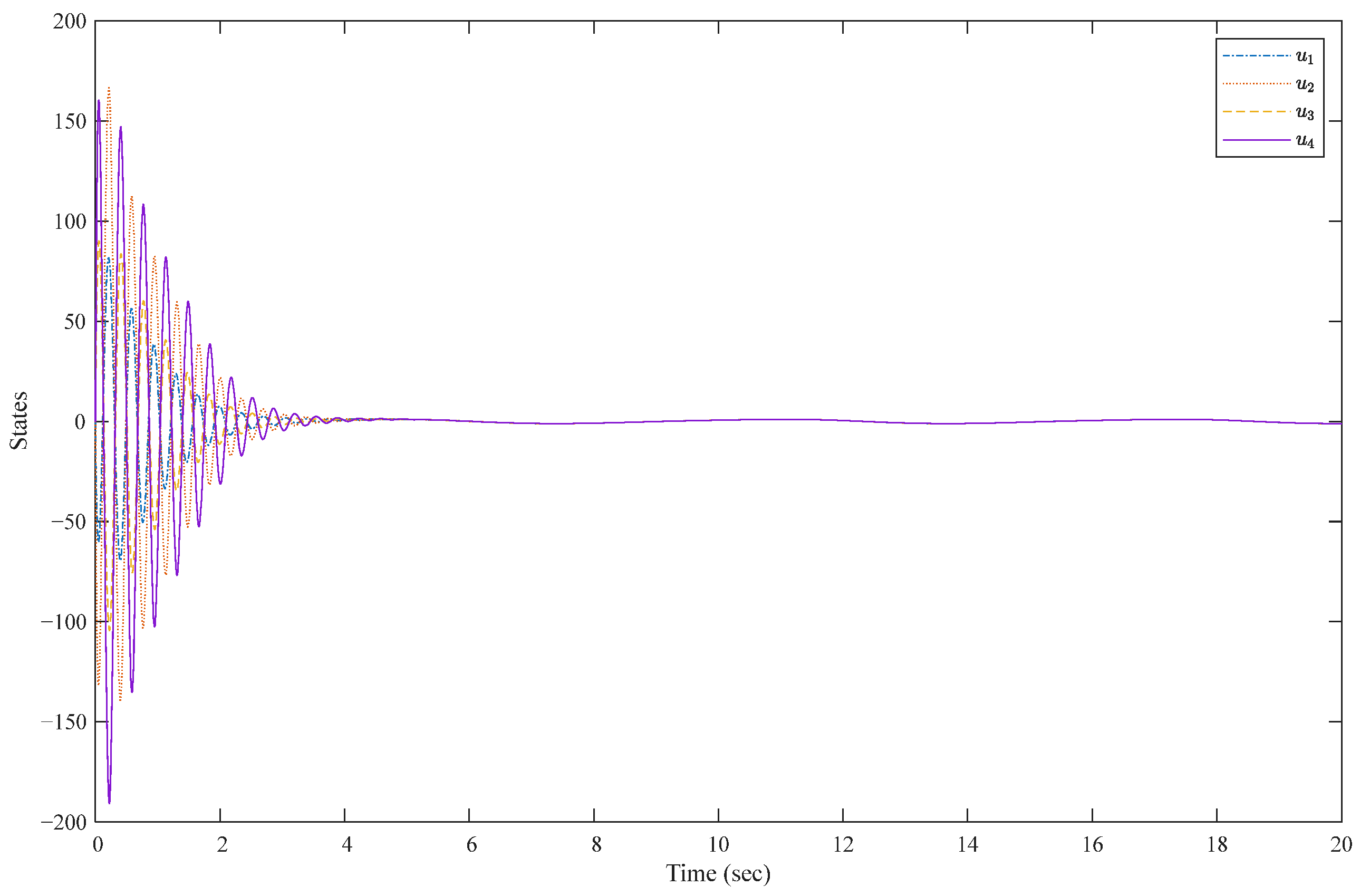
Figure 5 shows the control input curves of the four followers. The control signals are smooth and bounded, initially taking larger values to eliminate the initial errors and then decaying to very small levels once the system reaches a steady state.
Example2.
Consider a class of leader-following multiagent systems with external disturbances, where thefollower agent of this affine nonlinear multiagent system is described by the following dynamic equation:
where, andrepresent the position and velocity of theagent, respectively,, , , , , , , , , , , . The initial positions of the follower agents are, , , , , , , , the, .
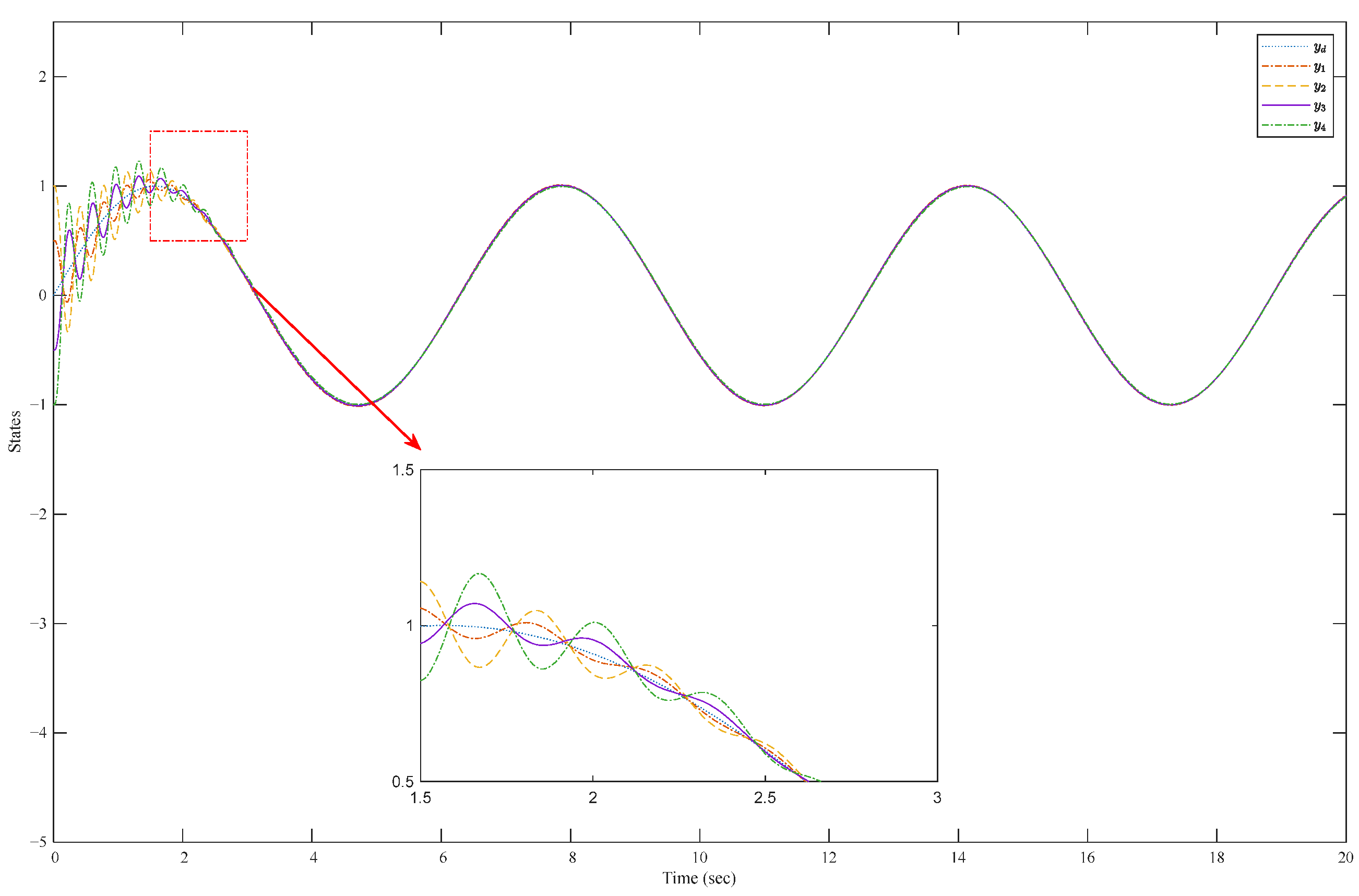
Figure 2, Figure 3, Figure 4 and Figure 5 present the simulation results for the first multiagent system, which demonstrate the effectiveness of the proposed neural network adaptive control method. In this simulation, no external disturbances are considered. Figure 6, Figure 7, Figure 8 and Figure 9 show the simulation results when external disturbances are added to the first scenario. To ensure a fair comparison, the initial conditions and control parameters are kept exactly the same in both simulations. The results indicate that the system responses with disturbances are very similar to those without disturbances, further validating the robustness and effectiveness of the proposed control method against external disturbances.
Overall, these results validate the effectiveness of the integrated neural-network-based adaptive predefined-time control strategy: the neural network compensates for nonlinear uncertainties, the adaptive laws adjust the controller parameters online, and the predefined-time framework guarantees convergence within a fixed time independent of the initial conditions.
Table 2 compares the proposed method with the existing method in [15] under multiple initial conditions. The max-min range and standard deviation of the steady-state tracking errors are listed. The proposed method achieves smaller values in both metrics, indicating better robustness and less sensitivity to initial conditions.
5. Conclusions
This paper has presented a novel predefined-time neural adaptive control strategy for the distributed formation control of nonlinear multiagent systems with full-state constraints. By employing a nonlinear mapping technique, the proposed method successfully removes the initial-condition feasibility restrictions inherent in classical barrier Lyapunov function-based approaches, simplifying the controller design while rigorously ensuring that all state constraints are satisfied throughout the system operation. The integration of predefined-time stability theory guarantees that formation convergence occurs within any user-prescribed time bound, independent of how dispersed the followers are initially. Moreover, the incorporation of neural network approximation and adaptive laws effectively compensates for unknown nonlinearities, enhancing the system’s robustness against model uncertainties. Lyapunov-based stability analysis guarantees that all closed-loop signals are semi-globally uniformly ultimately bounded and that the tracking errors converge as desired. Comparative simulation results quantitatively confirm the advantages of the proposed scheme, including a faster transient response, significantly reduced steady-state errors, and stronger adaptability to varying constraint boundaries. Thus, this work provides a systematic and flexible solution for predefined-time formation control under full-state constraints.
Building on the results of this paper, future research will extend the proposed control framework to more complex scenarios, such as multiagent systems with switching communication topologies, actuator faults, input saturation, or event-triggered communication mechanisms. Additionally, the integration of reinforcement learning or observer-based techniques to further relax the requirement for full-state measurement and to handle external disturbances will be explored. Experimental validation on physical multiagent platforms is also planned to bridge the gap between theory and practical applications.
Author Contributions
Conceptualization, Y.F. and J.Z.; Methodology, X.Y. and C.S.C.; Software, J.Z. and Y.J.; Validation, Y.F. and X.Y.; Formal analysis, Y.F.; Investigation, J.Z. and C.S.C.; Resources, Y.J.; Data curation, X.Y.; Writing—original draft, X.Y.; Writing—review and editing, Y.J.; Visualization, J.Z. and C.S.C.; Supervision, C.S.C.; Project administration, Y.J.; Funding acquisition, J.Z. All authors have read and agreed to the published version of the manuscript.
Funding
This work was supported in part by the National Natural Science Foundation of China under Grant 62203247.
Data Availability Statement
The original contributions presented in this study are included in the article. Further inquiries can be directed to the corresponding authors.
Conflicts of Interest
The authors declare no conflicts of interest.
References
Olfati-Saber, R.; Fax, J.A.; Murray, R.M. Consensus and Cooperation in Networked Multi-Agent Systems. Proc. IEEE2007, 95, 215–233. [Google Scholar] [CrossRef] [Scilit]
Li, Z.; Duan, Z.; Chen, G.; Huang, L. Consensus of Multiagent Systems and Synchronization of Complex Networks: A Unified Viewpoint. IEEE Trans. Circuits Syst. I Regul. Pap.2010, 57, 213–224. [Google Scholar] [CrossRef] [Scilit]
Qin, J.; Ma, Q.; Shi, Y.; Wang, L. Recent Advances in Consensus of Multi-Agent Systems: A Brief Survey. IEEE Trans. Ind. Electron.2017, 64, 4972–4983. [Google Scholar] [CrossRef] [Scilit]
Olfati-Saber, R.; Murray, R.M. Consensus problems in networks of agents with switching topology and time-delays. IEEE Trans. Autom. Control2004, 49, 1520–1533. [Google Scholar] [CrossRef] [Scilit]
Zhang, H.; Lewis, F.L.; Das, A. Optimal Design for Synchronization of Cooperative Systems: State Feedback, Observer and Output Feedback. IEEE Trans. Autom. Control2011, 56, 1948–1952. [Google Scholar] [CrossRef] [Scilit]
Su, Y.; Huang, J. Cooperative Output Regulation with Application to Multi-Agent Consensus Under Switching Network. IEEE Trans. Syst. Man Cybern. Part B (Cybern.)2012, 42, 864–875. [Google Scholar] [CrossRef] [Scilit]
Park, J.H.; Kim, S.H.; Moon, C.J. Adaptive Neural Control for Strict-Feedback Nonlinear Systems Without Backstepping. IEEE Trans. Neural Netw.2009, 20, 1204–1209. [Google Scholar] [CrossRef] [Scilit]
Ge, S.S.; Cong, W. Adaptive neural control of uncertain MIMO nonlinear systems. IEEE Trans. Neural Netw.2004, 15, 674–692. [Google Scholar] [CrossRef] [Scilit]
Atiya, A.F.; Parlos, A.G. New results on recurrent network training: Unifying the algorithms and accelerating convergence. IEEE Trans. Neural Netw.2000, 11, 697–709. [Google Scholar] [CrossRef] [Scilit]
Polycarpou, M.M. Stable adaptive neural control scheme for nonlinear systems. IEEE Trans. Autom. Control1996, 41, 447–451. [Google Scholar] [CrossRef] [Scilit]
Yu, Z. Adaptive Neural Network Control with Predefined-Time Convegence for PureFeedback Nonlinear Systems. Int. J. Appl. Math. Control Eng.2024, 7, 177–182. [Google Scholar] [CrossRef] [Scilit]
Chen, B.; Liu, K.; Liu, X.; Shi, P.; Lin, C.; Zhang, H. Approximation-Based Adaptive Neural Control Design for a Class of Nonlinear Systems. IEEE Trans. Cybern.2014, 44, 610–619. [Google Scholar] [CrossRef] [Scilit]
Wang, M.; Wang, C.; Shi, P.; Liu, X. Dynamic Learning From Neural Control for Strict-Feedback Systems with Guaranteed Predefined Performance. IEEE Trans. Neural Netw. Learn. Syst.2016, 27, 2564–2576. [Google Scholar] [CrossRef] [Scilit]
Li, Y.; Zhu, Q.; Zhang, J. Distributed adaptive fixed-time neural networks control for nonaffine nonlinear multiagent systems. Sci. Rep.2022, 12, 8459. [Google Scholar] [CrossRef] [Scilit] [PubMed]
Liu, Y.; Yu, J.; Yu, H.; Lin, C.; Zhao, L. Barrier Lyapunov Functions-Based Adaptive Neural Control for Permanent Magnet Synchronous Motors with Full-State Constraints. IEEE Access2017, 5, 10382–10389. [Google Scholar] [CrossRef] [Scilit]
Sun, W.; Su, S.F.; Wu, Y.; Xia, J.; Nguyen, V.T. Adaptive Fuzzy Control with High-Order Barrier Lyapunov Functions for High-Order Uncertain Nonlinear Systems with Full-State Constraints. IEEE Trans. Cybern.2020, 50, 3424–3432. [Google Scholar] [CrossRef] [Scilit]
Li, Y.; Liu, Y.; Tong, S. Observer-Based Neuro-Adaptive Optimized Control of Strict-Feedback Nonlinear Systems with State Constraints. IEEE Trans. Neural Netw. Learn. Syst.2022, 33, 3131–3145. [Google Scholar] [CrossRef] [Scilit]
Ren, B.; Ge, S.S.; Tee, K.P.; Lee, T.H. Adaptive Neural Control for Output Feedback Nonlinear Systems Using a Barrier Lyapunov Function. IEEE Trans. Neural Netw.2010, 21, 1339–1345. [Google Scholar] [CrossRef] [Scilit]
Ma, L.; Liu, L. Adaptive Neural Network Control Design for Uncertain Nonstrict Feedback Nonlinear System with State Constraints. IEEE Trans. Syst. Man Cybern. Syst.2021, 51, 3678–3686. [Google Scholar] [CrossRef] [Scilit]
He, W.; Chen, Y.; Yin, Z. Adaptive Neural Network Control of an Uncertain Robot with Full-State Constraints. IEEE Trans. Cybern.2016, 46, 620–629. [Google Scholar] [CrossRef] [Scilit]
Sun, W.; Wu, Y.; Lv, X. Adaptive Neural Network Control for Full-State Constrained Robotic Manipulator with Actuator Saturation and Time-Varying Delays. IEEE Trans. Neural Netw. Learn. Syst.2022, 33, 3331–3342. [Google Scholar] [CrossRef] [Scilit]
Sun, K.; Mou, S.; Qiu, J.; Wang, T.; Gao, H. Adaptive Fuzzy Control for Nontriangular Structural Stochastic Switched Nonlinear Systems with Full State Constraints. IEEE Trans. Fuzzy Syst.2019, 27, 1587–1601. [Google Scholar] [CrossRef] [Scilit]
Niu, B.; Zhang, Y.; Zhao, X.; Wang, H.; Sun, W. Adaptive Predefined-Time Bipartite Consensus Tracking Control of Constrained Nonlinear MASs: An Improved Nonlinear Mapping Function Method. IEEE Trans. Cybern.2023, 53, 6017–6026. [Google Scholar] [CrossRef] [Scilit] [PubMed]
Liu, Y.; Zhang, H.; Sun, J.; Wang, Y. Adaptive Fuzzy Containment Control for Multiagent Systems with State Constraints Using Unified Transformation Functions. IEEE Trans. Fuzzy Syst.2022, 30, 162–174. [Google Scholar] [CrossRef] [Scilit]
Wang, P.; Duan, G.; Li, P.; Wang, L. Adaptive Formation Control of Nonlinear High-Order Fully Actuated Multiagent Systems with Full-State Constraints and Its Application. IEEE Trans. Cybern.2025, 55, 5002–5013. [Google Scholar] [CrossRef] [Scilit] [PubMed]
Fan, H.; Shi, K.; Guo, Z.; Zhou, A. Finite-Time Synchronization Criteria for Caputo Fractional-Order Uncertain Memristive Neural Networks with Fuzzy Operators and Transmission Delay Under Communication Feedback. Fractal Fract.2024, 8, 619. [Google Scholar] [CrossRef] [Scilit]
Fan, H.; Shi, K.; Guo, Z.; Zhou, A.; Cai, J. Finite-Time Synchronization and Mittag–Leffler Synchronization for Uncertain Fractional-Order Delayed Cellular Neural Networks with Fuzzy Operators via Nonlinear Adaptive Control. Fractal Fract.2025, 9, 634. [Google Scholar] [CrossRef] [Scilit]
Bhat, S.P.; Bernstein, D.S. Continuous finite-time stabilization of the translational and rotational double integrators. IEEE Trans. Autom. Control1998, 43, 678–682. [Google Scholar] [CrossRef] [Scilit]
Wang, L.; Xiao, F. Finite-Time Consensus Problems for Networks of Dynamic Agents. IEEE Trans. Autom. Control2010, 55, 950–955. [Google Scholar] [CrossRef] [Scilit]
Cui, B.; Xia, Y.; Liu, K.; Shen, G. Finite-Time Tracking Control for a Class of Uncertain Strict-Feedback Nonlinear Systems with State Constraints: A Smooth Control Approach. IEEE Trans. Neural Netw. Learn. Syst.2020, 31, 4920–4932. [Google Scholar] [CrossRef] [Scilit] [PubMed]
Polyakov, A. Nonlinear Feedback Design for Fixed-Time Stabilization of Linear Control Systems. IEEE Trans. Autom. Control2012, 57, 2106–2110. [Google Scholar] [CrossRef] [Scilit]
Ma, C.; Dong, D. Non-Singular Practical Fixed-time Prescribed Performance Adaptive Fuzzy Consensus Control for Multi-Agent Systems Based on an Observer. IEEE/CAA J. Autom. Sin.2025, 12, 1209–1220. [Google Scholar] [CrossRef] [Scilit]
Mi, W.; Luo, L.; Zhong, S. Fixed-Time Consensus Tracking for Multi-Agent Systems with a Nonholomonic Dynamics. IEEE Trans. Autom. Control2023, 68, 1161–1168. [Google Scholar] [CrossRef] [Scilit]
Liu, N.; Yu, X.; Zhang, J.; Jiang, Y.; Chin, C.S. Predefined-Time Trajectory Tracking of Mechanical Systems with Full-State Constraints via Adaptive Neural Network Control. Mathematics2026, 14, 396. [Google Scholar] [CrossRef] [Scilit]
Jiménez-Rodríguez, E.; Muñoz-Vázquez, A.J.; Sánchez-Torres, J.D.; Defoort, M.; Loukianov, A.G. A Lyapunov-Like Characterization of Predefined-Time Stability. IEEE Trans. Autom. Control2020, 65, 4922–4927. [Google Scholar] [CrossRef] [Scilit]
Wu, L.B.; Park, J.H.; Zhao, N.N. Robust Adaptive Fault-Tolerant Tracking Control for Nonaffine Stochastic Nonlinear Systems with Full-State Constraints. IEEE Trans. Cybern.2020, 50, 3793–3805. [Google Scholar] [CrossRef] [Scilit]
Disclaimer/Publisher’s Note: The statements, opinions and data contained in all publications are solely those of the individual author(s) and contributor(s) and not of MDPI and/or the editor(s). MDPI and/or the editor(s) disclaim responsibility for any injury to people or property resulting from any ideas, methods, instructions or products referred to in the content.
Fang, Y.; Yu, X.; Zhang, J.; Jiang, Y.; Chin, C.S.
Predefined-Time Neural Adaptive Control for Distributed Formation Control of Nonlinear Multiagent Systems with Full-State Constraints. Mathematics2026, 14, 1658.
https://doi.org/10.3390/math14101658
AMA Style
Fang Y, Yu X, Zhang J, Jiang Y, Chin CS.
Predefined-Time Neural Adaptive Control for Distributed Formation Control of Nonlinear Multiagent Systems with Full-State Constraints. Mathematics. 2026; 14(10):1658.
https://doi.org/10.3390/math14101658
Chicago/Turabian Style
Fang, Yuehua, Xuan Yu, Jianhua Zhang, Yichen Jiang, and Cheng Siong Chin.
2026. "Predefined-Time Neural Adaptive Control for Distributed Formation Control of Nonlinear Multiagent Systems with Full-State Constraints" Mathematics 14, no. 10: 1658.
https://doi.org/10.3390/math14101658
APA Style
Fang, Y., Yu, X., Zhang, J., Jiang, Y., & Chin, C. S.
(2026). Predefined-Time Neural Adaptive Control for Distributed Formation Control of Nonlinear Multiagent Systems with Full-State Constraints. Mathematics, 14(10), 1658.
https://doi.org/10.3390/math14101658
Note that from the first issue of 2016, this journal uses article numbers instead of page numbers. See further details here.
Article Metrics
No
No
Article Access Statistics
For more information on the journal statistics, click here.
Multiple requests from the same IP address are counted as one view.
Fang, Y.; Yu, X.; Zhang, J.; Jiang, Y.; Chin, C.S.
Predefined-Time Neural Adaptive Control for Distributed Formation Control of Nonlinear Multiagent Systems with Full-State Constraints. Mathematics2026, 14, 1658.
https://doi.org/10.3390/math14101658
AMA Style
Fang Y, Yu X, Zhang J, Jiang Y, Chin CS.
Predefined-Time Neural Adaptive Control for Distributed Formation Control of Nonlinear Multiagent Systems with Full-State Constraints. Mathematics. 2026; 14(10):1658.
https://doi.org/10.3390/math14101658
Chicago/Turabian Style
Fang, Yuehua, Xuan Yu, Jianhua Zhang, Yichen Jiang, and Cheng Siong Chin.
2026. "Predefined-Time Neural Adaptive Control for Distributed Formation Control of Nonlinear Multiagent Systems with Full-State Constraints" Mathematics 14, no. 10: 1658.
https://doi.org/10.3390/math14101658
APA Style
Fang, Y., Yu, X., Zhang, J., Jiang, Y., & Chin, C. S.
(2026). Predefined-Time Neural Adaptive Control for Distributed Formation Control of Nonlinear Multiagent Systems with Full-State Constraints. Mathematics, 14(10), 1658.
https://doi.org/10.3390/math14101658
Note that from the first issue of 2016, this journal uses article numbers instead of page numbers. See further details here.