1. Introduction
Speech separation, a key front-end technology in signal processing, extracts clean speech of target speakers from mixed signals. It is valuable for hands-free communication, automatic meeting transcription, and hearing aids, especially improving speech perception in noisy/reverberant environments. Single-channel speech separation remains highly challenging [
1,
2,
3,
4,
5,
6,
7,
8,
9,
10]. This paper focuses on the existing limitations of single-channel speech separation methods and proposes an innovative solution.
Mainstream single-channel speech separation methods include Conv-TasNet [
11] employs temporal convolutional networks to enhance local temporal modeling capability; DPTNet [
12] and Sepformer adopt dual-path Transformer structures to simultaneously capture the long-term and short-term dependencies of sequences; TDANet [
13], inspired by biological physiological mechanisms, introduces a top-down attention architecture. While these methods have continuously achieved improved speech separation performance, they still have a critical limitation: over-reliance on a single mask network. The resulting mask is a contaminated coarse version, retaining interfering speech and noise. In complex scenarios (high noise, heavy spectral overlap), single networks fail to balance interference suppression and target preservation, leading to distorted separation with residual contamination.
To overcome the above limitations, this paper proposes a CPMN for single-channel speech separation, which aims to purify the coarse mask generated by existing speech separation frameworks and obtain an accurate speech mask. Specifically, without changing the structure of the classic existing speech separation frameworks, the CPMN is integrated after the mask network to directly improve speech separation performance. To verify the effectiveness and generality of the CPMN, this paper integrates it into three representative speech separation methods (Conv-TasNet [
11], DPTNet [
12], TDANet [
13]) and conducts systematic performance verification on multi-scenario datasets.
In summary, the proposed CPMN has four key contributions:
To tackle the critical challenge of limited speech mask accuracy—stemming from noise interference, cross-source feature aliasing, and other confounding factors—this paper introduces a CPMN framework comprising three synergistic modules: the DCAM, the FCCM, and the APMM. Leveraging a hierarchical design that enables seamless collaboration among these three modules, the framework achieves fine-grained correction of mask errors and efficient elimination of redundant information, thereby yielding a significant improvement in speech separation accuracy.
Guided by the original speech mask, the DCAM aggregates two types of temporal information: dynamic sliding-window features and long-range temporal features (modeling global temporal dynamics). This aggregation process generates context-aware attention weights tailored to the speech mask. Importantly, the DCAM establishes temporal dependencies for the speech mask with minimal computational overhead, which effectively improves the localization accuracy of mixed multi-speech signals—thus mitigating the issue of mask contamination.
The FCCM is proposed to compensate for missing feature components in the target speech mask that may be preserved in the mask of other speakers. Specifically, at regions affected by mask contamination, the features of the current speech mask are dynamically cross-complemented by incorporating weighted mask features from other speakers. The dynamic nature of this complementation is enabled by learnable weights, which are adaptively optimized via an adaptive filter.
The APMM is proposed to restore the target speech features and mitigate speech mask-contaminating, by which the contaminated speech mask is purified via an adaptive filter constituted by a learnable neural network. Finally, the filtered features are applied to restore the high-precision speech mask by a residual network.
2. Related Works
Mask estimation is one of the core technologies in single-channel speech separation. Its essence lies in training a model to learn the mapping relationship from the time-frequency or time-domain features of mixed speech to the target speech mask, and then using the mask to filter the mixed features to achieve the extraction of target speech. Based on differences in the processing workflow of mask estimation, mask estimation strategies can be divided into two categories: single-stage and multi-stage.
Single-stage mask networks are the most fundamental and commonly used mask estimation strategy [
11,
12,
13,
14,
15,
16,
17]. Their core characteristic is to directly complete the mapping from mixed features to the target mask through a single network structure, without the need for subsequent mask correction or optimization steps. However, single-stage mask networks have significant limitations: first, the direct mapping estimation method lacks a feedback and correction mechanism for mask errors. Once the mixed features are subjected to strong interference, such as non-stationary noise and cross-source feature aliasing, a large amount of redundant information is likely to be mixed into the mask, resulting in mask contamination; second, single-stage models are usually trained with fixed network structures and loss functions, and lack the ability of adaptive adjustment to different scenarios (e.g., different noise intensities and different numbers of speakers), leading to poor generalization performance of mask estimation in complex scenarios; third, most single-stage models only focus on the independent estimation of the target speech mask, ignoring the feature complementarity between masks of different speakers. This causes the key features that may be missing in the target mask to fail to be supplemented, further reducing the mask accuracy.
The two-stage strategy adopted by the CPMN proposed in this paper has significant advantages over single-stage methods: first, through phased processing from preliminary estimation to cross-purification, it can specifically resolve the inherent contradiction between interference suppression and target preservation in single-stage methods, and avoid the problems of rough masks and residual contamination caused by single-network modeling. Second, the post-integration design of the CPMN does not require reconstructing the basic network architecture. While achieving fine purification, it effectively breaks through the bottleneck of single-stage methods where performance is saturated and difficult to optimize in complex scenarios.
3. Generative Models
Given a single-channel speech mixture audio signal from different speakers, we define it as
where
denotes the defined mixed audio signal,
D is the number of speakers, and
denotes background noise. Our goal is to estimate each
.
3.1. Overall Pipeline
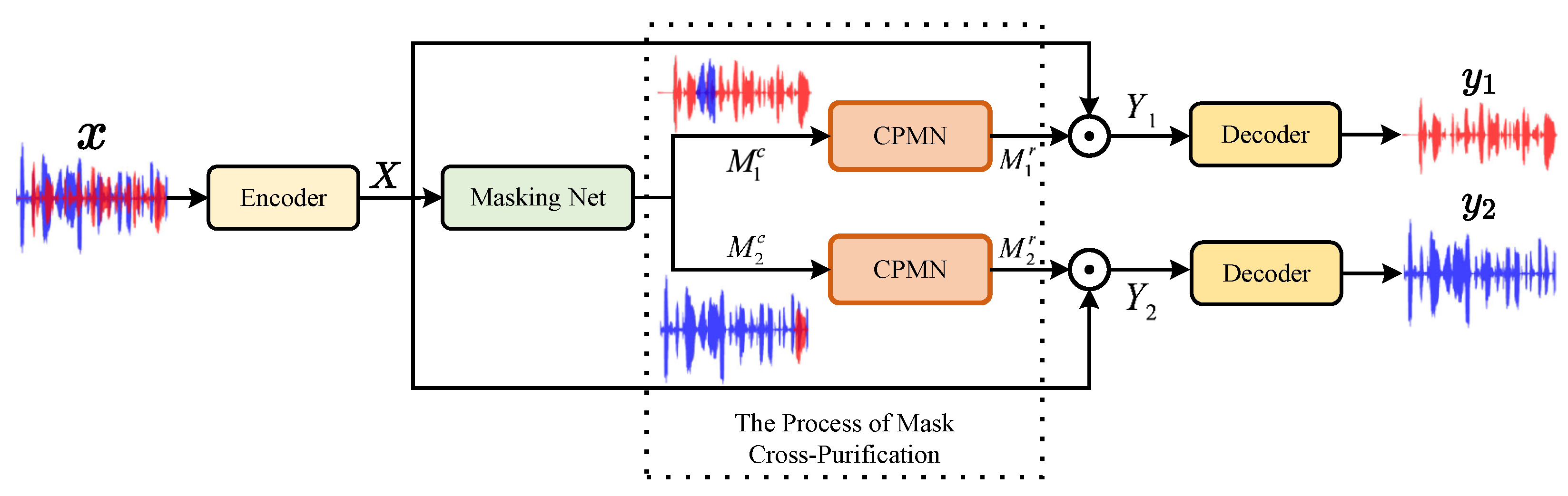
The proposed framework takes the base separation network + CPMN’ as the core, adopting a two-stage mode for high-precision speech separation (see
Figure 1). Its input is a single-channel mixed waveform, and output is the clean separated speeches of two speakers. The process includes three key steps:
First, the mixed speech is fed into the base network’s encoder. A Conv1D maps the time-domain waveform to intermediate features, and the base network’s mask network generates a coarse mask , completing the first-stage coarse separation.
Second, the initial coarse mask is input into the proposed CPMN. Specifically, the DCAM captures temporal dependencies, the FCCM explores cross-source correlations, and the APMM optimizes mask accuracy. Finally, a refined and purified speech mask is output, realizing the fine purification in the second stage.
Third, is input into the CPMN: the DCAM captures temporal dependencies, the FCCM explores cross-source correlations, and the APMM optimizes mask accuracy. The output is a refined mask , realizing the second-stage fine purification.
Speech reconstruction: is element-wise multiplied with the encoder’s intermediate features to obtain speaker-specific features. These features are mapped back to the time domain via the base network’s decoder, generating the final separated speech.
The core advantage is that it requires no reconfiguration of existing networks’ encoder–mask network–decoder structure. By post-integrating the lightweight CPMN, it resolves the inherent contradiction between interference suppression and target preservation in single-stage methods, significantly enhancing performance in complex scenarios.
3.2. Review of the Single-Channel Speech Separation Frameworks
As a classic time-domain speech separation framework, the single-channel speech separation network employs an end-to-end encoder–mask network–decoder architecture to directly process raw speech waveforms. It avoids the inherent phase ambiguity problem of time-frequency domain methods and serves as the foundation for modern speech separation technologies. This study adopts it as the base separation framework, and elaborates on its module design and working principles as follows.
3.2.1. Encoder
The encoder’s core function is to convert time-domain speech waveforms to high-dimensional feature representations. It consists of Conv1D and ReLU, with its mathematical definition as
where
denotes the mixed signal, and
represents the encoder’s output. For the conv layer, kernel size is
K, stride is
, and filter number is
N;
L is the output feature sequence time steps,
. After encoding,
X is multiplied by each speaker’s speech mask to yield separated speech feature sequences:
. Finally, these sequences are decoded into target speech waveforms.
3.2.2. Mask Networks
The mask network is the core for separation in single-channel speech separation, aiming to learn masks that distinguish two speakers. Most existing methods improve performance by modifying its architecture. Taking encoder output X as input, it estimates D speech masks .
3.2.3. Decoder
An inverse of the encoder, the decoder maps mask-weighted features back to time-domain speech waveforms. The element-wise product of the mask network and encoder outputs is fed into the decoder as input, defined as follows:
where
denotes the initially separated speech features of different speakers.
Subsequently,
is decoded by the decoder into speech waveforms of different speakers, defined as follows:
where
represents the separated speech waveform signals of the speakers.
3.3. Design Details of the CPMN
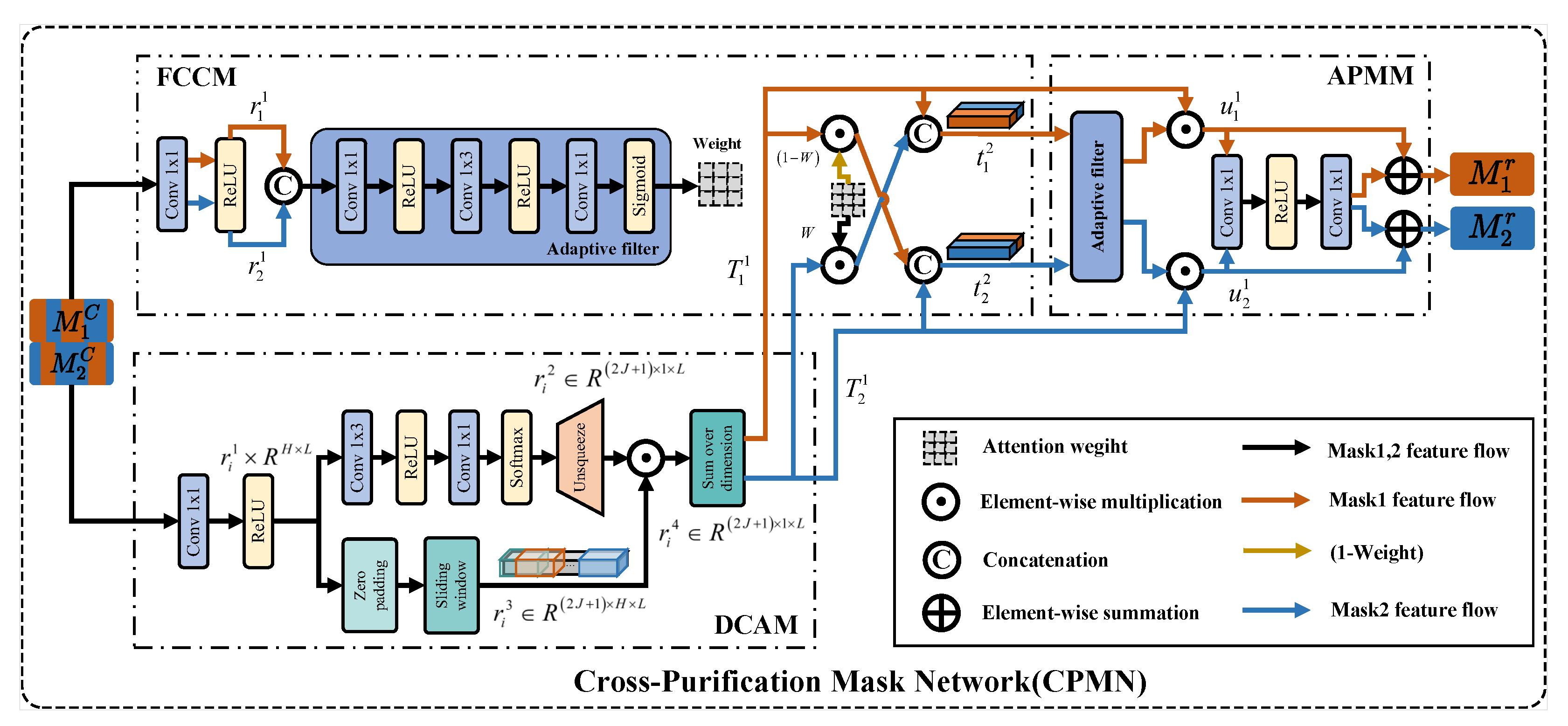
Addressing the core issue that speech masks generated by mask networks contain contamination, the CPMN improves mask accuracy through the synergy of three mechanisms: the DCAM, the FCCM, and the APMM. The following sections elaborate on the design logic, core computation process, and function implementation of each mechanism. The network architecture of the CPMN is illustrated in
Figure 2.
3.3.1. Design Details of the DCAM
The core goal of the DCAM is to establish temporal dependencies for raw speech masks with low computational overhead, improve the localization accuracy of mixed multi-speech signals, and alleviate mask contamination. The specific process is as follows.
First, a Conv1D is used to compress the dimension of input features, while introducing nonlinear transformation via ReLU activation. It is defined as follows:
where
and
represent the coarse mask and the input of the DCAM, respectively;
denotes the Conv1D operation; and
H represents the dimension of the output features. This design retains key temporal information while reducing the computational complexity of subsequent modules.
Next, the temporal information obtained from the dynamic sliding window and context attention is aggregated, enabling the network to simultaneously focus on feature information at the current time step and the J preceding and subsequent time steps. This method breaks through the limitation of static modeling for speech temporal dependencies by fixed windows. By assigning weights that dynamically change with input features to each position within the context window, it achieves adaptive attention to long-term coherent segments and short-term burst segments in speech signals, thereby injecting more accurate temporal correlation information into the coarse mask. It is defined as follows:
where
and
represent the carrier and output of important context attention weights, respectively;
denotes the multi-position temporal context features obtained by the dynamic sliding window; and
represents the context-aware attention weights after aggregating dynamic sliding window features and long-range temporal features.
,
,
, and
represent dimension expansion, zero-padding, sliding window, and dimension summation operations, respectively.
3.3.2. Design Details of the FCCM
Based on the core insight that interference signals contain residual target features, the FCCM quantifies the correlation between the two speakers’ features via cross-attention. It then performs dynamic cross-source feature complementation to compensate for feature components that may be missing in one target speech mask but retained in the other speaker’s mask. The specific process is as follows.
First, the compressed features of the two speakers are concatenated along the channel dimension to form a joint feature containing cross-source information. Subsequently, through three serially connected Conv1D layers and activation functions, the joint features of the two speakers’ speech masks are mapped to correlation weights in the temporal dimension:
where
denotes the feature correlation weights of different speech masks, which provide comprehensive information support for subsequent cross-feature complementation;
represents the channel-wise concatenation operation.
Next, dynamic complementation of the two speakers’ features is achieved based on the cross-attention weights:
where
denotes the intermediate purified features after cross-speaker feature complementation, corresponding to the preliminary optimized results of the two speakers’ features under the cross-attention mechanism, respectively;
represents the complete features obtained by integrating the original features and cross-source complementary features, which provide comprehensive feature input for the subsequent generation of accurate purified masks.
3.3.3. Design Details of the APMM
As the final processing module of the CPMN, the APMM balances the needs of noise reduction and fidelity preservation in speech separation through a collaborative design of dynamic suppression intensity adjustment and feature preservation. Ultimately, it achieves the recovery of high-precision speech masks. The specific process is as follows:
First, it purifies the speech masks using an adaptive filter composed of a learnable neural network to generate clean speech masks:
where
denotes the clean mask features after suppressing contaminated regions.
Finally, to alleviate the loss of target features caused by over-purification, a residual enhancement network is introduced for detail compensation. The final accurate speech mask is output through residual connections:
where
represents the final high-precision speech mask output by the CPMN.
4. Experiment Setup
4.1. Dataset Simulations
(1) Libri-2Mix [
18]: Target speeches (randomly from LibriSpeech Train-100) are mixed at −25 to −33 LUFS (uniformly sampled). Each 3 s clip contains 2 speakers, sampled at 8 kHz.
(2) WHAM! [
19]: A noisy variant of WSJ0-2Mix. WSJ0-2Mix has 100% speaker overlap (overly idealized, poor generalization. WHAM! mixes real-world noise (e.g., cafes) with speeches, with noise SNR uniformly sampled from −6 to 3 dB (more challenging). Each 4 s clip contains 2 speakers, sampled at 8 kHz.
(3) WSJ0-2Mix [
20]: A widely used dataset for speech separation evaluation, derived from WSJ0. It includes 30 h (20,000 clips) training, 10 h (5000 clips) validation, and 5 h (3000 clips) test sets, all sampled at 8 kHz.
4.2. Training Configurations
To verify the proposed CPMN’s effectiveness, this study conducts systematic experiments. The CPMN is embedded into three classic speech separation backbones (ConvTasNet, DPTNet, TDANet), yielding three test models (ConvTasNet-CPMN, DPTNet-CPMN, TDANet-CPMN) to validate its generality and effectiveness across architectures.
In experiments, the test models strictly followed the original training strategies (optimizer, loss function, etc.) and kept base network parameters (convolution kernels, kernel size, depth, attention heads, etc.) consistent with the original architectures. Only the CPMN’s core mechanisms were embedded into the feature pipeline. This minimizes interference from base parameter/training strategy differences, ensuring the CPMN is the sole variable driving performance changes and enabling accurate quantification of its efficacy.
4.3. Loss Function
The final output of an end-to-end speech separation model is the time-domain waveform of a clean target speaker’s speech signal. The scale-invariant signal-to-noise ratio (SI-SNR) is typically used as the evaluation metric, and the definition of SI-SNR [
21] is as follows:
where
S and
represent the clean target speech and the estimated target speech, respectively.
denotes the inner product, and
represents the L2 norm. A larger SI-SNR indicates better separation. Since the model is trained via gradient descent, the loss function is the SI-SNR inverse. Additionally, it uses the uPIT [
22] method during the training process.
5. Experimental Results and Comparisons
To evaluate speech separation performance and reconstructed signal quality, this study uses two metrics: SI-SNRi (Scale-Invariant Signal-to-Noise Ratio improvement, enhanced SI-SNR) and SDRi (Signal-to-Distortion Ratio improvement, improved traditional SDR).
5.1. TDANet (With/Without the CPMN) on Libri2Mix and WHAM!
To verify the CPMN’s speech separation performance gains, we integrate it into the TDANet baseline, conduct comparative experiments on two datasets (Libri-2Mix, WHAM!), and benchmark against validated advanced methods (e.g., SepFormer, DPTNet), ensuring objective and referenceable results.
Table 1 shows that the TDANet model embedded with the CPMN module achieves stable performance improvements on two test datasets. On the Libri-2Mix dataset, the SI-SNRi metric increases from 16.9 to 17.4, with a relative improvement of 2.96%. On the WHAM! dataset with complex noise and reverberation, the metric rises from 14.8 to 15.2, representing a relative gain of 2.70%. In terms of model overhead, the parameter size of the baseline TDANet is 2.8 M, which increases to 4.6 M after integrating the CPMN, with only 1.8 M additional parameters. Although the introduction of the mask optimization module leads to a certain increase in parameters, the overall model scale remains lightweight without causing excessive computational burden. The experimental results fully verify that the CPMN can effectively optimize the coarse masks generated by TDANet. Through dynamic context-aware temporal modeling and cross-source feature complementation, the proposed method accurately alleviates mask contamination under complex interference and steadily improves speech separation performance. Overall, our method obtains stable and effective performance optimization at a controllable cost of model complexity, achieving a favorable balance between separation accuracy and computational efficiency.
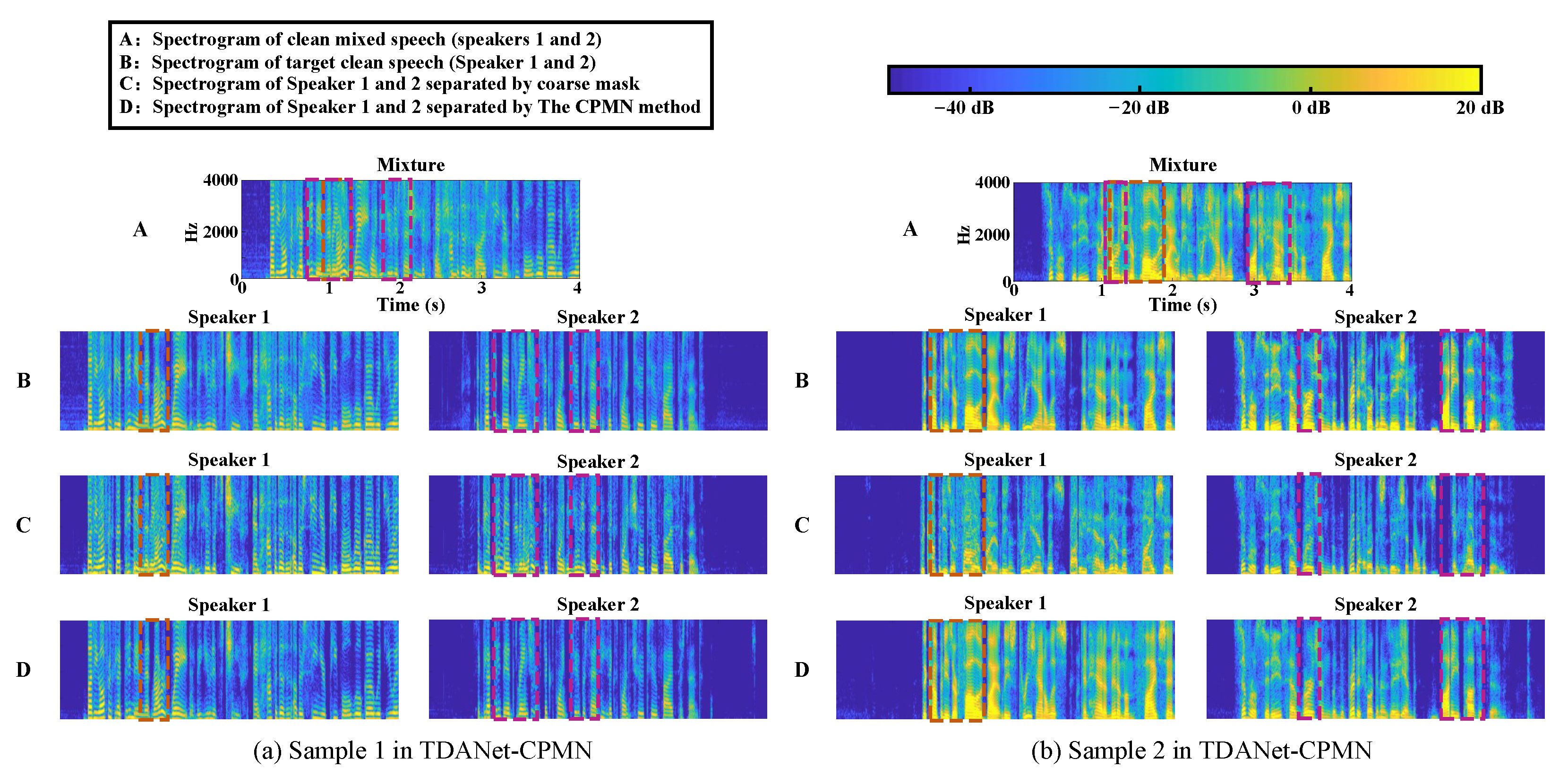
For further analysis, we visualized separation results (before/after CPMN integration) to verify its mask purification effect via spectrograms. Two random two-speaker test samples were selected from TDANet [
13] and TDANet-CPMN.
Figure 3 shows TDANet’s spectrograms retain obvious interference residuals (notably in speaker overlap regions), while TDANet-CPMN removes most contaminants—spectral contours are closer to clean speech with improved clarity. This intuitively validates the CPMN’s enhanced separation accuracy.
5.2. Conv-TasNet/DPTNet (With/Without the CPMN) on WSJ0-2Mix
To further verify the CPMN’s generality—its adaptability to diverse baselines—we integrate it into two classic end-to-end separation networks (Conv-TasNet, DPTNet) and conduct comparative experiments on the standard speech separation dataset WSJ0-2Mix. Conv-TasNet uses parameters consistent with the original work, while for DPTNet, we fix the encoder window length and number to 4 and 128, respectively.
As shown in
Table 2, after embedding the CPMN module into two baseline networks with different architectures, the SI-SNRi and SDRi metrics achieve stable and practical improvements. Specifically, the SI-SNRi of Conv-TasNet increases from 15.3 to 15.6 dB with an absolute gain of 0.3 dB and a relative improvement of 1.96%; the SI-SNRi of DPTNet rises from 20.4 to 20.8 dB, with an absolute gain of 0.4 dB and a relative improvement of 1.96%. The results demonstrate that the CPMN exhibits strong architectural generality, which is compatible with both the local temporal convolution of Conv-TasNet and the long-range Transformer attention mechanism of DPTNet. With the post-processing mask purification strategy, the proposed method can uniformly optimize coarse masks generated by different networks, which fully verifies its outstanding generalization ability.
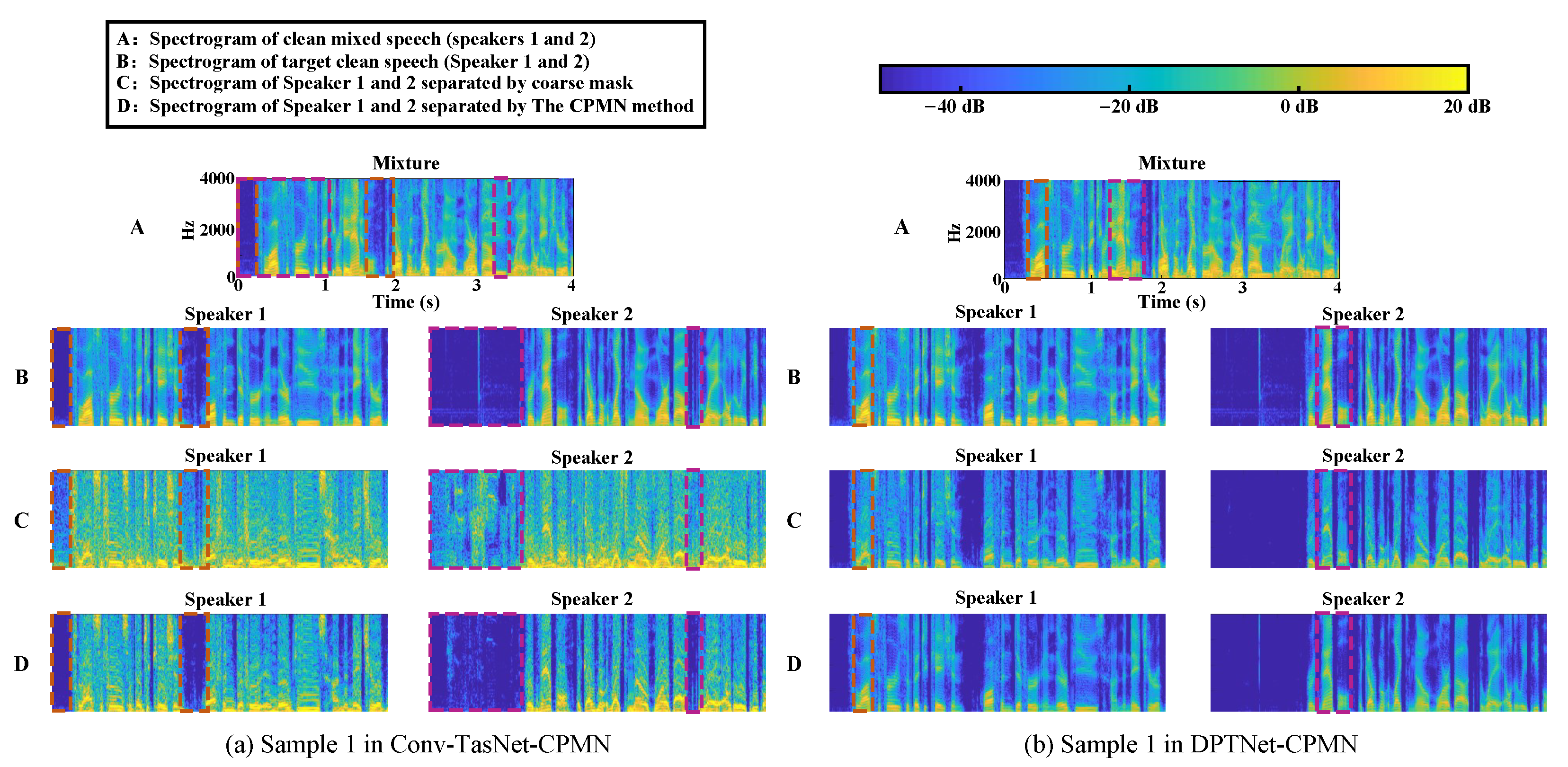
We further visualize separation results via spectrograms, using identical two-speaker test samples for (Conv-TasNet/Conv-TasNet-CPMN) and (DPTNet/DPTNet-CPMN) to verify mask purification.
Figure 4 reveals most interfering components are eliminated in the CPMN-integrated models’ spectrograms, further confirming the CPMN’s generality and effectiveness.
5.3. Ablation Study
To verify the synergistic effect and individual contribution of each core mechanism in the CPMN, this section conducts ablation experiments based on TDANet. The network configuration is appropriately simplified, where the input and output channels are reduced from 512 to 320, and the number of network blocks is decreased from 16 to 11. All experiments are implemented on the Libri2Mix dataset, and the results are presented in
Table 3.
The key conclusions drawn from
Table 3 are summarized as follows:
(1) Necessity and contribution of the DCAM in the CPMN As the fundamental support module of the three-stage mechanism, the DCAM only achieves an SI-SNRi of 13.2 dB when used alone (Group 6), which is obviously inferior to the complete CPMN-based model (14.2 dB, Group 8) and slightly lower than the original TDANet (13.7 dB, Group 1). By contrast, the combined performance of the FCCM and the APMM degrades after removing the DCAM (Group 2). The results indicate that the DCAM cannot guarantee high-precision speech separation independently. Instead, it provides essential context features for the follow-up modules. The absence of the DCAM will weaken the combined effect of other mechanisms, which fully demonstrates its indispensable role. (2) Necessity and contribution of the FCCM in the CPMN The FCCM serves as the core module for performance improvement with the highest individual contribution. When the FCCM works separately (Group 7), the model achieves an SI-SNRi of 14.0 dB and SDRi of 14.4 dB, reaching a performance level close to the full model. In addition, the removal of the FCCM (Group 3 and Group 6) causes a significant performance drop. It is proved that the FCCM plays a vital role in cross-feature complementation and acts as the core driving force for superior separation performance. (3) Necessity and contribution of the APMM in the CPMN The APMM functions as the final optimization module to refine separation accuracy. After eliminating the APMM (Group 4, DCAM + FCCM), the SI-SNRi drops from 14.2 (full model) to 13.7 dB, with a performance loss of 0.5 dB. This verifies that the APMM can purify the coarse features output by the first two stages and further boost separation quality. (4) Progressive synergistic effect of the three-stage mechanism All dual-module combinations (Group 2–4, SI-SNRi: 13.0∼14.0 dB) exhibit poorer performance than the complete model (14.2 dB, Group 8). This reveals that the three modules must cooperate to realize optimal separation performance. Moreover, the full model achieves a 0.5 dB improvement over the original TDANet, further validating the effectiveness and necessity of all core components in the CPMN.
5.4. Computational Overhead and Real-Time Performance Analysis
Apart from speech separation performance, practical deployment feasibility and low-latency inference are crucial for real-life scenarios like hearing aids and real-time speech transcription. To validate the practical applicability of the proposed CPMN, we conduct a comprehensive comparison between the baseline TDANet and our TDANet-CPMN model in terms of computational overhead, real-time performance, inference latency, and GPU memory consumption. All experiments are carried out using 3 s audio clips with an 8 kHz sampling rate, and all reported results are averaged over 50 independent inference runs to ensure statistical stability.
As listed in
Table 4, compared with the baseline TDANet, our proposed model exhibits a slight increase in computational complexity. The real-time factor and inference latency are maintained at a stable level with negligible growth. Meanwhile, the GPU memory occupancy increases gently with limited overhead. The results verify that our method achieves prominent performance gains under controllable computation, latency and memory cost, showing good practicability for hearing aids and live transcription deployment.
5.5. Sensitivity Analysis of Window Size in the DCAM
The window size in the DCAM is one of the core hyperparameters of the CPMN contextual feature enhancement module, which directly determines the capturing range of local dynamic speech features by the model. To investigate the influence of this parameter, ablation experiments are conducted on the Libri2Mix dataset based on TDANet. For experimental efficiency, the input and output channels are reduced from 512 to 320, and the number of network blocks is reduced from 16 to 11. The experimental results are presented in
Table 5.
As shown in
Table 5, the model performance exhibits an inverted U-shaped trend with the increase of window size. The optimal performance is achieved when the window size is set to 3, yielding SI-SNRi of 14.2 dB and SDRi of 14.6 dB, which outperforms the setting of window size 2. However, the separation metrics gradually decline as the window size further increases to 4, 8, and 16. This phenomenon indicates that a moderate window size can effectively aggregate the short-term stationary characteristics and adjacent temporal correlations of speech signals. In contrast, an excessively large window size will introduce redundant noise and cross-frame interference, thereby degrading the speech separation performance.
6. Conclusions
This study proposes a coarse-to-fine CPMN to address mask contamination in single-stage end-to-end speech separation. It uses baseline networks (e.g., Conv-TasNet, TDANet, DPTNet) to learn initial features and generate coarse masks, which are refined in a dynamically optimized purification space for more accurate separation. Across three datasets (Libri-2Mix, WHAM!, WSJ0-2Mix) and three classic baselines, the CPMN stably boosts SI-SNRi, verifying its effectiveness, generality, and practical value. Nevertheless, the CPMN has room for improvement. Future work will expand its application scenarios: optimizing cross-source feature interaction to adapt from current two-speaker separation to multi-speaker (more than two speakers) mixing scenarios, which will guide our subsequent research. In addition, the practical significance of the performance improvement brought by the proposed method in real noisy environments needs to be further discussed. It is clear that, although the public datasets adopted in the experiment can simulate partial noise scenarios, they still differ from the complex noise conditions in the real world, such as industrial production sites, underground working environments and urban noisy scenes. In subsequent research, real industrial noise data will be adopted to verify the model’s adaptability in practical scenarios, clarify the practical value of performance optimization, and support the stable operation of related voice interaction tasks. Finally, we will further evaluate the model on multilingual and spontaneous speech corpora to strengthen its overall generalization.
Author Contributions
F.Z.: Conceptualization, Methodology, Software, Formal analysis, Writing. K.Y.: Supervision, Writing—review & editing, Funding acquisition, Project administration. K.W.: Resources, Data curation, Investigation. All authors have read and agreed to the published version of the manuscript.
Funding
This research received no external funding.
Data Availability Statement
The original contributions presented in this study are included in the article. Further inquiries can be directed to the corresponding author.
Conflicts of Interest
Author Fuwen Zhu was employed by the company Jiaozuo Coal Industry Co., Ltd. The remaining authors declare that the research was conducted in the absence of any commercial or financial relationships that could be construed as a potential conflict of interest.
References
- Wang, D.; Chen, J. Supervised Speech Separation Based on Deep Learning: An Overview. IEEE/ACM Trans. Audio Speech Lang. Process. 2018, 26, 1702–1726. [Google Scholar] [CrossRef] [Scilit] [PubMed]
- Pariente, M.; Cornell, S.; Deleforge, A.; Vincent, E. Filterbank Design for End-to-end Speech Separation. In Proceedings of the ICASSP 2020—2020 IEEE International Conference on Acoustics, Speech and Signal Processing (ICASSP), Barcelona, Spain, 4–8 May 2020; pp. 6364–6368. [Google Scholar] [CrossRef] [Scilit]
- Xu, C.; Rao, W.; Chng, E.S.; Li, H. SpEx: Multi-Scale Time Domain Speaker Extraction Network. IEEE/ACM Trans. Audio Speech Lang. Process. 2020, 28, 1370–1384. [Google Scholar] [CrossRef] [Scilit]
- Zeghidour, N.; Grangier, D. Wavesplit: End-to-End Speech Separation by Speaker Clustering. IEEE/ACM Trans. Audio Speech Lang. Process. 2021, 29, 2840–2849. [Google Scholar] [CrossRef] [Scilit]
- Luo, Y.; Chen, Z.; Mesgarani, N.; Yoshioka, T. End-to-end Microphone Permutation and Number Invariant Multi-channel Speech Separation. In Proceedings of the ICASSP 2020—2020 IEEE International Conference on Acoustics, Speech and Signal Processing (ICASSP), Barcelona, Spain, 4–8 May 2020; pp. 6394–6398. [Google Scholar] [CrossRef] [Scilit]
- Zão, L.; Coelho, R.; Flandrin, P. Speech Enhancement with EMD and Hurst-Based Mode Selection. IEEE/ACM Trans. Audio Speech Lang. Process. 2014, 22, 899–911. [Google Scholar] [CrossRef] [Scilit]
- Wang, T.; Pan, Z.; Ge, M.; Yang, Z.; Li, H. Time-Domain Speech Separation Networks with Graph Encoding Auxiliary. IEEE Signal Process. Lett. 2023, 30, 110–114. [Google Scholar] [CrossRef] [Scilit]
- Luo, Y.; Chen, Z.; Mesgarani, N. Speaker-Independent Speech Separation with Deep Attractor Network. IEEE/ACM Trans. Audio Speech Lang. Process. 2018, 26, 787–796. [Google Scholar] [CrossRef] [Scilit]
- Wang, Z.Q.; Cornell, S.; Choi, S.; Lee, Y.; Kim, B.Y.; Watanabe, S. TF-GRIDNET: Making Time-Frequency Domain Models Great Again for Monaural Speaker Separation. In Proceedings of the ICASSP 2023—2023 IEEE International Conference on Acoustics, Speech and Signal Processing (ICASSP), Rhodes Island, Greece, 4–10 June 2023; pp. 1–5. [Google Scholar] [CrossRef] [Scilit]
- Meng, W.; Li, X.; Li, A.; Li, J.; Li, X.; Zheng, C. All Neural Kronecker Product Beamforming for Speech Extraction with Large-Scale Microphone Arrays. In Proceedings of the ICASSP 2024—2024 IEEE International Conference on Acoustics, Speech and Signal Processing (ICASSP), Seoul, Republic of Korea, 14–19 April 2024; pp. 8566–8570. [Google Scholar] [CrossRef] [Scilit]
- Luo, Y.; Mesgarani, N. Conv-TasNet: Surpassing Ideal Time–Frequency Magnitude Masking for Speech Separation. IEEE/ACM Trans. Audio Speech Lang. Process. 2019, 27, 1256–1266. [Google Scholar] [CrossRef] [Scilit] [PubMed]
- Chen, J.; Mao, Q.; Liu, D. Dual-path transformer network: Direct context-aware modeling for end-to-end monaural speech separation. arXiv 2020, arXiv:2007.13975. [Google Scholar]
- Li, K.; Yang, R.; Hu, X. An efficient encoder-decoder architecture with top-down attention for speech separation. arXiv 2023, arXiv:2209.15200. [Google Scholar]
- Luo, Y.; Chen, Z.; Yoshioka, T. Dual-path rnn: Efficient long sequence modeling for time-domain single-channel speech separation. In Proceedings of the ICASSP 2020—2020 IEEE International Conference on Acoustics, Speech and Signal Processing (ICASSP), Barcelona, Spain, 4–8 May 2020; pp. 46–50. [Google Scholar] [CrossRef] [Scilit]
- Yip, J.Q.; Zhao, S.; Ma, Y.; Ni, C.; Zhang, C.; Wang, H.; Nguyen, T.H.; Zhou, K.; Ng, D.; Chng, E.S.; et al. SPGM: Prioritizing Local Features for Enhanced Speech Separation Performance. In Proceedings of the ICASSP 2024–2024 IEEE International Conference on Acoustics, Speech and Signal Processing (ICASSP), Seoul, Republic of Korea, 14–19 April 2024; pp. 326–330. [Google Scholar] [CrossRef] [Scilit]
- Zhao, S.; Ma, B. MossFormer: Pushing the Performance Limit of Monaural Speech Separation Using Gated Single-Head Transformer with Convolution-Augmented Joint Self-Attentions. In Proceedings of the ICASSP 2023—2023 IEEE International Conference on Acoustics, Speech and Signal Processing (ICASSP), Rhodes Island, Greece, 4–10 June 2023; pp. 1–5. [Google Scholar] [CrossRef] [Scilit]
- Zhao, S.; Ma, Y.; Ni, C.; Zhang, C.; Wang, H.; Nguyen, T.H.; Zhou, K.; Yip, J.Q.; Ng, D.; Ma, B. MossFormer2: Combining Transformer and RNN-Free Recurrent Network for Enhanced Time-Domain Monaural Speech Separation. In Proceedings of the ICASSP 2024—2024 IEEE International Conference on Acoustics, Speech and Signal Processing (ICASSP), Seoul, Republic of Korea, 14–19 April 2024; pp. 10356–10360. [Google Scholar] [CrossRef] [Scilit]
- Cosentino, J.; Pariente, M.; Cornell, S.; Deleforge, A.; Vincent, E. LibriMix: An Open-Source Dataset for Generalizable Speech Separation. arXiv 2020, arXiv:2005.11262. [Google Scholar]
- Wichern, G.; Antognini, J.; Flynn, M.; Zhu, L.R.; McQuinn, E.; Crow, D.; Manilow, E.; Roux, J.L. WHAM!: Extending Speech Separation to Noisy Environments. In Proceedings of the Interspeech 2019, Graz, Austria, 15–19 September 2019; pp. 1368–1372. [Google Scholar] [CrossRef] [Scilit]
- Hackett, C. Regulating CSR: A Precursor to ‘Complete’ Globalisation In Development in an Era of Capital Control; Springer: Berlin/Heidelberg, Germany, 2017. [Google Scholar] [CrossRef] [Scilit]
- Roux, J.L.; Wisdom, S.; Erdogan, H.; Hershey, J.R. SDR—Half-baked or Well Done? In Proceedings of the ICASSP 2019—2019 IEEE International Conference on Acoustics, Speech and Signal Processing (ICASSP), Brighton, UK, 12–17 May 2019; pp. 626–630. [Google Scholar] [CrossRef] [Scilit]
- Kolbæk, M.; Yu, D.; Tan, Z.H.; Jensen, J. Multitalker Speech Separation with Utterance-Level Permutation Invariant Training of Deep Recurrent Neural Networks. IEEE/ACM Trans. Audio Speech Lang. Process. 2017, 25, 1901–1913. [Google Scholar] [CrossRef] [Scilit]
- Luo, Y.; Mesgarani, N. TaSNet: Time-Domain Audio Separation Network for Real-Time, Single-Channel Speech Separation. In Proceedings of the 2018 IEEE International Conference on Acoustics, Speech and Signal Processing (ICASSP), Calgary, AB, Canada, 15–20 April 2018; pp. 696–700. [Google Scholar] [CrossRef] [Scilit]
- Tzinis, E.; Wang, Z.; Smaragdis, P. Sudo RM -RF: Efficient Networks for Universal Audio Source Separation. In Proceedings of the 2020 IEEE 30th International Workshop on Machine Learning for Signal Processing (MLSP), Espoo, Finland, 21–24 September 2020; pp. 1–6. [Google Scholar] [CrossRef] [Scilit]
- Subakan, C.; Ravanelli, M.; Cornell, S.; Bronzi, M.; Zhong, J. Attention Is All You Need In Speech Separation. In Proceedings of the ICASSP 2021—2021 IEEE International Conference on Acoustics, Speech and Signal Processing (ICASSP), Toronto, ON, Canada, 6–11 June 2021; pp. 21–25. [Google Scholar] [CrossRef] [Scilit]
- Isik, Y.; Roux, J.L.; Chen, Z.; Watanabe, S.; Hershey, J.R. Single-Channel Multi-Speaker Separation using Deep Clustering. arXiv 2016, arXiv:1607.02173. [Google Scholar]
- Wang, Z.Q.; Roux, J.L.; Hershey, J.R. Alternative Objective Functions for Deep Clustering. In Proceedings of the 2018 IEEE International Conference on Acoustics, Speech and Signal Processing (ICASSP), Calgary, AB, Canada, 15–20 April 2018; pp. 686–690. [Google Scholar] [CrossRef] [Scilit]
- Liu, Y.; Wang, D. Divide and Conquer: A Deep CASA Approach to Talker-Independent Monaural Speaker Separation. IEEE/ACM Trans. Audio Speech Lang. Process. 2019, 27, 2092–2102. [Google Scholar] [CrossRef] [Scilit] [PubMed]
- Fan, C.; Tao, J.; Liu, B.; Yi, J.; Wen, Z.; Liu, X. End-to-End Post-Filter for Speech Separation with Deep Attention Fusion Features. IEEE/ACM Trans. Audio Speech Lang. Process. 2020, 28, 1303–1314. [Google Scholar] [CrossRef] [Scilit]
- Shi, Z.; Lin, H.; Liu, L.; Liu, R.; Han, J.; Shi, A. Deep Attention Gated Dilated Temporal Convolutional Networks with Intra-Parallel Convolutional Modules for End-to-End Monaural Speech Separation. In Proceedings of the Interspeech 2019, Graz, Austria, 15–19 September 2019; pp. 3183–3187. [Google Scholar] [CrossRef] [Scilit]
- Zhang, L.; Shi, Z.; Han, J.; Shi, A.; Ma, D. FurcaNeXt: End-to-End Monaural Speech Separation with Dynamic Gated Dilated Temporal Convolutional Networks. In Proceedings of the MultiMedia Modeling; Ro, Y.M., Cheng, W.H., Kim, J., Chu, W.T., Cui, P., Choi, J.W., Hu, M.C., De Neve, W., Eds.; Springer: Cham, Switzerland, 2020; pp. 653–665. [Google Scholar] [CrossRef] [Scilit]
| Disclaimer/Publisher’s Note: The statements, opinions and data contained in all publications are solely those of the individual author(s) and contributor(s) and not of MDPI and/or the editor(s). MDPI and/or the editor(s) disclaim responsibility for any injury to people or property resulting from any ideas, methods, instructions or products referred to in the content. |