Article

Multi-Model Fusion of Lithium Battery SOC Estimation Based on Bayesian Principle
School of Electrical Engineering and Automation, Jiangsu Normal University, Xuzhou 221116, China
*
Author to whom correspondence should be addressed.
Mathematics 2026, 14(10), 1642; https://doi.org/10.3390/math14101642
Submission received: 14 April 2026 / Revised: 7 May 2026 / Accepted: 10 May 2026 / Published: 12 May 2026
(This article belongs to the Special Issue Artificial Intelligence and Algorithms)

Abstract

The battery management system (BMS) is the core of ensuring the safety and performance of new energy vehicles, and real-time high-precision estimation of battery state of charge (SOC) is its key function, which directly affects battery safety, endurance, and service life. Faced with the challenges brought by high energy density and ultra-fast charging technology, lithium-ion batteries exhibit strong nonlinear and time-varying characteristics, making it difficult for existing SOC estimation methods to balance computational efficiency and accuracy. This study proposes a Bayesian-based Hammerstein multi-model (MM) fusion algorithm for accurate lithium battery SOC estimation across a wide temperature range, especially under low-temperature conditions. First, two Hammerstein SOC submodels are constructed: a traditional polynomial Hammerstein model and a TPA-Hammerstein model incorporating the temporal pattern attention mechanism. Second, KV-ADAM is employed for parameter training and identification of the submodels. Finally, a Bayesian weighted fusion strategy is used to dynamically integrate the outputs of the two submodels. The experimental results show that this method significantly improves the accuracy and robustness of SOC estimation, overcomes the limitations of a single model under complex dynamic conditions, provides an effective solution for lithium battery SOC estimation, and helps the safe operation of electric vehicles and the sustainable development of the industry.

1. Introduction

New energy electric vehicles are pivotal to achieving the dual carbon goals, with power batteries serving as their core components. The safety and performance of these batteries heavily depend on the battery management system (BMS) [1]. Among the numerous functions of the BMS, state of charge (SOC) estimation is the absolute core. SOC is equivalent to the “remaining fuel level” in gasoline vehicles, representing the key indicator of a battery’s remaining charge. The accuracy of its estimation directly determines three core aspects: safety, range reliability, and battery lifespan. However, faced with the challenges of high energy density and ultra-fast charging technology, the strong nonlinearity and time-varying characteristics of lithium-ion batteries make it extremely difficult to achieve high-precision, real-time SOC estimations [2,3]. Existing methods often struggle to balance computational complexity with estimation accuracy [4,5,6]. Therefore, overcoming the technical bottlenecks in SOC estimation and developing efficient, precise estimation algorithms are paramount to ensuring the safe operation of electric vehicles and promoting the sustainable development of the industry.
At present, SOC estimation methods can be mainly divided into three categories: direct estimation, model-based algorithms, and data-driven algorithms [7,8,9]. Although direct estimation methods such as the ampere-hour integration method and open-circuit voltage method are simple to calculate and easy to implement, they are prone to error accumulation in practical use and have high requirements for battery static state. Therefore, it is difficult for them to meet the real-time and accurate estimation of SOC under dynamic working conditions. Plett [10] pointed out that although the principle of the ampere-hour integration method is simple, its estimation accuracy heavily depends on the accuracy of the initial SOC, and the measurement noise of the current sensor can cause errors to accumulate over time, thereby reducing the reliability of long-term estimation. The model-based method combines an equivalent circuit model with a filter for SOC estimation, which can effectively suppress noise and parameter disturbances, but is sensitive to model parameters and initial conditions. Gong et al. [11] proposed an improved low-temperature battery OCV estimation method and used a dual adaptive extended Kalman filter (DAEKF) based on residual sequences to achieve synchronous estimation of model parameters and SOC, improving the accuracy of SOC estimation over a wide temperature range. However, as an internal state influenced by complex electrochemical kinetics, SOC, especially in low-temperature environments, undergoes significant changes in key parameters, making it difficult for model-based methods to accurately estimate SOC. The data-driven approach learns the complex nonlinear relationship between SOC and battery characteristics from a large amount of data through techniques such as machine learning. Yu et al. [12] constructed an autoregressive GPR model to further improve estimation accuracy and confidence, ultimately achieving relatively low estimation errors under extreme conditions. Chen et al. [13] used recursive neural networks for SOC estimation and achieved good accuracy in validation under dynamic load conditions. Li et al. [14] proposed a SOC estimation method that integrates CNN, BiLSTM, and attention mechanism, effectively improving feature extraction and temporal modeling capabilities in low-temperature environments and achieving high estimation accuracy. However, the above data-driven methods generally rely on a large amount of high-quality training data, with limited model generalization ability and a lack of interpretability for the internal physical mechanisms of the battery, making it difficult to ensure the robustness and reliability of the estimation under variable operating conditions. Although previous studies have explored hybrid model data-driven frameworks for SOC estimation [15,16], most of them adopt serial cascade architectures. Such architectures cannot dynamically fuse the outputs of parallel submodels according to real-time confidence, which limits their robustness under varying operating conditions.
At low temperatures, the electrochemical performance of batteries undergoes significant changes, and Lithium-ion batteries have inherent strong nonlinearity, hysteresis characteristics, and time-varying parameters, which make it difficult for their traditional linear equivalent circuit models to maintain high accuracy under all operating conditions. Moreover, due to the great computational complexity of the complex electrochemical model, it is difficult to use it for real-time operations in embedded battery management systems. Therefore, the Hammerstein model, which combines static nonlinear mapping with linear dynamic behavior, provides a favorable balance between modeling accuracy and computational efficiency, making it attractive for battery state estimation [17,18,19]. Its core difficulty is the parameter separation and identification of nonlinear and linear modules. Existing methods mainly include hyperparameters, layered identification, and key variable separation principles [20,21]. The key variable separation principle can avoid redundant parameters and decoupling processes and is more suitable for online real-time identification. In summary, the Hammerstein model has clear physical meaning and excellent fitting and identification efficiency, providing an effective approach for high-precision SOC estimation of lithium batteries under complex operating conditions [22,23,24].
In conclusion, this paper proposes a Bayesian-based Hammerstein multi-model fusion algorithm for estimating the state of charge (SOC) of lithium batteries. The main contributions of this study are as follows:
  • Constructing two parallel Hammerstein-based SOC submodels: a conventional polynomial Hammerstein submodel and a TPA-Hammerstein submodel incorporating the temporal pattern attention mechanism. This submodel utilizes dynamic operating condition features (battery terminal voltage, current, and temperature) as inputs to effectively characterize the complex nonlinear characteristics of lithium batteries, simulating the mapping relationship between battery state and SOC across the full low-temperature operating range.
  • Employing a key variable separation-based adaptive moment estimation algorithm (KV-ADAM) for parameter identification of the two submodels and using a key variable separation-based stochastic gradient descent(KV-SGD) as a comparison algorithm to verify the effectiveness of KV-ADAM.
  • A Bayesian weighted fusion strategy is developed to dynamically integrate the outputs of the two submodels, which achieves high-precision collaborative SOC estimation across the full operating domain and effectively enhances the accuracy and robustness of SOC estimation over a wide temperature range.
The organizational structure of this article is as follows: Section 2 introduces the dual submodel structure consisting of a conventional Hammerstein model and a TPA-Hammerstein model. Section 3 presents the KV-ADAM based parameter identification method and the Bayesian principle based multi-model fusion architecture for SOC estimation. Section 4 uses the MATLAB R2023b ([MathWorks], Natick, MA, USA) simulation platform to estimate SOC under US06 and LA92 at different temperature conditions. Section 5 presents the conclusion.

2. Model Structure

2.1. Traditional Hammerstein Model

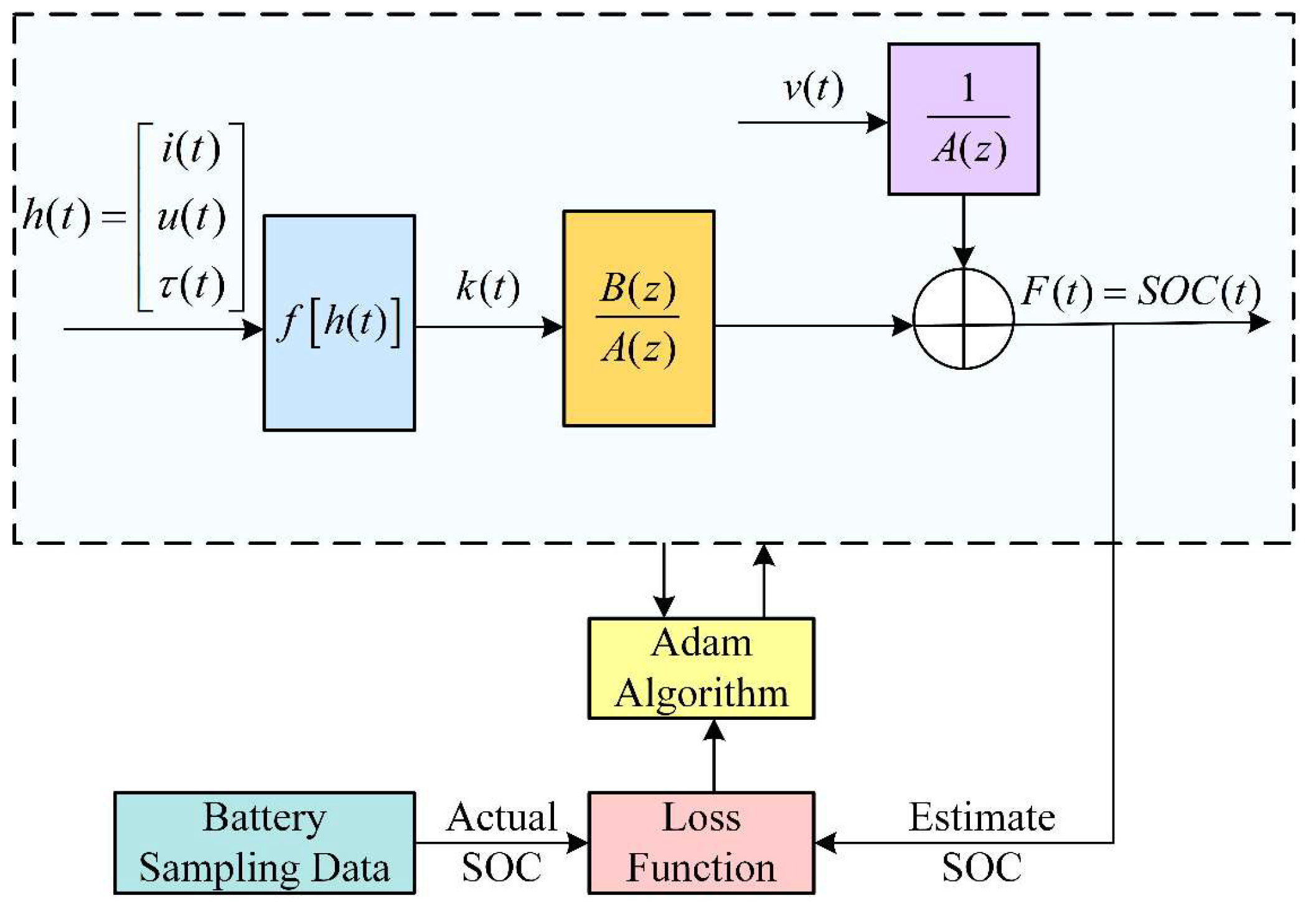
The traditional Hammerstein model is a block-structured nonlinear model, as shown in Figure 1, consisting of three static nonlinear polynomial blocks and a dynamic controlled autoregressive (CAR) linear model. It is defined as follows:
k t = k 1 t k 2 t k 3 t = f h 1 t f h 2 t f h 3 t = i = 1 m γ 1 i f i t i = 1 m γ 2 i f u t i = 1 m γ 3 i f τ t
A z F t = B z k t + v t
In the nonlinear unit, i t ϵ R , u t ϵ R , and τ t ϵ R represent the battery terminal current, terminal voltage, and ambient temperature as model inputs, respectively; the model output is defined as SOC m t ϵ R , where v t ϵ R denotes a zero-mean random white noise sequence, k t = k 1 t , k 2 t , k 3 t T ϵ R 3 × 1 represents the intermediate values of the system variables, and A z and B z are polynomials in the unit shift operator z j k t = k t j , expressed as:
A z = 1 + a 1 z 1 + a 2 z 2 + a n z n R
B z = b 1 z , b 2 z , b 3 z R 1 × 3
b i z = 1 + b i 1 z 1 + b i 2 z 2 + b i n z n R
where m and n are known orders.

2.2. TPA-Hammerstein Model

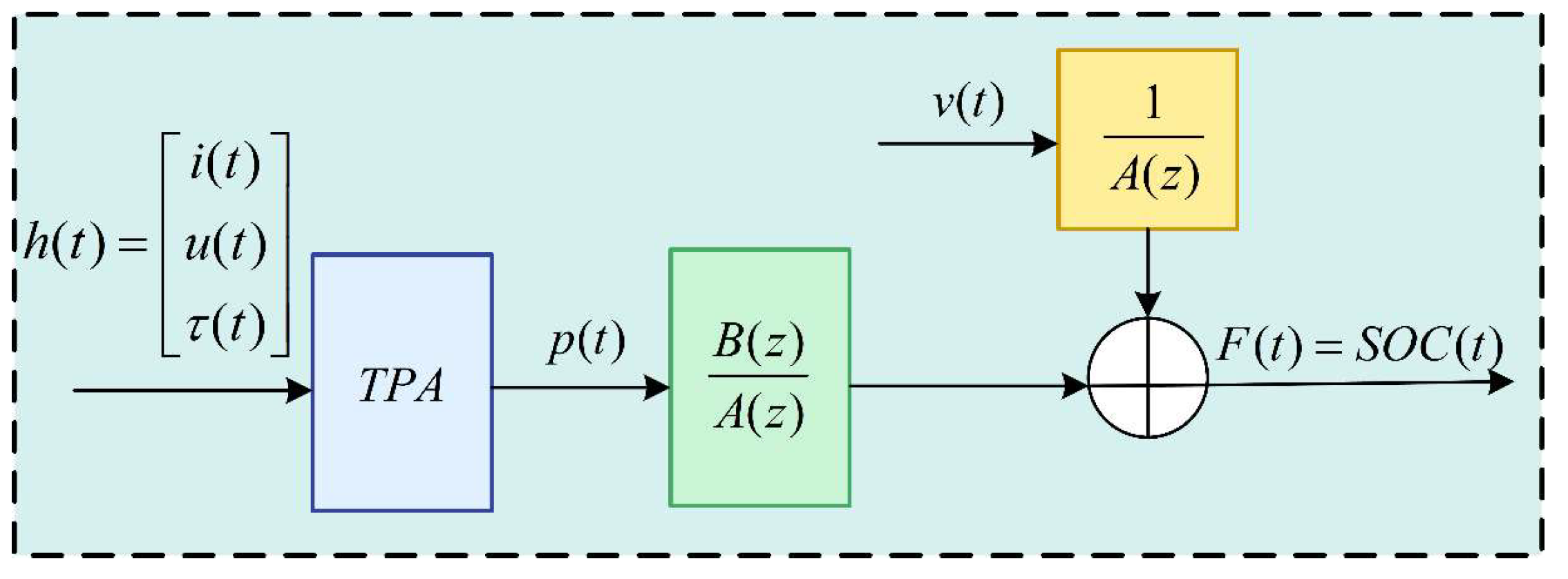
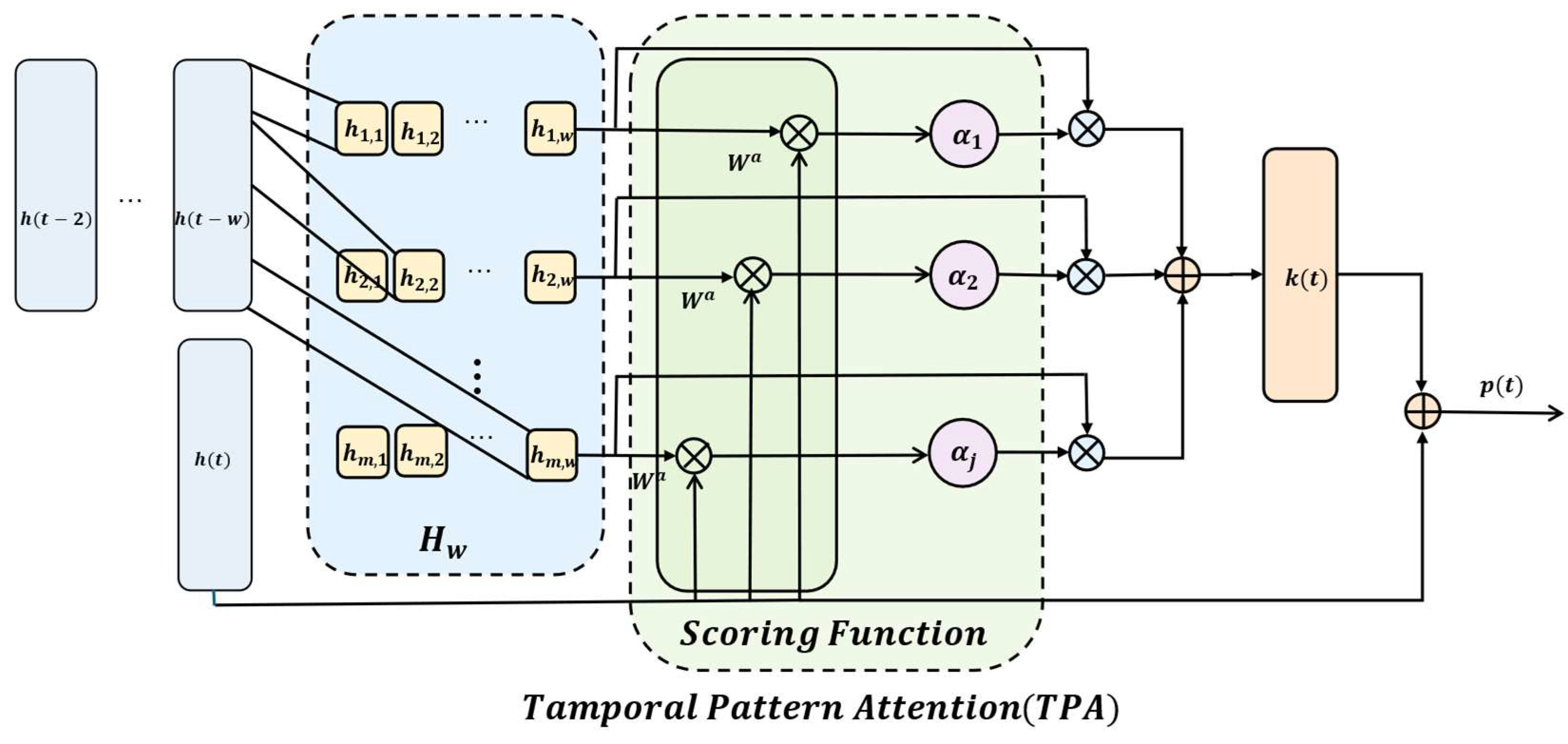
Building on the classical Hammerstein structure, the TPA-Hammerstein model incorporates a temporal pattern attention (TPA) mechanism [25,26,27]. This forms a serial architecture consisting of two cascaded components: an attention-driven nonlinear module and a controlled autoregressive (CAR) module, as illustrated in Figure 2 and Figure 3. The nonlinear module takes the battery terminal current (i(t)), terminal voltage (u(t)), and temperature ( τ t ) as inputs. It employs the TPA mechanism to adaptively weight historical input sequences, thereby effectively capturing the dynamic coupling relationships and critical transient features across the temporal dimension. Subsequently, the extracted high-dimensional nonlinear features are fed into the linear dynamic module, which ultimately outputs the battery SOC—the core performance metric of the system.
Define the input to the TPA nonlinear module as:
h t = k 1 t k 2 t k 3 t = i t , u t , τ t T R 3 × 1
H w = h t 1 , h t 2 , h t w = H w , 1 , H w , 2 , H w , w R m × w
where w denotes the window length.
Define the scoring function as:
f H w h t = H w T W a h t
W a R m × m represents the weight of the scoring function, expressed as:
W a = W 11 a W 12 a W 13 a W 21 a W 22 a W 23 a W 31 a W 32 a W 33 a
The attention weight α is obtained via the sigmoid function:
α = g f H w h t
Among which,
g x = 1 1 + e x
By weighting the vectors in Equation (7) with the weighting factor α , we obtain:
p t = j = 1 w α j H w , j = H w α
Using Equations (8) and (10)–(12), the output of the nonlinear module can be obtained:
p t = H w g H w T W a h t + W b h t
W b R m × m is a weight matrix:
W b = W 11 b W 12 b W 13 b W 21 b W 22 b W 23 b W 31 b W 32 b W 33 b
The linear module of this model is the CAR model, whose representation is consistent with the linear module of the aforementioned traditional Hammerstein model [28,29,30].

3. Methods

3.1. KV-ADAM Algorithm

For the models presented in Section 2, parameter estimation is carried out using the key variable separation principle. Its core concept involves isolating key variables from linear blocks and substituting the output expressions of nonlinear blocks into the separated key terms within the model. Subsequently, the Hammerstein system can be represented as a regression equation of system parameters [31,32,33]. Parameter estimation is computed using the gradient descent algorithm. The specific workflow is as follows:
Expanding Equation (2) yields:
F t = k t + b 1 k t 1 + + b n k t n a 1 F t 1 a n F t n + v t
Using the principle of key variable separation, substitute the separated key terms—namely the model input k t —into Equation (15) to obtain:
F t = H w g H w T W a h t + W b h t + ψ T t φ + v t
Define ψ t and φ :
ψ t = k t 1 , , k t n , Y t 1 , , Y t n T R 2 n ,
φ = b 1 , , b n , a 1 , , a n T R 2 n
Based on the above equations, three fictitious models were established using the principle of recursive identification, namely:
y 1 t = F t W b h t ψ T t φ = H w g H w T W a h t + v t
y 2 t = F t H w g H w T W a h t ψ T t φ = W b h t + v t
y 3 t = F t H w g H w T W a h t W b h t = ψ T t φ + v t
Then, the ADAM algorithm is employed for parameter optimization, defining three loss functions as follows:
J 1 W a = 1 2 y 1 t H w g H w T W a h t 2
J 2 W b = 1 2 y 2 t W b h t 2
J 3 φ = 1 2 y 3 t ψ T t φ 2
In the t-th iteration, the partial derivatives of J 1 W a , J 2 W b , and J 3 φ with respect to W a , W a , and φ , respectively, serve as the gradients. Where h t R 3 x 1 , W a , W b R 3 x 3 These gradients are expressed as follows:
g r a d J 1 W a = J 1 W a W a = y 1 t H w g H w T W a h t H w × ( H w T ) g H w T W a h t 1 S H w T W a h t h T t
g r a d J 2 W b = J 2 W b W b = y 2 t W b h t h T t
g r a d J 3 φ = J 3 φ φ = y 3 t ψ T t φ t ψ t
The symbol ⊙ denotes the Hadamard product, and * denotes multiplication.
m 1 t = μ 1 m 1 t 1 + 1 μ 1 g r a d *
m 2 t = μ 2 m 2 t 1 + 1 μ 2 g r a d 2 *
Among them, * are J 1 W a , J 2 W b , and J 3 φ .
In the ADAM algorithm, the first and second moment measures m 1 t and m 2 t respectively denote the expected values of the first and second order statistics of the gradient g r a d * and g r a d 2 * , which are updated using the corresponding decay coefficients μ 1 and μ 2 . Due to initial values being set to zero, early moments estimates exhibit a bias towards zero. To address this, the bias is corrected, enabling more accurate and stable parameter updates during training.
m ^ 1 t = m 1 t 1 μ 1 t
m ^ 2 t = m 2 t 1 μ 2 t
Define W a t , W b t , and φ t as the parameter estimation vectors at time t, namely W ^ a t , W ^ b t , and φ ^ t ,
W ^ a t + 1 = W ^ a t η 1 1 m ^ 2 t + σ m ^ 1 t
W ^ b t + 1 = W ^ b t η 2 1 m ^ 2 t + σ m ^ 1 t
φ ^ t + 1 = φ ^ t η 3 1 m ^ 2 t + σ m ^ 1 t
In this context, η 1 , η 2 , and η 3 denote learning rates, with σ employed to prevent the denominator from becoming zero.

3.2. Multi-Model Fusion Strategy Based on Bayesian Principles

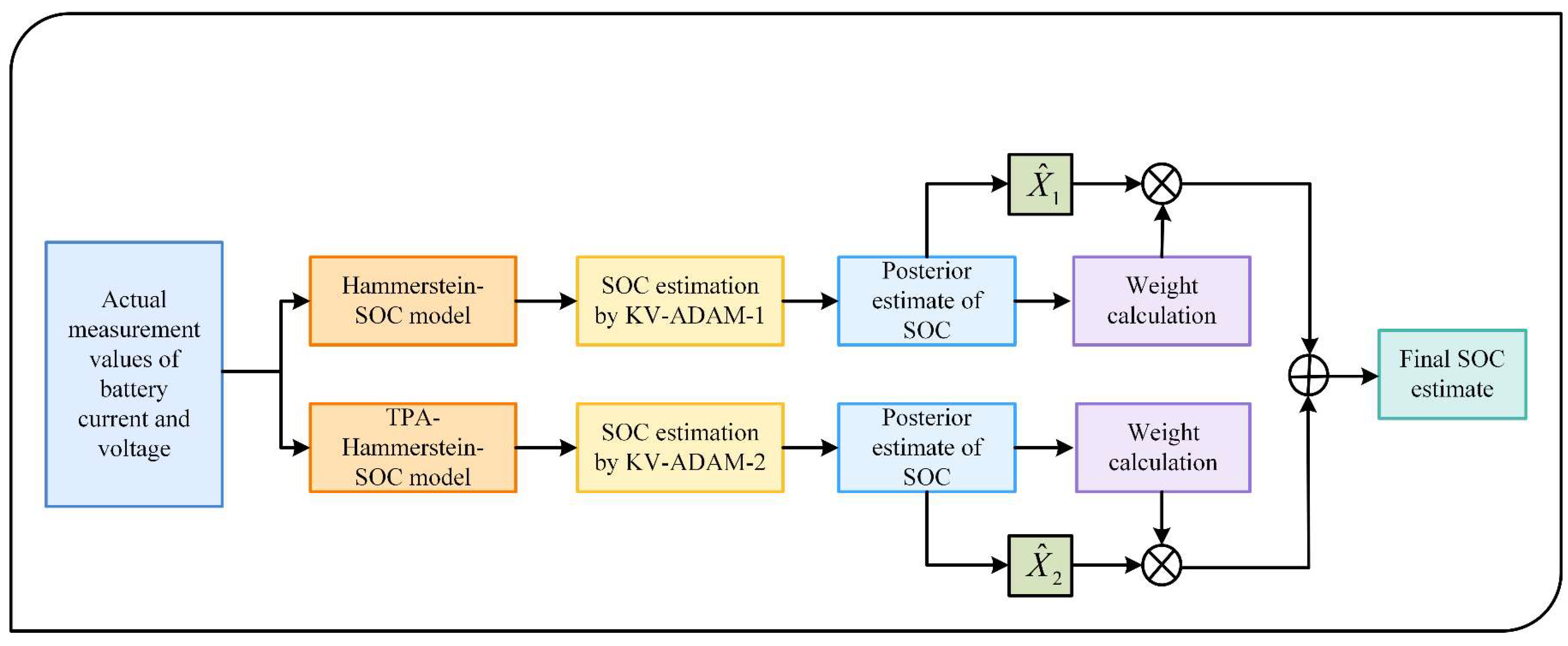
The core idea of multi-model fusion estimation is to employ a Bayesian inference framework to improve the adaptability of SOC estimation under complex dynamic operating conditions [34,35,36]. In this framework, multiple submodels with different structural characteristics operate in parallel, and their contributions are adaptively adjusted according to their consistency with the reference SOC sequence. The final SOC estimate is then obtained through the weighted combination of the submodel outputs.
This approach effectively quantifies model uncertainty and systematically adjusts the confidence level of the initial assumptions when new evidence is introduced, significantly enhancing the robustness and accuracy of state estimation. The system model used in this study is shown in Figure 4.
In the multi-model system constructed in this study, two independent submodels were first defined. For each independent submodel, a corresponding ADAM optimization algorithm was configured to enable each submodel to run in parallel under an independent ADAM optimizer: the first submodel adopts the conventional Hammerstein SOC model, with parameter optimization performed using the KV-ADAM algorithm, and its SOC estimate at time step k is denoted as X ^ 1 k = S O C ^ 1 k ; the second submodel employs a Hammerstein SOC model incorporating a temporal pattern attention mechanism, solved by the KV-ADAM algorithm based on the fusion of hierarchical identification principles, with its estimate denoted as X ^ 2 k = S O C ^ 2 k . Let the actual measured value at time step k be Y k = S O C k . To evaluate the goodness-of-fit of each submodel at the current time step, the estimation residual Y k = S O C k for the i-th submodel i = 1 , 2 at time step k is defined as the difference between the actual measured value and the submodel’s estimate:
The difference between the actual system measurement S O C k and the estimated measurement value S O C i k is defined as the residual e i k , as shown in the following equation:
e i k = S O C k S O C ^ i k
The residual e i k reflects the degree of similarity between the submodel and the actual system’s dynamic characteristics. A smaller residual amplitude indicates that the model more accurately captures battery behavior under the current operating conditions and should be assigned a higher confidence level. Conversely, if the residual exhibits systematic bias or excessive amplitude, it suggests reduced applicability of the model at the present moment. Due to the presence of measurement noise, single-point residuals often exhibit random fluctuations, and their direct use in weight calculation may lead to oscillatory estimation results. Therefore, this paper introduces a sliding window method for statistical analysis of the residual sequence to construct a probability density function reflecting the distribution characteristics of model error. Setting the sliding window length to r , when k r , the sample mean e - i k and sample variance σ i 2 k of the i-th model are calculated using the residual sequence from time k r + 1 :
e - i k = 1 r j = k r + 1 k e i j
σ i 2 k = 1 r 1 j = k r + 1 k e i j e - i k 2
When k < r , the window length increases incrementally with each time step until it reaches the preset value r , after which it remains constant. Based on the central limit theorem, assuming residuals follow a Gaussian distribution, the conditional probability density function of the i model at time k can be derived via the following equation:
f Y k | θ i , Y k 1 Y k | θ i , Y k 1 = 1 2 π σ i k exp e i T k 1 2 σ i 2 k e i k
Here, θ i denotes the parameter set of the i t h model. This probability density function quantifies the likelihood of observing the actual measurement Y k under the current model parameters [37,38]. Within a multi-model fusion framework, the model weights essentially represent the posterior probability of a model’s existence. According to Bayes’ theorem, the posterior probability (i.e., weight coefficient) P θ i Y k of the i t h model at time k can be updated from the prior probability at the previous time step and the likelihood function at the current time step:
P θ i Y k = f Y k | θ i , Y k 1 Y k | θ i , Y k 1 P θ i Y k 1 j = 1 n f Y k | θ i , Y k 1 Y k | θ i , Y k 1 P θ i Y k 1
Here, Y k = y 1 , y 2 , , y k denotes the entire sequence of observations up to time step k , while P θ i Y k 1 represents the weight (prior probability) of the i t h model at time step k 1 . Since the model parameter set θ i is fixed during the identification phase and treated as known, the conditional probability density term f Y k | θ i , Y k 1 Y k | θ i , Y k 1 can be directly computed from Equation (32). To simplify computation and prevent numerical underflow, it is typically assumed that measurement noise is independent and identically distributed across models, with weight updates at time step k primarily determined by the current likelihood ratio [39,40,41].
Ultimately, the optimal SOC fusion estimate X ^ f u s i o n k at time k is obtained by the weighted sum of the estimates from each submodel:
X ^ f u s i o n k = i = 1 2 P θ i Y k X ^ i k
This fusion strategy dynamically adjusts the contribution of each submodel to the overall estimation by continuously monitoring the residual statistical characteristics of each submodel. When residuals increase for a model due to abrupt operational changes, its corresponding probability density function value rapidly diminishes, leading to reduced weighting. Conversely, models demonstrating superior fit receive higher weighting. This mechanism ensures fusion estimates that are consistently dominated by the model best suited to the current system state, effectively overcoming the limitations inherent in relying on a single model.

4. Experiments and Simulation

4.1. Data Processing

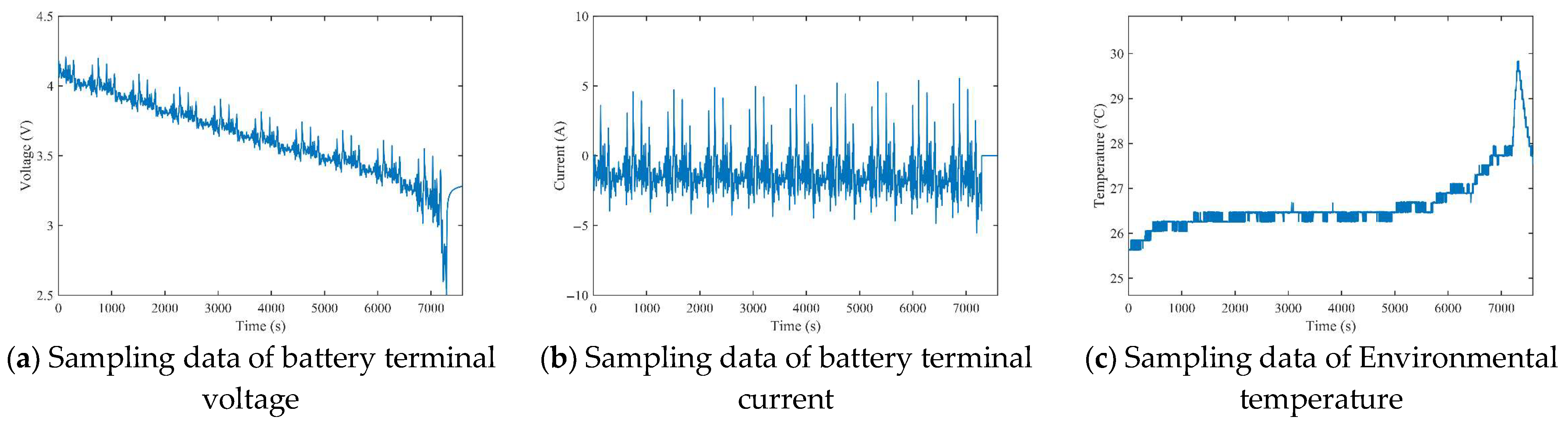
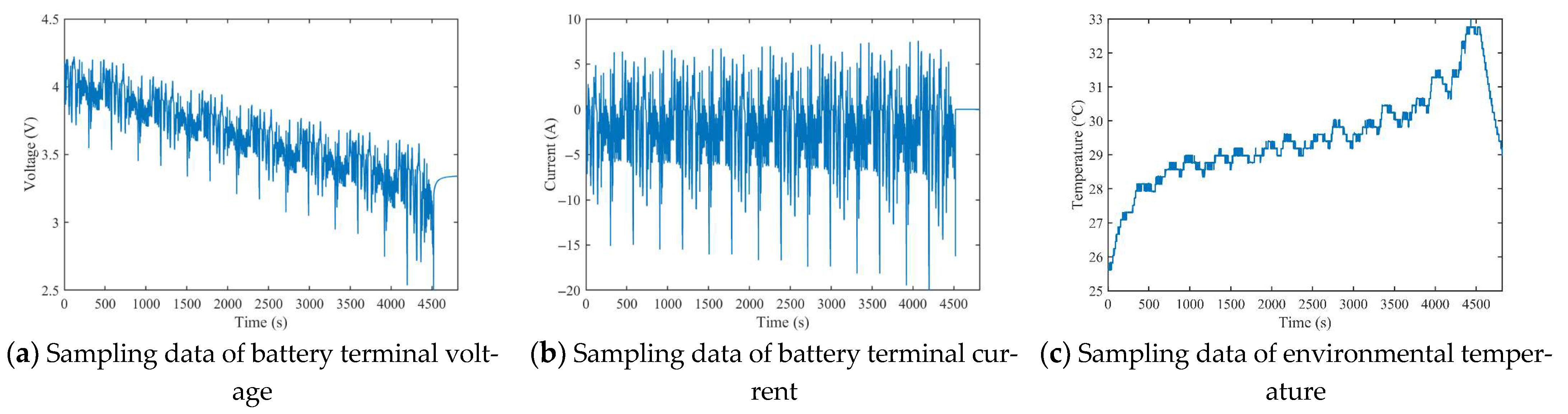
To validate the effectiveness of the KV-ADAM algorithm within the MM-Hammerstein SOC model for lithium battery SOC estimation, this study employs the Panasonic NCR18650PF battery dataset (Panasonic Corporation, Osaka, Japan) released by the University of Wisconsin–Madison. The lithium battery dataset collected at 25 °C under HWFET operating conditions was used as the training set for the model, as shown in Figure 5. The dataset measured under the US06 and LA92 supplementary federal testing programs was used as the testing set for the proposed model, and the main parameters of the battery are shown in Table 1. Three evaluation metrics—Root Mean Square Error (RMSE), Mean Absolute Error (MAE), and Coefficient of Determination (R2)—were employed to assess the estimation performance of the KV-ADAM algorithm based on the MM-Hammerstein model:
R M S E = t = 1 n S O C t S O C ^ t 2 n
M A E = 1 n t = 1 n S O C t S O C ^ t
R 2 = 1 t = 1 n S O C t S O C ^ t 2 t = 1 n S O C t S O C ¯ t 2
Here, S O C t and S O C ^ t denote the measured and estimated values respectively; S O C ¯ t represents the actual mean value.

4.2. Simulation and Analysis

To further validate the proposed method, comparative simulations were conducted at 25 °C to evaluate the performance of the KV-ADAM and KV-SGD algorithms. To rigorously evaluate the efficacy of the proposed Bayesian-based multi-model (MM) Hammerstein SOC estimation framework, comprehensive simulation verification was conducted under various environmental temperature conditions (25 °C, 10 °C, −10 °C, 0 °C, and −20 °C) for the US06 and LA92 driving conditions. This section focuses on the comparative performance analysis between the traditional Hammerstein model, the TPA-Hammerstein model, and the proposed MM-Hammerstein fusion architecture. By analyzing the trajectory tracking capabilities and error distribution characteristics under dynamic loading profiles, the superior robustness and accuracy of the Bayesian fusion mechanism are systematically validated.

4.2.1. Analysis of SOC Estimation Results Using KV-ADAM and KV-SGD Algorithm Under 25 °C

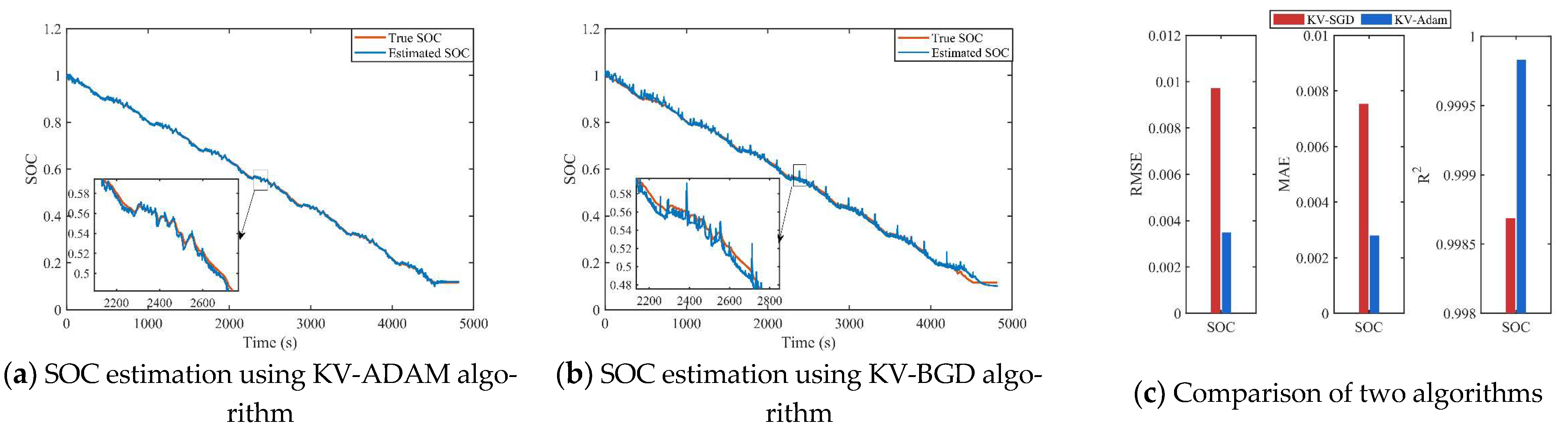
Figure 6 shows the dataset under US06 conditions at an ambient temperature of 25 °C. Figure 7a shows the estimation of lithium battery SOC using a polynomial Hammerstein model based on KV-ADAM algorithm at 25 °C. For comparison, the KV-SGD algorithm was used to optimize the Hammerstein model parameters and calculate SOC, as shown in Figure 7b. The performance of the models using two algorithms was compared, as shown in Figure 7c.
From Figure 7, we can draw the following conclusion: the Hammerstein model based on KV-ADAM algorithm is feasible for SOC calculation because its R2 is very high, reaching 0.9998, and its RMSE and MAE are also very low, at 0.0035 and 0.0029, respectively. The estimation performance is significantly better than that of the KV-SGD algorithm.

4.2.2. Analysis of SOC Estimation Results Under 25 °C Operating Conditions

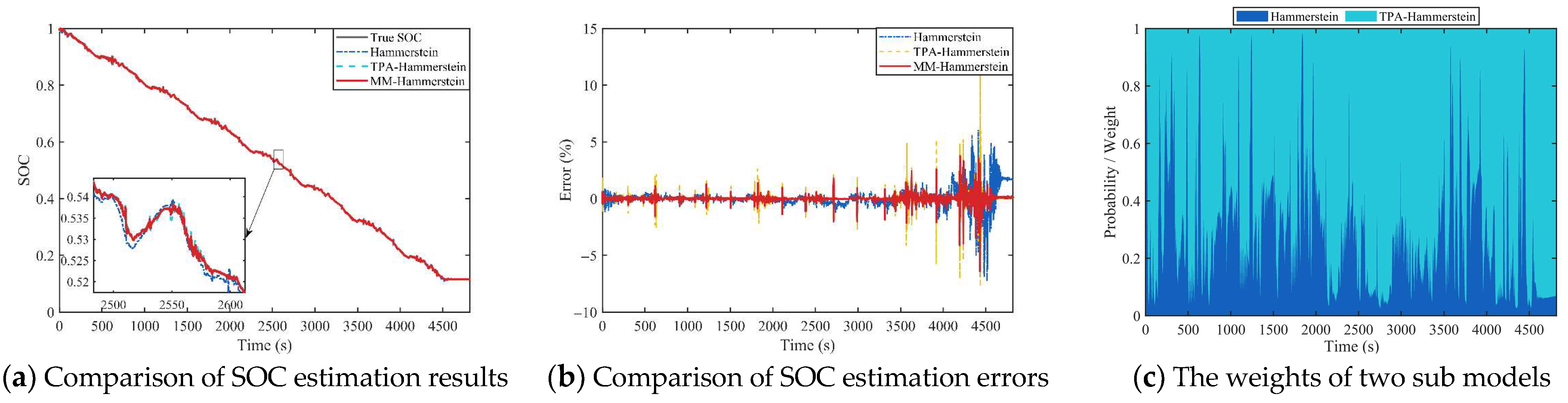
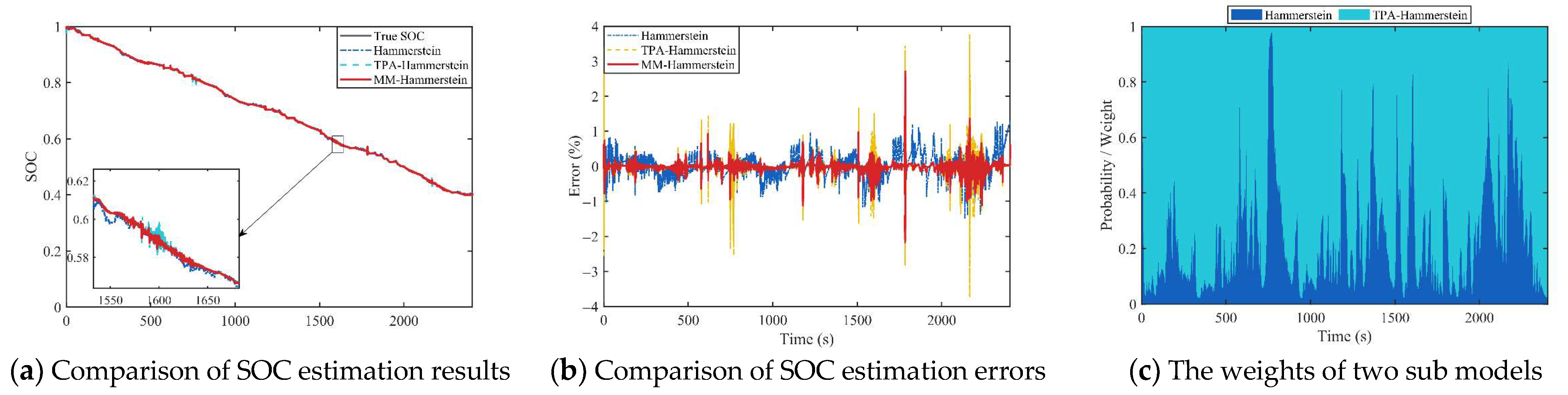
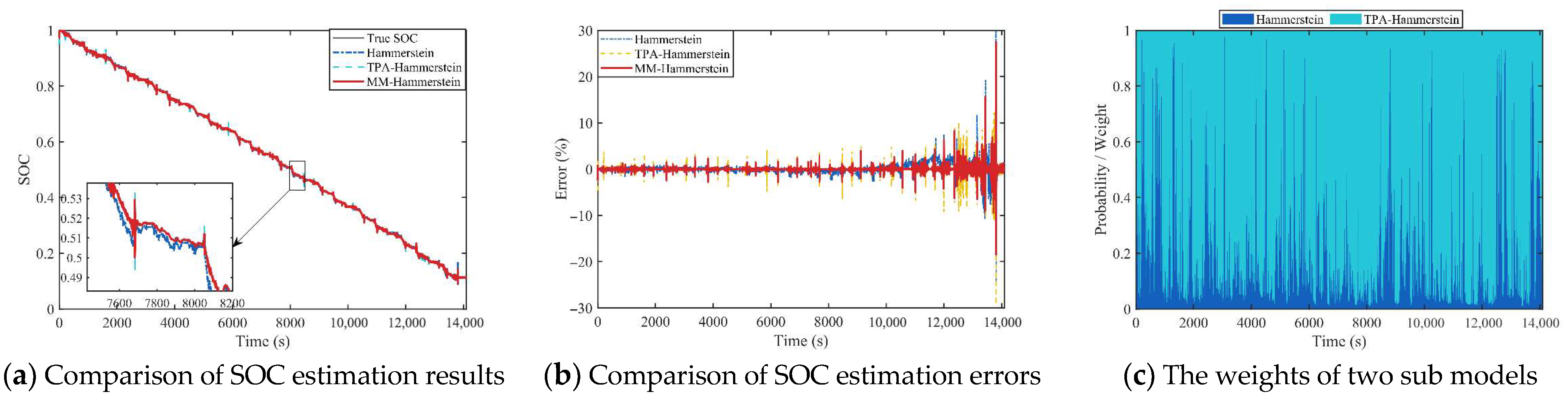
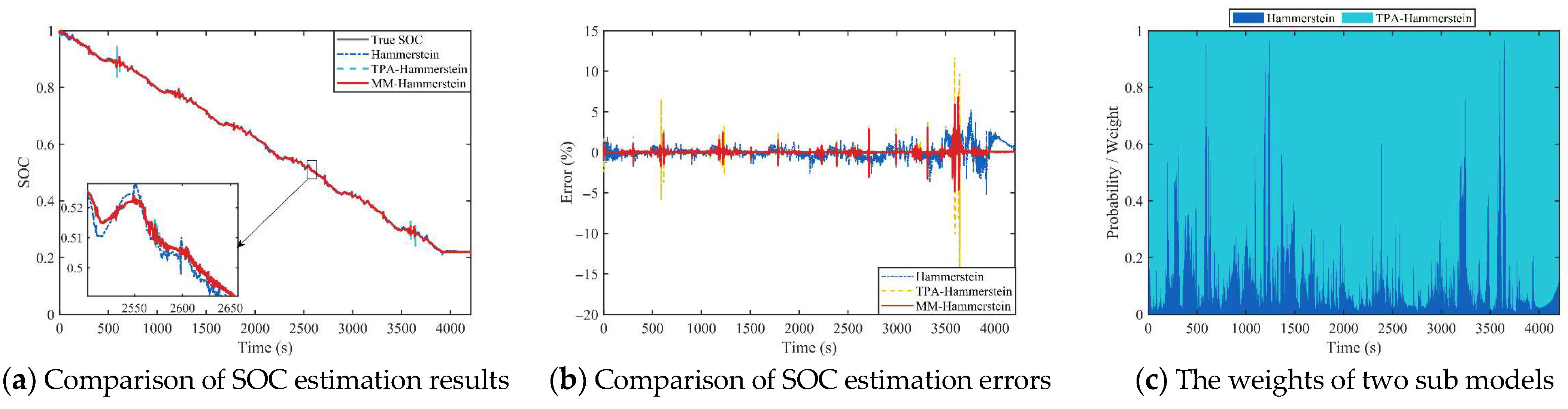
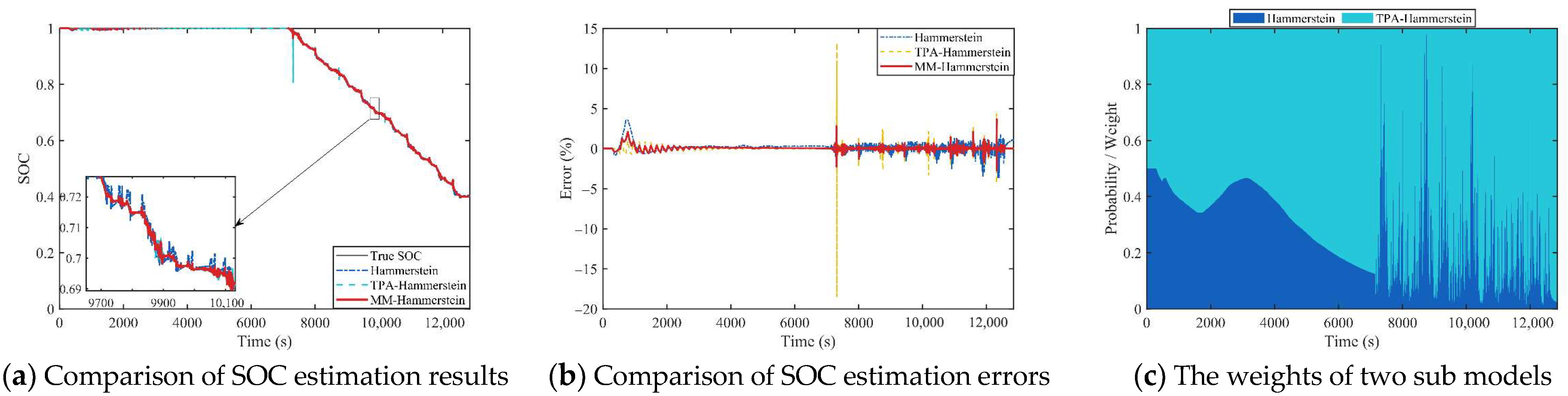
The MM-Hammerstein model based on KV-ADAM algorithm achieves simulation estimation through sampling data of US06 and LA92 driving conditions under battery operation. The results are shown in Figure 8 and Figure 9.
Figure 8a,b and Figure 9a,b show that under normal temperature conditions of 25 °C, the MM-Hammerstein model achieved highly accurate SOC estimation in both driving conditions, with errors consistently within a very narrow range, demonstrating excellent tracking ability and robustness.
The conclusion drawn from Figure 8c and Figure 9c is that in most cases, the TPA-Hammerstein model has higher weights, indicating that the multi-model fusion strategy can adaptively allocate weights according to different operating conditions, thereby further improving the reliability of the estimation.
In summary, the SOC estimation model based on MM-Hammerstein structure can achieve high-precision SOC estimation under normal temperature operating conditions. It fully utilizes the dynamic response characteristics of batteries under standard operating conditions, providing highly accurate technical references for battery management of new energy vehicles at room temperature.

4.2.3. Analysis of SOC Estimation Results Under 10 °C and 0 °C Operating Conditions

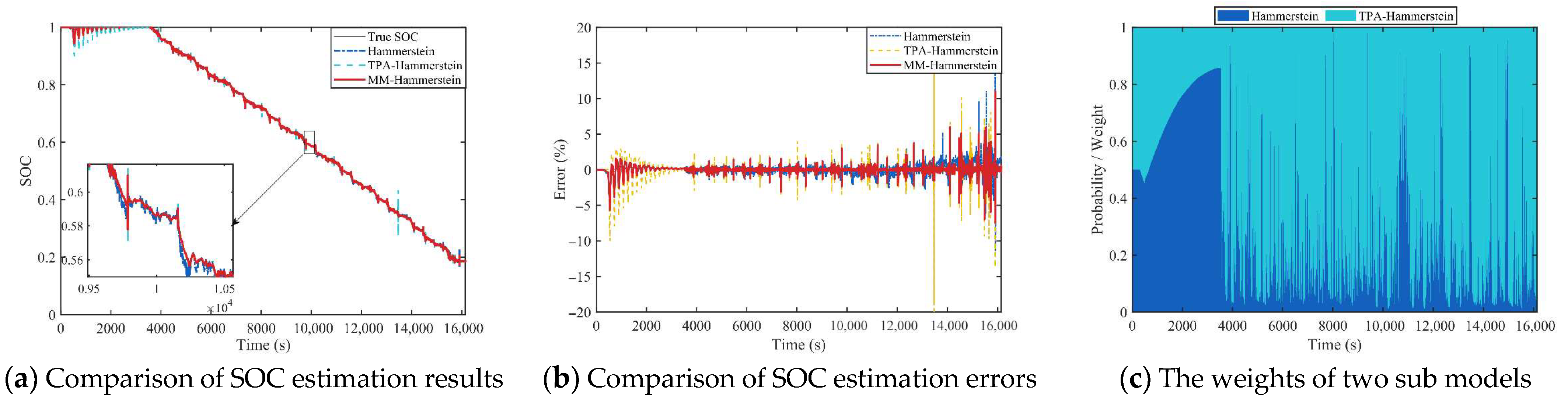
The MM-Hammerstein model based on the KV-ADAM algorithm was simulated and estimated by collecting sampling data of batteries under US06 and LA92 driving conditions, with ambient temperatures of 10 °C and 0 °C. The results are shown in Figure 10, Figure 11, Figure 12 and Figure 13.
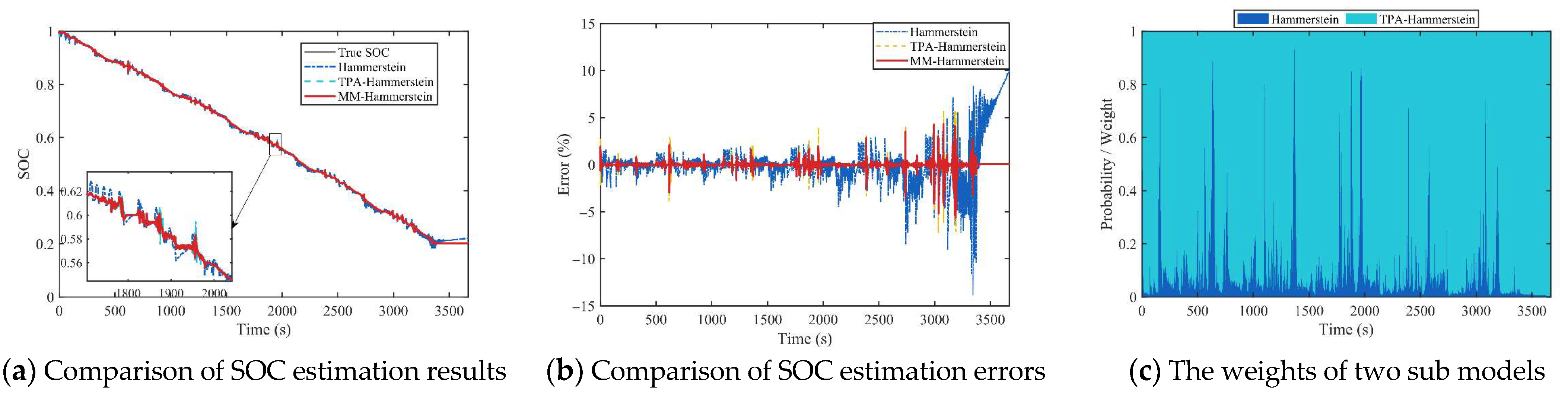
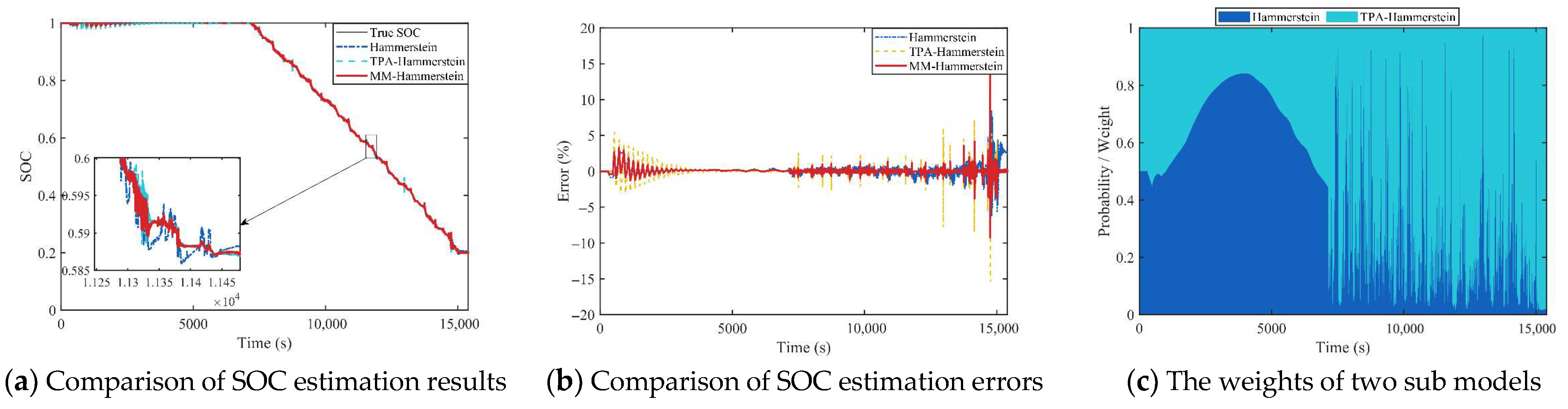
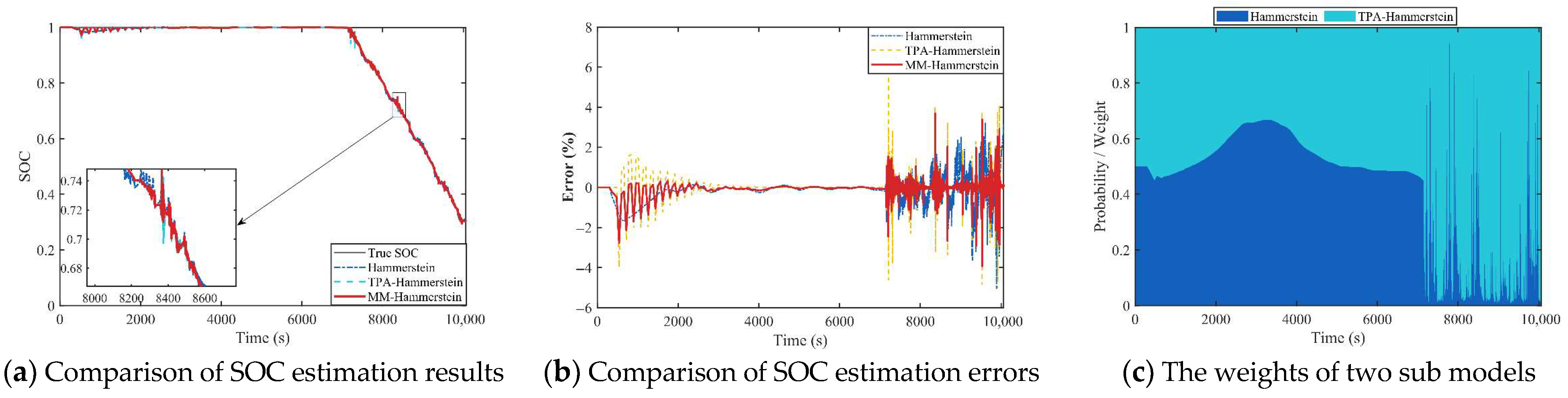
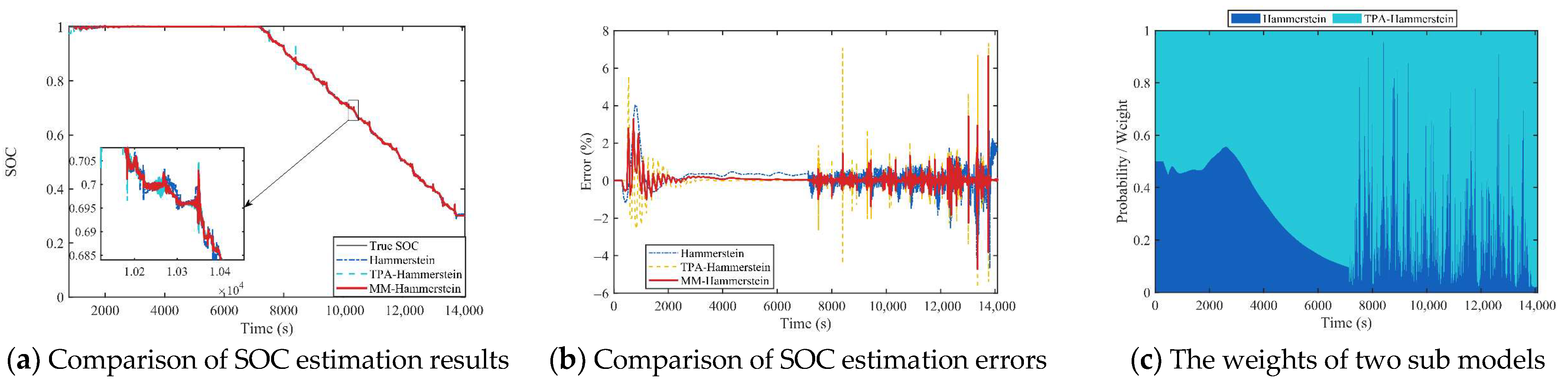
As shown in subgraphs (a) and (b) of Figure 10, Figure 11, Figure 12 and Figure 13, the MM-Hammerstein model continues to exhibit high-precision SOC estimation performance under low-temperature conditions of 10 °C and 0 °C. The estimation error remains within a narrow range, with some time points experiencing sudden changes in error, but still within the normal range, indicating that the model can accurately estimate the battery SOC under low-temperature conditions.
From Figure 10c and Figure 12c, it can be observed that under low-temperature conditions of 10 °C and 0 °C, the TPA-Hammerstein model dominates the entire operation process, with a more stable weight distribution and only minor dynamic adjustments made based on changes in battery operating conditions. From Figure 11c and Figure 13c, it can be seen that the Hammerstein model has a large weight at the beginning, and in the second half, it is dominated by the TPA-Hammerstein model. Therefore, the advantage of the multi-model fusion strategy is that it can dynamically adjust the contribution weights of each model for different operating conditions, thereby improving the reliability and adaptability of the estimation performance as a whole.
In summary, the SOC estimation model based on MM-Hammerstein architecture can still achieve high-precision SOC estimation under low-temperature conditions. It effectively overcomes the challenges brought by slight time-varying and nonlinear battery parameters under low-temperature conditions, providing a reliable technical solution for battery management in low-temperature areas.

4.2.4. Analysis of SOC Estimation Results Under −10 °C and −20 °C Operating Conditions

As shown in Figure 14a,b, Figure 15a,b, Figure 16a,b and Figure 17a,b, respectively, under extremely low-temperature conditions of −10 °C and −20 °C, the MM-Hammerstein model can still achieve accurate SOC estimation compared to the two submodels models. This model exhibits minimal estimation error and the most stable error fluctuations, effectively resisting estimation bias caused by the sharp increase in battery polarization and strong nonlinear characteristics.
From Figure 14c, Figure 15c, Figure 16c and Figure 17c, respectively, it can be concluded that the TPA-Hammerstein model dominates most of the time when estimating the lithium battery sampling data under extremely low-temperature conditions, which indicates that the fusion strategy can accurately identify the optimal adaptive submodel and avoid the problem of sharply increasing estimation errors due to the limitations of a single model structure.
In summary, the SOC estimation model based on MM-Hammerstein structure can achieve high-precision SOC estimation in extremely low-temperature environments, effectively overcoming the challenges of significant time-varying and strong nonlinearity of battery parameters under extremely low-temperature conditions, and providing key technical support for battery management in extremely cold regions.

4.2.5. Quantitative Evaluation and Statistical Consistency

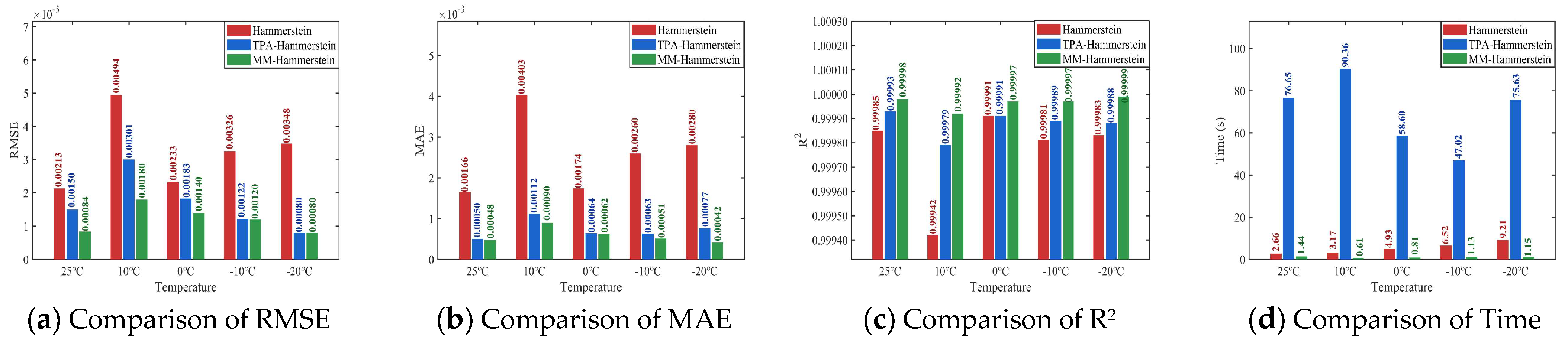
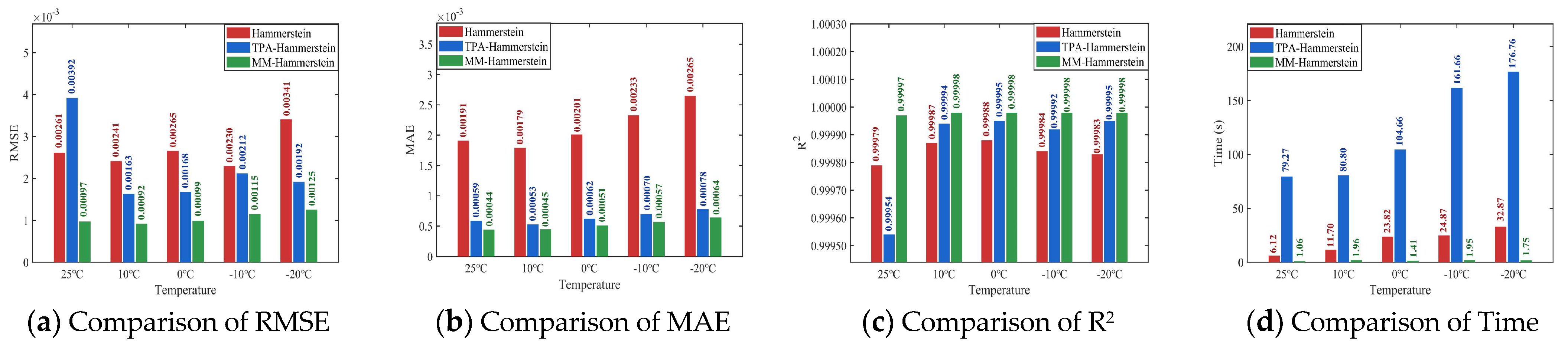
Figure 18 and Figure 19 show the RMSE, MAE, R2, and computation time of Hammerstein, TPA-Hammerstein, and MM-Hammerstein models at five temperatures: 25 °C, 10 °C, 0 °C, −10 °C, and −20 °C. These results further highlight the stability and superiority of the proposed models. Compared with the two submodels, the MM-Hammerstein model achieved high goodness of fit under all five temperature conditions, exceeding 0.9999. Although the fusion framework includes an additional Bayesian weighting step, its overall computation time remained comparable to, and in our implementation slightly lower than, those of the two standalone submodels.
More importantly, the RMSE and MAE of the MM-Hammerstein model are consistently lower than those of the independent Hammerstein model and TPA-Hammerstein model and maintain extremely stable RMSE (0.80 × 10⁻³–1.80 × 10⁻³) and MAE (0.42 × 10⁻³–0.90 × 10⁻³) throughout the entire operating temperature range.

4.3. Comparison of Errors with Other Methods

Finally, we compared the prediction results of the proposed MM-Hammerstein SOC model with those reported in prior studies, as summarized in Table 2, which indicates that the proposed model outperforms existing methods in both prediction accuracy and generalization ability.

4.4. Practical Implementation in BMS

The multi-model fusion Hammerstein architecture proposed in this article has been tested in a simulation environment. Its design considers the use of common signals in BMS, such as terminal voltage and load current, which can usually be easily obtained in BMS hardware. As conventional signals, they are widely used in BMS and are therefore easy to measure and collect. The feasibility of real-time implementation of this method in BMS has been supported by existing studies. For example, Wang et al. [45] proposed an SOC estimation method under multi-temperature conditions based on parametric-estimation OCV. Shi et al. [46] presented a data-driven SOC estimation framework, and Xiong et al. [47] reviewed the major SOC estimation methods for electric vehicles and discussed their application characteristics. These studies indicate that similar multi-step methods have the potential to be implemented in practical systems when computing resources are properly allocated. Regarding computational complexity, the preliminary analysis indicates that the various components of the proposed method can be processed within the time constraints required for real-time BMS operation. The calculation time for each estimation step is within an acceptable range, making this method suitable for implementation on embedded platforms. Future work will include hardware-in-the-loop testing and further performance evaluation on BMS prototypes to validate the real-time performance of the method under strict time constraints and ensure its feasibility in practical applications.

5. Conclusions

This article proposes a multi-model fusion Hammerstein architecture based on Bayesian principles, aiming to solve the problem of lithium battery SOC estimation under complex operating conditions. This method adopts the KV-ADAM algorithm to realize efficient identification and optimization of the parameters of the dual submodels under the fusion framework. In the proposed framework, the conventional Hammerstein submodel captures baseline nonlinear dynamics under normal conditions, while the TPA-Hammerstein submodel addresses temperature-dependent nonlinearities at low temperatures, and their combination improves SOC estimation accuracy across different operating conditions. Compared with traditional single Hammerstein models and state-of-the-art models in existing studies, the proposed MM-Hammerstein framework achieves accurate and robust SOC estimation across a wide temperature range, with particularly strong performance under low-temperature conditions. The experimental results show that the model maintains extremely low RMSE and MAE under all set temperature conditions including the normal temperature of 25 °C, with the Coefficient of Determination R2 exceeding 0.9999. This result fully validates the excellent robustness and anti-interference ability of the model in dealing with the strong nonlinearity and time-varying characteristics of batteries.
In addition, the modeling strategy based on the Bayesian fusion mechanism has good universality and scalability, which is not only applicable to SOC estimation, but also can be further extended to core fields of battery management such as battery state of health (SOH) assessment and remaining useful life prediction.
Despite the promising results, several challenges must be acknowledged for practical deployment. As discussed in Section 4.4, the proposed framework relies on terminal voltage and load current and battery temperature as inputs, which are standard signals readily available in commercial BMS hardware, and preliminary analysis indicates that the per-step computation time is within acceptable bounds for a real-time embedded operation. Nevertheless, further validation on actual BMS hardware prototypes under strict real-time constraints is still required before large-scale deployment. In addition, the present study is validated exclusively on the Panasonic NCR18650PF cylindrical lithium-ion battery under the US06 and LA92 driving cycle. The computational cost and real-time feasibility of the proposed fusion model on different battery types, operating conditions, and embedded BMS platforms have not been evaluated. Future work will focus on cross-condition generalization experiments and hardware-in-the-loop testing to further verify the practical feasibility of the proposed approach.

Author Contributions

Conceptualization, F.H. and B.X.; methodology, F.H.; validation, B.X.; investigation, F.H. and B.X.; resources, F.H.; writing—original draft preparation, F.H.; writing—review and editing, B.X.; visualization, F.H. All authors have read and agreed to the published version of the manuscript.

Funding

This research received no external funding.

Data Availability Statement

The data presented in this study are openly available on GitHub at https://github.com/XXXiiieee/csv-data-sample (accessed on 16 March 2026).

Conflicts of Interest

The authors declare no conflicts of interest.

References

  1. Cheng, K.W.E.; Divakar, B.P.; Wu, H.; Ding, K.; Ho, H.F. Battery-management system (BMS) and SOC development for electrical vehicles. IEEE Trans. Veh. Technol. 2011, 60, 76–88. [Google Scholar] [CrossRef]
  2. Ali, M.U.; Zafar, A.; Nengroo, S.H.; Hussain, S.; Alvi, M.J.; Kim, H.-J. Towards a smarter battery management system for electric vehicle applications: A critical review of lithium-ion battery state of charge estimation. Energies 2019, 12, 446. [Google Scholar] [CrossRef]
  3. Vidal, C.; Malysz, P.; Kollmeyer, P.; Emadi, A. Machine learning applied to electrified vehicle battery state of charge and state of health estimation: State-of-the-art. IEEE Access 2020, 8, 52796–52814. [Google Scholar] [CrossRef]
  4. Sabatino, S.; Calderaro, V.; Galdi, V.; Greber, G. State-of-Charge, State-of-Health and State-of-Power Estimation for Traction Batteries. In Proceedings of the 2024 IEEE International Conference on Electrical Systems for Aircraft, Railway, Ship Propulsion and Road Vehicles & International Transportation Electrification Conference (ESARS-ITEC), Naples, Italy, 26–29 November 2024; pp. 1–6. [Google Scholar] [CrossRef]
  5. Peng, J.; Qian, X.; Xu, X.; Wu, W.; Wang, J.; Wang, R.; Yang, H.Y.; Ye, J.; Wu, Y. State of charge estimation techniques for lithium-ion batteries: A review. Energy Technol. 2025, 13, 2500542. [Google Scholar] [CrossRef]
  6. Zhou, W.; Zheng, Y.; Pan, Z.; Lu, Q. Review on the battery model and SOC estimation method. Processes 2021, 9, 1685. [Google Scholar] [CrossRef]
  7. Xing, L.; Ling, L.; Gong, B.; Zhang, M. State-of-charge estimation for lithium-ion batteries using Kalman filters based on fractional-order models. Connect. Sci. 2022, 34, 162–184. [Google Scholar] [CrossRef]
  8. Eleftheriadis, P.; Giazitzis, S.; Leva, S.; Ogliari, E. Data-driven methods for the state of charge estimation of lithium-ion batteries: An overview. Forecasting 2023, 5, 576–599. [Google Scholar] [CrossRef]
  9. Oloyede, M.O.; Akpakwu, G.A.; Myburgh, H.C.; De Freitas, A.; Kunatsa, T. A review on state-of-charge estimation methods, energy storage technologies and state-of-the-art simulators: Recent developments and challenges. World Electr. Veh. J. 2024, 15, 381. [Google Scholar] [CrossRef]
  10. Plett, G.L. Battery Management Systems, Volume I: Battery Modeling; Artech House: Norwood, MA, USA, 2015. [Google Scholar]
  11. Gong, D.; Gao, Y.; Kou, Y. Parameter and state of charge estimation simultaneously for lithium-ion battery based on improved open circuit voltage estimation method. Energy Technol. 2021, 9, 2100235. [Google Scholar] [CrossRef]
  12. Yu, W.; Zheng, Y.; Wang, S. Data-driven state-of-charge estimation for lithium-ion batteries using variational inference. IEEE Trans. Circuits Syst. II Express Briefs 2025, 72, 1810–1814. [Google Scholar] [CrossRef]
  13. Chen, L.; Song, Y.; Lopes, A.M.; Bao, X.; Zhang, Z.; Lin, Y. Joint estimation of state of charge and state of energy of lithium-ion batteries based on optimized bidirectional gated recurrent neural network. IEEE Trans. Transp. Electrif. 2024, 10, 1605–1616. [Google Scholar] [CrossRef]
  14. Li, R.; Hao, Y.; Zhang, M.; Lv, Y. State-of-charge estimation of lithium-ion batteries based on the CNN-Bi-LSTM-AM model under low-temperature environments. Sensors 2026, 26, 264. [Google Scholar] [CrossRef]
  15. Song, Y.; Liu, D.; Liao, H.; Peng, Y. A hybrid statistical data-driven method for on-line joint state estimation of lithium-ion batteries. Appl. Energy 2020, 261, 114408. [Google Scholar] [CrossRef]
  16. Li, Y.; Wang, R.; Jin, Y.; Sun, Z.; Liu, H.; Liu, Y.; Liu, Y.; Xu, J.; Tao, Y.; Jiang, Z.; et al. A novel SOC estimation method for lithium-ion batteries based on serial LSTM-UKF fusion. Energies 2026, 19, 1467. [Google Scholar] [CrossRef]
  17. Hsu, S.-H.; Hung, S.-F.; Chien, S.-H. CdS sensitized vertically aligned single crystal TiO2 nanorods on transparent conducting glass with improved solar cell efficiency and stability using ZnS passivation layer. J. Power Sources 2013, 233, 236–243. [Google Scholar] [CrossRef]
  18. Plett, G.L. Extended Kalman filtering for battery management systems of LiPB-based HEV battery packs: Part 1. Background. J. Power Sources 2004, 134, 252–261. [Google Scholar] [CrossRef]
  19. Sun, F.; Hu, X.; Zou, Y.; Li, S. Adaptive unscented Kalman filtering for state of charge estimation of a lithium-ion battery for electric vehicles. Energy 2011, 36, 3531–3540. [Google Scholar] [CrossRef]
  20. Wu, X.M.; Qin, Z.; Yu, Y.S.; Zhang, Z.X. Experimental and numerical study on CO2 absorption mass transfer enhancement for a diameter-varying spray tower. Appl. Energy 2018, 225, 367–379. [Google Scholar] [CrossRef]
  21. Cherif, H.; Belhadj, J. Large-scale time evaluation for energy estimation of stand-alone hybrid photovoltaic–wind system feeding a reverse osmosis desalination unit. Energy 2011, 36, 6058–6067. [Google Scholar] [CrossRef]
  22. Sahinoglu, G.O.; Pajovic, M.; Sahinoglu, Z.; Wang, Y.; Orlik, P.V.; Wada, T. Battery state-of-charge estimation based on regular/recurrent Gaussian process regression. IEEE Trans. Ind. Electron. 2018, 65, 4311–4321. [Google Scholar] [CrossRef]
  23. Wang, C.; Yang, M.; Wang, X.; Xiong, Z.; Qian, F.; Deng, C.; Yu, C.; Zhang, Z.; Guo, X. A review of battery SOC estimation based on equivalent circuit models. J. Energy Storage 2025, 110, 115346. [Google Scholar] [CrossRef]
  24. Yang, B.; Wang, Y.; Zhan, Y. Lithium battery state-of-charge estimation based on a Bayesian optimization bidirectional long short-term memory neural network. Energies 2022, 15, 4670. [Google Scholar] [CrossRef]
  25. Shih, S.-Y.; Sun, F.-K.; Lee, H.-Y. Temporal pattern attention for multivariate time series forecasting. Mach. Learn. 2019, 108, 1421–1441. [Google Scholar] [CrossRef]
  26. Vaswani, A.; Shazeer, N.; Parmar, N.; Uszkoreit, J.; Jones, L.; Gomez, A.N.; Kaiser, L.; Polosukhin, I. Attention is all you need. In Proceedings of the 31st Conference on Neural Information Processing Systems (NeurIPS 2017), Long Beach, CA, USA, 4–9 December 2017; pp. 5998–6008. [Google Scholar]
  27. Wu, L.; Zhang, Y. Attention-based encoder-decoder networks for state of charge estimation of lithium-ion battery. Energy 2023, 268, 126665. [Google Scholar] [CrossRef]
  28. Yang, K.; Tang, Y.; Zhang, S.; Zhang, Z. A deep learning approach to state of charge estimation of lithium-ion batteries based on dual-stage attention mechanism. Energy 2022, 244, 123233. [Google Scholar] [CrossRef]
  29. Ren, X.; Liu, S.; Yu, X.; Dong, X. A method for state-of-charge estimation of lithium-ion batteries based on PSO-LSTM. Energy 2021, 234, 121236. [Google Scholar] [CrossRef]
  30. Yang, K.; Wang, Y.; Tang, Y.; Zhang, S.; Zhang, Z. A temporal convolution and gated recurrent unit network with attention for state of charge estimation of lithium-ion batteries. J. Energy Storage 2023, 72, 108774. [Google Scholar] [CrossRef]
  31. Wang, C.; Ji, Y. A novel hierarchical gradient identification method for Hammerstein state space systems based on the adaptive state filter. Optim. Control Appl. Methods 2026, 47, 218–233. [Google Scholar] [CrossRef]
  32. Kingma, D.P.; Ba, J. Adam: A method for stochastic optimization. arXiv 2014, arXiv:1412.6980. [Google Scholar] [CrossRef]
  33. Chemali, E.; Kollmeyer, P.J.; Preindl, M.; Emadi, A. State-of-charge estimation of Li-ion batteries using deep neural networks: A machine learning approach. J. Power Sources 2018, 400, 242–255. [Google Scholar] [CrossRef]
  34. Tang, A.; Huang, Y.; Liu, S.; Yu, Q.; Shen, W.; Xiong, R. A novel lithium-ion battery state of charge estimation method based on the fusion of neural network and equivalent circuit models. Appl. Energy 2023, 348, 121578. [Google Scholar] [CrossRef]
  35. Xiong, R.; Wang, J.; Shen, W.; Tian, J.; Mu, H. Co-estimation of state of charge and capacity for lithium-ion batteries with multi-stage model fusion method. Engineering 2021, 7, 1469–1482. [Google Scholar] [CrossRef]
  36. Mu, H.; Xiong, R.; Sun, F. A novel multi-model probability based battery state-of-charge fusion estimation approach. Energy Procedia 2016, 88, 840–846. [Google Scholar] [CrossRef]
  37. Mao, S.; Han, X.; Lu, Y.; Wang, D.; Su, A.; Lu, L.; Feng, X.; Ouyang, M. Multi sensor fusion methods for state of charge estimation of smart lithium-ion batteries. J. Energy Storage 2023, 72, 108736. [Google Scholar] [CrossRef]
  38. Blom, H.A.P.; Bar-Shalom, Y. The interacting multiple model algorithm for systems with Markovian switching coefficients. IEEE Trans. Autom. Control 1988, 33, 780–783. [Google Scholar] [CrossRef]
  39. Tang, A.; Gong, P.; Li, J.; Zhang, K.; Zhou, Y.; Zhang, Z. A state-of-charge estimation method based on multi-algorithm fusion. World Electr. Veh. J. 2022, 13, 70. [Google Scholar] [CrossRef]
  40. Bustos, R.; Gadsden, S.A.; Biglarbegian, M.; AlShabi, M.; Mahmud, S. Battery state of health estimation using the sliding interacting multiple model strategy. Energies 2024, 17, 536. [Google Scholar] [CrossRef]
  41. Lv, H.; Liao, Y.; Zhao, C.; Shang, X.; Zhang, F. State of charge estimation of lithium-titanate battery based on multi-model extended Kalman filter considering temperature and current rate. J. Energy Storage 2024, 77, 109890. [Google Scholar] [CrossRef]
  42. Zhang, L.; Yang, B.; Lyu, L.; Che, S.; Li, H.; Wang, W. A battery state-of-charge prediction method based on a Hammerstein model integrated with a hippopotamus optimization algorithm and neural network. Electronics 2026, 15, 698. [Google Scholar] [CrossRef]
  43. Wang, R.; Liu, L.; Zhang, H.; Qian, Q.; Xiao, L.; Qiu, Q.; Tan, C.; Yang, F. Collaborative estimation of lithium battery state of charge based on the BiLSTM-AUKF fusion model. Energies 2025, 18, 5624. [Google Scholar] [CrossRef]
  44. Li, X.; Liu, W.; Liang, B.; Li, Q.; Zhao, Y.; Hu, J. Highly robust co-estimation of state of charge and state of health using recursive total least squares and unscented Kalman filter for lithium-ion battery. IET Renew. Power Gener. 2024, 18, 3574–3581. [Google Scholar] [CrossRef]
  45. Wang, Q.; Qi, W. New SOC estimation method under multi-temperature conditions based on parametric-estimation OCV. J. Power Electron. 2020, 20, 614–623. [Google Scholar] [CrossRef]
  46. Shi, D.; Zhao, J.; Wang, Z.; Zhao, H.; Wang, J.; Lian, Y.; Burke, A.F. Spatial-temporal self-attention transformer networks for battery state of charge estimation. Electronics 2023, 12, 2598. [Google Scholar] [CrossRef]
  47. Xiong, R.; Cao, J.; Yu, Q.; He, H.; Sun, F. Critical review on the battery state of charge estimation methods for electric vehicles. IEEE Access 2018, 6, 1832–1843. [Google Scholar] [CrossRef]
Figure 1. Hammerstein SOC model.
Mathematics 14 01642 g001
Figure 2. TPA-Hammerstein SOC model.
Mathematics 14 01642 g002
Figure 3. The structure of the Time Pattern Attention (TPA) mechanism.
Mathematics 14 01642 g003
Figure 4. MM-Hammerstein structure.
Mathematics 14 01642 g004
Figure 5. Dataset for HWFET driving cycle (25 °C).
Mathematics 14 01642 g005
Figure 6. Dataset for US06 driving cycle (25 °C).
Mathematics 14 01642 g006
Figure 7. Comparison of SOC estimation using KV-ADAM and KV-SGD algorithm under 25 °C.
Mathematics 14 01642 g007
Figure 8. SOC estimation results of US06 under 25 °C.
Mathematics 14 01642 g008
Figure 9. SOC estimation results of LA92 under 25 °C.
Mathematics 14 01642 g009
Figure 10. SOC estimation results of US06 under 10 °C.
Mathematics 14 01642 g010
Figure 11. SOC estimation results of LA92 under 10 °C.
Mathematics 14 01642 g011
Figure 12. SOC estimation results of US06 under 0 °C.
Mathematics 14 01642 g012
Figure 13. SOC estimation results of LA92 under 0 °C.
Mathematics 14 01642 g013
Figure 14. SOC estimation results of US06 under −10 °C.
Mathematics 14 01642 g014
Figure 15. SOC estimation results of LA92 under −10 °C.
Mathematics 14 01642 g015
Figure 16. SOC estimation results of US06 under −20 °C.
Mathematics 14 01642 g016
Figure 17. SOC estimation results of LA92 under −20 °C.
Mathematics 14 01642 g017
Figure 18. Comparison of SOC estimation results based on Hammerstein model/TPA-Hammerstein model/MM-Hammerstein model under US06.
Mathematics 14 01642 g018
Figure 19. Comparison of SOC estimation results based on Hammerstein model/TPA-Hammerstein model/MM-Hammerstein model under LA92.
Mathematics 14 01642 g019
Table 1. Panasonic 18650PF lithium-ion battery parameters.
Battery Parameter ItemParameter Value
Nominal voltage3.6 V
Charge cut-off voltage4.2 V
Discharge cut-off voltage2.5 V
Gravimetric energy density207 Wh/kg
Rated capacity2.9 Ah
Table 2. Comparison of errors with other models.
ModelTemperature (°C)RMSEMAE
Hammerstein [42]−20, 100.0050–0.00590.0046–0.0054
CNN-BiLSTM-AM [43]−20, −10, 00.0033–0.00940.0017–0.0077
UKF [44]250.02770.0157
OCVPE-SOC [45]−20, −10, 00.0232–0.03310.0411–0.0498
MM-Hammerstein (our study)−20, −10, 0, 10, 250.0008–0.00180.0004–0.0009
Disclaimer/Publisher’s Note: The statements, opinions and data contained in all publications are solely those of the individual author(s) and contributor(s) and not of MDPI and/or the editor(s). MDPI and/or the editor(s) disclaim responsibility for any injury to people or property resulting from any ideas, methods, instructions or products referred to in the content.