1. Introduction
Interplanetary trajectory design is a fundamental problem in astrodynamics, directly influencing mission feasibility, duration, and fuel consumption. The use of gravity assist maneuvers has enabled several landmark space missions to reach distant targets with limited propulsion resources. However, the design of such trajectories leads to highly complex optimization problems characterized by nonlinear dynamics, multiple constraints, and mixed discrete-continuous decision variables. Interplanetary trajectory optimization presents a challenging and computationally demanding MINLP problem. The difficulty arises from the need to simultaneously determine discrete variables, such as the sequence of planetary encounters forming a multi-gravity assist (MGA) trajectory, and continuous trajectory parameters including time-of-flight and deep space maneuvers (DSM) [
1]. DSM are impulsive velocity changes performed along the interplanetary trajectory to modify the spacecraft’s path between planetary encounters [
2]. The evaluation of a single candidate trajectory requires the numerical solution of nonlinear dynamical models, which results in high computational costs, particularly when large search spaces with multiple flybys options must be explored [
3]. A wide range of optimization approaches has been proposed for interplanetary trajectory design, including deterministic methods and stochastic/metaheuristic algorithms. MINLP is a well-established and extensively studied framework for optimization problems involving both continuous and discrete decision variables, with numerous applications in engineering and trajectory optimization. However, in the context of interplanetary trajectory design, most existing optimization approaches are formulated under the assumption of a fixed sequence of planetary encounters, effectively reducing the search space to a purely continuous domain. While this assumption simplifies the optimization process, it neglects the combinatorial aspect of trajectory design, where the selection and ordering of flyby planets play a crucial role. As a result, many established methods are not directly applicable to problems that require the simultaneous optimization of both continuous trajectory parameters and discrete mission design decisions. This limitation reduces their ability to explore alternative trajectory architectures and may lead to suboptimal solutions in more general mission design settings. This limitation motivates the development of more general formulations that explicitly incorporate discrete decision variables into trajectory optimization, as considered in this work. Gradient-based techniques can efficiently solve smooth continuous problems but often struggle with discontinuities and combinatorial structures arising from MGA sequences. Consequently, population-based metaheuristics, such as genetic algorithms, particle swarm optimization, differential evolution (DE) [
4,
5,
6], ant colony optimization (ACO) [
7], and covariance matrix adaptation evolution strategy (CMA-ES) [
8], have become widely used for global optimization in this domain.
Benchmark problems such as Cassini1 and Cassini2 from the GTOPX (Global Trajectory Optimization Problems with eXtensions) library provide standardized test cases for the development and comparison of optimization algorithms under realistic mission conditions [
9]. The Cassini1 problem is formulated as a continuous optimization problem with a fixed sequence of planetary flybys and without allowing DSM, resulting in a relatively limited trajectory design space. Additionally, the final phase is defined as orbital insertion rather than a rendezvous condition, further restricting its applicability to broader mission design scenarios. The Cassini2 problem extends this formulation by introducing DSMs within the MGA-DSM framework [
2], increasing trajectory flexibility. However, the sequence of planetary flybys remains predefined, and the problem is still formulated as a continuous optimization task. Despite their usefulness, both Cassini1 and Cassini2 do not fully capture the combinatorial nature of realistic mission design problems. As a result, the optimization is restricted to a single trajectory architecture, limiting the exploration of alternative flyby combinations. This limitation is particularly important from an optimization perspective, as it prevents the evaluation of algorithms on problems that simultaneously involve combinatorial decision-making and continuous trajectory optimization, which are common in real-world mission design.
To address these limitations, we introduce the Cassini2-MINLP formulation, which provides a formally defined and reproducible benchmark that increases modeling flexibility and the dimensionality of the decision space by incorporating discrete mission design decisions. The proposed single-objective formulation minimizes the total , with fixed departure (Earth) and arrival (Saturn) planets, while the intermediate planetary flybys are treated as discrete decision variables selected from a predefined set of Solar System bodies. This structure results in a highly nonlinear, nonconvex, and combinatorial optimization problem that is suitable for assessing the performance and robustness of advanced global optimization methods. Small changes in the discrete decision variables may lead to discontinuous variations in the objective value, further increasing the difficulty of the optimization process. Furthermore, different flyby sequences induce disconnected regions of the feasible space, resulting in a highly fragmented search landscape. This combination of continuous trajectory variables and combinatorial flyby decisions increases the overall optimization complexity and provides a challenging testbed for evaluating global optimization algorithms.
In this paper, eight optimization algorithms from three major methodological families are evaluated: ACO, DE, and CMA-ES. The selected algorithms were chosen to represent three fundamentally different classes of stochastic optimization methods that are widely used in global optimization and black-box optimization problems.
MIDACO presents the class of ACO methods, which are particularly suitable for problems involving discrete decision variables and combinatorial structures. Its hybridization with continuous optimization mechanisms makes it applicable to mixed-integer problems such as the considered trajectory design task.
DISH belongs to the family of DE algorithms, which are well known for their robustness and effectiveness in continuous, high-dimensional, and nonconvex optimization problems. In this study, DISH is of particular interest due to its advanced population adaptation and memory mechanisms, allowing us to assess how DE-based methods handle the interaction between continuous and discrete components of the search space.
DX presents a modern class of CMA-ES variants, which rely on adaptive probabilistic sampling of candidate solutions. These methods are particularly effective in continuous optimization, but their performance on mixed-integer and highly discontinuous problems remains less explored. Including DX therefore provides insight into how distribution-based search strategies perform in the presence of discrete decision variables.
Together, these three algorithmic families cover fundamentally different search principles—probabilistic constructive search (ACO), population-based evolutionary search (DE), and CMA-ES. This diversity allows for a comprehensive assessment of how different optimization paradigms cope with the increased complexity of the proposed Cassini2-MINLP problem. The experimental evaluation includes both well-established and recent implementations, namely MIDACO [
10], DISH [
11], and the recently proposed DX-NES-ICI method [
12] (hereafter referred to as DX). All methods are tested under a consistent experimental setup with fixed random seeds, and their performance is assessed over 30 independent runs using the total
as the primary performance metric. Algorithm robustness is quantified through the variability of the obtained solutions, and statistical differences are analyzed using the Friedman test followed by Nemenyi post hoc comparisons.
The parameter settings of the considered algorithms were primarily adopted from the default configurations provided in their reference implementations (see
Table 1), as these are recommended across a wide range of optimization problems. To ensure a fair and reproducible comparison, all algorithms were evaluated using fixed parameter configurations rather than performing extensive parameter tuning. Only minor modifications were introduced where necessary (see
Table 2), mainly to improve numerical stability or to better match the problem scale. In addition, two initialization strategies were considered: deterministic initialization at the lower bounds and randomized initialization within the feasible domain, allowing us to assess sensitivity to starting conditions. A full parametric sensitivity analysis is beyond the scope of this study; instead, the focus is on a consistent and unbiased comparison of algorithmic performance.
The implementation of the Cassini2-MINLP benchmark, including all problem parameters and evaluation routines, is available in the
Supplementary Materials, enabling full reproducibility of the reported results.
The main contributions of this work are as follows:
A new mixed-integer extension of the Cassini2 trajectory optimization problem (Cassini2-MINLP), enabling the joint optimization of discrete flyby sequences and continuous trajectory parameters.
A discrete-event formulation and structural analysis of the feasible set, providing insight into how different flyby sequences affect trajectory solutions.
A reproducible benchmark framework for mixed-integer black-box optimization (MI-BBO) [
13], including a publicly available implementation and standardized evaluation setup.
A comprehensive experimental comparison of advanced stochastic optimization algorithms, analyzing their performance, robustness, and convergence behavior on the proposed problem.
The remainder of the paper is organized as follows. The next section provides background on the Cassini2-MINLP problem and its differences with respect to existing benchmarks. The mathematical formulation is then presented, followed by the description of the optimization algorithms and experimental setup. Finally, the numerical results are reported and discussed.
2. Related Work
This section reviews benchmark problems for MGA spacecraft trajectory optimization, including the Cassini missions, and summarizes the optimization methods used to solve them.
2.1. Background of Cassini Benchmark Problems
Early approaches to solving MGA spacecraft trajectory optimization problems included decomposition techniques [
14], numerical optimization methods [
15], and primer vector hodograph analysis [
16]. DSMs were introduced to increase trajectory flexibility and improve mission feasibility [
16,
17,
18]. These developments formed the basis for modern trajectory optimization approaches, including differential dynamic programming [
19], genetic algorithms [
20,
21], and other stochastic optimization methods [
22]. Such methods have been applied in various space missions, including Apollo, Mars transfer missions, and lunar and asteroid exploration programs. Mathematical models of orbital dynamics and asteroid motion play a key role in trajectory analysis and mission design problems [
23].
The GTOPX framework, which extends the GTOP benchmark database developed by the European Space Agency [
24], provides a unified interface for ten benchmark instances, including Cassini1, Cassini1-MINLP and Cassini2 [
25]. Cassini1 models a mission from Earth to Saturn with a fixed planetary flyby sequence [
26]. Mixed-integer extensions of this problem, referred to as Cassini1-MINLP [
27], introduce discrete decision variables for flyby selection and mission configuration [
27]. A simplified formulation of the Cassini1-MINLP problem is presented in [
28]. In contrast to the Cassini1 formulation, more advanced trajectory models, like Cassini2, allow DSM within each transfer leg between consecutive planetary flybys. Here, a leg refers to a segment of the spacecraft’s trajectory between two consecutive events, such as planetary flybys or the launch and the first encounter. Furthermore, in the Cassini1 and Cassini1-MINLP problems the spacecraft must reach Saturn and be captured into an elliptical orbit with a pericenter radius of
km and eccentricity
. In contrast, the Cassini2 formulation considers a rendezvous condition at Saturn, where the final
is evaluated as a matching maneuver rather than as an orbital insertion.
A concise comparison between the Cassini1 and Cassini2 benchmark problems is provided in
Table 3.
Trajectory design problems typically combine MGA sequences with DSM, forming the MGA–DSM trajectory model [
29]. The MGA sequence determines the order of planetary encounters, while DSMs enable trajectory corrections within individual transfer legs. Introducing DSM parameters increases the dimensionality of the optimization problem. For a trajectory involving
n planetary flybys, the dimension of a typical MGA–DSM decision space can be expressed as [
30]
.
Here, n denotes the number of planetary encounters. The first six variables define the initial conditions of the spacecraft trajectory, while each additional encounter contributes four parameters describing the associated flyby geometry and DSM.
In the Cassini2 trajectory model [
9], the optimization vector consists of 22 decision variables (see
Table 4). The first variables describe the launch conditions, including the launch epoch
, the hyperbolic excess velocity
, and the departure direction angles
u and
v. The subsequent variables present the time of flight between consecutive planetary encounters and the fractional location of DSMs within each transfer leg. The remaining parameters define the flyby geometry through the pericenter distance and the orientation of the flyby plane. Together, these variables define the decision vector of the Cassini2 MGA–DSM trajectory optimization problem.
2.2. General Formulation of Multicriteria MINLP Problems
A general multicriteria MINLP problem can be formulated as
where
denotes the
i-th objective function,
presents the vector of continuous decision variables of dimension
, and
denotes the vector of integer decision variables of dimension
[
31]. In the single-objective case, the problem reduces to the minimization of a single function
.
The optimization is subject to equality and inequality constraints:
where
denote equality constraints and
inequality constraints. In the Cassini2-MINLP formulation considered in this work, no explicit equality or inequality constraints are imposed. The problem is therefore treated as bound-constrained, and the decision variables satisfy
where
and
are the lower and upper bounds for continuous variables, and
and
are the lower and upper bounds for discrete variables. This formulation fully defines a general multicriteria MINLP problem.
The discrete part of Cassini1-MINLP is a combinatorial problem. For instance, selecting planetary flyby sequences from a set of nine candidate planets corresponds to variations with repetition, which can be calculated as:
where
is the number of distinct elements to arrange (here, 9 planets), and
r is the number of available positions (here, 4). This formula counts all possible arrangements allowing elements to be repeated [
32].
For brevity, in the following formulations the notation will be simplified as , where presents the combined vector of all decision variables.
2.3. MGA-DSM Problem
The MGA–DSM trajectory optimization problem can be formulated as
where
denotes the decision vector defining the trajectory parameters and
presents the bounded decision space. The performance of an MGA–DSM mission is evaluated through the objective function
J, which corresponds to the total velocity increment
required along the trajectory. Although
J is not a direct monetary cost, it serves as a proxy for propellant consumption and therefore reflects the energetic efficiency of the mission trajectory [
9,
33]. The resulting optimization problem is typically treated as a black-box optimization problem, since the objective function evaluation requires complex trajectory propagation and Lambert solutions, making analytical gradients unavailable.
For a generic MGA-DSM mission, the decision vector is partitioned as
where the continuous subvector
contains the temporal trajectory variables (launch epoch, transfer times, and DSM parameters), and
denotes the discrete variables defining the sequence of planetary flybys.
The continuous subvector is defined as
where
denotes the sequence of transfer times between consecutive celestial bodies,
presents the timing of DSMs, and
indicates the time of the final rendezvous at the target body. Each component of
influences the required velocity increments (
).
The impulsive velocity increments associated with the maneuver sequence are
where
denotes the velocity increment of maneuver
j. The total mission velocity increment is
where
N denotes the number of impulsive maneuvers included in the objective function. These consist of all DSMs and the final rendezvous maneuver; in this paper, the launch
is excluded, and planetary flybys are modeled as unpowered ballistic events that do not contribute to the objective function. Thus,
.
Each maneuver increment is computed as
where
and
are the spacecraft velocity vectors immediately before and after maneuver
j. Each maneuver therefore presents a three-dimensional change in heliocentric velocity, and the scalar quantity
corresponds to the magnitude of this change and is directly related to propellant consumption [
33].
The final maneuver corresponds to a rendezvous at the target body and is computed as
where
denotes the spacecraft velocity at arrival obtained from the Lambert solution of the final transfer leg, and
is the circular velocity at the rendezvous radius
around the target body.
The objective function (fitness function) used in the optimization is
2.4. Algorithms for MGA-DSM Trajectories
Several algorithms have been applied to MGA-DSM trajectory problems, and the Cassini2 benchmark has been frequently used for evaluating the performance of global optimization methods [
34,
35]. In this paper, three representative approaches are considered: MIDACO, DISH, and DX. These algorithms present different methodological families of global optimization methods, including ACO, DE, and CMA-ES.
These methods exploit the problem formulations described above to efficiently explore the combined continuous–discrete solution spaces. Evolutionary strategies (ES) were developed in the 1960s, with Rechenberg focusing on real-valued parameter optimization [
36], while Schwefel independently extended and generalized these concepts to broader evolutionary search methods. Other population-based stochastic optimization methods, such as DE, were developed later and have subsequently influenced hybrid algorithms like DISH.
Examples of state-of-the-art algorithms used in this context include:
Table 1 summarizes the parameter settings of MIDACO, DISH, and DX as implemented in their respective reference codes. These parameters include both problem-dependent quantities (such as the number of decision variables) and algorithm-specific configuration parameters. The listed baseline settings illustrate the original configurations of the algorithms prior to any problem-specific tuning. This provides the necessary context for the adjustments later applied to the Cassini2-MINLP problem (see
Section 3.4).
For clarity and consistency, the main symbols and parameters appearing in
Table 1 are explained below. The decision variables are presented by the vector
, where
denotes the
i-th component of the decision vector.
In MIDACO, o denotes the number of objectives, d the total number of decision variables, the number of integer variables, m the number of constraints, and the number of equality constraints. The lower and upper variable bounds are denoted by and , respectively, while presents the initial solution (typically set to the lower bound). The parameters maxeval and maxtime define termination criteria in terms of the maximum number of function evaluations and the maximum computational time, whereas printeval and save2file control the print frequency and file output options.
In DISH, the symbol d corresponds to the problem dimension and variable initialization (z) is typically performed using external files containing shift data. The index func_num identifies the benchmark test function used, and auxiliary arrays such as OShift, M, y, z, and x_bound define the transformations applied to the test functions.
In DX, the parameters d, , and specify the total number of variables and their integer and continuous components, respectively. The discrete domain of integer variables is given by domain_int. The algorithm initializes with a mean vector and sampling standard deviation , while determines the population size and margin presents a small stability parameter. Termination is governed by the parameters max_eval (maximum number of function evaluations) and tolerance (numerical accuracy threshold).
3. Methods
3.1. Cassini2-MINLP Formulation
This section presents the formulation of the proposed Cassini2-MINLP problem and highlights its key differences with respect to the standard Cassini2 benchmark.
The Cassini2-MINLP problem is modeled as an MI-BBO problem, following the MGA-DSM framework (see
Section 2). The continuous variables define the launch conditions and trajectory geometry (including transfer times and DSM parameters), while the discrete variables determine the sequence of intermediate planetary flybys, with the objective of minimizing the total velocity increment
, as defined in Equation (
11). The mission event structure is fixed; the discrete variables affect only the identities of intermediate encounters, and do not change the number of mission events. The total decision vector is defined as
where
The continuous variables present launch conditions, transfer times, and DSM parameters, while the discrete variables determine the identities of the intermediate planetary flybys.
The encounter sequence induced by the decision vector is defined as
where
maps the decision vector to a sequence of planetary encounters. The indices denote planetary encounters, with 3 representing Earth at launch and 6 representing Saturn at arrival.
The feasible set of the Cassini2-MINLP problem is defined as
where
is a bounded subset of
defined by mission-specific lower and upper bounds on the continuous decision variables (e.g., launch conditions, transfer times, and DSM parameters).
To enable the use of continuous optimization algorithms, the mixed-integer decision vector is presented using a continuous encoding. Specifically, the search vector is extended to
where the last four variables correspond to relaxed representations of the discrete flyby indices. In the optimization process, the search is performed over
, which provides a continuous encoding of the mixed-integer vector
. During objective-function evaluation, the integer variables are recovered by rounding and bounding operations
Thus, the optimization is performed in a continuous search space, while the discrete encounter sequence presents a phenotype induced from the relaxed continuous encoding.
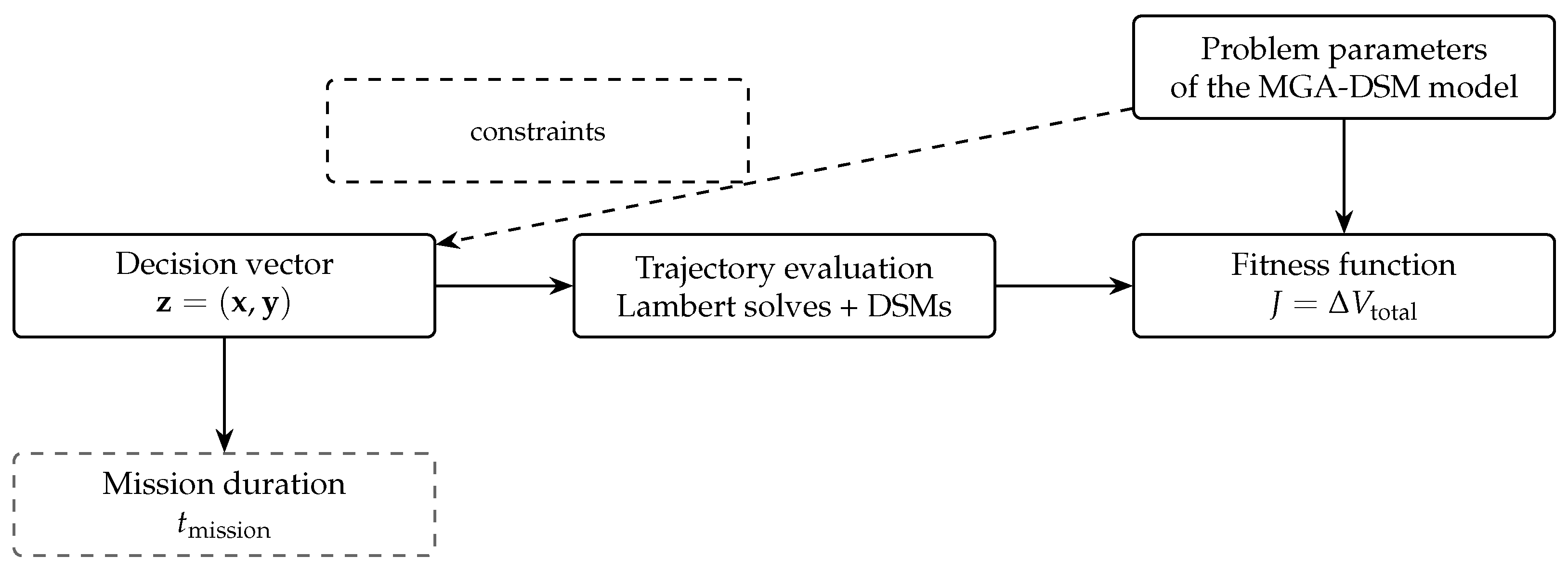
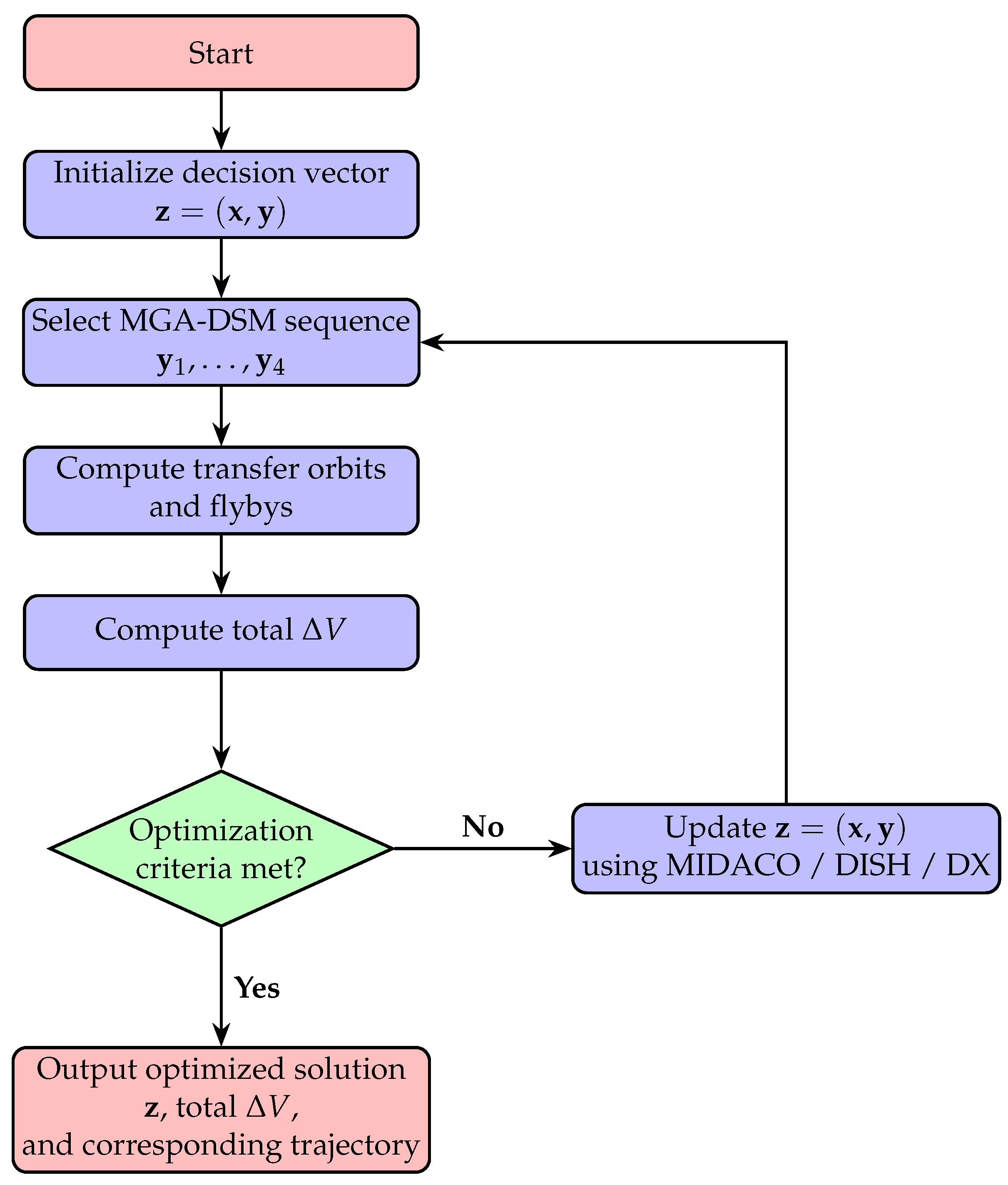
The overall optimization workflow is summarized in
Figure 1, providing a high-level overview of the interaction between the decision vector, trajectory evaluation, and objective computation. Given
and the problem parameters of the MGA-DSM model, the trajectory is evaluated by solving Lambert problems between consecutive flybys and computing the corresponding
, where
denotes the velocity increment associated with the
j-th maneuver. The optimizer iteratively updates
to minimize
. The mission duration
is monitored but is not included in the objective function.
3.2. Discrete Event Presentation and Feasible Set Structure
The proposed Cassini2-MINLP formulation extends the classical Cassini2 benchmark by introducing discrete decision variables, resulting in a fundamentally different optimization problem. Both formulations are evaluated under identical physical models, ephemeris data, and objective function. The difference between them arises solely from the structure of the decision variables and the associated feasible sets.
In both models, a candidate solution is presented by a finite sequence of mission events
This representation provides a convenient abstraction for analyzing how different flyby sequences affect the structure of the feasible set and the resulting trajectory solutions. For the Cassini2 and Cassini2-MINLP models,
. Each event
,
, corresponds to a heliocentric state
evaluated at mission time
. Within the MGA-DSM framework, events correspond to planetary encounters (launch, flybys, and final rendezvous), while DSMs occur within the transfer legs and therefore do not appear explicitly in the event sequence.
The event times are computed as
where
denotes the launch epoch and
the time of the
i-th mission event. Since planetary states are obtained from time-dependent ephemerides, their heliocentric positions depend on the evaluation time. Consequently, the Earth’s heliocentric state at departure is given by
. Different values of
therefore correspond to different heliocentric starting locations of the spacecraft along Earth’s orbit. Since ephemeris data are evaluated for the selected encounter bodies, the planetary states also depend on the encounter sequence
. Consequently, different encounter sequences generally lead to different optimal launch epochs and heliocentric states.
In the Cassini2 formulation, the encounter sequence is fixed as
corresponding to launch from Earth, two Venus flybys, an Earth flyby, a Jupiter flyby, and arrival at Saturn.
In contrast, the Cassini2-MINLP formulation treats the intermediate flyby indices as decision variables. The induced encounter sequence is
where
maps the decision vector to a sequence of planetary encounters,
, and the discrete variables
determine the identities of the intermediate flybys.
Consequently, the two formulations operate on different feasible sets. Let
and
denote the corresponding feasible solution sets. The Cassini2 feasible set corresponds to the subset of decision vectors that induce the fixed encounter sequence
It follows that
This implies that the Cassini2 formulation presents only a restricted subset of the solution space explored by the Cassini2-MINLP problem, since the Cassini2-MINLP formulation allows multiple encounter sequences to be explored during optimization. Therefore, although both formulations minimize the same objective function, the optimal solutions generally belong to different regions of the decision space.
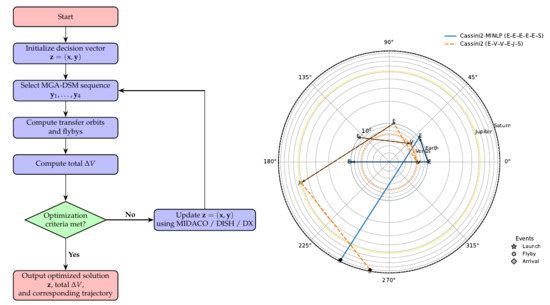
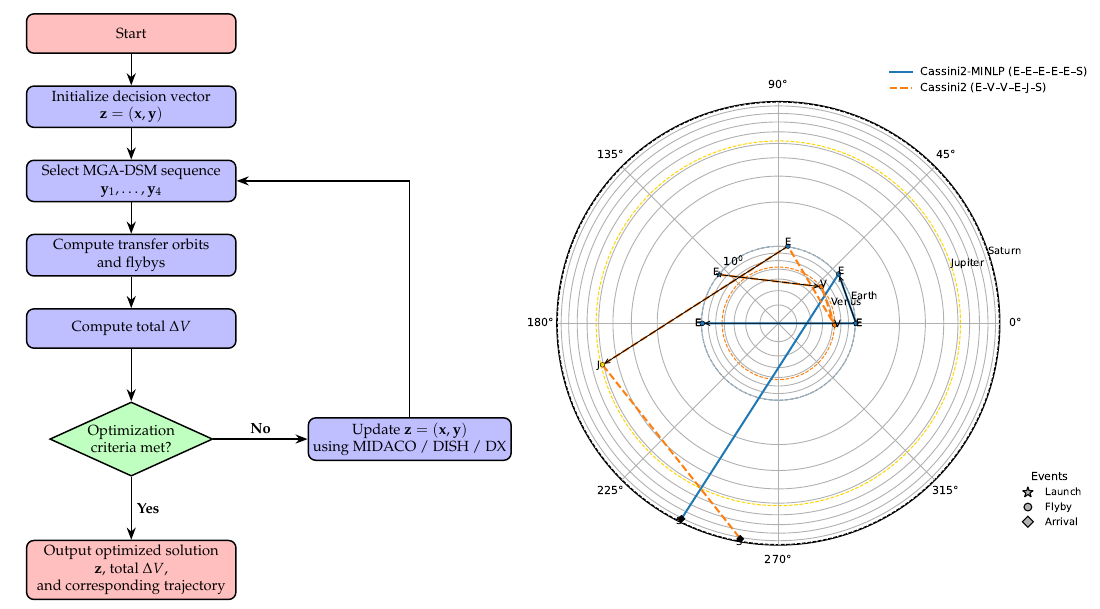
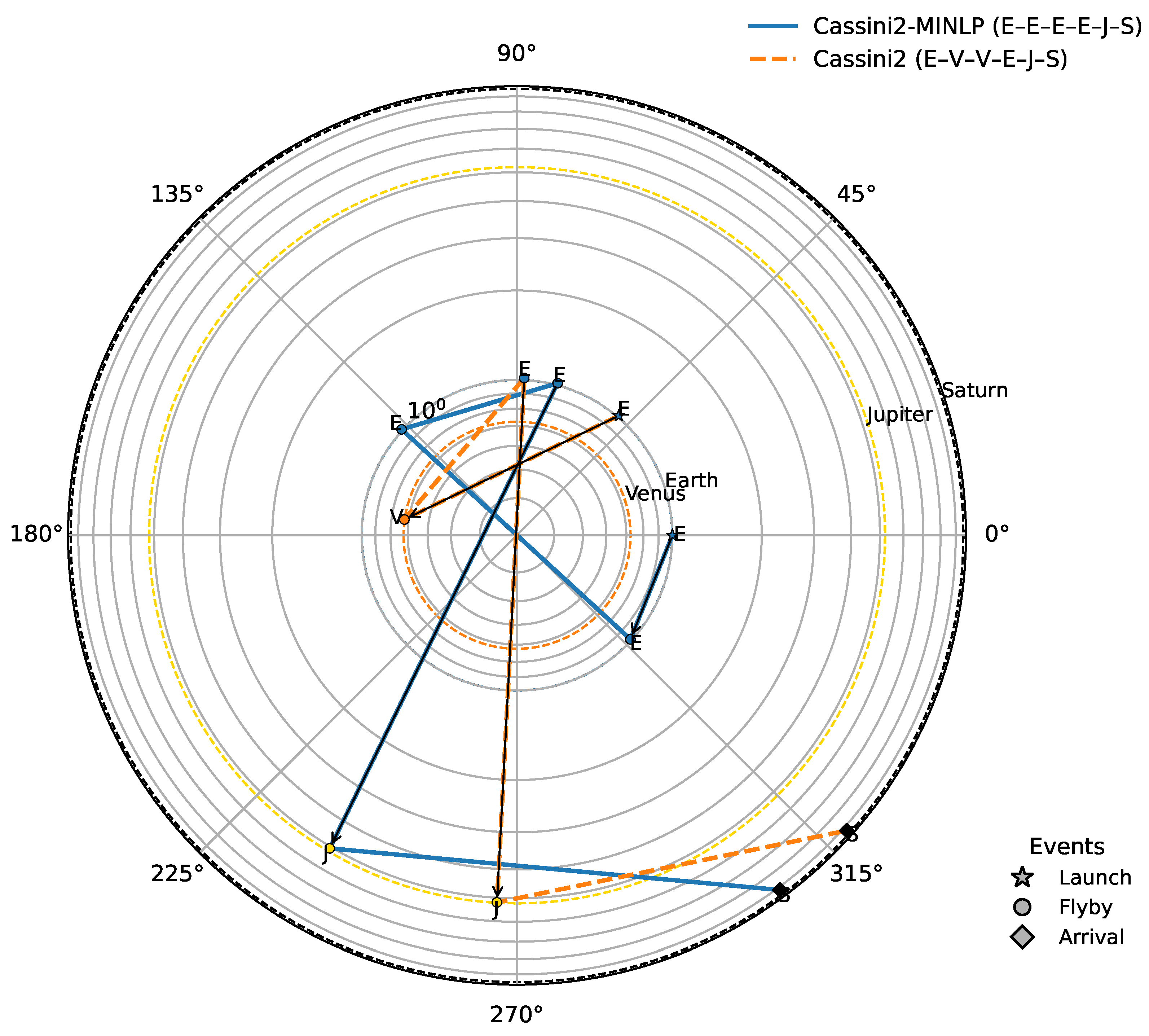
Figure 2 illustrates an event-based comparison of solutions obtained using the Cassini2 and Cassini2-MINLP formulations. The trajectories are presented in heliocentric polar coordinates, with a linear angular coordinate and a base-10 logarithmic radial scale, enabling visualization across several orders of magnitude in heliocentric distance. All spatial quantities are expressed in astronomical units (AU), consistent with the GTOPX benchmark convention [
9], where
Planetary encounters are indicated by letter codes: E (Earth), V (Venus), J (Jupiter), and S (Saturn). The figure shows that the Cassini2 trajectory follows a fixed sequence of planetary encounters, whereas the Cassini2-MINLP formulation allows alternative flyby combinations. Consequently, the optimized trajectory obtained with Cassini2-MINLP may follow a different interplanetary trajectory, reflecting the larger feasible set introduced by the variable encounter sequence. This illustrates how the MINLP formulation expands the search space by treating the encounter sequence as a decision variable.
3.3. Iterative Optimization Workflow
This section describes the iterative optimization procedure used to solve the Cassini2-MINLP problem.
The workflow is illustrated in
Figure 3, highlighting initialization, MGA-DSM selection, orbital computations, and total
evaluation. It also emphasizes the interaction between the optimization algorithm and the trajectory evaluation procedure, where each candidate solution is iteratively refined based on the computed objective value. The main steps are presented in Algorithm 1, which details the Cassini2-MINLP solution procedure.
3.4. Algorithm Details
The optimization algorithms employed in this paper—MIDACO, DISH, and DX—are selected based on their demonstrated applicability to mixed-integer and black-box optimization problems, as well as their reported performance on benchmark problems in the literature. MIDACO has been applied to mixed-integer nonlinear and black-box optimization problems [
10], DISH is based on differential evolution concepts with demonstrated performance on benchmark optimization tasks [
11], and DX-NES-ICI has been reported as a recent evolution-strategy-based method for black-box optimization [
12]. For clarity, the main characteristics of each algorithm and their configurations are summarized below.
Table 2 summarizes the initialization strategies and the algorithm-specific parameter settings used in the experiments, including several modifications relative to the default configurations. In the notation used in the table,
denotes the
i-th decision variable, while
and
present their lower and upper bounds, respectively.
For the MIDACO algorithms, MIDACOxl initializes all variables at their lower bounds, whereas MIDACOr samples continuous variables uniformly within the search bounds and selects discrete variables randomly from their domain.
The
DISH variants differ primarily in their initialization and parameter settings. DISHxl starts from the lower bounds of all variables, while DISHr and DISHrMS15BR1 employ uniform random initialization. The parameters
,
,
, and
control the population size, the number of stored past solutions, the probability of using archived solutions, and the fraction of top-performing solutions used to generate new candidate solutions, respectively. Compared with DISHr, DISHrMS15BR1 uses a larger memory size and a smaller
to improve exploration and stabilize convergence.
| Algorithm 1 Cassini2-MINLP Solution Procedure |
- Require:
Problem parameters, initial solution , optimization algorithm - Ensure:
Optimized solution , total , corresponding trajectory - 1:
Step 1: Initialize problem parameters - 2:
Continuous and discrete variables using Equation ( 15), objectives defined in Equation ( 14) - 3:
Step 2: Define box constraints for decision vector - 4:
Lower bounds using Equation ( 27), upper bounds using Equation ( 28) - 5:
Step 3: Initialize decision vector - 6:
- 7:
Step 4: Call selected optimization algorithm (MIDACO/DISH/DX) - 8:
Input: problem parameters (Step 1), bounds and (Step 2), initial (Step 3), and algorithm settings (e.g., maxFes) - 9:
Output: optimized solution , total , and the planetary sequence - 10:
Step 5: Extract solution and construct planet sequence - 11:
The last four components of present discrete planetary choices. - 12:
Obtain valid integer planet indices by rounding and clipping: - 13:
Step 6: Set problem type and model - 14:
Problem type ← rendezvous, model ← MGA/DSM (see Section 2.3) - 15:
Step 7: Compute orbital parameters and state propagation - 16:
Using Section 2.3 and Equation ( 11) to compute positions, velocities, and solve Lambert transfers. - 17:
Step 8: Compute maneuver components - 18:
For each maneuver j, compute the velocity increment using Equation ( 12). - 19:
For the final encounter, evaluate rendezvous condition using Equation ( 13) to obtain . - 20:
Step 9: Evaluate mission objectives - 21:
Compute total using Equation ( 11), corresponding to fitness using Equation ( 14). - 22:
Optionally compute mission duration (monitored but not included in the objective). - 23:
Step 10: Return optimized solution - 24:
Return , total , and the corresponding trajectory.
|
For the DX algorithms, DXxl initializes the search at the lower bounds, DXr employs uniform random initialization over the entire domain, and DXislm samples continuous variables within 25– of their domain, while discrete variables are randomly selected. The parameters , , and define the sampling standard deviation, the number of candidate samples generated per iteration, and a small tolerance parameter used to improve numerical stability.
Bold values in
Table 2 denote parameters that differ from the default settings listed in
Table 1 and were adjusted to improve convergence, exploration, or stability. The selected parameter settings are designed to balance exploration and exploitation while ensuring a fair comparison across algorithms.
All algorithms were executed using their publicly available reference implementations under identical experimental conditions. Each algorithm was evaluated over 30 independent runs with fixed random seeds to ensure a fair and reproducible comparison.
3.5. Reproducibility
Reproducibility is a key aspect of the proposed benchmark. To achieve reproducible benchmarking across all optimization methods, the original algorithm implementations were modified to employ unified random seeding, standardized configuration settings, and deterministic random number generators (RNGs). These adjustments guarantee that each experimental run starts from identical initial conditions and that all stochastic processes behave deterministically.
The following modifications were introduced to ensure consistent and reproducible behavior across all algorithms.
For the MIDACO algorithm, random initialization was standardized by introducing a user-defined seed that initializes the standard C library generator rand() via srand(seed). In addition, MIDACO internally supports its own pseudo-random routines through the parameter param[1] (SEED), which was explicitly set to zero in our implementation, as in the original code.
In the DISH implementation, based on LSHADE, the legacy rand() function was replaced with the modern C++ Mersenne Twister engine (std::mt19937). A single RNG instance is seeded once in main() and passed to all stochastic operations within the optimizer, including population initialization, mutation, crossover, and parameter sampling. Key experimental parameters, such as the number of runs and the maximum number of function evaluations, are specified in a centralized configuration file (config.h).
For DX, reproducibility was ensured by fixing all random seeds across the utilized libraries: np.random.seed(run) for NumPy, random.seed(run) for Python’s built-in RNG, and seed = 42 for the internal optimizer. This configuration guarantees deterministic initialization and consistent results across repeated trials.
3.6. Pseudocode: Cassini2-MINLP Solution Procedure
The pseudocode provides a step-by-step description of the proposed solution procedure, highlighting the integration of discrete decision variables into the standard Cassini2 workflow.
Algorithm 1 summarizes the Cassini2-MINLP solution procedure. Compared to the continuous-only Cassini2 formulation, several steps have been modified to accommodate discrete decision variables representing planetary flyby choices.
In particular, steps 1, 5, and 6 extend the original procedure. Step 1 initializes both the continuous and discrete components of the decision vector, which also affects the definition of the decision space and the associated box constraints. Step 5 extracts integer planetary indices from their continuous representation using rounding and bounding operations, and step 6 constructs the corresponding MGA-DSM event sequence.
These modifications influence the boundary conditions passed to the subsequent evaluation stages (steps 7 and 8), where the trajectory geometry, orbital transfers, and associated components are computed. As a result, the optimization process operates on MINLP formulation that extends the Cassini2 model by enabling combinatorial mission-design decisions.
4. Experimental Results
4.1. Evaluation on the Cassini2-MINLP Benchmark
The performance of the considered algorithms was evaluated on the recently introduced Cassini2-MINLP benchmark. Initialization strategies and algorithm-specific parameter settings for all solvers are presented separately in
Section 3.4 and
Table 2. A total of eight algorithmic variants were analyzed: MIDACOxl, MIDACOr, DISHxl, DISHr, DISHrMS15BR1, DXxl, DXr, and DXislm. Each variant was executed in 30 independent runs, with the termination criterion set to a maximum of
function evaluations (maxFEs).
Performance was assessed in terms of total , convergence behavior, and robustness across the discrete MGA-DSM sequences. These indicators highlight the impact of algorithm-specific parameters—such as population size, memory size, , and initialization strategy on the objective performance. Comparisons among the MIDACO, DISH, and DX variants provide insight into the effectiveness of the underlying algorithmic frameworks, as well as the influence of the parameter modifications introduced in this paper.
Reproducibility was ensured for all eight algorithms by using deterministic random number generators and centralized configuration of run parameters (see
Section 3.5).
The search space is identical for all eight algorithms. The optimization problem has a single objective
,
decision variables, of which
are integer variables, and no constraints
. The lower and upper bounds for each variable are as follows:
The following subsection presents the experimental setup and implementation details used to obtain the reported results.
4.2. Experimental Setup
The MIDACO solver (Version 6) was employed under a user-specific license, which encodes the name, affiliation, and license type of the user. The licensed MIDACO files were downloaded, compiled, and linked using the provided Makefile. To adapt MIDACO to the Cassini2-MINLP benchmark, we integrated the problem definition and objective function into the GTOPX framework and specified the corresponding lower and upper bounds for both continuous and discrete variables.
The program was executed thirty times with seeds from 1 to 30 (
./run 1, …,
./run 30), producing deterministic results for each run while allowing controlled variation across different initial conditions. The output of each run is a file named
MIDACO_SCREENxlx.TXT and
MIDACO_SCREENrx.TXT, where
x presents the run number. After collecting the results of the 30 runs, the
MIDACOgraphxl and
MIDACOgraphr scripts were executed, generating a convergence graph in PDF format (
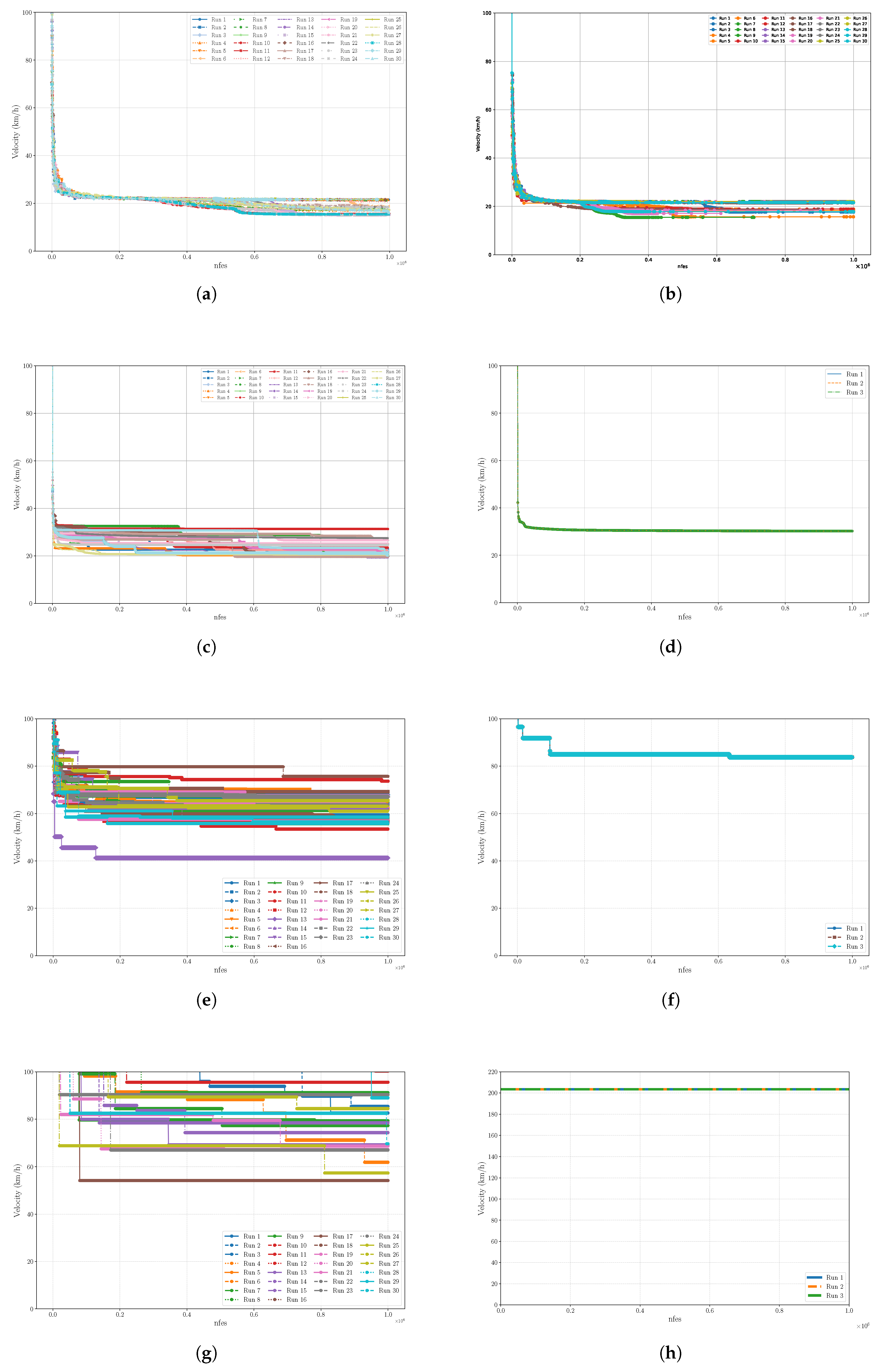
Figure 4d for MIDACOxl algorithm runs and
Figure 4c for MIDACOr algorithm runs) and a file
statistica.csv, containing the data compiled for
Table 5.
For the second set of experiments, the DISH algorithm was employed using the reference C++ implementation by A. Zamuda [
46], originally developed for a journal submission [
47] and later extended as part of the DISHchain1e+12 runtime code used at the GECCO 2019 Workshop and the CEC 2019 Special Session/Competition on the 100-Digit Challenge in Single-Objective Numerical Optimization. The pseudocode of the algorithm is provided in Viktorin et al. [
47].
In contrast to MIDACO, where the GTOPX interface was already included, the DISH implementation required the integration of GTOPX into the main algorithmic routines. Within this extension, the Cassini2-MINLP problem definition and objective function were added, and the corresponding lower and upper bounds for both continuous and discrete variables were specified.
The DISH algorithms were executed via automated shell scripts that handled compilation, execution, and data management. For each run, the results were stored in CSV files indexed by run number and random seed. By fixing the seeds, full reproducibility was ensured, allowing identical results to be obtained whenever the same seed was applied. Post-processing was carried out with dedicated analysis scripts that produced convergence plots (see
Figure 4a,b,h) and a statistical summary file (
statistics.csv), which is compiled in
Table 5.
Finally, the DX algorithm was selected for our experiments due to its suitability for MI-BBO problems commonly encountered in real-world scenarios. We employed DX Version 1.0.3 (9 December 2023), implemented in Python and freely available via the DX GitHub repository. The code was adapted to the Cassini2-MINLP benchmark by integrating the GTOPX interface into the main routines, adding the problem definition and objective function, and specifying the lower and upper bounds for all continuous and discrete variables. Fixed random seeds were applied to all sources of stochasticity to ensure reproducibility of the results.
The computational experiments were executed via a Python script, which generated convergence data for each run. Post-processing was performed using dedicated analysis scripts to produce both convergence plots (see
Figure 4e–g) and numerical summaries compiled in
Table 5. This workflow ensured that all DX variants were consistently benchmarked, and that results were fully reproducible across multiple independent runs.
All experiments were performed on an AMD Ryzen 5 5500U Radeon Graphics computer, x86_64 architecture, with eight cores and two threads per core (threads were not utilized), equipped with 22 GB of RAM, on a Linux Debian GNU/Linux operating system, version 12.11 (bookworm), using GCC version 12.2.0 as the compiler.
4.3. Performance Comparison
This subsection presents the numerical performance of the evaluated algorithms on the Cassini2-MINLP benchmark, followed by an analysis of convergence behavior, discrete decision variables, and statistical significance.
The convergence graphs for 30 independent runs of all eight algorithms (MIDACOxl, MIDACOr, DISHxl, DISHr, DISHrMS15BR1, DXxl, DXr, and DXislm) on the new Cassini2-MINLP benchmark instance are shown in
Figure 4d,e, with each run depicted in a distinct color and with different line styles. For algorithms MIDACOxl, DISHxl, and DXxl, only the first three runs are displayed (
Figure 4d,h,f), as all 30 runs yield identical values.
The performance of the algorithms is presented in
Table 5. They are sorted according to their mean (minimal) total
value in km/s through 30 runs, i.e., from the most efficient (lowest total
) to the least efficient solution. The mean value indicates the average performance over 30 independent runs, while the standard deviation reflects the variability among runs and is used as an indicator of robustness. Lower values imply greater stability; higher values indicate sensitivity to initialization and stochastic effects. This ordering highlights which solver achieved the most fuel-optimal trajectory among the tested configurations. The table also reports the best and the worst total
values (in km/s) and the corresponding planet sequences. The results show that DISHr achieved both the best average and the best individual objective values (minimal total
) among all eight compared algorithms over 30 independent runs.
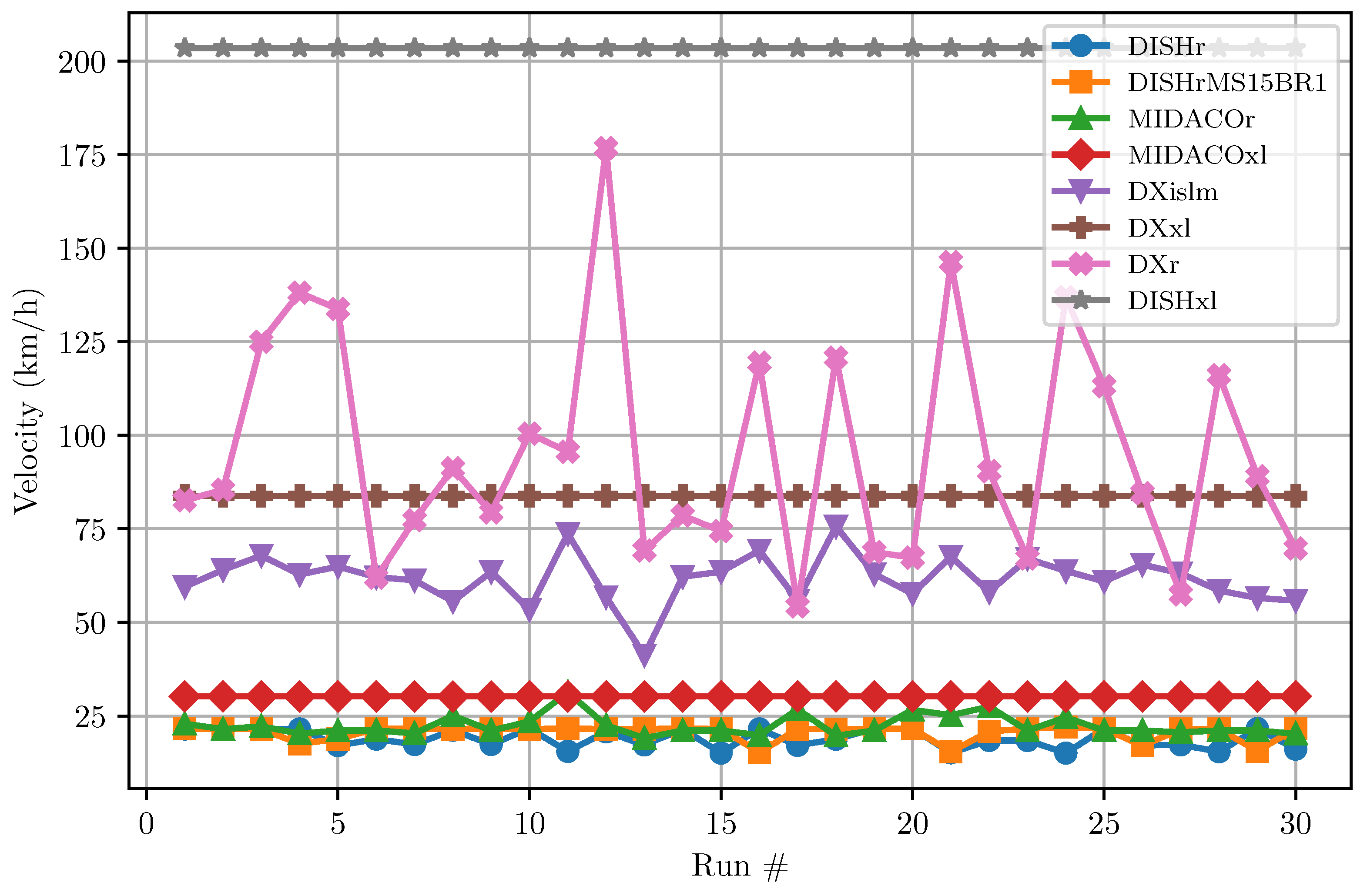
Figure 5 presents a comparative analysis of the tested algorithms based on the best solutions obtained from 30 independent runs. Consistent with the results reported in
Table 5, the figure shows that the DISHr algorithm achieves the lowest total
, indicating the best performance among the tested methods. It is followed by DISHrMB15BR1 and MIDACOr, while the remaining algorithms produce substantially higher total
values.
For some algorithms (MIDACOxl, DISHxl, and DXxl), flat lines are observed in
Figure 5. This behavior occurs because these algorithms start from identical initial values corresponding to the lower bounds of the decision variables.
The DISHxl algorithm exhibits significantly poorer performance and fails to converge in these runs. This behavior is related to the underlying DE mechanism, which relies on population diversity to generate effective mutation steps. If all individuals are identical, the mutation
produces no variation, since
. As a result, the algorithm stagnates and the search process becomes ineffective.
In contrast, MIDACOxl and DXxl exhibit better convergence behavior. MIDACOxl, which is based on ACO, maintains exploration through probabilistic solution construction and pheromone updates:
The DX algorithm relies on a CMA-based mechanism, in which candidate solutions are sampled from a multivariate normal distribution,
which preserves search variability even when identical initial values are used through adaptive updates of
,
, and
.
4.4. Analysis of Discrete Decision Variables
In addition to the overall performance in terms of total , we analyze the structure of the discrete decision variables obtained by the best-performing algorithm, DISHr. While the objective value reflects the fuel efficiency of a solution, the discrete MGA-DSM sequence determines the mission architecture and directly governs the temporal and geometric structure of the resulting trajectory.
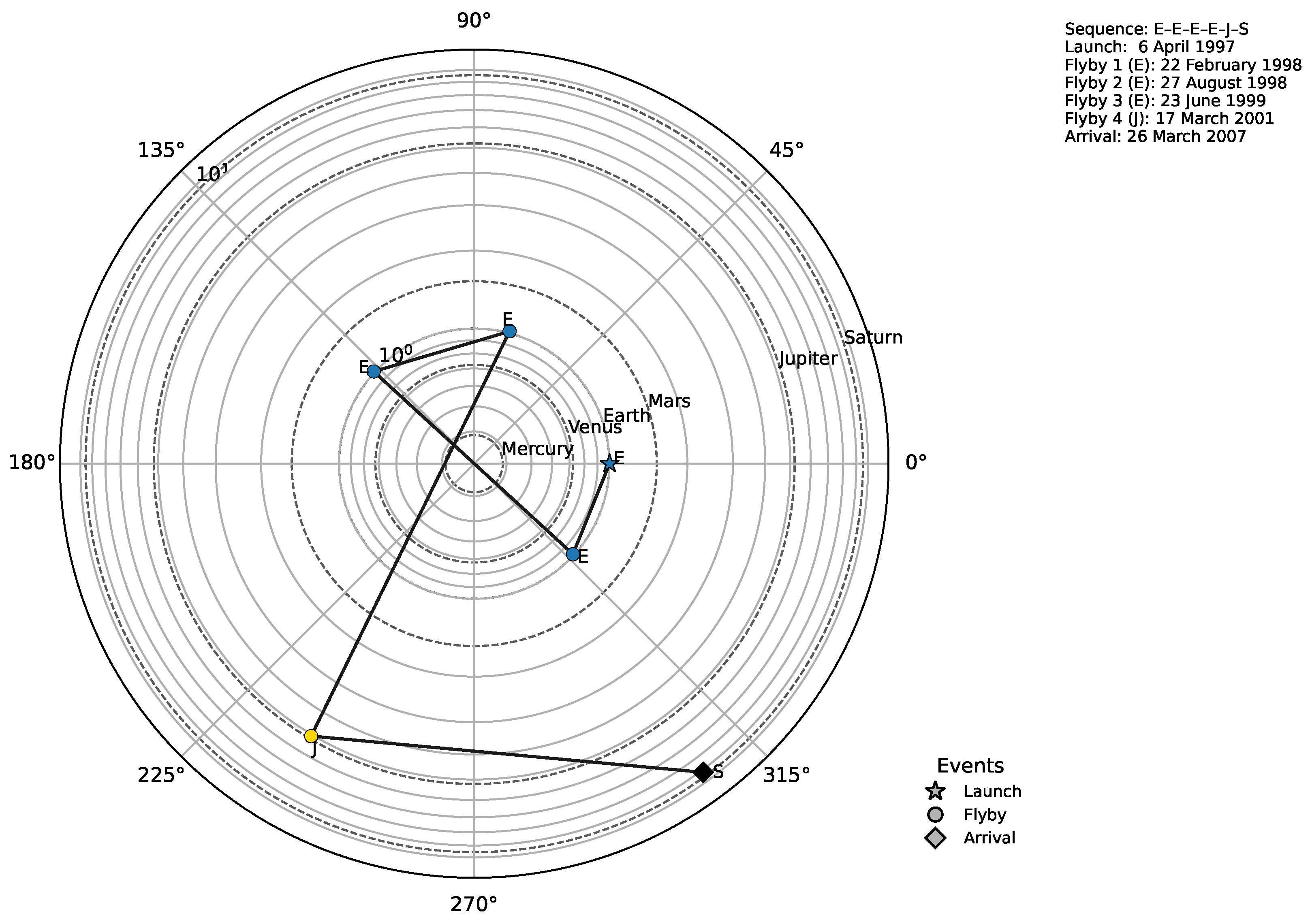
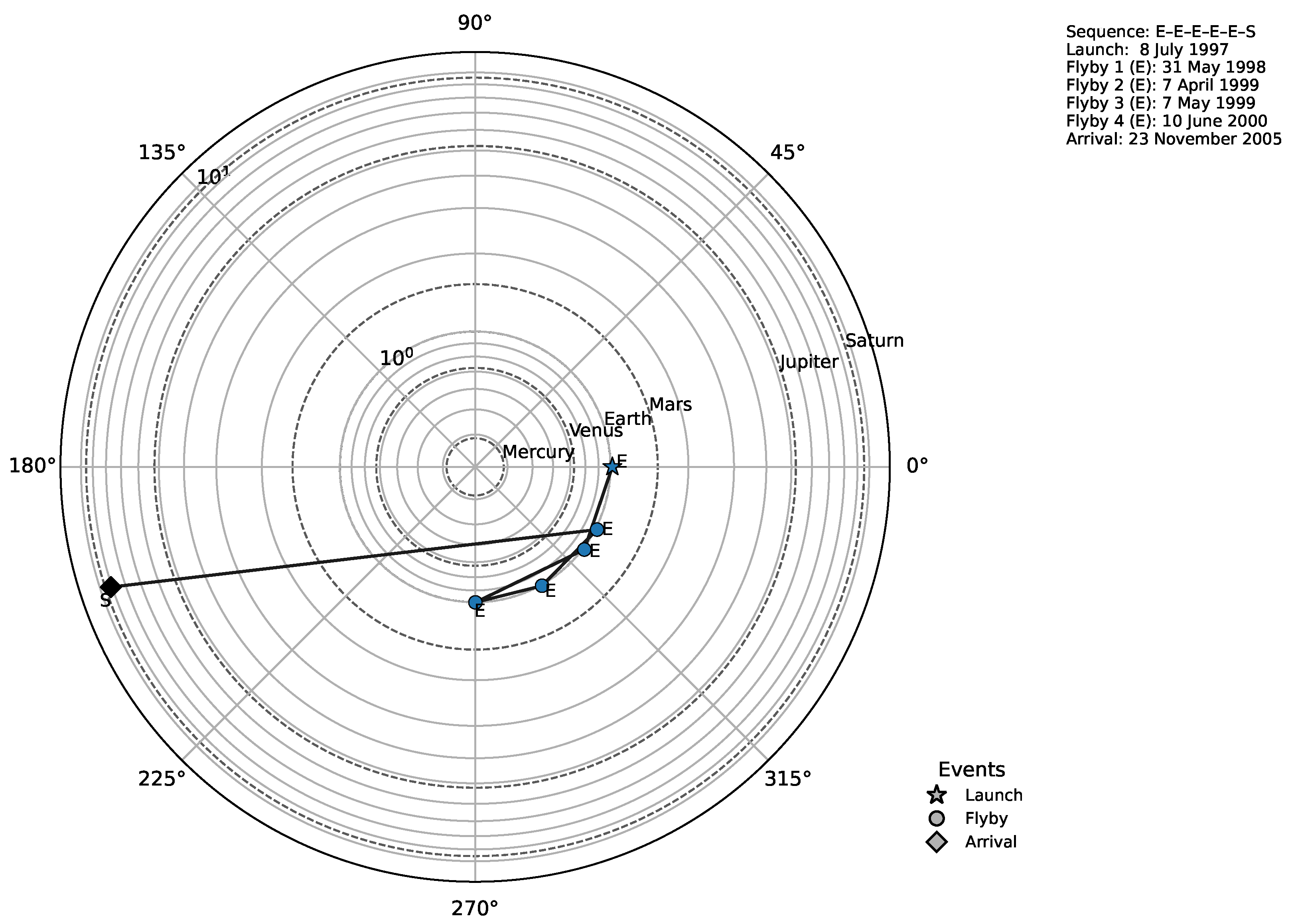
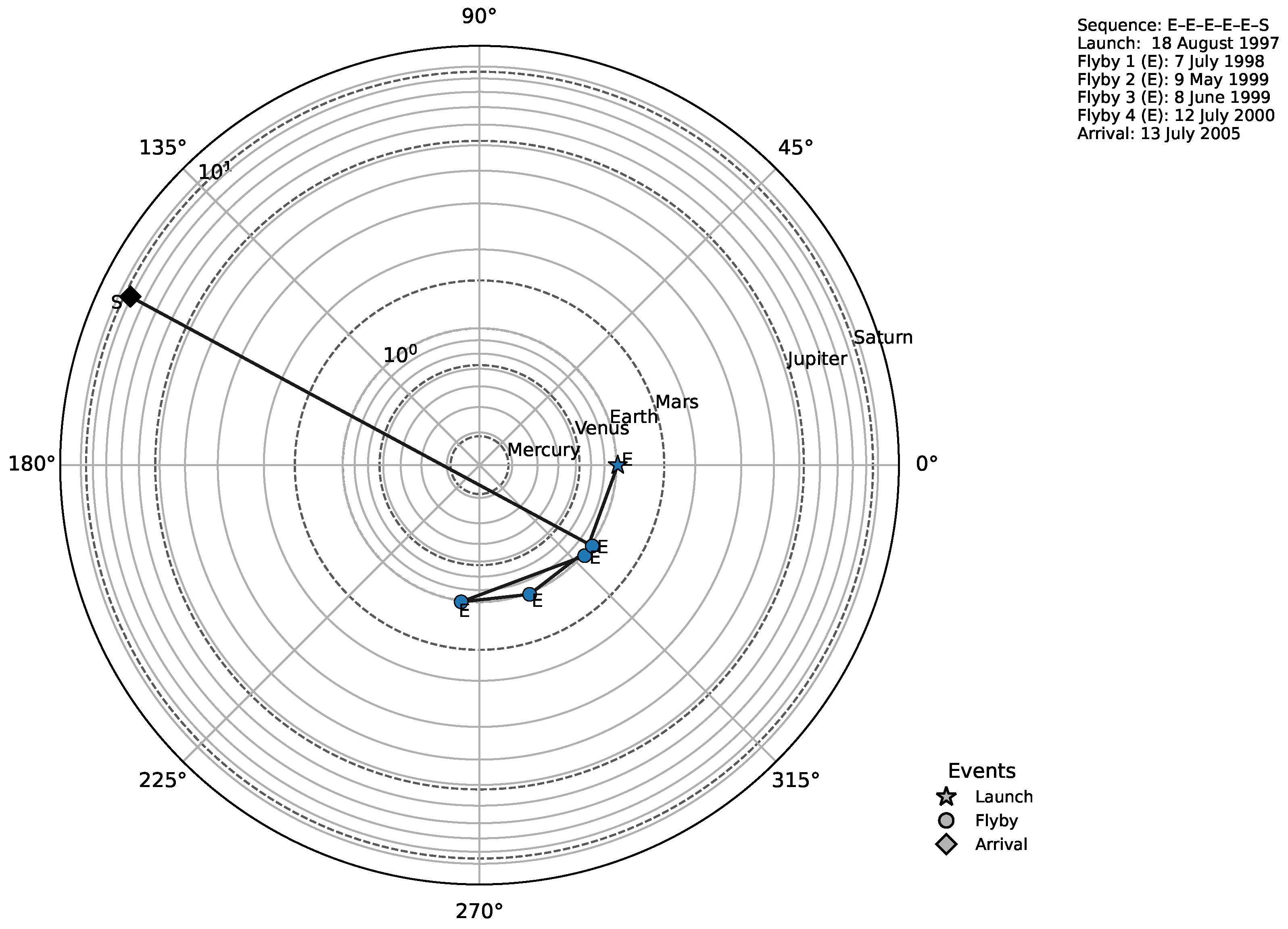
Figure 6,
Figure 7 and
Figure 8 show the discrete decision-variable configurations corresponding to the best, median, and worst runs, respectively, together with the heliocentric geometry of the transfer and the corresponding event epochs (MJD2000). Each figure visualizes the integer-valued components of the decision vector defining the planetary flybys and DSM locations. The planetary encounters follow the letter notation introduced in
Section 3.2. The best solution follows the sequence
E–E–E–E–J–S, whereas both the median and worst solutions follow the sequence
E–E–E–E–E–S. This highlights the role of the Jupiter gravity assist as a key structural feature of the best-performing trajectory. In contrast, the median and worst solutions share the same discrete sequence, indicating that differences in performance between them arise primarily from the continuous decision variables and their associated timing.
The temporal and structural characteristics of the three solutions are summarized in
Table 6, which reports the transfer durations between consecutive mission events, the corresponding target planets, the total mission duration, and the corresponding total
values. The event epochs follow the temporal model introduced in the
Section 3 (Equation (
21)) and are determined by the inter-event transfer times contained in the continuous decision vector. The durations listed in
Table 6 therefore present relative time intervals between consecutive events, whereas the event dates shown in the figure legends correspond to absolute epochs expressed in the MJD2000 scale.
The launch epochs differ between the three solutions, leading to distinct heliocentric departure conditions. Since planetary states are evaluated at absolute epochs , even moderate shifts in the launch date result in significantly different encounter geometries. This effect is particularly evident when comparing the median and worst solutions, which share identical discrete structures but exhibit substantially different performance.
Despite differences in the early mission structure, the total mission duration varies across solutions, with the longest duration observed for the best solution, followed by the median and worst (
Table 6). This indicates that improved performance is not achieved by reducing the overall time of flight. Instead, the dominant contribution to mission duration is consistently the outer transfer from DSM4 to Saturn arrival, lasting approximately
–
years depending on the solution and largely constrained by planetary geometry and orbital mechanics.
The differences between the solutions, therefore, originate primarily in the inner trajectory segments (Launch–DSM4).
Table 6 shows that the median and worst run exhibits strongly uneven timing, most notably the very short DSM2–DSM3 transfer (30 days), compared to significantly longer preceding and subsequent phases. Such timing patterns lead to less favorable encounter geometries and substantially increased impulsive requirements. In contrast, the best solution benefits from the inclusion of a Jupiter flyby, which enables efficient energy gain through gravity assist and reduces the required
. The median solution, although sharing the same discrete sequence as the worst case, achieves improved performance through more balanced transfer timing and more favorable encounter conditions.
Overall, the results indicate that the discrete MGA-DSM sequence is a dominant factor influencing solution quality. The total
varies substantially between the solutions as reported in
Table 6, reflecting differences in both discrete trajectory structure and total mission duration. The inclusion of a Jupiter flyby provides access to a more favorable energetic pathway, highlighting the importance of selecting appropriate planetary encounters. Differences in launch epoch and early encounter geometry, therefore, have a major impact on the overall fuel cost. These results indicate that the inclusion of specific planetary encounters (e.g., Jupiter) induces distinct regions in the search space with fundamentally different energetic characteristics, rather than yielding merely incremental improvements.
4.5. Statistical Analysis
The statistical comparison of the algorithms was performed using the Friedman test, where each independent run was treated as a repeated measurement of algorithm performance on the same problem instance. For each run, the algorithms were ranked according to their achieved total , and the Friedman test was used to assess whether the observed differences in performance are statistically significant.
When significant differences were detected, the Nemenyi post-hoc test was applied to perform pairwise comparisons between algorithms based on their average ranks. These non-parametric tests were selected because the performance data do not necessarily satisfy normality assumptions and involve repeated evaluations of multiple algorithms on the same problem, making the Friedman–Nemenyi framework a standard and appropriate choice for this type of comparison.
Figure 9 presents the distribution of total
for each algorithm over 30 independent runs, using boxplots with overlaid individual data points. Statistically significant differences determined by the Nemenyi post-hoc test are denoted by stars:
** ,
*** ,
**** , with the conventional significance threshold of
adopted throughout. Although these markers originate from the Nemenyi test, they guide the interpretation of all figures. Among the algorithms,
DISHr consistently achieves the lowest average total
(14.04–21.53 km/s, mean 19.00), followed closely by
DISHrMS15BR1 (15.44–22.04 km/s, mean 20.29) and
MIDACOr (19.06–31.31 km/s, mean 22.40).
DISHxl exhibits extreme values (203.52 km/s), indicating very poor performance, while CMA-ES-based algorithms (
DXxl,
DXr,
Dxislm) show intermediate results with variable stability [
48].
A Friedman test confirmed highly significant differences among the eight algorithms on the Cassini2-MINLP problem (
,
,
), indicating that at least two algorithms perform differently.
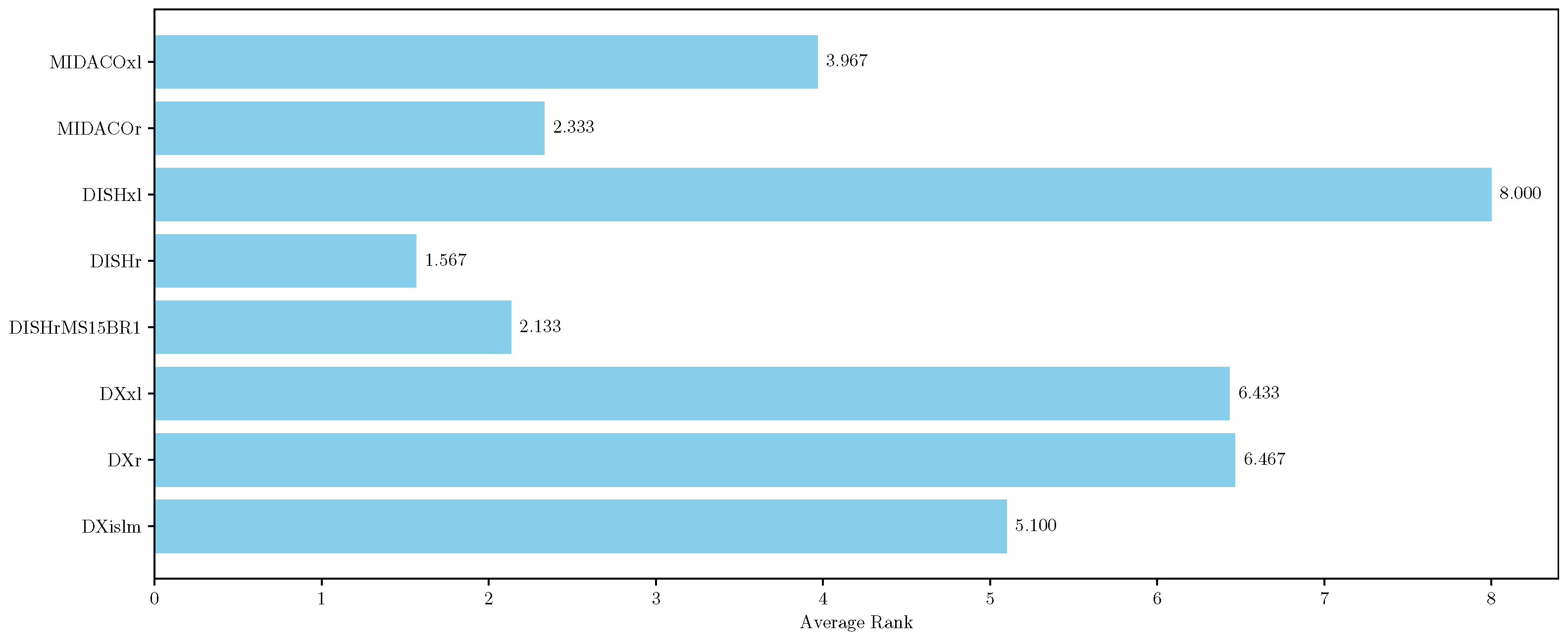
Figure 10 shows the average ranks, where lower ranks indicate better performance.
DISHr achieves the best rank (1.567, ***), followed by
DISHrMS15BR1 (2.133, **),
MIDACOr (2.333, **),
Dxislm (5.100),
DXxl (6.433),
DXr (6.467),
MIDACOxl (3.967, *), and
DISHxl (8.000, ***).
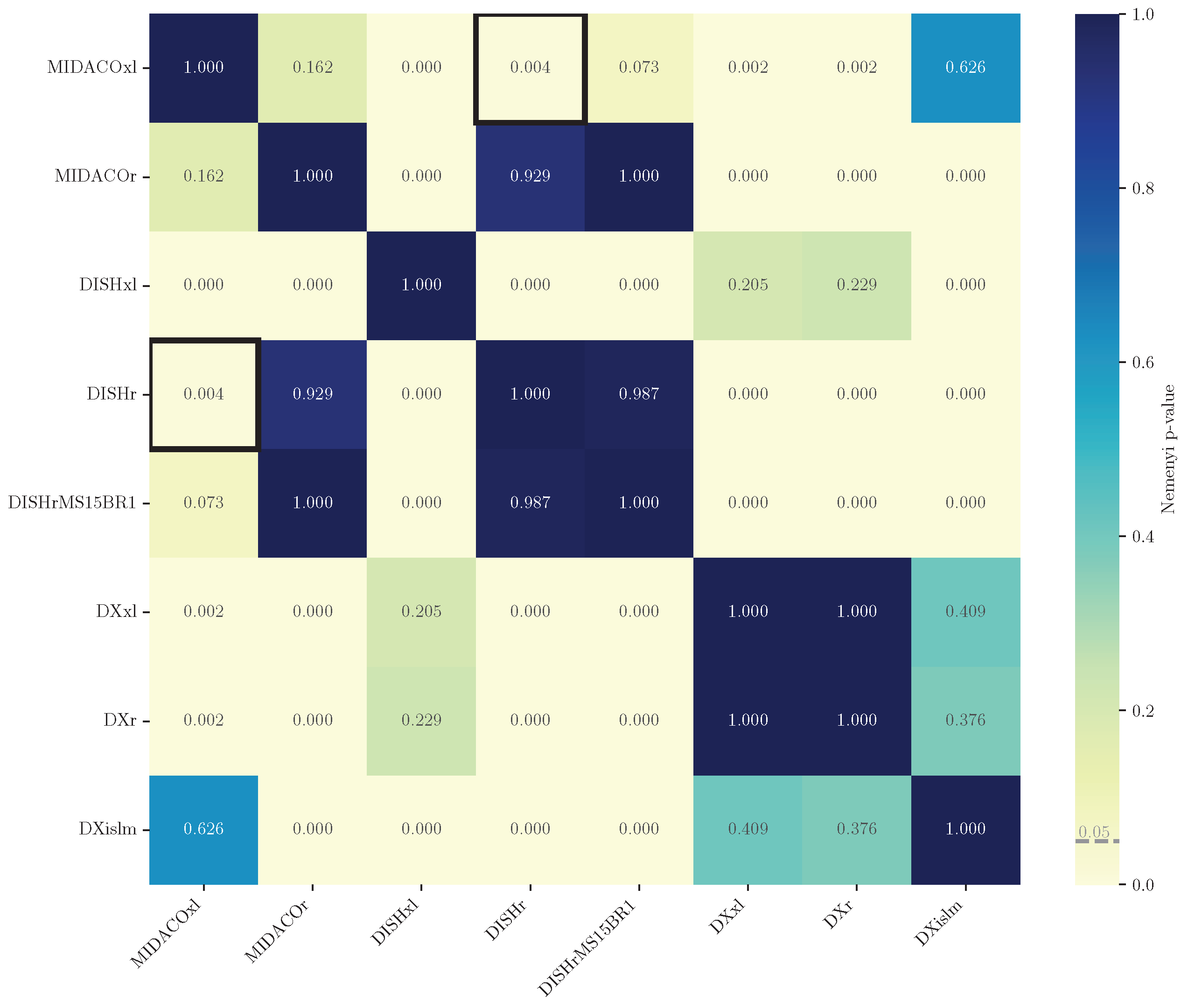
The Nemenyi post-hoc analysis (
Figure 11) evaluated pairwise differences based on average rank comparisons, with
p-values indicating the statistical significance of the observed differences. Pairwise
p-values include:
MIDACOxl–
DISHxl: 0.000,
MIDACOxl–
DISHr: 0.004,
MIDACOxl–
DXxl: 0.002,
MIDACOxl–
DXr: 0.002,
MIDACOxl–
MIDACOr: 0.162,
MIDACOxl–
DISHrMS15BR1: 0.073.
Three performance groups can be identified based on the statistical comparisons: a high-performance group (
DISHr,
DISHrMS15BR1,
MIDACOr), an intermediate group (
Dxislm), and a low-performance group (
MIDACOxl,
DXxl,
DXr,
DISHxl), with
DISHxl being the weakest. Stability, measured as the variability of total
across 30 runs, is slightly better for
DISHrMS15BR1 compared to
DISHr, while
DISHr consistently achieves the lowest total
[
49].
The results highlight the influence of the new Cassini2-MINLP formulation, where explicitly modeling intermediate flybys introduces additional integer variables. This increases the flexibility of possible transfer sequences and the dimensionality of the search space, making trajectory design more complex. The broader spread of values in weaker solvers suggests a more multimodal landscape, while the stable performance of hybrid ACO-based methods indicates their better adaptation to this higher-dimensional setting.
5. Conclusions
This paper introduced a new single-objective formulation of the Cassini2-MINLP interplanetary trajectory optimization problem, extending the Cassini2 benchmark by enabling optimization of the sequence of intermediate planetary flybys. The formulation incorporates four additional decision variables presenting flyby indices, implemented through a relaxed continuous encoding and recovered as integer variables via rounding and bounding operations. This extension increases both the dimensionality and the structural complexity of the trajectory design problem, resulting in a more complex MINLP problem.
Eight optimization algorithms from three methodological families (ACO, DE, and CMA-ES) were evaluated under a consistent experimental setup with fixed random seeds to ensure reproducibility. Statistical analysis based on the Friedman test and Nemenyi post-hoc comparisons revealed statistically significant differences in the achieved total among the algorithms. The results showed that DISHr, DISHrMS15BR1, and MIDACOr formed the most efficient group of solvers, achieving the lowest values, while the remaining algorithms exhibited progressively weaker performance and higher variance. In particular, DISHr demonstrated the best overall performance, while DISHrMS15BR1 showed improved robustness with lower variance. Statistical analyses based on the 30 independent runs using the Friedman test confirm highly significant differences among the algorithms, with the DISHr algorithm achieving the best average rank at value 1.567 and statistically outperforming several other competing methods according to the Nemenyi post-hoc test.
The observed variability among algorithms reflects the increased flexibility and dimensionality introduced by the Cassini2-MINLP formulation, which expands the set of feasible trajectories while simultaneously increasing the overall optimization complexity. The results confirm that the proposed Cassini2-MINLP problem provides a challenging and practically relevant benchmark for evaluating global optimization algorithms in interplanetary trajectory design and establishes a foundation for future studies on multi-objective formulations and advanced optimization strategies for complex space mission scenarios.
Future work will extend the Cassini2-MINLP benchmark toward a multi-objective formulation, enabling the simultaneous optimization of competing mission objectives such as total and mission duration. Such an extension will further strengthen the role of the benchmark as a standardized and reproducible testbed for the systematic evaluation of advanced optimization algorithms in interplanetary trajectory design. Sensitivity analyses, hyperparameter tunnings, AutoML integrations, integration of and with other automated models, are also important future directions.