1. Introduction
The escalating global demand for energy, in conjunction with the detrimental environmental repercussions of fossil fuel utilization, has rendered the transition to sustainable renewable energy sources an imperative priority. Renewable energy modalities, including biomass, hydropower, geothermal, wind, solar, and tidal energy, present ecologically sound alternatives that have the potential to substantially diminish greenhouse gas emissions while fostering long-term energy security.
Nonetheless, the identification of the most appropriate renewable energy source constitutes a multifaceted DM challenge. This process necessitates the evaluation of numerous criteria, encompassing energy efficiency, environmental ramifications, reliability, resource availability, land, and water footprints, as well as social and policy acceptability. Such criteria frequently exhibit conflicting and uncertain characteristics, thereby complicating the selection procedure. To navigate this complexity, sophisticated decision-making methodologies, particularly MCDM techniques, are extensively employed. These methodologies facilitate the systematic analysis and ranking of alternatives by decision-makers, based on a variety of quantitative and qualitative dimensions. The incorporation of uncertainty through fuzzy and intuitionistic fuzzy frameworks further bolsters the resilience of the DM process. Consequently, the selection of sustainable renewable energy sources is pivotal in the pursuit of energy sustainability, environmental conservation, and economic advancement, thereby ensuring a balanced and efficient energy future.
Intuitionistic fuzzy sets (IFSs) extend conventional fuzzy sets by incorporating hesitancy alongside membership and non-membership, facilitating a more minute and accurate depiction of uncertainty and ambiguity. Introduced by Atanassov in the year 1986, IFSs are especially beneficial in DM and evaluative contexts where linguistic descriptions may be more confusing because of the effect of hesitancy in DM. In practice, MCDM often reflects a scenario marked by limited information, varying expert opinions, and the presence of hesitancy in experts’ opinions and in uncertainty. IFSs were formulated to encapsulate such hesitancy present in ambiguity/uncertainty by delineating distinct degrees to it, whereas IVIFSs further refined this methodology by permitting these degrees to exist within predetermined intervals. Geometrical extensions of the IFS, such as triangular, trapezoidal, etc., reconceptualize uncertainty, ambiguity, and imprecision as regions encompassed within the IFS interpretation. The C-IFS framework shifts from a sharp-edged geometrical structure to a structure with a smooth surface with the center at (Է, Ը), where the radius captures the uncertainty/ambiguity. This conceptual framework has been integrated with conventional MCDM methodologies to develop novel aggregation families aimed at enhancing resilience against informational dispersion. Advancing this smooth surface geometric paradigm, the EIFS framework extends anisotropic uncertainty, specifically, varying degrees of dispersion along the major and minor axes.
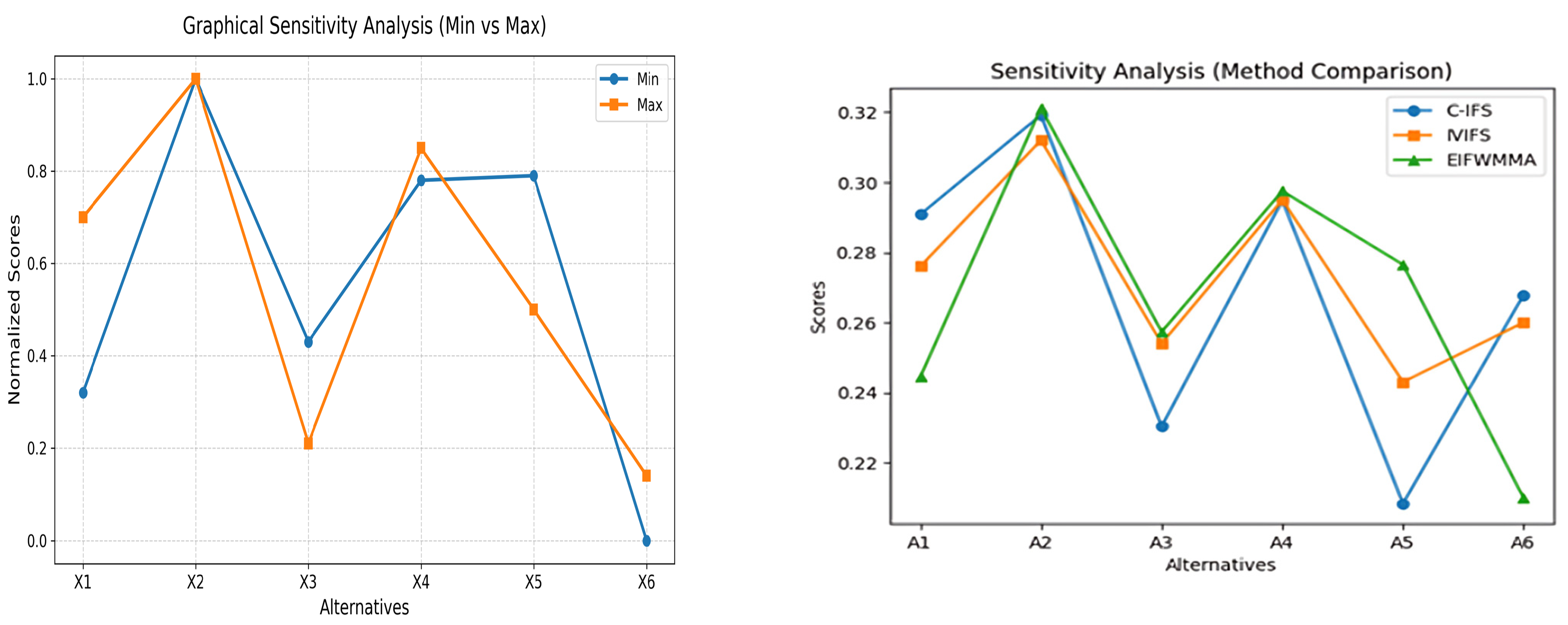
These advancements suggest that the EIFS holds promise for enabling more sophisticated and geometrically significant aggregation and ranking methodologies in comparison to C-IFSs and IVIFSs. Building upon this established trajectory, the current investigation introduces a novel operator, EIFWMMA, which integrates PCA, a machine learning-based dimensionality reduction, and weighted optimization techniques to enhance computational efficiency when addressing wide-ranging decision matrices. In this context, the selection of sustainable renewable energy sources is engaged for illustration. In this illustration, the rankings derived from EIFWMMA are compared with the benchmarks of C-IFS and IVIFS to highlight improvements in accuracy and consistency under uncertain conditions. The Min–Max normalization method confirms that the proposed framework authenticates the selection of optimal alternatives within other existing MCDM frameworks.
1.1. Literature Review
IFSs were introduced by Atanassov in 1986, advancing traditional fuzzy sets by integrating not only degrees of membership but also non-membership and hesitation parameters. This theoretical framework facilitates a more intricate depiction of uncertainty and imprecision, rendering IFSs particularly advantageous in a myriad of applications, encompassing DM processes and mathematical modeling [
1]. IFSs provide a sophisticated methodology for modeling uncertainty, augmenting traditional fuzzy sets through the inclusion of both membership and non-membership degrees. This duality engenders a more elaborate representation of uncertainty, which may be geometrically interpreted through various perspectives. The geometric representation of IFSs not only contributes to the visualization of their intrinsic properties but also amplifies their applicability in DM frameworks. The following delineates key elements of geometric representation within intuitionistic fuzzy sets. To improve decision-making by matching preferences for optimal outcomes, the paper presented a novel aggregation operator for Generalized Intuitionistic Fuzzy. These operators are distinguished by characteristics like Idempotency and Monotonicity [
2]. This paper presented new logarithmic operational laws for intuitionistic fuzzy sets. It presents a variety of aggregation operators [
3]. In 2020, Atanassov presented C-IFSs, which are an expansion of intuitionistic fuzzy sets. A circular representation of each element, delineated by degrees of participation and non-membership, is a defining characteristic of C-IFSs [
4]. C-IFSs represent a sophisticated enhancement of IFS, introduced to address uncertainty and indecision more effectively in processes of decision-making. C-IFSs are distinguished by a circular representation, wherein each component is articulated through degrees of membership and non-membership, with a radius denoting the degree of uncertainty. This paradigm shift facilitates a more intricate representation of data, which is particularly advantageous in multifaceted DM contexts. The utilization of C-IFSs across diverse methodologies, including TOPSIS and AHP, exemplifies their adaptability and efficacy in mitigating indecision and augmenting the precision of decision outcomes. The high levels of hesitation that might arise during DM processes, especially in situations with little uncertainty, are addressed by this approach. To address this hesitancy, one paper suggests a technique for determining decision-maker weights using the TOPSIS technique [
5]. BWM determines the relative weights of criteria within the hierarchy, capturing decision-makers’ preferences effectively. In the second phase, FHRA assesses qualitative risks by computing risk magnitudes from the lowest level and aggregating them upward through the hierarchy. Additionally, the multimodal transport cost model estimates both transportation cost and time [
6].
By successfully capturing vagueness and uncertainty in multi-attribute scenarios, one paper presented several aggregation operators for complex intuitionistic fuzzy information, such as CIF Hamacher weighted averaging, ordered weighted averaging, weighted geometric, and ordered weighted geometric operators. These operators improve decision-making abilities [
7]. Various weighted averaging and geometric operators are among the Frank aggregation operators for interval-valued intuitionistic fuzzy numbers that are introduced in another study [
8]. Using Einstein operations, one paper presented intuitionistic fuzzy aggregation operators that extend conventional aggregation techniques to Atanassov’s intuitionistic fuzzy values [
9]. Improved versions of IFS and C-IFS were intended to handle ambiguities and uncertainties in decision-making. They used a circular structure that improved the way degrees of membership and non-membership were represented, enabling a more sophisticated interpretation of the data. This novel method helps managers make well-informed decisions in the face of complicated environmental factors, which is especially helpful in MCDM contexts like the manufacturing industry [
10].
A paper by Atanassov and Gargov (1989) [
11] introduces IVIFSs, which generalize fuzzy set theory by incorporating a membership range and a non-membership range, enhancing the modeling of real-life decision-making problems. IVIFSs presented necessary modifications and a new eighth geometrical interpretation alongside comparisons of existing representations [
12]. Two geometrical representations of intuitionistic fuzzy sets visualized the connections between membership and non-membership degrees; these representations improve comprehension of intuitionistic fuzzy sets in a variety of settings [
13]. To facilitate efficient ranking, one study presents a geometric representation of intuitionistic fuzzy values based on Euclidean distance [
14]. Another study presented the Interval Valued C-IFS, which improves the capacity to account for uncertainty and encompasses a wider range of topics, especially in intricate assessments like the selection of digital transformation projects [
15].
The Muirhead mean [
16], introduced by Muirhead in 1902, serves as a generalized aggregation function. Muirhead means (MMs) are a well-known aggregation operator that can consider interrelationships among any number of arguments assigned by a variable vector, and some existing operators, such as arithmetic and geometric operators, the Bonferroni mean operator and the Maclaurin symmetric mean are special cases of MM operators [
17]. Therefore, the MM can offer a flexible and robust mechanism to process information fusion problems and make them better suited to solve MCDM problems. The MM aggregation operator has been successfully expanded to IFSs to improve DM procedures. This modification, referred to as the Intuitionistic Fuzzy Muirhead Mean (IFMM), enables the amalgamation of intuitionistic fuzzy numbers, thereby encapsulating the interconnections among various criteria in group DM environments. The subsequent sections delineate the principal characteristics of this operator’s implementation within intuitionistic fuzzy frameworks. The MM operator has been extended to IFNs to create IFMM operators, enabling flexible aggregation of multi-attribute group decision-making problems while considering interrelationships among the arguments through a parameter vector [
18]. Researchers addressed multi-attribute group DM problems by developing methods that aggregate individual decision matrices using IFMM operators [
19].
EIFS constitute a progressive paradigm for managing uncertainty in DM processes. By assimilating elliptic membership and non-membership functions, these sets refine conventional intuitionistic fuzzy logic systems, facilitating more sophisticated representations of uncertainty. The ensuing sections expound upon the fundamental elements of elliptic intuitionistic fuzzy sets. The concept of elliptic intuitionistic fuzzy sets, as introduced by Atanassov, represents an advancement in the field of fuzzy logic by incorporating the geometric flexibility of ellipses into an intuitionistic fuzzy framework. This approach enhances the ability to model and analyze complex systems with inherent uncertainty and imprecision. EIFSs extend traditional intuitionistic fuzzy sets by allowing for more adaptable and versatile representations of data, which is particularly useful in DM processes [
20]. EIFS are characterized by elliptical aggregation operators, which adapt to various point distributions. They enhance decision-making in MCDM by ranking alternatives based on their proximity to ideal options, accommodating diverse spatial patterns [
21]. MCDM techniques like AHP, TOPSIS, and MOORA systematically select sustainable renewable energy sources. Researchers have established criteria across environmental, economic, and technical domains, facilitating informed DM and addressing conflicting objectives in High Renewable Energy System selection [
22]. The TOPSIS and AHP methods for evaluating and selecting optimal renewable energy sources highlights solar energy as the most suitable option for sustainable energy planning in Egypt [
23]. Grey analytic hierarchy processes and weighted aggregate sum product assessment were used to select sustainable renewable energy sources. Solar energy emerged as the optimal choice, followed by wind, biomass, and solid waste energy [
24]. Another paper identifies the limitations of conventional synthesis methods for selecting renewable energy sources, highlighting their arbitrary nature and the difficulty of determining rescaling weights [
25]. To enhance the fuzzy environment for the selection of suitable renewable energy sources by the TOPSIS method, researchers integrated the proposed entropy and distance measures into its framework [
26]. An investigation of biodegradable oil-based minimum quantity lubrication (MQL) parameters for sustainable grinding of H13 die steel reveals significant advancements in eco-friendly machining practices. The use of biodegradable oils, such as Jatropha crude oil and olive oil, showed promising results in enhancing machinability while minimizing environmental impacts [
27]. Other researchers have normalized closeness coefficients using the Min–Max normalization method [
28].
In the context of sustainable renewable energy source selection, the enhanced aggregation operator EIFWMMA remains unexplored in MCDM applications. The integration of PCA effectively reduces redundancy and improves computational efficiency, while its adaptation for eliminating less significant criteria has not yet been applied within EIFS-based MCDM frameworks. Furthermore, the use of PCA based on machine learning to derive criteria weights in EIFS MCDM problems is still insufficiently addressed in the existing literature.
The existing literature on MCDM methods in intuitionistic fuzzy environments contains significant contributions; however, several limitations remain. Extensions such as Circular IFS (C-IFS) and Interval-Valued IFS (IVIFS) improve representation but often have redundancies or fail to capture directional uncertainty effectively. Traditional intuitionistic fuzzy sets (IFSs) assume symmetric and independent uncertainty, which restricts their applicability in complex real-world problems which possess nonlinearity along with asymmetricity.
Moreover, most existing aggregation operators rely on linear combinations and assume independence among criteria, thereby neglecting interrelationships and interaction effects. These limitations reduce the accuracy and reliability of decision outcomes in practical scenarios. Therefore, there is a need for advanced models like EIFS and EIFWMMA that can simultaneously address nonlinearity, asymmetric uncertainty and interdependent criteria in MCDM problems.
1.2. Research Gap
The enhanced aggregation operator EIFWMMA has not been previously explored in MCDM problems.
Implementation of PCA eliminates redundancy and enhances computational efficiency. Tailoring of PCA to reduce sluggish criteria has not been used yet in EIFS MCDM problems.
Also, PCA with machine learning has not been effectively used to determine criteria weights in EIFS MCDM problems in the literature.
Geometric representations have not been extensively or effectively utilized in EIFS MCDM processes; however, when compared with conventional averaging approaches, geometric methods demonstrate the potential to provide higher accuracy and more reliable outcomes.
This limitation significantly reduces their effectiveness in complex MCDM applications, particularly in the selection of sustainable renewable energy sources.
The identified shortcomings highlight a substantial research gap, justifying the necessity of elliptic fuzzy formulations and tailoring with machine learning techniques (PCA) to achieve more realistic and robust decision modeling in the selection of sustainable renewable energy sources.
1.3. Motivation
In 1987, Wold, Esbensen, and Geladi [
29] presented a seminal tutorial on principal component analysis (PCA) in Chemometrics and Intelligent Laboratory Systems, firmly establishing PCA as a fundamental technique for multivariate data analysis. The inadequate exploitation of potential insights derived from insufficiently scrutinized integrations of MCDM and PCA undermines the efficacy of DM processes. Building on this rationale, the present study identifies and develops novel decision-support methodologies that integrate PCA and EIFS-MCDM. It examines the techniques used for deriving criteria weights, evaluating the performance of alternatives and validating the adequacy of PCA within the DM framework. The selection of sustainable renewable energy sources involves multiple conflicting criteria such as cost, environmental impact, efficiency, and reliability, making it a complex MCDM problem under uncertainty.
1.4. Objectives of the Study
To propose the EIFWMMA operator within the MCDM framework.
To develop a score function-based approach for evaluating alternatives across multiple criteria, aiming to improve the accuracy of decision analysis.
To demonstrate the applicability and effectiveness of EIFS and the proposed EIFWMMA operator through a comprehensive numerical case study.
To validate the superiority of EIFSs over traditional fuzzy frameworks in terms of intuitive data interpretation, visualization of complex decision structures, and overall decision accuracy.
To develop an advanced MCDM framework for sustainable renewable energy source selection under uncertain environments.
Its practical implications span several domains like medical diagnosis and healthcare, risk assessment and safety systems, supply chains and logistics, etc.
1.5. Preliminary Concept
1.5.1. Definition [1]
Let a set Y be fixed. An IFS K in E is defined as K = {|} which assigns to each element y a membership degree and a non-membership degree . Where , ≥ 0, with the condition 0 ≤ + ≤ 1, for all In addition, = 1 − is called a hesitancy degree or an intuitionistic index of y to K, which represents the indeterminacy degree of y to K. Each pair of (, ) in K is called an IFN.
1.5.2. Definition [4]
Let us have a fixed universe E and its subset K. The set K = {|}, where 0 ≤ + ≤ 1 and [0, 1] is the radius of the circle around each element y E is called C-IFS and : E → [0, 1] and : E → [0, 1] represent the degree of membership (validity, etc.) and non-membership (non-validity, etc.) of element to a fixed set K E. Now, we can also define function : E→ [0, 1] by means = 1 − , and it corresponds to the degree of indeterminacy (uncertainty, etc.).
1.5.3. Definition [20]
An EIFS is defined as = {| , where : E → [0, 1] is the degree of membership of , : E→ [0, 1] is the degree of non-membership of and 0 ≤ ≤ 1 for all − .
The center
=
;
=
;
e(
y) =
and
[0, 1] are the semi-major and semi-minor axes.
where
,
,
where i = 1, 2, 3, …, q.
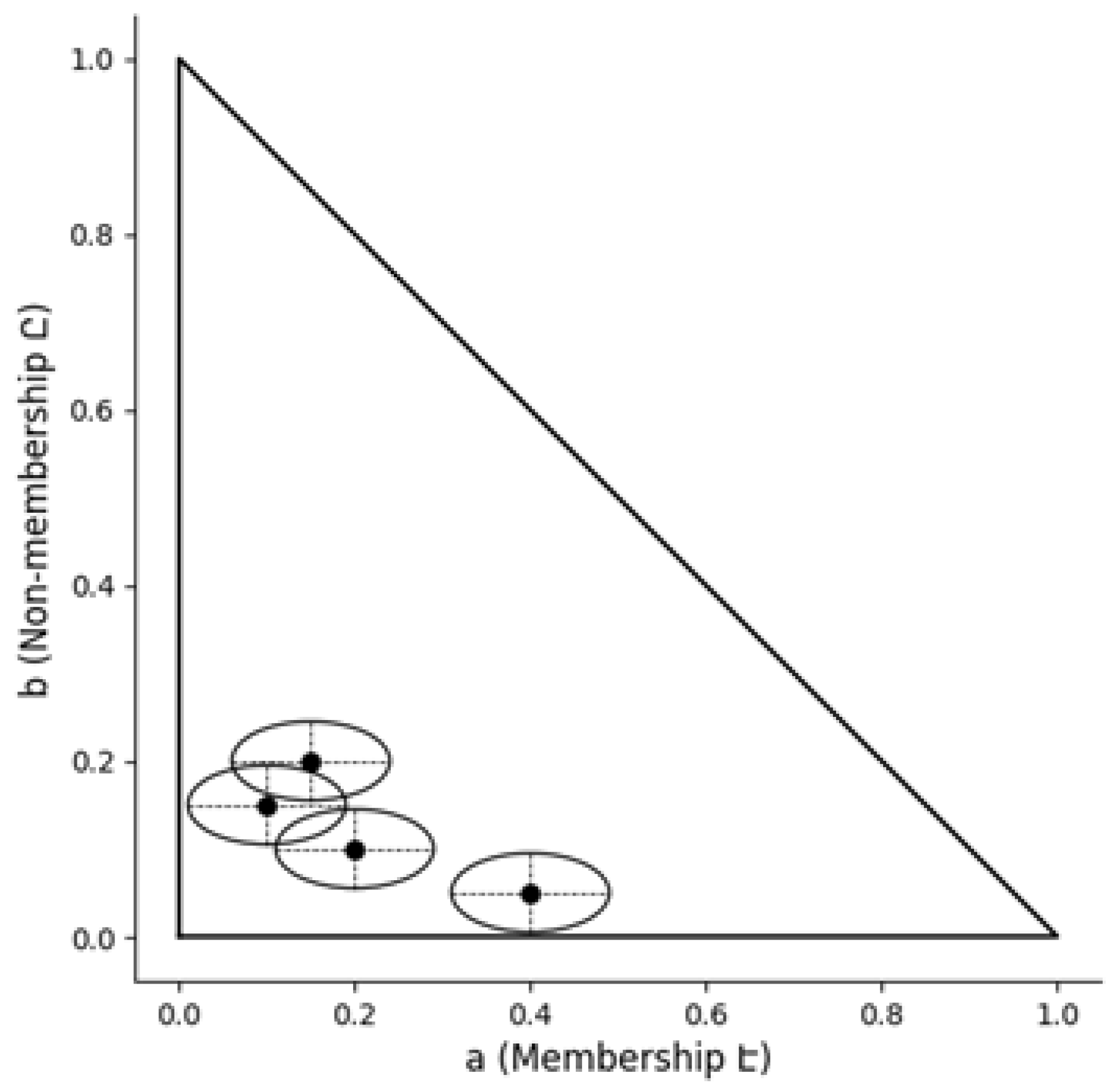
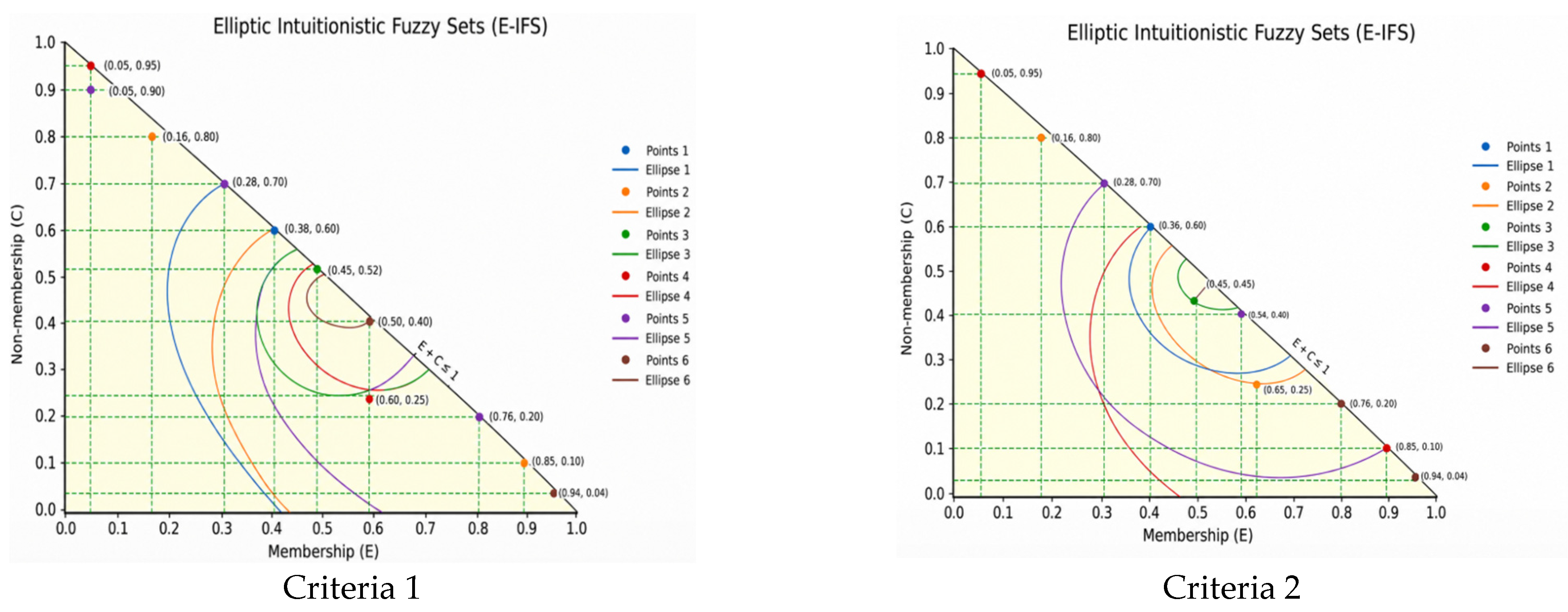
The geometrical interpretation of the E-IFS is represented in
Figure 1.
1.5.4. Definition [20]
Let
=
, (j = 1, 2, 3, …, n) be EIFSs over the universal set E and α > 0, where *
{min, max} if (
,
).
= {
|
}
1.5.5. Definition [16]
Let = (Էj, Ըj), (j = 1, 2, 3, …, n) be a collection of non-negative real numbers and
D = (
,
…)
R
n be a vector of parameters if
where
is any permutation and
is the collection of all permutations of (1, 2, …, n).
From Equation (1), we know that:
where n is the arithmetic averaging operator.
If (, …, , the MM reduces to (, … =
which is the geometric averaging operator.
If D = (1, 1, 0, 0, …, 0), the MM reduces to MM(1,1,0…0) (, … =
where i ≠ j, which is the Bonferroni mean operator.
If D = {1, 1, …, 1, 0, 0, …, 0}, the MM reduces to
MM
(1,1,…1,0,0…0) (
,
… =
, which is the Maclaurin symmetric mean.
Then Equation (2) is called the MM aggregation operator and Equation (1) is called the IFMM aggregation operator.
Numerical Example for Equation (1):
Consider three intuitionistic fuzzy values,
= 0.6,
= 0.8, and
= 0.7, and the corresponding weight vectors D = (1, 2, 1).
3. Extension of EIFS in MCDM
Fuzzy logic provides a rigorous framework for modeling uncertainty, vagueness, and linguistic ambiguity inherent in expert-driven MCDM problems; however, it lacks inherent mechanisms for handling high-dimensional data and redundant or correlated criteria. In complex decision environments such as renewable energy evaluation, the presence of numerous interrelated criteria may degrade computational efficiency and compromise decision accuracy.
In IFSs, the mean values of both membership and non-membership attributes are frequently utilized to address MCDM challenges. To refine this methodology, geometric IFS have been introduced. The C-IFS is employed to pinpoint the centroid of IF numbers and to assess their respective distances. The most extreme distance from the centroid is designated as the radius, thereby facilitating the creation of a circle that encompasses all relevant points. This approach guarantees comprehensive coverage utilizing the maximal spatial region. Conversely, to attain coverage with the minimal spatial region, the EIFS is implemented. The computation of the semi-major and semi-minor axes of the ellipsoid occurs, thereby ensuring that all points are contained within the minimal possible area.
In real-world MCDM problems such as renewable energy selection, decision data are often uncertain, imprecise, and expressed linguistically, making classical models inadequate. Although intuitionistic fuzzy sets (IFSs) capture uncertainty, they assume symmetric and independent information, which is unrealistic in practice. EIFSs are adopted for their ability to model asymmetric and directional uncertainty through an elliptical representation, providing more accurate and realistic expert evaluations. The Muirhead mean is utilized due to its capability to model nonlinear interactions among multiple criteria. Thus, the integration of EIFSs and Muirhead means (EIFWMMA) effectively addresses nonlinearity, asymmetric uncertainty and interrelated criteria, resulting in a more robust and reliable decision-making framework.
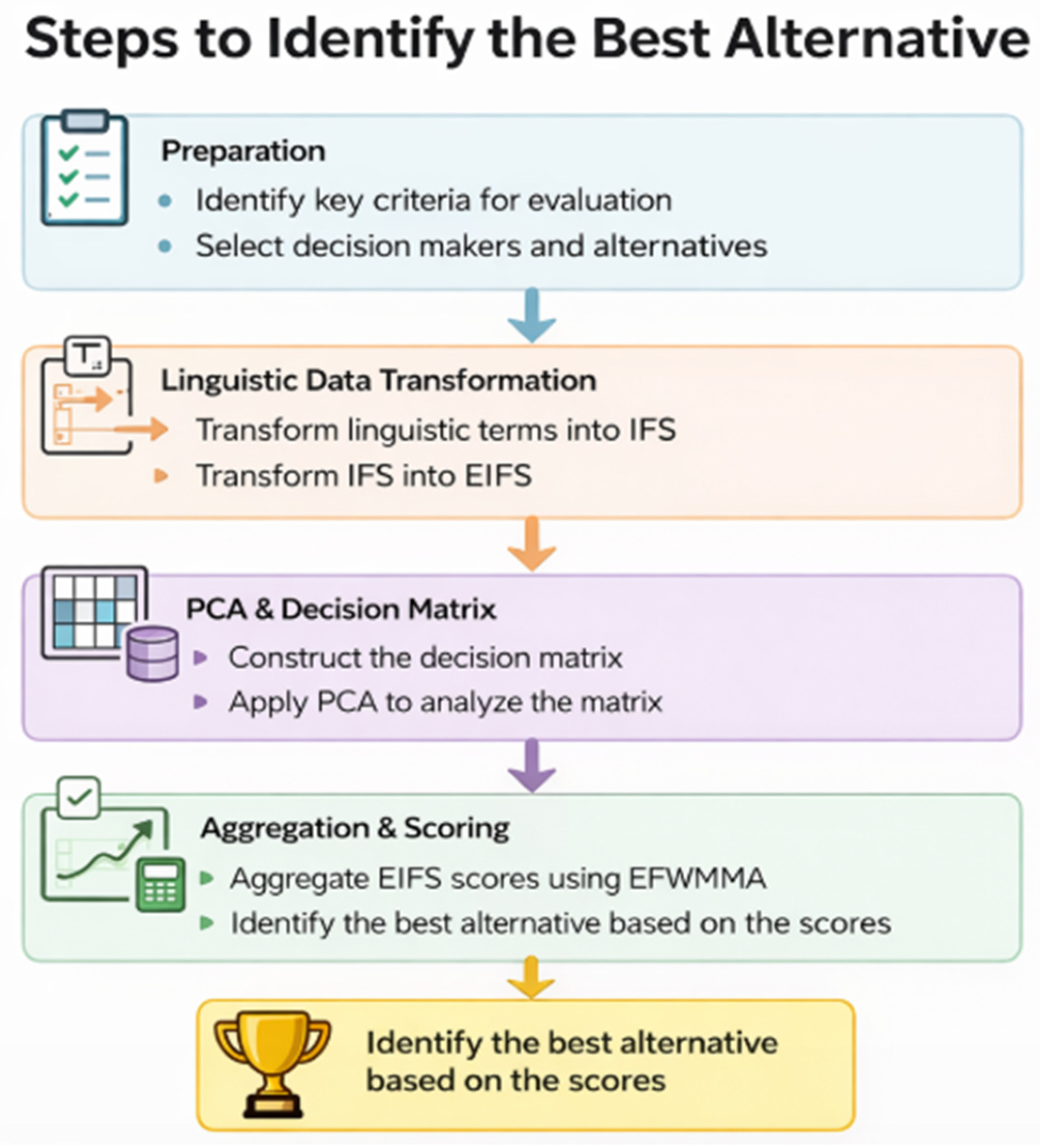
The EIFS provides a mathematical framework for articulating and processing complex evaluative data in MCDM scenarios characterized by imprecision and uncertainty. By integrating linguistic assessments from multiple decision-makers with the corresponding EIFS representations, it becomes feasible to capture the nuances of truth, indeterminacy, and falsity in a more comprehensive manner. Nonetheless, an abundance of criteria may lead to diminished accuracy in DM and escalate computational intricacies. To mitigate this, PCA can be employed to reduce dimensionality while preserving the most significant variance within the dataset. Furthermore, the optimal alternative can be discerned through effective information fusion facilitated by the EIFWMMA operator. The subsequent stages outlined below comprise the proposed methodology. The framework of implementing MCDM techniques using EIFS is presented in
Figure 2.
Algorithem of Implementing MCDM Techniques Using EIFS
PCA’s Role in Decision Process in Machine Learning Techniques:
Step 1: Create the decision matrix.
Step 2: Standardize the data to put all criteria on the same scale: zij = .
Step 3: Compute the covariance matrix measure relationships between criteria: S = .
Step 4: Find eigenvalues of matrix S.
Step 5: Select principal components.
Step 6: Explain variance ratio.
4. Application EIFS: Selection of Sustainable Renewable Energy Sources
In the global transition towards sustainable and low-carbon energy systems, the selection of appropriate renewable energy sources has become a critical real-world decision problem for governments, policymakers, and energy planners. Rapidly increasing energy demand, environmental degradation, and international commitments to climate change mitigation necessitate the identification of efficient, reliable, and environmentally sustainable energy alternatives. Therefore, adopting a robust and systematic decision-making framework is essential to support long-term energy planning and policy formulation.
Renewable energy technologies such as biomass, hydel, geothermal, wind, solar, and tidal energy exhibit diverse characteristics in terms of cost, efficiency, environmental impact, and resource availability. The selection process is inherently complex due to the presence of multiple conflicting criteria and uncertainty in expert evaluations. In practical scenarios, decision-makers must balance economic feasibility, environmental sustainability, technological reliability, and social acceptance, making the problem highly suitable for advanced MCDM approaches. Renewable energy sources are shown in
Figure 3.
The practical significance of this study lies in its ability to provide a realistic and reliable decision-support tool for evaluating renewable energy alternatives under uncertainty. The proposed EIFWMMA-based framework enables decision-makers to handle vague, imprecise, and asymmetric information effectively, thereby improving the quality and robustness of energy planning decisions. In sustainable renewable energy selection, expert assessments often exhibit directional variability and asymmetric uncertainty due to conflicting criteria, unequal confidence levels, and interdependent sustainability indicators. Traditional intuitionistic fuzzy models assume symmetric uncertainty, which limits their applicability in real-world decision contexts. In contrast, EIFS introduces an elliptical uncertainty structure that captures directional dominance, asymmetric hesitation, and interrelationships among criteria, resulting in a more accurate representation of practical evaluation scenarios.
Furthermore, the integration of the EIFWMMA operator allows for nonlinear aggregation of criteria, reflecting real-world interactions and trade-offs among decision factors. This ensures that the decision-making process aligns more closely with actual planning conditions, where criteria are often interdependent rather than independent.
By applying the proposed framework to a selection of six major renewable energy alternatives based on key sustainability criteria, this study demonstrates how advanced fuzzy MCDM techniques can support evidence-based decision-making in energy policy, infrastructure development, and resource management. Consequently, the proposed methodology offers a practically relevant, scalable, and uncertainty-resilient solution for sustainable energy planning and other complex decision-making problems.
The process of selecting sustainable renewable energy sources necessitates intricate DM frameworks that are shaped by various conflicting and uncertain factors, including cost, efficiency, environmental ramifications, and resource availability. Traditional MCDM methodologies, such as Analytic Hierarchy Process (AHP), Technique for Order of Preference by Similarity to Ideal Solution (TOPSIS), VIKOR, Complex Proportional Assessment (COPRAS), and Elimination and Choice Expressing Reality (ELECTRE), frequently encounter challenges in accurately depicting the uncertainty and ambivalence that characterizes expert assessments. To mitigate these deficiencies, this study adopts the EIFWMMA methodology. The EIFWMMA approach integrates the adaptability of the Muirhead mean operator with the expressive capabilities of EIFSs, thereby facilitating the concurrent evaluation of interrelationships among criteria alongside the vagueness inherent in decision-makers’ evaluations. The elliptic characterization within EIFSs effectively encapsulates the interdependence of membership and non-membership functions, presenting a more nuanced and thorough representation of uncertainty in contrast to conventional intuitionistic or fuzzy paradigms. Furthermore, the Muirhead mean element facilitates nonlinear aggregation, thereby mirroring the interactions and compensatory dynamics that exist among evaluation criteria. Unlike prevailing MCDM techniques that depend on linear aggregation or deterministic weighting, EIFWMMA guarantees enhanced robustness, precision, and adaptability in uncertain contexts. Consequently, the EIFWMMA methodology offers a more dependable, equitable, and uncertainty-resilient decision support framework for the identification of optimal renewable energy alternatives, exhibiting superior efficacy and consistency in comparison to traditional methodologies.
By formulating a structured framework for integrating EIFS into MCDM methodologies, this algorithm improves transparency, objectivity, and the overall quality of the decision-making process.
Step 1: Alternatives (Ѫ): From the provided list, we will select 6 distinct alternatives that represent different sustainable renewable energy sources (
Table 1). The selection of suitable renewable energy sources plays a crucial role in achieving sustainable power generation and reducing dependence on fossil fuels. Various technologies harness natural resources such as sunlight, wind, water, and organic matter to produce clean energy. In this study, six major renewable energy alternatives are considered for evaluation, each possessing unique characteristics, resource requirements, and environmental implications.
Criteria (Ѩ): We will select 6 key criteria that are representative and can be used to differentiate the alternatives effectively. These criteria will be considered benefit criteria (
Table 2).
By implementing an MCDM approach within this structured DM model, organizations can effectively evaluate and compare various alternatives to identify the most sustainable renewable energy source.
The following matrix presents the evaluation results provided by the decision-makers, expressed through linguistic variables. Comparative analysis of ranking and decisions in linguistic variables is shown in
Table 3 and
Table 4.
Step 2: Based on the reference values provided in
Table 1, the linguistic evaluations from the previous matrix are converted into their corresponding Intuitionistic Fuzzy Numbers (IFNs). The intuitionistic fuzzy decision matrices are given in
Table 5.
Step 3. IFSs into EIFSs
t(y) = = min {0.76,0.85,0.56,0.38,0.45,0.93} = 0.38
p(y) = = min {0.20,0.10,0.40,0.60,0.52,0.06} = 0.06
g(y) = , = max {0.76,0.85,0.56,0.38,0.45,0.93} = 0.93
s(y) = = max {0.20,0.10,0.40,0.60,0.52,0.06} = 0.60
= = = 0.655
= = = 0.33
= 0.655
= 0.33
The EIFS is .
The EIFS of the given matrix is given in
Table 6.
Step 4. Decision Matrix
The decision matrix is given in
Table 7. Score =
: S
].
Step 6. Covariance Matrix
Step 7. Eigenvalues
The eigenvalues are
≈ 3.449401, ≈ 1.356246, ≈ 0.614319,
≈ 0.127763, ≈ 0.008968
Step 8. Principal Components
= 6.0000
The proportion of variance represented in
Table 8.
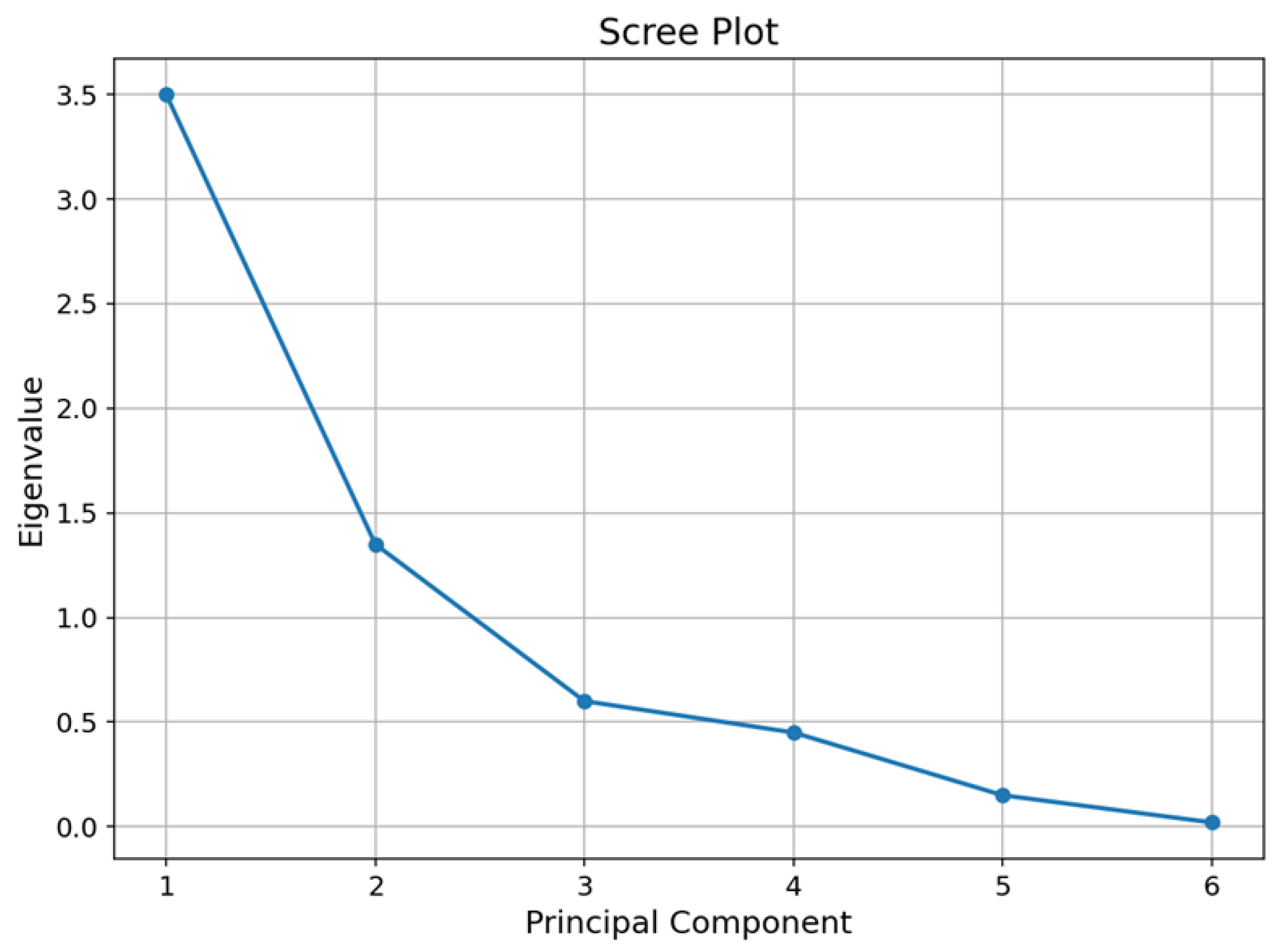
In the Scree plot (
Figure 4), the eigenvalues decline sharply from PC1 to PC3, forming an “elbow” at PC4. This indicates that the first three principal components account for most of the variance in the evaluation data, whereas PC4 and PC5 contribute negligibly.
Step 9. Explained variance ratio.
The explained variance ratio = is considered as a weight.
Therefore, weights = 0.5749, 0.2260, 0.1024.
4.1. Advantages of Integrating PCA with Machine Learning Techniques
To identify the irredundant criteria, machine learning techniques, particularly dimensionality reduction methods such as principal component analysis (PCA), are integrated to extract the most informative features. This facilitates noise reduction, mitigates multicollinearity, and enhances the stability of the decision model. Therefore, the integration of fuzzy logic with machine learning is well justified, as it synergistically combines uncertainty modeling with data-driven optimization, leading to a more robust, scalable, and computationally efficient MCDM framework.
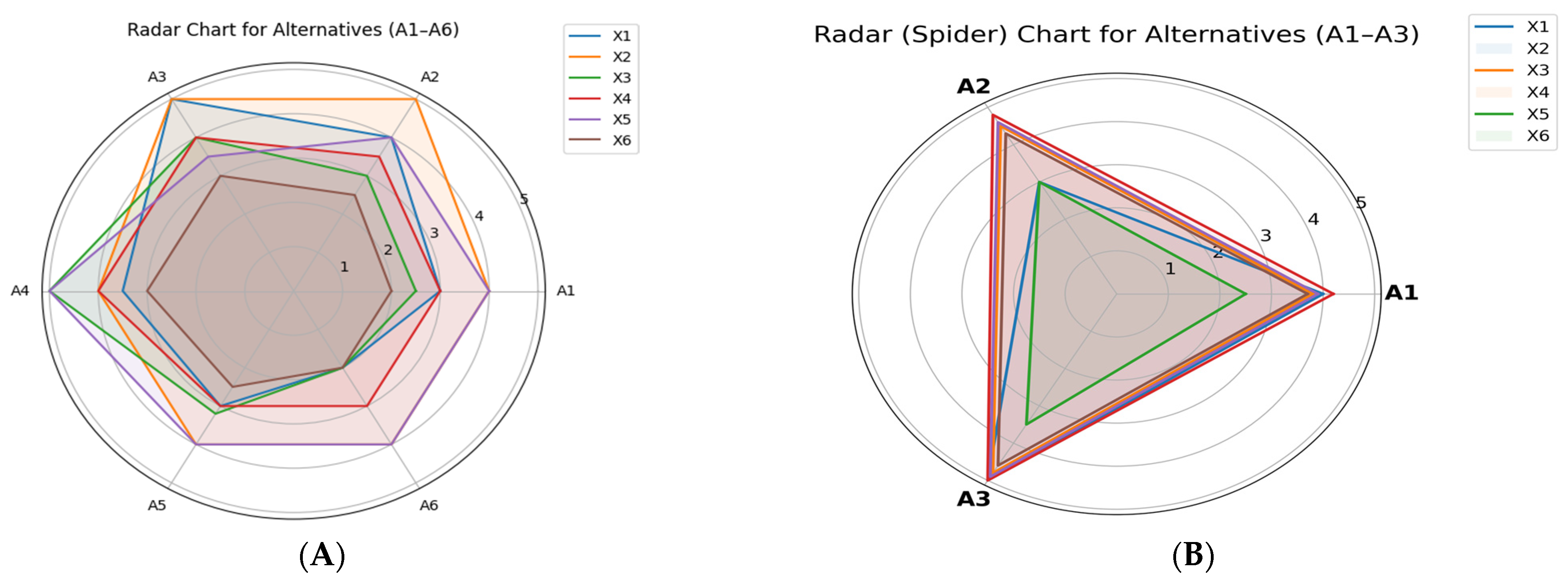
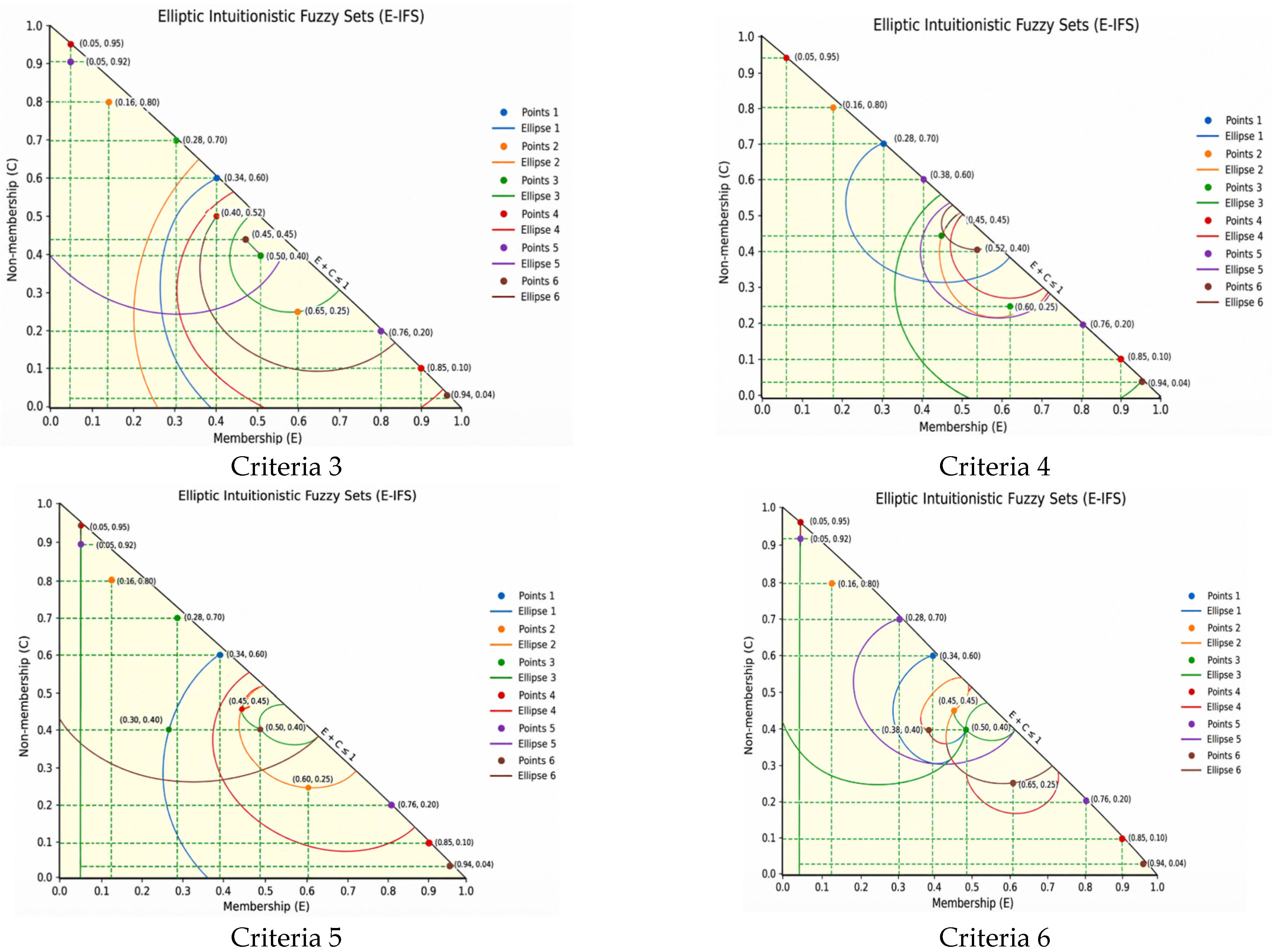
In the context of the selection of sustainable renewable energy sources, it is evident that although the initial framework encompassed five criteria, the fundamental distinctions among the six alternatives can be proficiently elucidated through merely three principal components. By concentrating exclusively on PC1, PC2, and PC3, the decision-making process is rendered more streamlined and devoid of superfluous elements, while still adhering to a data-driven and precise methodology, which is congruent with PCA’s function as a machine learning approach for dimensionality reduction. The reduced EIFS is given below in
Table 9, and a corresponding graphical representation is given in
Figure 5.
4.2. Using EIFWMMA Operator in Equation (7)
EIFWMMA matrix with weight w
1 = 0.5749, w
2 = 0.2260, w
3 = 0.1024
The aggregated values provided by case(i)
The aggregated values are represented in
Table 10. Now the score of aggregated values is given by [
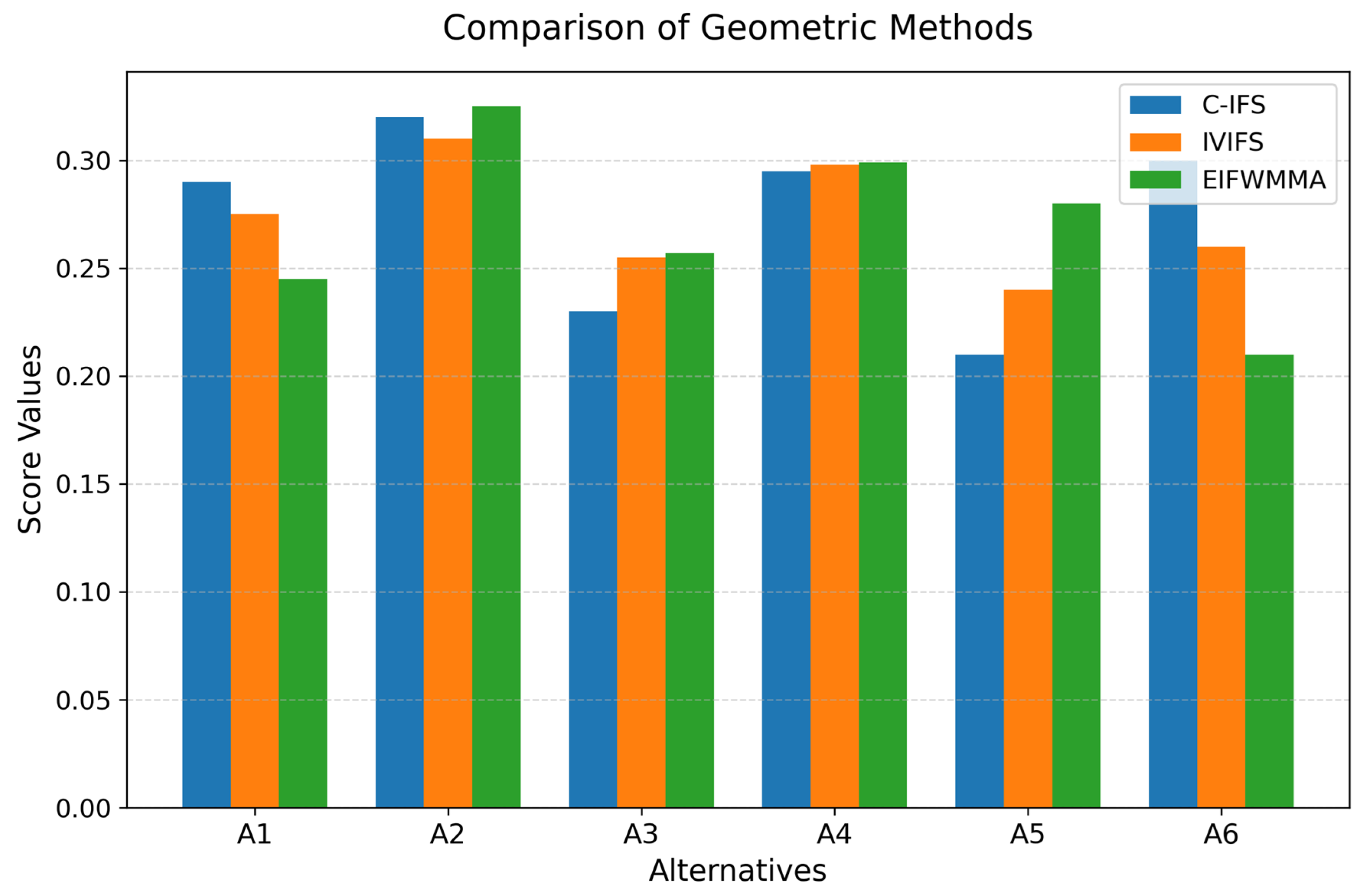
0.2444, Ѫ2 = 0.3212, Ѫ3 = 0.2573, Ѫ4 = 0.2975, Ѫ5 = 0.2765, Ѫ6 = 0.2098]. Here, Ѫ2 > Ѫ4 > Ѫ5 > Ѫ3 >
. This indicates that Zero Trust outperforms the other approaches. Hence, Ѫ2 is the most suitable alternative.
The aggregated values are provided by case(ii) using Equation (8). The score of aggregated values is given by [ 0.4837, Ѫ2 = 0.5645, Ѫ3 = 0.2910, Ѫ4 = 0.5371, Ѫ5 = 0.4095, Ѫ6 = 0.3648]. Here, Ѫ2 > Ѫ4 > Ѫ3 > Ѫ4 > . This indicates that Zero Trust outperforms the other approaches. Hence, Ѫ2 is the most suitable alternative.