Polygon Dissections via Lucas-Inspired Encoding




Abstract
1. Introduction
Related Work and Positioning of the Present Study
2. Preliminaries
2.1. Polygon Triangulations and Fuss–Catalan Numbers
2.2. -Angulations and Fuss–Catalan Numbers
2.3. Lucas Numbers and Their Analytical Properties
2.4. Lucas Words for Polygon Encodings
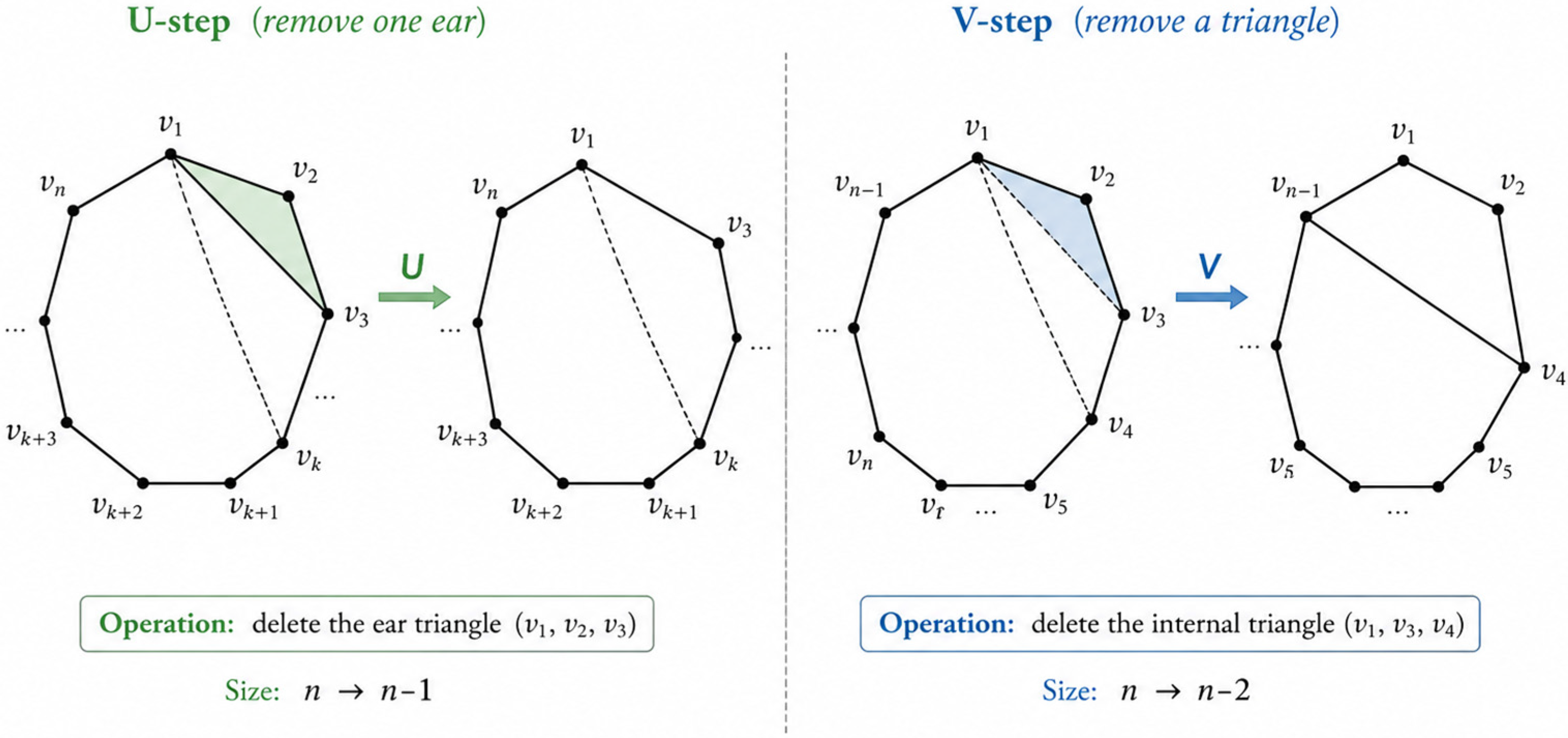
- -step (adjacent contraction): Reduction by one vertex analogous to using a diagonal that forms a triangle adjacent to the current pivot.
- -step (skip-one contraction): Reduction by two vertices corresponding to a diagonal that “skips” one vertex relative to the pivot.
- Geometric enumeration: Counts triangulations by Catalan numbers and counts -angulations by Fuss–Catalan numbers [26].
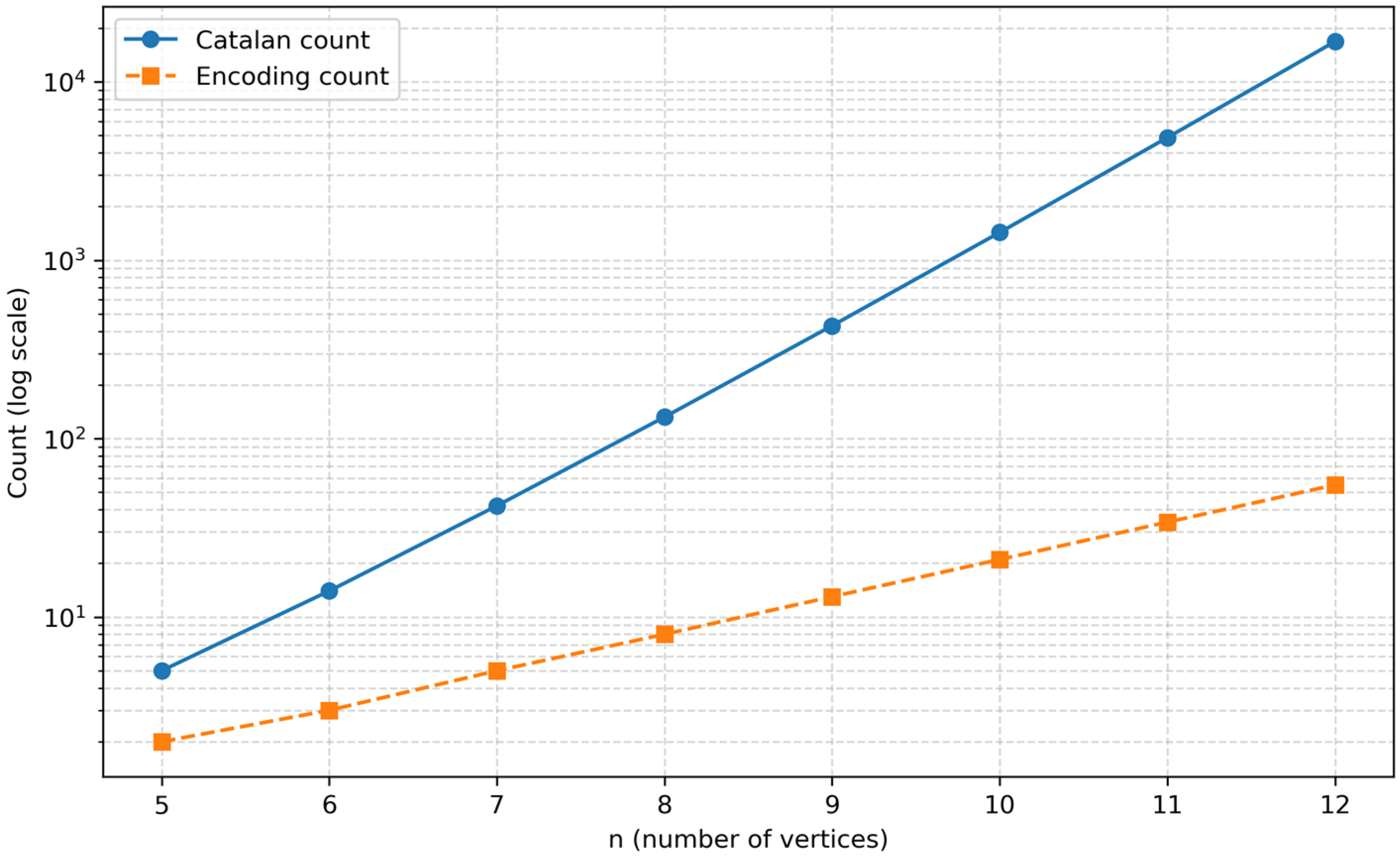
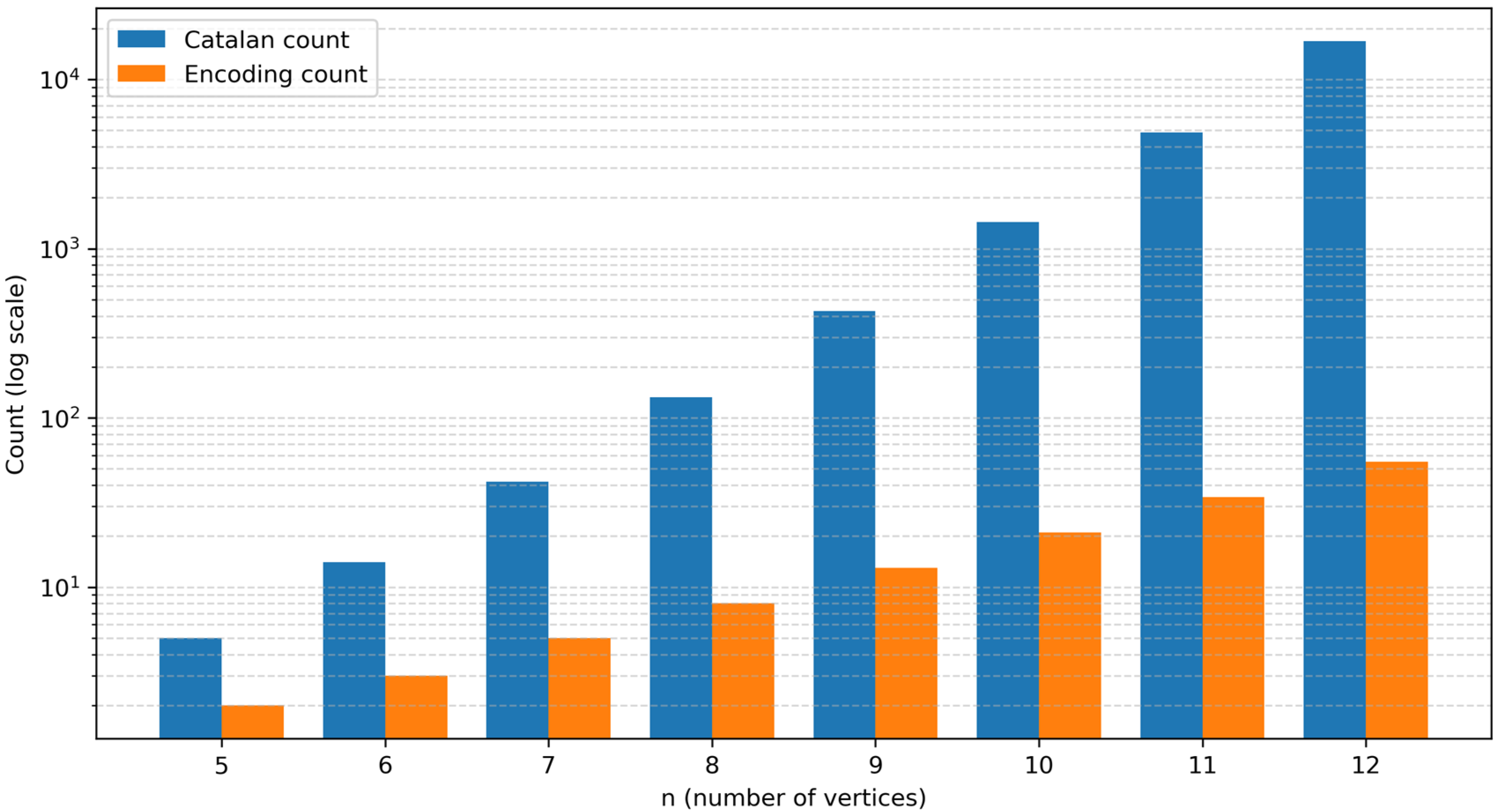
- Encoding enumeration: Counts the number of possible encodings of dissections, not the dissections themselves. This encoding space satisfies a Fibonacci-type recurrence due to the two-step reduction rules [13].
3. Lucas-Compatible Structural Formulation
- (i)
- Every admissible Lucas encoding word w associated with T has total reduction weight , where each U-step contributes 1 and each V-step contributes 2.
- (ii)
- The set of admissible encoding words is a constrained subset of , satisfying the total weight condition.
- (iii)
- The encoding map
3.1. Theoretical Framework for Lucas Encoding
- i.
- (U-step) Adjacent ear reduction: If contains the ear triangle , then we remove and replace by the smaller polygon which has vertices. This reduction contributes the symbol .
- ii.
- (V-step) Skip-one ear reduction: If contains the triangle and the edge separates off exactly one boundary vertex , then we remove and and replace by the smaller polygon , which has vertices. This reduction contributes the symbol .
3.2. Structural Remarks on the Restricted Class
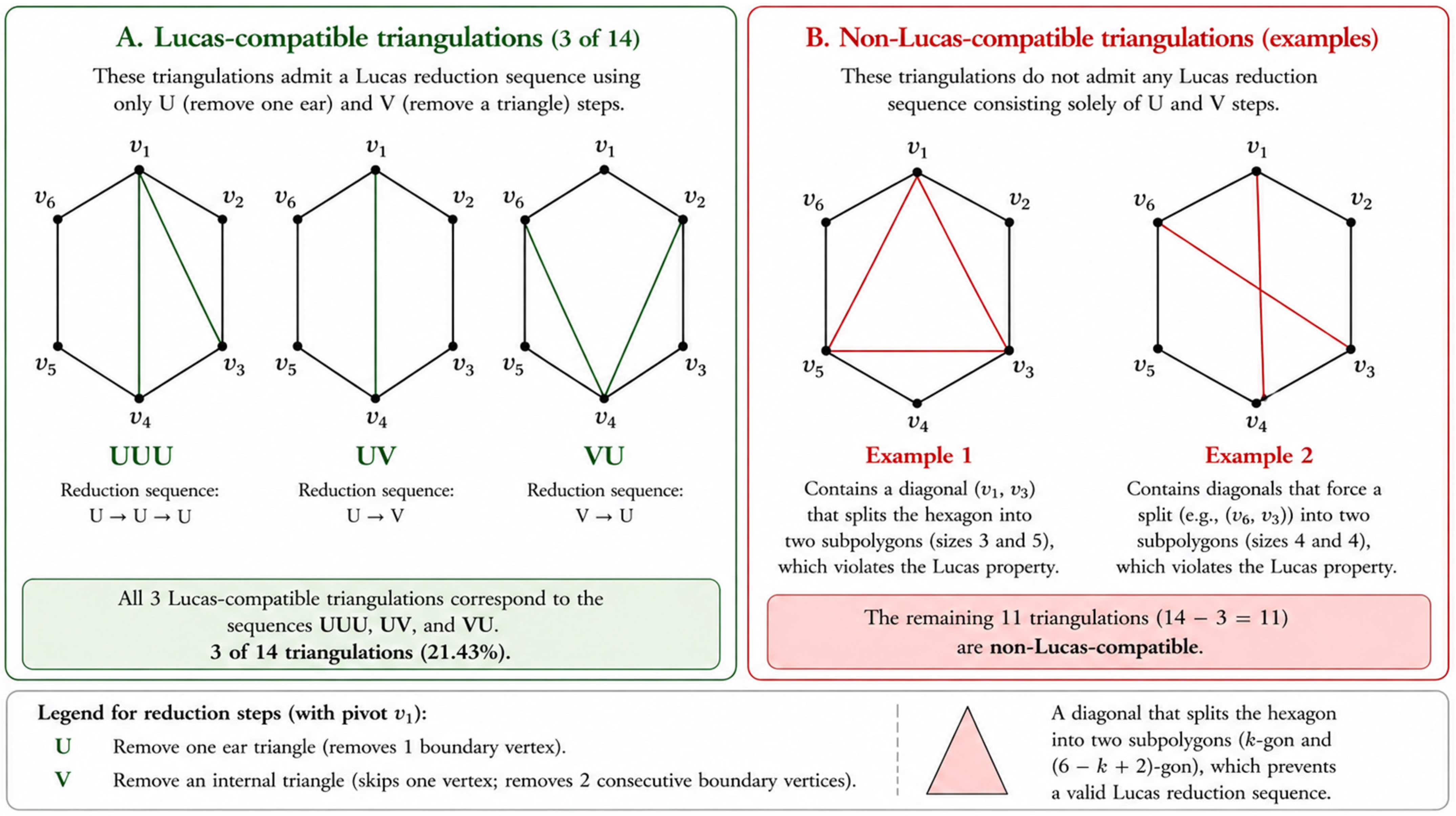
- The class is nonempty for all n ≥ 3 because fan triangulations are always Lucas-compatible.
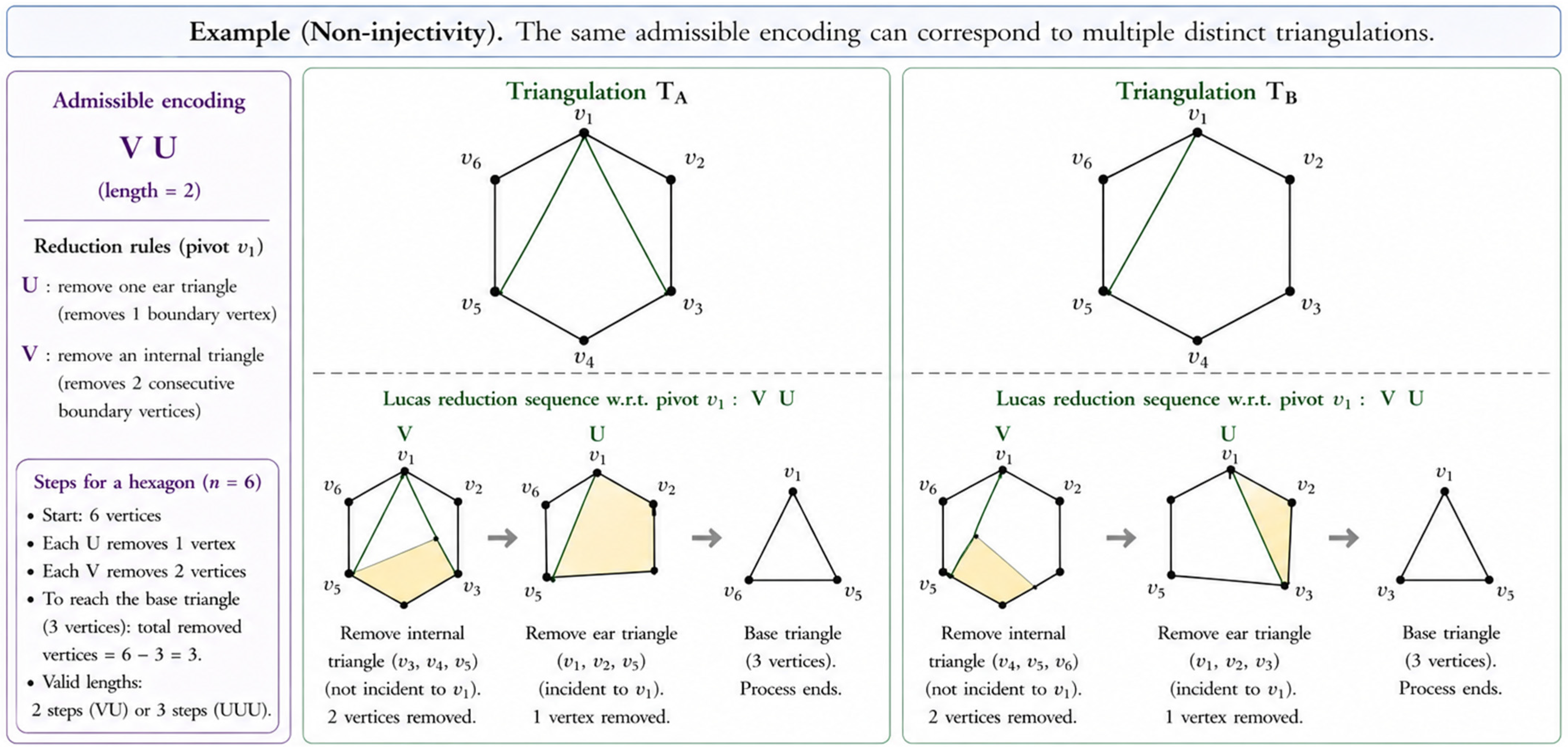
- The class is a strict subset of all triangulations for n ≥ 6, as shown already by the hexagon example.
- Full characterization of the class remains open, but the reduction-based definition yields effective recognition and generation procedures.
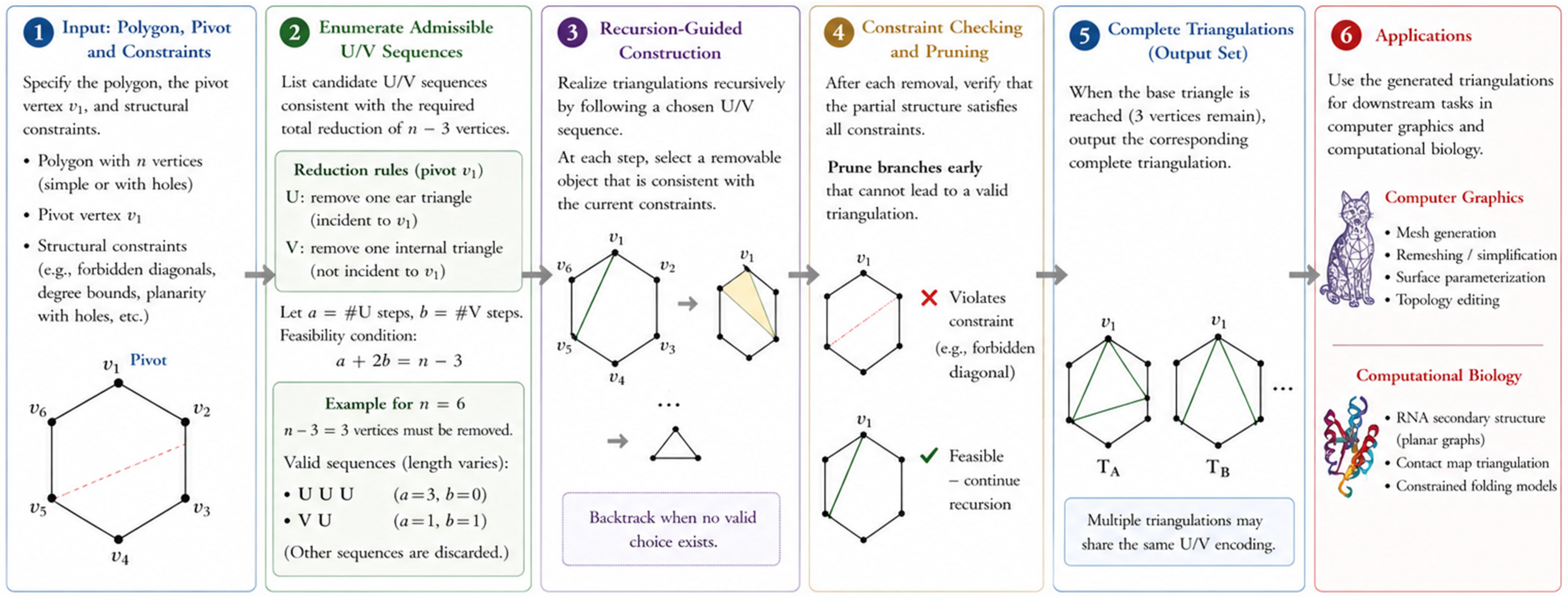
4. Algorithmic Framework
4.1. Fundamental Principles of Lucas-Based Algorithm Design
- Adjacent reduction (“U-step”): Selecting a diagonal that reduces the polygon from n vertices to vertices.
- Skip-one reduction (“V-step”): Selecting a diagonal that reduces the polygon from n vertices to vertices.
| Algorithm 1. Generate Encodings(n) |
| Input: Integer Output: Set of admissible reduction sequences Procedure:
|
Output-Sensitive Complexity and Memory Usage
| Algorithm 2. Generate Lucas Compatible Triangulations(n) |
| Input: A convex polygon Output: Set of Lucas-compatible triangulations with encodings Procedure:
|
4.2. Correctness of the Algorithms
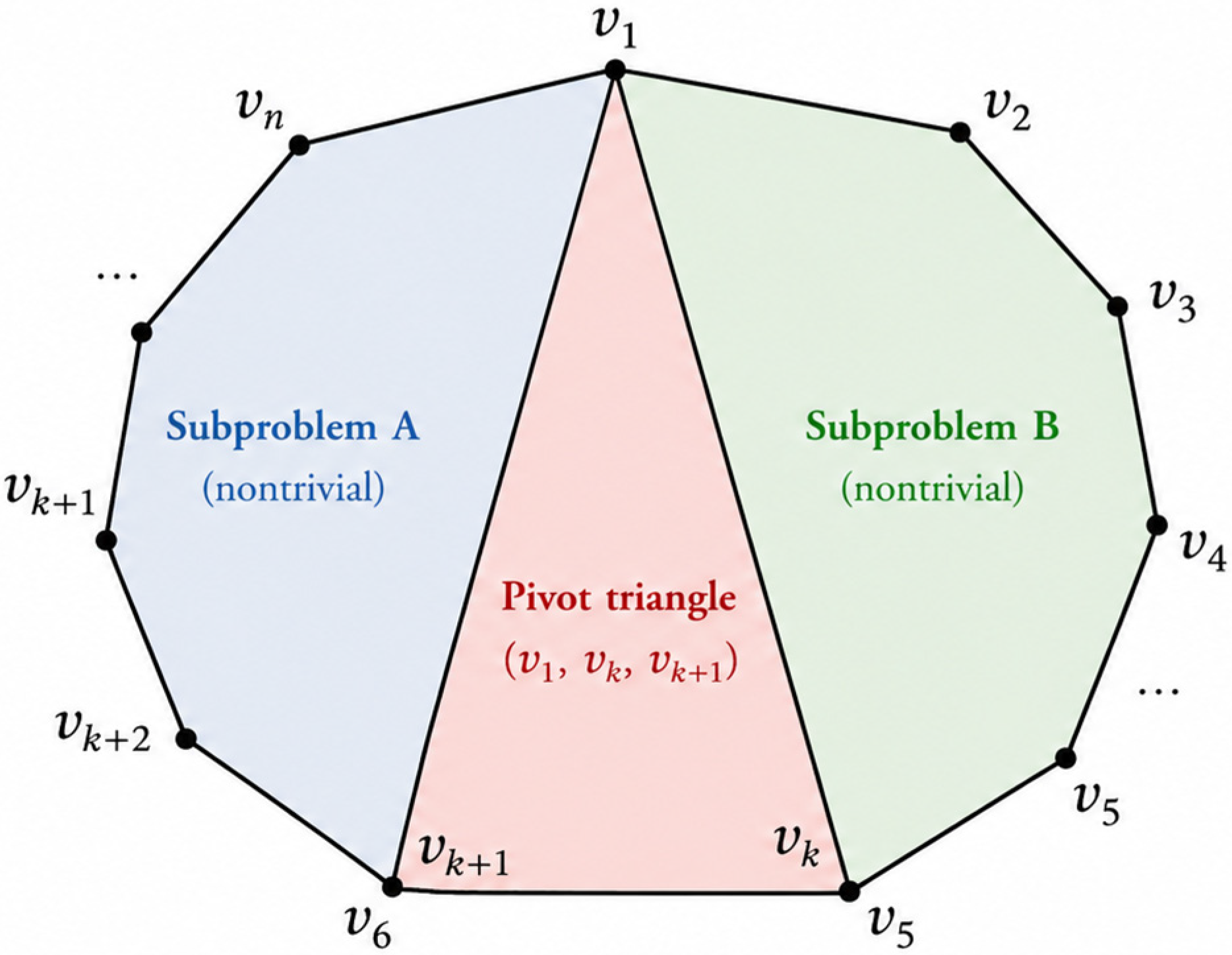
4.3. Why the Extension to -Angulations Is More Difficult
5. Computational Experiments
5.1. Compression and Structural Gap
5.2. Non-Injectivity and Equivalence Behavior
5.3. Practical Implications of the Encoding
6. Conclusions and Future Work
Supplementary Materials
Author Contributions
Funding
Data Availability Statement
Acknowledgments
Conflicts of Interest
Abbreviations
| CPU | Central Processing Unit |
| RAM | Random Access Memory |
References
- Lee, C.W.; Santos, F. Subdivisions and triangulations of polytopes. In Handbook of Discrete and Computational Geometry; Chapman & Hall/CRC: Boca Raton, FL, USA, 2017; pp. 415–447. [Google Scholar]
- Krtolica, P.V.; Stanimirović, P.S.; Mašović, S.H.; Elshaarawy, I.A.; Stupina, A. Convex Polygon Triangulation Based on Symmetry. Symmetry 2023, 15, 1526. [Google Scholar] [CrossRef]
- Aval, J.C. Multivariate Fuss–Catalan Numbers. Discret. Math. 2008, 308, 4660–4669. [Google Scholar] [CrossRef]
- Falcon, S. On the k-Lucas Numbers. Int. J. Contemp. Math. Sci. 2011, 6, 1039–1050. [Google Scholar]
- Koshy, T. Fibonacci and Lucas Numbers with Applications; John Wiley & Sons: Hoboken, NJ, USA, 2019; Volume 2. [Google Scholar]
- Lengyel, T. The Order of the Fibonacci and Lucas Numbers. Fibonacci Q. 1995, 33, 234–239. [Google Scholar] [CrossRef]
- Stanley, R.P. Catalan Numbers; Cambridge University Press: Cambridge, UK, 2015. [Google Scholar]
- Ballot, C.J.-C.; Williams, H.C. The Lucas Sequences: Theory and Applications; CMS/CAIMS Books in Mathematics; Springer Nature: Cham, Switzerland, 2023. [Google Scholar] [CrossRef]
- Suthar, T. Fibonacci Numbers and Their Lucas Coefficients. arXiv 2025, arXiv:2509.00070. [Google Scholar] [CrossRef]
- Saračević, M.; Selimi, A. Convex polygon triangulation based on planted trivalent binary tree and ballot problem. Turk. J. Electr. Eng. Comput. Sci. 2019, 27, 346–365. [Google Scholar] [CrossRef]
- Ballot, C. Lucasnomial Fuss–Catalan Numbers and Related Divisibility Questions. J. Integer Seq. 2018, 21, 1–36. [Google Scholar]
- Qi, F.; Guo, B.N. Some Properties and Generalizations of the Catalan, Fuss, and Fuss–Catalan Numbers. In Mathematical Analysis and Applications: Selected Topics; Ruzhansky, M., Dutta, H., Agarwal, R.P., Eds.; John Wiley & Sons, Inc.: Hoboken, NJ, USA, 2018; pp. 101–133. [Google Scholar] [CrossRef]
- Bennett, C.; Carrillo, J.; Machacek, J.; Sagan, B.E. Combinatorial Interpretations of Lucas Analogues of Binomial Coefficients and Catalan Numbers. Ann. Comb. 2020, 24, 503–530. [Google Scholar] [CrossRef]
- Selimi, A. Algorithm of Computational Geometry and Their Application in Linear Optimization and Dynamic Programming. Ph.D. Thesis, University of Novi Pazar, Novi Pazar, Serbia, 2018. [Google Scholar]
- Elizalde, S. A Bijection between 2-Triangulations and Pairs of Non-Crossing Dyck Paths. J. Comb. Theory Ser. A 2007, 114, 1481–1503. [Google Scholar] [CrossRef][Green Version]
- Aicardi, F. Fuss–Catalan Triangles. arXiv 2023, arXiv:2310.07317. [Google Scholar] [CrossRef]
- Bacher, R.; Krattenthaler, C. Chromatic statistics for Catalan and Fuß-Catalan numbers. arXiv 2011, arXiv:1101.1416. [Google Scholar] [CrossRef]
- Fomin, S.; Zelevinsky, A. Cluster Algebras II: Finite Type Classification. Invent. Math. 2003, 154, 63–121. [Google Scholar] [CrossRef]
- Chapoton, F.; Fomin, S.; Zelevinsky, A. Polytopal realizations of generalized associahedra. Can. Math. Bull. 2002, 45, 537–566. [Google Scholar] [CrossRef]
- Armstrong, D. Generalized Noncrossing Partitions and Combinatorics of Coxeter Groups. arXiv 2009, arXiv:math/0611106. [Google Scholar] [CrossRef]
- Knuth, D.E. The Art of Computer Programming; Addison–Wesley: Boston, MA, USA, 1998; Volume 3. [Google Scholar]
- Vajda, S. Fibonacci and Lucas Numbers, and the Golden Section: Theory and Applications; Dover Publications: Mineola, NY, USA, 2008. [Google Scholar]
- Benjamin, A.; Quinn, J. Proofs that Really Count: The Art of Combinatorial Proof; American Mathematical Society: Providence, RI, USA, 2003. [Google Scholar]
- Flajolet, P.; Zimmermann, P.; van Cutsem, B. A Calculus for the Random Generation of Combinatorial Structures. Theor. Comput. Sci. 1994, 132, 1–35. [Google Scholar] [CrossRef]
- Loday, J.-L. Realization of the Stasheff Polytope. Arch. Math. 2004, 83, 267–278. [Google Scholar] [CrossRef]
- Panayotopoulos, A.; Sapounakis, A. On Binary Trees and Dyck Paths. Math. Inf. Sci. Hum. 1995, 131, 39–51. [Google Scholar]
- Barcucci, E.; Bernini, A.; Pinzani, R. Sequences from Fibonacci to Catalan: A combinatorial interpretation via Dyck paths. RAIRO–Theor. Inf. Appl. 2024, 58, 8. [Google Scholar] [CrossRef]




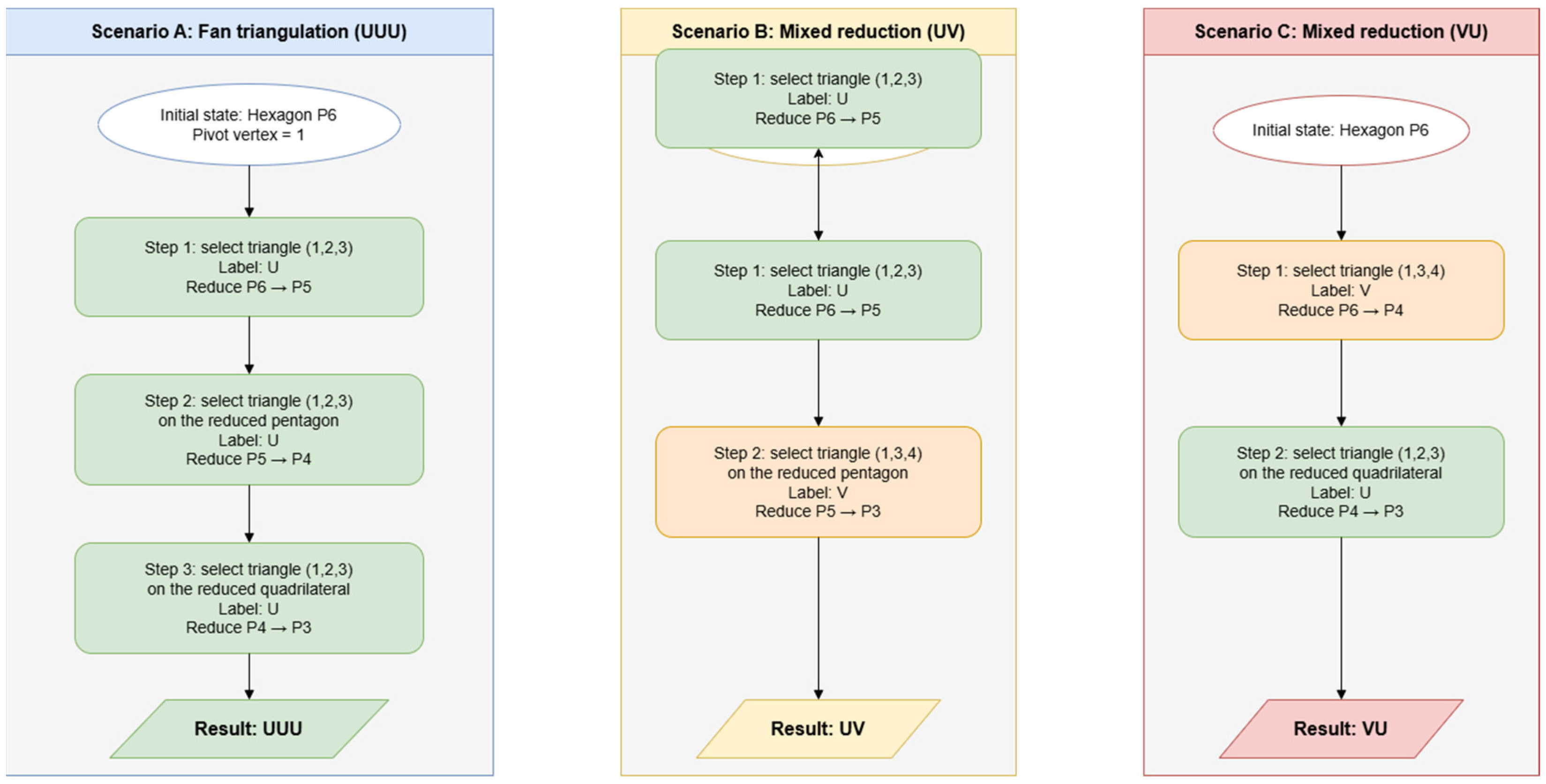
| Triangulation Type | Reduction Sequence | Lucas Word |
|---|---|---|
| Fan triangulation | (1, 2, 3) → (1, 2, 3) → (1, 2, 3) | UUU |
| Type A | (1, 2, 3) → (1, 3, 4) | UV |
| Type B | (1, 3, 4) → (1, 2, 3) | VU |
| Sequences | ||||
|---|---|---|---|---|
| 3 | 1 | 1 | 1.000 | |
| 4 | 1 | 2 | 0.500 | |
| 5 | 2 | 5 | 0.400 | |
| 6 | 3 | 14 | 0.214 | |
| 7 | 5 | 42 | … | 0.119 |
| 8 | 8 | 132 | … | 0.061 |
| 9 | 13 | 429 | … | 0.030 |
| 10 | 21 | 1430 | … | 0.015 |
| Property | Observation | Interpretation |
|---|---|---|
| Multiple triangulations → same encoding | Distinct triangulations may realize the same admissible Lucas word | The encoding map is gene-rally non-injective |
| Partial domain | Not every triangulation admits a complete Lucas-compatible reduction | The encoding is defined only on a restricted subclass |
| Realized encoding family | Only geometrically admissible words are retained | The symbolic space is constrained by geometric feasibility |
| Structural abstraction | The encoding records reduction patterns rather than full geometry | The framework is a compressed structural representation |
Disclaimer/Publisher’s Note: The statements, opinions and data contained in all publications are solely those of the individual author(s) and contributor(s) and not of MDPI and/or the editor(s). MDPI and/or the editor(s) disclaim responsibility for any injury to people or property resulting from any ideas, methods, instructions or products referred to in the content. |
© 2026 by the authors. Licensee MDPI, Basel, Switzerland. This article is an open access article distributed under the terms and conditions of the Creative Commons Attribution (CC BY) license.
Share and Cite
Selim, A.; Saracevic, M.; Aydin, O. Polygon Dissections via Lucas-Inspired Encoding. Mathematics 2026, 14, 1631. https://doi.org/10.3390/math14101631
Selim A, Saracevic M, Aydin O. Polygon Dissections via Lucas-Inspired Encoding. Mathematics. 2026; 14(10):1631. https://doi.org/10.3390/math14101631
Chicago/Turabian StyleSelim, Aybeyan, Muzafer Saracevic, and Omer Aydin. 2026. "Polygon Dissections via Lucas-Inspired Encoding" Mathematics 14, no. 10: 1631. https://doi.org/10.3390/math14101631
APA StyleSelim, A., Saracevic, M., & Aydin, O. (2026). Polygon Dissections via Lucas-Inspired Encoding. Mathematics, 14(10), 1631. https://doi.org/10.3390/math14101631