


Pharmacokinetics-Informed Agentic Architecture for Drug Dynamics with LLM-Driven In Silico Patients


Abstract
1. Introduction
- Clinical accuracy vs LLM flexibility: Clinical reasoning from LLaMA3 (via Ollama) is constrained using JSON schemas and augmented with retrieval from a knowledge graph built from authoritative sources such as Goodman & Gilman’s Pharmacology, ensuring accurate yet contextually rich outputs.
- Deterministic-Probabilistic balance: Physiologically-based pharmacokinetic models provide exact predictions of drug concentrations, while the LLM handles qualitative clinical judgments within strictly defined boundaries.
- Complex regimen safety: The system performs hierarchical drug interaction checks with severity stratification (contraindication > major > moderate > minor), supporting safe and realistic simulation of multi-drug regimens.
2. Related Works
2.1. In Silico Patients in Medical Training
2.2. Agent-Based Healthcare Models
2.3. LLMs in Clinical Reasoning
2.4. Gap Analysis and Novel Contribution
3. Methodological Proposal
3.1. Agentic Architecture
3.1.1. Physiological Simulation Layer
3.1.2. Clinical Decision Layer
3.1.3. Infrastructure Layer
3.2. Agent Communication Protocol
3.3. Doctor Agent
3.3.1. Design
3.3.2. Architecture
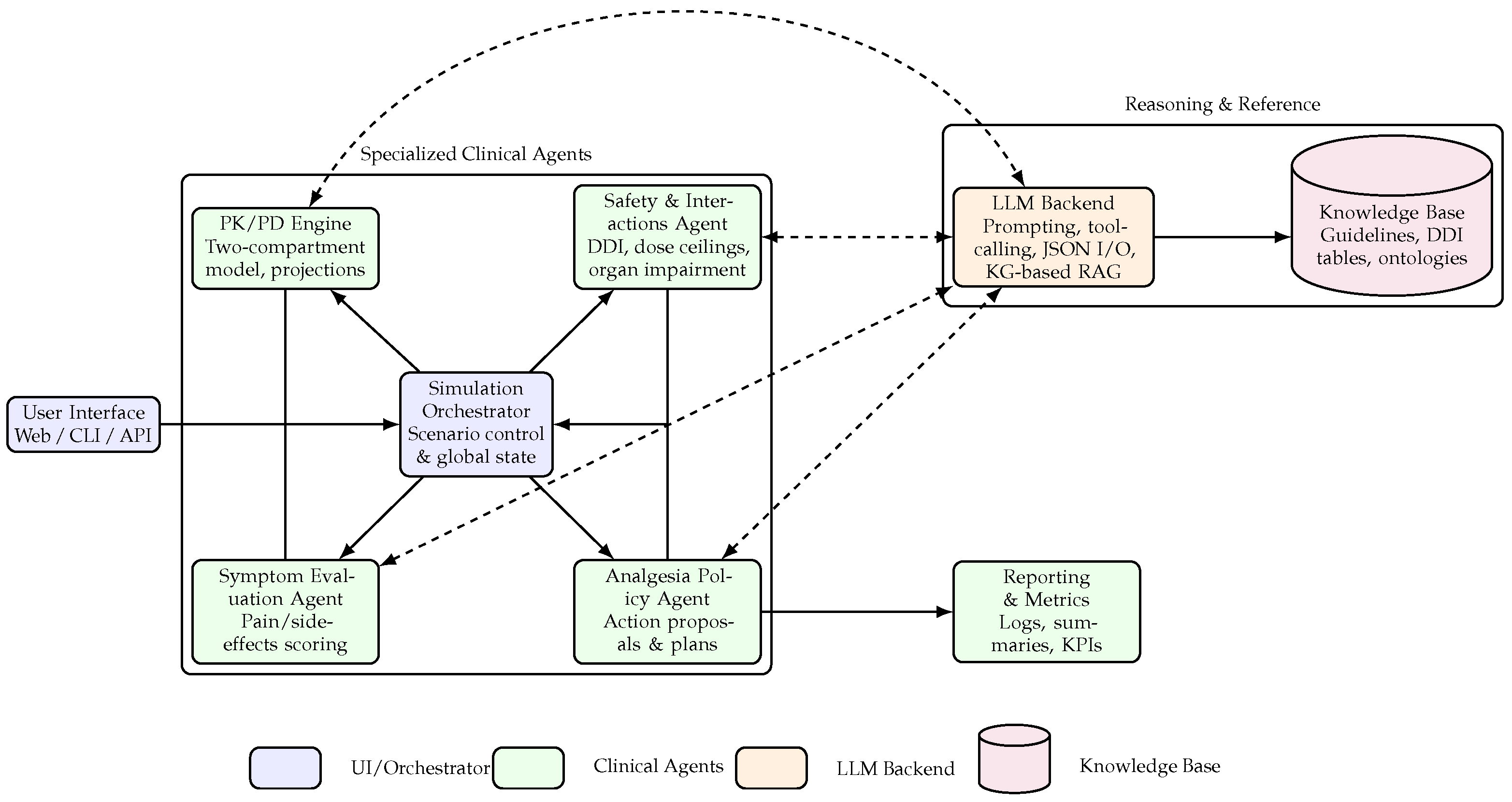
- LLM-based reasoning layer (high-level clinical reasoning): This layer uses LLaMA3 to generate clinical decisions (assessment, treatment plan, monitoring) based on the assembled patient context. It handles complex, context-dependent reasoning and produces structured outputs.
- Protocol-driven layer (deterministic clinical logic): This layer encodes clinical guidelines and decision trees. It is used to validate or replace LLM outputs when necessary, ensuring that decisions remain consistent with established medical practice.
- Rule-based safety layer (hard constraints): This layer enforces strict safety constraints, including drug–drug interactions, dose limits, allergies, and organ function adjustments. It acts as a final guardrail to block or modify unsafe actions.
- Primary layer (LLM-based reasoning): Clinical decisions are first generated using the LLM (LLaMA3), constrained by structured prompting and validated through JSON schemas.
- Secondary layer (protocol-driven decision trees): If the LLM output fails validation or is uncertain, the system falls back to deterministic clinical protocols encoded as decision trees.
- Tertiary layer (rule-based fallback): If both previous layers fail, a final rule-based mechanism is activated, using symptom-triggered heuristics to ensure safe and clinically plausible actions.
3.4. Patient Agent
3.4.1. Patient Agent Design
3.4.2. Patient Agent Architecture
3.5. Pharmaceutical Data Model
3.6. Pharmacokinetic Modeling
3.7. LLM Integration Architecture
- local deployment, ensuring data privacy and regulatory compliance;
- reduced latency, enabling real-time interaction within the multi-agent architecture;
- improved reproducibility through the use of open-weight models; and
- reliable integration via schema-constrained outputs, achieving 98.7% structured compliance in our experiments.
4. Experimental Approach
4.1. Patient Synthetic Scenarios
- Elderly patient with multiple comorbidities. A 78-year-old female (65 kg) presents with moderate chronic pain, hypertension, diabetes, and chronic kidney disease (GFR 60 mL/min). This scenario evaluates the system’s ability to manage polypharmacy risks in geriatric patients while balancing pain control with renal dosing adjustments. The patient’s penicillin allergy further tests the agent’s allergy screening capabilities when suggesting antibiotic alternatives for potential infections.
- Young healthy adult. A 25-year-old male (75 kg) with severe acute pain and no comorbidities serves as a baseline control scenario. This tests the system’s fundamental analgesic decision-making in an uncomplicated case, where optimal dosing can be achieved without special considerations for organ function or drug interactions.
- Middle-aged patient with liver disease. A 55-year-old male (80 kg) with cirrhosis (liver function 45%) and alcohol use disorder presents with moderate abdominal pain. This scenario challenges the system’s hepatic dosing adjustments and its ability to avoid hepatotoxic medications while managing pain in a patient with a substance use history.
- Pediatric patient with asthma. A 12-year-old female (42 kg) with moderate asthma and allergic rhinitis presents with wheezing and shortness of breath. This evaluates pediatric-specific dosing calculations and the system’s awareness of contraindications in patients with respiratory conditions and environmental allergies (dust mites, pollen).
- Post-cardiac surgery patient. A 68-year-old male (82 kg) status-post cardiac surgery with severe coronary artery disease presents with mild chest pain and severe incision pain. This complex case tests the system’s ability to balance analgesic needs against cardiovascular risks while respecting the patient’s sulfa drug allergy.
- Cancer patient on chemotherapy. A 45-year-old female (58 kg) with breast cancer and chemotherapy-induced neutropenia presents with severe nausea and fatigue. This scenario evaluates the system’s management of chemotherapy side effects while avoiding medications that might exacerbate neutropenia or interact with cancer therapies.
- Geriatric patient with polypharmacy. An 82-year-old female (61 kg) with osteoporosis, hypertension, diabetes, and renal impairment (GFR 50 mL/min) presents with confusion and dizziness. This tests the system’s ability to identify medication-induced cognitive effects in elderly patients taking multiple medications while adjusting for renal function.
- Trauma patient with multiple injuries. A 32-year-old male (88 kg) with fractures, lacerations, and headache presents with morphine allergy. This acute trauma scenario evaluates the system’s ability to prioritize pain management while working around opioid allergies and coordinating care for multiple concurrent injuries.
- HIV patient with opportunistic infection. A 38-year-old male (63 kg) with advanced HIV and oral candidiasis presents with fever and severe fatigue. This tests the system’s knowledge of antiretroviral interactions and its ability to select appropriate treatments for opportunistic infections while avoiding the patient’s sulfamethoxazole allergy.
- Pregnancy with hypertensive complications. A 29-year-old pregnant female (72 kg) with preeclampsia and gestational diabetes presents with headache and mild abdominal pain. This scenario evaluates the system’s understanding of medication risks in pregnancy, particularly for antihypertensive selection in preeclampsia while managing gestational diabetes.
- Obese Patient with Sleep Apnea. A 41-year-old male (120 kg) with severe obesity, sleep apnea, and hypertension presents with daytime sleepiness. This tests the system’s dosing adjustments for obesity and its avoidance of respiratory depressants in patients with sleep-disordered breathing.
4.2. Clinical Evaluation
4.3. Geriatric Case Management (78F)
4.4. Therapeutic Monitoring Performance
4.5. Safety System Performance
4.6. Limitations
5. Conclusions
Funding
Data Availability Statement
Conflicts of Interest
References
- Triola, M.M.; Campion, N.; McGee, J.B.; Albright, S.; Greene, P.; Smothers, V.; Ellaway, R. An XML Standard for Virtual Patients: Exchanging Case-Based Simulations in Medical Education. AMIA Annu. Symp. Proc. 2007, 2007, 741–745. [Google Scholar]
- Kononowicz, A.A.; Woodham, L.A.; Edelbring, S.; Stathakarou, N.; Davies, D.; Saxena, N.; Car, L.T.; Carlstedt-Duke, J.; Car, J.; Zary, N. Virtual Patient Simulations in Health Professions Education: Systematic Review and Meta-Analysis by the Digital Health Education Collaboration. J. Med. Internet Res. 2019, 21, e14676. [Google Scholar] [CrossRef]
- Cook, D.A.; Erwin, P.J.; Triola, M.M. Computerized virtual patients in health professions education: A systematic review and meta-analysis. Acad. Med. 2010, 85, 1589–1602. [Google Scholar] [CrossRef] [PubMed]
- Issenberg, S.B.; McGaghie, W.C.; Petrusa, E.R.; Lee Gordon, D.; Scalese, R.J. Features and uses of high-fidelity medical simulations that lead to effective learning: A BEME systematic review. Med. Teach. 2005, 27, 10–28. [Google Scholar] [CrossRef] [PubMed]
- Holderried, F.; Stegemann-Philipps, C.; Herschbach, L.; Moldt, J.A.; Nevins, A.; Griewatz, J.; Holderried, M.; Herrmann-Werner, A.; Festl-Wietek, T.; Mahling, M. A Generative Pretrained Transformer (GPT)-Powered Chatbot as a Simulated Patient to Practice History Taking: Prospective, Mixed Methods Study. JMIR Med. Educ. 2024, 10, e53961. [Google Scholar] [CrossRef]
- Liévin, V.; Hother, C.E.; Motzfeldt, A.G.; Winther, O. Can large language models reason about medical questions? Patterns 2024, 5, 100943. [Google Scholar] [CrossRef]
- Lee, K.; Lee, S.; Kim, E.H.; Ko, Y.; Eun, J.; Kim, D.; Cho, H.; Zhu, H.; Kraut, R.E.; Suh, E.; et al. Adaptive-VP: A Framework for LLM-Based Virtual Patients that Adapts to Trainees’ Dialogue to Facilitate Nurse Communication Training. arXiv 2025, arXiv:2506.00386. [Google Scholar]
- Hicke, Y.; Geathers, J.; Rajashekar, N.; Chan, C.; Jack, A.G.; Sewell, J.; Preston, M.; Cornes, S.; Shung, D.; Kizilcec, R. MedSimAI: Simulation and Formative Feedback Generation to Enhance Deliberate Practice in Medical Education. arXiv 2025, arXiv:2503.05793. [Google Scholar]
- Roux, P.; Okuya, Y.; Morel, C.; Soulès, M.; Bottemanne, H.; Brunet-Gouet, E.; Frileux, S.; Passerieux, C.; Younes, N.; Martin, J.C. Effectiveness of a Web-Based Virtual Simulation to Train Nursing Students in Suicide Risk Assessment: Randomized Controlled Investigation. JMIR Serious Games 2025, 13, e69347. [Google Scholar] [CrossRef]
- Salmeron, J.L.; Rahimi, S.A.; Navali, A.M.; Sadeghpour, A. Medical diagnosis of Rheumatoid Arthritis using data driven PSO–FCM with scarce datasets. Neurocomputing 2017, 232, 104–112. [Google Scholar] [CrossRef]
- Safdari, R.; Shoshtarian Malak, J.; Mohammadzadeh, N.; Danesh Shahraki, A. A Multi Agent Based Approach for Prehospital Emergency Management. Bull. Emerg. Trauma 2017, 5, 171–178. [Google Scholar]
- Chávez-Juárez, F.; Hackett, L.; Trujillo, G.; Blasco, A. A Multi-purpose Agent-Based Model of the Healthcare System. In Advances in Social Simulation; Ahrweiler, P., Neumann, M., Eds.; Springer: Cham, Switzerland, 2021; pp. 409–413. [Google Scholar] [CrossRef]
- Vemuri, A.; Decker, K.; Saponaro, M.; Dominick, G. Multi Agent Architecture for Automated Health Coaching. J. Med. Syst. 2021, 45, 95. [Google Scholar] [CrossRef]
- Li, Y.; Lawley, M.A.; Siscovick, D.S.; Zhang, D.; Pagán, J.A. Agent-Based Modeling of Chronic Diseases: A Narrative Review and Future Research Directions. Prev. Chronic Dis. 2016, 13, E69. [Google Scholar] [CrossRef]
- Yue, L.; Xing, S.; Chen, J.; Fu, T. ClinicalAgent: Clinical Trial Multi-Agent System with Large Language Model-based Reasoning. arXiv 2024, arXiv:2404.14777. [Google Scholar]
- Chen, X.; Yi, H.; You, M.; Liu, W.; Wang, L.; Li, H.; Zhang, X.; Guo, Y.; Fan, L.; Chen, G.; et al. Enhancing Diagnostic Capability with Multi-Agents Conversational Large Language Models. Npj Digit. Med. 2025, 8, 159. [Google Scholar] [CrossRef] [PubMed]
- Wang, J. Shapley Value Based Multi-Agent Reinforcement Learning: Theory, Method and Its Application to Energy Network. arXiv 2024, arXiv:2402.15324. [Google Scholar] [CrossRef]
- Kaissis, G.A.; Makowski, M.R.; Rückert, D.; Braren, R.F. Secure, privacy-preserving and federated machine learning in medical imaging. Nat. Mach. Intell. 2020, 2, 305–311. [Google Scholar] [CrossRef]
- Dong, Z.; Omidshafiei, S.; Everett, M. Collision Avoidance Verification of Multiagent Systems with Learned Policies. arXiv 2024, arXiv:2403.03314. [Google Scholar] [CrossRef]
- Hildt, E. What Is the Role of Explainability in Medical Artificial Intelligence? A Case-Based Approach. Bioengineering 2025, 12, 375. [Google Scholar] [CrossRef]
- Singhal, K.; Tu, T.; Gottweis, J.; Sayres, R.; Wulczyn, E.; Hou, L.; Clark, K.; Pfohl, S.; Cole-Lewis, H.; Neal, D.; et al. Toward expert-level medical question answering with large language models. Nat. Med. 2025, 31, 943–950. [Google Scholar] [CrossRef]
- Gao, Y.; Xiong, Y.; Gao, X.; Jia, K.; Pan, J.; Bi, Y.; Dai, Y.; Sun, J.; Wang, M.; Wang, H. Retrieval-Augmented Generation for Large Language Models: A Survey. arXiv 2023, arXiv:2312.10997. [Google Scholar]
- Ke, Y.H.; Jin, L.; Elangovan, K.; Abdullah, H.R.; Liu, N.; Sia, A.T.H.; Soh, C.R.; Tung, J.Y.M.; Ong, J.C.L.; Kuo, C.F.; et al. Retrieval augmented generation for 10 large language models and its generalizability in assessing medical fitness. npj Digit. Med. 2025, 8, 187. [Google Scholar] [CrossRef]
- Kwon, T.; iunn Ong, K.T.; Kang, D.; Moon, S.; Lee, J.R.; Hwang, D.; Sim, Y.; Sohn, B.; Lee, D.; Yeo, J. Large Language Models Are Clinical Reasoners: Reasoning-Aware Diagnosis Framework with Prompt-Generated Rationales. Proc. AAAI Conf. Artif. Intell. 2024, 38, 18417–18425. [Google Scholar] [CrossRef]
- Sholehrasa, H.; Ghanaatian, A.; Caragea, D.; Tell, L.A.; Riviere, J.E.; Jaberi-Douraki, M. AutoPK: Leveraging LLMs and a Hybrid Similarity Metric for Advanced Retrieval of Pharmacokinetic Data from Complex Tables and Documents. In Proceedings of the IEEE International Conference on Tools with Artificial Intelligence (ICTAI), Athens, Greece, 3–5 November 2025; pp. 338–346. [Google Scholar] [CrossRef]
- Beckenbauer, L.; Loewe, J.L.; Zheng, G.; Brintrup, A. Orchestrator: Active Inference for Multi-Agent Systems in Long-Horizon Tasks. arXiv 2025, arXiv:2509.05651. [Google Scholar]
- Almansoori, M.; Kumar, K.; Cholakkal, H. Self-Evolving Multi-Agent Simulations for Realistic Clinical Interactions. arXiv 2025, arXiv:2503.22678. [Google Scholar]
- Goodman, L.S.; Gilman, A.; Brunton, L.L.; Chabner, B.; Knollmann, B.C. The Pharmacological Basis of Therapeutics, 13th ed.; McGraw-Hill Education: New York, NY, USA, 2018. [Google Scholar]
- Stevens, S.M.; Woller, S.C.; Kreuziger, L.B.; Bounameaux, H.; Doerschug, K.; Geersing, G.J.; Huisman, M.V.; Kearon, C.; King, C.S.; Knighton, A.J.; et al. Antithrombotic Therapy for VTE Disease: Second Update of the CHEST Guideline and Expert Panel Report. Chest 2021, 160, e545–e608. [Google Scholar] [CrossRef]
- Johnson, J.A.; Caudle, K.E.; Gong, L.; Whirl-Carrillo, M.; Stein, C.M.; Scott, S.A.; Lee, M.T.M.; Gage, B.F.; Kimmel, S.E.; Perera, M.A.; et al. Clinical Pharmacogenetics Implementation Consortium (CPIC) Guideline for Pharmacogenetics-Guided Warfarin Dosing: 2017 Update. Clin. Pharmacol. Ther. 2017, 102, 397–404. [Google Scholar] [CrossRef] [PubMed]
- Hong, S.; Xiao, L.; Zhang, X.; Chen, J. ArgMed-Agents: Explainable Clinical Decision Reasoning with LLM Discussion via Argumentation Schemes. arXiv 2024, arXiv:2403.06294. [Google Scholar]
- El-Sappagh, S.; Franda, F.; Ali, F.; Kwak, K.S. SNOMED CT standard ontology based on the ontology for general medical science. BMC Med. Inform. Decis. Mak. 2018, 18, 76. [Google Scholar] [CrossRef]
- Nelson, S.J.; Zeng, K.; Kilbourne, J.; Powell, T.; Moore, R. Normalized names for clinical drugs: RxNorm at 6 years. J. Am. Med. Inform. Assoc. 2011, 18, 441–448. [Google Scholar] [CrossRef]
- Chang, R.; Jiao, H.; Nie, W.; Guo, H.; Xie, K.; Wu, Z.; Zhao, L.; Bai, Y.; Ma, Y.; Wang, L.; et al. Organ-Agents: Virtual Human Physiology Simulator via LLMs. arXiv 2025, arXiv:2508.14357. [Google Scholar] [CrossRef]
- Zou, H.; Banerjee, P.; Leung, S.S.Y.; Yan, X. Application of Pharmacokinetic-Pharmacodynamic Modeling in Drug Delivery: Development and Challenges. Front. Pharmacol. 2020, 11, 997. [Google Scholar] [CrossRef]
- Holbrook, A.M.; Pereira, J.A.; Labiris, R.; McDonald, H.; Douketis, J.D.; Crowther, M.; Wells, P.S. Systematic overview of warfarin and its drug and food interactions. Arch. Intern. Med. 2005, 165, 1095–1106. [Google Scholar] [CrossRef] [PubMed]
- U.S. Food and Drug Administration. Prilosec (Omeprazole) Delayed-Release Capsules: Prescribing Information. 2012. Available online: https://www.accessdata.fda.gov/drugsatfda_docs/label/2012/019810s096lbl.pdf (accessed on 7 May 2026).
- Gibaldi, M.; Perrier, D. Pharmacokinetics, 2nd ed.; Marcel Dekker: New York, NY, USA, 1982. [Google Scholar]
- Derendorf, H.; Schmidt, S. Rowland and Tozer’s Clinical Pharmacokinetics and Pharmacodynamics: Concepts and Applications, 5th ed.; Wolters Kluwer: Philadelphia, PA, USA, 2020. [Google Scholar]
- Therapeutic Goods Administration. Guideline on the Evaluation of the Pharmacokinetics of Medicinal Products in Patients with Decreased Renal Function. EMA/CHMP/83874/2014. 2024. Available online: https://www.tga.gov.au/resources/resources/international-scientific-guidelines-adopted-australia/guideline-evaluation-pharmacokinetics-medicinal-products-patients-decreased-renal-function (accessed on 6 March 2026).
- Food and Drug Administration. Pharmacokinetics in Patients with Impaired Renal Function: Study Design, Data Analysis, and Impact on Dosing. Guidance for Industry. 2024. Available online: https://www.fda.gov/regulatory-information/search-fda-guidance-documents/pharmacokinetics-patients-impaired-renal-function-study-design-data-analysis-and-impact-dosing (accessed on 6 March 2026).
- Saganuwan, S. Application of modified Michaelis–Menten equations for determination of enzyme inducing and inhibiting drugs. BMC Pharmacol. Toxicol. 2021, 22, 57. [Google Scholar] [CrossRef] [PubMed]

| Feature | AutoPK [25] | Medical LLMs [21] | Agent-Based Systems [15] | Proposal |
|---|---|---|---|---|
| PK data extraction | ✓ | ✓ | × | ✓ |
| PK simulation | × | × | × | ✓ |
| LLM-based reasoning | Limited | ✓ | Limited | ✓ |
| Multi-agent architecture | × | × | ✓ | ✓ |
| Safety validation (DDI, dosing) | × | Limited | Limited | ✓ |
| Real-time decision support | × | Limited | Limited | ✓ |
| Scenario | Age/Sex | Weight (kg) | Comorbidities/ Key Conditions | Clinical Presentation | Main Testing Focus |
|---|---|---|---|---|---|
| Elderly patient with multiple comorbidities | 78 F | 65 | Hypertension, diabetes, chronic kidney disease (GFR 60), penicillin allergy | Moderate chronic pain | Polypharmacy management, renal dosing adjustments, allergy screening |
| Young healthy adult | 25 M | 75 | None | Severe acute pain | Baseline analgesic decision-making |
| Middle-aged patient with liver disease | 55 M | 80 | Cirrhosis (45% liver function), alcohol use disorder | Moderate abdominal pain | Hepatic dosing adjustments, hepatotoxicity avoidance, substance use considerations |
| Pediatric patient with asthma | 12 F | 42 | Asthma, allergic rhinitis | Wheezing, shortness of breath | Pediatric dosing, contraindication awareness for respiratory conditions and allergies |
| Post-cardiac surgery patient | 68 M | 82 | Coronary artery disease, sulfa allergy | Mild chest pain, severe incision pain | Balancing analgesia with cardiovascular risk, allergy considerations |
| Cancer patient on chemotherapy | 45 F | 58 | Breast cancer, chemotherapy-induced neutropenia | Severe nausea, fatigue | Management of chemotherapy side effects, drug interactions, neutropenia avoidance |
| Geriatric patient with polypharmacy | 82 F | 61 | Osteoporosis, hypertension, diabetes, renal impairment (GFR 50) | Confusion, dizziness | Identifying medication-induced cognitive effects, renal dosing adjustments |
| Trauma patient with multiple injuries | 32 M | 88 | Morphine allergy | Fractures, lacerations, headache | Acute pain management with opioid allergy, coordination for multiple injuries |
| HIV patient with opportunistic infection | 38 M | 63 | Advanced HIV, oral candidiasis, sulfamethoxazole allergy | Fever, severe fatigue | Antiretroviral interaction knowledge, appropriate treatment selection for opportunistic infections |
| Pregnancy with hypertensive complications | 29 F | 72 | Preeclampsia, gestational diabetes | Headache, mild abdominal pain | Medication safety in pregnancy, antihypertensive selection, gestational diabetes management |
| Obese patient with sleep apnea | 41 M | 120 | Severe obesity, sleep apnea, hypertension | Daytime sleepiness | Dosing adjustments for obesity, avoidance of respiratory depressants |
| Scenario | Age/Sex | Pain Reduction | Safety Flags | Decision Time |
|---|---|---|---|---|
| Elderly Complex | 78 F | 42% | 3 | 2.4 s |
| Trauma Multiple | 32 M | 49% | 1 | 1.8 s |
| Pregnancy HTN | 29 F | 58% | 0 | 2.1 s |
| Obesity OSA | 41 M | 39% | 2 | 2.3 s |
| Liver Cirrhosis | 55 M | 37% | 3 | 2.5 s |
| Pediatric Asthma | 12 F | 53% | 1 | 1.9 s |
| Scenario | Expert-Reference Expectation | System Behavior | Agreement |
|---|---|---|---|
| Elderly complex patient | Avoid aggressive opioid escalation; adjust dosing according to renal function; monitor polypharmacy risks. | Reduced morphine dosing, flagged safety risks, and generated monitoring recommendations. | Consistent |
| Trauma patient with morphine allergy | Avoid morphine and select non-contraindicated analgesic alternatives; prioritize acute pain control. | Detected opioid allergy and avoided unsafe morphine recommendation. | Consistent |
| Pregnancy with hypertension | Avoid medications with pregnancy-related safety concerns; prioritize safer monitoring and conservative treatment. | Generated conservative recommendations without high-risk medication escalation. | Consistent |
| Liver cirrhosis | Avoid hepatotoxic drugs and consider reduced hepatic clearance. | Flagged hepatic impairment and avoided hepatotoxic treatment paths. | Consistent |
| Obesity with sleep apnea | Avoid respiratory depressants or recommend cautious dosing and monitoring. | Flagged respiratory-risk context and applied conservative safety constraints. | Consistent |
| Pediatric asthma | Consider age-appropriate dosing and avoid treatments that may worsen respiratory symptoms. | Applied pediatric-specific safety checks and respiratory-condition awareness. | Consistent |
Disclaimer/Publisher’s Note: The statements, opinions and data contained in all publications are solely those of the individual author(s) and contributor(s) and not of MDPI and/or the editor(s). MDPI and/or the editor(s) disclaim responsibility for any injury to people or property resulting from any ideas, methods, instructions or products referred to in the content. |
© 2026 by the author. Licensee MDPI, Basel, Switzerland. This article is an open access article distributed under the terms and conditions of the Creative Commons Attribution (CC BY) license.
Share and Cite
Salmeron, J.L. Pharmacokinetics-Informed Agentic Architecture for Drug Dynamics with LLM-Driven In Silico Patients. Mathematics 2026, 14, 1627. https://doi.org/10.3390/math14101627
Salmeron JL. Pharmacokinetics-Informed Agentic Architecture for Drug Dynamics with LLM-Driven In Silico Patients. Mathematics. 2026; 14(10):1627. https://doi.org/10.3390/math14101627
Chicago/Turabian StyleSalmeron, Jose L. 2026. "Pharmacokinetics-Informed Agentic Architecture for Drug Dynamics with LLM-Driven In Silico Patients" Mathematics 14, no. 10: 1627. https://doi.org/10.3390/math14101627
APA StyleSalmeron, J. L. (2026). Pharmacokinetics-Informed Agentic Architecture for Drug Dynamics with LLM-Driven In Silico Patients. Mathematics, 14(10), 1627. https://doi.org/10.3390/math14101627

