Article

Numerical Investigation for 3D Branches of the Lyapunov Families in the Hill’s Problem with Radiation Pressure

by
Omiros Ragos
1,
Angela E. Perdiou
2,
Efstathios A. Perdios
3 and
Vassilis S. Kalantonis
3,*
1
Department of Mathematics, University of Patras, GR-26504 Patras, Greece
2
Department of Civil Engineering, University of Patras, GR-26504 Patras, Greece
3
Department of Electrical & Computer Engineering, University of Patras, GR-26504 Patras, Greece
*
Author to whom correspondence should be addressed.
Mathematics 2026, 14(10), 1625; https://doi.org/10.3390/math14101625
Submission received: 30 March 2026 / Revised: 5 May 2026 / Accepted: 7 May 2026 / Published: 11 May 2026
(This article belongs to the Section C2: Dynamical Systems)

Abstract

Hill’s problem plays an important role in analyzing the local dynamics of an infinitesimal body under the gravitational influence of a distant massive primary and a nearby secondary body of smaller mass. When radiation pressure is included, the resulting model becomes particularly relevant for studying the motion of dust particles and solar-sail spacecraft in the vicinity of minor celestial bodies, such as planets or asteroids. This inclusion breaks the symmetry with respect to the Oy axis that characterizes the configurations of motion in the classical Hill’s problem. Thus, the location of the collinear equilibrium points, and the evolution of the Lyapunov families must be studied independently. Although the planar dynamics of the photogravitational Hill’s problem have been extensively investigated, its three-dimensional structure remains largely unexplored. The present study undertakes a systematic numerical investigation of branches of spatial periodic orbits that bifurcate from the planar Lyapunov families. Specifically, we compute all three-dimensional bifurcations up to multiplicity four and classify them according to their symmetry properties. The analysis reveals that these families exhibit distinct evolutionary patterns in the space of initial conditions, with most of them terminating in collision orbits with the secondary body.
MSC:
70-08; 70F07; 70F15; 70K42; 70K50; 70M20

1. Introduction

The restricted three-body problem is one of the fundamental models in celestial mechanics, providing a framework for describing the motion of a massless particle under the gravitational influence of two massive primaries. Its importance lies both in theoretical studies of dynamical systems and in practical applications related to mission design and orbital dynamics (see [1,2,3,4]). To enhance its physical realism and applicability to more complex celestial configurations, several generalizations of the classical R3BP have been developed, incorporating additional perturbative effects such as the oblateness of the primaries, relativistic corrections, radiation forces, and higher-order interaction terms (see, for example, [5,6,7,8,9,10,11,12,13,14,15,16,17,18,19,20,21,22]).
Hill’s problem [23] arises as a simplified yet powerful model for analyzing the local dynamics of a small body orbiting a secondary under the gravitational influence of a distant massive primary. It was originally formulated by Hill to describe the motion of the Moon around the Earth under the perturbing influence of the Sun. The model is derived as a limiting case of the restricted three-body problem by assuming that the distance between the primary and the secondary tends to infinity, which effectively implies that the mass of the secondary becomes negligible. Such a formulation significantly reduces the complexity of the classical restricted three-body problem while preserving its essential dynamical features, thereby making it a valuable tool in both theoretical and applied celestial mechanics (see [24,25,26]). Recent studies (see, for example, [27,28,29,30,31]) indicate that Hill’s model is also widely used for the analysis of spacecraft trajectories in the vicinity of asteroids, where the asteroid’s mass can be considered negligible compared to that of the Sun.
Periodic orbits in this framework have been extensively studied, as they form the backbone for understanding the global dynamics of the system. The vertical stability of the principal planar families was first investigated by Hénon [32], thereby laying the foundation for subsequent studies of spatial motion. A systematic computation of three-dimensional periodic orbits bifurcating from the collinear equilibrium points was later carried out by Zagouras and Markellos [33], revealing the intricate structure of the spatial phase space. Subsequent research further enriched this picture. Multiple planar families were explored by Hénon [34], while low-energy escape trajectories and their role in transport mechanisms were examined using Poincaré maps by Villac and Scheeres [35], providing insights relevant to mission design and transfer strategies. Additional contributions focused on the global organization of spatial families, including studies of the network of periodic orbits bifurcating from vertical critical members of the basic planar families [36], as well as later extensions incorporating branches originating from both vertical critical and vertical self-resonant orbits [37]. Also, the relationships among bifurcation points have been investigated through the computation of Conley–Zehnder indices and the construction of bifurcation graphs, providing a topological framework for understanding the interconnected structure of planar and spatial families of periodic orbits [38,39]. More recently, Or-Hof et al. [40] worked on transient-collision trajectories in Hill’s problem when the primary is oblate, and presented applications to the Mars-Deimos system.
The incorporation of radiation pressure into Hill’s problem is essential for the study of the motion of small bodies or spacecraft in environments where radiative effects cannot be neglected. The first systematic treatment of this extension was presented by Markellos et al. [41], who introduced the photogravitational Hill model and examined the influence of radiation pressure on Hill stability. A subsequent study further developed this framework by exploring the global structure of solutions and identifying periodic, escape, and collision orbits with multiplicities of up to sixteen [42]. Further investigations have addressed the emergence of irregular families of periodic orbits [43], as well as the motion of the infinitesimal third body in the vicinity of out-of-plane equilibrium points [44]. Beyond its theoretical relevance, the photogravitational Hill model has also demonstrated practical importance in mission design. For instance, recent studies have examined planar symmetric periodic orbits under solar radiation pressure for spacecraft operating near minor bodies, evaluating their evolution under varying radiation levels and their feasibility for asteroid orbiter missions [29]. Similarly, families of periodic orbits have been analyzed in the context of the Hayabusa 2 mission to asteroid 1999 JU3, providing insights into their stability, bifurcation structure, and robustness to parameter uncertainties, with direct implications for trajectory design and spacecraft operations in strongly radiative environments [28]. More recently, the influence of radiation pressure on bound circumplanetary orbits has been investigated in order to understand the distribution of dust in exoplanetary systems, revealing two distinct populations of stable retrograde orbits and their observational consequences for scattered light and debris disk morphology [45].
Although previous studies have provided valuable insights into the two-dimensional dynamics of the photogravitational Hill’s problem, its three-dimensional counterpart remains largely unexplored. Some progress has been reported in [46], where halo orbits for solar sails near artificial Sun–Earth Lagrange points were analyzed using third-order approximations, thereby revealing the influence of solar radiation pressure on their geometry and stability. In addition, a systematic bifurcation analysis of the main families of simple periodic orbits, including planar Lyapunov and vertical families at the collinear points, has been carried out under the effect of radiation pressure [47]. However, these studies primarily focus on basic families or approximate configurations, leaving the structure of the three-dimensional (3D) branches bifurcating from planar Lyapunov orbits under radiative effects largely unexplored, particularly in cases involving higher multiplicities. The investigation of such 3D periodic orbits is expected to provide deeper insight into the range of possible motions and their potential applications.
In this paper, we begin our analysis by determining the planar Lyapunov families emanating from the collinear equilibrium points for a representative value of the radiation parameter, Q 1 = 0.2 . To this end, a grid search is performed in a neighborhood of these points in the plane of initial conditions in order to identify suitable initial guesses for this determination. The Lyapunov families are then computed with high accuracy, and their vertical stability is assessed through the associated variational equations. Within this framework, we identify the vertical critical (VC) and vertical self-resonant (VSR) orbits, which give rise to families of three-dimensional periodic orbits with periods equal to, or integer multiples (two, three, or four times) of, that of the corresponding planar orbit. The identified VC and VSR orbits are subsequently continued with respect to the radiation parameter Q 1 over the interval 0 Q 1 1 , confirming their persistence across the entire range, including the classical Hill’s limit at Q 1 = 1 [37]. In contrast to the classical model, where both the Ox and Oy axes act as symmetry axes and each coplanar periodic orbit admits a symmetric counterpart with respect to the Oy axis, the inclusion of radiation pressure breaks this symmetry, leaving only symmetry with respect to the Ox axis. Consequently, each Lyapunov family and its associated planar orbits must be computed independently, together with their spatial bifurcations. Building upon these planar families, we compute all three-dimensional branches emerging from the vertical bifurcation points up to multiplicity four, providing a systematic characterization that includes their symmetry properties and termination behavior.
The paper is organized as follows. Section 2 introduces the equations of motion of the photogravitational Hill’s problem and outlines the methodology for determining the vertical stability of planar periodic orbits via the associated variational equations. Section 3 is devoted to the computation of the Lyapunov families and the identification of their vertical critical (VC) and vertical self-resonant (VSR) members, which serve as the starting points for the spatial branches. To construct the Lyapunov families, we employ a grid search to obtain suitable initial estimates, followed by a differential correction scheme for their numerical continuation. In Section 4, we present a comprehensive numerical investigation of the three-dimensional families bifurcating from these points, including their classification according to symmetry properties. For the localization of the bifurcation points and the computation of the spatial branches, we employ corresponding differential correction schemes. Section 5 summarizes the main results and provides concluding remarks, while the Appendix A contains representative plots of sample orbits from all three-dimensional branches that terminate in collision with the secondary body.

2. Equations of Motion—Vertical Stability

Let us first formulate the photogravitational restricted three-body problem. Consider two primary bodies, P 1 and P 2 , with masses m 1 and m 2 m 1 , respectively, moving in circular orbits about their common center of mass O under their mutual gravitational attraction. A barycentric coordinate system O X Y Z is introduced, rotating about (O) with constant angular velocity ω , such that the Ox axis always passes through both primaries. The system is rendered dimensionless by normalizing the total mass m 1 + m 2 and the distance | P 1 P 2 | between the primaries to unity, while setting ω = 1 . Let the normalized masses of P 1 and P 2 be denoted by 1 μ and μ , respectively, where 0 μ 0.5 . Under this normalization, the primaries are located at ( μ , 0 , 0 ) and ( μ 1 , 0 , 0 ) , correspondingly (see [1] for further details). It is further assumed that the primary body P 1 emits light radiation, thereby exerting radiation pressure. Let b 1 denote the ratio of the radiation force to the gravitational force emitted by P 1 , and define q 1 = 1 b 1 . A third body P, of negligible mass, moves under the combined gravitational influence of the two primaries and the radiation pressure exerted by P 1 , without affecting their motion. The motion of P is governed by the following system of equations [48,49]:
X ¨ 2 Y ˙ = 𝜕 Ω 𝜕 X = X q 1 ( 1 μ ) ( X + μ ) r 1 3 μ ( X + μ 1 ) r 2 3 , Y ¨ + 2 X ˙ = 𝜕 Ω 𝜕 Y = Y q 1 ( 1 μ ) Y r 1 3 μ Y r 2 3 , Z ¨ = 𝜕 Ω 𝜕 Z = q 1 ( 1 μ ) Z r 1 3 μ Z r 2 3 ,
where dots denote time derivatives,
Ω = 1 2 ( X 2 + Y 2 ) + q 1 ( 1 μ ) r 1 + μ r 2
is the potential-like function, and
r 1 2 = ( X μ ) 2 + Y 2 + Z 2 , r 2 2 = ( X μ + 1 ) 2 + Y 2 + Z 2
represent the distances of the third body from P 1 and P 2 respectively. The radiation pressure parameter q 1 modulates the effective gravitational influence of the radiating primary. In particular, when q 1 = 1 , radiation pressure is absent and the model reduces to the classical circular restricted three-body problem. For 0 < q 1 < 1 , gravitational attraction exceeds the radiation pressure. The case q 1 = 0 corresponds to an exact balance between gravitational and radiative forces. If q 1 < 0 , radiation pressure dominates gravitational attraction, effectively resulting in a repulsive force that drives the third body away from the radiating primary. The dynamical system admits the following Jacobi integral:
2 Ω ( X ˙ 2 + Y ˙ 2 + Z ˙ 2 ) = C ,
where C is the Jacobi constant.
Next, we outline the derivation of the equations of motion for Hill’s problem in the presence of radiation pressure, following the approach of [41]. This derivation is obtained by reformulating System (1) through an appropriate rescaling. Specifically, the spatial variables are transformed according to X = μ 1 + μ 1 / 3 x , Y = μ 1 / 3 y , while the radiation factor is replaced by using the relation q 1 = 1 μ 1 / 3 Q 1 . Subsequently, the limiting form of the system is derived by considering the limit as the mass parameter μ tends to 0. The resulting equations of motion are given by (see also [42])
x ¨ 2 y ˙ = 𝜕 W 𝜕 x = 3 x x r 3 Q 1 , y ¨ + 2 x ˙ = 𝜕 W 𝜕 y = y r 3 , z ¨ = 𝜕 W 𝜕 z = z z r 3 ,
where r = x 2 + y 2 + z 2 denotes the distance of the particle from the secondary body P 2 . The corresponding potential-like function is expressed by
W = 3 x 2 2 z 2 2 Q 1 x + 1 r .
The Jacobi-like integral takes the form
2 W ( x ˙ 2 + y ˙ 2 + z ˙ 2 ) = Γ ,
where Γ denotes the modified Jacobi constant. This constant is related to the corresponding Jacobi constant C of the photogravitational restricted three-body problem through the relation
C = 3 + μ 2 / 3 Γ 2 μ 1 / 3 Q 1 .
After describing the model, we interpret the physical meaning of the radiation parameter value Q 1 = 0.2 , which is used for the main part of the numerical results presented in the following sections. As mentioned earlier, q 1 = 1 μ 1 / 3 Q 1 . Consider, for example, the case where the primary bodies are the Sun and the Earth. In this case μ = 3.002600335797 × 10 6 and the value Q 1 = 0.2 corresponds to q 1 = 0.997114357418 . According to Schuerman [50], the latter parameter is approximated by the expression 1 A / m for particle sizes larger than or equal to the wavelength of the incident radiation, where A and m denote the geometric cross section and the mass of the particle, respectively. Thus, in the present case, A / m 2.885332350307 × 10 3 . Similarly, if the secondary body is the dwarf planet Ceres, then μ = 4.717908494506 × 10 10 , q 1 = 0.999844303145 , and A / m 1.556968549258 × 10 4 .
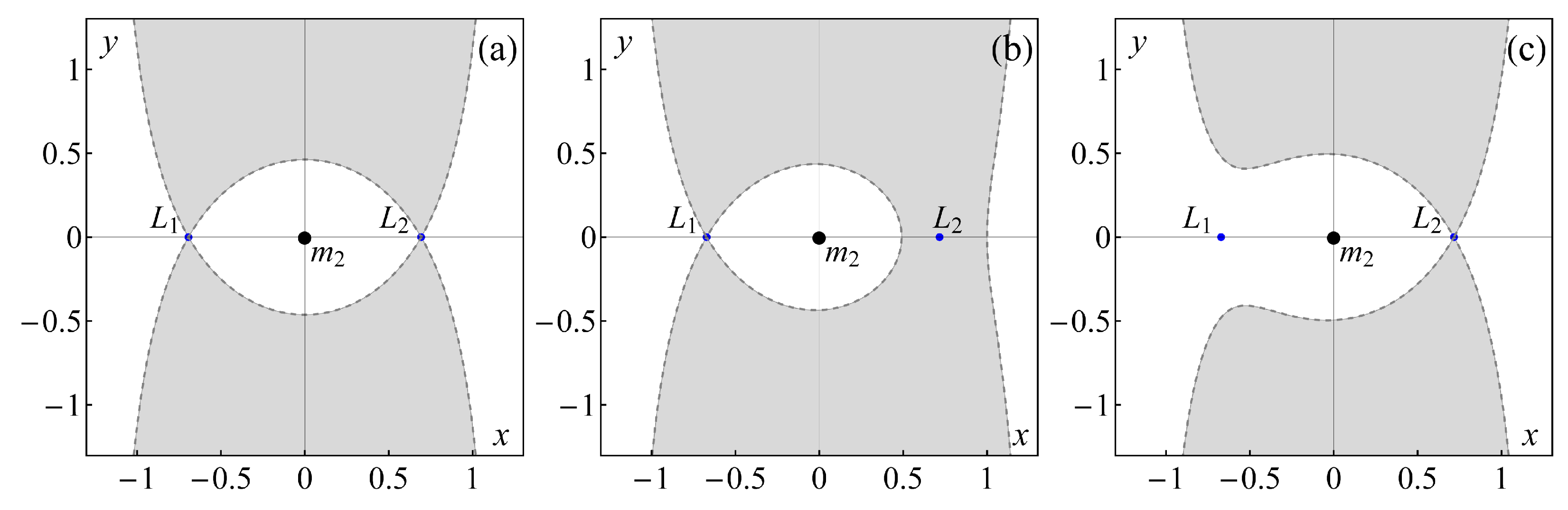
As in the classical Hill’s problem, the photogravitational version possesses two collinear equilibrium points, L 1 and L 2 [41,42]. However, while the classical Hill’s problem preserves symmetry w.r.t. the Ox axis and the Oy axis, the inclusion of radiation pressure in the Hill’s problem breaks the symmetry w.r.t. the Oy axis. Figure 1 illustrates this effect by presenting the zero-velocity curves corresponding to Γ ( L 1 ) and Γ ( L 2 ) for Q 1 = 0 and Q 1 = 0.2 . For Q 1 = 0 , we have that x L 1 = 0.69336127 = x L 2 , and Γ ( L 1 ) = Γ ( L 2 ) . For Q 1 = 0.2 , we obtain x L 1 = 0.67183607 , x L 2 = 0.71631092 , and Γ ( L 1 ) Γ ( L 2 ) . As a consequence of the loss of Oy-symmetry, the positions and stability of L 1 and L 2 must be analyzed independently in the photogravitational Hill’s problem. The same applies to the Lyapunov families emanating from these points, as well as their spatial bifurcations.
Next, we transform Equation (5) into a first-order system by introducing the variables x 1 = x , x 2 = y , x 3 = z , x 4 = x ˙ , x 5 = y ˙ , x 6 = z ˙ . The resulting system is given by
x ˙ i = f i ( x 1 , x 2 , x 3 , x 4 , x 5 , x 6 ) , i = 1 , 2 , 6 ,
where
f 1 = x 4 , f 2 = x 5 , f 3 = x 6 , f 4 = 2 x 5 + 3 x 1 x 1 r 3 Q 1 , f 5 = 2 x 4 x 2 r 3 , f 6 = x 3 x 3 r 3 ,
and, now, r = x 1 2 + x 2 2 + x 3 2 . Correspondingly, the potential-like function takes the form
W = 3 x 1 2 2 x 3 2 2 Q 1 x 1 + 1 r ,
while the Jacobi-like integral becomes
2 W ( x 4 2 + x 5 2 + x 6 2 ) = Γ .
The coordinates of the third body along any solution of System (9) depend uniquely on the initial state vector x 0 = ( x 10 , x 20 , x 30 , x 40 , x 50 , x 60 ) and on time t, namely x i = ( x 10 , x 20 , x 30 , x 40 , x 50 , x 60 ; t ) , i = 1 , 2 , , 6 . Their partial derivatives of these coordinates w.r.t. the initial conditions satisfy the equations of variations:
d d t 𝜕 x i 𝜕 x j 0 = k = 1 6 𝜕 f i 𝜕 x k 𝜕 x k 𝜕 x j 0 , i , j = 1 , 2 , , 6 ,
where
𝜕 f 1 𝜕 x j = 0 , j = 1 ,   2 ,   3 ,   5 ,   6 ,   7 𝜕 f 1 𝜕 x 4 = 1 , 𝜕 f 2 𝜕 x j = 0 , j = 1 ,   2 ,   3 ,   4 ,   6 , 𝜕 f 2 𝜕 x 5 = 1 , 𝜕 f 3 𝜕 x j = 0 , j = 1 ,   2 ,   3 ,   4 ,   5 , 𝜕 f 3 𝜕 x 6 = 1 , 𝜕 f 4 𝜕 x 1 = 3 1 r 3 + 3 x 1 2 r 5 , 𝜕 f 4 𝜕 x 2 = 3 x 1 x 2 r 5 , 𝜕 f 4 𝜕 x 3 = 3 x 1 x 3 r 5 , 𝜕 f 4 𝜕 x 4 = 0 , 𝜕 f 4 𝜕 x 5 = 2 , 𝜕 f 4 𝜕 x 6 = 0 ,
𝜕 f 5 𝜕 x 1 = 𝜕 f 4 𝜕 x 2 , 𝜕 f 5 𝜕 x 2 = 1 r 3 + 3 x 2 2 r 5 , 𝜕 f 5 𝜕 x 3 = 3 x 2 x 3 r 5 , 𝜕 f 5 𝜕 x 4 = 2 , 𝜕 f 5 𝜕 x 5 = 0 , 𝜕 f 5 𝜕 x 6 = 0 , 𝜕 f 6 𝜕 x 1 = 𝜕 f 4 𝜕 x 3 , 𝜕 f 6 𝜕 x 2 = 𝜕 f 5 𝜕 x 3 , 𝜕 f 6 𝜕 x 3 = 1 1 r 3 + 3 x 3 2 r 5 , 𝜕 f 6 𝜕 x 4 = 0 , 𝜕 f 6 𝜕 x 5 = 0 , 𝜕 f 6 𝜕 x 6 = 0 .
Equivalently, by using matrix notation, these equations can take the form
d V d t = R V ,
with
V = V ( x 0 ; t ) = v i j = 𝜕 x i 𝜕 x j 0 , i , j = 1 , 2 , , 6 ,
and
R = R ( x ) = 𝜕 f i 𝜕 x j , i , j = 1 , 2 , , 6 .
Explicitly, matrix R is
R = 0 0 0 1 0 0 0 0 0 0 1 0 0 0 0 0 0 1 𝜕 f 4 𝜕 x 1 𝜕 f 4 𝜕 x 2 𝜕 f 4 𝜕 x 3 0 2 0 𝜕 f 5 𝜕 x 1 𝜕 f 5 𝜕 x 2 𝜕 f 5 𝜕 x 3 2 0 0 𝜕 f 6 𝜕 x 1 𝜕 f 6 𝜕 x 2 𝜕 f 6 𝜕 x 3 0 0 0 .
The computation of the variations v i j along a given orbit can be performed by integrating System (14) simultaneously with the equations of motion (9). For symmetric periodic orbits with period T, the monodromy matrix V ( T ) can be computed more efficiently by exploiting the underlying symmetry of the orbit. Specifically, depending on the type of symmetry, one may compute V ( T / 2 ) or V ( T / 4 ) and subsequently reconstruct V ( T ) using the following symmetry-based transformation rules [51]:
I : V ( T ) = L V 1 ( T / 2 ) L V ( T / 2 ) , O x 1 x 3 plane symmetry , II : V ( T ) = M V 1 ( T / 2 ) M V ( T / 2 ) , O x 1 axis symmetry , III : V ( T ) = [ M V 1 ( T / 4 ) L V ( T / 4 ) ] 2 , O x 1 axis O x 1 x 3 plane symmetry , IV : V ( T ) = [ L V 1 ( T / 4 ) M V ( T / 4 ) ] 2 , O x 1 x 3 plane O x 1 axis symmetry ,
where L = diag ( 1 ,   1 ,   1 ,   1 ,   1 ,   1 ) and M = diag ( 1 ,   1 ,   1 ,   1 ,   1 , 1 ) . The third case of these formulae is applied if the starting position of the particle P lies on the O x 1 axis, while the fourth one is used when this position is outside this axis but on the O x 1 x 3 plane. This approach significantly reduces the computational effort.
In this study, we focus on the components of the variational matrix (15) that describe perturbations normal to the plane of motion and are directly associated with the vertical stability of planar periodic orbits. Their evolution characterizes the system’s response to small out-of-plane deviations and is quantified by the so-called vertical stability indices introduced by Hénon [52]. These indices are defined by
a v = 𝜕 x 3 𝜕 x 30 = v 33 , b v = 𝜕 x 3 𝜕 x 60 = v 36 , c v = 𝜕 x 6 𝜕 x 30 = v 63 , d v = 𝜕 x 6 𝜕 x 60 = v 66 .
Linear stability in the vertical direction is determined by the quantity s v = ( a v + d v ) / 2 . An orbit is vertically stable if | s v |   <   1 , whereas instability occurs when | s v |   >   1 . In the case of planar symmetric periodic orbits, symmetry implies that a v = d v , and the above criteria reduce to | a v |   <   1 for stability and | a v |   >   1 for instability. Alternatively, the stability properties of planar periodic orbits can be studied by applying the Floquet theory (see, for example, [53]).
According to [52], the index a v also provides information for the existence of families of three-dimensional periodic orbits that bifurcate from planar ones. In particular, its value indicates members of the planar families that serve as bifurcation points for spatial branches. The first kind of such points corresponds to vertical critical (VC) orbits. A defining property of VC orbits is that their vertical stability index satisfies
a v = 1 or a v = 1 .
If a planar family F contains a member with a v = 1 , then this orbit is a bifurcation point for a family of three–dimensional periodic orbits of the same period. That is, if T is the period of the planar orbit, then the corresponding member of the bifurcating spatial branch also has period T, so that the period ratio is q = 1 . In contrast, if a member of F satisfies a v = 1 , it gives rise to a period–doubling bifurcation. In this case, if the planar periodic orbit has period T, then the corresponding spatial orbit has period 2 T , and the associated period ratio is q = 2 . A second type of bifurcation point corresponds to vertical self-resonant (VSR) orbits, which indicate the presence of higher-order resonances.er resonances concerning q. Points of this type correspond to VSR orbits. If a member of F has period T and its vertical stability index a v satisfies:
a v = cos 2 π p q ,
where p , q are positive coprime integers with p < q and q > 2 , then this member is a bifurcation point for a spatial branch whose corresponding orbit has period q T .

3. The Lyapunov Families and Their Vertical Bifurcation Points

3.1. The Lyapunov Families

In this subsection, we outline the methodology used to compute the planar Lyapunov families for a fixed value of the radiation parameter Q 1 , and present the corresponding results for the case Q 1 = 0.2 . In the classical Hill’s problem, two Lyapunov families, denoted by a and c, originate from the collinear equilibrium points L 2 and L 1 , respectively. Each family consists of symmetric, planar, retrograde periodic orbits of multiplicity one [24]. Owing to the additional symmetry of the classical model w.r.t. the O x 2 axis, the orbits in families a and c are mirror images of one another; therefore, it is sufficient to compute only one of the two families. In contrast, in the photogravitational Hill’s problem, the inclusion of radiation pressure breaks the symmetry w.r.t. the O x 2 axis. As a result, families a and c no longer exhibit mirror symmetry, and must be computed independently.
To compute these families in our problem, we initially employ a grid search method to obtain approximate initial conditions for a set of planar symmetric periodic orbits belonging to these families. These approximations are then refined using a classical differential correction scheme.
The grid search technique, first described by Markellos et al. [54], and detects approximations of initial conditions for planar symmetric periodic orbits in Hamiltonian systems. In this approach, the plane ( Γ , x 1 ) is discretized using a fine grid with spacing ϵ , where ϵ is a small constant along the Γ axis. Each grid node is associated with initial conditions ( Γ 0 , x 10 ) , corresponding to the positive direction of the flow, with x 50 = 2 W ( x 10 ) Γ 0 . This expression follows from Relation (12) under the conditions x 20 = x 30 = x 40 = x 60 = 0 . Here, Γ 0 denotes the value of Γ at the initial state vector x 0 of an orbit. In this way, each grid node provides a set of initial conditions for computing solutions of System (9) that originate perpendicularly from the O x 1 . To implement this procedure, we first use the initial conditions ( Γ 0 , x 10 ) to numerically integrate the system up to the first intersection of the corresponding trajectory with the O x 1 axis. Next, we consider a neighboring node, e.g., ( Γ 0 , x 10 + ϵ ) , and again integrate (9) up to the first intersection of the corresponding orbit with the same axis. If the signs of the resulting values of the respective values of x 4 differ, then a symmetric periodic orbit of multiplicity 1 exists, with initial value for the x 1 lying between x 10 and x 10 + ϵ . Owing to the symmetry w.r.t. the O x 1 axis, the detected periodic orbit is expected to intersect this axis perpendicularly twice during its period. The same procedure is applied to all remaining grid nodes, yielding approximate initial conditions corresponding to symmetric periodic orbits of this type. We should note that, since the Lyapunov families start from the equilibrium points L 1 and L 2 , it is not necessary to perform the grid search on a wide part of the plane ( Γ , x 1 ) . Instead, the search is restricted to a small neighborhood around these points and to a limited number of nodes.
In the sequel, these approximations are used as initial guesses for a standard differential correction procedure aimed at computing nearby Lyapunov periodic orbits with a prescribed level of accuracy and constructing the corresponding families. For the purposes of the present contribution, the tolerance level was set to 5 × 10 9 (we note that the same level was used for all similar procedures). The aforementioned procedure is based on a predictor–corrector scheme, which in turn relies on the periodicity conditions satisfied by all orbits belonging to the families under consideration. Let F be any of these families. A coplanar orbit withan initial state vector x 0 = ( x 10 , 0 , 0 , 0 , x 50 , 0 ) is expected to belong to F if the corresponding state vector at its first intersection with the O x 1 axis, x cut = ( x 1 cut , x 2 cut , x 3 cut , x 4 cut , x 5 c u t , x 6 cut ) = ( x 1 cut , 0 , 0 , x 4 c u t , x 5 c u t , 0 ) satisfies the periodicity condition:
x 4 cut ( x 10 , 0 , 0 , 0 , x 50 , 0 ) = 0 .
Suppose that the aforementioned grid search technique provides a candidate solution of System (9) with initial state vector an initial state vector x 0 . In general, this solution is not expected to belong to F; that is, the value of x 4 at the first intersection of the solution with the O x 1 axis satisfies x ^ 4 cut 0 . To identify a nearby member of F, the components x 10 and x 50 of x 0 must be corrected by increments δ x 10 and δ x 50 , respectively, such that Condition (22) is satisfied for the orbit generated by the corrected initial state vector, i.e.,
x 4 cut ( x 10 + δ x 10 , 0 , 0 , 0 , x 50 + δ x 50 , 0 ) = 0 .
If these modifications are sufficiently small, then the following linearization of (23) may be used to estimate them:
𝜕 x 4 𝜕 x 10 δ x 10 + 𝜕 x 4 𝜕 x 50 δ x 50 = x ^ 4 cut .
Then, by fixing one of the quantities δ x 10 or δ x 50 , the previous equation can be solved to determine the other. The partial derivatives appearing in (24) are evaluated along the initial approximation of the periodic orbit at the time of its first intersection with the O x 1 axis. This corrector step may have to be repeated several times until Condition (22) is satisfied within a desired accuracy. At that point, a new member of the family F is obtained, and the time corresponding to this intersection is equal to half of the orbital period, i.e., t = T / 2 .
Suppose now that the initial state vector of a known member of F is x 0 = ( x 10 , 0 , 0 , 0 , x 50 , 0 ) . In order to continue the computation of the entire family F, we seek to determine the corresponding vector for a nearby orbit that also belongs to F. To this end, we have to calculate suitable modifications δ x 10 and δ x 50 for the components x 10 and x 50 of x 0 , such that the resulting orbit satisfies Condition (23). If these modifications are sufficiently small, the following linearization of this condition can be used to predict them:
𝜕 x 4 𝜕 x 10 δ x 10 + 𝜕 x 4 𝜕 x 50 δ x 50 = 0 .
By assigning a proper nonzero value d to one of the corrections δ x 10 and δ x 50 , Equation (25) can be solved to determine the value of the other. The values of the partial derivatives appearing in this equation are evaluated along the reference member of F at the time of its first intersection with the O x 1 axis. If the predicted initial state vector is not sufficiently accurate, the corrector step described above may be repeated until the periodicity condition (22) is satisfied within the desired tolerance.
A systematic application of this predictor–corrector scheme enables the construction of the entire family.
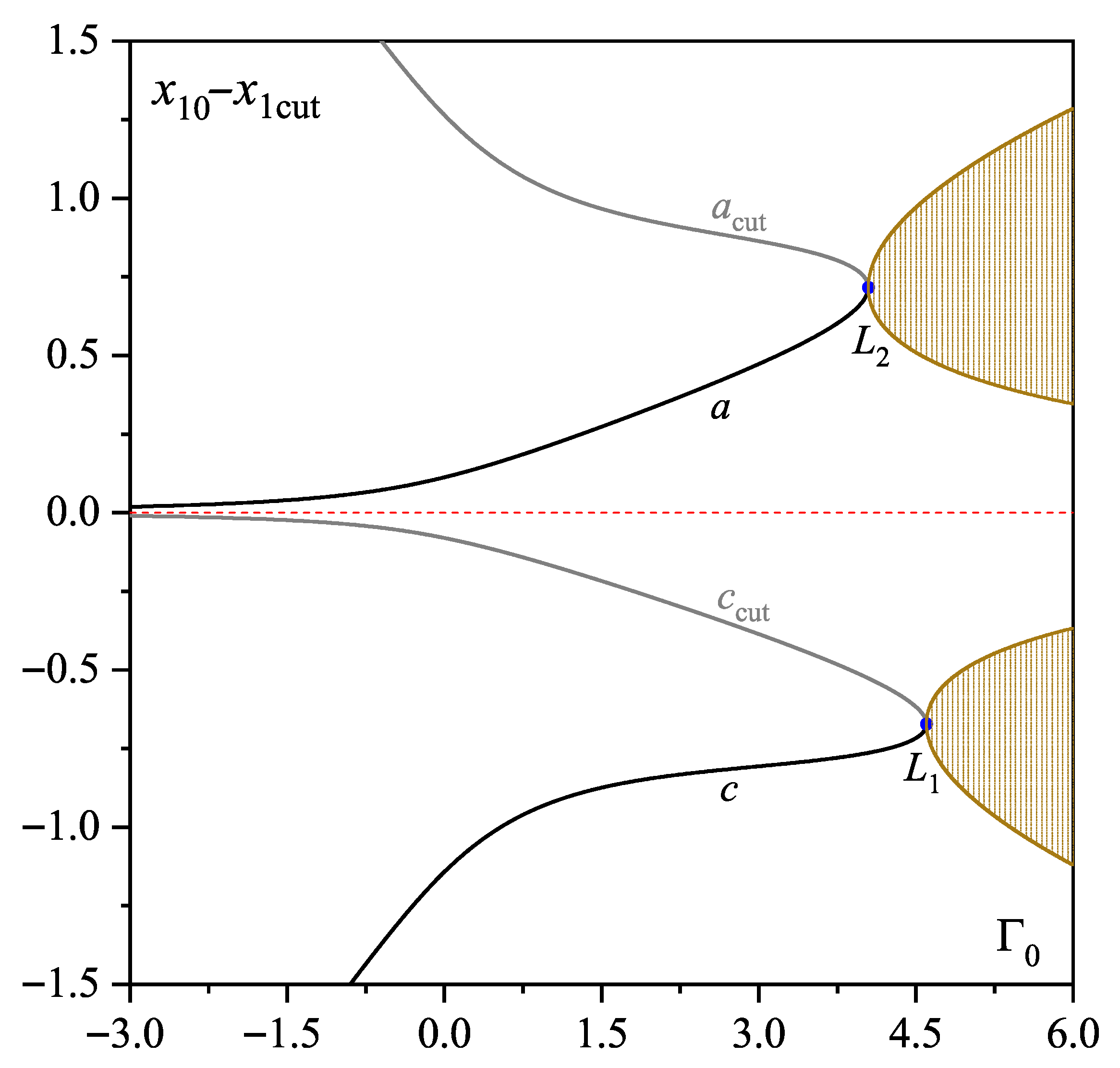
We have applied the aforementioned procedure for Q 1 = 0.2 . The results are shown in Figure 2, where we present the characteristic curves of families a and c in the space of ( Γ 0 , x 10 ) , together with the respective curves for a cut and c cut . These latter curves are the families formed by the second vertical intersections of the members of a ans c with the O x 1 axis. From this figure and the associated data, it can be directly observed that both families terminate in collision with the secondary body when either the initial or the second perpendicular intersection of their members with the O x 1 axis approaches this body.

3.2. Vertical Bifurcation Points of the Lyapunov Families

In this subsection, we first describe a procedure for computing the vertical bifurcation points of the Lyapunov families, namely their VC and VSR members, for a given value of the parameter Q 1 . These solutions are then used as initial conditions for the numerical continuation of the corresponding bifurcations over a range of values of Q 1 . Both processes are based on classical differential correction schemes.
We consider again F to be any of the Lyapunov families. An orbit is a VC or VSR member of F if it satisfies the following conditions:
x 4 cut ( x 10 , 0 , 0 , 0 , x 50 , 0 ) = 0 , a v ( x 10 , 0 , 0 , 0 , x 50 , 0 ) = a v ,
at its half period t = T / 2 . The first equation serves as a periodicity condition. The second ensures that the orbit corresponds to a VC or VSR member, i.e., a v is prescribed to take one of the special values of a v which, according to relations (20) and (21), guarantee the existence of a vertical bifurcation point. Suppose that an estimate of the initial vector x 0 = ( x 10 , 0 , 0 , 0 , x 50 , 0 ) of a VC or VSR member of F is available. Such an estimate can be obtained, for example, by monitoring the variation of a v along the family F. If the condition (26) are not satisfied exactly by the corresponding orbit, namely, if the value of x 4 at the first intersection of the orbit with the O x 1 axis and/or the associated value of a v are x ^ 4 cut 0 and/or a ^ v a v , then appropriate corrections δ x 10 , δ x 50 to the initial conditions must be determined such that
x 4 cut ( x 10 + δ x 10 , 0 , 0 , 0 , x 50 + δ x 50 , 0 ) = 0 , a v ( x 10 + δ x 10 , 0 , 0 , 0 , x 50 + δ x 50 , 0 ) = a v .
For sufficiently small values of δ x 10 , δ x 50 , the following linearization of the latter system can be used, to estimate these corrections:
𝜕 x 4 cut 𝜕 x 10 δ x 10 + 𝜕 x 4 cut 𝜕 x 50 δ x 50 = x ^ 4 cut , 𝜕 a v 𝜕 x 10 δ x 10 + 𝜕 a v 𝜕 x 50 δ x 50 = a v a ^ v ,
The above correction step may need to be repeated until the VC or VSR member of F is determined within the desired level of accuracy.
In the sequel, we describe a procedure for constructing a sequence of VC and VSR orbits as the radiation pressure parameter varies. This procedure is based on a classical differential correction scheme. Suppose that a VC or a VSR orbit has been determined for a given value Q 1 of the parameter, with initial conditions x 0 ( x 10 , 0 , 0 , 0 , x 50 , 0 ; Q 1 ) . Then, this orbit satisfies the following conditions:
x 4 cut ( x 10 , 0 , 0 , 0 , x 50 , 0 ; Q 1 ) = 0 , a v ( x 10 , 0 , 0 , 0 , x 50 , 0 ; Q 1 ) = a v ,
at its half period t = T / 2 . The above conditions are an extension of (26) in the sense that they also account for variations in the radiation pressure parameter. Thus, their interpretation, as well as that of a v remains unchanged.
Using these conditions, we may predict a neighboring orbit of the same type for Q 1 + δ Q 1 , where δ Q 1 is a small arbitrary quantity. Let ( x 10 + δ x 10 , 0 , 0 , 0 , x 50 + δ x 50 , 0 ; Q 1 + δ Q 1 ) denote the initial conditions of this orbit. Then, Condition (29) must be satisfied, i.e.,:
x 4 cut ( x 10 + δ x 10 , 0 , 0 , 0 , x 50 + δ x 50 , 0 ; Q 1 + δ Q 1 ) = 0 , a v ( x 10 + δ x 10 , 0 , 0 , 0 , x 50 + δ x 50 , 0 ; Q 1 + δ Q 1 ) = a v .
We set δ Q 1 equal to a suitably small quantity. If the quantities δ x 10 , δ x 50 are sufficiently small, the following linearization of the system can be used to compute these corrections:
𝜕 x 4 cut 𝜕 x 10 δ x 10 + 𝜕 x 4 cut 𝜕 x 50 δ x 50 + 𝜕 x 4 cut 𝜕 Q 1 δ Q 1 = 0 , 𝜕 a v 𝜕 x 10 δ x 10 + 𝜕 a v 𝜕 x 50 δ x 50 + 𝜕 a v 𝜕 Q 1 δ Q 1 = a v .
The partial derivative of x 4 cut w.r.t. Q 1 , as well the partial derivatives of a v w.r.t. x 10 , x 50 and Q 1 , which appear in the previous system, can be computed through additional integrations of Systems (9)–(14), after introducing slightly perturbing the values of x 10 , x 50 and Q 1 , respectively.
If the predicted orbit does not satisfy Condition (29), that is, if the values of x 4 and the stability index a v at the first intersection of the orbit with the O x 1 axis are x ^ 4 cut 0 and/or a ^ v a v , respectively, then corrections δ x 10 , δ x 50 must be applied to the corresponding initial conditions so that System (30) is fulfilled after setting δ Q 1 = 0 . For sufficiently small values of δ x 10 , δ x 50 , the following linearization of the resulting system can be used to calculate these corrections:
𝜕 x 4 cut 𝜕 x 10 δ x 10 + 𝜕 x 4 cut 𝜕 x 50 δ x 50 = x ^ 4 cut , 𝜕 a v 𝜕 x 10 δ x 10 + 𝜕 a v 𝜕 x 50 δ x 50 = a v a ^ v .
Again, the partial derivatives of x 4 cut and a v appearing in this system can be computed through by using additional integrations of Systems (9)–(14), after introducing small perturbations in the values of x 10 and x 50 , respectively.
We now proceed with the presentation of the results obtained using the aforementioned methods. In this work, we consider bifurcation points that generate three-dimensional branches with multiplicity up to 4. More precisely, if a v = 1 or a v = 1 , a VC orbit exists from which a family of three–dimensional periodic orbits bifurcates with q = 1 or 2 , respectively. In contrast, when a v = 0.5 or a v = 0 a VSR orbit exists from which a spatial family bifurcates with q = 3 or 4 , correspondingly. We recall that q is the factor determining the multiplicity for the period of the members of the generated family, as given given by Relations (20) and (21). Since (26) is evaluated at t = T / 2 , the value of a v must be computed using Formula II of (18).
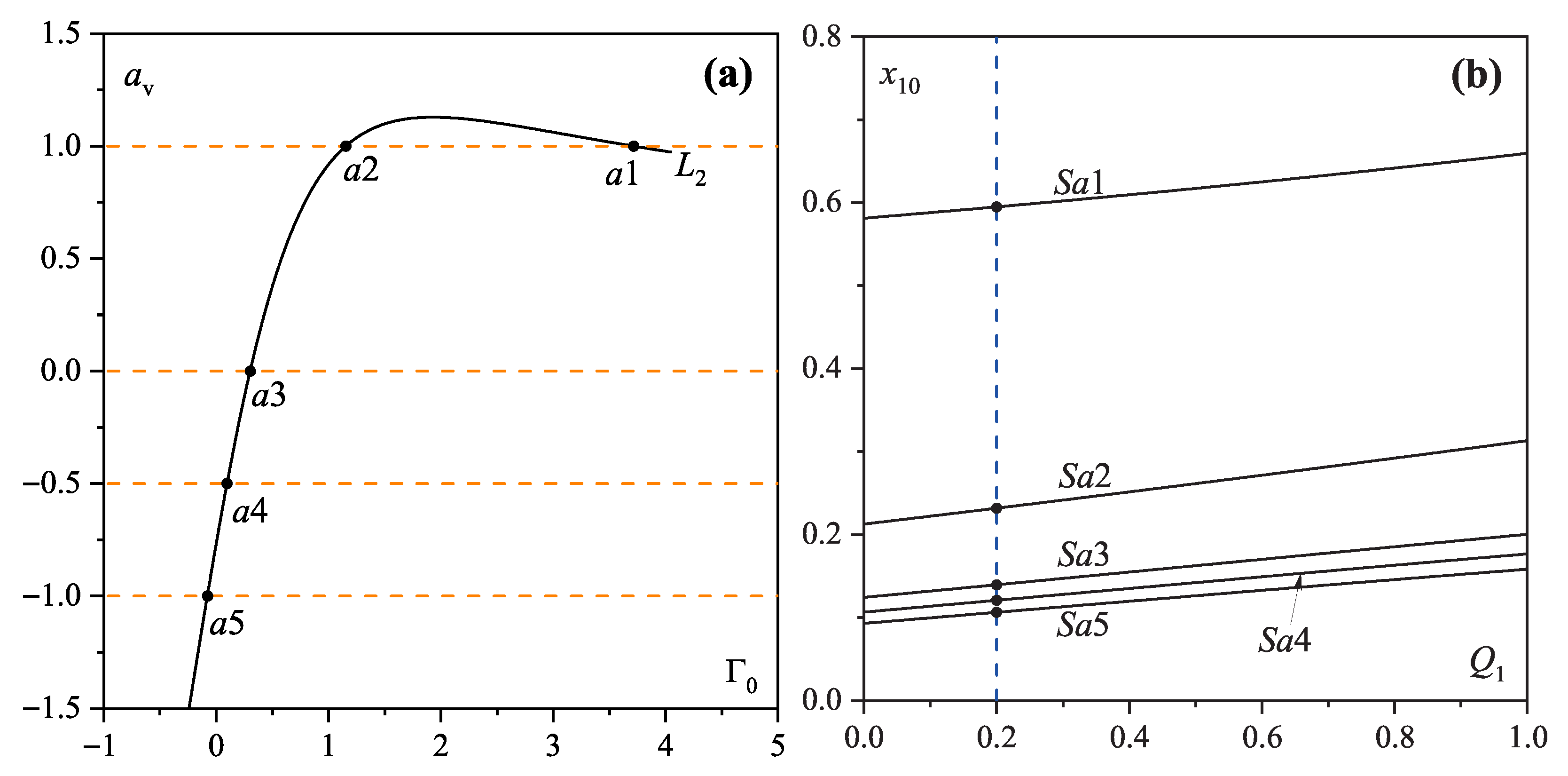
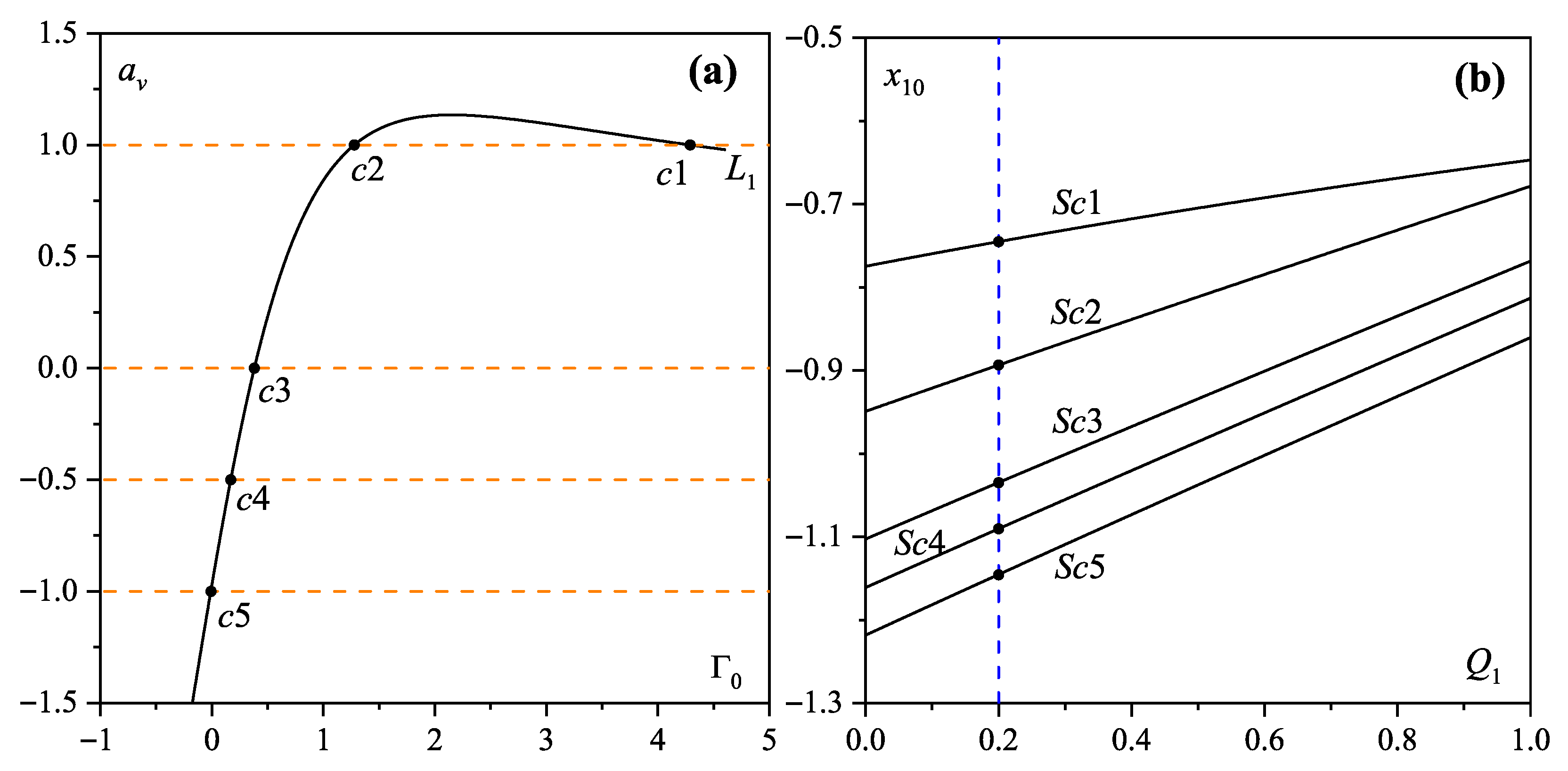
In Figure 3a, we present, for Q 1 = 0.2 , the vertical stability diagram of the Lyapunov family a emanating from the collinear equilibrium point L 2 . We observe that there are three VC orbits, denoted a 1 , a 2 and a 5 ; the first two generate two families of 3D periodic orbits whose members have the same period as the VC orbits (case q = 1 ) while the third generates a spatial family whose members have twice the period of a 5 (case q = 2 ). In addition, two VSR bifurcation points, a 4 and a 3 , are identified, from which families of 3D periodic orbits emerge with periods equal to three or four times that of the corresponding VSR orbits (cases q = 3 and q = 4 , respectively).
Figure 3b shows the relevant series presenting the evolution of the VC and VSR orbits w.r.t. the radiation parameter Q 1 Starting from the value of the radiation parameter Q 1 = 0.2 , these orbits are continued over the interval [ 0 , 1 ] . It can be observed that all computed VC and VSR orbits converge to their counterparts in the classical Hill’s problem as Q 1 0 , and persist throughout the considered range of the radiation parameter. A similar behavior is observed in Figure 4, where the vertical stability of the Lyapunov family c emanating from the collinear equilibrium point L 1 is presented together with the corresponding series of VC and VSR orbits. We recall that the symmetry with respect to the O x 2 axis is lost when radiation pressure is taken into account in Hill’s problem; therefore, the results for the Lyapunov families are presented separately.
In Table 1 we give accurate initial conditions of the VC and VSR orbits belonging to the Lyapunov families a and c, shown in Figure 3a and Figure 4a, respectively. In particular, each row of this table lists the half of the orbit’s period T / 2 , the position and velocity components x 10 and x 50 at a vertical intersection of the orbit with the O x 1 axis, the value of the Jacobi constant Γ 0 , the position value x 1 cut at the second vertical intersection with the O x 1 axis, as well as the the corresponding stability indices. As noted above, these orbits (computed for Q 1 = 0.2 ) have been used as initial seeds for the construction of the respective series over the interval Q 1 [ 0 , 1 ] .

4. Spatial Bifurcations of Lyapounov Families

The purpose of this section is the computation of families of symmetric three-dimensional periodic orbits that bifurcate from the VC and VSR members of the Lyapunov ones. Each of these branches consists of symmetric orbits.
To determine the type of symmetry exhibited by the members of a given branch, one must identify two mirror configurations occurring at distinct epochs [55]. In practice, this corresponds to detecting two perpendicular intersections between the position vector and the velocity vector along the orbit. In the photogravitational Hill problem, the following fundamental types of symmetry arise for three-dimensional periodic orbits: (a) O x 1 O x 1 axis symmetry (A-A): the third body departs from the O x 1 axis with velocity perpendicular to it and, at t = T / 2 , intersects the same axis again perpendicularly. (b) O x 1 x 3 O x 1 x 3 plane symmetry (P-P): this body starts from the O x 1 x 3 plane with velocity perpendicular to it and, at t = T / 2 , crosses the same plane again perpendicularly. Combinations of these symmetries give rise the following additional types: (c) O x 1 O x 1 x 3 double symmetry (A-P): the third body departs from the O x 1 axis with velocity perpendicular to it and, at t = T / 4 , intersects the O x 1 x 3 plane perpendicularly. (d) O x 1 x 3 O x 1 double symmetry (P-A): this body starts from the O x 1 x 3 plane with velocity perpendicular to it and, at t = T / 4 , crosses the O x 1 perpendicularly. The latter two types are equivalent but are distinguished according to the initial and final mirror configurations, respectively.
In the following, for each of the above symmetry types, we construct appropriate predictor–corrector schemes based on differential corrections for the computation of the corresponding spatial branches of the Lyapunov families. As usual, these schemes rely on the periodicity conditions that must be satisfied. We denote by B any branch whose members possess the specific symmetry.
  • Symmetry A-A: Then, any orbit of B has an initial state vector of the form x 0 = ( x 10 , 0 , 0 , 0 , x 50 , x 60 ) and, at half the number of its total crossings with the O x 1 axis (equivalently at half its period, t = T / 2 ), satisfies the following conditions:
    x 3 cut ( x 10 , 0 , 0 , 0 , x 50 , x 60 ) = 0 , x 4 cut ( x 10 , 0 , 0 , 0 , x 50 , x 60 ) = 0 ,
Suppose such an orbit is known. To predict the initial conditions of a nearby member of B, we seek suitable corrections δ x 10 , δ x 50 and δ x 60 to the corresponding components of x 0 such that
x 3 cut ( x 10 + δ x 10 , 0 , 0 , 0 , x 50 + δ x 50 , x 60 + δ x 60 ) = 0 , x 4 cut ( x 10 + δ x 10 , 0 , 0 , 0 , x 50 + δ x 50 , x 60 + δ x 60 ) = 0 .
By linearizing these equations, we obtain the system
𝜕 x 3 cut 𝜕 x 10 δ x 10 + 𝜕 x 3 cut 𝜕 x 50 δ x 50 + 𝜕 x 3 cut 𝜕 x 60 δ x 60 = 0 , 𝜕 x 4 cut 𝜕 x 10 δ x 10 + 𝜕 x 4 cut 𝜕 x 50 δ x 50 + 𝜕 x 4 cut 𝜕 x 60 δ x 60 = 0 .
Then, by assigning a suitably chosen nonzero constant value d to one of the corrections, we can solve this system to calculate the rest of them. The resulting system can be solved to determine the remaining corrections. In the case where the known orbit is a VC or VSR member of a Lyapunov family and the goal is to initiate a spatial branch bifurcating from this family, the quantity δ x 60 must be set equal to d so that the predicted orbit is genuinely three dimensional.
Consider now an estimate x 0 = ( x 10 , 0 , 0 , 0 , x 50 , x 60 ) of the initial state vector of an orbit close to B. Suppose that this orbit does not satisfy Condition (33) within the desired accuracy; that is, x 3 cut = x ^ 3 cut 0 and x 4 cut = x ^ 4 cut 0 . In this case, appropriate corrections δ x 10 , δ x 50 and δ x 60 must be applied to the corresponding components of x 0 so that System (34) is satisfied by the resulting orbit. A linearization of this system yields
𝜕 x 3 cut 𝜕 x 10 δ x 10 + 𝜕 x 3 cut 𝜕 x 50 δ x 50 + 𝜕 x 3 cut 𝜕 x 60 δ x 60 = x ^ 3 cut , 𝜕 x 4 cut 𝜕 x 10 δ x 10 + 𝜕 x 4 cut 𝜕 x 50 δ x 50 + 𝜕 x 4 cut 𝜕 x 60 δ x 60 = x ^ 4 cut .
By setting one of the correction terms in the above system equal to zero, the remaining corrections can be determined by solving the resulting system. However, the choice δ x 60 = 0 should be avoided at the initial stage of constructing a branch bifurcating from a VC or VSR member of any Lyapunov family.
  • Symmetry P-P: In this case, any member of B is characterized by an initial state vector of the form x 0 = ( x 10 , 0 , x 30 , 0 , x 50 , 0 ) . At half the number of its total crossings with the O x 1 axis (equivalently, at half its period t = T / 2 ) the following conditions are satisfied:
    x 4 cut ( x 10 , 0 , x 30 , 0 , x 50 , 0 ) = 0 , x 6 cut ( x 10 , 0 , x 30 , 0 , x 50 , 0 ) = 0 ,
Suppose that such an orbit is known. Then, by proceeding analogously to the previously described symmetric case, we obtain the following linear predictor for the initial conditions of neighboring members of this branch:
𝜕 x 4 cut 𝜕 x 10 δ x 10 + 𝜕 x 4 cut 𝜕 x 30 δ x 30 + 𝜕 x 4 cut 𝜕 x 50 δ x 50 = 0 , 𝜕 x 6 cut 𝜕 x 10 δ x 10 + 𝜕 x 6 cut 𝜕 x 30 δ x 30 + 𝜕 x 6 cut 𝜕 x 50 δ x 50 = 0 .
When initiating the construction of a spatial branch bifurcating from a VC or VSR member of a Lyapunov family, the quantity δ x 30 must be assigned a small nonzero value in order to ensure that the predicted orbit is three-dimensional.
A corresponding linear corrector is
𝜕 x 4 cut 𝜕 x 10 δ x 10 + 𝜕 x 4 cut 𝜕 x 30 δ x 30 + 𝜕 x 4 cut 𝜕 x 50 δ x 50 = x ^ 4 cut , 𝜕 x 6 cut 𝜕 x 10 δ x 10 + 𝜕 x 6 cut 𝜕 x 30 δ x 30 + 𝜕 x 6 cut 𝜕 x 50 δ x 50 = x ^ 6 cut .
At the initial stage of computing a branch bifurcating from a VC or VSR member of a Lyapunov family, the choice δ x 30 = 0 must be avoided when solving this system.
  • Symmetry A-P (or P-A): The two previously described types of symmetry give rise to spatial periodic orbits with simple symmetry. However, as noted above, their combination leads to a special class of doubly symmetric orbits. In the following, we focus on the A-P case of double symmetry since the corresponding results for the alternative P-A configuration can be readily inferred. An orbit of this type is characterized by an initial state vector of the form ( x 10 , 0 , 0 , 0 , x 50 , x 60 ) , implying that the first mirror configuration occurs on the O x 1 axis. At one quarter of the period ( t = T / 4 ), a second mirror configuration is imposed on the O x 1 x 3 plane. Accordingly, the following conditions
    x 4 cut ( x 10 , 0 , 0 , 0 , x 50 , x 60 ) = 0 , x 6 cut ( x 10 , 0 , 0 , 0 , x 50 , x 60 ) = 0 ,
    must be satisfied at the first perpendicular intersection of the orbit with this plane.
A linear predictor can be derived by proceeding analogously to the previous cases:
𝜕 x 4 cut 𝜕 x 10 δ x 10 + 𝜕 x 4 cut 𝜕 x 50 δ x 50 + 𝜕 x 4 cut 𝜕 x 60 δ x 60 = 0 , 𝜕 x 6 cut 𝜕 x 10 δ x 10 + 𝜕 x 6 cut 𝜕 x 50 δ x 50 + 𝜕 x 6 cut 𝜕 x 60 δ x 60 = 0 .
At the initial stage of constructing a spatial branch, the quantity δ x 60 must be assigned a small nonzero value in order to ensure that the predicted solution corresponds to a three-dimensional orbit.
A corresponding linear corrector is the following:
𝜕 x 4 cut 𝜕 x 10 δ x 10 + 𝜕 x 4 cut 𝜕 x 50 δ x 50 + 𝜕 x 4 cut 𝜕 x 60 δ x 60 = x ^ 4 cut , 𝜕 x 6 cut 𝜕 x 10 δ x 10 + 𝜕 x 6 cut 𝜕 x 50 δ x 50 + 𝜕 x 6 cut 𝜕 x 60 δ x 60 = x ^ 6 cut .
At the initial stage of computing a branch bifurcating from a VC or VSR member of a Lyapunov family, the choice δ x 60 = 0 must be avoided when solving this system.
To determine the stability properties of a three-dimensional periodic orbit, we employ the following parameters [51]:
P = α + α 2 4 ( β 2 ) 2 , Q = α α 2 4 ( β 2 ) 2 ,
with α = 2 Tr V and β = ( α 2 + 2 Tr V 2 ) / 2 , where V is the variational matrix (15) evaluated over the full period T of the orbit. A periodic orbit is then classified as stable if the stability parameters P and Q are real numbers and satisfy simultaneously the conditions | P | < 2 and | Q | < 2 . For computational efficiency, the variational matrix may also be evaluated at half or quarter of the orbital period, depending on the symmetry properties of the orbit. As discussed in Section 2, for A-A simple symmetry, the variational matrix can be obtained using Formula II of (18), whereas for P-P simple symmetry, Formula I applies. Finally, for doubly symmetric spatial periodic orbits, Formulae III and IV are used in the cases of A-P and P-A symmetries, respectively.
In the following, we present our results on the three-dimensional branches emanating from the VC/VSR members of families a and c listed in Table 1. More specifically, we provide and discuss tables of representative members of these branches, together with characteristic curves describing their evolution. In addition, in the Appendix A, we present representative orbits from these branches to illustrate their termination behavior in cases where they lead to collision.
Before presenting this description, we clarify the notation used for naming these branches. For this purpose, we consider two illustrative examples. The branch f a 2 1 is a 3D family bifurcating from the bifurcation point a 2 of the Lyapunov family a, and the multiplicity of its members is determined by q = 1 . This branch originates from the first perpendicular intersection of the orbit a 2 with the O x 1 axis. Similarly, the branch f c 4 cut 3 is a 3D family bifurcating from the bifurcation point c 4 of Lyapunov family c, with multiplicity factor q = 3 . This branch originates from the second perpendicular intersection of the orbit c 4 with the O x 1 x 3 plane. Thus, the subscript of f specifies the location of the planar family from which the branch originates, while the superscript indicates the multiplicity of the periodic orbits within the corresponding spatial branch.
Firstly, we focus on the branches whose members exhibit symmetry A-A. In Table 2, we present data for representative orbits of these families. Each row of the table lists the bifurcation point from which the corresponding branch originates, the name of the branch, the half-period of the specific member, the coordinates x 10 , x 50 , x 60 of its initial state vector, as well as the corresponding value of Γ 0 . The last entry indicates whether the family contains a segment of stable members (S) or not (U).
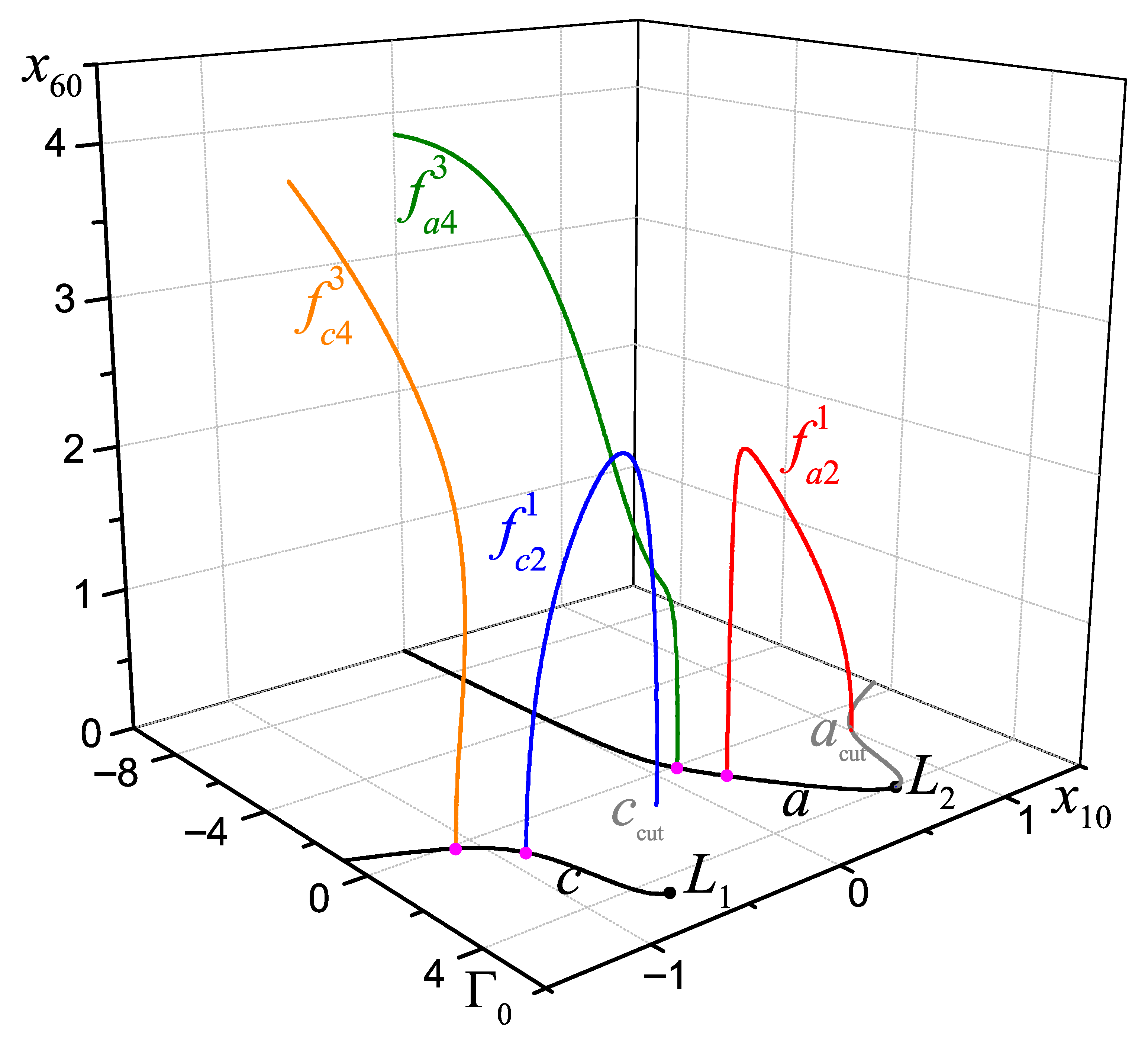
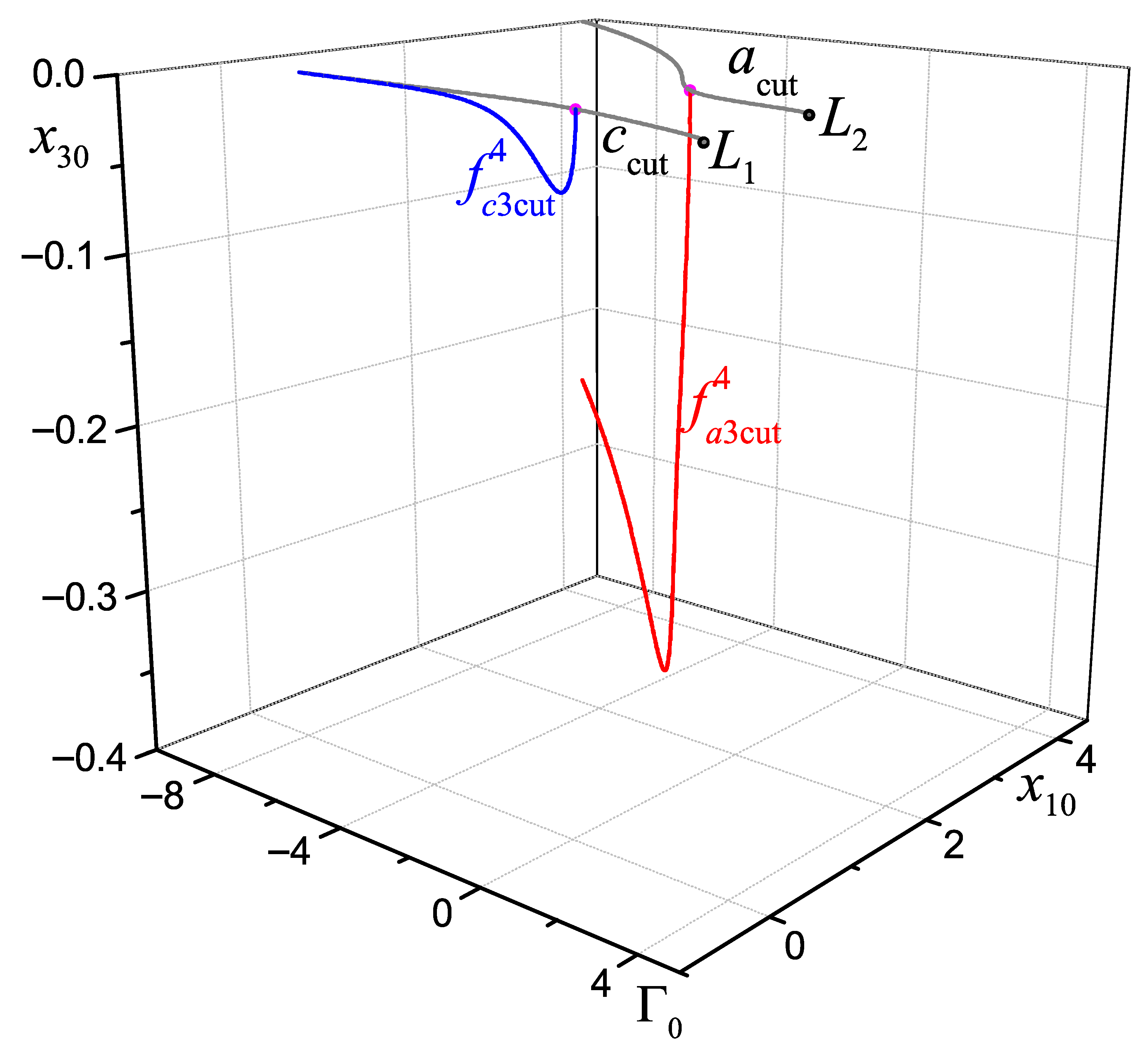
Next, we consider the characteristic curves of these branches, which are shown in Figure 5. An examination of these curves and the associated data leads to the following conclusions regarding the termination of this class of branches. Two of the branches belong to the multiplicity class q = 1 . The branch f a 2 1 , originating from a VC member of family a, terminates on a planar orbit that belongs to family a cut ; thus, its termination orbit of f a 2 1 is effectively a member of family a. A similar behavior is observed for f c 2 1 , which terminates on a member of c cut . The remaining two branches correspond to the case q = 3 . The branch f 4 3 terminates in configurations leading to collision with the secondary body P 2 ; more precisely, the first perpendicular intersection of its orbits with the O x 1 axis approaches this body. The termination of f c 4 3 occurs in a similar manner, as its members gradually tend toward collision with P 2 . In this case, the collision is associated with the second intersection of the orbit with the axis (at T = T / 2 ), which approaches the secondary body.
We now consider the branches consisting of orbits with P-P symmetry. Table 3 presents data for representative orbits of these families. Each row of the table lists the bifurcation point from which the corresponding branch originates, the name of the branch, the half-period of the specific member, the coordinates x 10 , x 30 , x 50 of its initial state vector, as well as the corresponding value of Γ 0 . The last column indicates whether the corresponding family contains a stable segment (S) or not (U).
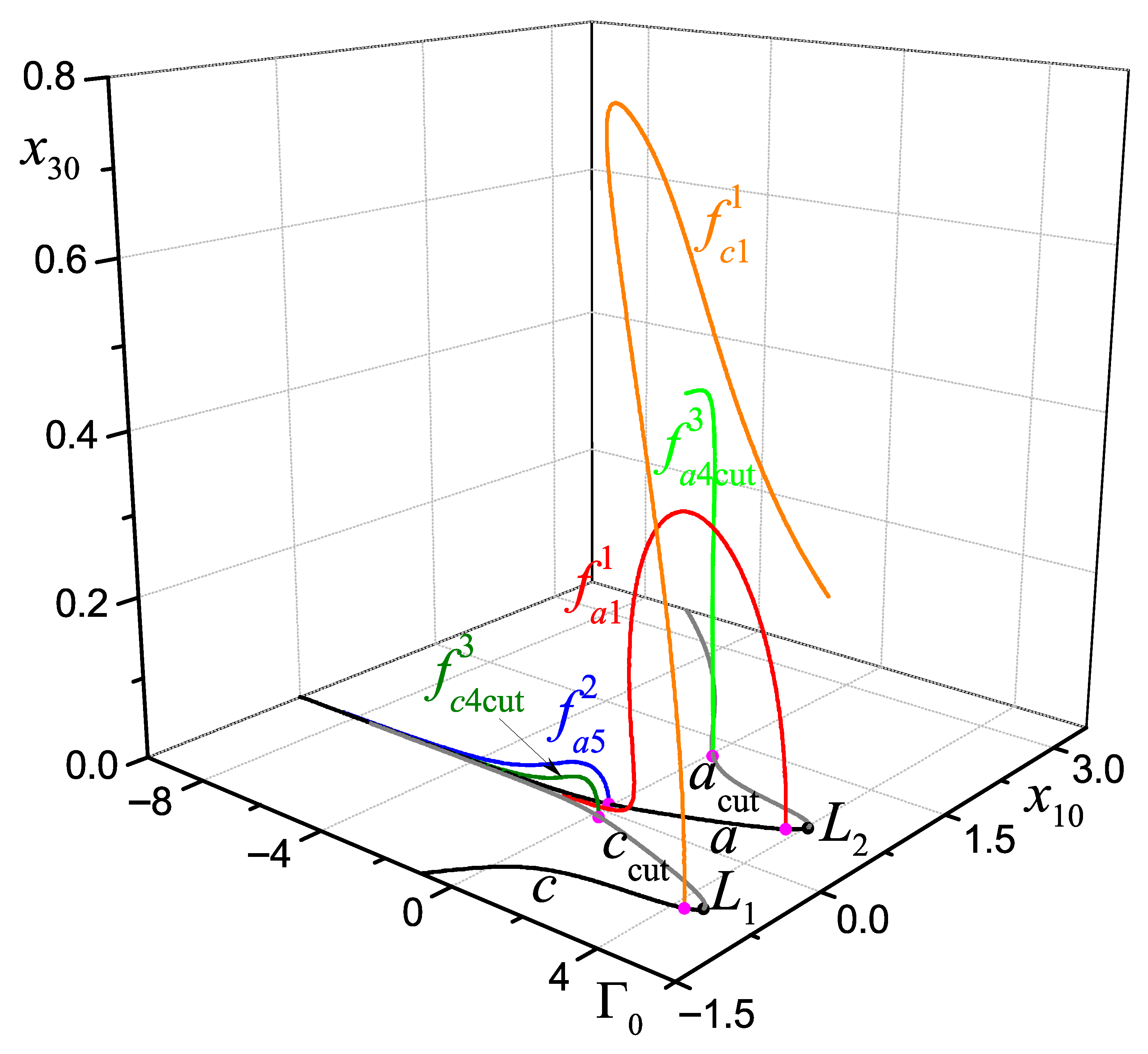
In addition, characteristic curves describing the evolution of these branches are presented in Figure 6. An examination of these curves and the associated data provides the following information regarding their termination behavior. Two of the branches belong to the multiplicity class q = 1 : The branch f a 1 1 terminates when the first perpendicular intersection of its orbits with the O x 1 x 3 plane approaches collision with P 2 . The termination of the branch f c 1 1 occurs when the second perpendicular intersection of its orbits with the same plane reaches the secondary body. For q = 2 , there is a single bifurcating family, namely f a 5 2 . This family ceases to exist when both perpendicular intersections of its members with the O x 1 x 3 plane collide with P 2 during its evolution. The remaining two branches correspond to the case q = 3 . The family f a 4 cut 3 terminates in collision with P 2 when the first perpendicular intersection of its orbits with this plane approaches P 2 . Similarly, the family f c 4 cut 3 terminates when the first perpendicular intersection of its members with O x 1 x 3 approaches P 2 .
We now consider the branches formed by orbits with A-P symmetry. In Table 4, we present data for representative orbits of these families. Each row of the table lists the bifurcation point from which the corresponding branch originates, the name of the branch, the half-period of the specific member, the coordinates x 10 , x 50 , x 60 of its initial state vector, as well as the corresponding value of Γ 0 . The final column indicates whether all members of the corresponding family are unstable (U) or whether the family contains segments of stable members (S).
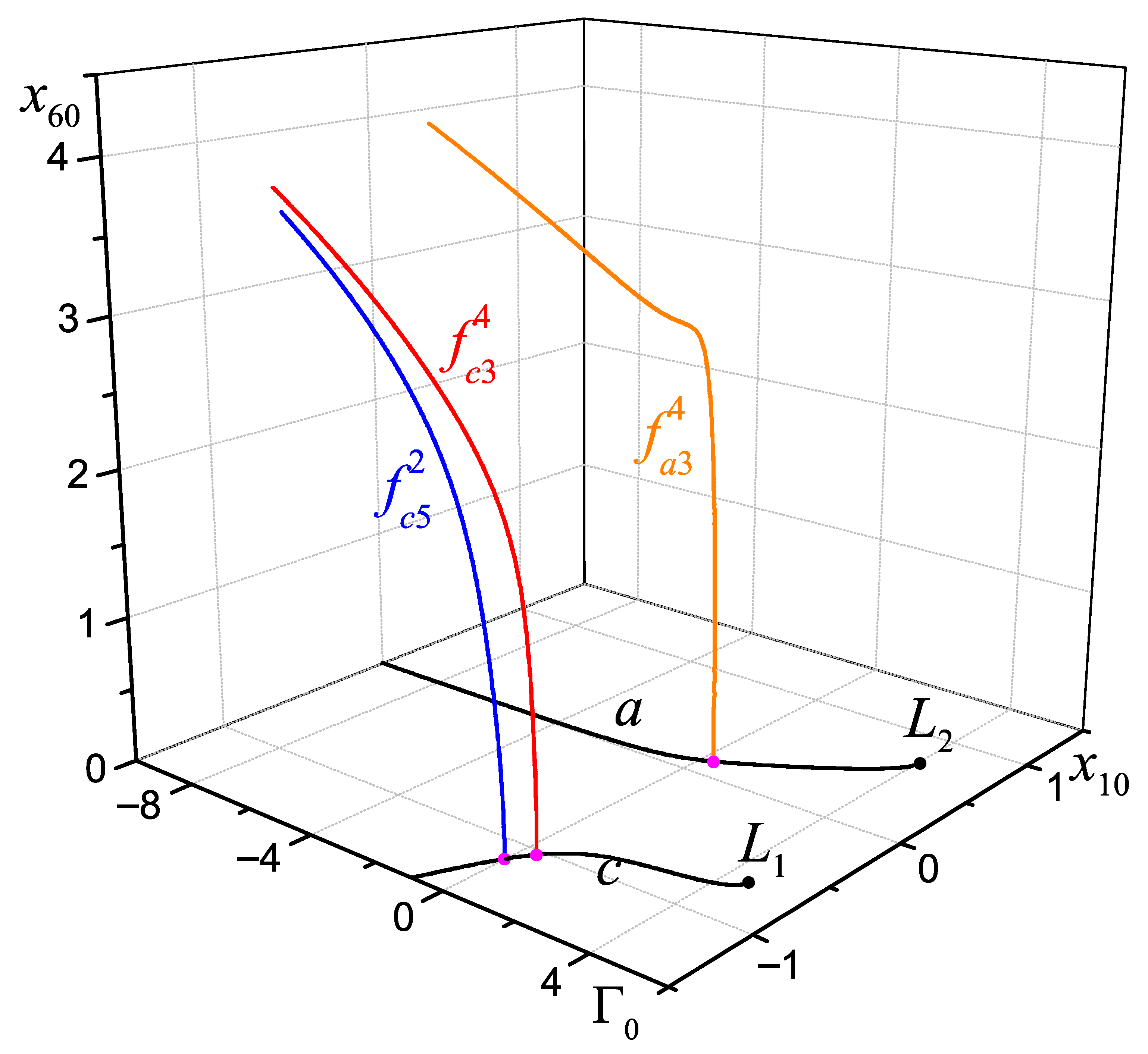
The evolution of these branches is illustrated by the characteristic curves presented in Figure 7. An examination of these curves and the associated data yields the following information regarding the termination of the A-P branches. There exists one branch belonging to the multiplicity class q = 2 , namely f a 5 2 . This branch terminates in collision with P 2 , as the perpendicular intersection of its members with the O x 1 x 3 plane at T = t / 4 gradually approaches this body. The remaining two branches correspond to the case q = 4 . The family f a 3 4 ceases to exist when the relevant intersection of its orbits collides with P 2 . Similarly, the family f c 3 4 terminates when its trajectories collide with the secondary body through oblique intersections.
Finally, we consider the branches composed of orbits with P-A symmetry. Table 5 presents data for representative orbits of these families. Each row of the table lists the bifurcation point from which the corresponding branch originates, the name of the branch, the half-period of the specific member, the coordinates x 10 , x 30 , x 50 of its initial state vector, as well as the corresponding value of Γ 0 . The final column indicates whether the corresponding branch contains a segment of stable members (S) or not (U).
The evolution of these branches is illustrated by the characteristic curves presented in Figure 8. An examination of these curves and the associated data yields the following information regarding their termination. Both branches correspond to the multiplicity class q = 4 and terminate in collision with P 2 . More specifically, the family f a 3 cut 4 terminates when its orbits collide with the secondary body at oblique intersections, whereas the family f c 3 cut 4 ceases to exist as its members gradually approach collision with the secondary at epoch t = T / 2 .

5. Conclusions

In this contribution, we investigated the spatial dynamics of Hill’s problem under the influence of radiation pressure exerted by the more massive primary. In particular, we focused on the three-dimensional branches of periodic orbits bifurcating from the Lyapunov families a and c, which consist of planar symmetric periodic orbits emanating from the collinear equilibrium points.
We began by computing the planar Lyapunov families for a representative value of the radiation parameter, Q 1 = 0.2 , using a grid search to obtain suitable initial guesses, followed by a differential correction scheme for accurate orbit continuation. The vertical stability of these families was then analyzed, allowing the identification of Vertical Critical (VC) and Vertical Self-Resonant (VSR) periodic orbits with multiplicity up to four. In each family, five such bifurcation points were detected and labeled a 1 a 5 and c 1 c 5 , respectively. Subsequently, these VC and VSR orbits were continued with respect to the radiation parameter Q 1 over the interval [ 0 , 1 ] . The results indicate that, despite the loss of symmetry with respect to the Oy axis, these families persist throughout this range, while for Q 1 = 0 all series converge to the corresponding bifurcation points of the classical Hill’s problem.
The three-dimensional branches bifurcating from these ten points were subsequently computed for the case Q 1 = 0.2 . We found that six of the bifurcation points give rise to a single spatial family, while the remaining four give rise to two distinct families, resulting in a total of fourteen branches. The first group includes a 1 , a 2 , a 5 and c 1 , c 2 , c 5 , which generate the families f a 1 1 , f a 2 1 , f a 5 2 and f c 1 1 , f c 2 1 , f c 5 2 , respectively. The second group, consisting of a 3 , a 4 and c 3 , c 4 , gives rise to eight families in total, namely f a 3 4 , f a 3 cut 4 , f a 4 3 , f a 4 cut 3 and f c 3 4 , f c 3 cut 4 , f c 4 3 , f c 4 cut 3 . In the notation of all branches, the superscripts denote the multiplicity of the bifurcating 3D orbits. All computed spatial families were classified according to their symmetry types. We found that four families exhibit axis–axis (A-A) symmetry, four exhibit plane–plane (P-P) symmetry, three exhibit axis–plane (A-P) symmetry, and two consist of plane–axis (P-A) symmetric orbits. Among all computed families, only f a 2 1 and f c 2 1 terminate on coplanar orbits, specifically on the original Lyapunov families a and c from which they bifurcate. In both cases, the termination occurs at the second vertical intersection of the planar orbits with the O x 1 axis, distinct from the initial bifurcation point. All remaining branches terminate in collision trajectories with the secondary body, indicating the limits of their evolution.
Beyond the aforementioned computational results, it is important to discuss the qualitative aspects of our study. A key difference between the classical Hill’s problem and its photogravitational counterpart lies in the absence of symmetry with respect to the Oy axis in the latter case. As a consequence, the structure of the phase space is significantly altered: the coplanar equilibrium points are shifted and are no longer symmetric with respect to the origin. Accordingly, the evolution of the characteristic curves and the members of the Lyapunov families are no longer not affected by this symmetry. The same applies to the spatial bifurcation points of these families and to the corresponding three-dimensional branches that emanate from them. As a result, additional types of dynamical behavior emerge in the photogravitational Hill’s problem.
The study of three-dimensional periodic orbits in non-planar dynamical systems is of fundamental importance, as these trajectories constitute the backbone that organizes the associated phase space. They represent invariant solutions that capture essential dynamical mechanisms, thereby enabling the analysis of stability properties, bifurcations, and the structure of chaotic motion in such systems. For instance, such motions may provide additional mechanisms for the trapping of interplanetary dust in the solar system, thereby helping to explain dust concentrations outside the orbital planes of the main bodies or the formation of planetary rings. In the context of artificial satellites used as space observatories, three-dimensional periodic orbits (e.g., halo or Lissajous trajectories) are particularly useful, as they can provide continuous, uninterrupted observations of the far side of celestial bodies or of deep space.
A natural extension of the present work would be the investigation of the Lyapunov families of the photogravitational Hill’s problem and their spatial bifurcations for values of the radiation pressure parameter different from Q 1 = 0.2 . Such values may be more relevant for flight mission design. It is also of interest to study the corresponding 3D bifurcations of the remaining basic planar families of the photogravitational Hill’s problem, which consist of simple periodic orbits (i.e., families f, g, and g ). Such an analysis would complement the present study and contribute to a more complete description of the spatial dynamics in the presence of radiation pressure. It would also serve as a direct continuation of earlier results obtained for the classical Hill’s problem without radiation pressure [36,37]. This investigation would enable a systematic exploration of all 3D branches originating from the basic planar families, thereby enhancing our understanding of the behavior of spatial periodic orbits when radiation pressure is incorporated into Hill’s problem.


Author Contributions

Conceptualization, O.R., A.E.P., E.A.P. and V.S.K.; methodology, O.R., A.E.P., E.A.P. and V.S.K.; software, O.R., A.E.P., E.A.P. and V.S.K.; validation, O.R., A.E.P., E.A.P. and V.S.K.; formal analysis, O.R., A.E.P., E.A.P. and V.S.K.; investigation, O.R., A.E.P., E.A.P. and V.S.K.; resources, O.R., A.E.P., E.A.P. and V.S.K.; data curation, O.R., A.E.P., E.A.P. and V.S.K.; writing—original draft preparation, O.R., A.E.P., E.A.P. and V.S.K.; writing—review and editing, O.R., A.E.P., E.A.P. and V.S.K.; visualization, O.R., A.E.P., E.A.P. and V.S.K.; supervision, O.R., A.E.P., E.A.P. and V.S.K. All authors have read and agreed to the published version of the manuscript.

Funding

This research received no external funding.

Data Availability Statement

The original contributions presented in this study are included in the article. Further inquiries can be directed to the corresponding author.

Acknowledgments

The authors would like to thank the reviewers for their constructive and insightful comments, which helped improve the quality and clarity of the manuscript.

Conflicts of Interest

The authors declare no conflicts of interest.

Appendix A

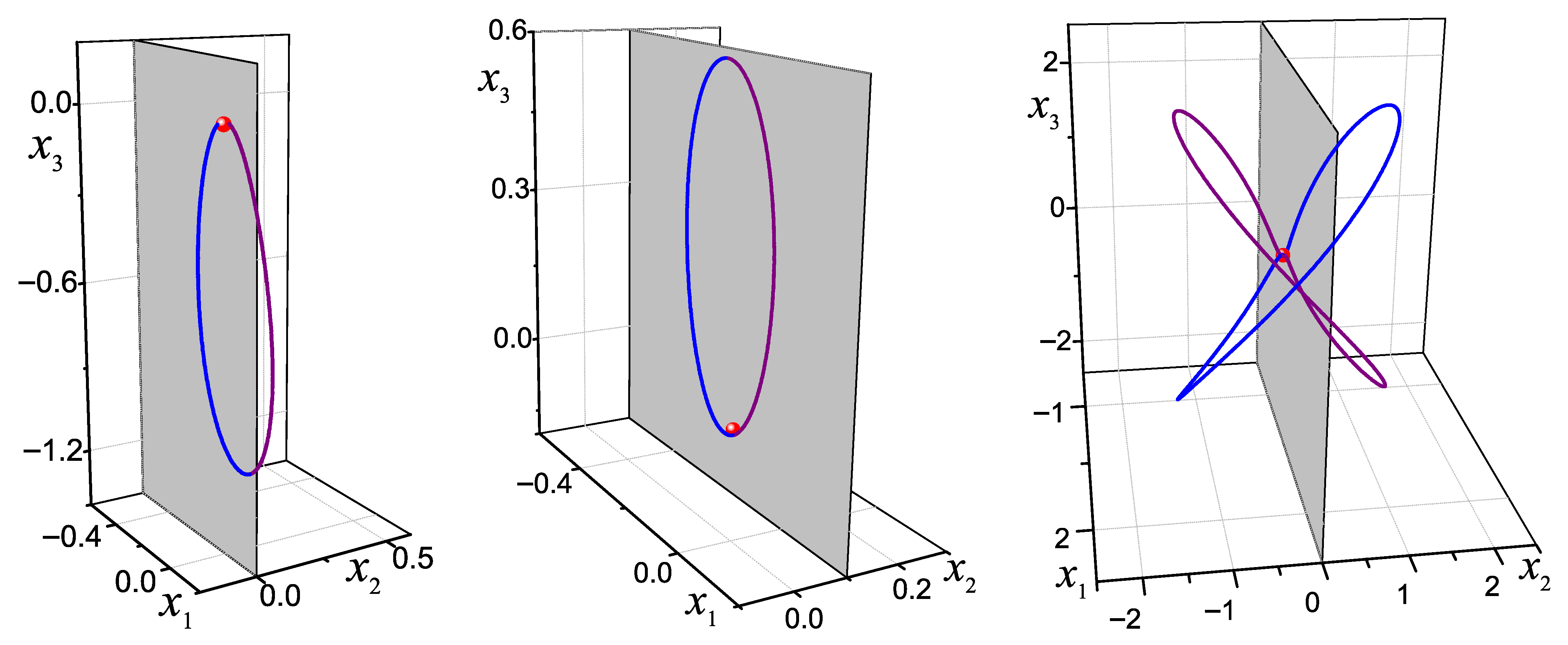
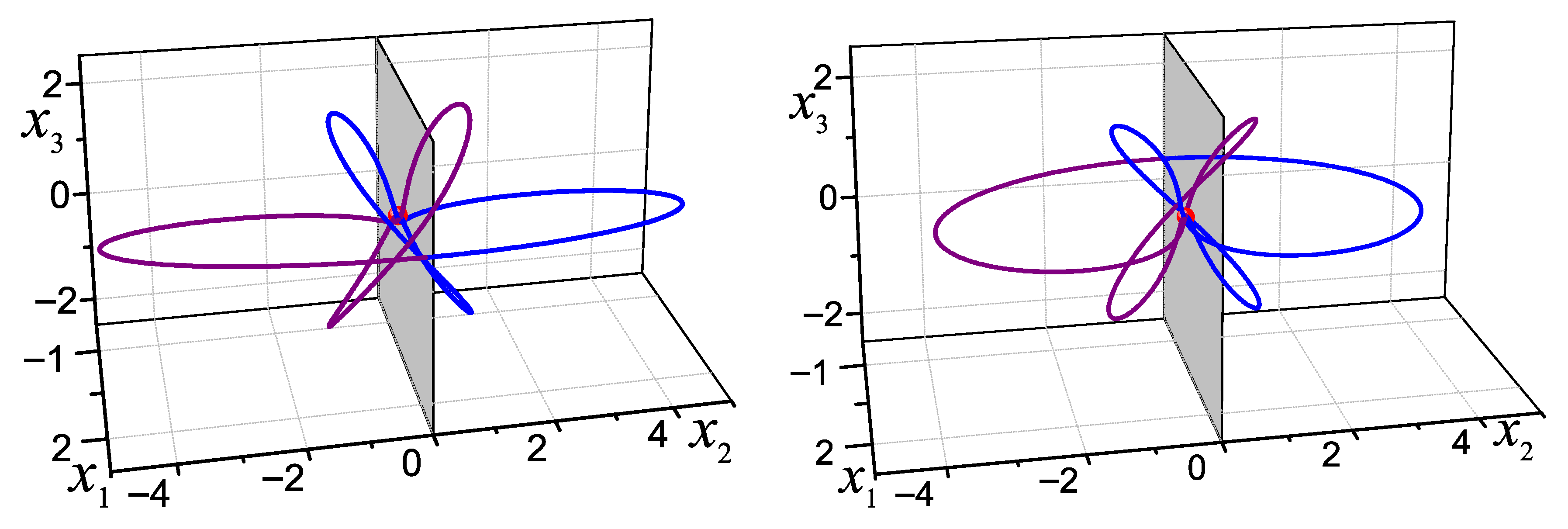
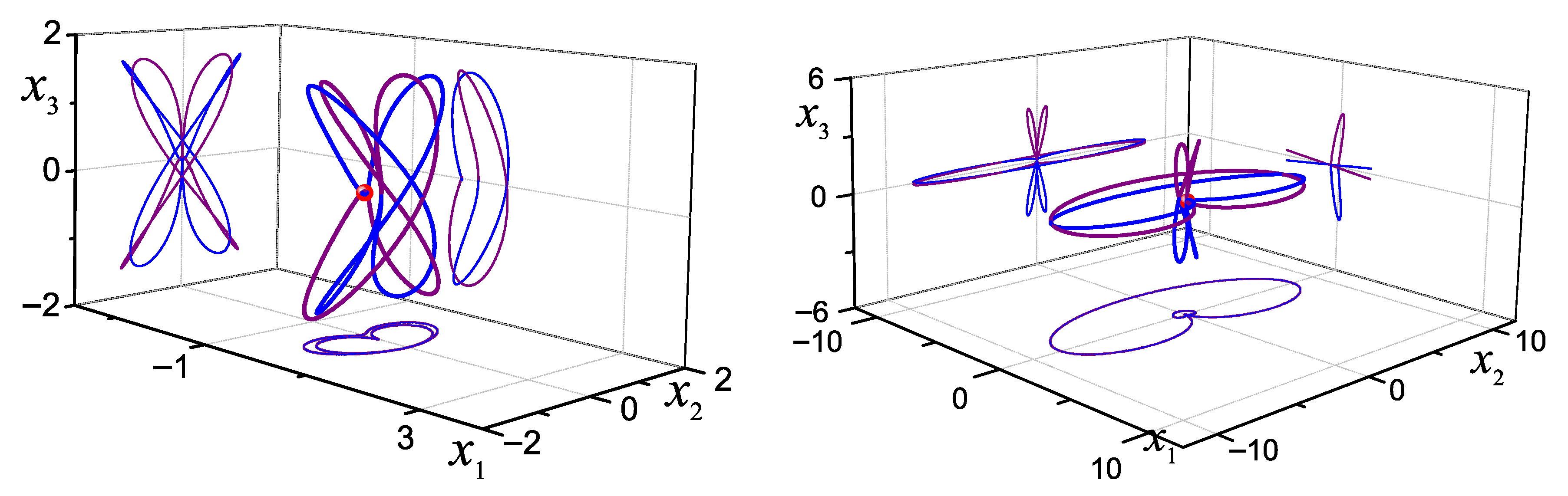
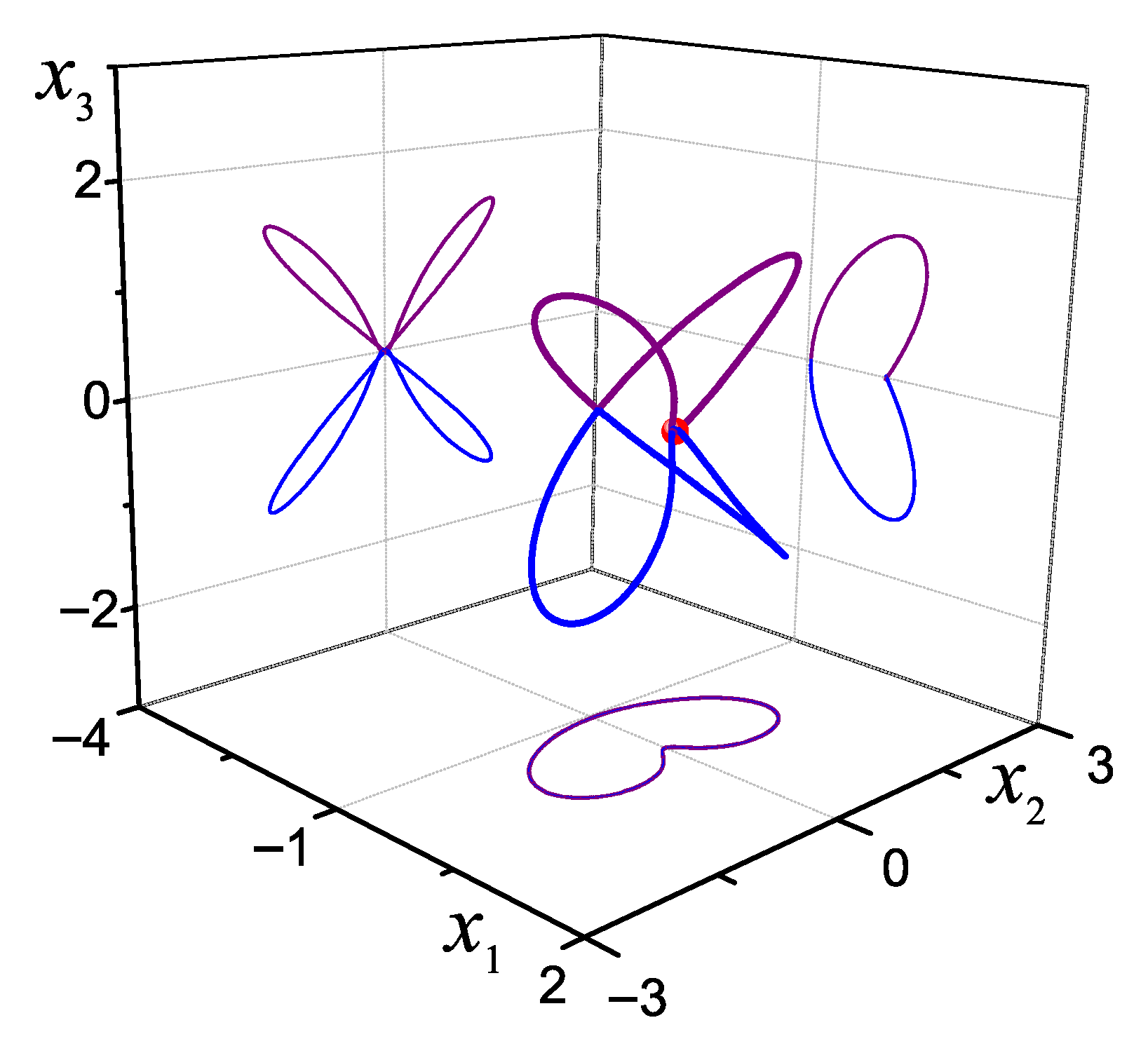
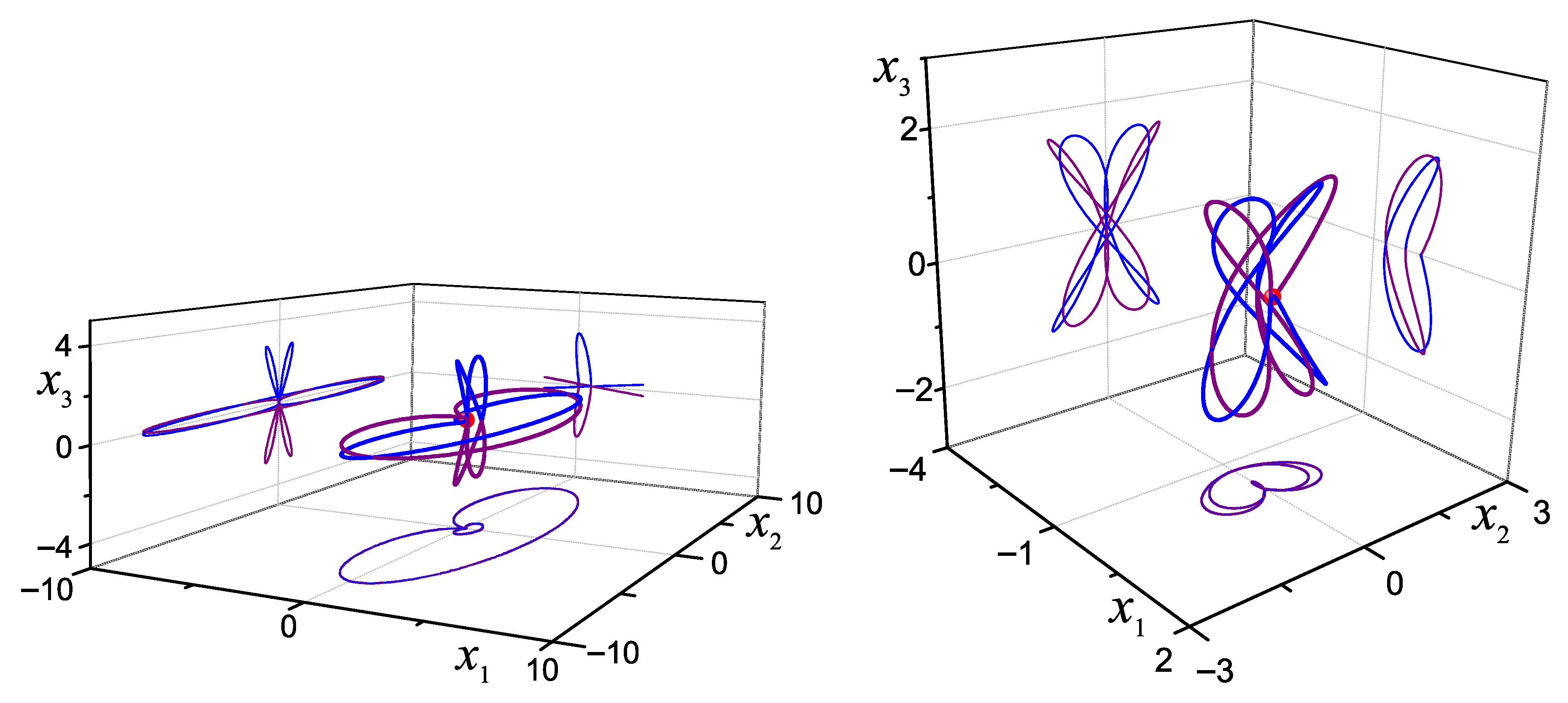
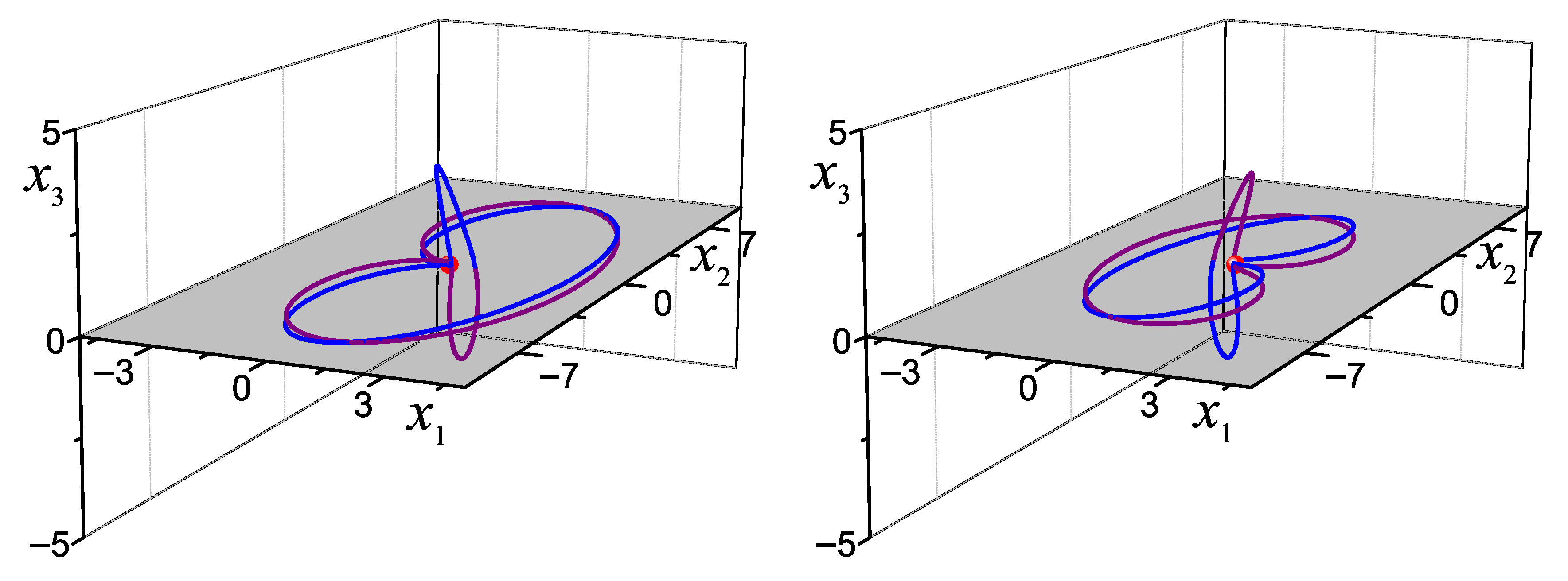
In this appendix, we include graphs for sample orbits from all the computed three-dimensional branches that lead to collision with the secondary body. For each branch, we have selected a representative member near its termination. For orbits exhibiting O x 1 O x 1 x 3 or O x 1 x 3 O x 1 symmetry (A-P or P-A), we also provide their projections onto the O x 1 x 2 , O x 1 x 3 , and O x 2 x 3 planes to illustrate their spatial structure. In the case of O x 1 O x 1 symmetric orbits (A-A), the O x 1 x 2 plane is shown in light gray to emphasize symmetry, while for O x 1 x 3 O x 1 x 3 symmetric ones (P-P), the O x 1 x 3 plane is highlighted for similar reasons. Orbit segments corresponding to different time intervals are color-coded, with purple used to present the part of each trajectory from t = 0 to T / 2 and blue applied to denote the respective corresponding part from t = T / 2 to T. The red dot marks the position of the secondary body. These visualizations complement the numerical results by highlighting the geometric features of each family near its termination.
Figure A1. Representative orbits from the families f a 4 3 (left panel) and f c 4 3 (right panel) near their termination points. The segments in color purple correspond to the evolution from t = 0 to T / 2 while the segments in blue depict the motion from t = T / 2 to T. The red dot indicates the position of the secondary body.
Mathematics 14 01625 g0a1
Figure A2. Representative orbits from the families f a 1 1 (left panel), f c 1 1 (center panel) and f a 5 2 (right panel) near their termination points. The segments traced in purple color correspond to the interval t = 0 to T / 2 while those in blue correspond to t = T / 2 to T. The red dot marks the location of the secondary body.
Mathematics 14 01625 g0a2
Figure A3. Representative orbits from the families f a 4 c u t 3 (left panel) and f c 4 c u t 3 (right panel) near their termination points. The segments shown in color purple correspond to the time interval t = 0 to T / 2 while those in blue correspond to t = T / 2 to T. The red dot indicates the position of the secondary body.
Mathematics 14 01625 g0a3
Figure A4. Representative orbits from families f a 3 4 (left panel) and f c 3 4 (right panel) near their termination points, shown together with their projections onto the O x 1 x 2 , O x 1 x 3 , and O x 2 x 3 planes. The purple segments correspond to the time interval t = 0 to T / 2 while the segments in blue represent the interval from t = T / 2 to T. The red dot indicates the position of the secondary body.
Mathematics 14 01625 g0a4
Figure A5. Representative orbit from family f c 5 2 near its termination point, shown along with its projections onto the O x 1 x 2 , O x 1 x 3 , and O x 2 x 3 planes. The segment in color purple corresponds to the time interval t = 0 to T / 2 while the segment in blue represents the interval from t = T / 2 to T. The red dot indicates the position of the secondary body.
Mathematics 14 01625 g0a5
Figure A6. Representative orbits from families f a 3 c u t 4 (left panel) and f c 3 c u t 4 (right panel) near their termination points, shown alongside their projections onto the O x 1 x 2 , O x 1 x 3 , and O x 2 x 3 planes. The segments colored purple correspond to the time interval t = 0 to T / 2 while the segments colored blue cover the interval from t = T / 2 to T. The red dot indicates the position of the secondary body.
Mathematics 14 01625 g0a6

References

  1. Szebehely, V. Theory of Orbits: The Restricted Problem of Three Bodies; Academic Press: London, UK, 1967. [Google Scholar] [CrossRef]
  2. Gao, F.B.; Zhang, W. A study on periodic solutions for the circular restricted three-body problem. Astron. J. 2014, 148, 116. [Google Scholar] [CrossRef]
  3. Musielak, Z.; Quarles, B. Three Body Dynamics and Its Applications to Exoplanets; Springer Briefs in Astronomy; Springer: Cham, Switzerland, 2017. [Google Scholar] [CrossRef]
  4. Voyatzis, G.; Tsiganis, K.; Antoniadou, I. Inclined asymmetric librations in exterior resonances. Celest. Mech. Dyn. Astr. 2018, 130, 29. [Google Scholar] [CrossRef]
  5. Ragos, O.; Zagouras, C. Periodic solutions around the collinear langrangian points in the photogravitational restricted three-body problem: Sun–Jupiter case. Celest. Mech. Dyn. Astr. 1990, 50, 325–347. [Google Scholar] [CrossRef]
  6. Niedzielska, Z. Nonlinear stability of the libration points in the photogravitational restricted three body problem. Celest. Mech. Dyn. Astr. 1994, 58, 203–213. [Google Scholar] [CrossRef]
  7. Verrier, P.; Waters, T.; Sieber, J. Evolution of the L1 halo family in the radial solar sail circular restricted three-body problem. Celest. Mech. Dyn. Astr. 2014, 120, 373–400. [Google Scholar] [CrossRef]
  8. Abouelmagd, E.I.; Alhothuali, M.S.; Guirao, J.L.G.; Malaikah, H.M. The effect of zonal harmonic coefficients in the framework of the restricted three body problem. Adv. Space Res. 2015, 55, 1660–1672. [Google Scholar] [CrossRef]
  9. Zotos, E.E. Unveiling the influence of the radiation pressure in nature of orbits in the photogravitational restricted three-body problem. Astrophys. Space Sci. 2015, 360, 1. [Google Scholar] [CrossRef]
  10. Pathak, N.; Thomas, V.O.; Abouelmagd, E.I. The perturbed photo-gravitational restricted three-body problem: Analysis of resonant periodic orbits. Discret. Contin. Dyn. Syst. S 2019, 12, 849–875. [Google Scholar] [CrossRef]
  11. Zotos, E.E.; Suraj, S.M.; Aggarwal, R.; Mittal, A. Orbit classification in the Copenhagen problem with oblate primaries. Astron. Nachr. 2019, 340, 760–770. [Google Scholar] [CrossRef]
  12. Gao, F.; Wang, R. Bifurcation analysis and periodic solutions of the HD 191408 system with triaxial and radiative perturbations. Universe 2020, 6, 35. [Google Scholar] [CrossRef]
  13. Ragos, O.; Perdiou, A.E.; Perdios, E.A. The three-body interaction effect on the families of 3D periodic orbits associated to Sitnikov motion in the circular restricted three-body problem. J. Astronaut. Sci. 2020, 67, 28–58. [Google Scholar] [CrossRef]
  14. Abouelmagd, E.I.; Pal, K.A.; Guirao, J.L.G. Analysis of nominal halo orbits in the Sun-Earth system. Arch. Appl. Mech. 2021, 91, 4751–4763. [Google Scholar] [CrossRef]
  15. Bello, N.; Umar, A.; Hussain, A.A. Locations of L4,5 of a dust grain type II comet tail in Solar-Jupiter system in the photogravitational relativistic R3BP. IOP SciNotes 2021, 2, 045001. [Google Scholar] [CrossRef]
  16. Suraj, M.S.; Aggarwal, R.; Asique, M.C.; Mittal, A.; Jain, M.; Paliwal, V.K. Effect of three-body interaction on the topology of basins of convergence linked to the libration points in the R3BP. Planet. Space Sci. 2021, 205, 105281. [Google Scholar] [CrossRef]
  17. Abbasali, E.; Kosari, A.; Bakhtiari, M. Solar sail orbital motion at the non-autonomous oblate earth-moon system: Family of periodic orbits. Arch. Appl. Mech. 2024, 94, 3785–3801. [Google Scholar] [CrossRef]
  18. Voyatzis, G.; Karydis, D.; Gkolias, I.; Gaitanas, M.; Tsiganis, K. Planar spacecraft trajectories in the Didymos–Dimorphos binary asteroid system. Planet. Space Sci. 2024, 240, 105825. [Google Scholar] [CrossRef]
  19. Abdullah, M.A.; Aneja, S.; Prasad, S.N. To study the relativistic effect in the perturbed circular restricted three-body problem. Mod. Phys. Lett. A 2025, 40, 2550027. [Google Scholar] [CrossRef]
  20. Herrero, A.; Moll-Lopez, S.; Moraño, J.-A.; Vega-Fleitas, E.; Villalibre, D. Basins of convergence in a multi-perturbed CR3BP. Appl. Sci. 2025, 15, 106. [Google Scholar] [CrossRef]
  21. Kalantonis, V.S.; Ragos, O.; Perdiou, A.E.; Perdios, E.A. Numerical exploration of the Lyapunov families and their spatial bifurcations in the R3BP under the presence of a three-body interaction. Int. J. Nonlin. Mech. 2025, 178, 105152. [Google Scholar] [CrossRef]
  22. Meena, O.P.; Lohani, M.; Sen, S.; Mishra, D.; Aggarwal, R. Application of Fourier series to the dynamics of a test particle in the CR3BP with an oblate primary. Int. J. Nonlin. Mech. 2025, 172, 105030. [Google Scholar] [CrossRef]
  23. Hill, G.W. Researches in the lunar theory. Amer. J. Math. 1878, 1, 5–26. [Google Scholar] [CrossRef]
  24. Hénon, M. Numerical exploration of the restricted problem V. Hill’s case: Periodic orbits and their stability. Astron. Astrophys. 1969, 1, 223–238. [Google Scholar]
  25. Gómez, G.; Marcote, M.; Mondelo, J.M. The invariant manifold structure of the spatial Hill’s problem. Dyn. Syst. 2005, 20, 115–147. [Google Scholar] [CrossRef]
  26. Voyatzis, G.; Gkolias, I.; Varvoglis, H. The dynamics of the elliptic Hill problem: Periodic orbits and stability regions. Celest. Mech. Dyn. Astr. 2012, 113, 125–139. [Google Scholar] [CrossRef][Green Version]
  27. Villac, B.F. Dynamics in the Hill Problem with Applications to Spacecraft Maneuvers. Ph.D. Dissertation, University of Michigan, Ann Arbor, MI, USA, 2003. Available online: https://deepblue.lib.umich.edu/items/f1b61573-4d25-4f29-9136-763bb5c6b1ad (accessed on 30 March 2026).
  28. Giancotti, M.; Campagnola, S.; Tsuda, Y.; Kawaguchi, J. Families of periodic orbits in Hill’s problem with solar radiation pressure: Application to Hayabusa 2. Celest. Mech. Dyn. Astr. 2014, 120, 269–286. [Google Scholar] [CrossRef]
  29. Yárnoz, D.G.; Scheeres, D.J.; McInnes, C.R. On the a and g families of orbits in the Hill problem with solar radiation pressure and their application to asteroid orbiters. Celest. Mech. Dyn. Astr. 2015, 121, 365–384. [Google Scholar] [CrossRef][Green Version]
  30. Stramacchia, M.; Colombo, C.; Bernelli-Zazzera, F. Distant retrograde orbits for space-based near earth objects detection. Adv. Space Res. 2016, 58, 967–988. [Google Scholar] [CrossRef]
  31. Meyer, K.R.; Offin, D.C. Introduction to Hamiltonian Dynamical Systems and the N–Body Problem; Springer International Publishing: Cham, Switzerland, 2017. [Google Scholar] [CrossRef]
  32. Hénon, M. Vertical stability of periodic orbits in the restricted problem II. Hill’s case. Astron. Astrophys. 1974, 30, 317–321. [Google Scholar]
  33. Zagouras, C.; Markellos, V.V. Three–dimensional periodic solutions around equilibrium points in Hill’s problem. Celest. Mech. 1985, 35, 257–267. [Google Scholar] [CrossRef]
  34. Hénon, M. New families of periodic orbits in Hill’s problem of three-bodies. Celest. Mech. Dyn. Astr. 2003, 85, 223–246. [Google Scholar] [CrossRef]
  35. Villac, B.F.; Scheeres, D.J. Escaping trajectories in the Hill three-body problem and applications. J. Guid. Control Dyn. 2003, 26, 224–232. [Google Scholar] [CrossRef]
  36. Batkhin, A.B.; Batkhina, N.V. Hierarchy of periodic solutions families of spatial Hill’s problem. Sol. Syst. Res. 2009, 43, 178–183. [Google Scholar] [CrossRef]
  37. Kalantonis, V.S. Numerical investigation for periodic orbits in the Hill three-body problem. Universe 2020, 6, 72. [Google Scholar] [CrossRef]
  38. Aydin, C. The Conley-Zehnder indices of the spatial Hill three-body problem. Celest. Mech. Dyn. Astr. 2023, 135, 32. [Google Scholar] [CrossRef]
  39. Aydin, C.; Batkhin, A.B. Studying network of symmetric periodic orbit families of the Hill problem via symplectic invariants. Celest. Mech. Dyn. Astr. 2025, 137, 12. [Google Scholar] [CrossRef]
  40. Or-Hof, J.; Gurfil, P.; Batkhin, A. Transient-collision trajectories in Hill’s problem with an oblate primary: Application to the Mars-Deimos system. Celest. Mech. Dyn. Astr. 2026, 138, 10. [Google Scholar] [CrossRef]
  41. Markellos, V.V.; Roy, A.E.; Velgakis, M.J.; Kanavos, S.S. A photogravitational Hill problem and radiation effects on Hill stability of orbits. Astrophys. Space Sci. 2000, 271, 293–301. [Google Scholar] [CrossRef]
  42. Kanavos, S.S.; Markellos, V.V.; Perdios, E.A.; Douskos, C.N. The photogravitationsl Hill problem: Numerical exploration. Earth Moon Planets 2002, 91, 223–241. [Google Scholar] [CrossRef]
  43. Tsirogiannis, G.A.; Perdios, E.A.; Markellos, V.V. Improved grid search method: An efficient tool for global computation of periodic orbits: Application to Hill’s problem. Astrophys. Space Sci. 2009, 103, 49–78. [Google Scholar] [CrossRef]

  44. Vincent, A.E.; Tsirogiannis, G.A.; Perdiou, A.E.; Kalantonis, V.S. Out–of–plane equilibrium points in the photogravitational Hill three-body problem. Symmetry 2024, 16, 1374. [Google Scholar] [CrossRef]
  45. Hansen, B.M.S.; Hayakawa, K. Bound circumplanetary orbits under the influence of radiation pressure: Application to dust in directly imaged exoplanet systems. Open J. Astrophys. 2024, 7. [Google Scholar] [CrossRef]
  46. Baoyin, H.; McInnes, C.R. Solar sail halo orbits at the Sun-Earth artificial L1 point. Celest. Mech. Dyn. Astr. 2016, 94, 155–171. [Google Scholar] [CrossRef]
  47. Katherine, Y.; Villac, B. Periodic orbits families in the Hill’s three-body problem with solar radiation pressure. Adv. Astronaut. Sci. 2010, 136, 285–300. [Google Scholar]
  48. Radzievskii, V.V. The restricted problem of three bodies taking account of light pressure. Astron. Zhurnal 1950, 27, 250–256. [Google Scholar]
  49. Simmons, J.F.L.; McDonald, A.J.C.; Brown, J.C. The restricted 3–body problem with radiation pressure. Celest. Mech. 1985, 35, 145–187. [Google Scholar] [CrossRef]
  50. Schuerman, D.W. The restricted three-body problem including radiation pressure. Astrophys. J. 1980, 238, 337–342. [Google Scholar] [CrossRef]
  51. Robin, I.A.; Markellos, V.V. Periodic orbits generated from vertical self-resonant satellite orbits. Celest. Mech. 1980, 21, 395–434. [Google Scholar] [CrossRef]
  52. Hénon, M. Vertical stability of periodic orbits in the restricted problem I. Equal masses. Astron. Astrophys. 1973, 28, 415–426. [Google Scholar]
  53. Perdios, E.; Markellos, V.V. Stability and bifurcations of Sitnikov motions. Celest. Mech. 1988, 42, 187–200. [Google Scholar] [CrossRef]
  54. Markellos, V.V.; Black, W.; Moran, P.E. A grid search for families of periodic orbits in the restricted problem of three bodies. Celest. Mech. 1974, 9, 507–512. [Google Scholar] [CrossRef]
  55. Roy, A.E.; Ovenden, M.W. On the occurrence of commensurable mean motions in the solar system: The mirror theorem. Mon. Not. Roy. Astron. Soc. 1955, 11, 296–309. [Google Scholar] [CrossRef]
Figure 1. Zero velocity curves on the O x y plane. (a) This curve corresponds to Γ ( L 1 ) = Γ ( L 2 ) for Q 1 = 0 . (b,c) The remaining curves correspond to Γ ( L 1 ) and Γ ( L 2 ) for Q 1 = 0.2 . Motion is permitted in the white regions and forbidden in the grey regions.
Mathematics 14 01625 g001
Figure 2. Lyapunov families of planar periodic orbits in Hill’s problem with radiation pressure for Q 1 = 0.2 . Forbidden regions to motion are shown with brown color, while the red dashed line indicates the position of the smaller primary body. Black lines represent the first cut ( Γ 0 , x 10 ) of the members of these families with the O x 1 axis, while gray lines stand for the second one, i.e., ( Γ 0 , x 1 c u t ) .
Mathematics 14 01625 g002
Figure 3. (a) Vertical stability of the family a, which emanates from L 2 , for Q 1 = 0.2 . The points named as a i , i = 1 , 2 , 5 , represent the VC/VSR orbits of a. (b) Series of the VC and VSR orbits presented in the neighboring figure w.r.t. the variation of Q 1 in the range [ 0 , 1 ] . The curves named S a i , i = 1 , 2 , 5 , represent these series. The blue dashed vertical line indicates the value Q 1 = 0.2 .
Mathematics 14 01625 g003
Figure 4. (a) Vertical stability of the family c, which emanates from L 1 , for Q 1 = 0.2 . The points named a i , i = 1 , 2 , 5 , represent the VC/VSR orbits of c. (b) Series of the VC and VSR orbits presented in the neighboring figure w.r.t. the variation of Q 1 in the range [ 0 , 1 ] . The curves named S c i , i = 1 , 2 , 5 , represent these series. The blue dashed vertical line indicates the value Q 1 = 0.2 .
Mathematics 14 01625 g004
Figure 5. 3D branches bifurcating from the VC/VSR orbits of Lyapunov families. The members of these branches possess A-A symmetry.
Mathematics 14 01625 g005
Figure 6. 3D branches bifurcating from the VC/VSR orbits of Lyapunov families. The members of these branches possess P-P symmetry.
Mathematics 14 01625 g006
Figure 7. 3D branches bifurcating from the VC/VSR orbits of Lyapunov families. The members of these branches possess A-P symmetry.
Mathematics 14 01625 g007
Figure 8. 3D branches bifurcating from the VC/VSR orbits of Lyapunov families. The members of these branches possess P-A symmetry.
Mathematics 14 01625 g008
Table 1. Bifurcation points (VC/VSR orbits) of the Lyapunov families a and c for Q 1 = 0.2 .
BP T / 2 x 10 x 50 Γ 0 x 1 cut a v = d v b v c v
a 1 1.59774367 0.59495129 0.68596549 3.71499169 0.80655739 1.000 0.090 0.000
a 2 2.12338953 0.23182370 2.74630980 1.15352533 1.00569621 1.000 0.000 25.041
a 3 2.59490594 0.13955523 3.74593691 0.30180528 1.17148435 0.000 0.024 41.492
a 4 2.74120895 0.12081136 4.05634805 0.09623711 1.23272445 0.500 0.026 28.395
a 5 2.87049716 0.10635657 4.34454934 0.07904756 1.29215682 1.000 0.027 0.000
c 1 1.48621667 0.74507788 0.60033765 4.28733216 0.56836716 1.000 0.117 0.000
c 2 2.00261244 0.89345387 1.92702659 1.27723345 0.19395771 1.000 0.000 4.070
c 3 2.48493608 1.03467278 2.27549522 0.38061217 0.10919992 0.000 0.193 5.171
c 4 2.64003830 1.09024971 2.38064346 0.16901198 0.09244067 0.500 0.143 5.245
c 5 2.77922556 1.14528116 2.47976001 0.00979434 0.07968445 1.000 0.000 5.215
Table 2. Sample members of 3D branches arising from the bifurcation points of the Lyapunov families for Q 1 = 0.2 : the branches consist of orbits that possess A-A (O x 1 O x 1 ) symmetry. These branches arise from the VC/VSR orbits presented in the first column.
BPBranch T / 2 x 10 x 50 x 60 Γ 0 Stability
a 2 f a 2 1 2.12339963 0.23184850 2.74571462 0.05000000 1.15339589 U
a 4 f a 4 3 8.24090381 0.12017018 4.03941873 0.50000000 0.07141455 U
c 2 f c 2 1 2.00266913 0.89320048 1.92637278 0.05000000 1.27642837 U
c 4 f c 4 3 8.02323180 1.05968664 2.31878919 0.50000000 0.05324907 U
Table 3. Sample members of 3D branches of the Lyapunov families for Q 1 = 0.2 : The branches consist of orbits that possess P-P (O x 1 x 3 O x 1 x 3 ) symmetry. These branches arise from the VC/VSR orbits presented in the first column, except f a 4 cut 3 , f c 4 cut 3 that bifurcate from the second vertical intersection of the corresponding orbits with the O x 1 axis.
BPBranch T / 2 x 10 x 30 x 50 Γ 0 Stability
a 1 f a 1 1 1.59753177 0.59107162 0.05000000 0.69864993 3.69269938 S
a 4 f a 4 cut 3 8.25339978 1.24580883 0.05000000 2.38913309 0.05142985 U
a 5 f a 5 2 5.70484528 0.07684836 0.04000000 4.85001249 0.45195725 U
c 1 f c 1 1 1.48589336 0.74463967 0.05000000 0.60657414 4.27071679 S
c 4 f c 4 cut 3 8.07794968 0.07454276 0.03000000 4.99801727 0.04445306 U
Table 4. Sample members of 3D branches of the Lyapunov families for Q 1 = 0.2 : The branches consist of orbits that possess A-P (O x 1 O x 1 x 3 ) symmetry. These branches arise from the VC/VSR orbits presented in the first column.
BPBranch T / 4 x 10 x 50 x 60 Γ 0 Stability
c 5 f c 5 2 2.77915263 1.14509399 2.47938073 0.05000000 0.01148894 U
a 3 f a 3 4 5.18981856 0.13956481 3.74548571 0.05000000 0.30170566 U
c 3 f c 3 4 4.97080083 1.03445626 2.27502480 0.05000000 0.37922680 U
Table 5. Sample members of 3D branches of the Lyapunov families for Q 1 = 0.2 : The branches consist of orbits that possess P-A (O x 1 x 3 O x 1 ) symmetry. These branches arise from from the second vertical intersection of the VC/VSR orbits presented in the first column with the O x 1 axis.
BPBranch T / 4 x 10 x 30 x 50 Γ 0 Stability
a 3 f a 3 cut 4 5.29321342 1.20996603 0.10001045 2.32296557 0.14921720 U
c 3 f c 3 cut 4 4.99798484 0.08073798 0.04000073 4.70689196 0.09206044 U
Disclaimer/Publisher’s Note: The statements, opinions and data contained in all publications are solely those of the individual author(s) and contributor(s) and not of MDPI and/or the editor(s). MDPI and/or the editor(s) disclaim responsibility for any injury to people or property resulting from any ideas, methods, instructions or products referred to in the content.