Article

Autonomous Normal–Cancer Discrimination by a LATS/pLATS-Explicit Hippo–YAP/TAZ Reaction System

Center for Mathematical Modeling and Data Science (MMDS), Osaka University, Toyonaka 560-8531, Japan
*
Author to whom correspondence should be addressed.
Mathematics 2026, 14(1), 99; https://doi.org/10.3390/math14010099
Submission received: 18 November 2025 / Revised: 17 December 2025 / Accepted: 18 December 2025 / Published: 26 December 2025

Abstract

In this study, we propose a minimal reaction system for the Hippo–YAP/TAZ pathway that explicitly includes inactive LATS, active pLATS, cytoplasmic and nuclear YAP/TAZ, and phosphorylated YAP/TAZ. Local cell density is incorporated into the LATS activation term, and nuclear YAP/TAZ controls a threshold-type switch between proliferative and quiescent cell states. This five-variable system of ordinary differential equations is coupled to a three-dimensional molecular dynamics model that provides time-dependent cell positions and densities. We define normal-like and cancer-like conditions by varying only the LATS phosphorylation rate while keeping the initial distribution of YAP/TAZ identical. Under normal-like parameters, increasing cell density leads to rapid accumulation of pLATS and suppression of nuclear YAP/TAZ below the proliferative threshold, resulting in a contact-inhibited epithelium dominated by quiescent cells. In contrast, under cancer-like parameters with delayed LATS activation, nuclear YAP/TAZ in a subset of cells remains above the threshold, and proliferative clusters persist even in high-density regions. These simulations show that, even without any bias in initial concentrations, modest changes in the kinetics of LATS phosphorylation alone can induce a clear bifurcation between normal-like and cancer-like growth at the tissue scale. The results provide a mechanistic bridge linking molecular-level dysregulation of the Hippo pathway to macroscopic tumor expansion.

1. Introduction

The Hippo pathway is a prototypical mechano- and density-responsive signaling cascade that regulates cell proliferation, apoptosis, and organ size control [1]. Recent reviews have further updated the mechanotransductive roles and biological functions of Hippo–YAP/TAZ signaling in development and regeneration [2]. From a modeling perspective, spatial and spatiotemporal frameworks have been proposed to quantify YAP/TAZ nuclear localization under stiffness- and time-dependent mechanical cues [3,4], and the current landscape of computational YAP/TAZ mechanotransduction models has been summarized in a recent review [5]. A representative instance is the Hippo–YAP/TAZ signaling module [6]. In this pathway, upstream serine/threonine kinases such as MST1/2 (Hippo) and LATS1/2 form a kinase cascade, while the transcriptional co-activators YAP (Yes-associated protein) and TAZ (transcriptional co-activator with PDZ-binding motif) act as downstream effectors [6]. Activated MST1/2 and LATS1/2 phosphorylate YAP/TAZ, thereby promoting their cytoplasmic retention and proteasomal degradation and, consequently, suppressing proliferation signals mediated by nuclear TEAD family transcription factors. Conversely, when the Hippo pathway is inactivated, YAP/TAZ become dephosphorylated, accumulate in the nucleus, and cooperate with TEAD and other transcription factors to drive cell proliferation and survival.
Under normal conditions, mechanical cues such as increased cell density lead to activation of MST1/2 and LATS1/2. Activated LATS1/2 phosphorylate YAP/TAZ, inducing 14-3-3-mediated cytoplasmic sequestration and ubiquitin-dependent degradation so that the nuclear fraction of YAP/TAZ remains low [1]. As a result, YAP/TAZ lose their ability to bind TEAD efficiently, and pro-proliferative and pro-survival transcriptional programs are suppressed. In contrast, when the Hippo pathway is functionally inactivated, LATS1/2-mediated phosphorylation is attenuated, dephosphorylated YAP/TAZ translocate into the nucleus and robustly activate proliferation and survival signals. Aberrant nuclear accumulation of YAP/TAZ has been reported to correlate closely with the onset and progression of a variety of cancers [1].
In our previous multicellular simulation study, we introduced a modeling framework in which cell proliferation is controlled through density- and mechanics-dependent regulation of the nuclear YAP/TAZ fraction, and we reproduced the behavior of cancer cells that continue to proliferate even at high density by imposing an exogenous bias: the initial YAP/TAZ concentration in cancer cells was set to twice that of normal cells [7]. However, experimental and molecular biological studies of Hippo dysregulation in cancer often describe oncogenic alterations primarily not as fixed differences in the absolute amount of YAP/TAZ but rather as kinetic defects along the Hippo–LATS axis—such as reduced LATS activity or imbalanced phosphorylation and dephosphorylation rates [8,9]. In other words, it is plausible that differences in the dynamics of LATS-mediated phosphorylation and the corresponding dephosphorylation pathways, rather than in the total YAP/TAZ abundance, play a central role in separating the responses of normal and cancer cells.
The aim of this study is, therefore, to present a concise model in which normal–cancer divergence can be reproduced solely by modifying the kinetics of the Hippo pathway centered on LATS while keeping the initial concentrations fixed. To this end, we construct an ordinary differential equation (ODE) system that incorporates a Hippo–YAP/TAZ reaction scheme based on a publicly available lineage map of human breast cancer cell lines [6], together with a threshold-gating mechanism for cell proliferation controlled by nuclear YAP/TAZ [1]. In particular, we represent with a minimal set of variables (i) the activation and inactivation rates of LATS, (ii) the phosphorylation and dephosphorylation of YAP/TAZ, and (iii) nucleo–cytoplasmic shuttling of YAP/TAZ. Using this model, we systematically investigate how changes in the kinetic parameters of LATS alone alter the time evolution of nuclear YAP/TAZ in response to cell density and mechanical stimuli and how these changes lead to bifurcation between proliferative and quiescent behavior in normal-like versus cancer-like conditions.

2. Materials and Methods

2.1. State Variables and Parameters

For each of the N cells, we introduce the following state variables:
X 1 , i : cytoplasmic YAP / TAZ ; X 2 , i : nuclear YAP / TAZ ; X 3 , i : phosphorylated YAP / TAZ ( cytoplasmic ) ; X 4 , i : inactive LATS ; X 5 , i : active pLATS
for i = 1 , , N . The local cell density around cell i is denoted by ρ i , and X 0 > 0 is a scaling constant for the local density signal. We introduce positive constants a 1 , a 2 , a 3 , a 4 , b 1 , b 2 .
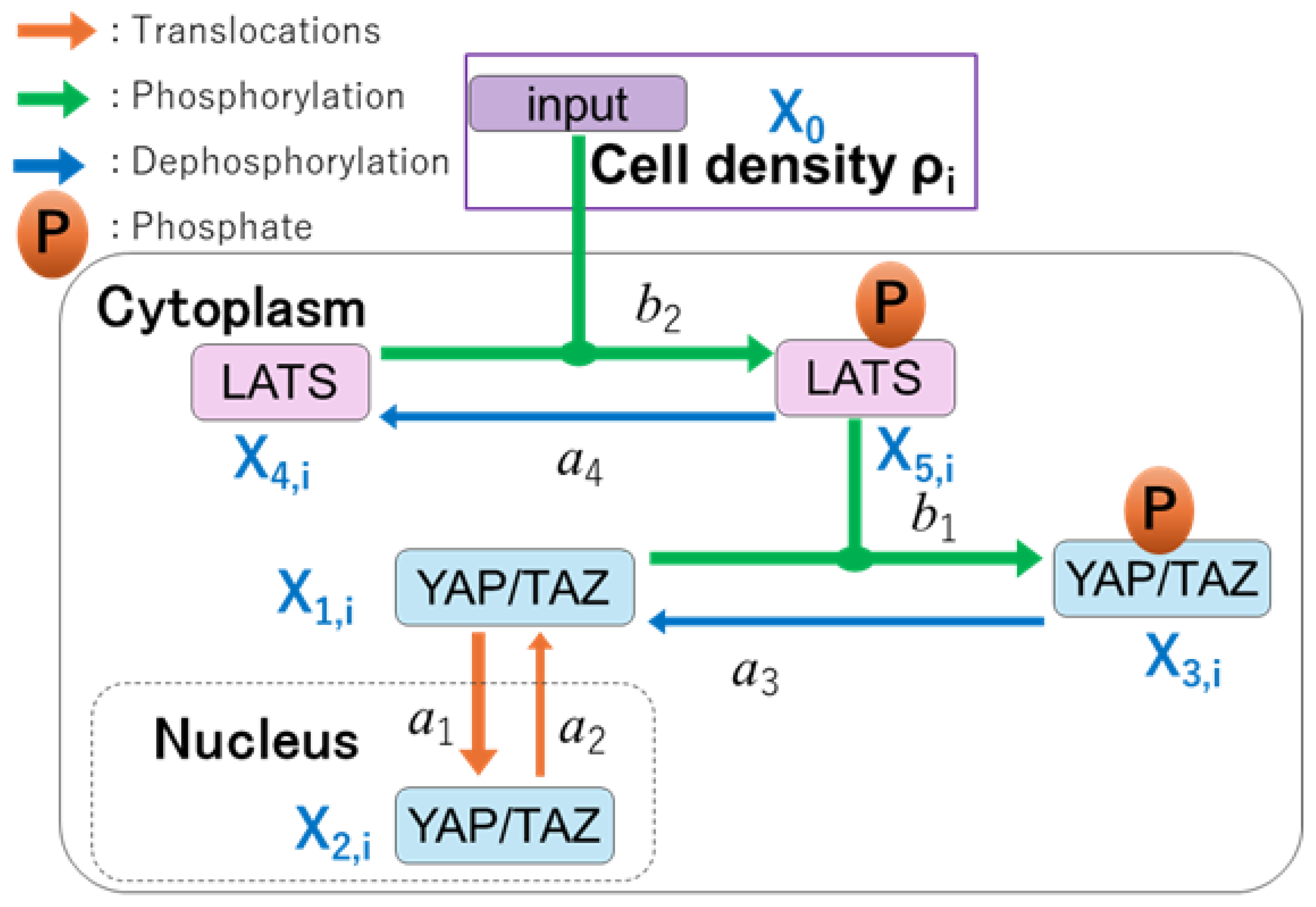
Figure 1 shows a schematic reaction network of the Hippo pathway corresponding to the five-variable ODE system used in this study.
The main state variables and parameters are summarized in Table 1. Detailed numerical values for the specific parameter settings are provided in Section 2.3: Items (II) and (III) for the initial values of X 1 X 5 and in Items (V)–(VII) for the parameter settings of a 1 a 4 , b 1 , and b 2 .

2.2. Reaction Equations (ODEs with Explicit LATS/pLATS Dynamics)

The intracellular dynamics of YAP/TAZ and LATS/pLATS in each cell are described by the following ODEs:
X ˙ 1 , i = a 1 X 1 , i + a 2 X 2 , i + a 3 X 3 , i b 1 X 5 , i X 1 , i ,
X ˙ 2 , i = a 1 X 1 , i a 2 X 2 , i ,
X ˙ 3 , i = a 3 X 3 , i + b 1 X 5 , i X 1 , i ,
X ˙ 4 , i = b 2 ρ i X 0 X 4 , i + a 4 X 5 , i ,
X ˙ 5 , i = a 4 X 5 , i + b 2 ρ i X 0 X 4 , i .
For convenience, we introduce the cell-dependent effective YAP/TAZ phosphorylation rate mediated by pLATS as
κ i : = b 1 X 5 , i ,
which appears in the phosphorylation reaction term in Equation (3) (and the corresponding loss term in Equation (1)), so that these terms can be written as + κ i X 1 , i in Equation (3) and κ i X 1 , i in Equation (1), respectively.
Equations (4) and (5) describe the reversible interconversion between LATS and pLATS so that
d d t X 4 , i + X 5 , i = 0
holds for each cell i.

2.3. Modeling of Normal and Cancer Tissues and Parameter Settings

In the simulations, we use identical initial concentrations for normal and cancer cells, and we separate cell-cycle state (growth vs. quiescence) solely through differences in the kinetic parameters of LATS.
(I)
Local contact signal X 0
We define X 0 as the maximum input signal transmitted to cell i from its surrounding cells. This quantity corresponds to the strength of the contact-derived signal when the local cell density is maximal. To match typical intracellular signaling molecule concentrations (0.01–1 μ M), we set the representative value to
X 0 = 0.1 [ μ M ]
as in [7].
(II)
YAP/TAZ concentrations X 1 , i , X 2 , i
The overall scale of YAP/TAZ concentrations is chosen in the range 0.01–1 μ M, based on typical signaling protein levels (see, e.g., Table S1 in [10]). In the initial low-density state, YAP/TAZ preferentially localize to the nucleus rather than the cytoplasm [1]. Therefore, we set the initial cytoplasmic–nuclear concentration ratio X 1 , i 0 / X 2 , i 0 to match the nuclear/cytoplasmic ratio of 4:1 reported by Zhang et al. [11]:
( X 1 , i 0 , X 2 , i 0 ) = ( X 1 0 , 4 X 1 0 ) , X 1 0 = 0.05 [ μ M ] .
The same initial values are used for normal and cancer cells.
(III)
LATS concentration X 4 , i and phosphorylated LATS concentration X 5 , i
The total LATS concentration is set to 2.5 X 1 0 based on the report by Hori et al. [12]. We assume that at t = 0 when cells enter the M phase of the cell cycle, half of the total LATS is phosphorylated. Accordingly, we set
( X 4 , i 0 , X 5 , i 0 ) = ( 1.25 X 1 0 , 1.25 X 1 0 ) .
(IV)
Nuclear YAP/TAZ threshold P th
It is known that expulsion of YAP from the nucleus in response to increased cell density corresponds to contact inhibition of proliferation [13]. Based on this, we introduce a proliferation threshold P th for the nuclear YAP/TAZ concentration:
P th = 0.02 [ μ M ] ,
which is approximately 10 % of the initial nuclear concentration X 2 , i 0 .
(V)
Reaction-rate coefficients a 1 , a 2
The reaction-rate coefficients are selected from the range 10 4 1 [ s 1 ] , following the typical values reported in Table S2 of [14]. To reproduce the experimentally observed nuclear enrichment of YAP/TAZ [1], we set the ratio of cytoplasm-to-nucleus versus nucleus-to-cytoplasm shuttling rates as
a 1 a 2 = 100 .
Specifically, we choose
a 1 = 5 × 10 2 [ s 1 ] , a 2 = 5 × 10 4 [ s 1 ] .
These values correspond to characteristic shuttling timescales 1 / a 1 20 s and 1 / a 2 2.0 × 10 3 s (about 33 min), which fall within the broad range reported for nucleocytoplasmic transport dynamics [15,16,17] (from fast sub-minute events to slower processes) and are consistent with reported YAP/TAZ nucleocytoplasmic trafficking studies.
(VI)
LATS phosphorylation rate b 2
From the Hippo (MST2–LATS1) signaling model of Shin et al. [18], the reaction rate for LATS phosphorylation can be estimated in the range
b 2 10 4 10 2 [ μ M 1 s 1 ] .
In this study, we set for normal cells
b 2 normal = 0.01 [ μ M 1 s 1 ] ,
and for cancer cells, we mimic impaired LATS phosphorylation [8,9] by using half of this value:
b 2 cancer = 0.005 [ μ M 1 s 1 ] .
(VII)
LATS dephosphorylation rate a 4
In the model of Shin et al. [18], the reaction rate corresponding to LATS dephosphorylation is reported as
a 4 0.01 0.2 [ min 1 ] ,
which, when converted to SI units, becomes
a 4 1.7 × 10 4 3.3 × 10 3 [ s 1 ] .
In the present study, we choose
a 4 = 0.001 [ s 1 ] ,
using the same value for both normal and cancer cells.

2.4. Proliferation Gate (Cell Growth vs. Cell-Cycle Arrest via Nuclear YAP/TAZ Threshold)

Following the Cell review [1], we assume that nuclear YAP/TAZ concentration X 2 , i acts as a switch between proliferative and quiescent states. Using the proliferation threshold P th defined above, we classify the state of cell i as
X 2 , i ( t ) > P th cell growth , X 2 , i ( t ) P th cell - cycle arrest .

2.5. Definition of Local Density ρ i and 3D-MA Simulations

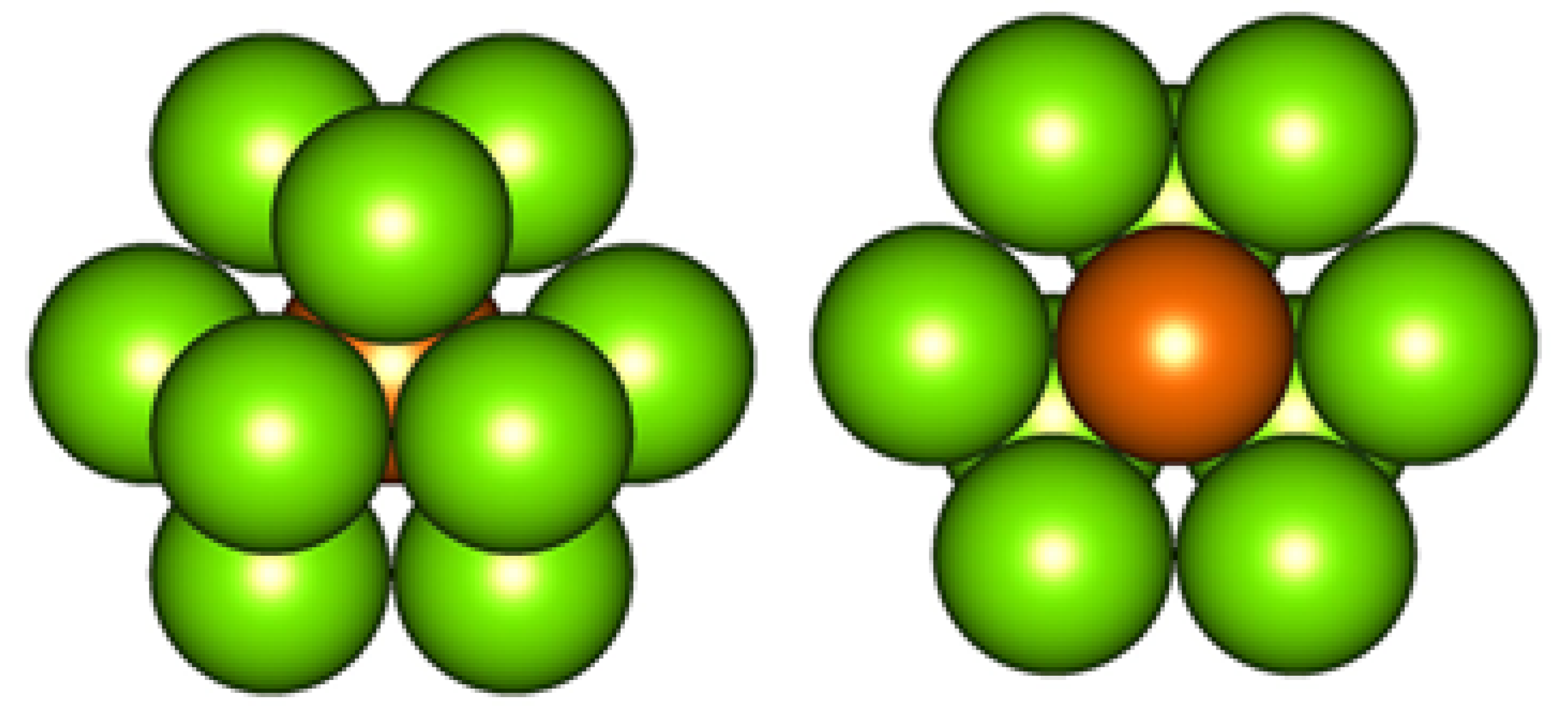
The local density ρ i is defined from the contact neighborhood in the multicellular 3D-MA simulation. Figure 2 illustrates a situation in which a single cell (orange) is surrounded by twelve neighboring cells (green) in contact: a 3D view (left) and a cross-sectional view (right).
Mathematically, we define the local density of cell i as
ρ i = α j = 1 N ( 1 δ i j ) exp r ¯ i j σ i j ,
where N is the total number of cells, δ i j is the Kronecker delta, r ¯ i j is the distance between the centers of cells i and j, and σ i j is the effective interaction range for the cell pair ( i , j ) . The normalization constant α is set to
α = e 2 12 ,
so that ρ i = 1 (i.e., 100 % ) in a configuration where cell i is densely surrounded by twelve neighbors, as depicted in Figure 2.
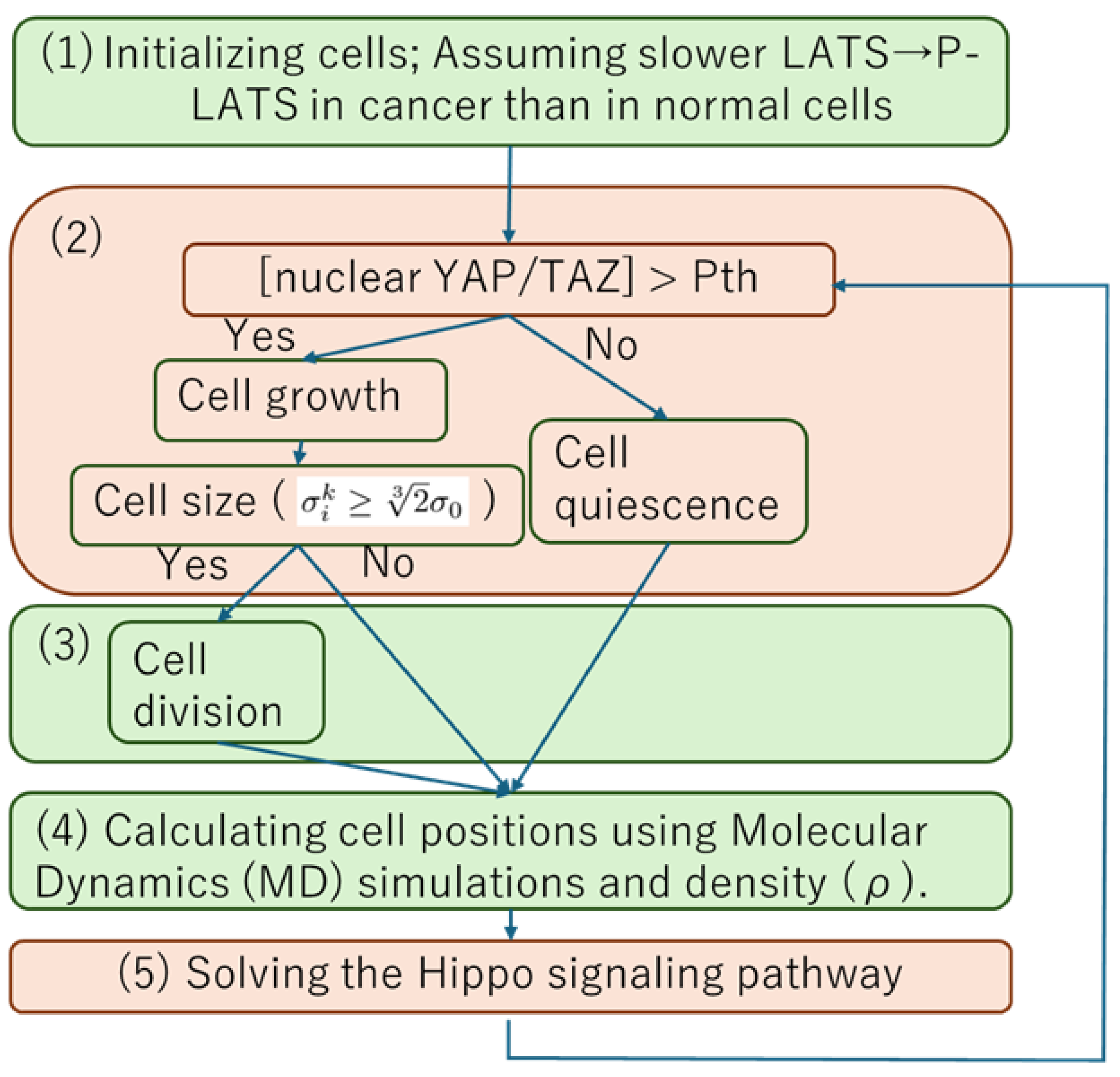
To improve reproducibility, we summarize the coupling procedure between the ODE module and the 3D-MA mechanical module in the flowchart shown in Figure 3. In Figure 3, the “cell size” check ( σ i k 2 3 σ 0 ) represents the volume-doubling criterion (for spherical cells, V σ 3 ) used to trigger cell division in the mechanical module.
At each time step, given the current cell positions, we first compute the local densities ρ i from cell–cell contacts, then update the intracellular state variables X k , i by integrating the ODE system, and finally update each cell’s cell-cycle state (e.g., growth vs. quiescence) and the corresponding mechanical parameters before advancing cell motion. In the 3D-MA simulations, intercellular repulsion/adhesion is modeled by a soft-core Lennard–Jones-type interaction (short-range repulsion with intermediate-range attraction) together with viscous drag, consistent with our earlier multiscale implementation [7].

2.6. Evaluation Metrics

For each cell, we use as primary readouts (i) the fraction of time for which X 2 , i > P th (the duration of the proliferative window) and (ii) the population-averaged nuclear YAP/TAZ concentration X 2 . When necessary, we employ the coupled ODE–MA framework [7] to evaluate how the time-dependent changes in ρ i obtained from the mechanical simulations influence the YAP/TAZ dynamics and the bifurcation between proliferative and quiescent behavior.

3. Results

First, we recall that the rate constant b 2 in Equations (1)–(5) controls the LATS phosphorylation step from X 4 , i to X 5 , i . In the present parameter set, we assign a slightly larger value in the normal-like case than in the cancer-like case,
b 2 , Normal > b 2 , Cancer ,
so that the conversion from X 4 , i to X 5 , i proceeds faster in normal-like cells, whereas LATS phosphorylation is slower and X 5 , i accumulates more sluggishly in cancer-like cells. In practice, however, the qualitative difference in nuclear YAP/TAZ dynamics between normal-like and cancer-like tissues is mainly governed by the effective phosphorylation rate κ i introduced below.
Equations (1)–(5) show that the nuclear fraction of YAP/TAZ is monotonically controlled through
κ i = b 1 X 5 , i .
The larger κ i is, the more rapidly X 1 , i is phosphorylated and transferred to X 3 , i and the more strongly X 2 , i is reduced. Therefore, even under identical initial concentrations, an increase in κ i leads to a decrease in the nuclear YAP/TAZ level. In particular,
κ Normal > κ Cancer X 2 Normal < X 2 Cancer ,
that is, under normal-like kinetics, cells spend a larger fraction of time with X 2 , i ( t ) < P th and, thus, undergo cell-cycle arrest, whereas under cancer-like kinetics, the time window with X 2 , i ( t ) P th is prolonged and proliferation persists. Moreover, Equations (4) and (5) provide a mechanism by which an increase in ρ i induces an increase in X 5 , i (=pLATS), thereby naturally incorporating contact inhibition (suppression of proliferation at high density) into the model [1,6].
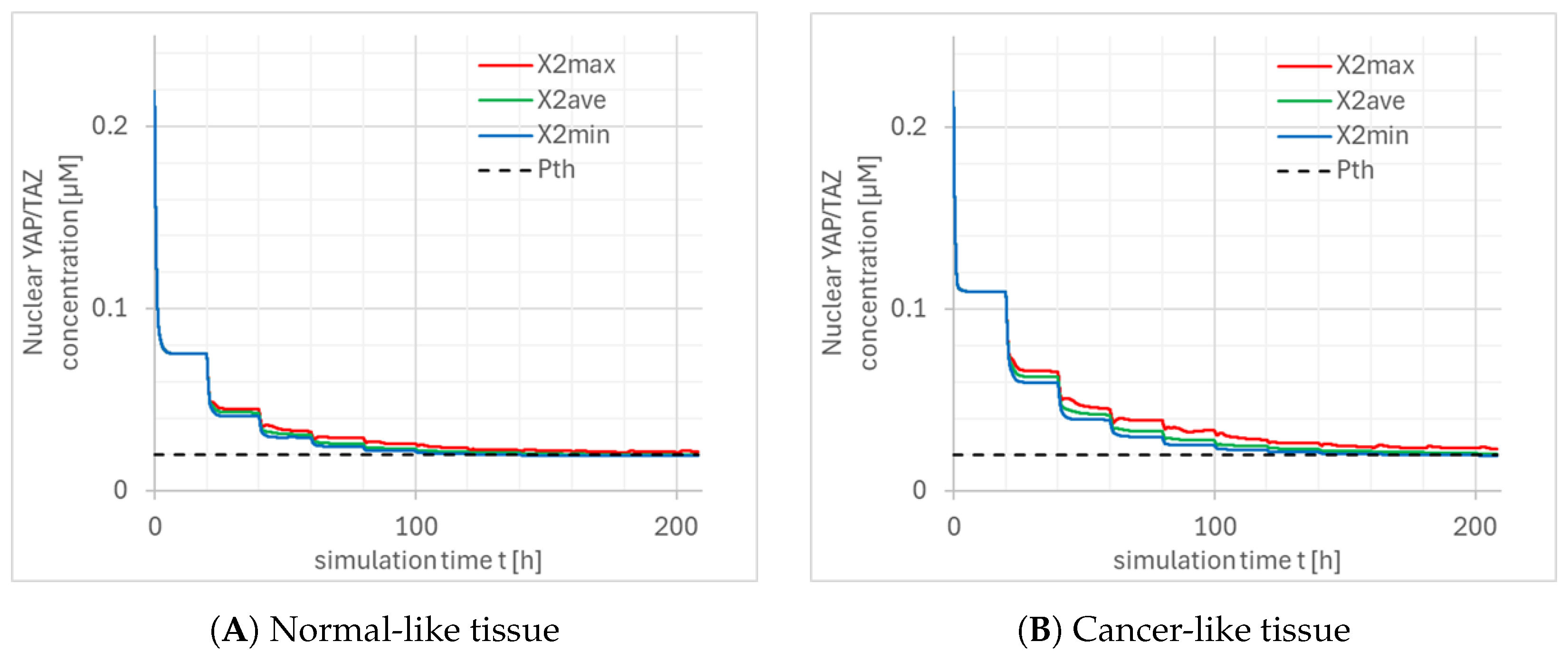
Figure 4 shows the time evolution of nuclear YAP/TAZ concentration in normal-like and cancer-like tissues. In the normal-like case, X 2 , i ( t ) falls below P th for an increasing number of cells over time, and these cells transition from a proliferative state to a quiescent state. In contrast, in the cancer-like case, a substantial fraction of cells maintain X 2 , i ( t ) P th for long periods, and proliferation is sustained.
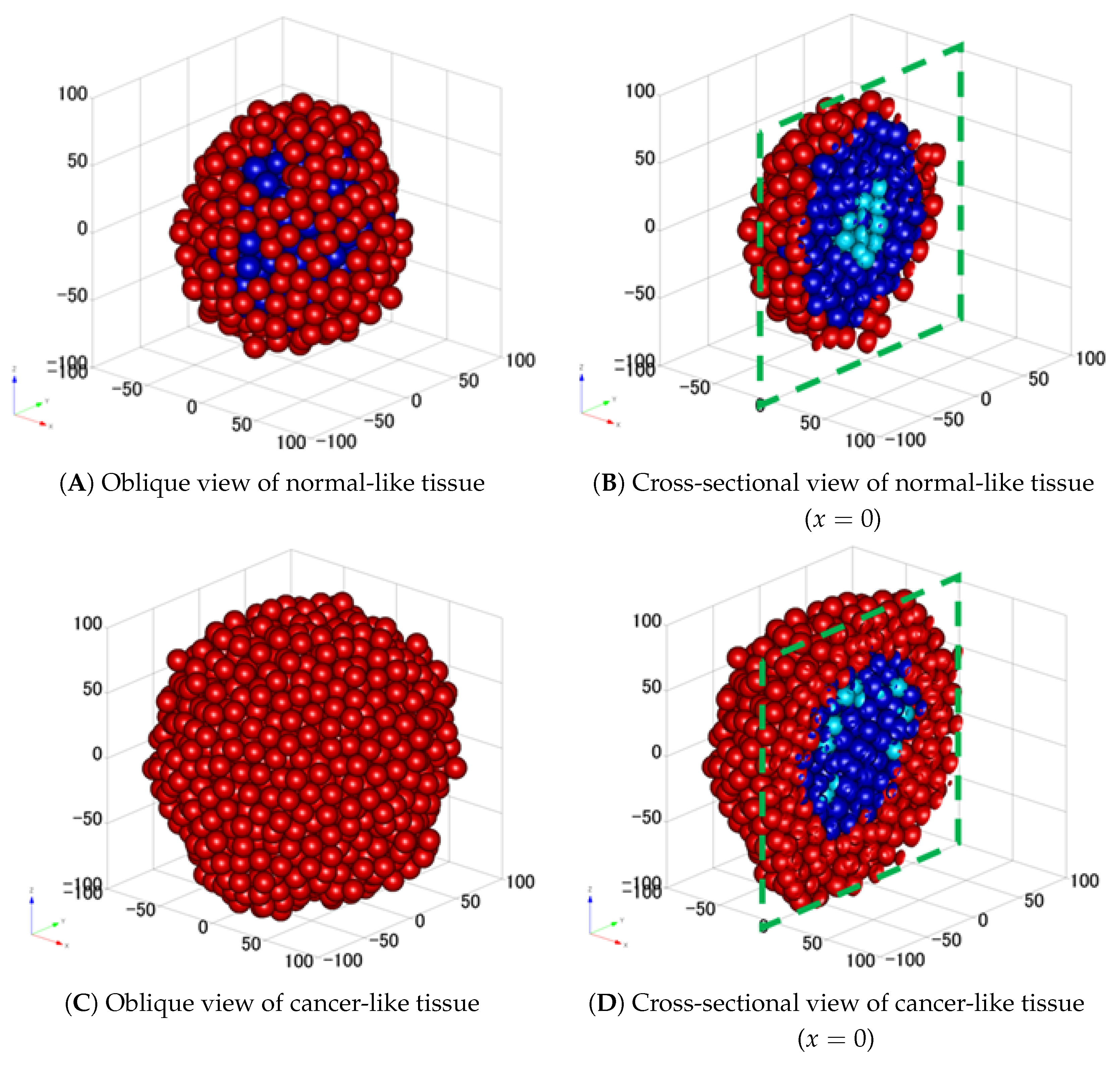
Figure 5 presents 3D snapshots of normal-like and cancer-like tissues at t = 208 h (approximately 10.4 cell cycles). x denotes the orthogonal Cartesian coordinates in 3D space [ μ m], and the x = 0 cross-section corresponds to the central y z -plane. In the 3D renderings, the coordinate axes are indicated by arrows: the x-axis in red, the y-axis in green, and the z-axis in blue. Panels (A, B) correspond to normal cells, and panels (C, D) to cancer cells; (A, C) show oblique 3D views, whereas (B, D) show cross-sectional views at x = 0 . All spatial coordinates are measured in μ m . Cells in mitosis or interphase that are in a proliferative state are shown in orange and red, respectively, whereas mitotic and interphase cells in cell-cycle arrest are shown in light blue and blue, respectively. The green dashed rectangles indicate the cross-sectional plane at x = 0 .
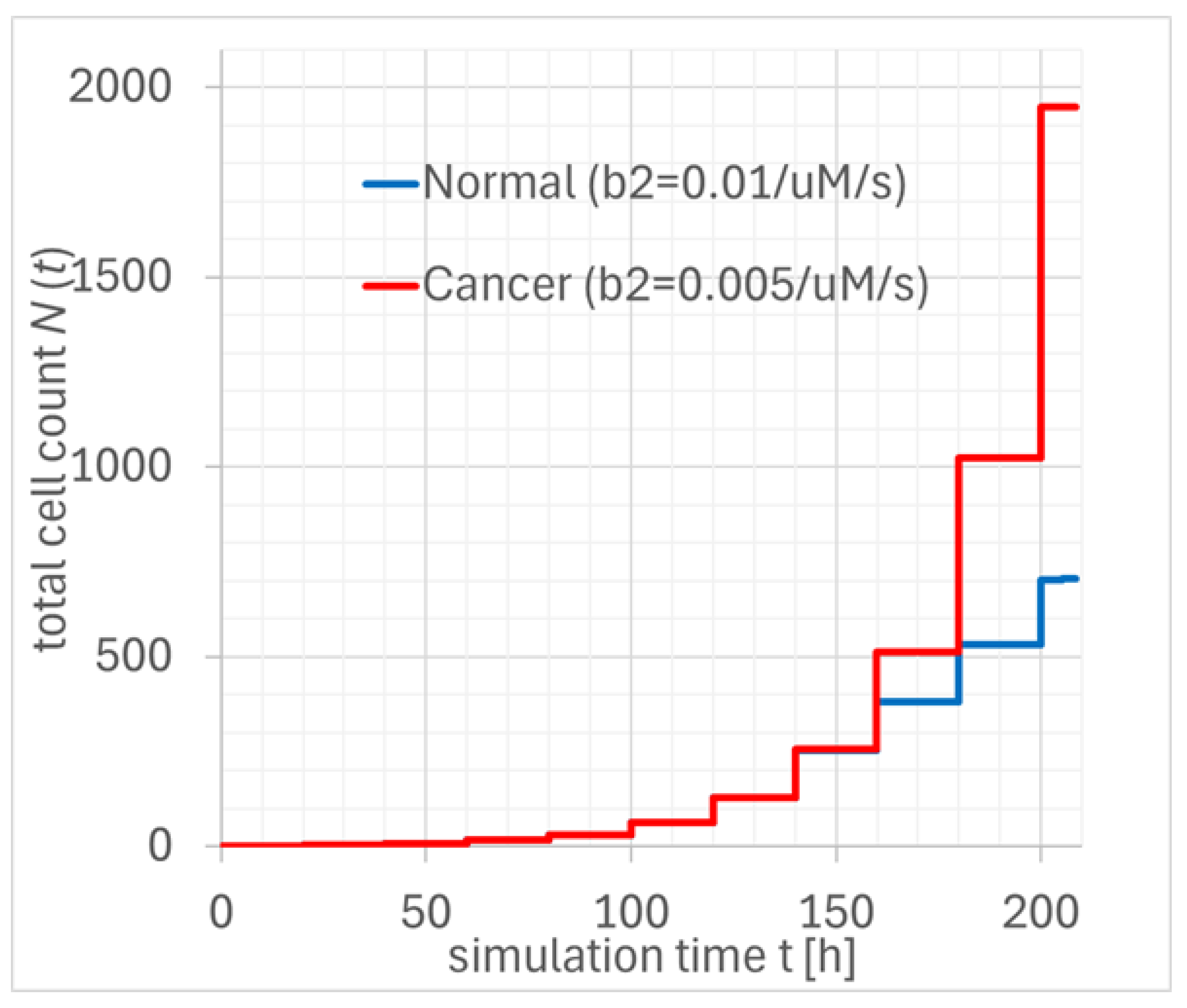
Figure 6 shows the time evolution of the total number of cells in normal-like and cancer-like tissues. In the normal-like case, the decrease in nuclear YAP/TAZ below P th leads to an early saturation of proliferation, and the total cell number approaches a plateau. In the cancer-like case, reduced LATS activity maintains a higher nuclear fraction of YAP/TAZ so that the total number of cells continue to increase over a long time.
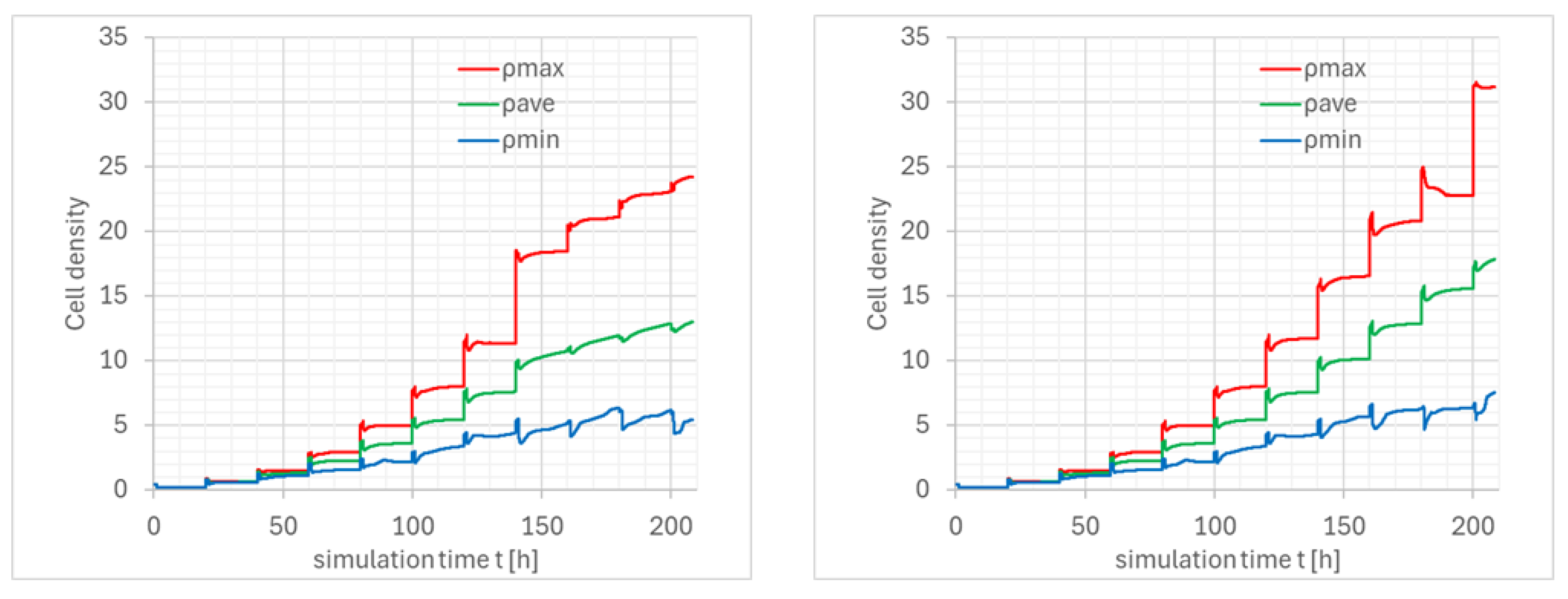
As an additional quantitative summary of spatial heterogeneity, we tracked the time evolution of the local cell-density signal ρ i across all cells and report ρ min ( t ) = min i ρ i ( t ) , ρ ave ( t ) = 1 N ( t ) i ρ i ( t ) , and ρ max ( t ) = max i ρ i ( t ) (Figure 7). Because ρ i is defined as an exponentially weighted sum of neighboring-cell contributions and normalized to a reference close-contact configuration, it is a dimensionless signal and is not bounded by 1; values ρ i 1 indicate locally crowded regions relative to the reference. In both tissues, ρ max increases stepwise over time, reflecting the emergence and growth of locally crowded regions, while the gap between ρ max and ρ min provides an objective measure of cell-to-cell variability in local crowding. Notably, the cancer-like tissue reaches a larger terminal ρ max (approximately 31 at t = 208 h) than the normal-like tissue (approximately 24), consistent with stronger local crowding and heterogeneity under the cancer-like growth dynamics.
The temporal evolution of the 3D tissue morphologies corresponding to Figure 5 is provided in Supplementary Movie S1 (PowerPoint file, pptx), which contains four embedded videos (mp4 format): (A) oblique views of normal-like tissue; (B) cross-sectional views of normal-like tissue; (C) oblique views of cancer-like tissue; and (D) cross-sectional views of cancer-like tissue.

4. Discussion

In this study, we reformulated the empirical rule of “cell-cycle arrest by contact inhibition in response to increased cell density” introduced in our PLOS 2024 model [7] as explicit LATS–pLATS kinetics in the upstream Hippo–YAP/TAZ pathway and coupled it to a multicellular 3D molecular dynamics (3D-MD) simulation framework. The present model is characterized by the following key features: (i) normal-like and cancer-like tissues share identical initial distributions of YAP/TAZ, (ii) the divergence between normal-like and cancer-like growth dynamics emerges autonomously by varying only the LATS phosphorylation rate b 2 , and (iii) the coupling between tissue density and proliferation control is explicitly described through the density-dependent LATS activation term b 2 ρ i X 0 . The effective parameter
κ i = b 1 X 5 , i ,
introduced in Equations (1)–(5), provides a lumped measure of the strength of the LATS–pLATS branch feeding into the YAP/TAZ module. The magnitude of κ i determines both the nuclear fraction of YAP/TAZ and the bifurcation between proliferative and quiescent states. Thus, estimating κ has the potential to be linked to stratification of malignancy as well as to the design of LATS-activating or mechanically based stimulation protocols.
Focusing on the time evolution of nuclear YAP/TAZ concentration X 2 , i , we find that in the normal-like model, an increase in local density ρ i activates LATS, promotes phosphorylation of X 1 , i and its transfer to X 3 , i via pLATS ( X 5 , i ), and, consequently, drives X 2 , i ( t ) below the threshold P th in many cells, leading to a transition from proliferation to cell-cycle arrest. In contrast, in the cancer-like model, halving the LATS phosphorylation rate b 2 relative to the normal case delays the rise in X 5 , i under the same density profile so that a subset of cells retain X 2 , i ( t ) P th for a prolonged period. As a result, in the normal-like model, cells in high-density regions are predominantly arrested, whereas in the cancer-like model, many proliferating cells (shown in red and orange) remain even at comparable densities. This reproduces a prototypical cancer-like growth pattern.
The comparison of 3D snapshots and cross-sectional views further highlights this contrast. In the normal-like model, towards the end of the simulation, most cells in the interior enter a quiescent state ( X 2 , i < P th ), and the tissue is almost uniformly filled with arrested cells, with only a small number of proliferating cells remaining at the periphery. This behavior is consistent with the classical picture of contact inhibition-driven formation of a confluent epithelial monolayer and the self-limiting control of tissue size. In the cancer-like model, by contrast, proliferating cell clusters persist within the tissue interior, and regions of sustained proliferation are maintained locally despite high cell density. Such “breakdown of contact inhibition” and “spatially heterogeneous proliferation patterns” can be interpreted as a qualitative reproduction of characteristic features frequently observed in experimental images of tumor tissues.
This qualitative interpretation is further supported by a quantitative summary of local crowding: the time evolution of the minimum, mean, and maximum of the local density signal ρ i across cells (Figure 7). Because ρ i is an exponentially weighted, dimensionless local density signal, it is not bounded by 1; larger values indicate locally crowded regions relative to the reference configuration. Notably, the cancer-like tissue attains a larger terminal ρ max than the normal-like tissue, consistent with stronger local crowding and heterogeneity.
In our formulation, LATS and phosphorylated LATS are explicitly introduced as variables X 4 , i and X 5 , i , and the phosphorylation rate b 2 and dephosphorylation rate a 4 are set on the basis of existing Hippo signaling models [18] and reports of LATS inactivation in cancer cells [8,9]. We showed that even a twofold difference between
b 2 normal = 0.01 [ ( μ M · s ) 1 ] and b 2 cancer = 0.005 [ ( μ M · s ) 1 ]
is sufficient to significantly alter nuclear YAP/TAZ dynamics via κ i = b 1 X 5 , i , leading to marked differences in the population-averaged X 2 and in the duration of proliferative windows. In other words, a modest reduction in LATS function can give rise to loss of contact inhibition and abnormal proliferation. The present framework visualizes this experimentally suggested link consistently from the level of molecular reactions up to the tissue scale, which constitutes a key novelty of our approach.
In the PLOS 2024 model [7], the relationship between cell density and nuclear YAP/TAZ was implemented as an empirical threshold rule, and contact inhibition-induced growth arrest was described as an indirect “density → growth rule”. In contrast, the present study explicitly incorporates a LATS–YAP/TAZ module derived from the Hippo pathway diagram [6], and describes density-dependent growth control as a mechanistic pathway:
contact - derived signal X 0 , ρ i LATS activation nuclear exclusion of YAP / TAZ .
This formulation brings several advantages: (i) the difference between normal and cancer conditions can be parametrized in a unified manner as differences in LATS kinetics; (ii) the rise and decay timescales of nuclear YAP/TAZ are reproduced consistently with existing models; and (iii) the molecular reactions of the Hippo pathway can be coupled, within the same framework, to the cell-position and density dynamics generated by the 3D-MD module. Thus, the present model can be regarded as an extension of the PLOS 2024 model that elevates its effective empirical rules to a mechanistic description based on LATS kinetics. In this sense, our multiscale framework is complementary to existing mechanotransduction modeling studies of Hippo/YAP/TAZ signaling by linking intracellular reaction kinetics to emergent tissue-level dynamics under density- and mechanics-dependent regulation.
Moreover, the model can be applied to in silico evaluation of therapeutic strategies. For example, one can quantitatively assess the effects of interventions that (i) pharmacologically enhance the LATS phosphorylation rate b 2 in cancer tissues to “restore” κ Cancer toward normal-like levels or (ii) inhibit the dephosphorylation rate a 4 to prolong pLATS activity, by comparing the resulting nuclear YAP/TAZ dynamics and time courses of the total cell number. In addition, if κ i or b 2 is used as an index of “effective LATS activity”, the framework may be combined with imaging data of nuclear YAP/TAZ to support malignancy assessment and the design of individualized intervention protocols.

Uncertainty of Kinetic Coefficients and Inter-Subject Variability

The kinetic coefficients in Equations (1)–(5) are intended as effective rate constants of a reduced Hippo pathway model. A complete set of these coefficients is not currently available from a single experimental protocol under conditions that match that of our simulations. Accordingly, uncertainty arises from both experimental measurement noise (e.g., quantification and normalization in biochemical assays) and parameter identifiability in reduced ODE models, where multiple parameter sets can reproduce similar trajectories.

5. Conclusions

In this study, we constructed a minimal Hippo–YAP/TAZ model that explicitly incorporates the dynamic equilibrium between LATS and pLATS, thereby replacing the empirical “density-dependent proliferation rule” used in our PLOS 2024 model [7] with a mechanistic description based on LATS kinetics. In particular, we demonstrated that, while keeping the initial distribution of nuclear YAP/TAZ concentrations fixed, autonomous separation of normal-like and cancer-like growth dynamics and 3D tissue morphologies can be achieved solely by varying the LATS phosphorylation rate b 2 .
The present model is consistent with the Hippo pathway wiring diagram, with experimental evidence for contact inhibition based on a nuclear YAP/TAZ threshold and with reports of reduced LATS activity in cancer cells. Through the coupled dynamics of LATS/pLATS and nuclear YAP/TAZ, the model enables visualization of density-dependent proliferation control from the molecular to the tissue scale within a unified multicellular 3D-MD simulation framework. Furthermore, numerical experiments in which we manipulate the LATS phosphorylation/dephosphorylation rates and the effective parameter κ i provide a basis for in silico evaluation of molecularly targeted therapies and mechanical interventions aimed at restoring contact inhibition. Taken together, these results indicate that our framework is a useful tool both for elucidating the mechanisms of density-dependent proliferation control and for supporting the design of therapeutic strategies.

Supplementary Materials

The following supporting information can be downloaded at: https://www.mdpi.com/article/10.3390/math14010099/s1, Supplementary Movie S1: A PowerPoint file containing four embedded mp4 videos labeled (A)–(D).

Author Contributions

Conceptualization, T.U. and T.S.; methodology, T.U. and T.S.; software, T.U.; validation, T.U.; formal analysis, T.U. and T.S.; investigation, T.U.; resources, T.U.; data curation, T.U.; writing—original draft, T.U.; writing—review & editing, T.S.; visualization, T.U.; supervision, T.S.; project administration, T.S.; funding acquisition, T.S. All authors have read and agreed to the published version of the manuscript.

Funding

This work was supported by the Japan Science and Technology Agency (JST), CREST (Grant Number JPMJCR2022).

Data Availability Statement

The data supporting the findings of this study are available from the corresponding author upon reasonable request.

Acknowledgments

The authors gratefully acknowledge financial support from JST CREST (Grant Number JPMJCR2022). The authors are deeply grateful to Hisashi Moriizumi (University of Cambridge) for his insightful suggestions that greatly improved the ODE model of the Hippo–YAP/TAZ pathway proposed in this study.

Conflicts of Interest

The authors declare no conflict of interest.

References

  1. Yu, F.-X.; Zhao, B.; Guan, K.-L. The Hippo pathway in organ size control, tissue homeostasis, and cancer development. Cell 2015, 163, 811–828. [Google Scholar] [CrossRef] [PubMed]
  2. Zhong, Z.; Jiao, Z.; Yu, F.-X. The Hippo signaling pathway in development and regeneration. Cell Rep. 2024, 43, 113926. [Google Scholar] [CrossRef] [PubMed]
  3. Scott, K.E.; Fraley, S.I.; Rangamani, P. A spatial model of YAP/TAZ signaling reveals how stiffness, dimensionality, and shape contribute to emergent outcomes. Proc. Natl. Acad. Sci. USA 2021, 118, e2021571118. [Google Scholar] [CrossRef] [PubMed]
  4. Novev, J.K.; Heltberg, M.L.; Jensen, M.H.; Doostmohammadi, A. Spatiotemporal model of cellular mechanotransduction via Rho and YAP. Integr. Biol. 2021, 13, 197–209. [Google Scholar] [CrossRef] [PubMed]
  5. Jafarinia, H.; Khalilimeybodi, A.; Barrasa-Fano, J.; Fraley, S.I.; Rangamani, P.; Carlier, A. Insights gained from computational modeling of YAP/TAZ signaling for cellular mechanotransduction. Npj Syst. Biol. Appl. 2024, 10, 90. [Google Scholar] [CrossRef] [PubMed]
  6. Miyamura, N.; Nishina, H. Organ size regulation by Hippo-YAP/TAZ signaling pathway. Riyouiki Yuugo Rev. (Life Sci. Integr. Rev.) 2016, 5, e004. [Google Scholar] [CrossRef]
  7. Umegaki, T.; Moriizumi, H.; Ogushi, F.; Takekawa, M.; Suzuki, T. Multicellular MD–Hippo model with cell–cell interactions. PLoS Comput. Biol. 2024, 20, e1012536. [Google Scholar] [CrossRef] [PubMed]
  8. Zhao, B.; Li, L.; Wang, L.; Wang, C.-Y.; Yu, J.; Guan, K.-L. Cell detachment activates the Hippo pathway via cytoskeleton reorganization to induce anoikis. Genes Dev. 2012, 26, 54–68. [Google Scholar] [CrossRef] [PubMed]
  9. Rahmat, M.B.; Zhang, S.; Koh, C.-G. POPX2 is a novel LATS phosphatase that regulates the Hippo pathway. Oncotarget 2019, 10, 1525–1538. [Google Scholar] [CrossRef] [PubMed]
  10. Beutler, T.C.; Mark, A.E.; van Schaik, R.C.; Gerber, P.R.; van Gunsteren, W.F. Avoiding singularities and numerical instabilities in free energy calculations based on molecular simulations. Chem. Phys. Lett. 1994, 222, 529–539. [Google Scholar] [CrossRef]
  11. Zhang, C.; Zhu, H.; Ren, X.; Gao, B.; Cheng, B.; Liu, S.; Sha, B.; Li, Z.; Zhang, Z.; Lv, Y.; et al. Mechanics-driven nuclear localization of YAP can be reversed by N-cadherin ligation in mesenchymal stem cells. Nat. Commun. 2021, 12, 6229. [Google Scholar] [CrossRef] [PubMed]
  12. Hori, T.; Takaori-Kondo, A.; Kamikubo, Y.; Uchiyama, T. Molecular cloning of a novel human protein kinase, kpm, that is homologous to warts/lats, a Drosophila tumor suppressor. Oncogene 2000, 19, 3101–3109. [Google Scholar] [CrossRef] [PubMed]
  13. Zhao, B.; Wei, X.; Li, W.; Udan, R.S.; Yang, Q.; Kim, J.; Xie, J.; Ikenoue, T.; Yu, J.; Li, L.; et al. Inactivation of YAP oncoprotein by the Hippo pathway is involved in cell contact inhibition and tissue growth control. Genes Dev. 2007, 21, 2747–2761. [Google Scholar] [CrossRef] [PubMed]
  14. Aoki, K.; Yamada, M.; Kunida, K.; Yasuda, S.; Matsuda, M. Processive phosphorylation of ERK MAP kinase in mammalian cells. Proc. Natl. Acad. Sci. USA 2011, 108, 12675–12680. [Google Scholar] [CrossRef] [PubMed]
  15. Singer, R.H.; Grünwald, D. Multiscale dynamics in nucleocytoplasmic transport. Curr. Opin. Cell Biol. 2012, 24, 100–106. [Google Scholar] [CrossRef] [PubMed]
  16. Kofler, M.; Kapus, A. Nuclear Import and Export of YAP and TAZ. Cancers 2023, 15, 4956. [Google Scholar] [CrossRef] [PubMed]
  17. Kofler, M.; Speight, P.; Little, D.; Di Ciano-Oliveira, C.; Szászi, K.; Kapus, A. Mediated nuclear import and export of TAZ and the underlying molecular requirements. Nat. Commun. 2018, 9, 4966. [Google Scholar] [CrossRef] [PubMed]
  18. Shin, S.-Y.; Nguyen, L.K. Unveiling Hidden Dynamics of Hippo Signalling: A Systems Analysis. Genes 2016, 7, 44. [Google Scholar] [CrossRef] [PubMed]
Figure 1. Reaction network of the Hippo pathway. The relationships among YAP/TAZ, LATS/pLATS, and the local density signal X 0 ρ i are shown schematically.
Mathematics 14 00099 g001
Figure 2. Geometric image of the local cell density ρ i . A single cell (orange) is surrounded in close contact by twelve neighboring cells (green): 3D view (left) and cross-sectional view (right). Adapted from Supplementary Figure D1 in [7], PLOS Computational Biology (CC BY 4.0).
Mathematics 14 00099 g002
Figure 3. Flowchart of the 3D multicellular agent (3D-MA) simulations. At each time step, (i) local densities ρ i are computed from cell positions and contact relations, (ii) the state variables X k , i are updated according to Equations (1)–(5), and (iii) cell motility and growth in the mechanical module are modified according to the updated cell-cycle state (e.g., growth vs. quiescence). The “cell size” condition ( σ i k 2 3 σ 0 ) corresponds to a volume-doubling threshold (for spherical cells, V σ 3 ) that triggers cell division in the mechanical module.
Mathematics 14 00099 g003
Figure 4. Time evolution of nuclear YAP/TAZ concentration (left: normal-like tissue; right: cancer-like tissue). The vertical axis represents the nuclear YAP/TAZ concentration [ μ M], and the horizontal axis represents the simulation time [h]. The red, green, and blue solid curves represent, respectively, the maximum, mean, and minimum of X 2 , i ( t ) over all N cells. The black dashed line indicates the proliferation threshold P th .
Mathematics 14 00099 g004
Figure 5. Three–dimensional snapshots of tissue organization at t = 208 h (left: normal-like tissue; right: cancer-like tissue). x denotes the orthogonal Cartesian coordinates in 3D space [ μ m], and the x = 0 cross-section corresponds to the central y z -plane. In the 3D renderings, the coordinate axes are indicated by arrows: the x-axis in red, the y-axis in green, and the z-axis in blue. Panels (A,B) show normal cells and panels (C,D) show cancer cells. Panels (A,C) are oblique 3D views, whereas panels (B,D) are cross-sectional views at x = 0 . The coordinates are given in μ m . Cells in mitosis and interphase that are in a proliferative state are shown in orange and red, respectively, and mitotic and interphase cells in cell-cycle arrest are shown in light blue and blue, respectively. The green dashed rectangles denote the cross-sectional plane at x = 0 .
Mathematics 14 00099 g005
Figure 6. Time evolution of the total cell number in normal-like and cancer-like tissues. The vertical axis indicates the total number of cells [counts], and the horizontal axis indicates the simulation time [h]. The blue curve shows the total number of normal cells, and the red curve shows the total number of cancer cells.
Mathematics 14 00099 g006
Figure 7. Time evolution of the local cell-density signal ρ i summarized across cells by the minimum ( ρ min ), mean ( ρ ave ), and maximum ( ρ max ): (left) normal-like tissue and (right) cancer-like tissue. ρ i is a dimensionless local density signal defined in Section 2.3 (exponentially weighted neighbor contributions) and is not bounded by 1.
Mathematics 14 00099 g007
Table 1. List of state variables and parameters. X k , i denotes the concentration in cell i, and X 0 is the scale of the local density signal. The reaction-rate coefficients a 1 , a 2 , a 3 , a 4 , b 1 , b 2 correspond to Equations (1)–(5). To reflect impaired LATS phosphorylation in cancer cells [8,9], we set b 2 in cancer cells to one-half of the value in normal cells. For the basis for selecting the value of X 0 , the initial values of X 1 X 5 , and the values of the coefficients a 1 a 4 , b 1 , and b 2 , see Section 2.3.
SymbolDescription
X 0 Scale of contact-derived signal
X 1 , i Cytoplasmic YAP/TAZ concentration
X 2 , i Nuclear YAP/TAZ concentration
X 3 , i Phosphorylated YAP/TAZ (cytoplasmic)
X 4 , i Non-phosphorylated LATS concentration
X 5 , i Phosphorylated LATS (pLATS) concentration
ρ i Local cell density (dimensionless)
a 1 Cytoplasm → nucleus YAP/TAZ shuttling rate
a 2 Nucleus → cytoplasm YAP/TAZ shuttling rate
a 3 YAP/TAZ dephosphorylation rate
a 4 LATS dephosphorylation rate
b 1 pLATS-dependent YAP/TAZ phosphorylation rate
b 2 Density-dependent LATS phosphorylation rate
Disclaimer/Publisher’s Note: The statements, opinions and data contained in all publications are solely those of the individual author(s) and contributor(s) and not of MDPI and/or the editor(s). MDPI and/or the editor(s) disclaim responsibility for any injury to people or property resulting from any ideas, methods, instructions or products referred to in the content.