Article

The Eigenvalue Problem of a Singular Tempered Fractional Equation with the Riemann–Stieltjes Integral Boundary Condition


1
School of Mathematical and Informational Sciences, Yantai University, Yantai 264005, China
2
Department of Mathematics and Statistics, Curtin University of Technology, Perth, WA 6845, Australia
*
Author to whom correspondence should be addressed.
Mathematics 2026, 14(1), 100; https://doi.org/10.3390/math14010100
Submission received: 10 November 2025 / Revised: 20 December 2025 / Accepted: 21 December 2025 / Published: 26 December 2025
(This article belongs to the Special Issue Advances in Fractional Order Models and Applications)

Abstract

In this paper, we investigate the existence of positive solutions of the eigenvalue problem for a singular tempered fractional equation with a Riemann–Stieltjes integral boundary condition and signed measures. By establishing the Green function and its properties, an eigenvalue interval for the existence of positive solutions is outlined based on Schauder’s fixed-point theorem and the upper and lower solutions method. An interesting feature of this paper is that f may be singular in both the time and space variables, and the Riemann–Stieltjes integral may involve signed measures.

1. Introduction

Let 0 < α 1 , 1 < β 2 , μ be a positive constant and ϰ be a bounded variation function. We consider the existence of positive solutions for the following eigenvalue problem of a singular tempered fractional equation with a Riemann–Stieltjes integral boundary condition and signed measures:
D t α , μ 0 R φ p ( 0 R D t β , μ z ( t ) = λ 1 q 1 g t , z ( t ) , z ( 0 ) = 0 , D t β , μ ( z ( 0 ) ) = 0 , z ( 1 ) = 0 1 z ( t ) d ϰ ( t ) ,
where φ p = | s | p 2 s is a p-Laplacian operator with p , q > 1 and D t α , μ 0 R , D t β , μ 0 R are tempered fractional-order derivatives (see Definition 1). The boundary condition 0 1 z ( t ) d ϰ ( t ) is the Riemann–Stieltjes integral type, which can be signed measures; g ( t , z ) : ( 0 , 1 ) × ( 0 , + ) [ 0 , + ) is continuous and may be singular at t = 0 , 1 and z = 0 .
Tempered fractional equations can replace classical fractional-order equations [1,2,3,4,5,6] in describing semi-heavy-tailed phenomena, such as power-law memory or jump behavior with exponential tempering, where heavy tails are truncated and all moments remain finite. In particular, in anomalous diffusion and porous media, transitions between sub- and super-diffusion lead to diffusion profiles with semi-heavy-tailed waiting times or jump sizes, representing finite-range heterogeneity [7,8]. These long waiting times are exponentially truncated; that is, particles may wait for long periods but not infinitely long, making the model more realistic for physical systems as all processes eventually relax.
Recently, Sabzikar [9] adopted a fractional Fourier transform with an exponential factor to study anomalous diffusion equations with tempered semi-heavy tails. Fractional Fourier transforms have also been widely applied in heat conduction [10], image processing [11,12], and related fields [13,14]. In addition to their applications in anomalous diffusion [15,16,17,18,19,20,21], tempered fractional equations have been used to model tempered Lévy flight diffusion [22], geophysical processes [23], financial models [24], problems in applied mathematics [25,26], and chemical graph theory [27].
It is well known that fractional-order integral and derivative operators have nonlocal characteristics [28,29,30,31,32,33], which provide more accurate tools for describing the viscoelastic and hereditary properties of natural phenomena [34,35,36,37,38,39,40,41,42]. In tempered fractional derivative operator (4), if μ 0 , it reduces to the standard fractional diffusion equation [43,44,45] (pure power-law memory), and, when μ 1 , it reduces to the classical diffusion equation [46,47,48,49,50,51,52,53,54,55,56]. For finite λ > 0 , memory decays roughly as t α e λ t [57]. This demonstrates that the tempered fractional equation encompasses both classical convection–diffusion and fractional advection models as special cases. Due to the fact that the tempered fractional equation provides a more general framework, Chen et al. [58] recently established the iterative properties of a unique positive solution for the following coupled tempered fractional system:
D t α , λ 0 R φ p ( D t β , λ 0 R u ( t ) ) = f 1 ( t , v ( t ) ) , D t j , λ 0 R φ p ( D t , λ 0 R v ( t ) ) = f 2 ( t , u ( t ) ) , u ( 0 ) = v ( 0 ) = 0 , D t β , λ 0 R u ( 0 ) = D t , λ 0 R v ( 0 ) = 0 , u ( 1 ) = 0 1 e λ ( 1 t ) u ( t ) d t , v ( 1 ) = 0 1 e λ ( 1 t ) v ( t ) d t .
based on iterative technique, where constants β , ( 1 , 2 ) , α , j ( 0 , 1 ) , φ p ( t ) is p-Laplacian operator, f 1 is increasing, and f 2 is decreasing with respect to the second variable, respectively. By employing the fixed-point theorem, Zhang et al. [59] considered the existence of multiple positive solutions for the following singular perturbation tempered fractional equation:
D t a , η 0 R φ p D t b , η 0 R u ( t ) ( t , u ( t ) = f ( t , u ( t ) ) , t ( 0 , 1 ) , u ( 0 ) = u ( 0 ) = D t b , η 0 R u ( 0 ) = 0 , u ( 1 ) = 0 ,
where f : [ 0 , 1 ] × R R + , : [ 0 , 1 ] × R R is a singular changing sign perturbation term. In fact, in addition to the fixed-point theorem and iterative technique, many other analytical theories and numerical approaches, such as space theory [60,61,62,63,64], regularity theory [65], operator theories [66,67,68], spectral theories [69,70], finite volume method [71,72,73,74,75], variational method [76,77,78], and finite-difference method [79], have also been developed to solve various nonlinear differential equations.
In the existing literature, relatively few studies have addressed tempered fractional diffusion equations with Riemann–Stieltjes integral boundary conditions and nonlinearities exhibiting singular behavior in the spatial variables. Motivated by this gap, and by employing the analytical theory and numerical approaches described above, this paper first establishes the Green function associated with the problem and investigates its fundamental properties. We then study the upper and lower solutions of the corresponding tempered fractional eigenvalue problem. Based on these upper and lower solutions, an amended fractional eigenvalue problem is constructed, and new existence results for positive solutions are obtained via the Schauder fixed-point theorem.
The contributions of this paper are threefold:
(1) Generalization of tempered fractional models
This paper studies tempered fractional diffusion equations with nonlinearities exhibiting strong singular behavior in the spatial variables. By incorporating exponential tempering, the proposed framework extends classical fractional models while preserving nonlocal memory effects and ensuring finite moments, making it more realistic for physical and biological applications.
(2) Riemann–Stieltjes integral boundary conditions with signed measures
Unlike most existing works that impose standard pointwise boundary conditions, this study considers Riemann–Stieltjes integral boundary conditions involving signed measures, as in [80]. This formulation captures distributed and weighted boundary interactions, providing a flexible and physically meaningful modeling framework.
(3) Analytical framework and existence results
The Green function and its fundamental properties are established for the associated tempered fractional eigenvalue problem. Using the method of upper and lower solutions, an amended eigenvalue problem is constructed, and new existence results for positive solutions are obtained via the Schauder fixed-point theorem.
The rest of this paper is structured as follows. In Section 2, we introduce some properties of Riemann–Liouville fractional calculus and provide the definitions of lower and upper solutions for the eigenvalue problem and some preliminaries. The main results and an example are presented in Section 3 and Section 4. Finally, Section 5 concludes the paper with a brief summary and potential directions for future research.

2. Preliminaries and Lemmas

Here, we first introduce the definitions of tempered Riemann–Liouville fractional derivative and Jordan decomposition.
Definition 1
(Tempered Riemann–Liouville fractional derivative). Let α > 0 , μ 0 , n = α , and z C n ( [ 0 , 1 ] ) . The tempered Riemann–Liouville derivative of order α is defined by
D t α , μ z ( t ) = e μ t D t α , μ ( e μ t z ( t ) ) ,
where D t α , μ z ( t ) = d n d t n ( I t n α z ( t ) ) , refers to the Riemann–Liouville fractional derivative and
I t n α z ( t ) = 0 t ( t s ) α 1 z ( s ) d s ,
is the Riemann–Liouville fractional integral operator.
Definition 2
(Jordan decomposition). Let ϰ be a signed measure of bounded variation on a measurable space ( X , F ) . For any measurable set A F , define
ϰ + ( A ) : = sup { ϰ ( B ) : B A , B F } ,
ϰ ( A ) : = inf { ϰ ( B ) : B A , B F } .
Then, ϰ + and ϰ are positive measures, called the positive variation and negative variation of ϰ, respectively, and satisfy
ϰ = ϰ + ϰ , | ϰ | = ϰ + + ϰ ,
where | ϰ | denotes the total variation measure of ϰ. The decomposition ϰ = ϰ + ϰ is called the Jordan decomposition of ϰ and is unique.
It is well known that the Riemann–Liouville fractional calculus has the following properties.
Lemma 1
([81]). Let α > β > 0 and m = [ α ] + 1 ; if z ( t ) C [ 0 , 1 ] L 1 [ 0 , 1 ] , then
(i) 
I t γ D t γ ( z ( t ) ) = z ( t ) + a 1 t γ 1 + a 2 t γ 2 + + a m t γ m , where a i R , i = 1 , 2 , 3 , , m .
(ii) 
I t α I t β ( z ( t ) ) = I t α + β z ( t ) , D t β I t α ( z ( t ) ) = I t α β z ( t ) , D t β I t β ( z ( t ) ) = z ( t ) .
Lemma 2
([82]). Suppose that h ( t ) C ( [ 0 , 1 ] , [ 0 , + ) ) . Then, for any λ > 0 , the following eigenvalue problem for a tempered fractional equation with Dirichlet boundary conditions
D t β , μ 0 R z ( t ) = λ 1 q 1 h ( t ) , z ( 0 ) = z ( 1 ) = 0 ,
admits a unique positive solution given by
z ( t ) = λ 1 q 1 0 1 H ( t , s ) h ( s ) d s ,
where
H ( t , s ) = t β 1 ( 1 s ) β 1 ( t s ) β 1 Γ ( β ) e μ t e μ s , 0 s t 1 , t β 1 ( 1 s ) β 1 Γ ( β ) e μ t e μ s , 0 t s 1 .
The function H ( t , s ) is the Green function associated with the tempered fractional eigenvalue problem (5).
Moreover, the Green function H ( t , s ) satisfies the following properties:
(i) 
H ( t , s ) is non-negative and continuous for all ( t , s ) [ 0 , 1 ] × [ 0 , 1 ] .
(ii) 
For any t , s [ 0 , 1 ] , H ( t , s ) satisfies the inequalities
s ( 1 s ) β 1 e μ s e μ t t β 1 ( 1 t ) Γ ( β ) H ( t , s ) s ( 1 s ) β 1 e μ s Γ ( β ) or e μ t t β 1 ( 1 t ) Γ ( β ) .
In this paper, we adopt the following basic assumption to guarantee the non-negativity of the Green function.
(G0) 
Let ϰ = ϰ + ϰ be the Jordan decomposition of the bounded variation measure ϰ satisfying, for every s [ 0 , 1 ] ,
0 1 H ( t , s ) d ϰ + ( t ) 0 1 H ( t , s ) d ϰ ( t ) ,
and 0 < ϖ < 1 .
Remark 1.
To guarantee the non-negativity of Green’s function G, we impose the structural condition that ϰ is a non-negative measure (or, alternatively, that ϰ is absolutely continuous with non-negative density) such as  (i)   and  (ii)   and signed measure  (iii)   , etc.:
(i) 
ϰ is a non-negative measure (equivalently nondecreasing);
(ii) 
ϰ is absolutely continuous with non-negative density;
(iii) 
(Jordan-dominance) writing ϰ = ϰ + ϰ , we require
0 1 H ( t , s ) d ϰ + ( t ) 0 1 H ( t , s ) d ϰ ( t ) for all s [ 0 , 1 ] ,
which is equivalent to H ϰ ( s ) 0 .
It follows from Lemma 1 and straightforward computation that the following equation
0 R D t β , μ ( z ( t ) ) = 0 , 0 < t < 1 , z ( 0 ) = 0 , z ( 1 ) = 1 ,
has a unique solution e μ ( 1 t ) t β 1 . Let
ϖ = 0 1 e μ ( 1 t ) t β 1 d ϰ ( t ) , H ϰ ( s ) = 0 1 H ( t , s ) d ϰ ( t ) .
According to [83], the Green function of the tempered fractional equation with the Riemann–Stieltjes integral boundary condition
0 R D t β , μ ( z ( t ) ) = λ 1 q 1 h ( t ) , z ( 0 ) = 0 , z ( 1 ) = 0 1 z ( t ) d ϰ ( t ) ,
is
G ( t , s ) = e μ ( 1 t ) t β 1 1 ϖ H ϰ ( s ) + H ( t , s ) .
Consequently, Equation (9) can be expressed as an equivalent integral form
z ( t ) = λ 1 q 1 0 1 G ( t , s ) h ( s ) d s .
Lemma 3.
Suppose ( G 0 ) holds; then, Green’s function defined in (10) possesses the following properties:
(1) 
G ( t , s ) 0 , for all t , s [ 0 , 1 ] .
(2) 
e μ t t β 1 ( 1 t ) ϑ ( s ) G ( t , s ) ϑ ( s ) , t , s [ 0 , 1 ] ,
where
ϑ ( s ) = e μ 1 ϖ H ϰ ( s ) + ( 1 s ) β 1 s e μ s Γ ( β ) .
Proof. 
(1) Firstly, it follows from (7) that H ( t , s ) 0 , t , s [ 0 , 1 ] ; thus, the condition ( G 0 ) guarantees the non-negativity of Green’s function G.
In what follows, we estimate Green’s function G from (7) and (10). In fact, for any t , s [ 0 , 1 ] , it follows from (7), (10), and Lemma 2 that
G ( t , s ) = e μ ( 1 t ) t β 1 1 ϖ H ϰ ( s ) + H ( t , s ) e μ ( 1 t ) t β 1 ( 1 t ) 1 ϖ H ϰ ( s ) + t β 1 ( 1 t ) e μ t ( 1 s ) β 1 s e μ s Γ ( β )   = e μ 1 ϖ H ϰ ( s ) + ( 1 s ) β 1 s e μ s Γ ( β ) e μ t t β 1 ( 1 t ) = e μ t t β 1 ( 1 t ) ϑ ( s ) .
At the same time, because 1 < β 2 , one has
G ( t , s ) = e μ ( 1 t ) t β 1 1 ϖ H ϰ ( s ) + H ( t , s ) e μ 1 ϖ H ϰ ( s ) + ( β 1 ) ( 1 s ) β 1 s e μ s Γ ( β ) = ϑ ( s ) .
Lemma 4.
Let h ( t ) L 1 ( 0 , 1 ) , and then the linear eigenvalue problem of the tempered fractional equation with the Riemann–Stieltjes integral boundary condition
D t α , μ 0 R φ p ( 0 R D t β , μ z ( t ) = λ 1 q 1 h ( t ) , z ( 0 ) = 0 , D t β , μ ( z ( 0 ) ) = 0 , z ( 1 ) = 0 1 z ( t ) d ϰ ( t ) ,
has one unique solution
z ( t ) = λ 0 1 G ( t , s ) 0 s e μ s Γ ( α ) ( s τ ) α 1 h ( τ ) e μ τ d τ q 1 d s .
Proof. 
Let
Λ ( t ) = 0 R D t β , μ z ( t ) , y ( t ) = φ p ( Λ ( t ) ) .
Consider the following linear eigenvalue problem of the tempered fractional equation with initial value condition
D t α , μ 0 R y ( t ) = λ 1 q 1 h ( t ) , t [ 0 , 1 ] , y ( 0 ) = 0 .
Integrate both sides of (14) to obtain
e μ t y ( t ) = λ 1 q 1 I t α 0 e μ t h ( t ) b 1 t α 1 = λ 1 q 1 0 t ( t s ) α 1 Γ ( α ) h ( s ) e μ s d s b 1 t α 1 .
It follows from y ( 0 ) = 0 , α ( 0 , 1 ] that b 1 = 0 , and thus we have
y ( t ) = λ 1 q 1 0 t ( t s ) α 1 e μ t Γ ( α ) h ( s ) e μ s d s .
Consequently,
y ( t ) = φ p 0 R D t β , μ z ( t ) = λ 1 q 1 0 t ( t s ) α 1 e μ t Γ ( α ) h ( s ) e μ s d s ,
which implies that the linear eigenvalue problem (12) can be transformed to the following boundary value problem:
D t β , μ 0 R z ( t ) = φ p 1 λ 1 q 1 0 t ( t s ) α 1 e μ t Γ ( α ) h ( s ) e μ s d s , z ( 0 ) = 0 , z ( 1 ) = 0 1 z ( t ) d ϰ ( t ) .
Therefore, it follows from (11) that the linear eigenvalue problem (12) is equivalent to the following integral form:
z ( t ) = 0 1 G ( t , s ) φ p 1 λ 1 q 1 0 s e μ s Γ ( α ) ( s τ ) α 1 h ( τ ) e μ τ d τ d s   = λ 0 1 G ( t , s ) 0 s e μ s Γ ( α ) ( s τ ) α 1 h ( τ ) e μ τ d τ q 1 d s .
Now we introduce the definitions of lower and upper solution for the eigenvalue problem of the tempered fractional equation with the Riemann–Stieltjes integral boundary condition (1).
Definition 3.
If continuous function Ψ ( t ) satisfies
D t α , μ 0 R φ p ( 0 R D t β , μ Ψ ( t ) λ 1 q 1 g t , z ( t ) , Ψ ( 0 ) 0 , D t β , μ ( Ψ ( 0 ) ) 0 , z ( 1 ) 0 1 Ψ ( t ) d ϰ ( t ) ,
then Ψ ( t ) is called a lower solution of the eigenvalue problem (1).
Definition 4.
If continuous function Φ ( t ) satisfies
D t α , μ 0 R φ p ( 0 R D t β , μ Φ ( t ) λ 1 q 1 g t , z ( t ) , Φ ( 0 ) 0 , D t β , μ ( Φ ( 0 ) ) 0 , z ( 1 ) 0 1 Φ ( t ) d ϰ ( t ) ,
then Φ ( t ) is called an upper solution of the eigenvalue problem (1).
Lemma 5.
Suppose ( G 0 ) holds if z C ( [ 0 , 1 ] , R ) satisfies D t α , μ z ( t ) 0 , t [ 0 , 1 ] and
z ( 0 ) = 0 , z ( 1 ) = 0 1 z ( s ) d ϰ ( s ) .
Then, z ( t ) 0 , t [ 0 , 1 ] .
Proof. 
Let h ( t ) ( L 1 ( 0 , 1 ) , [ 0 , + ) ) , and
D t α , μ z ( t ) = h ( t ) ,
subject to the Riemann–Stieltjes integral boundary condition
z ( 0 ) = 0 , z ( 1 ) = 0 1 z ( s ) d ϰ ( s ) .
It follows from (11) that
z ( t ) = 0 1 H ( t , s ) h ( s ) d s 0 , t [ 0 , 1 ] .
Lemma 6
(Schauder fixed-point theorem). Assume T is a continuous and compact mapping of Banach space E into itself if
{ z E : z = σ T z , for some 0 σ 1 } ,
is bounded. Then, T has a fixed point in E.

3. Main Results

In this paper, we choose E = C [ 0 , 1 ] with the norm | | z | | = max 0 t 1 | z ( t ) | as our working space, which is a Banach space with a partial-order relation
z y z ( t ) y ( t ) , z , y C [ 0 , 1 ] .
We now list an assumption that will be used throughout the rest of the paper.
  • ( G 1 )   g C ( ( 0 , 1 ) × ( 0 , + ) , [ 0 , + ) ) , and g is non-increasing in space variable; moreover, for any constant c 1 and for any ( t , z ) ( 0 , 1 ] × ( 0 , + ) , there exists a constant κ > 0 such that
g ( t , c z ) c κ g ( t , z ) .
Remark 2.
From (16), if 0 < c < 1 , then the following inequality holds:
g ( t , c z ) c κ g ( t , z ) .
In fact, if 0 < c < 1 , then 1 c > 1 . It follows from (16) that
g ( t , z ) = g t , 1 c ( c y ) 1 c κ g ( t , c z ) ,
which implies that (17) holds.
Remark 3.
The condition ( G 1 ) not only includes a large number of nonlinear functions such as
( 1 ) g ( t , z ) = a ( t ) z r , κ r < 0 , a ( t ) 0 , ( 2 ) g ( t , z ) = a ( t ) z r log ( 1 + z ) l , κ r < 0 , l 0 , ( 3 ) g ( t , z ) = a ( t ) i = 1 n z r i + z l i , κ min { r i , l i } < 0 , i = 1 , 2 , . . . n ,
but also the condition ( G 1 ) permits g to be singular at t = 0 , 1 and z = 0 ; for example, g ( t , z ) = z 1 3 t 1 5 ( 1 t ) 1 10 .
Define the function
ϱ ( s ) = g s , e μ s s β 1 ( 1 s ) , s ( 0 , 1 ) ,
and a Lebesgue space L 1 ρ ( 0 , 1 ) ( ρ > 0 ) equipped with the norm
| | ϱ | | L 1 ρ = 0 1 ϱ 1 ρ ( s ) d s ρ .
Theorem 1.
Assume that hypotheses  (G0)   and  (G1)   hold. Moreover, suppose that there exists a constant ρ ( 0 , α ) such that
ϱ L 1 ρ ( 0 , 1 ) .
Then, there exists a positive constant λ * such that, for any λ [ λ * , + ) , the eigenvalue problem for the tempered fractional equation with the Riemann–Stieltjes integral boundary condition (1) admits at least one positive solution z * ( t ) satisfying
l e μ t t β 1 ( 1 t ) z * ( t ) l 1 , t [ 0 , 1 ] ,
where l is a constant with 0 < l < 1 .
Proof. 
First, define the cone P in E by
P = { z E : z ( t ) 0 , t [ 0 , 1 ] } .
Next, choose a subset K P defined by
K = z E : there exists a constant 0 < l < 1 such that l e μ t t β 1 ( 1 t ) z ( t ) l 1 , t [ 0 , 1 ] .
For any t [ 0 , 1 ] , we have e μ t t β 1 ( 1 t ) 1 , which implies e μ t t β 1 ( 1 t ) K . Hence, K is nonempty.
Now, define the operator T λ : E E by
( T λ z ) ( t ) = λ 0 1 G ( t , s ) 0 s e μ s Γ ( α ) ( s τ ) α 1 g ( τ , z ( τ ) ) e μ τ d τ q 1 d s , t [ 0 , 1 ] .
We next show that T λ is well defined and satisfies T λ ( K ) K .
Indeed, for any z K , by the definition of K, there exists a constant 0 < l z < 1 such that
l z e μ t t β 1 ( 1 t ) z ( t ) l z 1 , t [ 0 , 1 ] .
Since 0 < ρ < α , by Lemma 3, the Hölder inequality, assumption (G1), and conditions (17) and (18), we obtain
( T λ z ) ( t ) λ 0 1 G ( t , s ) 0 s e μ s Γ ( α ) ( s τ ) α 1 g τ , l z e μ τ τ β 1 ( 1 τ ) e μ τ d τ q 1 d s λ l z κ ( q 1 ) Γ ( α ) 0 1 ϑ ( s ) 0 s ( s τ ) α 1 g τ , e μ τ τ β 1 ( 1 τ ) e μ τ d τ q 1 d s λ l z κ ( q 1 ) ϑ e μ ( q 1 ) Γ ( α ) 0 1 0 s ( s τ ) α 1 g τ , e μ τ τ β 1 ( 1 τ ) d τ q 1 d s λ l z κ ( q 1 ) ϑ e μ ( q 1 ) Γ ( α ) 0 1 0 s ( s τ ) α 1 1 ρ d τ 1 ρ 0 s ϱ 1 ρ ( τ ) d τ ρ q 1 d s λ l z κ ( q 1 ) ϑ e μ ( q 1 ) Γ ( α ) | | ϱ | | L 1 ρ q 1 0 1 0 s ( s τ ) α 1 1 ρ d τ ( 1 ρ ) ( q 1 ) d s λ l z κ ( q 1 ) ϑ e μ ( q 1 ) Γ ( α ) ϱ L 1 ρ q 1 1 ρ α ρ ( q 1 ) ( 1 ρ ) < + .
Hence, T λ z is well defined for all z K .
On the other hand, for any s ( 0 , 1 ) , we have 0 < e μ s s β 1 ( 1 s ) < 1 . By assumption (G1) and ϱ L 1 ρ ( 0 , 1 ) , it follows that
0 < 0 1 ϑ ( s ) 0 s ( s τ ) α 1 g ( τ , 1 ) d τ q 1 d s < + .
Therefore, by (16) and Lemma 3, we obtain
( T λ z ) ( t ) λ e μ t t β 1 ( 1 t ) Γ q 1 ( α ) e μ ( q 1 ) 0 1 ϑ ( s ) 0 s ( s τ ) α 1 g τ , l z 1 d τ q 1 d s λ l z κ ( q 1 ) e μ t t β 1 ( 1 t ) Γ q 1 ( α ) e μ ( q 1 ) 0 1 ϑ ( s ) 0 s ( s τ ) α 1 g ( τ , 1 ) d τ q 1 d s .
Define
l ˜ z = min { 1 2 , λ l z κ ( q 1 ) ϑ e μ ( q 1 ) Γ ( α ) ϱ L 1 ρ q 1 1 ρ α ρ ( q 1 ) ( 1 ρ ) 1 , λ l z κ ( q 1 ) Γ q 1 ( α ) e μ ( q 1 ) 0 1 ϑ ( s ) 0 s ( s τ ) α 1 g ( τ , 1 ) d τ q 1 d s } .
Then, from (21)–(23), we conclude that
l ˜ z e μ t t β 1 ( 1 t ) ( T λ z ) ( t ) l ˜ z 1 , t [ 0 , 1 ] .
Hence, T λ ( K ) K ,
Thus, from (12) and (13) in Lemma 4, it is clear that the following equation is valid:
D t α , μ 0 R φ p ( 0 R D t β , μ ( T λ z ) ( t ) = λ 1 q 1 g t , z ( t ) , ( T λ z ) ( 0 ) = 0 , D t β , μ ( ( T λ z ) ( 0 ) ) = 0 , ( T λ z ) ( 1 ) = 0 1 ( T λ z ) ( t ) d ϰ ( t ) .
In what follows, we try to construct the upper and lower solutions of the eigenvalue problem of the tempered fractional equation with the Riemann–Stieltjes integral boundary condition (1). To achieve this, let
χ ( t ) = 0 1 G ( t , s ) 0 s e μ s Γ ( α ) ( s τ ) α 1 e μ τ g τ , e μ τ τ β 1 ( 1 τ ) d τ q 1 d s .
It follows from Lemma 3 that
χ ( t ) e μ ( q 1 ) Γ q 1 ( α ) e μ t t β 1 ( 1 t ) 0 1 ϑ ( s ) 0 s ( s τ ) α 1 g τ , e μ τ τ β 1 ( 1 τ ) d τ q 1 d s   e μ ( q 1 ) Γ q 1 ( α ) e μ t t β 1 ( 1 t ) 0 1 ϑ ( s ) 0 s ( s τ ) α 1 g τ , 1 d τ q 1 d s , t [ 0 , 1 ] .
Now, take a fixed constant
λ 1 = max 2 , e μ ( q 1 ) Γ q 1 ( α ) 0 1 ϑ ( s ) 0 s ( s τ ) α 1 g τ , 1 d τ q 1 d s 1 > 1 ,
and then, by (25), we have
λ 1 χ ( t ) e μ t t β 1 ( 1 t ) , t [ 0 , 1 ] .
On the other hand, for any λ > λ 1 , it follows from the fact that the operator T λ is decreasing and (26) that
0 1 G ( t , s ) 0 s e μ s Γ ( α ) ( s τ ) α 1 e μ τ g τ , λ χ ( τ ) d τ q 1 d s e μ ( q 1 ) Γ q 1 ( α ) 0 1 G ( t , s ) 0 s ( s τ ) α 1 g τ , λ 1 χ ( τ ) d τ q 1 d s e μ ( q 1 ) Γ q 1 ( α ) 0 1 G ( t , s ) 0 s ( s τ ) α 1 g τ , e μ τ τ β 1 ( 1 τ ) d τ q 1 d s < + ,
and
χ ( t ) e μ ( q 1 ) Γ q 1 ( α ) | | ϑ | | 0 1 0 s ( s τ ) α 1 g τ , e μ τ τ β 1 ( 1 τ ) d τ q 1 d s   e μ ( q 1 ) Γ q 1 ( α ) | | ϑ | | 1 ρ α ρ ( q 1 ) ( 1 ρ ) | | ϱ | | L 1 ρ q 1 < + .
Let
ς = e μ ( q 1 ) Γ q 1 ( α ) | | ϑ | | 1 ρ α ρ ( q 1 ) ( 1 ρ ) | | ϱ | | L 1 ρ q 1 + 1 ,
and choose a constant
λ * = max λ 1 , e μ ( q 1 ) Γ q 1 ( α ) ς κ ( q 1 ) 0 1 ϑ ( s ) 0 s ( s τ ) α 1 g τ , 1 d τ q 1 d s 1 κ ( q 1 ) 1 .
Thus, by employing Lemma 3 and (16), one has
+ > λ * 0 1 G ( t , s ) 0 s e μ s Γ ( α ) ( s τ ) α 1 e μ τ g τ , λ * χ ( τ ) d τ q 1 d s e μ ( q 1 ) Γ q 1 ( α ) ( λ * ) 1 κ ( q 1 ) e μ t t β 1 ( 1 t ) 0 1 ϑ ( s ) 0 s ( s τ ) α 1 g τ , χ ( τ ) d τ q 1 d s e μ ( q 1 ) Γ q 1 ( α ) ( λ * ) 1 κ ( q 1 ) e μ t t β 1 ( 1 t ) 0 1 ϑ ( s ) 0 s ( s τ ) α 1 g τ , ς d τ q 1 d s e μ ( q 1 ) Γ q 1 ( α ) ( λ * ) 1 κ ( q 1 ) ς κ ( q 1 ) e μ t t β 1 ( 1 t ) 0 1 ϑ ( s ) 0 s ( s τ ) α 1 g τ , 1 d τ q 1 d s e μ t t β 1 ( 1 t ) , t [ 0 , 1 ] .
Let
Φ ( t ) = λ * χ ( t ) , Ψ ( t ) = λ * 0 1 G ( t , s ) 0 s e μ s Γ ( α ) ( s τ ) α 1 e μ τ ( s τ ) α 1 g τ , λ * χ ( τ ) d τ q 1 d s ,
and then
Φ ( t ) = T λ * ( e μ t t β 1 ( 1 t ) ) , Ψ ( t ) = T λ * ( Φ ( t ) ) .
Thus, for any t [ 0 , 1 ] , (26) and (27) imply that
Φ ( t ) = λ * 0 1 G ( t , s ) 0 s e μ s Γ ( α ) ( s τ ) α 1 e μ τ g τ , e μ τ τ β 1 ( 1 τ ) d τ q 1 d s = λ * χ ( t ) λ 1 χ ( t ) e μ t t β 1 ( 1 t ) , Ψ ( t ) = λ * 0 1 G ( t , s ) 0 s e μ s Γ ( α ) ( s τ ) α 1 e μ τ g τ , λ * χ ( τ ) d τ q 1 d s e μ t t β 1 ( 1 t ) .
Moreover, by using (24), (28), and (21)–(23), one has
Φ ( 0 ) = 0 , D t β , μ ( Φ ( 0 ) ) = 0 , Φ ( 1 ) = 0 1 Φ ( t ) d ϰ ( t ) , Ψ ( 0 ) = 0 , D t β , μ ( Ψ ( 0 ) ) = 0 , Ψ ( 1 ) = 0 1 Ψ ( t ) d ϰ ( t ) ,
and Φ ( t ) , Ψ ( t ) K . Thus, it follows from (29) that
Ψ ( t ) = ( T λ * Φ ) ( t ) e μ t t β 1 ( 1 t ) , Φ ( t ) e μ t t β 1 ( 1 t ) , t [ 0 , 1 ] ,
which implies that, for any t [ 0 , 1 ] , we have
Ψ ( t ) = ( T λ * Φ ) ( t ) = λ * 0 1 G ( t , s ) 0 s e μ s Γ ( α ) ( s τ ) α 1 e μ τ g τ , λ * χ ( τ ) d τ q 1 d s λ * 0 1 G ( t , s ) 0 s e μ s Γ ( α ) ( s τ ) α 1 e μ τ g τ , e μ τ τ β 1 ( 1 τ ) d τ q 1 d s = Φ ( t ) .
On the other hand, by using the monotonicity of g in z > 0 and (24), (28), (29), and (31), one gets
D t α , μ 0 R φ p ( 0 R D t β , μ Ψ ( t ) ) λ * 1 q 1 g ( t , Ψ ( t ) ) = 0 R D t α , μ φ p ( 0 R D t β , μ ( T λ * Φ ) ( t ) ) λ * 1 q 1 g ( t , Ψ ( t ) ) 0 R D t α , μ φ p ( 0 R D t β , μ ( T λ * Φ ) ( t ) ) λ * 1 q 1 g ( t , Φ ( t ) ) = λ * 1 q 1 g ( t , Φ ( t ) ) λ * 1 q 1 g ( t , Φ ( t ) ) = 0 ,
D t α , μ 0 R φ p ( 0 R D t β , μ Φ ( t ) ) λ * 1 q 1 g ( t , Φ ( t ) ) = 0 R D t α , μ φ p ( 0 R D t β , μ T λ * ( e μ t t β 1 ( 1 t ) ) ) λ * 1 q 1 g ( t , Φ ( t ) ) = λ * 1 q 1 g ( t , e μ t t β 1 ( 1 t ) ) λ * 1 q 1 g ( t , Φ ( t ) ) λ * 1 q 1 g ( t , e μ t t β 1 ( 1 t ) ) λ * 1 q 1 g ( t , e μ t t β 1 ( 1 t ) ) = 0 .
Thus, (31)–(33) assure that Φ ( t ) , Ψ ( t ) are a couple of upper and lower solutions of the eigenvalue problem of the tempered fractional equation with the Riemann–Stieltjes integral boundary condition (1) and Ψ ( t ) , Φ ( t ) K .
In order to establish the existence of the positive solution for the eigenvalue problem of the tempered fractional equation with the Riemann–Stieltjes integral boundary condition (1), we construct a function g *
g * ( t , z ) = g ( t , Ψ ( t ) ) , z < Ψ ( t ) , g ( t , z ( t ) ) , Ψ ( t ) z Φ ( t ) , g ( t , Φ ( t ) ) , z > Φ ( t ) ,
and obviously g * : ( 0 , 1 ) × [ 0 , + ) [ 0 , + ) is continuous. In this case, we consider the following amended tempered fractional equation with the Riemann–Stieltjes integral boundary condition
D t α , μ 0 R φ p ( 0 R D t β , μ z ( t ) = λ * 1 q 1 g * t , z ( t ) , z ( 0 ) = 0 , D t β , μ ( z ( 0 ) ) = 0 , z ( 1 ) = 0 1 z ( t ) d ϰ ( t ) ,
and define an amended operator D λ * by
( D λ * z ) ( t ) = λ * 0 1 G ( t , s ) 0 s e μ s Γ ( α ) ( s τ ) α 1 g * ( τ , z ( τ ) ) e μ τ d τ q 1 d s , t [ 0 , 1 ] .
Clearly, the amended operator D λ * : C [ 0 , 1 ] C [ 0 , 1 ] , and a fixed point of the operator D λ * is a solution of the amended tempered fractional equation with the Riemann–Stieltjes integral boundary condition (35).
For all z E , it follows from the monotonicity of g in z and (34) that
g ( t , Φ ( t ) ) g * ( t , z ( t ) ) g ( t , Ψ ( t ) ) , if Ψ ( t ) z Φ ( t ) , g * ( t , z ( t ) ) = g ( t , Ψ ( t ) ) , if z < Ψ ( t ) , g * ( t , z ( t ) ) = g ( t , Φ ( t ) ) , if z > Φ ( t ) ,
which implies that
g ( t , Φ ( t ) ) g * ( t , z ( t ) ) g ( t , Ψ ( t ) ) , z E .
Thus, by using (29) and (37), the following inequality holds:
g ( t , Φ ( t ) ) g * ( t , z ( t ) ) g ( t , Ψ ( t ) ) g ( t , e μ t t β 1 ( 1 t ) ) = ϱ ( t ) , z E .
Consequently, for any z E , Lemma 3 and (38) guarantee that
D λ * z ( t ) = λ * 0 1 G ( t , s ) 0 s e μ s Γ ( α ) ( s τ ) α 1 g * ( τ , z ( τ ) ) e μ τ d τ q 1 d s   λ * | | ϑ | | e μ ( q 1 ) Γ q 1 ( α ) 0 1 0 s ( s τ ) α 1 g ( τ , e μ τ τ β 1 ( 1 τ ) ) d τ q 1 d s   λ * e μ ( q 1 ) Γ q 1 ( α ) | | ϑ | | 1 ρ α ρ ( q 1 ) ( 1 ρ ) | | ϱ | | L 1 ρ q 1 < + .
Consequently, for the fixed λ * , the amended operator D λ * is uniformly bounded. In addition, according to the continuity of g * and Green function G, we get that D λ * : E E is continuous.
Let Ω be a bounded subset of E, and then we have | | z | | N for some positive constant N > 0 and all z Ω . Let L = max 0 t 1 , 0 z N | g * ( t , z ) | + 1 . It follows from the uniform continuity of G ( t , s ) that, for any ϵ > 0 and s [ 0 , 1 ] , there exists σ > 0 such that
G ( t 1 , s ) G ( t 2 , s ) < ϵ L e μ α Γ ( α ) q 1 ,
for t 1 t 2 < σ . Then,
D λ * z ( t 1 ) D λ * z ( t 2 ) 0 1 G ( t 1 , s ) G ( t 2 , s ) 0 s e μ s Γ ( α ) ( s τ ) α 1 g * ( τ , z ( τ ) ) e μ τ d τ q 1 d s   0 1 G ( t 1 , s ) G ( t 2 , s ) L e μ α Γ ( α ) q 1 d s < ϵ ,
which implies that D λ * ( Ω ) is equicontinuous. Thus, according to the Arzela–Ascoli theorem, D λ * : E E is a completely continuous operator.
Noticing that (39) indicates that
{ z E : z = σ T z , for some 0 σ 1 } ,
is bounded. Consequently, from the Schauder fixed-point theorem, we know that D λ * has at least one fixed point z * satisfying z * = D λ * z * .
To prove the fixed point z * of D λ * is also the fixed point of T λ * , by (34), we only need to show
Ψ ( t ) z * ( t ) Φ ( t ) , t [ 0 , 1 ] .
In fact, first, it follows from the fact that z * is a fixed point of D λ * and (30) that
z * ( 0 ) = 0 , D t β , μ ( z * ( 0 ) ) = 0 , z * ( 1 ) = 0 1 z * ( t ) d ϰ ( t ) , Φ ( 0 ) = 0 , D t β , μ ( Φ ( 0 ) ) = 0 , Φ ( 1 ) = 0 1 Φ ( t ) d ϰ ( t ) .
On the other hand, since z * is a fixed point of D λ * , by using (24) and (38), one gets
D t α , μ 0 R φ p ( 0 R D t β , μ Φ ( t ) ) φ p ( 0 R D t β , μ z * ( t ) ) = 0 R D t α , μ φ p ( 0 R D t β , μ Φ ( t ) ) 0 R D t α , μ φ p ( 0 R D t β , μ z * ( t ) ) = λ * 1 q 1 g ( t , e μ t t β 1 ( 1 t ) λ * 1 q 1 g * ( t , z * ( t ) ) 0 , t [ 0 , 1 ] .
Let ζ ( t ) = φ p ( 0 R D t β , μ Φ ( t ) ) φ p ( 0 R D t β , μ z * ( t ) ) , and it follows from (41) and (42) that
D t α , μ 0 R ζ ( t ) = 0 R D t α , μ φ p ( 0 R D t β , μ Φ ( t ) ) 0 R D t α , μ φ p ( 0 R D t β , μ z * ( t ) ) 0 , t [ 0 , 1 ] , 0 R D t α , μ ζ ( 0 ) = 0 R D t α , μ φ p ( 0 R D t β , μ Φ ( 0 ) ) 0 R D t α , μ φ p ( 0 R D t β , μ z * ( 0 ) ) = 0 .
By Lemma 4, we have
ζ ( t ) 0 ,
that is
φ p ( 0 R D t β , μ Φ ( t ) ) φ p ( 0 R D t β , μ z * ( t ) ) 0 ,
which implies that
0 R D t β , μ Φ ( t ) 0 R D t β , μ z * ( t ) , i . e . , D t β , μ 0 R ( Φ z * ) ( t ) 0 .
Thus, (41) and Lemma 4 yield that
Φ ( t ) z * ( t ) 0 .
So, z * ( t ) Φ ( t ) on [ 0 , 1 ] . Similarly, one also easily gets z * ( t ) Ψ ( t ) on [ 0 , 1 ] . Thus, the inequality (40) holds, which ensures
g * ( t , z * ( t ) ) = g ( t , z * ( t ) ) , t [ 0 , 1 ] .
Consequently, z * ( t ) is a positive solution of the eigenvalue problem of the tempered fractional equation with the Riemann–Stieltjes integral boundary condition (1).
In the end, it follows from (21)–(22) and Φ , Ψ K that
l e μ t t β 1 ( 1 t ) Ψ ( t ) z * ( t ) Φ ( t ) l 1 .

4. Example

Tempered fractional equations arise naturally in physical and engineering models of anomalous transport where memory effects persist over finite ranges. Such phenomena occur, for instance, in turbulent diffusion, transport in porous or heterogeneous media, and subdiffusive processes with environmental damping. Compared with classical fractional models, exponential tempering suppresses unrealistically long jumps and heavy-tailed waiting times while preserving essential nonlocal behavior.
The general model (1) can therefore be interpreted as describing a transition from subdiffusive to effectively normal diffusion under truncation or damping effects. The presence of Riemann–Stieltjes integral boundary conditions allows the boundary response to depend on cumulative or weighted interactions, which arise in systems with distributed feedback or boundary control. To illustrate the applicability of our existence results, we present a concrete example involving a singular nonlinearity and a signed boundary measure, together with numerical evidence supporting the theoretical conclusions.
Example 1.
Consider a nonlocal tempered fractional turbulent-flow equation
D t 1 2 , 1 3 0 R φ 5 2 ( 0 R D t 3 2 , 1 3 z ( t ) = λ 3 2 z 1 3 t 1 5 ( 1 t ) 1 10 , z ( 0 ) = 0 , D t 1 2 , 1 3 ( z ( 0 ) ) = 0 , z ( 1 ) = 0 1 z ( t ) d ϰ ( t ) ,
where
ϰ ( t ) = 0 , t 0 , 1 2 , 1 , t 1 2 , 3 4 , 1 4 , t 3 4 , 1 .
Then, there exists a positive constant λ * such that, for any λ [ λ * , + ) , the eigenvalue problem of the tempered fractional equation with the Riemann–Stieltjes integral boundary condition (43) has at least one positive solution z * ( t ) satisfying
l e t 3 t 1 2 ( 1 t ) z * ( t ) l 1 ,
where 0 < l < 1 is a constant.
Remark 4.
The fractional order α = 1 2 corresponds to subdiffusive transport, while the tempering parameter μ = 1 3 introduces exponential damping that limits long-range memory effects. The exponent p = 5 2 characterizes the intensity of the nonlinear diffusion, and the singular term z 1 / 3 represents localized source or sink effects commonly encountered in heterogeneous media. These parameter values are chosen to reflect physically meaningful transport regimes while ensuring that the assumptions of Theorem 1 are satisfied.
Proof. 
First, by straightforward calculation, the tempered fractional Equation (43) reduces to the following form:
D t 1 2 , 1 3 0 R φ 5 2 ( 0 R D t 3 2 , 1 3 z ( t ) = λ 3 2 z 1 3 t 1 5 ( 1 t ) 1 10 , z ( 0 ) = 0 , D t β , 1 3 ( z ( 0 ) ) = 0 , z ( 1 ) = z 1 2 5 4 z 3 4 .
Let
α = 1 2 , β = 3 2 , μ = 1 3 , p = 5 2 .
For the signed measure ϰ , the Green kernel associated with (43) takes the form
H ϰ ( s ) = H ( 1 2 , s ) 1 4 H ( 3 4 , s ) H ϰ ( s )   0.956 ( 1 s ) 1 2 0.7071 ( 1 2 s ) 1 2 0.245 ( 1 s ) 1 2 0.8660 ( 3 4 s ) 1 2 e s 3 , 0 s 1 2 , 0.956 ( 1 s ) 1 2 0.245 ( 1 s ) 1 2 0.8660 ( 3 4 s ) 1 2 e s 3 , 1 2 s 3 4 , 0.711 ( 1 s ) 1 2 e s 3 , 3 4 s 1 .
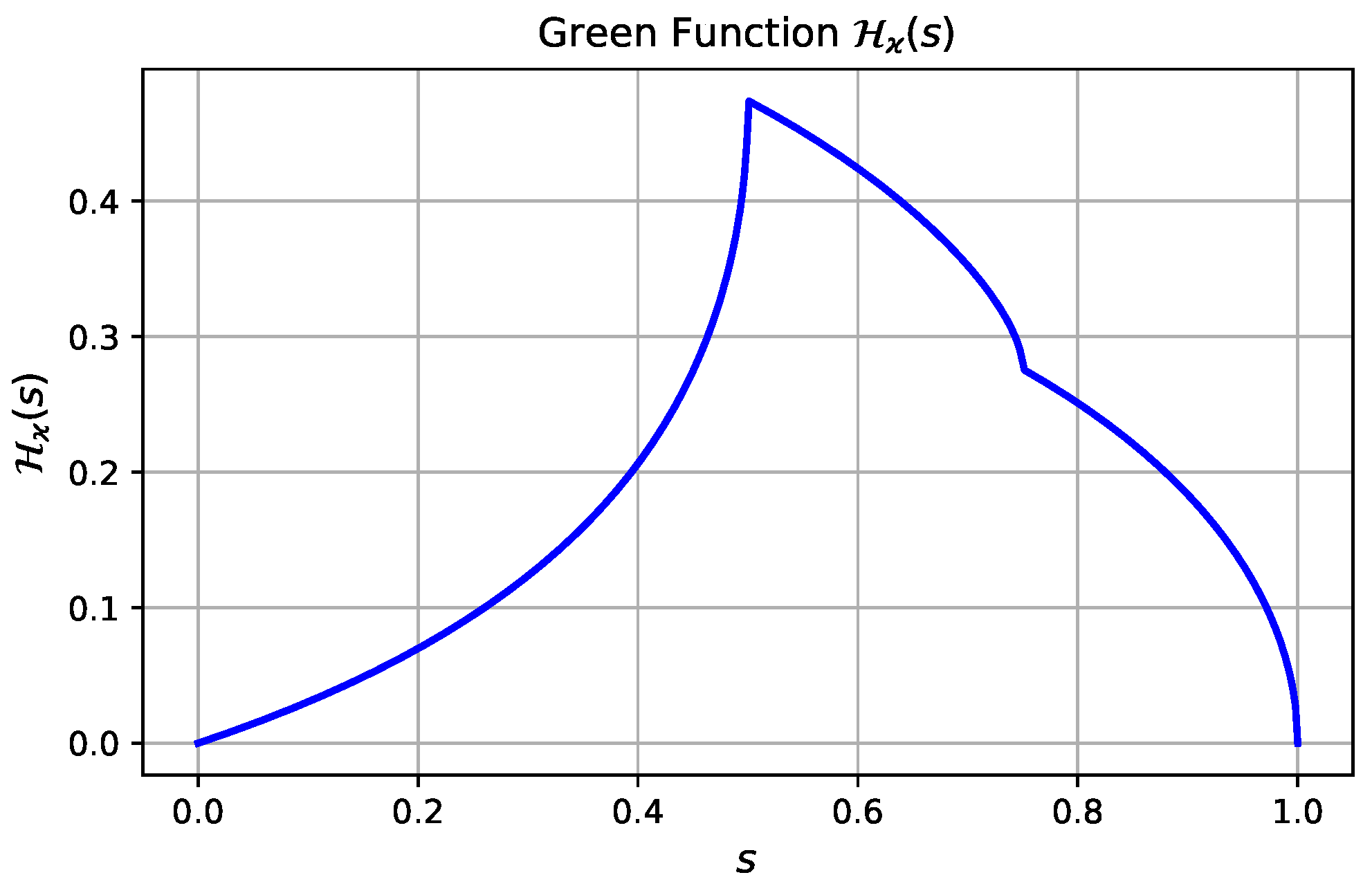
Hence, H ϰ ( s ) 0 .
To examine the validity of condition (G0) and the applicability of Theorem 1, we compute the associated Green kernel H ϰ ( s ) numerically. The values of Table 1 reported below are obtained by direct evaluation of the explicit Green function expression using standard floating-point arithmetic. The discretization of the interval [ 0 , 1 ] is sufficiently fine to ensure numerical stability and accuracy.
On the other hand, we have
0 < ϖ = 0 1 e 1 3 ( 1 t ) t 1 2 d ϰ ( t ) = e 1 3 ( 1 1 2 ) 1 2 1 2 1 4 e 1 3 ( 1 3 4 ) 3 4 1 2   = e 1 6 · 1 2 1 4 e 1 12 · 3 2 0.8353 0.2352 0.6001 < 1 .
Thus, condition (G0) holds.
Take κ = 4 since
g ( t , z ) = z 1 3 t 1 5 ( 1 t ) 1 10 ,
and clearly g C ( ( 0 , 1 ) × ( 0 , + ) , [ 0 , + ) ) , and g is non-increasing in z > 0 ; moreover, for any constant c 1 and for any ( t , z ) ( 0 , 1 ] × ( 0 , + ) ,
g ( t , c z ) = c 1 3 z 1 3 t 1 5 ( 1 t ) 1 10 c 4 z 1 3 t 1 5 ( 1 t ) 1 10 = c κ g ( t , z ) .
which implies that ( G 1 ) holds.
In the end, let
ϱ ( s ) = g s , e s 3 s 1 2 ( 1 s ) = e s 9 s 1 10 ( 1 s ) 3 10 , s ( 0 , 1 ) ,
and choose ρ = 7 5 ; we verify
ϱ L 5 7 ( 0 , 1 ) .
In fact,
| | ϱ | | L 5 7 = 0 1 ϱ 5 7 ( s ) d s 7 5 = 0 1 e 5 63 s s 5 70 ( 1 s ) 15 70 d s 7 5 = ( 1.4161497611 ) 7 5 1.655 .
Thus, ϱ L 5 7 ( 0 , 1 ) .
According to Theorem 1, there exists a positive constant λ * such that, for any λ [ λ * , + ) , the eigenvalue problem of the tempered fractional equation with the Riemann–Stieltjes integral boundary condition (43) has at least one positive solution z * ( t ) satisfying
l e t 3 t 1 2 ( 1 t ) z * ( t ) l 1 ,
where 0 < l < 1 is a constant. □
The numerical approximation of the positive solution z * ( t ) is obtained using a standard tempered fractional finite-difference scheme combined with the upper–lower solution iteration. The step size is chosen to balance computational efficiency and accuracy, and the parameters are selected to satisfy the assumptions of Theorem 1. Numerical experiments indicate that the solution remains stable under small variations regarding the discretization parameters.
Figure 1 shows the numerical plot of H ϰ ( s ) , demonstrating positivity despite ϰ including the signed measure.
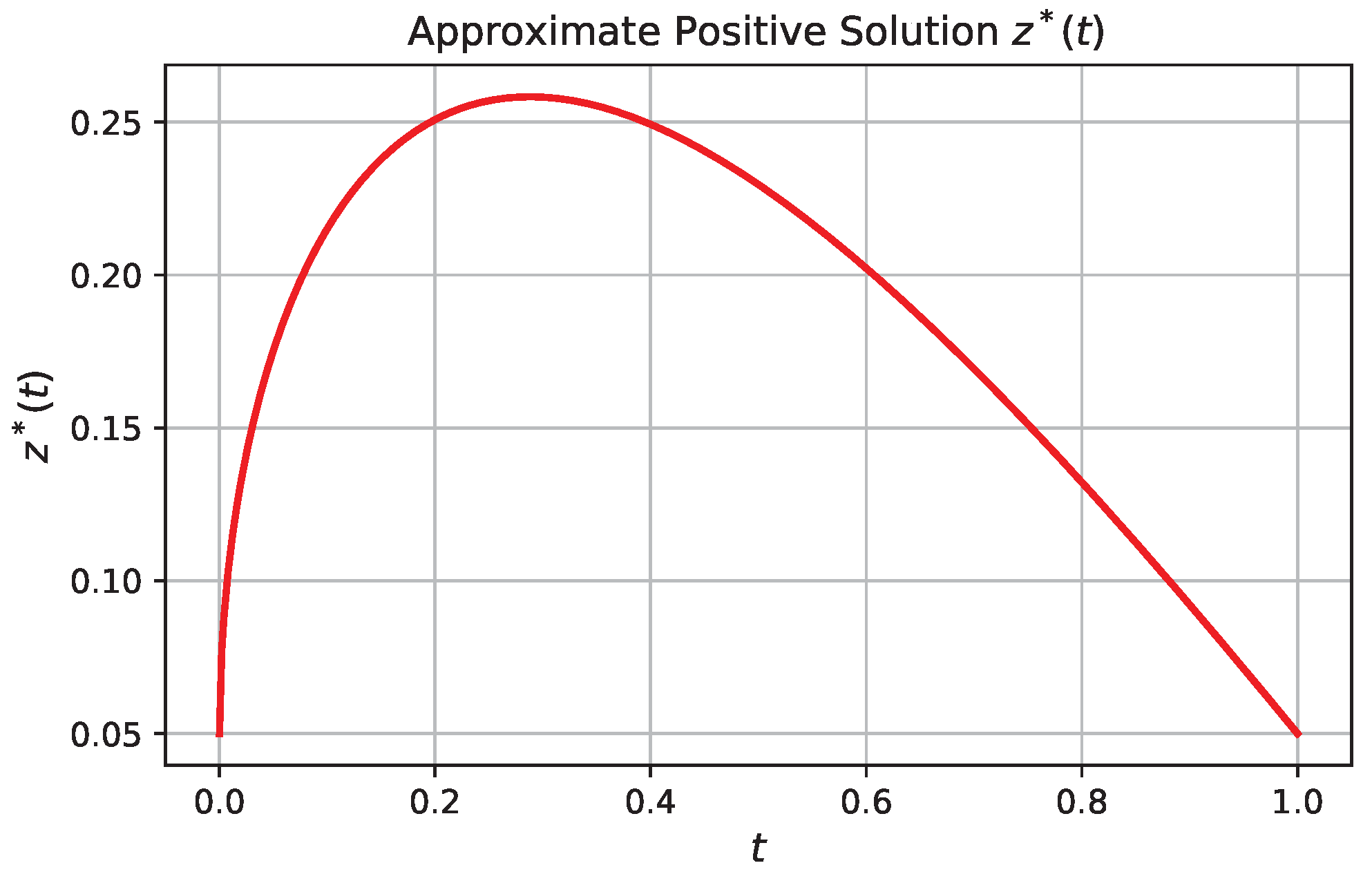
Using a standard tempered fractional difference scheme with upper–lower solution iteration, a positive solution z * ( t ) of (43) can be approximated. Figure 2 shows an illustrative numerical solution, satisfying
0.1 e t / 3 t 1 / 2 ( 1 t ) z * ( t ) 10 .
Remark 5.
We provide a brief physical interpretation for the example (43):
(i) 
The fractional order α = 1 2 and tempering parameter μ = 1 3 model tempered anomalous diffusion, where long-range memory effects persist but extreme transport events are suppressed.
(ii) 
The singular nonlinearity z 1 / 3 reflects localized sources or sinks, which are commonly encountered in turbulent or heterogeneous transport processes.
(iii) 
The Riemann–Stieltjes boundary condition with a signed measure represents nonlocal boundary feedback, allowing both reinforcing and dissipative effects at the boundary.
(iv) 
The numerical solution z * ( t ) exhibits smooth growth and decay, illustrating how the tempered operator moderates long-time behavior.
Remark 6.
Despite the signed measure, the positivity of H ϰ ( s ) ensures that condition  (G0)  is satisfied, validating the existence results and providing a clear physical picture.

5. Conclusions

Tempered fractional equations generalize both ordinary diffusion and pure fractional diffusion, providing flexible models for semi-heavy-tailed phenomena that arise in anomalous diffusion processes. In this paper, we investigated the existence of positive solutions to the eigenvalue problem for a singular tempered fractional equation with Riemann–Stieltjes integral boundary conditions involving signed measures. By constructing appropriate upper and lower solutions, we established an eigenvalue interval guaranteeing the existence of positive solutions and obtained estimates on their bounds. A notable feature of our results is that the nonlinearity f is allowed to be singular in both the temporal and spatial variables, and the boundary condition incorporates a Riemann–Stieltjes integral with signed measures.
Potential extensions of this work include developing numerical schemes to approximate the positive solutions, exploring higher-order or multi-term tempered fractional operators, and studying analogous eigenvalue problems under different types of integral or nonlocal boundary conditions. Such directions may further deepen the understanding of tempered fractional models and broaden their applicability in complex diffusion phenomena.

Author Contributions

Methodology, X.Z.; Investigation, H.S., L.L., X.B. and Y.W.; Writing—original draft, X.Z.; Writing—review and editing, Y.W. All authors have read and agreed to the published version of the manuscript.

Funding

The authors are supported financially by the Natural Science Foundation of Shandong Province of China (ZR2022AM015) and an ARC Discovery Project Grant DP230102079.

Data Availability Statement

The original contributions presented in this study are included in the article. Further inquiries can be directed to the corresponding author.

Conflicts of Interest

The authors declare that there are no conflicts of interest regarding the publication of this paper.

References

  1. Mao, W.; Wang, H.; Chen, C. A-posteriori error estimations based on postprocessing technique for two-sided fractional differential equations. Appl. Numer. Math. 2021, 167, 73–91. [Google Scholar] [CrossRef]
  2. Li, Y.; Zhang, Q.; Sun, B. Existence of solutions for fractional boundary value problems with a quadratic growth of fractional derivative. J. Funct. Spaces 2020, 2020, 7139795. [Google Scholar] [CrossRef]
  3. Zhang, T.; Cheng, T. A priori estimates of solutions to nonlinear fractional Laplacian equation. Electron. Res. Arch. 2022, 31, 1119–1133. [Google Scholar] [CrossRef]
  4. Zhang, T. Liouville type theorems involving the fractional Laplacian on the upper half Euclidean space. Fractal Fract. 2022, 6, 738. [Google Scholar] [CrossRef]
  5. Zhang, X.; Kong, D.; Tian, H.; Wu, Y.; Wiwatanapataphee, B. An upper-lower solution method for the eigenvalue problem of Hadamard-type singular fractional differential equation. Nonlinear Anal. Model. Control 2022, 27, 789–802. [Google Scholar] [CrossRef]
  6. Yang, Y.; Wen, C.; Liu, Y.; Li, H.; Wang, J. Optimal time two-mesh mixed finite element method for a nonlinear fractional hyperbolic wave model. Commun. Anal. Mech. 2024, 16, 24–52. [Google Scholar] [CrossRef]
  7. Zhang, X.; Chen, P.; Tian, H.; Wu, Y. Upper and lower solution method for a singular tempered fractional equation with a p-Laplacian operator. Fractal Fract. 2023, 7, 522. [Google Scholar] [CrossRef]
  8. Zhang, X.; Chen, J.; Chen, P.; Li, L.; Wu, Y. Nonlocal changing-sign perturbation tempered fractional sub-diffusion model with weak singularity. Fractal Fract. 2024, 8, 337. [Google Scholar] [CrossRef]
  9. Sabzikar, F.; Meerschaert, M.; Chen, J. Tempered fractional calculus. J. Comput. Phys. 2015, 293, 14–28. [Google Scholar] [CrossRef] [PubMed]
  10. Yang, Y.; Wu, Q.; Jhang, S.; Kang, Q. Approximation theorems associated with multidimensional fractional Fourier transform and applications in Laplace and heat equations. Fractal Fract. 2022, 6, 625. [Google Scholar] [CrossRef]
  11. Fu, Z.; Grafakos, L.; Lin, Y.; Wu, Y.; Yang, S. Riesz transform associated with the fractional Fourier transform and applications in image edge detection. Appl. Comput. Harmon. Anal. 2023, 66, 211–235. [Google Scholar] [CrossRef]
  12. Fu, Z.; Lin, Y.; Yang, D.; Yang, S. Fractional Fourier transforms meet Riesz potentials and image processing. SIAM J. Imaging Sci. 2024, 17, 476–500. [Google Scholar] [CrossRef]
  13. Wang, C.; Hou, X.; Wu, Q.; Dang, P.; Fu, Z. Fractional Fourier series on the torus and applications. Fractal Fract. 2024, 8, 494. [Google Scholar] [CrossRef]
  14. Chen, W.; Fu, Z.; Grafakos, L.; Wu, Y. Fractional Fourier transforms on Lp and applications. Appl. Comput. Harmon. Anal. 2021, 55, 71–96. [Google Scholar] [CrossRef]
  15. Wang, Y.; Xu, C.; Yang, M.; Zhang, J. Less emphasis on hard regions: Curriculum learning of PINNs for singularly perturbed convection diffusion reaction problems. East Asian J. Appl. Math. 2024, 14, 104–123. [Google Scholar] [CrossRef]
  16. Liu, X.; Yang, M.; Zhang, J. Supercloseness of weak Galerkin method for a singularly perturbed convection diffusion problem in 2D. J. Comput. Appl. Math. 2024, 436, 115404. [Google Scholar] [CrossRef]
  17. Zhang, X.; Chen, P.; Li, L.; Wu, Y. A singular tempered sub-diffusion fractional model involving a non-symmetrically quasi-homogeneous operator. Symmetry 2024, 16, 671. [Google Scholar] [CrossRef]
  18. Wang, X.; Wang, Z.; Jia, Z. Global weak solutions for an attraction-repulsion chemotaxis system with p-Laplacian diffusion and logistic source. Acta Math. Sci. 2024, 44, 909–924. [Google Scholar] [CrossRef]
  19. Ai, B.; Jia, Z. The global existence and boundedness of solutions to a Chemotaxis–Haptotaxis model with nonlinear diffusion and signal production. Mathematics 2024, 12, 2577. [Google Scholar] [CrossRef]
  20. Jia, Z. Global boundedness of weak solutions for an attraction-repulsion chemotaxis system with p-Laplacian diffusion and nonlinear production. Discret. Contin. Dyn. Syst.-Ser. B 2023, 28, 4847–4863. [Google Scholar] [CrossRef]
  21. Kuang, N.; Xie, H. Derivative of self-intersection local time for the sub-bifractional Brownian motion. AIMS Math. 2022, 7, 10286–10302. [Google Scholar] [CrossRef]
  22. Cartea, Á.; Negrete, D. Fluid limit of the continuous-time random walk with general Lévy jump distribution functions. Phys. Rev. E 2007, 76, 41–105. [Google Scholar] [CrossRef]
  23. Meerschaert, M.; Zhang, Y.; Baeumer, B. Tempered anomalous diffusion in heterogeneous systems. Geophys. Res. Lett. 2008, 35, L17403. [Google Scholar] [CrossRef]
  24. Carr, P.; Geman, H.; Madan, D.; Yor, M. The fine structure of asset returns: An empirical investigation. J. Bus. 2002, 75, 305–333. [Google Scholar] [CrossRef]
  25. Qiu, W.; Nikan, O.; Avazzadeh, Z. Numerical investigation of generalized tempered-type integrodifferential equations with respect to another function. Fract. Calc. Appl. Anal. 2023, 26, 2580–2601. [Google Scholar] [CrossRef]
  26. Chen, P.; Zhang, X.; Li, L.; Jiang, Y.; Wu, Y. Existence and asymptotic estimates of the maximal and minimal solutions for a coupled tempered fractional differential system with different orders. Axioms 2025, 14, 092. [Google Scholar] [CrossRef]
  27. Li, L.; Zhang, X.; Chen, P.; Wang, Y.; Wu, Y. Existence of solution for a fractional differential system on the chemical graph of glycerol. Nonlinear Anal. Model. Control 2025, 30, 811–837. [Google Scholar] [CrossRef]
  28. Shi, S.; Zhang, L.; Wang, G. Fractional non-linear regularity, potential and balayage. J. Geom. Anal. 2022, 32, 221. [Google Scholar] [CrossRef]
  29. Wu, J.; Wu, Q.; Yang, Y.; Dang, P.; Ren, G. Riemann-Liouville fractional integrals and derivatives on Morrey spaces and applications to a Cauchy-type problem. J. Appl. Anal. Comput. 2024, 14, 1078–1096. [Google Scholar] [CrossRef]
  30. Wu, Y.; Wang, G. Fractional Adams-Moser-Trudinger type inequality with singular term in Lorentz space and Lp space. J. Appl. Anal. Comput. 2024, 14, 133–145. [Google Scholar] [CrossRef]
  31. Wang, Y.; Guo, L.; Zi, Y.; Li, J. Solvability of fractional differential system with parameters and singular nonlinear terms. AIMS Math. 2024, 9, 22435–22453. [Google Scholar] [CrossRef]
  32. Xue, Y.; Wei, Y. Ground states of nonlocal fractional Schrödinger equations with potentials well. Taiwan. J. Math. 2022, 26, 1203–1217. [Google Scholar] [CrossRef]
  33. Guo, L.; Wang, Y.; Li, C.; Cai, J.; Zhang, B. Solvability for a higher-order Hadamard fractional differential model with a sign-changing nonlinearity dependent on the parameter ϱ. J. Appl. Anal. Comput. 2024, 14, 2762–2776. [Google Scholar] [CrossRef]
  34. Zhang, H.; Zhang, T. Unconditional stability and convergence of fully discrete FEM for the viscoelastic Oldroyd flow with an introduced auxiliary variable. J. Korean Math. Soc. 2023, 60, 273–302. [Google Scholar] [CrossRef]
  35. Wang, Z.; Chen, C.; Li, Y.; Yang, X. Decoupled finite element scheme of the variable-density and viscosity phase-field model of a two-phase incompressible fluid flow system using the volume-conserved Allen–Cahn dynamics. J. Comput. Appl. Math. 2023, 420, 114773. [Google Scholar] [CrossRef]
  36. Zhang, H.; Zhang, T. Optimal error estimates of two-level iterative finite element methods for the thermally coupled incompressible MHD with different viscosities. Math. Methods Appl. Sci. 2025, 48, 7109–7137. [Google Scholar] [CrossRef]
  37. Zhang, T.; Duan, M. Stability and convergence analysis of stabilized finite element method for the Kelvin–Voigt viscoelastic fluid flow model. Numer. Algorithms 2021, 87, 1201–1228. [Google Scholar] [CrossRef]
  38. Zhang, H.; Chen, C.; Zhang, T. Two-level iterative finite element methods for the stationary natural convection equations with different viscosities based on three corrections. Comput. Appl. Math. 2023, 42, 11. [Google Scholar] [CrossRef]
  39. He, J.; Zhang, X.; Liu, L.; Wu, Y.; Cui, Y. A singular fractional Kelvin-Voigt model involving a nonlinear operator and their convergence properties. Bound. Value Probl. 2019, 2019, 112. [Google Scholar] [CrossRef]
  40. Chu, X.; Chen, C.; Zhang, T. Stability and convergence of stabilized finite volume iterative methods for steady incompressible MHD flows with different viscosities. East Asian J. Appl. Math. 2023, 13, 361–397. [Google Scholar] [CrossRef]
  41. Shi, S.; Zhai, Z.; Zhang, L. Characterizations of the viscosity solution of a nonlocal and nonlinear equation induced by the fractional p-Laplace and the fractional p-convexity. Adv. Calc. Var. 2023, 17, 195–207. [Google Scholar] [CrossRef]
  42. Fritz, M.; Khristenko, U.; Wohlmuth, B. Equivalence between a time-fractional and an integer-order gradient flow: The memory effect reflected in the energy. Adv. Nonlinear Anal. 2023, 12, 20220262. [Google Scholar] [CrossRef]
  43. Gu, Q.; Chen, Y.; Zhou, J.; Huang, J. A fast linearized virtual element method on graded meshes for nonlinear time-fractional diffusion equations. Numer. Algorithms 2024, 97, 1141–1177. [Google Scholar] [CrossRef]
  44. Chen, C.; Liu, H.; Zheng, X.; Wang, H. A two-grid MMOC finite element method for nonlinear variable-order time-fractional mobile/immobile advection–diffusion equations. Comput. Math. Appl. 2020, 79, 2771–2783. [Google Scholar] [CrossRef]
  45. Liu, H.; Zheng, X.; Chen, C.; Wang, H. A characteristic finite element method for the time-fractional mobile/immobile advection–diffusion model. Adv. Comput. Math. 2021, 47, 41. [Google Scholar] [CrossRef]
  46. Qi, D.; Tao, X.; Zheng, J. Boundedness of the solution to a higher-dimensional triply haptotactic cross-diffusion system modeling oncolytic virotherapy. J. Evol. Equ. 2025, 25, 9. [Google Scholar] [CrossRef]
  47. Xie, J.; Zheng, J. A new result for global existence and boundedness in a three-dimensional self-consistent chemotaxis–fluid system with nonlinear diffusion. Acta Appl. Math. 2023, 183, 5. [Google Scholar] [CrossRef]
  48. Liu, X.; Yang, M. Error estimations in the balanced norm of finite element method on Bakhvalov–Shishkin triangular mesh for reaction–diffusion problems. Appl. Math. Lett. 2022, 123, 107523. [Google Scholar] [CrossRef]
  49. Xue, G.; Gao, Y. A Samarskii domain decomposition method for two-dimensional convection–diffusion equations. Comput. Appl. Math. 2022, 41, 283. [Google Scholar] [CrossRef]
  50. Yu, Y.; Xue, G. A nonlinear correction finite volume scheme preserving maximum principle for diffusion equations with anisotropic and discontinuous coefficients. Electron. Res. Arch. 2025, 3, 1589–1609. [Google Scholar] [CrossRef]
  51. Shi, D.; Ma, H. A novel linearized nonconforming BDF2–FDSD method for nonlinear convection-dominated diffusion equation. Comput. Appl. Math. 2025, 44, 203. [Google Scholar] [CrossRef]
  52. Shi, D.; Zhang, L. Unconditional superconvergence analysis of modified finite difference streamlined diffusion method for nonlinear convection-dominated diffusion equation. Comput. Math. Appl. 2024, 153, 81–93. [Google Scholar] [CrossRef]
  53. Zheng, J.; Ke, Y. Further study on the global existence and boundedness of the weak solution in a three-dimensional chemotaxis–Stokes system with nonlinear diffusion and general sensitivity. Commun. Nonlinear Sci. Numer. Simul. 2022, 115, 106732. [Google Scholar] [CrossRef]
  54. Zheng, J.; Qi, D. Global existence and boundedness in an N-dimensional chemotaxis–Navier–Stokes system with nonlinear diffusion and rotation. J. Differ. Equ. 2022, 335, 347–397. [Google Scholar] [CrossRef]
  55. Zheng, J.; Qi, D.; Ke, Y. Global existence, regularity and boundedness in a higher-dimensional chemotaxis–Navier–Stokes system with nonlinear diffusion and general sensitivity. Calc. Var. Part. Differ. Equ. 2022, 61, 150. [Google Scholar] [CrossRef]
  56. Liu, Q.; Shi, D. Nonconforming mixed finite element method for the diffuse interface model of two-phase fluid flows. Appl. Numer. Math. 2024, 197, 272–287. [Google Scholar] [CrossRef]
  57. Zhang, X.; Chen, J.; Li, L.; Wu, Y. A singular tempered sub-diffusion fractional equation with changing-sign perturbation. Axioms 2024, 3, 264. [Google Scholar] [CrossRef]
  58. Chen, P.; Zhang, X.; Wang, Y.; Wu, Y. The uniqueness and iterative properties of positive solution for a coupled singular tempered fractional system with different characteristics. Fractal Fract. 2024, 8, 636. [Google Scholar] [CrossRef]
  59. Zhang, X.; Chen, P.; Li, L.; Wu, Y. Multiplicity of positive solutions for a singular tempered fractional initial-boundary value problem with changing-sign perturbation term. Fractal Fract. 2025, 9, 215. [Google Scholar] [CrossRef]
  60. Gong, R.; Vempati, M.N.; Wu, Q.; Xie, P. Boundedness and compactness of Cauchy-type integral commutator on weighted Morrey spaces. J. Aust. Math. Soc. 2022, 113, 36–56. [Google Scholar] [CrossRef]
  61. Fu, Z.; Hou, X.; Lee, M.Y.; Li, J. A study of one-sided singular integral and function space via reproducing formula. J. Geom. Anal. 2023, 33, 289. [Google Scholar] [CrossRef]
  62. Wang, W.; Wu, Q.; Wang, W.; Wu, Q. Atomic decomposition theorem for Hardy spaces on products of Siegel upper half spaces and Bi-parameter Hardy spaces. J. Geom. Anal. 2023, 33, 351. [Google Scholar] [CrossRef]
  63. Dang, P.; Du, J.; Qian, T. Riemann boundary value problems for monogenic functions on the hyperplane. Adv. Appl. Clifford Algebr. 2022, 32, 29. [Google Scholar] [CrossRef]
  64. Wang, X.; Wang, G. Singular Hardy–Adams inequalities on hyperbolic spaces of any even dimension. Ann. Pol. Math. Inst. Mat. Pol. Akad. Nauk. 2022, 129, 175–192. [Google Scholar] [CrossRef]
  65. Duong, X.; Lacey, M.; Li, J.; Wick, B.; Wu, Q. Commutators of Cauchy-Szego type integrals for domains in Cn with minimal smoothness. Indiana Univ. Math. J. 2021, 70, 1505–1541. [Google Scholar] [CrossRef]
  66. Fu, Z.; Lu, S.; Shi, S. Two characterizations of central BMO space via the commutators of Hardy operators. Forum Math. Gruyter 2021, 33, 505–529. [Google Scholar] [CrossRef]
  67. Gu, L.; Liu, Y.; Yang, C. Solvability of some Riemann-Hilbert problems related to Dirac operator with gradient potential in R 3 . J. Appl. Anal. Comput. 2024, 14, 976–985. [Google Scholar] [CrossRef]
  68. Gu, L.; Liu, Y.; Lin, R. Some integral representation formulas and Schwarz lemmas related to perturbed Dirac operators. J. Appl. Anal. Comput. 2022, 12, 2475–2487. [Google Scholar] [CrossRef]
  69. Zhou, J.; Li, H.; Zhang, Z. A posteriori error estimates of spectral approximations for second order partial differential equations in spherical geometries. J. Sci. Comput. 2022, 90, 56. [Google Scholar] [CrossRef]
  70. Zheng, W.; Chen, Y.; Zhou, J. A Legendre spectral method for multidimensional partial Volterra integro-differential equations. J. Comput. Appl. Math. 2024, 436, 115302. [Google Scholar] [CrossRef]
  71. Shen, X.; Chen, C.; Bian, H.; Zhang, T. Two-level multiscale enrichment finite volume method based on the Newton iteration for the stationary incompressible magnetohydrodynamics flow. Math. Methods Appl. Sci. 2025, 48, 10271–10296. [Google Scholar] [CrossRef]
  72. Zhang, T.; Chu, X.; Chen, C. Unconditional stability and convergence analysis of fully discrete stabilized finite volume method for the time-dependent incompressible MHD flow. Discret. Contin. Dyn. Syst. B 2023, 28, 5839–5880. [Google Scholar] [CrossRef]
  73. Chen, C.; Yang, X. Fully-discrete finite element numerical scheme with decoupling structure and energy stability for the Cahn–Hilliard phase-field model of two-phase incompressible flow system with variable density and viscosity. ESAIM Math. Model. Numer. Anal. 2021, 55, 2323–2347. [Google Scholar] [CrossRef]
  74. Liu, Q.; Shi, D. Superconvergence error analysis of an efficient mixed finite element method for time-dependent natural convection problem. Comput. Math. Appl. 2023, 131, 68–81. [Google Scholar] [CrossRef]
  75. Hu, Z.; Chen, P.; Zhou, W. Two-grid finite element method for time-fractional nonlinear Schrödinger equation. J. Comput. Math. 2024, 42, 1124–1144. [Google Scholar] [CrossRef]
  76. Zhao, F.; Zheng, J.; Li, K. Global existence and boundedness to an n-d chemotaxis–convection model during tumor angiogenesis. Nonlinear Anal. Real World Appl. 2025, 82, 104257. [Google Scholar] [CrossRef]
  77. Zhang, T. Fully decoupled, Linear and unconditional stability implicit/explicit scheme for the natural convection problem. Appl. Anal. 2023, 102, 3020–3042. [Google Scholar] [CrossRef]
  78. Wu, Y.; Chen, W. On strongly indefinite Schrödinger equations with non-periodic potential. J. Appl. Anal. Comput. 2023, 13, 1–10. [Google Scholar] [CrossRef]
  79. Li, X.; Chen, Y.; Chen, C. An improved two-grid technique for the nonlinear time-fractional parabolic equation based on the block-centered finite difference method. J. Comput. Math. 2022, 40, 455–473. [Google Scholar] [CrossRef]
  80. Al-Issa, S.M.; Kaddoura, I.H.; Hamze, H.M. Hybrid differential inclusion with nonlocal, infinite-point or Riemann–Stieltjes integral boundary conditions. J. Math. Comput. Sci. 2024, 32, 25–42. [Google Scholar] [CrossRef]
  81. Kilbas, A.; Srivastava, H.; Trujillo, J. North-Holland Mathematics Studies. In Theory and Applications of Fractional Differential Equations; Elsevier: Amsterdam, The Netherlands, 2006; Volume 204. [Google Scholar]
  82. Li, L.; Zhang, X.; Chen, P.; Wu, Y. The existence of positive solutions for a p-Laplacian tempered fractional diffusion equation using the Riemann–Stieltjes integral boundary condition. Mathematics 2025, 13, 541. [Google Scholar] [CrossRef]
  83. Webb, J. Nonlocal conjugate type boundary value problems of higher order. Nonlinear Anal. 2009, 71, 1933–1940. [Google Scholar] [CrossRef]
Figure 1. Numerical plot of the Green kernel H ϰ ( s ) .
Mathematics 14 00100 g001
Figure 2. Numerical approximation of the positive solution z * ( t ) .
Mathematics 14 00100 g002
Table 1. Numerical values of H ϰ ( s ) on [ 0 , 1 ] .
s0.000.100.200.300.400.500.600.700.750.850.951.00
H ϰ ( s ) 0.00000.27480.28170.27780.26780.25900.22540.18140.13690.08610.03350.0000
Disclaimer/Publisher’s Note: The statements, opinions and data contained in all publications are solely those of the individual author(s) and contributor(s) and not of MDPI and/or the editor(s). MDPI and/or the editor(s) disclaim responsibility for any injury to people or property resulting from any ideas, methods, instructions or products referred to in the content.