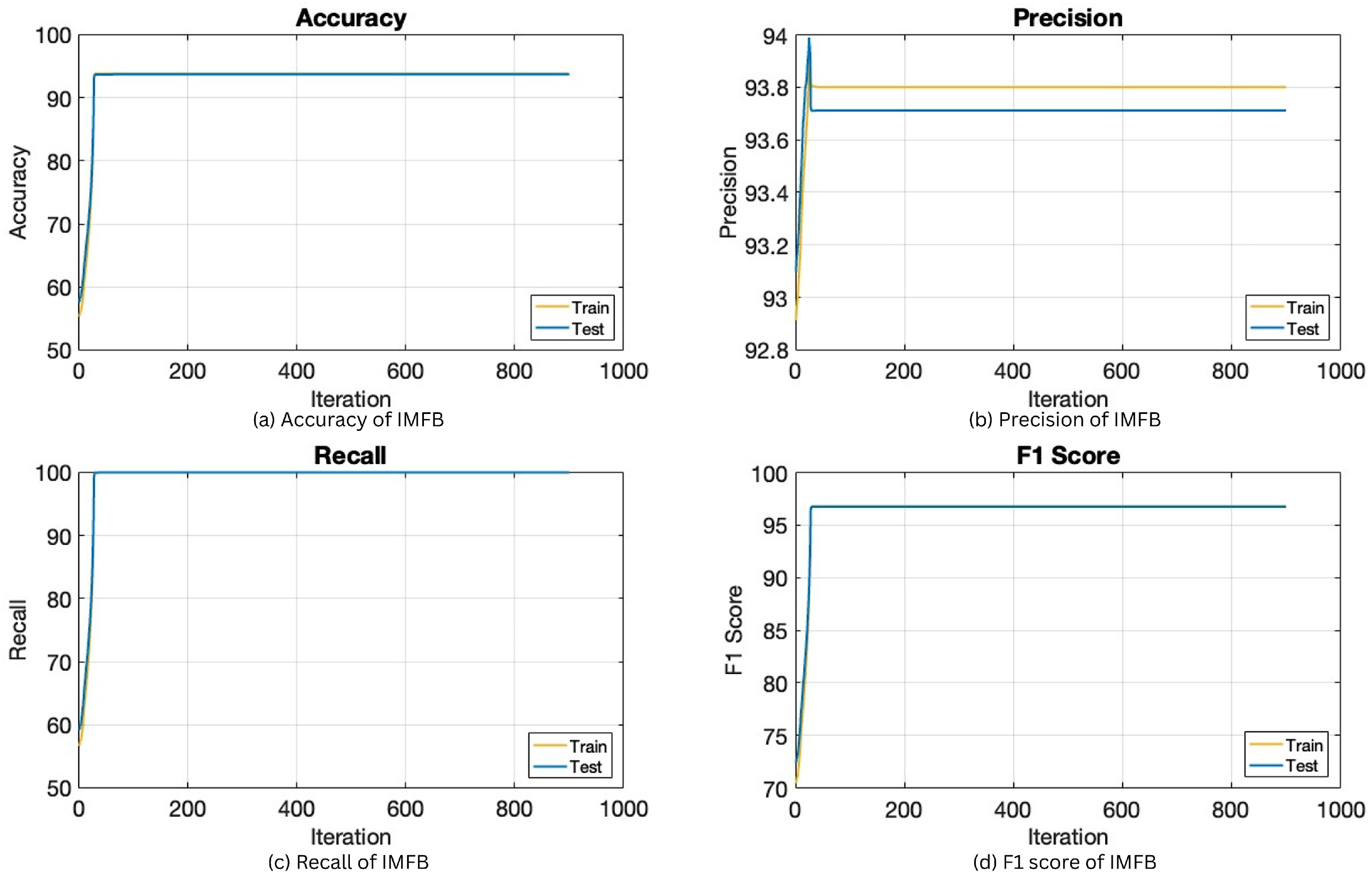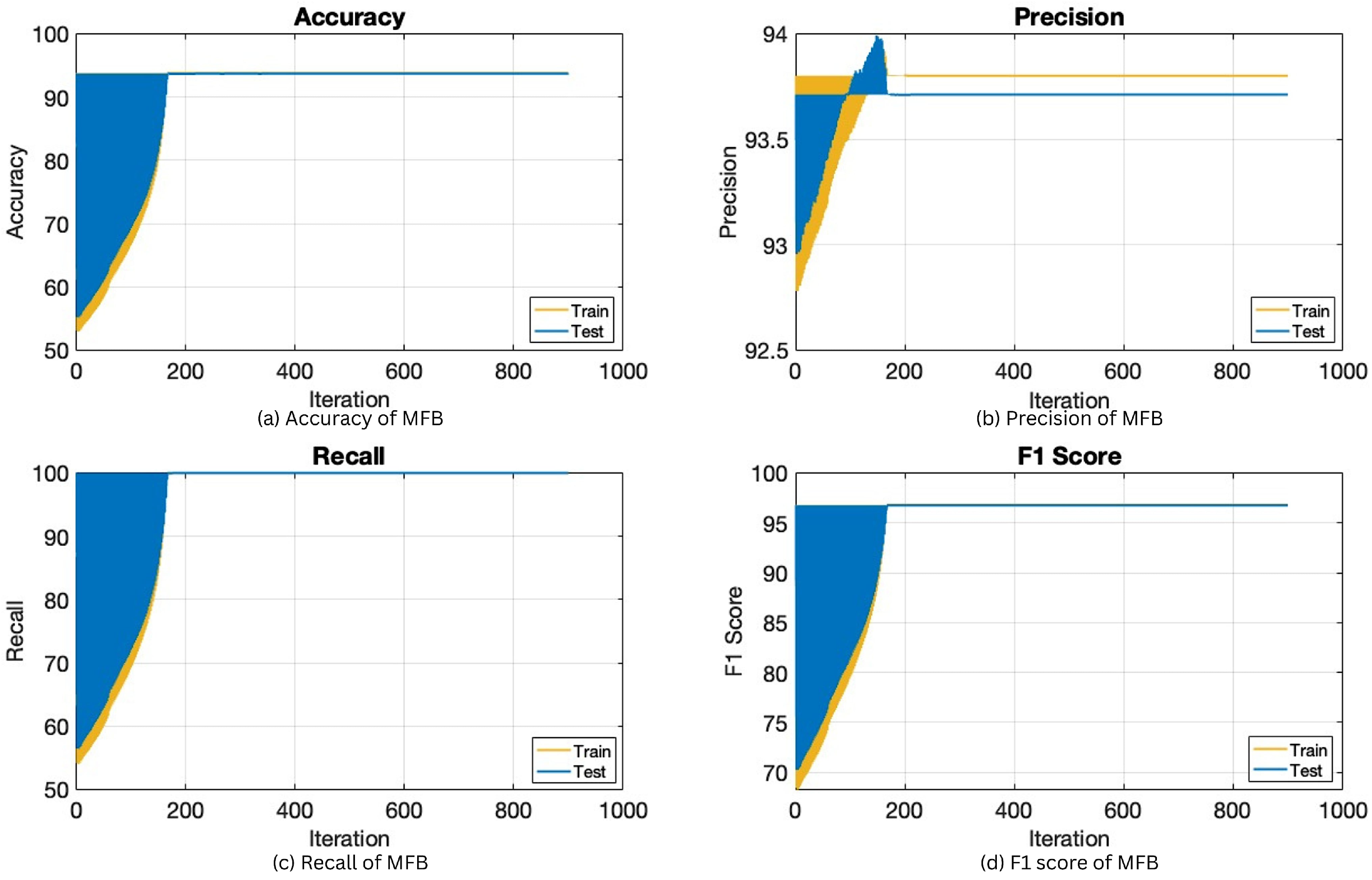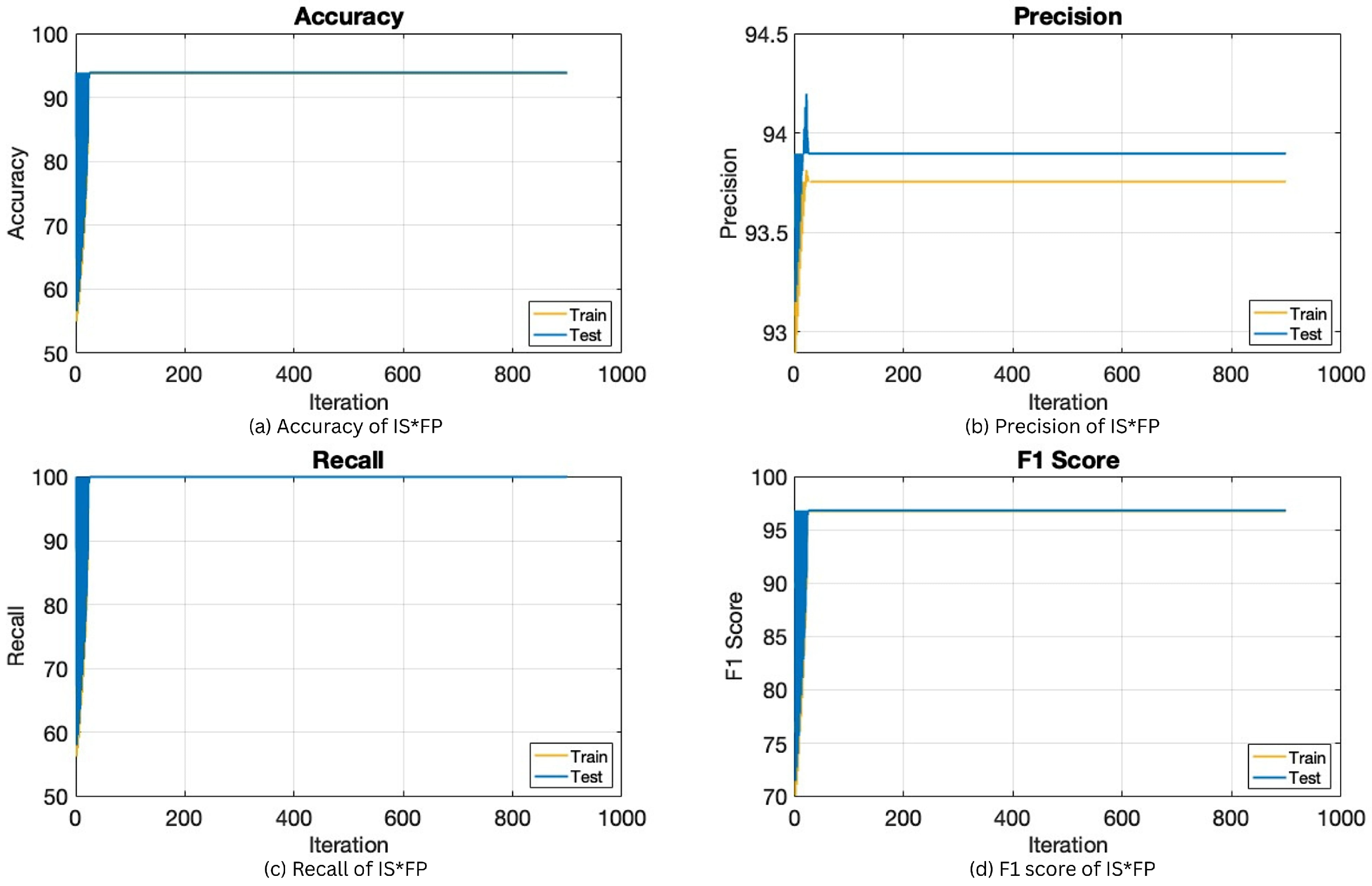
Solving Variational Inclusion Problems with Inertial S*Forward-Backward Algorithm and Application to Stroke Prediction Data Classification



Abstract
1. Introduction
| Algorithm 1 Inertial Mann forward–backward algorithm (IMFB). |
|
| Algorithm 2 Modified forward–backward algorithm (MFB). |
|
2. Preliminaries
- (i)
- G is called monotone if, for every pair , the following inequality holds:
- (ii)
- G is called maximally monotone if it is monotone and there is no other monotone operator that properly contains it. In other words, G is maximally monotone if, for every , the conditionimplies that .
- (i)
- F is called firmly nonexpansive if, for all , it satisfies:
- (ii)
- F is called β-cocoercive mapping if there exists a constant such that, for all , the following inequality holds:
- (iii)
- F is called L-Lipschitz continuous if there exists a constant such that, for all , the following inequality holds:
- (i)
- For every , the sequence converges.
- (ii)
- Every weak sequential cluster point of belongs to Ψ.
3. Weak Convergence Results
| Algorithm 3 Inertial S* forward–backward algorithm (IS*FB). |
|
- (i)
- .
- (ii)
- (iii)
- (i)
- .
- (ii)
- (iii)
- and
- (i)
- .
- (ii)
- (iii)
- and
4. Data
5. Application
6. Conclusions and Future Work
Author Contributions
Funding
Data Availability Statement
Acknowledgments
Conflicts of Interest
References
- Bersano, A.; Gatti, L. Pathophysiology and treatment of stroke: Present status and future perspectives. Int. J. Mol. Sci. 2023, 24, 14848. [Google Scholar] [CrossRef]
- Feigin, V.L.; Brainin, M.; Norrving, B.; Martins, S.; Sacco, R.L.; Hacke, W.; Fisher, M.; Pandian, J.; Lindsay, P. World Stroke Organization (WSO): Global Stroke Fact Sheet 2022. Int. J. Stroke 2022, 17, 18–29. [Google Scholar] [CrossRef]
- Feigin, V.L.; Krishnamurthi, R.V.; Parmar, P.; Norrving, B.; Mensah, G.A.; Bennett, D.A.; Barker-Collo, S.; Moran, A.E.; Sacco, R.L.; Truelsen, T.; et al. Update on the Global Burden of Ischemic and Hemorrhagic Stroke in 1990–2013: The GBD 2013 Study. Neuroepidemiology 2015, 45, 161–176. [Google Scholar] [CrossRef] [PubMed]
- Sudharsanan, N.; Deshmukh, M.; Kalkonde, Y. Direct estimates of disability-adjusted life years lost due to stroke: A cross-sectional observational study in a demographic surveillance site in rural Gadchiroli, India. BMJ Open 2019, 9, e028695. [Google Scholar] [CrossRef] [PubMed]
- Lin, H.; Guo, Y.; Di, Q.; Zheng, Y.; Kowal, P.; Xiao, J.; Liu, T.; Li, X.; Zeng, W.; Howard, S.W.; et al. Ambient PM2.5 and stroke: Effect modifiers and population attributable risk in six low- and middle-income countries. Stroke 2017, 48, 1191–1197. [Google Scholar] [CrossRef]
- Ueshima, H.; Sekikawa, A.; Miura, K.; Turin, T.C.; Takashima, N.; Kita, Y.; Watanabe, M.; Kadota, A.; Okuda, N.; Kadowaki, T.; et al. Cardiovascular disease and risk factors in Asia: A selected review. Circulation 2008, 118, 2702–2709. [Google Scholar] [CrossRef] [PubMed]
- Alexeeff, S.E.; Liao, N.S.; Liu, X.; Van Den Eeden, S.K.; Sidney, S. Long-term PM2.5 exposure and risks of ischemic heart disease and stroke events: Review and meta-analysis. J. Am. Heart Assoc. 2021, 10, e016890. [Google Scholar] [CrossRef]
- GBD 2021 Stroke Risk Factor Collaborators. GBD 2021 Stroke Risk Factor Collaborators. Global, regional, and national burden of stroke and its risk factors, 1990–2021: A systematic analysis for the Global Burden of Disease Study 2021. Lancet Neurol. 2024, 23, 973–1003. [Google Scholar] [CrossRef]
- Hassan, A.; Gulzar Ahmad, S.; Ullah Munir, E.; Ali Khan, I.; Ramzan, N. Predictive modelling and identification of key risk factors for stroke using machine learning. Sci. Rep. 2024, 14, 11498. [Google Scholar] [CrossRef]
- Dritsas, E.; Trigka, M. Stroke risk prediction with machine learning techniques. Sensors 2022, 22, 4670. [Google Scholar] [CrossRef]
- Chahine, Y.; Magoon, M.J.; Maidu, B.; Del Álamo, J.C.; Boyle, P.M.; Akoum, N. Machine learning and the conundrum of stroke risk prediction. Arrhythmia Electrophysiol. Rev. 2023, 12, e07. [Google Scholar] [CrossRef]
- Abujaber, A.A.; Alkhawaldeh, I.M.; Imam, Y.; Nashwan, A.J.; Akhtar, N.; Own, A.; Tarawneh, A.S.; Hassanat, A.B. Predicting 90-day prognosis for patients with stroke: A machine learning approach. Front. Neurol. 2023, 14, 1270767. [Google Scholar] [CrossRef] [PubMed]
- Rockafellar, R.T.; Wets, R.J.B. Variational Analysis; Springer Science & Business Media: Berlin, Germany, 2009; Volume 317. [Google Scholar] [CrossRef]
- Facchinei, F.; Pang, J.S. Finite-Dimensional Variational Inequalities and Complementarity Problems; Springer Science & Business Media: New York, NY, USA, 2003. [Google Scholar] [CrossRef]
- Whinston, M.D.; Green, J.R. Microeconomic Theory; Oxford University Press: Oxford, UK, 1995. [Google Scholar]
- Bishop, C.M. Pattern Recognition and Machine Learning; Springer: New York, NY, USA, 2006. [Google Scholar]
- Jun-On, N.; Cholamjiak, W. Enhanced double inertial forward-backward splitting algorithm for variational inclusion problems: Applications in mathematical integrated skill prediction. Symmetry 2024, 16, 1091. [Google Scholar] [CrossRef]
- Tongnoi, B. The forward-backward-forward algorithm with extrapolation from the past and penalty scheme for solving monotone inclusion problems and applications. Numer. Algor. 2025, 98, 2113–2143. [Google Scholar] [CrossRef]
- Khonchaliew, M.; Petrot, N.; Suwannaprapa, M. Two-step inertial viscosity subgradient extragradient algorithm with self-adaptive step sizes for solving pseudomonotone equilibrium problems. Carpathian J. Math. 2025, 41, 813–835. [Google Scholar] [CrossRef]
- Thang, T.V.; Tien, H.M. Parallel inertial forward-backward splitting methods for solving variational inequality problems with variational inclusion constraints. Math. Meth. Appl. Sci. 2025, 48, 748–764. [Google Scholar] [CrossRef]
- Alakoya, T.O.; Ogunsola, O.J.; Mewomo, O.T. An inertial viscosity algorithm for solving monotone variational inclusion and common fixed point problems of strict pseudocontractions. Bol. Soc. Mat. Mex. 2023, 29, 31. [Google Scholar] [CrossRef]
- Lions, P.L.; Mercier, B. Splitting algorithms for the sum of two nonlinear operators. SIAM J. Numer. Anal. 1979, 16, 964–979. [Google Scholar] [CrossRef]
- Nesterov, Y.E. A method for solving the convex programming problem with convergence rate O( ). Sov. Math. Dokl. 1983, 27, 372–376. [Google Scholar]
- Gibali, A.; Thong, D.V. Tseng type methods for solving inclusion problems and its applications. Calcolo 2018, 55, 49. [Google Scholar] [CrossRef]
- Shehu, Y.; Liu, L.; Dong, Q.L.; Yao, J.C. A relaxed forward-backward-forward algorithm with alternated inertial step: Weak and linear convergence. Netw. Spat. Econ. 2022, 22, 959–990. [Google Scholar] [CrossRef]
- Peeyada, P.; Suparatulatorn, R.; Cholamjiak, W. An inertial Mann forward-backward splitting algorithm of variational inclusion problems and its applications. Chaos Soliton. Fract. 2022, 158, 112048. [Google Scholar] [CrossRef]
- Peeyada, P.; Dutta, H.; Shiangjen, K.; Cholamjiak, W. A modified forward-backward splitting methods for the sum of two monotone operators with applications to breast cancer prediction. Math. Methods Appl. Sci. 2023, 46, 1251–1265. [Google Scholar] [CrossRef]
- Karahan, I.; Ozdemir, M. A general iterative method for approximation of fixed points and their applications. Adv. Fixed Point Theory 2013, 3, 510–526. [Google Scholar]
- Bauschke, H.H.; Combettes, P.L. Convex Analysis and Monotone Operator Theory in Hilbert Spaces, 2nd ed.; Springer: Cham, Switzerland, 2017. [Google Scholar] [CrossRef]
- Brézis, H. Opérateurs Maximaux Monotones et Semi-Groupes de Contractions dans les Espaces de Hilbert; Mathematical Studies; North-Holland: Amsterdam, The Netherlands, 1973; Volume 5. [Google Scholar]
- Zhang, S.S.; Lee, J.H.; Chan, C.K. Algorithms of common solutions to quasi variational inclusion and fixed point problems. Appl. Math. Mech. 2008, 29, 571–581. [Google Scholar] [CrossRef]
- Auslender, A.; Teboulle, M.; Ben-Tiba, S. A logarithmic-quadratic proximal method for variational inequalities. Comput. Optim. Appl. 1999, 12, 31–40. [Google Scholar] [CrossRef]
- Diabetes, Hypertension and Stroke Prediction Dataset. Available online: https://www.kaggle.com/datasets/prosperchuks/health-dataset/data (accessed on 27 November 2025).
- Wardhani, N.; Rochayani, M.; Iriany, A.; Sulistyono, A.; Lestantyo, P. Cross-validation Metrics for Evaluating Classification Performance on Imbalanced Data. In Proceedings of the 2019 International Conference on Computer, Control, Informatics and its Applications (IC3INA), Tangerang, Indonesia, 23–24 October 2019; pp. 14–18. [Google Scholar] [CrossRef]



| Attribute Name | Definitions and Encoding |
|---|---|
| Input | |
| Age | Age of Patient: |
| 1: =18–24 5: =40–44 9: =60–64 13: =80 or older | |
| 2: =25–29 6: =45–49 10: =65–69 | |
| 3: =30–34 7: =50–54 11: =70–74 | |
| 4: =35–39 8: =55–59 12: =75–79 | |
| gender | Gender of Patient: |
| 0: =Female | |
| 1: =Male | |
| HighChol | 0: =no high cholesterol |
| 1: =high cholesterol | |
| CholCheck | 0: =no cholesterol check in 5 years |
| 1: =yes cholesterol check in 5 years | |
| BMI | Body Mass Index |
| Smoker | Have you smoked at least 100 cigarettes in your entire life? [Note: 5 packs = 100 cigarettes]: |
| 0: =no | |
| 1: =yes | |
| HeartDiseaseorAttack | coronary heart disease (CHD) or myocardial infarction (MI): |
| 0: =no | |
| 1: =yes | |
| PhysActivity | physical activity in past 30 days - not including job |
| 0: =no | |
| 1: =yes | |
| Fruits | Consume Fruit 1 or more times per day |
| 0: =no | |
| 1: =yes | |
| Veggies | Consume Vegetables 1 or more times per day |
| 0: =no | |
| 1: =yes | |
| HvyAlcoholConsump | adult men drinks per week and adult women drinks per week: |
| 0: =no | |
| 1: =yes | |
| GenHlth | Would you say that in general your health is: |
| 1:= excellent 4:= fair | |
| 2:= very good 5:= poor | |
| 3:= good | |
| MentHlth | days of poor mental health scale 1–30 days |
| PhysHlth | physical illness or injury days in past 30 days scale 1–30 |
| DiffWalk | Do you have serious difficulty walking or climbing stairs?: |
| 0 := no | |
| 1 := yes | |
| HighBP | 0 := no high |
| BP 1 := high BP | |
| Diabetes | 0 := no diabetes |
| 1 := diabetes | |
| Output | |
| stroke | 0 := no stroke |
| 1 := suffered stroke | |
| Algorithm | |||||
|---|---|---|---|---|---|
| IMFB | - | - | 1 | ||
| MFB | - | 1 | |||
| IFB | 1 |
| Algorithm | Precision | Recall | F1-Score | Accuracy |
|---|---|---|---|---|
| IMFB | 93.90 | 100.00 | 96.58 | 93.90 |
| MFB | 93.71 | 100.00 | 96.75 | 93.71 |
| IFB | 93.90 | 100.00 | 96.58 | 93.90 |
Disclaimer/Publisher’s Note: The statements, opinions and data contained in all publications are solely those of the individual author(s) and contributor(s) and not of MDPI and/or the editor(s). MDPI and/or the editor(s) disclaim responsibility for any injury to people or property resulting from any ideas, methods, instructions or products referred to in the content. |
© 2025 by the authors. Licensee MDPI, Basel, Switzerland. This article is an open access article distributed under the terms and conditions of the Creative Commons Attribution (CC BY) license.
Share and Cite
Chaiwino, W.; Saksuriya, P.; Suparatulatorn, R. Solving Variational Inclusion Problems with Inertial S*Forward-Backward Algorithm and Application to Stroke Prediction Data Classification. Mathematics 2026, 14, 101. https://doi.org/10.3390/math14010101
Chaiwino W, Saksuriya P, Suparatulatorn R. Solving Variational Inclusion Problems with Inertial S*Forward-Backward Algorithm and Application to Stroke Prediction Data Classification. Mathematics. 2026; 14(1):101. https://doi.org/10.3390/math14010101
Chicago/Turabian StyleChaiwino, Wipawinee, Payakorn Saksuriya, and Raweerote Suparatulatorn. 2026. "Solving Variational Inclusion Problems with Inertial S*Forward-Backward Algorithm and Application to Stroke Prediction Data Classification" Mathematics 14, no. 1: 101. https://doi.org/10.3390/math14010101
APA StyleChaiwino, W., Saksuriya, P., & Suparatulatorn, R. (2026). Solving Variational Inclusion Problems with Inertial S*Forward-Backward Algorithm and Application to Stroke Prediction Data Classification. Mathematics, 14(1), 101. https://doi.org/10.3390/math14010101