Abstract
In this article, we look at the stochastic Wu–Zhang system (SWZS) forced by multiplicative Brownian motion in the Itô sense. The mapping method, which is an effective analytical method, is employed to investigate the exact wave solutions of the aforementioned equation. The proposed scheme provides new types of exact solutions including periodic solitons, kink solitons, singular solitons and so on, to describe the wave propagation in quantum mechanics and analyze a wide range of essential physical phenomena. In the absence of noise, we obtain some previously found solutions of SWZS. Additionally, using the MATLAB program, the impacts of the noise term on the analytical solution of the SWZS were demonstrated.
Keywords:
multiplicative white noise; stochastic exact solutions; stabilize by noise; mapping method MSC:
35A20; 60H10; 60H15; 35Q51; 83C15
1. Introduction
Nonlinear evolution equations (NLEEs) are commonly employed to describe complicated phenomena in a variety of engineering and scientific areas, including fluid dynamics, acoustics, optical fibers, solid state physics, hydrodynamics and plasma physics. Consequently, it is crucial to solve these NLEEs. Recently, numerous powerful approaches for discovering exact solutions to NLEEs have been introduced, such as -expansion method [1], Jacobi elliptic function expansion [2], modified extended tanh-function method [3], F-expansion method [4], Riccati equation method [5], -expansion [6,7], exp-function method [8], sine–cosine method [9], etc.
One of these equations is the Wu–Zhang system [10]. The Wu–Zhang system is a well-known model in quantum mechanics that describes the dynamics of two coupled qubits, or quantum bits. The system exhibits a variety of interesting phenomena, including entanglement generation and quantum phase transitions. One essential consideration in the study of the Wu–Zhang system is the role of noise, or random fluctuations in the system’s parameters, which can have significant effects on its behavior.
Noise in the Wu–Zhang system can come from a variety of sources, such as external electromagnetic fields or fluctuations in the system’s energy levels. These random fluctuations can lead to decoherence, or the loss of quantum coherence, which is important for quantum computing and other quantum technologies. Understanding the effects of noise in the Wu–Zhang system is crucial for developing strategies to mitigate its impact and improve the system’s performance.
In this article, we look at the stochastic Wu–Zhang system (SWZS) as follows:
where presents the surface velocity of water and indicates the elevation of the water; is the amplitude of noise; is a Brownian motion and . Due to their Lax pairs [11], the Wu–Zhang system (1) is integrable.
Due to the importance of the Wu–Zhang system in quantum mechanics, some authors obtained its solutions by using various methods including the dynamic analysis method [12], generalized extended tanh-function method [13], csch method, tan–cot method, extended tanh–coth method, modified simple equation method [14], extended tanh and Hirota methods [15], and extended trial equation method [16]. Moreover, the solutions of the fractal Wu–Zhang system with different fractional operators were obtained by using various methods including the modified auxiliary equation method [17], first integral method [18], and semi-inverse method [19], exponential rational function method [20], and iterative method [21]. However, the stochastic Wu–Zhang system with a noise term has not yet been addressed.
Our aim for this study is to obtain the exact stochastic solutions for the SWZS (1). To the best of our knowledge, the exact stochastic solutions for the SWZS (1) has never been obtained before. Several kinds of solutions may be found by using the mapping approach including periodic solitons, kink solitons, singular solitons and so on. In the absence of noise, we obtain some previous solutions of SWZS (1) such as the solutions stated in [13]. Furthermore, to study the effect of white noise on the discovered solutions, we present a number of two-dimensional and three-dimensional graphs.
The paper’s outline is as follows: Section 2 provides the wave equation of the SWZS (1), and Section 3 explains the mapping method. In Section 4, we obtain the solutions of the (1). In Section 5, we may investigate the impact of the stochastic term on the solutions of the SWZS (1). Finally, the obtained results of this paper are stated.
2. Traveling Wave Equation for SWZS
The wave equation for SWZS (1) is obtained by applying
where the deterministic functions and are real, and and k are non-zero constants. We note that
where is the Itô correction term. Similarly,
Considering the expectation on both sides of Equation (5), we arrive at
Since is a Gaussian process, for any real number . Hence, Equation (6) becomes
From Equation (9), we have
3. The Clarification of Mapping Method
Let us explain the method that we utilize here (for more information, see [22,23,24]). We assume the solution of Equation (11) has the form
where and are undefined constants to be determined and solves the following nonlinear elliptic function equation that is an ordinary equation:
where , and are real numbers. Equation (13) has several solutions for and as follows (Table 1).
Table 1.
The solutions of Equation (13) for distinct values and .
Where , , , , , are the Jacobi elliptic functions (JEFs) for 0 < ß < 1.
JEFs generate the following hyperbolic functions when ß → 1:
JEFs generate the following trigonometric functions when ß → 0:
4. Exact Solutions of the SWZS
With , Equation (12) takes the form
Inserting each coefficient of the various powers of , we have
and
By solving the above equations, we have
Plugging (15) into Equation (14), we obtain the following solution for the traveling wave Equation (11):
Using Equation (10), we have
Consequently, substituting Equations (16) and (17) into Equation (2), we have the solutions of the SWZS (1) as follows:
where
There are many cases for the solutions of Equation (15) relying on as follows:
Remark 1.
If we substitute and in (29), (30), (33), (34), (43), (44), (69), (70), (83) and (84), then we have the same trigonometric function solutions stated in [13], while if we substitute and in (21), (22), (27), (28), (39), (40), (59), and (60), then we have the same hyperbolic function solutions stated in [13].
5. Physical Meaning and Effect of Noise
Physical meaning: Obtaining exact solutions for stochastic Wu–Zhang systems is of utmost importance as it enables us to accurately predict and control the behavior of these systems under uncertainty. Different types of exact solutions, including periodic solitons, kink solitons, bright soliton, dark soliton and singular solitons, for Equation (1) are obtained here. Solitons are self-reinforcing solitary waves that maintain their shape and speed as they propagate through a medium. By obtaining exact soliton solutions of the Wu–Zhang system, researchers can better understand the dynamics of these waves and how they interact with their environment.
Furthermore, exact soliton solutions of the Wu–Zhang system allow for the prediction and manipulation of wave behavior in various applications. For example, in the field of optics, solitons play a crucial role in maintaining the coherence and stability of light pulses in fiber optic communications. By studying the exact soliton solutions of the Wu–Zhang system, researchers can develop more efficient methods for transmitting and controlling light waves in optical devices. This knowledge can lead to advancements in areas such as telecommunications, laser technology, and imaging systems.
Effect of Noise: Noise plays an essential role in the dynamics of the Wu–Zhang system in quantum mechanics. By studying the effects of noise on the system’s behavior, researchers can gain valuable insights into its properties and develop strategies to mitigate the impact of noise on its performance. Experimental studies have confirmed the theoretical predictions about the effects of noise on entanglement generation and quantum phase transitions in the Wu–Zhang system, highlighting the importance of noise in understanding and controlling quantum systems.
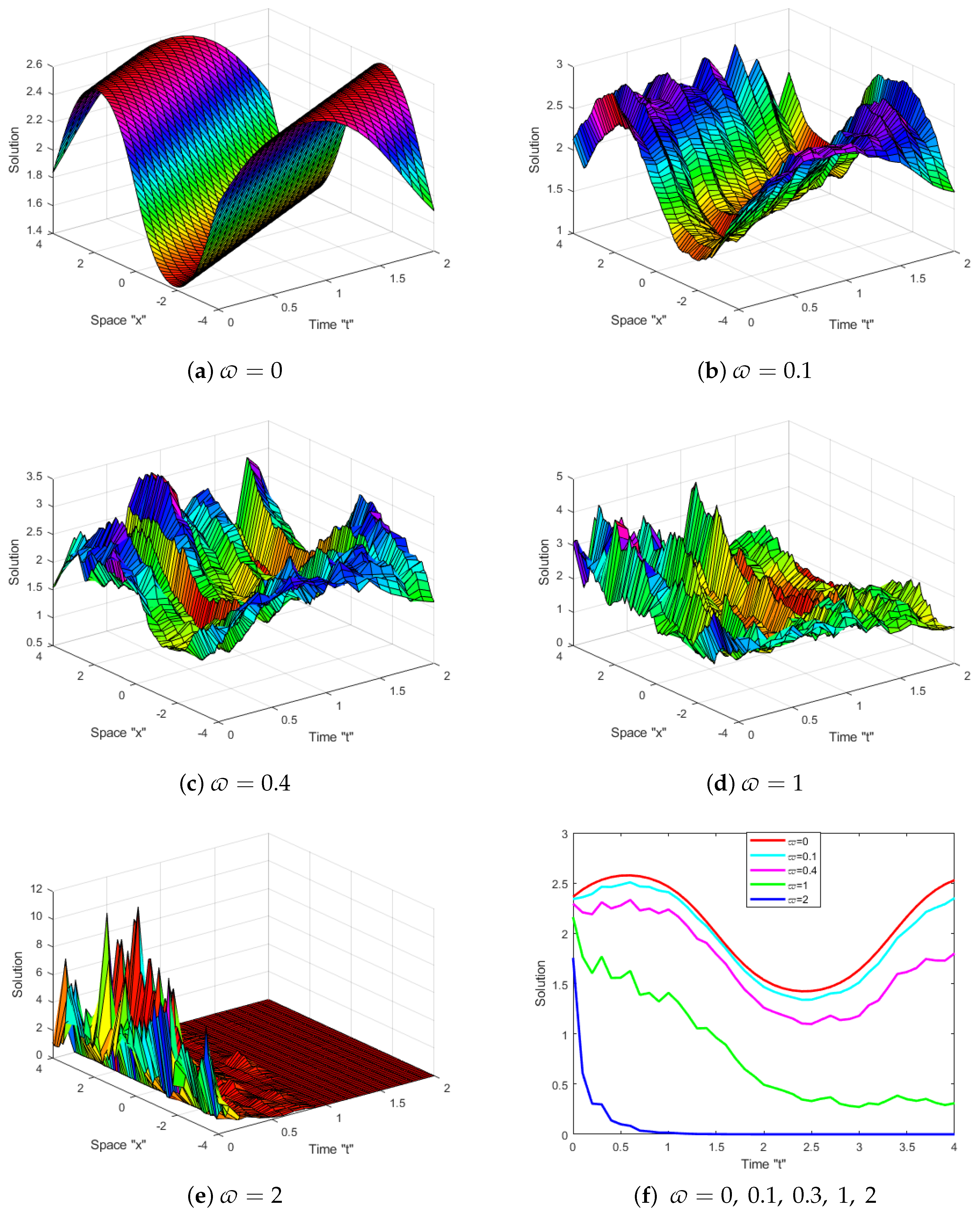
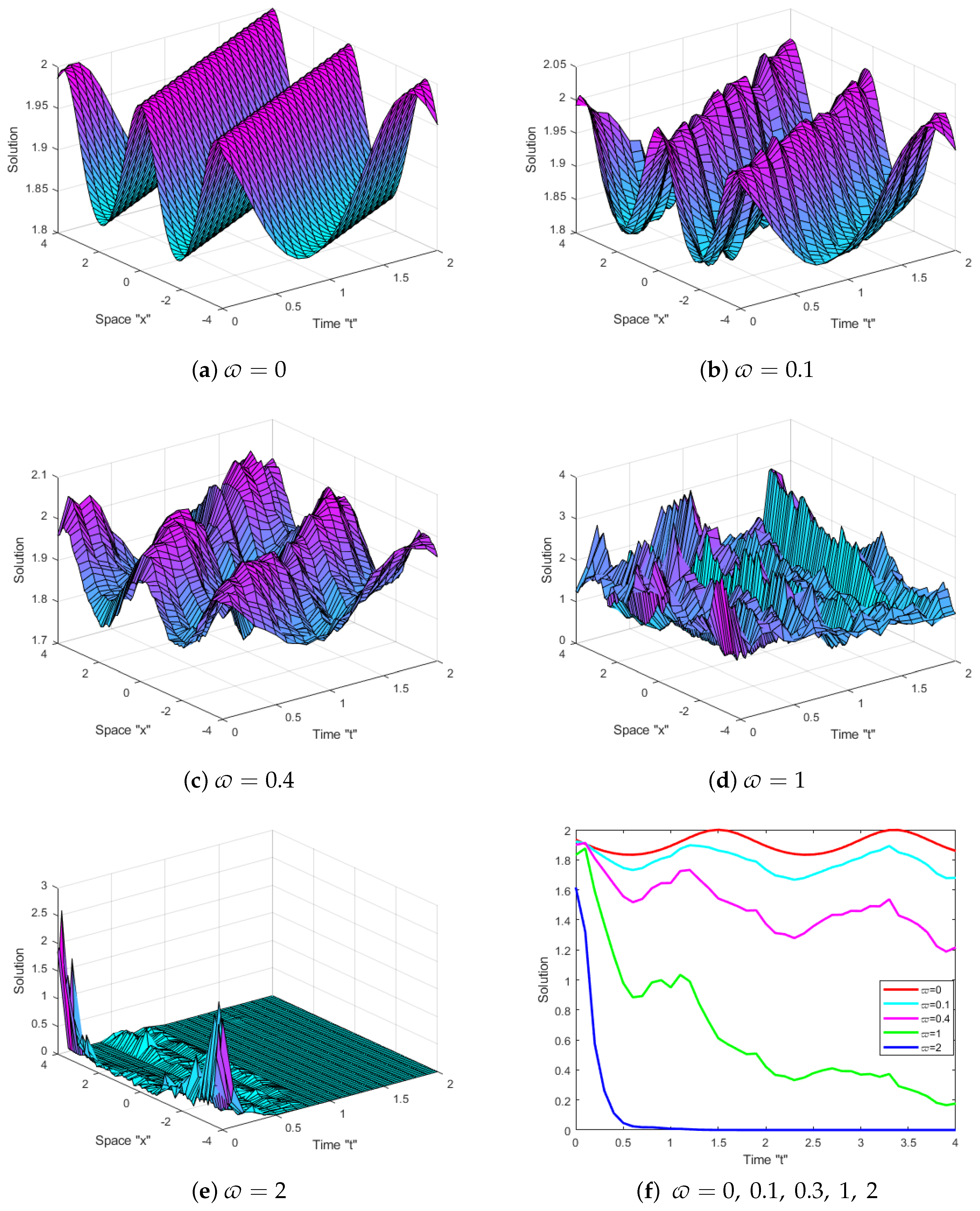
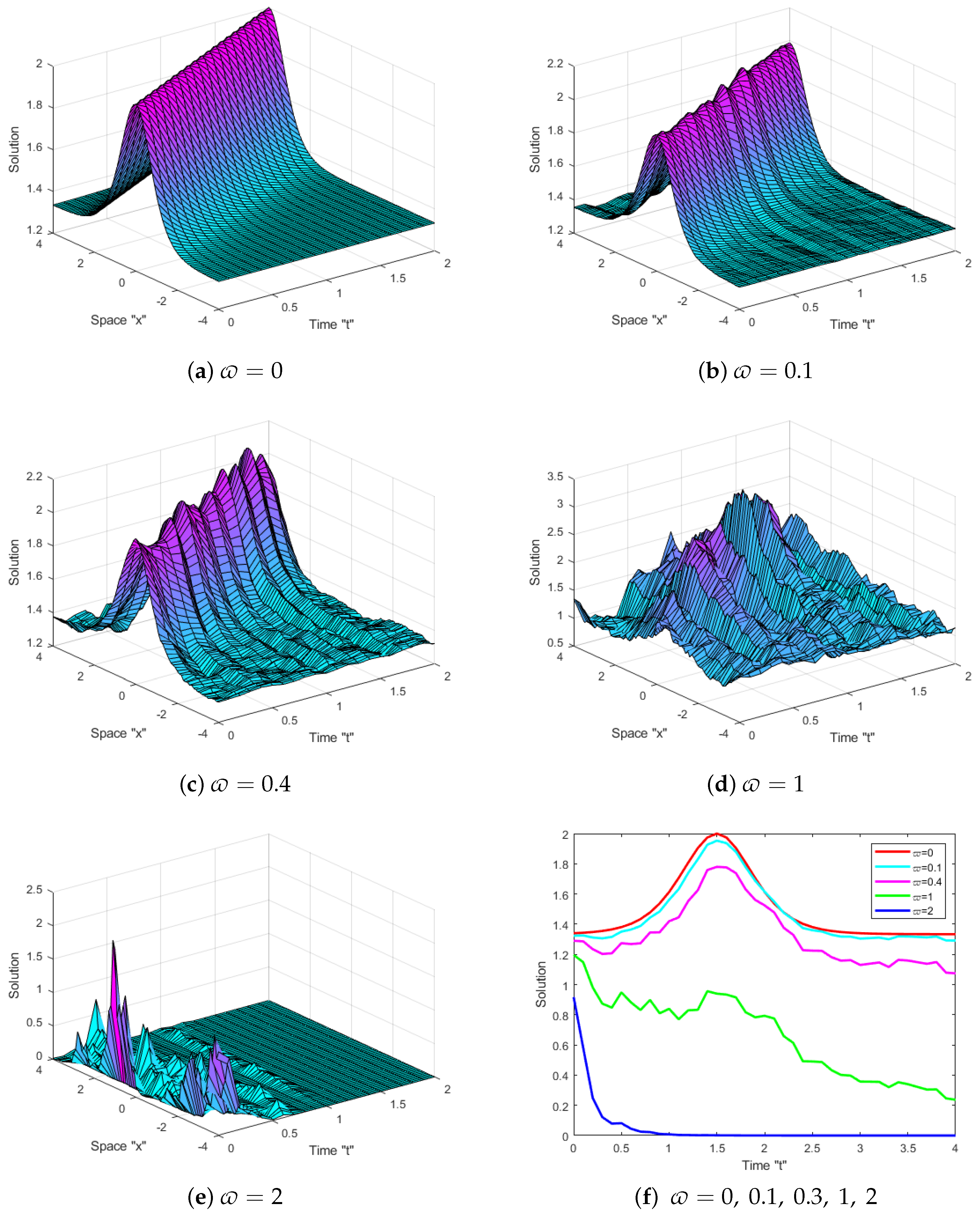
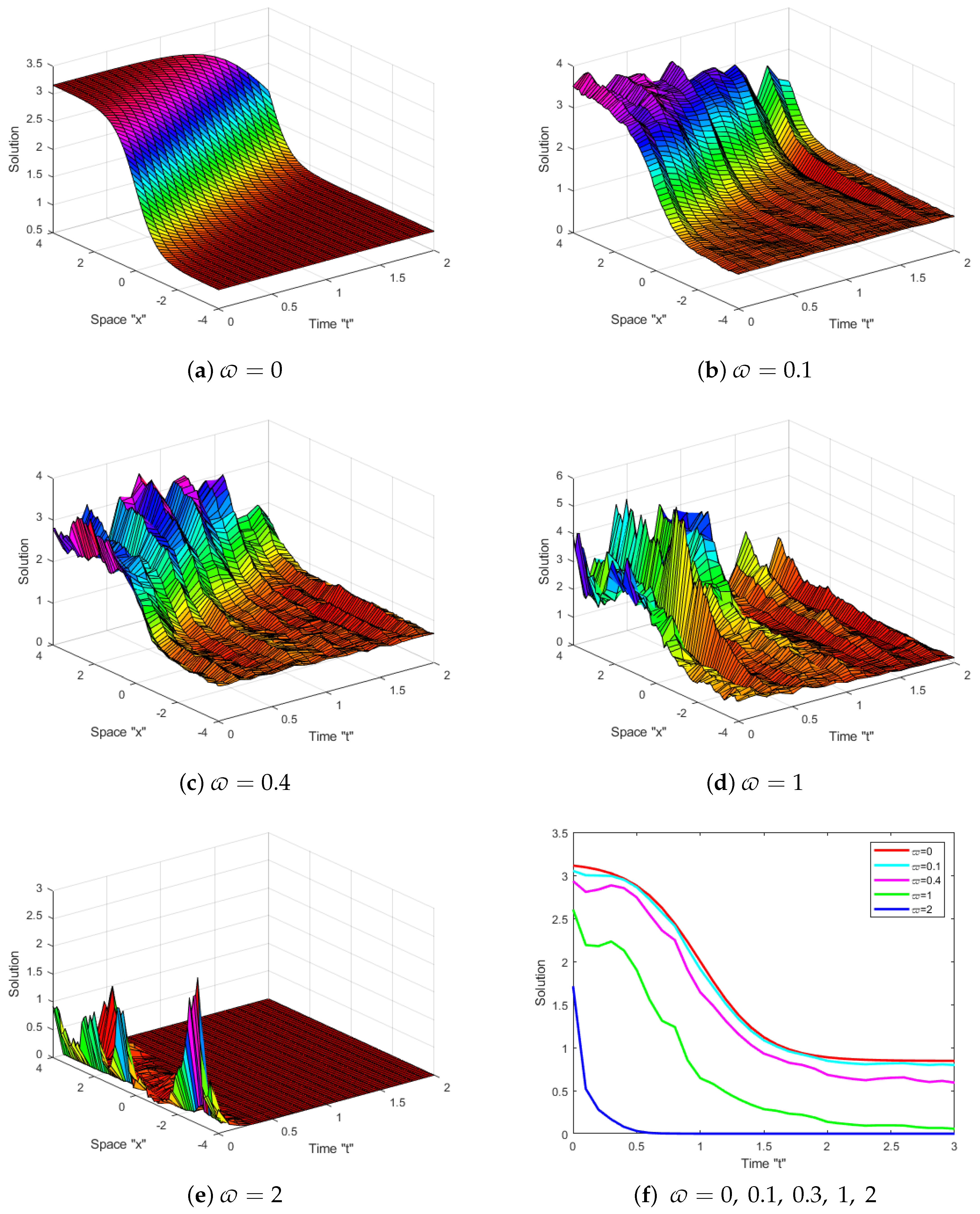
Now, let us show the effect of noise on the exact solution of the SWZS (1). To illustrate the behavior of some of the discovered solutions, many figures are provided, including Equations (19)–(22) as follows:
Now, Figure 1, Figure 2, Figure 3 and Figure 4 show that there are several kinds of solutions, such as periodic solutions, kink solutions, singular solutions and so on, when the multiplicative noise is neglected (i.e., when ). The surface becomes flatter after brief transit patterns when noise is added, and its amplitude is raised by . This indicates that the solutions of SWZS (1) are influenced by multiplicative white noise and are kept stable around zero.
Figure 2.
(a–e) display 3D shape of solution in Equation (20) with ß = 0.5, , and (f) shows 2D shape of Equation (20) with different .
Figure 4.
(a–c) display 3D shape of solution in Equation (22) with , and (d) shows 2D shape of Equation (22) with different .
6. Conclusions
In this paper, the stochastic Wu–Zhang system (1) perturbed by multiplicative white noise in the Itô sense was considered. We obtained novel hyperbolic, trigonometric, and elliptic stochastic solutions by applying a mapping approach. In the absence of noise, we obtained some previously obtained solutions of SWZS (1) such as the solutions stated in [13]. Since the Wu–Zhang system has significant uses in quantum mechanics, these solutions may be used to analyze a wide range of significant physical phenomena. Additionally, the MATLAB program was used to demonstrate the effects of the noise term on the analytical solution of the SWZS (1). We showed that the solutions of SWZS (1) were stabilized at zero by multiplicative white noise. In further work, we can obtain the solutions for the Wu–Zhang system with different fractional derivative operators such as the Caputo fractional derivative, Riemann–Liouville fractional derivative and M-truncated derivative [25,26].
Author Contributions
Conceptualization, E.E.A., A.I.A. and M.E.; methodology, E.E.A., A.I.A. and M.E.; software, W.W.M.; validation, W.W.M., E.E.A., A.I.A. and M.E.; formal analysis, E.E.A., A.I.A. and M.E.; data curation, E.E.A., A.I.A. and M.E.; writing—original draft preparation, W.W.M., E.E.A., A.I.A. and M.E.; writing—review and editing, W.W.M.; visualization, E.E.A., A.I.A. and M.E.; supervision, W.W.M.; project administration, W.W.M.; funding acquisition, W.W.M. All authors have read and agreed to the published version of the manuscript.
Funding
This research has been funded by Scientific Research Deanship at the University of Ha’il-Saudi Arabia through project number RG-24065.
Informed Consent Statement
Not applicable.
Data Availability Statement
The original contributions presented in this study are included in this article; further inquiries can be directed to the corresponding author.
Acknowledgments
This research has been funded by Scientific Research Deanship at the University of Ha’il-Saudi Arabia through project number RG-24065.
Conflicts of Interest
The authors declare no conflicts of interest.
References
- Khan, K.; Akbar, M.A. The exp(−ϕ(ς))-expansion method for finding travelling wave solutions of Vakhnenko-Parkes equation. Int. J. Dyn. Syst. Differ. Equ. 2014, 5, 72–83. [Google Scholar]
- Yan, Z.L. Abunbant families of Jacobi elliptic function solutions of the dimensional integrable Davey-Stewartson-type equation via a new method. Chaos Solitons Fractals 2003, 18, 299–309. [Google Scholar] [CrossRef]
- Baskonus, H.M.; Bulut, H.; Sulaiman, T.A. New complex hyperbolic structures to the lonngren-wave equation by using sine-gordon expansion method. Appl. Math. Nonlinear Sci. 2019, 4, 129–138. [Google Scholar] [CrossRef]
- Lu, B. The first integral method for some time fractional differential equations. J. Math. Anal. Appl. 2012, 395, 684–693. [Google Scholar] [CrossRef]
- Jiong, S. Auxiliary equation method for solving nonlinear partial differential equations. Phys. Lett. A 2003, 309, 387–396. [Google Scholar]
- Wang, M.L.; Li, X.Z.; Zhang, J.L. The (G′/G)-expansion method and travelling wave solutions of nonlinear evolution equations in mathematical physics. Phys. Lett. A 2008, 372, 417–423. [Google Scholar] [CrossRef]
- Zhang, H. New application of the (G′/G)-expansion method. Commun. Nonlinear Sci. Numer. Simul. 2009, 14, 3220–3225. [Google Scholar] [CrossRef]
- He, J.H.; Wu, X.H. Exp-function method for nonlinear wave equations. Chaos Solitons Fractals 2006, 30, 700–708. [Google Scholar] [CrossRef]
- Wazwaz, A.M. The sine-cosine method for obtaining solutions with compact and noncompact structures. Appl. Math. Comput. 2004, 159, 559–576. [Google Scholar] [CrossRef]
- Dong, W.B.; Wu, R.B.; Zhang, W.; Li, C.W.; Tarn, T.J. Spatial Control Model and Analysis of Quantum Fields in One-Dimensional Waveguides. SIAM J. Control Optim. 2016, 54, 1352–1377. [Google Scholar] [CrossRef]
- Lin, J.; Ren, B.; Li, H.; Li, Y. Soliton solutions for two nonlinear partial differential equations using a Darboux transformation of the Lax pairs. Phys. Rev. E 2008, 77, 036605. [Google Scholar] [CrossRef] [PubMed]
- Zheng, H.; Xia, Y.; Bai, Y.; Lei, G. Travelling Wave Solutions of Wu–Zhang System via Dynamic Analysis. Discret. Dyn. Nat. Soc. 2020, 2020, 2845841. [Google Scholar] [CrossRef]
- Zheng, X.; Chen, Y.; Zhang, H. Generalized extended tanh-function method and its application to (1 + 1)-dimensional dispersive long wave equation. Phys. Lett. A 2003, 311, 145–157. [Google Scholar] [CrossRef]
- Awad, A.J.M.; Al-Azzawi, F.J.I. Soliton solutions of Wu–Zhang system of evolution equations. Numer. Comput. Methods Sci. Eng. 2019, 1, 1–11. [Google Scholar]
- Inc, M.; Kilic, B.; Karatas, E.; Al Qurashi, M.M.; Baleanu, D.; Tchier, F. On soliton solutions of the Wu–Zhang system. Open Phys. 2016, 14, 76–80. [Google Scholar] [CrossRef]
- Mirzazadeh, M.; Ekici, M.; Eslami, M.; Krishnan, E.V.; Kumar, S.; Biswas, A. Solitons and other solutions to Wu–Zhang system. Nonlinear Anal. Model. Control 2017, 22, 441–458. [Google Scholar] [CrossRef]
- Khater, M.M.A.; Lu, D.; Attia, R. Dispersive long wave of nonlinear fractional Wu–Zhang system via a modified auxiliary equation method. AIP Adv. 2019, 9, 025003. [Google Scholar] [CrossRef]
- Eslami, M.; Rezazadeh, H. The first integral method for Wu–Zhang system with conformable time-fractional derivative. Calcolo 2016, 53, 475. [Google Scholar] [CrossRef]
- Liang, Y.H.; Wang, K.J. On a variational principle for the fractal Wu–Zhang system arising in shallow water. Int. J. Geomath. 2021, 12, 8. [Google Scholar] [CrossRef]
- Kaur, B.; Gupta, R.K. Time fractional (2+1)-dimensional Wu–Zhang system: Dispersion analysis, similarity reductions, conservation laws, and exact solutions. Comput. Math. Appl. 2020, 79, 1031–1048. [Google Scholar] [CrossRef]
- Yasmin, H.; Alderremy, A.A.; Shah, R.; Ganie, A.; Aly, S. Iterative solution of the fractional Wu–Zhang equation under Caputo derivative operator. Front. Phys. 2024, 12, 1333990. [Google Scholar] [CrossRef]
- Peng, Y.Z. Exact periodic wave solutions to the coupled Schrödinger-KdV equation and DS equations. Pramana-J. Phys. 2004, 62, 933–941. [Google Scholar] [CrossRef]
- Ahmed, A.I. Algolam, M.S.; Cesarano, C.; Rizk, D.; Gassem, F.; Mohammed, W.W. Dynamical behavior of the fractional generalized nonlinear Schrödinger equation of third-order. Opt. Quantum Electron. 2024, 56, 843. [Google Scholar] [CrossRef]
- Liu, Q.; Zhu, J.M. Exact Jacobian elliptic function solutions and hyperbolic function solutions for Sawada-Kotere equation with variable coefficient. Phys. Lett. A 2006, 352, 233–238. [Google Scholar] [CrossRef]
- He, J.H. A Tutorial Review on Fractal Spacetime and Fractional Calculus. Int. J. Theor. Phys. 2014, 53, 3698–3718. [Google Scholar] [CrossRef]
- Lu, J.-F.; Ma, L. Analysis of a Fractal Modification of Attachment Oscillator. Therm. Sci. 2024, 28, 2153–2163. [Google Scholar] [CrossRef]
Disclaimer/Publisher’s Note: The statements, opinions and data contained in all publications are solely those of the individual author(s) and contributor(s) and not of MDPI and/or the editor(s). MDPI and/or the editor(s) disclaim responsibility for any injury to people or property resulting from any ideas, methods, instructions or products referred to in the content. |
© 2025 by the authors. Licensee MDPI, Basel, Switzerland. This article is an open access article distributed under the terms and conditions of the Creative Commons Attribution (CC BY) license (https://creativecommons.org/licenses/by/4.0/).