Article

Blockchain-Enabled Synchromodal Transport Network Optimization: Toward Enhanced Transparency

School of Business, East China University of Science and Technology, Shanghai 200237, China
*
Author to whom correspondence should be addressed.
Mathematics 2025, 13(23), 3829; https://doi.org/10.3390/math13233829
Submission received: 30 October 2025 / Revised: 24 November 2025 / Accepted: 27 November 2025 / Published: 29 November 2025

Abstract

Blockchain technology, with its inherent decentralization and transparency, offers innovative solutions to current information-sharing challenges in synchromodal transport systems. This study first examines a synchromodal transport network under deterministic demand and investigates whether blockchain technology can enhance the connectivity among entities. An optimization model is developed to balance transparency and cost efficiency. The analysis is then extended to scenarios with uncertain demand, modeled using triangular fuzzy numbers. Chance-constrained programming and fuzzy goal programming are employed to address demand uncertainty while balancing the model’s dual objectives. Using an Asia–Europe transportation dataset, the model is solved via the CPLEX solver. The results indicate that blockchain significantly improves transparency in synchromodal transport networks, albeit with a moderate increase in operational costs. Under uncertain demand conditions, blockchain is effective in mitigating the adverse effects of demand fluctuations. From a managerial perspective, the findings suggest that governments should promote blockchain adoption in transportation, while enterprises should carefully evaluate their operational needs before implementation.

1. Introduction

Stakeholders in transportation networks are increasingly emphasizing enhancing system efficiency, reliability, flexibility, and sustainability through strengthened coordination and cooperation. Synchromodal transport has emerged as a new transportation paradigm, rooted in the concept of multimodal transport. Synchromodal transport aims to enable dynamic planning and coordination of multiple transport modes through real-time information exchange, thereby improving overall system efficiency and delivering demand-driven services. Its core objective is to reduce transportation costs and delivery times, while simultaneously enhancing supply chain service quality through intelligent utilization of available resources and efficient synchromodal transport flows. Empirical evidence from existing studies demonstrates that the synchronization mechanism offers significant advantages in achieving or substantially improving various logistics performance metrics, including mitigating idle capacity, strengthening responsiveness to disruptions, reducing dependence on road freight, and promoting the integrated development of low-carbon transport modes such as rail, maritime, and inland waterways.
However, the involvement of numerous stakeholders has introduced significant challenges, including inefficient information sharing, frequent cooperation conflicts, underdeveloped collaboration mechanisms, and limited tracking capabilities throughout the transportation process. To address these challenges, national policy emphasizes the intelligent transformation of the transportation sector. Blockchain’s inherent features, including decentralization, high security, transparency, and traceability, render it particularly suitable for collaborative transportation involving multiple operators. To facilitate its adoption in the transportation sector, governments have implemented policies aimed at fostering smart transportation and logistics systems. For example, the Guiding Opinions on Accelerating the Application and Industrial Development of Blockchain Technology advocates leveraging blockchain to dismantle data silos, ensure traceability in data collection and sharing, promote efficient data sharing, and drive digital innovation [1]. Similarly, the 14th Five-Year Plan for the Development of Modern Logistics underscores the need to accelerate the digital transformation of logistics, promote intelligent upgrades, and utilize advanced information technologies to digitize logistics components, develop diversified application scenarios, and achieve seamless integration of online and offline logistics resources [2]. In response to such policy-driven digitalization trends, a number of leading enterprises have actively embraced blockchain technology to enhance the transparency, efficiency, and coordination of logistics operations. For instance, Teleport, a logistics subsidiary of AirAsia Group, has launched Freightchain, a blockchain-based digital network designed to enhance the transparency and traceability of air cargo operations [3]. Similarly, COSCO Shipping, in partnership with the Global Shipping Business Network (GSBN), has established a trusted digital platform for supply chain logistics. This initiative features an open system architecture and a robust data supervision framework, contributing to the accelerated digital and intelligent transformation of the logistics supply chain [4]. In the domain of multimodal transport, Shanghai Port and the New Land-Sea Corridor, supported by the National Railway Group and leveraging the national blockchain special project, have implemented blockchain-enabled multimodal transport operations based on the “Chang’an Chain.” These efforts are aimed at improving intermodal efficiency and end-to-end coordination across trade networks [5]. International ports are also embracing blockchain solutions. The Port of Veracruz in Mexico has adopted blockchain technology to enhance freight transportation security, while the Port of Rotterdam has partnered with Samsung SDS and ABN AMRO to leverage blockchain for improving logistics transparency and operational efficiency [6].
Therefore, applying blockchain technology to the emerging model of synchromodal transport not only meets the practical demands of intelligent technology development, significantly improving system operational efficiency, but also ensures secure and reliable information exchange among operators. Leveraging blockchain technology to address practical challenges and construct a secure, efficient, and stable synchromodal transport network has become an urgent priority in the current context.
This study makes three key contributions. First, it explores the application of synchromodal transport networks and highlights the critical role of blockchain technology in improving operational efficiency and connectivity among stakeholders. Second, it develops a bi-objective optimization model that explicitly incorporates blockchain-enabled transparency as an objective, alongside total cost. By quantifying transparency within the model, this approach enables a systematic trade-off analysis between visibility and economic efficiency, addressing a gap in the existing literature. Third, this study extends the analysis to uncertain demand scenarios, thereby enhancing the model’s practical relevance. To capture demand uncertainty, triangular fuzzy numbers are employed, and the resulting fuzzy optimization problem is tackled using chance-constrained programming (CCP). Specifically, fuzzy chance constraints are transformed into their deterministic equivalents using predefined confidence levels, ensuring computational tractability while reflecting real-world ambiguity.
This paper is organized as follows: Section 2 presents a literature review of the application scenarios of blockchain technology, synchromodal transport, and the optimization of transportation networks under an uncertain environment. Section 3 develops synchromodal transport network optimization models leveraging blockchain technology under certain and uncertain demand. Section 4 introduces methodologies for addressing multi-objective problems and uncertain problems. Section 5 presents a numerical experiment. Section 6 outlines management implications. Section 7 offers conclusive remarks and suggests future research directions.

2. Literature Review

2.1. Application Scenarios of Blockchain Technology

Blockchain technology is increasingly applied to address specific challenges in supply chain management, transportation information systems, and logistics operations by enhancing transparency, security, and process efficiency.
In supply chain management, blockchain’s ability to provide immutable and transparent data tracking offers a robust mechanism for mitigating various operational uncertainties. Qin et al. investigated the integration of blockchain technology into a low-carbon supply chain comprising capital-constrained manufacturers and retailers. The technology enhanced transparency in handling uncertain emission reduction data, thereby enabling banks to dynamically adjust loan interest rates via smart contracts [7]. Similarly, Jing et al. explored the selection of sales models and blockchain adoption strategies for risk-averse manufacturers in platform-based supply chains under uncertain market conditions [8]. Yang et al. investigated the selection of different recycling strategies in a remanufacturing supply chain under the conditions of blockchain technology adoption and uncertain demand and found that recyclers are strongly incentivized to participate in the blockchain system [9]. Ardavan et al. proposed a multi-level and multi-objective optimization model for two-stage supply chain production and distribution planning based on the data envelopment analysis method, while comprehensively incorporating the transparency benefits enabled by blockchain technology and addressing uncertainty conditions through stochastic and fuzzy programming [10].
Within transportation information systems, blockchain is recognized as a solution to inefficiencies and security challenges. It effectively addresses the low efficiency associated with traditional Electronic Data Interchange (EDI), an advantage demonstrated in the frameworks proposed for EDI digital upgrading and enhanced collaborative efficiency [11,12]. Moreover, blockchain mitigates security vulnerabilities arising from the Internet of Things (IoT) and 6G connectivity, with related research focusing on authentication framework design to ensure the security of extended networks [13,14]. This transition toward blockchain-based solutions also includes cross-platform integration of fragmented information, exemplified by applications in sea–rail intermodal operations [15]. With the development of blockchain technology, multiple independent blockchains, along with private and consortium chains, coexist. As a link between blockchain networks, blockchain interoperability enables seamless interconnection and communication across different chains and enhances system scalability [16]. Alhussayen proposed a blockchain oracle interoperability technique specifically designed for permissioned blockchain platforms and presents cross-network transaction latency measurements along with an analysis of the results [17]. Vijayalakshmi et al. presented a new paradigm for enhancing interoperability services, capable of flexibly improving transaction interoperability across different blockchain networks and addressing the existing challenges in cross-chain transmission over multiple blockchain networks [18]. Darshan et al. introduced interoperability to enable private entities to communicate and exchange data securely. Research has confirmed that computing power is preserved throughout this process, and that blockchains integrating different consensus algorithms perform effectively in practical applications [19]. Kim et al. introduced a gateway-based interoperability framework that enables cross-chain asset transfer between Hyperledger Fabric and Hyperledger Besu (private Ethereum) and verified its practicality and applicability in the Web3 environment [20]. Anthony et al. proposed a standardized architecture to support the interoperability and intraoperability of distributed ledger technologies within collaborative enterprise environments [21].
Regarding operational decision-making in logistics, researchers have begun to integrate blockchain technology into analytical models. Gorçün et al. tackled the challenge of selecting appropriate blockchain types for logistics carriers by proposing a Multi-Criteria Decision-Making (MCDM) model based on Fermatean fuzzy sets and Dombi aggregation operators [22]. Xue et al. proposed a blockchain-based two-stage evolutionary game model to analyze collaborative emergency supply transportation, thereby offering a robust theoretical foundation and practical guidance for decision-making processes within emergency management departments and logistics enterprises [23]. Hong et al. developed a dual-objective location-routing model to address low passenger load factors and profit margins in international freight train services [24]. Their model incorporated blockchain-related costs, adoption decisions, and the anticipated savings in customs clearance fees and time. Ardavan et al. introduced a bi-objective model facilitated by blockchain aimed at minimizing total costs while maximizing transparency [25]. Oudani incorporated the cost of blockchain usage into the synchromodal transport model and established a multi-objective mathematical optimization framework to simultaneously minimize total transportation cost, total transportation time, and carbon dioxide emissions [26]. Wang et al. developed an emergency logistics information traceability model based on consortium blockchain technology, enabling the optimization of logistics information flow and resource allocation, and incorporated key parameters such as time of record on-chain, consensus time, and block size into the model [27].

2.2. Synchromodal Transport

Current research on synchromodal transport has focused on two domains: qualitative and quantitative analysis. In the realm of qualitative studies, Giusti et al. conducted a comprehensive review of key success factors and six enabling technologies for implementing synchromodal transport, examining their characteristics, interdependencies, and potential future research directions [28]. Guo et al. investigated strategic, tactical, and operational planning challenges specific to synchromodal transportation within global cold chains, emphasizing its unique complexities [29]. Tomas Ambra et al. explored the emerging technologies that underpin both the Physical Internet and synchromodal transport systems [30].
In the realm of quantitative analysis for synchromodal transport, Qu et al. proposed a mixed-integer programming model based on a synchromodal transport framework for re-planning hinterland freight operations. The model provides an integrated solution that encompasses the reorganization of freight processes, transshipment organization at intermediate terminals, and corresponding service adjustments [31]. Pérez and Mes introduced an integrated approach combining a simulation-based mixed-integer linear programming model for short-haul transport with a Markov decision process model for long-distance logistics [32]. Guo et al. developed a rolling horizon framework to manage dynamic events, a hybrid stochastic method to tackle uncertainties, and a preprocessing-based heuristic algorithm to generate timely solutions during each decision-making period, thereby enhancing the operational efficiency of synchromodal transport [33]. Zhang et al. developed a mixed-integer linear programming model to quantify service flexibility in synchromodal transport planning and proposed a heuristic algorithm based on an adaptive large neighborhood search to effectively solve this problem [34].

2.3. Optimization of Transportation Network Under Uncertain Environment

When considering transportation network optimization under uncertainty, domestic and international research has concentrated on two interconnected streams: optimal hub location selection and transportation route optimization.
In hub location research, to address uncertainties such as transportation costs, demands, and facility capacities, researchers have adopted robust optimization, the intuitionistic fuzzy variable method, and other approaches. Rahmati et al. addressed the multi-allocation equilibrium hub location problem without capacity constraints by applying adjustable robust optimization with polyhedral uncertainty sets to handle uncertain transportation costs [35]. Bashiri et al. developed a two-stage robust optimization approach to solve the uncapacitated hub location problem with uncertain demands, where the level of conservatism is controlled by an uncertainty budget, and employed an accelerated Benders decomposition algorithm to obtain its solution [36]. Han et al. proposed a new multimodal network model that incorporates detour strategies and characterizes network uncertainties from the demand perspective. Uncertainties in the model are addressed using robust optimization methods, and the model is transformed and simplified via the Lagrangian relaxation algorithm and the enhanced ε-constraint method [37]. Cheng et al. investigated the facility capacity location problem under uncertainty in both facility capacity and customer demand. The objective was to minimize the total cost comprising the first-stage location cost and the second-stage adjustment cost. The problem was modeled using a distributionally robust optimization (DRO) framework [38]. Meanwhile, Yu et al. proposed a multi-commodity, multimodal hierarchical hub location problem under uncertain demands. To address the uncertainty, intuitionistic fuzzy variables were employed to characterize the uncertain parameters. A four-index mathematical model was developed and solved using the General Algebraic Modeling System (GAMS) optimization software [39].
Through modeling techniques such as distributionally robust optimization, hybrid robust-stochastic optimization, and fuzzy optimization, path optimization research can simultaneously address multi-dimensional uncertainties, including demand, transportation time, and transportation cost. Xu et al. comprehensively considered the economic feasibility of hub construction and renovation as well as the operational status of the existing high-speed rail network. By applying a distributionally robust optimization approach to address demand uncertainty, they reformulated the optimization model for high-speed rail express cargo transportation networks into a mixed-integer second-order cone programming problem [40]. Ren et al. developed a hybrid robust-stochastic optimization model based on the robust optimization approach and the box uncertainty set to address the multimodal transport path optimization problem under uncertainty in demand, transportation time, and carbon trading price [41]. Guo et al. investigated the multi-period multimodal transport routing and transit planning problem (MPMT-RTP) based on storage service strategies. First, an integer programming model was formulated to describe the problem under deterministic conditions. Second, two robust optimization models were developed to address period-specific fluctuations in freight rates and uncertainties in transport capacity, with solution efficiency improved through robust counterpart transformation [42]. Sun et al. characterized the uncertainty of time-sensitive cargo demand using interval fuzzy numbers, as well as the resulting uncertainties in transportation costs, carbon emissions, and cargo delivery times. Aiming to minimize both transportation costs and carbon emissions, they investigated the multi-objective optimization problem of low-carbon paths in multimodal transport for time-sensitive goods [43]. Zhang et al. considered network transportation capacity and delivery time as constraints and incorporated transportation cost, transfer cost, splitting cost, and penalties for delay and storage as cost objectives. They modeled the uncertain factors as random parameters and formulated an optimization model to minimize the total transportation cost [44]. Wang et al. introduced triangular fuzzy variables to represent uncertain cargo demand and established fuzzy time windows for both nodes and destinations. They developed a multimodal transport path optimization model aimed at minimizing transportation costs and carbon emission fees [45].

2.4. Research Gap

Although the existing literature comprises a solid foundation in areas such as blockchain applications, synchromodal transport models, and network optimization under uncertainty, the issues addressed in this paper remain insufficiently examined from three specific and critical perspectives. First, although blockchain technology has been widely recognized for its potential to enhance transparency and security in supply chains and transportation systems, its application in quantitative optimization models for logistics operations has received relatively limited research attention. Moreover, there is still insufficient exploration of its practical application in specific transport modes and complex networks. Second, synchromodal transport is an advanced mode of transport that evolved from multimodal transport. The existing literature has primarily focused on multimodal transport networks, and research on the optimization design of synchromodal transport networks remains scarce. Furthermore, little attention has been paid to the impact of digital technologies on synchromodal transport. Third, research integrating blockchain technology with uncertainty modeling remains limited, and existing models have not yet operationalized quantifiable transparency as a mechanism to address demand uncertainty.

3. Model Building

3.1. Problem Description and Notation

In synchromodal transport, the operator is categorized into three distinct roles: supplier, transit operator, and retailer, as illustrated in Figure 1. Prior to submitting transportation requests, each operator must determine whether to utilize blockchain technology for interconnection with other parties. If blockchain is adopted, it enables the supplier and transit operator to access each other’s plans as well as the retailer’s demands. Simultaneously, the retailer can dynamically modify its demands based on real-time transportation status updates. Blockchain platforms vary significantly in their underlying designs, such as consensus mechanisms and data architectures, which directly lead to variations in key performance indicators, including throughput, transaction latency, scalability, and operational costs. Consequently, the operator’s choice of blockchain platform type will directly influence the efficiency and quality of information sharing, thereby affecting the collaborative capabilities and operational expenses of the entire transportation network. In this study, the supplier and retailer are situated on separate continents. The goods are transported via a multimodal approach: initially by road from the supplier to a transfer terminal, then by sea to a terminal located on a different continent, and finally by road to the ultimate destination.
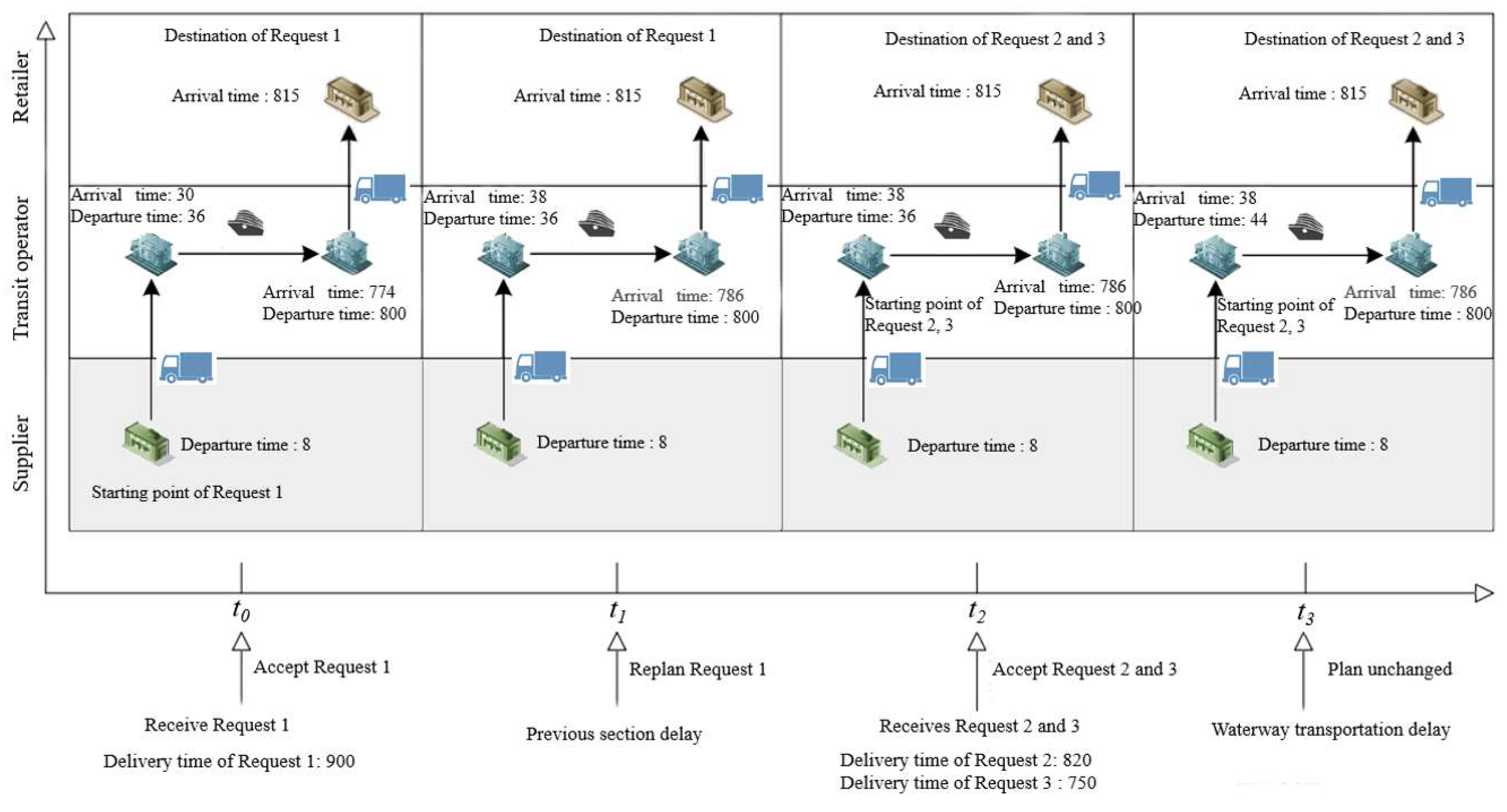
Once the transportation plan is established, it is executed in a dynamic and stochastic environment. Figure 2 illustrates a system with three operators responsible for selecting modes and routes within their respective regions. At time   t 0 , the system receives shipment demand 1 and plans to utilize the road–sea–road mode. However, at time   t 1 , a delay in road transport hinders the timely transfer to ship 1. Consequently, ship 2 is scheduled to replace ship 1 for the remaining transport. At time   t 3 , two additional demands, 2 and 3, are received. Demands 2 and 3 can be consolidated and transported together by ship 2; however, demand 3 must arrive by time 750 to avoid incurring a delay penalty. Given this constraint, the supplier decides to reject demand 3. Ship 2 arrives slightly late at time 790 due to travel time uncertainty, yet it remains within an acceptable range, so the original plan is retained. After receiving the demands, addressing infeasible demands, transfers, and delivery delays in a coordinated manner becomes critical for ensuring synchromodal transport. This paper employs a rolling horizon framework to manage dynamic events, considering factors such as demand quantity, release time, and delivery time to adaptively adjust the transportation mode.
The research problem is based on the following hypotheses: (1) The product flow in the network is realized through a single pair of origin–destination nodes. (2) Only two transportation modes, namely, trucks and cargo ships, are considered, with both modes having fixed capacities. (3) Each transfer node can send or receive flows to/from multiple hub nodes. (4) The capacity constraints of the nodes are not taken into account. This simplification aims to construct a theoretical network optimization framework addressing the relationship between blockchain transparency and cost before introducing operational complexity. (5) Direct transportation between supply and demand nodes is prohibited; instead, all transportation must be conducted via transfer nodes.
In this study, a blockchain-based synchromodal transport network optimization model is constructed using the parameters and variables defined in Table 1.

3.2. Optimization of Synchromodal Transport Network Leveraging Blockchain Technology Under Deterministic Demands

Since the concept of blockchain is fundamentally based on decentralization, its increasing adoption by operators leads to a higher number of generated blocks and consequently enhances transparency. This article examines blockchain from the perspective of securing data interactions and assumes that the transparency criterion is defined by the probability that an attacker cannot successfully manipulate the blockchain [25]. An unscrupulous node a attempts to tamper with an honest blockchain consisting of B total blocks. To manipulate the entire chain, the attacker must modify the target block before a new honest block H is appended to the existing honest chain and must subsequently alter all the following blocks.
Suppose the transparency criterion f b pr is defined by the probability P failure that the attacker cannot successfully manipulate the blockchain, where this probability is given in Equation (1):
P failure = r + k 1 k P H r P a k 1 P a P H k
Let P H denote the probability that an honest node H finds the next block, and let P a denote the probability that the attacker a finds the next block. Let k represent the number of consecutive failures experienced by the attacker. Equation (1) expresses the probability of observing k failures before the attacker achieves the rth success, which is derived by scaling the negative binomial distribution by the attacker’s failure probability 1 P a P H . The assumption of r = 1 is adopted, meaning that once the attacker first successfully tampers with the data, they gain control over the entire blockchain. Therefore, the transparency criterion f b pr in this paper is defined by the probability of the attacker’s first successful modification of the blockchain, as given in Equation (2).
f b pr = P H P a k 1 P a P H k
Based on the transparency criterion defined in Equation (2), as the number of blockchain-using operators increases, the number of generated blocks grows accordingly, leading to continuous improvement in the transparency of the synchromodal transport network.
In this study, the operators introducing blockchain can gain several advantages, including enhanced transparency, improved traceability, optimized planning, and strengthened security. These benefits contribute to cost savings, which can be considered as revenue for the operators. However, given that revenue distribution in the blockchain network requires consensus among members and that these revenues are interdependent among operators, they can also be regarded as part of the interaction costs between operators. The blockchain-based synchromodal transport network optimization model proposed in this paper is as follows:
F 1 = max i , j N b B y ij b f b pr B b B A
F 2 = min k K ( i , j ) N r R b B ( 1 γ b y ij b ) c k 1 d ij   k q r x ij krt + k . l K , k l r R i T c kl 2 q r s ir klt + k K i , j N r R c r delay T r delay q r x ij krt + i , j N b B c b B b y i b
s.t.
j N y p r j kt 1 , k K ;   r R
j N y p r j kt = j N y jp r kt , k K ;   r R
k K j N x p r j krt 1 , r R
k K j N x jd ( r ) krt 1 , r R
j N x ij krt j N x ji krt = 0 ,   k K ,   r R ;   i N \ T ,   p r ,   d r
k K j N x ij krt k K j N x ji krt = 0 ,   r R ;   i T \ p r ,   d r
x ij krt     y ij kt , i ,   j N ;   k K ;   r R
j N x ji krt + j N x ij lrt     s ir klt + 1 , r R ;   i T ;   k ,   l K
s ir kkt = 0 , r R ;   i T ;   k K
y ij kt     z ij k , i ,   j N ;   k K
z ij k + z ji k     1 , i ,   j N ;   k K
z ij k + z jp k + z pi k     2 , i ,   j ,   p N ;   k K
r R q r x ij krt   u r y ij kt , i ,   j N ;   k K
t kr + t i ¯ k j N x ij krt     t kr , i N ;   k K ;   r R
T r   release   μ 2 y ij b t kr + M 1 x ij krt , i ,   j N ;   r R ;   k K ;   b B
T r delay     t kr + t i ¯ k + θ σ k T r due + M x ij krt 1 ,   i ,   j N ;   r R ;   k K
T r delay     t kr + τ ij k + θ σ k T r due + M x ij krt 1 ,   i ,   j N ;   r R ;   k K
t kr t lr     M 1 s ir klt ,   i T ;   r R ;   k ,   l K ,   k l
y ij b     y i b , i ,   j N ;   b B
y ij b     y ij kt , i ,   j N ;   b B ;   k K
B   ¯ i , j N b B y ij b   f b pr B b B A   B ¯
b B i N y i b     B N
x ij krt ,   y i b ,   y ij b ,   y ij kt ,   z ij k ,   s ir klt = 0 , 1 ,   i ,   j N ;   r R ;   k , l K ;   b B
The objective function F 1 aims to maximize the total number of blocks generated by the blockchain, while the objective function F 2 focuses on minimizing costs, including transportation, transfer, cargo handling, demand delay, and fixed blockchain usage costs. Constraint (5) ensures that each vehicle has at most one route originating from its starting station; Constraint (6) specifies that the same vehicle completes transportation at its destination station; Constraints (7) and (8) ensure that for each request, the corresponding transportation vehicle must pick up and deliver goods at their designated pick-up and delivery nodes, respectively; Constraints (9) and (10) represent the conservation of vehicle flow and request flow into and out of regular nodes and transfer nodes, respectively; Constraint (11) guarantees that for requests transported by vehicles, the vehicle must traverse the associated arc; Constraint (12) restricts transfers to occurring only once at each transfer terminal. Constraint (13) specifies the transfer process across different transportation modes; Constraints (14)–(16) ensure the elimination of sub-loops in the network; Constraint (17) defines the capacity limitations of the transportation system; Constraint (18) establishes time boundaries for service initiation and termination; Constraint (19) captures the impact of blockchain technology on request release times and service start times; Constraints (20) and (21) estimate the potential delay of request r upon reaching its destination node; Constraint (22) enforces time restrictions during transfers; Constraint (23) guarantees that only blockchain-enabled operators can establish connections with other blockchain-enabled operators; Constraint (24) ensures the formation of a blockchain when there is a transportation link between synchromodal nodes; Constraint (25) sets an upper bound and lower bound for transparency thresholds within the synchromodal transport network; Constraint (26) mandates the minimum number of blockchain-adopting nodes required in the synchromodal transport network; and finally, Constraint (27) declares the attributes of the binary decision variable.
In this model, the objective function F 2 is nonlinear due to the multiplication of two decision variables. To address this nonlinearity, a new binary variable g ij krbt can be introduced to linearize the model. The corresponding formula is as follows:
F 2 = min k K ( i , j ) N r R b B x ij krt γ b g ij krbt c k 1 d ij   k q r + k . l K , k l r R i T c kl 2 q r s ir klt + k K i , j N r R c r delay T r delay q r x ij krt + i , j N b B c b B b y i b
x ij krt + y ij b 1   g ij   krbt , i , j N ,   k K ,   r R ,   b B

3.3. Synchromodal Transport Network Optimization Based on Blockchains Under Uncertain Demands

In actual operations, the goods demand of operators fluctuates dynamically due to various factors such as time and road conditions, leading to uncertainty in the volume of goods transportation. Consequently, investigating the application of blockchains by operators within a synchromodal transport network under uncertain demand aligns more closely with real-world demands. Currently, numerous research findings have emerged regarding the optimization of transportation networks under uncertain demand. Many scholars capture this uncertainty by incorporating fuzzy variables. In this paper, the fuzzy variable q r ˜ is employed to replace q r in the optimization model of the blockchain-based synchromodal transport network under certain demand, thereby deriving the optimization model for a blockchain-based synchromodal transport network under uncertain demand.
F 1 = max i , j N b B y ij b f b pr B b B A
F 2 = min k K ( i , j ) N r R b B ( 1 γ b y ij b ) c k 1 d ij   k q r ˜ x ij krt + k . l K , k l r R i T c kl 2 q r ˜ s ir klt + k K i , j N r R c r delay T r delay q r ˜ x ij krt + i , j N b B c b B b y i b
s.t. (5)–(16), (18)–(27)
r R q r ˜ x ij krt   u r y ij kt , i ,   j N ;   k K

4. Solution Method

4.1. Multi-Objective Transformation Based on the ε-Constraint Algorithm and Fuzzy Method

The model developed in this paper is a multi-objective optimization model. To address any problems, it is typically necessary to transform the multi-objective function into a single-objective function. The ε-constraint algorithm is a widely used and effective method for solving multi-objective optimization problems, as it can efficiently convert bi-objective problems into single-objective ones. However, in certain cases, the ε-constraint algorithm may exhibit low efficiency in generating optimal solutions. This shortcoming can be effectively mitigated by integrating the fuzzy logic approach. The detailed solution steps of the algorithm are presented below [46].
Set one of the objective functions of the original model, denoted as F 1 , as the new objective function, while treating the other objective function of the original mode F 2 as a constraint. Introduce Equation (33) as a constraint condition into the original model, with the formula expressed as follows:
F 2   σ
Determine the value of σ , that is, determine the range of the objective function F 2 . Specifically, find the optimal value F 1 I of the objective function F 1 under the given constraint conditions. Subsequently, incorporate this optimal value as an additional constraint into the original model to calculate the value F 2 N of the objective function F 2 . By analogy, obtain F 2 I and F 1 N . Consequently, the range of σ can be expressed as σ ∈ [ F 2 I , F 2 N ].
The optimal degree of the mth Pareto solution is represented using the fuzzy logic method, as shown in Equation (34). Here, δ ( F 1 m ) denotes the optimal degree of the mth solution for the objective function F 1 , while F 1 m indicates the value corresponding to the mth Pareto point.
F 1 m =   1 , F m n F m max F 1 N F 1 m F 1 N F 1 I , F 1 N F 1 m F 1 I 0 , F 1 I F m min , m M
For each solution m, the optimal degree δ m is calculated based on its individual characteristics. Here, λ 1 and λ 2 represent the weights of the objective functions F 1 and F 2 , respectively, and the optimal degree is presented in Equation (35).
δ m = λ 1 δ F 1 m + λ 2 δ F 2 m λ 1 + λ 2

4.2. Uncertain Problem Transformation Through Fuzzy Goal Programming

Using triangular fuzzy numbers to represent q ˜ r , it can be expressed as q ˜ r = ( q ˜ r L , q ˜ r C , q ˜ r U ), where q ˜ r L and q ˜ r U denote the lower and upper bounds of the fuzzy demand, respectively, while q ˜ r C represents the most probable demand quantity, satisfying q ˜ r L   <     q ˜ r C   <     q ˜ r U . To avoid adverse consequences arising from decision-making under uncertainty, this paper employs the credibility-based fuzzy chance-constrained programming approach to address uncertain demand and introduces the concept of credibility. By applying Theorem 1, the constraint conditions involving uncertain demands in the model are converted into deterministic equivalents [47].
Theorem 1. 
If  σ ˜  is a triangular fuzzy number defined as  σ ˜  = ( ε 1 , ε 2 , ε 3 ) where  ε 1     ε 2     ε 3 , and given the confidence level 0.5 ≤ ξ ≤ 1, we derive the following result [47]:
C r { σ ˜ m } ξ m 2 ξ 1 ε 1 + 2 ( 1 ξ ) ε 2
C r { σ ˜ m } ξ m 2 ξ 1 ε 3 + 2 ( 1 ξ ) ε 2
In the formula, m represents a random variable, and C r denotes the confidence level of the event.
Assume the confidence level is denoted as λ (0.5 ≤ λ ≤ 1). By applying Theorem 1, reformulate the objective function (31) and the constraint condition (32) into the objective function (38) and the constraint (39), respectively.
F 2 = min k K ( i , j ) N r R b B ( 1 γ b y ij b ) c k 1 d ij   k q ˜ r U x ij krt + k . l K , k l r R i T c kl 2 q ˜ r U s ir klt + k K i , j N r R c r delay T r delay q ˜ r U x ij krt + i , j N b B c b B b y i b
u r y ij kt ( 2 λ 1 ) r R q ˜ r L x ij krt + 2 ( 1 λ )   r R q ˜ r C x i j k r t , i ,   j N ;   k K
The linearization process is applied to Equation (38), yielding the following result:
F 2 = min k K ( i , j ) N r R b B ( x ij krt γ b g ij krbt ) c k 1 d ij   k q ˜ r U + k . l K , k l r R i T c kl 2 q ˜ r U s ir klt + k K i , j N r R c r delay T r delay q ˜ r U x ij krt + i , j N b B c b B b y i b
x ij krt + y ij b 1 g ij krbt , i ,   j N ,   k K ,   r R ,   b B
Take Equation (40) as the new objective function and incorporate Equation (41) into the constraint conditions, thereby completing the linearization of the objective function.
In the model proposed in this paper, two objective functions are considered. To address the multi-objective optimization problem, it is essential to convert the multi-objective functions into a single-objective function. Hence, the fuzzy goal programming method is employed to solve this issue [48]. Specifically, the expected levels of the original objective function (30) and the updated objective function (40) are defined based on the fuzzy goals presented in Equations (42) and (43). In these equations, the symbol denotes approximately less than or equal to.
f 1 F 1
F 2 f 2
In order to convert the objective function into the membership function, it is essential to determine both the ideal value and the anti-ideal value of the objective function. The ideal value can be derived when each objective function is optimized individually. Meanwhile, the anti-ideal value of one objective function can be computed during the optimization of another objective function. Based on this approach, the membership functions for the objective functions defined in Equations (30) and (40) are presented in Formulas (44) and (45).
μ F 1 = 1 ,   f 1     F 1 1 f 1 F 1 f 1 f 1 ,   f 1   F 1   f 1 0 ,   F 1     f 1
μ F 2 = 1 ,   f 2     F 2 1 F 2 f 2 f 2 f 2 ,   f 2   F 2   f 2 0 ,   f 2     F 2
Finally, the new model is derived as follows:
max θ 1 μ F 1 + θ 2 μ F 2
s.t. (5)–(16), (18)–(27)
u k y ij kt ( 2 λ 1 ) r R q ˜ r L x ij krt + 2 ( 1 λ ) q ˜ r C x ij krt , i ,   j N ;   k K
x ij krt + y ij b 1 g ij krbt , i ,   j N ,   k K ,   r R ,   b B
0     μ F 1 ,   μ F 2     1

5. Numerical Experiment

5.1. Main Data and Parameter Values

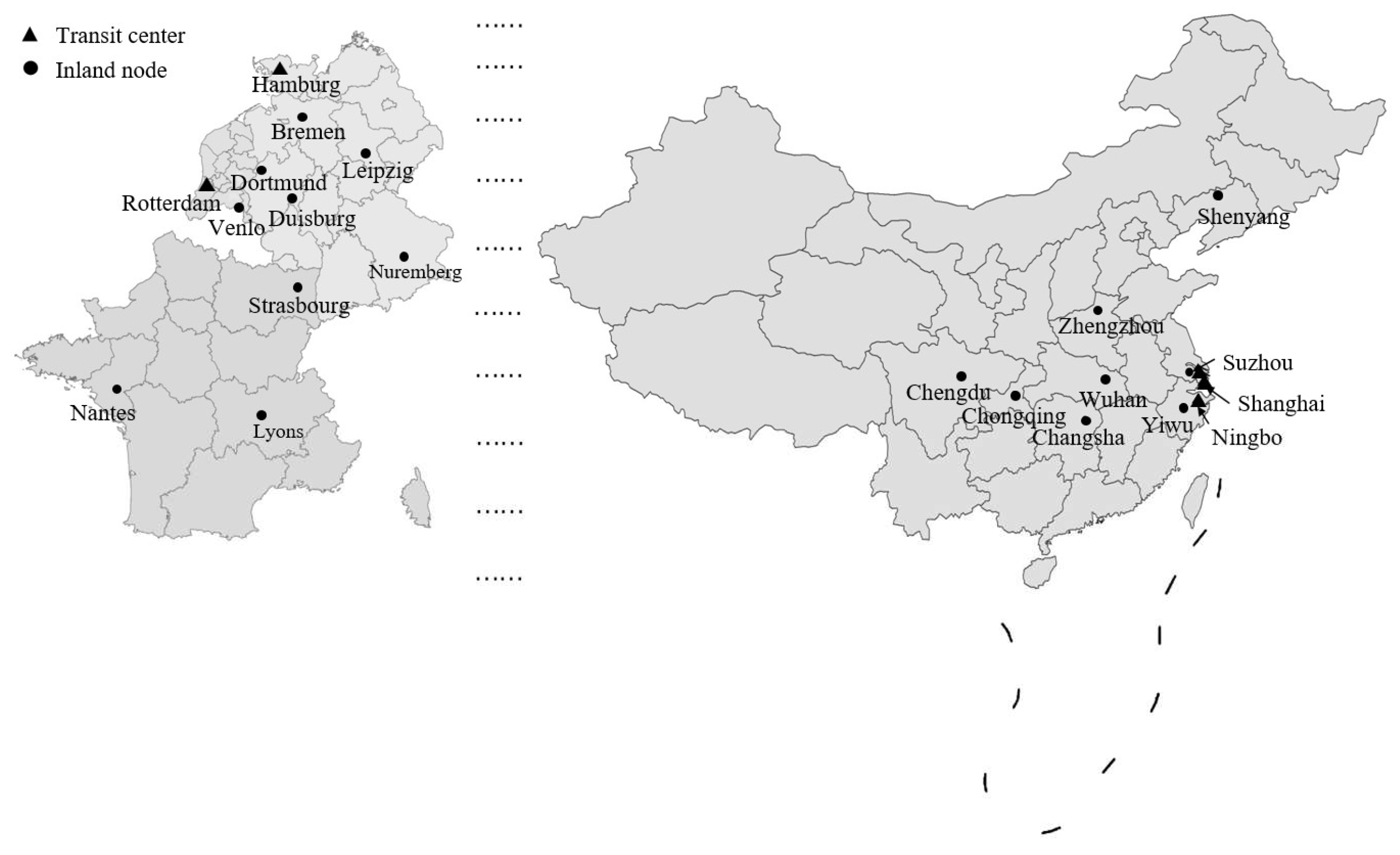
The Asia–Europe dataset comprises 8 inland nodes in China, 4 China–Europe transfer nodes, and 9 inland nodes in Europe, totaling 21 nodes across multiple operators. Specific details regarding node numbers and distributions are provided in Table 2 and Figure 3.
The following text uses I-N21-K2-R50 to denote an instance in the given synchromodal transport network, which consists of 21 operators, 2 transportation modes, and 50 transportation demands. Drawing on Guo et al., the sources, destinations, quantities, announcement times, and other attributes of the demands are generated according to a series of probability distributions [49]. For the Asia–Europe dataset, the loading and unloading times (unit: hours) are set as 4 and 12 for trucks and cargo ships, respectively [49]. In accordance with Ardavan et al., the value of the transparency standard f b pr is 0.67, the blockchain’s fixed usage cost is CNY 15,000, the parameter μ b , representing the time saved by operators due to blockchain adoption, is 0.5, and the unit transparency improvement B A   achieved through blockchain technology in synchromodal transport is 3. The number of blocks B b generated by the blockchain is 10, and the influence coefficient of the b-type blockchain on variable transportation costs γ b is 0.1, within a feasible range of [0, 1]. The transportation network’s transparency is bounded between 75 and 200 [25].

5.2. Optimization Results of Synchromodal Transport Routes Incorporating Blockchain Technology Under Deterministic Demand Scenarios

The algorithm was implemented using CPLEX 12.10.0 and executed on a computer equipped with an Intel i5 quad-core processor operating at 2.7 GHz and featuring 16 GB of RAM.

5.2.1. Network Transparency and Total Cost Balance Analysis

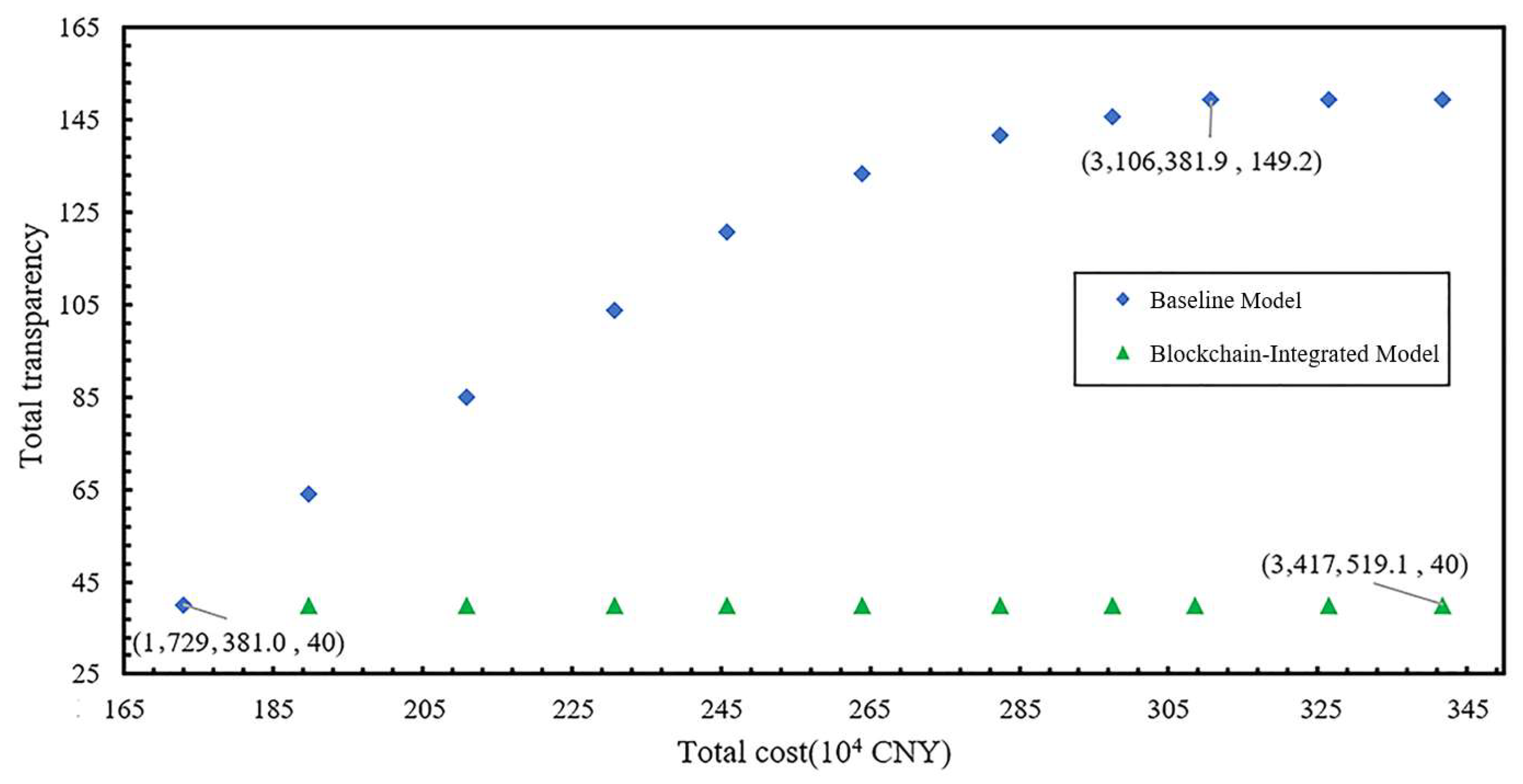
Using the I-N21-K2-R50 instance from the Asia–Europe dataset, we conducted a comparative analysis of two model variants: (1) a Baseline Model, which does not include any blockchain-related objectives or constraints and focuses on traditional operational objectives (e.g., cost and efficiency); and (2) a Blockchain-Integrated Model, which incorporates blockchain-specific elements such as transparency constraints and other trust-related features. The weights assigned to the transparency and total cost functions were both set to 0.5, and the resulting outcomes are presented in Figure 4.
Figure 4 illustrates that the transparency of the synchromodal transport network optimization model remains constant as it does not incorporate blockchain technology. In contrast, in a synchromodal transport network utilizing blockchain technology, total transparency progressively increases with rising costs and stabilizes after reaching a certain number of blocks, ultimately achieving its maximum value.
Specifically, during the transparency growth phase, higher costs result in a slower rate of transparency improvement. Without blockchain technology, the system’s total cost is CNY 1,729,381, with fixed transparency at 40. Upon introducing blockchain technology, transparency significantly improves; however, as costs continue to rise, the rate of transparency enhancement gradually slows down. When the total cost reaches CNY 3,106,381.9, transparency peaks at 149.2 and remains stable thereafter. Therefore, setting an appropriate cost budget is critical for optimizing transparency. At lower cost levels, moderately increasing the budget to adopt blockchain technology can markedly enhance transparency with relatively high cost-effectiveness. However, as costs further escalate, the potential for transparency improvement becomes limited, and excessive investment may lead to diminishing marginal returns, inhibiting the desired outcomes.

5.2.2. Impact of Different Types of Blockchain

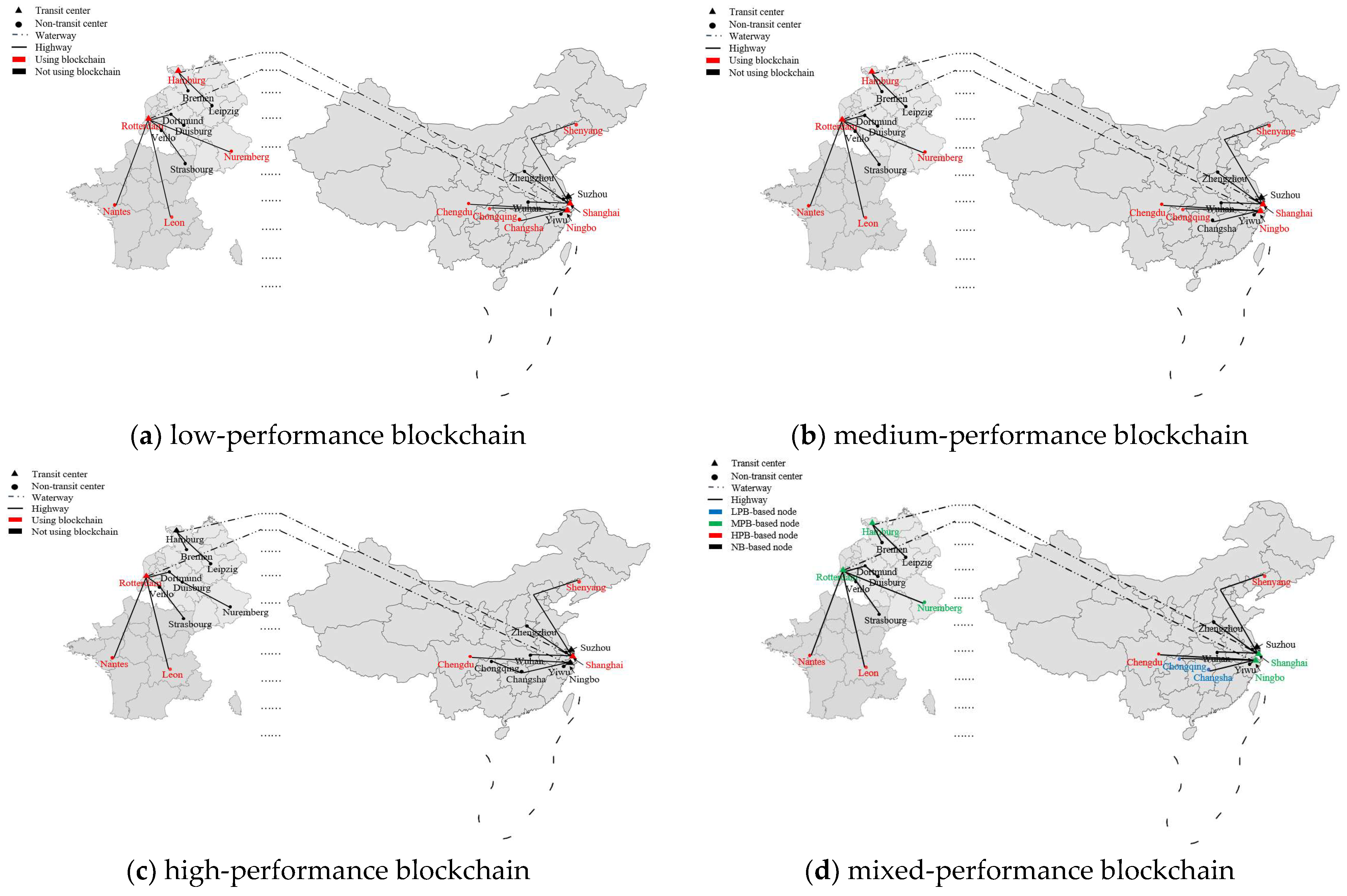
Different blockchain platforms vary in their consensus mechanisms, performance metrics, smart contract capabilities, and applicable scenarios. Consequently, when selecting a blockchain platform, operators must carefully evaluate their specific requirements and the unique characteristics of each platform. Christidis et al. determined that the performance and transaction processing capacity of various blockchains significantly influence operator decision-making [50]. This study investigated three distinct blockchains with varying levels of performance. The number of blocks B b generated by these blockchains was set at 10, 20, and 30, respectively. In cases where two operators utilize blockchains with differing performance levels, the parameters of the lower-performing blockchain will determine the number of blocks and the resulting revenue. The fixed usage costs for the three blockchains are CNY 15,000, 30,000, and 50,000, respectively. The corresponding parameters μ b , indicating the demand communication time saved by operators, are 0.50, 0.55, and 0.75, while the reductions in variable transportation costs are 0.10, 0.15, and 0.25 units. The analysis focuses on overall transparency, total cost, and operators’ adoption of blockchain technology. The results are reported in Table 3 and Figure 5.
From Table 3, it is evident that as blockchain performance improves, the number of operators utilizing blockchain technology decreases, while both total cost and overall transparency increase. This trend occurs because higher-performance blockchains incur greater usage costs, which may not offer sufficient benefits for some operators. However, higher-performance blockchains generate more blocks, thereby enhancing overall transparency. Given a sufficient budget, adopting a higher-performance blockchain can improve both transparency and secure information exchange.
When evaluating the three types of blockchains, operators choose the most appropriate option based on their specific requirements, aligning with real-world scenarios. The findings indicate that, with an identical budget, considering all three blockchain types collectively provides greater transparency compared to relying on a single type. Moreover, when substituting medium-performance blockchains for low-performance ones, the marginal cost-effectiveness ratio of marginal cost increment to absolute transparency gain is approximately 20,000:1. The same ratio applies when comparing high-performance blockchains to medium-performance ones. However, when all three types are integrated, the cost-to-transparency ratio decreases to roughly 10,000:1, significantly lower than when using only one blockchain type. This indicates that, compared with deploying any single type of blockchain, the hybrid blockchain strategy can achieve the same level of network transparency at a lower total cost.
In Figure 5a–c, operators highlighted in red represent those integrated with blockchain technology. In Figure 5d, blue indicates the use of low-performance blockchain, green represents medium-performance blockchain, and red denotes high-performance blockchain. The adoption of blockchain technology influences both the connectivity and transportation routes between nodes. For example, in the route from Chongqing to Nuremberg, when only low-performance blockchain is employed, the path passes through Ningbo and Rotterdam. In contrast, with high-performance blockchain, the route extends through Changsha, Ningbo, Rotterdam, Dortmund, and Duisburg.
As illustrated in Figure 5, the incorporation of blockchain affects node connections and routing choices. When operators along the route establish connections via blockchain, goods are transported directly to the relevant blockchain-linked operator. This is because blockchain enables dynamic optimization of transportation plans based on real-time conditions, eliminating unnecessary intermediate steps and reducing both time and cost. Similarly, when multiple types of blockchain are considered, goods move directly between any two operators using blockchain, with no variation in routing due to differences in blockchain performance levels.
It can be inferred that while high-performance blockchains enhance transparency, they also incur higher costs. Operators should choose the most appropriate blockchain type based on their specific requirements. In networks incorporating multiple blockchain types, utilizing different blockchains can yield better returns and align more closely with practical needs compared to relying on a single type. Furthermore, the adoption of blockchain technology can influence transportation routes, leading to reduced transportation costs and generating greater economic benefits for operators.

5.2.3. Impact of Operator Preferences on System Performance

The Pareto solution set derived from combining the multi-objective optimization algorithm based on the ε -constraint method with the fuzzy approach demonstrates a substantial conflict between the two objective functions: maximizing transparency and minimizing total cost. Achieving optimal solutions for both objectives simultaneously is challenging. When optimizing these objectives, the operator’s preferences must be comprehensively considered. Specifically, when focusing solely on maximizing transparency while disregarding cost, the total transparency can reach 161.7, but this results in a prohibitively high total cost of CNY 3,232,731.3. Conversely, if the sole focus is on minimizing total cost while ignoring transparency, the total cost can be reduced to CNY 1,729,381, yet the total transparency drops drastically to 40.
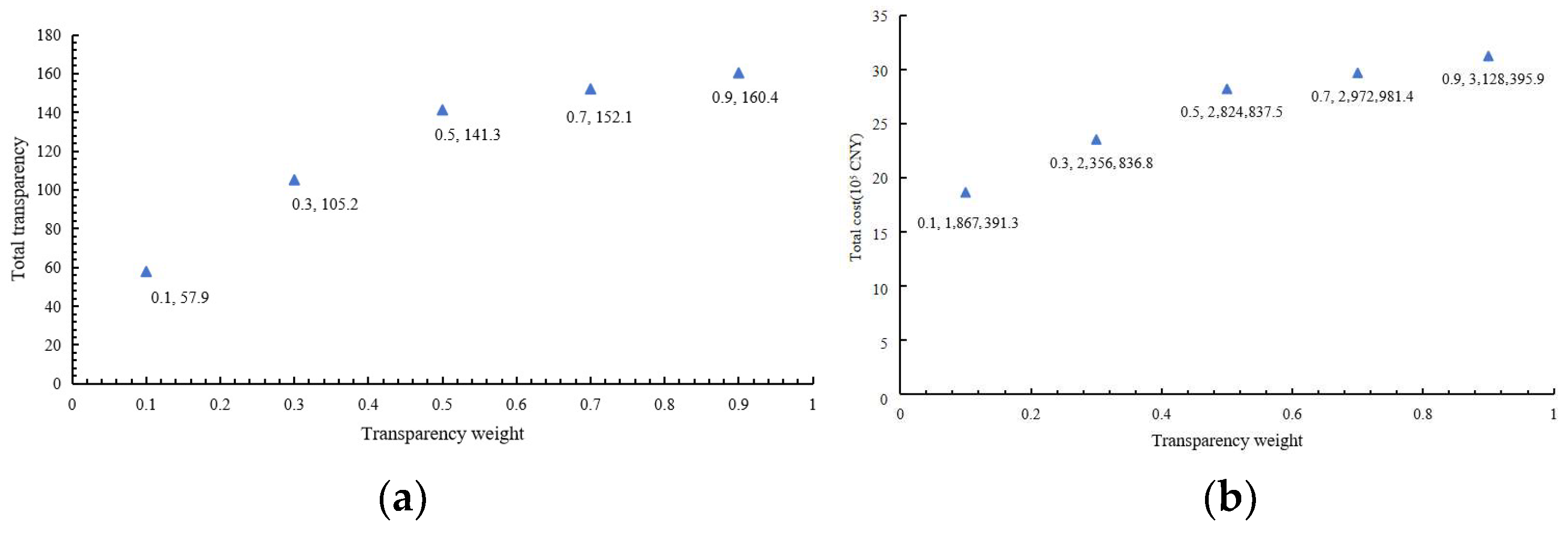
In order to assist operators in their decision-making, we comprehensively consider operator preferences, the total transparency, and the total cost of the synchromodal transport network. By analyzing the results under different weight coefficients, we explore the optimization scenarios. Specifically, five weight combinations are considered: ( ω 1 ,   ω 2 ) = (0.1, 0.9), (0.3, 0.7), (0.5, 0.5), (0.7, 0.3), and (0.9, 0.1). As ω 1 increases continuously, it reflects a gradual shift in operator preferences from minimizing cost to maximizing transparency. Different weight coefficients result in distinct Pareto solutions. Table 4 and Figure 6 illustrate the optimization outcomes and trends of the synchromodal transport network under varying weight coefficients. Here, Δ F 1   and Δ F 2   denote the transparency growth rate of F 1 N and the cost reduction rate of F 2 N , respectively, with the following calculation formulas:
Δ F 1 = F 1 N F 1 F 1 N F 1 I
Δ F 2 = F 2 N F 2 F 2 N F 2 I
It can be observed from Table 4 that the optimization outcomes for total transparency and total cost vary under different weight coefficients. When the operator aims to maximize transparency, the scheme with transparency weight ω 1 = 0.9 is selected. In this case, transparency increases by 98.93%, while cost decreases by 7.42%. Conversely, when the operator seeks to minimize cost, the scheme with ω 1 = 0.1 is chosen. Here, the cost decreases by 96.70%, while transparency increases by 14.70%.
As illustrated in Figure 6, both total transparency and total cost increase as the operator’s preference for transparency grows, with their trends remaining roughly parallel. This phenomenon occurs because, in the absence of cost constraints, a greater number of operators opt to adopt blockchain technology, thereby steadily enhancing network transparency. When the transparency weight ω 1 increases from 0.1 to 0.3, the optimal total transparency of the synchromodal transport network rises from 57.9 to 105.2, while the optimal total cost increases from CNY 1,867,391.3 to CNY 2,356,836.8. Compared to other weight intervals, the growth rate during this period reaches its peak, indicating that when the number of blockchain-using operators is relatively low, moderately increasing their count can enhance inter-operator connectivity, significantly improve transparency, and benefit the synchromodal transport network. Consequently, operators should meticulously evaluate their preferences, carefully balance the trade-off between transparency and cost, and select the approach that best aligns with their requirements.

5.3. Optimization Results of Multimodal Transport Route Under Uncertain Demands with Blockchain Technology Integration

The adopted blockchain is characterized by low performance. In the initial state, the weights assigned to the transparency function and the cost function are both set to 0.5. The confidence level λ is configured at 0.6, 0.8, and 1, representing low-, medium-, and high-demand-uncertainty scenarios. When λ equals 0.5, it signifies that the demand is in a deterministic state.

5.3.1. Impact of Uncertain Demands on Total Transparency and Total Cost

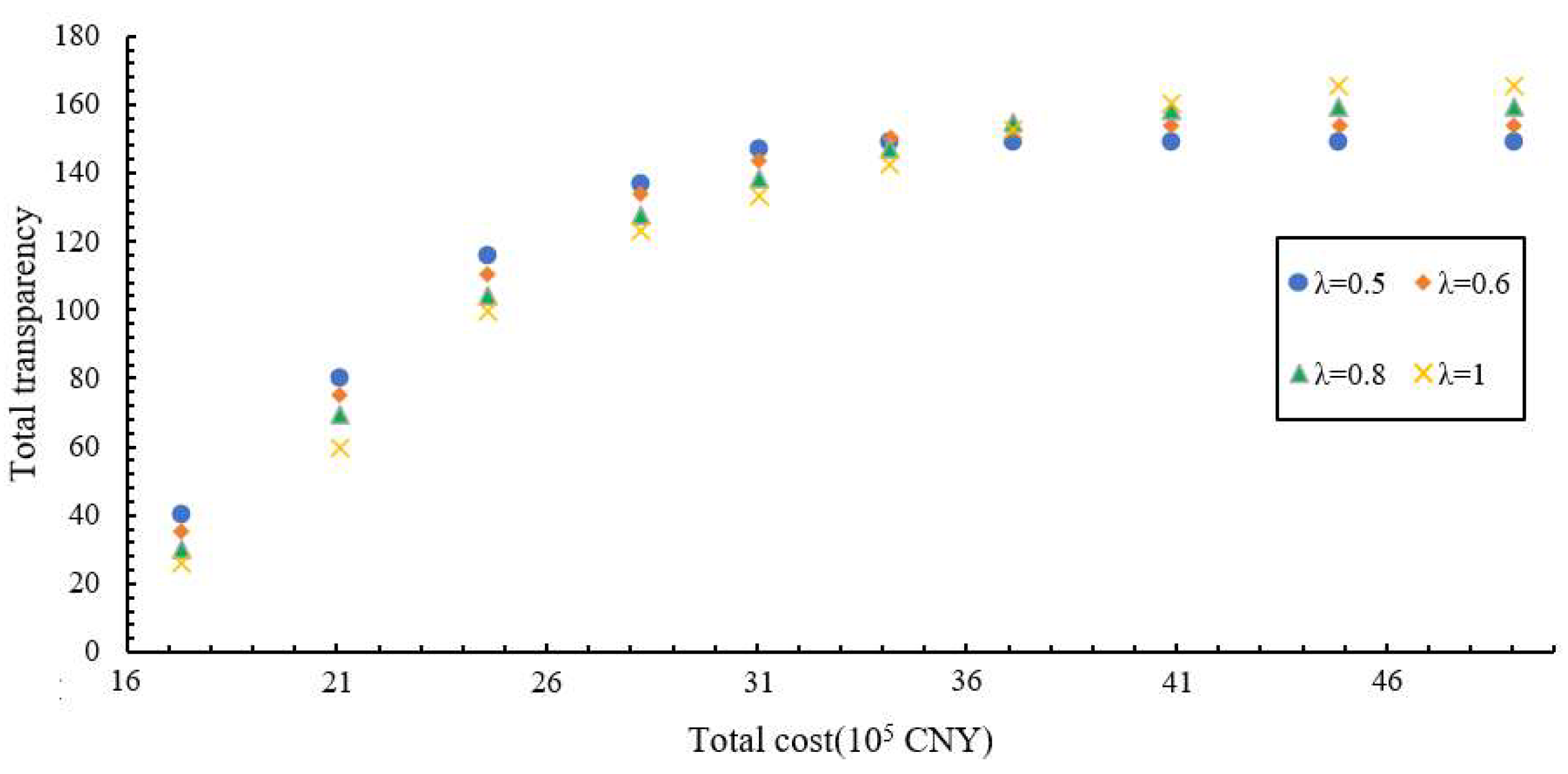
In order to investigate the impact of uncertain demand on the overall transparency and total cost of a blockchain-based synchromodal transport network, this paper compares the total transparency and total cost of the network under deterministic demand and three distinct levels of uncertain demand. As illustrated in Figure 7 and Table 5, the total transparency and total cost of the synchromodal transport network exhibit varying trends across the four scenarios.
It can be observed from Figure 7 that as uncertainty increases, in both definite demand and uncertain demand scenarios, the total transparency of the blockchain-based synchromodal transport network gradually improves with the rise in total cost. In uncertain scenarios, transparency not only correlates positively with cost but also with the degree of uncertainty. For instance, when the total cost is approximately CNY 2,100,000, the total transparency values across the four scenarios are 80, 75, 69.2, and 59.8. Conversely, when the total cost rises to approximately CNY 4,000,000, the total transparency values across the four scenarios increase to 149.2, 153.7, 156.9, and 157.1. This suggests that achieving the same level of transparency necessitates greater investment as uncertainty intensifies.
As illustrated in Figure 7 and Table 5, under constrained budgets, heightened demand uncertainty results in a significant decline in transparency. This occurs because, under cost constraints, the number of operators in the network utilizing blockchain technology is restricted, leading to inadequate timely and secure information sharing. Consequently, the synchromodal transport network struggles to effectively address demand uncertainty. When sufficient cost is available, the total transparency of the synchromodal transport network gradually increases with rising demand uncertainty. This is attributed to the growing number of operators adopting blockchain technology, which enables the establishment of an efficient information-sharing mechanism among operators, thereby enhancing the network’s resilience to demand uncertainty.

5.3.2. Impact of Uncertain Demands on Operator Selection

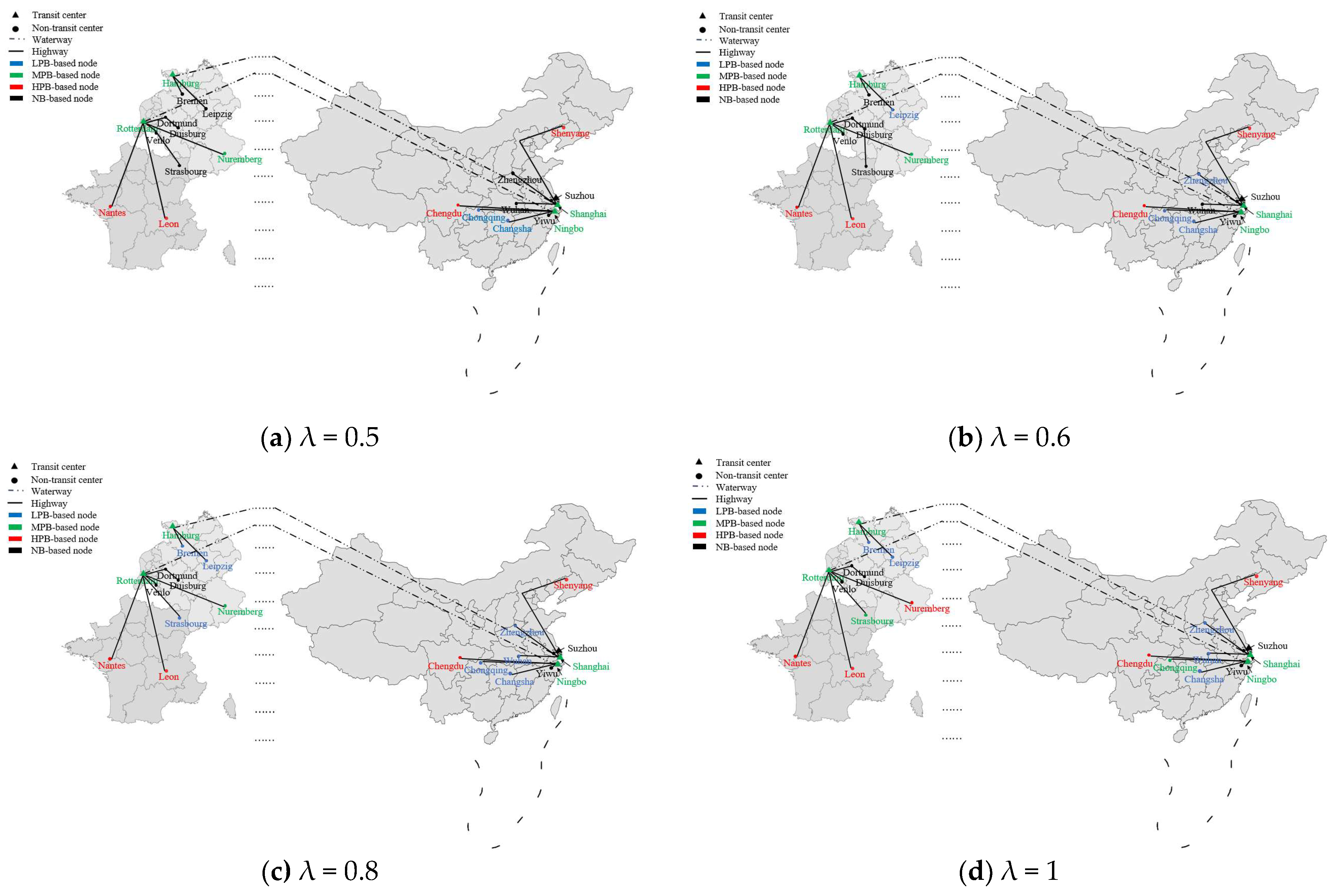
By adopting three distinct performance blockchains, a comparative analysis was performed to evaluate the scenarios under definite demands and different levels of uncertainty for selecting operators within the synchromodal transport network. The results are presented in Table 6 and Figure 8.
It can be observed from Table 6 that, as uncertainty increases, the number of operators opting to establish connections with other operators via blockchain exhibits an upward trend. This is because blockchain facilitates faster, more secure, and more reliable information exchange under conditions of uncertain demand, thereby enhancing network transparency and mitigating the adverse effects of uncertainty. As uncertainty rises, operators are inclined to adopt high-performance blockchains, which provide superior block generation capabilities and greater flexibility in planning, albeit at a higher cost.
Meanwhile, as uncertainty increases, achieving the same level of transparency necessitates a higher cost. On the one hand, demand uncertainty can disrupt the transportation process, leading to additional cost expenditures. On the other hand, with rising demand uncertainty, the frequency of blockchain technology usage among various operators significantly increases, resulting in a greater number of generated blocks. However, as the number of blocks grows, the marginal increase in overall transparency gradually diminishes. Once the number of blocks reaches a certain scale, the transparency of the transportation network approaches a saturation point. At this stage, further resource investment yields minimal improvement in transparency. Consequently, maintaining transparency in highly uncertain environments necessitates substantially higher expenditures.
For clarity and brevity, Figure 8 uses LPB, MPB, HPB, and NB to denote low-performance blockchain, medium-performance blockchain, high-performance blockchain, and the scenario without blockchain adoption, respectively. As shown in Figure 8, rising demand uncertainty encourages more operators to adopt blockchain technology, with a growing preference for high-performance options. Taking the route from Rotterdam to Strasbourg as an example, when the uncertainty parameter λ = 0.5, the path goes through Venlo. When λ increases to 0.6, the route is adjusted to include Dortmund and Duisburg. This change reflects how adding more operator nodes along the path provides alternative routing options, thereby enhancing resilience against demand fluctuations. At λ = 0.8, a low-performance blockchain is deployed to establish a direct Rotterdam–Strasbourg connection, streamlining the route and reducing intermediate stops. This illustrates blockchain’s ability to dynamically optimize transport plans in real time, cutting down both travel time and operational complexity. Finally, when λ reaches 1, Strasbourg adopts a medium-performance blockchain to link with Rotterdam, further strengthening the network’s capacity to cope with high uncertainty.

6. Discussion

The findings of this study possess significant managerial implications for stakeholders in the transport and logistics sector, including government agencies and enterprises, thereby supporting strategic planning and informed decision-making.
The application of blockchain technology can significantly enhance the transparency of transportation networks and effectively improve their resilience to risks in environments characterized by demand uncertainty. Therefore, governments should implement targeted policy measures to facilitate the adoption of this technology within the industry, providing incentives such as tax reductions and research and development subsidies to encourage enterprises to integrate blockchain solutions.
When demand is certain, operators experience a diminishing marginal return on transparency from unit investment. Therefore, enterprises should avoid blind pursuit of large-scale deployment and instead tailor their blockchain application strategies to their specific business scale and budget constraints, prioritizing implementation along key transportation routes and with core partners to achieve an optimal balance between transparency enhancement and cost control. Beyond deployment scope, the selection of blockchain performance levels is equally critical. Not all business scenarios require the highest-performance technical solutions. Enterprises should deploy blockchains with varying performance levels based on key factors such as route importance and cargo value, ensuring alignment between technological capability and operational needs to maximize overall cost-effectiveness.
In market environments where uncertainty has become the norm, blockchain technology has demonstrated significant value in improving service reliability and operational controllability. Against this backdrop, enterprises with ample budgets can justify proactive strategic investments to build systemic resilience, whereas those with constrained budgets should refrain from large-scale commitments under high uncertainty and instead focus on targeted, risk-controlled pilot implementations—thereby harnessing blockchain’s stability benefits while minimizing exposure to financial and operational risks.

7. Conclusions

Based on the synchromodal transport network model, this paper employs transparency to illustrate the role of blockchain in the synchromodal transport network. By considering whether operators within the network adopt blockchain technology to establish connections with customers, a bi-objective optimization model was constructed with transparency and cost as the key objectives, accounting for both deterministic and uncertain demand scenarios. The Asia–Europe dataset served as the data source, and the model was solved using CPLEX. The key findings are summarized as follows:
Increasing investment can enhance the transparency of blockchain-based synchromodal transport networks; however, the marginal benefits diminish once a saturation point is reached. Utilizing multiple types of blockchains provides greater transparency compared to relying on a single type, as varying performance levels impact both cost and transparency differently. At the same time, as the cost of blockchain adoption increases, the total system cost exhibits a continuously rising trend, which aligns with the finding of Hong et al. that comprehensive costs increase as blockchain technology costs rise [24]. Operator preferences also play a critical role: those prioritizing transparency must be willing to incur higher costs, whereas operators focused on cost-efficiency may adjust the importance of transparency to achieve an optimal balance. Furthermore, under limited budgets, transparency tends to decrease as demand uncertainty increases. Conversely, higher investment in the face of uncertainty can improve transparency. Additionally, uncertainty elevates the peak transparency level and the associated costs required to achieve it, incentivizing more operators to adopt blockchain technology and favor high-performance versions, which in turn drives up overall network costs.
Based on this study, future research can be extended in several key directions. Our study focuses solely on the optimization problem of blockchain-based synchromodal transport networks under a single allocation mode. Second, the current model does not incorporate capacity constraints at transfer nodes, a simplification that may lead to overestimation of network-wide transportation efficiency or underestimation of total costs. The impact of this assumption on overall system performance therefore merits in-depth analysis, and integrating such constraints could significantly improve the model’s practical relevance. Furthermore, future research can delve deeper into the construction of large-scale transfer networks and develop efficient, practical algorithms to address the associated challenges.

Author Contributions

Conceptualization, S.L., Y.L. and M.W.; methodology, S.L. and L.L.; software, Y.L.; validation, S.L., H.J. and M.W.; data curation, Y.L.; writing—original draft preparation, H.J.; writing—review and editing, S.L.; visualization, H.J.; supervision, L.L.; project administration, S.L. and L.L. All authors have read and agreed to the published version of the manuscript.

Funding

This research was funded by the National Natural Science Foundation of China under Grant 72032001.

Data Availability Statement

The original contributions presented in the study are included in the article. Further inquiries can be directed to the corresponding author.

Conflicts of Interest

The authors declare no conflicts of interest.

References

  1. Ministry of Industry and Information Technology, Central Cyberspace Administration of China. Guiding Opinions on Accelerating the Application and Industrial Development of Blockchain Technology. Available online: https://www.cac.gov.cn/2021-06/07/c_1624629407537785.htm (accessed on 7 June 2021).
  2. General Office of the State Council. 14th Five-Year Plan for Modern Logistics Development. Available online: https://www.gov.cn/zhengce/content/2022-12/15/content_5732092.htm (accessed on 15 December 2022).
  3. Ledger Insights. AirAsia Launches Blockchain Air Cargo Transport Network Freightchain. Available online: https://ledgerinsights.com/airasia-blockchain-air-cargo-freightchain/ (accessed on 20 April 2020).
  4. China Cosco Shipping News. Cosco Shipping Adds New Services with “Digital and Intelligent Empowerment” Based on Blockchain Technology. Available online: https://newspaper.coscoshipping.com/col25998/art/2023/art_25998_311826.html (accessed on 24 February 2023).
  5. International Center for Science & Technology Innovation. Multimodal Transportation “One-Stop” Service, “Chang’an Chain” Trusted Chain Connects Rail-Sea Freight Data. Available online: https://www.ncsti.gov.cn/kjdt/xwjj/202507/t20250716_210060.html (accessed on 16 July 2025).
  6. Shanghai Association for Science & Tech. Expand the Application of Blockchain to Shape a New Ecosystem for Shipping. Available online: https://www.sast.gov.cn/content.html?id=1750020723214131202&cid=1369121551382872066 (accessed on 24 January 2024).
  7. Qin, J.; Fu, H.; Wang, Z.; Lyu, X. Financing decisions in capital-constrained supply chains considering uncertain emission reduction outputs and blockchain technology applications. Int. J. Prod. Res. 2025, 63, 8371–8392. [Google Scholar] [CrossRef]
  8. Jing, Y.; Liu, F. Sales Mode Selection and Blockchain Adoption for Platform Supply Chain Under Risk Aversion. Mathematics 2025, 13, 2184. [Google Scholar] [CrossRef]
  9. Yang, T.; Li, C.; Bian, Z. Recycling Strategies in a Collector-Led Remanufacturing Supply Chain under Blockchain and Uncertain Demand. Processes 2023, 11, 1426. [Google Scholar] [CrossRef]
  10. Babaei, A.; Khedmati, M.; Jokar, M.R.A. A new model for production and distribution planning based on data envelopment analysis with respect to traffic congestion, blockchain technology and uncertain conditions. Ann. Oper. Res. 2025, 348, 1145–1181. [Google Scholar] [CrossRef]
  11. Jiao, W.W.; Liu, T. Intermodal Transport Digital Waybill Based on Blockchain Technology. Comput. Appl. Softw. 2021, 38, 28–32. [Google Scholar] [CrossRef]
  12. Huang, M.Z.; Wang, R.M.; Lin, X.L. A Study of the Application of Blockchain Technology on Multimodal Transportation Data Exchange. Railw. Transp. Econ. 2021, 43, 75–81. [Google Scholar] [CrossRef]
  13. Kumar, N.; Ali, R. Blockchain-enabled authentication framework for Maritime Transportation System empowered by 6G-IoT. Comput. Networks 2024, 244, 110353. [Google Scholar] [CrossRef]
  14. Leontis, P.; Ntouros, K.; Mazilu, A.I.; Brotsis, S.; Kolokotronis, N. SEAGuard: A Blockchain-Based Security Framework for IoT Maritime Transportation Systems. In Proceedings of the 2024 IEEE International Conference on Cyber Security and Resilience (CSR), London, UK, 29–31 May 2024; pp. 421–426. [Google Scholar]
  15. Yin, Q.Y.; Sheng, G.W.; Zhang, R. Construction Pattern of China’s Rail-Sea Multimodal Transport Information Platform. Railw. Transp. Econ. 2024, 46, 65–72. [Google Scholar] [CrossRef]
  16. Zhu, S.; Chi, C.; Liu, Y. A study on the challenges and solutions of blockchain interoperability. China Commun. 2023, 20, 148–165. [Google Scholar] [CrossRef]
  17. Alhussayen, A.A.; Jambi, K.; Khemakhem, M.; Eassa, F.E. A blockchain oracle interoperability technique for permissioned blockchain. IEEE Access 2024, 12, 68130–68148. [Google Scholar] [CrossRef]
  18. Vijayalakshmi, C.; Florence, S.M. A novel interoperability model for cross blockchain communications. Wirel. Pers. Commun. 2024; in press. [Google Scholar] [CrossRef]
  19. Darshan, M.; Amet, M.; Srivastava, G.; Crichigno, J. An architecture that enables cross-chain interoperability for next-gen blockchain systems. IEEE Internet Things J. 2023, 10, 18282–18291. [Google Scholar] [CrossRef]
  20. Kim, M.; Kim, Y. A practical gateway-based interoperability framework for blockchains in Web3. IEEE Access 2025, 13, 153542–153556. [Google Scholar] [CrossRef]
  21. Anthony Jnr, B. Enhancing blockchain interoperability and intraoperability capabilities in collaborative enterprise—A standardized architecture perspective. Enterp. Inf. Syst. 2024, 18. [Google Scholar] [CrossRef]
  22. Görçün, Ö.F.; Pamucar, D.; Biswas, S. The blockchain technology selection in the logistics industry using a novel MCDM framework based on Fermatean fuzzy sets and Dombi aggregation. Inf. Sci. 2023, 635, 345–374. [Google Scholar] [CrossRef]
  23. Xue, R.; Xiong, L. Two-stage evolutionary game model on complex networks for emergency logistics based on blockchain platform. Expert Syst. Appl. 2024, 256, 124925. [Google Scholar] [CrossRef]
  24. Hong, Z.; Shen, H.; Sun, W.; Zhang, J.; Liang, H.; Zhao, G. Research on the Location-Routing Optimization of International Freight Trains Considering the Implementation of Blockchain. Mathematics 2024, 12, 3797. [Google Scholar] [CrossRef]
  25. Babaei, A.; Khedmati, M.; Akbari Jokar, M.R. Designing an integrated blockchain-enabled supply chain network under uncertainty. Sci. Rep. 2023, 13, 3928. [Google Scholar] [CrossRef]
  26. Oudani, M. A combined multi-objective multi-criteria approach for blockchain-based synchromodal transportation. Comput. Ind. Eng. 2023, 176, 108996. [Google Scholar] [CrossRef]
  27. Wang, C.; Guo, Z.; Shi, F.; Chen, M.; Wang, X.; Liu, J. Research on emergency logistics information traceability model and resource optimization allocation strategies based on consortium blockchain. PLoS ONE 2024, 19, e0303143. [Google Scholar] [CrossRef]
  28. Giusti, R.; Manerba, D.; Bruno, G.; Tadei, R. Synchromodal logistics: An overview of critical success factors, enabling technologies, and open research issues. Transp. Res. Part E 2019, 129, 92–110. [Google Scholar] [CrossRef]
  29. Guo, W.; Atasoy, B.; van Blokland, W.B.; Negenborn, R.R. A dynamic shipment matching problem in hinterland synchromodal transportation. Decis. Support Syst. 2020, 134, 113289. [Google Scholar] [CrossRef]
  30. Ambra, T.; Caris, A.; Macharis, C. Towards freight transport system unification: Reviewing and combining the advancements in the physical internet and synchromodal transport research. Int. J. Prod. Res. 2019, 57, 1606–1623. [Google Scholar] [CrossRef]
  31. Qu, W.; Rezaei, J.; Maknoon, Y.; Tavasszy, L. Hinterland freight transportation replanning model under the framework of synchromodality. Transp. Res. Part E 2019, 131, 308–328. [Google Scholar] [CrossRef]
  32. Pérez Rivera, A.E.; Mes, M.R. Integrated scheduling of drayage and long-haul operations in synchromodal transport. Flex. Serv. Manuf. J. 2019, 31, 763–806. [Google Scholar] [CrossRef]
  33. Guo, W.; Atasoy, B.; van Blokland, W.B.; Negenborn, R.R. Global synchromodal transport with dynamic and stochastic shipment matching. Transp. Res. Part E 2021, 152, 102404. [Google Scholar] [CrossRef]
  34. Zhang, Y.; Guo, W.; Negenborn, R.R.; Atasoy, B. Synchromodal transport planning with flexible services: Mathematical model and heuristic algorithm. Transp. Res. Part C 2022, 140, 103711. [Google Scholar] [CrossRef]
  35. Rahmati, R.; Neghabi, H. Adjustable robust balanced hub location problem with uncertain transportation cost. Comput. Appl. Math. 2021, 40, 14. [Google Scholar] [CrossRef]
  36. Rahmati, R.; Bashiri, M.; Nikzad, E.; Siadat, A. A two-stage robust hub location problem with accelerated Benders decomposition algorithm. Int. J. Prod. Res. 2021, 60, 5235–5257. [Google Scholar] [CrossRef]
  37. Han, W.; Fan, T.; Li, S.; Liu, L. Robust multimodal hub network design for hazmat considering a detour strategy. J. Loss Prev. Process Ind. 2023, 85, 105137. [Google Scholar] [CrossRef]
  38. Cheng, C.; Yu, Q.; Adulyasak, Y.; Rousseau, L.-M. Distributionally robust facility location with uncertain facility capacity and customer demand. Omega 2024, 122, 102959. [Google Scholar] [CrossRef]
  39. Eydi, A.; Shirinbayan, P. Multi-modal and multi-product hierarchical hub location problem with fuzzy demands. Eng. Appl. Artif. Intell. 2023, 123 Pt A, 106282. [Google Scholar] [CrossRef]
  40. Xu, S.; Liu, K. Hub-and-spoke network optimization method of China Railway High-speed Express based on distributionally robust optimization. Chin. J. Manag. Sci. 2025, 33, 231–238. [Google Scholar] [CrossRef]
  41. Ren, X.; Pan, S.; Zheng, G. Robust Optimization of Multimodal Transportation Route Selection Based on Multiple Uncertainties from the Perspective of Sustainable Transportation. Sustainability 2025, 17, 5508. [Google Scholar] [CrossRef]
  42. Guo, F.; Xu, Y.; Huang, Z.; Wu, Y. Collaborative optimization of routing and storage strategy of multi-period multimodal transport in an uncertain environment. Comput. Oper. Res. 2024, 167, 106676. [Google Scholar] [CrossRef]
  43. Sun, Y.; Ge, Y.; Wang, F.; Wang, D. Optimization for a green intermodal routing problem of time-sensitive goods under interval fuzzy demand. J. Railw. Sci. Eng. 2025; in press. [Google Scholar] [CrossRef]
  44. Zhang, K.; Qian, M.; Gao, M.; Han, Z. A model for optimizing routes and freight volume distribution of road-rail cooperative transportation based on uncertainties. Railw. Transp. Econ. 2025, 47, 20–29. [Google Scholar] [CrossRef]
  45. Wang, Q.; Li, Y.; Li, H.; Luo, J.; Xian, Y.; Li, P. Research on route optimization of low-carbon multimodal transport under uncertainty condition. Railw. Transp. Econ. 2023, 45, 62–69. [Google Scholar] [CrossRef]
  46. Wu, P.; Ji, H.; Lin, F.; Cheng, J. Route and speed multi-objective optimization for green intermodal transportation with service time window. Oper. Res. Manag. Sci. 2024, 33, 35–41. [Google Scholar] [CrossRef]
  47. Wang, Q.R.; Wang, X.N.; Zhu, C.F.; Li, Y.J. Research on two-stage emergency logistics location-routing problem with uncertain demand. J. Catastrophol. 2025, 40, 160–166. [Google Scholar] [CrossRef]
  48. Tiwari, R.N.; Dharmar, S.; Rao, J. Fuzzy goal programming—An additive model. Fuzzy Sets Syst. 1987, 24, 27–34. [Google Scholar] [CrossRef]
  49. Guo, W.; Zhang, Y.; Li, W.; Negenborn, R.R.; Atasoy, B. Augmented Lagrangian relaxation-based coordinated approach for global synchromodal transport planning with multiple operators. Transp. Res. Part E 2024, 185, 103535. [Google Scholar] [CrossRef]
  50. Christidis, K.; Devetsikiotis, M. Blockchains and Smart Contracts for the Internet of Things. IEEE Access 2016, 4, 2292–2303. [Google Scholar] [CrossRef]
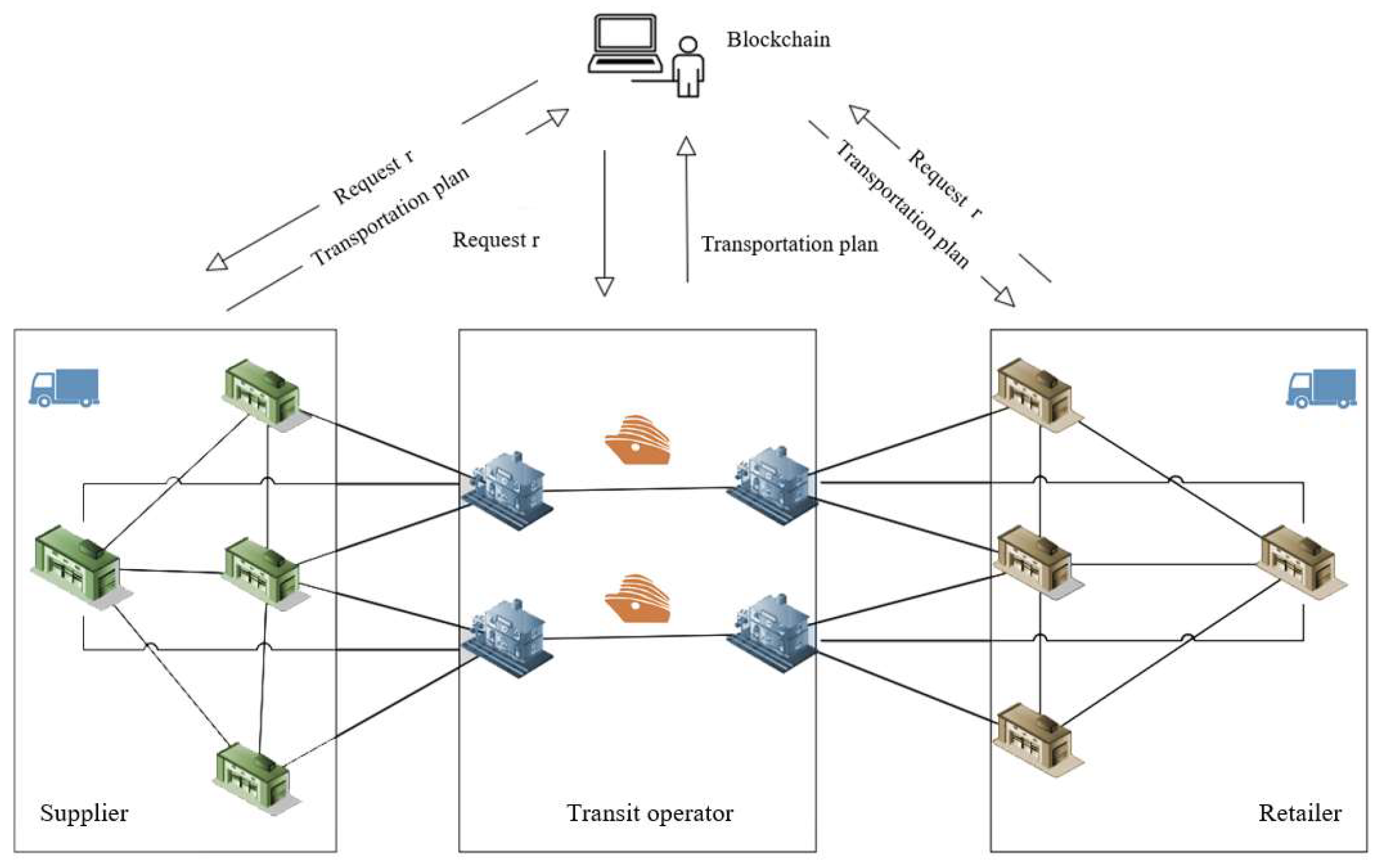
Figure 1. Schematic representation of a blockchain-based synchromodal transport network.
Mathematics 13 03829 g001
Figure 2. Schematic representation of synchromodal transport planning.
Mathematics 13 03829 g002
Figure 3. Synchromodal transport network connecting Asia and Europe.
Mathematics 13 03829 g003
Figure 4. Comparison of total cost and total transparency values between the Baseline Model and Blockchain-Integrated Model.
Mathematics 13 03829 g004
Figure 5. Optimization results of the synchromodal transport network for operators using blockchains of different performance levels.
Mathematics 13 03829 g005
Figure 6. Total transparency and cost under different weights: (a) Total transparency; (b) Total cost.
Mathematics 13 03829 g006
Figure 7. Variation in total transparency and cost under different demands.
Mathematics 13 03829 g007
Figure 8. Number of operators adopting blockchain technology in synchronous transportation networks under varying levels of demand uncertainty, and the types of blockchains employed.
Mathematics 13 03829 g008
Table 1. Definitions of parameters and variables.
TypologySymbolMeaning
SetsNOperator set, i, jN, where P/D/TN denotes the sets of transportation nodes for different operators, namely suppliers, retailers, and transfer centers
RTransportation request set, rR
KTransportation mode set, k, lK, where k represents inland transportation and l represents sea transportation
BBlockchain set, bB
Parameters f b pr Influence coefficient of the number of blocks generated by b-type blockchains on the transparency of the transportation network
γ b Influence coefficient of b-type blockchains on variable transportation costs
B b Number of blocks generated by blockchain type b
c k 1 Unit transportation cost of transporting goods by using the transportation mode k
c kl 2 Unit transfer cost from transportation mode k to transportation mode l
c r delay Unit penalty cost for each hour of delay of request r
p(r)Pickup node of request r
d(r)Delivery node of request r
d ij k Transportation distance from node i to node j via mode k
q r Demand quantity of goods for request r
u k Capacity of transportation mode k
t ¯ k i Time required for loading and unloading of transportation mode k at node i
T r release Release time of request r
T r delay Delay time of request r reaching the distribution terminal
T r due Delivery time of request r
θBuffer parameter
μ b Time saved in request transmission when operators utilize blockchain b
σ k Standard deviation of transportation time
c b Fixed usage costs of blockchain encompassing construction costs and maintenance costs, among others
MSufficiently large positive number
τ ij k Transportation time of the transport vehicle k at nodes i and j
B A Unit transparency of synchromodal transport enhanced by blockchain technology
B N Minimum number of operators required for implementing blockchain technology
B ¯ ,   B _ Expected minimum and maximum transparency of the transportation network
t kr / t kr Service start time/end time of the transportation mode k of request r
Decision variables y i b y i b = 1 indicates operator i uses the type b blockchain; otherwise y i b = 0
y ij b y ij b = 1 indicates operators i and j establish a connection using blockchain technology; otherwise y ij b = 0
x ij krt x ij krt = 1 indicates request r is transported between nodes i and j by means of transportation k in period t; otherwise x ij krt = 0
y ij kt y ij kt = 1 indicates transport between node i and node j using transportation mode k in period t; otherwise y ij kt = 0
z ij k z ij k = 1 indicates on transportation route for mode k, node i precedes node j; otherwise z ij k = 0
s ir klt s ir klt = 1 indicates request r is transferred from transportation mode k to transportation mode l at the transfer node i in period t; otherwise s ir klt = 0
Table 2. Asia–Europe dataset operator information.
NumberOperatorType
1WuhanInland node
2YiwuInland node
3SuzhouInland node
4ChangshaInland node
5ChongqingInland node
6ShenyangInland node
7ZhengzhouInland node
8ChengduInland node
9VenloInland node
10DuisburgInland node
11LyonInland node
12DortmundInland node
13NurembergInland node
14StrasbourgInland node
15BremenInland node
16LeipzigInland node
17NantesInland node
18ShanghaiTransit center
19NingboTransit center
20RotterdamTransit center
21HamburgTransit center
Table 3. Impact of various blockchain types on synchromodal transport networks.
Blockchain TypeOptimal Total Cost (CNY)Optimal Total TransparencyOperators Using Blockchain
None1,729,38140None
Low performance2,824,837.5141.84, 5, 6, 8, 11, 13, 17, 18, 19, 20, 21
Medium performance3,116,197.3154.45, 6, 8, 11, 13, 17, 18, 19, 20, 21
High performance3,327,638.9163.16, 8, 11, 17, 18, 20
Low + Medium + High performance3,418,381.1172.2Low performance: 4, 5
Medium performance: 13, 18, 19, 20, 21
High performance: 6, 8, 11, 17
Table 4. The impact of operator preferences on synchromodal transport networks.
ω 1 Optimal Total TransparencyOptimal Total Cost (CNY) Δ F 1 Δ F 2
0.157.91,867,391.314.70%96.70%
0.3105.22,356,836.853.57%62.80%
0.5141.32,824,837.583.23%42.02%
0.7152.12,972,981.492.11%25.19%
0.9160.43,128,395.998.93%7.42%
Table 5. The total transparency and total cost under definite and indefinite demands.
λ (min F1, F2)(max F1, F2)
0.5(40, 1,729,381.0)(149.2, 3,263,927.4)
0.6(34, 1,818,206.4)(153.7, 3,909,716.4)
0.8(29, 1,977,195.1)(159.5, 4,297,491.7)
1(26, 2,096,843.8)(165.2, 4,594,137.9)
Table 6. Operator selection under different demands.
Demand SituationOptimal Total Cost (CNY)Optimal Total TransparencyOperators Leveraging Blockchain Technology
λ   =   0.5 3,418,381.1172.2low:4, 5
medium: 13, 18, 19, 20, 21
high: 6, 8, 11, 17
λ   =   0.6 3,816,134.1183.4low:4, 5, 7, 16
medium: 13, 18, 19, 20, 21
high: 6, 8, 11, 17
λ   =   0.8 4,271,832.6190.7low: 1, 4, 5, 7, 14, 15, 16
medium: 13, 18, 19, 20, 21
high: 6, 8, 11, 17
λ = 1 4,872,791.7201.6low: 1, 4, 7, 15, 16
medium: 5, 14, 18, 19, 20, 21
high: 6, 8, 11, 13, 17
Disclaimer/Publisher’s Note: The statements, opinions and data contained in all publications are solely those of the individual author(s) and contributor(s) and not of MDPI and/or the editor(s). MDPI and/or the editor(s) disclaim responsibility for any injury to people or property resulting from any ideas, methods, instructions or products referred to in the content.