Article

The Role of Feature Vector Scale in the Adversarial Vulnerability of Convolutional Neural Networks


1
Department of Computer Engineering, Korea National University of Transportation, 50, Daehak-ro, Daesowon-myeon, Chungju-si 27469, Republic of Korea
2
Department of Artificial Intelligence, Gachon University, Seongnam 13120, Republic of Korea
*
Author to whom correspondence should be addressed.
Mathematics 2025, 13(18), 3026; https://doi.org/10.3390/math13183026
Submission received: 18 August 2025 / Revised: 14 September 2025 / Accepted: 16 September 2025 / Published: 19 September 2025
(This article belongs to the Special Issue The Application of Deep Neural Networks in Image Processing)

Abstract

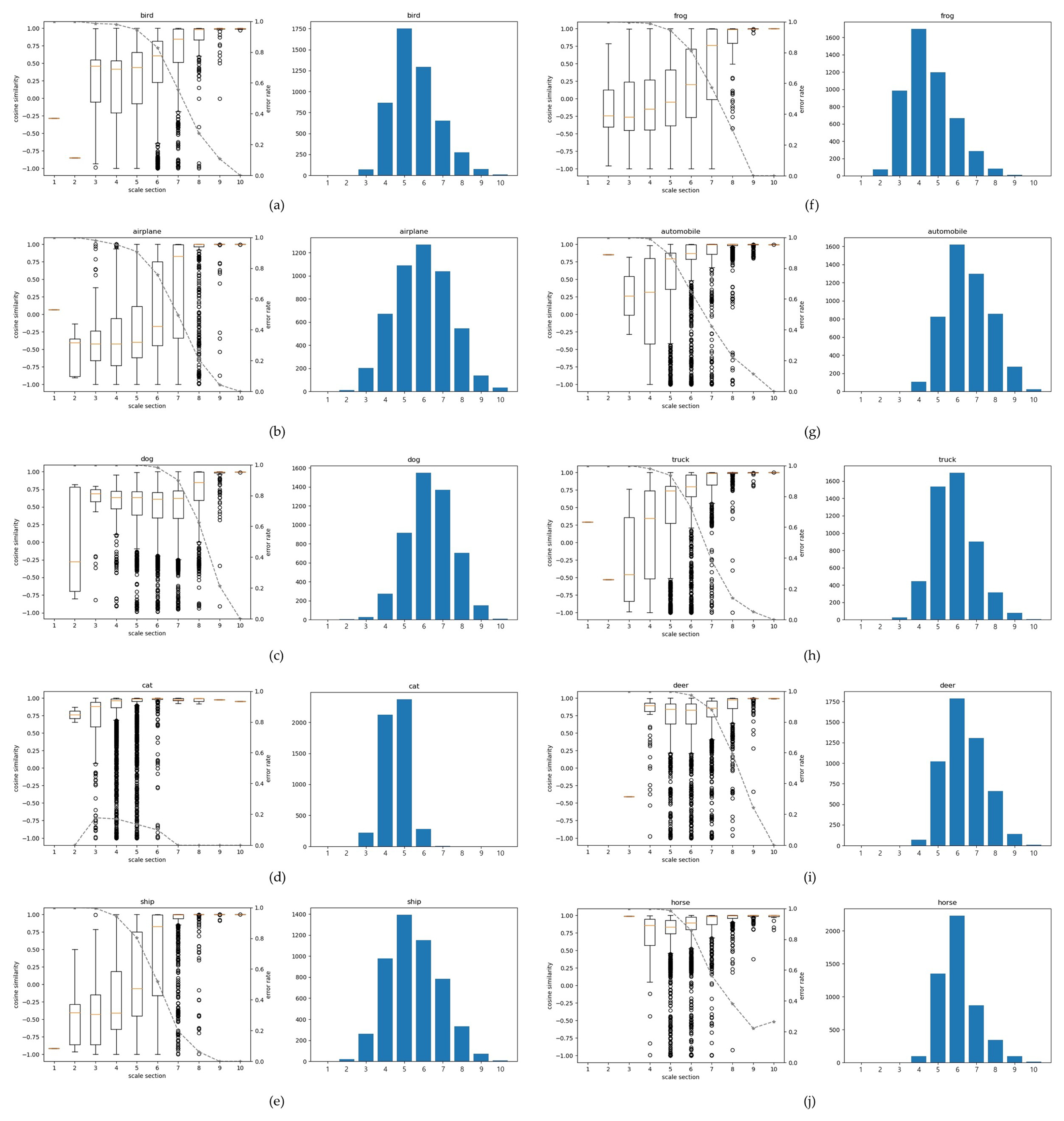
In image classification, convolutional neural networks (CNNs) remain vulnerable to visually imperceptible perturbations, often called adversarial examples. Although various hypotheses have been proposed to explain this vulnerability, a clear cause has not been established. We hypothesize an unfair learning effect: samples are learned unevenly depending on the scale (norm) of their feature vectors in feature space. As a result, feature vectors with different scales exhibit different levels of robustness against noise. To test this hypothesis, we conduct vulnerability tests on CIFAR-10 using a standard convolutional classifier, analyzing cosine similarity between original and perturbed feature vectors, as well as error rates across scale intervals. Our experiments show that small-scale feature vectors are highly vulnerable. This is reflected in low cosine similarity and high error rates, whereas large-scale feature vectors consistently exhibit greater robustness with high cosine similarity and low error rates. These findings highlight the critical role of feature vector scale in adversarial vulnerability.
Keywords: convolutional neural networks; vulnerability; feature vector; adversarial examples; gabor noise convolutional neural networks; vulnerability; feature vector; adversarial examples; gabor noise