Abstract
Frequency-hopping multiple access is widely adopted to blunt narrow-band jamming and limit spectral disclosure in cyber–physical systems, yet its practical resilience depends on three sequence-level properties. First, balancedness guarantees that every carrier is occupied equally often, removing spectral peaks that a jammer or energy detector could exploit. Second, a wide gap between successive hops forces any interferer to re-tune after corrupting at most one symbol, thereby containing error bursts. Third, a no-hit zone (NHZ) window with a zero pairwise Hamming correlation eliminates user collisions and self-interference when chip-level timing offsets fall inside the window. This work introduces an algebraic construction that meets the full set of requirements in a single framework. By threading a permutation over an integer ring and partitioning the period into congruent sub-blocks tied to the desired NHZ width, we generate balanced wide gap no-hit zone frequency-hopping (WG-NHZ FH) sequence sets. Analytical proofs show that (i) each sequence achieves the Lempel–Greenberger bound for auto-correlation, (ii) the family and zone sizes satisfy the Ye–Fan bound with equality, (iii) the hop-to-hop distance satisfies a provable WG condition, and (iv) balancedness holds exactly for every carrier frequency.
MSC:
94A55; 05B10; 94B25
1. Introduction
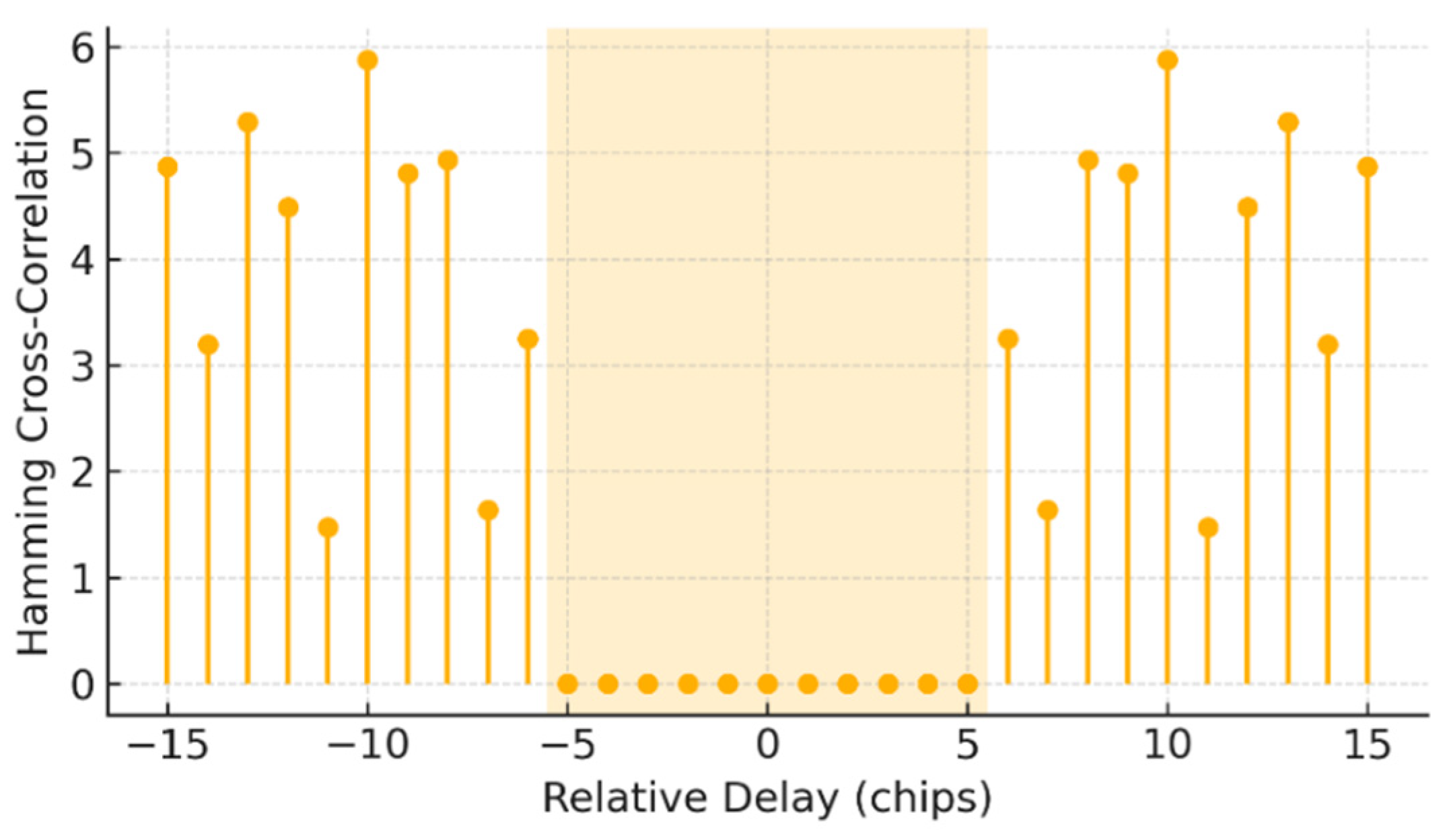
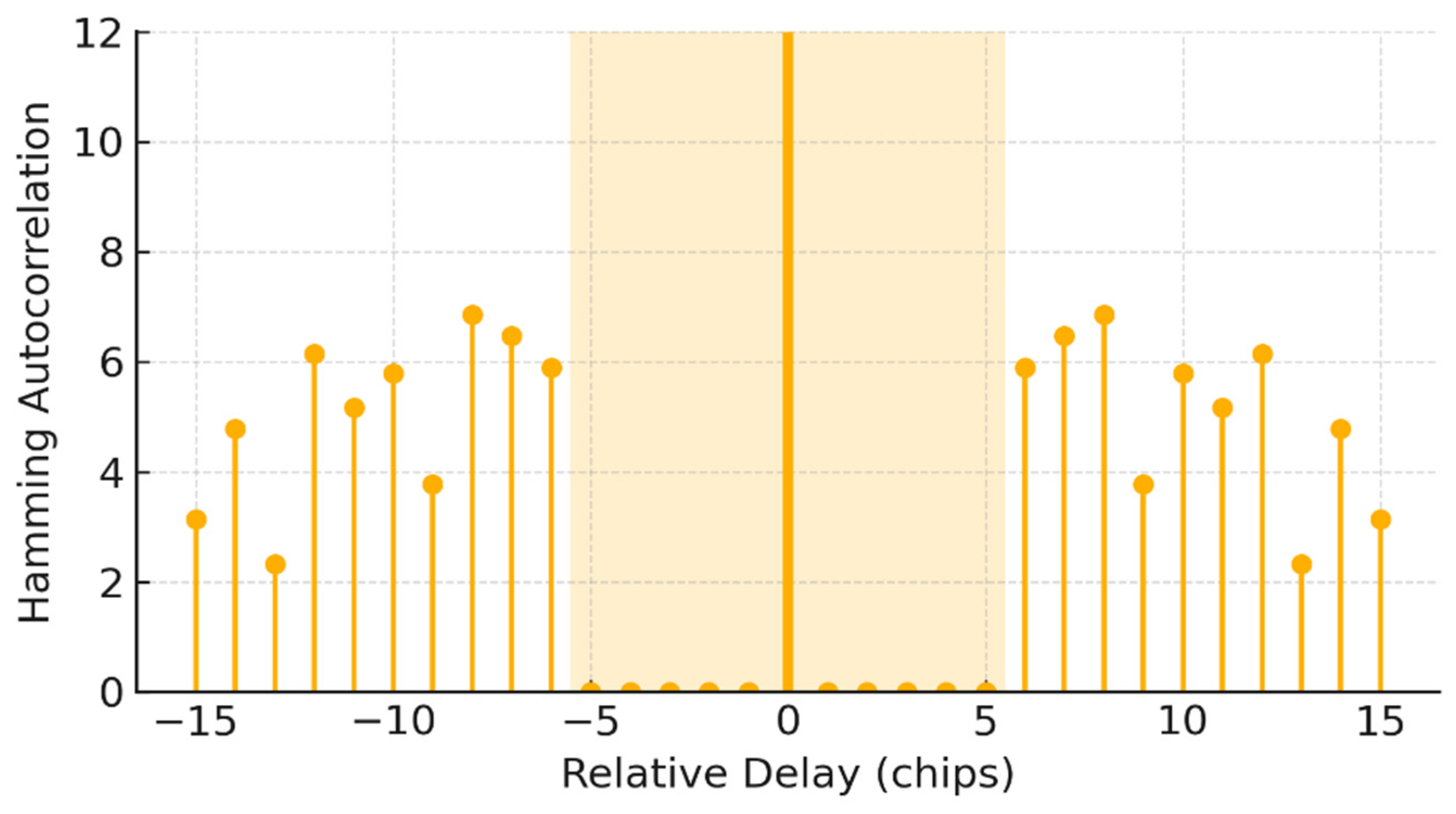
Frequency-hopping (FH) multiple access has been a reliable method of blunting narrow-band jamming for more than forty years because rapid carrier changes hide a signal’s spectrum and confine any narrow-band interferer to a single hop [1,2,3,4]. In quasi-synchronous (QS) links—where chip-level timing offsets are unavoidable—the strength of an FH link hinges on how the hop pattern is designed to guarantee zero hits in the designated zone (Figure 1 and Figure 2). Four sequence-level properties matter in practice: balancedness, an explicit no-hit zone (NHZ), a provable wide gap (WG) between successive hops, and an auto-correlation floor that satisfies the Lempel–Greenberger (LG) bound [5]. Balancedness means that every carrier appears the same number of times in one period, flattening the power spectrum and delaying spectrum estimation attacks [6]. The NHZ concept was introduced by Wang and Fan [7] and Ye and Fan [8], who showed that, if the relative delay between two QS users (or between a multipath echo and the main signal) falls inside a dedicated L-chip window, then all pairwise Hamming correlations are zero. Later work added non-repeating NHZ sequences [9], Ye–Fan-optimal families [10], and larger low-hit zone or Cartesian product sets [11,12].
Figure 1.
Hamming cross-correlation between NHZ sequences (zone size 5).
Figure 2.
Hamming auto-correlation of NHZ sequences (zone size 5).
An NHZ alone cannot deter a jammer that exists on neighboring hops. Early wide gap designs appeared in Wang et al. [13] and Zhang [14]. More recently, Wang et al. [15] and Shu et al. [16] presented sequence sets with NHZ and WG properties, but without considering balancedness, length flexibility, or LG optimality. Balanced WG-aware NHZ coding matters in practice [17]. Block cipher-assisted spectrum control experiments [6], multi-sequence anti-jamming frameworks [18], and asymmetric FH access networks [19] all show that widening hop distances or flattening the spectrum raises the jammer-to-signal ratio an attacker must achieve. Conversely, modern time–frequency analysis tools [20] and agile rendezvous algorithms [21] expose poorly balanced or tightly packed patterns, while the latest one-coincidence sequences for cryptography [22,23] highlight the same four requirements.
In this paper, we present an algebraic construction with NHZ orthogonality, a measurable wide gap, balancedness, and optimal Hamming auto-correlation for even lengths. By permuting an integer ring and slicing the period into equal sub-blocks tied to the desired NHZ width, we generate a balanced WG-NHZ family that (i) satisfies the Ye–Fan bound with equality, (ii) satisfies the Lempel–Greenberger bound for every sequence, and (iii) guarantees a provable hop-to-hop distance.
2. Preliminaries
An FH sequence of length is defined over an alphabet , in which each symbol corresponds to an available frequency. The Hamming correlation between two FH sequences and of length is defined as
where the indicator function is defined as if and if for any . An FH sequence set X is a collection of FH sequences of length over . When an FHS with satisfies for , it is called an optimal FH sequence with respect to the Lempel–Greenberger bound [17]. The FHS set X is called an NHZ sequence set if it satisfies
for all if , and for all if . The optimality of an NHZ-FHS set is typically evaluated using the Ye–Fan bound [6].
Theorem 1 ([6], Ye–Fan bound).
An NHZ sequence set satisfies
If an NHZ sequence set satisfies (2) with equality, then it is called an optimal NHZ sequence set.
If every sequence in an FH sequence set X satisfies
then X is called an FH sequence set with wide gap . An FH sequence is balanced if every symbol in the alphabet appears with an equal number in the sequence. An FH sequence set is also balanced if every sequence in the set is balanced. A balanced hopping pattern visits each frequency the same number of times within one period, distributing signal energy uniformly across the band and eliminating spectral peaks or gaps. This even spectral footprint frustrates single-tone jammers and ensures that interference and power loading are shared fairly between all users, leading to greater link reliability and network capacity.
In the next section, we generate NHZ sequence sets of any even length whose Hamming correlation is identically zero within a configurable delay window, whose successive hops are separated by a provable wide gap, and whose individual sequences satisfy the Lempel–Greenberger bound. Every carrier appears equally often, giving the set a balanced spectral footprint that flattens the average power spectral density and equalizes the interference between users. The new family size attains the Ye–Fan bound with equality.
3. Design of NHZ Sequences with WG
We construct a set of FH sequences based on permutations on integer rings. To achieve a no-hit zone of the desired length, we construct the sequence in blocks whose sizes are directly related to that zone size. Furthermore, we set up some difference between adjacent terms to obtain the WG property.
Construction 1.
Define an FH sequence set X
consisting of FH sequences of length over as
where and is a permutation on such that , , and for .
Theorem 2.
For an integer and an odd integer
, the set X in Construction 1 is an optimal NHZ sequence set with wide gap
. Furthermore, each
has an optimal Hamming auto-correlation with respect to the Lempel–Greenberger bound. Furthermore, each
is balanced.
Proof of Correlation Properties.
For , the Hamming cross-correlation is given by
Since is between and for and between and for , we can check the symbol coincidence separately for each case. When , a necessary and sufficient condition for
is and . Similarly, when , a necessary and sufficient condition for
is (equivalently, ) and . For both cases, we have for , which implies is a nonzero multiple of . Therefore, the cross-correlation value is 0 when . The optimality of the set can be easily checked using
For , the Hamming auto-correlation of is equivalent to
Let , and , for any . If , then and , which is a contradiction. Therefore, if ; that is, has an optimal Hamming auto-correlation with respect to the Lempel–Greenberger bound. □
Proof of Wide Gap Properties.
If , that is, , then
When and , we have
On the other hand, when and , the value
is also between and . Therefore, each has wide gap . □
Proof of Balanced Properties.
Since the Hamming auto-correlation of is except for , every symbol appears at most once within . Moreover, there exists at least one such that for any since there are exactly symbols in the sequence. Therefore, each symbol appears exactly once within one period of a sequence. □
4. Results
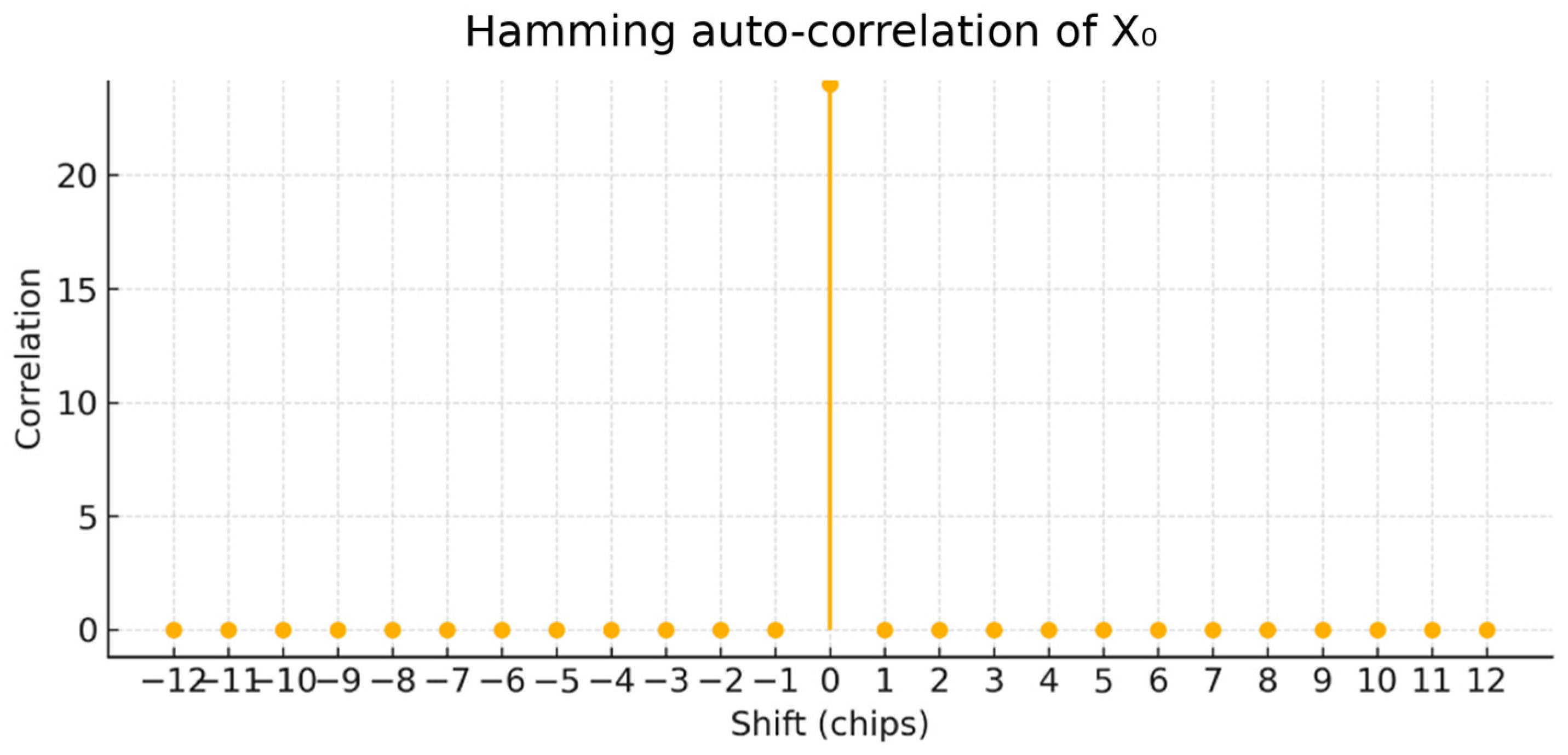
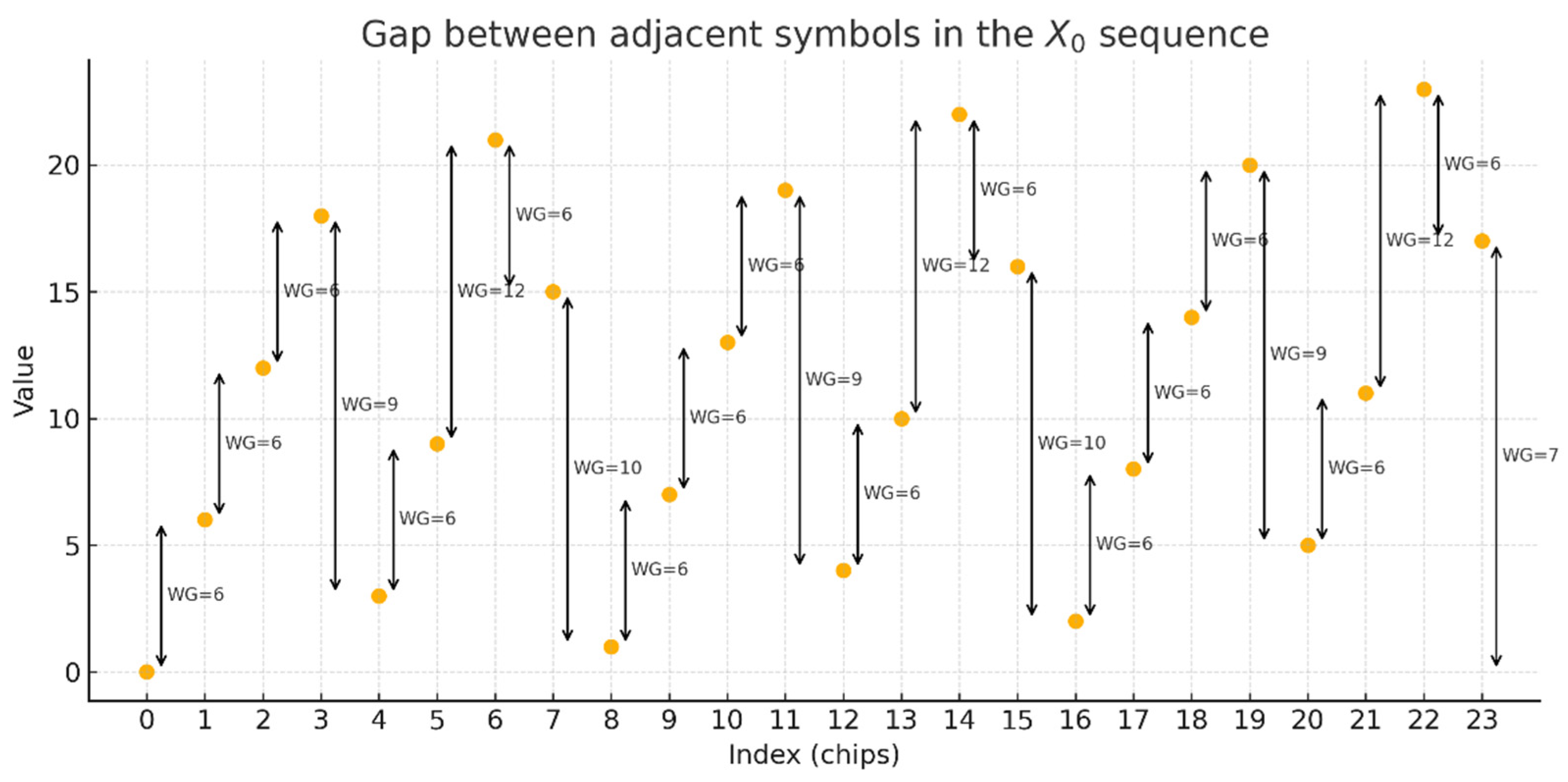
This section validates the proposed construction through two representative test cases to demonstrate that the same algebraic rules hold for larger dimensions. The two cases illustrate that the Ye–Fan and Lempel–Greenberger bounds are satisfied for even lengths while maintaining balanced frequency usage and a provable wide gap. The study was largely theoretical: every major result was obtained through analytic derivation and presented in closed form, and thus, there was no need for extensive Monte Carlo trials or large-scale numerical optimization. Note that a compact auxiliary script was used to (a) list the codewords shown in this section and (b) produce the plots in Figure 3, Figure 4, Figure 5 and Figure 6. The experimental environments were Python 3.11.4 (64-bit), NumPy 1.26.4, SciPy 1.13.0, Matplotlib 3.9.0, Windows 11 Home, Intel Core i9-10900, and 64 GB RAM.
Figure 3.
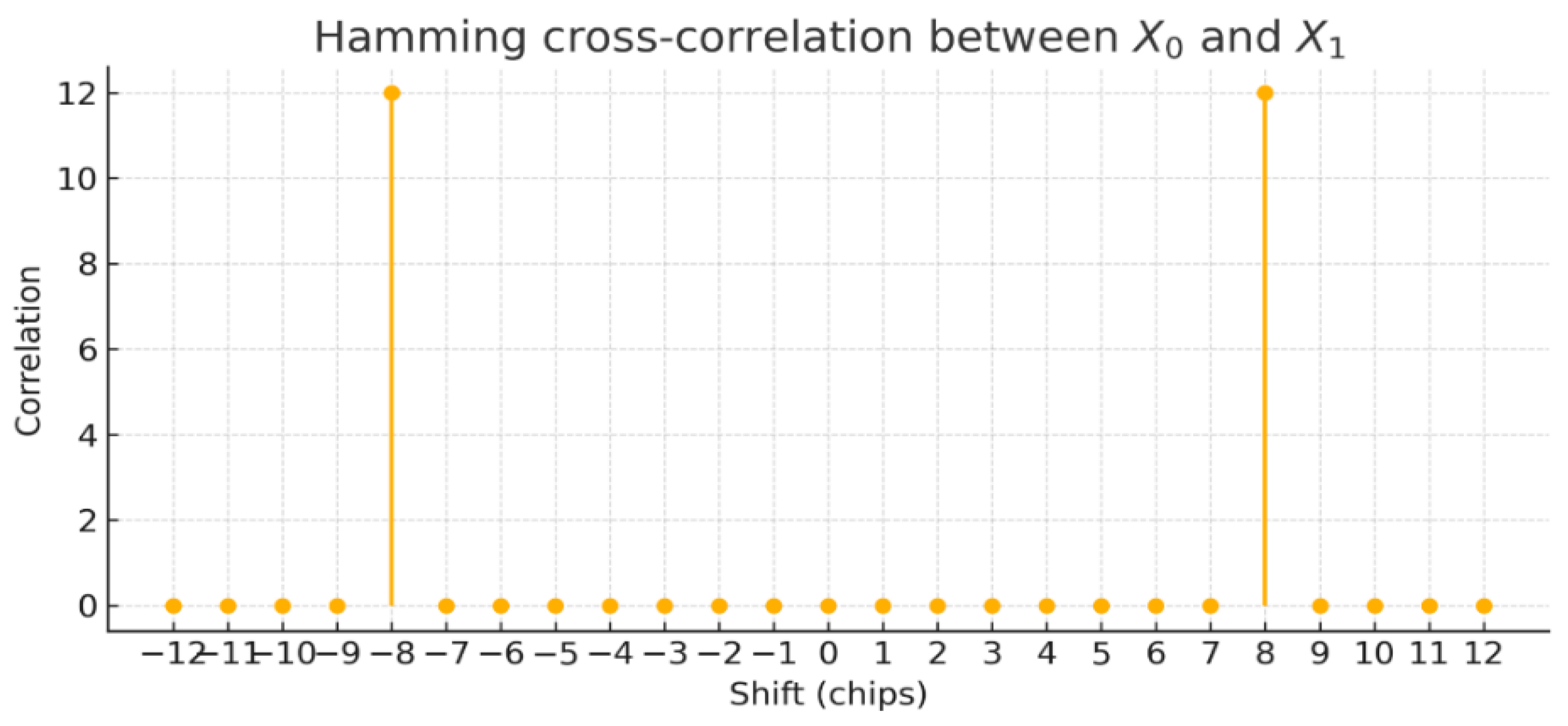
Hamming cross-correlation between and for and .
Figure 4.
Hamming auto-correlation of for and .
Figure 5.
Wide gap property of for and .
Figure 6.
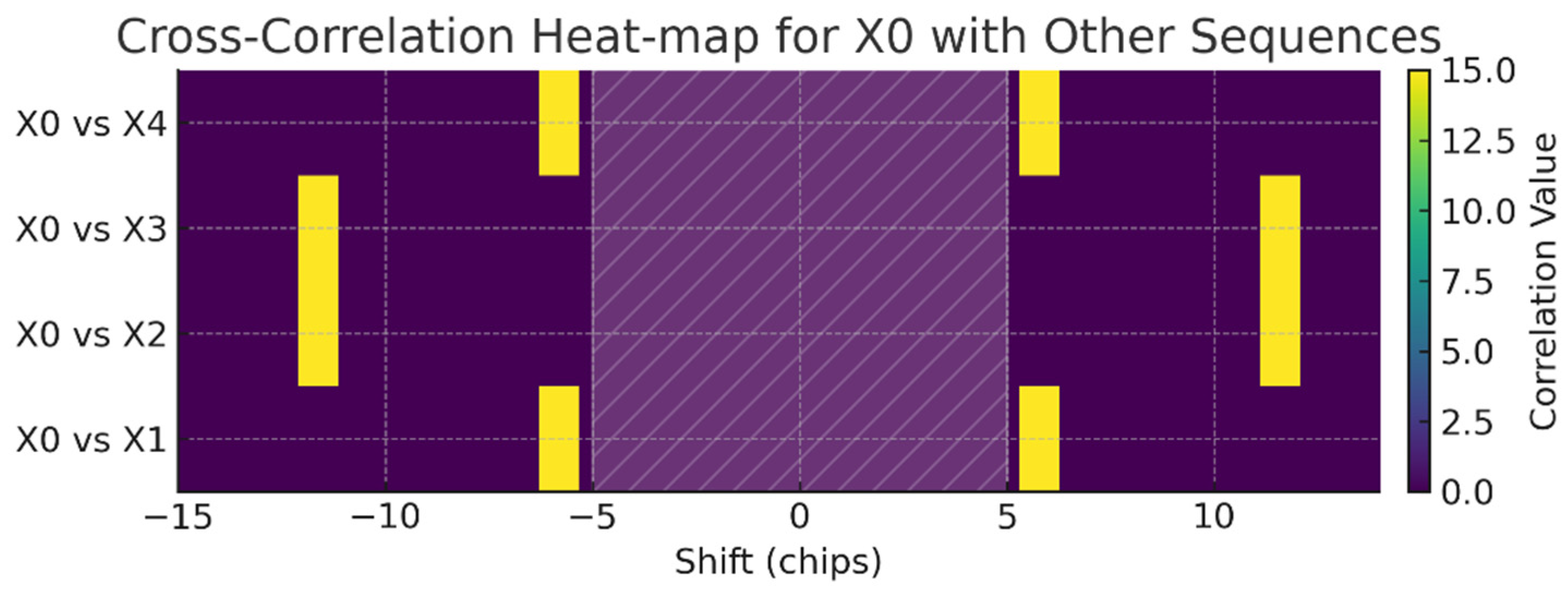
Cross-correlation heat-map for Case 2.
Case 1: and in Construction 1. The codewords are given by
The cross-correlation values are given by
The cross-correlation values between and are plotted in Figure 3, in which the window of the no-hit zone is clearly shown. Note that the cross-correlation values for the other pair of sequences are identical to Figure 3. Clearly, it is optimal with respect to the Ye–Fan bound since
On the other hand, the auto-correlation values of each are given by
and therefore, all the sequences are optimal with respect to the Lempel–Greenberger bound. The auto-correlation values for are plotted in Figure 4. Moreover, the gap value sets within one period of each sequence are given by
and therefore, the wide gap 5 of the FH sequence set is easily checked and depicted in Figure 5. Therefore, the set X is an optimal NHZ-FHS set with wide gap .
Case 2: and in Construction 1. The codewords are given by
For any , the cross-correlation values are given by
On the other hand, the auto-correlation values of each are given by
and therefore, all the sequences are optimal with respect to the Lempel–Greenberger bound. The set X is optimal with respect to the Ye–Fan bound since
Moreover, the gap value sets within one period of each sequence are given by
and therefore, the wide gap 9 of the FH sequence set is easily checked. Therefore, the set X is an optimal NHZ-FHS set with wide gap . A cross-correlation heatmap of with other sequences is illustrated in Figure 6.
5. Discussion and Conclusions
Compared with the most recent constructions satisfying the WG and NHZ properties reported in [15,16], our design simultaneously incorporates three additional considerations. First, every sequence maintains perfectly balanced frequency usage, eliminating spectral density bias across the hop set. Second, the construction remains valid for any even sequence length and the NHZ width dividing the length, providing a level of length and zone flexibility. Third, each sequence in the set satisfies the Ye–Fan and Lempel–Greenberger bounds at the same time while guaranteeing a provable wide gap size, thereby unifying multiple optimality criteria within one framework. These combined properties distinguish the proposed scheme from the approaches in [15,16] and broaden its practical applicability to quasi-synchronous FH networks. The comparison of parameters is summarized in Table 1.
Table 1.
Parameter comparison with recent WG NHZ sequence sets.
Note that the sequence lengths in Construction 1 are limited to the alphabet size to keep all the required properties—wide gap, no-hit zone, optimal Hamming auto-correlation, and balancedness—because it is mathematically impossible to preserve the optimal Hamming auto-correlation with an increased length and balancedness. However, if we concentrate on the NHZ property rather than the optimal Hamming auto-correlation, we can obtain some parameter flexibility. By concatenating distinct sequences in Construction 1, it is possible to construct balanced NHZ sequence sets with longer lengths.
Uniform hopping patterns have long been recognized as an important factor against partial-band and reactive jamming because they eliminate discrete spectral lines and maximize the spread-spectrum processing gain. In [24], it was demonstrated that, when every carrier is used with equal probability, the ensemble-averaged power spectral density (PSD) becomes flat, and the jammer-to-signal ratio required for denial grows with the hop set size. More recently, the same effect was confirmed on IEEE 802.11 testbeds [25]: a uniformly distributed FH schedule forced a reactive jammer to spend about 5 dB more power to reach the same packet loss rate observed for non-uniform schedules [26]. These results support the claim that a strictly uniform frequency occupancy boosts interference and jamming resilience without introducing a noticeable implementation overhead.
In summary, this paper introduces an integer ring permutation-based construction that, for every even length, generates a family of NHZ sequences that is Ye–Fan and Lempel–Greenberger optimal. The resulting sets exhibit strictly uniform frequency occupancy, which flattens the average power spectrum and enhances the interference and jamming resilience without incurring more than ε-level additional complexity in implementation. Together, these attributes position the proposed WG NHZ sequence set as a versatile and performance-consistent solution for next-generation QS-FH communication systems.
Author Contributions
Conceptualization, J.-H.C. and S.L.; methodology, D.L.; formal analysis, J.-H.C. and S.L.; writing—review and editing, D.L., S.L. and J.-H.C.; funding acquisition, D.L. All authors have read and agreed to the published version of the manuscript.
Funding
This study was supported by Konkuk University in 2023.
Data Availability Statement
No new data were created or analyzed in this study.
Acknowledgments
The authors appreciate the constructive comments of the anonymous reviewers and the handling editor, which greatly improved the manuscript.
Conflicts of Interest
The authors declare no conflicts of interest regarding this paper.
References
- Simon, M.K.; Omura, J.K.; Scholtz, R.A.; Levitt, B.K. Spread Spectrum Communications Handbook; McGraw-Hill: New York, NY, USA, 2002. [Google Scholar]
- Sarwate, D.V. Reed-Solomon codes and the design of sequences for spread-spectrum multiple-access communications. In Reed-Solomon Codes and Their Applications; Wicker, S.B., Bharagava, V.K., Eds.; IEEE Press: Piscataway, NJ, USA, 1994. [Google Scholar]
- Fan, P.; Darnell, M. Sequence Design for Communications Applications; Research Studies Press, John Wiley & Sons: London, UK, 1996. [Google Scholar]
- Yang, L.; Giannakis, G.B. Ultra-wideband communications: An idea whose time has come. IEEE Sig. Proc. Mag. 2004, 21, 26–54. [Google Scholar] [CrossRef]
- Lempel, A.; Greenberger, H. Families of sequences with optimal Hamming correlation properties. IEEE Trans. Inf. Theory 1974, 20, 90–94. [Google Scholar] [CrossRef]
- Gao, W.; Guan, L.; Hui, P.; Zhang, H.; Li, Z. Block-Cipher No-Hit-Zone Sequence-Assisted Spectrum Control Scheme for Distributed Systems. Electronics 2025, 14, 1802. [Google Scholar] [CrossRef]
- Wang, X.; Fan, P. A class of frequency hopping sequences with no-hit zone. In Proceedings of the 4th International Conference on Parallel and Distributed Computing, Applications and Technologies (PDCAT 2003), Chengdu, China, 29 August 2003; pp. 896–898. [Google Scholar]
- Ye, W.; Fan, P. Two classes of frequency hopping sequences with no-hit zone. In Proceedings of the 7th International Symposium on Communication Theory and Applications (ISCTA 2003), Ambleside, UK, 13–18 July 2003; pp. 304–306. [Google Scholar]
- Ye, W.-X.; Fan, P.-Z.; Gabidulin, E.M. Construction of non-repeating frequency-hopping sequences with no-hit zone. Electron. Lett. 2006, 42, 681–682. [Google Scholar] [CrossRef]
- Chung, J.-H.; Han, Y.-K.; Yang, K. No-hit-zone frequency-hopping sequence sets with optimal Hamming autocorrelation. IEICE Trans. Fundam. Electron. Commun. Comput. Sci. 2010, E93-A, 2239–2244. [Google Scholar] [CrossRef]
- Liu, X.; Shu, Q.; Zeng, Q. Low-hit-zone frequency/time hopping sequence sets with large family size. IEEE Access. 2019, 7, 181733–181739. [Google Scholar] [CrossRef]
- Zhou, L.; Han, H.; Liu, X. Frequency-hopping sequence sets with no-hit-zone through Cartesian product. Cryptogr. Commun. 2020, 12, 485–497. [Google Scholar] [CrossRef]
- Wang, H.; Zhao, Y.; Shen, F.; Sun, W. The design of wide interval FH sequences based on RS code. In Proceedings of the International Conference on Mechatronics and Automation (ICMA 2009), Changchun, China, 9–12 August 2009; pp. 2345–2350. [Google Scholar]
- Zhang, H. Design and performance analysis of frequency hopping sequences with given minimum gap. In Proceedings of the 2010 International Conference on Microwave and Millimeter Wave Technology (ICMMT 2010), Chengdu, China, 8–11 May 2010; pp. 1271–1274. [Google Scholar] [CrossRef]
- Wang, C.; Yang, W.; Fan, F. Optimal no-hit-zone frequency hopping sequence sets with wide gap. Electron. Lett. 2022, 58, 106–108. [Google Scholar] [CrossRef]
- Shu, Q.; Liu, H.; Zhu, Y.; Liu, X. Strong no-hit-zone frequency sequence set with wide gap. Electron. Lett. 2022, 58, 436–438. [Google Scholar] [CrossRef]
- Shu, Q.; Liu, H.; Liu, X.; Yang, Y.; Chen, W. Optimal wide-gap-zone frequency hopping sequences. Adv. Math. Commun. 2024, 18, 1379–1389. [Google Scholar] [CrossRef]
- Huang, T.; Liu, Y.; Liu, X.; Wang, M. A New Improved Multi-Sequence Frequency-Hopping Communication Anti-Jamming System. Electronics 2025, 14, 523. [Google Scholar] [CrossRef]
- Duan, R.; Jin, L.; Lan, X. Analysis of Anti-Jamming Performance of HF Access Network Based on Asymmetric Frequency Hopping. Sensors 2025, 25, 2950. [Google Scholar] [CrossRef] [PubMed]
- Zeng, Z.; Jiang, C.; Zhou, Y.; Zhou, T. A Time–Frequency Domain Analysis Method for Variable Frequency Hopping Signal. Sensors 2024, 24, 6449. [Google Scholar] [CrossRef] [PubMed]
- Choi, Y.-J.; Kim, Y.-S.; Jang, J.-W. Channel-Hopping Sequence and Searching Algorithm for Rendezvous of Spectrum Sensing. Sensors 2025, 25, 62. [Google Scholar] [CrossRef] [PubMed]
- Shao, M.; Miao, Y. A Construction of Optimal One-Coincidence Frequency-Hopping Sequences via Generalized Cyclotomy. Entropy 2024, 26, 935. [Google Scholar] [CrossRef] [PubMed]
- Tian, X.; Han, H.; Niu, X.; Liu, X. Construction of optimal frequency hopping sequence set with low-hit-zone. Entropy 2023, 25, 1044. [Google Scholar] [CrossRef] [PubMed]
- Scholtz, R.A. The Spread Spectrum Concept. IEEE Trans. Commun. 1977, 25, 748–755. [Google Scholar] [CrossRef]
- IEEE Std 802.11-2020; IEEE Standard for Information Technology—Telecommunications and Information Exchange Between Systems—Local and Metropolitan Area Networks—Specific Requirements—Part 11: Wireless LAN Medium Access Control (MAC) and Physical Layer (PHY) Specifications. IEEE: New York, NY, USA, 2021. [CrossRef]
- Pelechrinis, K.; Koufogiannakis, C.; Krishnamurthy, S.V. On the Efficacy of Frequency Hopping in Coping with Jamming Attacks in 802.11 Networks. IEEE Trans. Wirel. Commun. 2010, 9, 3258–3271. [Google Scholar] [CrossRef]
Disclaimer/Publisher’s Note: The statements, opinions and data contained in all publications are solely those of the individual author(s) and contributor(s) and not of MDPI and/or the editor(s). MDPI and/or the editor(s) disclaim responsibility for any injury to people or property resulting from any ideas, methods, instructions or products referred to in the content. |
© 2025 by the authors. Licensee MDPI, Basel, Switzerland. This article is an open access article distributed under the terms and conditions of the Creative Commons Attribution (CC BY) license (https://creativecommons.org/licenses/by/4.0/).