Article

Failure Mode and Effect Analysis Using Interval Type-2 Fuzzy and Multiple-Criteria Decision-Making Methods


1
Department of Industrial Engineering and Management, National Taipei University of Technology, Taipei 10608, Taiwan
2
Department of Health Care Management, National Taipei University of Nursing and Health Sciences, Taipei 112303, Taiwan
3
Institute of Urban Planning, College of Public Affairs, National Taipei University, New Taipei City 23741, Taiwan
*
Author to whom correspondence should be addressed.
Mathematics 2024, 12(24), 3931; https://doi.org/10.3390/math12243931

Submission received: 1 November 2024 / Revised: 5 December 2024 / Accepted: 9 December 2024 / Published: 13 December 2024
(This article belongs to the Section D2: Operations Research and Fuzzy Decision Making)

Abstract

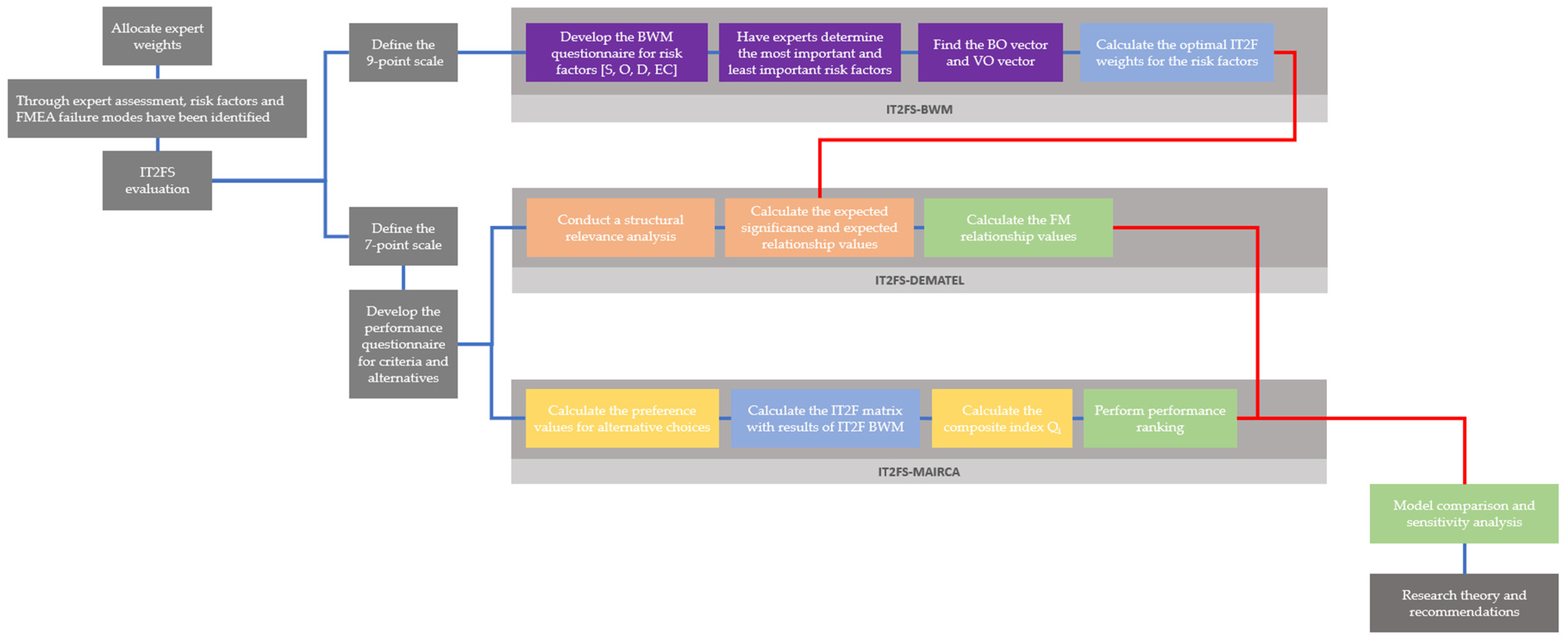
In recent years, Failure Mode and Effects Analysis (FMEA) has become an essential preventive tool widely applied across various fields. As a structured system analysis method, FMEA aids in identifying potential failure modes in product or process design, allowing for preventive measures to be taken in advance. However, traditional FMEA has certain limitations, as it does not comprehensively consider all potential failure factors. This study proposes an improved FMEA method that addresses these shortcomings by integrating it with a Multiple-Criteria Decision Making (MCDM) model, thereby enhancing the comprehensiveness of the assessment framework. Notably, this research introduces an economic risk factor—Expected Cost (EC)—to make the analysis results more aligned with real-world conditions. Additionally, to manage the uncertainty in expert opinions, this study applies Interval Type-2 Trapezoidal Fuzzy Numbers (IT2TFNs) and combines them with the Best-Worst Method (BWM) to calculate the weights of risk factors. Furthermore, the Decision-Making Trial and Evaluation Laboratory (DEMATEL) method is employed to explore the interrelationships between failure modes. Finally, the Multi-Attribute Ideal-Real Comparative Analysis (MAIRCA) method is used to rank risk factors, determining the priorities for improvement. This paper uses an air purifier as a case study to validate the effectiveness of the improved FMEA method, successfully addressing the shortcomings of traditional FMEA regarding uncertainty in expert opinions and the calculation of Risk Priority Numbers (RPNs). It provides a more practical and accurate risk assessment framework.
Keywords: FMEA; IT2TFNs; BWM; DEMATEL; MAIRCA FMEA; IT2TFNs; BWM; DEMATEL; MAIRCA