
Abstract
Bi-univalent functions associated with the leaf-like domain within the open unit disk are investigated and a new subclass is introduced and studied in the research presented here. This is achieved by applying the subordination principle for analytic functions in conjunction with -calculus. The class is proved to be not empty. By proving its existence, generalizations can be given to other sets of functions. In addition, coefficient bounds are examined with a particular focus on and coefficients, and Fekete–Szegö inequalities are estimated for the functions in this new class. To support the conclusions, previous works are cited for confirmation.
Keywords:
analytic functions; convolution; fractional derivatives; bi-univalent functions; starlike class; MSC:
30C45; 30C50
1. Introduction, Definitions, and Motivation
Let be an analytic function defined in the open unit disk . We can classify this function as a member of a specific class if it can be represented as:
Furthermore, the class consists of normalized analytic and univalent functions that satisfy the following normalization conditions:
An analytic function that satisfies and within the domain is called a Schwarz function. When considering two functions and from , is referred to as subordinate to , denoted by , if a Schwarz function exists such that for all .
The class is associated with Carathodory functions, as characterized by Miller [1]. These functions satisfy:
A Taylor series expansion offers an exact representation for any polynomial function in the family :
According to the Carathodory’s Lemma (as referenced in [2]), it is established that
In essence, if, and only if,
As the foundation upon which many important subclasses of analytic functions are built, the class is crucial to the study of analytic functions.
For any function in the subfamily of normalized analytic and univalent , there exists an inverse function denoted as and defined by
where
A function is said to be bi-univalent if the inverse function . The subclass of denoted by contains all bi-univalent functions in .
A table illustrating certain functions within class and their inverse functions is provided in Table 1.
Table 1.
List of some of the functions in class along with their inverses.
Analytic functions and their subclasses have been the subject of extensive research in the field of complex analysis, especially from the geometric function theory point of view. The class is one of these subclasses that has attracted a lot of interest. Here is how the class of starlike functions is defined:
The class comprises functions that not only belong to but also satisfy the additional condition that the real part of the derivative ratio is strictly positive for all in the unit disk.
The study of and its properties is fundamental. Scholars work to comprehend the geometric and analytic characteristics of functions in this class, investigating mappings, singularities, and other properties. Through exploring the challenges of , researchers hope to gain a better understanding of the structure and behavior of analytic functions, which will enhance their knowledge of complex analysis and its uses.
In 1992, Ma and Minda [3] introduced the set by employing the concept of subordination, outlined as follows:
Here, represents an analytic function with and is normalized according to conditions (2). Table 2 shows how different authors approached the problem of defining additional subclasses of starlike functions by choosing particular expressions for .
Table 2.
Some subclasses of starlike functions defined by subordination.
In 2015, Raina and Sokól [5] examined a new family of starlike functions that are subordinate to the analytic function . These functions are associated with a shell-shaped region. The authors established coefficient inequalities for this family of functions [5].
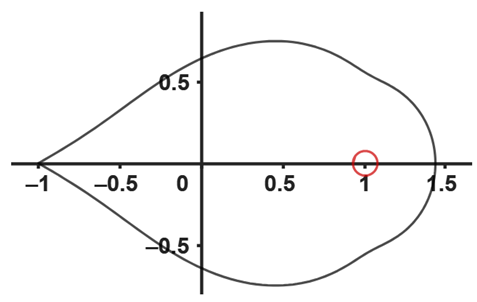
Taking inspiration from their work, Priya and Sharma [6] introduced a particular class of functions that are subordinate to the function , which is related to a leaf-like domain. Additionally, they presented another class of functions that are subordinate to , which is also associated with the leaf-like domain. This is illustrated in Figure 1.
Figure 1.
Leaf-shaped region, displays the image of , where .
Quantum calculus, or -difference calculus, does not use the idea of a derivative as the limit of a ratio as the increment tends to zero. Instead, it relies on the -difference operator, which is crucial for our discussion. This calculus expands the traditional concepts of mathematical analysis by introducing the parameter . For a detailed exploration of this topic, readers are advised to check the comprehensive treatise by Gasper and Rahman [11], which offers in-depth explanations and practical applications of -difference calculus in a variety of disciplines, including number theory, physics, and combinatorics.
A -analytic function is a specific type of analytic function that relies on a parameter called q. This parameter can either be a complex number or a formal variable. The definition of this function falls within the scope of -calculus, a generalization of calculus that incorporates the concepts of the -binomial coefficient and the -derivative [12].
Definition 1
([13]). The -bracket represented by is defined explicitly for as follows:
with the useful identity
Table 3 displays the initial terms of the sequence , along with its overarching formula.
Table 3.
For , the first few terms of are.
Definition 2
([13,14]). The -difference operator, or -derivative, of a function is defined for by:
Because of its numerous applications in physics, quantum mechanics and mathematics, particularly in the field of geometric function theory, researchers are still drawn to the study of -calculus. A significant aspect of -calculus is the operator , which is important for the analysis of different classes of analytic functions. In 1990, Ismail et al. [15] made a significant breakthrough by introducing the concept of -extension for starlike functions in the unit disk. This breakthrough opened the door for further investigations in geometric function theory. For example, in [16], Srivastava and his colleagues explored -starlike functions in conic domains and conducted studies on the upper bounds of the Fekete–Szegö functional. Recently, Srivastava provided a comprehensive survey that explains the mathematical foundations and practical applications of fractional -derivative operators, within the context of geometric function theory [17]. For those interested in delving deeper into -calculus and its implications in this field, an abundance of research is at one’s disposal, starting with classical publications [18,19], continuing with studies like [20,21,22,23], and considering very recent research outcomes on the topic like [24,25,26,27,28,29,30,31,32].
Definition 3
([15]). A function of the form (1) is said to belong to the class if it satisfies the condition given by
Remark 2.
As a result, it is evident from the previous inequality that as approaches , the inequality simplifies to:
The closed disk above represents only the right-half plane, and the class of -starlike functions transforms into the known class .
Similarly, the relationship in Equation (6) can be expressed as follows (see [21]) using the idea of subordination:
Applying the principles mentioned earlier and employing the concept of subordination by utilizing -calculus, we establish a novel subclass of analytic functions that are associated with a particular leaf-like domain.
Definition 4.
A function is said to belong to the class if it satisfies the condition given by
where
Alsoboh and Oros [13] conducted a study on a particular category of bi-univalent functions related to the leaf-like domain within the open unit disk using -calculus.
Remark 3.
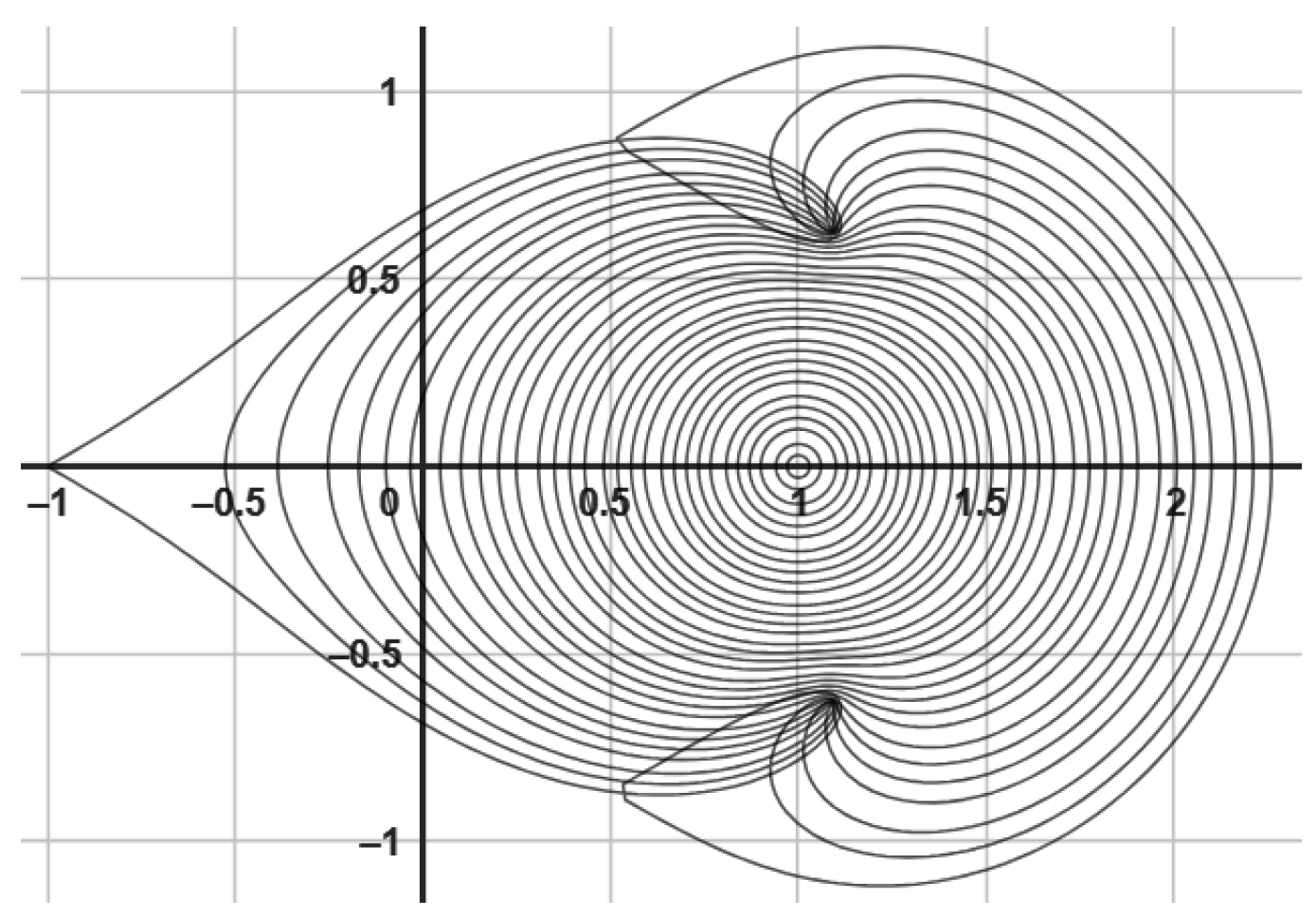
The unit disk is mapped onto a leaf-shaped region via the analytic and univalent function . With regard to the real axis, it is symmetric. The function satisfies and has a positive real part, see Table 4.
Table 4.
Figure illustrating the leaf-shaped region , which is bounded and symmetric with respect to the real axis. The figure was generated using GeoGebra Classic 6. For more details, see [13].
The main goal of this work is to investigate the properties of bi-univalent functions associated with the leaf-like domain in . In the section that follows, the definition of the investigated class and examples to assist with achieving this goal will be given. In Section 3, coefficient estimates are obtained for the new class and the Fekete–Szegö functional is evaluated in Section 4. Corollaries that correspond to the examples provided, generated by the theorems proved in the previous sections, are stated in Section 3 and Section 4.
2. Definition and Example
We will use the -calculus theory and the previously mentioned subordination principle among analytic functions to give an exact mathematical description of the newly defined class of bi-univalent functions related to a leaf-like domain.
Definition 5.
A bi-univalent function of the type (1) belongs to the class if it fulfills the following subordinations:
and
where
with .
Example 1.
If , then is reduced to defined by
and
Remark 4.
We want to emphasize that the class is not empty. In particular, consider the functions defined by:
It is easy to see that and, moreover, with its inverse:
By utilizing the notations provided in Equations (9) and (10), we can easily demonstrate through a straightforward calculation that:
Also, for all , , which implies that .
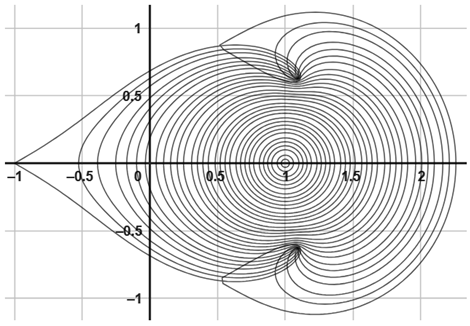
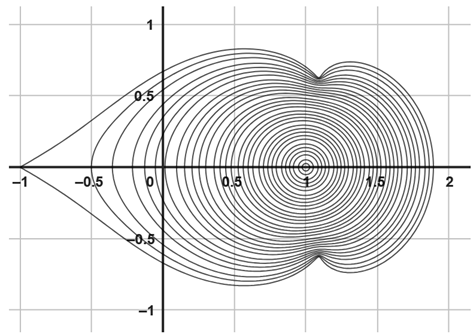
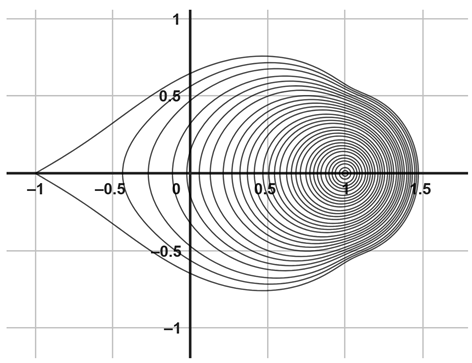
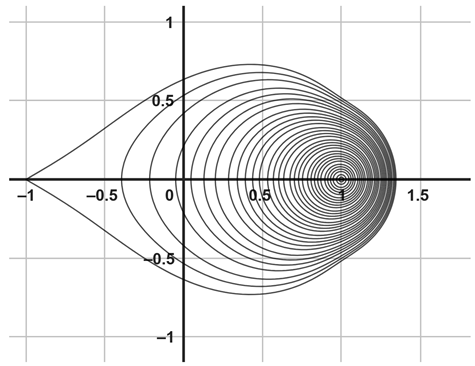
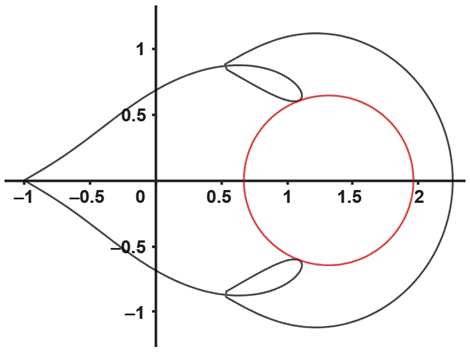
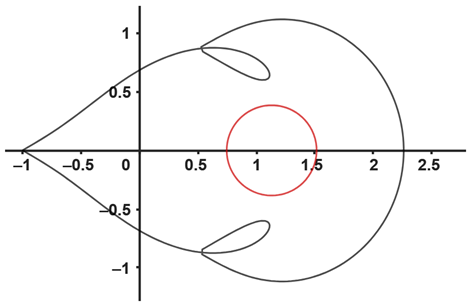
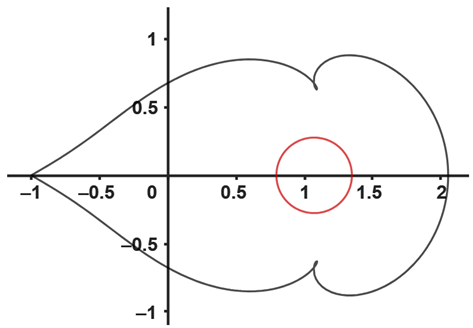
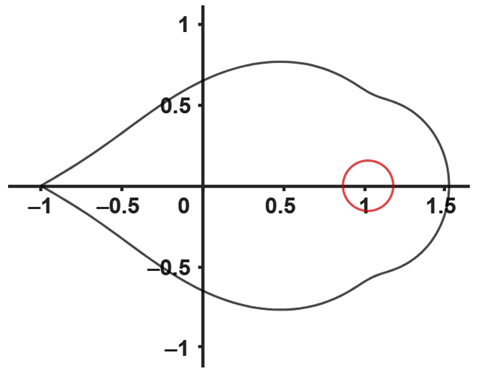
We employ the GeoGebra Classic 6 to generate the visual representations of the boundary using the functions and , as illustrated in Table 5. This is applicable to various scenarios where the conditions , , and are satisfied. It is worth noting that is a univalent function within . As a consequence, the relationships and are valid. These relationships can be justified by the facts that , , and . Please refer to Table 5 for further clarification.
Table 5.
The image of (red color) and (black color) with several values of , and
Up to this moment, there has been a scarcity of academic study on the numerous parameters that influence the functional classification of a leaf-like domain. The fundamental purpose of this work is to examine the initial Taylor–Maclaurin coefficients of functions , as given by Equation (1), which are significant for the class related to a leaf-like domain. Furthermore, we seek to study the estimated value of the Fekete–Szegö functional.
3. The Bounds of the Coefficients within the Class
Initially, the estimates for the coefficients of the class , as defined in Definition 5, are provided.
Theorem 1.
Proof.
If . As per Definition 5, the presence of certain analytic functions and can be established, satisfying the conditions , and , for all . Setting
and
then . From the above relations, we obtain
and
Also,
and
Adding (23) and (24), performing some calculations, we obtain
Substituting the value of from (26), we obtain
Moreover,
Applying (4) for the coefficients and , we obtain
By subtracting (24) from (23), and using , we obtain
Thus, applying (4), we conclude that
The proof of the theorem has been successfully concluded. □
Corollary 1.
If is an element of Σ defined by (1) and belongs to the class , then we can state the following:
4. The Fekete–Szegö Functional
Both Fekete and Szegö published their work in 1933, establishing a precise limit for the functional [33]. This limit, known as the classical Fekete–Szegö inequality, was derived using real values of . It is a challenging task to establish precise boundaries for a given function within a compact family of functions , for a real parameter . In this context, the Fekete–Szegö inequality for functions belonging to the class is examined, considering the findings of Zaprawa [34].
Theorem 2.
Proof.
Then, we conclude that
Which completes the proof of Theorem 2. □
Corollary 2.
Let be an element of Σ defined by (1) and belonging to the class and . Then, we have
5. Conclusions
In this study, we have conducted an investigation on coefficient problems related to recently defined subclasses of bi-univalent functions in given in Definition 5. The investigated subclasses are and . We have computed the Taylor–Maclaurin coefficients and , along with estimates for the Fekete–Szegö functional problem, for functions belonging to each of these bi-univalent function classes.
In future research, the exploration of upper bounds for the Zaclman conjecture and the investigation of the Hankel determinants of orders two and three within the aforementioned subclasses show potential for new avenues of research and exploration.
Author Contributions
Conceptualization, A.A. (Ala Amourah); Methodology, A.A. (Ala Amourah) and A.A. (Abdullah Alsoboh); Software, A.A. (Ala Amourah); Validation, A.A. (Ala Amourah); Formal analysis, A.A. (Abdullah Alsoboh); Investigation, S.M.E.-D. and D.B.; Resources, A.A. (Ala Amourah) and S.M.E.-D.; Data curation, A.A. (Ala Amourah) and A.A. (Abdullah Alsoboh); Writing—original draft, A.A. (Ala Amourah); Supervision, D.B. All authors have read and agreed to the published version of the manuscript.
Funding
This research received no external funding.
Institutional Review Board Statement
Not applicable.
Informed Consent Statement
Not applicable.
Data Availability Statement
No data were used to support this study.
Acknowledgments
The first author expresses their gratitude to Philadelphia University-Jordan for supporting this work, particularly the non-financial support in providing necessary resources.
Conflicts of Interest
The authors declare no conflicts of interest.
References
- Miller, S.S. Differential inequalities and Caratheodory functions. Bull. Am. Math. Soc. 1975, 81, 79–81. [Google Scholar] [CrossRef]
- Duren, P.L. Univalent Functions; Grundlehren der Mathematischen Wissenschaften, Band 259; Springer: New York, NY, USA; Berlin/Heidelberg, Germany; Tokyo, Japan, 1983. [Google Scholar]
- Ma, W.; Minda, D. A unified treatment of some special classes of univalent functions. In Proceedings of the Conference on Complex Analysis, Tianjin, China, 19–23 June 1992; pp. 157–169. [Google Scholar]
- Sokół, J.; Stankiewicz, J. Radius of convexity of some subclasses of strongly starlike functions. Zesz. Nauk. Politech. Rzesz. Mat. 1996, 19, 101–105. [Google Scholar]
- Raina, R.K.; Sokol, R.K. On Coefficient estimates for a certain class of starlike functions. Hacet. J. Math. Stat. 2015, 44, 1427–1433. [Google Scholar] [CrossRef]
- Priya, M.H.; Sharma, R.B. On a class of bounded turning functions subordinate to a leaf-like domain. J. Phys. Conf. Ser. 2018, 1000, 012056. [Google Scholar] [CrossRef]
- Rath, B.; Kumar, K.S.; Krishna, D.V.; Lecko, A. The sharp bound of the third Hankel determinant for starlike functions of order 1/2. Complex Anal. Oper. Theory 2022, 16, 1–8. [Google Scholar] [CrossRef]
- Mahmood, S.; Srivastava, H.M.; Khan, N.; Ahmad, Q.Z.; Khan, B.; Ali, I. Upper bound of the third Hankel determinant for a subclass of q-starlike functions. Symmetry 2019, 11, 347. [Google Scholar] [CrossRef]
- Ullah, K.; Srivastava, H.M.; Rafiq, A.; Arif, M.; Arjika, S. A study of sharp coefficient bounds for a new subfamily of starlike functions. J. Inequal. Appl. 2021, 2021, 194. [Google Scholar] [CrossRef]
- Shi, L.; Shutaywi, M.; Alreshidi, N.; Arif, M.; Ghufran, S.M. The sharp bounds of the third-order Hankel determinant for certain analytic functions associated with an eight-shaped domain. Fractal Fract. 2022, 6, 223. [Google Scholar] [CrossRef]
- Gasper, G.; Rahman, M. Basic Hypergeometric Series, 2nd ed.; Encyclopedia of Mathematics and Its Applications; Cambridge University Press: Cambridge, MA, USA, 2004; Volume 96. [Google Scholar]
- Pashaev, O.K.; Nalci, S. q-analytic functions, fractals and generalized analytic functions. J. Phys. A Math. Theor. 2014, 47, 045204. [Google Scholar] [CrossRef]
- Alsoboh, A.; Oros, G.I. A Class of Bi-Univalent Functions in a Leaf-Like Domain Defined through Subordination via q-Calculus. Mathematics 2024, 12, 1594. [Google Scholar] [CrossRef]

- Ahuja, O.; Bohra, N.; Cetinkaya, A.; Kumar, S. Univalent functions associated with the symmetric points and cardioid-shaped domain involving (p,q)-calculus. Kyungpook Math. J. 2021, 61, 75–98. [Google Scholar]
- Ismail, M.E.; Merkes, E.; Styer, D. A generalization of starlike functions. Complex Var. Theory Appl. 1990, 14, 77–84. [Google Scholar] [CrossRef]
- Srivastava, H.M.; Khan, B.; Khan, N.; Ahmad, Q.Z.; Tahir, M. A generalized conic domain and its applications to certain subclasses of analytic functions. Rocky Mt. J. Math. 2019, 49, 2325–2346. [Google Scholar] [CrossRef]
- Srivastava, H.M. Operators of basic (or q-) calculus and fractional q-calculus and their applications in geometric function theory of complex analysis. Iran. J. Sci. Technol. Trans. A Sci. 2020, 44, 327–344. [Google Scholar] [CrossRef]
- Al-Salam, W.A. Some fractional q-integrals and q-derivatives. Proc. Edinb. Math. Soc. 1966, 15, 135–140. [Google Scholar] [CrossRef]
- Agarwal, R.P. Certain fractional q-integrals and q-derivatives. Proc. Camb. Philos. 1969, 66, 365–370. [Google Scholar] [CrossRef]
- Alsoboh, A.; Amourah, A.; Darus, M.; Rudder, C.A. Studying the Harmonic Functions Associated with Quantum Calculus. Mathematics 2023, 11, 2220. [Google Scholar] [CrossRef]
- Uçar, H.E.Ö. Coefficient inequality for q-starlike functions. App. Math. Comput. 2016, 276, 122–126. [Google Scholar] [CrossRef]
- Amourah, A.; Frasin, B.A.; Ahmad, M.; Yousef, F. Exploiting the Pascal Distribution Series and Gegenbauer Polynomials to Construct and Study a New Subclass of Analytic Bi-Univalent Functions. Symmetry 2022, 14, 147. [Google Scholar] [CrossRef]
- Amourah, A.; Abdelkarim, H.; AL-Elaumi, A. (p, q)-Chebyshev polynomials and their applications to bi-univalent functions. J. TWMS J. Appl. Eng. Math. 2022, 12, 481–486. [Google Scholar]
- Alb Lupas, A.; Oros, G.I. Sandwich-type results regarding Riemann-Liouville fractional integral of q-hypergeometric function. Demonstr. Math. 2023, 56, 20220186. [Google Scholar] [CrossRef]
- Illafe, M.; Yousef, F.; Haji Mohd, M.; Supramaniam, S. Initial Coefficients Estimates and Fekete–Szegö Inequality Problem for a General Subclass of Bi-Univalent Functions Defined by Subordination. Axioms 2023, 12, 235. [Google Scholar] [CrossRef]
- Andrei, L.; Caus, V.A. Subordinations Results on a q-Derivative Differential Operator. Mathematics 2024, 12, 208. [Google Scholar] [CrossRef]
- Khan, M.F.; AbaOud, M. New Applications of Fractional q-Calculus Operator for a New Subclass of q-Starlike Functions Related with the Cardioid Domain. Fractal Fract. 2024, 8, 71. [Google Scholar] [CrossRef]
- Alsoboh, A.; Amourah, A.; Darus, M.; Rudder, C.A. Investigating New Subclasses of Bi-Univalent Functions Associated with q-Pascal Distribution Series Using the Subordination Principle. Symmetry 2023, 15, 1109. [Google Scholar] [CrossRef]
- Alsoboh, A.; Amourah, A.; Sakar, F.M.; Ogilat, O.; Gharib, G.M.; Zomot, N. Coefficient Estimation Utilizing the Faber Polynomial for a Subfamily of Bi-Univalent Functions. Axioms 2023, 12, 512. [Google Scholar] [CrossRef]
- Srivastava, H.M.; El-Deeb, S.M. The Faber polynomial expansion method and the Taylor-Maclaurin coefficient estimates of bi-close-to-convex functions connected with the q-convolution. AIMS Math. 2020, 5, 7087–7106. [Google Scholar] [CrossRef]
- Alkouri, A.; AbuHijleh, E.A.; Alafifi, G.; Almuhur, E.; Al-Zubi, F.M. More on complex hesitant fuzzy graphs. AIMS Mathematics 2023, 8, 30429–30444. [Google Scholar] [CrossRef]
- Alsharo, D.; Abuteen, E.; Alkouri, A.; Alkhasawneh, M.; Al-Zubi, F. Complex shadowed set theory and its application in decision-making problems. AIMS Math. 2024, 9, 16810–16825. [Google Scholar] [CrossRef]
- Fekete, M.; Szegö, G. Eine Bemerkung über ungerade schlichte Funktionen. J. Lond. Math. Soc. 1933, 1, 85–89. [Google Scholar] [CrossRef]
- Zaprawa, P. On the Fekete-Szegö problem for classes of bi-univalent functions. Bull. Belg. Math. Soc.—Simon Stevin 2014, 21, 169–178. [Google Scholar] [CrossRef]
Disclaimer/Publisher’s Note: The statements, opinions and data contained in all publications are solely those of the individual author(s) and contributor(s) and not of MDPI and/or the editor(s). MDPI and/or the editor(s) disclaim responsibility for any injury to people or property resulting from any ideas, methods, instructions or products referred to in the content. |
© 2024 by the authors. Licensee MDPI, Basel, Switzerland. This article is an open access article distributed under the terms and conditions of the Creative Commons Attribution (CC BY) license (https://creativecommons.org/licenses/by/4.0/).