Article

Implicit Stance Detection with Hashtag Semantic Enrichment

1
College of Big Data and Internet, Shenzhen Technology University, Shenzhen 518118, China
2
Guangdong Key Laboratory for Intelligent Computation of Public Service Supply, Guangzhou 510006, China
*
Author to whom correspondence should be addressed.
These authors contributed equally to this work.
Mathematics 2024, 12(11), 1663; https://doi.org/10.3390/math12111663
Submission received: 30 April 2024 / Revised: 22 May 2024 / Accepted: 23 May 2024 / Published: 26 May 2024

Abstract

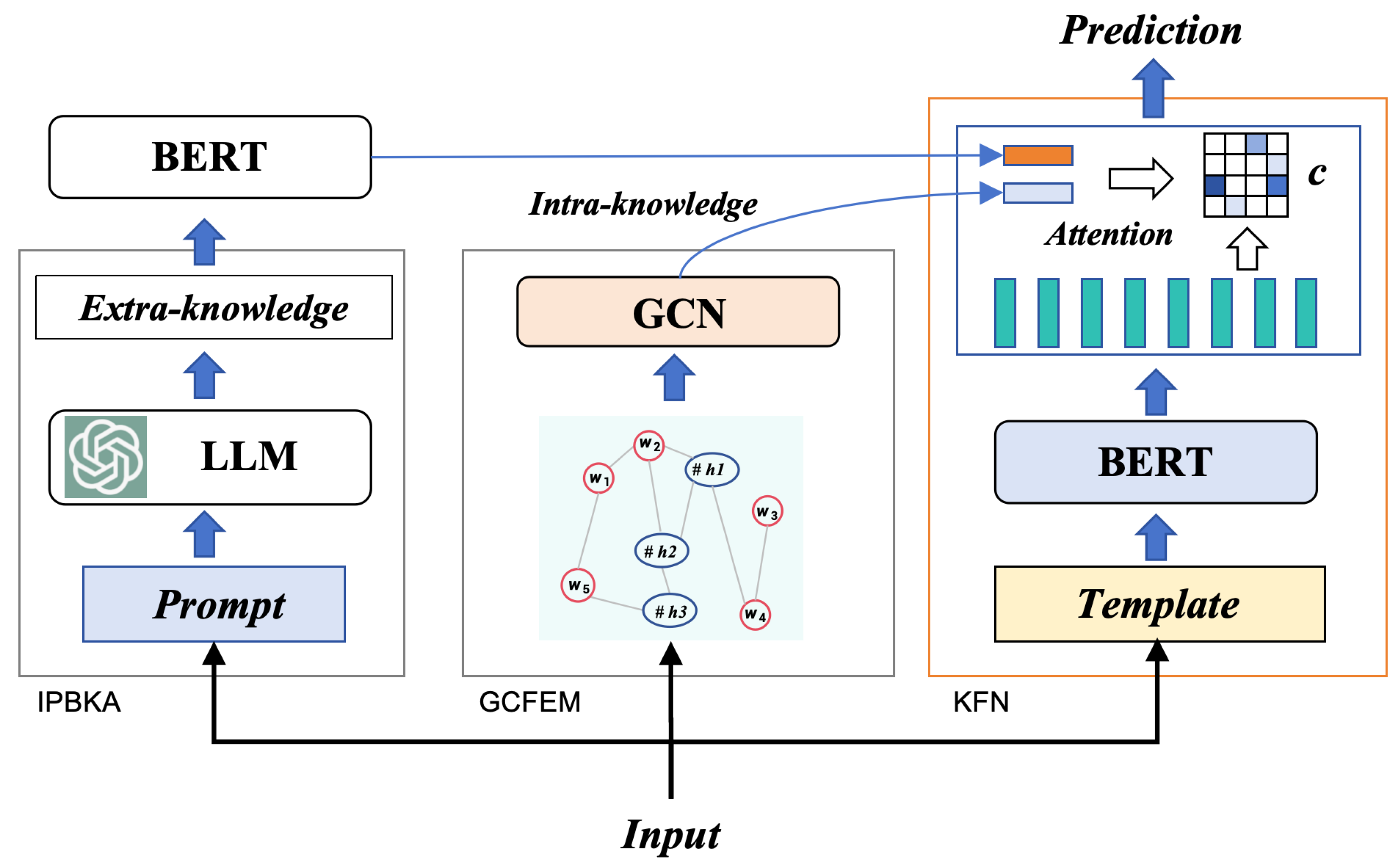
Stance detection is a crucial task in natural language processing and social computing, focusing on classifying expressed attitudes towards specific targets based on the input text. Conventional methods predominantly view stance detection as a task of target-oriented, sentence-level text classification. On popular social media platforms like Twitter, users often express their opinions through hashtags in addition to textual content within tweets. However, current methods primarily treat hashtags as data retrieval labels, neglecting to effectively utilize the semantic information they carry. In this paper, we propose a large language model knowledge-enhanced stance detection framework (LKESD) for stance detection. LKESD contains three main components: an instruction-prompted background knowledge acquisition module (IPBKA) that retrieves background knowledge of hashtags by providing handcrafted prompts to large language models (LLMs); a graph convolutional feature-enhancement module (GCFEM) is designed to extract the semantic representations of words that frequently co-occur with hashtags in the dataset by leveraging textual associations; an a knowledge fusion network (KFN) is proposed to selectively integrate graph representations and LLM features using a prompt-tuning framework. Extensive experimental results on three benchmark datasets demonstrate that our LKESD method outperforms 2.7% on all setups over compared methods, validating its effectiveness in stance detection tasks.
Keywords: stance detection; hashtag representation; knowledge-integrated methods stance detection; hashtag representation; knowledge-integrated methods