Article

Reducing the Reality Gap Using Hybrid Data for Real-Time Autonomous Operations

by
Suleyman Yildirim
1,* and
Zeeshan A. Rana
2,*
1
Digital Aviation Research and Technology Centre (DARTeC), Cranfield University, Bedford MK43 0AL, UK
2
Centre for Aeronautics, Cranfield University, Bedford MK43 0AL, UK
*
Authors to whom correspondence should be addressed.
Mathematics 2023, 11(7), 1696; https://doi.org/10.3390/math11071696
Submission received: 13 February 2023 / Revised: 17 March 2023 / Accepted: 29 March 2023 / Published: 2 April 2023
(This article belongs to the Special Issue Mathematical Modeling, Optimization and Machine Learning)

Abstract

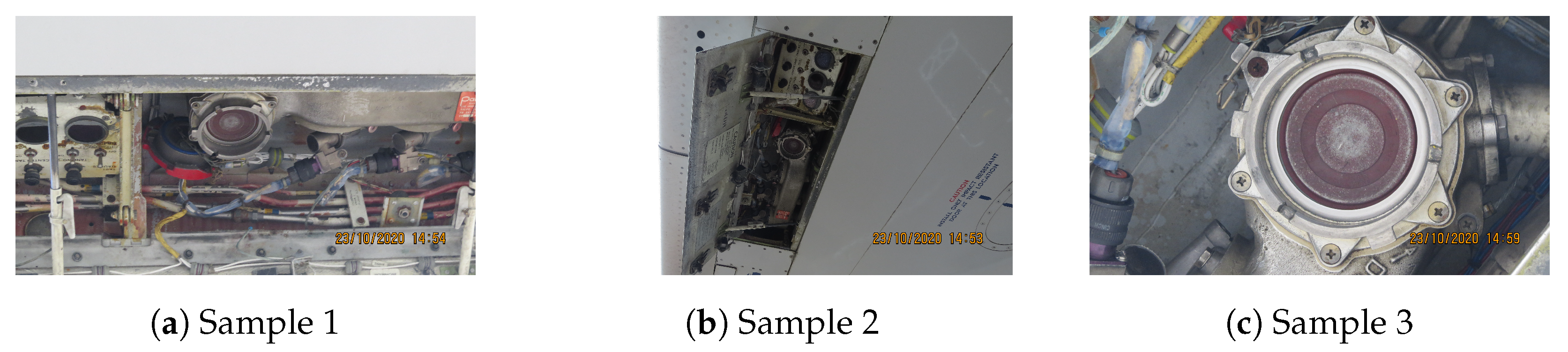
This paper presents an ablation study aimed at investigating the impact of a hybrid dataset, domain randomisation, and custom-designed neural network architecture on the performance of object localisation. In this regard, real images were gathered from the Boeing 737-400 aircraft while synthetic images were generated using the domain randomisation technique involved randomising various parameters of the simulation environment in a photo-realistic manner. The study results indicated that the use of the hybrid dataset, domain randomisation, and the custom-designed neural network architecture yielded a significant enhancement in object localisation performance. Furthermore, the study demonstrated that domain randomisation facilitated the reduction of the reality gap between the real-world and simulation environments, leading to a better generalisation of the neural network architecture on real-world data. Additionally, the ablation study delved into the impact of each randomisation parameter on the neural network architecture’s performance. The insights gleaned from this investigation shed light on the importance of each constituent component of the proposed methodology and how they interact to enhance object localisation performance. The study affirms that deploying a hybrid dataset, domain randomisation, and custom-designed neural network architecture is an effective approach to training deep neural networks for object localisation tasks. The findings of this study can be applied to a wide range of computer vision applications, particularly in scenarios where collecting large amounts of labelled real-world data is challenging. The study employed a custom-designed neural network architecture that achieved 99.19% accuracy, 98.26% precision, 99.58% recall, and 97.92% mAP@.95 trained using a hybrid dataset comprising synthetic and real images.
Keywords: hybrid data; synthetic data; object detection; ablation study hybrid data; synthetic data; object detection; ablation study