Article

Power System Transient Stability Assessment Based on Machine Learning Algorithms and Grid Topology

1
Department of Automated Electrical Systems, Ural Federal University, 620002 Yekaterinburg, Russia
2
Department of Electrical Engineering, Canadian University Dubai, Dubai P.O. Box 415053, United Arab Emirates
3
Department of Mathematics and Statistics, American University of Sharjah, Sharjah P.O. Box 26666, United Arab Emirates
*
Author to whom correspondence should be addressed.
Mathematics 2023, 11(3), 525; https://doi.org/10.3390/math11030525
Submission received: 30 December 2022 / Revised: 15 January 2023 / Accepted: 16 January 2023 / Published: 18 January 2023
(This article belongs to the Special Issue Modeling and Simulation for the Electrical Power System)

Abstract

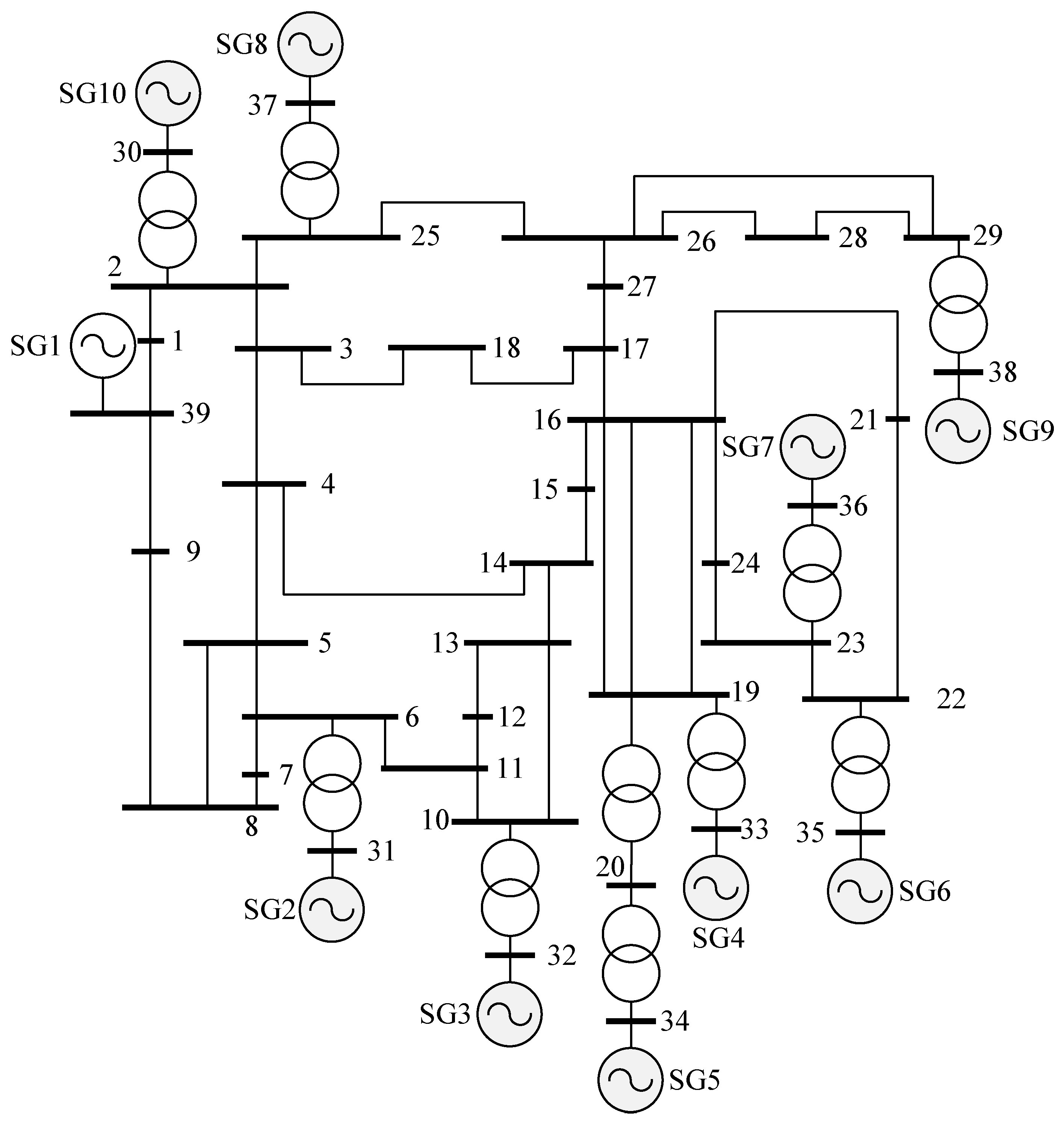
This work employs machine learning methods to develop and test a technique for dynamic stability analysis of the mathematical model of a power system. A distinctive feature of the proposed method is the absence of a priori parameters of the power system model. Thus, the adaptability of the dynamic stability assessment is achieved. The selected research topic relates to the issue of changing the structure and parameters of modern power systems. The key features of modern power systems include the following: decreased total inertia caused by integration of renewable sources energy, stricter requirements for emergency control accuracy, highly digitized operation and control of power systems, and high volumes of data that describe power system operation. Arranging emergency control in these new conditions is one of the prominent problems in modern power systems. In this study, the emergency control algorithms based on ensemble machine learning algorithms (XGBoost and Random Forest) were developed for a low-inertia power system. Transient stability of a power system was analyzed as the base function. Features of transmission line maintenance were used to increase accuracy of estimation. Algorithms were tested using the test power system IEEE39. In the case of the test sample, accuracy of instability classification for XGBoost was 91.5%, while that for Random Forest was 81.6%. The accuracy of algorithms increased by 10.9% and 1.5%, respectively, when the topology of the power system was taken into account.
Keywords: ensemble machine learning; extreme gradient boosting; power system modeling; random forest; transient stability ensemble machine learning; extreme gradient boosting; power system modeling; random forest; transient stability