Representation of Fractional Operators Using the Theory of Functional Connections


Abstract
1. Introduction and Motivations
1.1. Notations
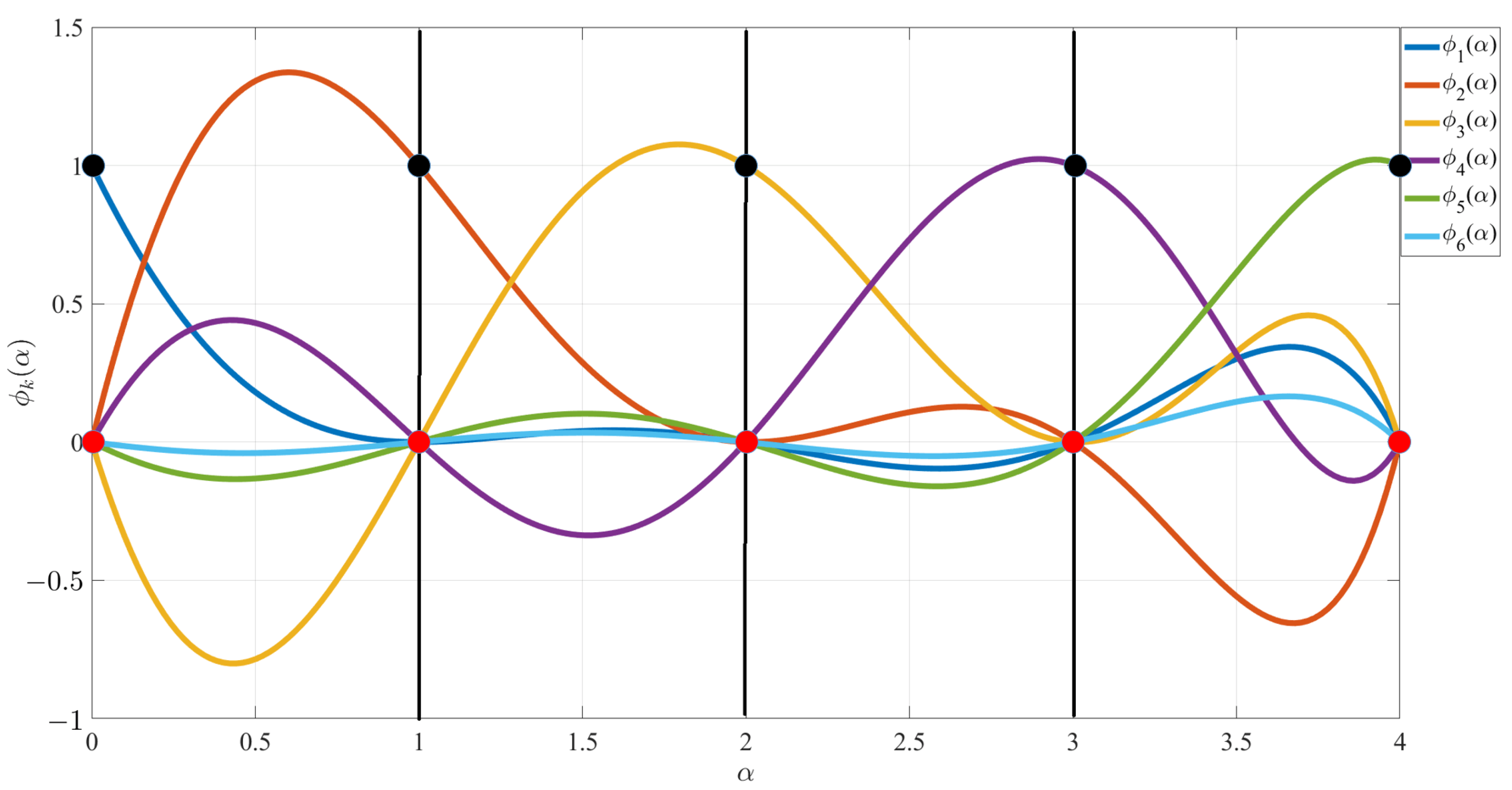
- Switching functions for integers: Since fractional operators have all constraints specified for , a closed-form of switching functions analytically satisfying the switching function property is developed for integers. These switching functions are computed by avoiding matrix inversion and are valid for any series of real numbers. This set of switching functions is called “Lagrangian switching functions” because their expressions coincide with the multiplicative terms of Lagrange polynomials [41].
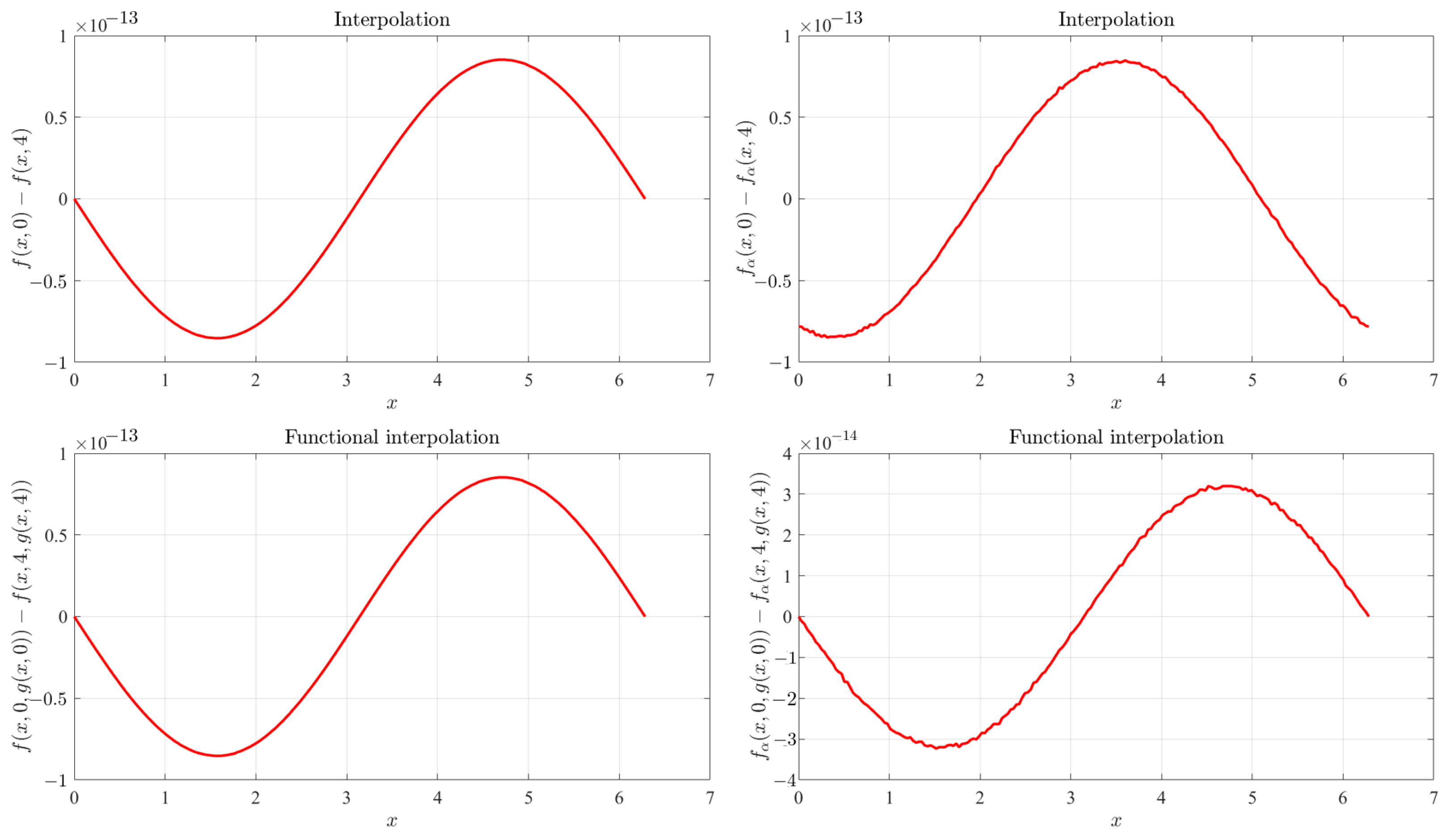
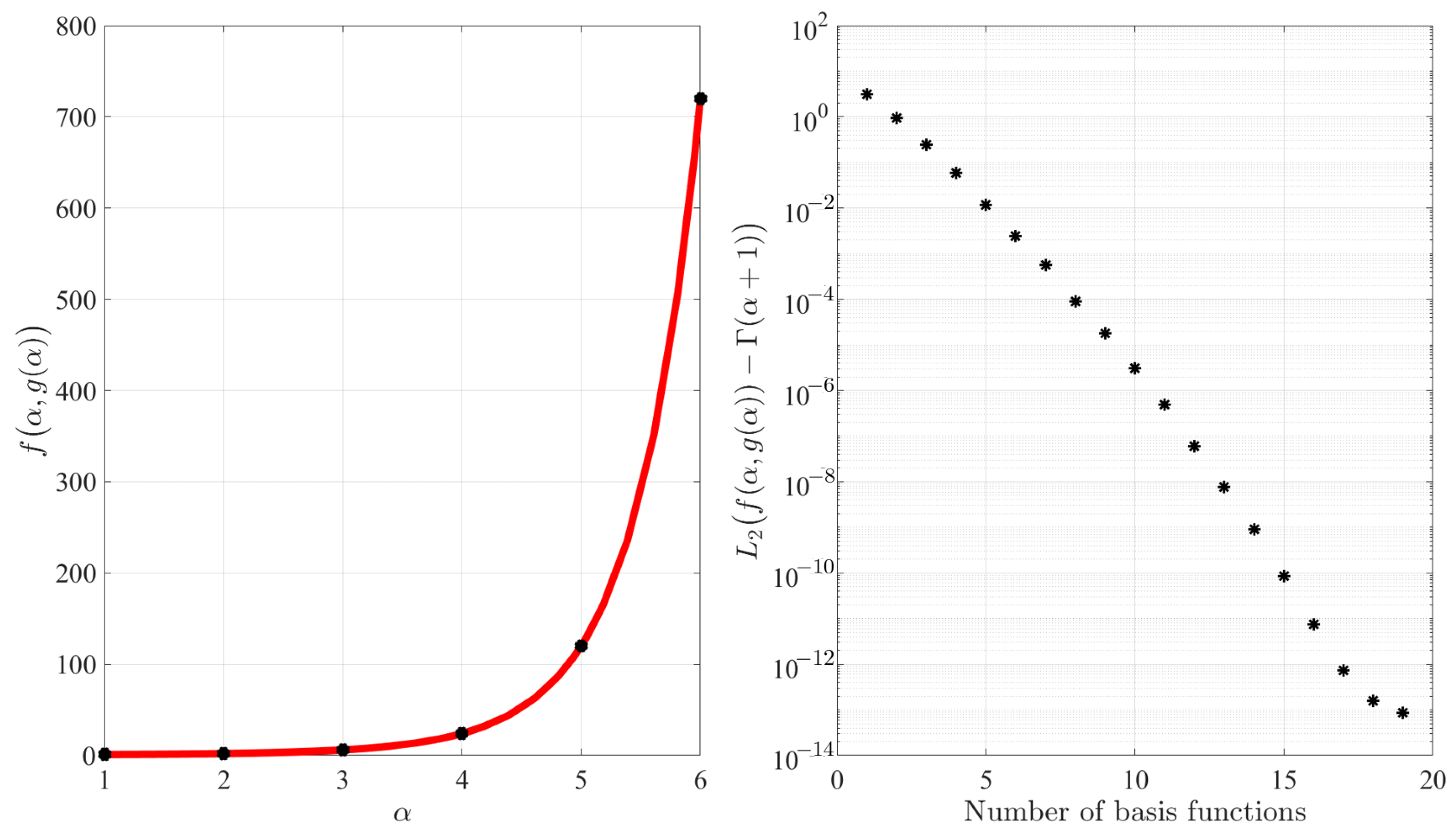
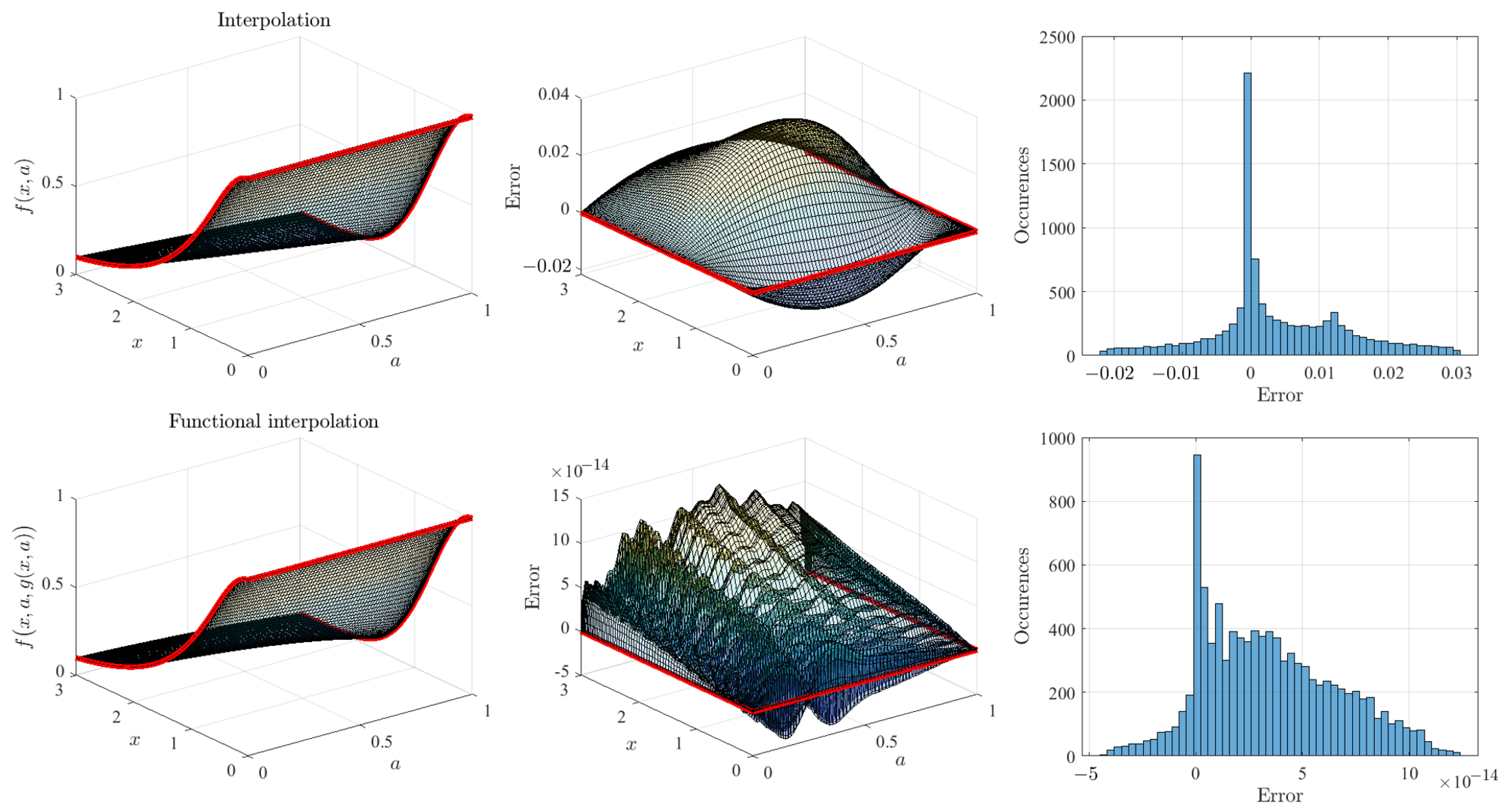
- Continuous description of integer and function sequences: The capability of generating closed-form switching functions for integers provides us the capability to use TFC to generate all functions interpolating any numbers sequence and all surfaces interpolating any function sequence. The example of interpolating the function in the range is provided.
1.2. Brief Background on the Theory of Functional Connections
2. Examples of Applications
- They are local operators;
- They can be expressed in terms of orthogonal polynomials (rather than infinite series or nasty integrals);
- The approximation accuracy they usually provide is close to machine error.
2.1. Function, First Derivative, and Anti-Derivative Example
2.2. Quadratic Polynomial Example
2.3. Trigonometric Function Example
3. Continuous Representations of Any Integer or Function Sequence
3.1. Switching Functions for Sequences
3.2. Functional Interpolation of Any Sequence of Numbers and Functions
3.3. Least-Squares Approximation of the Function
4. Least-Squares Approximation with Functional Interpolation
Functional Approximation of the Mittag–Leffler Function
5. Discussion
Funding
Informed Consent Statement
Data Availability Statement
Acknowledgments
Conflicts of Interest
Abbreviations
| TFC | Theory of Functional Connections |
References
- Ross, B. The development of fractional calculus 1695–1900. Hist. Math. 1977, 4, 75–89. [Google Scholar] [CrossRef] [Scilit]
- Riemann, B. Versuch einer allgemeinen Auffassung der Integration und Differentiation. Gesammelte Werke 1876, 62, 331–344. [Google Scholar]
- Liouville, J. Mémoire sur le Calcul des Différentielles à Indices Quelconques; Walter de Gruyter: Berlin, Germany; New York, NY, USA, 1832. [Google Scholar]
- Miller, K.S. The Weyl fractional calculus. In Fractional Calculus and Its Applications; Springer: Berlin/Heidelberg, Germany, 1975; pp. 80–89. [Google Scholar]
- Almeida, R. A Caputo fractional derivative of a function with respect to another function. Commun. Nonlinear Sci. Numer. Simul. 2017, 44, 460–481. [Google Scholar] [CrossRef] [Scilit]
- Baleanu, D.; Jajarmi, A.; Mohammadi, H.; Rezapour, S. A new study on the mathematical modeling of human liver with Caputo–Fabrizio fractional derivative. Chaos Solitons Fractals 2020, 134, 109705. [Google Scholar] [CrossRef] [Scilit]
- Anastassiou, G.A. On right fractional calculus. Chaos Solitons Fractals 2009, 42, 365–376. [Google Scholar] [CrossRef] [Scilit]
- Yang, Q.; Liu, F.; Turner, I. Numerical methods for fractional partial differential equations with Riesz space fractional derivatives. Appl. Math. Model. 2010, 34, 200–218. [Google Scholar] [CrossRef] [Scilit]
- Sousa, J.V.d.C.; De Oliveira, E.C. On the ψ-Hilfer fractional derivative. Commun. Nonlinear Sci. Numer. Simul. 2018, 60, 72–91. [Google Scholar] [CrossRef] [Scilit]
- Mathai, A.; Haubold, H.J. Erdélyi–Kober Fractional Calculus: From a Statistical Perspective, Inspired by Solar Neutrino Physics; Springer: Berlin/Heidelberg, Germany, 2018; Volume 31. [Google Scholar]
- Banerjee, J.; Ghosh, U.; Sarkar, S.; Das, S. A study of fractional Schrödinger equation composed of Jumarie fractional derivative. Pramana 2017, 88, 1–15. [Google Scholar] [CrossRef] [Scilit]
- Jarad, F.; Abdeljawad, T.; Hammouch, Z. On a class of ordinary differential equations in the frame of Atangana–Baleanu fractional derivative. Chaos Solitons Fractals 2018, 117, 16–20. [Google Scholar] [CrossRef] [Scilit]
- Teodoro, G.S.; Machado, J.T.; De Oliveira, E.C. A review of definitions of fractional derivatives and other operators. J. Comput. Phys. 2019, 388, 195–208. [Google Scholar] [CrossRef] [Scilit]
- Yang, X.J. General Fractional Derivatives: Theory, Methods, and Applications; CRC Press: Boca Raton, FL, USA, 2019. [Google Scholar]
- Chikriy, A.A.; Matichin, I.I. Presentation of solutions of linear systems with fractional derivatives in the sense of Riemann-Liouville, Caputo and Miller-Ross. J. Autom. Inf. Sci. 2008, 40, 1–11. [Google Scholar]
- De Oliveira, E.C.; Tenreiro Machado, J.A. A review of definitions for fractional derivatives and integral. Math. Probl. Eng. 2014, 2014, 238459. [Google Scholar] [CrossRef] [Scilit]
- Ahmad, B.; Ntouyas, S.K. On Hadamard fractional integrodifferential boundary value problems. J. Appl. Math. Comput. 2015, 47, 119–131. [Google Scholar] [CrossRef] [Scilit]
- Osler, T.J. The fractional derivative of a composite function. SIAM J. Math. Anal. 1970, 1, 288–293. [Google Scholar] [CrossRef] [Scilit]
- Butzer, P.L.; Westphal, U. An introduction to fractional calculus. In Applications of Fractional Calculus in Physics; World Scientific: Singapore, 2000; pp. 1–85. [Google Scholar]
- Agila, A.; Baleanu, D.; Eid, R.; Irfanoglu, B. A freely damped oscillating fractional dynamic system modeled by fractional Euler–Lagrange equations. J. Vib. Control 2018, 24, 1228–1238. [Google Scholar] [CrossRef] [Scilit]
- Katugampola, U.N. New approach to a generalized fractional integral. Appl. Math. Comput. 2011, 218, 860–865. [Google Scholar] [CrossRef] [Scilit]
- Oliveira, D.; De Oliveira, E.C. Hilfer–Katugampola fractional derivatives. Comput. Appl. Math. 2018, 37, 3672–3690. [Google Scholar] [CrossRef] [Scilit]
- Scherer, R.; Kalla, S.L.; Tang, Y.; Huang, J. The Grünwald–Letnikov method for fractional differential equations. Comput. Math. Appl. 2011, 62, 902–917. [Google Scholar] [CrossRef] [Scilit]
- Baleanu, D.; Fernandez, A. On Fractional Operators and Their Classifications. Mathematics 2019, 7, 830. [Google Scholar] [CrossRef] [Scilit]
- Karcı, A. The physical and geometrical interpretation of fractional order derivatives. Univ. J. Eng. Sci. 2015, 3, 53–63. [Google Scholar] [CrossRef] [Scilit]
- Tarasov, V.E. Geometric interpretation of fractional-order derivative. Fract. Calc. Appl. Anal. 2016, 19, 1200–1221. [Google Scholar] [CrossRef] [Scilit]
- Tavassoli, M.H.; Tavassoli, A.; Rahimi, M.O. The geometric and physical interpretation of fractional order derivatives of polynomial functions. Differ. Geom. Dyn. Syst 2013, 15, 93–104. [Google Scholar]
- Moshrefi-Torbati, M.; Hammond, J. Physical and geometrical interpretation of fractional operators. J. Frankl. Inst. 1998, 335, 1077–1086. [Google Scholar] [CrossRef] [Scilit]
- Gorenflo, R.; Kilbas, A.A.; Mainardi, F.; Rogosin, S.V. Mittag-Leffler Functions, Related Topics and Applications; Springer: Berlin/Heidelberg, Germany, 2020. [Google Scholar]
- Haubold, H.J.; Mathai, A.M.; Saxena, R.K. Mittag-Leffler functions and their applications. J. Appl. Math. 2011, 2011, 298628. [Google Scholar] [CrossRef] [Scilit]
- Garrappa, R.; Kaslik, E.; Popolizio, M. Evaluation of Fractional Integrals and Derivatives of Elementary Functions: Overview and Tutorial. Mathematics 2019, 7, 407. [Google Scholar] [CrossRef] [Scilit]
- Patnaik, S.; Hollkamp, J.P.; Semperlotti, F. Applications of variable-order fractional operators: A review. Proc. R. Soc. A 2020, 476, 20190498. [Google Scholar] [CrossRef] [Scilit] [PubMed]
- Mortari, D. The Theory of Connections: Connecting Points. Mathematics 2017, 5, 57. [Google Scholar] [CrossRef] [Scilit]
- Mortari, D.; Leake, C.D. The Multivariate Theory of Connections. Mathematics 2019, 7, 296. [Google Scholar] [CrossRef] [Scilit]
- Mortari, D. Least-Squares Solution of Linear Differential Equations. Mathematics 2017, 5, 48. [Google Scholar] [CrossRef] [Scilit]
- Mortari, D.; Johnston, H.R.; Smith, L. High accuracy least-squares solutions of nonlinear differential equations. J. Comput. Appl. Math. 2019, 352, 293–307. [Google Scholar] [CrossRef] [Scilit]
- Leake, C.D.; Johnston, H.R.; Smith, L.; Mortari, D. Analytically Embedding Differential Equation Constraints into Least Squares Support Vector Machines Using the Theory of Functional Connections. Mach. Learn. Knowl. Extr. 2019, 1, 60. [Google Scholar] [CrossRef] [Scilit] [PubMed]
- Leake, C.D.; Mortari, D. Deep Theory of Functional Connections: A New Method for Estimating the Solutions of Partial Differential Equations. Mach. Learn. Knowl. Extr. 2020, 2, 37–55. [Google Scholar] [CrossRef] [Scilit]
- Tomovski, Ž.; Hilfer, R.; Srivastava, H.M. Fractional and operational calculus with generalized fractional derivative operators and Mittag–Leffler type functions. Integral Transform. Spec. Funct. 2010, 21, 797–814. [Google Scholar] [CrossRef] [Scilit]
- Baleanu, D.; Fernandez, A. On some new properties of fractional derivatives with Mittag-Leffler kernel. Commun. Nonlinear Sci. Numer. Simul. 2018, 59, 444–462. [Google Scholar] [CrossRef] [Scilit]
- Wikipedia. Lagrange Polynomials. 2023. Available online: https://en.wikipedia.org/wiki/Lagrange_polynomial (accessed on 3 November 2023).
- Mathai, A.M.; Haubold, H.J. An Introduction to Fractional Calculus; NOVA Science Publisher: Hauppauge, NY, USA, 2017. [Google Scholar]
- Johnston, H.R. The Theory of Functional Connections: A Journey from Theory to Application. Ph.D. Thesis, Texas A&M University, College Station, TX, USA, 2021. [Google Scholar]
- Wang, Y.; Topputo, F. A TFC-based homotopy continuation algorithm with application to dynamics and control problems. J. Comput. Appl. Math. 2022, 401, 113777. [Google Scholar] [CrossRef] [Scilit]
- Mai, T.; Mortari, D. Theory of Functional Connections Applied to Quadratic and Nonlinear Programming under Equality Constraints. J. Comput. Appl. Math. 2022, 406, 113912. [Google Scholar] [CrossRef] [Scilit]
- Mortari, D. Using the Theory of Functional Connections to Solve Boundary Value Geodesic Problems. Math. Comput. Appl. 2022, 27, 64. [Google Scholar] [CrossRef] [Scilit]
- Leake, C. The Theory of Functional Connections on Vector Spaces. arXiv 2023, arXiv:2302.10223. [Google Scholar]
- Junior, A.K.d.A.; Aljbaae, S.; Vaillant, T.; Piñeros, J.M.; Coelho, B.; Barbosa, D.; Bergano, M.; Pandeirada, J.; Carvalho, F.C.; Santos, L.B.; et al. Theory of Functional Connections and Nelder-Mead optimization methods applied in satellite characterization. arXiv 2023, arXiv:2307.11592. [Google Scholar]
- Zhang, H.; Zhou, S.; Zhang, G. Shaping low-thrust multi-target visit trajectories via theory of functional connections. Adv. Space Res. 2023, 72, 257–269. [Google Scholar] [CrossRef] [Scilit]
- Li, S.; Yan, Y.; Zhang, K.; Li, X. Fuel-optimal ascent trajectory problem for launch vehicle via theory of functional connections. Int. J. Aerosp. Eng. 2021, 2021, 2734230. [Google Scholar] [CrossRef] [Scilit]
- Mortari, D.; Garrappa, R.; Nicolò, L. Theory of Functional Connections Extended to Fractional Operators. Mathematics 2023, 11, 1721. [Google Scholar] [CrossRef] [Scilit]
- SM, S.; Kumar, P.; Govindaraj, V. A novel method to approximate fractional differential equations based on the theory of functional connections. Numer. Algorithms 2023, 1–23. [Google Scholar] [CrossRef] [Scilit]
- Sivalingam, S.; Govindaraj, V. A novel numerical approach for time-varying impulsive fractional differential equations using theory of functional connections and neural network. Expert Syst. Appl. 2024, 238, 121750. [Google Scholar]
- Leake, C.D. The Multivariate Theory of Functional Connections: An n-Dimensional Constraint Embedding Technique Applied to Partial Differential Equations. Ph.D. Thesis, Texas A&M University, College Station, TX, USA, 2021. [Google Scholar]
- Halberstam, H.; Roth, K.F. Sequences; Springer Science & Business Media: Berlin/Heidelberg, Germany, 2012. [Google Scholar]
- Ingham, A.E.; Ingham, A.E. The Distribution of Prime Numbers; Number 30; Cambridge University Press: Cambridge, UK, 1990. [Google Scholar]
- Stanley, R.P. Catalan Numbers; Cambridge University Press: Cambridge, UK, 2015. [Google Scholar]
- Mezo, I. The r-Bell numbers. J. Integer Seq. 2011, 14, A11. [Google Scholar]
- Pollack, P.; Shevelev, V. On Perfect and Near-Perfect Numbers. J. Number Theory 2012, 132, 3037–3046. [Google Scholar] [CrossRef] [Scilit]
- Dickson, L.E. Finiteness of the odd perfect and primitive abundant numbers with n distinct prime factors. Am. J. Math. 1913, 35, 413–422. [Google Scholar] [CrossRef] [Scilit]
- Sloane, N.J. The On-line Encyclopedia of Integer Sequences. 2003. Available online: https://oeis.org/ (accessed on 3 November 2023).
- Journal of Integer Sequences. Available online: https://cs.uwaterloo.ca/journals/JIS/ (accessed on 12 February 2023).
- Davis, P.J. Leonhard Euler’s Integral: A Historical Profile of the Gamma Function: In Memoriam: Milton Abramowitz. Am. Math. Mon. 1959, 66, 849–869. [Google Scholar] [CrossRef] [Scilit]
- Wikipedia. Hadamard’s Gamma Function. 2023. Available online: https://en.wikipedia.org/wiki/Hadamard%27s_gamma_function (accessed on 28 October 2023).
- Is the Gamma Function Mis-Defined? Or: Hadamard versus Euler-Who Found the Better Gamma Function? Available online: https://www.luschny.de/math/factorial/hadamard/HadamardsGammaFunction.html (accessed on 3 November 2023).
- Artin, E. The Gamma Function; Courier Dover Publications: Mineola, NY, USA, 2015. [Google Scholar]
- Garrappa, R. The Mittag-Leffler Function. 2023. Available online: https://www.mathworks.com/matlabcentral/fileexchange/48154-the-mittag-leffler-function (accessed on 21 October 2023).


Disclaimer/Publisher’s Note: The statements, opinions and data contained in all publications are solely those of the individual author(s) and contributor(s) and not of MDPI and/or the editor(s). MDPI and/or the editor(s) disclaim responsibility for any injury to people or property resulting from any ideas, methods, instructions or products referred to in the content. |
© 2023 by the author. Licensee MDPI, Basel, Switzerland. This article is an open access article distributed under the terms and conditions of the Creative Commons Attribution (CC BY) license (https://creativecommons.org/licenses/by/4.0/).
Share and Cite
Mortari, D. Representation of Fractional Operators Using the Theory of Functional Connections. Mathematics 2023, 11, 4772. https://doi.org/10.3390/math11234772
Mortari D. Representation of Fractional Operators Using the Theory of Functional Connections. Mathematics. 2023; 11(23):4772. https://doi.org/10.3390/math11234772
Chicago/Turabian StyleMortari, Daniele. 2023. "Representation of Fractional Operators Using the Theory of Functional Connections" Mathematics 11, no. 23: 4772. https://doi.org/10.3390/math11234772
APA StyleMortari, D. (2023). Representation of Fractional Operators Using the Theory of Functional Connections. Mathematics, 11(23), 4772. https://doi.org/10.3390/math11234772