Article

A Population Pyramid Dynamics Model and Its Analytical Solution. Application Case for Spain

Institut Universitari de Matemàtica Multidisciplinar, Universitat Politècnica de València, Camí de Vera s/n, 46022 Ciutat de Valéncia, Spain
Mathematics 2022, 10(19), 3443; https://doi.org/10.3390/math10193443
Submission received: 1 September 2022 / Revised: 13 September 2022 / Accepted: 18 September 2022 / Published: 22 September 2022
(This article belongs to the Special Issue Mathematical Methods and Models in Nature and Society)

Abstract

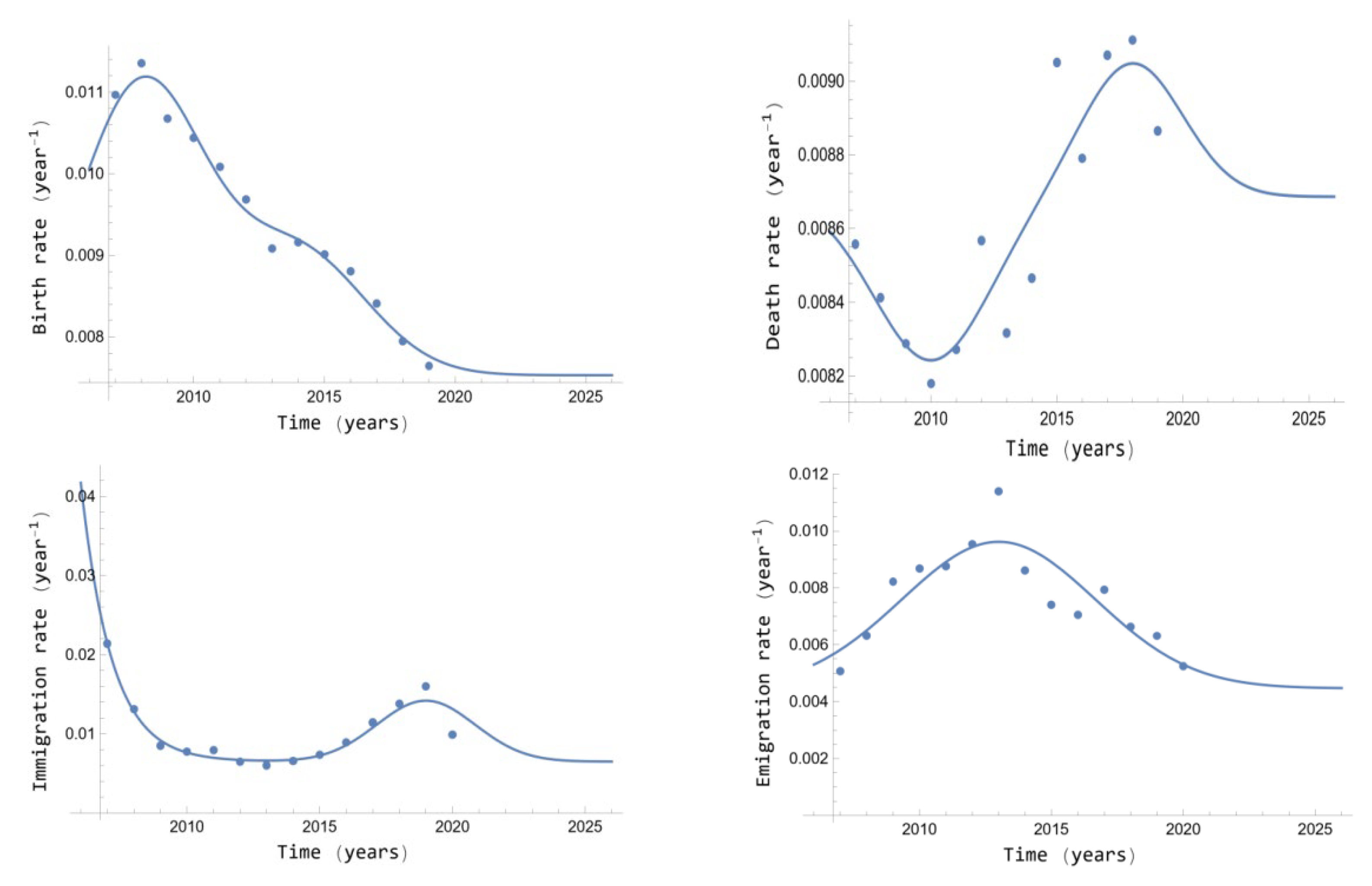
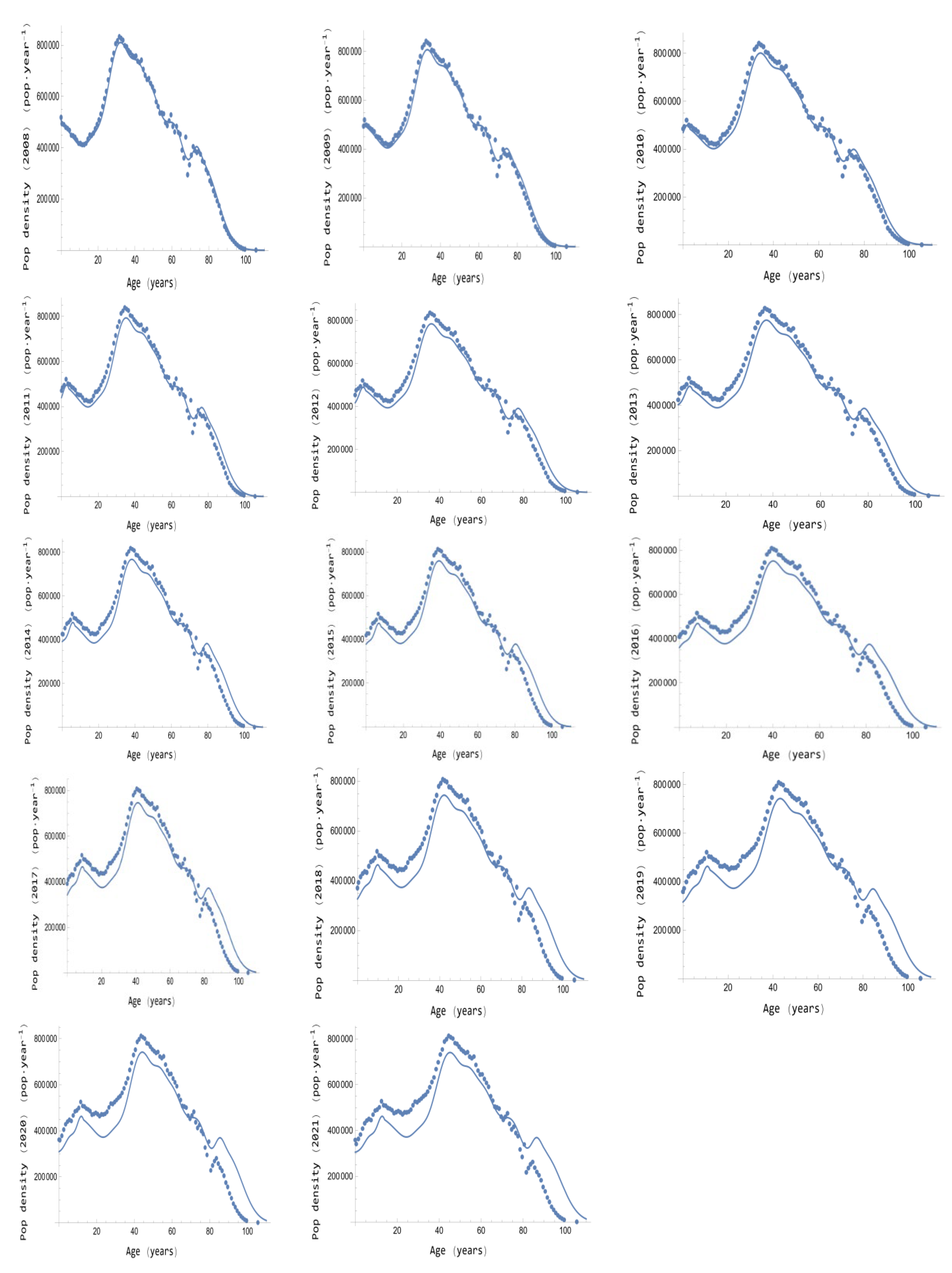
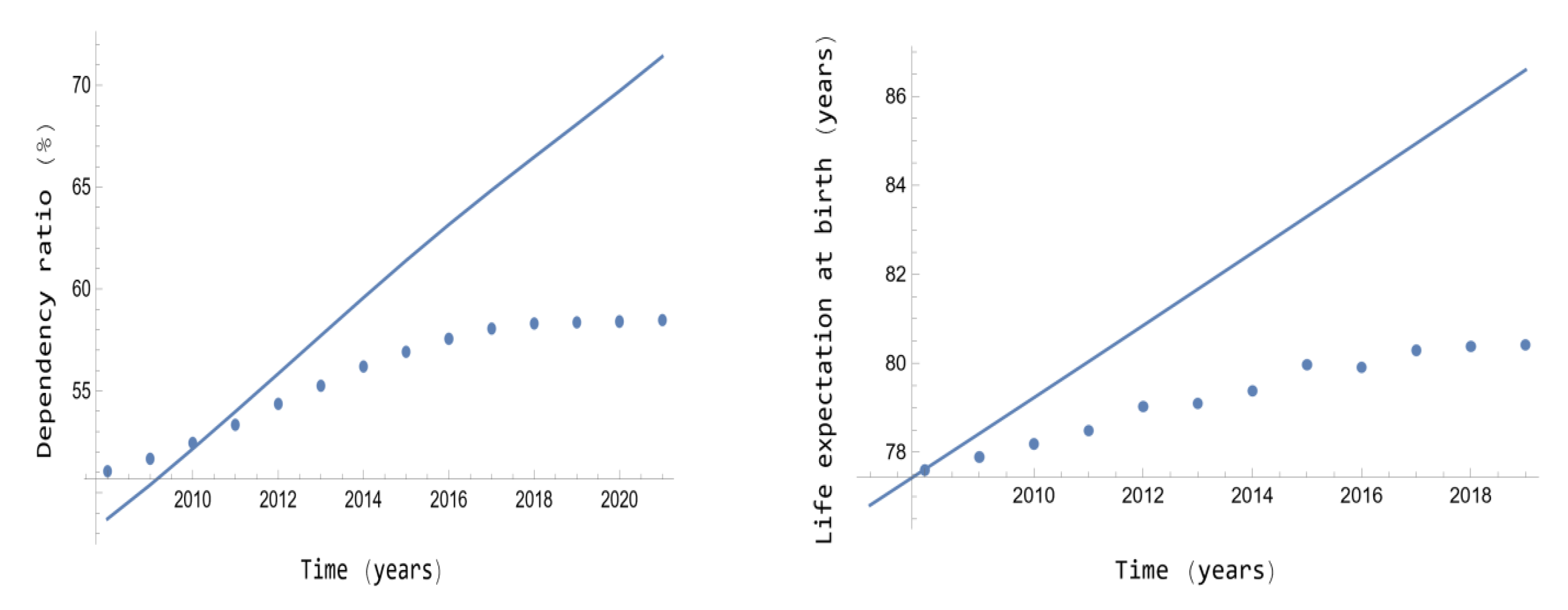
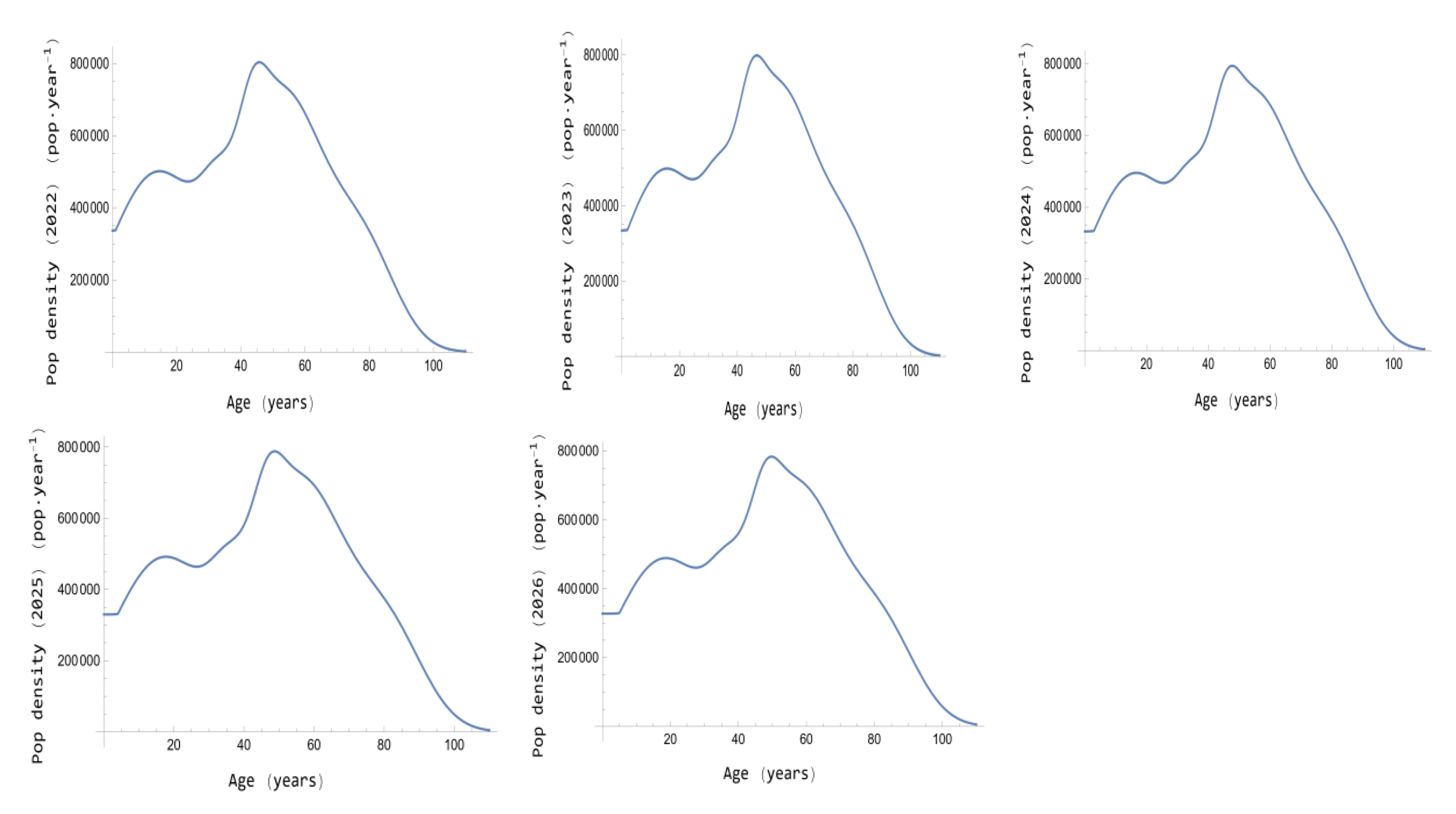
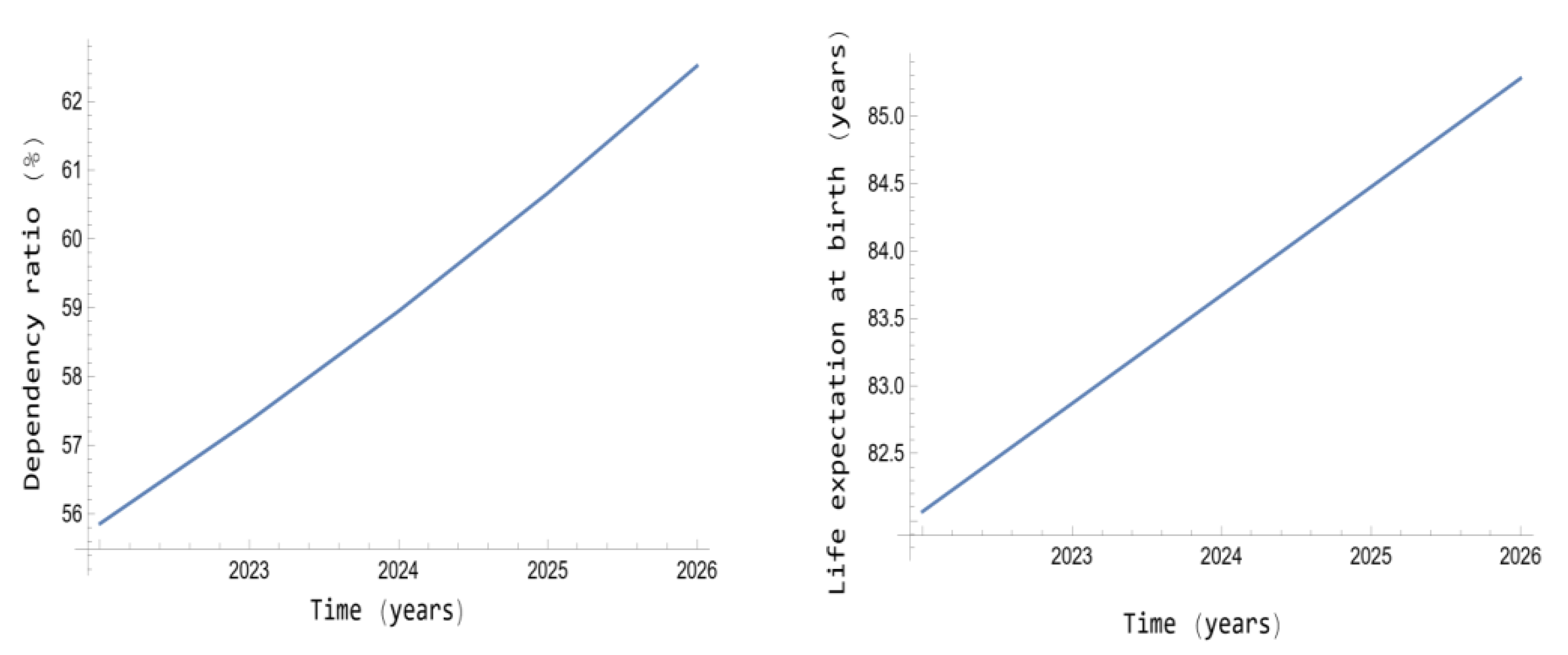
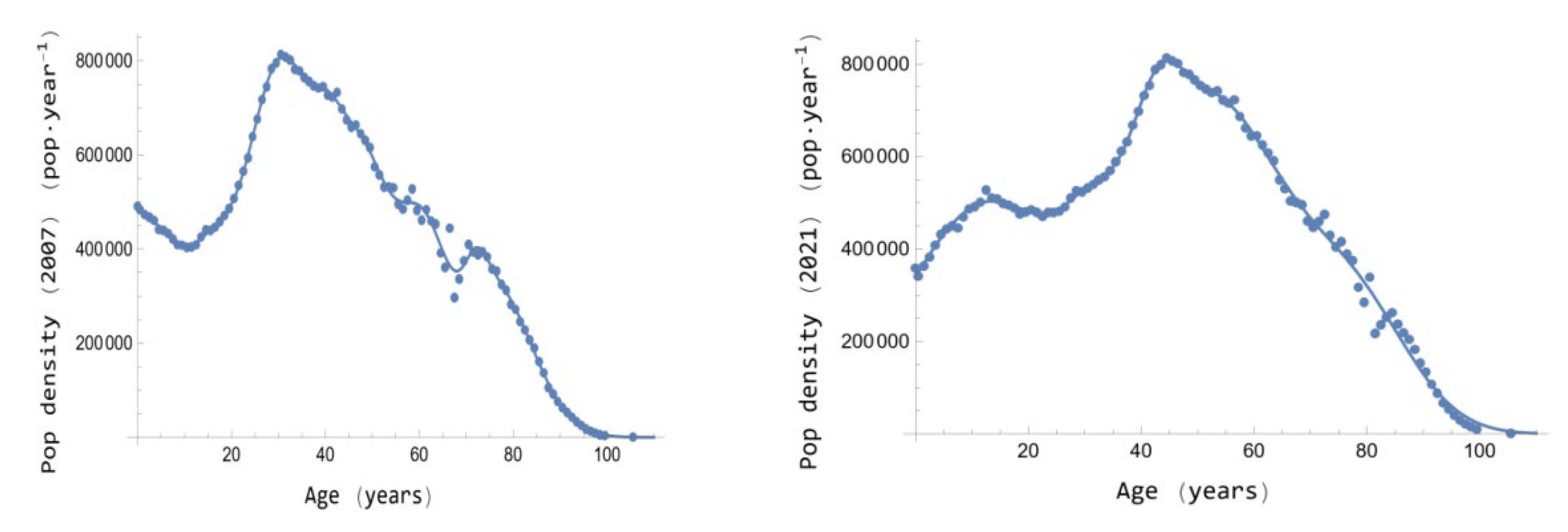
This paper presents the population pyramid dynamics model (PPDM) to study the evolution of the population pyramid of a determined country or society, deducing as a crucial objective its exact analytical solution. The PPDM is a first-order linear partial differential equation whose unknown variable is the population density (population per age unit) depending on time and age, jointly an initial condition in the initial time and a boundary condition given by the births in the zero age. In addition, the dynamical patterns of the crude birth, death, immigration and emigration rates depending on time, jointly with the mathematical pattern of the initial population pyramid depending on ages, take part of the PPDM. These patterns can be obtained from the historical data. An application case of the PPDM analytical solution is presented: Spain, in the 2007–2021 period for its validation, and in the 2021–2026 period for its future forecasting. This application case also permits to obtain the forecasting limits of the PPDM by comparing the historical data with those provided by the PPDM. Other variables that can be obtained from the historical population pyramids data, such as the dependency ratio and the life expectancy at birth, are considered.
Keywords: population pyramid dynamics; first-order linear partial differential equation; age-structured population dynamics; von Foerster–McKendrick model; analytical solution; dependency ratio; life expectancy at birth population pyramid dynamics; first-order linear partial differential equation; age-structured population dynamics; von Foerster–McKendrick model; analytical solution; dependency ratio; life expectancy at birth