1. Introduction
Online and hybrid learning are now an established part of higher education. They shape how students encounter teachers, access resources, participate with peers, receive feedback, complete assessment and develop a sense of themselves as learners (
Picciano, 2017). As these forms of learning have become increasingly common, attention has shifted from questions of technological adoption towards questions of educational quality. Among these is how online and hybrid learning environments support meaningful engagement in learning rather than simply access to content or completion of required tasks.
This issue is important because online and hybrid learning distribute participation across time, space, people and technologies (
Shea & Bidjerano, 2010).
Moore’s (
2019) theory of transactional distance is useful here because it highlights that educational distance is not simply geographical but shaped by relationships between structure, dialogue and learner autonomy. Students in online and hybrid courses may need to interpret written instructions, move between synchronous and asynchronous learning activities, seek clarification at a distance, decide when to engage, and determine whether their understanding is sufficient. These conditions can create opportunities for agency, but they can also make engagement more challenging when expectations, support and pathways through learning are unclear.
The Special Issue to which this paper contributes foregrounds engagement, agency and belonging in online and hybrid university learning, with particular interest in relational, sociocultural and Self-Determination Theory perspectives. This focus is timely because discussions of online and hybrid education still risk treating technology as the primary explanatory approach. A human-centred perspective instead directs attention towards how learning environments shape students’ experiences of participation, motivation, challenge and connection. From this perspective, the central educational question is not what technologies are used, but how learning environments enable students to participate meaningfully and act purposefully in relation to their learning.
This paper develops a conceptual argument that agency in online and hybrid higher education depends on the interaction between motivational and cognitive conditions. Self-Determination Theory (SDT) explains why autonomy, competence and relatedness create the conditions under which learners are able and willing to act with agency (
Ryan & Deci, 2000,
2017). Cognitive Load Theory (CLT) complements this perspective by explaining the cognitive conditions that support agentic action. Learners need environments that reduce unnecessary cognitive burden while preserving the effort required for understanding (
Paas et al., 2010;
Sweller, 2011). Although relationships between motivation and cognitive load have begun to receive increased attention (
Evans et al., 2024), most SDT-CLT research has focused on motivation, engagement, self-regulation or learning outcomes rather than learner agency as the central organising concept. This article addresses that gap by proposing that different combinations of motivational and cognitive conditions give rise to different forms of participation and by positioning learner agency as the key explanatory construct through which these conditions are understood. Students are therefore more likely to act with agency when they experience learning as meaningful, achievable, connected and appropriately challenging (
Bandura, 2001;
Biesta & Tedder, 2007).
Agency is influenced by the opportunities, constraints, expectations and forms of support embedded within learning design (
Jääskelä et al., 2020). This perspective raises two related questions: what motivates students to act with agency, and what enables them to do so? To address these questions, the paper draws on Self-Determination Theory (SDT) and Cognitive Load Theory (CLT). Together, these theories provide complementary explanations of the motivational and cognitive conditions that support learner agency.
The paper first outlines the methodological approach adopted. Then, it defines learner agency in the context of online and hybrid university learning. It then positions online and hybrid learning as environments that can enable or constrain agency through their design. The following sections develop Self-Determination Theory (SDT) and Cognitive Load Theory (CLT) as complementary explanatory lenses before integrating them into a framework for agency-supportive learning design. The aim is not to offer a universal model of online learning, but to articulate a theoretically grounded account of how online and hybrid environments can support students to participate as capable, connected and responsible learners.
2. Methodological Approach
A conceptual review approach has been adopted to examine learner agency in online and hybrid higher education and to develop a theoretical framework integrating Self-Determination Theory (SDT) and Cognitive Load Theory (CLT). Conceptual reviews seek to synthesise and reinterpret existing scholarship to provide new theoretical insights, identify gaps in understanding, and advance conceptual development within a field. Rather than conducting a systematic review, the purpose of this paper is to critically examine and integrate relevant bodies of literature to address the question of how learner agency can be understood and supported in online and hybrid learning environments.
The review drew on the foundational and contemporary literature related to learner agency, online and hybrid learning, SDT, and CLT. The literature was selected purposively based on its relevance to understanding the conditions that support or constrain learners’ capacity to act purposefully within educational settings. Foundational works were included to establish key concepts and theoretical perspectives, while more recent scholarship was used to identify emerging developments and areas of convergence across the literature. The literature reporting conceptual tensions, conditional effects or findings inconsistent with simple relationships were retained to inform the framework’s limitations, boundary conditions and areas requiring further investigation.
SDT and CLT were selected because they offer complementary, but largely separate, explanations of learner action. SDT provides an account of the motivational conditions associated with autonomous engagement, while CLT explains how cognitive demands influence learners’ capacity to process information, make decisions, and participate effectively in learning activities. Although both theories have been widely applied in educational research, they have rarely been brought together explicitly to explain learner agency in online and hybrid learning contexts.
The analysis involved an iterative process of reading, comparison and conceptual synthesis. The literature related to learner agency, motivation, self-regulation, cognitive load, and online learning design was examined to identify recurring themes, points of alignment, and areas of tension across the theoretical perspectives. Through this process, an integrated framework was developed that conceptualises learner agency as shaped by the interaction between the quality of learners’ motivation and the cognitive conditions under which participation occurs. The six design considerations presented later in the article emerged through this process of comparison and synthesis and are intended as conceptual implications of the framework rather than systematically derived or empirically validated design prescriptions.
3. Defining Learner Agency in Online and Hybrid Learning
For the purposes of this paper, learner agency is understood as students’ capacity to act purposefully within the opportunities and constraints of a learning environment. Drawing on ecological perspectives, agency is not a fixed characteristic but emerges through interactions between learners and the contexts in which they act (
Biesta & Tedder, 2007;
Jääskelä et al., 2020).
Agency includes choice, but agency is not synonymous with choice. Choices only become agentic when learners understand their significance and can use them to advance meaningful learning. Choice is most supportive when it is meaningful, relevant and not overly burdensome (
Katz & Assor, 2007;
Schneider, 2021). Similarly,
Bandura (
2001) emphasises that agency involves intentionality, forethought and self-regulation rather than simply freedom to choose. In online and hybrid learning environments, providing multiple options without adequate guidance may increase complexity rather than support agency. What matters is not the availability of choice itself, but whether learners are able to use those choices in ways that advance meaningful learning.
Agency should also not be equated with independence (
Hartnett, 2016). Learners may act agentically when they seek help, use feedback, collaborate with peers, draw on resources or participate in disciplinary communities. From this perspective, agency is inherently relational (
Emirbayer & Mische, 1998;
Jääskelä et al., 2020). Sociocultural theories of learning, influenced by
Vygotsky (
1978), emphasise that learning is mediated through social interaction, language, cultural tools and participation in shared practices. Agency, therefore, emerges through learners’ engagement with the people, resources and structures that make action possible (
Biesta & Tedder, 2007;
Emirbayer & Mische, 1998). Rather than residing solely within the individual, agency is enacted through participation in social and educational contexts (
Biesta & Tedder, 2007).
Agency is also distinct from self-regulated learning. Self-regulated learning refers to the processes through which learners plan, monitor and adjust their learning, whereas agency concerns how learners respond to and shape the opportunities and constraints they encounter (
Biesta & Tedder, 2007). Self-regulation may be one means through which agency is enacted, but the concepts are not interchangeable. Agency may involve engaging with intended activities, but it may also involve negotiating expectations, seeking support outside the course, adopting alternative pathways, or resisting forms of participation that learners judge to be inappropriate or unhelpful (
Emirbayer & Mische, 1998). Agentic action should therefore not be equated with compliance or with participation preferred by the teacher.
This relational and situated understanding is particularly important in online and hybrid learning. Agency is therefore influenced by the opportunities and constraints embedded within educational environments.
A useful distinction can be drawn between unsupported independence and environments that support agency. Unsupported independence occurs when learners are expected to manage their learning with limited guidance, inadequate feedback or minimal connection to others (
Hartnett, 2016;
Moore, 2019). By contrast, environments support agency when they provide meaningful opportunities for decision-making within coherent and relationally supportive structures (
Jääskelä et al., 2020). These environments do not create agency or determine how learners will act. Rather, they provide opportunities and constraints that learners may take up, negotiate, redirect or resist in relation to their purposes and circumstances (
Biesta & Tedder, 2007;
Emirbayer & Mische, 1998).
Online and hybrid learning should therefore create conditions that enable purposeful action without assuming that agency can be produced through design or that it must align with intended forms of participation.
4. Online and Hybrid Learning as Environments for Agency
Online and hybrid learning are often described in terms of mode, platform or delivery (
Picciano, 2017). In this article, online learning refers to courses in which teaching and participation occur predominantly through digital environments and may include synchronous and asynchronous activity. Hybrid learning refers to deliberately integrated combinations of online and face-to-face participation within a course. These categories encompass considerable variation in timing, teacher presence, peer interaction and technology use. While the framework may have relevance to blended, HyFlex and large-scale open learning environments, these settings are not examined directly and should not be assumed to create equivalent conditions for learner agency (
Picciano, 2017;
Vaughan et al., 2013).
While these descriptors are administratively useful, they reveal little about how learning is experienced. Students learn through engagement with teachers, peers, disciplinary practices, digital tools and learning resources (
Wenger, 1998). Their capacity to act purposefully is influenced by whether the environment supports autonomy, develops competence, fosters meaningful connections with others and provides clear pathways for participation (
Hartnett, 2016). Learners are more likely to take ownership of their learning when they understand what is expected, can see value in their learning, feel capable of succeeding, and experience themselves as legitimate members of a learning community (
Hartnett, 2019).
The relational nature of online learning has long been recognised.
Garrison et al. (
2000) emphasised teaching presence, social presence and cognitive presence as interdependent elements of meaningful inquiry in online environments.
Vaughan et al. (
2013) extended this work into blended learning, arguing that learning experiences across online and face-to-face settings must be purposefully integrated to support participation and inquiry. These perspectives challenge views of online learning as the passive consumption of content. Instead, they position learning as active participation in a community of learners, where agency is supported when students understand how to contribute, why their contributions matter, and how their participation connects to broader learning goals.
A distinctive characteristic of online and hybrid learning is that participation is mediated through technologies, resources and communication tools. Students interact through learning management systems, discussion forums, video conferencing, shared documents, recorded lectures, digital feedback and assessment artefacts. These forms of mediation can support agency when they make learning processes visible, expectations clear and pathways for participation easy to follow. They can constrain agency when they fragment attention, create unnecessary complexity or obscure relationships between different elements of the learning environment (
Jang et al., 2010). In these situations, students may struggle to exercise agency not because they lack motivation, but because the learning environment itself becomes difficult to interpret and navigate.
Understanding online and hybrid learning as environments for learner agency highlights the importance of learning design, relationships and opportunities for participation. Agency is supported not simply through flexibility or access, but through the design of coherent learning environments that make participation meaningful, achievable and worthwhile (
Reeve & Cheon, 2021). The following sections explore these conditions through the lenses of Self-Determination Theory and Cognitive Load Theory, focusing on the motivational and cognitive factors that support learner agency.
5. Self-Determination Theory and Learner Agency
Self-Determination Theory provides the first theoretical lens for understanding learner agency in online and hybrid learning. SDT proposes that the quality of motivation depends on the satisfaction of three fundamental psychological needs, namely autonomy, competence and relatedness (
Ryan & Deci, 2000,
2017). They shape whether students experience learning as meaningful, whether they believe effort can lead to progress and whether they feel connected enough to participate. From this perspective, learner agency is more likely to emerge when learning environments support these fundamental psychological needs.
SDT also distinguishes forms of motivation according to the extent to which the reasons for acting have been internalised. Organismic Integration Theory describes a continuum from externally regulated activity undertaken because of rewards, requirements or consequences to more autonomous forms of motivation, in which learners identify with and eventually integrate the value of an activity into their sense of self (
Ryan & Deci, 2000,
2017). This distinction is particularly relevant in higher education, where students may initially participate because of assessment requirements, qualifications or career aspirations. Such motives need not remain externally regulated. When learning environments support autonomy, competence and relatedness, learners are more likely to understand, value and internalise the purposes of learning. Learner agency therefore depends not only on whether students are motivated, but also on the quality and internalisation of their motivation.
Autonomy is the need most clearly connected to agency, but it is often misunderstood. In SDT, autonomy means acting with a sense of volition and endorsement rather than having unlimited choice or no structure (
Ryan & Deci, 2017). In online and hybrid learning, flexibility may create uncertainty when purposes and expectations are unclear. Autonomy-supportive environments therefore combine meaningful choice with sufficient structure to help learners understand and act on available opportunities (
Jang et al., 2010).
Autonomy and learner agency are therefore related but distinct. In SDT, autonomy concerns learners’ experience of acting with volition and self-endorsement, whereas learner agency concerns their capacity to act purposefully within the opportunities and constraints of a learning environment. Autonomy may support learner agency, but the two concepts are not synonymous. Competence refers to students’ experience that they can make progress and meet challenges. In online and hybrid courses, competence can be undermined when students are unsure what is expected, cannot judge whether they are on track, or receive feedback too late to act on it (
Hartnett, 2015). Competence support does not equate to making tasks easy. Students need challenge in order to learn, but challenge must be accompanied by a credible sense that effort can lead to progress.
Reeve and Cheon (
2021) identify competence-supportive teaching as including structure, guidance and responsiveness. In online and hybrid learning, competence support may include worked examples, staged tasks, clear criteria, formative quizzes, guided peer review, prompt feedback and opportunities to revise. These supports do not undermine agency. They enable it by helping students make better decisions about effort and strategy.
Relatedness connects motivation to belonging. In online and hybrid learning, students may be uncertain whether their contributions are recognised, whether support is available, or whether participation is valued. Teacher presence and peer connection therefore matter not only for satisfaction but also for agency (
Garrison et al., 2000;
Hartnett, 2016). Students are more likely to contribute, take intellectual risks and use feedback when participation occurs within credible and supportive relationships (
Cleveland-Innes et al., 2019;
Garrison et al., 2000;
Vaughan et al., 2013).
The implication is that agency-supportive online and hybrid learning must attend to both psychological need satisfaction and the internalisation of motivation. When students understand why learning matters, feel capable of progress, experience meaningful connection and value the purposes of learning, the motivational conditions for learner agency are strengthened. Motivation alone, however, is insufficient. Learners’ capacity to act on that motivation is also influenced by the cognitive demands of the learning environment.
6. Cognitive Load Theory and Learner Agency
Cognitive Load Theory (CLT) provides a complementary perspective on learner agency by explaining the cognitive conditions that enable purposeful participation in learning. While Self-Determination Theory explains why learners may be motivated to act with agency, CLT helps explain whether they have sufficient cognitive resources available to do so. Developed from research on human cognitive architecture, CLT proposes that working memory has a limited capacity for processing new information, whereas long-term memory stores the knowledge structures and schemas that support learning and skilled performance (
de Bruin et al., 2020;
Sweller, 1994,
2023,
2024). Learning is therefore influenced not only by what students are asked to learn but also by how learning activities, information and environments are designed (
Chen et al., 2023;
Paas & van Merriënboer, 2020).
Exercising agency requires learners to make decisions, monitor progress, evaluate alternatives, regulate effort and adapt strategies in response to challenge. These metacognitive activities consume cognitive resources and impose a cognitive load of their own (
de Bruin et al., 2020;
de Bruin & van Merriënboer, 2017). Recent work integrating CLT and self-regulated learning suggests that the cognitive demands of learning and the cognitive demands of self-regulation compete for the same limited working-memory resources (
de Bruin & van Merriënboer, 2017;
Wang & Lajoie, 2023). Learners may therefore struggle to act agentically not because they lack motivation, but because excessive cognitive demands leave insufficient capacity for planning, monitoring and decision-making.
CLT distinguishes between intrinsic cognitive load, which arises from the inherent complexity of the learning task, and extraneous cognitive load, which arises from the way learning is presented or organised (
Sweller, 1994). From an agency perspective, this distinction is important because intrinsic load is often necessary for learning, whereas extraneous load consumes cognitive resources without contributing to understanding. CLT therefore suggests that learners are most able to exercise agency when working-memory resources are directed towards meaningful learning rather than avoidable complexity (
Evans et al., 2024;
Skulmowski & Xu, 2021).
The relationship between cognitive load and agency is not linear.
Seufert et al. (
2024) show that learner agency is strongest when cognitive demands are sufficiently challenging to require active engagement and self-regulation, but not so demanding that they overwhelm available resources. Under these conditions, learners are more likely to monitor their progress, adjust strategies and take responsibility for learning. When cognitive load becomes excessive, however, the self-regulatory processes associated with agency may diminish or cease altogether. High cognitive load can reduce self-efficacy, undermine motivation and increase frustration, making purposeful participation less likely (
Evans et al., 2024;
Zhang, 2024). Agency therefore depends not only on learners’ willingness to act but also on their cognitive capacity to do so.
This issue is particularly relevant in online and hybrid learning environments, where students frequently interact with learning through digital platforms, multimedia resources and distributed forms of communication. Such environments can introduce substantial extraneous cognitive load through fragmented systems, unclear navigation, dispersed resources and poorly integrated learning activities (
Lange et al., 2021;
Qiu & Qiu, 2026;
Surbakti et al., 2024). Learners may expend considerable cognitive effort locating information, interpreting expectations or coordinating participation across multiple platforms before engaging with the intended learning task. In these circumstances, cognitive resources that might otherwise support judgement, self-regulation and purposeful participation are instead consumed by navigating the learning environment itself.
Multimedia design can have similar effects. Excessive text, poorly integrated visuals and the need to switch repeatedly between different media formats may overload learners’ limited processing capacity (
Mayer, 2017;
Mayer & Moreno, 2010). Even learning-related visuals can become distracting when presented in excessive numbers, while multilingual and second-language learners may experience higher cognitive demands when processing complex multimedia environments (
Bali et al., 2026). Such demands do not simply affect learning outcomes; they may also reduce learners’ capacity to make informed decisions, monitor understanding and engage strategically with learning activities.
Distraction and divided attention present additional challenges. Online learners spend more time engaging in off-task digital activities than their campus-based peers (
Ochs et al., 2024), potentially reducing the cognitive resources available for self-regulation and purposeful participation. Research also suggests that neurodivergent learners may experience disproportionately high levels of extraneous cognitive load in online environments when content organisation, presentation and information architecture are confusing or repetitive (
Le Cunff et al., 2024). These findings highlight that agency is shaped not only by learners’ dispositions and motivations but also by the cognitive demands embedded within the environments in which learning occurs.
Importantly, reducing extraneous cognitive load should not be confused with eliminating challenge. Agency is not developed through the absence of difficulty. Learners must encounter tasks that require interpretation, problem-solving, judgement and persistence. Productive challenge supports agency because it preserves the learner’s role as an active problem-solver while providing sufficient guidance for meaningful progress (
Mucheli & Chow, 2026). Challenges that are appropriately calibrated can stimulate attention, persistence and agentic responses to difficulty (
Spence et al., 2025). By contrast, unnecessary complexity consumes working-memory resources without contributing to learning and may result in frustration or disengagement (
Skulmowski & Xu, 2021). The goal of learning design is therefore not to make learning easy, but to distinguish meaningful challenge from avoidable confusion.
7. Integrating SDT and CLT: Motivational and Cognitive Conditions for Learner Agency
Motivational and cognitive conditions are closely interconnected. Motivational conditions influence whether learners invest effort and persist, while cognitive conditions influence whether they can understand and act on the opportunities available to them. Learners’ experiences of progress, difficulty and cognitive clarity may, in turn, strengthen or undermine competence, autonomy and the internalisation of learning goals (
Evans et al., 2024;
Gupta & Prashar, 2025). The proposed integration therefore focuses on the reciprocal relationships through which motivational and cognitive conditions shape different forms of participation.
These relationships are not simply additive. Learning environments may strengthen one condition while constraining another. For example, meaningful choice may enhance autonomy but increase cognitive burden if options become excessive or poorly differentiated. Likewise, clear structure may support competence while being experienced as controlling. Cognitive clarity can strengthen motivation by making learning purposes and pathways easier to understand, whereas excessive cognitive demands may undermine competence and persistence (
Evans et al., 2024;
Gupta & Prashar, 2025;
Schneider, 2021;
Schneider et al., 2018).
Cognitive conditions may influence internalisation because learners require sufficient capacity to interpret expectations, understand relevance, and connect externally established requirements with personally meaningful goals. Cognitive demand therefore affects not only whether learners can act on their motivation, but also how they understand the purposes of learning.
SDT and CLT therefore offer complementary explanations of learner agency. SDT explains why learners are willing to invest effort (
Ryan & Deci, 2017), while CLT explains the cognitive conditions that enable them to do so (
Sweller, 2011,
2024). Together, they provide a more complete account of the conditions that support purposeful participation in learning.
The proposed integration draws on three forms of support. First, studies examining learner agency directly inform the conceptualisation of purposeful action and its relationship with educational conditions (
Biesta & Tedder, 2007;
Jääskelä et al., 2020;
Spence et al., 2025). Second, studies of motivation, engagement, self-regulation, cognitive load and achievement provide indirect evidence about processes that may enable or constrain agency (
Evans et al., 2024;
Gupta & Prashar, 2025;
Lehikko et al., 2024;
Seufert et al., 2024). Third, the proposed relationships between these processes and learner agency represent theoretical inferences developed through the conceptual synthesis. Evidence concerning related constructs informs, but does not validate, learner agency by proxy. The framework should therefore be understood as a theoretically informed model requiring empirical investigation rather than as an already validated explanation of learner agency.
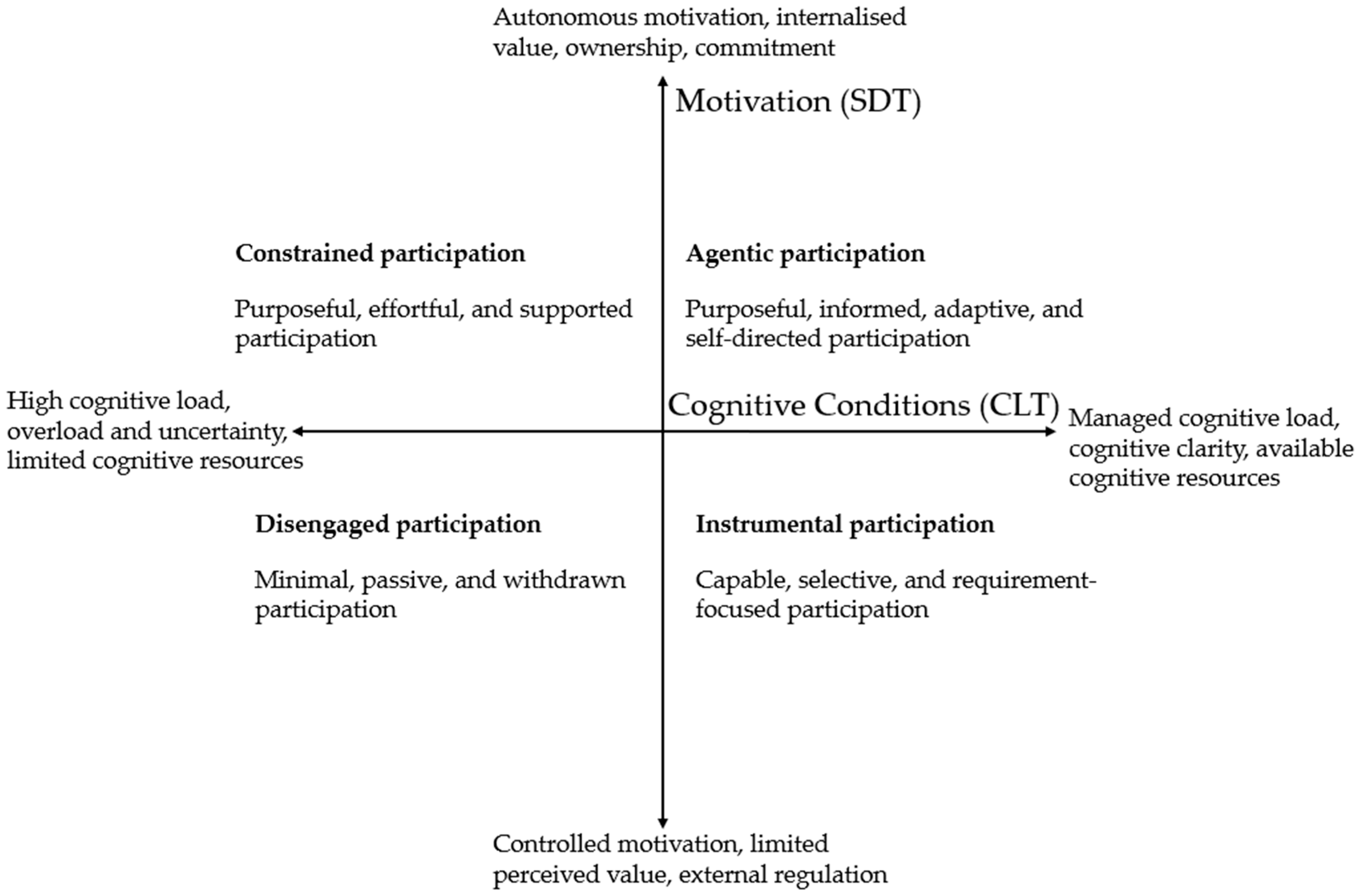
Figure 1 illustrates the proposed framework. The vertical axis reflects the quality of learners’ motivation. At one end, autonomous motivation is characterised by internalised value, ownership and commitment; at the other, controlled motivation is characterised by external regulation and limited perceived value. The horizontal axis represents cognitive conditions. These range from high cognitive load, overload, uncertainty and limited cognitive resources to managed cognitive load, cognitive clarity and available cognitive resources. Different combinations of these motivational and cognitive conditions give rise to four forms of participation.
Boundary conditions: Prior knowledge, learner expertise, digital capability, task complexity, learning modality, disciplinary expectations, programme structures, institutional policies, technological systems, and wider contextual conditions influence learners’ movement across quadrants.
Agentic participation is most likely when autonomous motivation is combined with managed cognitive load and sufficient cognitive resources. Learners recognise the value of their learning, experience ownership and commitment, and can interpret opportunities, make informed decisions and adapt their actions. Participation under these conditions is purposeful, informed, adaptive and self-directed. This does not mean that learners necessarily follow the pathway preferred by the teacher. Agentic action may include seeking assistance, drawing on alternative resources, negotiating expectations, or redirecting participation in response to learners’ goals and circumstances.
Constrained participation occurs when autonomous motivation and commitment are present, but high cognitive load, uncertainty, or limited cognitive resources impede purposeful action. Learners may value the activity and make sustained efforts to participate yet require considerable guidance and support. Participation under these conditions is purposeful and effortful but cognitively constrained, demonstrating that autonomous motivation alone may be insufficient to support agentic participation.
Instrumental participation occurs when cognitive load is manageable and cognitive resources are available, but motivation is more controlled and the activity has limited internalised value. Learners may understand expectations, manage tasks successfully and complete requirements without experiencing strong ownership or commitment. Participation under these conditions is capable, selective and requirement-focused. This should not automatically be treated as non-agentic because learners may make strategic decisions about how to allocate their effort and attention. It nevertheless differs from the more internally endorsed and self-directed participation represented in the agentic quadrant.
Disengaged participation is associated with controlled motivation, limited perceived value and cognitively demanding conditions. Learners may experience little ownership of the activity while also facing overload, uncertainty or insufficient cognitive resources. Participation may consequently become minimal, passive or withdrawn. As with the other quadrants, this position should not be interpreted as a fixed learner characteristic. It represents a response to particular motivational, cognitive and contextual conditions and may change as those conditions change.
The quadrants represent situated forms of participation rather than stable learner characteristics. Movement among them is expected as motivation, cognitive demands, support, expertise and personal circumstances change. The framework therefore describes dynamic relationships among motivation, cognitive conditions and participation rather than fixed learner categories.
The framework leads to three propositions:
Proposition 1. Autonomous motivation is more likely to support agentic participation when cognitive load is manageable, and learners have sufficient cognitive resources to interpret opportunities and translate intentions into purposeful action.
Proposition 2. Motivational and cognitive conditions are interdependent: design features intended to support one dimension may strengthen or weaken the other depending on how they are structured and experienced.
Proposition 3. The relationship between motivation, cognitive conditions and learner agency is influenced by learner expertise, prior knowledge, digital capability, task characteristics, learning modality, and wider institutional and contextual conditions.
Integrating SDT and CLT offers a framework for understanding how motivation and cognitive conditions jointly influence participation. The design considerations that follow translate this perspective into practical questions for online and hybrid learning without assuming that learning environments create agency or that agentic action must conform to intended participation.
8. Discussion
The integrated framework has six implications for online and hybrid learning design. These are not presented as novel pedagogical practices or as principles derived exclusively from SDT and CLT. Rather, SDT and CLT provide a shared explanatory framework for understanding how established design practices may influence motivation, cognitive conditions and opportunities for purposeful action. The contribution lies not in the individual practices themselves, but in explaining how different combinations of motivational and cognitive conditions give rise to different forms of participation, and how the same design practice may support one condition while constraining another. Choice may strengthen autonomy while increasing cognitive burden, structure may provide cognitive clarity while being experienced as controlling, and challenge may promote competence while exceeding available cognitive resources. The design considerations therefore focus attention on the interactions, tensions and trade-offs that shape learner agency in online and hybrid learning.
The design considerations focus primarily on course-level learning design, where educators and design teams can make direct decisions about structure, activities, assessment, feedback and technology use. This practical focus does not imply that agency is enabled or constrained solely at the course level. Programme structures, institutional policies, platform choices, accessibility arrangements and learners’ wider circumstances also shape the opportunities and constraints they encounter. These influences are represented as boundary conditions in
Figure 1 but are not examined comprehensively in the design discussion that follows.
8.1. Support Autonomy Through Purpose and Participation
Agency is supported when learners experience autonomy in relation to their learning. In online and hybrid courses, this requires more than providing flexibility or choice. Choice is most likely to support autonomy when learners understand its purpose and significance, rather than being presented with options that are disconnected from meaningful learning (
Katz & Assor, 2007;
Schneider, 2021). Students therefore need to understand what they are being asked to do, why it matters and how different learning activities contribute to broader learning goals (
Hartnett, 2016). They also need opportunities to connect these purposes to their own interests, goals and circumstances. Agency emerges not simply from what the learning environment provides, but from how learners take up and respond to those opportunities (
Biesta & Tedder, 2007).
The relationships between resources, synchronous and asynchronous activities, assessment tasks and feedback should be explicit rather than assumed. When learners understand the purpose and value of learning activities, they are more likely to engage with them willingly rather than simply comply with requirements (
Reeve & Cheon, 2021;
Ryan & Deci, 2017). Clear rationales and visible learning pathways support autonomy by helping students make informed decisions about their participation, while also reducing uncertainty about what matters and where effort should be directed (
Jang et al., 2010). Recent work indicates that autonomy-supportive environments characterised by structure and load-reducing instructional practices can simultaneously support motivation, engagement and lower cognitive burden (
Evans et al., 2024). This is particularly important in online learning environments, where cognitive overload can undermine learners’ psychological need satisfaction and their ability to benefit from learning opportunities (
Gupta & Prashar, 2025). In this way, autonomy becomes a foundation for learner agency.
8.2. Support Agency Through Structure and Guidance
Agency is supported by learning environments that provide coherent organisation, transparent expectations and accessible forms of support. Structure helps students make informed decisions about how to participate, where to focus effort and when to seek help. This aligns with SDT research showing that autonomy support and structure can work together rather than in opposition (
Jang et al., 2010;
Reeve et al., 2022). Within SDT, structure supports autonomy because it helps learners understand what is expected, why learning activities matter and how progress can be achieved. At the same time, competence is strengthened when expectations are clear, pathways through learning are visible and feedback provides actionable guidance (
Reeve & Cheon, 2021;
Reeve et al., 2022).
From an ecological perspective, structure shapes the opportunities and constraints that learners encounter as they participate in learning (
Biesta & Tedder, 2007). Clear expectations, visible pathways and accessible support do not determine how students will act, but they create conditions that make purposeful participation more achievable. In contrast, fragmented organisation or inconsistent guidance can limit learners’ ability to engage effectively with the opportunities available to them.
These same design features also reduce the cognitive effort required to interpret instructions, locate resources or determine priorities, allowing learners to focus their attention on meaningful learning rather than course navigation (
Evans et al., 2024;
Gupta & Prashar, 2025). Structure should therefore be understood not as a constraint on agency, but as a condition that enables learners to participate purposefully, make informed decisions and engage with meaningful challenge. The amount of structure required is likely to vary according to learners’ expertise and familiarity with the task, with more explicit guidance often required for novices than for more experienced learners (
Sweller, 2024).
8.3. Support Competence Through Progression and Feedback
Students are more likely to act with agency when they believe effort can lead to progress. Within SDT, competence refers to learners’ experience that they can meet challenges and achieve valued outcomes through their actions (
Ryan & Deci, 2017). Competence can be supported through staged tasks, clear criteria, worked examples, formative opportunities, timely feedback and opportunities to revise and improve (
Reeve & Cheon, 2021). In online and hybrid contexts, these supports are particularly important because students may have fewer informal cues about whether they are on track or how their performance is developing (
Hartnett, 2015).
Feedback should help students understand not only what needs improvement, but how to act on that information. Feedback is most effective when it provides direction for future learning and helps learners develop their capacity to monitor, evaluate and adjust their own work (
Bearman et al., 2024;
Molloy & Boud, 2012). These processes support agency by enabling students to make informed decisions about effort, strategy and next steps. Experiences of competence matter because they influence how learners engage with the opportunities available to them. When students can recognise progress and understand how their actions contribute to learning, they are better positioned to participate purposefully and respond productively to challenge.
Competence is strengthened when learning pathways are visible and expectations are clear. From a CLT perspective, guidance, worked examples, coherent sequencing and explicit criteria can reduce unnecessary cognitive burden by helping learners focus their attention on the task itself rather than on interpreting what is required (
Evans et al., 2024;
Sweller, 2011). Supporting competence therefore requires more than encouragement; it requires learning environments that make progress visible, provide actionable feedback and direct cognitive effort towards meaningful learning. As learner expertise develops, however, some forms of guidance may need to be reduced or redesigned to avoid imposing unnecessary cognitive burden (
Sweller, 2024).
8.4. Support Relatedness Through Connection and Belonging
Agency is relational as well as individual. Within SDT, relatedness refers to learners’ experience of being recognised, valued and connected to others (
Ryan & Deci, 2017). In online and hybrid learning, these experiences are shaped by opportunities to participate in relationships and practices that extend across teachers, peers, disciplinary communities and learning activities (
Garrison et al., 2000;
Hartnett, 2016). Students are more likely to contribute, ask questions and take intellectual risks when they feel that their participation matters and that they are legitimate participants in the learning community.
From an ecological perspective, agency emerges through participation in the social and educational contexts in which learning takes place (
Biesta & Tedder, 2007). Teacher presence, peer interaction and feedback therefore do more than provide support; they shape the opportunities through which learners can engage, contribute and respond. Structured discussions, collaborative activities, responsive communication and opportunities for dialogue create conditions in which students can develop both a sense of belonging and a capacity for purposeful participation (
Garrison et al., 2000;
Vaughan et al., 2013).
These social conditions also support learning by helping students interpret expectations, make sense of feedback and navigate challenging learning tasks. In online and hybrid environments, where learners may have fewer informal opportunities for interaction, relatedness often requires deliberate design. Supporting connection and belonging is therefore not simply about creating a positive learning experience. It is about creating the social conditions that enable learners to participate confidently, draw on the resources of others and exercise agency within a community of learning.
8.5. Support Meaningful Challenge Through Cognitive Clarity
Learner agency is more likely to emerge when students can direct their attention and effort towards meaningful learning rather than navigating avoidable complexity. Online and hybrid learning environments should therefore be organised in ways that minimise unnecessary cognitive burden. Students should not have to spend effort interpreting unclear instructions, locating resources, resolving inconsistent terminology or determining how different learning activities connect to one another (
Skulmowski & Xu, 2021;
Sweller, 2011). This allows learners to focus on the intellectual work of learning.
At the same time, agency-supportive design should not remove challenge. From both ecological and sociocultural perspectives, agency develops through engagement with worthwhile opportunities and constraints rather than through the absence of difficulty (
Biesta & Tedder, 2007). Students need opportunities to explain, apply, compare, evaluate, synthesise and revise. Productive challenge allows learners to exercise judgement, test understanding and respond to feedback in ways that strengthen both competence and agency. Research suggests that effortful learning conditions can support deeper learning and longer-term retention when learners understand their purpose and persist through initial difficulty (
de Bruin et al., 2023;
Nelson & Eliasz, 2023).
Productive challenge cannot be defined by task difficulty alone. It occurs when task demands are relevant to the intended learning, appropriately sequenced and achievable with the knowledge, guidance and support available to the learner (
Chen et al., 2023;
Sweller, 2024). Calibration therefore requires consideration of prior knowledge, element interactivity, learner expertise and opportunities to obtain feedback or assistance (
Paas & van Merriënboer, 2020;
Sweller, 2024). Guidance, worked examples and staged tasks may reduce cognitive burden for novices but become redundant as expertise develops because of the expertise reversal effect (
Sweller, 2024). Productive challenge therefore requires support to be adjusted over time, directing effort towards meaningful learning without overwhelming learners’ available cognitive resources.
8.6. Support Agency Through Informed Judgement
Assessment and feedback should help students develop the capacity to make informed judgements about their own learning. Opportunities to evaluate evidence, justify decisions, apply criteria, compare alternatives and respond to feedback encourage learners to engage actively with standards, quality and progress rather than simply comply with requirements (
Bearman et al., 2024;
Molloy & Boud, 2012). Such practices support autonomy through active decision-making and support competence by making expectations, progress and achievement visible.
Opportunities to exercise judgement are central to learner agency because agency develops through learners’ responses to the situations, opportunities and constraints they encounter (
Biesta & Tedder, 2007). Assessment supports this process when learners must explain and defend their decisions in unfamiliar or complex situations (
Bearman et al., 2024).
In technology-rich environments, including those where genAI may be used, judgement becomes even more important. Students need to determine what kinds of support are appropriate, what remains their responsibility, and how the quality and limitations of outputs should be evaluated. Rather than replacing judgement, technologies should create opportunities for learners to exercise it. The key question is therefore not whether technologies are used, but whether their use strengthens students’ capacity to act as capable, connected and responsible learners.
This design consideration draws most directly on evaluative judgement and ecological accounts of learner agency. Its relevance to the present framework lies in the cognitive demands associated with judgement. Exercising judgement requires sufficient cognitive resources to evaluate alternatives, apply criteria and respond appropriately in uncertain situations.
The six design considerations summarised in
Table 1 apply the integrated framework to practical decisions in online and hybrid learning design. The application of these design considerations is likely to vary across learning modalities. In predominantly asynchronous online courses, visible pathways, accessible guidance and deliberately designed opportunities for connection may be particularly important because clarification and interaction are less immediate. In hybrid courses, where online and face-to-face participation intersect, coherence across activities, feedback processes and learning relationships becomes especially important. The framework should therefore be adapted to the particular patterns of interaction, timing and technology use present within a course rather than applied uniformly across all online and hybrid contexts (
Garrison et al., 2000;
Vaughan et al., 2013).
Viewing learner agency as shaped, but not determined, by learning design has several implications for online and hybrid higher education. Most importantly, it suggests that supporting learner agency should be treated as a core objective of learning rather than a desirable by-product of effective teaching. This requires moving beyond assumptions that agency naturally follows from flexibility, choice or technology use. Instead, agency becomes a design consideration that can inform decisions about course structure, assessment, feedback, learner support and technology integration.
The implications extend beyond individual courses. Learner agency also offers a complementary lens for examining educational quality. Existing indicators such as satisfaction, engagement, completion and learning outcomes remain important, but they do not fully explain whether learners are able to interpret opportunities, make informed decisions and act purposefully within a learning environment. The framework is not proposed as a validated quality indicator. Rather, it prompts closer consideration of how educational environments enable, constrain or redirect purposeful participation and how these experiences may vary across learners, contexts and disciplines.
9. Conclusions
This article has argued that learner agency offers a useful lens for examining quality in online and hybrid higher education. By integrating Self-Determination Theory and Cognitive Load Theory, it proposed that agency is shaped by both learners’ motivational experiences and the cognitive demands of the environments in which they learn. The resulting framework contributes a more integrated account of learner agency by explaining how different combinations of motivational and cognitive conditions may give rise to different forms of participation. It highlights the importance of designing online and hybrid learning environments that support students not simply to participate, but to act purposefully, responsively and responsibly in relation to their learning.
10. Future Directions
The framework proposed in this article requires empirical examination and refinement. Future research should investigate whether the relationships proposed in
Figure 1 and the three propositions are supported in different online and hybrid higher education contexts. In particular, research should examine whether autonomous motivation and cognitive conditions interact as proposed and whether the four forms of participation identified in the framework can be distinguished empirically.
Motivation could be examined through established measures of motivational regulation and psychological need satisfaction, while cognitive conditions could be investigated through validated measures of cognitive load supplemented by task-performance and process data. Learner agency itself should be examined directly through evidence of purposeful decision-making, adaptation, help-seeking, negotiation and redirected participation rather than inferred from engagement, achievement or completion alone.
Mixed-method and longitudinal designs may be especially valuable for examining movement across quadrants over time and across learning activities. Experimental and design-based research could explore how variations in choice, structure, guidance and challenge affect motivational and cognitive conditions. Relevant moderators include prior knowledge, learner expertise, digital capability, disciplinary context and learning modality. Future work should also examine whether the proposed relationships operate similarly across online and hybrid learning environments and across different learner groups.