Article

University Co-Creation Space: Contributions to Sustainability Education and STEM Science Communication Through Participatory Practice

by
Bianca-Maria Köck
1,*,
Ines Kirchengast
2,
Alexander Pichlhöfer
2,
Lara Lammer
3,
Bettina Mihalyi-Schneider
1,
Habibe Idiskut
1,
Mayuki Cabrera-Gonzalez
1,
Karin Katharina Tielsch
4,
Christian Nosko
5 and
Katharina Rosenberger
6
1
Institute of Chemical, Environmental and Bioscience Engineering (E166), TU Wien, Getreidemarkt 9/166, 1060 Vienna, Austria
2
Institute of Material Technology, Building Physics, and Building Ecology (E207), TU Wien, Karlsplatz 13, 1040 Vienna, Austria
3
Automation and Control Institute (ACIN, E376), TU Wien, Gußhausstraße 27–29, 1040 Vienna, Austria
4
Faculty of Architecture and Planning, Dean’s Office (E299-01), TU Wien, Karlsplatz 13, 1040 Vienna, Austria
5
Department of Teacher Education Vienna, Private University College of Teacher Education of Christian Churches Austria, Mayerweckstraße 1, 1210 Vienna, Austria
6
Department of Research and Development, Private University College of Teacher Education of Christian Churches Austria, Mayerweckstraße 1, 1210 Vienna, Austria
*
Author to whom correspondence should be addressed.
Educ. Sci. 2026, 16(9), 1375; https://doi.org/10.3390/educsci16091375 (registering DOI)
Submission received: 20 May 2026 / Revised: 21 July 2026 / Accepted: 14 August 2026 / Published: 26 August 2026

Abstract

The Transformer project at TU Wien exemplifies how universities can act as initiators for sustainability education and STEM science communication. Addressing the urgent need for climate change adaptation and the strengthening of key competencies for sustainability, this paper examines the university’s role in creating a temporary, participatory learning space. The Transformer bridges academic research and societal practice, demonstrating how higher education institutions can actively shape sustainable development. As both a knowledge producer and a facilitator of public dialogue, TU Wien designs the Transformer as a hands-on laboratory for children and adolescents, providing low-threshold access to STEM and sustainability content. By integrating university students and researchers from architecture, civil and environmental engineering, mechanical engineering, electrical engineering, informatics, and technical chemistry, the project transforms abstract scientific concepts into tangible, co-created solutions. This approach is designed to foster systemic thinking, practical skills, and participant agency—outcomes for which this paper presents documented but preliminary evidence—while enriching academic teaching and research through real-world applications. This paper analyses how TU Wien’s commitment to interdisciplinary cooperation and participatory science communication positions the Transformer as a model for other institutions, with a focus on circular economy as the anchor theme. Through reflective practice on four analytical dimensions—place-based learning, staged sustainability education, co-creative STEM communication, and the engaged university—this study offers insights into the challenges and opportunities of university-led co-creation spaces and considerations for institutions seeking to develop comparable initiatives.

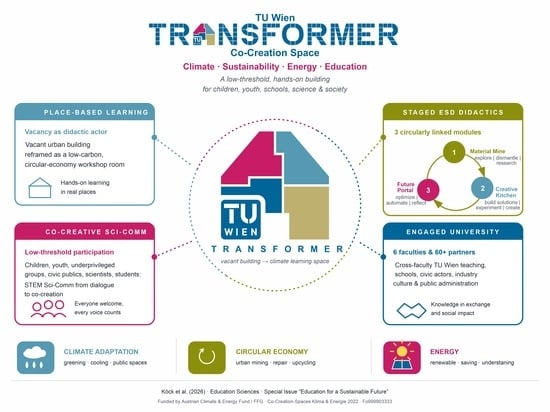
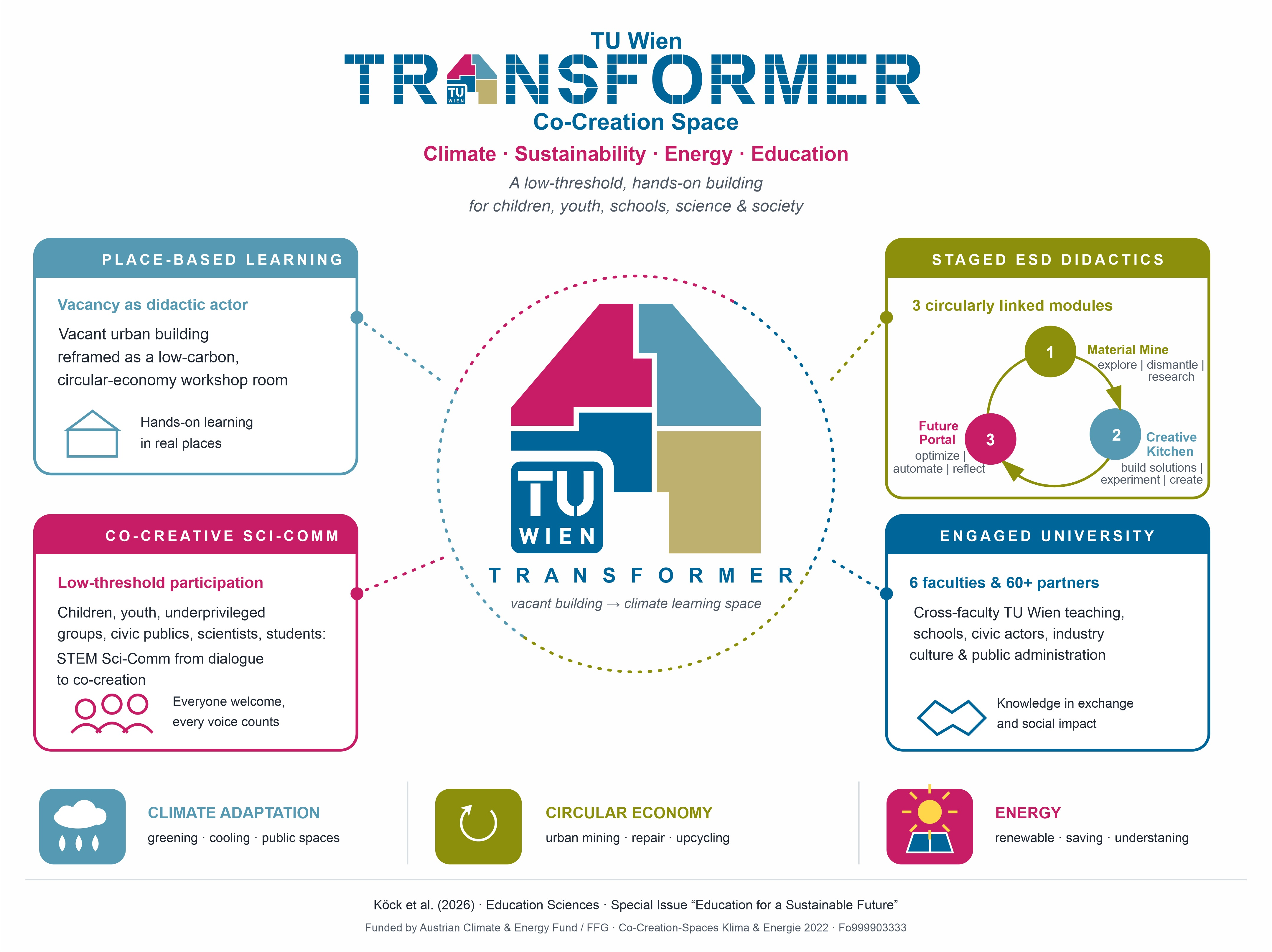
Graphical Abstract

1. Introduction

Climate change adaptation and the transition to sustainable societies demand not only technological innovation but also broad societal capability, civic engagement, and transformative education. The 2030 Agenda for Sustainable Development, adopted by the United Nations General Assembly in 2015, states in its preamble, “This Agenda is a plan of action for people, the planet and prosperity.” At its centre stand the 17 Sustainable Development Goals (SDGs), which describe the most pressing development challenges facing humanity (UN General Assembly, 2015). UNESCO underscores the contribution of education to this vision: “Education can and must contribute to a new vision of sustainable global development” (UNESCO, 2017, pp. 6f). SDG sub-target 4.7 specifically addresses Education for Sustainable Development (ESD): ensuring “that all learners acquire the knowledge and qualifications necessary to promote sustainable development, including … education for sustainable development and sustainable lifestyles, human rights, gender equality, promotion of a culture of peace and non-violence, global citizenship and appreciation of cultural diversity and of culture’s contribution to sustainable development” (UN General Assembly, 2015, p. 18). UNESCO (2017, p. 7) formulates the core message concisely: “Education for Sustainable Development—a key instrument to achieve the SDGs”.
In Austria, ESD is anchored in the education system through the Policy Statement on Environmental Education for Sustainable Development (Grundsatzerlass Umweltbildung für nachhaltige Entwicklung, BMBWF, 2014), which applies to all school levels and types. Yet achieving the ambitions of ESD requires more than curricular adjustments within formal education systems. It demands new learning formats, new institutional roles, and new relationships between knowledge production and societal practice. Universities, as both knowledge producers and societal actors, occupy a distinctive position in this landscape: they possess disciplinary depth, infrastructural resources, and convening power, but they also face persistent challenges in translating these assets into accessible, inclusive, and participatory engagement with broader publics. The National Academy of Sciences (2018) underscores that graduate STEM education must prepare students not only for research but for diverse career paths that require communication, collaboration, and societal engagement. UNESCO (2019) calls for STEM competences that go beyond technical proficiency to include creativity, critical thinking, and ethical reasoning. Penprase (2020) argues that twenty-first-century STEM education must integrate humanistic perspectives to address complex global challenges.
Against this background, the present paper examines the following research question: How does the Transformer project at TU Wien, conceived of as a co-creative, temporary learning space, contribute to sustainability education and STEM science communication? The Transformer is a university-led innovation lab funded under the Austrian Research Promotion Agency (FFG) call “Co-Creation-Spaces Klima & Energie 2022” (Klima- und Energiefonds, 2022; project number FO999903333), operating in a repurposed vacant building in Vienna’s third district. It brings together children, adolescents, university students, researchers, companies, and civil society partners in hands-on, interdisciplinary formats that address climate change adaptation, circular economy, energy literacy, urban mining, and participatory design.
The research question is addressed along four analytical dimensions, each combining theoretical grounding, practical description, and critical reflection:
First, place-based and situated learning (Section 3). The temporary learning space itself—a vacant building activated as a modifiable resource—functions as a didactic actor. Drawing on situated learning theory (Lave & Wenger, 1991) and place-based education, this paper examines how the materiality, temporality, and malleability of the site shape learning processes and lower participation thresholds, complemented by Green Pedagogy approaches (Forstner-Ebhart & Linder, 2018; Wogowitsch, 2012).
Second, staged sustainability education and design-based learning (Section 4). The Transformer’s three innovation modules—Material Mine, Creative Kitchen, and Future Portal—implement a circularly linked learning logic from analysis through design to systemic thinking. This dimension is framed through ESD competence models (Rieckmann, 2021; KMK, 2016; Böse, 2023), Bloom’s revised taxonomy (Krathwohl, 2002), and design-based learning approaches (Heller, 2022), with constructivist principles of knowledge construction through active engagement forming the epistemological foundation.
Third, STEM science communication from transmission to transformation (Section 5). This paper situates the Transformer within a five-stage taxonomy of science communication, examining its co-creative and inclusive practices against empirical evidence on participation barriers and makerspace exclusion dynamics (Metcalfe et al., 2022).
Fourth, the engaged university and third mission (Section 6). TU Wien’s role is analysed not as linear knowledge transfer but as institutional bridge-building through interdisciplinary collaboration, university student involvement as mentors, and a growing partner network (Sanders & Stappers, 2008; Star & Griesemer, 1989).
The Discussion (Section 7) synthesises these four perspectives and evaluates the project against a set of governance criteria for participatory practice. The Conclusions (Section 8) summarise key findings and offer recommendations for practice and policy.

2. Materials and Methods

2.1. Research Design

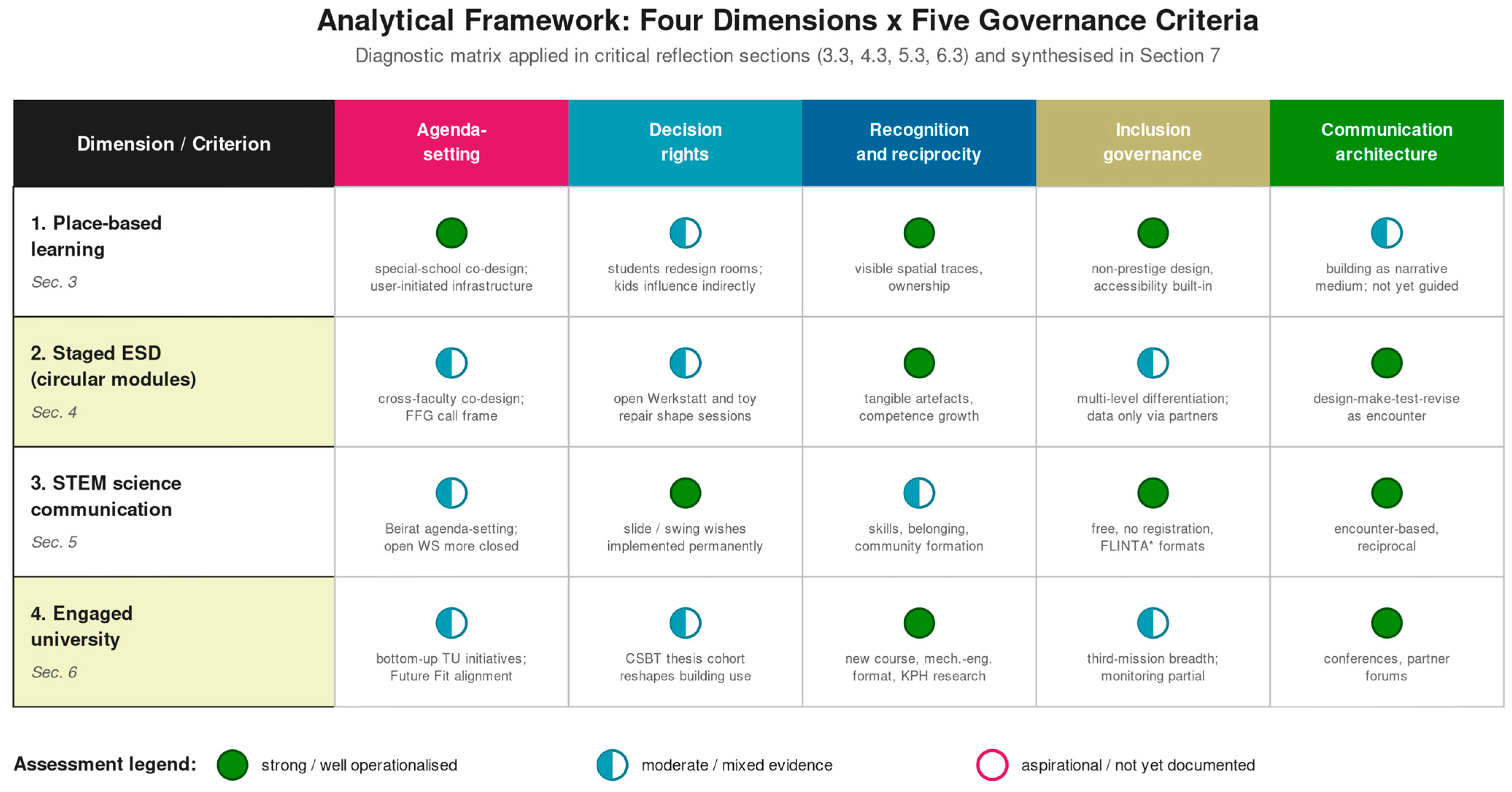
This paper adopts a reflective practice approach (Schön, 1983), combining design-based reasoning with critical self-analysis of an ongoing, co-creative project. The Transformer is not studied from an external evaluative standpoint but examined from within, drawing on the authors’ direct involvement as project designers, facilitators, and researchers. This positioning is appropriate for an innovation lab in its implementation phase, where the primary analytical task is to articulate design rationales, document implementation experiences, and identify tensions between ambition and practice. This paper does not claim external evaluation or controlled impact measurement; its contribution lies in structured reflection grounded in documented project practice and relevant theoretical frameworks. In terms of author positionality, the author team deliberately combines insider and outsider perspectives: most authors were directly involved in designing and facilitating the project, whereas two co-authors, based at a university of teacher education (KPH), were involved neither in the project’s development nor in its practical implementation. They contributed an external educational research perspective throughout the writing process, including the structure of the paper, the methodological frame, and—importantly—the critical review of the qualitative assessments underlying Figure 1 and Table S1. The ratings were derived iteratively: initial self-assessments by the implementing team members were challenged and revised in discussion with these two non-implementing co-authors until consensus was reached. This procedure does not substitute for independent external evaluation—which remains a stated limitation (Section 7.6)—but it introduces a structured outsider check against confirmation bias.

2.2. Data Sources

The analysis draws on the following data sources: (a) project documentation, including the FFG funding application (FO999903333) and progress reports; (b) workshop planning templates that link learning objectives to methods, Bloom-aligned action verbs, and evaluation instruments; (c) protocols and outcomes from three Youth-Plus Advisory Board (JugendPlus) sessions (June 2024, August 2025, April 2026); (d) cooperation documentation, including records from the collaboration with Camillo Sitte Bautechnikum and other partner organisations; (e) participant registration data from the digital system implemented in March 2025; (f) publicly available strategic documents of TU Wien (TU Wien, 2025a, 2025b); and (g) structured field observations conducted by eleven university students across 26 workshop formats involving approximately 250 children and adolescents between March and June 2025, analysed through a mixed-methods approach combining independent LLM-assisted qualitative coding with manual synthesis (Köck et al., 2026; conference poster—see Appendix A). Each source serves a distinct evidentiary function in answering the research question: the funding application and progress reports (a) document the intended design and institutional commitments, providing the baseline against which implemented practice is compared; workshop planning templates (b) make the intended pedagogy explicit and allow the analysis to distinguish between planned and enacted scaffolding; advisory-board protocols (c) constitute the primary documented channel of participant voice and are the main source for assessing agenda-setting and decision rights; cooperation records (d) evidence the depth of partner involvement beyond declarative partnership lists; registration data (e) provide descriptive reach and demographic indicators used in the inclusion governance assessment; institutional strategy documents (f) anchor claims about organisational embedding; and the structured field observations (g) supply the only systematically collected observational evidence on participant engagement and are therefore used with the caveats set out in Section 7.6 and Appendix A.

2.3. Analytical Framework: Governance Criteria for Participation

To maintain analytical coherence across the four thematic dimensions, this paper employs five governance criteria derived from the science communication and participatory research literature. These criteria serve as a diagnostic instrument applied in the critical reflection sections of each thematic chapter (Section 3.3, Section 4.3, Section 5.3, and Section 6.3) and synthesised in the Discussion (Section 7). They are informed by participatory science communication research (Metcalfe et al., 2022) that highlights both the promise and pitfalls of co-creative approaches, including risks of tokenistic participation and bounded inclusion.
(1) Agenda-setting: documented co-definition of problems and success criteria with participants, beyond pre-set thematic framing. (2) Decision rights: explicit participant influence on methods, formats, and outcomes, not limited to topic selection or data collection. (3) Recognition and reciprocity: clear benefit flows back to participants and communities, including skills, resources, visibility, and policy interfaces. (4) Inclusion governance: systematic reduction of participation costs (time, credentials, intimidation, discrimination), monitored over time. (5) Communication architecture: planned encounter-based exchanges (workshops, youth advisory council, co-interpretation), avoiding a dissemination-only model.
The combined application of the four dimensions and the five criteria is summarised in Figure 1 and unpacked in detail in Section 7.2.
A cell-by-cell justification of all 20 assessment values, with cross-references to the manuscript sections in which the underlying evidence is presented, is provided in the Supplementary Material (Table S1).

2.4. The Project in Overview

The Transformer is a TU Wien innovation lab of type B (“non-economically used innovation lab”) funded under the FFG call “Co-Creation-Spaces Klima & Energie 2022” (Klima- und Energiefonds, 2022; project FO999903333). The funded project period runs from 1 December 2023 to 30 November 2026. The project brings together education for sustainable development, co-creation, circular construction, urban mining, energy and digital literacy, participatory spatial design, and gender- and diversity-sensitive practice. The call—and the broader programme line “Junge Talente für die Energiewende” (Young Talents for the Energy Transition)—was informed by (i) the European Strategic Energy Technology Plan (SET Plan), particularly its strand on Energy Education and Training, which frames education as an integral part of the clean energy innovation agenda; (ii) Austria’s FTI-Strategie 2030 (Strategy for Research, Technology and Innovation, Goal 3: “Relying on knowledge, talents and skills”), which foregrounds talent development as a core national innovation objective; and (iii) the European benchmark and indicator framework Education and Training 2020 (ET2020), which couples skills and inclusion as policy targets, aiming, for example, that by 2030, less than 15% of 15-year-olds should be low-achievers in reading, mathematics, and science.
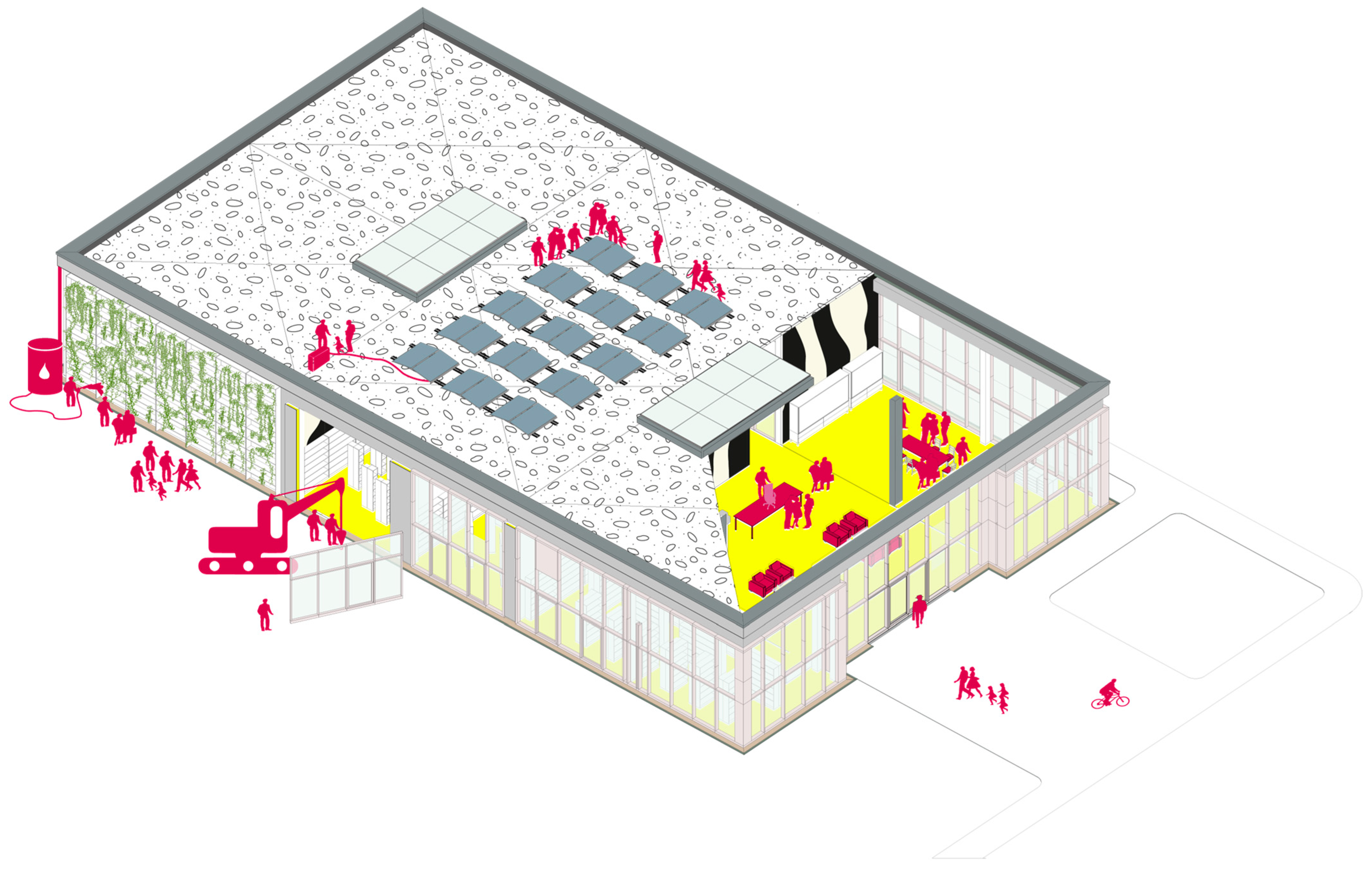
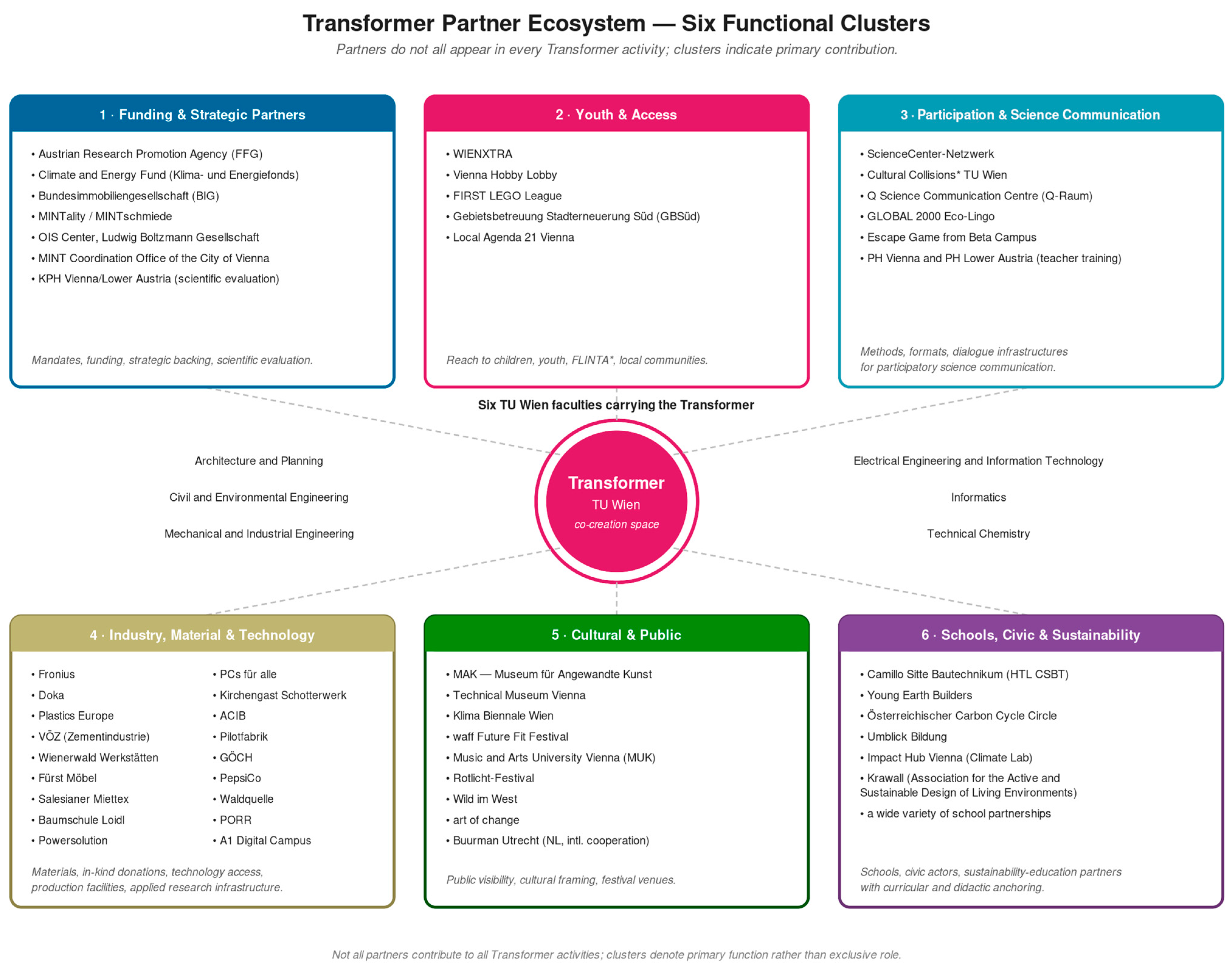
A constitutive feature of the project design is that it is academically carried out by six faculties of TU Wien: Architecture and Planning; Civil and Environmental Engineering; Mechanical and Industrial Engineering; Electrical Engineering and Information Technology; Informatics; and Technical Chemistry. Sustainability issues are deliberately addressed not as single-discipline problems but as technical, ecological, social, and spatial challenges that require the interaction of different forms of knowledge. Figure 2 presents the project’s design intent through an isometric concept visualisation produced during the conceptualisation phase.
Table 1 summarises the project’s primary stakeholder groups, their associated goals, and the formats through which they are addressed.
Regarding participant demographics: the project’s out-of-school formats most readily reach children between 8 and 13 years of age. Adolescents above 13 are considerably harder to engage in leisure-time settings despite dedicated efforts, including school cooperation, age-specific leisure-time channels and formats, and the deliberate take-up of youth trends. Through cooperation with Vienna Hobby Lobby, the project also hosts mixed-age groups spanning primary to lower secondary school (6–15 years), although narrower age bands would be preferable for cognitively demanding topics such as sustainable solutions with robotics. School workshops, by contrast, have been requested and delivered across the entire school career, from the first year of primary school to students shortly before their school-leaving examinations at age 18–19.

3. The Temporary Learning Space: Vacancy as a Didactic Actor

3.1. Theoretical Framework: Place-Based and Situated Learning

The Transformer’s pedagogical approach is grounded in situated learning theory, which conceptualises learning not as decontextualised knowledge acquisition but as participation in authentic practices within communities of practice. Lave and Wenger’s (1991) framework of legitimate peripheral participation describes how newcomers enter a practice through observation and marginal tasks, gradually moving toward fuller engagement as their competence and belonging develop. The repurposed building provides such a community of practice: participants enter through low-threshold activities, encounter real materials and spatial challenges, and progressively take on more complex roles in the making and transformation process.
Complementing this perspective, place-based education emphasises the site itself as curriculum: local contexts, materiality, and the history of a building become learning resources. The Transformer operationalises this principle by treating the vacant building not merely as a venue but as an object of investigation, adaptation, and co-design. Material flows, building structures, and infrastructural systems become directly observable and negotiable, turning abstract concepts of circular economy and resource management into tangible, place-embedded learning experiences. This approach resonates with Green Pedagogy, which emphasises subject-oriented sustainability learning through demanding, process-based learning arrangements in authentic environments (Forstner-Ebhart & Linder, 2018; Wogowitsch, 2012). The concept of affordance further enriches the theoretical framing: the building enables and constrains actions, and its “playability”—the degree to which participants can modify, adapt, and leave traces—functions as a didactic affordance that shapes learning trajectories.

3.2. Implementation: The Building as a Learning Object

The Transformer activates a vacant building as a modifiable resource and turns that very site into an object of learning. The building is not only used as a venue; it is gradually investigated, adapted, designed, and further developed together with children, adolescents, university students, researchers, and external partners. This creates low-threshold access to university knowledge and new forms of dialogue between science and everyday life; indications of community-building in the neighbourhood are documented in the repeated-visitor patterns in the registration data, the growth of the JugendPlus advisory board, and partner-initiated follow-up projects (Section 5.2 and Section 6.3). The Transformer is thus not a conventional workshop programme in a neutral room but a materially tangible co-creation space in which the outcomes of educational and design processes become directly visible in the built environment.
The vacancy is intentionally treated as a malleable environment, closer to a “playable” design laboratory than a fixed classroom. This connects to scholarship on adventure playgrounds, which emerged from children’s autonomous play on building sites and vacant land and were conceived as environments where children can build, unbuild, and remake with light supervision, supporting experimentation, risk-taking, and learning through trial and error rather than enforcing predetermined uses of space (Russell et al., 2021). Related work on junk playgrounds frames play as an anti-aesthetic practice that can legitimately unfold in “leftover” and non-prestigious spaces, precisely because such settings enable imaginative appropriation of found materials instead of policing established aesthetic norms (Papastergiou, 2020). Educational research on learner-led and co-designed learning spaces further shows that giving learners meaningful influence over shared spaces can strengthen ownership and agency and help them articulate how spatial conditions affect wellbeing and participation (Hancock et al., 2023).
Within the Transformer, this logic is operationalised by treating parts of the building as legitimately “changeable” at multiple scales of intervention. At the structural scale, partner organisations have co-designed substantial alterations: in cooperation with a special-needs school, accessible sanitary facilities and the removal of selected interior walls were jointly planned and built, anchoring barrier-free use as a co-defined infrastructural goal rather than a retrofit. At the level of permanent installations, children’s wishes have driven concrete additions: a slide installed in the workshop space and—currently in construction together with the Young Earth Builders initiative—a balance-track route to the sanitary facilities both originated from explicit participant requests for more active, hands-on, body-based interaction with the building. At the level of furnishings and zoning, university students lead frequent reconfigurations (small workshop rooms, entrance area), while children’s input shapes design indirectly through observed needs: rally-style explorations during the third advisory-board session voiced a desire for more play areas, while embedded observation revealed sensory overload in the large workshop room; the team responded by introducing more enclosed elements with “surprise effect” upon opening and planning tactile, removable indicator objects on each saw that show—at child-eye level—what each tool can produce. The building effectively becomes a self-made playground that grows with participants’ projects rather than remaining a polished venue that participants must “fit into.”
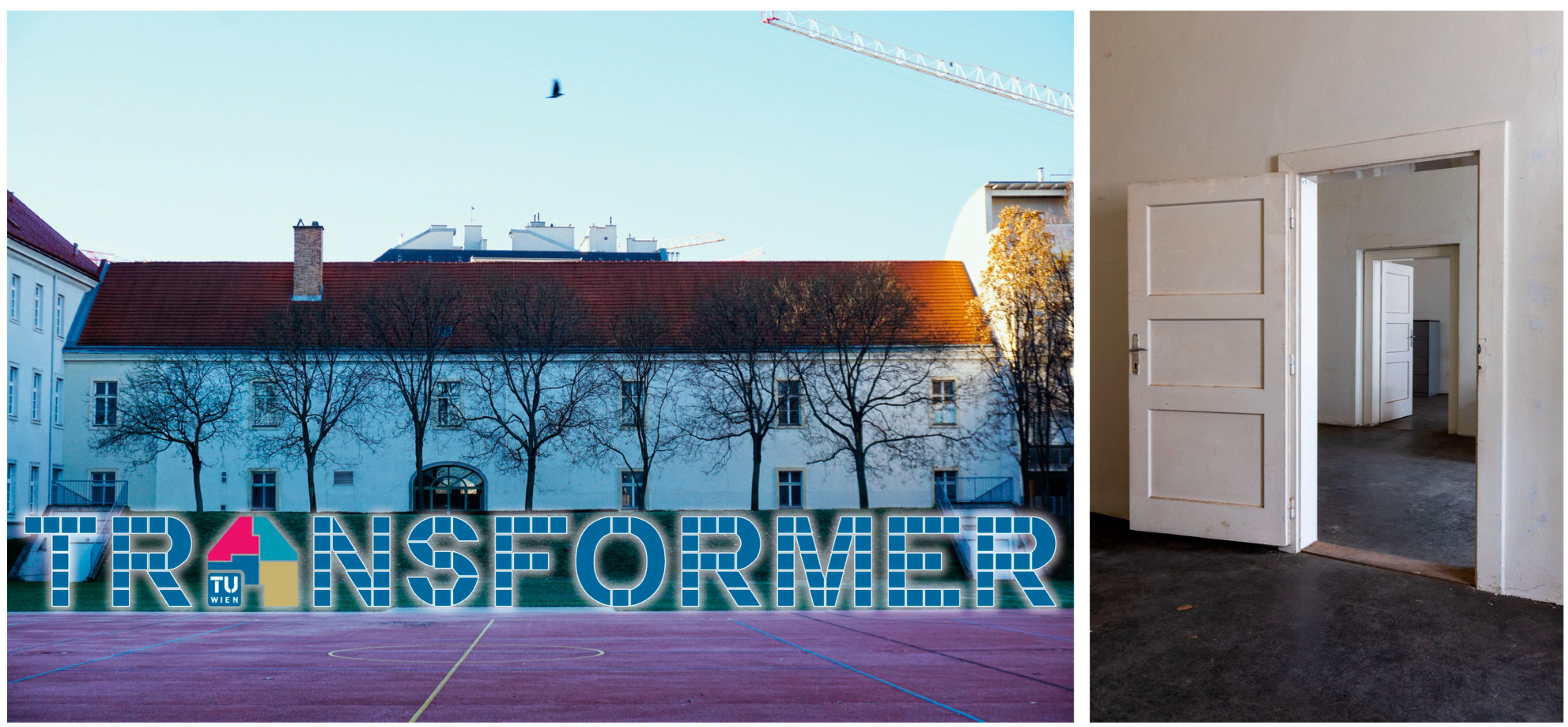
The vacancy’s visibly “as-found” character lowers participation thresholds. Aged surfaces and reused furnishings signal that iteration, mess, and imperfect first attempts are expected and acceptable, reducing fear of “damaging” a prestige location and supporting a more exploratory creative process. This is consistent with evidence from makerspace research indicating that first-time users can feel like intruders and that environments perceived as “sterile” and dominated by expensive machines can heighten anxiety about “messing it up”, thereby discouraging experimentation (Melo & Rodney, 2023). Figure 3 illustrates the building’s exterior with the project’s distinctive lettering and the as-found interior at the start of the project.
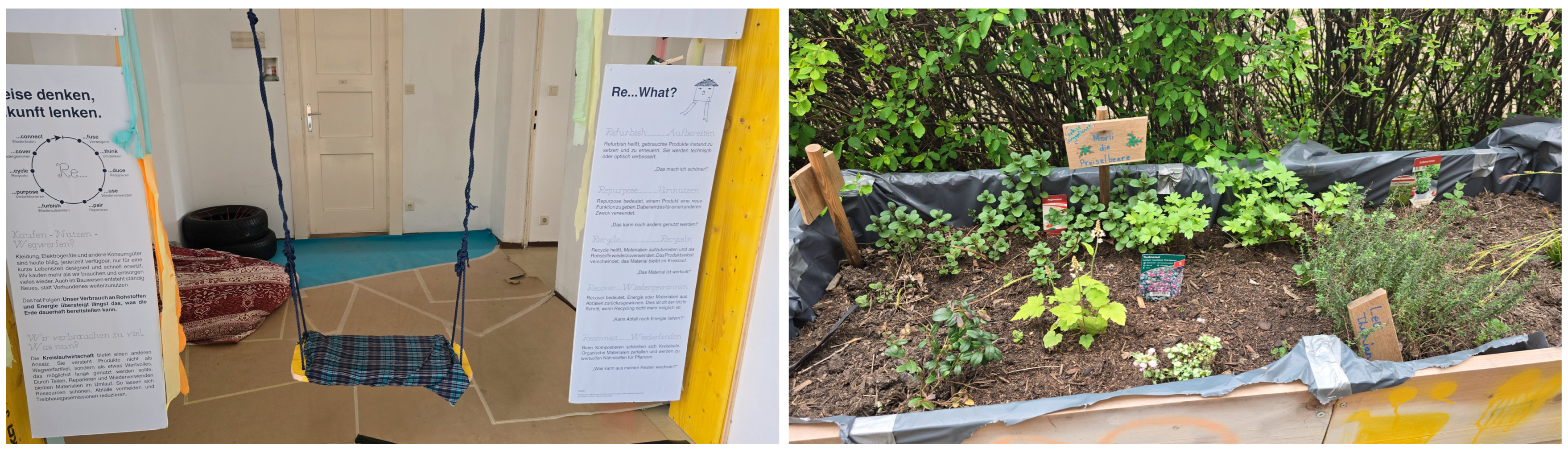
User-driven additions to the building are increasingly visible. A swing—originally requested by participants in the first JugendPlus advisory board (June 2024)—was built collectively in subsequent workshops and now functions as a permanent installation; in the third advisory board (April 2026), participants documented this swing as a “Wohlfühlort” (Wohlfühlort) in their own photographs. A raised garden bed was likewise built and planted in workshops and similarly photographed by participants as a positive site of the Transformer. Figure 4 reproduces two of these participant-taken photographs, illustrating both the participatory design heritage of these elements and the methodological practice of having young people themselves document the spaces they value.
The Transformer also deliberately integrates opportunities for urban nature contact and co-stewardship. Through creating a garden and vertical greening behind the building based on participants’ own ideas and needs, learners gain nature experience through STEM activities. This educational stance is compatible with evidence that connection to nature and place attachment are associated with pro-environmental action (Daryanto & Song, 2021; Whitburn et al., 2020). Specific kinds of nature contact—especially regular visits—relate to both wellbeing and pro-environmental behaviour (Martin et al., 2020; Nisbet et al., 2009).

3.3. Critical Reflection: Spatiality and Temporality

The temporality of the learning space presents both opportunities and risks. On the one hand, the finite project duration (December 2023 to November 2026) creates a sense of urgency and experimentation that supports low-threshold, iterative engagement (the iterative logic is unpacked in Section 4.1). On the other hand, temporality raises questions about continuity and long-term impact: What happens when the building is no longer available? Can the relationships, competencies, and community structures built during the project period be sustained beyond it? The project’s funded timeframe does not resolve this tension but makes it explicit as a design challenge for university-led innovation labs.
The vacancy also entails limits of changeability. Safety requirements, structural constraints, and building-owner specifications circumscribe the degree to which participants can modify the space. While this tension is managed through facilitation and safety concepts, it illustrates a broader governance question: who ultimately decides how the space is changed, and to what extent do participants hold genuine decision rights (agenda-setting and decision-rights criteria) versus operating within parameters defined by institutional actors?
Regarding transferability, the principle of “vacancy as learning space” is not inherently tied to this particular building or urban context. However, the conditions that enabled the Transformer—a willing building owner, institutional backing from a university, and dedicated funding—are not universally available. Whether and how the model can be adapted to different regional infrastructures and target-group realities is currently being explored through a satellite location in Melk (Lower Austria) with Fürst Möbel.

4. Staged Sustainability Education: The Circular Learning Logic of Material Mine, Creative Kitchen, and Future Portal

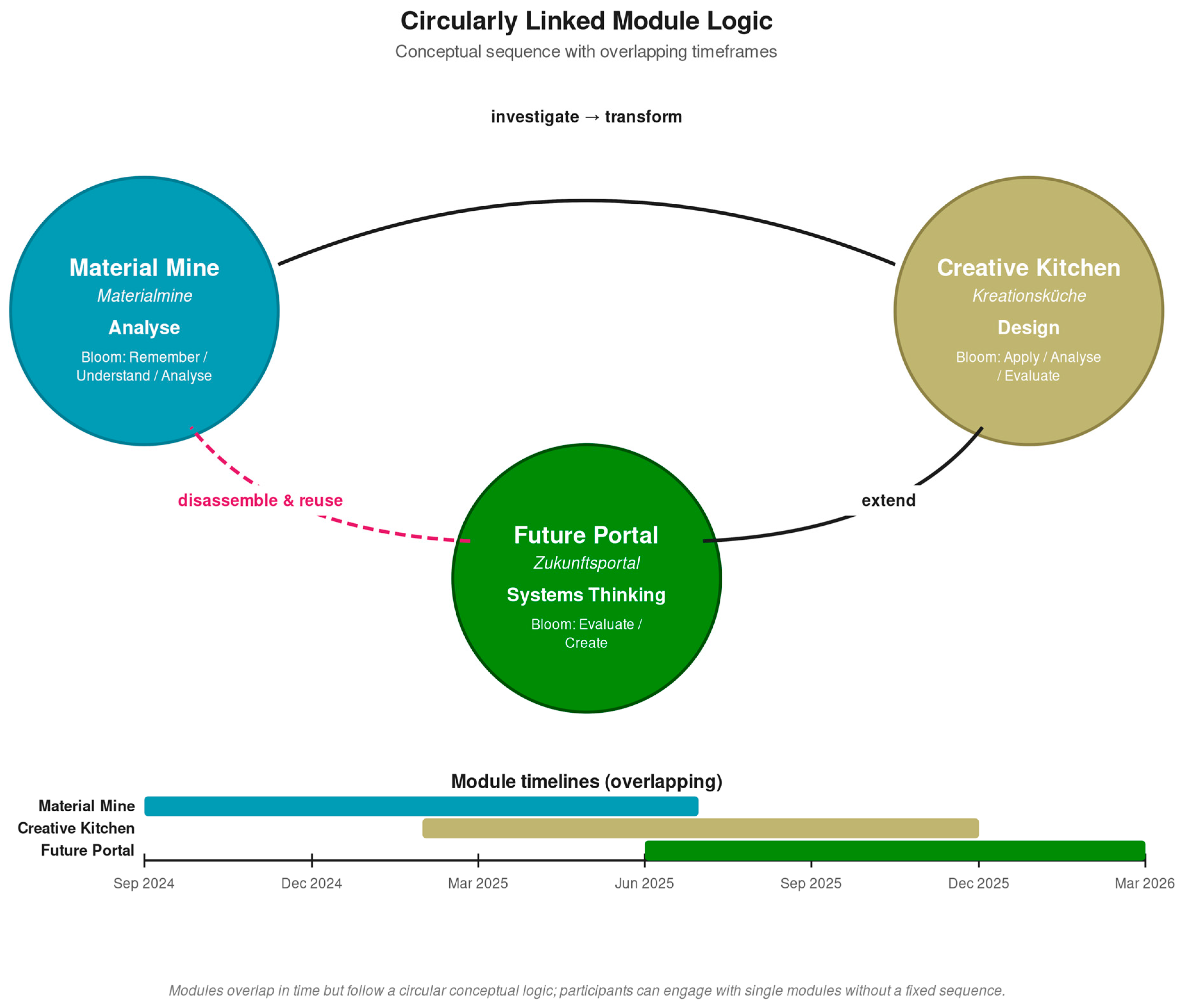
The three innovation modules of the Transformer were not pre-defined externally but co-developed within the cross-faculty project team: while the funding call (Klima- und Energiefonds, 2022) provided a strategic frame, the concrete module logic (Material Mine, Creative Kitchen, Future Portal) and its didactic sequencing were determined through internal co-creation workshops using methods such as Lego Serious Play and World Café formats. This origin in shared, embodied design conversations is reflected in the module logic itself, which is open to ongoing reshaping in response to participants’ interests. Figure 5 summarises the resulting circularly linked module logic and the modules’ overlapping activity timeframes.

4.1. Theoretical Framework: ESD, Gestaltungskompetenz, Design-Based Learning, and Constructivist Foundations

Sustainable action encompasses more than environmentally responsible living. The Brundtland definition established that “sustainable development is development that meets the needs of the present without compromising the ability of future generations to meet their own needs” (World Commission on Environment and Development, 1987). Sustainable action depends on the private, public, and political spheres (Holzbaur, 2020, pp. 14, 230). In the four domains of nutrition, consumption, mobility, and housing, individuals can significantly influence their greenhouse gas emissions. The development of sustainability competencies and engagement with sustainability-relevant values are therefore central (Rieckmann, 2021). Within ESD there is a need to “develop fundamental competencies for a future-oriented shaping of private and professional life, for participation in society, and for shared responsibility in a global framework” (KMK, 2016, p. 14).
Böse (2023) provides an overview of competence models for action competence for shaping sustainable development (Gestaltungskompetenz). The German Standing Conference of the Ministers of Education and Cultural Affairs (KMK, 2016, pp. 88, 90f) names eleven core competencies in the Curricular Framework for Global Development (Orientierungsrahmen Globale Entwicklung) across the areas of recognition, evaluation, and action, guiding learners on the path from knowledge to sustainable action. Recognition refers to purposeful knowledge acquisition through research and information gathering. Evaluation involves assessing information, adopting different perspectives, and engaging in critical reflection. Action encompasses motivational components, successful action, and learning from failure.
The development of effective Sustainability Competencies—the ability and willingness to pursue sustainability goals on the basis of informed decisions—is inconceivable without the capacity for knowledge acquisition, analysis, and evaluative competence. Rieckmann (2021) identifies didactic principles for implementing ESD, including learner-centredness, accessibility, action and reflection orientation, transformative and transgressive learning, and participation orientation. The Whole School Approach positions ESD as a concern of the entire school community, encouraging learners to become “change agents who possess the knowledge, means, willingness, and courage to take transformative action for sustainable development” (DUK, 2021, p. 28). More broadly, Rieckmann et al. (2026) provide a comprehensive handbook on ESD that underscores the interdisciplinary and systemic character of sustainability learning.
ESD must encompass not only formal but also non-formal and informal education, including out-of-school learning. The KMK (2024, p. 11) underlines that “holistic perspectives, cross-disciplinary problem analysis, and systemic approaches are facilitated particularly through cross-curricular learning, the inclusion of out-of-school learning sites, and cooperation with external partners”. Grothaus et al. (2025, pp. 693–697) understand out-of-school climate education broadly as “learning opportunities that, beyond the respectively usual, institutionally established learning programmes in schools, training, and continuing education, offer climate education goals for children, adolescents, or adults”. They affirm that knowledge alone represents a necessary but not sufficient precondition for action and that out-of-school learning sites are particularly effective for promoting specialist knowledge, interest, and motivation.
For the design of such out-of-school learning sites, co-creative approaches can help overcome hierarchical barriers, address challenges, develop innovative solutions, and make decisions. They can foster critical thinking and social competencies—essential future skills in a dynamic society. Jörissen and Grein (2025, p. 15) identify as particularly decisive the opportunity, through co-creation, “to learn about ourselves and about the things we want to achieve together”. Michalik (2024, p. 11) emphasises a similar dimension of mutual learning in co-creative formats.
The Transformer’s learning design draws on design-based learning as a core pedagogical mechanism. The iterative “design–make–test–revise” cycle supports higher-order reasoning: comparing alternatives, working with constraints, and improving outcomes while staying anchored in real artefacts and contexts. Evidence from maker-education research shows that well-structured making activities can strengthen critical thinking tendencies and learning performance, particularly when reflection is intentionally scaffolded (Wang et al., 2024). Integrating an engineering design process into makerspace learning has been shown to foster students’ systems-thinking skills, suggesting that prototyping can function as a vehicle for reasoning about complex socio-technical and environmental systems rather than merely producing artefacts (Abdurrahman et al., 2023; Ioannou & Gravel, 2024).
Epistemologically, this approach rests on constructivist foundations. Learning is understood not as the passive reception of transmitted knowledge but as the active construction of understanding through engagement with authentic problems, materials, and social contexts. The situated learning framework already referenced positions knowledge as inseparable from the practices and communities in which it is developed (Lave & Wenger, 1991). In parallel, the Transformer follows a constructionist logic of making, experimenting, and reflecting that is well established in engineering and design education (Blikstein et al., 2017), where knowledge is constructed through the creation of tangible artefacts in social settings. This constructivist orientation also informs the participatory action research perspective adopted in the Transformer: children and young people are seen as co-researchers, and knowledge is constructed through social exchange and action. The products developed generate self-confidence and self-efficacy through their scientific or social relevance. In this framing, the Transformer does not merely “deliver” sustainability content but creates conditions under which learners actively construct sustainability-relevant knowledge, competencies, and identities through practice.
The competence orientation aligns with sustainability competence frameworks highlighting systems thinking, anticipatory competence, normative competence, strategic competence, and interpersonal competence as core capacities for addressing sustainability challenges (Wiek et al., 2011). To ensure coherence across diverse formats and age groups, the Transformer’s programme logic follows a backward-design rationale (Wiggins & McTighe, 2005): the team first defines goal structures, then operationalises them into workshop formats with clear learning outcomes and evidence criteria, ensuring alignment between intended outcomes, learning experiences, and evaluation. For structuring cognitive demand, the programme design employs Bloom’s revised taxonomy as a scaffold for progressing from foundational knowledge toward higher-order thinking. Krathwohl (2002) reframes the original categories into Remember–Understand–Apply–Analyse–Evaluate–Create and supports outcome-aligned objective design and assessment planning. To capture a competence particularly central to co-creation spaces—collaborative action and shared problem solving—the programme also draws on Heller (2022), who argues that collaboration is essential for contemporary learning and proposes adding “Collaborate” (positioned between Apply and Analyse and/or treated as a cross-cutting feature) to make collaboration visible in both learning design and assessment. This extension makes explicit that higher-order reasoning can be developed through collaborative interpretation, critique, negotiation, and co-production, precisely the practices that occur when learners jointly frame problems, test prototypes, and discuss sustainability trade-offs.

4.2. Implementation: Three Modules as a Coherent Didactic Programme

The three innovation modules—Material Mine, Creative Kitchen, and Future Portal—are conceived as circularly linked modules with overlapping timeframes. Conceptually, the modules form a circular learning logic, investigating, transforming, and further developing: first, materials, products, building components, and resource relations are analysed; next, new creations and spatial interventions are developed on that basis; finally, these are extended through energy, digitalisation, and automation perspectives. This sequence—co-created as described at the opening of this section—deliberately mirrors the cognitive progression of Bloom’s revised taxonomy (Krathwohl, 2002): Material Mine foregrounds remembering, understanding, and analysing; Creative Kitchen activates applying, evaluating, and creating through design work with the analysed materials; and Future Portal extends these operations towards systems-level evaluation and creation. This circular linkage—outputs of one module becoming inputs of another—makes systems thinking a structural property of the programme rather than merely a topic within it: participants experience material loops, feedback, and interdependence performatively, not only conceptually. After their use phase, outputs can again be dismantled, reflected upon, and fed back into the cycle (Material Mine → Creative Kitchen → Future Portal → back to Material Mine). Chronologically, the modules run partly in parallel (Material Mine: September 2024–July 2025; Creative Kitchen: February 2025–December 2025; Future Portal: from July 2025 onwards), so participants can engage with individual modules without a fixed sequence while still encountering the circular logic across formats.
Workshop concepts—including objectives, choice of methods, and the depth of knowledge development—are adapted to the respective age group. The format “electricity from painting and kneading”, for example, is offered from the first year of primary school up to the ninth grade; depending on prior knowledge, facilitators adjust the depth and complexity of the experiments, from testing different conductive materials and building simple switches to deriving the underlying physical principles, including reflection on the relationships expressed in formulas. Age-differentiated scaffolding is equally visible in project work: in a self-built pumped-storage power plant project—initially developed by a mechanical engineering student as part of a university project thesis—the conception, electronics, and construction were carried out by older girls during a holiday camp, while younger children contributed to fine-tuning and design and gained insights through use. Similarly, a converted exercise bicycle that enables playing a video racing game through physical movement (controlled by a microcontroller) is used in an age-differentiated way: with younger children, the focus is on playing and making energy conversion tangible through their own bodily effort, whereas with older participants, the underlying microcontroller code can additionally be examined and modified. The energy credit system illustrates this iterative adaptation: the original concept—participants earning credits through energy generation and energy saving—proved too demanding in practice and did not create the intended engagement. It was therefore redesigned after piloting into a playful system with an individual pass for each participant, which primarily motivates participants to attend workshops from different thematic areas and collect points across them.
  • Material Mine (September 2024–July 2025): Analysing—Bloom: Remember/Understand/Analyse
The Material Mine forms the analytical starting point. It focuses on circular economy, urban mining (Koutamanis et al., 2018), and a systemic understanding of resources across their full life cycle. Children and adolescents investigate materials and everyday objects, dismantle products, analyse building and usage contexts, and engage with the ecological, economic, and social impacts of material flows. Thematically, this ranges from life-cycle analysis and the city as a material bank to digital resources and the energy consumption of seemingly “immaterial” systems. The aim is to build capacities for perception, analysis, and evaluation. Participants understand that products and infrastructures do not simply “exist” but result from complex relations between materials, energy, and labour. Dismantling, sorting, collecting, and documenting create a material depot that serves as the physical basis for the following modules.
The “de-blackboxing” approach—opening devices, dismantling components, tracing functional principles—develops an applied understanding of how technologies work and how design choices shape environmental impacts (repairability, modularity, material intensity, feasibility of reuse and recycling). Research on technology-related anxiety indicates that greater technology experience and higher self-efficacy are associated with lower anxiety and that structured learning support can reduce technology-related learning anxiety via strengthened self-efficacy (Cazan et al., 2016; Chai & Sha, 2025). Makerspace-based learning yields measurable gains in technology self-efficacy (Andrews et al., 2021), and design-for-repair research shows that increasing perceived self-efficacy (“repair can-do attitude”) supports willingness to repair (van den Berge et al., 2023), an important behavioural precursor for circular practices.
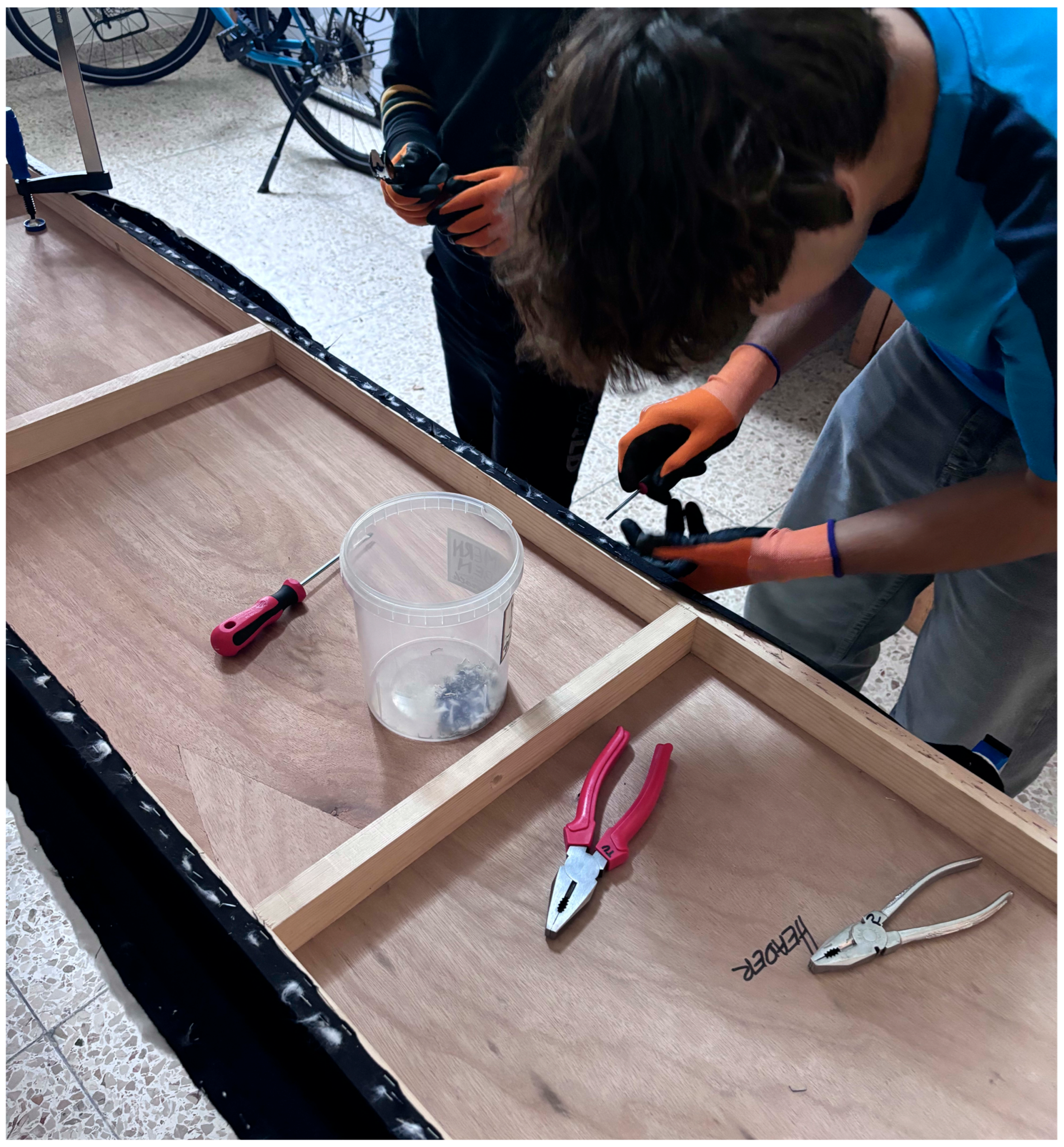
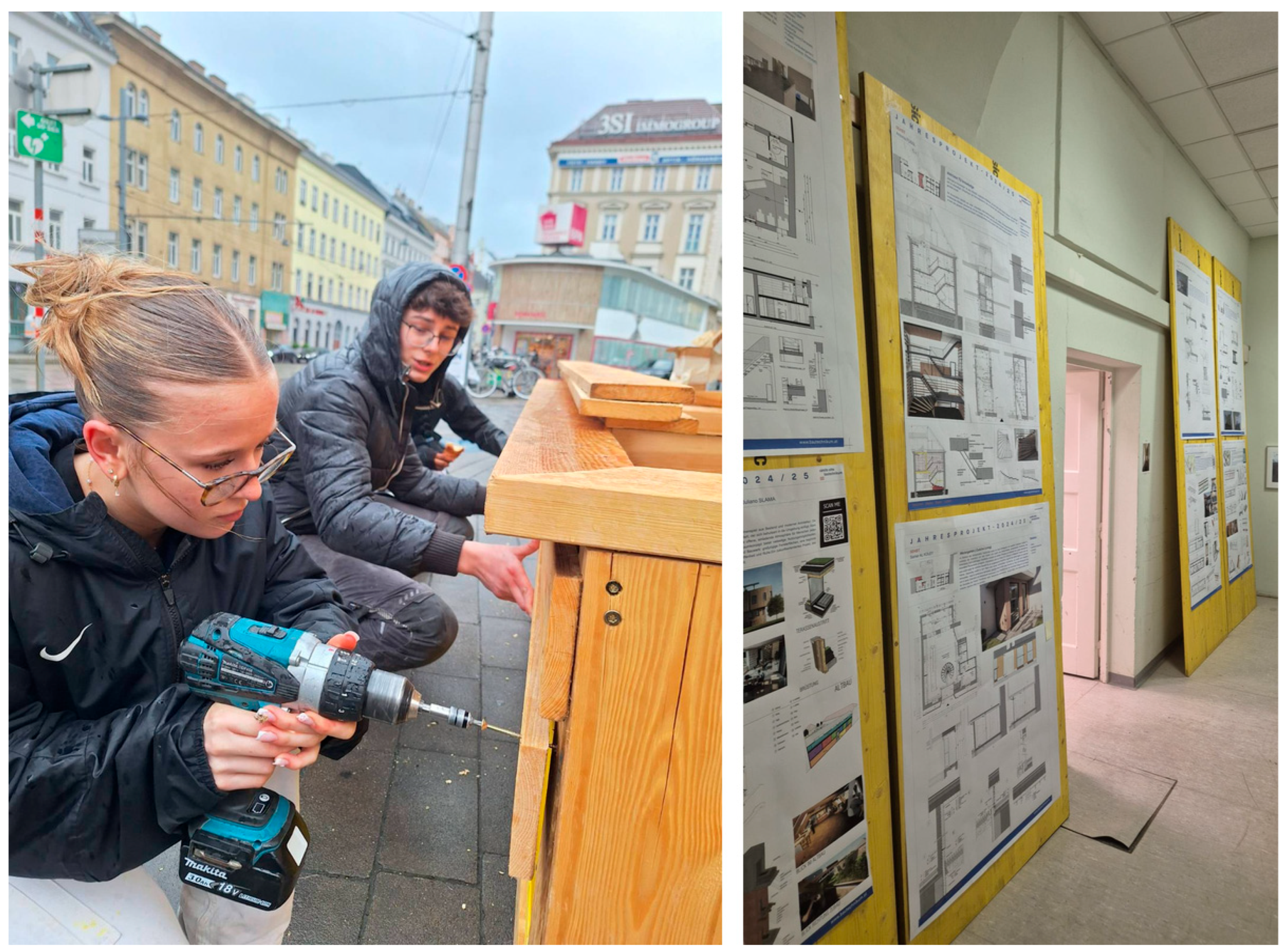
For example, in waste collection campaigns, children gather discarded materials in their neighbourhood and then collectively disassemble them by, for example, separating Tetra Paks into paper, aluminium layers, and plastic caps. These separated fractions become resources for further making: shredded plastic caps (similar to ironing beads) are transformed into pendants, aluminium sheets are shaped into miniature buildings or plant containers, and recovered paper is recycled and reprocessed. A further thematic focus lies on product life cycles and material comparisons: interactive stations allow participants to explore plastics in comparison to other materials across everyday objects, textiles, and packaging—building on findings from the FFG Talente Regional project CirKuS on Circular Plastic in Schools. In a complementary format, participants trace the life cycle of a smartphone, using decommissioned materials and components sourced from TU Wien’s own inventory through the Cultural Collisions initiative (TU Wien, 2024), connecting hands-on investigation with circular economy thinking and the analytical objectives of the Material Mine. Figure 6 illustrates a typical Material Mine activity: adolescents dismantling a discarded exhibition canvas donated by the Museum of Applied Arts into its constituent layers.
Structured field observations across 26 workshop formats confirm that abstract climate concepts become tangible through direct material engagement: children understood CO2 emissions significantly better through hands-on shell experiments on ocean acidification than through theoretical explanations, and upcycling projects led to measurable awareness of circular economy principles (Köck et al., 2026).
  • Creative Kitchen/Kreationsküche (February 2025–December 2025): Designing—Bloom: Apply/Analyse/Evaluate
In the Creative Kitchen, the focus shifts from analysis to design and implementation. Materials, components, and knowledge generated in the Material Mine are translated into concrete projects: furniture, greening systems, repair and upcycling formats, interventions in the building and public space, or new educational and design prototypes. The Creative Kitchen is the productive core of the Transformer, where children and adolescents actively shape the space and experience that sustainability is not only about criticising existing conditions but about practically developing and testing alternatives. The open workshop format, including a “licence system” for tools, machines, and devices, strengthens the ability to work independently, safely, and responsibly.
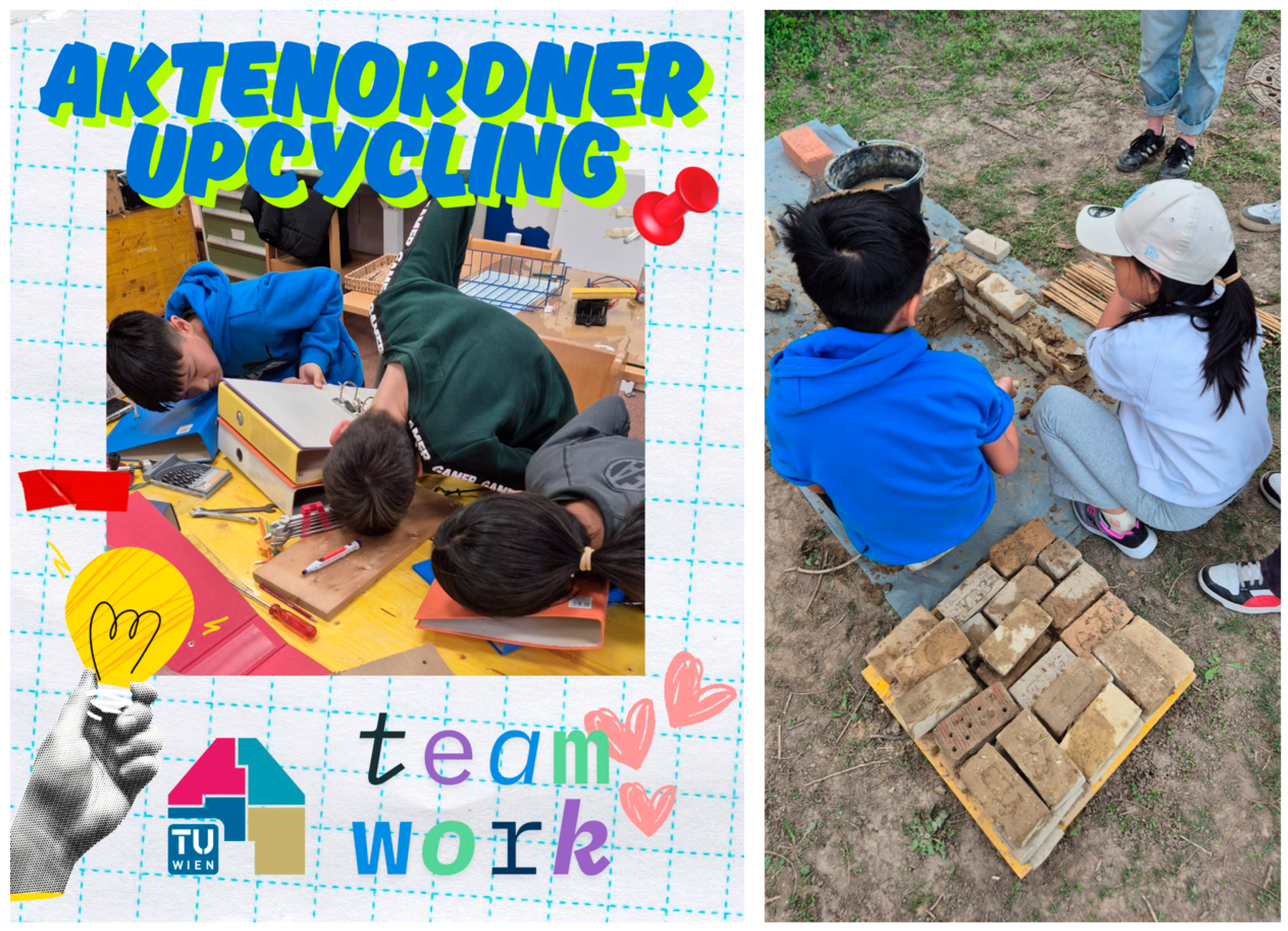
Two recurring formats illustrate the module’s open, adaptive logic. The open workshop (offene Werkstatt) deliberately leaves both materials and sequence to participants and facilitators on the day; concrete activity emerges from what participants bring with them and what catches their interest. The Repair Your Toy (Reparier dein Spielzeug) format is structurally adaptive: which devices are diagnosed and repaired, which techniques are demonstrated, and which sub-skills are practised depend entirely on the toys that participants bring along, turning each session into a different micro-curriculum. Two further examples illustrate the module’s range, indoors and outdoors (Figure 7): an upcycling workshop in which donated office binders provided by GÖCH were transformed by children into a tested stool and clay-based earth-building activities in the Transformer garden in cooperation with Young Earth Builders (Young Earth Builders, 2025), in which participants prototype with mineral materials.
Circular economy thereby becomes tangible as lived practice: materials no longer needed are treated not as waste but as starting points for new uses. Concrete examples of public-space interventions include the Grünes Parklet (Green Parklet)—a publicly accessible community terrace designed and built in a parking lane in front of the Camillo Sitte Bautechnikum using upcycled materials, developed through a student design competition in cooperation with the school (cf. Section 6)—and the creation of greened seating installations at Fasanplatz in the third district, implemented together with Grätzllabor and the Gebietsbetreuung Stadterneuerung (GB*). These projects illustrate how the Creative Kitchen extends beyond the Transformer building into the surrounding neighbourhood, making sustainability interventions visible and tangible in public space.
  • Future Portal/Zukunftsportal (from July 2025): Systems Thinking—Bloom: Evaluate/Create
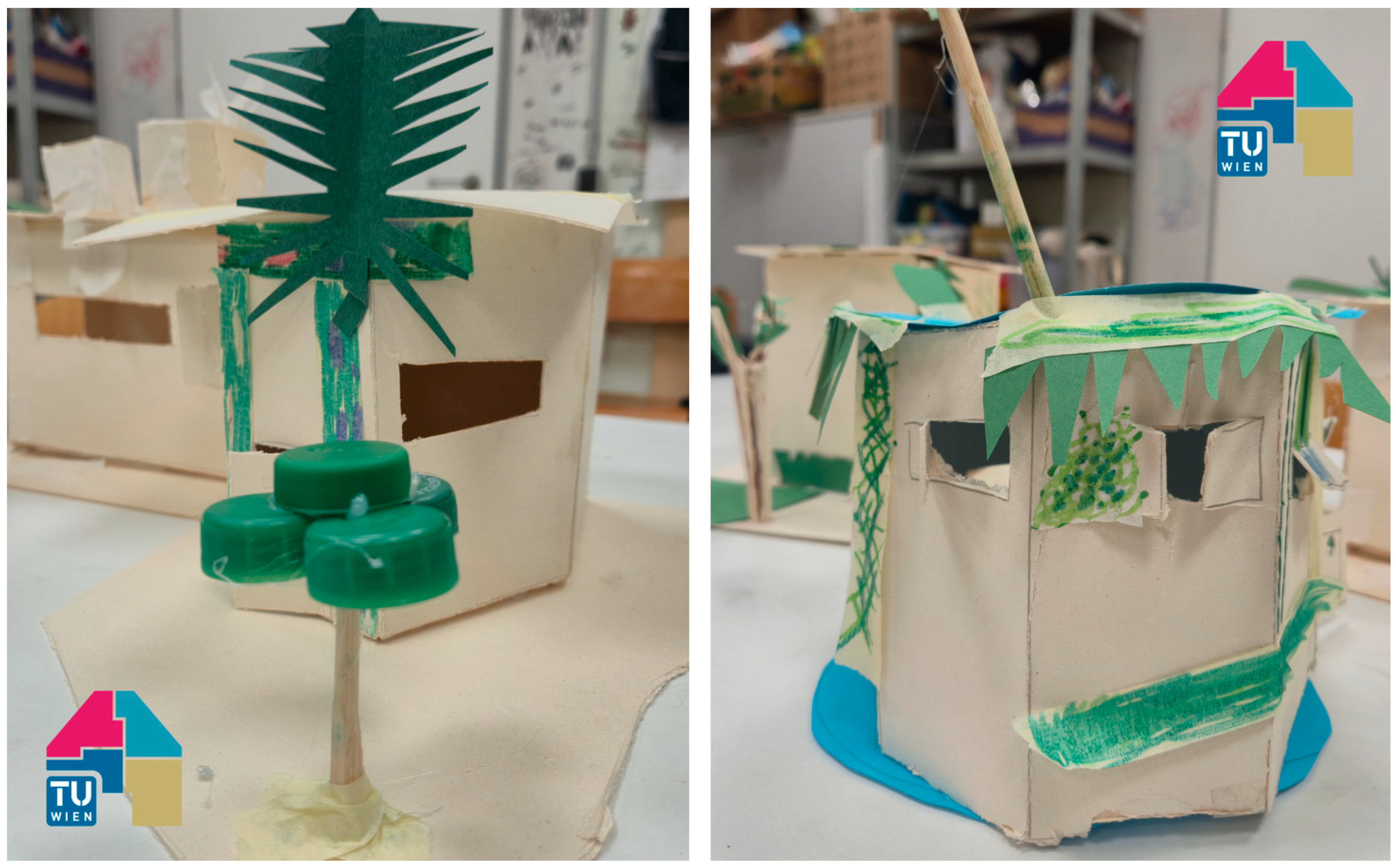
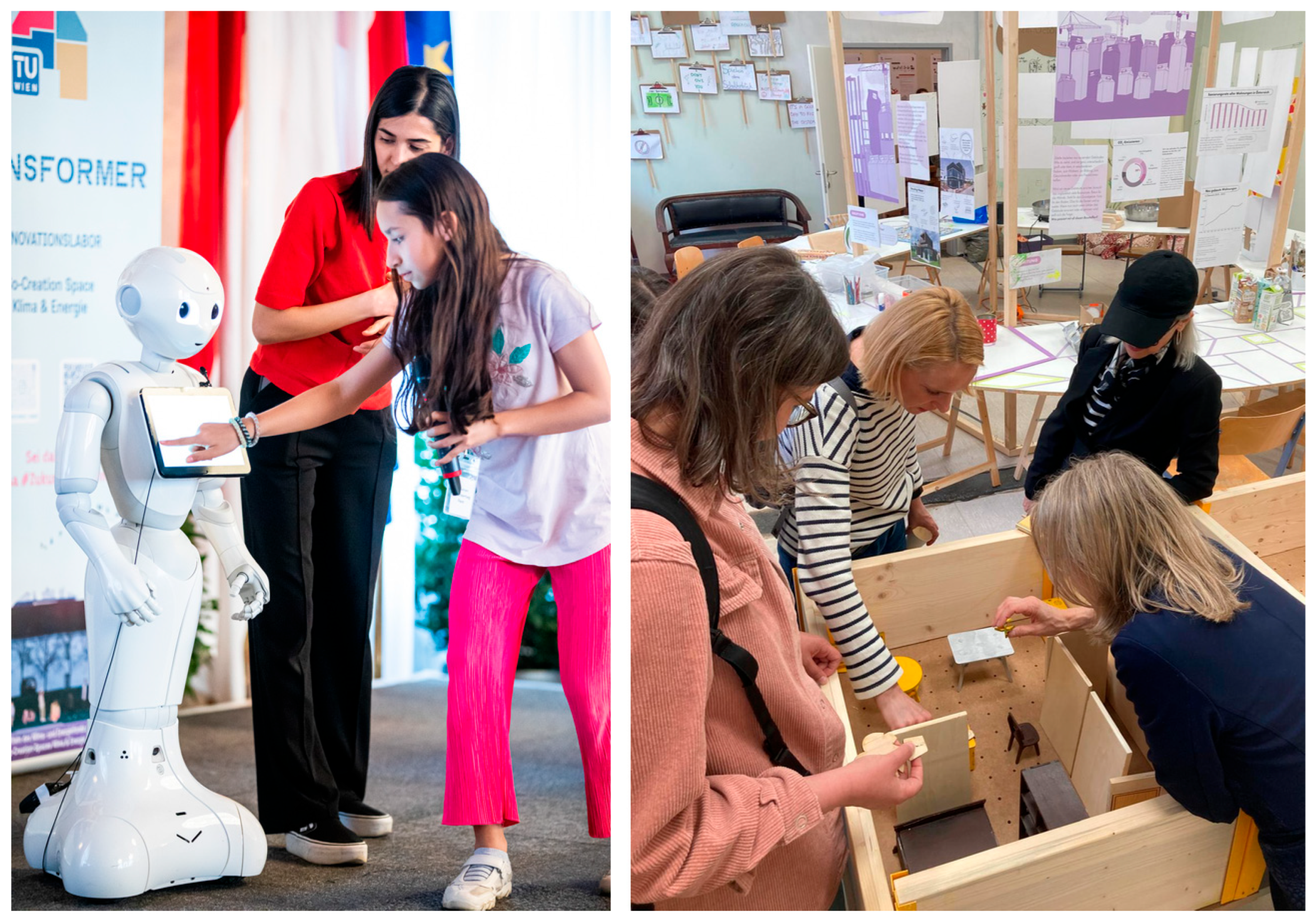
The Future Portal builds on the material outcomes of the Creative Kitchen and expands them through energy, digitalisation, and automation perspectives. The focus is on how existing creations can be technically further developed, energetically optimised, or complemented by digital components. Examples include the energy-credit system, forms of manual energy generation, the integration of renewable energy systems, automated irrigation or control solutions, and the critical reflection on the resource consumption of digital applications. The aim is to convey energy not as an abstract background variable but as a resource that can be experienced, negotiated, and shaped. Children and adolescents understand that digital and automated systems always have material and energetic preconditions. The module extends competences developed earlier by adding reflection and judgement in the field of tension between technology, climate, resources, and everyday life. For instance, in the workshop Vienna of the Future (Wien der Zukunft), children take on the role of urban planners and work on real problems such as climate adaptation and energy use in their neighbourhoods, practising critical thinking and participation in tangible urban planning challenges. Figure 8 reproduces two child-built cardboard models from this format, exemplifying how participants combine visual design, recycled materials, and explicit climate-adaptation features (vertical greening, shading, water elements).

4.3. Critical Reflection: Modular Continuity

The circularly linked modular logic presupposes that participants engage with the Transformer over an extended period and experience the full sequence from analysis through design to systemic thinking. In practice, however, many children and adolescents may participate in individual workshops without traversing the full module logic. Whether the intended progression from Material Mine through Creative Kitchen to Future Portal is realised in individual learning biographies depends on continuity of participation, a condition that is structurally challenging in a voluntary, out-of-school setting. To help address this issue, in addition to individual workshops, term-long courses in partnership with Vienna Hobby Lobby focusing on disadvantaged children and young people are offered; one current example is the Girls Club Robotics.
Evidence for actual competence development is beginning to emerge. A systematic field observation study, in which eleven university students embedded as observers documented 26 workshop formats with approximately 250 children and adolescents between March and June 2025, identified six empirically grounded design principles for successful climate education in makerspace-like settings: (i) material literacy for climate understanding; (ii) productive failure as resilience training; (iii) scaffolded freedom (balancing open-ended tasks with clear microstructures); (iv) technology as a bridge to sustainability; (v) multi-level differentiation for mixed-age groups; and (vi) community learning as social infrastructure (see Appendix A). The study indicates that iterative design processes promoted problem-solving competence—children whose initial attempts failed demonstrated higher persistence and more creative solution approaches—and that projects with local relevance (urban gardening, vacant-space transformation) appeared to be, in the observers’ assessments, particularly conducive to fostering action competence rather than climate anxiety. The workshop planning templates include evaluation instruments aligned with learning objectives, but systematic evidence of longitudinal competence gains has not yet been collected. This is an acknowledged limitation; the reflective-practice framing of this paper does not claim otherwise.
Regarding governance: the three-module structure and its thematic sequencing were designed by the project team. Participants influence specific workshop content and how the space is used within modules, but the overarching programme architecture reflects institutional design decisions. The degree to which the agenda-setting and decision-rights criteria are met thus varies: within individual workshops, participant voice shapes outcomes; at the programme architecture level, design authority remains with the university team.

5. Co-Creation as STEM Science Communication: Low-Threshold Participation with Structurally Excluded Groups

5.1. Theoretical Framework: From Transmission to Transformation

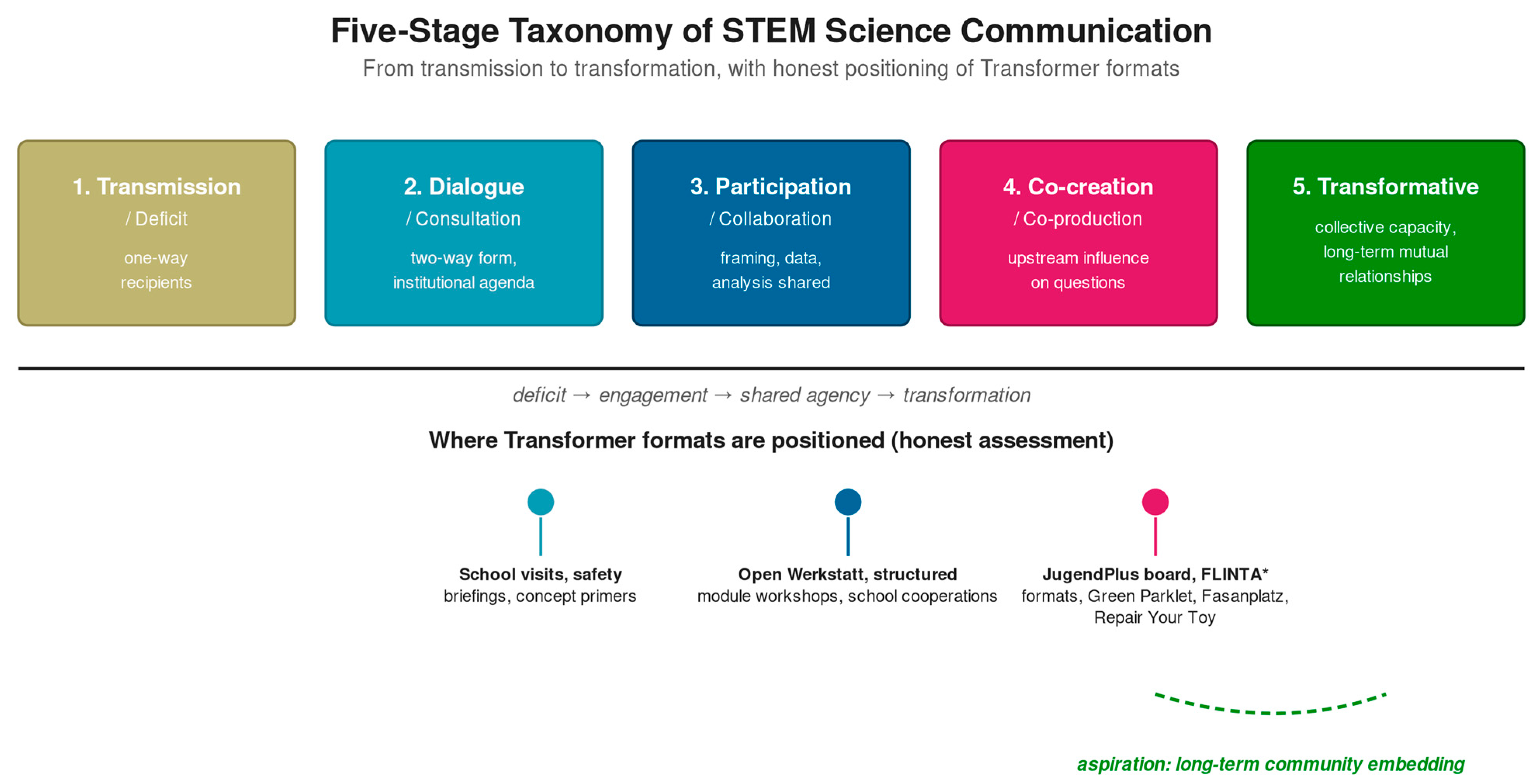
STEM science communication is increasingly conceptualised as a continuum that moves from one-way information transmission toward dialogic, participatory, co-creative, and ultimately transformative practices that explicitly address inclusion, governance, and societal outcomes. Figure 9 presents the five-stage taxonomy used in this paper as a diagnostic instrument and indicates where Transformer formats are currently positioned.
Science communication research and practice have been shifting from deficit models toward engagement models since the 1990s (Sturgis & Allum, 2004; Wu et al., 2019), while some practitioners still treat communication as one-way knowledge transfer from “experts” to “deficit groups”. This combination—an engagement turn alongside persistent deficit assumptions—makes a staged taxonomy analytically useful. Building on the classic triad of deficit → dialogue → participation, and informed by inclusive science communication principles (Metcalfe et al., 2022), a five-stage taxonomy is proposed:
(1)
Transmission/deficit. Communication is primarily one-way; publics are positioned as recipients; success is assessed via awareness and understanding metrics (Metcalfe, 2019; Metcalfe et al., 2022; Wu et al., 2019).
(2)
Dialogue/consultation. Communication is two-way in form; publics express perceptions and concerns, yet agenda-setting and decision authority commonly remain institutional (Metcalfe, 2019; Metcalfe et al., 2022).
(3)
Participation/collaboration. Publics and scientists collaborate on parts of the work (e.g., problem framing, deliberation, data collection, analysis, dissemination) (Barbosa-Gómez et al., 2022; Metcalfe et al., 2022).
(4)
Co-creation/co-production. Participation moves “upstream” so that publics share influence over what questions matter, how knowledge is produced, and how outcomes are interpreted and used (Barbosa-Gómez et al., 2022; Metcalfe et al., 2022).
(5)
Transformative engagement. The goal is to build collective capacity, foster inclusive participation, and empower communities with greater agency to tackle complex societal challenges. Publics are active partners in co-creating knowledge and solutions (Pandya et al., 2025). Transformative community engagement includes citizen science approaches but differs in having the main goal of “contributing to long-term trusting and mutually beneficial relationships between communities and science” (Pandya et al., 2025). Practitioners intentionally embrace inclusive science communication principles—deliberately involving diverse voices, being reflexive about power dynamics, and ensuring reciprocity—while explicitly recognising risks such as tokenistic participation and bounded inclusion (Metcalfe et al., 2022).
This taxonomy should be treated as a diagnostic map rather than a linear ladder. STEM science communication programmes can legitimately use transmission or dialogue elements (e.g., safety briefings, concept primers) while pursuing co-creation or transformative goals, as long as governance and evaluation reflect those goals.
  • Empirical constraints of classic STEM delivery.
Evidence indicates that “classic” STEM delivery—predominantly curriculum-driven, classroom-centred instruction with limited authentic practice and participant agency—encounters persistent implementation barriers. A qualitative study of novice STEM teachers reports difficulties related to classroom management, curriculum development, and practical constraints, alongside tensions between teachers’ pedagogical beliefs and broader system expectations (Aslam et al., 2023). Such findings matter for science communication because they show that even when STEM is framed as “hands-on” and “interdisciplinary”, day-to-day constraints can pull practice back toward transmissive patterns (coverage, compliance, and test alignment). A systematic review of integrated STEM education finds strong consensus around “integration”, “real-world problems”, “inquiry”, “design”, and “teamwork” as core principles, implying that high-quality STEM learning is expected to be situated in authentic problem contexts and collaborative design processes (Portillo-Blanco et al., 2024).
Curricular constraints become even more visible when STEM delivery is expected to integrate sustainability themes. A large teacher survey reports that more than half of teachers experienced moderate to significant challenges teaching sustainability-related domains, with “Sustainable Consumption and Production” identified as especially challenging and having the least curriculum coverage (Hamwy et al., 2023). Transformative STEM communication cannot simply “add” sustainability topics to classic STEM delivery without redesigning time, assessment, and teacher supports.
A third empirically supported constraint is exclusivity. Even STEM-adjacent innovation spaces can reproduce marginalising norms. A study on STEM makerspaces identifies six barriers to entering and sustaining participation—time, purpose, certification requirements, intimidation linked to space design and perceived skill norms, and identity-linked barriers—with the concern that discriminatory experiences may lead individuals to withdraw after initial entry (Andrews & Boklage, 2024). An integrative review of openness practices in the maker movement notes that exclusion of lower-income groups due to resource constraints and challenges in sustaining long-term activities remain key barriers (Saari et al., 2021).
  • Why the Transformer is not a makerspace.
While the Transformer shares features with makerspaces—open-format workshops, tools and materials, peer learning—it differs in several critical respects. Makerspaces and FabLabs often shift barriers from financial access to competence and cultural norms (Andrews & Boklage, 2024; García-Ruiz & Lena-Acebo, 2022), and they frequently lack explicit sustainability anchoring. The Transformer’s integration of circular economy as an organising principle, its deliberate targeting of structurally excluded groups, and its embeddedness in a university’s mission distinguish it from conventional maker formats. The gendered dimension is also relevant: maker initiatives report underrepresentation of women as users and leaders (Millard et al., 2018), and the Transformer addresses this through FLINTA* formats, cooperative facilitation, and visible role models.
The Transformer’s integration into a university’s third mission gives it access to disciplinary expertise, structured pedagogical planning, and institutionally supported evaluation that standalone makerspaces typically lack. The licence system for tools and machines, combined with progressive skill scaffolding, addresses the certification and skill barriers identified in makerspace research, creating structured pathways from novice to independent practitioner rather than relying on informal peer learning alone. The Transformer’s explicit focus on children and adolescents from disadvantaged backgrounds—operationalised through free access, partnership-based outreach, and deliberately non-prestige spatial design—contrasts with many makerspaces that, despite “open-access” rhetoric, primarily attract already-privileged, technology-affine participants.
  • Why the Transformer is not a typical citizen science project.
Citizen science is widely associated with the democratisation of science, but empirical work shows that participation can be narrowly defined. An analysis of communication strategies of 157 citizen-science projects finds that projects tend to interpret communication mainly as dissemination rather than encounter-based engagement, and participants are often positioned as data contributors rather than co-communicators (Giardullo et al., 2023). The Transformer does not fit the classical citizen science model of systematic data collection by lay participants for research purposes. However, it shares several features with broader, contemporary definitions of citizen science. Building on Haklay’s (2013) original four-level typology, Haklay et al. (2021) distinguish (1) crowdsourcing, (2) distributed intelligence, (3) participatory science, and (4) extreme citizen science, where participants co-define research questions and co-interpret results. The Transformer operates primarily at levels 3–4: participants co-define problems (e.g., which materials to investigate, which sustainability challenges to address in their neighbourhood), collaboratively generate knowledge through hands-on inquiry (disassembly, material analysis, life-cycle investigations), and co-interpret findings in shared reflection formats. The ECSA Ten Principles of Citizen Science (ECSA, 2015; L. D. Robinson et al., 2018) emphasise that citizen science projects should produce genuine scientific outcomes, offer learning opportunities for participants, and be evaluated for both scientific output and participant experience. The Transformer meets these criteria in several respects: it generates actionable knowledge about material flows, building performance, and neighbourhood sustainability; it systematically documents learning outcomes through structured observation and evaluation instruments; and it treats participants as co-creators of knowledge rather than passive recipients. What distinguishes the Transformer from typical citizen science projects is its primary orientation: while conventional citizen science prioritises the production of research data, the Transformer prioritises the co-creation of learning experiences and spatial interventions. The scientific knowledge generated—about didactic design principles, participation dynamics, and sustainability competence development—is a systematic by-product of the educational process rather than its primary objective. This positions the Transformer in a hybrid space between citizen science and co-creative sustainability education, contributing to what Irwin (1995) originally envisioned as “science for the people and science by the people”.

5.2. Implementation: Who Co-Creates, and How?

Co-creation in the Transformer is treated as a pedagogical principle rather than a method: rather than positioning young people as recipients of expert knowledge, the project emphasises collaborative problem framing, making, and interpretation. This aligns with contemporary definitions of participatory science communication as a dynamic process in which different forms of knowledge are acknowledged, shared, and negotiated (Sanders & Stappers, 2008) and where power relations are deliberately levelled. Co-creation is enabled through collaborations connecting university teaching and research with external organisations and local initiatives, producing hybrid formats that combine STEM learning, sustainability education, and maker culture.
  • Youth-Plus (JugendPlus) Advisory Board.
The JugendPlus Advisory Board is a key participatory instrument, ensuring democratic and needs-oriented programme design. Meetings are supported methodologically and didactically by the OIS Center of the Ludwig Boltzmann Gesellschaft. The focus is on participatory programme planning: the advisory board actively involves children, young people, parents, and experts in the development of offerings. It also serves as a measure for avoiding selectivity, ensuring that access to the innovation lab is non-discriminatory and that the interests of various target groups are represented. Since the project’s start, three advisory board meetings have taken place: the first in June 2024 during the set-up phase, before the official programme had begun; the second in August 2025 during the regular workshop phase; and the third in April 2026.
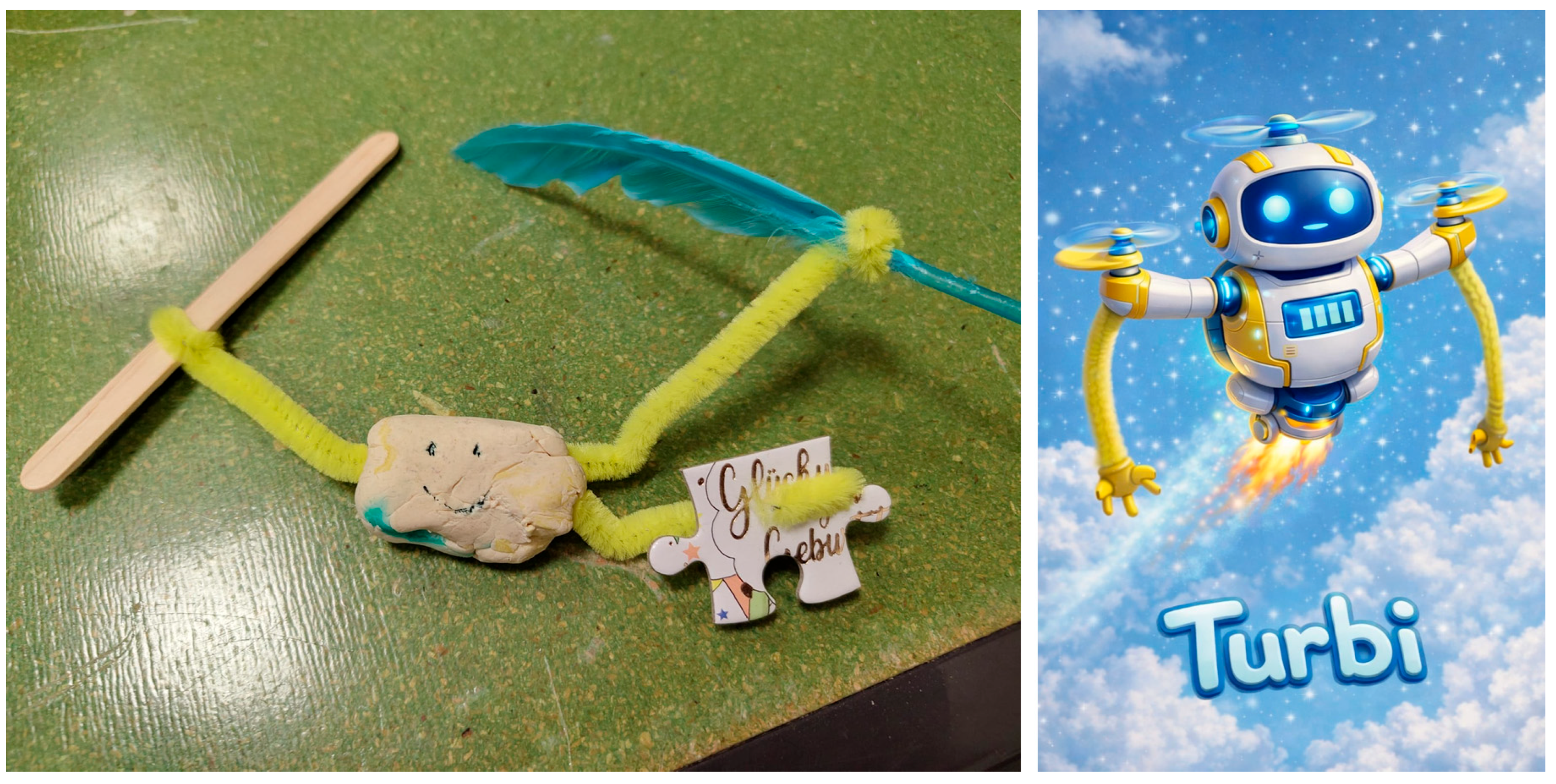
Several advisory board outcomes have already shaped the programme tangibly. Children’s wishes voiced in the first session—for a slide and a swing—were converted into both workshop content (collaborative building sessions) and permanent installations within the building (cf. Figure 4). Findings from the third session, including photo-challenge insights into what participants particularly enjoyed in the Transformer building, are now being translated into the planning of upcoming workshops and spatial design choices, demonstrating that advisory board input feeds back into operational programme decisions over multiple cycles. The third session also worked with imaginary inhabitants of the Transformer —fictional creatures crafted by participants from upcycled materials—as a methodological device to externalise preferences, needs, and interests; participants’ written prompts about their creatures were subsequently translated into AI-generated digital portraits, allowing children to encounter and discuss their own design ideas in two complementary representations (Figure 10).
  • Open workshop and low-threshold access.
The open workshop format requires no prior knowledge, no entrance fee, and no registration, a deliberately radical form of low-threshold access. “Low-threshold” here means more than formal openness; it encompasses didactic reduction of complex content, accessible language, practice-oriented approaches, and conscious design of a fear-free learning space. Through action-oriented experiments, co-creative tasks, and everyday-relevant problem settings, abstract concepts from circular economy or climate adaptation are translated into concrete experiential spaces. The placement of the project at the university itself contributes to symbolic inclusion: children gain access to an institutional space often perceived as exclusive. The university becomes experienceable not only as a knowledge producer but as a public educational space.
  • Target-group-specific formats.
The Transformer develops dedicated formats for groups that are underrepresented in conventional STEM settings, including FLINTA* offerings that strengthen self-efficacy and belonging through cooperative, hands-on approaches rather than performance-oriented settings. Formats for socio-economically disadvantaged children and adolescents respond to emerging patterns sometimes described as “climate classism”, where access to sustainability-related knowledge and future competencies is unevenly distributed. Practical enabling structures—such as family-compatible scheduling and partnerships that lower participation barriers—complement these targeted formats.
  • Cooperation as access infrastructure.
Outreach to less-reached groups relies on cooperation with partners such as WIENXTRA and Vienna Hobby Lobby, which support access to children and adolescents who are less likely to enter university-linked STEM environments through conventional channels. The Transformer also builds on neighbourhood embedding through cooperation with the Gebietsbetreuung Stadterneuerung (GB*) and the locale Agenda 21 Vienna (LA21), strengthening local anchoring through neighbourhood-oriented formats and public events. A third cluster consists of science communication and transfer networks, including ScienceCenter-Netzwerk, which provides interfaces to hands-on science mediation and contributes to dissemination beyond the immediate project site.
  • Dialogue formats as science communication.
At the Transformer, science communication is implemented as a lived community practice with the aim of achieving interactive dialogue on an equal footing. Instead of purely informative formats, participatory models such as interactive exhibitions are offered, in which non-scientific actors are directly involved. The open workshop and structured workshops follow a practice-oriented approach: theoretical knowledge (e.g., materials science, biotechnology) is conveyed through practical experiments. The programme is low-threshold and, depending on age, in-depth knowledge is communicated in a relaxed manner during the activity.
From a social science perspective, the work draws on the Lundy model, based on Article 12 of the UN Convention on the Rights of the Child and focusing on four elements—space, voice, audience, and influence (Lundy, 2007)—as well as on participatory action research, where children and young people are seen as co-researchers (Webber et al., 2024). Knowledge is constructed through social exchange and action, with the products developed generating self-confidence and self-efficacy in the children through their scientific or social relevance.

5.3. Critical Reflection: Co-Creation Tensions and Reach

Across the three advisory-board sessions, participant turnover was high: each round drew different children. This pattern reflects the changing recruitment context as much as any deficit in commitment. The first meeting (June 2024) took place before the official programme had started, before any familiarity with the Transformer existed; participants were recruited through personal invitations via the project team’s networks, with some travelling from more distant parts of Vienna. By contrast, the second (August 2025, n = 10) and third (April 2026) meetings were promoted through the Transformer’s established communication channels: newsletter, Instagram, and partner organisations such as WIENXTRA. The shift in recruitment infrastructure visibly strengthened the link between advisory board work and ongoing programme participation: in the second session, 70% of participants (7 out of 10) used the regular workshop offering; from the second meeting onward, the share of participants who had been or subsequently became regular workshop attendees exceeded 50%.
The initial ambition of fully congruent personnel between the advisory board and ongoing programme is therefore being reached gradually rather than abruptly. As the project’s communication infrastructure matures, the bridge between participation in the advisory board and engagement in the programme becomes more reliable. Approaches under further consideration include increasing meeting frequency and examining whether tighter cadence would stabilise the peer group, transforming the project location from a primarily functional space into a low-threshold social space that fosters informal relationships and motivates repeated visits.
Regarding honest positioning in the taxonomy, the Transformer aims at co-creation and transformative practice but operates in a field of tension. Some formats—particularly open workshops with spontaneous visitors—remain closer to dialogue or participation levels, where agenda-setting and thematic framing are partly predetermined. Importantly, this is not only a residual of institutional path dependence: pre-set structures often reflect the expressed wishes of participants themselves, who frequently prefer to work within familiar formats and with clear guidance. Empirical observations across workshops suggest that excessive openness or unstructured invitations to “co-decide everything” can produce disorientation, decision fatigue, or demotivation rather than empowerment, particularly for first-time visitors and participants from groups with little prior experience of formal participation. Co-creation therefore requires deliberate calibration of how much structure to provide and at which moments to open up genuine decision space, rather than a categorical preference for maximum openness. The co-creation claim is most defensible in contexts where participants have demonstrable influence on programme content; where decision rights remain predominantly with the project team, a more cautious positioning—participation rather than co-creation—is warranted.
Questions of reach also remain. The project explicitly targets socio-economically disadvantaged groups, and systematic data on socio-economic composition exist for participants reached through partner-mediated formats such as Vienna Hobby Lobby cohorts. For the open, free-access workshop programme, however, comparable data are deliberately not collected: any registration form or demographic survey at the door would itself constitute a participation barrier and undermine the low-threshold logic that the project pursues. As a result, claims about inclusive reach in the open-access strand remain plausible based on partner-channel evidence and qualitative observation, but cannot yet be quantitatively documented for the full participant base.

6. The University Opening Outward: Not Just Outreach but a Mutual Learning Process

6.1. Theoretical Framework: Third Mission, Transdisciplinarity, and the Engaged University

Science communication has become a core task for university scientists. It is an integral part of what is known as transfer performance. In addition to the pillars of research and teaching, knowledge transfer has gained importance and is now referred to as the third mission. Science, society, business, and politics engage in dialogue; solving social challenges, strengthening trust, and communicating research results in an understandable way require science communication that goes beyond what was long the domain of journalism alone. Creating transparency and keeping people informed enables the population to participate in social debates.
The core idea of the Transformer is to conceive the university as a space in which knowledge is not only produced or disseminated but co-developed together with diverse actors. Through collaborative work on concrete artefacts, different disciplines, experiential backgrounds, and forms of knowledge come into contact and become effective through productive processes of negotiation and meaning-making (Star & Griesemer, 1989). In this setting, learning, research, and science communication are not treated as separate activities but are structurally intertwined, following a constructionist logic of making, experimenting, and reflecting (Blikstein et al., 2017). The Transformer thus fosters self-efficacy as a central driver of learning through action, reflection, and mastery experiences (Schunk & DiBenedetto, 2020; Zimmerman, 2000); technological literacy understood as socio-technical competence rather than mere technical proficiency (Jäggle et al., 2020); and mutual understanding across perspectives. In this way, the Transformer aims to act as an enabler of societal transformation not through the translation of knowledge but through shared practice and co-creation (Sanders & Stappers, 2008).
K. Robinson and Aronica (2015, p. 135f) emphasise that learning works only when learners are personally involved. At the Transformer, complex topics such as energy efficiency and the circular economy are taught not as theory but as real problems that combine knowledge from technology, design, ethics, and social issues. This interdisciplinary approach is in line with Robinson’s call for a holistic curriculum. By translating research topics into practical, experience-oriented formats, the project staff creates an “anchor” in the lives of young people: when a child designs a solution to the heat in their own neighbourhood, it is no longer an abstract subject but a personally meaningful action. (The mentor role of university students is discussed in detail in Section 6.2).

6.2. Implementation: How TU Wien Builds Bridges

  • Faculty-spanning collaboration.
Technological innovation increasingly takes place under conditions of complexity, uncertainty, and strong societal interdependence. Yet innovation practices in engineering and technology development remain largely shaped by disciplinary specialisation, solution-driven approaches, and linear models of problem solving. Research in engineering education shows that interdisciplinary collaboration cannot be achieved simply by assembling mixed teams; it is frequently impeded by divergent epistemic assumptions, incompatible vocabularies, and differing approaches to problem framing and evaluation (Froyd & Ohland, 2005; Kolmos & De Graaff, 2014; Xu, 2025). Even though interdisciplinary, constructionist learning environments foster collaboration, reflective problem framing, and human-centred design practices, students’ engagement with sustainability may remain superficial when sustainability is positioned mainly as an external reference point rather than embedded as an integral dimension of problem framing and iterative design practice (Jäggle & Lammer, 2026).
The Transformer addresses these challenges by bringing together expertise from six faculties of TU Wien in a shared, practice-oriented space. Rather than organising interdisciplinarity as a formal requirement, the project enables it through joint work on concrete artefacts and real-world problems, for instance, combining architectural knowledge of material reuse with engineering approaches to energy systems and informatics perspectives on digitalisation.
  • University students as mentors and co-creators.
A central element of the Transformer’s inclusive design is the involvement of university students as active co-designers and mediators. In the sense of a peer-learning approach, they assume the role of multipliers between academic research and societal practice. The proximity in age, life-world, and experiential context between university students and children creates a lower communicative threshold than conventional expert formats. Students function not exclusively as knowledge transmitters but as learning companions in a co-creative process. This role shift supports dialogic science communication in which questions, uncertainties, and alternative perspectives are given explicit space.
Several university courses are directly integrated into the Transformer. At the Automation and Control Institute (ACIN), the course “Produktentwicklung am Beispiel Roboter” (Product Development Using the Example of Robotics) prepared interdisciplinary teams of students to design and conduct robotics workshops with partner school classes. Following an initial preparation phase, the student teams visited schools several times during the semester and guided pupils through a structured robot product development process culminating in a final presentation event. The course combined outreach in educational robotics with experiential learning for university students—who gained experience in interdisciplinary collaboration, project facilitation, and science communication—and is based on the FWF Science Communication Project Crazy Robots (Hirschmanner et al., 2015; Lammer et al., 2015). Simultaneously, the peer setting has effects within the university: students acquire didactic, communicative, and transdisciplinary competencies. They learn to prepare complex content in an audience-appropriate manner, integrate societal questions into their discipline, and assume responsibility in the context of sustainable development. Peer learning thus operates not only as a mediation instrument but as an educational format in the sense of transformative higher education. The potential inclusion of apprentices or students from different social and disciplinary backgrounds can further strengthen this effect; while apprentices are not yet involved, their participation is envisioned for future iterations. Diversity within the facilitation team increases the representation of different educational biographies and creates identification opportunities for participating children.
As part of the mechanical engineering curriculum, students design workshops on study-related topics with a focus on climate and energy (e.g., upcycling car construction with various drive systems, miniature pumped-storage power station) and offer them on at least two workshop dates or build larger, hands-on installations.
A further course, Wissenschaft & Co-Creation (Science & Co-Creation), was developed specifically for the Transformer as a faculty-spanning offering open to students from different study programmes across TU Wien. The course brings together university students with diverse disciplinary backgrounds and combines several modalities of learning. Students are introduced to the theoretical foundations of science communication, co-creation, and education for sustainable development through internal lectures by project team members and external guest contributions from partner organisations. Field excursions and structured observations of ongoing Transformer workshops give them direct exposure to participatory practice; through assisting in workshop facilitation, they move from observers to co-facilitators. In the final phase of the course, students design and run their own workshops with children and adolescents at the Transformer, applying the principles that they have studied in a real, supervised setting. The course thus integrates concept learning, observation, supported practice, and autonomous workshop delivery within a single semester (Köck et al., 2026; TU Wien Transformer course overview).
  • Partner network: more than 60 organisations across six functional clusters.
The Transformer is best understood as a networked co-creation infrastructure rather than a stand-alone educational site. Its implementation depends on a growing ecosystem of more than 60 partner organisations that contribute complementary functions; not all partners are active in every Transformer activity, and the clusters indicate primary rather than exclusive contributions. Analytically, the partner landscape can be grouped into six functional clusters (Figure 11): (1) funding and strategic partners, providing mandates, funding, premises, and scientific evaluation; (2) youth and access intermediaries, providing trusted access to children, adolescents, and socio-economically disadvantaged groups; (3) participation and science communication partners, contributing methods, dialogue formats, and teacher training interfaces; (4) industry, material, and technology partners, contributing materials, in-kind donations, technology access, and production facilities; (5) cultural and public engagement partners, providing public visibility and festival venues; and (6) school, civic, and sustainability partners, anchoring the project curricularly and didactically. For readers wishing to replicate the model, the decisive design feature is not the specific organisations but the functional coverage: each cluster addresses a distinct bottleneck of university-led co-creation (legitimacy and funding; access and trust; methods; materials and infrastructure; visibility; curricular anchoring). The full list of partner organisations per cluster is provided in Supplementary Material Table S2.
  • Camillo Sitte Bautechnikum as a case study.
The collaboration with Camillo Sitte Bautechnikum (CSBT)—a higher technical school for construction engineering located approximately 800 metres from the Transformer—illustrates how multi-layered, evolving cooperation generates value for the neighbourhood and educational practice. Figure 12 shows two facets of the cooperation: pupils building public-space seating with vertical greening for Fasanplatz and CSBT pupils’ annual final projects, which use the Transformer building itself as their design and research subject.
The cooperation included: (a) the Green Parklet project, a collaborative design and implementation of a publicly accessible community terrace in a parking lane, requiring upcycling of found objects and materials, with a student design competition and jury process culminating in a grand opening in December 2024; (b) joint educational activities at the Green Parklet in spring 2025, including workshops on greening, irrigation methods, and microclimates; (c) participation in Klima Biennale Wien (2024), where the Transformer building was opened for the first time with a participatory programme designed in collaboration with CSBT; (d) a greening initiative at Fasanplatz in the third district, implemented in cooperation with Grätzllabor (Lokale Agenda 21 Wien); and (e) use of the Transformer building as the basis for students’ final construction projects, with the school class using the premises weekly from October 2024 to April 2025. The building was also measured using a 3D laser scan as part of a thesis project, demonstrating the potential of shared resources through cooperation.
  • TU Wien strategy: science communication as a core task.
TU Wien is actively committed to science communication. The Development Plan 2025 emphasises that science communication increases understanding of research and technology and conveys the special responsibility of a technical university. The Performance Agreement 2025–2027 includes measures for communicating technical content to a diverse audience, including children and young people. With the planning of the Q Science Communication Centre (Q-Raum) (TU Wien, 2026)—a new science communication centre to be established in the centre of Vienna in collaboration with the Austrian Academy of Sciences and the University of Vienna—a dialogue space aimed at the general public is being created.
  • Multiplier function and transfer.
Transfer is pursued not only through documentation but also through active exchange with other Austrian co-creation spaces and partner organisations. The project uses conferences and sectoral forums as infrastructures for network expansion and method transfer, including the Lower Austrian Cultural Mediation Conference, the Ois zam Forum of Ludwig Boltzmann Gesellschaft, the Austrian Klimatag, and chemistry communication exchange with the Platform Green Chemistry—Zukunft:Chemie. Public engagement is also pursued through cultural events: the Transformer participated in Klima Biennale Wien (2024) and contributed to the Wiener Töchtertag (Daughters’ Day) festival at Vienna City Hall in April 2026 (Wiener Töchtertag, 2026), with formats combining robotics and sustainability (Figure 13).
These activities suggest that the Transformer develops transferable principles—low-threshold access, iterative co-creation, cross-sector exchange, and method testing across contexts—that can be adapted by other innovation labs, municipalities, and intermediary organisations.

6.3. Critical Reflection: Mutual Learning and Sustainability of the Model

A central question concerns the sustainability of the structure after the funded project period ends. How will interdisciplinary collaboration and the partner network be maintained when FFG funding expires? Whether this depends on individual engagement or institutional structures remains an active topic. The distinction matters: if the Transformer model relied solely on the extraordinary commitment of specific individuals, its transferability and sustainability would be structurally limited. Encouragingly, several signals suggest a movement toward institutional embedding rather than purely individual heroics. The Transformer aligns explicitly with TU Wien’s Future Fit strategy, providing an institutional reference frame for follow-up planning, and the project team is actively pursuing complementary funding instruments to extend operations beyond November 2026.
The claim that the university engages in a genuinely “mutual learning process” can be substantiated by several documented practice changes within TU Wien. First, the cross-faculty course Science Communication & Co-Creation (Wissenschaft & Co-Creation) was established specifically for the Transformer and has been redesigned each semester based on accumulated practice insights, integrating science communication, co-creation theory, and embedded workshop practice. Second, project-based courses in the mechanical engineering curriculum gained access to entirely new societal exchange formats through the Transformer, formats that were not part of the standard repertoire before the project started. Third, the cooperation with the Private University College of Teacher Education of Christian Churches Austria (KPH, KPH) generated new educational research questions that are being addressed jointly and has led to follow-on research applications in the area of climate transformation. Beyond formal courses and research, individual TU Wien researchers have initiated additional projects through the Transformer—an example is a collaboration with electrical engineering colleagues developing a photovoltaic roof for the project’s cargo bike, jointly with pupils of a higher technical school (HTL). Finally, the Transformer’s role as a hosting institution for visits to other TU Wien research infrastructures, the TU Mitmachlabor, and the Aspern Mobility Lab in the Seestadt urban development zone demonstrates that the project not only exports academic knowledge outward but also brokers access between previously separated parts of the university itself. Even within these emerging mechanisms, however, students’ engagement with sustainability may remain superficial when sustainability is not embedded as an integral dimension of problem framing (Jäggle & Lammer, 2026), and the systematic documentation of how individual interactions translate into lasting institutional learning remains a task for ongoing accompanying research.
Regarding governance, external partners and participants increasingly shape the strategic use of the project. While agenda-setting at the strategic level remains anchored in the TU Wien core team, partners and stakeholders have started to redirect substantial resources: in cooperation with Camillo Sitte Bautechnikum (CSBT), an initial wish for joint thesis supervision evolved into a year-long project in which the Transformer building itself served as the research resource for a series of student final theses, exemplifying how a partner request can reshape the project’s strategic priorities. The degree to which decision rights extend to partners and participants beyond the format level is a question the project will continue to address as further iterations build on these emerging precedents.

7. Discussion

7.1. Synthesis: How the Four Dimensions Answer the Research Question

The research question asked how the Transformer contributes to sustainability education and STEM science communication. The analysis across four dimensions reveals that this contribution arises not from any single feature but from their interaction.
The temporary learning space (Section 3) provides a material and spatial foundation that enables situated, place-based learning. The building’s malleability, “as-found” character, and integration of nature contact lower participation thresholds and make sustainability tangible as a spatial practice rather than an abstract topic.
The staged didactic programme (Section 4) translates this spatial foundation into a coherent learning logic. The Material Mine–Creative Kitchen–Future Portal sequence (running with overlapping timeframes but conceptually circular) operationalises ESD competence frameworks (Böse, 2023; KMK, 2016; Rieckmann, 2021) through design-based learning, constructivist principles of knowledge construction (Blikstein et al., 2017; Lave & Wenger, 1991), and Bloom-informed scaffolding (Krathwohl, 2002), creating a progression from analysis through design to systemic thinking.
The co-creative approach to STEM science communication (Section 5) positions the Transformer beyond transmission and dialogue toward participation and co-creation, though an honest assessment reveals that not all formats reach the co-creation level consistently. The emphasis on inclusion, low-threshold access, and structurally excluded groups distinguishes the approach from conventional makerspaces and citizen science models.
The university’s role (Section 6) provides the institutional, disciplinary, and infrastructural backbone. TU Wien’s six-faculty involvement, university student integration as mentors (Jäggle et al., 2020; K. Robinson & Aronica, 2015), and a growing partner network constitute the social infrastructure through which the project operates. The university acts not only as a knowledge sender but as a bridge between academic expertise and societal practice (Sanders & Stappers, 2008; Star & Griesemer, 1989), though the extent to which this bridge operates bidirectionally remains a question for further investigation.

7.2. Governance Criteria: Overall Assessment

Applying the five governance criteria across all four dimensions reveals a differentiated picture (summarised in Figure 1).
Agenda-setting is strongest at the spatial and workshop levels: structural alterations to the building (such as accessible sanitary infrastructure co-designed with a special-needs school or permanent installations like the slide and the planned balance track) demonstrate genuine co-definition of strategic infrastructure, while advisory board input, iterative programme development, and bottom-up initiatives by individual TU Wien researchers (e.g., the photovoltaic roof project for the cargo bike with HTL pupils) extend agenda-setting beyond the project core. At the higher strategic level, programme architecture remains predominantly institutional but is anchored in the TU Wien Future Fit strategy.
Decision rights show a similar layered picture: within workshops and spatial interventions, participants exercise meaningful agency, including documented cases in which advisory board wishes (slide, swing, photo-challenge insights) translated directly into permanent installations and future workshop planning; partner organisations have also reshaped strategic uses of the building (e.g., CSBT’s year-long thesis cohort cooperation), while the overall modular sequencing remains a project-team responsibility.
Recognition and reciprocity are operationalised through practical skills, self-efficacy experiences, community formation, neighbourhood benefits (e.g., the Green Parklet, public events), and—crucially—documented bidirectional learning at TU Wien itself: the new Science & Co-Creation course, redesigned project-based mechanical engineering courses, and KPH-led follow-on research questions and applications. The exchange shelf (Tauschregal) enables mutual gifting even without synchronous participation.
Inclusion governance is a core design principle, reflected in free access, no-registration formats, FLINTA offerings, accessibility built into the building, and partnership-based outreach. However, systematic monitoring of who is actually reached—particularly regarding socio-economic composition—is, as discussed in Section 5.3, deliberately limited to partner-mediated formats to avoid creating registration barriers in the open-access programme. Communication architecture* prioritises encounter-based exchanges over dissemination; the variety of formats and conference-level multiplier work supports this ambition, though the place-based dimension would benefit from more programmed mediation of the building’s own narrative (e.g., guided walk-throughs of the building’s biography of changes).

7.3. Ecological and Social Sustainability Contributions

The Transformer’s ecological sustainability contribution operates on two levels: circular economy practice through the building and the programme and capability-building for low-carbon, resource-aware everyday action. Circularity is enacted operationally through a “use what exists” approach: the building itself is a form of adaptive reuse, and the interior set-up prioritises donated, borrowed, and second-hand equipment and furniture. This is reinforced pedagogically through the Material Mine/Creative Kitchen logic (disassembly, reuse, recombination, prototyping), which turns the circular economy from an abstract concept into repeated, embodied practice. The ecological direction aligns with the EU’s current circular economy policy trajectory (European Commission, 2020; European Parliament & Council, 2024a, 2024b; Regulation (EU) 2024/1781; Directive (EU) 2024/1799): the Transformer’s emphasis on disassembly, repair, and reuse builds precisely the skills and culture that these value-retention policies seek to mainstream.
The project further links circularity to the built environment through urban mining and treating buildings as material banks: the city’s existing stock is framed as a resource reservoir, and material flows are made visible (Koutamanis et al., 2018). Ecological sustainability is also pursued through practical empowerment: participants acquire transferable competences (tool use, basic repair, prototyping with energy-related components, understanding trade-offs) that can translate into household-level actions such as small refurbishments, maintenance, or informed consumption changes.
Regarding social sustainability, the Transformer pursues equitable access, inclusive participation pathways, and community formation; the evidence base for these claims comprises the registration data (reach and repeat participation), the documented advisory board protocols (voice and decision rights), and the cooperation records with access-intermediary partners (Section 2.2). Free participation, outreach via public city channels, hyperlocal visibility, and continuous iteration of communication formats respond to known participation barriers in informal STEM settings. The deliberate creation of psychological safety and belonging—through the building’s “non-prestige” character and an environment where getting things dirty is expected—functions as a social signal that experimentation is legitimate. Community building is treated as a core sustainability outcome: repeated encounters through recurring workshops, open formats, festivals, and partnerships create a social infrastructure where climate transformation is framed as a collective capability rather than an individual performance. Communication choices such as plain language can be justified empirically: randomised evidence from guideline communication shows that plain-language versions measurably improve understanding and usability compared to standard technical language (Sayfi et al., 2024).

7.4. The Transformer Between Sustainability Education and STEM Science Communication

The two goals of sustainability education and STEM science communication reinforce each other in several respects. Circular economy, energy literacy, and material-cycle thinking provide content-rich anchors for both educational processes and public engagement. Hands-on making and prototyping serve simultaneously as learning mechanisms and communicative interfaces that make scientific content tangible for diverse audiences.
At the same time, tensions exist. The depth required for genuine sustainability learning (e.g., systemic understanding of material flows, critical assessment of trade-offs) may conflict with the communicative low-threshold orientation that prioritises accessibility and breadth of reach. A workshop designed for maximum inclusivity may sacrifice analytical depth; a module designed for sustained competence development may not reach spontaneous visitors. The three-module structure attempts to navigate this tension through staged engagement, but its effectiveness depends on participation continuity that remains structurally uncertain. Empirical support for this synergy comes from structured field observations carried out by eleven university student observers across 26 workshop formats with approximately 250 participants between March and June 2025. The study identified six design principles for effective climate education in makerspace-like settings—including scaffolded freedom, multi-level differentiation for mixed-age groups, and the deliberate use of productive failure as resilience training—and was triangulated through LLM-assisted qualitative coding combined with peer debriefings, manual coding, and negative-case analysis (Köck et al., 2026). These principles indicate that the combination of creativity, technology, and sustainability fosters action competence rather than climate anxiety; however, this remains a preliminary finding from a single, non-peer-reviewed observational study (see Appendix A) and should be treated as indicative rather than confirmatory. Read in this cautious way, it lends tentative support to the Transformer’s positioning as a format with transformative ambitions rather than a merely informational one.

7.5. Comparison with Other Formats

The Transformer shares features with several established formats while maintaining distinctive characteristics. Unlike conventional makerspaces, it anchors all activities in sustainability themes and addresses structural exclusion as a design variable rather than an afterthought. Unlike science centres, it operates in a temporary, non-institutional space that becomes part of the learning process. Unlike real-world laboratories, its primary orientation is educational rather than research-driven, though the boundaries are intentionally blurred. Unlike student labs, it is not embedded in a school logic but operates as a voluntary, out-of-school space with deliberate community anchoring. The combination of university embeddedness, temporary vacancy, circular economy focus, co-creative governance, and explicit inclusion orientation constitutes the Transformer’s specific contribution.

7.6. Limitations

This paper is a self-report by the project team, without external evaluation. It does not employ systematic impact measurement or a control-group design. The project is still ongoing at the time of writing; findings are therefore preliminary. The specific Viennese context—including the availability of a suitable building, an established network of partner organisations, and a university with relevant disciplinary breadth—limits the direct generalisability of the model.

7.7. Implications

For other universities and innovation labs, the Transformer suggests several transferable design principles: (a) vacancy activation as a scalable model for creating low-threshold learning spaces; (b) circular learning logic that connects analysis, making, and systems thinking in a coherent sequence; (c) co-creative governance with structured but evolving participation instruments; (d) networked implementation through functional partner clusters; and (e) faculty-spanning collaboration anchored in shared practice rather than formal committee structures. These principles are context-sensitive: their adaptation requires attention to local conditions, target-group realities, and institutional cultures. For university teaching, the project suggests that practice-oriented, hands-on formats contribute to the democratisation of STEM education. Especially for participants without a pronounced scientific background, concrete, experience-based approaches open up alternative learning pathways. Science is perceived not as an abstract, inaccessible discipline but as a shapeable process in which different perspectives can participate.
The continuation of the Transformer beyond the funded project period is an explicit aspiration of the project team and the partner network. Securing follow-up funding and embedding the model in lasting institutional structures—inside TU Wien and in cooperation with municipal, federal, and EU-level programmes—are being actively pursued, in line with the long-standing experience that one-off project funding rarely matches the time horizons required for genuine community building and transformative learning.

8. Conclusions

The Transformer contributes to sustainability education and STEM science communication through the interaction of four dimensions: a temporary, materially malleable learning space that itself becomes a didactic actor; a circularly linked learning logic from analysis through design to systemic thinking, grounded in constructivist and design-based learning principles (Blikstein et al., 2017; Krathwohl, 2002; Lave & Wenger, 1991); a co-creative approach to STEM engagement that goes beyond transmission and dialogue toward participatory and potentially transformative practice (Metcalfe et al., 2022); and a university that positions itself not only as a knowledge producer but as an institutional bridge between disciplinary expertise and societal practice (Sanders & Stappers, 2008; Star & Griesemer, 1989).
The project suggests that universities can take on an enabling and connecting role in sustainability education when they commit institutional resources—faculty collaboration, university student involvement, strategic alignment—and combine this commitment with genuine low-threshold access, partnership-based outreach, and iterative programme development informed by participant voice. The Transformer shows that complex STEM and sustainability content can be translated into tangible, accessible, and participatory formats without sacrificing analytical substance, provided that the learning design is structured through clear competence frameworks and supported by interdisciplinary expertise.
At the same time, the analysis reveals persistent challenges. Participatory governance structures such as the JugendPlus advisory board require ongoing attention to retention and representativeness. The gap between co-creative ambition and operational reality must be honestly assessed: not all formats consistently achieve co-creation, and systematic evidence of competence development and inclusive reach remains to be established. The sustainability of the model after funded project periods depends on institutional embedding that goes beyond individual commitment.
For practice, the findings suggest that comparable co-creative learning spaces benefit from: activating existing spatial resources (vacancies, underused buildings) as learning environments; anchoring programmes in circular, staged learning logics; treating inclusion as a design variable rather than a by-product; building networked implementation through functional partner clusters; and institutionalising science communication as a mutual process rather than unidirectional outreach. For policy, the findings underscore the need for funding frameworks that support multi-year, multi-stakeholder innovation labs with sufficient flexibility for iterative development and that explicitly incentivise inclusive, co-creative approaches to STEM and sustainability education.
Open research questions include the longitudinal effects of participation on sustainability competencies and educational trajectories; the conditions under which co-creative governance can be sustained beyond project-funded periods; the comparative effectiveness of university-led co-creation spaces relative to other informal learning formats; and the specific mechanisms through which interdisciplinary collaboration in such spaces influences both participant outcomes and institutional learning within the university.

Supplementary Materials

The following supporting information can be downloaded at https://www.mdpi.com/article/10.3390/educsci16091375/s1: Table S1: Cell-by-cell justification of the analytical-framework assessments (Figure 1); Table S2: Full list of partner organisations, grouped by primary functional cluster, with cross-references to the manuscript sections where each piece of evidence is presented; Text S1: Methodological notes on the structured field-observation study.

Author Contributions

Conceptualization, B.-M.K., L.L., and B.M.-S.; Methodology, B.-M.K., A.P., and K.K.T.; Validation, M.C.-G.; Investigation, B.-M.K., H.I., I.K., L.L., A.P., and K.K.T.; Writing—Original Draft Preparation, C.N., K.R., and B.-M.K.; Writing—Review & Editing, all authors; Visualization, B.-M.K.; Project Administration, B.-M.K.; Funding Acquisition, B.-M.K., A.P., I.K., and B.M.-S. All authors have read and agreed to the published version of the manuscript.

Funding

This research was funded by the Austrian Climate and Energy Fund (Klima- und Energiefonds, KLIEN), administered by the Austrian Research Promotion Agency (FFG), under the call “Co-Creation-Spaces Klima & Energie 2022” (Klima- und Energiefonds, 2022) (project “Co-Creation Space für hands-on Klimatransformationslösungen rund um Leerstandsgebäuderessourcen”, grant number FO999903333; e-call application 49430491). The funded project period runs from 1 December 2023 to 30 November 2026. Total FFG grant: EUR 325,000; total project costs: EUR 802,920. The continuation of the Transformer beyond this funded period is actively being pursued by the project team and partner network through complementary funding instruments and institutional embedding. The APC was funded by the TU Wien Bibliothek/Open-Access Programme.

Institutional Review Board Statement

The Transformer project has been reviewed by the Research Ethics Committee of TU Wien with respect to the collection of participant data (including FLINTA* self-identification). No social scientific data were directly collected from children or adolescents for the present paper. Standard consents regarding data protection, photographic rights, and safety were obtained for all workshop participation but are not used as data sources for this paper.

Informed Consent Statement

At the beginning of every workshop, a consent sheet is completed for each child (for out-of-school workshops). It covers safety permissions (for example, which tools the child is allowed to use) and, separately by publication medium, photographic releases; the sheets are signed by both the child and a parent or legal guardian. For all photographs reproduced in this article, the corresponding release for use in a scientific publication was given. The same procedure was applied to the participant-generated images in Figure 4 and Figure 10, which were created during JugendPlus advisory board sessions. The consent forms were developed jointly with the data protection unit of TU Wien. Informed consent for workshop participation and data protection is routinely obtained for all Transformer activities; no social scientific data from these consent processes are analysed in this paper.

Data Availability Statement

Data underlying the analyses presented in this paper are available from the corresponding author upon reasonable request.

Acknowledgments

The authors thank the project’s partner organisations and supporters, including WIENXTRA, Vienna Hobby Lobby, the OIS Center of the Ludwig Boltzmann Gesellschaft, Camillo Sitte Bautechnikum, Lokale Agenda 21 Wien, Gebietsbetreuung Stadterneuerung, ScienceCenter-Netzwerk, Buurman Utrecht, and Umwelt. Wissen Netzwerk Niederösterreich and all other partners, as well as all participating university students and mentors; colleagues from the Transformer project, such as Azra Korjenic, Vasiliki Archodoulaki, Lisa Schardt, Stefan Szeider, Andrea Hackl, Simon Amort, and Lukas Savas; supporting colleagues from the TU Wien; and the children and adolescents who shaped the Transformer through their engagement. The authors also acknowledge the support of the TU Wien faculties of Architecture and Planning, Civil and Environmental Engineering, Mechanical and Industrial Engineering, Electrical Engineering and Information Technology, Informatics, and Technical Chemistry. Open Access Funding by TU Wien.

Conflicts of Interest

The authors declare no conflicts of interest. The funding sponsors had no role in the design of the study; in the collection, analyses, or interpretation of data; in the writing of the manuscript; or in the decision to publish the results.

Appendix A. Methodological Notes on the Structured Field Observation Study

The structured field observations cited in Section 2.2, Section 4.2, and Section 7.4 (Köck et al., 2026) are reported in a conference poster; the present paper therefore treats their findings as indicative rather than confirmatory. The observations were conducted by eleven university students between March and June 2025 across 26 workshop formats involving approximately 250 children and adolescents. Observers used a semi-structured observation protocol covering participation intensity, emotional responses, group dynamics, tool use, and verbalised reasoning and produced written field notes for each session. Analysis proceeded in two independent strands: (1) LLM-assisted qualitative coding, in which field notes were segmented and coded against an inductively developed category system, and (2) manual synthesis by the study team. The two strands were subsequently compared, and divergences were resolved through discussion. No formal inter-coder reliability statistic was computed, and the LLM-assisted codes were validated only through this discussion-based comparison with the manual strand; both constraints are reflected in the cautious use of these findings throughout the paper (Section 2.2 and Section 7.6). The coding scheme, category definitions, and prompt validation procedure are documented in the project archive and available from the corresponding author upon reasonable request.

References

  1. Abdurrahman, A., Maulina, H., Nurulsari, N., Sukamto, I., Umam, A. N., & Mulyana, K. M. (2023). Impacts of integrating engineering design process into STEM makerspace on renewable energy unit to foster students’ system thinking skills. Heliyon, 9(4), e15100. [Google Scholar] [CrossRef] [Scilit]
  2. Andrews, M. E., & Boklage, A. (2024). Alleviating barriers facing students on the boundaries of STEM makerspaces. Education Sciences, 14(7), 772. [Google Scholar] [CrossRef] [Scilit]
  3. Andrews, M. E., Borrego, M., & Boklage, A. (2021). Self-efficacy and belonging: The impact of a university makerspace. International Journal of STEM Education, 8, 24. [Google Scholar] [CrossRef] [Scilit]
  4. Aslam, S., Alghamdi, A. A., Abid, N., & Kumar, T. (2023). Challenges in implementing STEM education: Insights from novice STEM teachers in developing countries. Sustainability, 15(19), 14455. [Google Scholar] [CrossRef] [Scilit]
  5. Barbosa-Gómez, L., Cañizo, C. d., & Revuelta, G. (2022). Participatory citizen science in solar energy research: Going beyond data collection to promote the energy transition. Journal of Science Communication, 21(2), N06. [Google Scholar] [CrossRef] [Scilit]
  6. Blikstein, P., Kabayadondo, Z., Martin, A., & Fields, D. (2017). An assessment instrument of technological literacies in makerspaces and FabLabs. Journal of Engineering Education, 106(1), 149–175. [Google Scholar] [CrossRef] [Scilit]
  7. BMBWF. (2014). Grundsatzerlass umweltbildung für nachhaltige entwicklung. Bundesministerium für Bildung, Wissenschaft und Forschung. Available online: https://www.oekolog.at/das-ist-%C3%B6kolog/%C3%B6kolog-programm/grundsatzerl%C3%A4sse/ (accessed on 27 April 2026).
  8. Böse, S. (2023). Die umsetzung von bildung für nachhaltige entwicklung im sachunterricht: Eine rekonstruktive fallstudie zu motiven von lehrkräften in der grundschule. Verlag Julius Klinkhardt. Available online: https://www.pedocs.de/volltexte/2023/28191/pdf/Boese_2023_Die_Umsetzung_von_Bildung.pdf (accessed on 29 April 2026).
  9. Cazan, A.-M., Cocoradă, E., & Maican, C. I. (2016). Computer anxiety and attitudes towards the computer and the internet with Romanian high-school and university students. Computers in Human Behavior, 55, 258–267. [Google Scholar] [CrossRef] [Scilit]
  10. Chai, T., & Sha, C. (2025). Prevention of AI learning anxiety: The chain mediation role of technophilia and AI self-efficacy under the context of teacher support. Acta Psychologica, 261, 105979. [Google Scholar] [CrossRef] [Scilit]
  11. Daryanto, A., & Song, Z. (2021). A meta-analysis of the relationship between place attachment and pro-environmental behaviour. Journal of Business Research, 123, 208–219. [Google Scholar] [CrossRef] [Scilit]
  12. Deutsche UNESCO-Kommission (DUK). (2021). Bildung für nachhaltige entwicklung: Eine roadmap. Deutsche UNESCO-Kommission. Available online: https://unesdoc.unesco.org/ark:/48223/pf0000374802 (accessed on 27 April 2026).
  13. European Citizen Science Association (ECSA). (2015). Ten principles of citizen science. ECSA. [Google Scholar] [CrossRef] [Scilit]
  14. European Commission. (2020). Circular economy action plan. Available online: https://ec.europa.eu/environment/strategy/circular-economy-action-plan_en (accessed on 27 April 2026).
  15. European Parliament & Council. (2024a). Directive (EU) 2024/1799 of 13 June 2024 on common rules promoting the repair of goods. Available online: https://eur-lex.europa.eu/eli/dir/2024/1799/oj (accessed on 27 April 2026).
  16. European Parliament & Council. (2024b). Regulation (EU) 2024/1781 of 13 June 2024 establishing a framework for the setting of ecodesign requirements for sustainable products. Available online: https://eur-lex.europa.eu/eli/reg/2024/1781/oj (accessed on 27 April 2026).
  17. Forstner-Ebhart, A., & Linder, W. (Eds.). (2018). Green pedagogy. Hochschule für Agrar- und Umweltpädagogik. Available online: https://www.haup.ac.at/wp-content/uploads/2019/10/Green-Pedagogy.pdf (accessed on 27 April 2026).
  18. Froyd, J. E., & Ohland, M. W. (2005). Integrated engineering curricula. Journal of Engineering Education, 94(1), 147–164. [Google Scholar] [CrossRef] [Scilit]
  19. García-Ruiz, M. E., & Lena-Acebo, F. J. (2022). FabLabs: The road to distributed and sustainable technological training through digital manufacturing. Sustainability, 14(7), 3938. [Google Scholar] [CrossRef] [Scilit]
  20. Giardullo, P., Neresini, F., Marín-González, E., Luís, C., Magalhães, J., & Arias, R. (2023). Citizen science and participatory science communication: An empirically informed discussion connecting research and theory. Journal of Science Communication, 22(2), A01. [Google Scholar] [CrossRef] [Scilit]
  21. Grothaus, J., Tischer, J., & Terhardt, A. (2025). Außerschulische bildung zur klimakrise. In Handbuch klimabildung (pp. 691–718). Springer. [Google Scholar] [CrossRef] [Scilit]
  22. Haklay, M. (2013). Citizen science and volunteered geographic information: Overview and typology of participation. In D. Sui, S. Elwood, & M. Goodchild (Eds.), Crowdsourcing geographic knowledge (pp. 105–122). Springer. [Google Scholar] [CrossRef] [Scilit]
  23. Haklay, M., Dörler, D., Heigl, F., Manzoni, M., Hecker, S., & Vohland, K. (2021). What is citizen science? The challenges of definition. In K. Vohland, A. Land-Zandstra, L. Ceccaroni, R. Lemmens, J. Perelló, M. Ponti, R. Samson, & K. Wagenknecht (Eds.), The science of citizen science (pp. 13–33). Springer. [Google Scholar] [CrossRef] [Scilit]
  24. Hamwy, N., Bruder, J., Sellami, A., & Romanowski, M. H. (2023). Challenges to teachers implementing sustainable development goals frameworks in Qatar. Sustainability, 15(15), 11479. [Google Scholar] [CrossRef] [Scilit]
  25. Hancock, J., Al Bishawi, R., & Coyle, D. (2023). Ownership and agency through learner-led design of shared learning spaces: A multi-case study approach. Cambridge Journal of Education, 53(6), 761–778. [Google Scholar] [CrossRef] [Scilit]
  26. Heller, R. F. (2022). A new bloom—Adding ‘collaborate’ to bloom’s taxonomy. Journal of Learning Development in Higher Education. [Google Scholar] [CrossRef] [Scilit]
  27. Hirschmanner, M., Lammer, L., & Vincze, M. (2015). Mattie: A simple educational platform to enthuse the next generation of engineers for robotics. In Proceedings of the tenth annual ACM/IEEE international conference on human-robot interaction extended abstracts (HRI’15 extended abstracts) (pp. 21–22). ACM. [Google Scholar]
  28. Holzbaur, U. (2020). Nachhaltige entwicklung: Der weg in eine lebenswerte Zukunft (2nd ed.). Springer. [Google Scholar] [CrossRef] [Scilit]
  29. Ioannou, A., & Gravel, B. E. (2024). Trends, tensions, and futures of maker education research: A 2025 vision for STEM+ disciplinary and transdisciplinary spaces for learning through making. Educational Technology Research and Development, 72(1), 1–14. [Google Scholar] [CrossRef] [Scilit]
  30. Irwin, A. (1995). Citizen science: A study of people, expertise and sustainable development. Routledge. [Google Scholar]
  31. Jäggle, G., & Lammer, L. (2026). Teaching future engineers sustainability with educational robotics. In Robotics in education. Lecture Notes in networks and systems. Springer. [Google Scholar]
  32. Jäggle, G., Lammer, L., Hieber, H., & Vincze, M. (2020). Technological literacy through outreach with educational robotics. In M. Merdan, W. Lepuschitz, G. Koppensteiner, R. Balogh, & D. Obdržálek (Eds.), Robotics in education: Current research and innovations (Vol. 1023, pp. 113–124). Advances in intelligent systems and computing. Springer. [Google Scholar] [CrossRef] [Scilit]
  33. Jörissen, J., & Grein, M. (2025). Ko-kreation als ansatz in lehre, curriculums- und organisationsentwicklung. implikationen für die qualitätsentwicklung an hochschulen. In J. Jörissen, D. Möller, M. Grein, S. Kopczynski, & D. Peters (Eds.), Evaluation von studium und lehre ko-kreativ gestalten (pp. 15–28). Waxmann. [Google Scholar]
  34. Klima Biennale Wien. (2024). Klima biennale wien 2024—Festival on climate, art and science. Available online: https://2024.biennale.wien (accessed on 27 April 2026).
  35. Klima- und Energiefonds. (2022). Leitfaden co-creation-spaces klima & energie 2022: Innovative und kreative lernorte. Klima- und Energiefonds. Available online: https://www.ffg.at/ausschreibungen/CoCreationSpacesKlimaundEnergie2022 (accessed on 27 April 2026).
  36. KMK—Kultusministerkonferenz. (2016). Orientierungsrahmen für den lernbereich globale Entwicklung (2nd ed.). KMK. Available online: https://teams.public.onecdn.static.microsoft/evergreen-assets/safelinks/2/atp-safelinks.html (accessed on 27 April 2026).
  37. KMK—Kultusministerkonferenz. (2024). Empfehlung zur bildung für nachhaltige entwicklung in der schule. Available online: https://www.kmk.org/fileadmin/veroeffentlichungen_beschluesse/2024/2024_06_13-BNE-Empfehlung.pdf (accessed on 27 April 2026).
  38. Kolmos, A., & De Graaff, E. (2014). Problem-based and project-based learning in engineering education. In A. Johri, & B. M. Olds (Eds.), Cambridge handbook of engineering education research (pp. 141–160). Cambridge University Press. [Google Scholar] [CrossRef] [Scilit]
  39. Koutamanis, A., van Reijn, B., & van Bueren, E. (2018). Urban mining and buildings: A review of possibilities and limitations. Resources, Conservation & Recycling, 138, 32–39. [Google Scholar] [CrossRef] [Scilit]
  40. Köck, B., Pichlhöfer, A., & Tielsch, K. (2026, March). From makerspace to climate education space: What 26 field observations reveal about the TU Wien transformer and the concept behind it [Poster P04]. Österreichischer klimatag 2026. Available online: https://ccca.ac.at/fileadmin/00_DokumenteHauptmenue/05_Veranstaltungen/Klimatag/2026/Poster/P04_Koeck.pdf (accessed on 27 April 2026).
  41. Krathwohl, D. R. (2002). A revision of bloom’s taxonomy: An overview. Theory Into Practice, 41(4), 212–218. [Google Scholar] [CrossRef] [Scilit]
  42. Lammer, L., Weiss, A., & Vincze, M. (2015). The 5-step plan: A holistic approach to investigate child-robot interaction. In A. Tapus, E. André, J.-C. Martin, F. Ferland, & M. Ammi (Eds.), Social robotics. ICSR 2015 (Vol. 9388, pp. 376–386). Lecture notes in computer science. Springer. [Google Scholar]
  43. Lave, J., & Wenger, E. (1991). Situated learning: Legitimate peripheral participation. Cambridge University Press. [Google Scholar] [CrossRef] [Scilit]
  44. Lundy, L. (2007). ‘Voice’ is not enough: Conceptualising article 12 of the united nations convention on the rights of the child. British Educational Research Journal, 33(6), 927–942. [Google Scholar] [CrossRef] [Scilit]
  45. Martin, L., White, M. P., Hunt, A., Richardson, M., Pahl, S., & Burt, J. (2020). Nature contact, nature connectedness and associations with health, wellbeing and pro-environmental behaviours. Journal of Environmental Psychology, 68, 101389. [Google Scholar] [CrossRef] [Scilit]
  46. Melo, M. M., & Rodney, R. (2023). Space invaders: First-time users feel like intruders in the makerspace. Library & Information Science Research, 45(4), 101264. [Google Scholar] [CrossRef] [Scilit]
  47. Metcalfe, J. (2019). Comparing science communication theory with practice: An assessment and critique using Australian data. Public Understanding of Science, 28(4), 382–400. [Google Scholar] [CrossRef] [Scilit]
  48. Metcalfe, J., Gascoigne, T., Medvecky, F., & Nepote, A. C. (2022). Participatory science communication for transformation. Journal of Science Communication, 21(2), E. [Google Scholar] [CrossRef] [Scilit]
  49. Michalik, G. (2024). Co-creation: Die kraft des gemeinsamen denkens (2nd ed.). Schäffer-Poeschel Verlag für Wirtschaft Steuern Recht. [Google Scholar]
  50. Millard, J., Sorivelle, M. N., Deljanin, S., Unterfrauner, E., & Voigt, C. (2018). Is the maker movement contributing to sustainability? Sustainability, 10(7), 2212. [Google Scholar] [CrossRef] [Scilit]
  51. National Academy of Sciences. (2018). Graduate STEM education for the 21st century: Consensus study report. National Academies Press. Available online: https://nap.nationalacademies.org/resource/25038/Graduate%20STEM%20Education-ReportHighlights.pdf (accessed on 27 April 2026).
  52. Nisbet, E. K., Zelenski, J. M., & Murphy, S. A. (2009). The nature relatedness scale: Linking individuals’ connection with nature to environmental concern and behavior. Environment and Behavior, 41(5), 715–740. [Google Scholar]
  53. Pandya, R. E., Boyd, A. D., Feliú-Mójer, M. I., & Yanovitzky, I. (2025). Transformative community-engaged science: Strengthening relationships between science and society. Proceedings of the National Academy of Sciences of the United States of America, 122, e2400929122. [Google Scholar] [CrossRef] [Scilit]
  54. Papastergiou, C. (2020). Junk playgrounds: The “anti-aesthetics” of play in post-world-war-II playground design. sITA—Studii de Istoria și Teoria Arhitecturii, 8, 245–264. [Google Scholar] [CrossRef] [Scilit]
  55. Penprase, B. E. (2020). STEM education for the 21st century. Springer. [Google Scholar] [CrossRef] [Scilit]
  56. Portillo-Blanco, A., Deprez, H., De Cock, M., Guisasola, J., & Zuza, K. (2024). A systematic literature review of integrated STEM education: Uncovering consensus and diversity in principles and characteristics. Education Sciences, 14(9), 1028. [Google Scholar] [CrossRef] [Scilit]
  57. Rieckmann, M. (2021). Bildung für nachhaltige entwicklung. In M. Rieckmann, M. Singer-Brodowski, F. Bertschy, & F. Rauch (Eds.), Handbuch bildung für nachhaltige entwicklung. Budrich. [Google Scholar]
  58. Rieckmann, M., Singer-Brodowski, M., Bertschy, F., & Rauch, F. (Eds.). (2026). Handbuch bildung für nachhaltige entwicklung. Budrich. ISBN 978-3-8474-3200-5. [Google Scholar]
  59. Robinson, K., & Aronica, L. (2015). Creative schools: The grassroots revolution that’s transforming education. Penguin Books. [Google Scholar]
  60. Robinson, L. D., Cawthray, J. L., West, S. E., Bonn, A., & Ansine, J. (2018). Ten principles of citizen science. In S. Hecker, M. Haklay, A. Bowser, Z. Makuch, J. Vogel, & A. Bonn (Eds.), Citizen science: Innovation in open science, society and policy (pp. 27–40). UCL Press. [Google Scholar]
  61. Russell, W., Fitzpatrick, J., & Handscomb, B. (2021). ‘Adventure playgrounds’, ‘nature’ and ‘learning’: Disrupting lofty notions. Built Environment, 47(2), 206–222. [Google Scholar] [CrossRef] [Scilit]
  62. Saari, H., Åkerman, M., Kieslinger, B., Myllyoja, J., & Sipos, R. (2021). How open is the maker movement? Integrative literature review of the openness practices in the global maker movement. Sustainability, 13(24), 13559. [Google Scholar] [CrossRef] [Scilit]
  63. Sanders, E. B.-N., & Stappers, P. J. (2008). Co-creation and the new landscapes of design. CoDesign, 4(1), 5–18. [Google Scholar] [CrossRef] [Scilit]
  64. Sayfi, S., Charide, R., Elliott, S. A., Hartling, L., Munan, M., Stallwood, L., Butcher, N. J., Richards, D. P., Mathew, J. L., Suvada, J., Akl, E. A., Kredo, T., Mbuagbaw, L., Motilall, A., Baba, A., Scott, S. D., Falavigna, M., Klugar, M., Friessová, T., … Pottie, K. (2024). A multimethods randomized trial found that plain language versions improved adults’ understanding of health recommendations. Journal of Clinical Epidemiology, 165, 111199. [Google Scholar] [CrossRef] [Scilit]
  65. Schön, D. A. (1983). The reflective practitioner: How professionals think in action. Basic Books. [Google Scholar]
  66. Schunk, D. H., & DiBenedetto, M. K. (2020). Motivation and social cognitive theory. Contemporary Educational Psychology, 60, 101832. [Google Scholar] [CrossRef] [Scilit]
  67. Star, S. L., & Griesemer, J. R. (1989). Institutional ecology, “translations” and boundary objects: Amateurs and professionals in Berkeley’s museum of vertebrate zoology, 1907–39. Social Studies of Science, 19(3), 387–420. [Google Scholar] [CrossRef] [Scilit]
  68. Sturgis, P., & Allum, N. (2004). Science in society: Re-evaluating the deficit model of public attitudes. Public Understanding of Science, 13(1), 55–74. [Google Scholar] [CrossRef] [Scilit]
  69. TU Wien. (2024). Cultural collisions. Vienna University of Technology. Available online: https://www.tuwien.at/en/cultural-collisions (accessed on 27 April 2026).
  70. TU Wien. (2025a). Entwicklungsplan 2025. TU Wien. Available online: https://www.tuwien.at/fileadmin/Assets/tu-wien/Ueber_die_TU_Wien/Berichte_und_Dokumente/Entwicklungsplan/TUW_Entwicklungsplan_2025_.pdf (accessed on 27 April 2026).
  71. TU Wien. (2025b). Leistungsvereinbarung 2025–2027. TU Wien. Available online: https://www.tuwien.at/fileadmin/Assets/tu-wien/Ueber_die_TU_Wien/Berichte_und_Dokumente/Leistungsvereinbarung/Leistungsvereinbarung_2025-2027.pdf (accessed on 27 April 2026).
  72. TU Wien. (2026). Q wie question: Das science communication center hat jetzt einen namen [News]. TU Wien. Available online: https://www.tuwien.at/tu-wien/aktuelles/news/news/q-wie-question-das-science-communication-center-hat-jetzt-einen-namen (accessed on 27 April 2026).
  73. UNESCO. (2017). Education for sustainable development goals: Learning objectives. UNESCO. Available online: https://unesdoc.unesco.org/ark:/48223/pf0000247444 (accessed on 27 April 2026).
  74. UNESCO. (2019). Exploring STEM competences for the 21st century. UNESCO. Available online: https://unesdoc.unesco.org/ark:/48223/pf0000368485 (accessed on 27 April 2026).
  75. UN General Assembly. (2015). Transforming our world: The 2030 agenda for sustainable development. A/RES/70/1. Available online: https://undocs.org/A/RES/70/1 (accessed on 27 April 2026).
  76. van den Berge, R., Magnier, L., & Mugge, R. (2023). Sparking the repair “can-do” attitude: Enhancing users’ willingness to repair through design support in fault diagnostics. International Journal of Design, 17(3), 25–39. [Google Scholar] [CrossRef]
  77. Wang, X.-M., Huang, X.-T., Han, Y.-H., & Hu, Q.-N. (2024). Promoting students’ creative self-efficacy, critical thinking and learning performance: An online interactive peer assessment approach guided by constructivist theory in maker activities. Thinking Skills and Creativity, 52, 101548. [Google Scholar] [CrossRef] [Scilit]
  78. Webber, C., Wilkinson, K., Duncan, L. G., & McGeown, S. (2024). Working with a young people’s advisory panel to conduct educational research: Young people’s perspectives and researcher reflections. International Journal of Educational Research, 124, 102308. [Google Scholar] [CrossRef] [Scilit]
  79. Whitburn, J., Linklater, W., & Abrahamse, W. (2020). Meta-analysis of human connection to nature and pro-environmental behavior. Conservation Biology, 34(1), 180–193. [Google Scholar] [CrossRef] [Scilit]
  80. Wiek, A., Withycombe, L., & Redman, C. L. (2011). Key competencies in sustainability: A reference framework for academic program development. Sustainability Science, 6(2), 203–218. [Google Scholar] [CrossRef] [Scilit]
  81. Wiener Töchtertag. (2026). Wiener töchtertag—Daughters’ day vienna. WAFF/WKO Vienna. Available online: https://www.toechtertag.at (accessed on 27 April 2026).
  82. Wiggins, G., & McTighe, J. (2005). Understanding by design (2nd ed.). ASCD. [Google Scholar]
  83. Wogowitsch, C. (2012). Grüne pädagogik—Der weg zu einem subjektorientierten nachhaltigen lebensstil. Haushalt in Bildung & Forschung, 1, 89–98. [Google Scholar]
  84. World Commission on Environment and Development. (1987). Our common future (Brundtland Report). Oxford University Press. [Google Scholar]
  85. Wu, L. Y., Wu, S. P., & Chang, C. Y. (2019). Merging science education into communication: Developing and validating a scale for science edu-communication utilizing awareness, enjoyment, interest, opinion formation, and understanding dimensions (SEC-AEIOU). Sustainability, 11(17), 4551. [Google Scholar] [CrossRef] [Scilit]
  86. Xu, L. (2025). Innovative interdisciplinary models in engineering education: Transforming practices across global universities. Engineering Education Review, 2, 129–144. [Google Scholar] [CrossRef] [Scilit]
  87. Young Earth Builders. (2025). Young earth builders—Earth-building initiative for children and youth. Available online: https://www.youngearthbuilders.at/ (accessed on 27 April 2026).
  88. Zimmerman, B. J. (2000). Self-efficacy: An essential motive to learn. Contemporary Educational Psychology, 25(1), 82–91. [Google Scholar] [CrossRef] [Scilit] [PubMed]
Figure 1. Analytical framework: four analytical dimensions (rows) crossed with five governance criteria (columns), with qualitative assessment of how strongly each criterion is operationalised within each dimension. Filled circles (●) indicate criteria that are well operationalised with documented evidence; half-filled circles (◐) indicate moderate or mixed evidence. The 20 cells of the matrix are based on the practice and reflection material discussed in Section 3, Section 4, Section 5 and Section 6, and a justification for each cell is provided below in Section 2.3 and revisited in Section 7.2. The assessments are a structured self-assessment by the author team (critically reviewed by the two non-implementing co-authors (see Section 2.1) and do not constitute an independently validated instrument. Source: own elaboration; figure colours follow the project’s brand palette.
Education 16 01375 g001
Figure 2. Isometric concept visualisation of the Transformer in the design phase: photovoltaic roof, vertical greening, hands-on workshop area, central public event zone, and adjacent street-level activity. Source: I. Kirchengast (project team).
Education 16 01375 g002
Figure 3. The Transformer building. (left) Exterior with TRANSFORMER lettering at the entrance courtyard. (right) Interior in the as-found state at project start, showing original doors, plain walls, and concrete floor, the non-prestige condition that supports low-threshold participation. Photo (right): Leonhard Hilzensauer (TU Wien magazine “Umwelt”, December 2023).
Education 16 01375 g003
Figure 4. Participant-taken photographs from the third JugendPlus advisory board (April 2026), documenting “Wohlfühlorts” in the Transformer. (left) The swing, originally requested at the first advisory board (June 2024) and built collectively in workshops. (right) The raised garden bed in the Transformer garden, built and planted in participatory workshops. Both photographs taken by participating children and adolescents during the third advisory board session.
Education 16 01375 g004
Figure 5. Circularly linked module logic of the Transformer with overlapping module timeframes. Top: conceptual sequence Material Mine → Creative Kitchen → Future Portal, with a return loop through disassembly and reuse that closes the circle. Bottom: actual module activity periods, showing that the modules overlap in time so that participants can engage with single modules without committing to a fixed sequence. Source: own elaboration; figure colours follow the project’s brand palette.
Education 16 01375 g005
Figure 6. Material Mine in action: adolescents dismantling a canvas (a discarded exhibition object donated by MAK Vienna) into its constituent fabric, frame and fastening materials. Such activities operationalise material literacy as the analytical foundation of the module. Source: own photograph.
Education 16 01375 g006
Figure 7. Two Creative Kitchen examples illustrating the module’s open, adaptive logic. (left) Aktenordner-Upcycling workshop: donated office binders provided by GÖCH (Austrian Society for Chemistry) transformed by children into a tested stool, communicated to the wider public through the project’s Instagram channel. (right) Outdoor activity: children building with raw clay and reclaimed bricks in the Transformer garden, in cooperation with the Young Earth Builders initiative. Source: own photographs.
Education 16 01375 g007
Figure 8. Cardboard models from the Vienna of the Future workshop. (left) Hut-style model with green roof and palm tree element made from reclaimed plastic caps. (right) Building-block model with paper foliage and reclaimed plastic-cap tree. Children develop scaled urban design proposals incorporating greening, water management, and other climate adaptation features, using recycled paper, cardboard, and bottle caps. Source: own photographs.
Education 16 01375 g008
Figure 9. Five-stage taxonomy of STEM science communication used in this paper as a diagnostic instrument. Stages move from one-way transmission/deficit through dialogue/consultation, participation/collaboration, and co-creation/co-production to transformative engagement. Markers below the pipeline indicate where typical Transformer formats are honestly positioned (open workshops, JugendPlus advisory board, FLINTA*, and public-space interventions); the dashed green arrow indicates the project’s aspiration toward sustained transformative engagement. The positioning of Transformer formats within the taxonomy is likewise a self-assessment by the project team, not an independently validated placement.
Education 16 01375 g009
Figure 10. Methodology of the third JugendPlus advisory board (April 2026). (left) Hand-built imaginary inhabitants of the Transformer crafted by participants from upcycled materials. (right) AI-generated digital portraits produced from the children’s own prompts about their creatures, used as additional reflection material in the subsequent group discussion of preferences, needs, and interests. Source: own photographs (left) and AI-generated images from participant prompts (right).
Education 16 01375 g010
Figure 11. Transformer partner ecosystem grouped by primary function. The Transformer/TU Wien hub in the centre is linked by dashed connectors to six functional clusters: (1) funding and strategic partners; (2) youth and access intermediaries; (3) participation and science communication partners; (4) industry, material, and technology partners; (5) cultural and public engagement partners; and (6) school, civic, and sustainability partners. Not all partners contribute to every Transformer activity; the clusters denote primary contribution rather than exclusive role. Source: own elaboration based on the project’s network documentation.
Education 16 01375 g011
Figure 12. Cooperation with Camillo Sitte Bautechnikum (CSBT). (left) CSBT pupils constructing seating with vertical greening for Fasanplatz, in cooperation with Lokale Agenda 21 Wien (Grätzllabor). (right) The annual CSBT final project 2024/25 used the Transformer building as the design subject; selected project posters were exhibite around the Transformer site, illustrating its role as a shared research resource. Source: own photographs.
Education 16 01375 g012
Figure 13. Public engagement beyond the project building. (left) The Transformer team contributed to the Wiener Töchtertag festival at Vienna City Hall (April 2026), with hands-on activities combining robotics and sustainability. (right) During the Klima Biennale Wien (2024), the TU Wien Library hosted a guided tour through interactive Transformer stations set up at miniature scale. Source: own photographs.
Education 16 01375 g013
Table 1. Primary stakeholder groups, associated goals, and formats. FLINTA* is an acronym that stands for Frauen (women), Lesben (lesbians), Intergeschlechtliche (intersex), Nicht-binäre (non-binary), Trans, and Agender persons. The asterisk (*) acts as a placeholder for any other gender identities that do not fit traditional norms.
Stakeholder GroupGoalsFormats
Children and adolescents (diverse backgrounds)Action competence, technological agency, sustainability literacyWorkshops (Material Mine, Creative Kitchen, Future Portal), open workshops, school cooperations, external events such as neighbourhood festivals
Girls and young women (incl. FLINTA*)Self-efficacy, belonging, expanded STEM pathwaysCooperative hands-on formats, FLINTA* and girls-only formats, visible role models, family-compatible scheduling, targeted communication and workshop design
Families and local residentsPractical everyday competencies, community exchangeOpen-house events, neighbourhood festivals, garden projects, exchange shelf
Schools and educational institutionsCurricular enrichment, competence-oriented workshopsClass visits and workshops, project-based formats, teacher cooperation and training courses
University students (with apprentices envisioned for future iterations)Facilitation skills, interdisciplinary practice, science communicationMentoring roles, course-integrated projects, service learning, workshop facilitation
Researchers and TU Wien staffScience communication capacity, societal exchangeWorkshop facilitation, participatory formats, citizen science exploration
TU Wien as institutionVisibility, societal embeddedness, STEM recruitmentPublic events, festivals like Repair Festival and Klima Biennale Wien, strategic partnerships, building relationships with society and schools
Companies and civil-society partnersCo-development of formats, network building, knowledge exchangeJoint workshops, material/tool sharing, co-creative governance
Disclaimer/Publisher’s Note: The statements, opinions and data contained in all publications are solely those of the individual author(s) and contributor(s) and not of MDPI and/or the editor(s). MDPI and/or the editor(s) disclaim responsibility for any injury to people or property resulting from any ideas, methods, instructions or products referred to in the content.