Generative AI in Higher Education: Student Perceptions and a Teaching Framework for Creative Interactive Content Design



Abstract
1. Introduction
2. Materials and Methods
2.1. Quantitative Procedures and Participants
2.2. Qualitative Procedures and Participants
2.3. Teaching Framework for AI-Supported Creative Interactive Content
3. Results
3.1. Quantitative Results
3.2. Qualitative Results
3.2.1. Functional Uses of AI
A01: If I have a doubt, I use it to solve it. Basically, I use it to help me solve problems.
A02: I think it helps me especially with concepts; I ask it to summarize them or explain them in a way that makes it easier for me to understand what I do not understand.
A04: I basically use AI to solve programming problems, not to be creative. In programming, there are many options that are either right or wrong, and sometimes you don’t spot them. AI really helps a lot with that frustration. I used to use AI to summarize things so I could study them faster and more effectively. You could say I use it to solve programming problems.
A02: If I notice any contradictions, I try to verify the information on other websites, and if, for example, two websites tell me the opposite of what the AI says, I’ll most likely end up not trusting the AI.
A06: AI undoubtedly diminishes creativity and originality, because ultimately, I believe that in the creative process, the problems you face help you enhance your creativity and the originality of the idea you’ve come up with. If we rely on AI from the start, our ideas lose their value.
B01: I think that when it comes to using AI, we should each take a moment to reflect and decide what we’re using it for, rather than having it constantly available as a go-to solution for everything that comes up. We need to be more selective in how we use it.
3.2.2. Perceived Limits on Creativity and Doubts About Reliability
B15: AI doesn’t create new ideas; it just pulls bits and pieces from here and there. In the end, it’s like it takes things that already exist and gives them to you. It’s not that it does a better job of the creative process; it simply takes the creative process that someone else has already done before and gives it to you.
B18: I believe that AI lacks the ability to be original in the same way that humans are, because although people use similar methods, we are all different in a way that allows us to be original; therefore, I don’t think AI is comparable—much less on par—with a human being in terms of originality.
3.2.3. Risks of Dependence
C25: I think humans always choose to be as lazy as possible, so AI is the perfect excuse to be as lazy as possible—it’s something we’re naturally drawn to.
D30: By nature, we tend to take the easy way out, and AI makes everything easier and faster for us. But when you use AI, that ease doesn’t actually get you anywhere—it just helps you quickly get a grade on an assignment, an exam, or whatever—but you haven’t done anything other than provide an input, receive the output, and submit it. The moment you realize that you’re not learning that you’re not gaining any value for yourself, and that you’re not achieving anything, you realize that relying on AI makes you, in a way, dumber.
C23: The only time I ever felt like I was relying too much on AI was in high school with math—I was never good at math, so I’d give up the problems I couldn’t solve the AI, and it would solve them for me. There came a point when I realized in class that I wasn’t learning anything, so I cut back on that reliance a bit.
D29: There was a moment when I realized I was pretty dependent on it. In high school, I had to do a lot of research papers and used AI a ton. When I got to college, I realized it had become my first instinct; there came a point where everything I turned in was done with AI. I felt bad inside, thinking that nothing I turned in came from my own mind. Since then, I’ve tried to completely avoid turning in anything that’s entirely written by AI. It’s complicated.
3.2.4. Need for Pedagogical Guidance
A08: We need guidance on how to use it better—we need help realizing that if you use it a lot, you’ll eventually end up depending on it. In other words, we need to be made aware of what it means to use it so much.
C16: Teachers should try to help us make the most of AI in our learning, because it’s clear that AI doesn’t replace human work. For example, it would be helpful if a teacher gave us tips or guidelines on what to feed into the AI to avoid wasting time and getting no results. They could guide us on how to use more specific prompts that might be more useful. We need them to help us think, because AI is designed to keep us from thinking.
3.3. Design Proposal for AI-Supported Creative Content
4. Discussion
5. Conclusions
Author Contributions
Funding
Institutional Review Board Statement
Informed Consent Statement
Data Availability Statement
Conflicts of Interest
References
- Aldreabi, H., Salama, N., Alhur, M., Alzboun, N., & Rajeh, N. (2025). Determinants of student adoption of generative AI in higher education. Electronic Journal of e-Learning, 23(1), 15–33. [Google Scholar] [CrossRef] [Scilit]
- Alier, M., García-Peñalvo, F. J., & Camba, J. D. (2024). Generative artificial intelligence in education: From deceptive to disruptive. International Journal of Interactive Multimedia and Artificial Intelligence, 8(5), 5–14. [Google Scholar] [CrossRef] [Scilit]
- Amabile, T. M. (1996). Creativity in context. Routledge. [Google Scholar]
- Bermejo, L. (2021). Prácticas docentes de alfabetización transmedia en el aula universitaria: Análisis de proyectos creados por alumnos. In Transmedialización y crowdsourcing en la cultura mediática contemporánea (J. Alberich Pascual, & D. Sánchez-Mesa Martínez, Coord.; pp. 81–96). Universidad de Granada. [Google Scholar]
- Castillo-Martínez, I. M., Flores-Bueno, D., Gómez-Puente, S. M., & Vite-León, V. O. (2024). AI in higher education: A systematic literature review. Frontiers in Education, 9, 1391485. [Google Scholar] [CrossRef] [Scilit]
- Crabfinder. (2024). [Mobile App y PC]. Available online: https://fure4.itch.io/crabfinder (accessed on 15 May 2026).
- Csikszentmihalyi, M. (1996). Creativity: Flow and the psychology of discovery and invention. HarperCollins. [Google Scholar]
- Descubre Leyendas. (2025). Proyecto I+D, ministerio de economía y competitividad (PID2023-152730OB-I00). Available online: https://www.ufv.es/descubre-leyendas/ (accessed on 15 May 2026).
- Fetters, M. D., Curry, L. A., & Creswell, J. W. (2013). Achieving integration in mixed methods designs-principles and practices. Health Services Research, 48(6), 2134–2156. [Google Scholar] [CrossRef] [Scilit] [PubMed]
- Gaspar, D., & Mabic, M. (2015). Creativity in higher education. Universal Journal of Educational Research, 3(9), 598–605. [Google Scholar] [CrossRef] [Scilit]
- Guilford, J. P. (1959). Traits of creativity. In H. H. Anderson (Ed.), Creativity and its cultivation (pp. 142–161). Harper. [Google Scholar]
- Holzner, N., Maier, S., & Feuerriegel, S. (2025). Generative AI and creativity: A systematic literature review and meta-analysis. arXiv, arXiv:2505.17241. [Google Scholar] [CrossRef] [Scilit]
- Ito, M., Gutiérrez, K. D., Livingstone, S., Penuel, B., Rhodes, J. E., Salen, K., Schor, J., Sefton-Green, J., & Watkins, S. C. (2013). Connected learning: An agenda for research and design. Digital Media and Learning Research Hub; LSE. [Google Scholar]
- Jenkins, H., Purushotma, R., Weigel, M., Clinton, K., & Robison, A. (2009). Confronting the challenges of participatory culture: Media education for the 21st century. MIT Press. [Google Scholar]
- La Tumba de Tutankamón. (2022). [PC]. Available online: https://latumbadetutankamon.itch.io/la-tumba-de-tutankamon (accessed on 15 May 2026).
- Mainer Blanco, B., & Vega Rodríguez, P. (2019). Diseño de un legendario literario hispánico del siglo XIX accesible online. Estudios Hispánicos, 27, 153–163. [Google Scholar] [CrossRef] [Scilit]
- Mamonov, S. (2024). The impact of generative AI on human creativity: A critical review. In ICIS 2024 TREOS (Vol. 83). Association for Information Systems. [Google Scholar]
- McKim, C. A. (2017). The value of mixed methods research: A mixed methods study. Journal of Mixed Methods Research, 11(2), 202–222. [Google Scholar] [CrossRef] [Scilit]
- Miles, M., Huberman, M., & Saldana, J. (2014). Qualitative data analysis: A methods source book. SAGE, Arizona State University. [Google Scholar]
- Muñoz Martínez, C., Roger-Monzo, V., & Castelló-Sirvent, F. (2025). Generative AI and critical thinking in online higher education: Challenges and opportunities. RIED-Revista Iberoamericana de Educación a Distancia, 28(2), 233–273. [Google Scholar] [CrossRef] [Scilit]
- Operación Mosquito. (2021). [Mobile App y PC]. Available online: https://gracovizt.itch.io/operacion-mosquito (accessed on 15 May 2026).
- Özer, M. (2024). Potential benefits and risks of artificial intelligence in education. Bartın University Journal of Faculty of Education, 13(2), 232–244. [Google Scholar] [CrossRef] [Scilit]
- Paw Frontier. (2025). [Mobile App y PC]. Available online: https://moonspit.itch.io/paw-frontier (accessed on 15 May 2026).
- Pérez Alonso-Geta, P. (2009). Creatividad e innovación: Una destreza adquirible. Revista de Educación, 21(1), 179–198. [Google Scholar] [CrossRef] [Scilit] [PubMed]
- Pérez-Escoda, A., Ortega-Fernández, E., & Pedrero-Esteban, L. M. (2022). Digital literacy against fake news: Strategies and gaps among university students. Revista Prisma Social, 38, 221–243. [Google Scholar]
- Pérez-Escoda, A., Zazo Correa, L., Pedrero Esteban, L. M., & Mainer, B. (2026). Aprender con IA, un reto para la universidad: Uso y percepciones entre los estudiantes. In Innovación educativa: Fundamentos pedagógicos para una transformación sostenible de la educación. Dykinson. [Google Scholar]
- Romo, M. (1997). Psicología de la creatividad. Paidós. [Google Scholar]
- Scolari, C. A., Masanet, M.-J., Guerrero-Pico, M., & Establés, M.-J. (2018). Transmedia literacy in the new media ecology: Teens’ transmedia skills and informal learning strategies. El Profesional de la Información, 27(4), 801–812. [Google Scholar] [CrossRef] [Scilit]
- Stratton, S. J. (2021). Population research: Convenience sampling strategies. Prehospital and Disaster Medicine, 36(4), 373–374. [Google Scholar] [CrossRef] [Scilit] [PubMed]
- Thayer, A., Evans, M., McBride, A., Queen, M., & Spyridakis, J. (2007). Content analysis as a best practice in technical communication research. Journal of Technical Writing and Communication, 37(3), 267–279. [Google Scholar] [CrossRef] [Scilit]
- The Last Sign Productions. (2022). Caminos legendarios [Mobile App]. Android. Available online: https://play.google.com/store/apps/details?id=com.NextLevelStudios.CaminosLegendarios&hl=es (accessed on 15 May 2026).
- The Last Sign Productions. (2024). Girls in time [Mobile App]. Android. Available online: https://play.google.com/store/apps/details?id=com.tlspro.girlintime&hl=es_419&gl=US (accessed on 15 May 2026).
- Torrance, E. P. (1969). Creativity: What research says to the teacher, 18. National Education Association. [Google Scholar]
- Torun, F. (2025). The perspectives of academicians and students regarding the use of generative artificial intelligence in higher education. International Journal of Technology in Education (IJTE), 8(1), 65–87. [Google Scholar] [CrossRef] [Scilit]



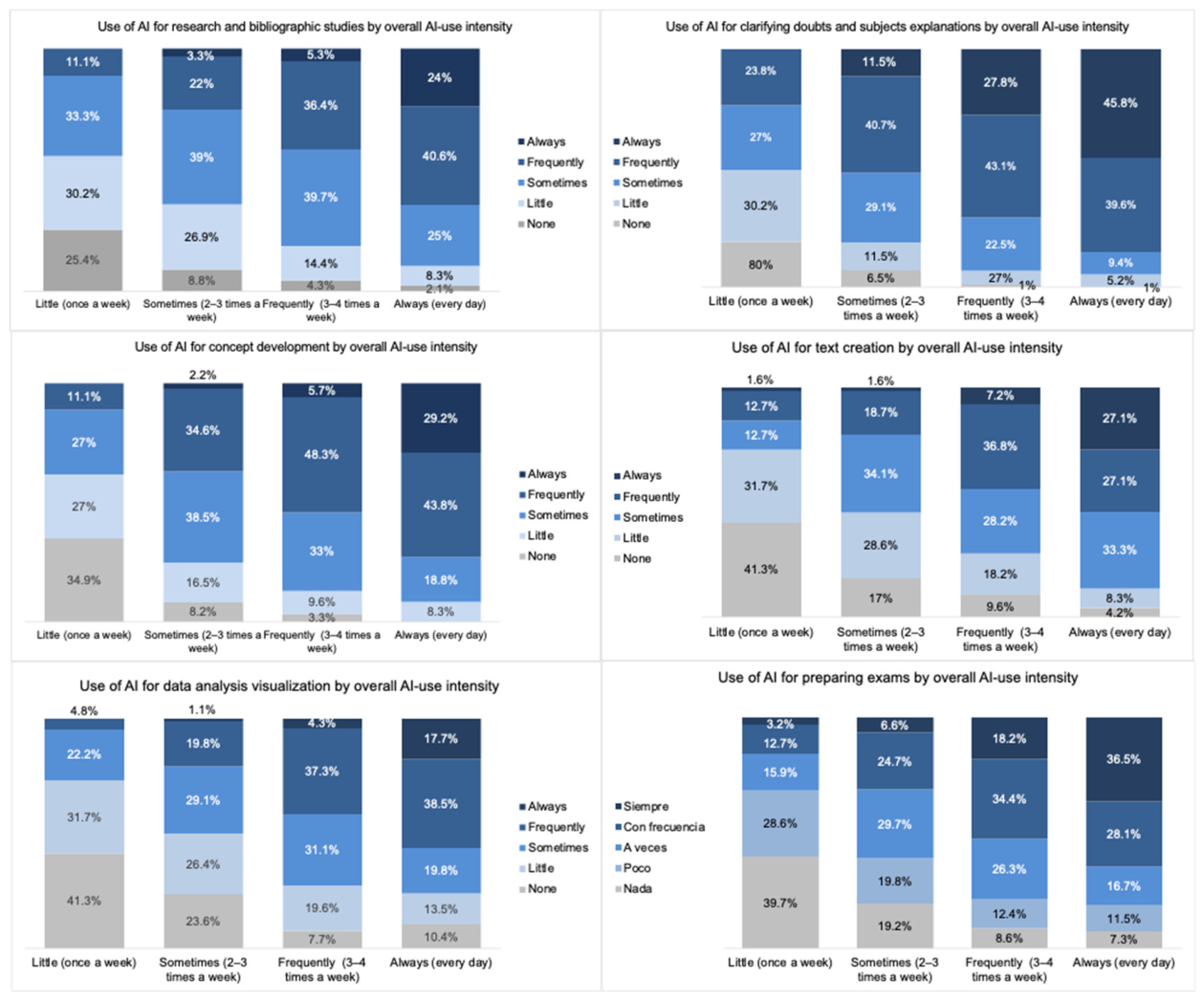
| As Part of My Studies, I Use AI to… | Media | SD | Never | Rarely | Sometimes | Often | Always | N |
|---|---|---|---|---|---|---|---|---|
| …conduct research and literature review | 3.07 | 1.053 | 47 | 107 | 199 | 162 | 40 | 555 |
| …develop concepts and ideas | 3.23 | 1.067 | 49 | 75 | 174 | 213 | 44 | 555 |
| …analyse data and create visualisations | 2.80 | 1.175 | 100 | 122 | 151 | 154 | 28 | 555 |
| …solve problems and support decision-making | 2.52 | 1.205 | 141 | 145 | 135 | 105 | 29 | 555 |
| …clarify doubts and explain subject-specific concepts | 3.62 | 1.107 | 31 | 58 | 126 | 217 | 123 | 555 |
| …translate texts | 2.28 | 1.199 | 192 | 134 | 137 | 63 | 29 | 555 |
| …produce written texts | 2.90 | 1.188 | 86 | 118 | 161 | 145 | 45 | 555 |
| …analyse and process texts | 2.88 | 1.177 | 86 | 119 | 170 | 136 | 44 | 555 |
| …prepare for exams | 3.10 | 1.306 | 90 | 91 | 135 | 152 | 87 | 555 |
| …support programming and simulations | 1.99 | 1.275 | 295 | 93 | 74 | 61 | 32 | 555 |
| [Variable 1] | [Variable 2] I Use AI to … | d | χ2 | p | C | ρ | N |
|---|---|---|---|---|---|---|---|
| How often do you use AI? | (V2.1) Conduct research and literature review | 16 | 151.83 | <0.001 | 0.463 | 0.411 | 555 |
| (V2.2) Develop concepts and ideas | 16 | 225.59 | <0.001 | 0.538 | 0.451 | 555 | |
| (V2.3) Analyse data and create visualisations | 16 | 138.89 | <0.001 | 0.447 | 0.410 | 555 | |
| (V2.4) Solve problems and support decision-making | 16 | 130.15 | <0.001 | 0.436 | 0.407 | 555 | |
| (V2.5) Clarify doubts and explain subject-specific concepts | 16 | 185.89 | <0.001 | 0.501 | 0.455 | 555 | |
| (V2.6) Translate texts | 16 | 93.17 | <0.001 | 0.379 | 0.327 | 555 | |
| (V2.7) Produce written texts | 16 | 164.55 | <0.001 | 0.478 | 0.420 | 555 | |
| (V2.8) Analyse and process texts | 16 | 154.67 | <0.001 | 0.467 | 0.407 | 555 | |
| (V2.9) Prepare for exams | 16 | 129.85 | <0.001 | 0.435 | 0.395 | 555 | |
| (V2.10) Support programming and simulations | 16 | 57.79 | <0.001 | 0.307 | 0.255 | 555 |
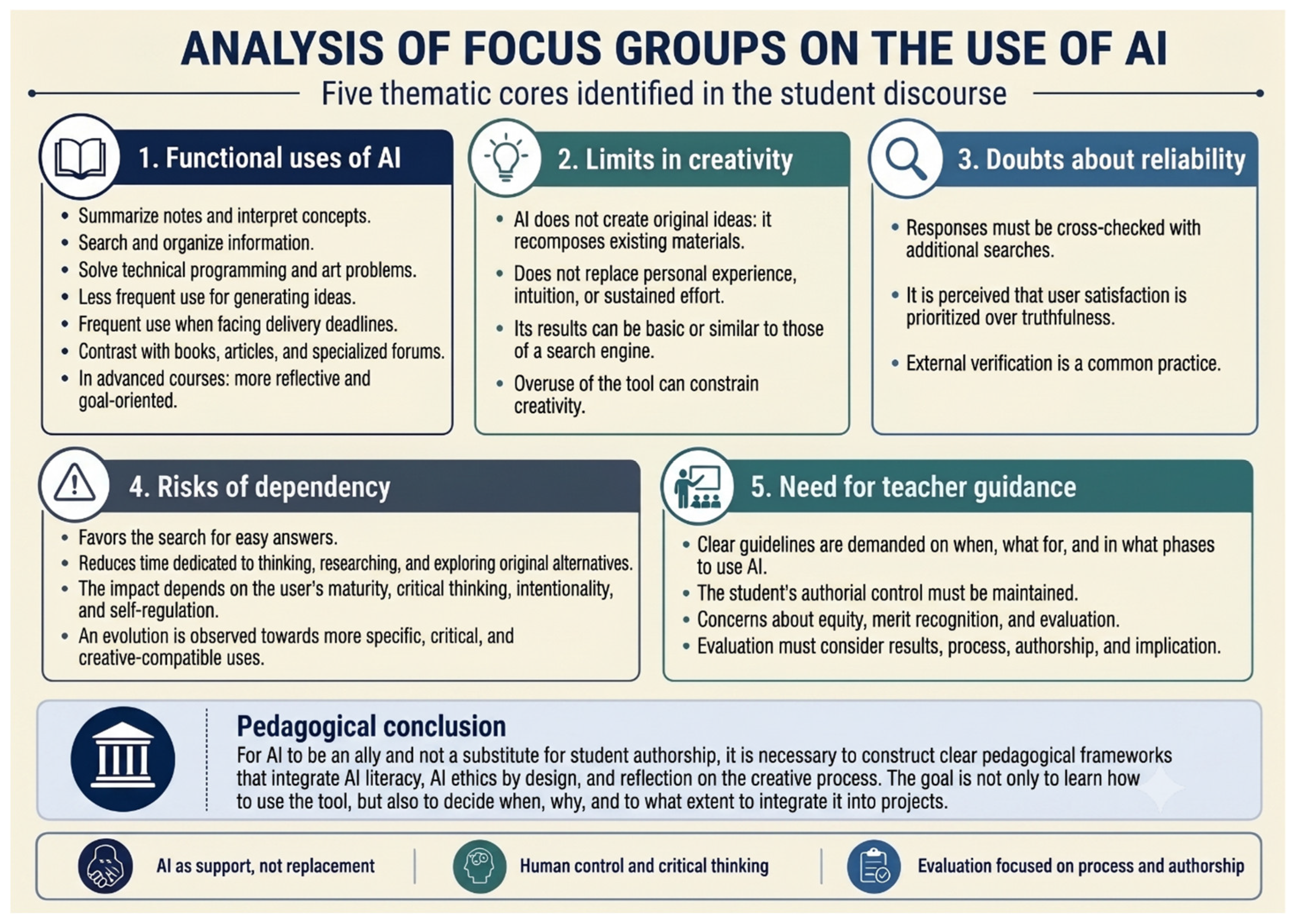
| Main Category | Core Finding | Subcategories to Report |
|---|---|---|
| 1. Functional uses of AI | AI is mainly interpreted as a practical support tool rather than an autonomous creative agent. | 1.1 Summarizing and conceptual clarification 1.2 Searching and organizing information 1.3 Technical problem-solving 1.4 Use under creative block or deadline pressure 1.5 Selective and goal-oriented use in advanced stages |
| 2. Perceived limits on creativity | Students see AI as useful but limited in relation to originality, intuition and sustained creative effort. | 2.1 Recombination rather than originality 2.2 Irreplaceability of personal experience and intuition 2.3 Basic, generic, or search-engine-like outputs 2.4 Creative narrowing through overuse |
| 3. Doubts about reliability | AI outputs are treated as provisional and require verification | 3.1 Need for external verification 3.2 Perceived satisfaction-over-truth bias 3.3 Verification as routine practice |
| 4. Risks of dependence | Dependence is framed as a threat to thinking, investigation, and creative autonomy. | 4.1 Cognitive shortcut and easy-answer logic 4.2 Reduced time for thinking, investigation and exploration 4.3 Dependence conditioned by user maturity and self-regulation 4.4 Evolution towards critical and compatible use |
| 5. Need for pedagogical guidance | Students demand explicit frameworks that regulate AI use without eliminating its educational value. | 5.1 Explicit guidelines for when, why and how to use AI 5.2 Boundaries of authorial control 5.3 Fairness, merit and assessment equity 5.4 Process-oriented assessment |
Disclaimer/Publisher’s Note: The statements, opinions and data contained in all publications are solely those of the individual author(s) and contributor(s) and not of MDPI and/or the editor(s). MDPI and/or the editor(s) disclaim responsibility for any injury to people or property resulting from any ideas, methods, instructions or products referred to in the content. |
© 2026 by the authors. Licensee MDPI, Basel, Switzerland. This article is an open access article distributed under the terms and conditions of the Creative Commons Attribution (CC BY) license.
Share and Cite
Mainer, B.; Pérez-Escoda, A. Generative AI in Higher Education: Student Perceptions and a Teaching Framework for Creative Interactive Content Design. Educ. Sci. 2026, 16, 1337. https://doi.org/10.3390/educsci16081337
Mainer B, Pérez-Escoda A. Generative AI in Higher Education: Student Perceptions and a Teaching Framework for Creative Interactive Content Design. Education Sciences. 2026; 16(8):1337. https://doi.org/10.3390/educsci16081337
Chicago/Turabian StyleMainer, Belén, and Ana Pérez-Escoda. 2026. "Generative AI in Higher Education: Student Perceptions and a Teaching Framework for Creative Interactive Content Design" Education Sciences 16, no. 8: 1337. https://doi.org/10.3390/educsci16081337
APA StyleMainer, B., & Pérez-Escoda, A. (2026). Generative AI in Higher Education: Student Perceptions and a Teaching Framework for Creative Interactive Content Design. Education Sciences, 16(8), 1337. https://doi.org/10.3390/educsci16081337