

Article

Exploring the Feasibility of the Self-Determined Learning Model of Instruction for Students with Autism in Chinese Special Education Settings

Department of Special Needs Education, Graduate School of Humanities and Social Sciences, Hiroshima University, 1-1-1 Kagamiyama, Higashi-Hiroshima 739-8524, Japan
*
Author to whom correspondence should be addressed.
Educ. Sci. 2026, 16(8), 1334; https://doi.org/10.3390/educsci16081334
Submission received: 15 June 2026 / Revised: 11 August 2026 / Accepted: 17 August 2026 / Published: 20 August 2026

Abstract

Self-determination is critical in promoting classroom engagement among students with autism spectrum disorder. The Self-Determined Learning Model of Instruction (SDLMI), an evidence-based practice for enhancing self-determination in students with disabilities, has gained increasing scholarly attention. However, empirical studies in Chinese contexts remain limited. This exploratory, descriptive implementation study used an A–B–M single-case approach with two individual cases to examine descriptive patterns in self-determination skills, perceived opportunities for self-determination, and classroom engagement before, during, and after the implementation of an SDLMI-based action-plan in Mandarin-speaking special education classrooms in Fujian Province, China. Preliminary findings indicated positive trends in students’ self-determination skills and classroom engagement after the implementation of the SDLMI, as well as increased perceived school-based opportunities for self-determination and mixed changes in perceived home-based opportunities. These findings are consistent with the existing international literature and provide preliminary case-level support for the cultural feasibility of adapting SDLMI practices within Chinese special education settings. Further research with larger samples and more rigorous experimental designs must fully assess its effectiveness and generalizability.

1. Introduction

Classroom engagement is a key mediator of learning outcomes for students with disabilities, with high-achieving students sustaining academic engagement longer than their lower-achieving peers (Fredricks et al., 2004; Greenwood et al., 2002; Rhode et al., 2010). In China, policies such as the Second Special Education Enhancement Plan (2017–2020) recognize classroom engagement as a core indicator of educational quality (Ministry of Education of the People’s Republic of China, 2017), reflecting a consensus that fostering such engagement is crucial for meaningful learning outcomes among students with autism spectrum disorder (ASD).
However, students with ASD often face challenges such as impulsivity, poor self-regulation, and aggression, which hinder classroom engagement (Harris et al., 2005; Kim & Park, 2012; Turner, 1999). Low engagement can disrupt instruction and limit learning for all students (Ducharme & Shecter, 2011; Kim & Park, 2012), increase the risk of school dropout and unemployment (Alexander et al., 2001; Finn, 1989; Wong et al., 2021), and reduce instructional quality, as teachers may spend more time on behavior management (Kim & Park, 2012).
Research suggests that self-determination instruction is associated with improvements in classroom engagement for students with ASD (Rowe et al., 2017; Yang et al., 2022). Self-determination encompasses interrelated skills such as choice-making, problem-solving, decision-making, goal-setting, goal attainment, and self-awareness (Shogren et al., 2015). For example, Lane et al. (2015) found that offering choices in a writing class increased motivation and engagement, while Sullivan and Roane (2018) reported that classroom choices reduced inappropriate behaviors and improved task completion. Gural et al. (2024) demonstrated that self-monitoring strategies further enhance student engagement. Despite this growing body of international evidence, studies within the Chinese context remain limited.
Several theories account for the development of self-determination (Shogren et al., 2024). Among them, the Self-Determined Learning Model of Instruction (SDLMI) is an evidence-based approach that promotes self-determination in students with disabilities (Agran et al., 2006; Shogren et al., 2012; Wehmeyer et al., 2012). Previous research has indicated that the SDLMI may enhance self-determination and classroom engagement across a range of educational settings (Wehmeyer et al., 2003). Nevertheless, research investigating its implementation within Chinese special education contexts remains limited.
The SDLMI comprises three phases: goal-setting, planning, and self-regulation (Shogren et al., 2019). Integrated into the regular curriculum, it teaches key self-determination skills such as goal-setting, goal attainment, and problem-solving (Raley et al., 2020). Previous research has reported positive associations between the SDLMI and improvements in self-determination (Wehmeyer et al., 2012), classroom engagement (Agran et al., 2006), and reductions in problematic behaviors, such as disruption and non-compliance (Mazzotti et al., 2013).
In Chinese special education settings, the SDLMI has gained increasing attention for its potential to promote self-determination despite teacher shortages and high student–teacher ratios (K. S. Huang & Xu, 2018). The model is often recommended for its efficiency because it can be integrated into existing curricula without the need for additional instructional time (Xu, 2010; Zhao, 2018). Empirical studies have suggested that the SDLMI enhances goal-setting and problem-solving skills among students with intellectual disabilities, both in transition support (Zhao, 2018) and upper-grade special education classrooms (Xu, 2010).
Despite its benefits, implementing the SDLMI presents several challenges. Most research focuses on the development of self-determination skills rather than classroom engagement (Yang et al., 2022) and primarily involves adolescents with intellectual disabilities, leaving gaps in knowledge regarding children with ASD (Yuan & Yu, 2018). However, implementation frequently overlooks China’s special education system and cultural context (K. S. Huang & Xu, 2018; Wang, 2018). In addition, parental involvement remains limited as many parents have limited understanding of self-determination concepts (Chen, 2024; Zhang et al., 2010). More recent work has also highlighted the importance of family perspectives and individualized instructional support in Chinese special education contexts, particularly for students with ASD or intellectual and developmental disabilities (Chen, 2024; S. Huang et al., 2023). Thus, adapting the SDLMI to China’s cultural and educational context is essential for effective implementation.
This exploratory study examines changes in self-determination skills and classroom engagement following the introduction of the SDLMI in a Chinese special education context. The findings aim to provide preliminary insights into the cultural adaptation of the SDLMI within similar East Asian educational contexts. Accordingly, this study was guided by the following research questions:
Research Question 1: How did students’ self-determination skills change during the implementation of the SDLMI?
Research Question 2: How did teachers and parents perceive opportunities for self-determination throughout the implementation process?
Research Question 3: What patterns of classroom engagement emerged during and after the implementation of the SDLMI?

2. Materials and Methods

This exploratory, descriptive implementation study used an A–B–M single-case approach with two individual cases to investigate preliminary patterns of behavioral change during SDLMI implementation (Freeman & Mash, 2008). Phase A corresponded to baseline, Phase B corresponded to intervention, and Phase M corresponded to maintenance, examining whether observed behavioral patterns were sustained after active support ended. During the initial observation phase, students had not yet identified individualized target behaviors; therefore, only general classroom engagement patterns were observed to establish contextual understanding. The baseline phase involved systematic observation of identified target behaviors before individualized SDLMI-based action-plan implementation. Following baseline data collection, the intervention phase was introduced sequentially across participants according to participant readiness. This staggered introduction provided a transparent descriptive account of each case; however, it did not constitute the experimental control associated with a formal multiple-baseline design. Accordingly, the results characterize behavioral patterns that co-occurred with SDLMI implementation rather than establish a functional or causal relationship between the intervention and the observed changes. To support transparency and reproducibility, Table 1 summarizes the timing of phases, valid observation sessions, total scheduled sessions, and intervention introduction points for each participant. Goal-setting activities were completed before active action-plan implementation, and self-evaluation activities were completed at the end of the intervention phase before follow-up observations began. Accordingly, baseline and maintenance should be interpreted as descriptive implementation phases rather than strictly intervention-free experimental conditions.

2.1. Participants

The participants were two elementary school-aged male students diagnosed with ASD and enrolled in the same special education school. Owing to the exploratory nature of the study and the small sample size, each student was treated as an individual case, and behavioral changes were descriptively analyzed across cases. Both students demonstrated observable difficulties with classroom engagement, including leaving their seats, responding inconsistently to teacher prompts, and engaging in other behaviors that interfered with classroom participation. The inclusion criteria were as follows: (1) the ability to comprehend teacher instructions, (2) observable classroom engagement difficulties identified through repeated classroom observations conducted collaboratively by teachers and researchers, and (3) parental willingness to participate in the self-determination intervention process. Although SDLMI activities were delivered in a small-group classroom context, only two students were enrolled as research participants and analyzed as individual cases in this study. Other classmates participated in regular classroom group activities but were not included in the analysis because they either did not meet the ASD-focused inclusion criterion or their families were unable to participate consistently in the parent-involvement components of the SDLMI process, such as goal-setting discussions, feedback, and home–school collaboration. Consequently, these classmates were not treated as withdrawn participants, and no individual outcome data from them were analyzed.
Participant A was a 12-year-old fifth-grade boy diagnosed with ASD, whose Wechsler Intelligence Scale for Children, Fourth Edition (WISC-IV) scores were as follows: Full Scale IQ (FIQ) = 63, Verbal Comprehension Index (VCI) = 53, Perceptual Reasoning Index (PRI) = 76, Working Memory Index (WMI) = 73, and Processing Speed Index (PSI) = 74. Observations were conducted during regularly scheduled arts and handicraft classes comprising 13 students with intellectual disabilities or ASD. Participant A attended classes regularly, followed verbal instructions, and demonstrated age-appropriate fine motor abilities. However, he frequently engaged in off-task behaviors, including leaving his seat, drawing on his arms or fingers during instruction, and handling classroom materials inappropriately. These behaviors often disrupted the student’s sustained engagement in classroom activities despite repeated verbal prompting from teachers.
Participant B was an 11-year-old fifth-grade boy diagnosed with ASD, whose WISC-IV scores were as follows: FIQ ≤ 47, VCI ≤ 45, PRI = 48, WMI = 75, and PSI = 49. Observations were conducted during a mathematics class comprising 10 students with intellectual disabilities or ASD. Participant B demonstrated limited comprehension of verbal instructions and required visual prompts and physical guidance to initiate classroom tasks. He frequently exhibited off-task and dysregulated behaviors, including wandering around the classroom, crawling under desks, producing disruptive vocalizations, and interfering with peers’ activities. Verbal prompting alone was generally insufficient to facilitate consistent classroom engagement, and he frequently required individualized assistance to participate appropriately in classroom activities.
For both participants, individualized target behaviors were selected through repeated classroom observations and discussion among teachers, researchers, and parents. Teachers identified behaviors that interfered with classroom participation, researchers helped operationalize these behaviors for systematic observation, and parents provided information about students’ support needs and consistency with home-based expectations.

2.2. Setting

This study was conducted in a special education school in Fujian Province, China, which enrolled 136 students (84 elementary, 52 middle school) with intellectual disabilities or ASD. Both elementary school teachers provided consent to participate. The SDLMI was implemented from March to June in a self-contained classroom.

2.3. Outcome Variables and Measures

2.3.1. Measure of Self-Determination

Self-determination, one of the primary outcome domains examined in this study, was assessed using the American Institutes for Research (AIR) Self-Determination Scale (Wolman et al., 1994), available in student, parent, and educator versions. This scale evaluates capacity and opportunity. All items are rated on a five-point Likert scale ranging from 1 (never) to 5 (always), with higher scores indicating greater self-determination skills and more frequent opportunities to foster self-determined behavior. In the educator version, capacity includes three subscales: knowledge of self-determined behavior (Knowledge), ability to perform self-determined behavior (Ability), and perception of one’s knowledge and ability to perform self-determined behavior (Perception). As the original parent version only assesses Ability, the Knowledge and Perception items from the educator version were adapted for parent use. Items originally phrased for educators to rate “the student” were reworded so that parents could rate “the student/child” based on everyday observations in home and daily life contexts. The original English AIR forms served as the primary source instruments, and the available Japanese versions were used as conceptual references during translation and adaptation. This modification allowed parents to complete the same three capacity subscales used in the educator version. Because this adaptation altered the structure of the original AIR parent instrument, parent scores on the Knowledge and Perception subscales are not directly comparable with those obtained using the unmodified parent version and should be interpreted as study-specific. In addition, because the reliability and validity of the translated and adapted Chinese version were not formally established in the present study, all scale-based results should be regarded as preliminary and interpreted with caution. The student version includes two subscales: “What I do” (behavioral) and “How I feel” (affective). Because participants demonstrated varying levels of language comprehension, only those with sufficient language skills completed the questionnaire. For these students, the teachers provided support by reading the items aloud and offering simple explanations. To minimize fatigue, the students completed the scale across several brief sessions.
All three versions of the scale also assess opportunities for self-determination in home and school environments. To improve contextual appropriateness, teachers did not complete items related to home-based opportunities, whereas parents did not complete items pertaining to school-based opportunities. For the present study, two translators with expertise in psychometric assessment independently completed forward translations of the scale into Chinese, and a third bilingual translator conducted back-translation procedures to verify linguistic and conceptual equivalence.

2.3.2. Measure of Classroom Engagement

Classroom engagement was operationally defined as observable on-task participation behaviors aligned with each participant’s individualized classroom goals. These engagement behaviors (see Table 2) were systematically observed and recorded across all phases of the study.

2.3.3. Goal Attainment

Individual goal attainment was measured using Goal Attainment Scaling (Kiresuk et al., 1994). Teachers and researchers collaboratively established meaningful behavioral goals for each participant. Five levels of performance, ranging from −2 to +2, were defined for each goal, with 0 representing the expected level of goal attainment.

2.4. Intervention

The SDLMI served as the instructional framework in this study and was implemented in self-contained classrooms. Grounded in self-determination and self-regulated learning theory (Wehmeyer et al., 2000), the model guides students through a problem-solving process in which they set goals, create action plans, monitor progress, and make necessary adjustments. It comprises three phases, each corresponding to a central question that the students must address: “What is my goal?”; “What is my plan?”; and “What have I learned?” In this study, the core SDLMI procedures—goal-setting, action planning, plan implementation, progress monitoring, and self-evaluation—were operationalized through these guiding questions. Educational support was provided to make the SDLMI process accessible to each participant with ASD. These supports included visual cue cards, graphic organizers, environmental modifications, verbal and physical prompting, self-monitoring, and self-instruction. Supports were selected according to each participant’s communication, cognitive, and behavioral needs. Participant-specific examples of these supports are described below in the intervention procedures. A goal was considered appropriate when it was observable, measurable within regular classroom activities, functionally related to classroom engagement, understandable to the student with visual or verbal support, and feasible for teachers and parents to reinforce across school–home contexts.

2.5. Considerations for SDLMI Implementation

2.5.1. Cultural Adaptation

To enhance contextual relevance within the Chinese special education setting, the SDLMI was implemented using a small-group format rather than individualized instruction. This approach reflected the collaborative nature of classroom practices and the strong emphasis on school–family involvement within the local educational context. Students worked collaboratively with teachers, peers, and parents to establish goals, develop action plans, and participate in reflective activities. Visual materials, such as graphic organizers and activity-record sticky notes, were used to facilitate expression and support engagement.

2.5.2. Parental Involvement

Parents were systematically involved in the intervention. They participated in goal-setting discussions, provided feedback, and supported home–school collaboration. Additionally, take-home materials supported continuity between school and home, with the aim of strengthening students’ self-esteem, persistence, and generalization of self-determination skills.

2.6. Considerations for Participants with ASD

Because both participants demonstrated distinct cognitive, behavioral, and communication profiles, individualized educational supports were incorporated throughout the SDLMI implementation process. As described in Section 2.4 and Section 2.6.3, these supports were used to facilitate access to the SDLMI guiding questions and action-plan activities rather than to constitute a separate intervention package.

2.6.1. Observer Training

Observer training consisted of three stages: (1) learning the operational definitions of target behaviors (Table 2), recording procedures, and use of the observation checklist; (2) participating in video-based coding practice using classroom recordings; and (3) conducting simultaneous live observations. Formal data collection started only after the observers achieved a minimum of 80% agreement across three consecutive practice sessions.

2.6.2. Interobserver Agreement (IOA)

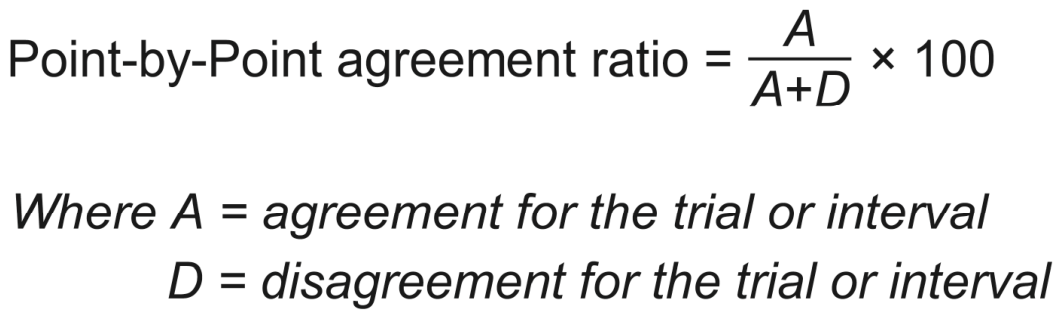
Interobserver agreement (IOA) was calculated for approximately 30% of observation sessions using point-by-point agreement procedures (Figure 1). The sessions selected for IOA calculation were distributed across phases. The average IOA was 93.9% for Participant A (range: 83.3–100.0%) and 100.0% for Participant B.

2.6.3. Procedure

To clarify how the SDLMI was embedded into classroom instruction, Table 3 summarizes the main teacher actions, student actions, and parent roles across the three SDLMI phases.
Initial Observation. During the initial observation phase, the students had not yet established self-determination or engagement goals. Thus, observers recorded general notes on off-task behaviors to obtain contextual understanding. Formal behavioral observations began in the baseline phase after individualized target behaviors had been identified but before students implemented their SDLMI-based action plans. The AIR Self-Determination Scale was also administered to the students, teachers, and parents for multi-informant assessment.
Prior to the SDLMI intervention, key concepts such as goals, plans, barriers, and adjustments were introduced through small-group sessions using visual aids. The students used colored sticky notes to record reflections, self-assessments, and peer feedback, which were then displayed on the classroom blackboard for collective sharing and teacher-guided discussion.
Baseline. During this phase, students identified individualized engagement goals and discussed potential action steps with support from teachers, parents, and peers. However, individualized SDLMI-based action plans had not yet been implemented. Visual aids (diagrams, picture cards) enhanced comprehension, and the students selected responses with scaffolded support to maintain autonomy. Simultaneously, systematic observations of target behaviors were conducted to establish baseline behavioral patterns for comparison across study phases.
Intervention. During the intervention phase, students implemented individualized action plans developed through the SDLMI process. Action planning, plan implementation, progress monitoring, and self-evaluation were considered core SDLMI procedures. Visual cue cards, self-monitoring procedures, self-instruction, prompting, and environmental modifications served as individualized educational supports that helped each participant access and enact the SDLMI process.
Participant A. With guidance, Participant A identified that specific materials, such as scissors and colored pencils, contributed to his off-task behavior. To minimize distractions, these materials were only distributed after the teacher’s explanation. Participant A selected visual cue cards and peer prompting as support strategies to facilitate sustained classroom engagement. Cue cards depicting expected classroom behaviors (e.g., facing the teacher, staying seated) were placed on his desk, and verbal reminders were provided when necessary.
Participant B. Initially, Participant B struggled to choose an appropriate strategy, but with support, he selected a combination of cue cards and self-monitoring. Visual cue cards depicting target classroom behaviors, such as raising a hand before speaking, were introduced during instructional activities, and occurrences of target behaviors were systematically recorded throughout the intervention period.
Maintenance. Follow-up observations were conducted three times for each participant after the end of active intervention support and after Phase 3 self-evaluation of the SDLMI had been completed. During the maintenance phase, no new individualized action-plan support was introduced. The AIR Self-Determination Scale was re-administered to the students, teachers, and parents to measure post-intervention changes in self-determination skills.

2.7. Measure of Social Validation

At the conclusion of the maintenance phase, teachers completed a social validity questionnaire designed to assess the perceived acceptability, feasibility, and usefulness of the SDLMI implementation process (Wolf, 1978). The items were rated on a five-point Likert scale (1 = strongly disagree to 5 = strongly agree) to evaluate content relevance, ease of implementation, and perceived benefits for student development (Table 4).

2.8. Ethical Considerations

This study was approved by the Ethics Review Committee of the Graduate School of Humanities and Social Sciences, Hiroshima University (Approval No. HR-ES-000943). Written informed consent was obtained from the participants’ legal guardians, and assent was obtained from the teachers. Participants were informed in writing that all data would be used solely for research purposes and that the identities of the schools and individuals would remain strictly confidential.

3. Results

3.1. Self-Determination

3.1.1. Changes in Participant A’s Self-Determination

Both teacher (59 → 64 out of 90) and parent (36 → 61 out of 90) ratings showed increased self-determination for Participant A across the study phases, with parent ratings reflecting notable improvements in perceived capacity. For “Opportunities for Self-Determination,” the teachers reported increased school opportunities (24 → 30 out of 30), whereas the parents reported a decline in perceived home opportunities (29 → 21 out of 30).
Participant A’s self-reported scores also improved, especially on the Capacity subscale (41 → 47 out of 60). School and home opportunity ratings remained at ceiling levels throughout the study phases.

3.1.2. Changes in Participant B’s Self-Determination

Participant B demonstrated increased self-determination scores across teacher-, parent-, and self-report measures over the course of the study. Teacher ratings increased (32 → 64 out of 90), as did parent ratings (22 → 37 out of 90), with consistent gains across Knowledge, Ability, and Perception. Regarding opportunities for self-determination, both teachers (14 → 25 out of 30) and parents (8 → 15 out of 30) reported increases. Participant B’s self-reported scores reflected similar gains in Capacity (23 → 36 out of 60) and perceived opportunities at school and home (10 → 17 out of 30).
To facilitate comparison across informants and participants, Table 5 summarizes the pre- and post-intervention AIR Self-Determination Scale scores reported by teachers, parents, and students.

3.2. Classroom Engagement

3.2.1. Changes in Participant A’s Classroom Engagement Behavior

Participant A set two classroom engagement goals: (1) maintaining attention during class and (2) remaining seated. Engagement was coded as “not observed” for any 10-s interval containing off-task behaviors, such as inattention or leaving the seat.
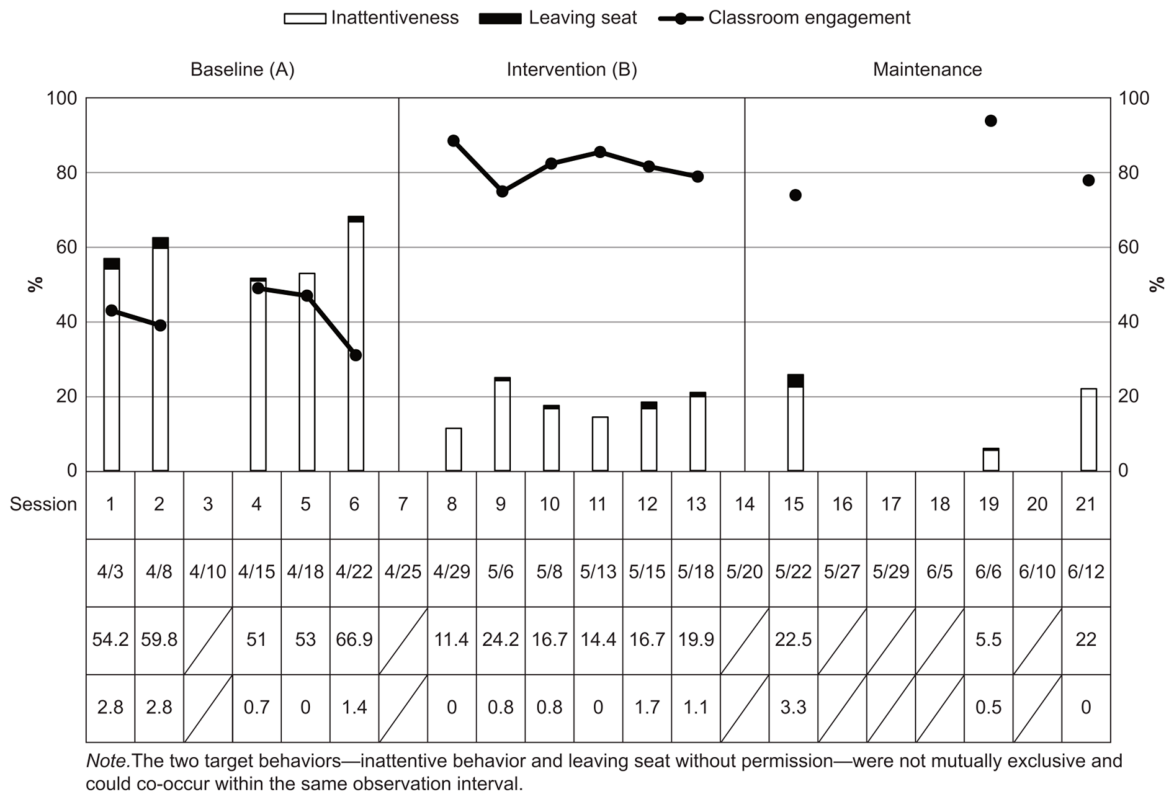
Baseline. Participant A’s classroom engagement, presented in Figure 2, ranged from 31.0% to 49.0% (M = 41.8%) and remained relatively stable prior to the introduction of the intervention phase.
Intervention. Participant A’s classroom engagement increased to 75.0–88.6% (M = 82.1%).
Maintenance. Following the intervention, Participant A’s classroom engagement remained stable at 74.0–94.0% (M = 82.0%), comparable to levels observed during the intervention phase.

3.2.2. Changes in Participant B’s Classroom Engagement Behavior

Participant B set a single goal: responding to the teacher’s questions. Both spontaneous and prompted responses were recorded as instances of engagement.
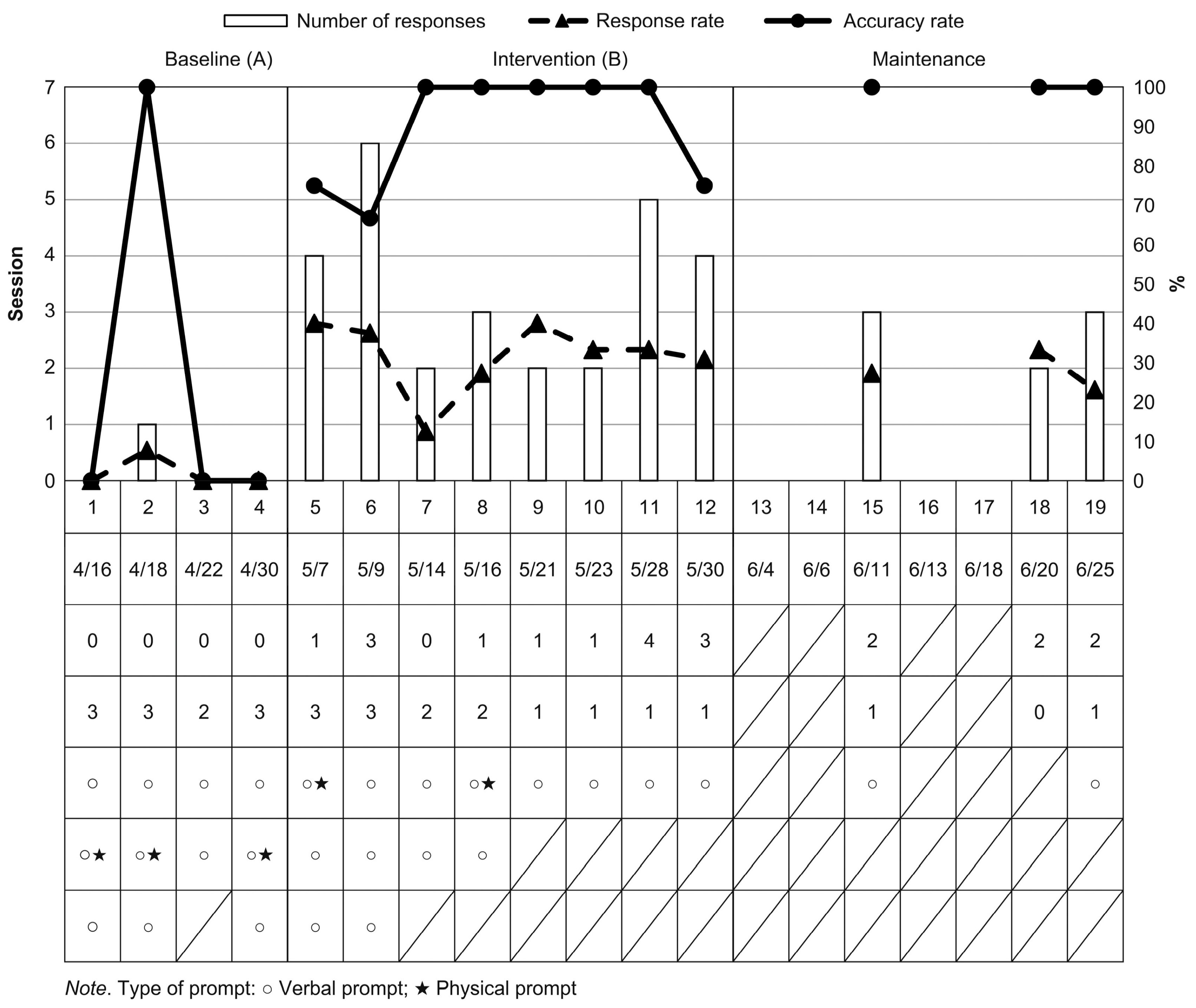
Baseline. Figure 3 shows that Participant B demonstrated low frequencies of target responses during the baseline phase even when teacher prompting was provided.
Intervention. Participant B’s engagement increased, with 2–6 responses per session (12.5–40.0%, M = 31.8%) and 66.7–100.0% accuracy (M = 89.6%), while spontaneous responses rose to 1–4 occurrences per session. Physical prompting gradually decreased across sessions, whereas verbal prompting remained the primary support strategy.
Maintenance. Participant B demonstrated a pattern similar to that observed during the intervention phase, with 2–3 responses per session (23.1–33.3%, M = 27.9%) and 100.0% accuracy. Most responses occurred spontaneously, and only minimal prompting was required across follow-up observations.

3.3. Goal Attainment Scaling

Participant A set two goals—“remaining seated during class” (−1) and “maintaining focus during lessons” (+1)—yielding a composite T-score of 50.0, reflecting attainment at the expected level. Participant B set one goal—“responding to the teacher’s questions during class” (+1)—yielding a T-score of 60.0 and demonstrating above-expected attainment.

3.4. Social Validation

The social validation results were uniformly high, with all items rated 4 (agree) or 5 (strongly agree) on the five-point Likert scale. Notably, both teachers assigned a rating of 5 to Items 2, 7, 8, and 9, indicating strong perceived acceptability, feasibility, and overall value of the SDLMI.

4. Discussion

4.1. Overview of Findings

Increases in self-determination and classroom engagement were observed across both participants, accompanied by changes in perceived opportunities for self-determination within school and home environments. These findings provide preliminary insights into the feasibility of culturally adapting SDLMI practices within a Chinese special education context. However, given the exploratory nature of this study and the small number of participants, the findings should be interpreted with caution. Although positive changes were observed during the implementation period, the study design does not permit definitive causal inferences regarding the relationship between SDLMI implementation and student outcomes.

4.2. Self-Determination Capacity

Both participants demonstrated increases in self-determination across teacher, parent, and, where applicable, student self-report measures throughout the study period. These findings are generally consistent with previous research examining SDLMI implementation among students with intellectual disabilities and ASD.
Notably, Participant A’s parent reported greater gains in self-determination than the teacher, likely reflecting enhanced awareness of progress through parental involvement. In contrast, Participant B’s scores remained comparatively lower across several measures, potentially reflecting more extensive communication and behavioral support needs. Previous research has suggested that students requiring higher levels of individualized support may demonstrate different developmental trajectories in self-determination (Carter et al., 2009, 2013; Cook & Odom, 2013). These findings underscore the potential importance of educator and family involvement during SDLMI implementation, as well as the need to consider individual learning profiles and support requirements when adapting self-determination practices for students with ASD.

4.3. Opportunities for Self-Determination in School and Home Environments

Across the study period, both students and teachers reported increased school-based opportunities for self-determination. These patterns are broadly consistent with those of previous studies examining SDLMI implementation in educational settings (Shogren et al., 2014, 2015).
Participant B’s self-reports indicated increased home-based opportunities for self-determination, whereas Participant A’s self-reported home opportunity ratings remained at ceiling levels throughout the study. Parent ratings likewise increased for Participant B. These findings may suggest that parental involvement plays a meaningful role in supporting self-determination practices within home environments (Shogren et al., 2015; Trainor, 2005). In contrast, Participant A’s parent reported a decrease in home-based opportunities (29 → 21 out of 30), which may reflect changes in parental expectations or perceptions following increased participation in the intervention process. Overall, the findings suggest that school–family collaboration may represent an important consideration when implementing self-determination practices for students with ASD across both school and home contexts.

4.4. Classroom Engagement

Classroom engagement was higher for both participants during the intervention and maintenance phases than during baseline, which is generally consistent with previous studies reporting engagement-related improvements among students with disabilities participating in SDLMI-based interventions (Agran et al., 2006; Algozzine et al., 2001; Yang et al., 2022).
Research has identified that students with ASD often face difficulties in processing linguistic and social information and adapting to environmental demands, which can hinder goal-setting and sustained motivation central to the SDLMI (Shogren et al., 2015; Wehmeyer et al., 2013). In the present study, visual supports, behavioral schedules, and peer-assisted activities were incorporated to provide structured and accessible opportunities for participation throughout the intervention. Both participants demonstrated increased classroom engagement during the intervention phase, and these gains were sustained during the maintenance follow-up sessions. These observations may suggest that structured and visually supported SDLMI practices can be feasibly adapted for students with ASD within Chinese special education settings.

4.5. Limitations and Future Directions

This study has several limitations that should be noted. First, the study included only two students with ASD from one special education school and used an exploratory, descriptive single-case (two-case) design. Therefore, the findings should be interpreted as descriptive case-level evidence rather than generalizable evidence of SDLMI effectiveness. The small number of analytic cases and the single-school context limit the external validity of the findings, restricting generalization to other students with ASD, other disability groups, or other educational settings. Second, the SDLMI was implemented using a small-group format to align with the collaborative characteristics of the Chinese educational context; however, this group-based approach may have introduced additional contextual influences on student behavior and engagement. Third, classroom engagement was examined only within specific instructional settings, thereby limiting the broader generalizability of the findings. Fourth, although interobserver agreement levels were high, formal implementation fidelity measures were not systematically collected across all sessions. This limits the extent to which the observed behavioral changes can be specifically attributed to consistent SDLMI implementation. In particular, without session-by-session fidelity checklists or teacher implementation logs, it is impossible to determine whether each SDLMI component, such as goal-setting, action planning, self-monitoring, and self-evaluation, was delivered with the same level of consistency across sessions and participants. Therefore, this study cannot fully distinguish the contribution of the SDLMI framework from teacher-provided classroom support, regular classroom instruction, or other contextual factors. Finally, although the AIR Self-Determination Scale underwent translation and back-translation procedures, the psychometric properties of the adapted Chinese version were not formally validated. The parent version was structurally modified by adding Knowledge and Perception items adapted from the educator version, which further limits the comparability of parent scores with the original instrument and constrains their interpretation. A further limitation concerns the phase structure: because goal-setting and self-evaluation activities occurred around phase transitions, these phases should be interpreted as descriptive implementation phases rather than strictly intervention-free experimental conditions. Despite these limitations, this study provides preliminary insights into the cultural feasibility of SDLMI implementation in Chinese special education settings. Future research should include larger and more diverse samples, longer follow-up periods, and more rigorous experimental or quasi-experimental designs to further examine the effectiveness and cultural adaptability of SDLMI practices for students with ASD.

5. Conclusions

This exploratory, descriptive study examined the association of SDLMI-based action-plan implementation with changes in self-determination, perceived opportunities for self-determination, and classroom engagement in two special education cases in China. Participant-level findings suggested increases in self-determination capacity, increased school-based opportunities, mixed home-based opportunity ratings, and higher classroom engagement during the intervention and maintenance phases than at baseline. Therefore, the study offers preliminary case-level observations suggesting that culturally responsive adaptations, including visual supports, collaborative goal-setting, and school–family involvement, may support the practical feasibility of SDLMI implementation for students with ASD in Chinese special education contexts. Because the design was descriptive and involved only two cases, future research should use larger samples, longer follow-up periods, systematic fidelity measurement, and more rigorous experimental or quasi-experimental designs.

Author Contributions

Conceptualization, Y.C.; Formal analysis, Y.C.; Data curation, Y.C.; Writing—original draft, Y.C.; Writing—review & editing, A.F.; Visualization, A.F. All authors have read and agreed to the published version of the manuscript.

Funding

This research received no external funding.

Institutional Review Board Statement

The study was conducted in accordance with the Declaration of Helsinki, and approved by the Ethics Review Committee of Graduate School of Humanities and Social Sciences, Hiroshima University (protocol code HR-ES-000943 and with approval granted on 11 May 2023).

Informed Consent Statement

Informed consent was obtained from all subjects involved in the study.

Data Availability Statement

The raw data supporting the conclusions of this article will be made available by the authors on request.

Conflicts of Interest

The authors declare no conflicts of interest.

Abbreviations

The following abbreviations are used in this manuscript:
ASDAutism spectrum disorder
SDLMISelf-Determined Learning Model of Instruction
AIRAmerican Institutes for Research
IOAInterobserver agreement

References

  1. Agran, M., Cavin, M., Wehmeyer, M., & Palmer, S. (2006). Participation of students with moderate to severe disabilities in the general curriculum: The effects of the self-determined learning model of instruction. Research and Practice for Persons with Severe Disabilities, 31(3), 230–241. [Google Scholar] [CrossRef] [Scilit]
  2. Alexander, K. L., Entwisle, D. R., & Kabbani, N. S. (2001). The dropout process in life course perspective: Early risk factors at home and school. Teachers College Record, 103(5), 760–822. [Google Scholar] [CrossRef] [Scilit]
  3. Algozzine, B., Browder, D., Karvonen, M., Test, D. W., & Wood, W. M. (2001). Effects of interventions to promote self-determination for individuals with disabilities. Review of Educational Research, 71(2), 219–277. [Google Scholar] [CrossRef] [Scilit]
  4. Carter, E. W., Lane, K. L., Cooney, M., Weir, K., Moss, C. K., & Machalicek, W. (2013). Self-determination among transition-age youth with autism or intellectual disability: Parent perspectives. Research and Practice for Persons with Severe Disabilities, 38(3), 129–138. [Google Scholar] [CrossRef] [Scilit]
  5. Carter, E. W., Owens, L., Trainor, A. A., Sun, Y., & Swedeen, B. (2009). Self-determination skills and opportunities of adolescents with severe intellectual and developmental disabilities. American Journal on Intellectual and Developmental Disabilities, 114(3), 179–192. [Google Scholar] [CrossRef] [Scilit] [PubMed]
  6. Chen, Y. X. (2024). Self-determination in children with intellectual disabilities or autism spectrum disorder. Asian Journal of Human Services, 27, 138–154. [Google Scholar] [CrossRef] [Scilit]
  7. Cook, B. G., & Odom, S. L. (2013). Evidence-based practices and implementation science in special education. Exceptional Children, 79(3), 135–144. [Google Scholar] [CrossRef] [Scilit]
  8. Ducharme, J. M., & Shecter, C. (2011). Bridging the gap between clinical and classroom intervention: Keystone approaches for students with challenging behavior. School Psychology Review, 40(2), 257–274. [Google Scholar] [CrossRef] [Scilit]
  9. Finn, J. D. (1989). Withdrawing from school. Review of Educational Research, 59(2), 117–142. [Google Scholar] [CrossRef]
  10. Fredricks, J. A., Blumenfeld, P. C., & Paris, A. H. (2004). School engagement: Potential of the concept, state of the evidence. Review of Educational Research, 74(1), 59–109. [Google Scholar] [CrossRef] [Scilit]
  11. Freeman, K. A., & Mash, E. J. (2008). Single-case research designs. In M. Hersen, & A. M. Gross (Eds.), Handbook of clinical psychology, Vol. 2: Children and adolescents (pp. 322–350). John Wiley & Sons. Available online: https://psycnet.apa.org/record/2008-03310-011 (accessed on 10 August 2026).
  12. Greenwood, C. R., Horton, B. T., & Utley, C. A. (2002). Academic engagement: Current perspectives on research and practice. School Psychology Review, 31(3), 328–349. [Google Scholar] [CrossRef] [Scilit]
  13. Gural, I., Cividini-Motta, C., Del Vecchio, M. L., & Risse, M. R. (2024). Evaluating the effects of self-monitoring of performance with a peer component on disruptive behavior and task completion of children with autism spectrum disorder. Behavioral Sciences, 14(7), 547. [Google Scholar] [CrossRef] [Scilit] [PubMed]
  14. Harris, K. R., Friedlander, B. D., Saddler, B., Frizzelle, R., & Graham, S. (2005). Self-monitoring of attention versus self-monitoring of academic performance: Effects among students with ADHD in the general education classroom. The Journal of Special Education, 39(3), 145–156. [Google Scholar] [CrossRef] [Scilit]
  15. Huang, K. S., & Xu, S. (2018). Analysis on practice mode of integrated self-determination course for adolescents with disabilities. Journal of Modern Special Education, 12(24), 26–34. (In Chinese) [Google Scholar]
  16. Huang, S., Lehr, D. H., Rossetti, Z., & Wang, M. (2023). Individualizing instruction for students with intellectual and developmental disabilities in China: Teachers’ perceptions and practices. Intellectual and Developmental Disabilities, 61(5), 385–398. [Google Scholar] [CrossRef] [Scilit] [PubMed]
  17. Kim, N. H., & Park, J. (2012). The effects of the family-involved SDLMI on academic engagement and goal attainment of middle school students with disabilities who exhibit problem behavior. International Journal of Special Education, 27(1), 117–127. [Google Scholar]
  18. Kiresuk, T. J., Smith, A., & Cardillo, J. E. (1994). Goal attainment scaling: Applications, theory, and measurement. Lawrence Erlbaum Associates. [Google Scholar]
  19. Lane, K. L., Royer, D. J., Messenger, M. L., Common, E. A., Ennis, R. P., & Swogger, E. D. (2015). Empowering teachers with low-intensity strategies to support academic engagement: Implementation and effects of instructional choice for elementary students in inclusive settings. Education and Treatment of Children, 38(4), 473–504. [Google Scholar] [CrossRef] [Scilit]
  20. Mazzotti, V. L., Test, D. W., & Wood, C. L. (2013). Effects of multimedia goal-setting instruction on students’ knowledge of the self-determined learning model of instruction and disruptive behavior. Journal of Positive Behavior Interventions, 15(2), 90–102. [Google Scholar] [CrossRef] [Scilit]
  21. Ministry of Education of the People’s Republic of China. (2017). Second special education enhancement plan (2017–2020). Available online: http://www.moe.gov.cn/srcsite/A06/s3331/201707/t20170720_309687.html (accessed on 12 April 2026).
  22. Raley, S. K., Burke, K. M., Hagiwara, M., Shogren, K. A., Wehmeyer, M. L., & Kurth, J. A. (2020). The self-determined learning model of instruction and students with extensive support needs in inclusive settings. Intellectual and Developmental Disabilities, 58(1), 82–90. [Google Scholar] [CrossRef] [Scilit] [PubMed]
  23. Rhode, G., Jenson, W. R., & Reavis, H. K. (2010). The tough kid book: Practical classroom strategies. Pacific Northwest Publishing. [Google Scholar]
  24. Rowe, D. A., Mazzotti, V. L., Ingram, A., & Lee, S. (2017). Effects of goal-setting instruction on academic engagement for students at risk. Career Development and Transition for Exceptional Individuals, 40(1), 25–35. [Google Scholar] [CrossRef] [Scilit]
  25. Shogren, K. A., Long, H., Hicks, T. A., & Ferreira, H. R. (2024). Self-determination for students with disabilities during challenging times. Children and Youth Services Review, 166, 107944. [Google Scholar] [CrossRef] [Scilit]
  26. Shogren, K. A., Palmer, S. B., Wehmeyer, M. L., Williams-Diehm, K., & Little, T. D. (2012). Effect of intervention with the self-determined learning model of instruction on access and goal attainment. Remedial and Special Education, 33(5), 320–330. [Google Scholar] [CrossRef] [Scilit] [PubMed]
  27. Shogren, K. A., Plotner, A. J., Palmer, S. B., Wehmeyer, M. L., & Paek, Y. (2014). Impact of the self-determined learning model of instruction on teacher perceptions of student capacity and opportunity for self-determination. Education and Training in Autism and Developmental Disabilities, 49(3), 440–448. [Google Scholar] [CrossRef] [Scilit]
  28. Shogren, K. A., Raley, S. K., Burke, K. M., & Wehmeyer, M. L. (2019). The self-determined learning model of instruction (SDLMI) teacher’s guide. Kansas University Center on Developmental Disabilities. [Google Scholar]
  29. Shogren, K. A., Wehmeyer, M. L., Palmer, S. B., Forber-Pratt, A. J., Little, T. D., & Lopez, S. (2015). Causal agency theory: Reconceptualizing a functional model of self-determination. Education and Training in Autism and Developmental Disabilities, 50(3), 251–263. [Google Scholar] [CrossRef] [Scilit]
  30. Sullivan, W. E., & Roane, H. S. (2018). Incorporating choice in differential reinforcement of other behavior arrangements. Behavioral Development, 23(2), 130–137. [Google Scholar] [CrossRef] [Scilit]
  31. Trainor, A. A. (2005). Self-determination perceptions and behaviors of diverse students with LD during the transition planning process. Journal of Learning Disabilities, 38(3), 233–249. [Google Scholar] [CrossRef] [Scilit] [PubMed]
  32. Turner, M. (1999). Repetitive behaviour in autism: A review of psychological research. Journal of Child Psychology and Psychiatry, 40(6), 839–849. [Google Scholar] [CrossRef]
  33. Wang, S. S. (2018). Local interpretation and realization of self-determination by students with intellectual disabilities. Chinese Journal of Special Education, 6, 29–34. (In Chinese) [Google Scholar]
  34. Wehmeyer, M. L., Abery, B. H., Mithaug, D. E., & Stancliffe, R. J. (2003). Theory in self-determination: Foundations for educational practice. Charles C. Thomas Publisher, Ltd. [Google Scholar]
  35. Wehmeyer, M. L., Palmer, S. B., Agran, M., Mithaug, D. E., & Martin, J. E. (2000). Promoting causal agency: The self-determined learning model of instruction. Exceptional Children, 66(4), 439–453. [Google Scholar] [CrossRef] [Scilit]
  36. Wehmeyer, M. L., Palmer, S. B., Shogren, K., Williams-Diehm, K., & Soukup, J. H. (2013). Establishing a causal relationship between intervention to promote self-determination and enhanced student self-determination. The Journal of Special Education, 46(4), 195–210. [Google Scholar] [CrossRef] [Scilit] [PubMed]
  37. Wehmeyer, M. L., Shogren, K. A., Palmer, S. B., Williams-Diehm, K. L., Little, T. D., & Boulton, A. (2012). Impact of the self-determined learning model of instruction on self-determination: A randomized-trial control group study. Exceptional Children, 78(2), 135–153. [Google Scholar] [CrossRef] [Scilit] [PubMed]
  38. Wolf, M. M. (1978). Social validity: The case for subjective measurement or how applied behavior analysis is finding its heart. Journal of Applied Behavior Analysis, 11(2), 203–214. [Google Scholar] [CrossRef] [Scilit] [PubMed]
  39. Wolman, J. M., Campeau, P. L., DuBois, P. A., Mithaug, D. E., & Stolarski, V. S. (1994). AIR self-determination scale and user guide. American Institutes for Research. [Google Scholar]
  40. Wong, J., Coster, W. J., Cohn, E. S., & Orsmond, G. I. (2021). Identifying school-based factors that predict employment outcomes for transition-age youth with autism spectrum disorder. Journal of Autism and Developmental Disorders, 51(1), 60–74. [Google Scholar] [CrossRef] [Scilit] [PubMed]
  41. Xu, S. (2010). A study on the self-determination of young people with intellectual disabilities [Doctoral dissertation, East China Normal University]. [Google Scholar]
  42. Yang, L., Chiu, H. M., Sin, K. F., & Lui, M. (2022). The effects of school support on school engagement with self-determination as a mediator in students with special needs. International Journal of Disability, Development and Education, 69(2), 399–414. [Google Scholar] [CrossRef] [Scilit]
  43. Yuan, H. J., & Yu, S. H. (2018). An overview of the empirical studies of the self-determined learning model of instruction (SDLMI) applied to special students. Journal of Modern Special Education, 10, 22–29. [Google Scholar]
  44. Zhang, D., Landmark, L., Grenwelge, C., & Montoya, L. (2010). Culturally diverse parents’ perspectives on self-determination. Education and Training in Autism and Developmental Disabilities, 45(2), 175–186. [Google Scholar] [CrossRef] [Scilit]
  45. Zhao, J. (2018). A case study on the improvement of self-determination in transition education for student with moderate intellectual disabilities [Master’s thesis, Sichuan Normal University]. [Google Scholar]
Figure 1. Point-by-Point Agreement Ratio.
Education 16 01334 g001
Figure 2. Frequency of Occurrence of Target Behaviors in Participant A.
Education 16 01334 g002
Figure 3. Frequency of Occurrence of Target Behaviors in Participant B.
Education 16 01334 g003
Table 1. Overview of study phases, observation sessions, calendar dates, and intervention introduction points for each participant.
ParticipantPhaseDatesSessions (Valid/Total)Notes
ABaseline4/3–4/255/7 (Sessions 1–7)Before action-plan implementation; goal-setting completed before intervention.
AIntervention4/29–5/206/7 (Sessions 8–14)Action-plan from Session 8; self-evaluation at phase end.
AMaintenance5/22–6/123/7 (Sessions 15–21)Follow-up after active support ended.
BBaseline4/16–4/304/4 (Sessions 1–4)Before action-plan implementation.
BIntervention5/7–5/308/8 (Sessions 5–12)Action-plan from Session 5; self-evaluation at phase end.
BMaintenance6/4–6/253/7 (Sessions 13–19)Follow-up after active support ended.
Table 2. Operational definitions of target behaviors.
Target BehaviorOperational DefinitionCriteria for Counting
Inattentive behavior(1) During instruction, the student fails to pay attention to the teacher or lesson, shown by off-task behaviors such as staring aimlessly or resting the head on the desk.
(2) During independent or hands-on activities, the student misuses learning materials or engages in irrelevant actions that are inconsistent with instructional goals.
If the student engages in inattentive behavior (e.g., staring aimlessly, resting their head on the desk, or misusing materials) for ≥6 s within a 10-s interval, the interval is coded as one occurrence.
Leaving the seat without permissionThe student leaves his seat without permission, walking/moving elsewhere in class.If the student remains out of their seat for ≥6 s within a 10-s interval, the interval is coded as one occurrence.
Verbal response to teacher’s questionThe student verbally responds to the teacher’s questions addressed to the class.Each instance in which the student verbally responds to a teacher’s question directed to the class is recorded as one occurrence, regardless of whether the response is spontaneous, verbally prompted, or physically prompted.
Note. Spontaneous response occurs when the student voluntarily raises his hand and responds without prompting. A verbal prompt involves the teacher encouraging the student verbally (e.g., “Can you answer this, Participant B?”). A physical prompt involves gentle teacher assistance (e.g., light touch on the shoulder or arm or hand-over-hand support to initiate a raised hand).
Table 3. Summary of classroom implementation procedures across SDLMI phases.
SDLMI PhaseTeacher ActionsStudent ActionsParent Role
Phase 1Introduced engagement problems using visual aids; guided students to select individualized classroom goals.Identified target behaviors and selected goals such as staying seated, maintaining attention, or responding to teacher questions.Joined goal-setting discussions and shared information about students’ support needs.
Phase 2Helped students break goals into action steps; embedded cue cards, prompting, and self-monitoring into regular lessons.Chose support strategies and practiced action plans during mathematics or arts/handicraft activities.Reviewed action plans and supported consistency between school and home.
Phase 3Guided students to review progress, reflect on goal attainment, and adjust supports when needed.Reflected on whether they followed their plans and evaluated classroom engagement.Provided feedback on perceived changes and supported continued use of strategies.
Table 4. Items for evaluating social validity.
Questionnaire Item
  • I believe that the SDLMI content is appropriate for students’ developmental levels and individual needs.
2.
I consider the self-determination instruction content to be ethically appropriate.
3.
I feel that the SDLMI can be implemented in the classroom without undue burden.
4.
I found the SDLMI instructional methods easy for students to understand.
5.
I believe that the SDLMI enhances students’ self-determination skills.
6.
I found that the students became more actively engaged in class through the SDLMI.
7.
I believe that the SDLMI outcomes will positively impact students’ future learning and daily life.
8.
I would like to continue using this instructional approach in the future.
9.
I am satisfied with the overall support and instructional content provided.
Table 5. Summary of pre- and post-intervention AIR Self-Determination Scale scores.
ParticipantInformantCapacity Pre/PostOpportunity Pre/Post
ATeacher59/90 → 64/90 (+5)24/30 → 30/30 (+6)
AParent36/90 → 61/90 (+25)29/30 → 21/30 (−8)
AStudent41/60 → 47/60 (+6)Ceiling → Ceiling
BTeacher32/90 → 64/90 (+32)14/30 → 25/30 (+11)
BParent22/90 → 37/90 (+15)8/30 → 15/30 (+7)
BStudent23/60 → 36/60 (+13)10/30 → 17/30 (+7)
Note. Capacity scores range from 0 to 90 (teacher/parent) or 0 to 60 (student); opportunity scores range from 0 to 30. Teachers rated school-based opportunities and parents rated home-based opportunities, and students rated perceived opportunities at school and home. Participant A’s student-reported opportunity scores were at ceiling at both assessments.
Disclaimer/Publisher’s Note: The statements, opinions and data contained in all publications are solely those of the individual author(s) and contributor(s) and not of MDPI and/or the editor(s). MDPI and/or the editor(s) disclaim responsibility for any injury to people or property resulting from any ideas, methods, instructions or products referred to in the content.