1. Introduction
Technical and vocational education and training (TVET) occupies an ambiguous position in Brazil. It is widely recognized as strategic for economic development and youth employment, yet it continues to face persistent dropout rates. The paradox is clear: demand for qualified workers grows, but participation in vocational upper-secondary education remains comparatively limited. In 2021, vocational programs accounted for 11% of upper-secondary students aged 15–19 in Brazil, compared with 37% across OECD countries for the same age group (
OECD, 2023b). Separately, Brazil’s PNAD Continuous Education 2023 reported that 9.2% of the country’s 9.0 million upper-secondary students attended either a technical upper-secondary course or a secondary-level teacher-training course traditionally known in Brazil as normal/magistério. Because the Brazilian and OECD indicators use different classifications and denominators, they should not be treated as directly interchangeable (
IBGE, 2024;
OECD, 2023b).
Supply and access matter, but they do not explain the discrepancy by themselves. The persistence of dropout points to motivational processes and contextual conditions that remain insufficiently understood. It also points to a practical need for institutions to monitor early indicators of disengagement and conditions associated with vulnerability before withdrawal is completed.
Research on motivation in vocational education has advanced, especially through SDT (
Deci & Ryan, 1985,
2000) and instruments for assessing motivational regulation, including the Academic Motivation Scale (
Vallerand et al., 1992), its Brazilian application (
Sobral, 2003), and a motivation-for-learning measure adapted specifically for technical education (
Scacchetti et al., 2014). Much of this literature, however, still begins with the individual student. It asks why young people decide to enter vocational training, which external factors influence them, and which personal barriers push them away. The institution often appears only as context, not as an active agent in the motivational process.
This gap matters because SDT does not treat motivation as a fixed individual attribute. Motivation develops through the interaction between person and context (
Deci & Ryan, 2000;
Reeve et al., 2004). Even so, few studies examine institutional conditions as contextual factors associated with motivation in TVET or translate this perspective into conceptual tools for institutional assessment and preventive planning.
The central premise of this review is that young people’s motivation to enter and remain in TVET develops through interactions with educational institutions. Curriculum, pedagogical culture, support practices, and belonging mechanisms may contribute to how students interpret their training. Drawing on SDT, the article argues that technical schools may support or frustrate autonomy, competence, and relatedness, with potential implications for motivational regulation, engagement, and retention. The review has two objectives: (a) to examine how the institutional dimension of TVET relates to young students’ motivational processes; and (b) to propose conceptual and instrumental foundations for diagnosing and preventing dropout within this theoretical framework. The second objective is the article’s main original contribution and responds to a practical demand among TVET researchers and managers.
The relevance of this analysis is both theoretical and practical. At the theoretical level, it widens the scope of motivation research in TVET by shifting attention from the student alone to the student–institution relationship. At the practical level, it offers researchers, educational managers, and policymakers a framework for examining dropout before it becomes a completed event.
Two propositions guided the review. First, institutional arrangements may contribute to dropout vulnerability when they support or frustrate basic psychological needs. Second, prevention may benefit from multilevel assessment that combines individual motivational indicators, relational experiences, institutional climate, and equity-sensitive markers of structural barriers.
2. Materials and Methods
2.1. Review Design
This article adopts a critical narrative review design. It does not aim to provide a systematic review, a meta-analysis, or an exhaustive map of the evidence. Its purpose is to integrate heterogeneous theoretical, empirical, and policy-oriented literature and use that synthesis to develop a conceptual framework for dropout diagnosis and prevention in TVET.
Narrative reviews are appropriate when the central task is conceptual integration rather than estimation of pooled effects. They also carry a higher risk of selection and confirmation bias. For that reason, this review adopted explicit procedures to make the search, selection, and synthesis process more transparent.
2.2. Literature Search Strategy
A structured, non-systematic search identified sources across four related domains: (1) SDT and educational motivation; (2) motivation, engagement, and dropout in TVET; (3) Brazilian empirical and policy-oriented evidence on technical education, retention, and dropout; and (4) institutional practices related to curriculum, teaching, student support, school climate, and belonging. Searches were conducted between January and April 2026 in Google Scholar, SciELO, and ERIC. Scopus was not searched as a standalone database; however, Scopus-indexed publications identified through cross-database searching, citation chaining, publisher searches, and DOI-based verification were considered when they met the eligibility criteria. Additional sources were identified through OECD publications, national and international institutional reports, Brazilian educational statistics databases, and manual screening of the reference lists of key publications. This period corresponds to the actual search window used for manuscript preparation.
Search terms combined English and Portuguese descriptors: “self-determination theory”, “TVET”, “technical education”, “student motivation”, “dropout”, “retention”, “autonomy support”, “school belonging”, “educação profissional”, “evasão escolar”, and “permanência estudantil”. No language restrictions were initially applied. Publications from the last 10-15 years received priority, while seminal works remained in the corpus when they were necessary for the theoretical development of SDT and related frameworks. Reference lists of key theoretical and empirical articles were manually screened to identify sources not captured in the initial search.
An update search was conducted on 2 August 2026 using the same conceptual domains and eligibility principles. The prospective update covered publications dated from 1 May to 2 August 2026 and was supplemented by an unrestricted check for relevant studies published in 2025 that had not been captured previously. The English search string combined TVET/VET terms with dropout, attrition, retention, persistence, or disengagement and motivation, Self-Determination Theory, autonomy, competence, or relatedness. The Portuguese-language search combined “educação profissional” [vocational education], “educação técnica” [technical education], or EPT with “evasão” [dropout], “abandono” [withdrawal], “permanência” [persistence], or “retenção” [retention], and “motivação” [motivation], “autodeterminação” [self-determination], “autonomia” [autonomy], “competência” [competence], or “pertencimento” [belonging]. The Portuguese terms are reported in their original form because they correspond to the descriptors used in the search. The update was conducted directly in Scopus, SciELO, ERIC, and the CAPES Periodicals Portal. Scopus returned 136 records for the English strategy and 37 for the Portuguese strategy; SciELO returned one and two records, respectively, with one duplicate across the two searches; ERIC contributed 200 records after an identical duplicate export was removed; and the CAPES Portal contributed 138 records exported in three RIS batches. After removal of within-platform duplicate exports, 513 records were carried forward, and cross-database deduplication resulted in 471 unique update-search references recorded in
Supplementary Materials S1. Exact Boolean strings, database-specific counts, the deduplication map, and the update-search log are provided in the
Supplementary File. The update and subsequent targeted verification incorporated 14 additional sources into the cited corpus. These additions strengthened the empirical and intercultural basis of the review without altering its overall conceptual architecture.
2.3. Inclusion and Exclusion Criteria
Sources were included when they met at least one of five conditions: they presented foundational theoretical arguments relevant to SDT or complementary motivational frameworks; reported empirical findings on motivation, engagement, retention, or dropout in TVET; examined institutional conditions or contextual factors such as curriculum, teaching practices, student support, belonging, or school climate; provided Brazilian or international evidence directly applicable to technical education; or described validated instruments relevant to motivational diagnosis. Studies emphasizing individual-level explanations were not automatically excluded. They were retained when they contributed evidence on motivational regulation, student characteristics, socioeconomic vulnerability, or comparison with institutional explanations. Exclusion was limited to sources that were unrelated to the review objectives, duplicated evidence already represented by more complete publications, or lacked sufficient methodological or conceptual clarity to support interpretation.
Source identification and selection were conducted by the author. Potentially relevant records were first assessed for alignment with the four search domains and the review objectives; sources retained after this preliminary relevance assessment were then examined in full text when accessible. Ambiguous cases were resolved by prioritizing relevance to the review objectives, clarity of the empirical or theoretical contribution, and applicability to the Brazilian TVET context.
Full texts were sought through publisher websites, DOI links, SciELO, ERIC, institutional repositories, library-accessible copies, and author-accessible versions. Sources whose full text could not be accessed were not used to support claims requiring verification of study design, sample characteristics, analytical procedures, or empirical results. Such sources were retained only when their bibliographic identity and the relevant theoretical, descriptive, or policy-oriented contribution could be verified through an authoritative record. Sources that could not be verified with sufficient confidence were corrected, replaced, or excluded. The verification basis for each included source is documented in
Supplementary Materials S1.
Because this is a critical narrative review rather than a systematic review, no PRISMA flow diagram was produced for the original January–April search. A contemporaneous screening log was not maintained for that stage, so exact retrospective counts of records identified, screened, excluded, and assessed in full text are not reported. Retrospective reconstruction of unsupported counts was deliberately avoided. By contrast, the 2 August 2026 update was prospectively documented, and its database-specific retrieval counts and deduplication process are reported above and in
Supplementary Materials S1. The update records were prioritized and appraised according to the narrative-review eligibility principles rather than treated as a fully systematic screening cohort. The final cited corpus comprised 55 sources, including foundational theoretical works, empirical studies, validated instruments, policy documents, and institutional reports.
The final 55-source cited corpus should therefore not be interpreted as the endpoint of a single systematic screening pipeline. Rather, it represents a narrative synthesis combining the original January–April search, the prospectively documented August update, citation chaining, and targeted verification.
2.4. Quality and Transparency Procedures
The Scale for Assessment of Narrative Review Articles (SANRA) informed the review process (
Baethge et al., 2019). A formal SANRA score was not calculated because the scale was used as a reporting and transparency guide rather than as an external appraisal tool. Its six domains shaped manuscript revision by requiring explicit aims, a transparent search description, coherent scientific reasoning, adequate referencing, appropriate presentation of evidence, and a clear distinction between literature-based synthesis and authorial propositions.
A structured extraction matrix was used to audit the 55 cited sources. For each source, the matrix recorded bibliographic identity, country, study design, sample or corpus, institutional dimension, psychological need, equity marker, principal finding, methodological limitation, verification basis, and the specific claim supported in the manuscript. For empirical studies, interpretive weight was informed by design transparency, description of participants or data sources, adequacy of measures, coherence of analysis, and relevance to the review questions. Theoretical and institutional sources were assessed for conceptual fit, provenance, and public accessibility. No numerical quality score or formal risk-of-bias tool was applied; these judgments informed the cautious use and wording of evidence rather than producing exclusion thresholds.
Supplementary Materials S1 contains the unified reference database, search strategies, database-specific retrieval counts, deduplication map, screening decisions, exclusion codes, verification status, and structured extraction matrix for the sources included in the narrative synthesis. It should not be interpreted as a PRISMA-style systematic-review record.
Table 1 summarizes how the six SANRA domains were operationalized in the present critical narrative review.
2.5. Analytical Synthesis
The synthesis relied on conceptual coding rather than statistical aggregation. Evidence was first organized around the three basic psychological needs proposed by SDT: autonomy, competence, and relatedness. Institutional mechanisms were then grouped into three dimensions: curriculum, teaching practices, and student support and belonging. Complementary theories helped delimit the explanatory scope of SDT: Student Integration Theory clarified academic and social integration; Expectancy-Value Theory clarified perceived utility and expectations of success; Social Cognitive Theory clarified self-efficacy and reciprocal person-context interactions; and sociological perspectives on educational inequality clarified how social stratification shapes access, recognition, and institutional belonging.
The findings of the narrative synthesis are presented in
Section 3,
Section 4,
Section 5 and
Section 6.
Section 3 establishes the theoretical findings and explanatory boundaries of SDT and the complementary frameworks.
Section 4 synthesizes evidence concerning Brazilian TVET students, equity, and motivational tensions.
Section 5 presents the literature-based synthesis of curriculum, teaching, and student support as institutional motivational conditions.
Section 6 then moves from literature synthesis to the authorial conceptual contribution: the three-level diagnostic architecture and the five evidence-informed prevention propositions. This distinction is maintained throughout so that reviewed evidence is separated from components proposed by the author.
3. Findings of the Narrative Synthesis: Theoretical Framework
3.1. Self-Determination Theory as an Analytical Framework
Understanding why young people enter and remain in TVET requires a framework that connects individual experience with institutional context. Self-Determination Theory (SDT), developed by Edward L. Deci and Richard M. Ryan, serves as the main analytical framework for this review. It is especially relevant here for three reasons: it has extensive empirical validation in education; it is connected to instruments adapted to the Brazilian context, including technical education; and it moves beyond the simple opposition between intrinsic and extrinsic motivation by treating engagement as graded, relational, and context-sensitive.
SDT is useful because it explains how contexts help or hinder the internalization of values, goals, and regulations. This directly affects the quality of students’ motivation. The theory is particularly relevant for TVET, where young people’s choices often emerge at the intersection of personal projects, economic needs, family expectations, and institutional experiences.
3.2. Complementary Theoretical Perspectives
SDT is the primary framework, but it does not explain every mechanism involved in dropout and retention. Three motivational and educational theories were therefore incorporated to clarify what SDT explains directly and what it leaves under-specified.
Student Integration Theory clarifies institutional integration processes associated with persistence or withdrawal. Self-Determination Theory (SDT) addresses how autonomy, competence, and relatedness relate to motivational quality, whereas Tinto’s Student Integration Theory specifies how academic and social integration within the institution may be associated with students’ decisions to remain enrolled (
Tinto, 1993). Because Tinto’s model was originally developed for higher education, its use here is complementary and conceptual rather than evidence of direct validation in TVET.
Expectancy-Value Theory explains how students evaluate the usefulness of training and their chances of success. This contribution is especially relevant in TVET, where enrollment may be shaped by employability, income expectations, family pressure, or perceived opportunity costs (
Eccles & Wigfield, 2002).
Social Cognitive Theory adds the construct of self-efficacy and emphasizes reciprocal interactions among person, behavior, and context. It complements SDT’s emphasis on competence by specifying how students’ beliefs about their capability to succeed may be strengthened or weakened by feedback, prior achievement, and institutional supports (
Bandura, 1997).
Sociological perspectives on educational inequality caution against interpreting motivation apart from socially structured access to economic, cultural, and social capital (
Bourdieu, 1986). In this review, institutional recognition is treated as an interpretive extension of this sociological perspective. Taken together, these perspectives frame dropout as the result of motivational, social, institutional, and structural conditions, rather than motivation alone.
3.3. The Motivational Continuum: From Amotivation to Autonomous Regulation
One of SDT’s central contributions is its replacement of the simple opposition between intrinsic and extrinsic motivation with a self-determination continuum. Along this continuum, behaviors range from amotivation, when the individual perceives no value in the activity, to intrinsic motivation, when engagement arises from interest and satisfaction inherent to the activity itself (
Deci & Ryan, 1985;
Ryan & Deci, 2017).
Between these poles are different forms of extrinsic regulation, organized by degree of internalization: external, introjected, identified, and integrated regulation. For this article, the key distinction is between controlled motivation, marked by external or internal pressure, and autonomous motivation, which includes identified regulation, integrated regulation, and intrinsic motivation. These categories describe the quality of motivational regulation and should not be treated as direct measures of persistence or dropout (
Deci & Ryan, 1985;
Ryan & Deci, 2017).
Meta-analytic evidence similarly indicates that intrinsic motivation and identified regulation are consistently associated with adaptive student outcomes, whereas amotivation and more externally regulated forms of motivation are associated with less favorable academic and persistence-related outcomes (
Howard et al., 2021).
In Brazilian TVET,
Scacchetti et al. (
2014) found a predominance of identified regulation and intrinsic motivation among students from public and private institutions. This finding is significant for the present analysis. It suggests that initially instrumental motivations, such as employability and income generation, do not necessarily block retention. In favorable institutional contexts, they may be progressively internalized into more autonomous forms of engagement.
3.4. Basic Psychological Needs: Autonomy, Competence, and Relatedness
SDT links the motivational continuum to three basic psychological needs (BPN): autonomy, competence, and relatedness (
Deci & Ryan, 1985,
2000;
Ryan & Deci, 2017). These needs are considered universal and interdependent. When satisfied, they promote internalization, well-being, and sustained engagement. When frustrated, they contribute to amotivation, psychological distress, and disengagement.
In SDT, autonomy does not mean absolute independence. It refers to the experience of acting in alignment with values and interests perceived as one’s own (
Deci & Ryan, 2000). Educational contexts support autonomy when students receive meaningful reasons for tasks, have their perspectives acknowledged, and encounter real margins of choice within a clear pedagogical structure (
Reeve et al., 2004;
Reeve, 2016).
Competence refers to the perception of being able to meet challenges and make progress in mastering relevant tasks. When students experience competence, engagement tends to strengthen. When competence is frustrated, for example through denigrating feedback or the absence of recognized progress, withdrawal and low self-efficacy become more likely.
Relatedness concerns the experience of being recognized and valued within a meaningful community. In school, it appears in the quality of bonds with teachers and peers, in the perception of institutional belonging, and in the feeling that the student is seen as a legitimate subject in the educational space.
These three needs do not operate in a rigid sequence. In educational contexts, they tend to reinforce one another. When one need is systematically frustrated, the others are often affected, with direct implications for diagnosing the institutional motivational climate.
Recent VET-specific evidence extends this pattern. A longitudinal study of 458 vocational students found that autonomy and contextual factors such as social relatedness and recognition of competence were positively associated with persistence, although not with vocational competence (
Ma & Winther, 2025). In Finnish VET, satisfaction of autonomy, competence, and relatedness was generally negatively associated with school burnout and dropout intentions, although not all hypothesized associations reached statistical significance (
Pylväs & Nokelainen, 2025). These findings support an institutional reading of motivational processes while reinforcing the need for cautious, context-sensitive interpretation.
4. Young People and Technical Vocational Education in Brazil: Profile, Expectations, and Motivational Tensions
Building on the theoretical synthesis above, this section presents the findings concerning Brazilian TVET students, their educational trajectories, and the motivational tensions identified across the reviewed literature.
Brazilian studies emphasize that young people in technical education should not be treated as a homogeneous category. Their educational trajectories are shaped by social position, work expectations, school experiences, identity formation, and unequal access to opportunities (
Dayrell, 2003;
M. R. d. Silva et al., 2013;
Raymundo et al., 2021).
Any analysis of motivation in TVET must begin with the students who actually attend this modality in Brazil. They are not abstract learners. They are young people situated in trajectories marked by social inequality, expectations of mobility, economic pressure, and identity construction still in progress. From the SDT perspective, motivational quality depends not only on individual dispositions but also on how institutions respond to students with distinct histories, needs, and horizons.
4.1. Profile, Enrollment, and Enrollment Motivations
Brazilian evidence indicates that students’ decisions to enter and remain in technical education are associated with expectations of employability, occupational status, and the quality of their institutional experiences (
M. R. d. Silva et al., 2013). More recent research with students from a public technical secondary school found lower perceived autonomy than competence and belonging, while competence and belonging were positively associated with dimensions of academic self-efficacy (
Maia et al., 2025). These findings reinforce the need to interpret enrollment and persistence through both socioeconomic expectations and students’ motivational experiences within the institution.
Enrollment in professional and technological education increased by 12.1%, from approximately 2.15 million enrollments in 2022 to 2.41 million in 2023 (
INEP, 2024). Participation in upper-secondary technical education nevertheless remained limited. PNAD Continuous Education 2023 reported that 9.2% of Brazil’s 9.0 million upper-secondary students attended either a technical upper-secondary course or a secondary-level teacher-training course traditionally known in Brazil as normal/magistério (
IBGE, 2024). This national measure is not directly equivalent to OECD indicators, which use different age and program denominators (
OECD, 2023a,
2023b).
INEP (
2024) also reports the distribution of professional and technological education enrollments by demographic characteristics and technological axis.
The decision to enroll in a technical program rarely follows a linear or fully autonomous path. It usually emerges from economic factors, family expectations, social representations about work and education, and personal interests that are still consolidating. Through the SDT lens, many students therefore arrive in TVET with more controlled forms of motivational regulation. The critical issue is whether the institution can transform these instrumental motivations into more internalized forms of engagement over time.
Brazilian qualitative evidence also indicates that vocational students’ engagement reflects the interaction between their reasons for studying, the investment they make in learning, and their satisfaction with the educational experience (
Fontes & Duarte, 2019). Because the study is qualitative and context-specific, it is used here to illuminate motivational meanings rather than to estimate population-level effects.
4.2. Equity and Vulnerability
Dropout vulnerability is not equally distributed across student populations. Socioeconomic status, gender, race and ethnicity, disability, geographic location, family responsibilities, previous educational opportunities, transportation, digital access, and time available for study are associated with differences in motivation and persistence. These factors do not replace motivational mechanisms; rather, they provide structural and social contexts within which autonomy, competence, and relatedness are experienced. They are also associated with differences in access to resources, perceptions of belonging, academic expectations, and opportunities for engagement throughout the educational trajectory. Motivational processes, therefore, should not be interpreted apart from broader social determinants.
The updated search added further evidence for equity-sensitive interpretation. In German VET, compromises in the field of work explained part of the higher dropout probability observed among adolescents with a migration background, whereas social-status compromises did not show the same explanatory role (
Busse et al., 2025). In a single-campus Brazilian study, quota students showed higher retention; the authors also reported that, in a context where adaptation difficulties were addressed and student assistance was available, dropout did not differ significantly between quota and non-quota students (
Fujimoto & Serra, 2025). These studies illustrate that equity markers should be interpreted together with institutional support and opportunity structures rather than as fixed student deficits.
Brazilian research has also conceptualized permanence as an institutional and collective responsibility supported by material conditions, symbolic recognition, and sustained student-support policies, rather than as an exclusively individual achievement (
J. C. Silva & Freitas, 2022). This perspective reinforces the need to interpret motivational indicators together with students’ material conditions and their recognition within the institution.
Equity stratification should be used to identify disparities, structural barriers, and differential institutional experiences, rather than to assign inherent dropout risk to particular demographic groups or to generate deficit labels. Institutional responses should focus on remediable conditions and supports, not on demographic membership itself.
4.3. Motivational Tensions Specific to TVET Students
This heterogeneity is also documented in Brazilian technical education. A study of students in subsequent technical courses reported diversity in age, employment status, socioeconomic conditions, expectations, and educational trajectories (
Raymundo et al., 2021).
Qualitative evidence from initial VET similarly indicates that early leaving emerges from interactions among prior educational experiences, teachers, peers, and limited satisfaction of basic psychological needs, rather than from a single student deficit (
Bentsalo et al., 2024). Because the study involved a small Estonian sample, it is used to clarify mechanisms rather than to support broad prevalence claims.
Drawing on SDT and available data on student profiles, three recurring motivational tensions can be identified in TVET trajectories.
The first is the tension between immediate need and life project. Many students enroll because they need income and labor-market entry. This often places them, at least initially, in more controlled motivational forms. Persistence may be more likely when the institution helps students connect training with personally meaningful goals rather than experiencing education only as an opportunity cost.
The second is the tension between identity under construction and social stigma. The literature shows that technical training was long associated with the working class, while the preparatory track was symbolically linked to more prestigious trajectories (
Cunha, 2005). Within the interpretive framework adopted here, this historical hierarchy may also have subjective implications. Technical training may be experienced both as an opportunity and as a form of symbolic devaluation, potentially affecting relatedness and the development of professional identity.
The third is the tension between student heterogeneity and homogeneous provision. TVET students differ in age, gender, income, work experience, expectations, and academic repertoires. When institutions respond to this diversity with uniform curricula and undifferentiated support, they may frustrate autonomy, competence, and relatedness at the same time.
5. The Institution as Motivational Agent: Curriculum, Teaching, and Student Support
The synthesis now shifts from student characteristics and motivational tensions to the institutional conditions identified across the reviewed literature. If motivation is partly associated with contextual conditions that support autonomy, competence, and relatedness, educational institutions can be examined as motivational contexts. Curriculum, pedagogical relationships, and student support practices may provide conditions that support or frustrate these needs. The following sections examine three institutional dimensions through which such contextual contributions may occur.
5.1. The Curricular Dimension: Autonomy and Meaning of Training
The curriculum is one of the principal institutional conditions through which student motivation may be supported or frustrated. It defines what must be learned, how much flexibility is available, at what pace learning unfolds, and how closely training connects to students’ lives. From the SDT perspective, these decisions are theoretically expected to relate to students’ experience of autonomy.
In Brazilian TVET, national guidelines have increasingly emphasized the integration of general and technical education. In practice, many programs are still marked by rigid timetables, compartmentalized disciplines, and limited personalization of trajectories. When the curriculum offers few real choices and presents decontextualized content, students may have fewer opportunities to internalize the value of training. Such curricular conditions may therefore be associated with weaker engagement and greater vulnerability to disengagement.
Brazilian studies have reported pedagogical and curricular conditions associated with disengagement and permanence, including students’ identification with the course and the perceived relevance of curricular experiences (
Nunes & Silvano, 2024;
Souza et al., 2025). These findings reinforce the point that curriculum helps define the meaning students attribute to training.
5.2. The Teaching Dimension: Competence, Autonomy, and Motivational Style
Brazilian research on subsequent and concomitant technical courses identifies multiple factors associated with student permanence, including student assistance, gender, and teachers’ motivational practices (
Souza et al., 2023). Because the study is institutionally situated and primarily descriptive, these findings should be interpreted as associations rather than causal effects.
Teachers mediate students’ daily relationship with the curriculum. In SDT, the teacher’s interpersonal style is a theoretically important contextual variable for motivational quality. It may contribute to how students perceive choice, recognition, challenge, and support in the learning process.
The literature distinguishes two poles of teaching practice. Autonomy-supportive practices include active listening, meaningful reasons for tasks, choices within a clear structure, and formative feedback. Controlling practices rely more heavily on pressure, prescriptive language, and punitive assessment.
Reeve (
2009) links autonomy-supportive teaching to more self-determined motivation and engagement, whereas controlling teaching can undermine these outcomes. A Brazilian study also found variation in teachers’ preferences for control versus autonomy support, but its design does not establish effects on student persistence or dropout (
Machado et al., 2012).
A teacher’s motivational style should not be treated only as an individual trait. It may also be associated with institutional conditions, organizational culture, evaluation policies, and working conditions. Evidence suggests that teachers’ autonomous motivation for teaching is positively associated with students’ perceptions of autonomy-supportive teaching and with students’ autonomous motivation for learning (
Roth et al., 2007). Meta-analytic evidence further indicates that teacher autonomy support is positively associated with students’ need satisfaction and more self-determined forms of motivation (
Bureau et al., 2022).
5.3. The Student Support and Belonging Dimension: Relatedness as Institutional Policy
Student support may be less formalized than other institutional dimensions, but it is centrally relevant to students’ experiences of belonging and may be associated with retention. From the SDT perspective, relatedness depends on the experience of being recognized, valued, and included in a meaningful community. In school, this involves positive interpersonal relationships and institutional signals that the student matters, is expected, and has a legitimate place.
Studies on dropout in Brazilian technical education indicate that withdrawal may develop progressively and is associated with interacting educational and institutional conditions (
Dore & Lüscher, 2011;
Moreira & Cardoso, 2024). From this angle, student support cannot be reduced to a one-time reception activity. It should function as a continued policy of belonging, combining structured mechanisms with cultural dimensions related to school climate and student listening.
Organizational identification may provide an additional institutional indicator of relatedness. During the first year of VET, stronger organizational identification was associated with social integration, perceived competence, emotional engagement, and lower dropout intention (
Maue et al., 2023). These findings are associative and arise from the German company-based VET context, but they support monitoring students’ sense of membership over time.
Longitudinal evidence from TVET internships further indicates that school support and affective-motivational processes are associated with engagement and vocational persistence (
Hung et al., 2026). Vocational persistence, however, should not be treated as equivalent to course completion or observed dropout.
Documented institutional experiences provide examples of tutoring, mentoring, psychosocial support, transition support, and other practices intended to strengthen students’ connection to school and support permanence (
Firjan SESI & PNUD, 2023). Because the report includes both impact-evaluated initiatives and practices selected on the basis of a plausible theory of change, it documents intervention options rather than establishing that relatedness-focused actions cause higher retention.
5.4. The Institution as an Integrated Motivational System
Curriculum, teaching, and student support do not operate in isolation. Within the proposed framework, they are treated as interrelated dimensions that may jointly contribute to experiences of autonomy, competence, and relatedness. Fragmented interventions may therefore have limited reach when other institutional dimensions remain unchanged. For example, the motivational benefits of curricular flexibility may be constrained when teaching practices remain predominantly controlling, while student-support initiatives may have limited reach when curricular experiences remain rigid or weakly connected to students’ lives.
This interpretation has analytical and managerial implications. Student motivation should not be examined only in relation to individual characteristics, nor should institutional responsibility be reduced to a single school sector. Motivation may be partly conditioned by how the institution organizes formative experiences. From this perspective, dropout and disengagement may also be examined as possible indicators of institutional motivational climate.
The central diagnostic question, then, is not whether students are sufficiently motivated in the abstract. It is whether institutional arrangements provide conditions that may support motivational internalization across diverse student trajectories.
Table 2 synthesizes the proposed relationships among institutional dimensions, basic psychological needs, motivational mechanisms, and corresponding institutional practices.
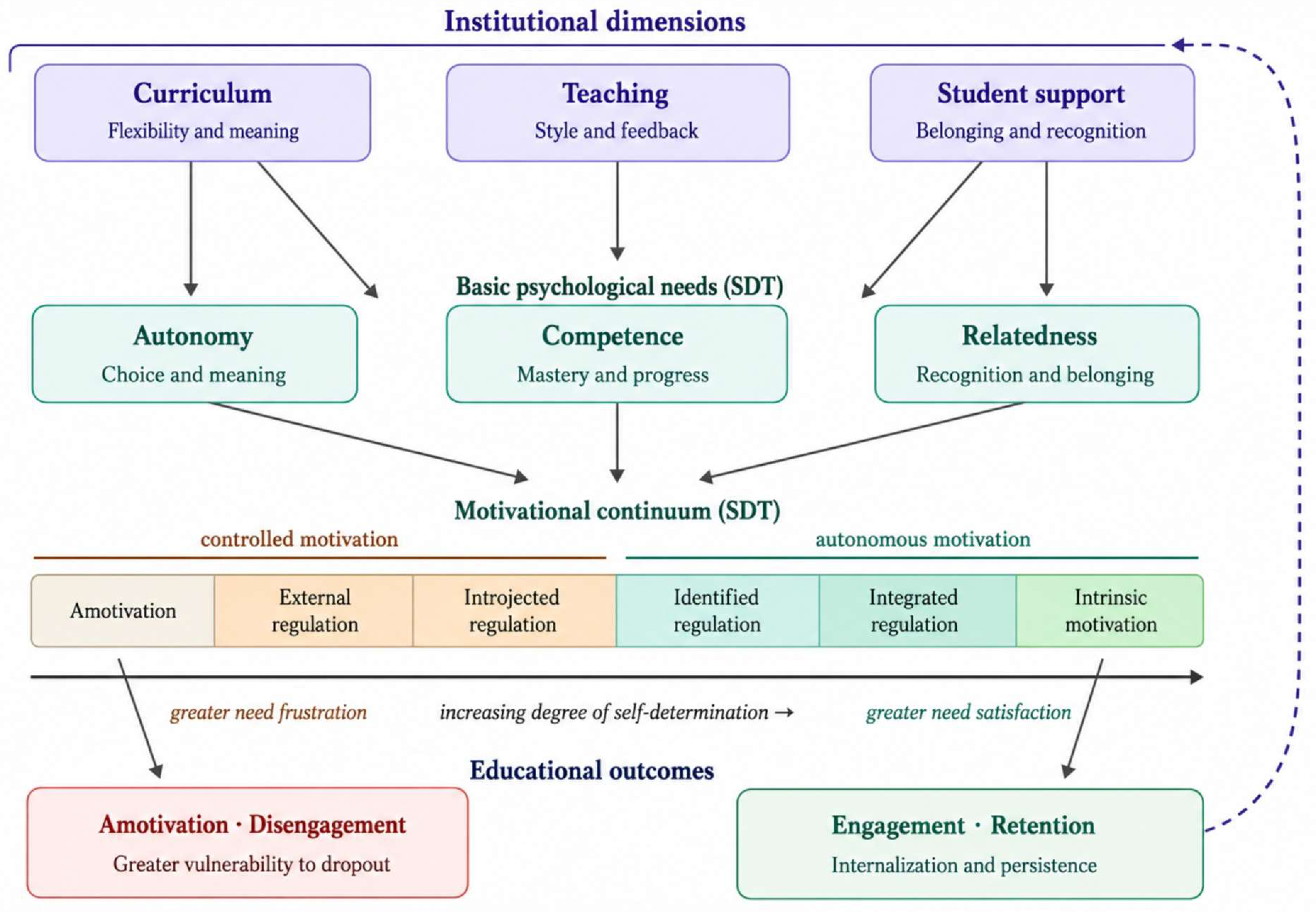
Institutional dimensions—curriculum, teaching, and student support and belonging—may contribute to the satisfaction or frustration of basic psychological needs: autonomy, competence, and relatedness. Satisfaction and frustration of these needs are theoretically associated with students’ motivational regulation along the self-determination continuum. Autonomous motivation includes identified regulation, integrated regulation, and intrinsic motivation; controlled motivation includes external and introjected regulation. Distinct motivational profiles are associated with engagement, retention, disengagement, and dropout.
Figure 1 provides a visual synthesis of the conceptual relationships among institutional dimensions, basic psychological needs, motivational regulation, and educational outcomes proposed in this review. The pathways shown are conceptual and should not be interpreted as validated causal or predictive relations.
6. Conceptual Foundations for Dropout Diagnosis and Prevention
The framework that follows should be read as a conceptual diagnostic architecture derived from the reviewed literature, not as an empirically validated instrument or predictive model. Here, diagnostic refers to the structured characterization of motivational, relational, institutional, and equity-related conditions that may warrant attention. It does not imply clinical diagnosis, an individual dropout-risk score, validated cutoffs, or the ability to predict which student will subsequently withdraw.
The first premise is that dropout may emerge through a cumulative process shaped by interacting educational and contextual factors rather than occurring as an entirely sudden event (
Dore & Lüscher, 2011). This pattern suggests a potential window for institutional monitoring and support. The proposed architecture is intended to organize such signals, but it should not be interpreted as demonstrating that any specific indicator predicts subsequent dropout.
The second premise is that motivation can be measured and monitored across the educational trajectory. Motivation can be assessed using instruments validated in Brazil, including a motivation-for-learning measure adapted for technical education (
Scacchetti et al., 2014). Such instruments can describe students’ motivational profiles and changes over time. Their use may inform institutional monitoring, but psychometric validity should not be interpreted as evidence that they predict observed dropout or function as validated risk-classification instruments.
Evidence from vocational education also supports the relevance of monitoring dropout intentions and motivational trajectories. Studies in VET contexts indicate that dropout intention can be associated with actual dropout and that motivational differences may become visible during the first weeks of a vocational program, reinforcing the need for early and longitudinal diagnosis (
Findeisen et al., 2024;
Eegdeman et al., 2025).
The update also identified a 2026 scale-development study with Filipino secondary students in vocational courses. Across two samples, the study identified nine dimensions of academic disengagement spanning value, effort and ability beliefs, peer relationships, pedagogy, facilities, task demands, parental influence, and general aversion to technical-vocational education (
Mordeno et al., 2026). This evidence supports a multilevel diagnostic approach, while the proposed dimensions require cultural adaptation and empirical validation before use in Brazilian TVET.
The third premise is that dropout is a multilevel phenomenon and that prevention can therefore be conceptualized across curriculum, teaching, and student support and belonging. The reviewed evidence does not establish that multilevel strategies are uniformly more effective than single-component interventions; the proposed coordination of levels is an authorial synthesis to be tested empirically.
For the architecture to progress from conceptual diagnosis to prediction, future prospective studies would need to test whether the proposed indicators predict subsequent observed dropout, rather than dropout intention alone; evaluate discrimination and calibration and, where decision thresholds are contemplated, sensitivity and specificity; assess incremental predictive value beyond routine administrative indicators such as attendance and performance; determine whether relational and institutional variables add information beyond student-level motivation; and examine predictive performance across institutions and equity-relevant subgroups. Until such evidence is available, no individual risk thresholds or predictive classifications are proposed.
6.1. A Three-Level Conceptual Diagnostic Architecture for TVET
Based on these premises, the review proposes a conceptual diagnostic architecture organized at three levels of analysis: individual, relational, and institutional.
At the individual level, diagnosis identifies each student’s position on the motivational continuum, the basic psychological needs being satisfied or frustrated, and the moments in the trajectory when vulnerability to disengagement increases. Quantitative instruments such as the motivation-for-learning measure adapted for technical education by
Scacchetti et al. (
2014), together with related Brazilian psychometric evidence on academic motivation in higher education (
Guimarães & Bzuneck, 2008), can inform measurement. However, the proposed administration points—entry, mid-course, and transition or exit stages—are authorial recommendations that require empirical testing in Brazilian TVET.
Longitudinal research has also examined the relationship between vocational competence and dropout intention, supporting the inclusion of competence-related indicators in diagnostic models while reinforcing that dropout intention remains a proxy rather than observed withdrawal (
Ma et al., 2024). The findings also suggest that domain-specific and domain-linked competence may relate differently to distinct forms of withdrawal intention.
Brazilian applied research has proposed a teaching-assessment instrument designed to connect student perceptions, pedagogical evaluation, and management decisions oriented toward school permanence in professional and technological education (
Costa et al., 2024). Although the instrument has not yet undergone broad predictive validation, it illustrates an example of institution-level assessment procedures that could inform management decisions in Brazilian EPT.
At the relational level, diagnosis examines the pedagogical and interpersonal relationships that mediate students’ experiences. Particular attention is given to teachers’ motivational styles and students’ perception of institutional support. Student reports of perceived autonomy support and structured classroom observations can be considered at this level (
Reeve & Cheon, 2021). Interviews and student-listening protocols may complement these measures as institutionally generated qualitative data. Because no autonomy-support measure was identified as validated specifically for Brazilian TVET in the reviewed corpus, any scale should be culturally adapted and psychometrically evaluated before institutional use.
At the institutional level, the architecture examines curricular organization, support and belonging mechanisms, teacher working conditions, and equity-related barriers as contextual features potentially associated with the school’s motivational climate. Qualitative methods, including document analysis, focus groups, and interviews with managers and teachers, complement quantitative instruments.
Taken together, the three levels provide a proposed institutional motivational profile for hypothesis generation, monitoring, and planning. Whether this integrated profile improves intervention targeting or prediction of observed dropout remains an empirical question.
Table 3 operationalizes the proposed three-level diagnostic architecture by distinguishing candidate indicators, proposed monitoring points, and the evidence status of each component.
6.2. Evidence-Informed SDT-Based Propositions for Dropout Prevention
Based on the reviewed literature and the conceptual synthesis developed here, five interdependent strategic axes are proposed as evidence-informed propositions. They should not be interpreted as established evidence-based dropout-reduction interventions for Brazilian TVET.
The first axis is autonomy-oriented curricular management. It involves introducing margins of choice in formative pathways, making the relevance of content explicit for professional practice and students’ lives, and connecting theory and practice so that students perceive themselves as agents of their own training. This does not necessarily require broad structural reform. It requires curricular reconfigurations that expand the meaning of the formative experience.
The second axis is teacher training for autonomy support. Intervention-oriented research indicates that teachers can learn autonomy-supportive practices and that such training may benefit student motivation, classroom climate, and educational functioning (
Reeve & Cheon, 2021). Continuing education programs aligned with this model, combined with spaces for collective pedagogical reflection, may help improve the school’s motivational climate.
These intervention findings come largely from educational settings outside Brazilian TVET. Accordingly, teacher-training programs based on autonomy support should be locally adapted and evaluated before institution-wide adoption.
The third axis is structured student support as a relatedness policy. This includes initial integration protocols, attendance and participation monitoring, tutoring, and student listening mechanisms. Brazilian institutional evidence documents early integration, monitoring, tutoring, mentoring, and other support practices intended to strengthen student permanence (
Firjan SESI & PNUD, 2023). Institutions need to identify early signs of withdrawal and respond to them before disengagement becomes dropout.
Intervention evidence also supports a settings-based approach. A Danish non-randomized controlled trial found a modest reduction in dropout in vocational schools implementing a multicomponent social and institutional intervention, although residual confounding cannot be excluded (
Andersen et al., 2018). This evidence supports coordinated institutional action while remaining insufficient to establish universal effectiveness across TVET systems.
The fourth axis is equity-sensitive monitoring. Motivational indicators should be stratified by relevant social markers so that institutions can identify whether particular groups experience lower belonging, lower perceived competence, lower autonomy support, or greater exposure to structural barriers.
The fifth axis is longitudinal monitoring of motivational trajectories. Repeated measurement across the formative trajectory may help institutions monitor changes in motivation, belonging, attendance, participation, and institutional barriers over time. Whether such monitoring can reliably identify subsequent dropout risk or evaluate intervention effects requires prospective validation.
Table 4 summarizes the five evidence-informed prevention propositions and indicates the current strength and scope of the evidence supporting each axis.
7. Discussion
This review converges with literature showing that vocational dropout requires responses across multiple educational and institutional domains rather than student-focused measures alone (
Cerda-Navarro et al., 2017;
Souza et al., 2025). The SDT-based framework developed here extends this understanding by mapping how curriculum, teaching, student support, and equity-oriented policies may be interpreted through the three basic psychological needs. The reviewed literature suggests that these institutional dimensions are associated with motivational regulation and may contribute to conditions that support or undermine persistence. The argument is not that institutions determine dropout; rather, they provide part of the motivational context within which students interpret difficulties, evaluate belonging, and consider whether persistence is viable.
International evidence on vocational training dropout also reinforces the multifactorial nature of withdrawal, with apprentices reporting interacting individual, occupational, training-related, and contextual reasons for premature termination (
Böhn & Deutscher, 2022).
A central discussion point concerns the relationship between initial motivation and institutional context. Some students enter TVET with predominantly instrumental or externally regulated motivations. SDT does not treat this as a permanent barrier to retention. When the institutional environment consistently supports autonomy, competence, and relatedness, students may internalize the value of their training (
Deci & Ryan, 2000;
Ryan & Deci, 2017). Institutional assessment should therefore consider both students’ motivational profiles and the contextual conditions that may support progressive internalization, without assuming predictive validity for subsequent dropout.
Evidence from vocational school contexts supports the relevance of this mechanism. A Self-Determination Theory-based model of vocational school dropout intentions found that perceived teacher autonomy support and school-administration support were relevant contextual factors for explaining students’ motivation, perceived competence, academic performance, and intention to drop out (
Hang et al., 2017).
The proposed three-level conceptual diagnostic architecture responds to a gap in the Brazilian TVET literature. The motivation-for-learning measure adapted for technical education by
Scacchetti et al. (
2014) provides psychometric evidence for individual-level assessment in that context. However, few studies, to the best of our knowledge, have proposed an integrated SDT-based conceptual diagnostic architecture that combines individual, relational, institutional, and equity-sensitive assessment for TVET dropout prevention in Brazil. The integration of these levels is theoretically consistent with SDT’s emphasis on person–context interaction (
Reeve et al., 2004) and potentially useful for informing institutional planning, subject to empirical validation.
The five prevention axes align with evidence on autonomy-supportive teaching and teacher development (
Reeve & Cheon, 2021), student-support and belonging-oriented practices documented in Brazilian institutional evidence (
Firjan SESI & PNUD, 2023), equity-sensitive stratification informed by the PROGRESS-Plus equity lens adapted from health-equity research (
O’Neill et al., 2014), and longitudinal evidence on early motivational trajectories (
Eegdeman et al., 2025). Bringing these axes into a unified SDT-based framework advances beyond fragmented intervention approaches, while remaining a conceptual proposition that requires empirical testing.
The review also contributes to educational management by proposing that dropout and disengagement be examined, in part, as possible indicators of institutional motivational climate rather than solely as reflections of student deficits. Consistent with
Moreira and Cardoso’s (
2024) emphasis on institutional conditions associated with permanence and dropout, the present review interprets this shift as a move from exclusively individual explanations toward broader institutional accountability.
Reeve (
2009) notes that teachers who adopt controlling practices often do so not by preference but in response to systemic pressures. The same logic applies to institutions. Addressing dropout requires attention to these structural conditions alongside individual motivational profiles.
A theoretical caution is necessary. SDT helps explain how institutional environments support or frustrate motivation, but it does not, by itself, explain the historical production of educational hierarchies, unequal access to cultural capital, or the symbolic devaluation of vocational pathways. The framework should therefore be used alongside sociological and policy-oriented analyses, not as a substitute for them.
Although SDT conceptualizes autonomy, competence, and relatedness as basic psychological needs, the ways in which these needs are expressed, interpreted, and institutionally supported may vary across sociocultural and educational contexts. Autonomy should not be equated with individualism or independence; within SDT, it refers primarily to the experience of volition. Cross-cultural educational evidence provides broad support for the relevance of need support across Eastern and Western settings while also indicating variation in the relative contribution of specific needs.
Nalipay et al. (
2020), for example, found that autonomy and relatedness support were similarly associated with student achievement across Eastern and Western samples, whereas competence support showed a stronger association in the Western sample. Transferability should therefore not be assumed at the level of indicators, thresholds, or intervention design. The theoretical constructs may be broadly relevant, but their operationalization requires cultural adaptation and local validation.
The framework has context-sensitive and potentially transferable elements. The SDT core—autonomy, competence, relatedness, and motivational internalization—may be applicable across educational settings, but the institutional mechanisms described here are locally grounded. They include Brazilian technical education policies, patterns of social stratification, and specific support arrangements. Application outside Brazil should preserve the motivational logic of the framework while recalibrating indicators, support mechanisms, and equity markers to each TVET system.
8. Limitations
Several limitations should be acknowledged. First, as a critical narrative review, this article does not provide an exhaustive or fully reproducible synthesis of all available evidence. Explicit procedures increased transparency, but narrative reviews remain vulnerable to selection and confirmation bias.
Second, no formal risk-of-bias instrument or PRISMA-based screening process was applied. The structured source matrix and narrative appraisal improved consistency in the use of evidence, but they do not provide the inferential safeguards of a systematic review.
Source identification, selection, extraction, and narrative appraisal were conducted by a single author. This may have increased the risk of subjective source selection, interpretive bias, and inconsistency in appraisal. The structured extraction matrix and claim-to-source audit were used to improve procedural consistency and transparency, but independent duplicate screening and extraction were not performed.
Because conceptual coding and framework construction were also conducted by a single author, the organization of evidence into three diagnostic levels and five prevention axes may be sensitive to interpretive coding decisions. Independent replication, expert review, or formal consensus procedures should therefore examine the stability and face validity of the proposed architecture in future work.
Third, the proposed framework is theoretically informed but not yet empirically validated. Its predictive capacity and applicability should be examined in different institutional contexts.
Fourth, although complementary theories and sociological perspectives were incorporated, the review remains primarily centered on SDT. It may therefore underrepresent alternative explanations, including critical theories of educational inequality, labor-market segmentation, and institutional reproduction.
Finally, the findings derive predominantly from the Brazilian TVET context. The theoretical core may be relevant to other systems, but the institutional indicators, equity markers, and prevention strategies proposed here require contextual adaptation before use in other educational systems.
9. Conclusions
This review began with a recurrent challenge in TVET: many young people enter technical education but do not complete their training. Conventional explanations often emphasize individual deficits or socioeconomic vulnerability. Such explanations are insufficient.
Student motivation is not fixed and develops in interaction with institutional experiences. Curriculum, teaching practices, student support, and equity-oriented policies may support or frustrate autonomy, competence, and relatedness. These institutional and motivational conditions are associated with engagement, persistence, and vulnerability to dropout, although the present review does not establish causal or predictive effects.
The main theoretical contribution of this review is the shift from an individual-centered interpretation of motivation to a student–institution framework. Its practical contribution is a three-level conceptual diagnostic architecture and five evidence-informed prevention propositions. Neither should be interpreted as a validated predictive model or as evidence that the proposed interventions reduce dropout in Brazilian TVET. Although the SDT core may be transferable across educational settings, application beyond Brazil requires contextual adaptation and local validation of institutional indicators, support mechanisms, and equity markers.
Future validation should prioritize prospective, multicenter cohorts using observed dropout or completion rather than intention alone; evaluate discrimination and calibration and, where decision thresholds are considered, sensitivity and specificity; test incremental predictive value beyond attendance, performance, and other routine administrative indicators; examine whether relational and institutional variables add information beyond student-level motivation; assess performance across equity-relevant subgroups; and evaluate intervention effects using appropriate experimental or quasi-experimental designs. Qualitative and participatory research should also examine feasibility, acceptability, and potential unintended labeling effects.
Dropout prevention should not be reduced to persuading students to remain enrolled. It requires building institutions in which students have reasons to continue, conditions to learn, support to persist, recognition as legitimate members of the school community, and equitable opportunities to complete their training.