Article

From Discipline to Improvisation: A Practice-Based Model for Training Creativity

by
Yuli Liang
1,*,
Peter Walgenbach
1 and
Stefan R. Schweinberger
2,*
1
Economics and Business Administration, Friedrich Schiller University Jena, 07743 Jena, Germany
2
Department of General Psychology and Cognitive Neuroscience, Friedrich Schiller University Jena, 07743 Jena, Germany
*
Authors to whom correspondence should be addressed.
Educ. Sci. 2026, 16(8), 1311; https://doi.org/10.3390/educsci16081311
Submission received: 8 May 2026 / Revised: 7 August 2026 / Accepted: 9 August 2026 / Published: 17 August 2026
(This article belongs to the Section Education and Psychology)

Abstract

For a long time, research on creativity has focused more on cognitive aspects (“minds”) rather than the production side (“actions”). This paper examines the creative practice as a subjective experience, using researcher introspection as a qualitative methodology. Through in-depth reflection on the creative development of an Ikebana artist, this study captures the complexity of creative practice, and offers detailed insights into its embodied and procedural dimensions, including experimentation and flow. Drawing on the theory of deliberate practice, the study challenges the notion that creativity is purely spontaneous and demonstrates how improvisation emerges through disciplined practice and deliberate experimentation. We propose a three-stage, practice-based model for training creativity: mastering fundamentals, exploring variations, and ultimately breaking free from established forms.

1. Introduction

Creativity, as defined by a number of scholars, is the generation of novel and useful ideas or solutions (Amabile, 1983; Amabile et al., 1996; Burleson & Selker, 2002; Sternberg, 1988; Woodman et al., 1993). Glăveanu and Beghetto (2021) asserted that this bipartite standard definition of creativity is not sufficient, adding that creative experience involves principled engagement with the unfamiliar and a willingness to approach the familiar in unfamiliar ways. Accordingly, such meaningful actions and interactions are marked by the principles of open-endedness, nonlinearity, pluri-perspectives, and future-orientation. In the field of management studies, creativity is distinguished by innovation. Creativity centres on idea generation, and innovation emphasizes idea implementation (Amabile, 1996; Mumford & Gustafson, 1988). In this article, creativity is defined as engaged experience that does not separate idea generation from implementation. In this sense, it follows Joas’s (1994) view of conceiving cognition not as preceding action, but rather as a phase of action by which action is directed and redirected in its situational contexts.
Creativity remains a perplexing issue, and especially if and how creativity can be developed. Studies that have attempted to analyse and measure creativity have yielded unexplained or conflicting results (Simonton, 2012). Scholars from different disciplines have conducted research through different methodologies and analysed some of the different components of creativity (Eysenck, 1993; Rogers, 1954; Sharma, 1986; Wallace, 1986; Watts et al., 2020). The influence of social context on creativity has been extensively studied in recent decades. The research focus has then shifted from a specific dimension to a system.
Amabile (1988) proposed a componential model to specify the basic elements that work together to produce creative behaviour. The model was revised in 2016, to reflect the dynamics of the creative process. Four new constructs have been added—a sense of progress, the meaningfulness of work, affect or emotions, and extrinsic motivation. Yet, just as they commented on this dynamic componential model in the paper, Amabile and Pratt (2016, p. 179) stated that “the revised model is very complex, and it is unlikely that any single study could test all of it… much of what we have proposed has yet to receive empirical examination.” In another study, Woodman and Schoenfeldt (1989, 1990) proposed an interactionist model of creative behaviour at the individual level. In this model, they suggest that individuals are influenced by various antecedent conditions, both cognitive abilities and noncognitive traits or predispositions. Meanwhile contextual and social influences can either facilitate or inhibit creative accomplishment. This interactionist model provides an integrating framework that combines important elements of the personality (e.g., Woodman, 1981), cognitive (e.g., Hayes, 1989), and social psychology (e.g., Amabile, 1983) explanations of creativity. Based on this interactionist model of creative behaviour, Woodman, Sawyer, and Griffin further extend the model of creative behaviour into a social context. They develop an interactive framework for organizational creativity that integrates creative processes, creative products, creative persons, and creative situations. It is their belief that “systematic investigation of cross-level social and contextual influences that enhance or constrain creativity would provide a particularly fruitful line of inquiry” (Woodman et al., 1993).
This paper aims to revisit the creative process and offer new insights into creativity training. Unlike findings derived from psychological laboratories or controlled experiments, these insights are grounded in the researcher’s (in the present case: Y. Liang., the first author of this paper, referred to in the first person in the Introspection Report below) first-hand creative experiences, as documented in her introspection report. Through this qualitative account, disciplined experimentation emerges as a central element of the creative process—an aspect that previous models of creativity have largely underexplored.

2. Qualitative Introspection

Historically, introspection has been one of the foundations of psychology (Wundt, 1880). James (1890) defined introspection as observing the “stream of consciousness” from within. Introspection is believed to be a reflexive, metacognitive process, attending to or thinking about oneself or what is currently being experienced by oneself (Overgaard, 2008).
Introspective ethnography is a powerful methodology to answer rigorously scientific inquiries. Some researchers use introspection, but refer to it differently by the labels of subjective reports, personal accounts, self-reports, experiential testimonials, self-examination, or autoethnography. Hochschild, the author of The Managed Heart: Commercialization of Human Feeling (Hochschild, 2015), examined the lived emotional experience of two groups of public-contact workers—flight attendants and bill collectors—and famously raised the notion of ‘emotional labour’. Holbrook (1986) experiments with ‘subjective personal introspection’ and provided an autobiographical and personal account of fanaticism in his own consumer behaviour as a collector, appreciator, and sometime performer of jazz. Studies by Carolyn Ellis, a social constructionist, drawn from the experience of a practitioner-researcher, using the autobiographical method, demonstrated the advantages of introspection in dealing with the complex, ambiguous, and processual nature of emotional experience (Ellis, 1992). In the recent decades, we see a resurrection of studying subjective experiences, and introspection methodology is indispensable, advantageous, and provides otherwise unavailable evidence that cannot be collected by any other means (Ellis, 2016).
In organizational studies, the aesthetic experience of spatial settings is naturally described by personal accounts or by the authors’ fieldwork notes. For example, van Marrewijk (2010) draws on his own personal experience as a telecommunication engineer and organizational anthropologist to explore, in auto-ethnographic fashion (Humphreys, 2005), the aesthetic experience of two different corporate buildings. McMahon et al. (2017) employ an analytic autoethnography methodology to describe a female swimmer’s experiences of ‘competitive performance’ stigma, and explore the role of particular cultural insiders in the reproduction of competitive performance stigma. Strati (2020) points out that his academic research is directly linked to his artistic experience as a conceptual photographer. Based on a personal account, his research on organizational life and conceptual art photography reveals an empathetic-aesthetic understanding of action in interactive organizational contexts. A similar reliance on first-person experience can be found in creativity research: Oleynick et al. (2014) use self-reports to study inspiration. As the authors put it, “Self-reporting is a straightforward and appropriate method for operationalizing inspiration, because the inspiration construct is inextricably intertwined with a distinctive phenomenological experience… Putting inspiration into practice through self-reporting enables researchers to test such claims” (Oleynick et al., 2014, p. 62).
According to Wallendorf and Brucks (1993), introspection is categorised differently when the researcher is alone or with another researcher, namely, researcher introspection, guided introspection, interactive introspection, syncretic forms of introspection, and reflexivity within research. In researcher introspection, the researcher serves as the sole introspector who takes his or her own relevant emotions, sensations, memories, thoughts, or imagination as data for analysis (Wallendorf & Brucks, 1993). To Holbrook, researcher introspection is a rich case study and thick description useful to other researchers, not an exercise in egocentrism (Holbrook, 1987). Several scholars (Brown, 1998; Byrne, 2005; Gould, 1995, 2011) have suggested that introspection would enable us to understand, examine, and theorise about subjective experiences in naturalistic settings and enjoy a privileged and peculiar access to the subjective data which are not directly accessible from the third person perspective with the same level of readiness, vividness, richness and depth.
Introspection can be linked to theories of autobiographical memory production, as the introspective process often involves recalling past experiences, emotions, and thoughts. Autobiographical memory encompasses both involuntary and voluntary recollections, shaping the way individuals reflect on their experiences. Berntsen’s (2009) seminal work, Involuntary Autobiographical Memories: An Introduction to the Unbidden Past, posits that involuntary memories are a fundamental mode of remembering, often triggered spontaneously by environmental cues without conscious retrieval efforts. This explains that in introspective research, researchers may encounter sudden recollections that offer deeper insights into their subjective experiences. Berntsen et al. (2013) further suggest that involuntary memories arise through automatic processes, reinforcing that introspection is not solely a deliberate act but also influenced by spontaneous memory activation. Additionally, Staugaard and Berntsen (2014) demonstrated that cue distinctiveness and retention intervals significantly influence memory retrieval, which has direct implications for researcher introspection: the emergence of specific memories during introspective writing or analysis may be shaped by external stimuli and the time elapsed since the experience.
These studies on involuntary autobiographical memories are particularly relevant to the present introspection report, which was triggered by a recent Ikebana demonstration and completed rapidly thereafter. The short retention interval meant that the experience was still highly vivid, allowing for a rich, immediate introspective process before memory distortion could occur over time. The distinctiveness of the Ikebana performance—its visual composition, sensory elements, and emotional engagement—served as a powerful cue for introspective recall. Furthermore, Conway and Pleydell-Pearce (2000) argue that autobiographical memory operates within a self-memory system, where introspective reflection interacts with personal identity construction. This suggests that introspection is not simply about recalling past experiences but involves actively reconstructing and interpreting those experiences in relation to the researcher’s evolving sense of self. In qualitative research, introspection is often used within autoethnographic methodologies, where self-observation and reflective narratives serve as legitimate data sources (Ellis et al., 2011). Anderson (2006) emphasizes that introspective engagement should move beyond personal description through analytic reflexivity and theoretical analysis. Understanding these memory mechanisms enriches introspective practices by highlighting how both voluntary and involuntary recall contribute to self-reflection, thereby enhancing the depth and authenticity of researcher introspection.
Researcher introspection differs from participant observation (Spradley, 1980) mainly in its empirical focus and locus of analysis. Participant observation examines places, actors, activities, and cultural meanings within a social situation. Researcher introspection, by contrast, treats the researcher’s own experience as the principal empirical material and object of analysis, revealing less visible dimensions of practice such as tacit judgement, bodily experience, changing motivation, and inner struggle. Researcher introspection can take many forms. It can be a conversation with self or with others. It can be presented in the form of field notes or narratives. It can be performed by reading and analysing diaries, or free-writing about the subject’s thoughts and feelings, and what it means to them (Ellis, 1991). This paper uses researcher introspection methodology, and takes the form of uninterrupted free writing from a first-person perspective. The first-person introspection method requires the researcher to be rigorous, honest, and provide an authentic, and complete process description. By thinking about “What am I doing or thinking and how am I feeling?” and “How can I describe it?”, questions about the internal state and interactions with the external world are answered.
The introspective report was written over approximately three days in October 2021, following an ikebana demonstration presented to the organizers of the 38th EGOS Colloquium on 21 September 2021. This demonstration subsequently led to a performance entitled “The Beauty of Imperfection,” presented to Colloquium participants in Vienna on 8 July 2022. The account retrospectively reconstructs the first author’s development as an ikebana practitioner from 2014 to the time of writing, drawing on remembered experiences of training, practice, experimentation, performance, and artistic development. The primary findings and the initial model derived from the report were drafted on 3 November 2021. Following this initial draft, the account was interpreted through iterative rounds of close reflection on recurring experiences and processes, with particular attention to bodily engagement, motivation, and inner struggle. The report therefore constitutes a faithfully and critically examined reconstruction of the researcher’s experience rather than an objective record.
Creative work results from conscious processes and intentional decision-making (Pressing, 2007), suggesting that creativity involves deliberate and mindful choices. This study draws on an artist-researcher’s introspection report, offering rich empirical insights to inform a theoretical framework of creativity. What follows is a reflective account of the artist-researcher’s journey in Ikebana, followed by an analysis of key findings and discussions. Finally, a new model is introduced to systematize the creative process.

3. Introspection Report

3.1. What Do I Create in Ikebana Art?

Ikebana is a meditative Zen art, also known as the “flower path” (kadō), which follows both aesthetic and philosophical principles. To better understand Ikebana, it is helpful to first introduce Chinese ink painting.
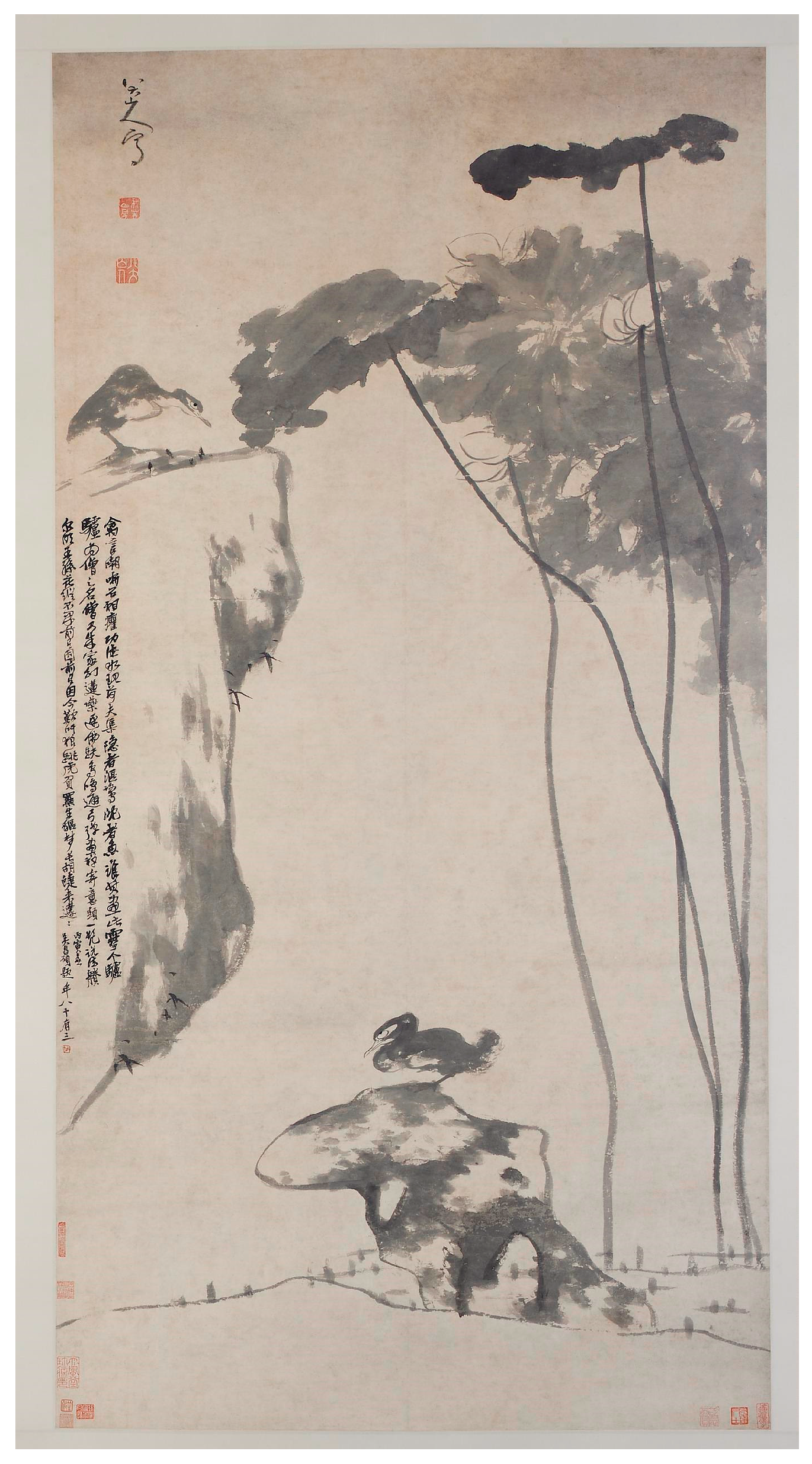
Figure 1 presents a Chinese ink-wash painting on paper, Lotus and Ducks by Bada Shanren, c. 1696, Qing Dynasty.
“… look at the division, low and high, the separation between the two, with a wide swath of unpainted paper, all of the flowers stems coming up and rising the full length of the painting on the right side …” Now get closer to see the lotus flowers. “Although they are constructed of just two strokes of ink, they create this full volume, and a sense of lightness and preciousness that recalls the beauty of a lotus blossom, with remarkable fidelity…”
(Excerpt from a commentary by Stephen D. Allee, as cited in Smarthistory, n.d.)
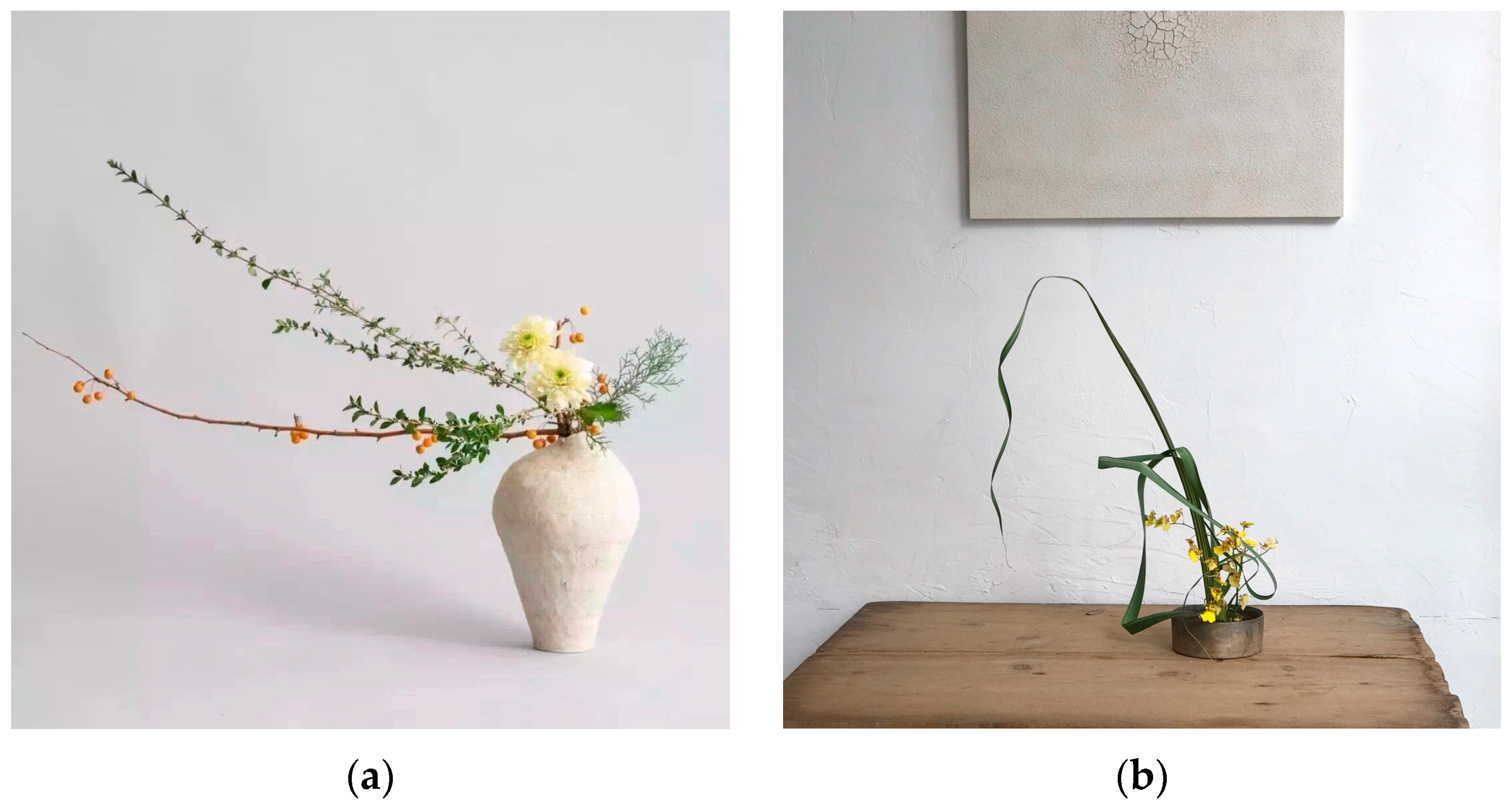
Just as Bada Shanren used brushes, ink, and paper in his paintings with extreme refinement, I, as an Ikebana artist, use an economy of material (flowers, plants, or any other material in a minimalist arrangement) to achieve the same purpose of producing an entire space. In my Ikebana work, I intentionally leave some space. As in Zen Buddhism, things emanate from emptiness, or nothingness. I offer the viewers, through their own imagination, the opportunity to generate a larger context. This style is called Zen, or Wabi-sabi (Figure 2a,b). Fleeting moments of beauty are captured here. To appreciate Wabi-sabi is to appreciate time.
Not only do I make Ikebana a display art, but I make Ikebana a performance art. What is unique about performing Ikebana is that the audience sees the best side of the arrangement; as a performer, I imagine what the arrangement looks like from the “invisible mirror”. During my performances, I invite the audience to not just observe it, but to enter the scene, such as sitting under a cherry blossom tree, and sometimes even slipping into a meditative state.
Is there a standard for good Ikebana art? A flower in nature is beautiful in itself. It is the human imagination that makes this flower more beautiful. That is what I call for true Ikebana art. Ikebana is a creative art. If you create something like your teacher, it counts as a failure.

3.2. How Do I Make Ikebana Performance?

I was once invited to show Ikebana art to illustrate the beauty of imperfection, which is the very essence of wabi-sabi or Zen philosophy.
I began by showing a charcoal-black clay container with visible traces of a broken arm handle on one side, and quickly explained the story. I obtained this container from an art and design shop. Because of the broken arm, it was left on the ground and no customer picked it up until I spotted it.
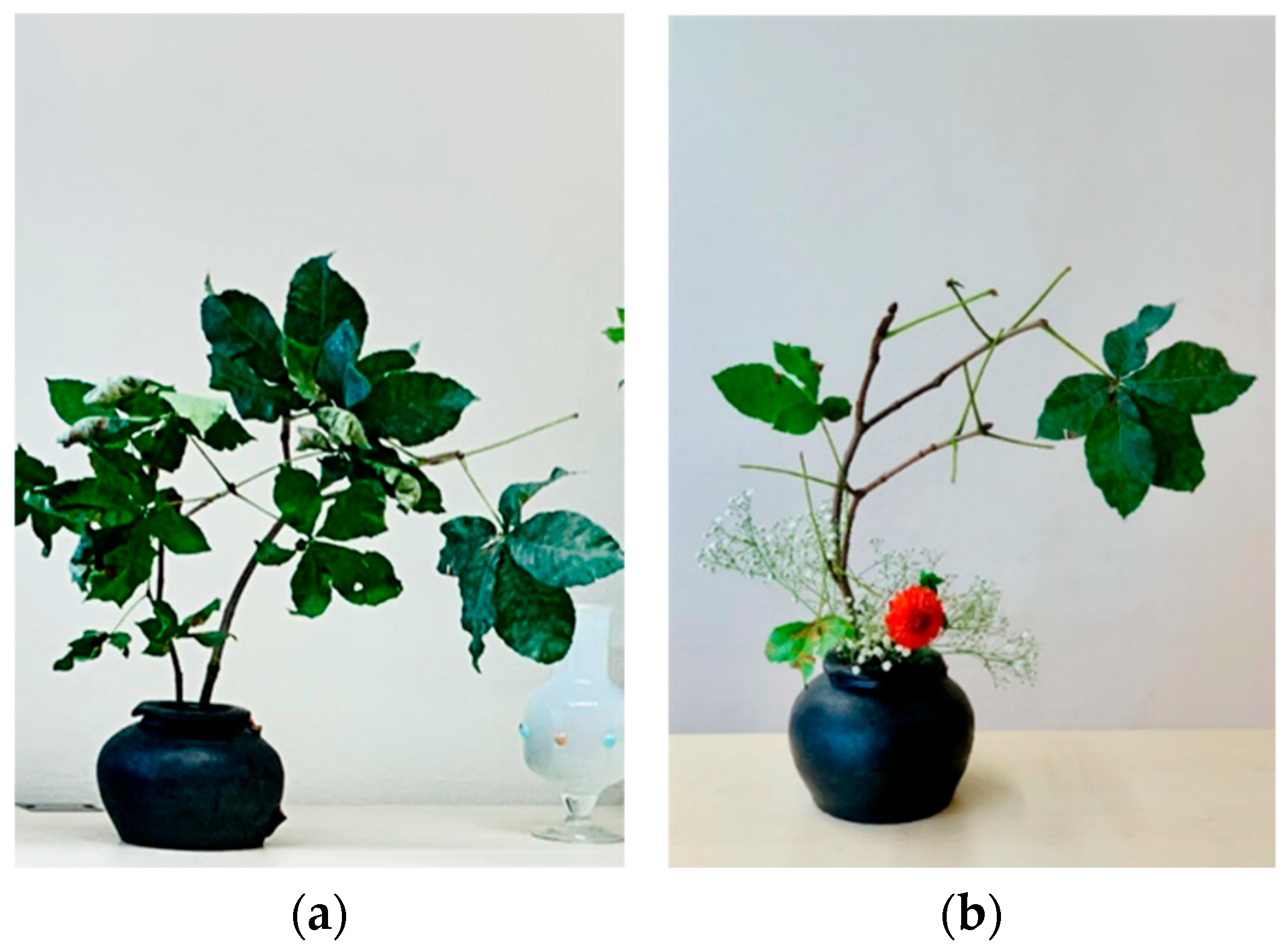
Now came the focus of my Ikebana demonstration. I showed a half-meter long branch full of leaves, which I obtained from a tree on a hillside near my house. It was a very ordinary tree, so ordinary that none of my neighbours knew its name. As it was late September, most of the leaves had turned yellow and withered. They hung wildly from the branches, growing on different sides of the branches to receive the most sunlight (Figure 3a). I then fixed this branch to the container. As I started to cut the leaves, the structure of the branch began to emerge—like a constellation. I cut the leaves one by one, but at different paces. Sometimes I was decisive, and sometimes I contemplated for a while before deciding to actually cut. As I cut the leaves, I “imagined” myself seeing the leaves blowing off the trees. Eventually, there are only three leaves left on the branches. The vast central part of the branch consists only of sub-branches (Figure 3b).
Bringing the viewers to the scene of a tree of falling leaves was the main part of the performance. However, an ascent needed to be added to fulfil this asymmetrical scene. For this, I chose a red dahlia, a fully and perfectly blossomed dahlia. And just one dahlia. To create a sense of volume and enrich the layers, I completed the work by deploying a handful of white gypsophila around the red dahlia and on the lower side of the branch. I “imagined” myself walking into misty woods.
My performance ends here. By now, you have probably a handful of ideas about the beauty of wabi-sabi—the beauty of imperfection. In the book Wabi-Sabi: for Artists, Designers, Poets & Philosophers (Koren, 1994), the author writes, “Wabi-sabi occupies roughly the same position in the Japanese pantheon of aesthetic values as do the Greek ideals of beauty and perfection in the West… Wabi-sabi is a beauty of things imperfect, impermanent, and incomplete. It is a beauty of things modest and humble. It is a beauty of things unconventional.” (p. 7).

3.3. How Do I Feel When I Create?

When I mentioned that I “imagined” myself watching leaves fall from a tree, or that I was walking into a foggy wood, those critical moments are “flow”. In the context of creativity, the term “flow” seems to have been coined by happiness researcher Csikszentmihalyi (1990). According to Csikszentmihalyi, flow is a state of happiness experienced as a mental state of complete immersion (concentration) and complete absorption in an activity (“absorption”) that goes on by itself.
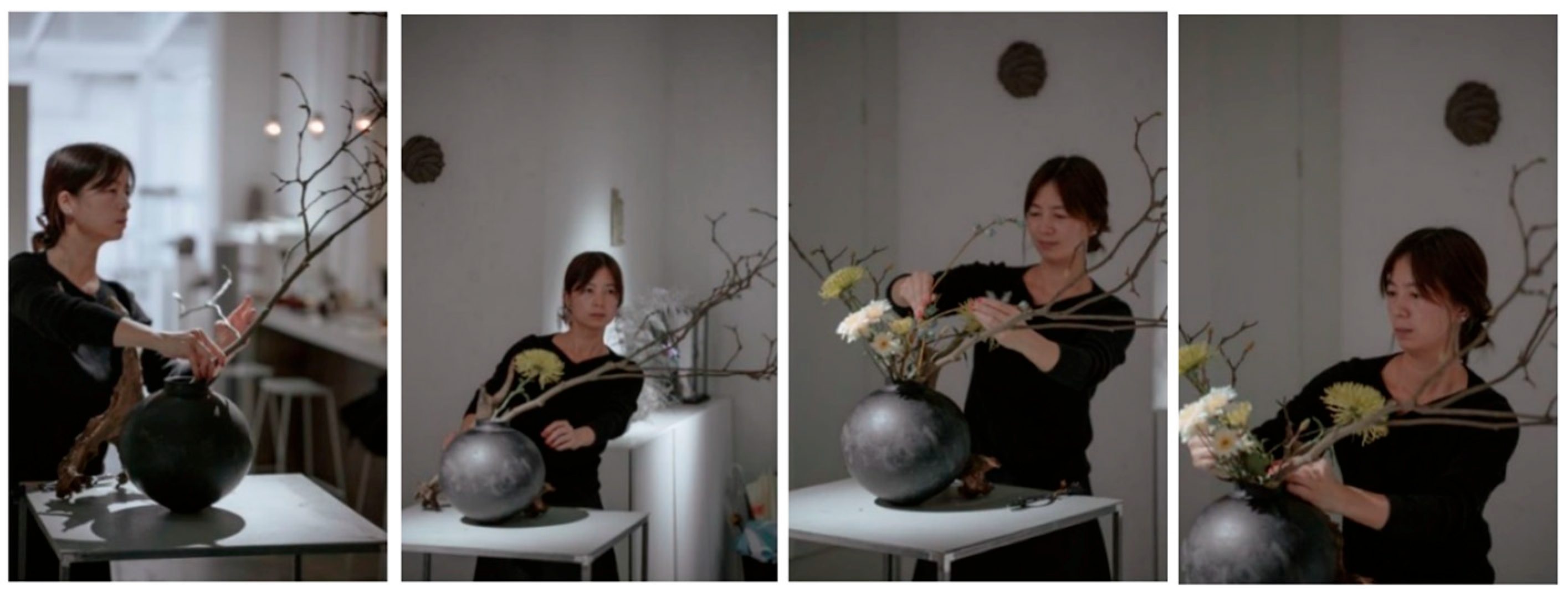
I experience “flow” when practicing Ikebana. Not all flow experiences involve creative activity; however, most people reach the state of flow during the most productive stages of the creative process. Like Csikszentmihalyi’s (1990) statement that “during flow you don’t feel anything, time stops,” for me, emotions in the state of flow is more than such ‘nothingness’—it combines calmness with excitement, and joy. “Flow” can be practiced and achieved mindfully. Before the performance, I would have prepared the environment for the task, made myself feel comfortable, and gradually immersed myself in the task at hand. I call this approach “escalation to flow”. Once in the mode of Flow, everything goes on with seemingly effortlessness (Figure 4).

3.4. I Am Trained to Be Creative—How?

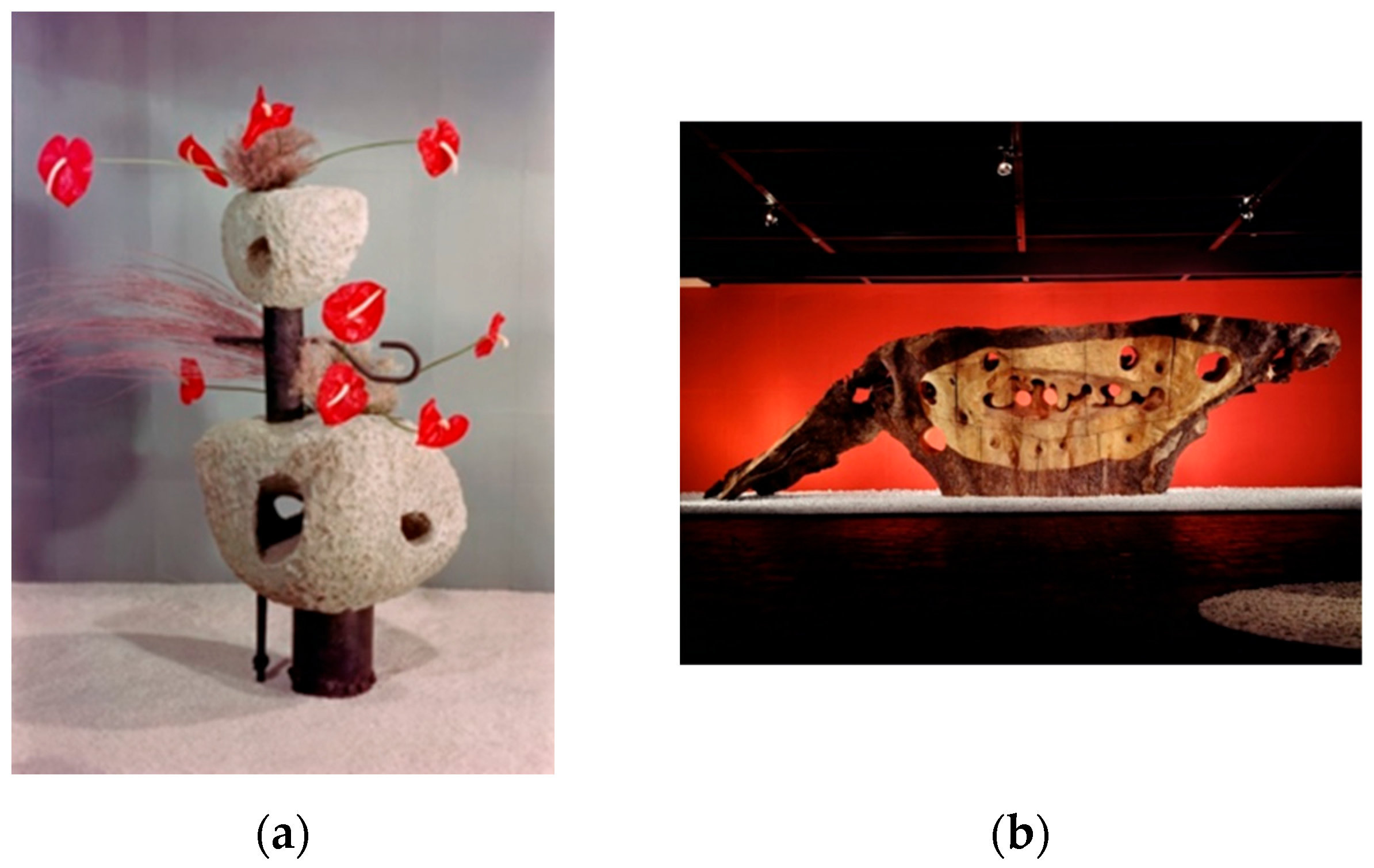
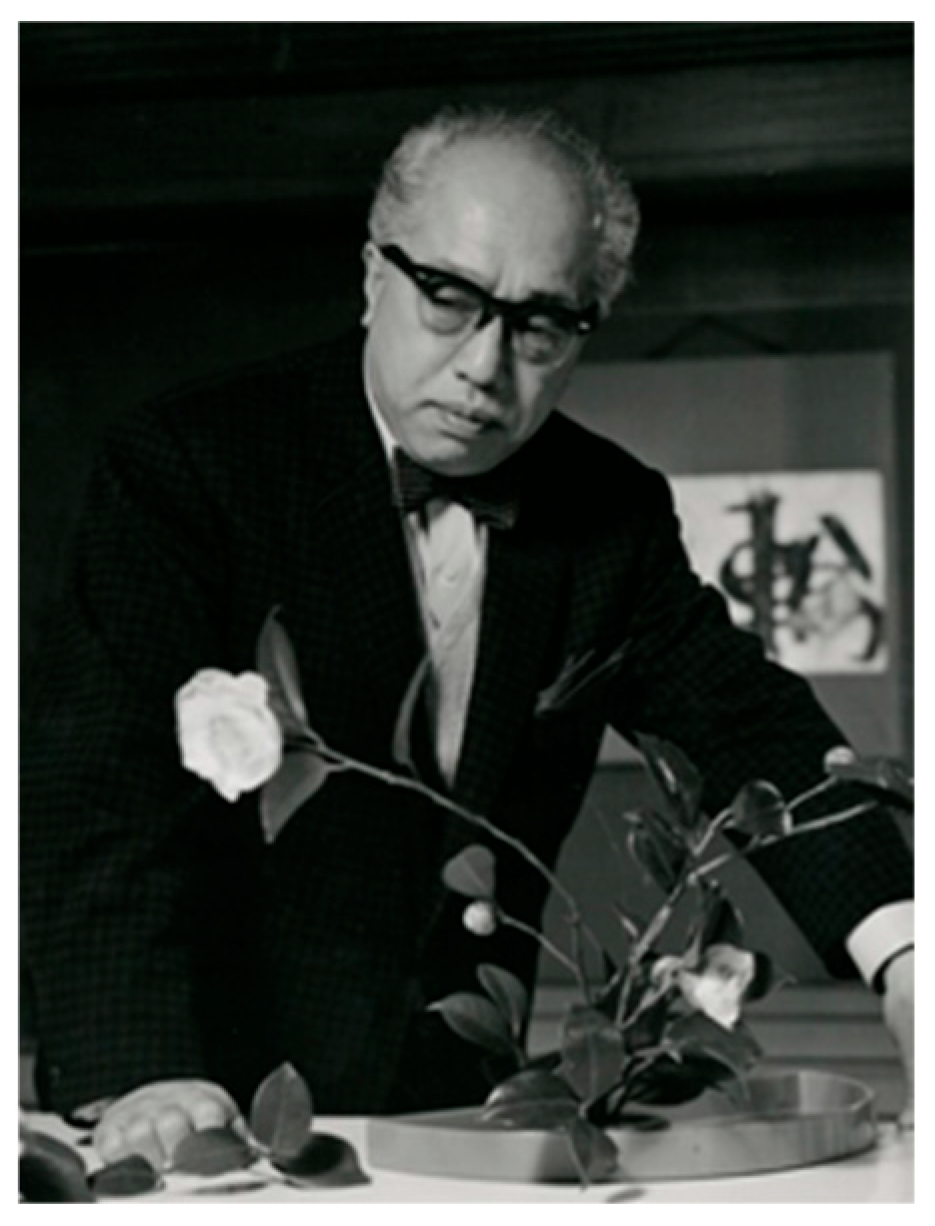
To review the learning journey of an Ikebana artist, it is necessary to recount briefly why Sofu Teshigahara (Figure 5) founded the Sogetsu school (www.sogetsu.or.jp) in 1927. He believed that simply following established forms, people would not be able to express their originality, therefore he departed from the traditional Ikebana practices. He disliked pretentious beautification; he liked to express rough textures and powerful lines, showing primitive life forms and human instincts. He incorporated many areas of Western art, such as painting, sculpture, and architecture, into his Ikebana creations (Figure 6a,b). He was therefore dubbed the “Picasso in the world of Ikebana” by Time magazine.
To make this creative art accessible to everyone, a highly systematic training process has been laid out over the last few decades. Students gain skills through interaction with plants, use space to deepen their understanding of the material, and ultimately master a high level of self-expression. After seven years of 200 classes, I received the 2nd Sanyo, Ikebana professor diploma. Looking back, I see four key elements in this training process:
First, free creation stems from the practice of basic styles. In other words, one begins by learning the fixed style before one can express freely. At the same time, in Sogetsu school, the final judgement of Ikebana work is not for the textbook or the teacher, but for the artist himself. This gives Ikebana students a sense of freedom and confidence right from the start.
Second, Ikebana is an art through practice. My sensei, Mr. Soyama Nakamura, started his apprenticeship at the age of 15 at the second generation of the Sogetsu Foundation’s family, Kasumi Teshigahara. Since then, he has been learning, then teaching Ikebana for 40 years. I was always amazed by his endless stream of novel ideas, combining flowers with a variety of materials, arranged in elegant or playful ways. When asked how come he had so many different ideas, he said, ‘because I do Ikebana every day’.
Third, after obtaining a teacher’s diploma, if one wants to go to the next level, one must have “artistic spirit without art”. The spirit of artless art means willingness to experiment and acceptance of failures. There are no textbooks after obtaining a teacher’s diploma. One must be prepared to continually experiment with new materials, methods and spaces. My sensei acknowledged my talents, strengths and weaknesses. Whenever I felt lacking in ideas, he encouraged me to try something completely different.
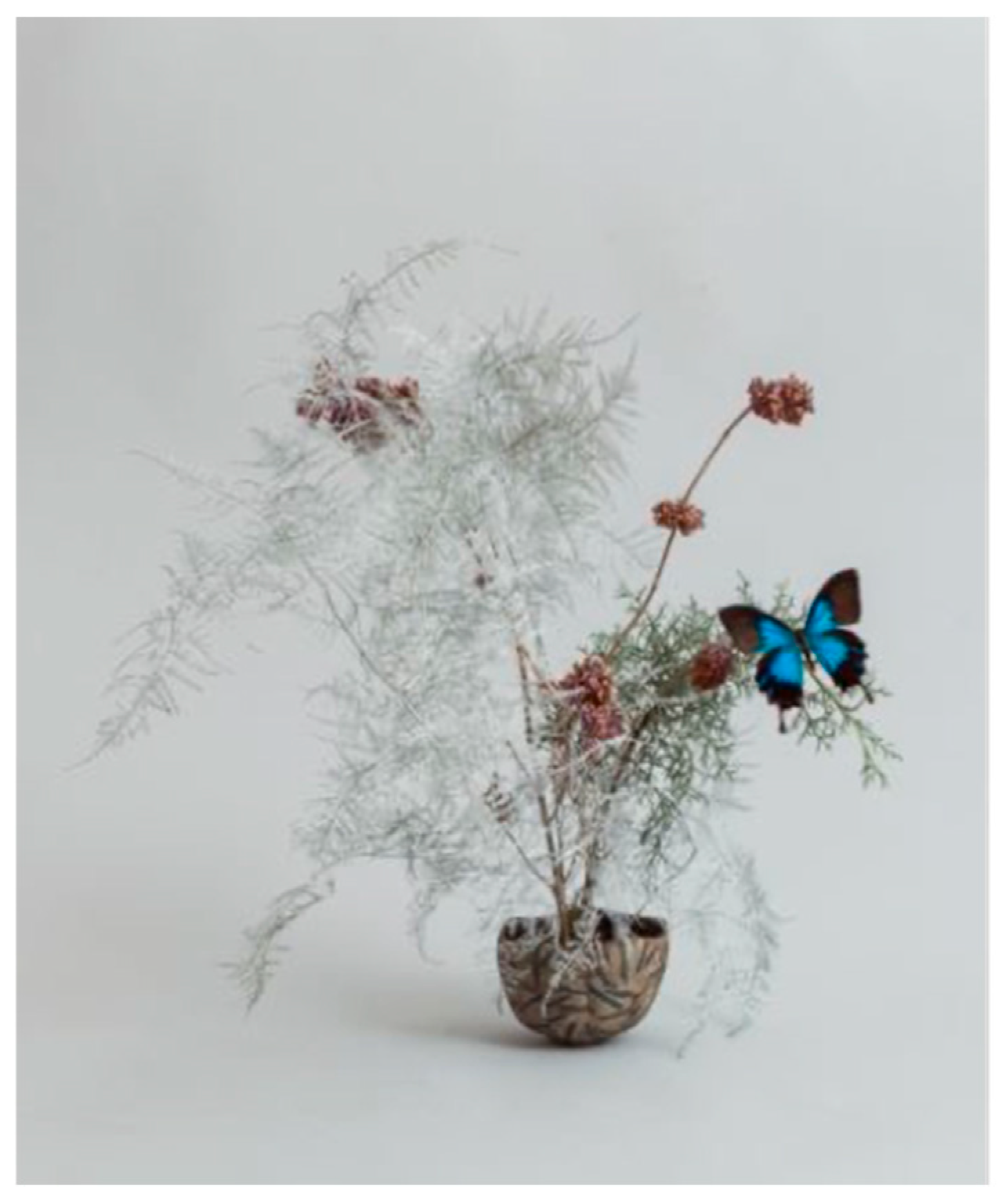
Finally, an artist has to find his style on his own. A good Ikebana artist will develop a style, giving meaning to flowers. To crave for my own style, I ventured out to some of the most beautiful natural landscapes. Readings on Daoism and Buddhism deepened my thinking about gaining balance and harmony. For that, I accepted the imperfections in my life. These concepts are projected into my Ikebana creations and my style was formed following wabi-sabi and Zen philosophy (Figure 7).

3.5. How Do I Keep Experimenting?

Experimentation is the most critical part of the creative process to achieve an advanced level of mastery in the art of Ikebana.
In the beginner stage, I was very good at following the basic principles—fixed style, making variations of a fixed style, but without becoming rigid. My arrangement was simple and pretty—just two branches and three flowers. After completing my arrangement, I always sat down and observed the relationship between plants and the spaces they create. Then, I stepped up to the intermediate level, a new phase of free style arrangement. I was able to choose the right flowers and branches, combine them considering lines, colours and mass, and present them in the best possible form. Different perspectives produce new looks. I have mastered the art of creating beautiful Ikebana.
For a long time, I was proud of myself. However, Sogetsu Ikebana is not only about creating beauty, but also about imagination. Unexpectedly, I encountered a serious bottleneck. I struggled at the stage of the transition to a true Ikebana artist—I needed to break the form. But I was afraid to try. I was so proud of making beautiful Ikebana, that I was afraid I would make something bad, discordant, unpleasant, messy, stupid, dull, or pointless, or anything that is not good enough.
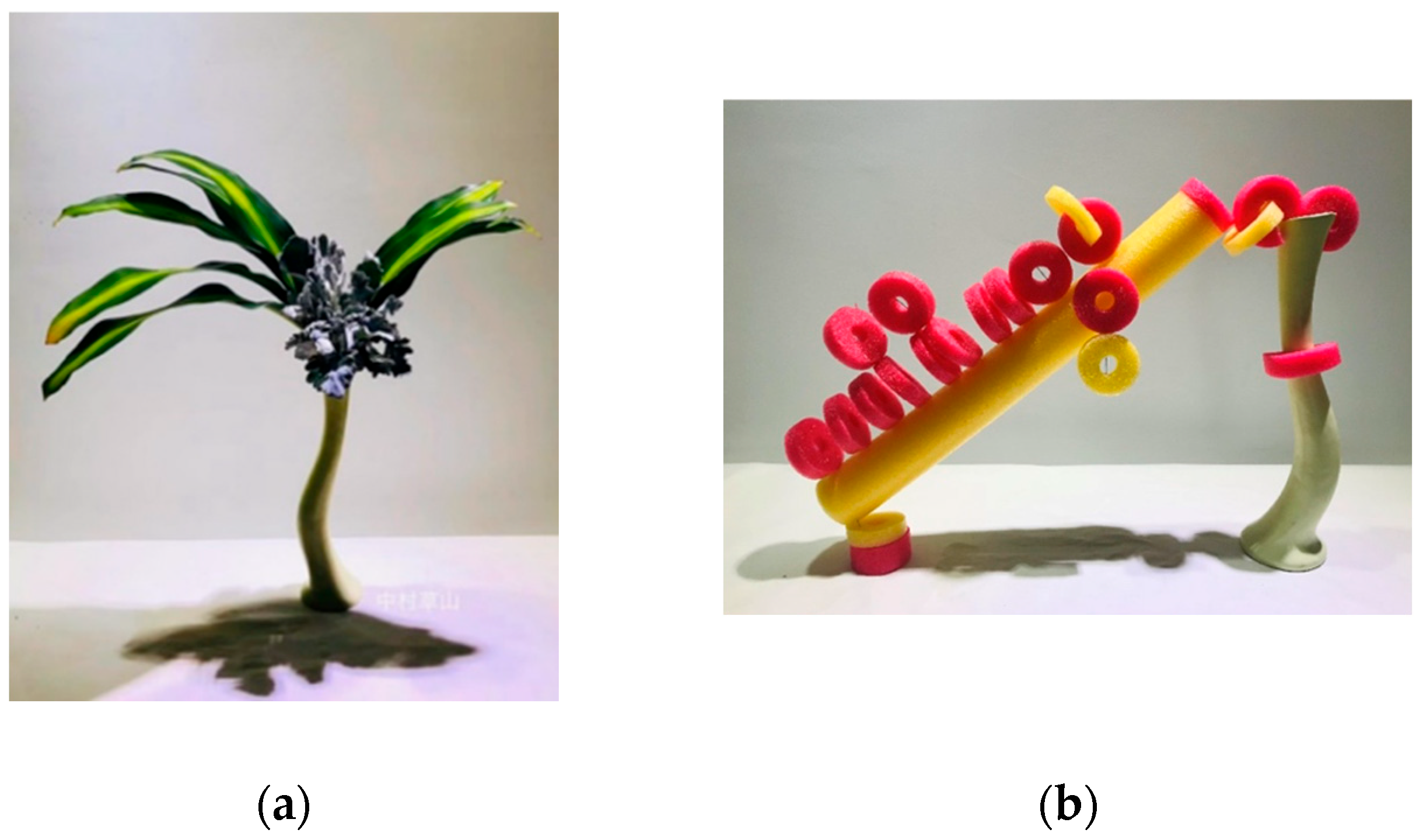
In a course where the theme was to express a movement, I had to decide which movement to express. The first thing I thought of was the verb “dance” because I saw dancing orchids. Then I thought it was not very creative. So, I decided to change it. I thought of “blow”. I came up with the image of “branches blowing in the wind.” I picked out a few willow branches. But immediately I said to myself ‘This is too easy’. Then “flow” came to my mind. Sadly, I struggled to find a suitable container. Finally, I decided to “fly”. Thirty minutes later, I had changed five containers and cut many branches and flowers. My table was a mess, but my Ikebana still did not “fly”. I was frustrated—I could not even finish something so simple! Some voices kept ringing in my ears—“This is a horrible piece”, “Is this the best I can do?”, “I really don’t have any original ideas”, “I have no talent in it!”. I felt hopeless. My sensei, Sozan Nakamura, came to me and within a few minutes, he used a floral vessel just like mine, picked up some leftover materials that I had “wasted” and made a “flying” piece (Figure 8a). Then he said to me, “Don’t be overly concerned about the result.” At that moment, I realized what the problem was—my fears. I kept rejecting ideas and it took me too long time to get started. When I finally started, I could not really focus. From that class on, I began to consciously identify my fears and learned to relax. When I was promoted to a teacher’s diploma in 2017, I visited several Zen temples in Kyoto and meditated in front of a rock garden in a sea of sand. There was an enlightening moment when my fear of being judged was cleared.
I no longer limit myself to creating something pretty, but aspire to something new (Figure 8b). Creativity is something you practice, not just a talent you are born with (Kelley & Kelley, 2012). For me, it is true.
All in all, to master the art of Ikebana, one must start by repeating the basics, then make a lot of variations, and finally create one’s own novelty.

3.6. How Does the Environment Enable Me?

Over the years of practicing Ikebana, I have had several peak performances. The most memorable one was the first time I had the “This is my day!” feeling.
It was an opportunity to collaborate with Japanese ceramist Shingo Takeuchi on an exhibition at Shanghai Jiemo Gallery. Koh, the owner, is an eccentric man. He graduated from a prestigious university, majoring in economics. He taught himself photography and contracted with big brands like “Apple”. He made good money and then opened the Jiemo Gallery, introducing Japanese craftsmanship to China. I met him through a mutual friend. We chatted, and he turned to me and said, “Come and create something for Shingo Takeuchi. The potter is here this Sunday, and we will have his solo exhibition on Monday.”
On Sunday, I came with flowers and materials. I did some research on the potter over the weekend. Unlike many traditional Japanese craftsmen, Takeuchi worked for a Japanese car company before becoming a potter. “If you keep your standards up, you’ll get great work. Respect and be in awe of nature, because life is a part of it”, his profile read. The ceramist was playing with clay in the back of the room with his grandson. I then said hello to the photographer. He is Koh’s former apprentice and has only recently started his own studio.
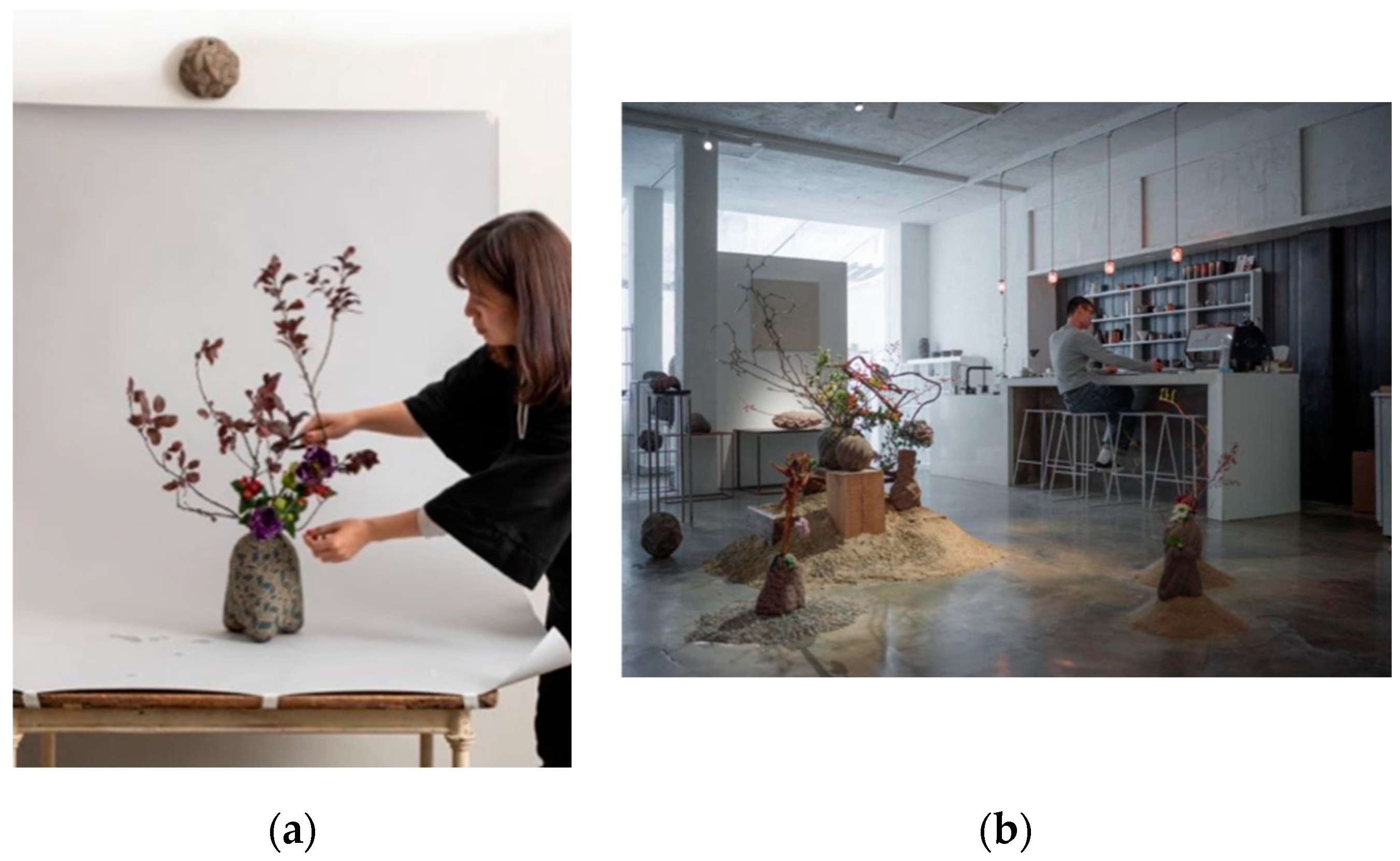
I begin work. There are more than fifty pieces of pottery on the floor. My job is to create Ikebana that complements the pottery. I can start with any piece I like. Whenever I finish one, the arrangement is moved to the studio and the photographer takes the picture (Figure 9a). The photos will be used in catalogues as well as online shopping sites. It was a commissioned job, but Koh did not say any expectations. He arrived late. Most of the time, he was talking to his two assistants.
It is in mid of autumn. The gallery room is pure white (Figure 9b). There is a full-length glass door leading to the courtyard. The sun shines in. The music plays softly. Occasionally guests come in. I did not have lunch. I stopped for a coffee and chatted with Koh and his assistants, Ajie and Spike. Neither of them attended college. Both worked in a small town before coming to Shanghai. Ajie makes good coffee and Spike makes good tea. Both are quiet but can engage in arguments that interest them.
I do not know when it became dark. I felt as if I had done quite some work. I stopped. It was already eight o’clock. The photographer told me that I had made over thirty arrangements. Interestingly, I did not even take the time to “check” my creation, before they were handed off to the photo booth. The resulting output was amazingly good. The ceramist is amazed by the possibilities that I have demonstrated through Ikebana and how my arrangement has enhanced the characters to his pottery.
That day in Jiemo was “my day”. When I look back at all my peak performance occasions, there are two environmental prerequisites that supported my creativity. First, there was autonomy. I did not have a workload target of how much I had to accomplish, or a finite timeline. Second, I was surrounded by like-minded people. There was some kind of unspoken connection between us. New ideas came up, we tested and implemented them. Time flew. The work was done. Everything went on smoothly.

4. Findings and Discussion

This concludes the introspection report. The following section summarizes the key findings on the creative process—elements that remain underexplored in the current literature. Through introspection, these findings lay the groundwork for future research on creativity, in particular, how creativity can be trained.

4.1. Creativity as a Structured and Experimental Practice

Creativity can be systematically developed, through deliberate practice, structured experimentation, and improvisation. The training of creative abilities has long been a central focus in psychology, management studies, and education. Since Guilford’s (1950) presidential address to the American Psychological Association (APA) on “divergent thinking,” creativity research has heavily focused on creative thinking. Studies on creative individuals—whether musicians, writers, or scientists (Andreasen & Glick, 1988; Barron, 1963; Matthews, 1986; Richards, 1996) often fail to differentiate between artistic and scientific creativity.
Feldman et al. (1994), in their joint publication Changing the World: A Framework for the Study of Creativity, proposed that creativity emerges from the dynamic interaction of multiple integrated factors. They argued that:
“Personality, values, intrinsic motivation, and discovery orientation give valuable clues as to who may turn out to make a creative contribution in art—and perhaps other domains as well… But in the course of our investigations, it became very clear that a prediction based on these factors left much of the variance in creative achievement unexplained”.
(p. 143)
A substantial body of research has emphasized creative thinking—the cognitive aspect of creativity—while comparatively less attention has been directed toward the creative process, the “doing” aspect. In creative education, critical thinking is often prioritized over rote memorization. However, my experience of developing creativity through practice suggests that sustained practice may be even more crucial than thought alone. Psychologist K. Anders and his colleagues (Ericsson et al., 2007; Ericsson & Charness, 1994; Ericsson et al., 1993) extensively explored the concept of deliberate practice and posited that expert performance is the result of prolonged, intentional practice rather than innate talent. Ericsson’s research indicates that engaging in activities specifically designed to improve performance leads to the development of expertise.
While Ericsson’s research primarily focuses on developing expertise, deliberate practice is equally essential in fields that require adaptability and improvisation. In cardiac surgery, Dearani et al. (2017) examined how the orchestration of an operation includes both structured and improvised steps. To achieve expertise and perfection, deliberate practice is defined as focused and repeated tasks to improve performance with coaching and immediate feedback. Similarly, a qualitative study by Johansen (2016) examined practice activities among jazz students, focusing on the development of improvisational competence. The findings revealed that students engaged in deliberate practice to cultivate a personal “voice,” highlighting the importance of structured experimentation in improvisation. Moreover, Beaty’s (2015) research into the neuroscience of musical improvisation suggests that through deliberate practice, musicians build a repertoire of generalized motor programs, enabling fluent access and execution during performance. These studies underscore how disciplined practice facilitates the spontaneous aspects of improvisation.
Creativity is often perceived as the product of spontaneous inspiration; however, from the artist’s perspective, it emerges through repeated practice and structured experimentation. Just as improvisation in music and surgery is refined through deliberate practice, creativity is not simply innate but developed through intentional, disciplined engagement. Integrating deliberate practice into the creative process not only enhances technical proficiency but also fosters the ability to experiment and improvise effectively. Renzulli’s (1978) Three-Ring Conception of Giftedness proposes that gifted behavior emerges from the interaction of above-average ability, creativity, and task commitment. Later research likewise treats creativity as a complex capacity shaped by developmental, educational, and experiential influences (Makel & Plucker, 2008; Runco & Sakamoto, 1998). Deliberate practice, more broadly, plays an important role in the acquisition of expertise (Ericsson et al., 1993). By treating creativity as a process of disciplined experimentation—combining technical mastery with iterative exploration—individuals can refine their ability to generate novel ideas and solutions. This emphasis on disciplined practice does not imply that creative cognition is purely deliberate. Xie et al. (2021) show that spontaneous and deliberate thinking can co-occur, with creative tasks engaging both executive control and internally generated thought. Yang and Wu (2022) found that mind wandering—operationalized as attention shifting off task during incubation—enhanced flexible idea generation and intuitive insight, but reduced persistence and systematic analysis. Together, these studies suggest that creativity emerges from the interaction of disciplined preparation, deliberate control, and periods of less constrained thought.
Despite the roles of structured experimentation, deliberate practice, and iterative refinement in the creative process, major theoretical models of creativity often overlook these aspects. Training, practice, and experimentation remain missing constructs in Amabile’s componential model of creativity, as well as in Woodman and Schoenfeldt’s interactionist model. Several scholars (Sloman, 1996; Smith & DeCoster, 1999) have pointed out that strict adherence to standard rules rarely fosters creativity; rather, successful creativity often involves breaking free from those rules. Mayer (2013) constructed a creative instructional design model to develop college students’ creative learning. Similarly, Karkockiene (2005), developed a specialized program designed to deliberately cultivate and systematically stimulate students’ creative thinking abilities. These studies suggest that students can also assess their own creative traits—including originality, idea generation, and curiosity. A study of Deliberate practice in music: Development and psychometric validation of a standardized measurement instrument (Passarotto et al., 2022) indicated that musicians who implement effective practice habits are focused on solving problems related to music playing and often refine their practice routines to increase their effectiveness. In addition, musicians who usually exhibit high amounts of deliberate practice behaviour often decompose long and complex tasks into shorter and simpler elements, aiming to master them more easily and in shorter time. My introspection report suggests deliberate practice and disciplined experimentation to developing creativity has proven to be effective—follow the fundamentals, make extensive modifications, break established forms, and continue experimenting.
Experimentation should be further emphasized and placed at the centre of the creative process and creativity training. However, attitudes toward experimentation remain ambivalent. On the one hand, experimentation is widely recognized as the pathway to innovation. On the other hand, few people persist in it due to the risks, failures, imperfect results, uncertain outcomes, and potential for criticism or rejection (Mueller et al., 2012). What distinguishes those who persist in experimentation despite challenges from those who abandon it after only a few attempts? The field of creativity research could shift its current focus from analysing the interaction of creative elements at the individual and organizational levels to addressing the real challenge: how to help individuals and organizations develop greater tolerance for failure and genuinely embrace experimentation.

4.2. Embodied Creativity, Through Bodily and Material Engagement

Recent psychological research has provided compelling evidence for the creativity-enhancing effects of embodying creative metaphors (Coste et al., 2019; Frith et al., 2020; Griffith, 2021; Leung et al., 2012; Wang et al., 2019). Leung et al. (2012) demonstrated that both physical and psychological embodiment of metaphors for creativity promoted fluency, flexibility, and originality in problem-solving. This concept, referred to as embodied creativity, suggests that creativity is not solely the product of abstract thinking but is also shaped by physical, sensory, and interactive experiences. For instance, studies (Stanciu, 2015) have shown that engaging in fluid arm movements can lead to more fluid and original ideas, highlighting the connection between bodily motions and creative cognition. Similarly, activities like free walking, as opposed to confined walking patterns, have been found to enhance creative performance, underscoring the role of physical movement in fostering creativity (Malinin, 2019).
This body of research highlights the need for a systematic approach to fostering creativity, allocating more time and resources to experiential learning in fieldwork and makerspaces. Beyond structured experiments, creativity also emerges from physical engagement with materials and the environment. Leclair (2023) argues that affect is generated and embedded in creative processes through the interplay between materials and bodies, while physical spaces, objects, and social interactions contribute to the atmospheric qualities that stimulate creativity. My researcher introspection further supports this perspective, demonstrating how the embodied act of Ikebana—cutting leaves, positioning branches, and sensing spatial balance—enabled deeper creative insights. The precise movements and tactile interactions involved in the arrangement process were not merely technical but directly shaped my aesthetic and conceptual choices. This first-hand experience aligns with research suggesting that bodily movements, sensory immersion, material engagement, and atmosphere are integral to creative thinking, reinforcing the argument that creativity is deeply embodied rather than purely cognitive.

4.3. Flow as Both Feeling and Perception

The experience of flow provides an alternative perspective on the role of emotions in the creative process. When creativity “flows,” it often accompanies the most productive stages of idea generation and artistic work. As Ghiselin (1963) observed, creative acts engage the entire psyche, drawing upon all its substance and energy. But can flow be defined purely in terms of positive or negative emotions?
The role of affect in creativity has been widely debated. Russ (2013) synthesized findings from contemporary social and cognitive psychology, presenting a model that illustrates how affect influences the creative process. Amabile et al. (2005) conducted daily longitudinal studies to examine the impact of emotions on employee creativity. Their results suggest that positive emotions enhance creative thinking, self-rated creativity, and peer-reviewed creative performance. However, Watts et al. (2020) reached a different conclusion after investigating the impact of mild shifts in affective tone (pleasant vs. unpleasant) and arousal levels (high vs. low). Their study found that the strongest creative performance was exhibited by participants who were either in a stable, pleasantly toned, low-arousal state (i.e., relaxed) or in an unpleasantly toned, high-arousal state (i.e., angry). This contradicts the widespread belief that higher levels of pleasant affect necessarily enhance creativity.
Between the extremes of ecstasy (intensely positive) and fear (intensely negative), many emotions converge toward a neutral point—calmness. Existing research has largely focused on whether positive or negative emotions are better predictors of creative output. The introspective flow experiences in this study align with the findings of Watts et al. (2020), suggesting that very intense pleasant affect is not always conducive to creativity. Instead, the most productive creative performance appears to emerge when individuals maintain a stable, relaxed emotional state. Future research could delve deeper into the nuances of specific emotional states and explore how spatial atmospheres influence the affective conditions that foster creativity.
While much of the discussion on flow focuses on its emotional aspects, it may also involve cognitive processes like perceptual fluency or perceptual enhancement—key concepts in memory and consciousness research (e.g., Jacoby, 1983). Perceptual fluency refers to the ease with which sensory information is processed, which can influence our experiences of immersion and creativity. Jacoby’s (1983) work on perceptual enhancement demonstrates that prior exposure to a stimulus can improve its subsequent processing, even when we are not consciously aware of the prior encounter. This enhanced fluency can shape our judgments and sense of familiarity, making certain stimuli or experiences feel more natural and engaging. In the context of creativity, this suggests that moments of deep immersion in imaginative thought—such as visualizing falling leaves or walking into a foggy wood—may be facilitated by an increased ease of perceptual processing.
Thus, what feels like a seamless creative “flow” may be partly rooted in underlying cognitive mechanisms that enhance our ability to engage with familiar or well-practiced sensory and conceptual patterns. In this sense, how I feel when I create is also a matter of how I perceive when I create. The emotions experienced during the creative process—such as excitement, tranquillity, or inspiration—are deeply intertwined with how I interpret and process surrounding stimuli. This perspective aligns with the findings of Ivcevic and Brackett (2015), who demonstrated that creativity is influenced by both openness to experience and emotion regulation ability. Specifically, their study revealed that individuals with high levels of openness and strong emotion regulation skills are more likely to exhibit creative behaviours. This suggests that creativity is not solely about emotional engagement but also involves effectively managing emotions and being receptive to new experiences, thereby influencing how creative immersion unfolds.

4.4. The Social Environment of Creativity: Peer Dynamics

While much has been written about leadership in fostering creativity, far less attention has been given to the role of peer relationships in creative work. Since the 1980s, social psychologists have increasingly recognized creativity as a social phenomenon (Amabile, 1983; Amabile et al., 1996; Csikszentmihalyi, 1988, 1998; Csikszentmihalyi & Sawyer, 2014; Dunbar, 1997; Harrington, 1990; Pelz & Andrews, 1966; Simonton, 2000; Sternberg & Lubart, 1991). Pelz and Andrews (1966) conducted one of the first major studies examining technical performance, working relationships, and motivation among 1300 scientists and engineers, identifying the conditions that correlate with high or low R&D output. Subsequent research has demonstrated that empowerment, as reflected in autonomy, participation in decision-making, and workplace influence (Wall et al., 2002), is positively associated with creativity and innovation (Aiken et al., 1980; Amabile et al., 1996; Bailyn, 1985; Greenberg, 1992). Similarly, studies have found a link between supportive, non-controlling leadership behaviours and employee creativity (Cummings & Oldham, 1997; Guastello, 1998; Oldham & Cummings, 1996; Redmond et al., 1993). Beyond leadership, the broader organizational and cultural environment plays a crucial role in shaping creative outcomes. Cropley (1997) identified key indicators of an instructional environment conducive to creativity. Zhou and Su (2010), in their article A Missing Piece of the Puzzle: The Organizational Context in Cultural Patterns of Creativity, highlight cultural differences between East Asian and Western approaches to creativity, underscoring how different organizational norms influence creative expression.
From the experience of producing creative, imaginative, and artistic work, the presence of like-minded collaborators who feel connected and trusted is crucial. However, this does not imply that co-workers must share similar backgrounds. Instead, an environment that fosters mutual respect, appreciation of differences, and trust in each other’s abilities enables effective collaboration. In the case of improvising in organizations, Fisher and Barrett (2019) suggested that like the performing arts, improvising in organizations evokes simultaneous exhilaration and fear, as well as experiences of nongoal-directed action, therefore is normatively discouraged, leading many workers to avoid improvising, using it as a method of last resort and even hiding its use.
Notably, the concept of co-creativity has gained systematic research attention in the context of industrial design and innovation (Frow et al., 2015). This highlights the growing recognition that creativity is not only an individual endeavor but a collective process shaped by social interactions and collaborative dynamics. Thompson (2018) similarly conceptualizes organizational creativity as an aesthetic and relational process of shared imagining, through which organizational members develop, express, materialize, and negotiate images of possible futures. Unlike traditional views that position creativity as an individual cognitive process, co-creativity emphasizes collaboration, knowledge exchange, and mutual influence among participants. Understanding co-creativity has profound implications for fostering innovation in organizations, education, and creative industries, where effective collaboration and interdisciplinary engagement play a critical role in advancing new ideas and solutions.

4.5. Resilience: An Underexplored Trait in Creativity

When it comes to motivation, monetary incentives or other external rewards are rarely the most effective drivers of creativity. Instead, character and intrinsic motivation play a crucial role. Curiosity, excitement for the unknown, and the courage to challenge the status quo are essential qualities for sustaining creative practice throughout the creative process. One must be willing to step outside the comfort zone, persist through difficulties, and learn from failure.
Research on personality traits linked to creativity is extensive (Barron & Harrington, 1981; Guilford, 1967; Maslow, 1962; Rogers, 1954). However, one trait remains less studied but highly relevant—resilience. A well-known anecdote of Thomas Edison’s 10,000 attempts to perfect the light bulb exemplifies the power of resilience. Edison himself famously remarked:
“Genius is one percent inspiration and ninety-nine percent perspiration.”
Sternberg and Lubart (1995) argue that highly creative individuals tend to exhibit perseverance in the face of obstacles, a willingness to take calculated risks, and an openness to uncertainty and new experiences. Similarly, Lou et al. (2012) identify key indicators of creative character traits, including:
  • Acceptance of independent challenges
  • Proactivity
  • Originality
  • High capability
  • Imagination
  • Knowledge-seeking behaviour
  • Adaptability
  • Associative ability
Influential theories of resilience assume that resilience is based on three building blocks—the capacity to accept and face reality, the ability to find meaning in aspects of life via values, and the ability to improvise (Coutu, 2002). Given its role in helping individuals withstand setbacks, learn from failure, and sustain experimentation, resilience warrants greater attention as a foundation of creative persistence.

5. Conclusions: A Practice-Based Model for Training Creativity

Based on the introspection report, this study empirically explores the underexplored construct of the creative process. Glăveanu’s (2013) Five As framework—actor, action, artifact, audience, and affordances—offers a dynamic and sociocultural account of creativity by emphasizing the relations among individuals, activities, material outcomes, social evaluation, and contextual possibilities. The present study shares this emphasis on action and context but addresses not only how creativity is constituted, but how the creative capability can be deliberately developed over time. This developmental emphasis is supported by Scott et al.’s (2004) quantitative review, which found that more successful creativity training programs were likely to focus on development of cognitive skills and the heuristics involved in skill application, using realistic exercises appropriate to the domain at hand. To advance creativity as a learnable and trainable skill—rather than an innate trait—it is necessary to establish a systematic model that develops creativity. The proposed model does not attempt to encompass all possible elements of creativity but instead highlights those that are indispensable for cultivating creative capability at the individual, practice, and environmental dimensions.

5.1. Three Core Dimensions of the Model

  • Individual dimension: cultivating intrinsic motivation and resilience
Creativity begins with curiosity—the drive to explore the unknown. However, creativity is not sustained by curiosity alone; it requires resilience—the ability to recover quickly from setbacks. Resilience is closely tied to work ethic, as maintaining high standards despite obstacles demands persistence. Agogué et al. (2024) suggest that external conditions foster creativity only when they do not displace personal effort. Strong beliefs in a presumed creativity driver may produce complacency and reduce the effort invested in idea generation. This supports our study’s emphasis on work ethic as an integral part of deliberate practice and experimentation: creativity is developed not simply by entering favourable conditions, but by persistently engaging in the work itself.
2.
Creative practice dimension: a three-stage process of disciplined experimentation
A systematic approach to training creativity follows a structured sequence: mastering fundamentals, making extensive variations, breaking away from established forms, and continuing to experiment. Flow may arise during periods of deep engagement in creative practice, likely the most productive stage of creativity, where individuals are fully immersed in their creative endeavours.
3.
Environmental dimension: autonomy, peer trust, and tolerance for failure
The social and organizational environment plays a critical role in creativity. Creative settings should provide autonomy, allowing individuals the freedom to explore and experiment. Peer relationships should be built on mutual respect, with an understanding that each person contributes unique expertise. Moreover, a creative culture must normalize errors and failures as essential parts of the experimentation process, fostering reflection and continuous learning.

5.2. Experimentation at the Centre of Creative Practice

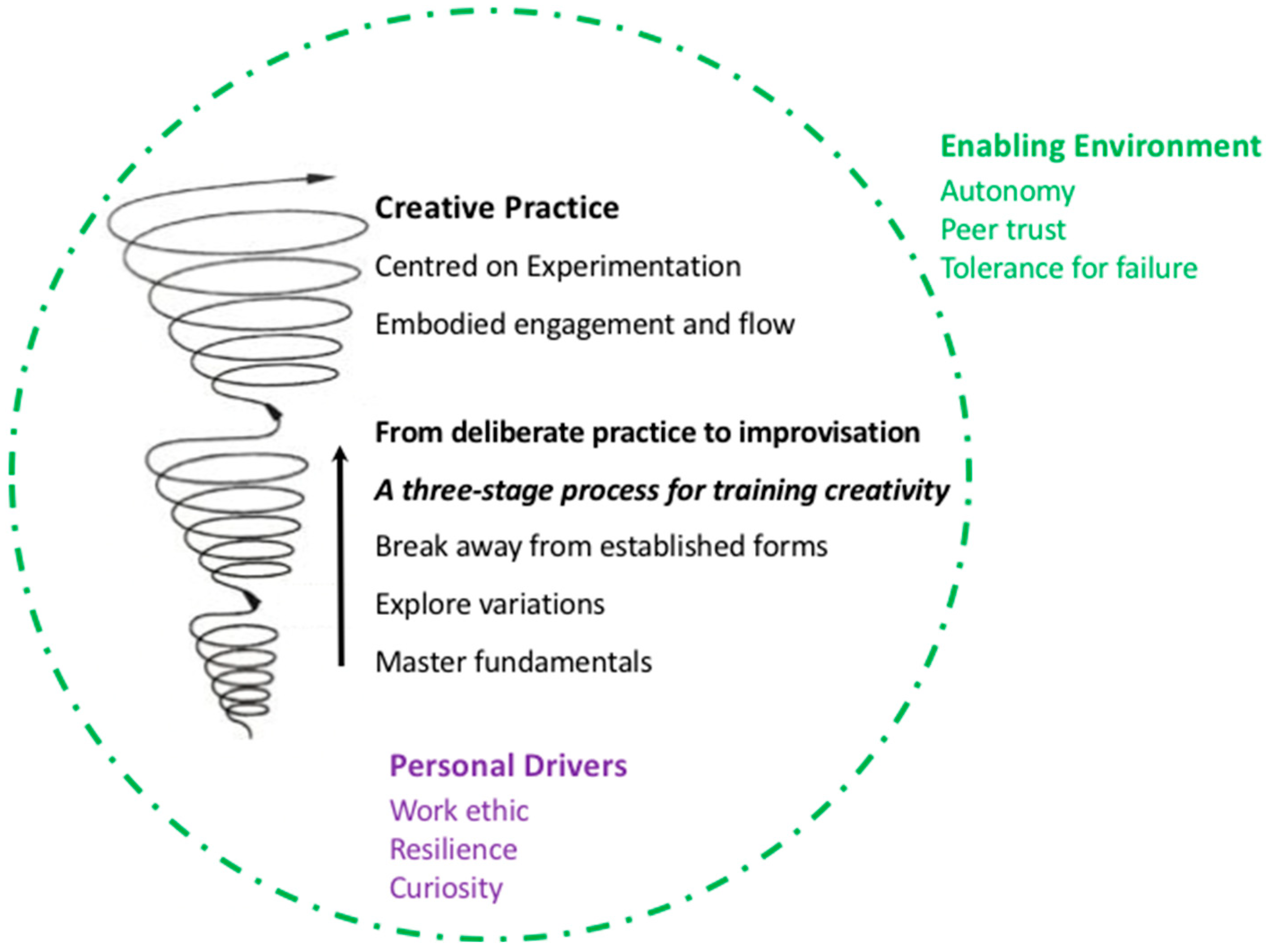
This practice-based model (Figure 10) places experimentation at the centre of creative practice. Experimentation is essential not only for artists and designers but also for scientific researchers and innovators. However, despite its importance, people often resist creative ideas—particularly in uncertain conditions—even when creativity is openly valued (Mueller et al., 2012). In societies or organizations with low tolerance for failure and error, experimentation becomes a high-stakes endeavour, discouraging risk-taking.
Instead of focusing solely on how to generate more creative ideas, academic research should shift toward understanding how individuals, organizations, and institutions can integrate mistakes, failures, and experimentation as fundamental components of the creative practice. By fostering a culture that embraces experimentation, we can create environments where creativity thrives, rather than one where it is constrained by fear of failure.
As illustrated and summarized in Figure 10, the model conceptualizes creativity as a developmental and iterative process in which deliberate practice and experimentation progressively build creative capability. Experimentation serves as the central mechanism through which practitioners move from mastering fundamentals to exploring variations and ultimately breaking away from established forms, while embodied engagement and flow may accompany deep involvement in creative practice. This development is sustained by personal drivers—work ethic, resilience, and curiosity—and enabled by autonomy, peer trust, and tolerance for failure. The dotted green boundary distinguishes the individual domain from the surrounding environment while indicating that the individual remains open to environmental affordances and constraints.

6. Contribution, Limitations, and Implications

Creative artists possess a unique ability to identify and develop ideas, and their first-hand experiences provide valuable insights that can support, refine, and challenge existing creativity models. The introspective approach used in this study contributes to creativity research by offering an alternative, experience-driven perspective that complements theoretical and experimental studies. Gallagher (2003) suggests that insights obtained through introspection can directly inform experimental design, bridging the gap between subjective experience and empirical investigation. This study enriches the literature by shifting the focus from what is already known about creativity to what remains underexplored, thereby opening new avenues for research. Additionally, this introspective report can serve as a foundation for interview-based research, providing a structured guide for exploring the lived experiences of creative individuals—their processes, inspirations, and the conditions that foster creativity.
Critics may argue that the creativity of an artist differs fundamentally from that of an engineer designing a new machine. This study does not assume that creativity takes the same form across disciplines; rather, it proposes that creative capability can be cultivated through disciplined practices of experimentation. Eisner (2004) maintains that the arts are not peripheral to education but are critically important for developing “complex and subtle aspects of the mind.” Artistic practice cultivates forms of thinking suited to ambiguity, uncertainty, qualitative judgement, and multiple possible outcomes, thereby offering an important framework for creativity development beyond the arts. Research in science and mathematics similarly suggests that creativity should be made an explicit educational goal and fostered through imaginative, experimental, and collaborative activities rather than treated as innate or left to develop unaided (Rees & Newton, 2021; Newton et al., 2022). Guo et al.’s (2025) meta-analysis indicated that structured training can cultivate multiple dimensions of creativity among university students, including creative thinking, graphic creativity, verbal creativity, word creativity, emotional creativity, and problem-solving. This finding aligns with a practice-based view in which creative capability develops through guided activities and repeated engagement.
The first author’s Ikebana practice is also not solely a personal pursuit; in performances and commissioned works, she creates for audiences and clients, balancing personal expression with external expectations. While this study presents a personal introspective account, it encourages researchers in other creative domains to apply a similar methodology, capturing insights from diverse fields such as engineering, scientific innovation, and design. Csikszentmihalyi (2001) notes that good ideas begin with an individual, but if they are truly creative, they eventually influence others within the same field.
Strati (2000, p. 54) reflects on the role of artistic research in organizational studies:
“I am aware, in fact, that the experience gained from my artistic research has provided me with a large stock of knowledge about everyday life in organizations. Knowledge of this kind, I believe, has been deliberately neglected by organizational theories and management studies.”
Similarly, this artist-researcher self-reported study aims to spark curiosity and experimentation in creativity research. By embracing both foundational principles and uncharted territories, researchers can uncover innovative solutions and expand the boundaries of knowledge. Integrating introspection with structured experimentation and behavioural observations offers a valuable pathway for future studies, bridging the gap between subjective experience and systematic creativity research.

Author Contributions

Conceptualization, Y.L.; methodology, Y.L.; formal analysis, Y.L.; investigation, Y.L.; resources, Y.L., P.W. and S.R.S.; data curation, Y.L.; writing—original draft preparation, Y.L.; writing—review and editing, Y.L., P.W. and S.R.S.; visualization, Y.L.; supervision, P.W. and S.R.S.; project administration, Y.L. All authors have read and agreed to the published version of the manuscript.

Funding

This research received no external funding.

Data Availability Statement

The introspective data supporting the findings of this study are contained within the article.

Conflicts of Interest

The authors declare no conflicts of interest.

References

  1. Agogué, M., Parguel, B., & Bendas, A. (2024). Do you believe Red Bull gives wings? When implicit theories of creativity impair creative performance. Creativity and Innovation Management, 33(3), 461–475. [Google Scholar] [CrossRef] [Scilit]
  2. Aiken, M., Bacharach, S. B., & French, J. L. (1980). Organizational structure, work process, and proposal making in administrative bureaucracies. Academy of Management Journal, 23(4), 631–652. [Google Scholar] [CrossRef] [Scilit]
  3. Amabile, T. M. (1983). The case for a social psychology of creativity. In The social psychology of creativity (pp. 3–15). Springer. [Google Scholar]
  4. Amabile, T. M. (1988). A model of creativity and innovation in organizations. Research in Organizational Behavior, 10(1), 123–167. [Google Scholar]
  5. Amabile, T. M. (1996). Creativity in context. Westview Press. [Google Scholar]
  6. Amabile, T. M., Barsade, S. G., Mueller, J. S., & Staw, B. M. (2005). Affect and creativity at work. Administrative Science Quarterly, 50(3), 367–403. [Google Scholar] [CrossRef] [Scilit]
  7. Amabile, T. M., Conti, R., Coon, H., Lazenby, J., & Herron, M. (1996). Assessing the work environment for creativity. Academy of Management Journal, 39(5), 1154–1184. [Google Scholar] [CrossRef] [Scilit]
  8. Amabile, T. M., & Pratt, M. G. (2016). The dynamic componential model of creativity and innovation in organizations: Making progress, making meaning. Research in Organizational Behavior, 36, 157–183. [Google Scholar] [CrossRef] [Scilit]
  9. Anderson, L. (2006). Analytic autoethnography. Journal of Contemporary Ethnography, 35(4), 373–395. [Google Scholar] [CrossRef] [Scilit]
  10. Andreasen, N. C., & Glick, I. D. (1988). Bipolar affective disorder and creativity: Implications and clinical management. Comprehensive Psychiatry, 29(3), 207–217. [Google Scholar] [CrossRef] [Scilit] [PubMed]
  11. Bailyn, L. (1985). Autonomy in the industrial R&D lab. Human Resource Management, 24(2), 129–146. [Google Scholar] [CrossRef] [Scilit]
  12. Barron, F. (1963). Creativity and psychological health: Origins of personality and creative freedom. D. Van Nostrand Company. [Google Scholar]
  13. Barron, F., & Harrington, D. M. (1981). Creativity, intelligence, and personality. Annual Review of Psychology, 32, 439–476. [Google Scholar] [CrossRef] [Scilit]
  14. Beaty, R. E. (2015). The neuroscience of musical improvisation. Neuroscience & Biobehavioral Reviews, 51, 108–117. [Google Scholar] [CrossRef] [Scilit] [PubMed]
  15. Berntsen, D. (2009). Involuntary autobiographical memories: An introduction to the unbidden past. Cambridge University Press. [Google Scholar]
  16. Berntsen, D., Staugaard, S. R., & Sørensen, L. M. T. (2013). Why am I remembering this now? Predicting the occurrence of involuntary (spontaneous) episodic memories. Journal of experimental psychology: General, 142(2), 426–444. [Google Scholar] [CrossRef] [Scilit] [PubMed]
  17. Brown, S. (1998). What’s love got to do with it?: Sex, shopping and subjective personal introspection. In S. Brown, B. Clarke, & A. M. Doherty (Eds.), Romancing the market (pp. 135–169). Routledge. [Google Scholar]
  18. Burleson, W., & Selker, T. (2002). Creativity and interface. Communications of the ACM, 45(10), 89–90. [Google Scholar]
  19. Byrne, A. (2005). Introspection. Philosophical Topics, 33(1), 79–104. [Google Scholar]
  20. Conway, M. A., & Pleydell-Pearce, C. W. (2000). The construction of autobiographical memories in the self-memory system. Psychological Review, 107(2), 261–288. [Google Scholar] [CrossRef] [Scilit] [PubMed]
  21. Coste, A., Bardy, B. G., & Marin, L. (2019). Towards an embodied signature of improvisation skills. Frontiers in Psychology, 10, 2441. [Google Scholar] [CrossRef] [Scilit] [PubMed]
  22. Coutu, D. L. (2002). How resilience works. Harvard Business Review, 80(5), 46–55. [Google Scholar] [PubMed]
  23. Cropley, A. J. (1997). Fostering creativity in the classroom: General principles. In M. A. Runco (Ed.), The creativity research handbook (Vol. 1, pp. 84–114). Hampton Press. [Google Scholar]
  24. Csikszentmihalyi, M. (1988). Motivation and creativity: Toward a synthesis of structural and energistic approaches to cognition. New Ideas in Psychology, 6(2), 159–176. [Google Scholar] [CrossRef] [Scilit]
  25. Csikszentmihalyi, M. (1990). The domain of creativity. In M. A. Runco, & R. S. Albert (Eds.), Theories of creativity (pp. 190–212). Sage Publications, Inc. [Google Scholar]
  26. Csikszentmihalyi, M. (1998). Fruitless polarities. Behavioral and Brain Sciences, 21(3), 411. [Google Scholar] [CrossRef] [Scilit]
  27. Csikszentmihalyi, M. (2001). A systems perspective on creativity. Creative Management, 11–26. [Google Scholar]
  28. Csikszentmihalyi, M., & Sawyer, K. (2014). Shifting the focus from individual to organizational creativity. In The systems model of creativity (pp. 67–71). Springer. [Google Scholar]
  29. Cummings, A., & Oldham, G. R. (1997). Enhancing creativity: Managing work contexts for the high potential employee. California Management Review, 40(1), 22–38. [Google Scholar] [CrossRef] [Scilit]
  30. Dearani, J. A., Gold, M., Leibovich, B. C., Ericsson, K. A., Khabbaz, K. R., Foley, T. A., Julsrud, P. R., Matsumoto, J. M., & Daly, R. C. (2017). The role of imaging, deliberate practice, structure, and improvisation in approaching surgical perfection. The Journal of Thoracic and Cardiovascular Surgery, 154(4), 1329–1336. [Google Scholar] [CrossRef] [Scilit] [PubMed]
  31. Dunbar, K. (1997). How scientists think: On-line creativity and conceptual change in science. In T. B. Ward, S. M. Smith, & J. Vaid (Eds.), Creative thought: An investigation of conceptual structures and processes (pp. 461–493). American Psychological Association. [Google Scholar]
  32. Eisner, E. W. (2004). The arts and the creation of mind. Yale University Press. [Google Scholar]
  33. Ellis, C. (1991). Sociological introspection and emotional experience. Symbolic Interaction, 14(1), 23–50. [Google Scholar] [CrossRef] [Scilit]
  34. Ellis, C. (1992). Investigating subjectivity: Research on lived experience (Vol. 139). Sage. [Google Scholar]
  35. Ellis, C. (2016). Revision: Autoethnographic reflections on life and work. Routledge. [Google Scholar]
  36. Ellis, C., Adams, T. E., & Bochner, A. P. (2011). Autoethnography: An overview. Historical Social Research/Historische Sozialforschung, 36(4), 273–290. [Google Scholar] [CrossRef]
  37. Ericsson, K. A., & Charness, N. (1994). Expert performance: Its structure and acquisition. American Psychologist, 49(8), 725–747. [Google Scholar] [CrossRef]
  38. Ericsson, K. A., Krampe, R. T., & Tesch-Römer, C. (1993). The role of deliberate practice in the acquisition of expert performance. Psychological Review, 100(3), 363–406. [Google Scholar] [CrossRef]
  39. Ericsson, K. A., Roring, R. W., & Nandagopal, K. (2007). Giftedness and evidence for reproducibly superior performance: An account based on the expert performance framework. High Ability Studies, 18(1), 3–56. [Google Scholar] [CrossRef] [Scilit]
  40. Eysenck, H. J. (1993). Creativity and personality: Suggestions for a theory. Psychological Inquiry, 4(3), 147–178. [Google Scholar] [CrossRef] [Scilit] [PubMed]
  41. Feldman, D. H., Csikszentmihalyi, M., & Gardner, H. (1994). Changing the world: A framework for the study of creativity. Praeger. [Google Scholar]
  42. Fisher, C. M., & Barrett, F. J. (2019). The experience of improvising in organizations: A creative process perspective. Academy of Management Perspectives, 33(2), 148–162. [Google Scholar] [CrossRef] [Scilit]
  43. Frith, E., Miller, S., & Loprinzi, P. D. (2020). A review of experimental research on embodied creativity: Revisiting the mind–body connection. The Journal of Creative Behavior, 54(4), 767–798. [Google Scholar] [CrossRef] [Scilit]
  44. Frow, P., Nenonen, S., Payne, A., & Storbacka, K. (2015). Managing co-creation design: A strategic approach to innovation. British Journal of Management, 26(3), 463–483. [Google Scholar] [CrossRef] [Scilit]
  45. Gallagher, S. (2003). Phenomenology and experimental design toward a phenomenologically enlightened experimental science. Journal of Consciousness Studies, 10(9–10), 85–99. [Google Scholar]
  46. Ghiselin, B. (1963). Automatism, intention, and autonomy in the novelist’s production. Daedalus, 92(2), 297–311. [Google Scholar]
  47. Glăveanu, V. P. (2013). Rewriting the language of creativity: The Five A’s framework. Review of General Psychology, 17(1), 69–81. [Google Scholar] [CrossRef] [Scilit]
  48. Glăveanu, V. P., & Beghetto, R. A. (2021). Creative experience: A non-standard definition of creativity. Creativity Research Journal, 33(2), 75–80. [Google Scholar] [CrossRef] [Scilit]
  49. Gould, S. J. (1995). Researcher introspection as a method in consumer research: Applications, issues, and implications. Journal of Consumer Research, 21(4), 719–722. [Google Scholar] [CrossRef] [Scilit]
  50. Gould, S. J. (2011). The emergence of consumer introspection theory (CIT): Introduction to a JBR special issue. Journal of Business Research, 65(4), 453–460. [Google Scholar] [CrossRef] [Scilit]
  51. Greenberg, E. (1992). Creativity, autonomy, and evaluation of creative work: Artistic workers in organizations. The Journal of Creative Behavior, 26(2), 75–80. [Google Scholar] [CrossRef] [Scilit]
  52. Griffith, A. (2021). Embodied creativity in the fine and performing arts. Journal of Creativity, 31, 100010. [Google Scholar] [CrossRef] [Scilit]
  53. Guastello, S. J. (1998). Creative problem solving groups at the edge of chaos. The Journal of Creative Behavior, 32(1), 38–57. [Google Scholar] [CrossRef] [Scilit]
  54. Guilford, J. P. (1950). Creativity. American Psychologist, 5(9), 444–454. [Google Scholar] [CrossRef] [Scilit] [PubMed]
  55. Guilford, J. P. (1967). The nature of human intelligence. McGraw-Hill. [Google Scholar]
  56. Guo, H., Zhou, Z., & Ma, F. (2025). Effect of training programs on the creativity of university students: A multi-level meta-analysis. Thinking Skills and Creativity, 56, 101779. [Google Scholar] [CrossRef] [Scilit]
  57. Harrington, D. M. (1990). The ecology of human creativity: A psychological perspective. In M. A. Runco, & R. S. Albert (Eds.), Theories of creativity (pp. 143–169). Sage Publications. [Google Scholar]
  58. Hayes, J. R. (1989). Cognitive processes in creativity. In J. A. Glover, R. R. Ronning, & C. R. Reynolds (Eds.), Handbook of creativity (pp. 135–145). Springer. [Google Scholar]
  59. Hochschild, A. R. (2015). The managed heart. In Working in America (pp. 29–36). Routledge. [Google Scholar]
  60. Holbrook, M. B. (1986). Aims, concepts, and methods for the representation of individual differences in esthetic responses to design features. Journal of Consumer Research, 13(3), 337–347. [Google Scholar] [CrossRef] [Scilit]
  61. Holbrook, M. B. (1987). What is consumer research? Journal of Consumer Research, 14(1), 128–132. [Google Scholar] [CrossRef] [Scilit] [PubMed]
  62. Humphreys, M. (2005). Getting personal: Reflexivity and autoethnographic vignettes. Qualitative Inquiry, 11(6), 840–860. [Google Scholar] [CrossRef] [Scilit]
  63. Ivcevic, Z., & Brackett, M. A. (2015). Predicting creativity: Interactive effects of openness to experience and emotion regulation ability. Psychology of Aesthetics, Creativity, and the Arts, 9(4), 480–487. [Google Scholar] [CrossRef] [Scilit]
  64. Jacoby, L. L. (1983). Perceptual enhancement: Persistent effects of an experience. Journal of Experimental Psychology: Learning, Memory, and Cognition, 9(1), 21–38. [Google Scholar] [CrossRef] [PubMed]
  65. James, W. (1890). The principles of psychology (Vol. 1). Henry Holt and Company. [Google Scholar]
  66. Joas, H. (1994). The creativity of action: Pragmatism and the critique of the rational action model. In I. Carlgren, G. Handal, & S. Vaage (Eds.), Teachers’ minds and actions: Research on teachers’ thinking and practice (pp. 62–73). Routledge. [Google Scholar]
  67. Johansen, G. G. (2016). To practise improvisation. A qualitative study of practice activity among jazz students, with a particular focus on the development of improvisation competence. Arts and Humanities in Higher Education, 15(3–4), 347–365. [Google Scholar]
  68. Karkockiene, D. (2005). Creativity: Can it be trained? A scientific educology of creativity. International Journal of Educology, 51–58. [Google Scholar]
  69. Kelley, T., & Kelley, D. (2012). Reclaim your creative confidence. Harvard Business Review, 90(12), 115–118. [Google Scholar] [PubMed]
  70. Koren, L. (1994). Wabi-sabi for artists, designers, poets & philosophers. Stone Bridge Press. [Google Scholar]
  71. Leclair, M. (2023). The atmospherics of creativity: Affective and spatial materiality in a designer’s studio. Organization Studies, 44(5), 807–829. [Google Scholar] [CrossRef] [Scilit]
  72. Leung, A. K.-y., Kim, S., Polman, E., Ong, L. S., Qiu, L., Goncalo, J. A., & Sanchez-Burks, J. (2012). Embodied metaphors and creative “acts”. Psychological Science, 23(5), 502–509. [Google Scholar] [CrossRef] [Scilit] [PubMed]
  73. Lou, S.-J., Chung, C.-C., Dzan, W.-Y., & Shih, R.-C. (2012). Construction of a creative instructional design model using blended, project-based learning for college students. Creative Education, 3(7), 1281–1290. [Google Scholar]
  74. Makel, M. C., & Plucker, J. A. (2008). Creativity. In S. I. Pfeiffer (Ed.), Handbook of giftedness in children: Psychoeducational theory, research, and best practices (pp. 247–270). Springer. [Google Scholar] [CrossRef] [Scilit]
  75. Malinin, L. H. (2019). How radical is embodied creativity? Implications of 4E approaches for creativity research and teaching. Frontiers in Psychology, 10, 2372. [Google Scholar] [CrossRef] [Scilit] [PubMed]
  76. Maslow, A. H. (1962). Creativity in self-actualizing people. In Toward a psychology of being (pp. 127–137). D Van Nostrand. [Google Scholar] [CrossRef] [Scilit]
  77. Matthews, G. (1986). The interactive effects of extraversion and arousal on performance: Are creativity tests anomalous? Personality and Individual Differences, 7(6), 751–761. [Google Scholar] [CrossRef] [Scilit]
  78. Mayer, R. E. (2013). Designing instruction for constructivist learning. In Instructional-design theories and models (pp. 141–159). Routledge. [Google Scholar]
  79. McMahon, J., Zehntner, C., & McGannon, K. R. (2017). Fleshy, female and forty: A docudrama of a former elite swimmer who re-immersed herself into elite swimming culture. Qualitative Research in Sport, Exercise and Health, 9(5), 546–553. [Google Scholar] [CrossRef] [Scilit]
  80. Mueller, J. S., Melwani, S., & Goncalo, J. A. (2012). The bias against creativity: Why people desire but reject creative ideas. Psychological Science, 23(1), 13–17. [Google Scholar] [CrossRef] [Scilit] [PubMed]
  81. Mumford, M. D., & Gustafson, S. B. (1988). Creativity syndrome: Integration, application, and innovation. Psychological Bulletin, 103(1), 27–43. [Google Scholar] [CrossRef]
  82. Newton, D. P., Wang, Y., & Newton, L. (2022). ‘Allowing them to dream’: Fostering creativity in mathematics undergraduates. Journal of Further and Higher Education, 46(10), 1334–1346. [Google Scholar] [CrossRef] [Scilit]
  83. Oldham, G. R., & Cummings, A. (1996). Employee creativity: Personal and contextual factors at work. Academy of Management Journal, 39(3), 607–634. [Google Scholar] [CrossRef] [Scilit]
  84. Oleynick, V. C., Thrash, T. M., LeFew, M. C., Moldovan, E. G., & Kieffaber, P. D. (2014). The scientific study of inspiration in the creative process: Challenges and opportunities. Frontiers in Human Neuroscience, 8, 436. [Google Scholar] [CrossRef] [Scilit] [PubMed]
  85. Overgaard, M. (2008). Introspection. Scholarpedia, 3(5), 4953. [Google Scholar]
  86. Passarotto, E., Preckel, F., Schneider, M., & Müllensiefen, D. (2022). Deliberate practice in music: Development and psychometric validation of a standardized measurement instrument. Psychology of Music, 50(5), 1637–1655. [Google Scholar] [CrossRef] [Scilit]
  87. Pelz, D. C., & Andrews, F. M. (1966). Scientists in organizations: Productive climates for research and development. John Wiley. [Google Scholar]
  88. Pressing, J. (2007). Improvisation: Methods and models. In Physical theatres: A critical reader (pp. 66–78). Routledge. [Google Scholar]
  89. Redmond, M. R., Mumford, M. D., & Teach, R. (1993). Putting creativity to work: Effects of leader behavior on subordinate creativity. Organizational Behavior and Human Decision Processes, 55(1), 120–151. [Google Scholar] [CrossRef] [Scilit]
  90. Rees, S. W., & Newton, D. P. (2021). The creative sciences. School Science Review, 382, 57–62. Available online: https://www.ase.org.uk/resources/school-science-review/issue-382/creative-sciences (accessed on 15 July 2026).
  91. Renzulli, J. S. (1978). What makes giftedness? Reexamining a definition. Phi Delta Kappan, 60(3), 180–184, 261. [Google Scholar]
  92. Richards, M. C. (1996). Opening our moral eye. SteinerBooks. [Google Scholar]
  93. Rogers, C. R. (1954). Toward a theory of creativity. ETC: A Review of General Semantics, 11(4), 249–260. [Google Scholar]
  94. Runco, M. A., & Sakamoto, S. O. (1998). Experimental studies of creativity. In R. J. Sternberg (Ed.), Handbook of creativity (pp. 62–92). Cambridge University Press. [Google Scholar]
  95. Russ, S. W. (2013). Affect and creativity: The role of affect and play in the creative process. Routledge. [Google Scholar]
  96. Scott, G., Leritz, L., & Mumford, M. (2004). The effectiveness of creativity training: A quantitative review. Creativity Research Journal, 16(4), 361–388. [Google Scholar] [CrossRef] [Scilit]
  97. Sharma, S. C. (1986). Creativity and mental health training. Indian Journal of Behaviour, 10(3), 11–16. [Google Scholar]
  98. Simonton, D. K. (2000). Creativity: Cognitive, personal, developmental, and social aspects. American Psychologist, 55(1), 151–158. [Google Scholar] [CrossRef] [PubMed]
  99. Simonton, D. K. (2012). Taking the U.S. Patent Office criteria seriously: A quantitative three-criterion creativity definition and its implications. Creativity Research Journal, 24(2–3), 97–106. [Google Scholar] [CrossRef] [Scilit]
  100. Sloman, S. A. (1996). The empirical case for two systems of reasoning. Psychological Bulletin, 119(1), 3–22. [Google Scholar] [CrossRef]
  101. Smarthistory. (n.d.). Bada Shanren, Lotus and Ducks. Available online: https://smarthistory.org/bada-shanren-lotus-and-ducks/ (accessed on 15 October 2021).
  102. Smith, E. R., & DeCoster, J. (1999). Associative and rule-based processing: A connectionist interpretation of dual-process models. In S. Chaiken, & Y. Trope (Eds.), Dual-process theories in social psychology (pp. 323–336). The Guilford Press. [Google Scholar]
  103. Sogetsu Foundation. (n.d.). Sofu Teshigahara. Available online: https://www.sogetsu.or.jp/about/iemoto/sohu/ (accessed on 15 October 2021).
  104. Spradley, J. P. (1980). Participant observation. Harcourt Brace Jovanovich College Publishers. [Google Scholar]
  105. Stanciu, M. M. (2015). Embodied creativity: A critical analysis of an underdeveloped subject. Procedia-Social and Behavioral Sciences, 187, 312–317. [Google Scholar] [CrossRef] [Scilit]
  106. Staugaard, S. R., & Berntsen, D. (2014). Involuntary memories of emotional scenes: The effects of cue discriminability and emotion over time. Journal of Experimental Psychology: General, 143(5), 1939–1957. [Google Scholar] [CrossRef] [Scilit] [PubMed]
  107. Sternberg, R. J. (1988). A three-facet model of creativity. In R. J. Sternberg (Ed.), The nature of creativity (pp. 125–147). Cambridge University Press. [Google Scholar]
  108. Sternberg, R. J., & Lubart, T. I. (1991). An investment theory of creativity and its development. Human Development, 34(1), 1–31. [Google Scholar] [CrossRef] [Scilit]
  109. Sternberg, R. J., & Lubart, T. I. (1995). Defying the crowd: Cultivating creativity in a culture of conformity. Free Press. [Google Scholar]
  110. Strati, A. (2000). Theory and method in organization studies: Paradigms and choices. Sage. [Google Scholar]
  111. Strati, A. (2020). Art and organizing: A brief personal reflection. In Aesthetics, organization, and humanistic management (pp. 11–21). Routledge. [Google Scholar]
  112. Thompson, N. A. (2018). Imagination and creativity in organizations. Organization Studies, 39(2–3), 229–250. [Google Scholar] [CrossRef] [Scilit]
  113. van Marrewijk, A. (2010). The beauty and the beast: The embodied experience of two corporate buildings. In A. van Marrewijk, & D. Yanow (Eds.), Organizational spaces: Rematerializing the workaday world (pp. 96–114). Edward Elgar. [Google Scholar]
  114. Wall, T. D., Cordery, J. L., & Clegg, C. W. (2002). Empowerment, performance, and operational uncertainty: A theoretical integration. Applied Psychology, 51(1), 146–169. [Google Scholar] [CrossRef] [Scilit]
  115. Wallace, B. (1986). Creativity: Some definitions: The creative personality; the creative process; the creative classroom. Gifted Education International, 4(2), 68–73. [Google Scholar] [CrossRef] [Scilit]
  116. Wallendorf, M., & Brucks, M. (1993). Introspection in consumer research: Implementation and implications. Journal of Consumer Research, 20(3), 339–359. [Google Scholar] [CrossRef] [Scilit] [PubMed]
  117. Wang, X., He, Y., Lu, K., Deng, C., Qiao, X., & Hao, N. (2019). How does the embodied metaphor affect creative thinking? NeuroImage, 202, 116114. [Google Scholar] [CrossRef] [Scilit] [PubMed]
  118. Watts, L. L., McIntosh, T. J., Gibson, C., Mulhearn, T. J., Medeiros, K. E., Mecca, J. T., & Cohen-Charash, Y. (2020). Mild affective shifts and creativity: Effects on idea generation, evaluation, and implementation planning. The Journal of Creative Behavior, 54(4), 985–1001. [Google Scholar] [CrossRef] [Scilit]
  119. Woodman, R. W. (1981). Creativity as a construct in personality theory. Journal of Creative Behavior, 15(1), 43–66. [Google Scholar] [CrossRef] [Scilit]
  120. Woodman, R. W., Sawyer, J. E., & Griffin, R. W. (1993). Toward a theory of organizational creativity. The Academy of Management Review, 18(2), 293–321. [Google Scholar] [CrossRef] [Scilit]
  121. Woodman, R. W., & Schoenfeldt, L. F. (1989). Individual differences in creativity. In J. A. Glover, R. R. Ronning, & C. R. Reynolds (Eds.), Handbook of creativity (pp. 77–91). Springer. [Google Scholar]
  122. Woodman, R. W., & Schoenfeldt, L. F. (1990). An interactionist model of creative behavior. The Journal of Creative Behavior, 24(1), 10–20. [Google Scholar] [CrossRef] [Scilit]
  123. Wundt, W. (1880). Logik: Eine untersuchung der principien der erkenntniss und der methoden wissenschaftlicher forschung (Vol. 1). Enke. [Google Scholar]
  124. Xie, H., Beaty, R. E., Jahanikia, S., Geniesse, C., Sonalkar, N. S., & Saggar, M. (2021). Spontaneous and deliberate modes of creativity: Multitask eigen-connectivity analysis captures latent cognitive modes during creative thinking. NeuroImage, 243, 118531. [Google Scholar] [CrossRef] [Scilit] [PubMed]
  125. Yang, T., & Wu, G. (2022). Spontaneous or deliberate: The dual influence of mind wandering on creative incubation. The Journal of Creative Behavior, 56(4), 584–600. [Google Scholar] [CrossRef] [Scilit]
  126. Zhou, J., & Su, Y. (2010). A missing piece of the puzzle: The organizational context in cultural patterns of creativity. Management and Organization Review, 6(3), 391–413. [Google Scholar] [CrossRef] [Scilit]
Figure 1. Lotus and Ducks by Bada Shanren, c. 1696, Qing Dynasty, ink on paper. Freer Gallery of Art, Smithsonian’s National Museum of Asian Art, F1998.45.
Education 16 01311 g001
Figure 2. Wabi-sabi style Ikebana created at Jiemo Gallery and photographed by Dino. (a) Restrained use of materials. (b) Withering leaves emphasize the natural ageing process of plants.
Education 16 01311 g002
Figure 3. Ikebana demonstration—cutting leaves until only three remain: (a) before cutting; (b) after cutting.
Education 16 01311 g003
Figure 4. Emotions experienced during the process of creating Ikebana at Jiemo Gallery.
Education 16 01311 g004
Figure 5. Teshigahara Sofu (1900–1979), founder of Sogetsu, dubbed the “Picasso in the world of Ikebana” by Time magazine. Images retrieved from Sogetsu Foundation (n.d.).
Education 16 01311 g005
Figure 6. Examples of Teshigahara Sofu’s “living sculpture of Ikebana”: (a) Two Birds (1951); (b) Torikami (1966). Images retrieved from Sogetsu Foundation (n.d.).
Education 16 01311 g006
Figure 7. The artist’s Ikebana style—characterized by Zen aesthetics and the Spirit of Chinese Painting. Pottery by Shingo Takeuchi, exhibited at Jiemo Gallery.
Education 16 01311 g007
Figure 8. Creating something new. (a) Teacher’s demonstration work expressing movement—Fly. (b) My work created during the Flowerless Ikebana course.
Education 16 01311 g008
Figure 9. Collaboration at Jiemo Gallery: (a) working with a potter and a photographer. (b) The gallery environment.
Education 16 01311 g009
Figure 10. A practice-based model for training creativity. The spiral represents the iterative movement from mastering fundamentals to exploring variations and ultimately breaking away from established forms, with experimentation at the centre of creative practice. The dotted green boundary distinguishes the individual domain from the enabling environment while indicating openness to environmental influence.
Education 16 01311 g010
Disclaimer/Publisher’s Note: The statements, opinions and data contained in all publications are solely those of the individual author(s) and contributor(s) and not of MDPI and/or the editor(s). MDPI and/or the editor(s) disclaim responsibility for any injury to people or property resulting from any ideas, methods, instructions or products referred to in the content.